

Another Way for week of August 4, 2023
The Day I was Called to the Principal’s Office
Were you ever called to the principal’s office?
Don Augsburger, the pastor who baptized me, also served as my principal at Bethany Christian High School a few years. So you can guess I was terribly chagrined when he had to call me into the principal’s office one day.
That only happened once. I was 16 and hormones were buzzing and Don got a call or message from the local hang out (restaurant right across from the school), that my boyfriend at the time had been seen with his hand on my leg under the table.

Don himself was embarrassed to have to call me in for such a thing, but we both got over it. I think he felt the owner was overly worried about students’ behavior sometimes, and Don kind of dismissed me with a half-smile knowing that I was as mortified as he was that particular day.

You see, my dad served as Don’s deacon at church, and according to Don, he became a very beloved deacon for Don. Especially because Dad talked Don into wearing a bowtie with a regular suit jacket instead of the plain-collared Mennonite suit he had been accustomed to wearing at other churches he had served. Somehow the bowtie was less “fancy” I guess than a necktie.

Don died last fall and I’m amazed at how many intersections his life had with my own, from an early age. I’ve been wanting to add my tribute regarding Don but we’ve lost so many beloved friends and family in recent years that I’ve written about, and I don’t want this column to morph into an “obituary” column. But I wanted to share a little about this pastor, friend, principal, and seminary professor.
Don loved memorizing poems, including very long ones, and he could recall and recite them well into his 90s. In fact, one of his favorite poems, because of the power and the truths it conveys, deals with the “Death” angel being called to God’s throne who promptly sent Death to earth to bring back to heaven an older and tired woman who was very ready. The poem is titled “Go Down, Death.”
The family asked a skilled actor and poet, Helen Stoltzfus, to recite the poem at Don’s memorial service, who I knew from one of my college writing classes. Helen did not memorize the poem as Don had done over many years, but she read James Weldon Johnson’s long and powerful elegy with rich vigor and authority, accompanied by a pianist for background music. I think many in the audience felt like we were there by the side of one of our own loved ones, passing on to the afterlife: a better life, spent in eternity with God and Jesus.
Don’s brother, David Augsburger, a well-known writer, radio speaker and preacher, spoke at the funeral, reminding us that Don had prepared for his day of being taken to eternity. He checked his priorities every day, like the wise bridesmaids in the Biblical parable commonly called the “Ten Virgins,” five of whom missed a wedding because they had not brought enough oil to last through the wait for the groom to arrive. Dave said Don regularly “checked the oil” regarding his faith, so that he would be ready when the day came to be called to heaven. This meant spending ample time in prayer every day, reading the Bible, doing what he could to share and reach out to others, and focusing on God’s abiding love for us.
As I listened to this commanding poem at his memorial service, I knew that all of us will be one day called to the afterlife, and the wise ones are the those who have prepared by making sure they have followed in the footsteps of Jesus given to us in the Bible.
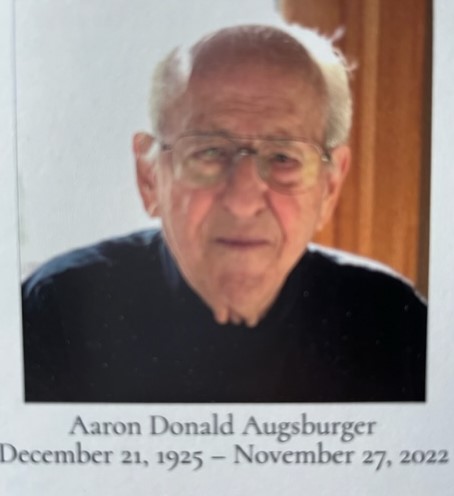
Don was a mentor in many ways—back in my high school days, instruction classes when I was preparing to be baptized as a young teenager, his preaching and leadership over 96 years, his mind and brain so very active, and a beautiful blessing for others. May we all follow his lead.
***
So, well: Were you ever called to the principal’s office? For good or bad?
Confession is good for the soul: comments and confessions here!
Share here or at Another Way, P.O. Box 363, Singers Glen, VA 22834, or email anotherwaymedia@yahoo.com.
Another Way is a column by Melodie Davis, in syndication since 1987. She is the author of ten books, most recently Memoir of an Unimagined Career. Another Way columns are posted at FindingHarmonyBlog.com a week after newspaper publication.
Another Way for week of July 28, 2023
The Day I Sat in Rosa Park’s Seat
One of the places we visited on a recent trip to Michigan was the Henry Ford Museum in Detroit. I had been there as a 5th grader at Middlebury Elementary School in northern Indiana, and I remember being super excited for my first chartered bus trip. The only things I remembered from the trip were Model T Fords, a large train locomotive, and making a short hop into the city of Windsor, Canada which is just across the border from Detroit.
Slow forward about 60 years and I was eager to finally introduce my husband to the Ford Museum filled with so many interesting antiques, historical cars, and old trains (which he loves), and the histories of early airplanes. In 60 years, the displays had been enhanced, changed, grown and updated as one might expect.
As we strolled through interesting artifacts, we happened upon the bus that Rosa Parks was riding the day she was arrested for refusing to give up her seat in a Montgomery, Alabama bus, in the days when segregation was the rule. She worked downtown as a seamstress and was likely tired when the bus driver asked her to leave her seat so white folks could sit there. She refused and was thus arrested.
A guide for a small tour group was sharing stories from that era when we joined it and boarded the bus. My husband and I quickly sat down on a bench so we wouldn’t distract the other tourists from the guide’s input.
Then she paused for comments or questions. I piped up and asked, “What seat had Rosa been sitting on?”
The guide’s serious face changed to a friendly smile and said, “You are sitting where she sat.” I gulped. How fascinating.

But as we heard more explanation and stories, my excited feeling changed to empathy for the courageous but peaceful boycott that Rosa and others launched: a movement to end segregation in the Montgomery bus system. After a year of boycotting, the issue was taken up by the Supreme Court which declared laws segregating buses unconstitutional.
The history of how the museum landed this meaningful artifact was fascinating, including years where a farmer had bought and used it for storing lumber and tools. When museums (including the Smithsonian) became interested in obtaining and restoring it because of the bus’s history, careful research into its past was made. “This is the bonafide bus, right down to its number, even though it has been repainted and all cleaned up,” said the guide.
The guide at the museum stressed how Rosa Parks and her cohorts were able to keep the bus boycott free of violence, and that was not an easy task.
This experience was more than I expected out of our visit. I began to feel nudged to do more in the area of helping our communities, churches, and schools do more to end the racism that corrodes our whole nation. Fittingly, my small group at church is currently studying a newish book titled Necessary Risks: Challenges Privileged People Need to Face, by Teri McDowell Ott (Fortress Press). While I squirm at the adjective “privileged” here, I know that I don’t have to deal daily with the ramifications of my skin color and history. I can go whole days and weeks without really digging into the disadvantages and dangers faced by many people of color.
I write a lot about my father who believed strongly we need to love all people, regardless of race or nationality. We moved to the deep south before my senior year of high school (1969) where I experienced how far our country had to go in abolishing racism. We have come a long way but as already noted, there is much to be done. Praying for change, courage, and spreading love.
Read more about the Rosa Park bus here:
More info on the successful bus boycott here:
Or read a friend’s experiences on a recent Civil Rights learning tour in the deep south (7 posts):
***
Comments? Questions? Your own thoughts or stories? Share here or write to me at Another Way, P.O. Box 363, Singers Glen, VA 22834, or email anotherwaymedia@yahoo.com.
Another Way is a column by Melodie Davis, in syndication since 1987. She is the author of ten books, most recently Memoir of an Unimagined Career. Another Way columns are posted at FindingHarmonyBlog.com a week after newspaper publication.
Another Way for week of July 21, 2023
When We Had Orange Pineapple Ice Cream for Breakfast
Ask any of my siblings for one of their memorable vacation stories and at least one of them will come up with the story of being forced to eat Orange Pineapple Ice Cream for breakfast.

Now, I know that doesn’t sound so terrible and many kids would be excited to have ice cream for breakfast but on this particular trip to Niagara Falls our family found a small local motel which housed each of their visitors in small separate cabins which they called “huts.” Hagar’s Homey Huts to be exact. The “huts” were very cute and self-sufficient. With a refrigerator of some kind, this was long before anyone had microwaves and such in their motel or hotel rooms.

On a vacation, Mom and Dad usually visited a nearby grocery store to buy simple-to-make sandwiches, fruit, and maybe some veggies, chips and dessert of some kind. On this particular trip Dad saw Orange Pineapple Ice Cream in the store’s freezer department and thought it would be a wonderful treat. He had enjoyed it in times past and wanted to introduce us to it.
I’m sure we all enjoyed it for our dessert that night before we went to bed.
However, in the morning, there was still Orange Pineapple Ice Cream in the freezer and Dad wasn’t about to throw it out and so pushed it for breakfast. I don’t remember what else we had. I think it didn’t taste quite so good for breakfast, if my memory serves, because we all remember Dad making us eat the ice cream, even if it kind of turned our tummies at that hour of the morning.
Well, my husband and I just returned from a nice summer trip to northern Michigan and enjoyed a range of hotels: some were great, some just so so, but most of them had free breakfasts (well, at least the price of your breakfast was paid for by your room price, right?). One place kind of apologized for just serving coffee and small blueberry muffins, but hey, it was a breakfast.
Our last hotel was a very very nice one at a higher price bracket. Quite lovely. If Deep South comedian Jerry Clower were still alive he would have called it a “ritzy ditzy shore’ e’nuff fancy do-dad hotel.”
It had a sparkling breakfast area but with a big difference: no free breakfast! Our opinion of that place soon rocketed to the bottom. You had to PAY for food (free coffee), but I’m talking $12.95 or more for a breakfast dish. Times two of us. Plus tax and tip.
Yeah, it was a little stiffer than we wanted to pay for two breakfast plates so I began to comb through the food items I still had in our cooler and bags. I found some leftover pizza slices, an apple we could share, and chocolate chip cookies. There were other odds and ends we could have found and of course we could make “free” coffee in our hotel room, but it certainly brought to mind the Hagar Homey Hut breakfast of my childhood.
What memories or stories does this trigger for you?
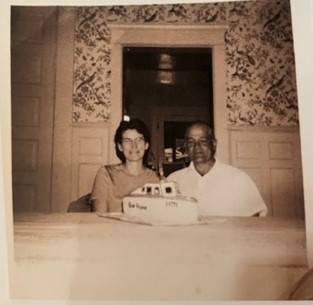
My parents gave me the travel bug and thankfully, my husband enjoys traveling too, so the state of Michigan was mostly our destination this trip. He had never been to the northern parts. While we live in the beautiful Shenandoah Valley, I can’t help but envy Michiganders who enjoy lakes, rivers, and three of the “Great Lakes” we all learned about in geography: Lake Michigan, Lake Huron and Lake Superior all touch its borders. Boundless miles of natural forests met us over many miles. But the other thing I enjoyed a lot were the beautiful flowers at many homes in some of the resort towns. Growing and sharing flowers is something many of us enjoy at our own homes.
But don’t buy orange pineapple ice cream and ask me to eat it for breakfast.
***
What is your favorite place to travel to? If you could travel anywhere you wanted, where would that be?
Share your story, travel nightmares, or future dreams by commenting here or by mail at Another Way, P.O. Box 363, Singers Glen, VA 22834, or email anotherwaymedia@yahoo.com.
Another Way is a column by Melodie Davis, in syndication since 1987. She is the author of ten books, most recently Memoir of an Unimagined Career. Another Way columns are posted at FindingHarmonyBlog.com a week after newspaper publication.
Another Way for week of July 14, 2023
Three Women Who Made a Dent in Changing Food Habits
Thirty years after the end of World War II, a Mennonite woman launched a cookbook, More-with-Less, which went on to sell nearly two million copies (so far). She had a lot of help with it but the idea for it came from her head and heart. (See below for a drawing or a free sampler from the More-with-Less cookbook, as long as supplies last.)
The author and organizer of this significant cookbook, Doris Janzen Longacre, was a young mother who had spent time as a church relief worker in Vietnam and Indonesia through Mennonite Central Committee (MCC). One evening her family and another which had also served overseas as volunteers with MCC, gathered to share an evening meal and their conversation turned to global hunger. They discussed how MCC had asked churches to examine their own food habits and challenged them to eat and spend 10 percent less. That led to Doris’ brainchild for a recipe book reminding cooks and others that “how we cook can change the world.”
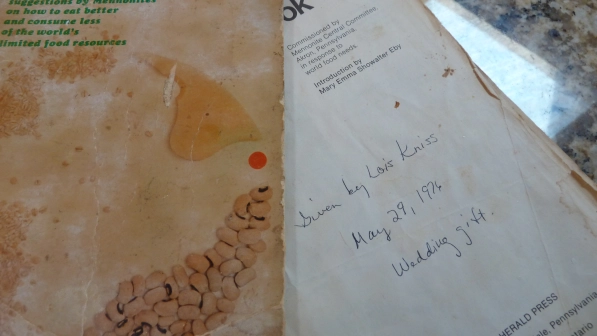
I received Doris’s cookbook as a wedding gift, the year the book was launched. Doris was about 11 years older than me and just 39 when she unfortunately succumbed to cancer.
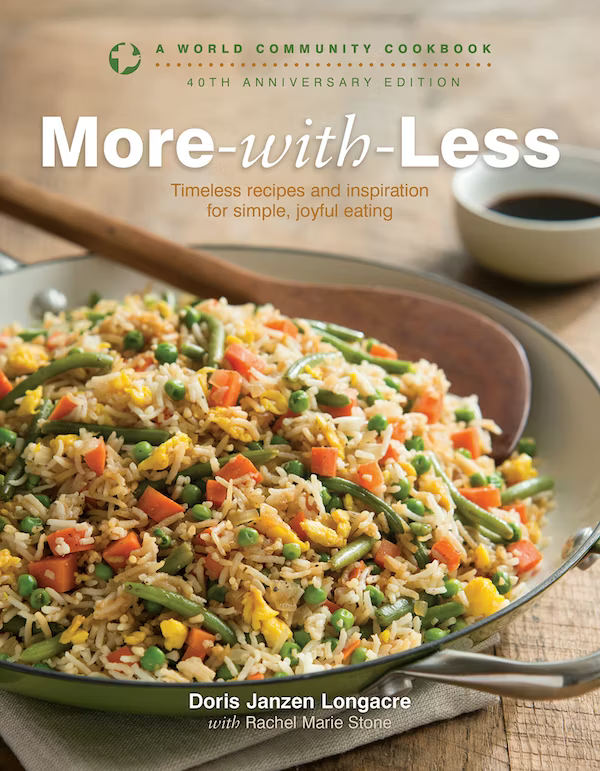
Forty years later, the publishers of More-with-Less cookbook updated and relaunched that cookbook with major revisions, a project spearheaded by Rachel Marie Stone. Rachel is an award-winning food writer who researched and shared the story of how this classic got started, around a picnic table. At first, the eventual publisher of this cookbook was reluctant to publish a cookbook that “didn’t have a cake on the front” and feared it would not sell enough to break even.
I liked this quote from Stone: “Decades later, Doris’s wisdom is still relevant. She championed simple food, well-prepared from whole, fresh, quality ingredients and eaten with gratitude.” I was excited to help relaunch that cookbook in 2016 as a managing editor for Herald Press.
More recently, I discovered an essay by June Mears Driedger, whose name I had often heard in Mennonite circles but never knew her story of how she came to the Mennonite church through the More-with-Less cookbook. I doubt she was alone in that journey. In a nutshell, June had been teaching at a school in the Dominican Republic:
“Although our midday meal was cooked by a Dominican woman, we were responsible for making our own suppers in the school kitchen. One evening, while looking for a recipe to make mayonnaise for my tuna-salad sandwich, I grabbed the More-With-Less Cookbook off the shelf, found the recipe, made the mayo, and then began reading the introductory section while eating the sandwich.
“’This book is not about cutting back,’ it declared. ‘Put dismal thoughts aside. This book is about living joyfully, richly, and creatively….’”
“My heart was warmed by the writer’s sensible, matter-of-fact tone and her nonjudgmental, multicultural perspective. An hour later I was still reading the introduction. I wanted to know the writer behind the words—who was this woman who advocated such a countercultural approach to cooking, food, and life?” (From The Other Side website.)
I recently read a non-fiction book called Unbroken by bestselling author Laura Hillenbrand, an amazing but difficult story of one man who was a prisoner of war during World War II and suffered in every way possible. His story of beatings and starving—and later, forgiveness—after surviving various POW camps in the Far East struck me deeply. Now, just looking at packages of rice in the grocery store, or pictures of recipes using rice on the front of a cookbook turn my stomach—because so often the POWS were given rice that was infested with maggots. (I know, now I’ve spoiled your supper.)
May we all eat our meals with more appreciation and gratitude as we try to cook and prepare healthy foods, and mindful of all those all over the world who do not have enough good food for growling bellies.
***
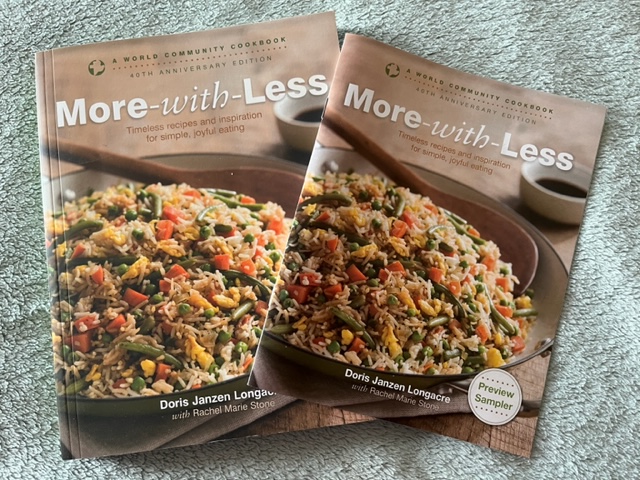
The 2016 edition of More-with-Less (320 pages) will be given away in a drawing August 12, 2023.
Six non-winners will receive a “preview sampler” with 12 recipes.
To enter, comment here on my blog!
Or send your entry to Another Way, P.O. Box 363, Singers Glen, VA 22834, or email anotherwaymedia@yahoo.com. I must receive it by August 12, 2023.
Another Way is a column by Melodie Davis, in syndication since 1987. She is the author of ten books, most recently Memoir of an Unimagined Career. Another Way columns are posted at FindingHarmonyBlog.com a week after newspaper publication.
Another Way for week of July 6, 2023
Pruning Time: When Growing Tomatoes is like Raising Children
I think my favorite job in our rather large garden is pruning and tying up tomato branches.
Even if you don’t do any gardening or raise tomatoes, stay tuned for the lessons pruning can teach us about life.
My parents basically had just bush tomatoes in our garden, that I recall, but my father-in-law here in Virginia was an amazing gardener. He taught me the art and need for pinching out suckers. If you look closely at tomato vines, there are little sprouts that come between the main tomato vine, and the stems which grow and bear tomatoes as the vine progresses. I know some gardeners may argue about the need for pruning but it depends on how you grow the tomatoes.
Bush tomatoes may not need this pruning but if you grow your tomatoes with stake supports or t-posts (metal fence posts found in farm stores), you can tie up the branches as they grow. Many varieties of tomatoes will then keep producing fruit until frost comes. So that is where pruning comes in. One website, Gardeners Supply, notes that if left unattended, “tomatoes will grow into shrubby, multi-stemmed plants that topple under the weight of their fruit.” That website also notes that allowing some suckers to flourish further up the plant can bring late season tomatoes.
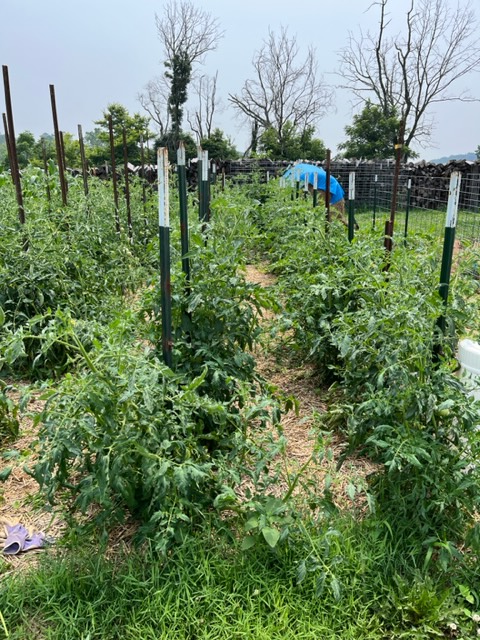
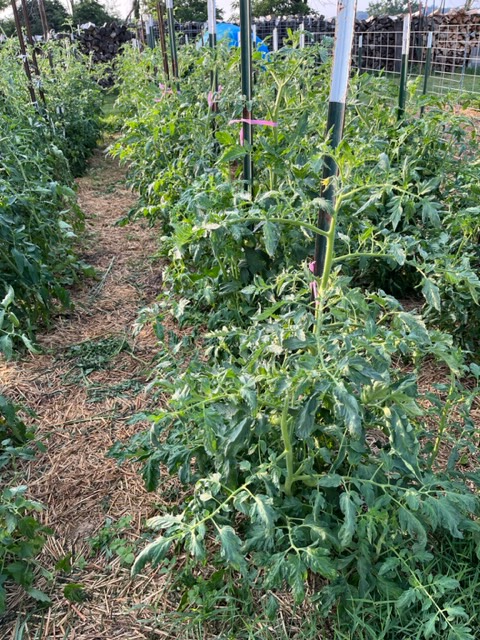
But as I quietly work the rows, tying up stalks and pruning the suckers, it makes me think about life lessons on raising children. When children are just babies, we likely love everything about them except diapers or colic. As they grow into toddlers or grade school, we may try to weed out such habits as thumb sucking, temper tantrums, taking toys from siblings, bullying others at school, or worse. The teen years we try to help steer them to positive relationships and friends, and away from drugs, alcohol, smoking. Of course I am aware of negative pruning in families when children are mistreated and punished in severe ways.
But garden pruning as an adult reminds me to trim out bad habits or tendencies in my own life and personality. Am I jealous? Judgmental? Think of myself as better than others? Yes, yes and yes: I can slip into those habits or bad behaviors.
As I work painstakingly to remove the little tomato suckers to help larger robust stems prosper and bear big fruit, the quietness of the garden helps me remember others in prayer, to breathe deeply of the fresh air (well, recently it’s been smoky), and helps me look out for tomato worms. Tearing up old t-shirts or sheets to make soft tie-ups for the branches occupies me on other mornings.
There was another thing that I was reminded of this summer during our fairly significant drought period. We had weeks without any measurable rain. The grass turned brown and crackly. I watered the tomatoes night after night for three weeks, using water from our well, or some rainwater storage tanks. My mind then went to so many people around the world suffering from long dry seasons, dealing with dust and walking miles for water or food. I thought of children with those extended bellies and the elderly with thin arms and legs. On the opposite end, were countries and communities which experienced too much rain and flooding. My heart and prayers go out to all who lament on either end.
My Dad had a true heart for people suffering from food and water insecurity, as folks call it these days. He participated in two worldwide organizations (CROP and Heifer International) which attempted to bring food and livestock to communities and families in need—who were to turn around and raise the offspring of livestock to keep feeding the family in future years. I need to do a better job of sharing with others, like my Dad taught. Perhaps he’s still pruning me!
Speaking of food, be on the lookout for my next column sharing experiences from a dietitian who launched a cookbook which has helped millions eat healthier.
***
Do you raise tomatoes? Do you like pruning?
How do you work at pruning bad habits or tendencies?
Tell us here or contact me at Another Way, P.O. Box 363, Singers Glen, VA 22834, or email anotherwaymedia@yahoo.com.
Another Way is a column by Melodie Davis, in syndication since 1987. She is the author of ten books, most recently Memoir of an Unimagined Career. Another Way columns are posted at FindingHarmonyBlog.com a week after newspaper publication.
Another Way for week of June 30, 2022
The Exciting (or Scary) Future Changes in Technology
I was super frustrated.
Why did my credit union have to completely change its online banking services? A new password was needed. Oh, now they want me to use at least one numeral. Try again. Then it locks me out temporarily for 10 minutes. Oh why all this difficulty for those of us in our “upper years,” shall we say?
Because things are getting dicey in terms of online activity and if we don’t keep up, as seniors we will soon dry up, have to rely on our kids or other younger helpers to do our accounting, etc., our online business, and even checking the “My Chart” medical info that is so so so hard to get to. Hey hospitals and doctors: do you hear me?
My husband has taken to driving and showing up physically at the cardiac department of our local hospital to make arrangements for an appointment, because too often the phone tagging back and forth with messages left and not answered for 48 hours are left hanging. Or, you are left in queue endlessly and then have to listen AGAIN to 12 different messages if you want this service or that office or whatever.
Ok. Rant over.
The world of AI, artificial intelligence, may be exciting and serve useful purposes, but also scary to those who fear they won’t be able to keep up with technology. AI can clone your loved one’s voice and make a phone call where you think you are hearing from a granddaughter, for instance, who says she needs money to get home from an accident. Or something like that. And it isn’t your granddaughter at all.
Psychology Today website notes that “facial recognition technology can be used to identify individuals without their consent, or to track their movements.”
Some are also concerned about early experiments with self-driving cars. TechTarget website explains that a self-driving car (sometimes called autonomous or driverless) “is a vehicle that uses a combination of sensors, cameras, radar and AI to travel between destinations without a human operator.” These can be not-so-safe and I hope and pray those game-y efforts are shelved for safer models many years (say maybe 25 years) in the future. Our children and grandchildren may have to worry about them or eagerly adopt them but we can hope for real people to be in control and that our grandchildren will be able to keep up.
I was intrigued by a fellow blogger and distant friend, Shirley Showalter, who recently wrote a regular blog post about her grandchildren, and then worked through the Bard website to write a second section of her blog post using AI. The computer-written piece was well done, perfect in every way—but without the human touch of Shirley. A computer does the research and supplies sentences on the topic. I have not yet tried Bard or ChatGPT but I can imagine that if I were still in an office job, I might use such tools to write routine things like a report or news release or advertisements. But stay assured: this is me writing, not a robot!
In a recent small group, those of us over the age of 70 expressed our frustration and fears for the future, especially those of us with children and grandchildren. Just like my grandparents likely did over a hundred years ago! My grandmother on my father’s side was orphaned at the age of five; my grandfather on my mother’s side lost his mother at the age of eight. But both children were resilient (and taken in by relatives). They grew up to be fine persons and parents themselves. So while we may worry about what may be ahead for our grandchildren because of changes in technology, health concerns and worldwide issues, it may not be wise to worry excessively. We can try to keep up the best we can.
***
I’d love to hear your rants or raves or cautions about technology!
Write to me at Another Way, P.O. Box 363, Singers Glen, VA 22834, or email anotherwaymedia@yahoo.com.
Another Way is a column by Melodie Davis, in syndication since 1987. She is the author of ten books, most recently Memoir of an Unimagined Career. Another Way columns are posted at FindingHarmonyBlog.com a week after newspaper publication.
***
Another Way for week of June 23, 2023
25 Things that Bring Me Joy
What brings you joy? Here is my list, but it could go on for many more pages. I hope it inspires your own thoughts, reflections, and pleasures.
- I love crawling into bed with a good book: nice to get cozy under the blankets, or in summer, a sheet and one thinner soft cover. It puts me to sleep, which is a good thing, which means I can’t or don’t read many mysteries, because they tend to keep me awake longer. They say that going to bed at a somewhat regular time is especially good for us older folks.
- I love snuggling babies, watching them look around at the world, and maybe if you’re lucky, they crack a smile at you.
- I love being retired and love having my husband retired too. Our lives are different now.
- Traveling. Anywhere, including to visit grandchildren! It is one of the joys of retiring when you don’t have to count vacation days and worry about running out of them.
- I love singing hymns with a congregation—so often moved to tears of deep connection. I can no longer sing as I once did but with the congregation as a choir, it helps!
- Flowers. All kinds, all scents. The delicacy and beauty make me happy.
- Watching the sun come up over our rolling seven-acre hayfield. Every morning, ever new, even when you can’t see the sun, it is joy.
- A freshly made bed. Wrinkles smoothed out.
- A freshly made apple pie with plenty of cinnamon. Best when made with Stayman apples from our Shenandoah Valley.
- The first summer meal of corn on the cob, garden tomatoes, green peppers, meat.
- A small bowl of ice cream for dessert, an hour or so after supper.
- Reading books to my grandchildren such as the rhythmical “Drummer Hoff,” and singing “Froggy Went a Courtin’” as they drift off to sleep.
- A hug you didn’t ask for from a child.
- A tender and surprising kiss.
- Hearing from readers of this column, now in papers since 1987.
- A young groom being overcome with emotion as his bride walks down a long, outdoor aisle.
- An elderly widow being overcome with emotion as she mourns the loss of her longtime love. I take joy in knowing how much they loved each other.
- A freshly vacuumed rug.
- A long front porch with a swing on the end. My husband did not make the swing but he made sure, as workers built our house and finished the porch, that the swing was attached to the sturdiest and safest rafter with heavy duty hooks. We worked together putting the hooks in which took hours one night. And now, grandkids enjoy the ups and downs of that sturdy solid swing.
- When my Dad was able to get the hay safely in the barn before a rain came. As he pulled the barn door shut, his heart and face were flooded with happiness.
- How Dad would frequently pause behind Mom’s chair thanking her for the meal and landing a sweet kiss on her cheek as he left the supper table to go watch Walter Cronkite.
- A summer reunion with siblings or cousins, aunts and uncles, grandparents and great grandparents.
- Bringing joy to other people whether with a surprise visit, a phone call, a card in the mail.
- Gathering with a smaller group of people from church who know and share each other’s ups and downs and losses and joys.
- This joy list reminds me of a wonderful old hymn by Adelaide Proctor: “I thank Thee, who hast made the earth so bright, so full of splendor and of joy, beauty, and light. So many glorious things are here, noble and right.”

What are your joys?
What is your number one?
I first called this “Simple Things that Bring Me Joy” but then I realized that some of these things are not so simple. What title would you give it?
Comment here or send to me at Another Way, P.O. Box 363, Singers Glen, VA 22834, or email anotherwaymedia@yahoo.com. (I may do a follow-up column with your picks.)
Another Way is a column by Melodie Davis, in syndication since 1987. She is the author of ten books, most recently Memoir of an Unimagined Career. Another Way columns are posted at FindingHarmonyBlog.com a week after newspaper publication.
Another Way for June 16, 2023
The Shopping Trip that Almost Stopped a Wedding
Mother started dating because her older sister Florence told her it was time—at age 16. Mother did have a crush in high school over a boy who “wasn’t even cute,” Mom wrote in a journal my sister Linda “Pert” gave her (so we’d have more stories sharing her thoughts and experiences).
Mom said she enjoyed going to gatherings where young people would give speeches or skits. One goal was to “meet new cute guys.” Emphasis on cute. Other typical teen dates usually included going to church, an amusement park, miniature golfing, or church fellowships. She added, “Of course there was a war going on then and gas was rationed,” which limited activities. A lot of guys were “away in service, either army or Civilian Public Service.”
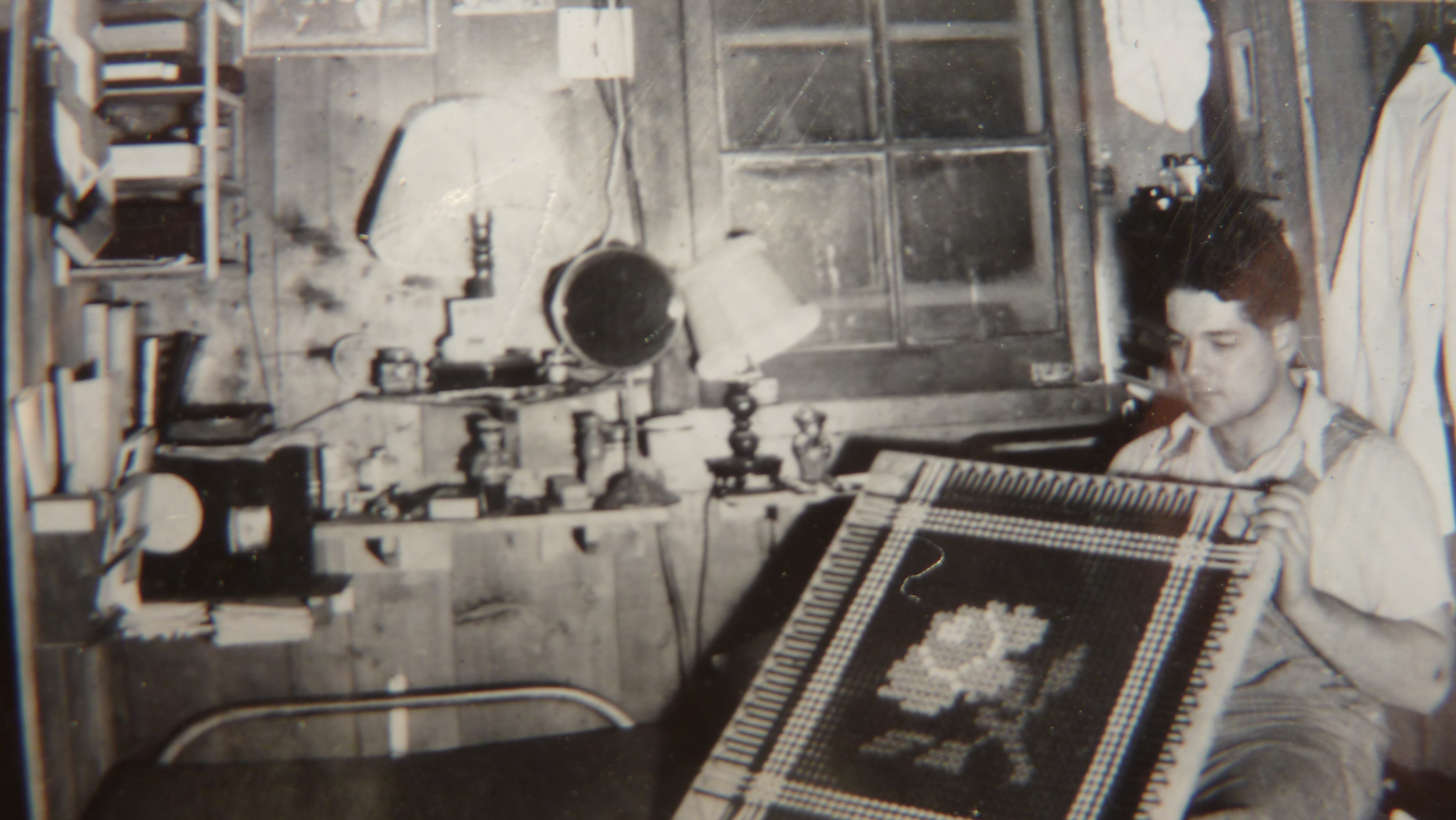
Dad and Mom starting exchanging letters when he served at a mental hospital in Michigan, and Mom lived in northern Indiana. Mother was actually out with another guy when Dad first came to visit Mom, and her father and dog got acquainted with my Daddy first—always a good move! Mom recalled, “I was quite interested because he owned a farm already (ha!) and was good looking too!”
Mother’s mother, Ruth, said Daddy was too old for mom—about seven years older. He was also shorter than mom. “Plus, he had size eight shoes while I wore 10’s!”
Mother began working on transforming his hair cut which had been parted in the middle, a look she didn’t care for. She said Dad was “so easy to talk to and lots of fun.” (Mom added, again, that “he was good looking,” lest we forget.) Mom also “felt so comfortable with him.”
As they learned to know each other’s families, Dad’s nieces were about Mom’s age, and they were “so friendly at our first meeting. Especially Audrey Ann and Gloria.”
They dated for about three years and the courtship began in earnest when World War 2 was over. Mom wrote, “I prayed a lot. It took me several years to know I had found ‘the one,’” she said, adding, “Lord, if I am to marry this guy, make me fall in love with him!”
When Dad proposed to Mom in his car, she answered, “Maybe.” After some lengthy pondering because of their age difference, she finally said yes.
As the wedding approached, they went shopping in Fort Wayne, Ind., an hour away, looking for a suit for Dad. Dad soon found a suit he liked and fit, but mother thought it would be good to look in a few other stores. Shopping was one of mom’s favorite activities while Dad was more of a “look, fit, buy, get out” guy. Daddy was so frustrated over that shopping trip that they almost broke up. “It was sad to have him so mad at me. He didn’t even kiss me goodbye that day,” Mom recalled.
But they got married at Olive Mennonite Church on January 1, 1946, with Mom dressed in a white satin dress she had made herself, and carried a satin covered Bible. They had no wedding rings. Only immediate family members were invited—parents and siblings. Their marriage went for 60 wonderful years until Dad died in 2006.
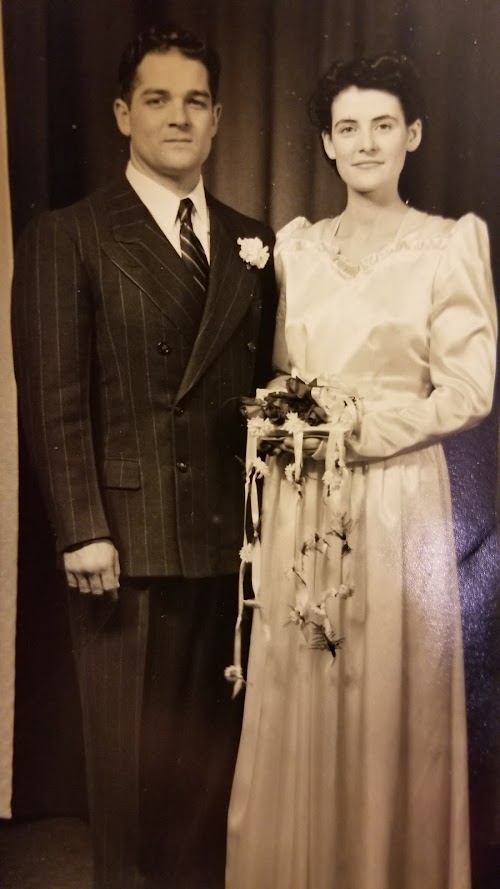
Her fondest memory of the wedding was that the minister said they dared kiss at the end of the ceremony if “we didn’t hang on too long.” Mom was so happy to have a church wedding and a honeymoon in Florida, a longtime dream for Mom. The trip instilled in them both a love for travel—a yen that all of us children have. The match was arranged in heaven and we know that’s where their spirits are today. Thanks, Dad, for all you gave us and meant to us.

Our hearts go out to all children who don’t know or are not able to be with their fathers, and I pray for father figures for those kids. My heart warms as I observe my sons-in-law taking such active roles in raising their little ones. Happy belated Father’s Day!
***
Do you know your parents’ love story?
What do you do to make up after a disagreement?
***
Fellow blogger Marian Beaman shares her love story in her new memoir, My Checkered Life: A Marriage Memoir. You may want to check it out!
Comment here or write to me at Another Way, P.O. Box 363, Singers Glen, VA 22834, or email anotherwaymedia@yahoo.com.
Another Way is a column by Melodie Davis, in syndication since 1987. She is the author of ten books, most recently Memoir of an Unimagined Career. Another Way columns are posted at FindingHarmonyBlog.com a week after newspaper publication.
Another Way for week of June 9, 2023
Blind Date and Life Ever After
What does it take to marry someone who is totally blind or with some other challenge?
Ferne Bowman is a woman I have only recently learned to know a bit, even though her piano-tuning husband, Dan, came into our home and tuned our piano for many years. I always enjoyed fascinating conversations with Dan as I drove him to his next piano tuning job.
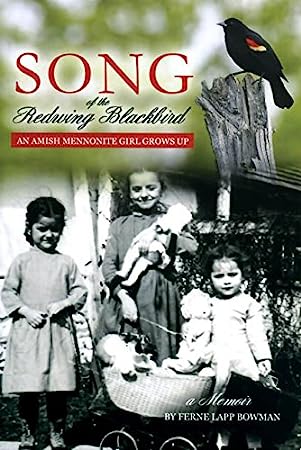
The Bowman team—and long marriage of over 50 years—is nothing short of remarkable. I have just finished reading Ferne’s memoir, Song of the Redwing Blackbird: An Amish Mennonite Girl Grows Up. Earlier I read and reviewed Dan’s memoir in my column, From Sight to Insight: A Mennonite Farm Boy’s Adventures Through Blindness to Living and Seeing Without Vision. Today I’ll focus on Ferne’s story.
I truly enjoyed reading Ferne’s book as she began each chapter—many of them brief—with a story or adventure or encounter from her childhood and long years of living. She writes very well and gives a good example of how to write an entertaining memoir. She also fills the book with photos illustrating many stories or memories. Both of these things (the stories and the photos) make for easy reading.
Ferne grew up “Amish Mennonite” (sometimes known as “Beachy Amish,” a particular order of Amish faith), and gradually decided to leave the strictness of some practices in that group to a more modern Mennonite group. Today Ferne and Dan are members of a local church in Mennonite Church USA. But Ferne highly values the home in which she grew up even though tragedy and difficulty touched her family early on. I won’t reveal a spoiler here.
One of the rules in her early faith family was that most children ceased formal education after eighth grade, or they were perhaps allowed to attend two years of high school. Families and ministers said that was “enough education” and spurned high school diplomas. Youth rarely went to college unless they wanted to become a teacher.
So it was that Ferne met Dan as a freshman at Eastern Mennonite College in her later twenties, working on a teaching degree. Everyone knew “the blind guy” on campus. And we all know people who have had to live with difficult physical challenges that happen after they have gotten married. But in Ferne and Dan’s case, Ferne knew what she was going to deal with. I should add that Dan is intelligent, outgoing, hardworking, and an excellent conversationalist who is eager to adapt to new technologies that help him cope and communicate.
In the book, she tells of first meeting Dan at the same table in the dining hall at college where the students were assigned tables for a half week at a time, usually three girls and three boys to a table. She doesn’t remember much about the week where Dan was also sitting at her table, but he keenly remembers that Ferne laughed “at one of his smart comments,” which attracted Dan’s attention.
Dan ended up asking her for a date to the Spring Banquet. Most folks are nervous on a first date but Ferne needed to serve as a guide as they walked to the banquet/dining hall. He took her arm, but she accidentally slammed him into a door post by not allowing enough room for him to pass through. The evening ended on a very good note, however, playing some games involving trivia where Ferne was quite impressed with Dan’s “vast knowledge on every subject.”

And that was the beginning of a long sweet courtship and finally marriage and raising their eventual family of three daughters. Ferne says, “To me, he is not a blind man: he’s Dan.” He just happens to never have seen his wife’s face nor the faces of their daughters and grandchildren. But that didn’t matter. Ferne and Dan have carved out a meaningful and fairly ordinary family life which Ferne describes in wonderful detail in her book.
***
Tell us about an extraordinary woman, man, child that you know or have met! We’d love to hear.
***
Ferne Bowman’s book is available from her home in Harrisonburg, VA 22802. Please contact her by email: fernelappbow@verizon.net The book is $10.00 plus $1 postage. Or write to me at the address below for Ferne’s mailing address.
Another Way, P.O. Box 363, Singers Glen, VA 22834, or email anotherwaymedia@yahoo.com.
Another Way is a column by Melodie Davis, in syndication since 1987. She is the author of ten books, most recently Memoir of an Unimagined Career. Another Way columns are posted at FindingHarmonyBlog.com a week after newspaper publication.
Another Way for week of June 2, 2023
Personal: What Do You Cherish?
One writing “prompt” I stumbled across recently was “What personal belongings do you hold most dear?” Here are some of my top ones:
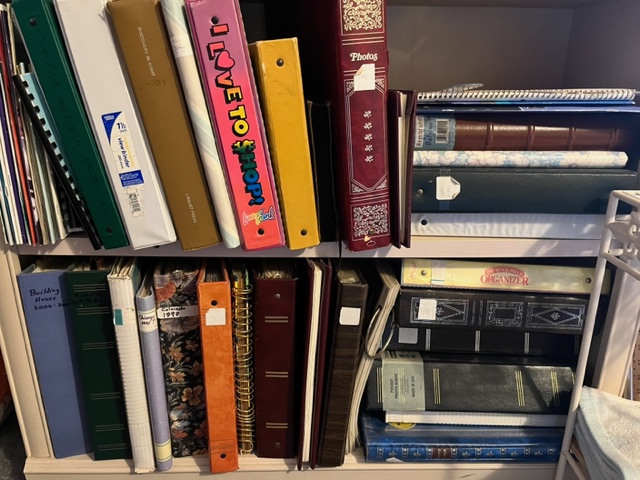
Photos. I guess at the tippy top of my list would be photos, especially of family and including those that go way back. I have one old old album that my Aunt Susie started and passed down to her only daughter. At some point her daughter, who was single and didn’t have any children, passed it on to my mother because she was the last living aunt/uncle relative in the family. It included some ancient photos of my Dad and other family members, but also many many photos of people that I have no clue about. Not sure what will happen to it after I’m gone and it is not my “most dear” album, but somehow I love it.
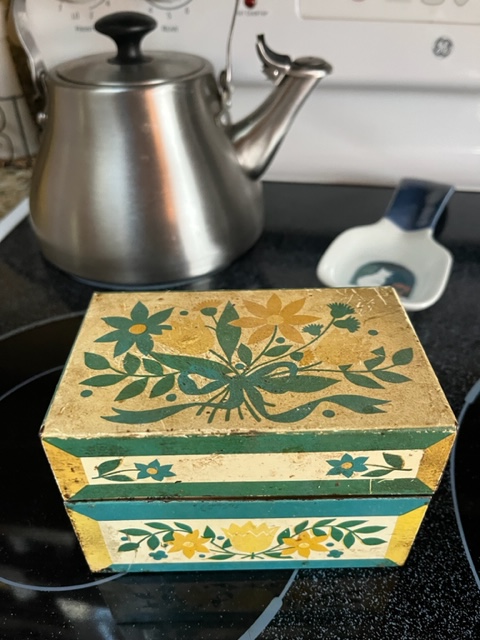
Recipe Box. I have a 50-year-old recipe box that I think I started when I was in college and living with a houseful of roommates (13) so I was actually able to do real cooking that year, and my senior year. It is very worn and old looking, but at least one of my daughters informed me it meant a lot to her.
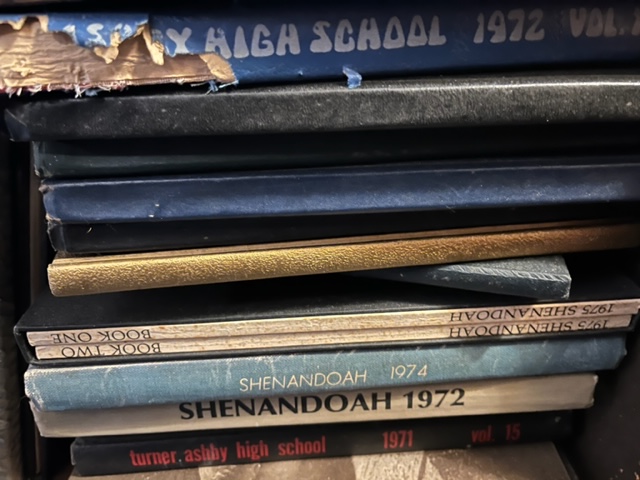
Yearbooks. I have a love-hate affair with old yearbooks, partly because they are big and take up a lot of room. But when it comes to settling arguments about who was in what class, who a certain teacher was, or to introduce your children and grandchildren to some of your best friends, those books come in handy.
Tools. My husband was happy to “inherit” a few of Dad’s older tools that were in a tray in Mom’s closet.
Mom’s Stuff. There are too many mementos and dishes and even pans to name here and I’ve already talked about Mom’s Singer sewing machine and perhaps other stuff. But the sweater-jacket I picked up after her passing, that came in so handy for Mom and then me, is now lost. My fault. So it goes.
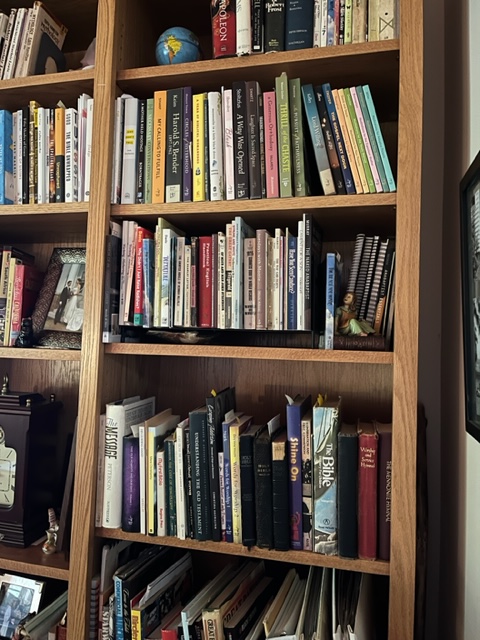
Books. My shelf has many books by many other authors, but the books I’ve written, I hope get passed down to my children and theirs. Because they’re the story of my life, and my husband’s, and our children too.
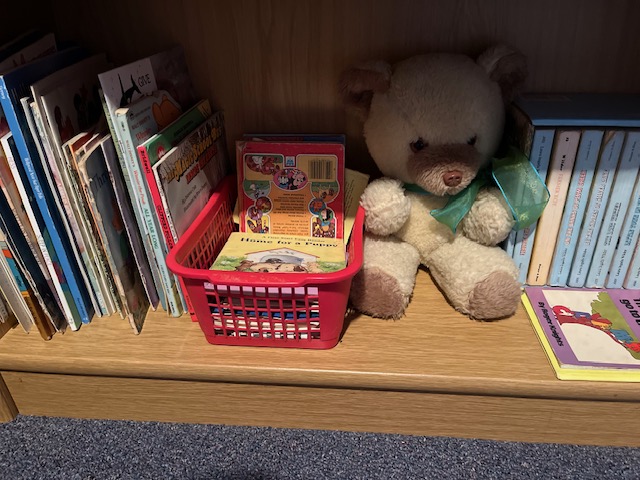
Children’s Books. I have enjoyed “kiddy lit” from way back and once our own children were born, I began to savor and treasure certain books more than others. Now I love sharing favorite books with our grandchildren. Who will get what?
Trophies and Certificates. Meh—not so much. They meant something at the time but I gladly will let my daughters dispose of them when the time comes.
Stuff from Aunts and Uncles. In the category of “oh dear what should I do with such and such…” I include a drawer of items passed down to us from Stuart’s aunts. They are special to me because I don’t really have anything from Stuart’s mother (who died before we were married, I never knew her, as I wrote a couple weeks ago). At some point I will probably donate the nail files and unknown souvenirs from someone’s travels, but a precious little purse crocheted by Estella (and used by several nieces and great nieces for fancy occasions like proms) will now be earmarked for my first (and at this point) only granddaughter.
Bibles. Finally, many of us have Bibles that are indeed precious. At last count, my husband and I have about nine Bibles between us. My favorite? Probably the one my parents gave me upon graduation from high school with my name engraved. I have already donated three or four copies of other Bibles in different versions, thinking someone else should surely get use out of them.
What personal belongings do you hold most dear?
What things rise to the top for you?
Have you gotten rid of things you now wish you hadn’t?
Comment here or write to me at Another Way, P.O. Box 363, Singers Glen, VA 22834, or email anotherwaymedia@yahoo.com.
Another Way is a column by Melodie Davis, in syndication since 1987. She is the author of ten books, most recently Memoir of an Unimagined Career. Another Way columns are posted at FindingHarmonyBlog.com a week after newspaper publication.

 findingharmonyblog