

Another Way for week of November 8, 2019
Take Me Out to the—Yes—Ballgame!
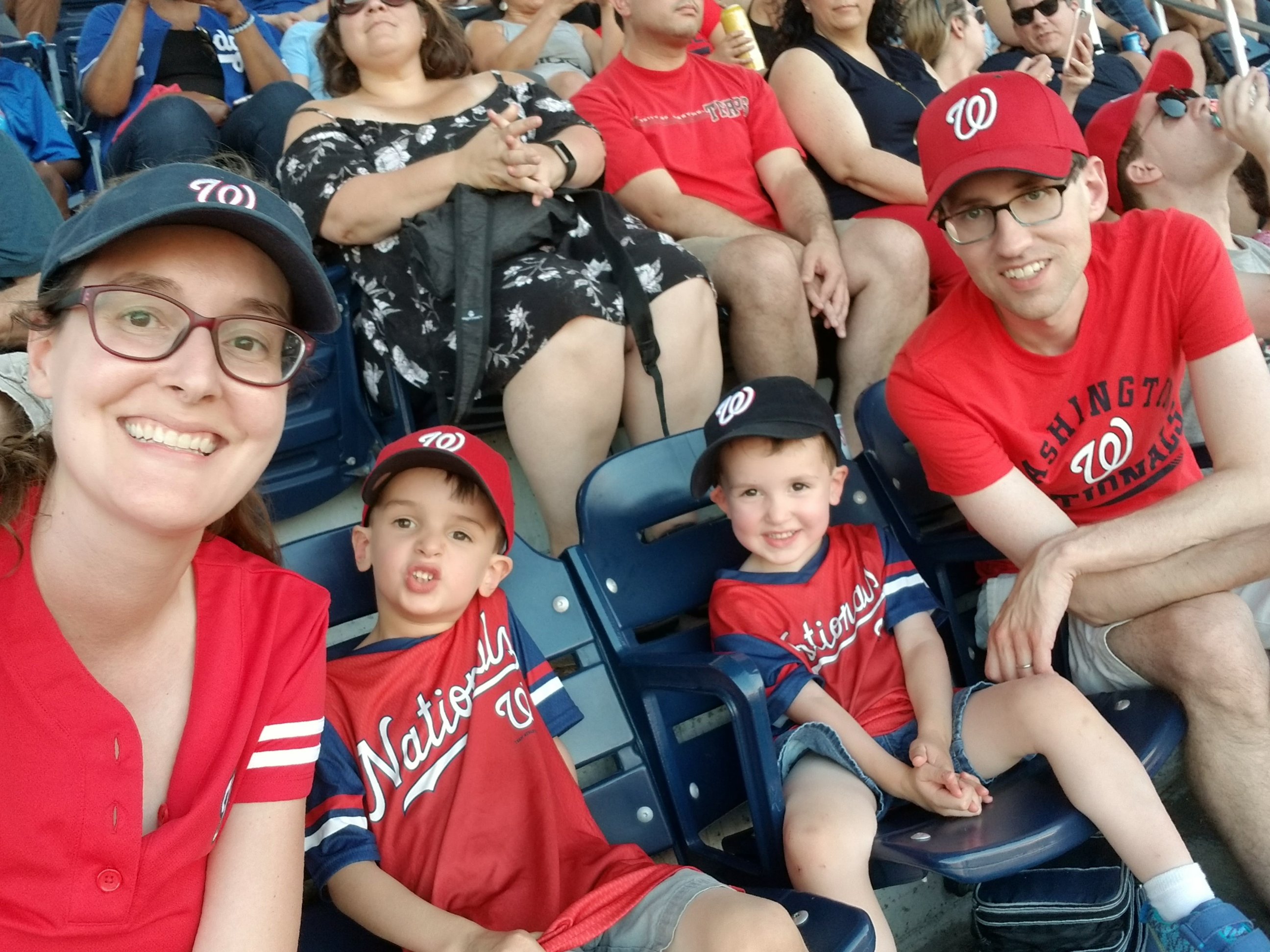
My daughter and part of her family at a Washington Nationals game earlier in the season.
After many years of shrugging off baseball as slow and boring, I have finally become a fan of the sport.
That may sound like an unusual proclamation for a sixty-something grandma, but the recent World Series has taught me what an exciting and excruciating game it is to play, especially for the pitcher.
With our nearby team, the Washington Nationals’ long-awaited triumphant win of the World Series, I actually sat down and watched hours of baseball.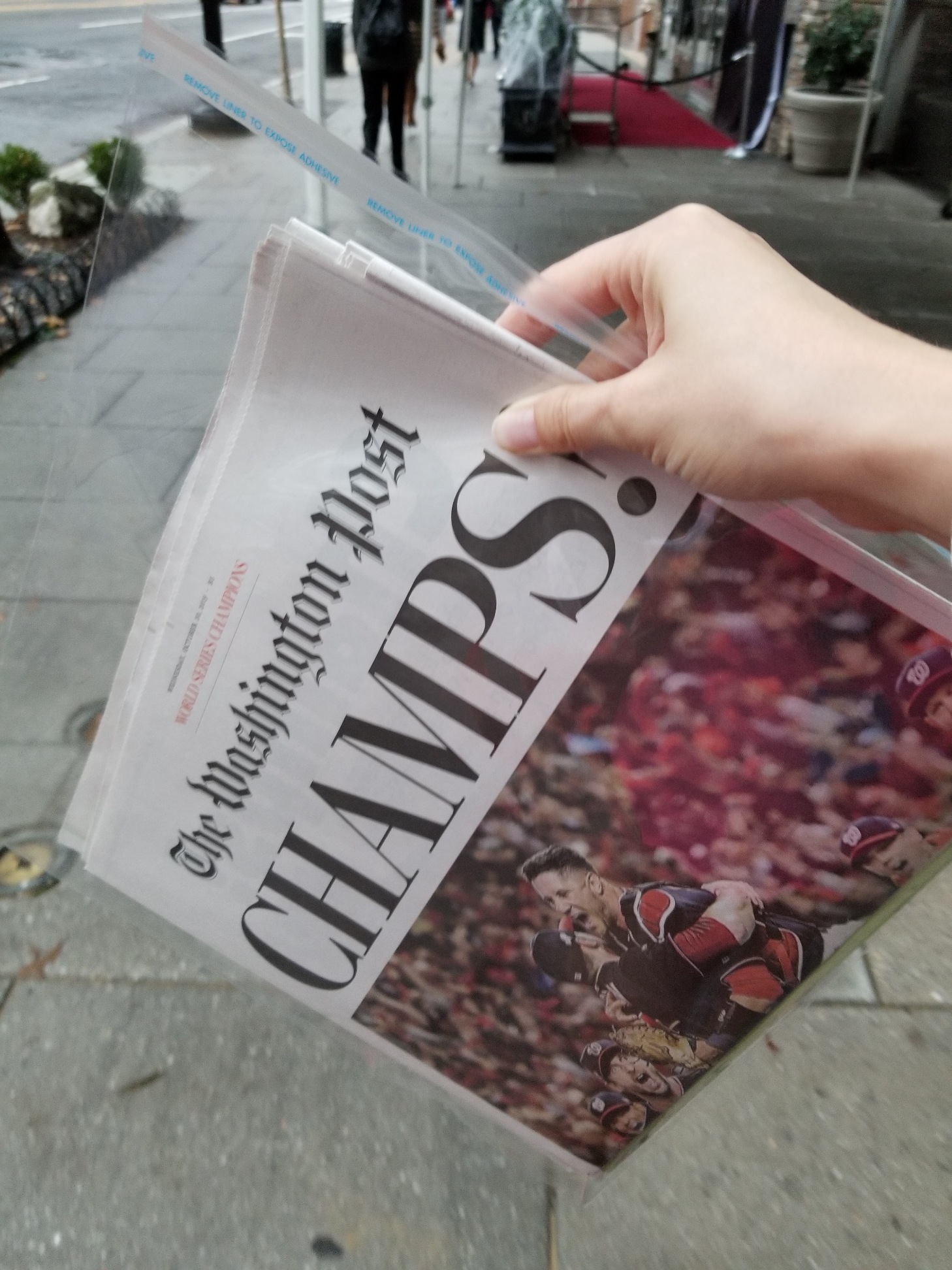
Now, let me hasten to add that my husband would scoff, loudly, because I couldn’t make it all the way through various games—except for the final one—without falling asleep on the couch. But I am newly impressed with the tensions; the almost 100-mile-an-hour whirls of the ball; the difficulty of keeping your eye on opponents attempting to steal bases while also pitching with laser focus; and being ready to field a ball yourself. I just say, Wow.
Some confessions: I grew up playing basketball, and that was the one sport we sometimes went to watch as a family, beginning when I was in elementary school. We also had a hoop and cement pad at the side of our garage. While my middle sister took top basketball billing all through high school and college and even toured several countries in Asia with a Christian exhibition team, we all loved the game. My 95-year-old mother still enjoys watching basketball on TV because she can understand the basics.
I also played softball one year in high school because my best friend went out for the team, but I never loved the sport. I was always terrified of getting hit with the ball or a bat, and thought being an outfielder was unendingly boring. And watching it on TV? Big yawn. With football I became an involved fan when our daughters began playing in marching band.

Oldest grandson at a special birthday at a real dugout.
But I have never been to a professional baseball game or even a minor league one: something all of my grandsons (except the youngest) have done.

Even the dog loves playing backyard baseball.
You could say my interest in baseball has grown considerably by playing ball with our grandsons. The two oldest are only six and nearly six, but they both love the game. Proud grandma believes they show promise. I have not yet actually seen them play in their T-ball league games, but boy-o-boy have I pitched, caught, hit, ran the bases, and chased foul balls and bad pitches in tiny back and front yards in three states with those tykes for hours on end.
We were happy to take care of three of our grandchildren recently so their parents could catch a play-off game in their city. When their boys found out where Mommy and Daddy were going, they understandably put up a fuss. But they were somewhat consoled when reminded that earlier in the season, they had gone to an afternoon game, and someday they would be old enough to go out in the evening.
This season I’ve learned about baseball traditions that somehow I had never really known: singing “Take me out to the ballgame” during the 7th inning stretch, and that the organist also plays “up to bat” songs that are different for each player, with the “Baby Shark” kiddo song becoming a thing for the Nationals this year.
The traditions associated with the game—including the constant adjusting of ball caps, the wrapping and unwrapping of batting gloves repeatedly after each pitch, the clearing of dirt from pitcher mounds that is “in the way,” nonverbal communication between pitcher and catcher, the spitting, the gum chewing, the meticulously followed dances in the dugout after a homerun, the overall camaraderie of players—even on opposing teams—was interesting to observe.
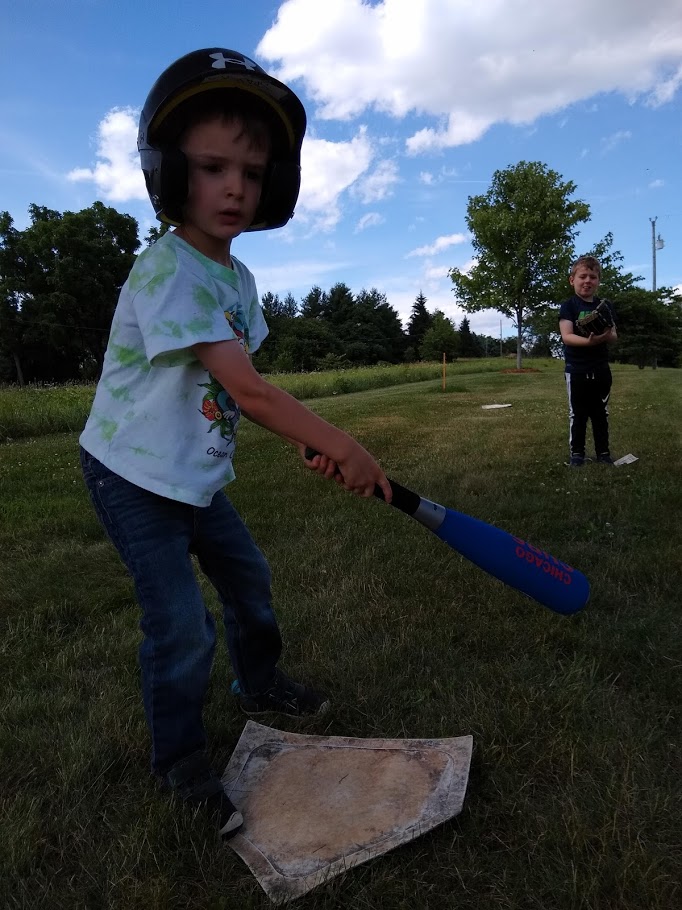
Two oldest grandsons getting in some swings (and misses) at our house.
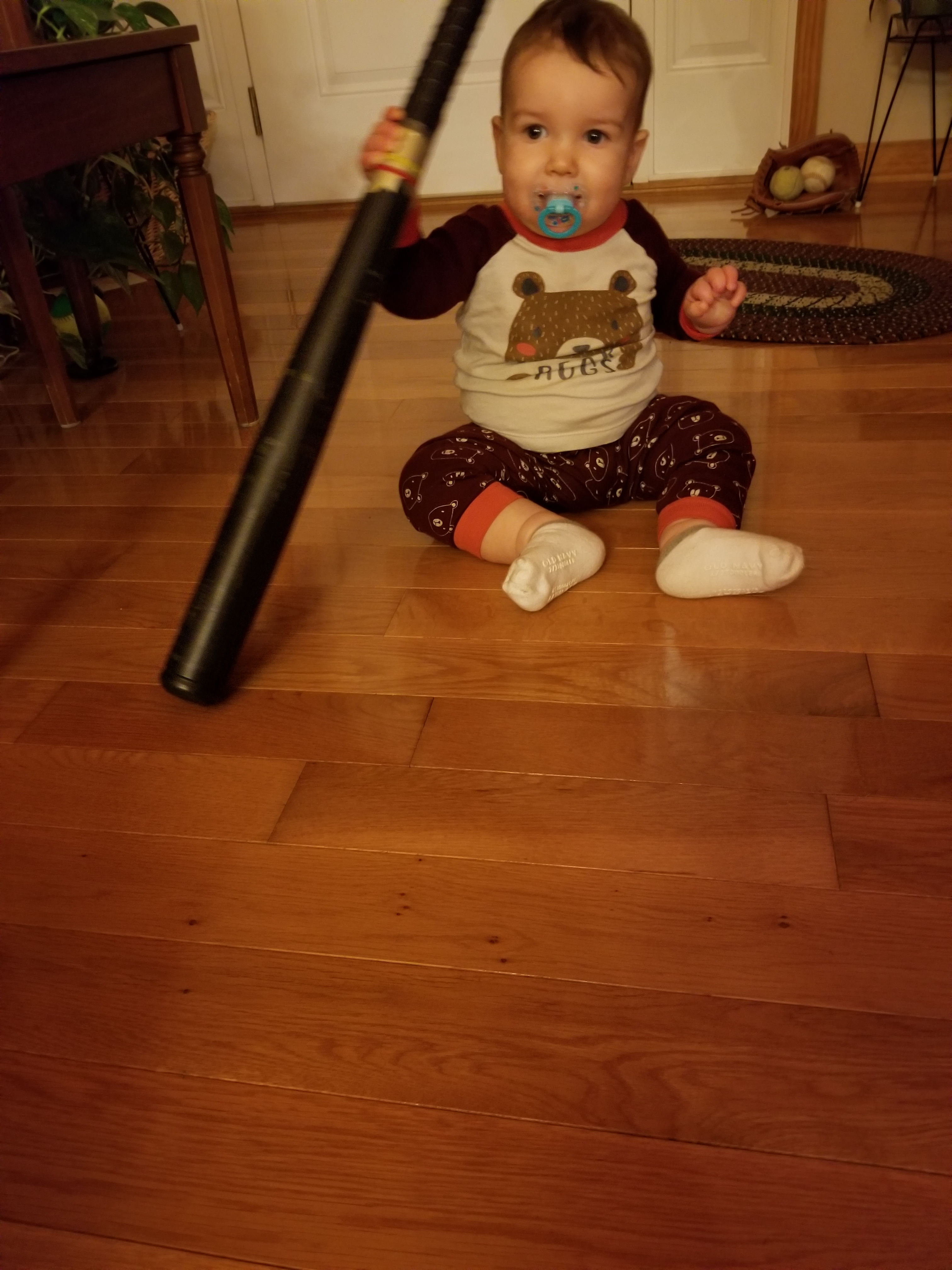
The youngest grandson, ready to join the fun.
I look forward to more that my little players will hopefully teach me in the years ahead even as they make sure I get a good workout chasing their fly and foul balls and tagging them when they practice their slides.
Maybe you can teach an aging grandma to enjoy a new/old sport.
***
Do you like, love, or not enjoy baseball? If so, when and how did you get your opinion or attitude?
Or, other sports memories, stories, insights, or opinions you want to share? Comment here!
Or send to me at anotherwaymedia@yahoo.com or write to Another Way Media, P.O. Box 363, Singers Glen, VA 22834.
Another Way is a column by Melodie Davis, in syndication since 1987. She is the author of nine books. Another Way columns are posted at FindingHarmonyBlog.com a week after newspaper publication.
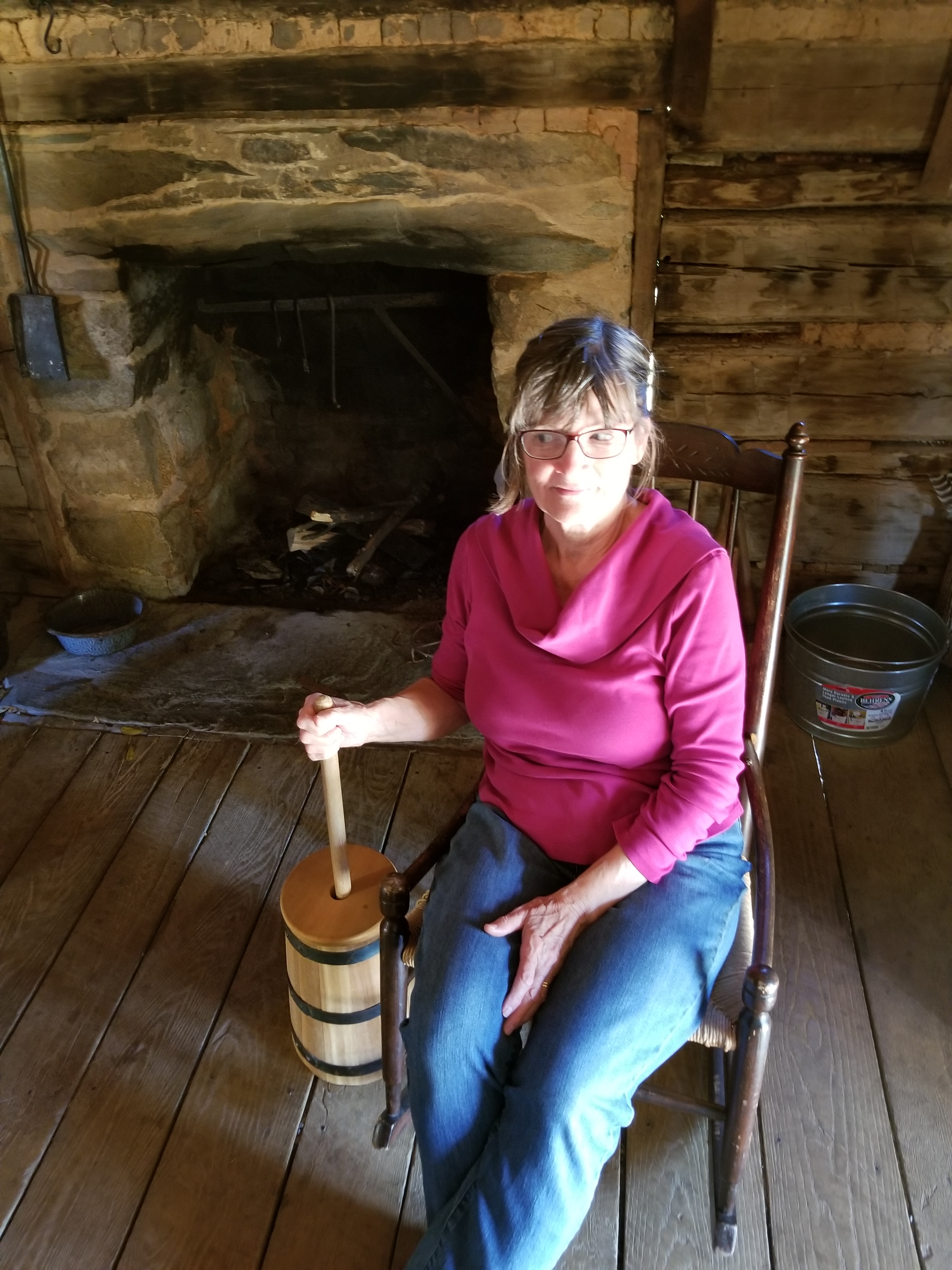
No, not likely to take up churning my own butter, but my husband and I enjoyed this step back in time at Humpback Rocks pioneer farm along the Blue Ridge Parkway recently.
Another Way for week of November 1, 2019
Driving Each Other Crazy in Retirement?
(Or, my latent, domestic side)
“Are you driving each other crazy yet?” This question from my dental hygienist caught me off guard because yes, I knew it was an issue for some couples. But in a word, no, we are not driving each other crazy yet, I’m happy to say. Frankly I’m a little surprised because, yes, that is something to worry/wonder about, along with preparing financially. But I’m currently feeling contented and perhaps curiously to some, cautiously celebrating a return—or perhaps launch—of a delayed domestic life.
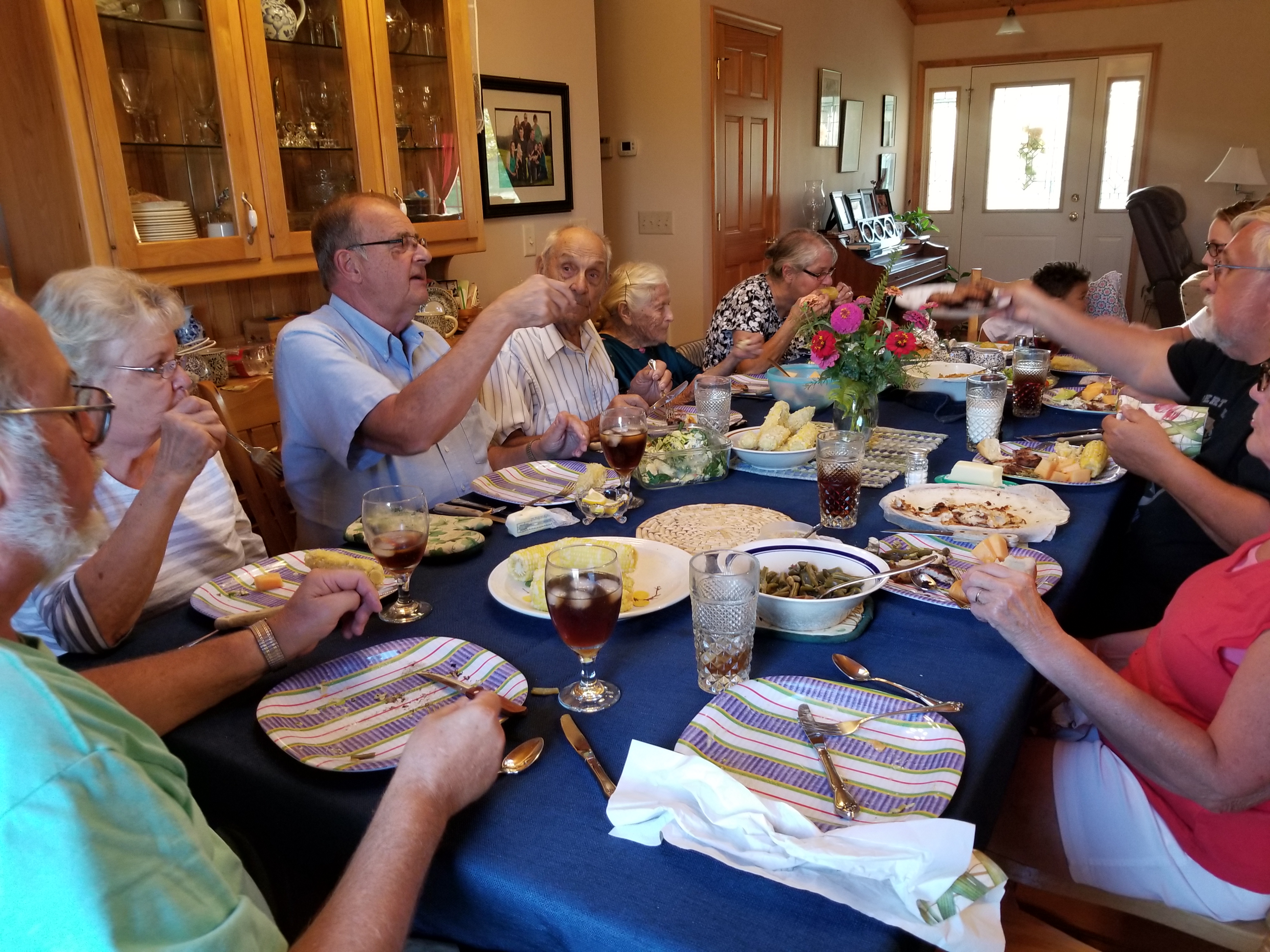
Loving a table full of friends and family.
I used to think what I wanted to do after high school was just get married and have children. I guess you could call me a domestic at heart. I looked forward to having a home and family of my own. The role models around me were mostly women doing just that: being homemakers and full-time mothers in their homes.
That bubble burst while I was a senior in high school participating in a retreat with other high schoolers. I will never forget the counselor who asked us what our hopes were for after graduation. I said something like “get married and have a family.” The wise man looked at me (no doubt a bit surprised) and pushed, “What if no husband comes along, Melodie? What then?” That was 1970 and the entry of large numbers of women and mothers into the work force had certainly begun; this may be a bit hard to believe now in 2019, but a career or longterm employment had not quite become a personal goal of mine at that time. I had never questioned that I would get married.
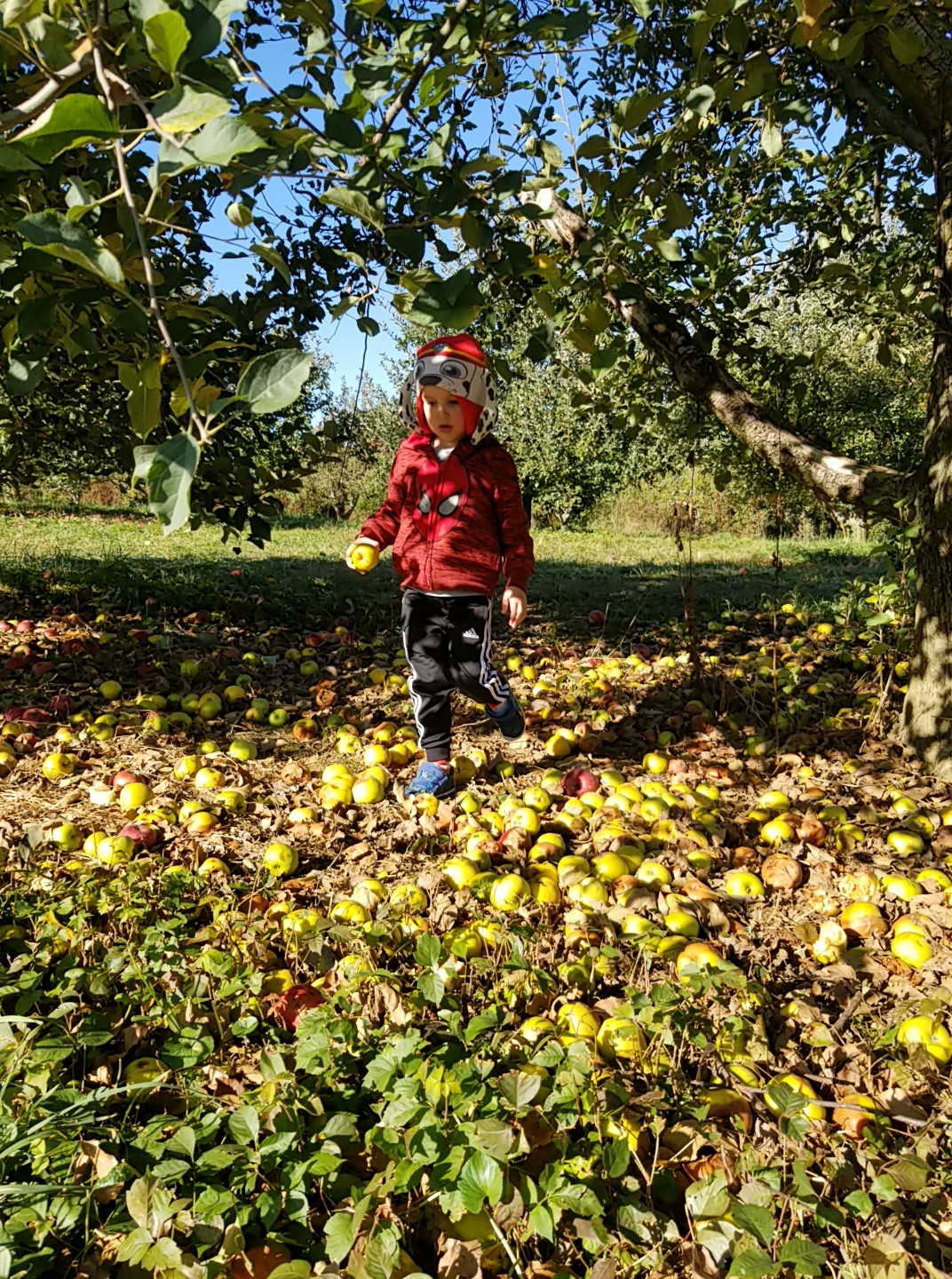
Picking apples with grandsons at amazing 200-years-in-the-same-family orchard, Stribling Orchard. http://striblingorchard.com/
Let me hasten to say that I went on to attend college and began a wonderful job and career that I enjoyed 99 percent of the time. I was able to be involved in exciting, creative, mind-stretching and life-changing work. Even when our children came along, my husband and I decided I would stay in my job half time to help make ends meet, and as they grew and started school I gradually increased my hours over the years until I was working about 36 hours a week. I loved reserving a little domestic “me” time.
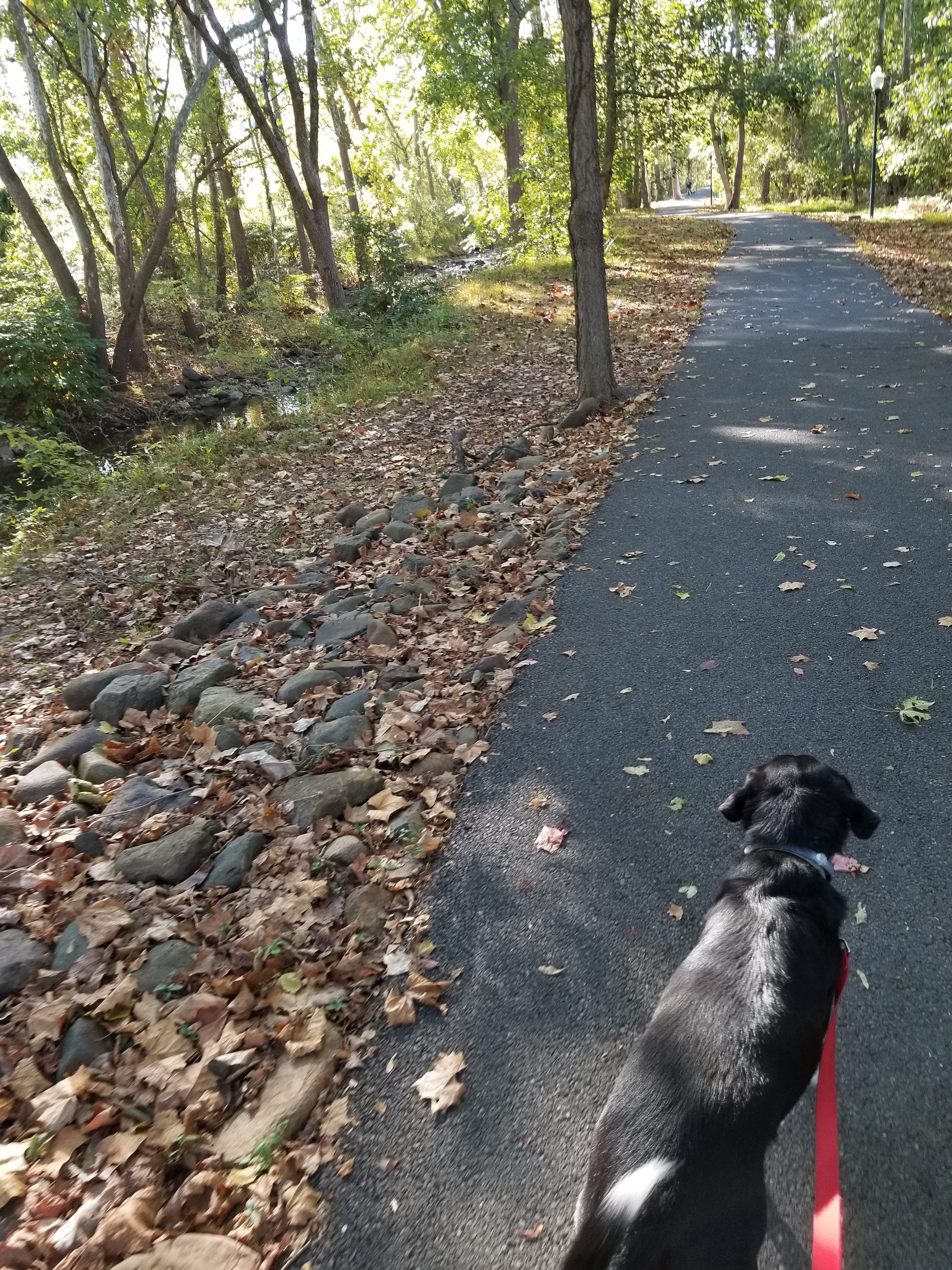
Walking our dog Velvet along a marvelous paved path (with stream) in Front Royal, Va.
I realize that at this point my husband and I are fortunate not to have to get up and go to work, although there are many that enjoy part time work long into retirement. Now that I am six months into retired status, I am relishing the opportunity to get up late, take a nap, read a book, work in the flower bed (during the day when I still have energy, not in the evening quickly before or after supper), clean out files, wipe the dust and lint from behind the dryer and refrigerator, go with my husband to the gym/pool, run errands around town, and travel to visit and help out with our growing grandchildren.

Late garden harvest–still producing through October.
This summer I enjoyed work like canning and freezing vegetables from our garden. Even though it’s still a chore, it’s much better to be canning at 11 in the morning than 11 at night. I’ve even done some mending and have many more deep cleaning and organizing projects to launch. I’m enjoying baking pies and taking meals to those with an ill or recuperating family member.
So yes, I’m a little surprised by the contented blooming of my domestic side. Not that life is perfect; patience, love, and forgiveness are required in all stages of life.
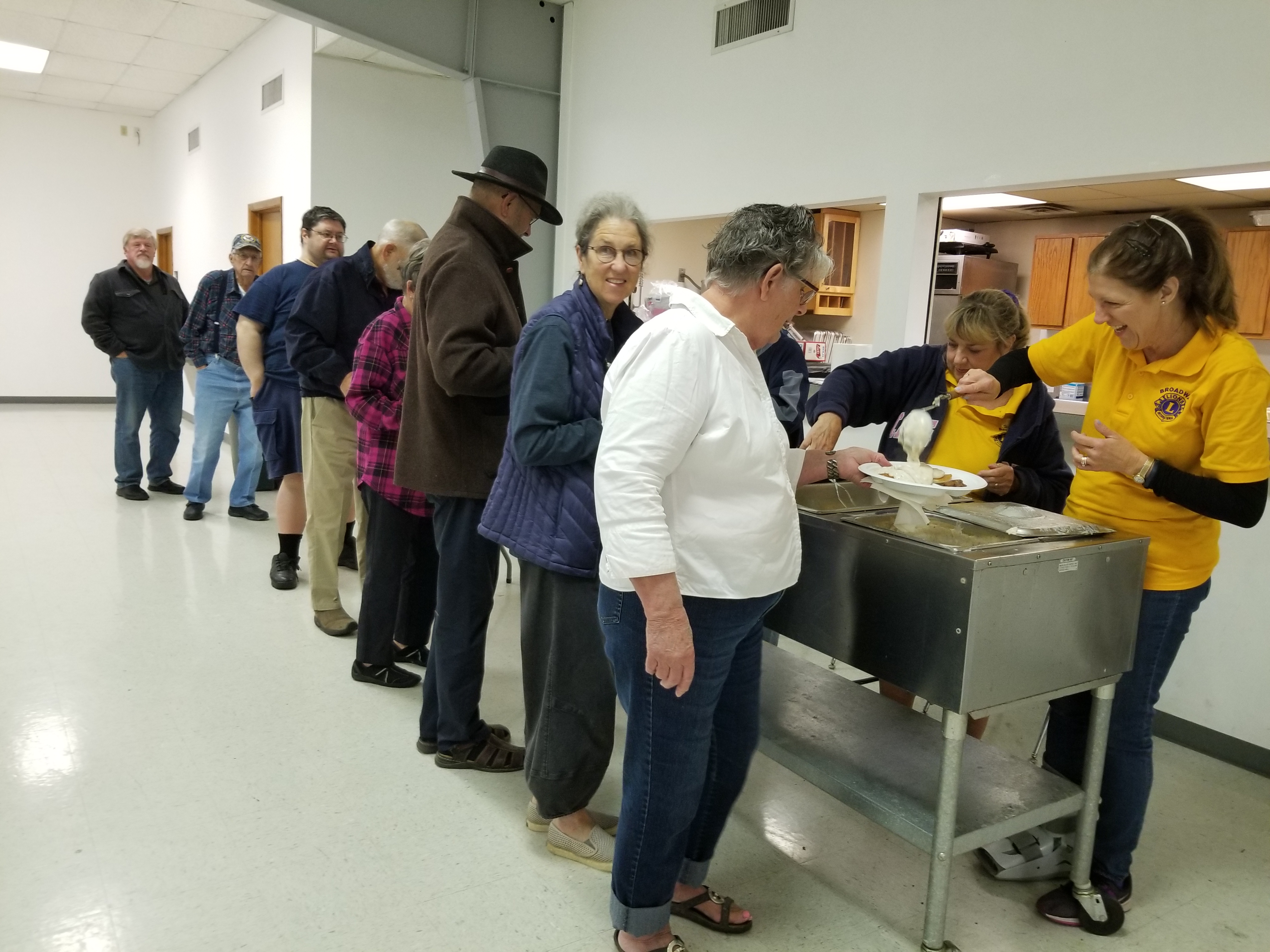
Enjoying volunteering with our local Broadway Lions Club, here at the annual Pancake Days.
Likely the spouse who is able to retire first ends up establishing somewhat of a routine. In our case it was my husband. One relative said she retired first and enjoyed her own routine of going to the gym, then having extended coffee time with women there, which she didn’t want to give up. After her husband retired several years later, he fell into his own routine—of always feeling like tomorrow would be a better day to get started on XYZ. “There’s always the next day to keep you procrastinating,” he warned.
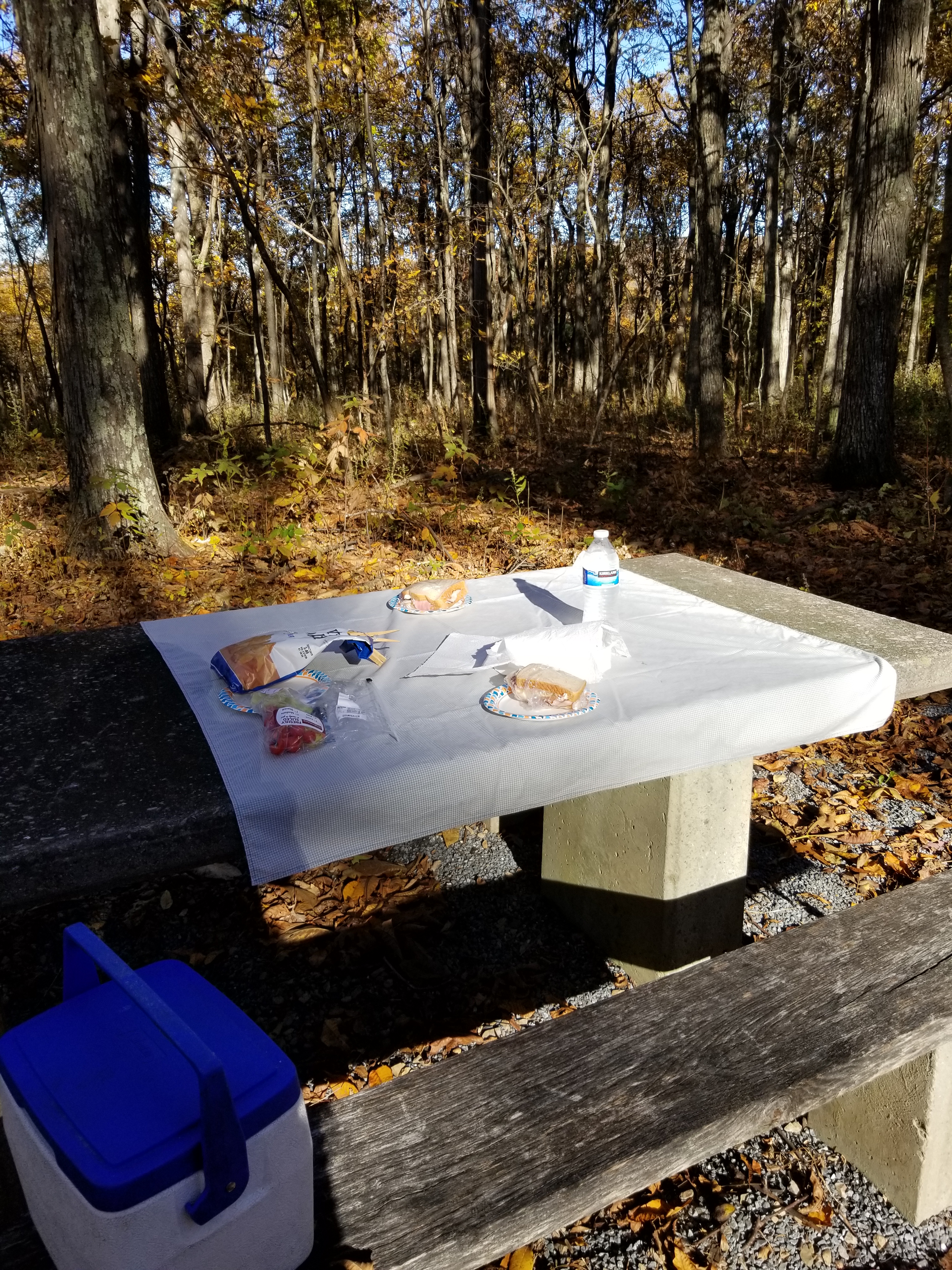
Thank you Lord for many simple blessings.
Until there’s not, of course. Again, no matter what age or stage we’re at, we all benefit by accepting each day as a gift, and NOT put off until tomorrow what we want to get done today.
***
What do you hope to do in retirement? Do you worry/wonder about whether you will be happy? I’d love to hear from you with your experiences, or wonderings about the future! Comment here or through the addresses below.
***
For a free short book, Work Therapy, contact me at anotherwaymedia@yahoo.com or write to Another Way Media, P.O. Box 363, Singers Glen, VA 22834.
Another Way is a column by Melodie Davis, in syndication since 1987. She is the author of nine books. Another Way columns are posted at FindingHarmonyBlog.com a week after newspaper publication.
 Another Way for week of October 25, 2019
How Well Do You Truly Listen?
Being part of a team that produced documentaries about the real-life experiences of ordinary people gave me many blessings, including a sharpened appreciation for the art of listening—truly listening to people’s stories.
I remember once when our producer was interviewing a woman who had lost her husband in a too-early death. Our video was focused on dealing with grief as survivors, and Jerry wanted her to tell about her experiences with that. But she had something she wanted to tell first: the story of her dear husband’s life. “You got the book backwards,” she chided the producer bravely. “First I want you to know how he lived.” Jerry was sensitive enough to listen as she shared even though he knew he could not end up using all the story in that documentary.
This story was brought to my mind recently in a book about how churches can better respond to the neighborhoods that surround them, listening to the stories of people: their hurts, triumphs, griefs, memories, and experiences. What does it take to truly listen? It means we listen for the back back back story, and refrain from jumping in with our own memories of similar stories.
 In Neighborhood Church by Krin Van Tatenhove and Rob Mueller (Westminster/John Knox Press, 2019), Krin tells of a Navajo neighbor she had while living in New Mexico. Sometimes she would stop and talk for friendly conversation with him. “I tend to be extremely verbal, and after sharing my animated thoughts, I would stop and wait for a response.” The man would sit there with “open eyes, a wide smile, and silence.”
This disturbed her. At first she wondered if he had disabilities, or a fear of socializing with others, but as she grew more comfortable with this long awkward pause, he would finally “respond with words that were often wise and precise.” The Navajo custom is to let another person finish talking, and allow silence to occur for a long pause—to make sure the other person is finished talking and allowing the conversation to sink in. “It is a sign of respect, and to make sure that they have heard the whole story before responding or reacting. Navajos believe listening is a sacred part of being in harmony with the world and others,” Krin writes.
That reminder helped me remember another interview our producer Jerry did with a Cheyenne chief and Mennonite pastor, Lawrence Hart. In that interview on forgiveness, Lawrence talked about the ills and wrongs committed against native peoples. He talked very very slowly—and with the great wisdom mentioned by Krin in her book. It was, frankly, a bit of an exercise to listen to without speeding on ahead and (of course was edited with great care). But I’ve tried to remember this skill in listening to others. We all want to be listened to.
Teens and young adults today speak so-o-o-o rapidly and as I’m getting harder of hearing, it is often hard to catch what they are saying. I’m sure other readers share this frustration. But older adults also have the problem of butting in to each other’s stories and not really listening to what the other one is saying. Right?
The Catholic custom of confessing regularly to a priest behind a veiled screen gives another example of deep listening. In a new novel, Light from Distant Stars, (Revell, 2019) the main character is dealing with the imminent death of his father. He suspects that his announcement to his father that he would not be taking over the family funeral home business may have brought about the situation where his father is being kept alive by a ventilator. The Catholic priest who comes in the middle of the night to listen to Cohen’s doubts and confessions (even though this longtime priest is technically retired) are revealing. The author, Shawn Smucker, asks and reflects on the important questions of faith as the priest models a listening ear.
Do you long to be heard—listened to? Are you good at giving time and space to others trying to get through the din to tell you their story, and how they are truly doing? Or do you too quickly move on to your own story and reflections? Good questions for us all.
 ***
***
How do you rate your listening skills?
What do you look for as signs that someone is truly listening?
How have you worked at being a better listener?
Comment here or send your thoughts and stories on this topic. Send to anotherwaymedia@yahoo.com or write to Another Way Media, P.O. Box 363, Singers Glen, VA 22834.
Learn here about a project called the Listen First Movement.
Another Way is a column by Melodie Davis, in syndication since 1987. She is the author of nine books. Another Way columns are posted at FindingHarmonyBlog.com a week after newspaper publication.
Another Way for week of October 18, 2019
Monday Morning Melancholy
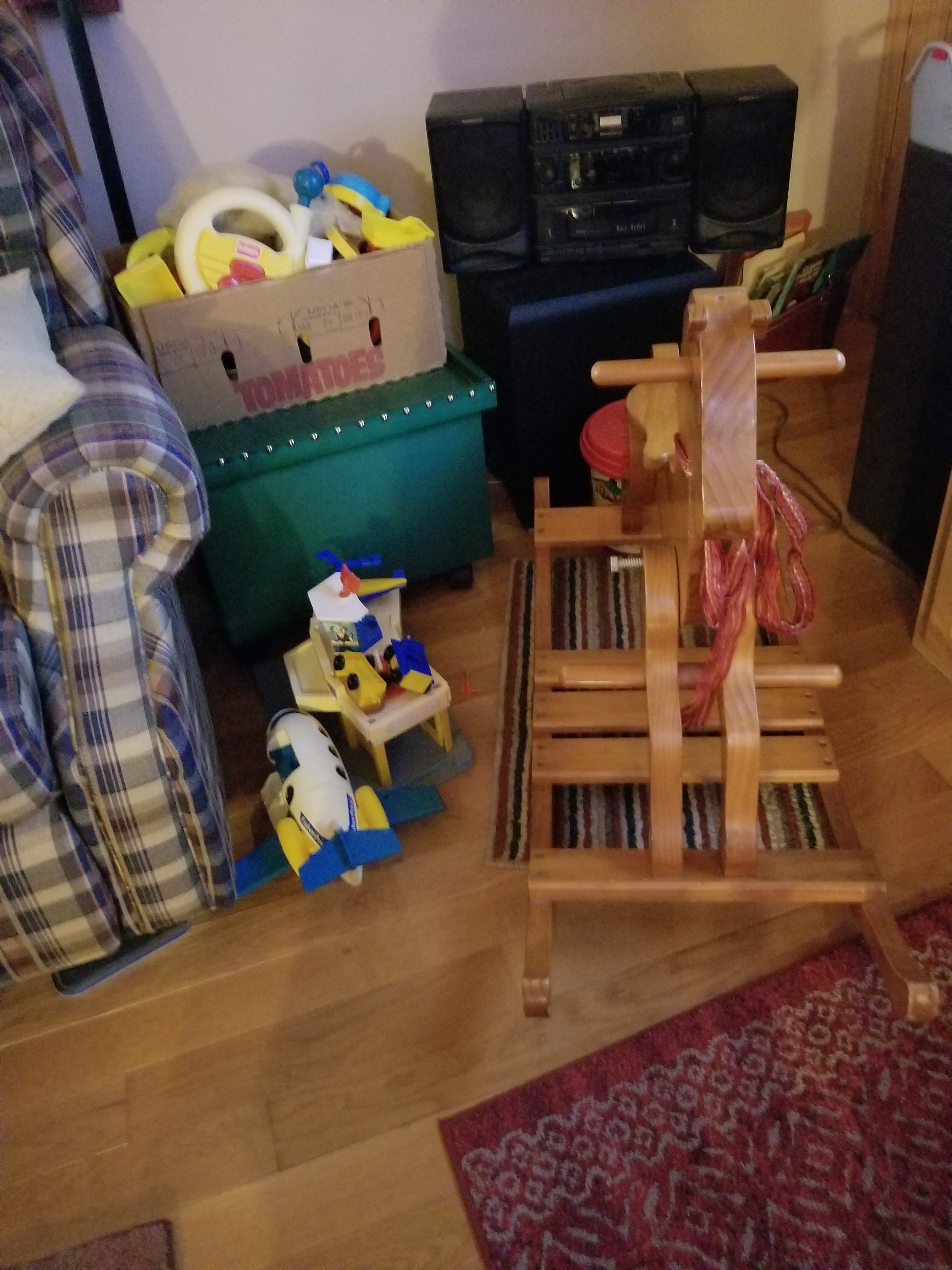
Order has mostly been restored in the toy corner.
The toys, books, and dirty dishes have been mostly cleaned up and put away after a 24-hour whirlwind visit of three grandchildren and their parents. All five of our grandchildren (in two families) live two to seven hours away. But signs of the brief visit of one family linger over into Monday.
Ever since we enthusiastically entered the grandparent years just six years ago, we alternately savor and go through “the morning after” melancholy that breathes in each room. Everywhere there are remnants of a too-brief but always-welcome stay.

Remnants of diaper changes remain.

The too-short pants that filled in for the three year old.
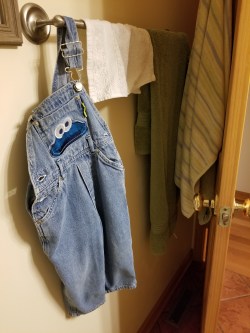
We strip beds, pick up the remaining odd plastic egg or baseball glove, and I spy the Cookie Monster overalls hanging in the guest bathroom. The story there was that three-year-old Henry got a mess of spaghetti on his blue jeans at supper. Since it was just a 24-hour pop-in, they didn’t bring a lot of extra clothes. The house was newly chilly with the first real days of fall, so I pulled out a pair of overalls I keep on hand just in case. The pants were about six inches too short for the lean and lanky almost-four-year-old, but he LOVES Cookie Monster so he happily padded around the rest of the evening in those pants.
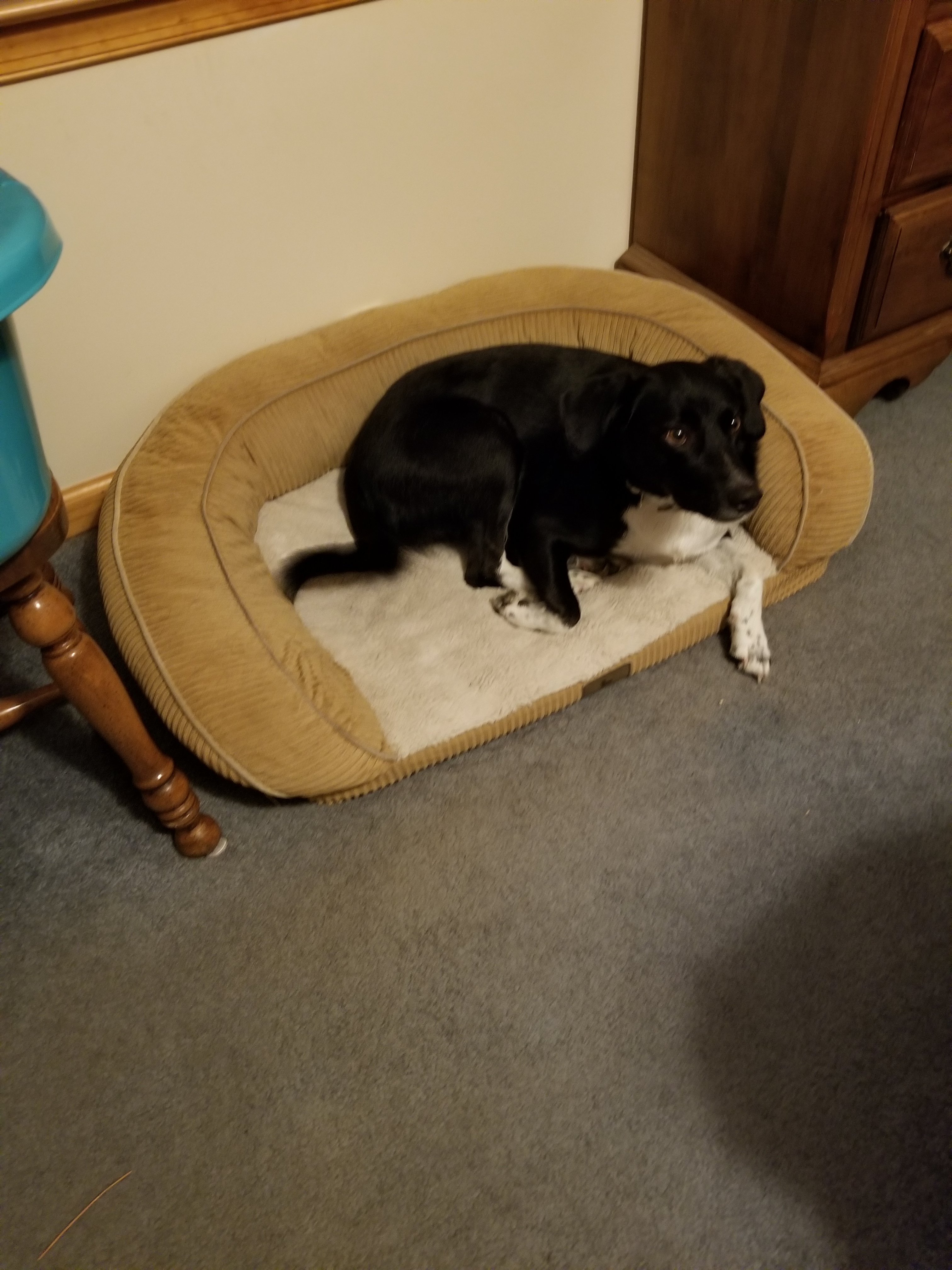
Velvet seemed happy to reclaim her bed.

Grandma won’t mind if I empty the wastebaskets for her, will she?
The next morning, I loved watching the just-turned-one-year-old scoot from room to room doing a great army crawl, mostly on hardwood floors. In our bedroom as his parents got ready for my daughter’s 20th class reunion picnic lunch, he gleefully flopped himself into the dog’s cushy bed, much to my chagrin. I painstakingly ran the lint-picker-upper over his outfit. Now on Monday morning, the dog has rightly reclaimed her dog bed.
How can my oldest daughter have graduated 20 years ago already? It’s a question I pondered frequently that weekend. We marveled that some of her classmates had children who were already college-age, and here they are still chasing children in spaghetti-clad overalls and doggie-haired rompers.
On Saturday night, we wrangled the boys through dinner, baths, and bedtime. The evening was not without frustration and lost tempers—including my own. We raised three girls. Our girls had their own trials and temper tantrums I suppose but those memories are now foggy of mostly mild misbehaving. I apologized to the little one who triggered me losing my cool—who soon had his pajamas on thanks to an older brother’s help.
In my own defense, granny was exhausted too: it was also our Lions Club pancake weekend. My husband and I together worked a total of 34 hours over four days: getting things ready and then making and serving the sausage, pancakes, and gravy to hundreds of good folks. Pancake days always come homecoming weekend for our high school—the pancake sale being a tradition the locals look forward to. It was always hectic when our kids were in marching band too, and those weekends we also squeezed in watching their parade and halftime show, rushing away from Lion clean up duties. Now we dutifully try to take our turn making sure we don’t leave the pancake sale until the last pan is cleaned and the cooking tent is stored for another year. Yes, bone tired, and for me, a hangover headache the next morning. Not from alcohol but just too much going on.
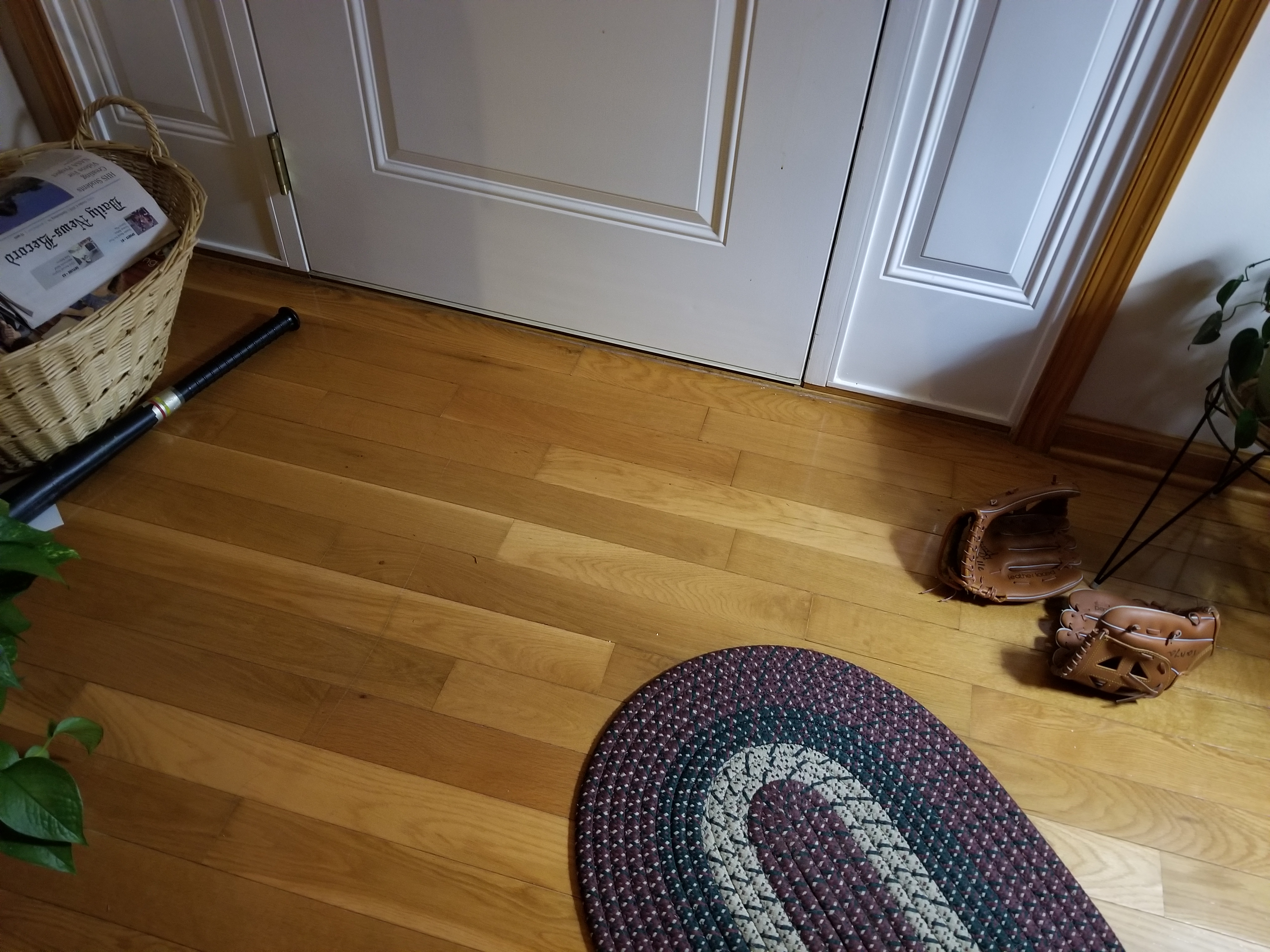
The mitts and plastic bat are right where some little boys left them.

Our favorite place as we wait for Mommy and Daddy to finish packing.
But by the time my daughter and husband are packing to leave around 1 p.m. on Sunday, hubby and I spend 15 or so minutes minding the grandchildren as they swing with us (go high Grandma!!) on the beloved porch swing, or race each other on the lengthy porch. Our little crawler cuddles safely on our laps. Henry launches slowly into a poetic description of the sights he is seeing as we swing on this windy day: “The trees are moving, the leaves are falling, the flowers are waving, the flag is blowing.” I compliment him that it sounds like a poem and he says, “What’s a poem?” Older brother and I try to explain it and I wish for a pencil to capture his words. Later I try to reconstruct it for his mamma and I think I’ve got more or less what he said—at least the spirit of his surprisingly poetic construction.
Ah yes, a budding writer, maybe. Or a ball player. Or just an ordinary boy whose words tug around my heart and make me wish for more golden October days and hours with all five of our grandsons—even when they act ornery or contrary or are just too tired to get their pajamas on.
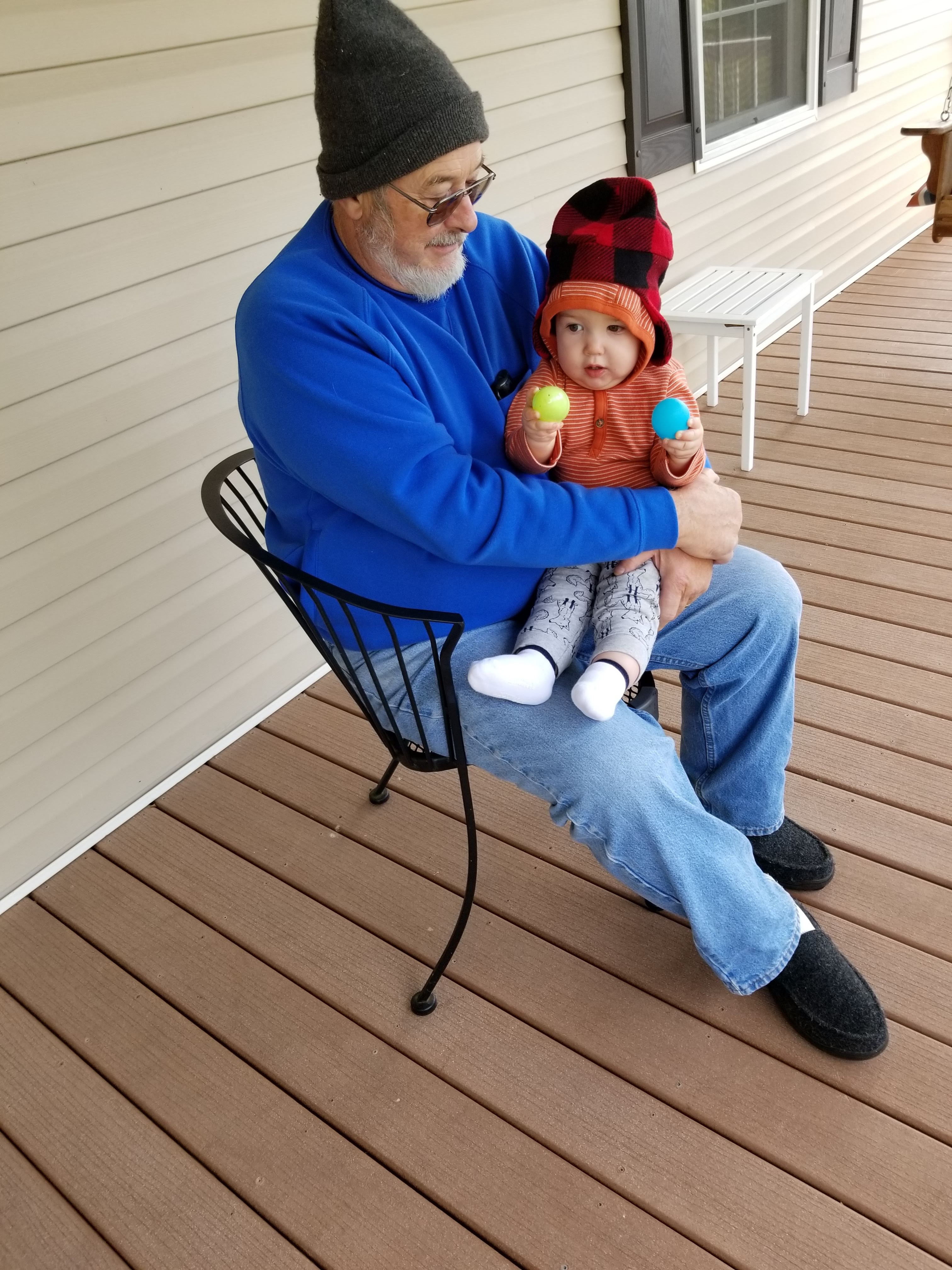
Waiting for the Easter bunny? The one-year-old somehow loved these little eggs in his hands and wouldn’t let go.
What marvelous and beautiful gifts these little boys are! We are so thankful. We love them all.
***
Sweet and tender, or tired times: share your ups and downs here!
***
When did your children or grandchildren surprise you with something they knew or did or loved?
I’d love to hear any sweet or fun stories from your children or grandchildren, with permission to quote them in a future column. As always, you can comment here or send to me at anotherwaymedia@yahoo.com.
Another Way is a column by Melodie Davis, in syndication since 1987. She is the author of nine books. Another Way columns are posted at FindingHarmonyBlog.com a week after newspaper publication.
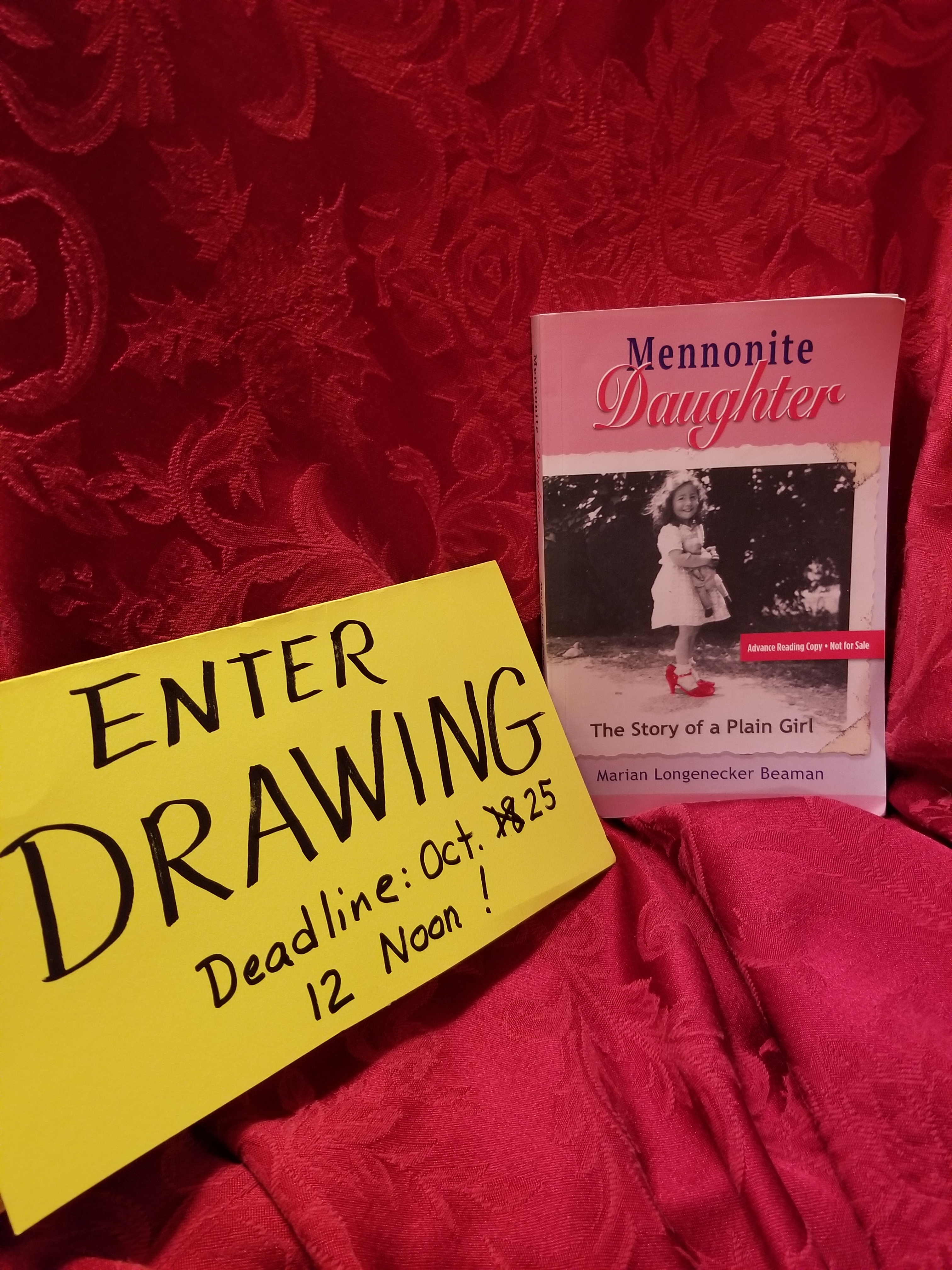
Be sure to enter our drawing for one free copy of Marian’s memoir! See directions below.
Another Way for week of October 11, 2019
A Gentler Time? Growing up Plain
I love biographies, autobiographies, and memoir—including the memories of ordinary citizens. When we read a memoir, don’t most of us look for epiphanies and connections that may be similar to our own lives or upbringing?
Marian Longenecker Beaman’s debut book, Mennonite Daughter: The Story of a Plain Girl takes the reader through early childhood events and memories—some of them funny and heartwarming and others that are painful: difficult to take and understand.
Early on I was drawn to Marian’s “Plain and Fancy” blog telling some of these stories. We have the same alma mater, Eastern Mennonite University, but she grew up as a very conservative and plain Mennonite in eastern Pennsylvania while I grew up in a less plain Mennonite community in Indiana a few years behind her. But I also frequently felt different than my peers, wearing dresses all through elementary school along with pigtails and no cut hair until I was about 12. We also both eventually married men who weren’t Mennonites and found new church homes where we practice an active faith.
Marian is a former college English professor, so her writing is crisp and descriptive, with careful and precise word choices that bring alive the action, color, and flavor of growing up a plain Mennonite in Lancaster County, Pa. She lived in an area and era where women especially were expected to dress and behave very conservatively, although she was not Amish or Old Order. Marian chafed under the restrictions and as the oldest child, somehow her father tended to make an example of her. Later as a beginning teacher in the conservative Lancaster Mennonite High School, before church rules began to change regarding dress, she also had scrapes with the school administration.
But her relationships with her mother, grandmother, and an aunt who never married seems to be the balm Marian needs to survive and thrive through her growing up difficulties. She portrays fun and hilarious experiences with her sisters, a brother, and cousins which balance the strain the restrictions put on her spirit in a mid-century Mennonite home. The children play bride and groom clomping about in the bright red shoes portrayed on her book’s cover. Her aunt actually experiments with taking home movies, to the delight of the children. Her exceedingly frugal father eventually buys Marian a beautiful violin—but without ever consulting Marian regarding whether she would enjoy taking violin lessons. She ends up loving to play, including in her public high school’s orchestra, but is confronted with a dilemma when she does not want to stick out like a plain girl when all the other girls have beautiful dresses to wear. Her mother comes to the rescue and sews a suitably “fancy” dress that fits within the confines of their church rules. Marian is elated to blend in with others on stage: a high moment in the memoir.
Marian started her “Plain and Fancy” blog about the same time I began mine, “Finding Harmony Blog.” We regularly exchange comments on each other’s posts and I truly hope we can meet in person someday. But meanwhile, observing that I was/am an editor and writer for a lot of years, she asked me (and others) to go over her memoir manuscript in an early “beta” stage as they say. I gave her feedback and now I am delighted to see that the memoir has earned great reviews on Amazon and Goodreads and other places, which helps many others know about an author’s work. Even an author who was once a plain little Mennonite girl, emotionally surviving what we sometimes want to call “a gentler time.” Some of the confrontations Marian went through were hardly gentle—painfully cruel and rough.
Mennonite Daughter comes to a satisfying conclusion as Marian matures into romance, career, and a faith community that fits her spirit and ambitions—free to be the person she wants to be with peace about her past. And the teacher in her still enjoys loving and guiding precious two-year-olds at her church. I feel that many Another Way readers would enjoy this well written and historical glance into a plain culture many wonder about.
***
Is there anything I’ve written about Marian’s book that especially resonates with you? Marian and I both would love to hear!
***
You can enter a drawing for a free copy of Mennonite Daughter (deadline Oct. 25) by commenting here on my blog. You can even just say something like “I want to win Marian’s book.” Or, you can send a comment to me at anotherwaymedia@yahoo.com or Another Way Media, P.O. Box 363, Singers Glen, VA 22834, to be entered in the drawing.
Deadline: I will draw the winner’s name on October 25 at 12 noon, so be sure to send your name or comment as soon as possible! Winner will be announced here and on my Facebook page: melodie.m.davis. I will contact the winner to get her/his mailing address.
You can also visit Marian’s blog for more info on this book: https://marianbeaman.com/.
***
Another Way is a column by Melodie Davis, in syndication since 1987. She is the author of nine books. Another Way columns are posted at FindingHarmonyBlog.com a week after newspaper publication.
Another Way for week of October 4, 2019
To Save a Life
Two bare-chested male mannequin halves were laying ready on the table as we walked into the training room. An assortment of first aid supplies and gloves were on the tables, for each of us five “students.” Suddenly I pondered the wisdom of signing up for this class. Could I ever perform CPR on someone who desperately needed it? What had we gotten ourselves into?
My husband and I recently learned various first aid skills in an American Heart Association course, taught by a friend from our Lions Club, Fred Shobe. Fred is the safety director for a local large company, Trumbo Electric. We spent six hours learning cardiopulmonary resuscitation (CPR), using an Automated External Defibrillator (AED), and responding to other emergencies such as choking, low blood sugar, bee stings, snake bites, tick bites, applying a tourniquet, delivering a shot with an “Eppy” autoinjector, and more.
I’m not going to try to repeat the training here, that would be impossible and not advisable. But I’ll share highlights.
There are numerous ways anyone can be helpful at the scene of an accident or after an apparent heart attack, cardiac arrest (two different things), stroke, fainting, seizure, and more. Some of our drills included learning and then practicing these basic steps:
1. Take a few seconds to quickly assess the scene, making sure it is safe so that no one else gets hurt. This could be shutting off a mower or weed eater, moving objects out of the way, etc. and having people stand back to give you and the victim room.
2. Figure out if the person is breathing/responsive: Tap on his chest and say, “Are you ok?” If there is no answer, yell for help, or if someone is there with you, have them call 9-1-1. Also send them to find a First Aid kit, and an AED if available.
3. Try to assess if the person has stopped breathing or is only gasping. If no one steps up, call 9-1-1 yourself and put your phone on speaker so you can talk to a dispatcher without the phone in hand. A dispatcher is trained to talk you through basic CPR until more advanced emergency personnel arrive. Never hang up from the dispatcher until they tell you to do so. It helps to always be aware of the address or area you’re at, to provide as complete a description of your location as possible. Someone else can go meet the EMS (Emergency Medical Services) and direct them to your side.
4. If the person is not breathing, start CPR (30 compressions and 2 breaths per set if you know how). Continue doing this until either an AED is provided, or EMS arrives. An AED attempts to shock a heart back into its normal rhythm. Once an AED arrives, turn it on. It will talk you through the proper steps of using it. You will need to remove or cut open the patient’s shirt or top for the shock pads to be stuck to the chest.
5. Or, if the person is breathing normally when you first check their breathing, then look for blood from an injury, possible broken bones, and medical jewelry or medical tattoo. The person may be diabetic and lost consciousness from low blood sugar. Stay with the person until EMS arrives, and if bleeding, use first aid to stop the bleeding. Let the EMS take over once they arrive.
As the only woman in our training group, I started to worry about the instructions to remove or cut open the person’s shirt or top in an actual emergency. Did that mean women too? Of course. Our instructor added that you may need to cut open the front of a bra especially if the bra has an underwire. (The wire’s conductivity could mess with the electric shock of the AED.) He added that if there are bystanders or others helping with the rescue attempt, they could assist by holding up blankets, towels, or sweaters to help give a female patient some privacy. Obviously, medical emergencies are not a time to worry about baring all.
I appreciated all we learned. Just knowing what is involved is helpful; how to assist someone giving CPR or other first aid can also be lifesaving. Just a little over a year ago, my great-nephew collapsed on the high school football field. The person administering CPR had just had a refresher course, and the quick action of all involved—including those who helicoptered him to a nearby university hospital, were credited with his recovery. His family was so very grateful to God and the staff who stepped up. Fred emphasized that every minute that passes for a person who needs CPR and is not receiving it, their rate of survival diminishes.
***
For one resource, check this video on YouTube: CPR/AED Emergency Response Refresher.
I invite you to share your emergency story by commenting here, or sending to anotherwaymedia@yahoo.com or Another Way Media, P.O. Box 363, Singers Glen, VA 22834.
Another Way is a column by Melodie Davis, in syndication since 1987. She is the author of nine books. Another Way columns are posted at FindingHarmonyBlog.com a week after newspaper publication.
Another Way for week of September 27, 2019
Learning with Children with Autism

Mr. Scott Showalter on an unbearably hot day when the air conditioning was off, but determined to dress up for the “Lion King” theme!
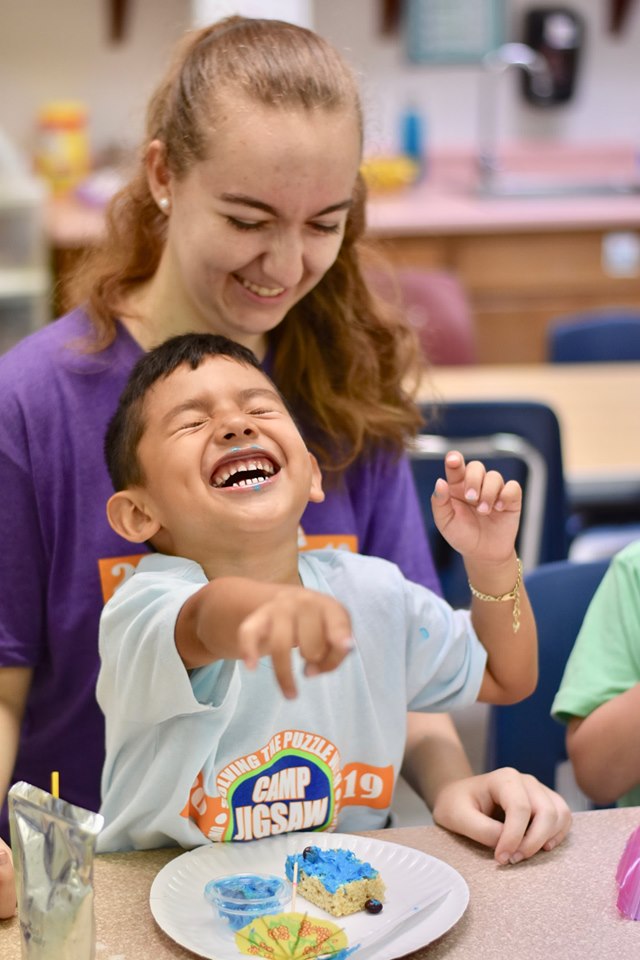
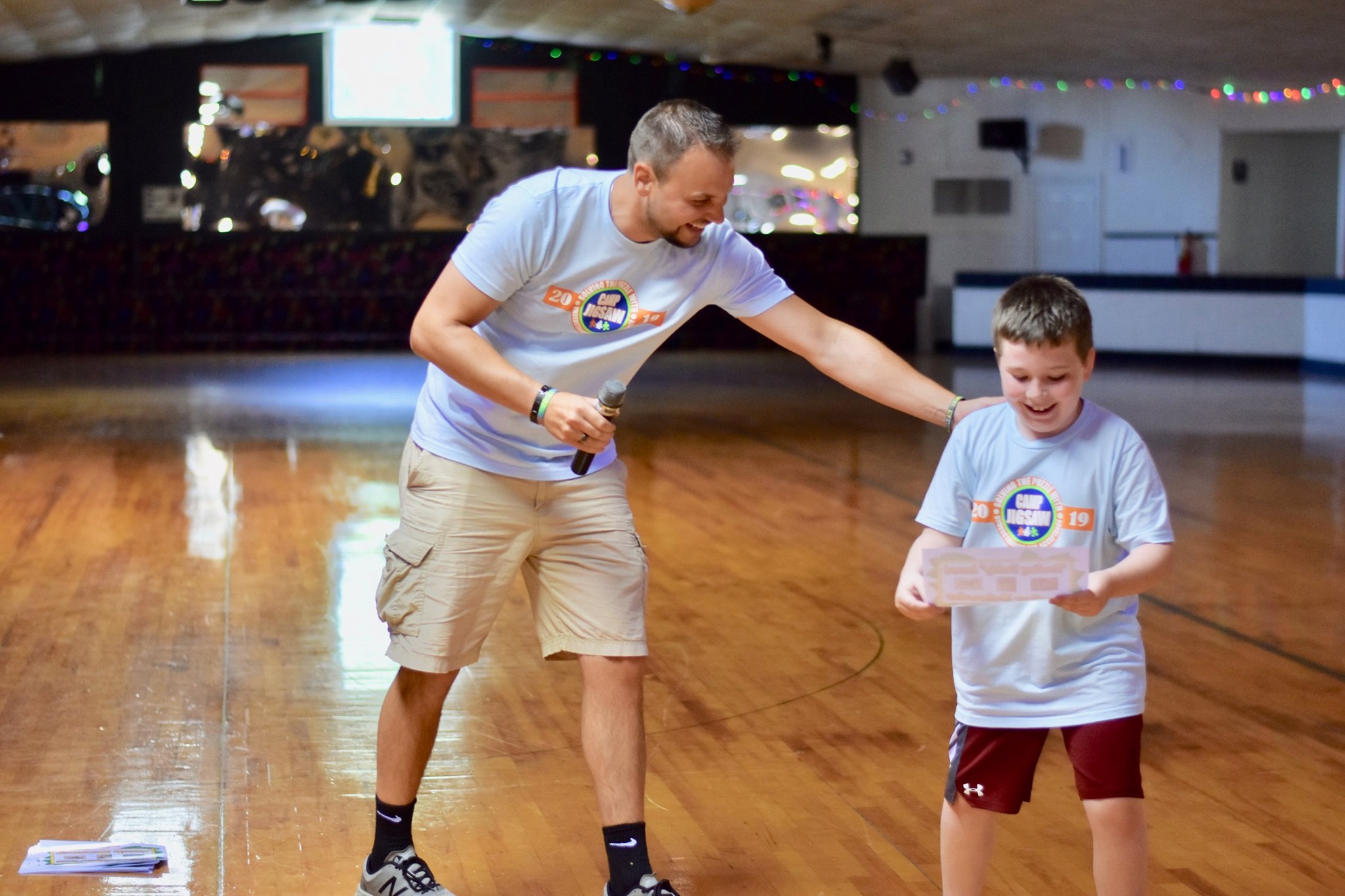
Mr. Showalter holds the 20 or so daycampers of Camp Jigsaw spellbound as he chats with the puppet on his one hand, doing a pretty fair ventriloquist imitation. The love and skill he has for interacting with children who sometimes just can’t handle sitting still or being quiet or waiting for their turn, flows from him and over the room.
One of the highlights of our summer was volunteering two weeks (my husband) and one week (me) to help with a half-day camp for children at various places on the autism spectrum. Neither of us are professional educators or had any experience with children with autism although we’ve known some families with specific issues.
The camp was for children kindergarten through grade 5, and organized because kids with autism issues often feel like they don’t fit into a traditional summer day or overnight camp. So they miss out on the fun of other kids. This camp was held at a local elementary school.
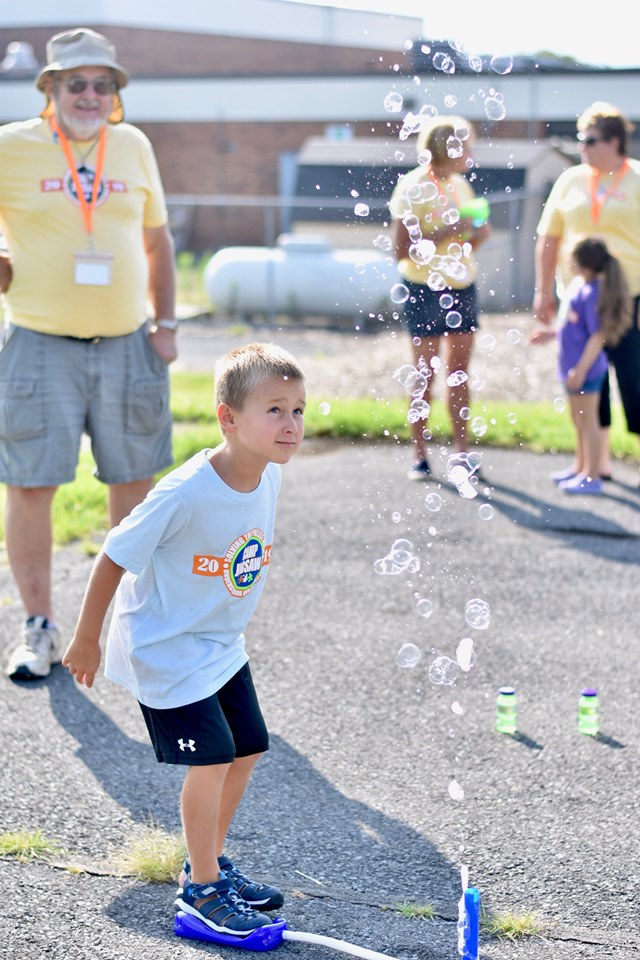
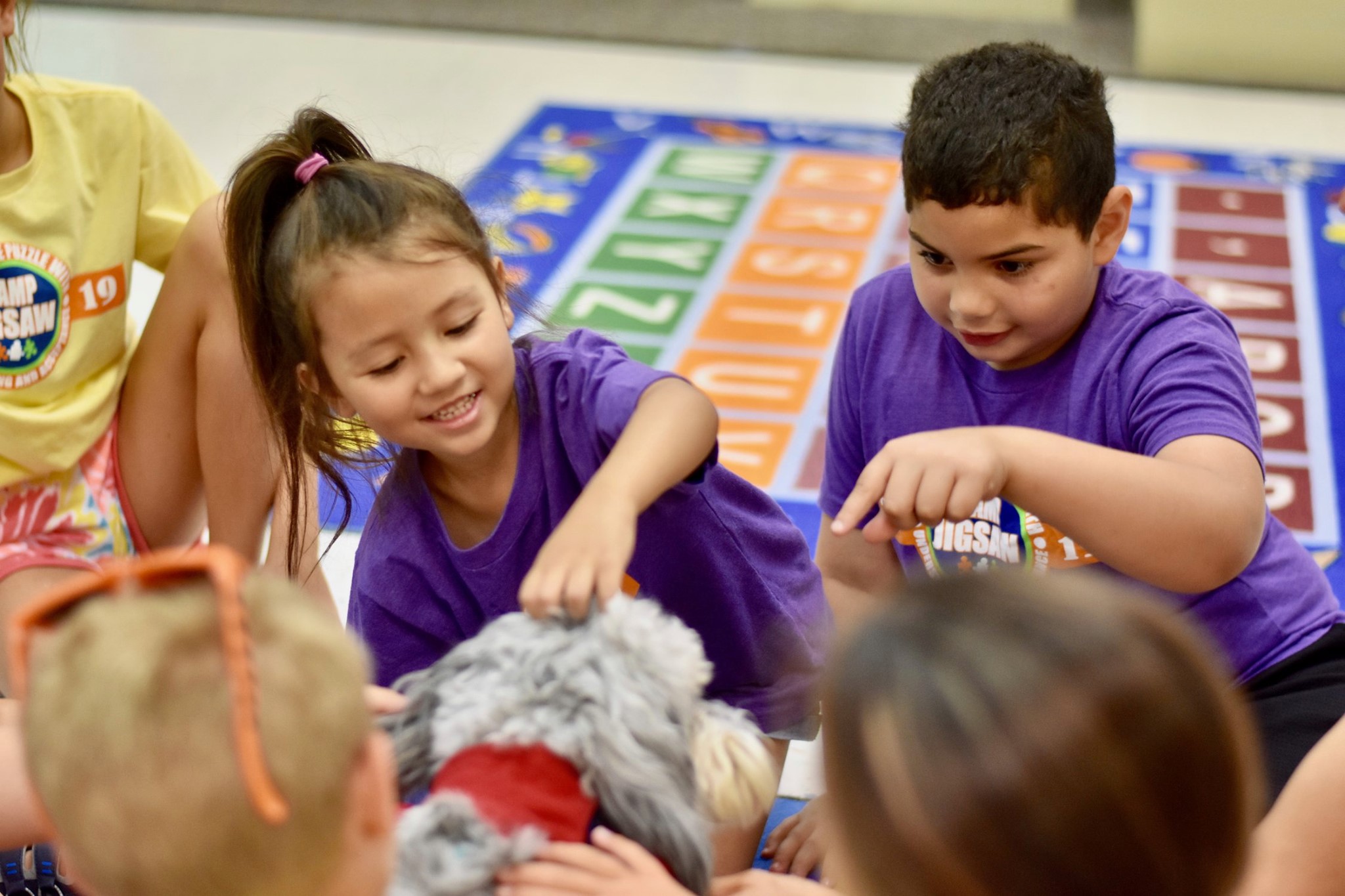
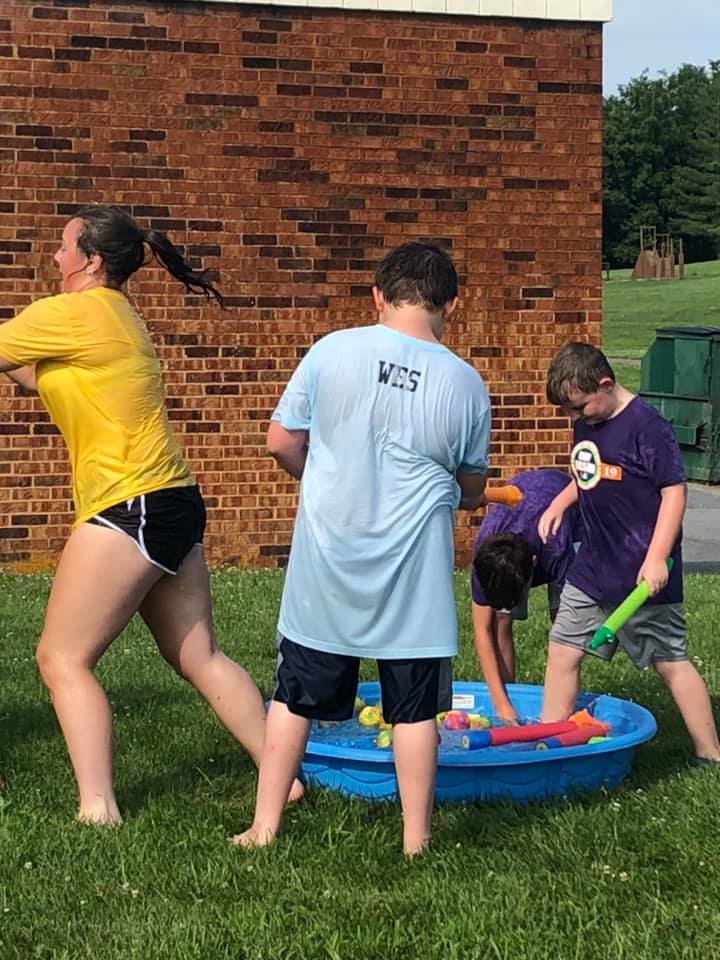
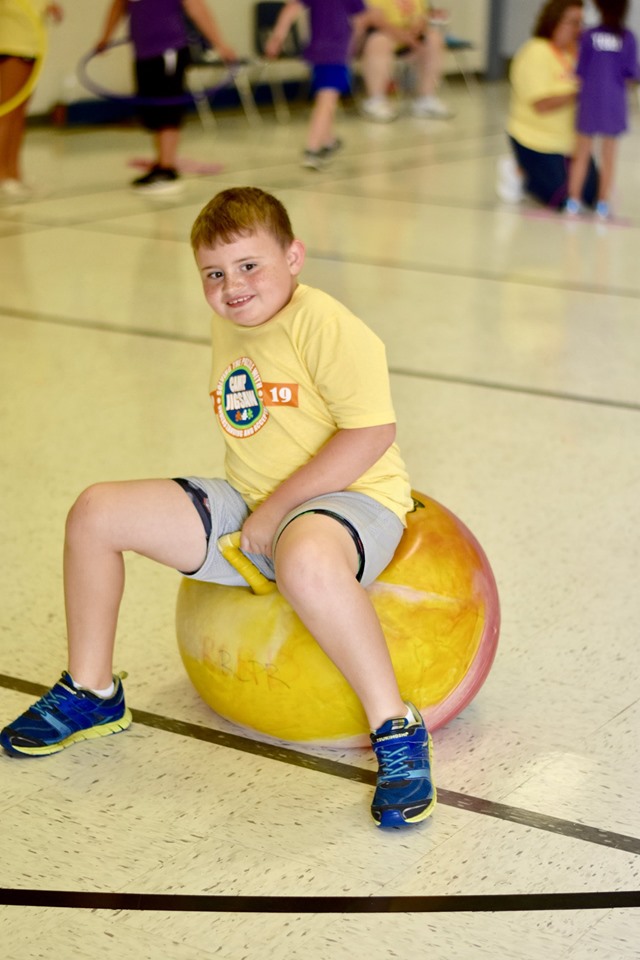
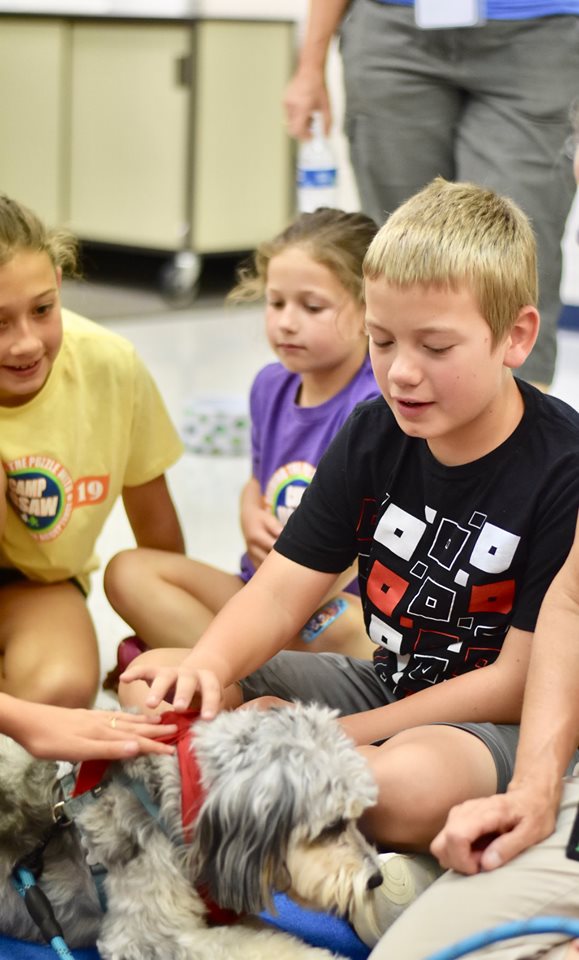
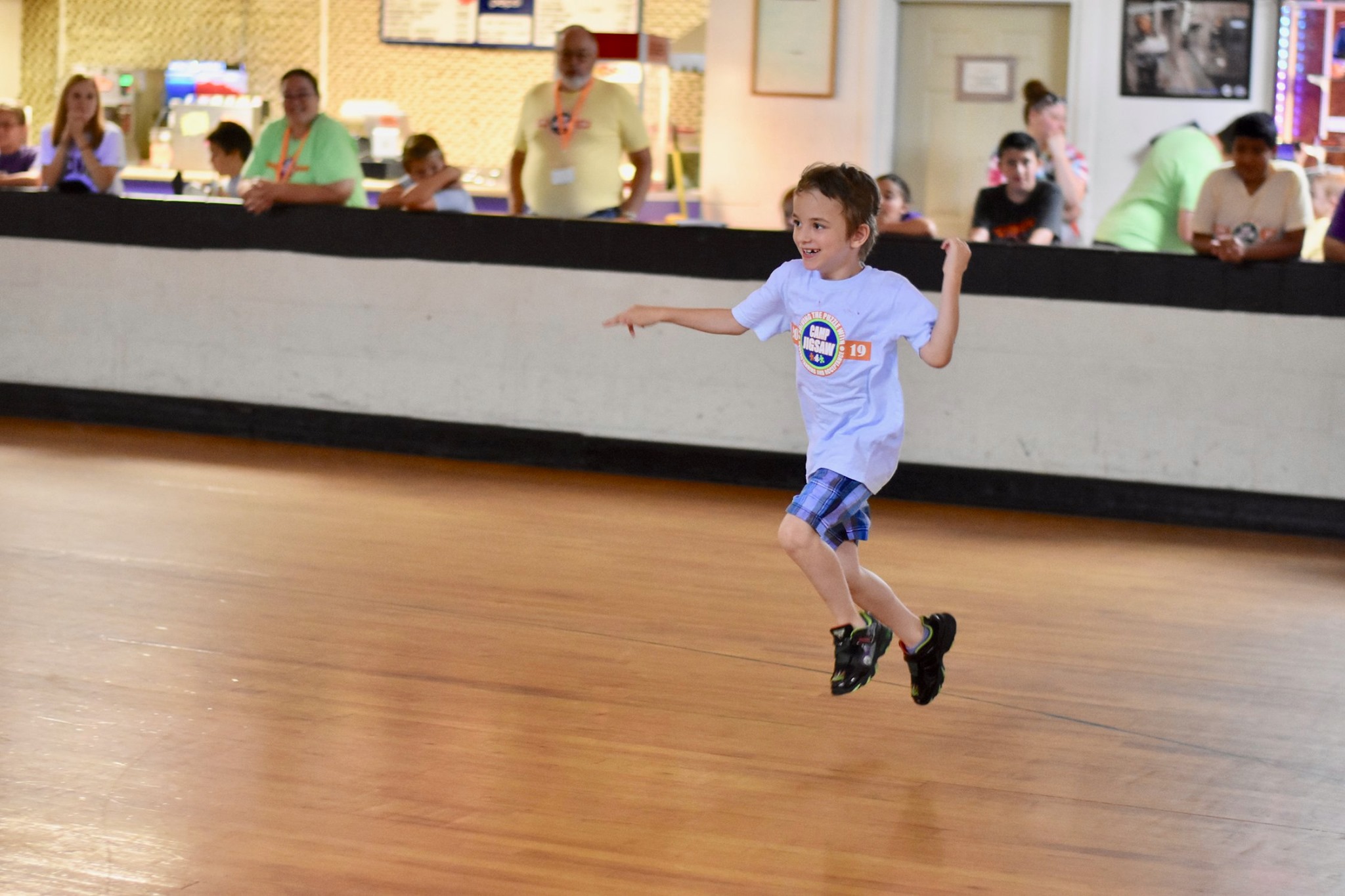
We had a lot of good old-fashioned fun, becoming kids again ourselves. There was gigantic bubble blowing, water fights, magic shows, time with a therapy dog and trainer, Kung Fu artist giving lessons, daily snack time, yoga, water balloon baseball, old fashioned storyteller, bowling, roller skating (many children for the very first time), a jump park and large local water park, making music, rock painting, dunk tank, relay races, balloon animals, cooperative games, and playing Twister on a mat covered with shaving cream. The program for this camp is free for families; volunteers, organizers, civic clubs and churches raised funds and donated snacks and other supplies. Some invited speakers and performers donated their time.
We found ourselves not only enjoying the activities with the children, but that interacting with them and the other adults was eye-opening, educational, and a “Mister Rogers” review of things like being kind. Having good manners. Saying please and thank you more often. Since children on the autism spectrum are frequently frustrated by issues which keep them from being like their classmates and friends, learning ways to de-stress or cool off was another learning.
If we “caught” a child being kind or doing something nice for someone else, we rewarded them with a small plastic gem, and each day there were total goals set for the gems children accumulated. If the group of children reached the number set for that day, they each received a simple take home prize—such as cheapo plastic sunglasses, binoculars, safari hats. If you are thinking: rewards—what a gimmicky way to get children to behave and cooperate! The counselors remind us: don’t you (or didn’t you—for those retired) also work for the reward of a paycheck? Yep.
My husband signed up first after our friend Joe had experienced an awesome two weeks last summer with the inaugural camp—he called it life changing. It was a great success for children, parents, teachers, and schools. This camp was for kids from four elementary schools in our area and we’d love to see other areas follow suit. The founder and spark plugs behind the day camp include Scott Showalter mentioned above, with pre-kindergarten teacher Holly Blais, (who first worked at a camp for children with autism in Pennsylvania), and Jill Rice, speech pathologist. Each camper had an adult volunteer alongside, plus numerous middle and high school mentors who participated in the fun.
Scott would open each morning’s activities with a motivational speech setting out some goals for the children, such as being a participator, communicating with others, staying in the activity space, and being polite. One morning as he huddled with us as volunteers and leaders before campers arrived, he shared how he and his wife have a dog Bella “whose daily life consists mainly of being in the house, in the back yard, or occasional walks or trips. But every morning she can’t wait to start a new day. She jumps on our bed and wiggles all over to wake us up, just as excited as she was the previous day.” The Showalters find her exuberance exciting—even if they’d sometimes appreciate sleeping a little longer.
Showalter encouraged us to face our new day with the daycampers with the enthusiasm of a lively dog. This advice was very apt, as some volunteers had to deal with outbursts or meltdowns of children.
Ready for a new day? Bring it on with the energy and eagerness of a young dog. And remember your manners, even when your day doesn’t go as hoped. There are lessons to be learned!
Perhaps the best way to get a feel for what we experienced is to simply share these photos, mostly shared by Sydney Coffman and Ruth Breeden Sonifrank.





For a free booklet, “Dealing with Autism as a Family,” email me at anotherwaymedia@yahoo.com or Another Way Media, P.O. Box 363, Singers Glen, VA 22834.
Another Way is a column by Melodie Davis, in syndication since 1987. She is the author of nine books. Another Way columns are posted at FindingHarmonyBlog.com a week after newspaper publication.
Another Way for week of September 20, 2019
Discovering More than Gold in Alaska – Part 2

The eerie landscape of Denali National Park, many streams of sediment flowing from the melts.
The fog and mist linger much of the day, lacing the trees and mountains in an ethereal, otherworldly haze. Later in the day, it rains off and on, making the chance we’d see the peak named Denali—highest on the North American continent—nil to nothing.

Some of many white caps we saw, especially in Glacier Bay.
The weather overall was so rainy that even though we should have seen Denali (the native word means “the high one”) as we traveled into the Denali Park Preserve by bus (the only way you’re allowed to travel deep into the park), we didn’t. I was disappointed but not crushed, knowing it would have been somewhat rare–only about 20-30 percent of visitors end up seeing Denali. We saw many other beautiful mountains.

The six travelers sitting down for a formal dinner.
How do you capsulize 12 days of amazing travel? Do you tell about the gorgeous, exciting and educational aspects, or do you reveal the things that went wrong (leaving your little bag with your passport on a souvenir store counter)? If you missed last week’s column, my husband and I were delighted to finally travel to Alaska with some of his family. Most of our group have had various serious medical issues these last few years, but none had unsurmountable problems on our trip, thank God.

My biggest surprise: gorgeous flowers everywhere in Anchorage and elsewhere, gift of summertime’s very long days and rays.
We spent our first six days on land, visiting natural attractions beginning at Fairbanks near the Arctic Circle, and eventually took a sightseeing train to Anchorage on the Gulf of Alaska.
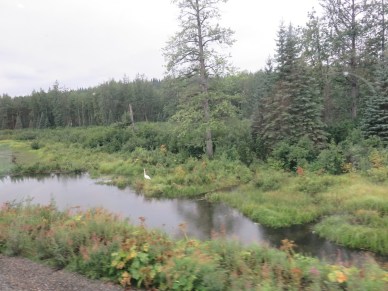
Trumpeter swan. Author and NPR reporter Heather Lende says they sound like a middle school student learning to play trumpet. I can hear that!
Overall the scenery in Alaska was stunning, powerfully bringing to mind the creation of the world. It was an intriguingly sparse landscape—often covered with gray sediment from water washing over rocks and eroding river banks. Only six types of trees grow in Denali Park and much of the interior of Alaska. Permafrost keeps the ground too hard for some tree roots to edge down deeper. We saw white and black spruce, quaking aspen, paper birch, larch, and balsam poplar. My biggest surprise was seeing some of the largest flower blossoms I’ve ever seen, on the streets of Anchorage and other ports: they grow huge because of long summer days. Also a nice surprise: very kind and helpful locals in Anchorage when one of our travelers took a spill on a city street.

Our grizzly in the wild, seen from busy windows.
Highlights were watching a black grizzly for a good ten minutes (safely from our converted school bus, and as quiet as 35 excited passengers can get) as he munched on leaves and crossed a stream; we also saw caribou, moose, eagles, a trumpeter swan.

Caribou with fuzzy antlers.
By mid-August the creatures were instinctively preparing for the coming winter. Speaking of winter, we were told it is almost unheard of for schools to ever close for snow! (Take that, Virginia, where we close schools sometimes before snow even starts. Yes, our hills and curvy roads can be treacherous of course.)
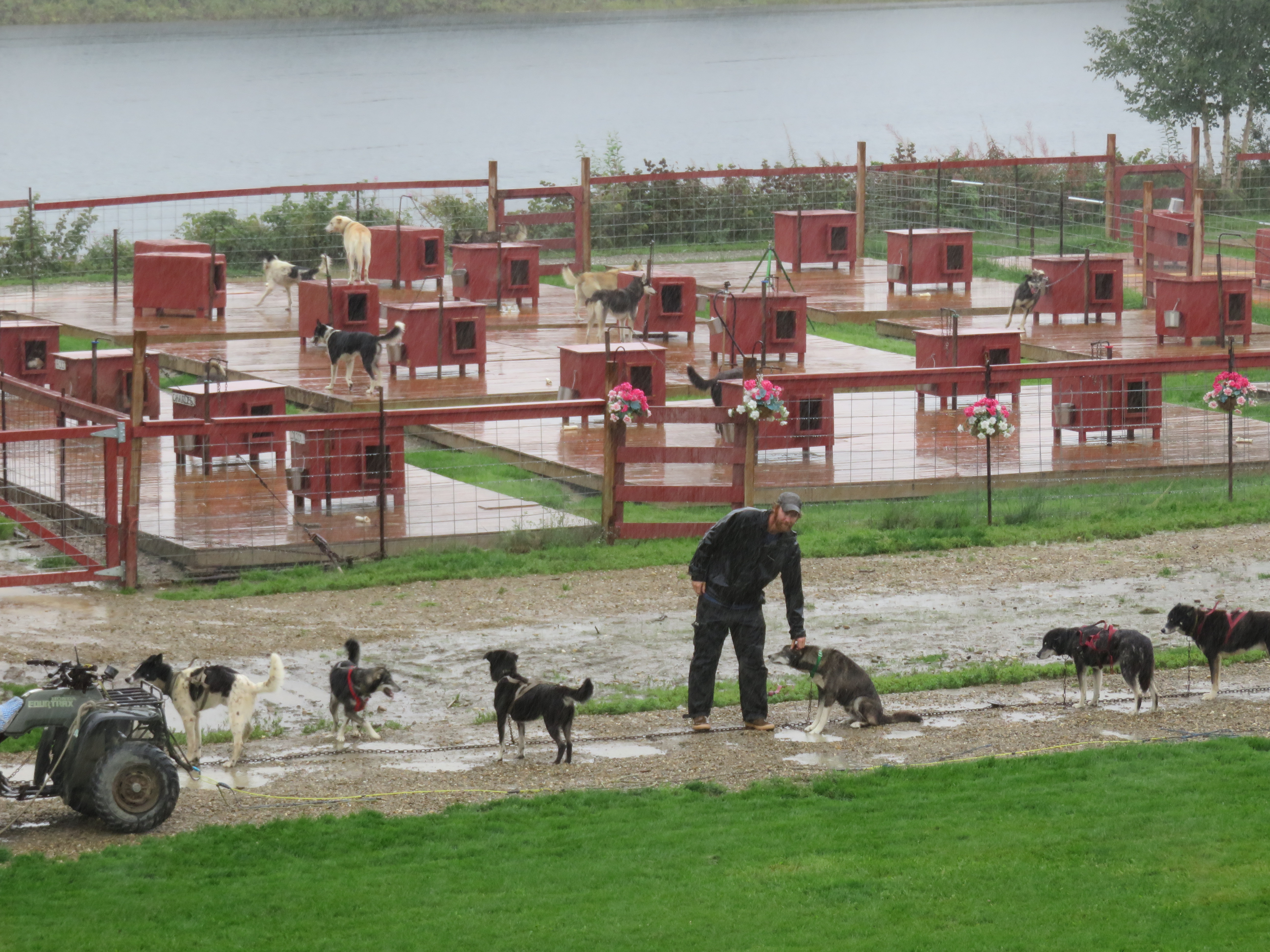
David Monson at his rainy home with sled dogs.
I also was intrigued watching the joy and exuberance on the faces of Iditarod sled dogs who were unhooked from their dog houses to pull an ATV beside our river excursion boat. The dogs adore running fast and being part of the pack. This was at the home of the late musher Susan Butcher, who died of cancer in 2006. Her husband, David Monson, explained the training process to us, assisted by his daughters. Susan was the second woman to win the Iditarod in 1986 and then won four out of five sequential years.

Grandma had to buy autographed books for her grandsons, telling the story of Granite, the amazing and beloved dog of Susan Butcher. Signed by her husband, David Monson.

Here’s the gold Stuart and I were able to glean from our panning! They gave us old film containers to store our treasure.
Last week I mentioned panning for real gold. What seemed like such a touristy thing to do turned out to be challenging and educational—learning how the dredging worked and how much gold and oil have helped the economy of the state. But panning was tricky: shaking the pan and rinsing the sand with water until only some gold flecks (tiny nuggets) remained. My husband scored about $25 worth all together.
Finally we boarded our cruise ship in Seward, Alaska, and followed the coast the next five days to four other ports—a great relaxing way to spend the second week. No packing and unpacking and moving every one or two nights, and no cooking or even making our beds.

Margerie Glacier was sobering to watch as ice constantly fell off into Glacier Bay.

Closer shot of Margerie Glacier.
In Glacier Bay, we watching solemnly as glaciers “calved” or broke up, lingering near Margerie Glacier. Someone who’d been there five years ago said the glacier had shrunk dramatically since he was there.
Only in recent days have I grasped how glad I was to share this trip with my in-laws. Sitting down to our reserved table in the ship’s gala dining room each evening, there was never a lack of conversation. Do you agree that family bonds—even though we don’t always agree—are the real gold?

Every day, the ship’s elevators told us what day it was. Probably the most common topic of conversation in the elevators. 🙂
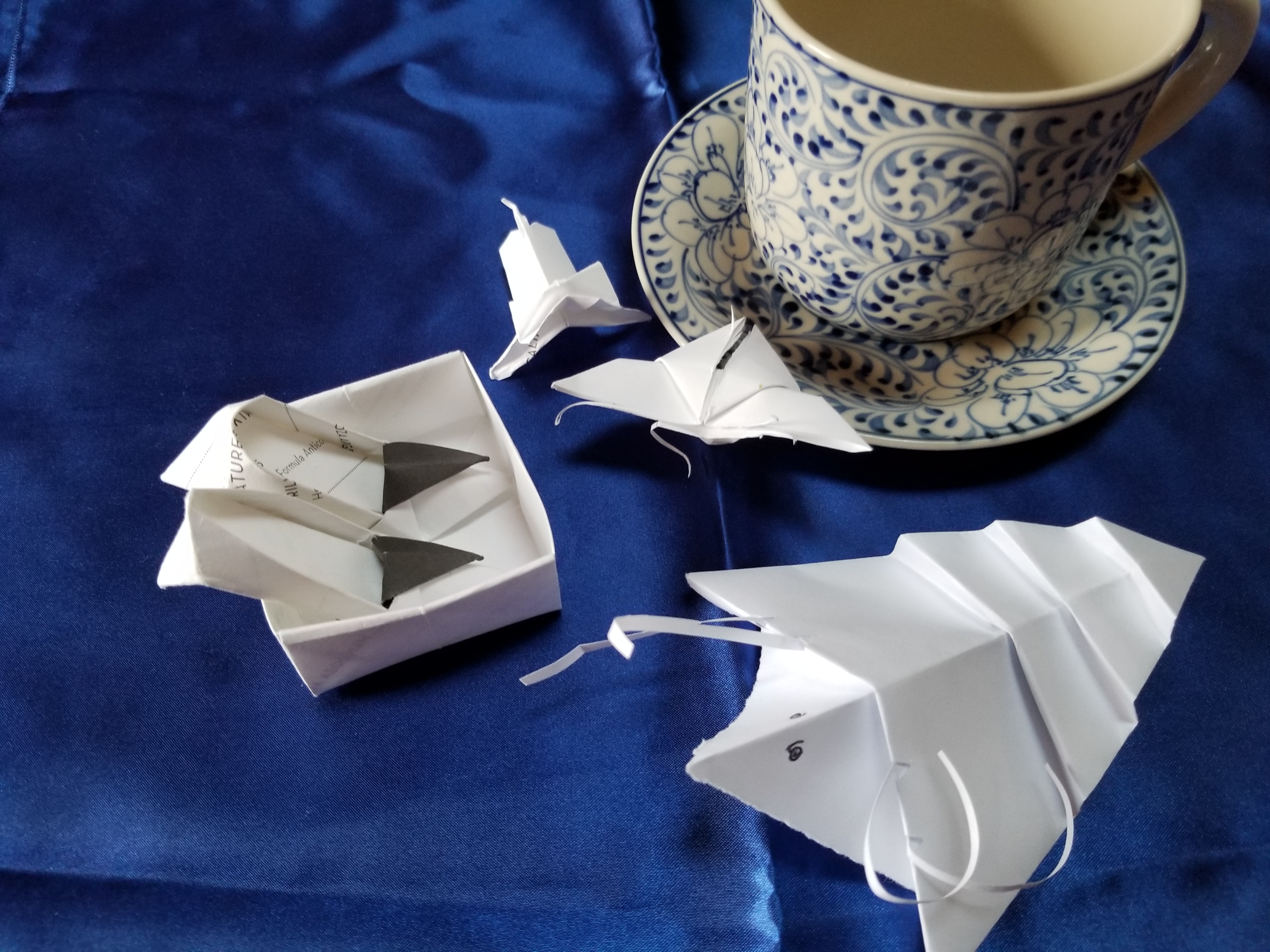
My favorite “take homes” — tiny origami art made by our sommelier: do you see a puppy, butterfly, lobster and why not: lady slippers?

Our favorite town, Haines, Alaska. Flowers all along the gangplank from the ship to the village. Since returning, I discovered a marvelous writer/blogger from Haines: Heather Lende. https://heatherlende.com/blog/
***
See a bit of the school bus tour at Denali National Park, very similar to the one we took: https://www.youtube.com/watch?v=TcwWnig7mcw. Or watch a clip from the same Gold Dredge #8 we visited: YouTube: https://www.youtube.com/watch?v=u5gWl4BX4Nw
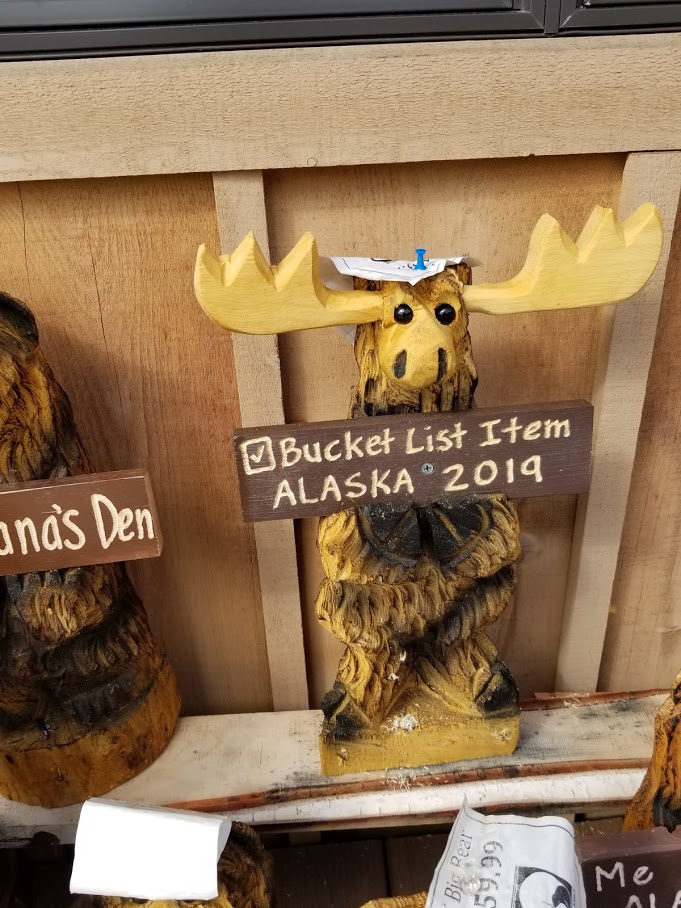
What’s on your bucket list?
Send your own adventure stories, questions, or comments to anotherwaymedia@yahoo.com or write to Another Way Media, P.O. Box 363, Singers Glen, VA 22834.
Another Way is a column by Melodie Davis, in syndication since 1987. She is the author of nine books. Another Way columns are posted at FindingHarmonyBlog.com a week after newspaper publication.


This was not OUR ship, but another seemingly sailing straight towards us. Obviously, he took a turn.
Another Way for week of September 13, 2019
We Found Gold – Part 1
After serious saving and waiting approximately five years, my husband and I were finally able to visit Alaska in August.
The Christmas of 2015 we told our kids not to give us gifts for Christmas but maybe give money towards an Alaska trip. The yen to go far north started for my husband a number of years ago when his father visited Alaska with his second wife who had relatives there (his first wife died in 1973). So we longed for the opportunity to also explore America’s “last frontier.”

Flag of our 49th state, at a real gold mine, Gold Dredge #8.
Alaska has a limited season for warmish tourist travel, (the prime time is really just mid-June to mid-September at latest), so that’s not a big window working around family schedules and priorities. We planned to travel with Stuart’s brothers, our sister-in-law, and a friend, so meshing all our family birthdays, events, and medical issues meant wondering “will we ever be able to pull this off”?
For one thing, Stuart and I wanted to wait until we retired so we wouldn’t burn two weeks of vacation days on one trip; then our middle daughter was expecting her second child the middle of one summer; then my brother-in-law’s youngest daughter was planning an early September wedding—not a good summer for parents of the bride to go on a big trip; finally last September our oldest daughter was expecting a third baby, and we needed and wanted to be around in case the baby came early. Plus the other grandma had already booked an Alaska trip last September and likely would not be around to help with the baby and older sons, and one of Stuart’s brothers was also scheduled for major surgery. So all that meant we waited. I doubt we’re alone with these kinds of issues at our ages.
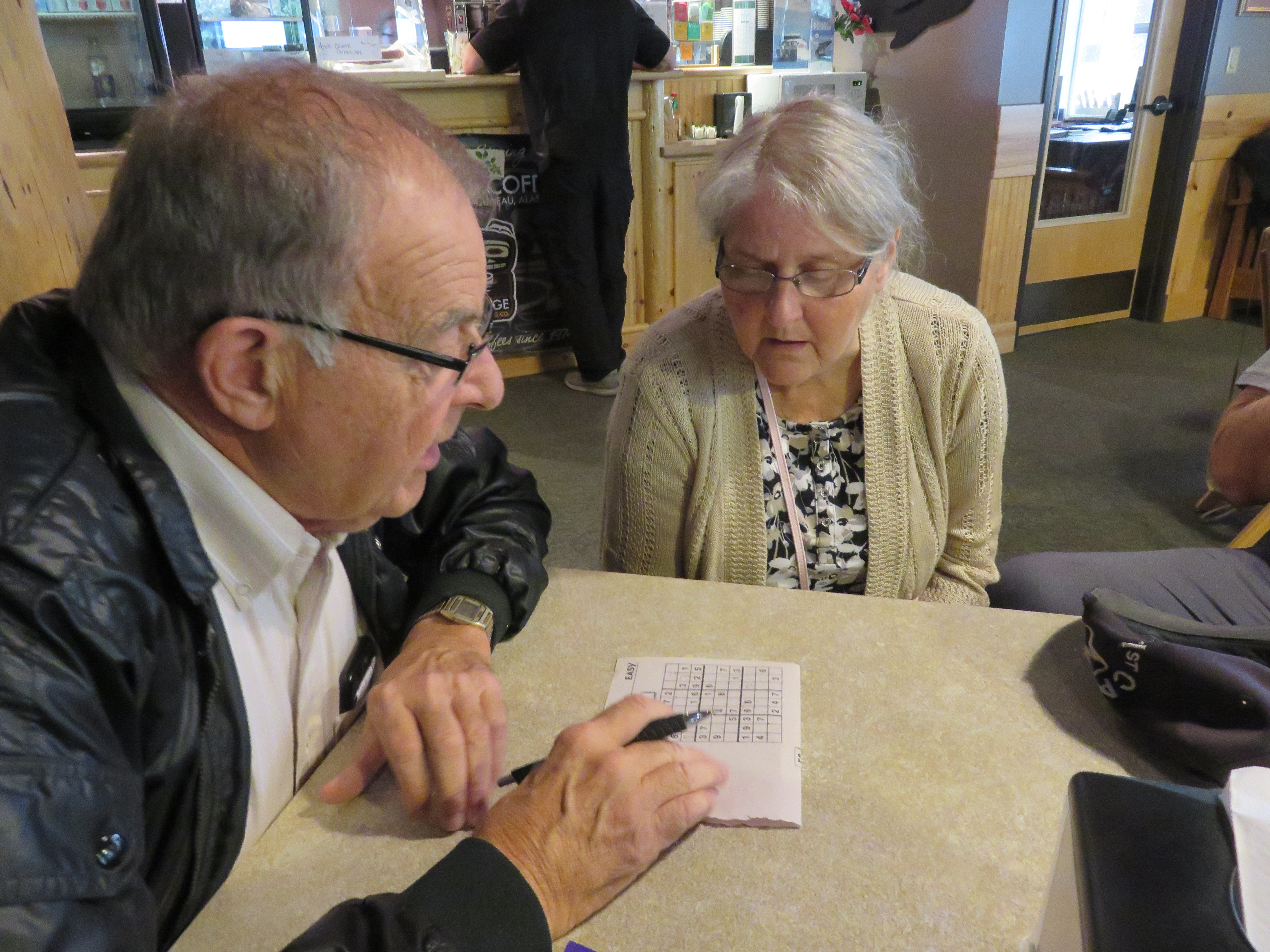
We spent many hours together over the winter planning for the trip with my brother-in-law here, and my sister-in-law. Here they’re not trip planning but Barbara was figuring out if she would ever enjoy doing Sudoku puzzles like Nolan. The answer? (What do you see on her face?)
But this summer we finally got “our” turn, and as we began planning in January there were many worries about “what if this or that happens” filling our darker hours wondering if the long anticipated trip would actually come true. There were particular health concerns among our party of six so trip insurance was an absolute must. All of us held our breath as the summer edged closer to departure. I watched my steps very carefully: no falls please!
On the morning of August 12, I pinched myself to feel it was real. I thought back to the western camping trip my parents promised us when we were kids, which we began planning in 1959. They said, (wisely in retrospect), “We’ll all save up our money and when Nancy graduates from high school in 1964, we’ll go out west for about six weeks.” We were immediately excited and ready to go, but all four kids groaned that five years was way too long to wait and that we’d be “too old.” By trip time, we ranged in age from nine to 17: smart parents to plan such a trip that we would all be able to remember. So we were old enough to not pinch each other and fight on long miles in the back seat.

Glacier Bay, with some of the best weather we experienced.
My parents gave us the gift of visiting many states and national parks, and a treasury of family bonds and memories. While my parents knew it was important to be old enough, for this Alaska trip we travelers knew at ages 65-71, it was important to go now, before we got TOO old.
Speaking of long miles, fast forward to 2019 as our group of six flew from Washington D.C. to

A bush pilot illustrating landing on a river: a necessity for getting around in Alaska for those who live in certain areas. No, we did not ride one of these to Alaska!
Denver, and then on to Fairbanks, Alaska. The flight from Denver to Fairbanks was over five and a half hours and none of us purchased extra legroom (not even the six-foot-four guy wearing a huge leg boot). I was ready to pinch my husband at times to move his arm over, but finally adjusted to a posture where my shoulder got its space too.
Next time, I’ll share some of the high spots, low moments, and biggest learnings of this particular trip. And how we found gold, both the literal and the sentimental kind. I think we appreciate things more we have to work hard for and wait on, agree?
***
I’d love to hear about a trip you were delighted to take. Or you memories of a childhood trip to which you looked forward. Or perhaps one you’re planning now!
Share here! Or send comments or questions to me at anotherwaymedia@yahoo.com or write to Another Way Media, P.O. Box 363, Singers Glen, VA 22834.
***
Another Way is a column by Melodie Davis, in syndication since 1987. She is the author of nine books. Another Way columns are posted at FindingHarmonyBlog.com a week after newspaper publication.
Another Way for week of August 30, 2919
Whitewater Moments, Inspired by a Photo
With summer winding down very quickly now, I hope you are as full of special and even magical summer moments as I am.
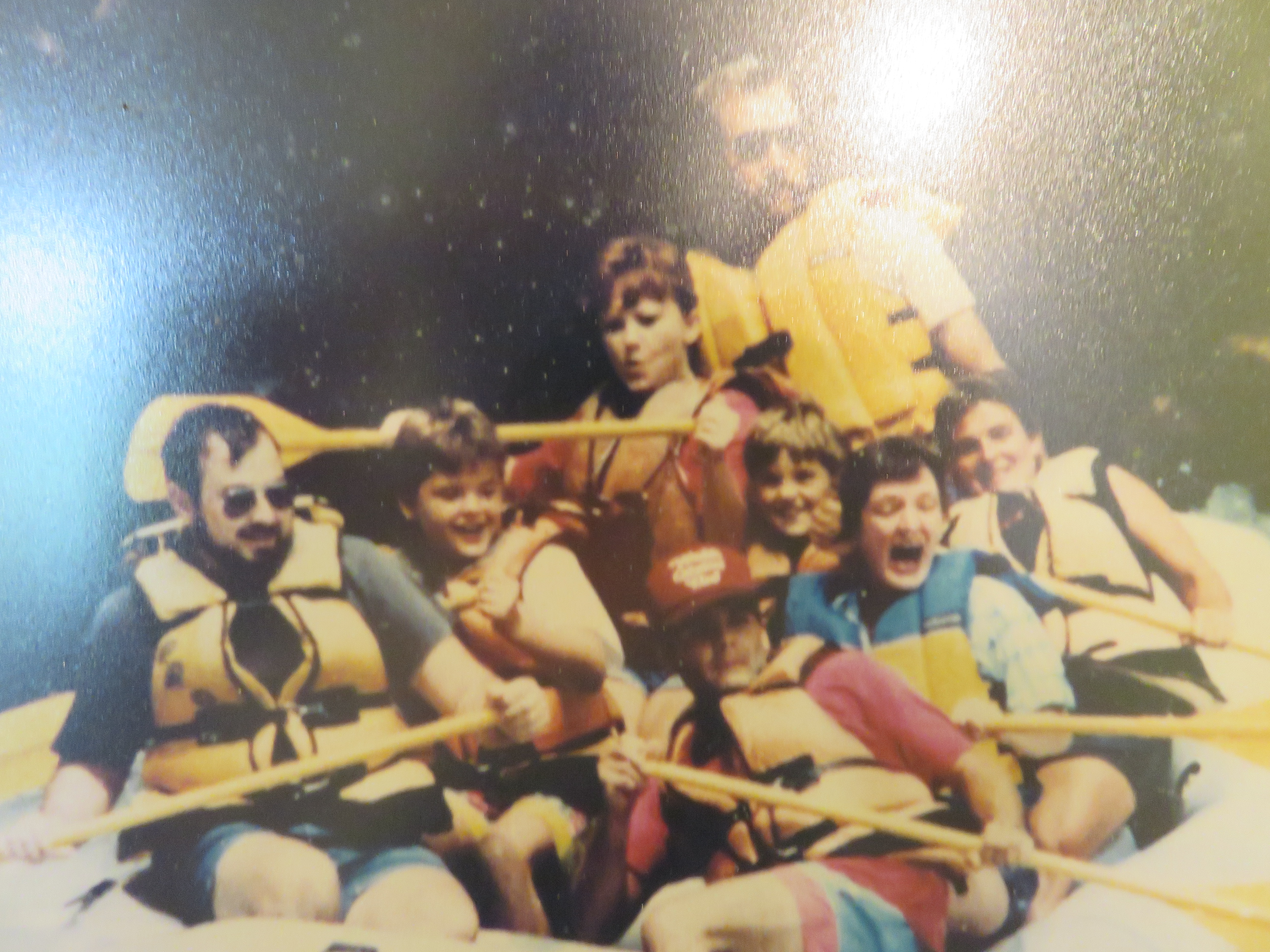
Photo of a photo: from l to r: Stuart; nephew Jamie; sis-in-law Debbe; brother Terry, in front, red hat; nephew Jeremy; yours truly; sister Pert; in back ex-bro-in-law–still a family friend–Stan and navigator for the day.
When I was at my mother’s retirement apartment this July, an old photo brought back a very special moment and trip when our extended family (my siblings, parents, and grandchildren) went on our very first whitewater rafting trip, circa 1990. We ventured out on the pretty rambunctious Nantahala River in the Great Smoky Mountains of North Carolina. I would say enjoyed, but not everyone experienced the fast-moving river equally!
First of all, my parents weren’t up to it—just like now I don’t think my husband and I are quite up to it anymore. Also, the children under the age of eight were not allowed on that level of rapids, so Grandpa and Grandma took them on some other touristy outings nearby. Over the years, many us were thrilled to navigate four different U.S. rivers with various groupings of family members.
That first trip, we were all quite green except maybe my then-brother-in-law who apparently looked strong and river-wise enough to be appointed as navigation guide on our particular raft.
In the photo, all of our faces tell stories. I stared at Mom’s photo for quite a while, taken professionally by the rafting company. It brings back a flood of emotions from the trip, and memories of family. Those photos always cost an arm and a leg of course, but they mean so much later.
In the picture, I’m sitting near the front of the raft, oar in hand but leaning back as we were told to do when riding a large rapid. My mouth is wide open: not in horror or fear, but in glee for the adrenaline rush and amazement that we were in real whitewater. One sister is right behind me, and while she looks happy and excited, she looks a bit calmer—I think she had done river rafting before—certainly had many more outdoor adventurous trips than I. My youngest brother and my husband were at the very front of the raft, and their faces reflect more serious caution, perhaps because as fathers and husbands, they were feeling the weight of what we had gotten ourselves into. Would we all come out ok? Not hurt? All alive? Those thoughts passed through all of our minds at times, I know, except maybe the two children in the middle of the raft. Another raft held other cousins and another sister and her husband.
My two nephews—my brother’s only sons—have pure happiness on their faces; they did not need to help do the heavy lifting of rowing the raft (the older one may have held an oar, but he didn’t have the strength his dad or uncles had). His younger brother and the youngest on the raft, about age nine, is totally protected in the middle of the boat and just along for the fun—reflected on his face. Back of him is his mother—my sister-in-law, whose face speaks volumes. She told us later she was praying the whole time, “Dear-God-if-you-get-us-out-of-this-I-will-never-try-this-again.” She was a great sport. My brother-in-law at the very rear also had quite a serious look, reflecting probably the weight of his responsibility to help us steer the craft safely through the waters.
We did make it securely off the river although in the years to come, had some close scrapes where some of us slipped out of a raft and downriver, but safely recovered and climbed back in. I must add that in retrospect, and knowing a young man who did die rafting a Colorado river, I am ever more grateful for the safety we experienced as we rowed in God’s amazing and awe-inspiring world. God imagined and created an outdoor world that beckons and begs us to love and care for it, recognizing not only the majesty of nature, but the mind and Being behind it all.
***
Have you had any white knuckle moments—whether on whitewater or not?
Share your stories here, we’d love to hear. 🙂
Or send comments to anotherwaymedia@yahoo.com or Another Way Media, P.O. Box 363, Singers Glen, VA 22834.
Another Way is a column by Melodie Davis, in syndication since 1987. She is the author of nine books. Another Way columns are posted at FindingHarmonyBlog.com a week after newspaper publication.

 findingharmonyblog