


Another Way for week of November 24, 2017
Enchanted: Story Circles Across Generations
After spending time with my grandsons in two different storytime circles, I am pretty amazed. Not by my grandsons (hey, all grandmas think their grandkids are amazing, right?), but by the storytellers!
Circle 1: Northern Virginia
Talk about energy. I wasn’t sure who was more keyed up: the two and three-year-olds who circled me, or the young librarian in charge of story hour at a library near my oldest daughter’s house.
I had my then-two-year-old grandson James with me, and it was the first time for both of us (well, the first time in 30 some years for me, since the time his own mother was a preschooler). I felt new along with James.

James enjoying This is a Moose read by his grandpa.
First the storyteller: short with jet-black dyed hair with edges of red, a small tattoo running up her arm, and wearing old style sailor blue jeans (wide legged). She looked in her 20s and practically bounced as she valiantly charmed about 18 little minions mostly with her voice, hand motions, and electric smile.
Each child came with a parent or caretaker, although we were a kaleidoscope of Asian, Arabic, Indian, Latina, and plain old beige like me.
My grandson was mesmerized too, so much so that I had to nudge him to go up to participate in the group type activities. He preferred just watching the others from my lap.

Owen mesmerized by a storyteller at a Thomas the Tank Engine Day.
Circle 2: Spencer, North Carolina
More recently I was able to watch the faces of another daughter’s two boys at a Thomas the Tank Engine excursion and surrounding activities at the North Carolina Transportation Museum in Spencer.
We had enjoyed the main “event,” a brief train ride with hundreds of other eager and excited mostly preschoolers, parents and grandparents. We browsed the gift shops and each boy picked out what they wanted in the way of new Thomas paraphernalia. We posed with trains for photos, played with wooden tracks and train cars and engines at various train tables. There were kiddie-car-sized trains to ride on going in small circles which Sam, the oldest grandson, could operate by pushing a button. There were huge model railroad train layouts to admire and point out the tiny figurines and flag men waving and signaling, lights flashing, and engines chugging away. And more!
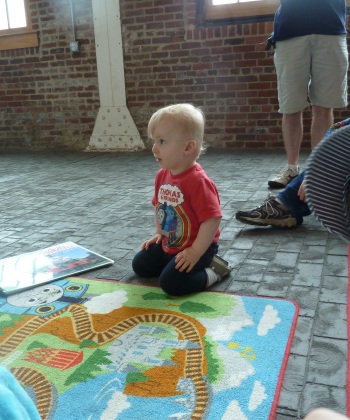
Then I spied a large rug with a handful of children and parents or grandparents sitting cross-legged on the floor in a far corner of the warehouse, which also functioned as an antique train restoration facility. Another energetic woman, this time maybe in her late 40s or early 50s, was reading huge Thomas the Tank Engine books to the small gathered fans. Ah, a chance to sit down, rest, and regroup from the super stimulation of taking in so much fun.
She mostly told rather than read from the poster-sized storybooks, pausing to answer questions from the tykes if they just couldn’t wait until the end, and drew my two grandsons in like she was the original pied piper. Ms. Piper’s smile, eyes and enthusiasm were captivating and I was especially fascinated by how my 14-month-old grandson drank her in like she was his fairy godmother. His eyes barely left her as we sat there through three tales from Thomas land. It wasn’t great literature (many hero-themed books fail in that department) but it was a book, not animation, not a video, not a movie, not a play. We talked to her after the reading—and indeed she is a teacher in “real life” too. How lucky her students!
Both of these women reminded me how great is the power of a face and voice, spurred on by deep love for children, plus commitment to engage a kid’s powerful imagination and brain. The readers were educators, actors, and drama queens who adored children—in the very best sense of being drama queens!
I love the way my grandchildren are helping me see life through new eyes—and indeed it was that way with when I had my own children—and even a “little sister” (and little brother for my husband) in the Big Brother/Big Sister program before we had children. I so remember going to the mall and the toy store and county fair with her and enjoying everything through younger eyes. And I know my husband felt the same way as he enjoyed childhood activities with his “little.”
How thankful I am in this season to have been blessed with both children and grands—something none of us should ever take for granted. And to relearn the wonderful gifts children are endowed with by their Creator.
But back to the magic of stories and books: don’t overlook these old standby Christmas gifts in your shopping!

***
What are some of your favorite books for small children? Here are two we discovered this year:
Moonshot: The Flight of Apollo 11
My thank you gift to all readers this year is a small 2018 lighthouse-themed monthly planning calendar, suitable for purse or pocket. Request it at anotherwaymedia @ yahoo.com.
***
Another Way is a column © by Melodie Davis, in syndication since 1987. Columns are posted at http://www.FindingHarmonyBlog.com a week after newspaper publication.
Another Way for week of November 10, 2017
Yearning for a Better Life
Several weeks I wrote about how South Africa became one of the countries about which my ears perk up. All three of my daughters (but not us as parents) have been there—they each spent three weeks on church “mission” trips. I use air quotes because they were the ones ministered too, as is the case with most mission trips, but the experience helped form them and their outlook while they were teens.
We owe that to a South African pastor Maake Masango and our own pastor at the time, Ann Reed Held, who although she gulped at the audacity of what the youth had inspired the rest of our church to take on, she was also down deep, moved and amazed. This in turn nudged me—years later—to begin reading more books about South Africa, including the autobiography Kaffir Boy: The True Story of a Black Youth’s Coming of Age in Apartheid South Africa by Mark Mathabane.
Mark does a superb job in the opening of his autobiography describing his life from the perspective of a five year old boy, keeping his words and language mostly simple and straightforward. We feel the terror with him when the Peri-Urban or (black Alexandra Police Squad) conduct their frequent raids into homes of sleeping citizens to examine whether residents have their passes or other paperwork in order. They seek to exert their control, can be bought off with bribes, and make life in a rat infested, crawling-with-lice shack which often reeks of urine or worse, that much more miserable.
The “pass laws” which required them to carry at all times their “papers” were what controlled all of life for the blacks and “colored” in South Africa. Little Johannes was born shortly before an incident known as the Sharpeville massacre, when 69 unarmed protestors were killed by the South African police during a peaceful demonstration against the pass laws.
Many days little Johannes (he changed his name to Mark later in life) has nothing to eat all day other than a little pap (porridge) for breakfast. The child copes with hunger and lightheadedness as he helps his mother clean their hovel, watch over his younger siblings, and run around with friends who seem destined for an early street life. That any child survived that kind of existence is made more horrifying by the realization that children today also must struggle with malnutrition, rats, and the endless paperwork of refugees holding out for a better life somewhere, anywhere. This awfulness has not gone away with the end of apartheid or war in so many places around the globe.

Johannes’ mother, Magdalene, desperately wants her son to go to school, even though they barely have enough money for food, let alone school fees. Much paperwork needs to be completed. The task is complicated by Magdalene being from one tribe, Tsonga, and the father another, Venda. She finally wins the paperwork battle (after trying over a year in endless lines) to get Johannes registered. She then has the equally trying test of convincing young Johannes he needs to go to school, rather than become a gang or street kid.
His father scorns education and drinks most of his earnings, but at one point takes Johannes to the tribal reserve for a visit. The boy is terrified he will be left there. As Johannes grows into his adolescent and teen years, their relationship is extremely tense so they mostly don’t talk or interact, to keep the peace. Not unlike other fathers and sons around the world.
Johannes’s father believed in tribal witch doctors and their powers. His mother also believes in some folk ways and tells stories from those traditions, but there are quack Christian evangelists who come to the “yard” (neighborhood) by whom Johannes is completely turned off from an early age. Eventually, his mother begins going to a Christian church that seems to have solid teachings and joins that group. She prays faithfully, adding some prayers to ancestors for good measure.
Johannes turns out to be an excellent student, and even though children at his school are commonly beaten for not paying fees or having a clean uniform, he studies hard, learns English, Afrikaans, and other tribal languages. Although he fears and hates whites because of his early experiences with the brutality of apartheid, through his granny he meets whites (her employers) and his world begins to open. He learns that not all whites are evil and they give him precious books—and comic books—which he loves. They also give him what becomes his eventual ticket out of South Africa—a tennis racket.

The book is spellbinding at turns and horrifically graphic at others. While I have not yet read Mathabane’s other books, including one about his mother Magdalene’s own life and her eventual move to the U.S., the truths that she manages to impart to him even in the squalor and hopelessness of a Soweto ghetto are soul-stirring. Mark and Magdalene somehow give me hope that we in the U.S. can strive to overcome the racism that has so long infected our shores and our being.
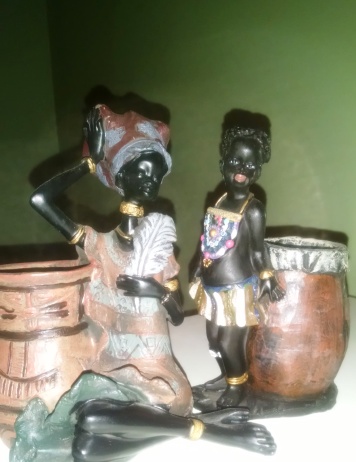
In 2008, Elizabeth Makoto Moleko and Mary Motau from Tembisa, South Africa, came on a group mission trip to our church; we were happy to have them stay in our home. As is the custom, they gave us these beautiful handcarved gifts from their country.
***
Comments or questions? Your own insights of life there from reading, your experience, or from friends? I’d love to hear from you. Comment here or email me at anotherwaymedia@yahoo.com.
Another Way is a column by Melodie Davis, in syndication since 1987. Another Way columns are posted at FindingHarmonyBlog.com a week after newspaper publication.
Exhale: Towards Better Understanding

Another Way for week of November 17, 2017
I exhale a bit at my desk and a rumpled tissue and paper two feet away wiggle with the puff of breath from my slightly opened mouth. It somewhat startles me, but reminds me that in this world, what we do, say, hear, and believe affects others around us even when we don’t realize it.
As I write this it is Election Day in the U.S. I stay pretty far away from politics in this space largely because I get so tired of the rhetoric and the attack ads and the disappointments that come with every election that I don’t want to add to the pontificating. Plus this column appears in a variety of communities and until this year, also appeared in Canada so I’ve not been inclined to get too local or specific. And readers are often split in their viewpoints as well.
But. But, because we all live on the same planet (except those on the space station) what we do, say, hear and believe affects others around us.
Centuries ago an oft-quoted poet said it this way: “No man is an island.” If John Donne were writing that today, I’m sure he would say no one is an island, and that is just one way we are affected by others. Our language and expressions and way of looking at the world are impacted by the winds of change.
Here’s an excerpt from the poem, edited just a whit for the times:
No one is an island entire of itself; every person
is a piece of the continent, a part of the main;
… any one’s death diminishes me,
because I am involved with humanity.
Therefore never send to know for whom
the bell tolls; it tolls for thee. –John Donne, 1624
As I write this we are also just days away from the latest mass killing, the latest huffing and puffing of politics and “was it this, was it that” and latest vigils, prayers for families, and weeping for those we do not know but know the bell could be for us or our families next.
How do we live like this? Why do I write this in the lead up to Thanksgiving? All of us who live should be so very grateful for the breath that puffs from our mouths or noses. I am alive for another day, to continue to try to think about things “another way” and influence as I am able, all of us to dream of better ways. Better ways than war, than misunderstandings, than just hand wringing after the latest horrifying event. We can start by trying to understand where others are coming from.
Retired editor Richard A. Kauffman wrote recently on Facebook of an experience sitting down with a men’s group which had a civil conversation about the Texas church shooting of early November. He gave me permission to share it here:
Today we talked about responses to mass shootings in our country. We don’t all agree on that topic, but we had a very civil, respectful conversation. I got this fantasy: that we would serve as a fishbowl for a broader conversation around that topic, demonstrating that difference can be generative and can be dealt with constructively rather than in a contentious and polarized manner. The conversation reinforced for me also that most of the knotty problems our society is dealing with are moral and that political tactics get in the way of finding real and durable solutions to them.
As we approach Thanksgiving, for the sake of happier family gatherings, many of us draw in our breaths and cut off any conversation that hints of controversy. Perhaps respectful conversation is truly not possible in families where “irregular people” (Joyce Landorf’s memorable term decades ago for those who are just plain complicated or twisted in their personality or way of thinking) make that difficult.
But if we try to keep in mind respect and love for each other—especially in families—and try to really listen to each other and hear where the other is coming from, that can be at least a start to having those constructive conversations and action toward new solutions. On whatever the issue. Keep love for each other and God foremost in those dialogues. Do it for your mother or father, for your children or grandchildren, or for me.
And then exhale after a good Thanksgiving Day spent with loved ones.

***
What do you wish for most during this season of remembering blessings, even as we go through difficulties?
***
Name one deep gratitude you wish to share.
My thank you gift to all readers this year is a small 2018 lighthouse-themed monthly planning calendar, suitable for purse or pocket. Request it by mail from Another Way Media, Box 363, Singers Glen, VA 22850 or email me at anotherwaymedia@yahoo.com.
Another Way is a column © by Melodie Davis, in syndication since 1987. Columns are posted at http://www.FindingHarmonyBlog.com a week after newspaper publication.

Another Way for week of November 3, 2017
What South Africa Can Still Teach North America
I am blown away. I just finished a book by Mark Mathabane, Kaffir Boy, about growing up in apartheid South Africa in the 60s. It is unforgettable. I’ve mentioned it several times in this column recently and now that I’ve finished the book, I’ll share some thoughts in these next two columns.
I knew about apartheid as a system of laws in the beautiful country of South Africa which mandated segregation. I never knew or understood what that meant on a daily basis for those living out their lives under such strict racial divides. It was modern slavery and degradation combined with poverty and utter squalor.
In the summer of 1997, our oldest daughter went to a large youth conference at Montreat Conference Center in the Smoky Mountains, North Carolina. Everyone there (according to her and others in her youth group) was extremely moved by the words of Maake Masango, a pastor from Johannesburg, South Africa (now professor emeritus in theology and Christian education at the University of Pretoria).

Artist Jerome Lawrence of Atlanta, Ga., painted this picture of a woman in Liberia voting for the first time, 2005. Getting the right to vote for South Africa was a similiar high point for many South Africans.
This was just three years after all citizens of South Africa were finally allowed to vote in an election in 1994, something many blacks in South Africa never thought they would live to see. Nelson Mandela, released from 27 years of prison, was elected president. Apartheid had been the official policy since 1948, and its end in 1991 was astoundingly fresh.
Back then, those of us from other countries also pretty much figured apartheid would never end—but not some citizens of that fine country, including a boy named Johannes Mathabane. We’ll get to that in my next column.
I have by my computer a photo of our oldest daughter and our pastor’s oldest daughter on the stage at Montreat Conference Center. My daughter is at the podium, and even though I was not there and did not take the photo, to me it is rich with poignancy and meaning. It was a pivotal point in the life of our whole congregation when the youth came home from their summer conference all fired up by a single speaker who had invited them to visit his newly freed and beloved country, South Africa.
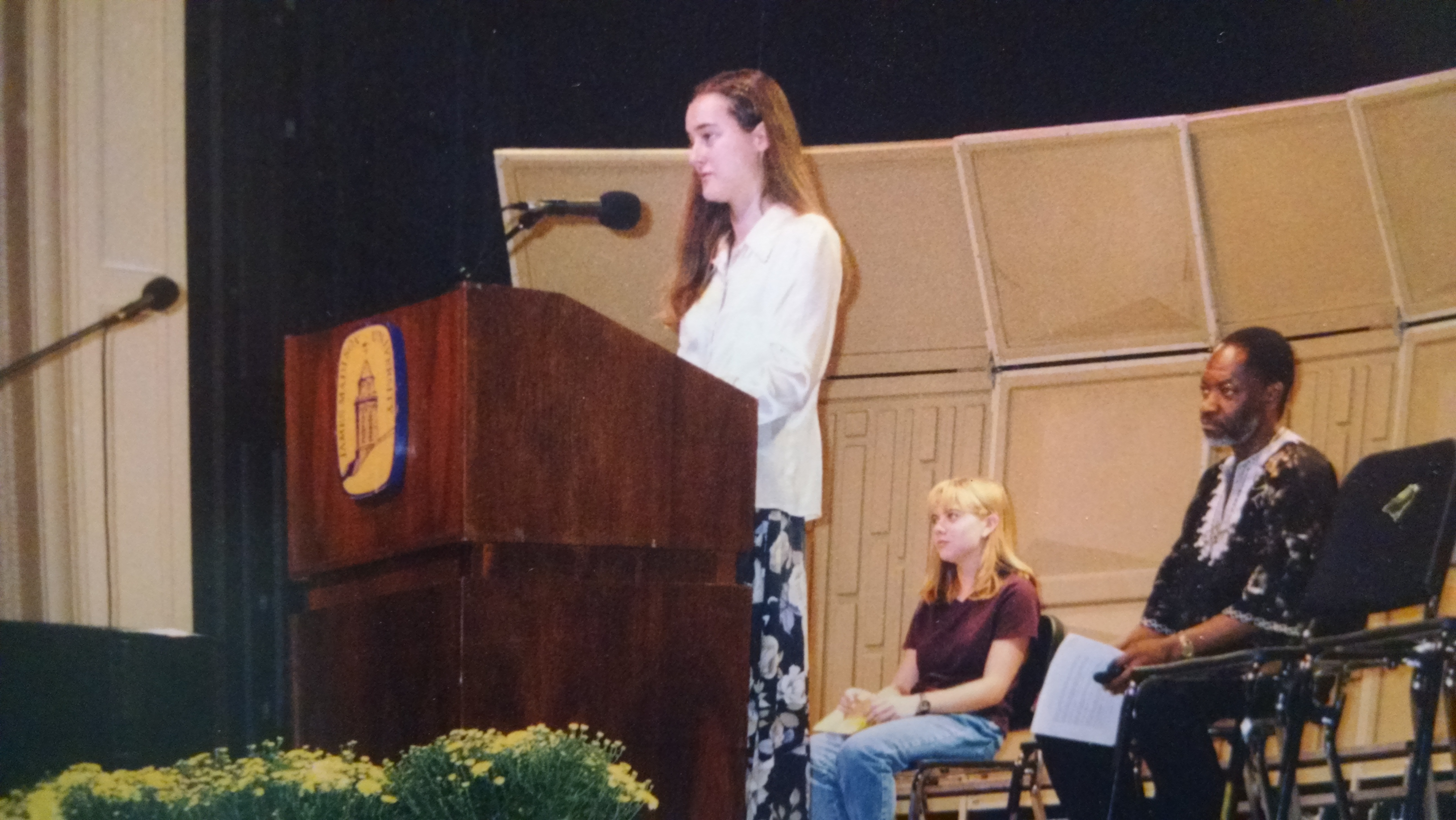
Michelle Davis and Rebecca Held on stage with Montreat conference speaker, Maake Masango, far right.
That my daughter got to be on stage with this amazing speaker still moves me—particularly in how it came about. This daughter is sometimes, shall we say, a little scatterbrained, or to put it more positively, has so many ideas going on in her brain that she forgets some things. On that particular day, our pastor, Ann Reed Held (and sponsor for the youth group), had wrangled a dinner date with the exciting conference speaker, Maake. Our youth were to arrive on time at a special dining room and they would get their own private audience with him.
Michelle had completely forgotten about the dinner and was enjoying a walk on the opposite side of the conference center when she remembered. She sprinted across the campus and blew into the dining room—breathless, late, and looking straight at our dear pastor, who was scowling. When she apologized profusely Maake laughed and said she could make it up to him by saying the opening prayer before his sermon that night. How could she refuse? She was charmed into agreeing and faced over one thousand youth, pastors, and sponsors that night in Montreat’s auditorium.
The youth from our church ended up being quite moved by Maake’s stories of suffering, and South Africa’s newly adopted policy of official forgiveness for those who had perpetrated atrocities under the reign of apartheid. They felt led to respond to another compelling invitation from Maake: “Come to South Africa, see for yourself. Our church will host you.”
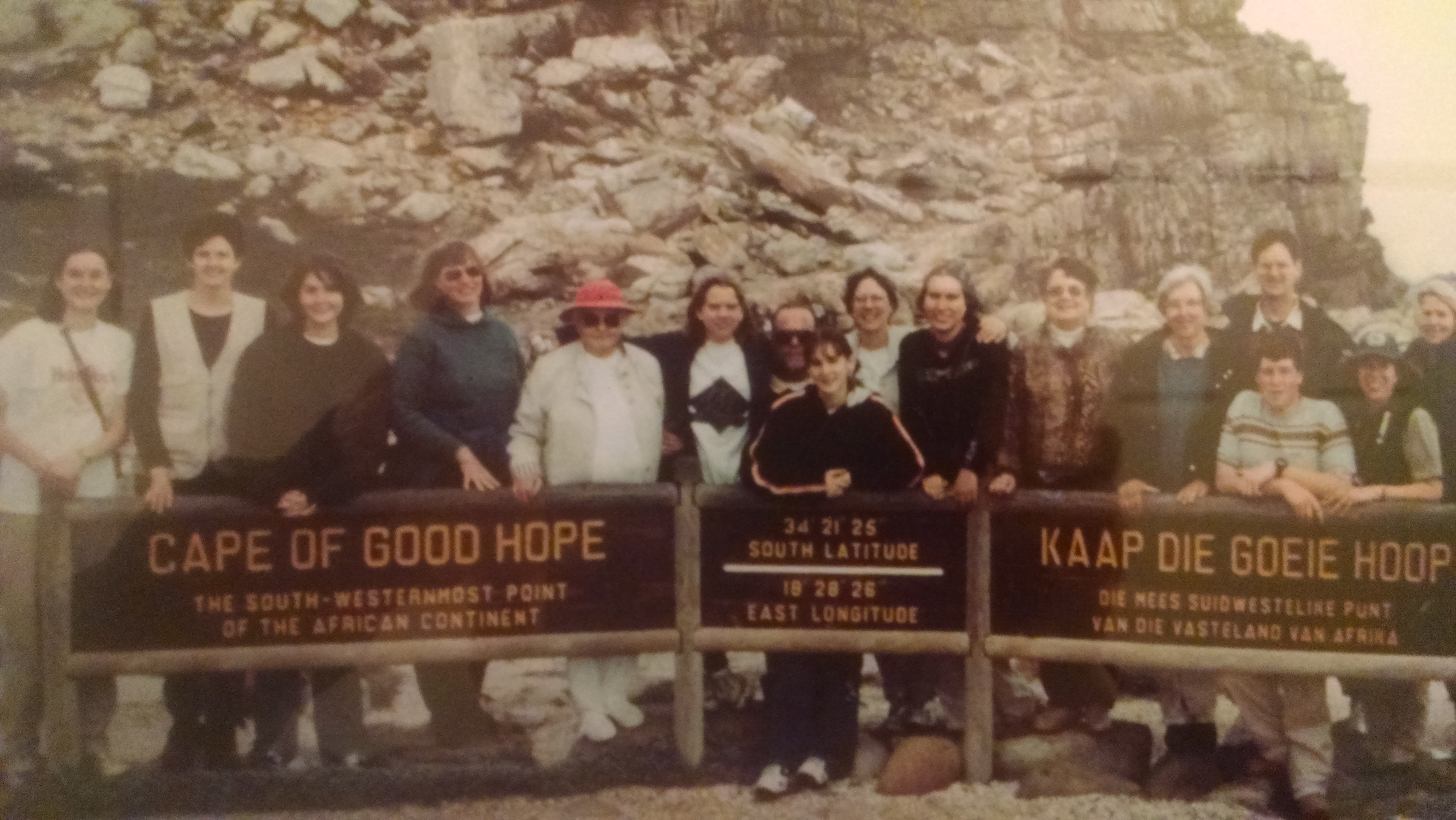
Trinity Presbyterian Church group first trip to South Africa, here at Cape of Good Hope. From left: Michelle Davis, Lisa Hammet, Ellen Chappel, Nancy Hopkins-Garriss, Isabelle Dotson, Rebecca Held, Ken Bahn, Tanya Davis, Ann Held, Julie Radloff, Ann Rutherford, Pat Churchman, ___, Kevin Gallagher, Maureen Gallagher McLeod, ___. (Your help filling in any names appreciated!)
They came home energized by Maake’s invitation and went about, with the pastor’s help, organizing an ongoing mission relationship with two different churches in South Africa and our church, Trinity Presbyterian. It changed the lives of our youth for the better—and educated the rest of us, even those who didn’t go. Our two older daughters got to go on the first trip, and our youngest daughter was able to go a half dozen years later. We also helped host a group from those churches as they visited our church, taught us rich South African music in various tribal languages, and ministered beautifully among us. Two women stayed in our home and my eyes were further opened in numerous ways.
Come back next week for more on how apartheid impacted the life and future (and lack of it) for one young boy, and so many others in South Africa.
***
Mission trips and mission partnerships with churches around the globe are common experiences for many Christians. Do you have any stories or perspectives to share: what you learned and loved?
Find more artwork by Jerome Lawrence, who painted the beautiful painting above, “Building Hope.” I once did a pre-interview with Mr. Lawrence by phone in advance of the TV documentary, Shadow Voices: Finding Hope in Mental Illness, which aired on ABC-TV and others. We have two of his wonderful paintings. You can see him painting in this brief trailer for the documentary.
Comment here or email to Another Way Media, Box 363, Singers Glen, Va. 22850, or anotherwaymedia@yahoo.com, or post on Another Way Newspaper Column’s Facebook page.
Another Way is a column © by Melodie Davis, in syndication since 1987. Another Way columns are posted at FindingHarmonyBlog.com a week after newspaper publication.
Another Way for week of October 27, 2017
The Paper Trail
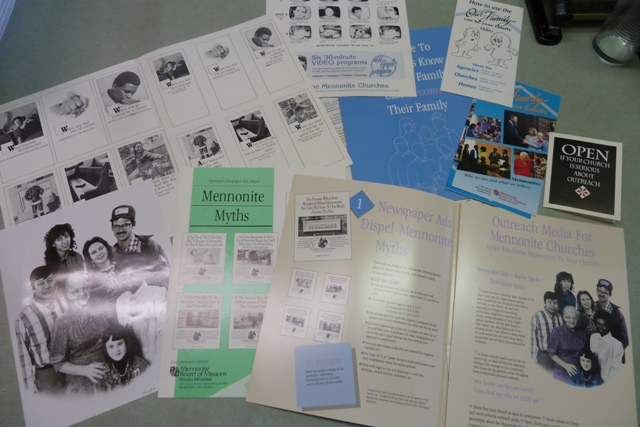
In the past several months, I have thrown away or recycled reams of paper. Our office is moving to a new location and we’ve been instructed to greatly “purge” or downsize our paper/file footprint.
I was amused by my 30-something colleague, who works totally on the computer and has very little in the way of paper files and folders. He’s a designer, not a writer, so he majors in digital files. In a check-in session we were each to report on how purging was going and he laughingly said, “Oh, I’ve gotten rid of maybe a paper, or two.”
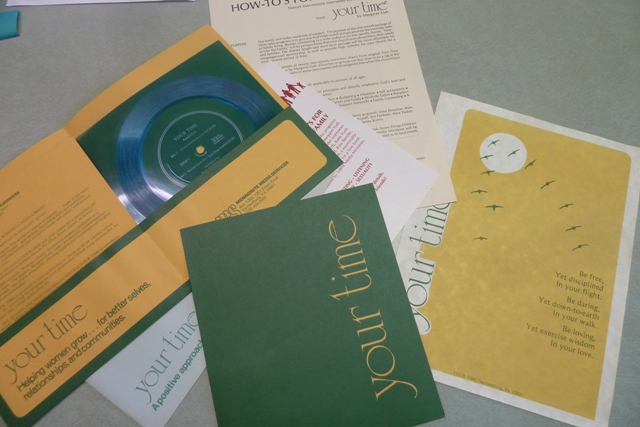
Scads of promotional materials I wrote for various radio programs and projects.
I envy that and I pledge to print out and save many fewer things in the future; but in my defense, a paper reminder is often my way of making sure I complete a task and don’t forget it buried in my computer.
And to be honest, I truly struggle with getting rid of the paper trail, especially from trips, meetings, speaking engagements—so much from my work life these past 40 plus years.
As I flip through them, there are so many triggers and I recall memories, people, stories—so many things that would be long forgotten if I didn’t still have those papers. Right? Do lost memories matter?
Truly I know the importance of decluttering our lives, especially as we get older. The experts talk about the three piles: everything should go into one pile or another: 1) Keep. 2) Giveaway or sell. 3) Throw away. Someone has said “Only keep the things that give you joy.”
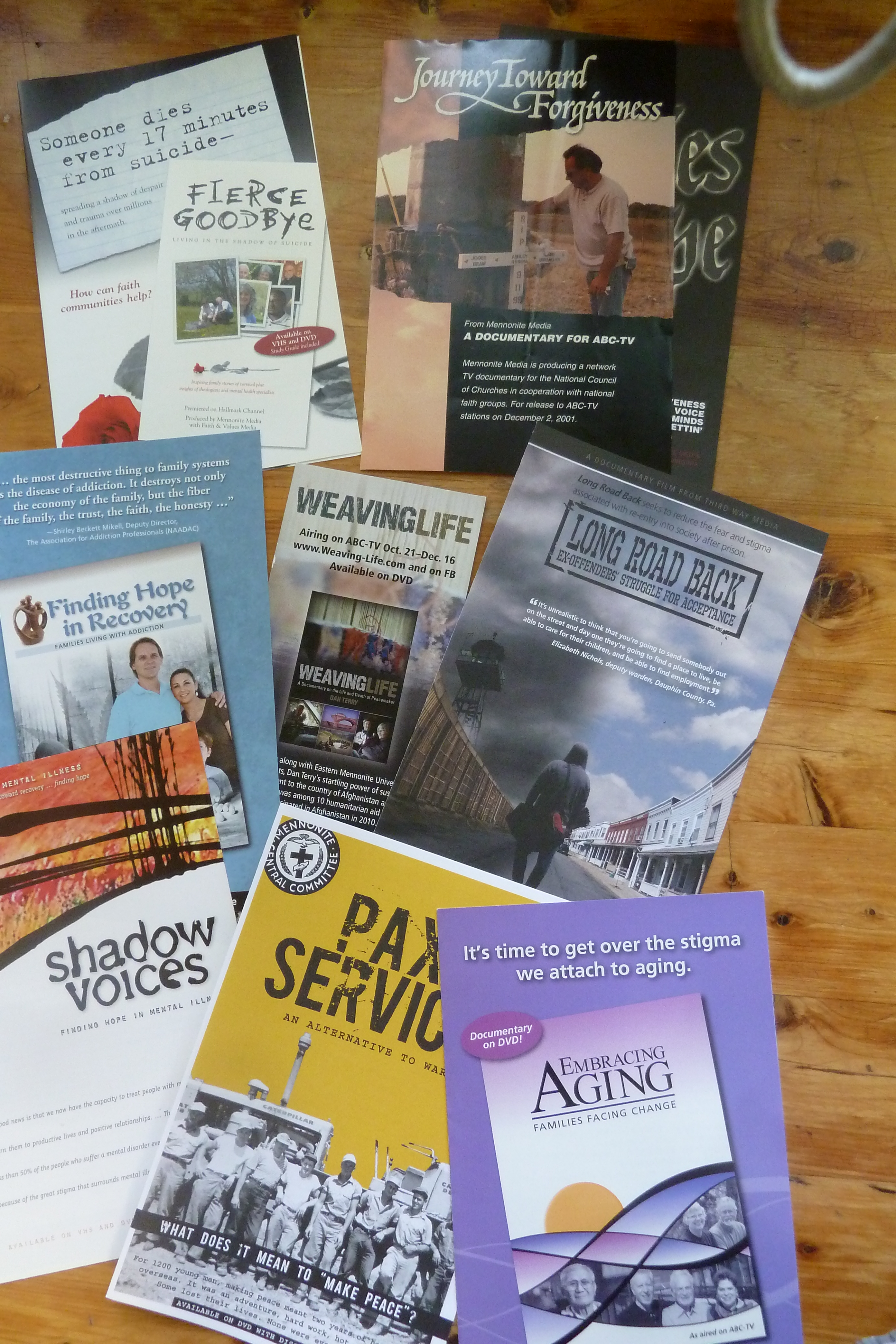
A decade of producing award-winning documentaries which aired on several networks.
At home, one of my rather brutal ways of facing the question of needing to pare down is to ask myself, “Will I be able to take this to my assisted living quarters?” We have no plans to move to a retirement community of any kind but I’m enough of a realist to know that downsizing is most likely somewhere in my future. And that can be a freeing step when you no longer have to take care of a home, yard, or garden.

Artwork: an acrylic painting by my daughter Tanya from her visit to Frontier Culture Museum in Staunton, Va.
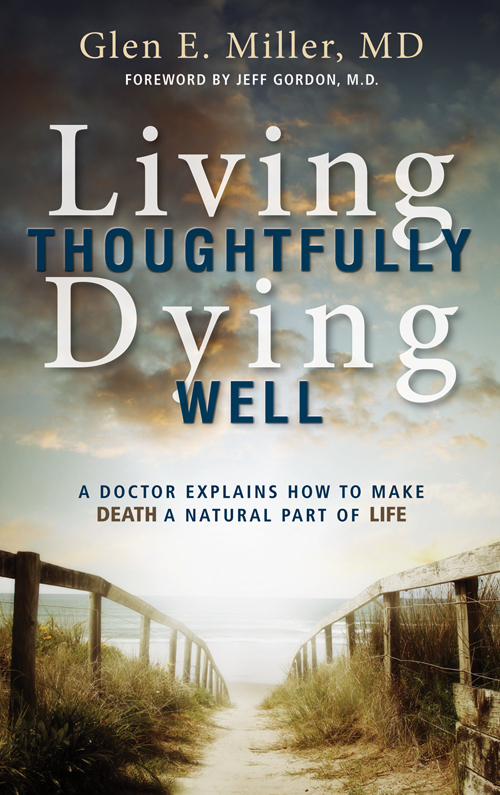
I’ve added a fourth way to handle some things, which I first heard suggested by a doctor/author friend Glen Miller, who wrote a book which I edited, Living Thoughtfully, Dying Well. Take a photo of your mementos, and file them on your computer in carefully named files (so that doesn’t also become an unmanageable slush pile). This works for such things as certificates given to you over the years, name badges from special meetings or conferences, items you created or had a hand in making that no longer serve a useful purpose, and artwork. That way you can remember the item, but not have it take up precious space in a closet or file drawer or shelf in your home. It also works for beloved books that you think you may want to re-read in the future, but don’t have room to keep. Take a photo, file it electronically, and then if you want to read old books (I can barely keep up now with new books I want to read), flick through your electronic library and check it out of a physical library. Or you may find the complete book, or used copies available online.
I like the title of Dr. Miller’s book because it points to the need to be more thoughtful in how we spend our days and our living space on this earth. No one wants their home to become as cluttered and unhealthy to live in as that of a true hoarder.
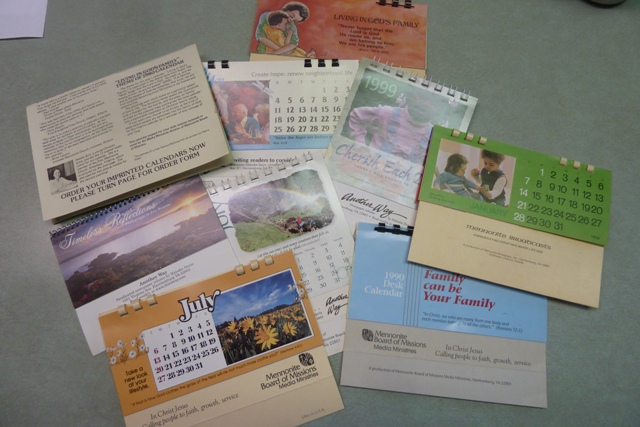
Thematic desk calendars produced by our office over many years, personalized and purchased by congregations to give to church members.
I was going to add that writers are particularly prone to keeping various papers as idea triggers for future projects. But my husband, who is truly a creative soul in other realms, has a hard time throwing away or taking to the dump any piece of wood or metal that might be useful in a project someday. I know knitters and quilters and fabric lovers who have vast collections of yarn or fabric. Or cookbooks.
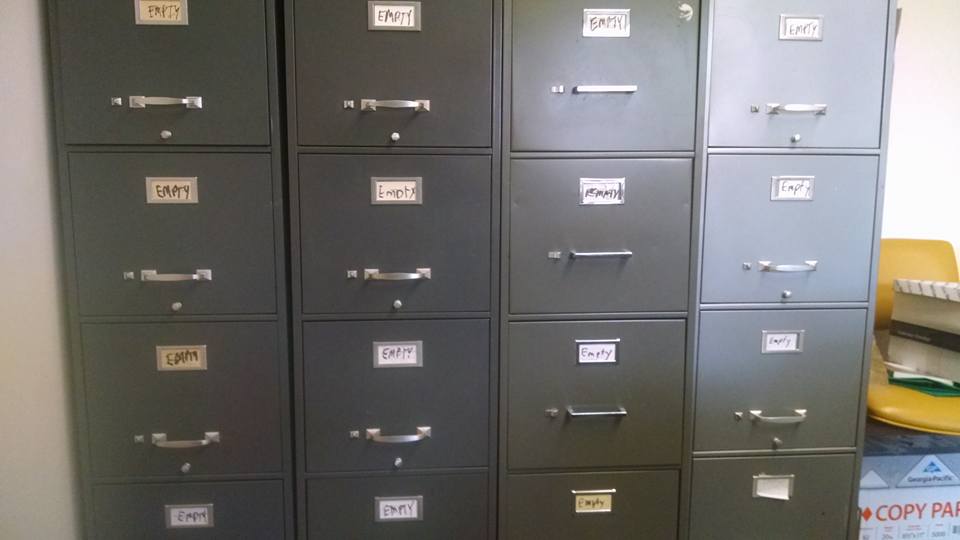
16 file drawers, now gloriously empty.
So it’s not just paper piles we have to tame. What is your nemesis or doom? Scripture reminds us: “Do not store up for yourselves treasures on earth, where moth and rust corrupt and where thieves break in and steal; but store up for yourselves treasures in heaven … For where your treasure is, there your heart will be also” (Matthew 6:19-21).
I think I’ll post that on my new office door. Or maybe just file it electronically.
***
I’d love to hear what you’re tempted to collect too much of.
What is your nemesis or material you have a tendency to collect and save ?
Comment here or send to anotherwaymedia@yahoo.com, or tell me on the Facebook page for Another Way Newspaper Column.
To see more or purchase Dr. Miller’s Living Thoughtfully, Dying Well, check here.
Another Way is a column by Melodie Davis, in syndication since 1987. Another Way columns are posted at FindingHarmonyBlog.com a week after newspaper publication.
What will energy production look like in 50 years? Blowing smoke

On Reddish Knob in 1982, when Michelle was about 16 months old.
We gazed at the two chimneys blowing white smoke which we had seen from a distance for many years, the infamous chimneys of the Mt. Storm power plant in West Virginia.
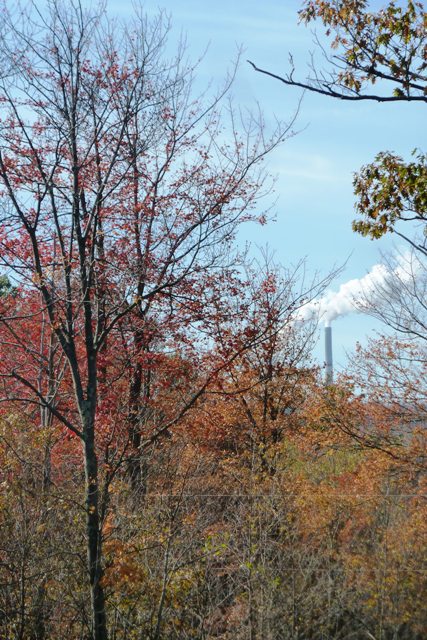
Ever since he learned that on a really clear day we could see those puffs of smoke from a favorite drive up a local mountain, Reddish Knob, my husband had wanted to check out Mt. Storm sometime. He was always fascinated that from the top of our nearby mountain (at 4397 feet) we can see almost all the way to western Maryland (about 100 miles) or southern Pennsylvania, if the atmosphere is extremely clear.
So on a recent weekend, we drove to Mt. Storm. We also went in hunt of fall color and space to unwind from a very busy, over-scheduled week. We didn’t find much of the former but plenty of just chillin’ on a non-programmed schedule. A Sabbath day.

I don’t think I had truly grasped that this was a coal power plant until I saw the conveyers connecting to nearby coal mines or at least transport docks. I recalled my mixed feelings living in the midst of strip mines in eastern Kentucky–knowing that was what the people depended on for jobs and for low cost energy.
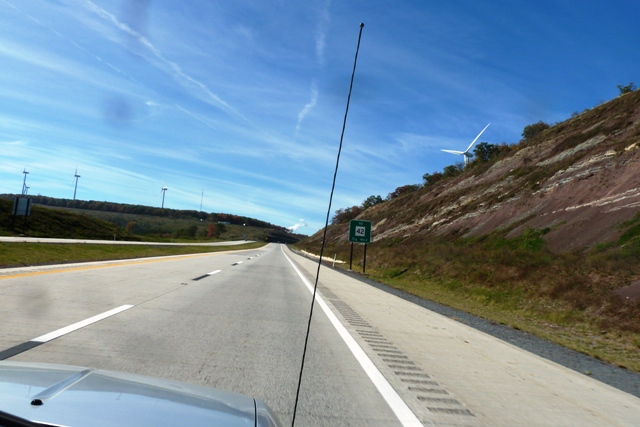
Also near Mt. Storm—mixing the 1800s and 2000s—are giant wind turbines generating electricity from two ridges where wind is plentiful. Neither form of energy is de rigueur for environmentalists—unless the wind turbines are off shore, where they supposedly kill or maim fewer birds.
 If you do a bit of research on that issue, it seems to me the verdict is mixed. Here are three links that rose to the top. I left the complete urls visible so you can get a sense of their gist.
https://phys.org/news/2017-06-farms-bird-slayers-theyre-behere.html
http://grist.org/news/wind-energy-company-fined-1-million-over-bird-deaths/
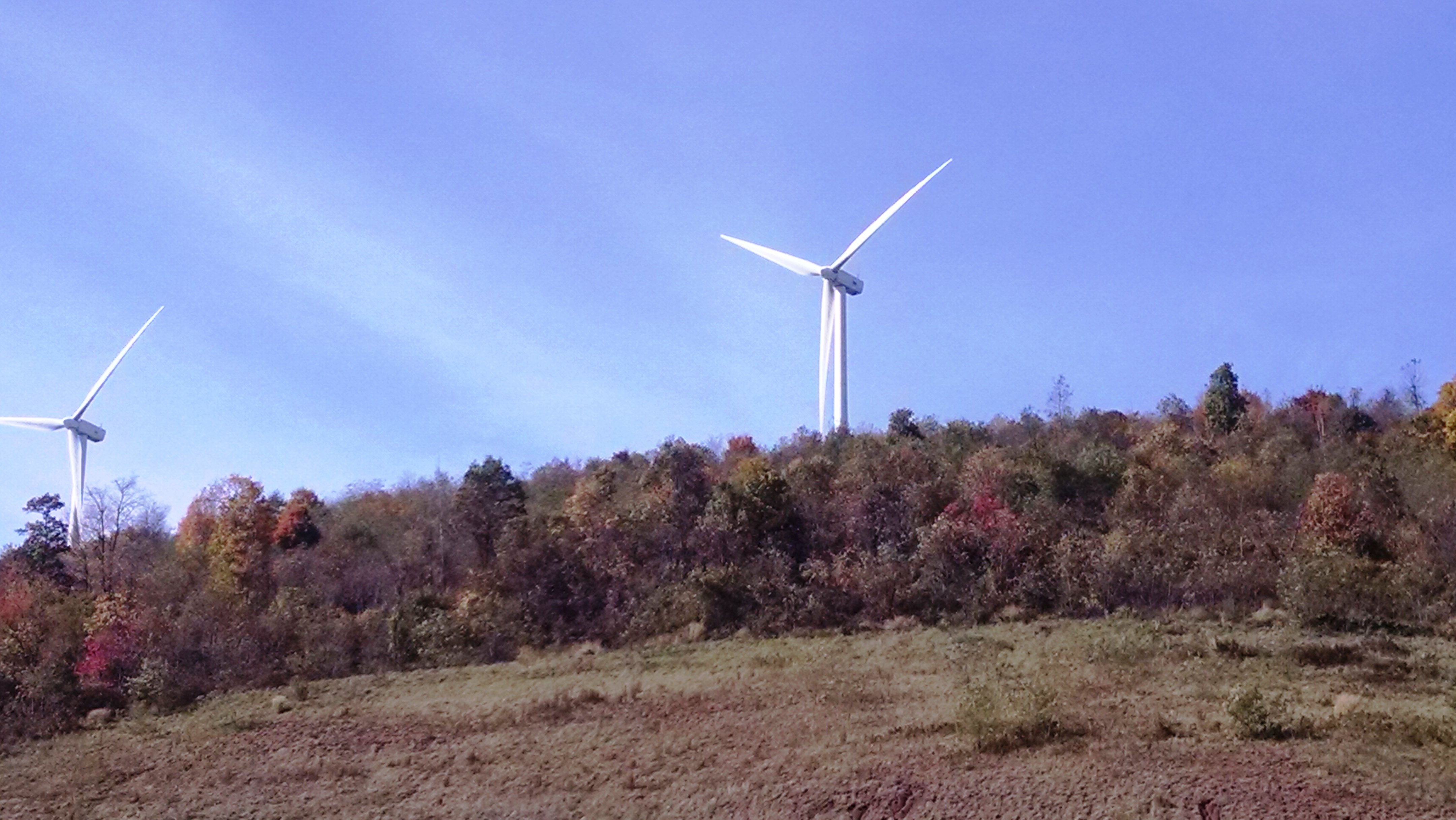
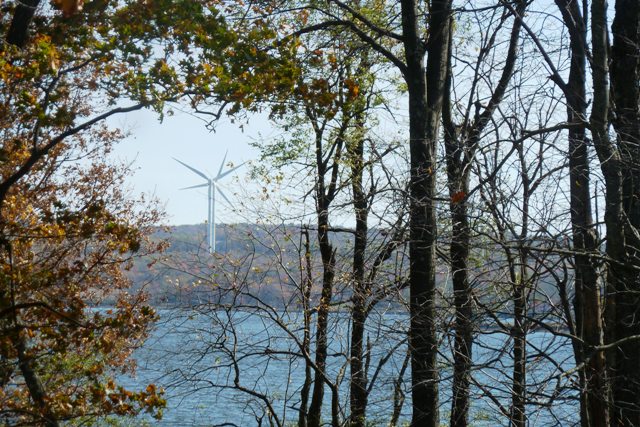
Here also is a link straight to Mt. Storm electrical plant. It was built in the 60s and in the first years truly was dirty—emitting flying ash with asbestos pollution in the immediate community. After we came home, we learned that the lake stays warmish (seldom below 60 degrees) year round from the fact that its water is totally sucked up to cool the turbines in the plant, and then deposited back in the lake every 2.5 days. Had I known that, I might have wandered down to water’s edge to see what it felt like. Not sure I’d want to swim or eat fish out of that lake though.
This was the same weekend we hosted a “solar open house” at our home, and enjoyed chatting with an interested visitor. Solar of course is among the cleaner of the energy producing industries, and the industry is addressing concerns about the energy needed to make solar panels, and recycling them down the line after their life span is over (20-25 years?).
Pipelines for gas. Coal mines. Nuclear plants. Power from water. Power from
the wind. Solar. All of the forms of generating power for our electrical needs and wants, have drawbacks. You can hear people arguing for or against any of the above. Blowin’ smoke.
My mixed feelings come from the modern reality we live with: we are so tied to our electricity demands. My husband—even though our electric bills are now practically peanuts (after going solar), still is an energy miser, always reminding me to turn off this or that light and keeping our thermostat set low in the winter and high in the summer. As I write this, it is November 1—the day the heat was turned on in our boarding house in Barcelona, Spain, no matter how cold it got earlier. Think of those around the world who only have electricity sporadically—or several hours at a time. Or none at all. Amazing we all live on the same earth.
And that’s the bottom line: there is one earth, lots of people; we have to do the best we can to preserve the place as a livable habitat for as long as the earth stands. For our kids and grandkids and great grands and those we’ll never know. Yes?
Photo with two of our grandkids that we had our son-in-law take (solar panels on the roof) for the solar tour website.
***

Our youngest daughter Doreen, 2016, take a photo from Reddish Knob looking towards West Va. and Mt. Storm.
How do you save energy? How do you wish to do better?
What kind of fuel did your family use growing up?
I’d love to hear your thoughts, experiences or memories here.
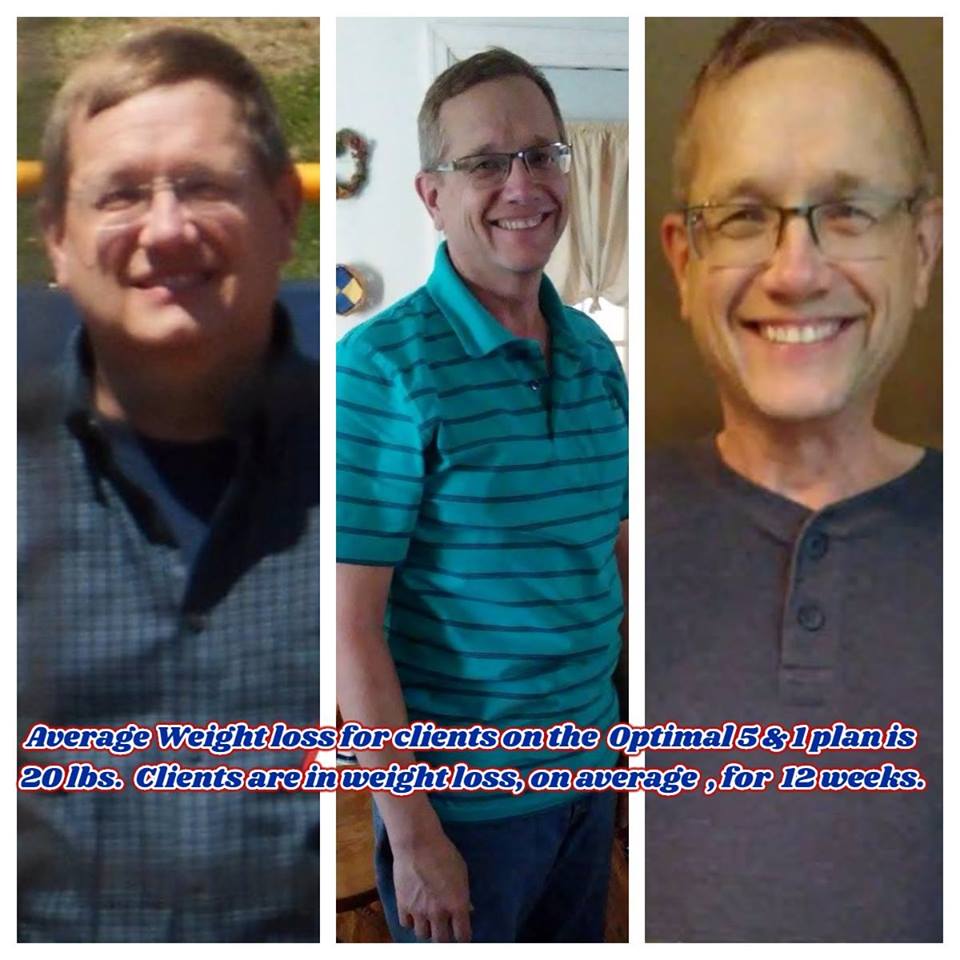
Rich Reed’s change to healthier eating after a health crisis.
Today I’m sharing a guest blog post from Annette and Rich Reed, who recently joined our Lions Club in Broadway, Va. –Melodie
Finding a healthier way of life
By Annette Zook Reed with Rich Reed
Our health awakening happened in June of 2002. We had just moved into our new home. We were both 40 years old and had 5 children ages 12 to 2. Rich was at his ideal weight. Life as a pastor had been very stressful for us as a pastoral couple. We had been placed in churches with high pastoral turnover rates due to internal strife. It was not a good way to start as a new pastor.
We believe that this stress, poor eating habits, and genetics led to what should have been a fatal heart attack. Rich’s left anterior descending artery, known as the widow maker, was 100% occluded [obstructed]. A stent was placed which opened this artery up beautifully. There was no significant damage.
Rich was placed on a low fat diet due to high cholesterol. But his weight continued to gradually rise; he did not have the tools to keep the low fat regimen. I am a nurse and would give encouragement (which I am sure came across as nagging), but nothing helped. All I heard from him was, “I don’t feel good. I have a headache. I’m tired.” It was a broken record that soon got old. I found myself over-functioning to make up for his lack of energy. The stress of his poor health was taking its toll on me. I had almost lost him once. I didn’t want his weight gain to bring on another health crisis.
Rich’s blood sugar began creeping up as he gained a total of 45 lbs. That was my worst fear. I frantically tried to make higher protein meals to bring his blood sugars down from the 150’s. It didn’t work. The rising blood sugar numbers got Rich’s attention, but he resigned himself to the fact that he would just be unhealthy like many of his family members. I was not so complacent! I was not willing to give up on his health!
I had been watching the healthy transformation of a nursing school friend on face book. She lost 215 pounds, down from nearly 400 pounds, before my very eyes. The timing was perfect. She and her husband, both heath coaches, were coming to Harrisonburg for a health event. We met with them in May of 2016 and decided to do their health program.
I began to see Rich lose weight within the first week. He lost 8 pounds and that immediate success helped him believe he could do this. I was elated. I didn’t have to nag or be overly concerned anymore. Rich had his own health coach who stayed in close contact. Rich could call him anytime he needed help.
Both of us delved into the reading material that teaches the Habits of Health and advocates for small, healthy changes in daily habits. I realized there were things I needed to change and we worked together to make our lives healthier—emotionally, financially, and physically. We both became health coaches to pay this gift forward. We had never seen a program that promised healthy transformation far beyond weight loss. Rich reached his ideal weight five months after starting the program. What is even more wonderful is that he knew he would have the tools and support so that he could not only lose the weight but also to maintain that healthy weight.
I am so relieved and am confident that he is doing everything he can to do to help the tiny stent in his artery to be healthy and happy for a long time to come. The fear is gone. I anticipate growing old with my best friend by my side.
Our mindset and approach to life is changing as we continue to work with our health coaches. I have been able to leave a very stressful job at a local nursing home to do our full time health coaching business from home. I am using my nursing skills, but you don’t have to have medical training to do this. All that is needed is a passion to be healthy yourself and a desire to help others. We are working to build a team of coaches that will help us reach more people with the gift of health and hope. Rich wants to pay this forward to those struggling with health issues. My heart is with family members who are scared for the lives of their loved ones. This is why we do what we do. It is very fulfilling and we love it!
If this is something you are interested in learning about, do not hesitate to contact us. We are on Facebook and we would love for you to friend us and introduce yourself on messenger. You can also reach us at Rich: 540-246-4928 and Annette: 540-405-1781. We can also explore the health coaching opportunity with you as well. This source of income may help you reach financial goals you may have.
We made this healthy investment in our lives and it was the best investment we could have made. We invite you to travel this journey with us.
Talk to you soon!
Rich and Annette, Broadway Va.
Certified OPTAVIA Coaches™
***
Another Way for week of October 20, 2017
Parking Lot Encounters of the Friendly Kind
I was heading out of Food Lion with my usual cart of Friday groceries and noticed two men talking at the backend of a pick up truck. Out of the corner of my eye it seemed that one was paying attention to me; I wondered briefly if I knew him.
Two weeks earlier in the same parking lot, a guy on a motorcycle, with a green helmet and jacket smiled and said hello as I was getting into my car after buying groceries. I almost ignored him because, well, at my age, I’m not used to guys on motorcycles saying hi. (He turned out to be a man I had worked with for several years on various projects whom I hadn’t seen in years.) So I guess my radar was up to not snub anyone in my neighborhood grocery store parking lot where I do often know people.
After depositing the groceries in my minivan, I trucked my empty shopping cart to the nearest cart caddy and then saw the one man heading my way.
“I just wanted to tell you, I love your hair!” he said with genuine pleasantness.
This is not an everyday occurrence for a 65-year-old gal.
My hair? My hair! Really? No one hardly ever compliments my hair anymore, unless it is on days that I have just come from my hairdresser. And then I generally find a way to deflect the compliment, out of habit.
In high school, looking back, I did have pretty hair: long, washed and rolled every single night. Yes, I slept on curlers of the large, hard, plastic painful type through most of high school. Ugh. But my hair earned raves. Big price to pay for shiny, bouncy, smooth locks after I combed it all out in the morning.
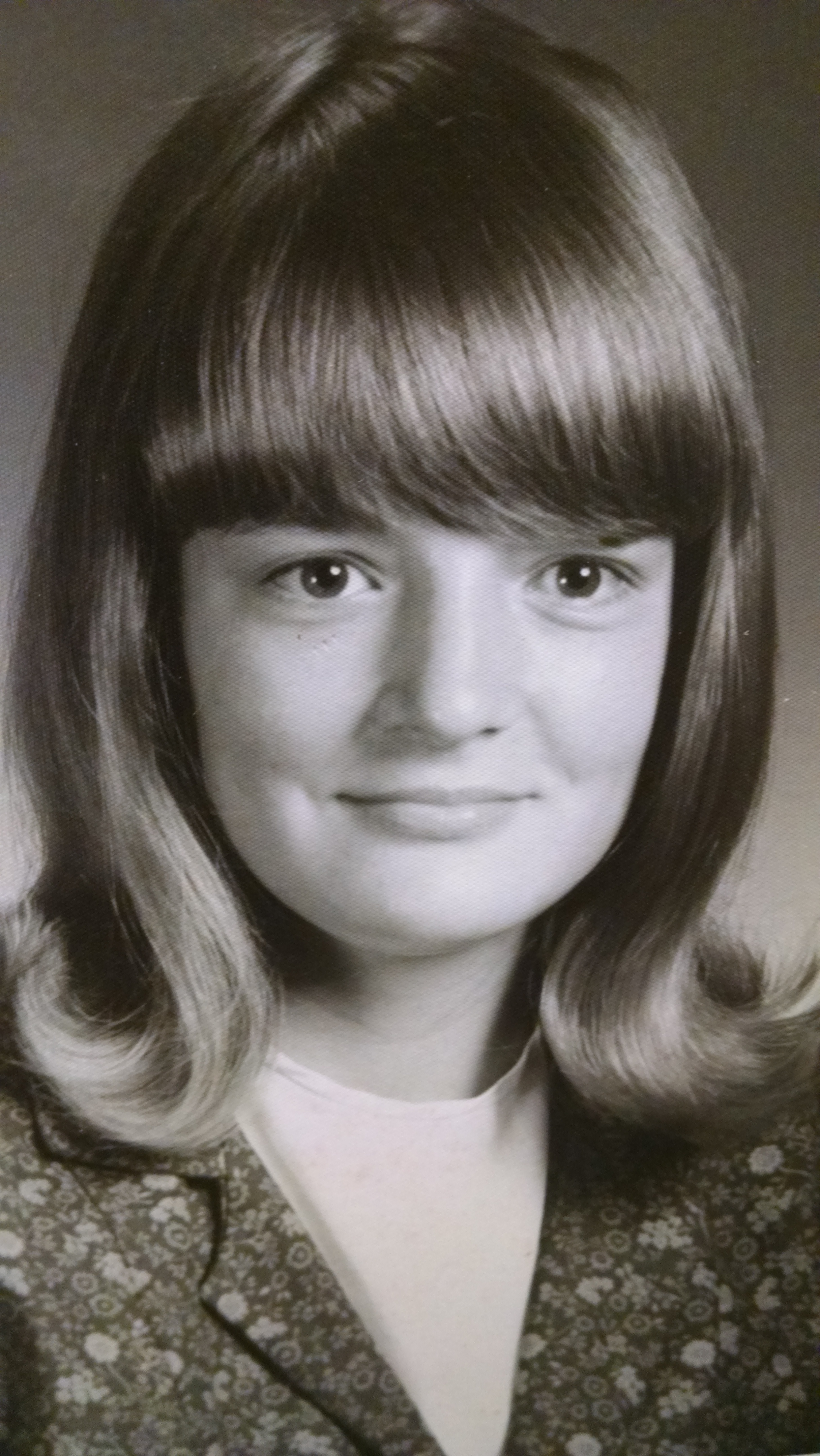
Hair from my “big roller” days, 1967.
So after the parking lot hair compliment, I was so shocked that I allowed my face to break into the biggest smile I could muster and just said “Wow, thank you! That’s very nice.”
He stammered to say that he didn’t mean to be anyone scary or looking for a pick up but just likes to find something to compliment any chance he can. “You never know what a compliment can mean to someone.”
Mr. Random Complimenter did make my day and I’ll confess I went home and looked in the mirror to see how my hair was looking. It was the normal salt and pepper graying hair of many a woman over the age of 65, but I had to laugh because my husband often says he doesn’t say anything about my hair ever because he’s not sure how it is supposed to look. I had recently told my haircutter not to keep trimming the layers and that I would try to grow it to one length again, just for something different.
I tell this story not to compliment myself, but to sing the praises of a man willing to take such a risk in this day and age.
My point here? Who can you surprise with a genuine compliment? Try it!
My final unusual parking lot encounter, at least for a woman of my advanced years, was a week later. (I think we’re on a roll here.) I was scrubbing our small, trusty Nissan at a do-it-yourself carwash before a weekend trip. A younger man (40s, 50s?) pulled up to the vacuum cleaner in front of my bay, and prepared to clean out the inside of his car. But first he called to me over the noise of the water sprayer: “Need some help, sweetie?”
Now, I don’t believe he was trying to pick me up either, heaven forbid, but rather thinking perhaps a woman as old as I in my office clothes shouldn’t be washing a car all by herself? I’ll never know. I politely refused, saying I was fine. Maybe he was just trying to get my bay quicker.
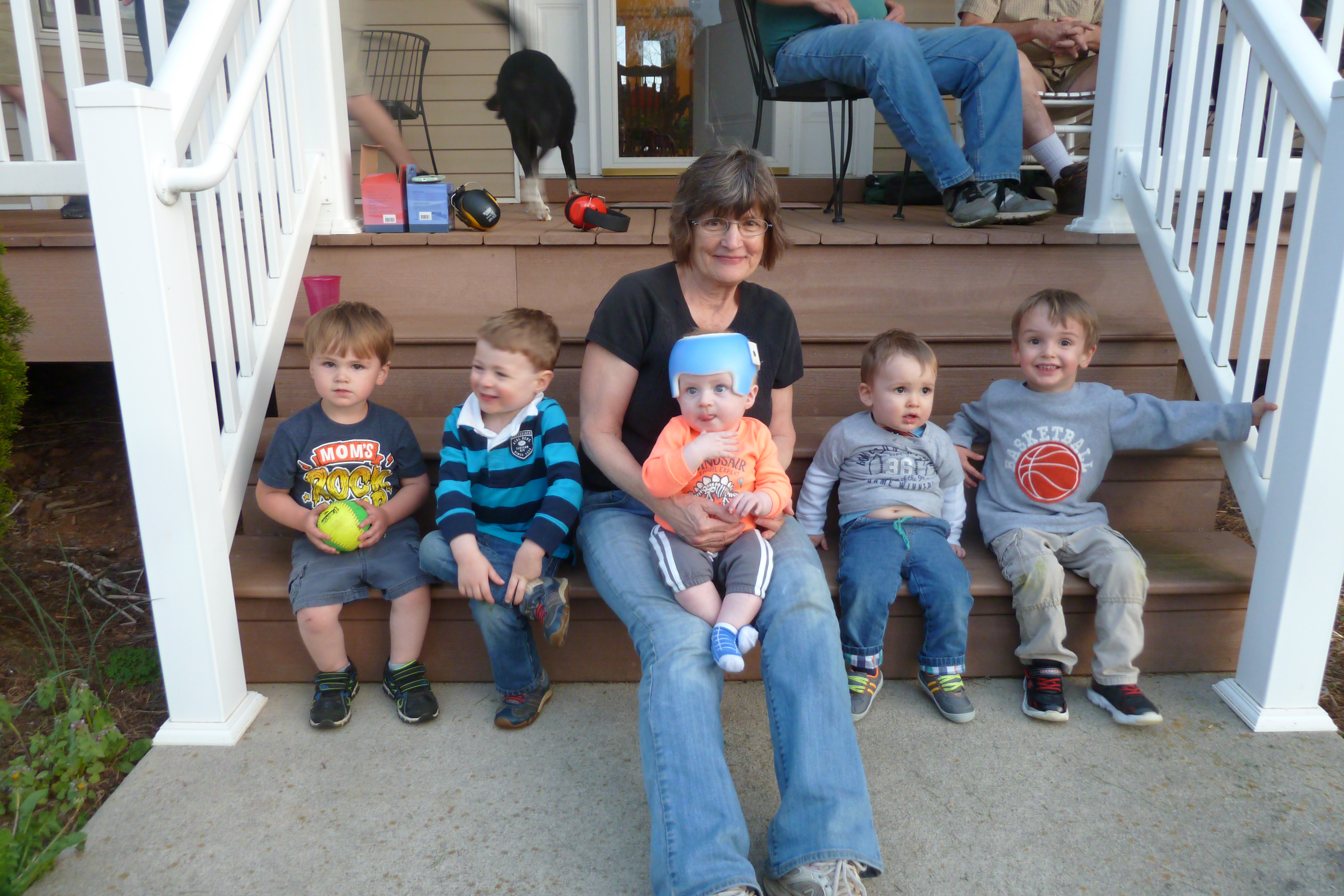
Grammy hairdo now, and my four grandsons, plus their cousin, far left.
Moral of this story? Don’t try calling a woman sweetie unless you think she is old enough to be your grandma, ok?
***
Do you have stories of random compliments or similar to send my way? I’d love to hear them and perhaps do a follow up post or column.
***
Any hair-raising stories, of what you’ve put your hair through as a teen, young adult, or older?
Post in comments or send comments or stories to anotherwaymedia@yahoo.com or Another Way Media, Box 363, Singers Glen, Va. 22850 or post at my Facebook page called Another Way Newspaper Column.
Another Way is a column by © Melodie Davis, in syndication since 1987. Another Way columns are posted at FindingHarmonyBlog.com a week after newspaper publication.

Another Way for week of October 14, 2017
Smoking at School?
It was the Motley Crew who sang this popular song by The Brownsville Station in the year 1973: “Smokin’ in the boys room … Everybody knows that smokin’ ain’t allowed in school.”
My husband, who graduated high school in 1972, had his 45th year class reunion recently. One of the planned activities for the weekend was a trip through the hallowed halls at his old high school, now a middle school. The principal, a young woman (well, ok, she said her class was having its 25th reunion, but she looked so young!) made sure we got to go into all of the classrooms that still looked very much like they did back in 1972. I toured with my husband just to get a taste of what his high school was like back then, and to hear the stories and memories the walls evoked.
But my head wasn’t the only one that turned around when these classmates started reminiscing about an outside smoking area in a courtyard between some wings of the school.

Former smoking area at my husband’s old high school.
This was not a smoking area for teachers, but for students! Can you imagine it today? Even the Motley Crew said way back then, “everybody knows” that it “ain’t” allowed.
As my husband reminded his former classmates, it was only permissible if you had a signed note from your parents on file at the school; if you didn’t have a note, you better not stop and talk with anyone in the area or else you could be tapped for your permission papers. I’m guessing that there was also a cut off age—perhaps 16, although my husband didn’t remember any.
I don’t know how widespread this rule was. I went to a Christian school my first three years where that would have been totally forbidden, but I do recall there was a smoking area at the public high school where I graduated high school. I would love to hear from readers about the rules on smoking you remember at your schools.
When I told my work colleagues about this discovery and memory, they were amazed. Our society has changed so much it is incredibly difficult to imagine schools allowing kids to light up on the grounds. But remember back in the day—people could smoke on airplanes in a special section. In restaurants, sometimes you could have your “smoke” without a special section. And my hospital roommate, when I had our first daughter, was a smoker. There was only a curtain dividing us in our room. (Thankfully, I was moved.)
Unfortunately, I can’t say I was a nonsmoker all my life. I’m not proud of it, but for about two to three months of my junior year of college in Barcelona, Spain, where 75-80 percent of people—including my friends—smoked. Cheap brands were about ten cents a pack then. I went through several packs before I realized how easily it could become a habit. I told myself I had better stop before it become entrenched and hard to quit.
I do have sympathy for anyone who has tried and wants to quit but has difficulty. Of course there are all kinds of products available to help reduce the urge to smoke.
I did a little research online to see if other people remembered the days of “smoking at school.” One wrote in a discussion forum:
“Upon registration a parent had to sign if you were allowed to smoke. Then you’d have a box checked on your ID and could go out to a shed. My dad signed mine. He said he wanted it to be my choice, and he didn’t want to prevent me from hanging out with friends who smoked. This just seems crazy now!”
When we reflect on how policies about smoking have changed so dramatically in the last 30 years, we wonder what changes could come about that we can’t imagine now.
Nicotine is a powerfully addicting drug. If you smoke and want to quit, the Great American Smoke Out is coming up on November 16, a great time to quit! Some quit that day, or set goals for quitting. That would make this the best holiday season ever.
We only get one precious life. Now is a good time to make sure your life is not cut short by the habit of smoking.
***
What policies do you remember from your high school days on smoking? I’d love to hear practices in your community.
***
Another Way Media, Box 363, Singers Glen, Va. 22850 or anotherwaymedia@yahoo.com.
Another Way is a column by Melodie Davis, in syndication since 1987. Another Way columns are posted at FindingHarmonyBlog.com a week after newspaper publication.
Another Way for week of October 6, 2017
How Are We Taught to Love?
One of my newer favorite writers, Marianne Jantzi, posed this question in one of her “Connections” columns (a small Canadian women’s magazine): “What if we had never been taught to keep our homes and families near our hearts?”
Are we taught that, and how? Where does family love and devotion start? Perhaps more importantly, how do we nourish that in ourselves, our children? Is it natural, or learned?
***
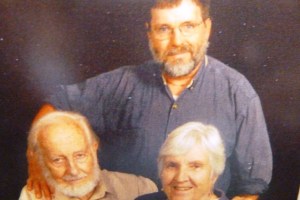
Chad Churchman with his parents, Charles and Pat.
It was one of those “let’s-toss-normal-structure-aside-Sundays,” with chairs placed around tables and in small circles instead of traditional rows (we don’t have pews). The liturgy was pretty normal but when we got to the sermon, mostly we were led through discussion suggestions, with each person sharing from their own journey. We were to close our circles by praying for each other, anointing each other with a bit of oil, and then telling each other “God loves you and I love you.”
On that Sunday morning, one of the persons in my small circle was Chad, who I will always think of as a “young” man, about 11 years younger than me. Chad had suffered a severe head injury in a skiing accident when he was truly young and daring, a freshman in college. After the accident he lay in a coma in critical care for weeks, but eventually regained the ability to walk, talk and function. He was, however, very much changed in personality, but he became a much loved member of our church community as he lived in a separate small cabin at his parents’ home. He eventually was able to hold a job as a landscaper at a local university, loved hiking and the outdoors, and took great joy in doing stonemasonry on the side. Then he had to quit his job about four years ago. Increasingly, he had difficulties talking, swallowing and sometimes walking.
The next Sunday morning after our “small circle” experiment in worship, we received the terrible and shocking news that Chad had died Saturday evening in a choking incident. His aging parents were not strong enough to do a Heimlich maneuver, although they tried valiantly to help him.
My mind went immediately back to the small group circle with Chad and the special anointing. The blessing we gave each other was so simple, yet profound: “God loves you, and I love you.” I will treasure that special service and memory of Chad as he now walks and lives freely in that other heavenly realm with our great and loving God.
Our pastor, Stephanie Sorge Wing, said she gives each of her small sons this blessing—God loves you, and I love you—each night as they go to bed. That is one way to help teach our families the love of God. It is also through the daily tasks requiring great patience, endurance and dedication that our families see love demonstrated (and which Chad’s parents—through many difficulties—possessed in spades).
This is how we teach children and each other what love is. Chad himself became a carrier of that love as his main greeting at church became a solidly gripped handshake or a sweet bear hug. He also reached out to help others however he could.
***
Another excellent Canadian writer (British Columbia), Gareth Brandt, writes in a devotional magazine Rejoice! about God’s great love. Brandt notes that, “God is often depicted as quite emotionally volatile in various Old Testament stories, but divine anger is always temporary, whereas God’s love is always steady and lasting, even eternal. … This love is … the basic message of the gospel we pass on to the next generation.”
Brandt closes with this beautiful reminder:
“When our daughter was lying in a coma: God is love. When we moved from rich familiar soil to windblown prairie: God is love. In the thick and thin of our marriage: God is love. Amid disunity and division: God is love. On special occasions and in ordinary life: God is love. Whatever you have experienced: God is love. Come what may: God is love.”
***
How do you see God’s love made visible around you?
What prayer or reminder did you or do you say to your children or grandchildren when you put them to bed, or other special traditions?
What do you remember your parents or grandparents saying to you?
I’d love to see your comments below!
***
Another Way is a column by Melodie Davis, in syndication since 1987. Another Way columns are posted at FindingHarmonyBlog.com a week after newspaper publication.

 findingharmonyblog
