

 (Sorry for my delay in publishing this online but our summer has been a bit busy.)
Another Way for week of July 14, 2017
What Travel Does
Fifty years ago this month my parents took the trip of two lifetimes. I say two lifetimes because I doubt I will ever have the opportunity to duplicate it. But that’s ok. That they even attempted it, is just as incredible to me today as it was in 1967.
They went around the world visiting Germany, Amsterdam, France, Switzerland, Israel, Jordan, Egypt, India, Thailand, Vietnam, Korea, Japan, and Hawaii in a trip of about four weeks.
However, fifty years ago in June 1967, less than three weeks before they were set to leave, the “six day” war erupted in Israel. For several anxious days, they (and the tour organizers for their “Holy Land” tour) pondered: can we still visit? What will happen? Many many more face those kinds of ongoing questions on almost any trip abroad or even as we fly or travel in the U.S. Where is safe?
They did what so many others do: go anyway. Nowhere is truly safe, not even in 1967.
They didn’t feel too guilty, either, for leaving us at home doing the chores on the farm (with the help of a wonderful family who moved in with us for the duration). Just three years earlier, in 1964, Mom and Dad took our whole family on a western U.S. camping trip that we planned and saved for over five years—and remembered for decades. Truly our lifetime trip as a family.
Mom and Dad did not first plan on going clear around the world. The original idea was to attend Mennonite World Conference in Amsterdam, a long term dream. When they went to make arrangements through the travel agency, Mom and Dad asked the agent how much extra would it cost to visit France and Switzerland, where they wanted to visit historical sites related to the beginnings of Mennonite faith. Looking at the map, then they asked how much extra it would be to add on a leg to the Middle East to visit the Holy Lands and then India, in order to visit food distribution sites for the CROP program Dad had long worked with. The travel agent pointed out that once they were that far, it made as much sense to continue on to the Far East. So they decided to visit locations where heifers and other donated animals were making life easier for families in Thailand through what was then called the Heifer Project (now Heifer International). And so it went. I remember those details because Dad told the story so often!
It made sense for them to do this trip even though they were ordinary farmers with an average income which went up and down with the price of pigs and corn (two of our main products on the farm). Dad always said they paid for this trip by not smoking all their lives. Think about it. At today’s price of roughly $25 a carton (on the super cheap side), if you smoked a carton a week that’s $2600 a year for both husband and wife. You could save up for a pretty nice trip in ten years—$26,000, which isn’t that far to plan ahead.
A big savings for them was staying with missionaries in some locations, and also with friends who had visited our home over the years from various countries. They ate frugally—they both came back having lost weight, if my memory serves me. When you are visiting countries partially to see just how far the crops and money you donated to “feed the hungry people of the world” went (one of their main goals), you don’t exactly feel like gorging at a buffet.
Dad came back a “missionary” himself: as he began sharing their slides and many stories, they were invited to numerous churches, CROP programs and farmer banquets to talk about the needs they saw and deliver the message that yes, there truly were starving people they were helping through both distribution of precious sacks of rice and grain (where he witnessed very thin men scraping the leftover grain up off distribution platforms, so as not to let any go to waste). Dad often told that story with emotion in his throat and tears in his eyes. He learned and shared that supplies and food sent through government agencies often sat in warehouses or docks and spoiled because of red tape, while goods shipped through Christian and other non-governmental sources reached the people with less obstruction.
My memories these fifty years later, and how thoroughly Dad preached Christ’s gospel truth of “caring for the least of these” (Matthew 25:40) to anyone who would listen, is one testament to the lasting impact their life changing trip had.
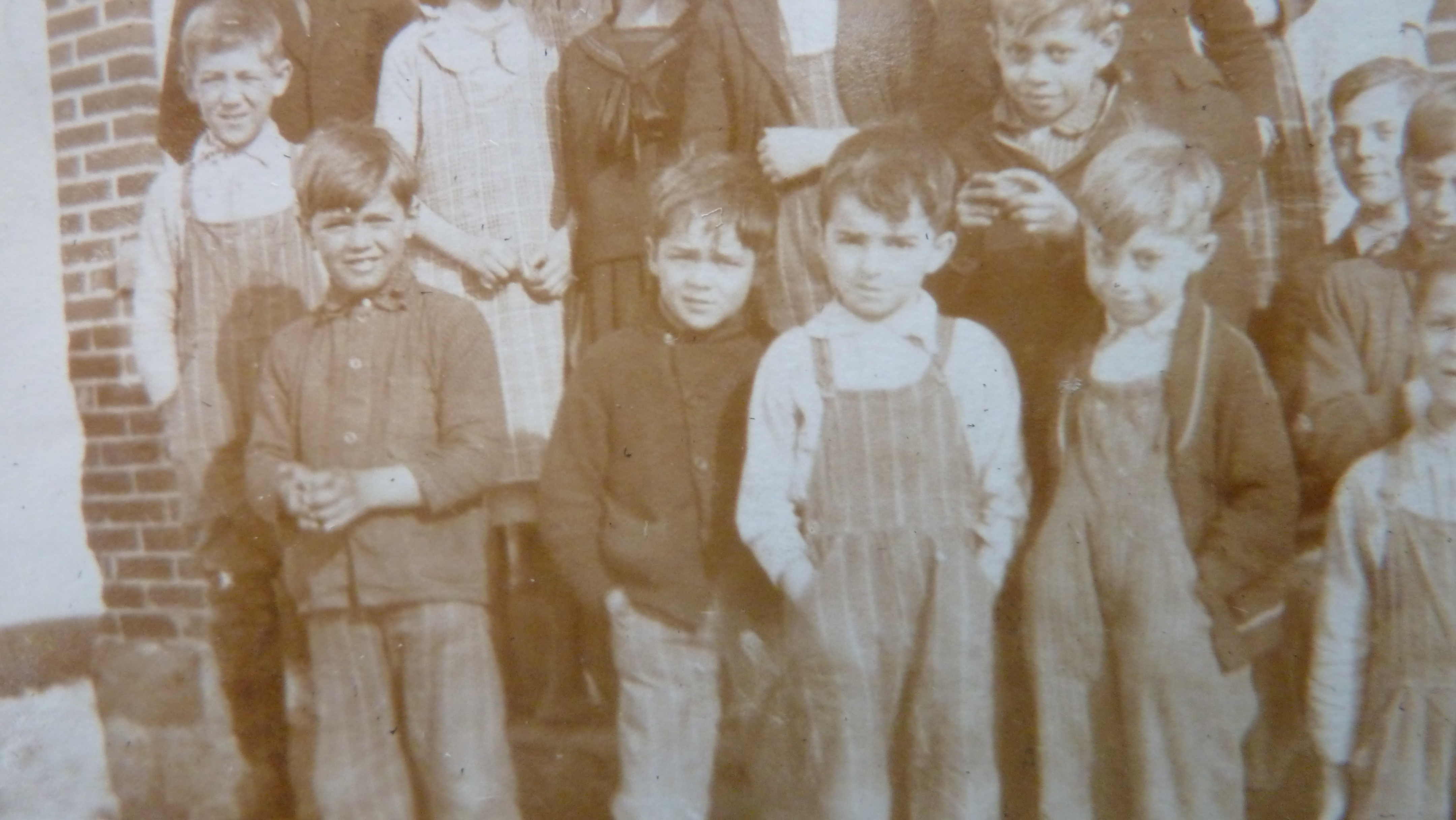
My father as a young school boy, circa 1922, second from left in front row, who couldn’t have imagined flying in an airplane, let alone going around the world.
What has travel done for you? Even if it is only to an area nearby? What have you learned through opening your eyes to needs—perhaps in your own backyard? I’d love to hear from you at anotherwaymedia@yahoo.com or Another Way Media, Box 363, Singers Glen, Va. 22850.
***
My own brief experience at Mennonite World Conference 2015 in Harrisburg, Pa. was described in several blog posts here.
***
Another Way is a column by Melodie Davis, in syndication since 1987. Another Way columns are posted at FindingHarmonyBlog.com a week after newspaper publication.
Another Way for week of July 7, 2017
Making the World a Better Place
“That’s not a toy.”

L to R: James Gilkeson, Jr., son David Gilkeson, and grandson James Matthew Gilkeson at Matt’s wedding a few years ago. Photo provided.
The young man speaking at his beloved grandfather’s memorial service remembered these words so well from his growing up days. His dedicated and loving grandpa, “Pop” would try to keep his grandchildren safe as they romped and played and creatively used almost anything for their imaginative play. For instance, they innovated using a window, to play “ordering carry-out at the fast food window.” Of course! (My grandsons play that too using the little window on the playhouse their great grandfather made—for their mothers.)
James Matthew Gilkeson—who I used to teach in Sunday school—winsomely taught those of us at this service, myself included. He gave a beautiful tribute for his grandfather, Jim Gilkeson, Jr. Jim and his wife, Emily, were at our wedding 41 years ago, and we spent many years in the same small group or “house church.”

Jim Gilkeson, Jr., far left, at a dinner he hosted at Sunnyside Retirement Home May 2016 at “The Highlands” apartments, before moving to assisted living. He almost always wore a bow tie. (M.Davis photo)
Matt started off his reflections quoting from a podcast “S-Town” about John B. McLemore and an essay he wrote titled “A Worthwhile Life Defined” where McLemore used a little math to figure out how many hours the average person has in life to build a better world. Matt used those numbers to report that in his grandfather’s long life of 91 years, Jim spent 32 years sleeping; 40 years working and doing chores like mowing lawn; and 17 years doing the things that he truly loved and that make the world a better place. The things that we all live for, or should.
Those were statistics for an average man. Matt felt his grandfather, however, was an extraordinary man, and talked about how his grandfather was actually able to squeeze more of the “truly loved” things into his life by merging them with various jobs he held, and volunteering for 50 years as a Boy Scout leader. He had a passion for helping young people with a variety of problems, working for improvements in the criminal justice system, and faithfully helping our church Clothes Closet for many years. As a Boy Scout, Matt was able to spend many hours with his grandfather that he may not have otherwise, in their shared love of all things scouting, and he also helped both grandparents with their Clothes Closet work.
Matt talked about how, as is typical in many families, one parent or grandparent is more willing and open to bend the rules. If Jim was riding the grandchildren too hard about this issue or that, his grandmother, Em would call from the kitchen or wherever saying, “Jim, let them be! They’re kids.” Jim’s heart was in the right place—concerned for their safety—something he “preached” around our church building also.
Matt’s take away and challenge that I carried with me from that memorial service was how much do I really work to help make the world a better place?
Yes, there are still many people striving for that goal. We went to another memorial service recently for an elderly couple who died within four days of each other. So the family held a joint service, and the speakers emphasized how “doing for others” characterized both their lives in helping others. The father, Wilkie, was known for the beautiful dahlias he raised, and took great joy in sharing blooms with others. Each year at Christmas, his wife Shirley made something like 30 fresh coffee cakes and liberally bestowed them on friends and family. Among many other loving deeds and involvements.
Rob, the retirement home chaplain who conducted the service, recalled how Wilkie had been the one to call out his personal gifts for being a pastor when he was just a teenager. Rob was helping to usher at church and Wilkie took him aside and asked, “Have you ever considered the ministry?” Rob said he had not previously considered that but after Wilkie raised the question, he did think about it a great deal. Rob today works among those who will never make him famous or rich—but enjoys and encourages the many gifts of those living in the retirement community where he serves.
How are you spending your days? In a world where there is too much hate and fear, how are you helping the world become a better place?
I’d love to hear from you at anotherwaymedia@yahoo.com or Another Way Media, Box 363, Singers Glen, Va. 22850.
Another Way is a column by Melodie Davis, in syndication since 1987. Another Way columns are posted at FindingHarmonyBlog.com a week after newspaper publication.
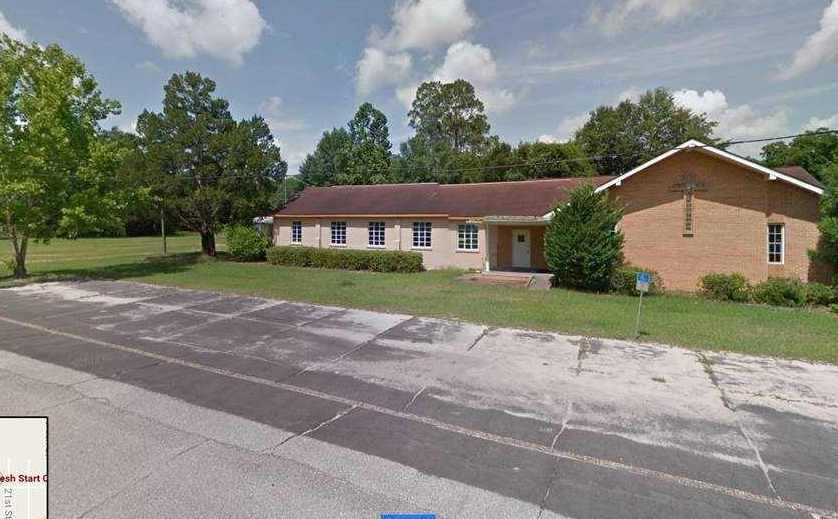
Oak Terrace Mennonite Church (no longer has this name) but it looked about like this in the 1970s when this true story took place here. Google Maps image, edited.
Another Way for week of June 16, 2017
The Generous Gift
Editor’s note: Second of a four-part June series celebrating men and dads, drawn and updated from favorite Another Way columns over the years.
We stood in the little foyer of that cement block church in rural North Florida after worship one Sunday morning. The room hummed with all the chatter of folks whose main weekly social event was going to church on Sunday. Everyone but the pastor’s family knew that this was the Sunday for the surprise.
You see, the pastor’s car was one of those models that “kept the Lord working overtime,” as the pastor would sometimes quip, running on faith. His family definitely needed a newer car, but hardly had the money for one. He did not receive full financial support from our small congregation, and worked part time helping run a fledging mobile home factory. He had four children, one who required special physical therapy for his mental and physical challenges.
Not that anyone in that congregation was much better off. Many were farmers; that year both rain and blight had blunted much hope of any profit.
Children whispered expectantly and grownups maneuvered to get the pastor and his wife in one place at the same time so someone could hand them the envelope. Finally, it was in the pastor’s hand. He started to open it, oblivious to the gift that waited. Then he decided he’d just wait to open the envelope until he got home.
Someone prompted his wife, “Ruby, would you please help John open that envelope?”
By now, all normal conversation had stopped. Together Ruby and John tore the seal and began to pull out a fat wad of green.
Ruby joked, “There must have been a bank robbery.”
We laughed, and as John and Ruby went on to read the note that was enclosed, the hush returned along with knowing smiles. The note said there was $1570 in bills in that envelope. That wouldn’t buy much of a car today, but in 1973, it was enough to purchase a good used vehicle.
Then Ruby took off, red-eyed for the bathroom, and the dam broke for the rest of us, too. Tears flowed freely from many eyes, and John was left to muster the thanks that no words could express.
John was a pastor who had not gone to seminary, and his tongue sometimes got tangled up in his sermons or reading Old Testament names. “Frustrated” would come out “flusterated,” for instance, an inventive mix of flustered and frustrated.
This was an era when kids didn’t take real guns to school and shoot classmates, but John perceived that area youth he ministered to could use an in-school spiritual listening ear. He arranged with school officials to be available in the school library at two high schools over lunch hours for kids to voluntarily come to talk to him where they spilled out problems with friends, parents, schoolwork, or religion. He never pressured anyone.
“We aren’t reaching the community through our preaching services anymore,” he told me once for an article I wrote about his ministry with students. “If we don’t busy ourselves and touch this generation of young people, we’ve lost them.” The most frequent problems concerned relationships with parents, and divorce. They also shared boy-girl problems. Some talked of suicide.
I found out what a great listening ear John had some years later. My husband, our new baby, and I returned to that town to visit my brother and his wife who still lived there. My husband had been wrestling with spiritual questions himself—questions that had plagued him for years. After he heard John preach on Sunday morning, he perceived that this was a pastor he could talk to—he didn’t seem like he was on some pious pedestal. He did not use huge words. We called John that afternoon and he said sure, come on over after the evening service and we could talk. My brother and his wife gladly babysat for us.
And although I’m sure John was tired after two services and a long day visiting members in the hospital, he counseled with us until 1 a.m., talking and sharing until my spouse had some answers to his questions. I was pleased for the way John guided us; he didn’t tell us what to believe, but affirmed the faith we had and were brought up in.
Years later, John had a life-changing stroke: one that left him confused, almost helpless, and dependent on his ever faithful Ruby. It still seems like such a terrible blow, but the trials he helped others face were now his. I hope his family can still take comfort and strength knowing and remembering how fully and humbly he served for as long as he was able. He gave us all a generous gift. Himself.
***
Who is a man who stands out in your life, and why?
Send stories or comments to anotherwaymedia@yahoo.com or Another Way Media, Box 363 , Singers Glen, Va. 22850. I would love to do a follow up column.
Another Way is a column by Melodie Davis, in syndication since 1987. Another Way columns are posted at FindingHarmonyBlog.com a week after newspaper publication.
 Another Way for week of June 9, 2017
Excellence was a buzzword in business circles back in the 1980s, set off by the best-selling In Search of Excellence book by authors Thomas Peters and Robert Waterman. They profiled what made businesses, small and large, successful. I always said Peters and Waterman should have met the operator of this particular small town car wash.
I didn’t know his name but I called him Mr. Carwash. He treated me like an old friend after only three weeks of taking my business there. He would appear shortly after you pulled up to the entrance and directed you to “put ‘er in neutral and take your foot off the brake.” He then proceeded to give your tires a good scrubbing, while they whirled around in a special contraption. That done, he brought goodies to the car window: candies for the children, sure, but Mr. Carwash always added a welcome touch for a Mom or Dad with lagging energy: adult candy such as a peppermint or butterscotch.
Next he gave you a coupon with an unusual guarantee: if it rained the day of your car wash, you were to come back within three days for a re-wash. “One woman thought if it rained within three days she’d get a free wash. But that’s not what it says,” he carefully pointed out. “But I gave it to her anyway,” he added. Sometimes he gave you a coupon for $1 off the already low $3 price for your next carwash.
Next Mr. Carwash scrubbed the extra-dirty places on the car with a foaming wand and then finally let you enter the automatic part. While the brushes did their thing, you might spy him grabbing a bit of sandwich. It was his lunch hour, too, after all.
But then he’d be back to guide you out of the bay at precisely the right moment. He said it was tricky, and it was. “You’ve got to move right on out or you’ll miss your rinse. See?” he pointed out ruefully after my very first run. “The front part of your van is spotted,” he said with a touch of disdain or perhaps just disappointment.
In subsequent trips, I learned you shouldn’t move too fast or too slow, because the water would turn off and then the back quarter of your vehicle would wind up spotted. But when I finally managed to pull out just when he directed, Mr. Carwash beamed: “Look at that shine! I love to send people out of here looking their best. Remember no one else in town has the spot-free rinse.”
What made Mr. Carwash’s automatic carwash excellent? Not the candy or coupons. Not the tire scrub or pre-wash. Not the soft brushes or even his special spot-free rinse.
What made that little bay so excellent was Mr. Carwash himself. The personal attention. The feeling that you, and your car, mattered. Mr. Carwash cared about his work.
I once apologized for interrupting his lunch. He wouldn’t hear it. “Oh, that’s okay. I start eating it about 10 o’clock. See, I eat breakfast at 6 a.m.”
Mr. Carwash took pride in getting it right, giving a good wash every time, making his customers happy. While many people today complain that so many workers don’t care about what kind of product they turn out or the service they give, there are still people around like Mr. Carwash.
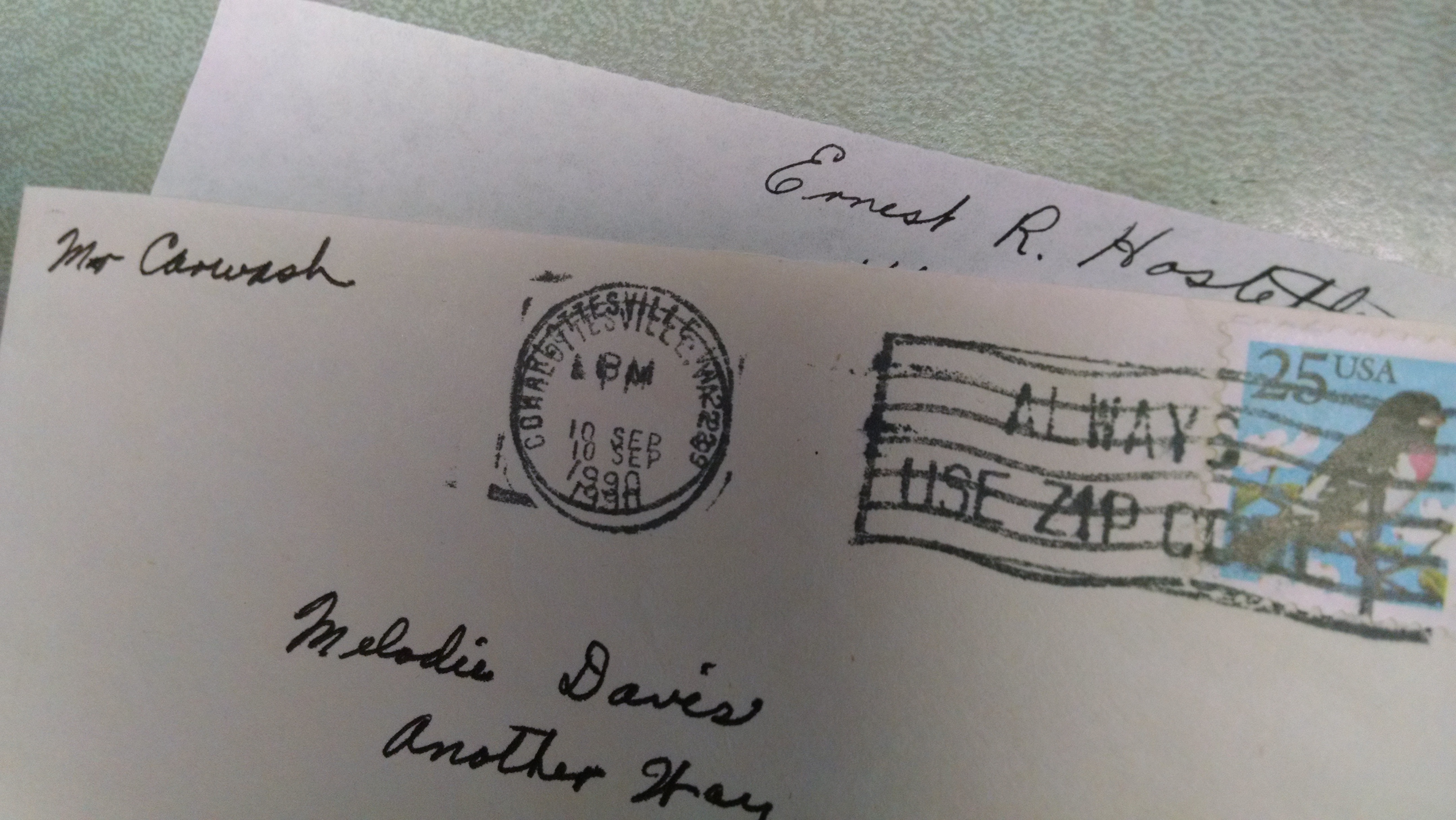
After I first wrote this column about Mr. Carwash’s superior service in our local paper, I received a letter. In the corner with his return address label, he had scrawled in, “Mr. Carwash.” After that we were on a first name basis and I felt I had lost a friend when he became too ill to work, then finally died. But whenever I think of excellence in a simple chore performed well, I think of the shining example of Mr. Carwash.
No other bay in town had Mr. Carwash.

Act 1 at Mesmerizing Mortuary. The wackier the names, the better.
It may have been an “off off off off OFF Broadway” play as the director/producer/playwright claimed in her opening announcements before the show.

Our row : my oldest sister Nancy in foreground, my nephew (shaved head) and sister Pert, eyes half closed. (Sorry about that, this was a crowd picture.)
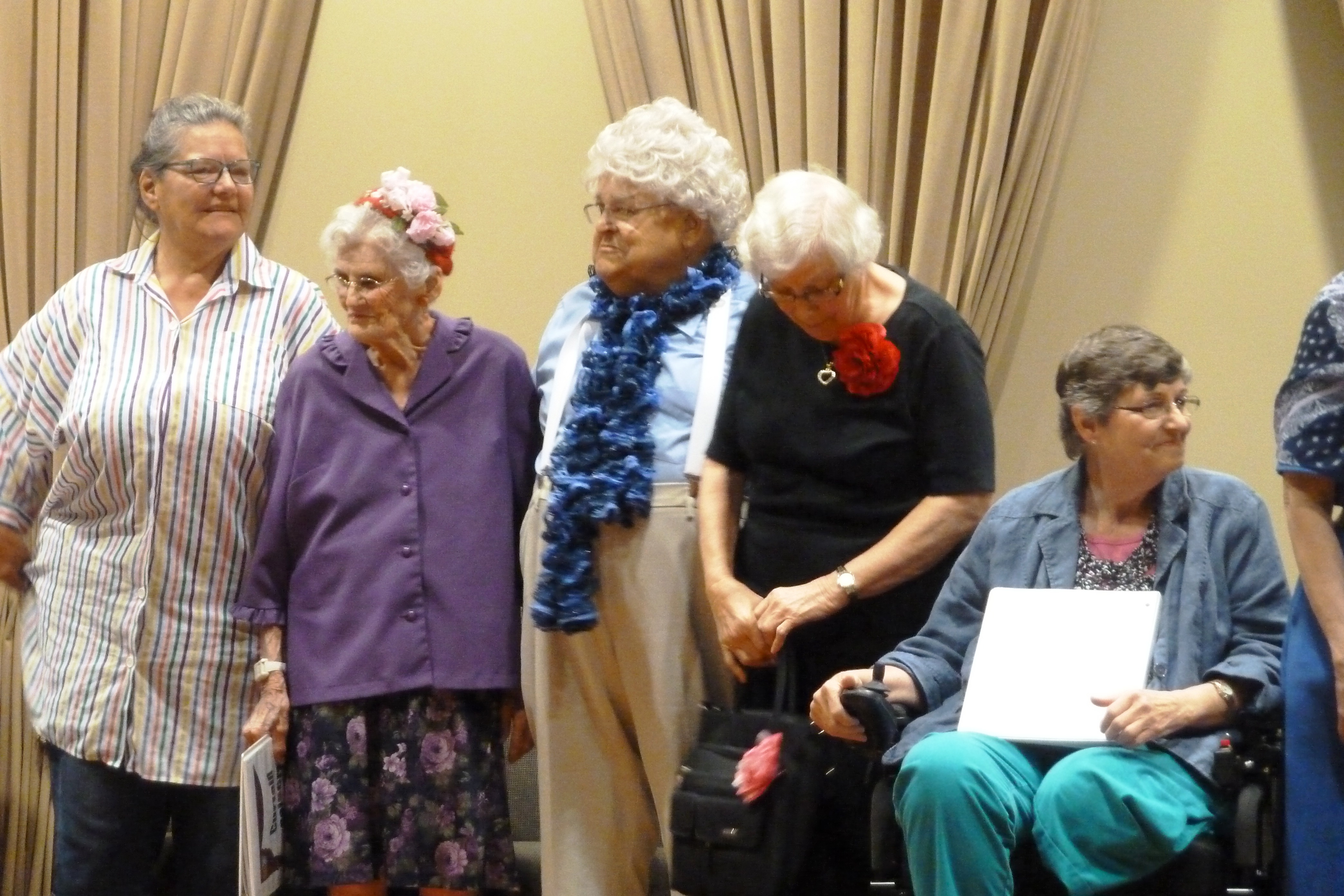
My mother, Bertha, in purple, next to “Jessie Underhand” in his “casket” clothes, and other cast members.
But there was a turn-away crowd plus extra chairs had to be put in the aisles for the opening matinee performance of “Where There’s A Will, There’s a Relative” on June 2. This was at a retirement complex and Mom was playing the part of one of two widows (along with others) who show up with hands out to see if they’ve been named in the will of “Jesse Underhand” after he kicks the bucket.

Pre-performance jitters: Pert looking over Mom’s script with Mom in costume.
My mother has always enjoyed acting in skits and talent shows where she could raise Cain and act silly, wear outlandish clothes and even earrings (long forbidden in our upbringing), and best of all make people laugh. When we were kids, our friends claimed they loved coming to our house because Mom always made them laugh.
It had been on my bucket list to finally get to one of the plays put on by an awesome drama group, The Curtain Raisers, as part of Amy Willhelm’s creative activity director work for Greencroft Retirement Community in Goshen, Indiana. Mom will be 93 in July, and I knew it was high time to make it a priority to see her perform, after having to miss three previous shows for one reason or another. My sister Pert also traveled to Indiana for the play, and we loved joining my sister who lives nearby for the event.
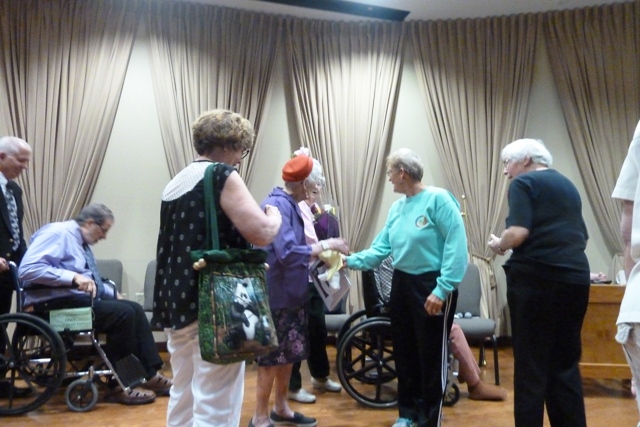
The play was great, missed lines and all. I hasten to add these senior citizens—some of them very senior, read their scripts from a book (no memorization of lines) but they practice hard and truly work at delivering their lines with the best possible annunciation, in character, and leaving gaps after punch lines for people to laugh. They love ad-libbing and getting permission to add lines to the show.
The theme—dealing with the death of a loved one—seems like a somber topic especially for this crowd, and Amy as script writer had actually woven in good solid information about how a will is probated, getting copies of death certificates for the executor, and how long to expect certain things to take. Being able to laugh in the face of life’s realities and not take ourselves too seriously was certainly another take away from the play.

Mom and “son” and “daughter in law” who show up to make claims on the estate after being estranged from underhanded Jessie most of their lives. Or was Jessie the world’s worst procrastinator?
But for the actors, they also enjoy much laughter as they prepare for the play. Director Willhelm purposely writes humorous dramas that draw from their life experiences. As Mom says, the work and fun keeps their minds alert and striving for a wonderful goal together. My hat is off to this ambitious director who offers these seniors such a creative and fun opportunity.

Helping Mom out the door, movie star glasses and all. She always wear dark glasses outside due to her eye issues.

Mom’s entourage helped her into the car, plus me playing paparazzi, of course.

Roses for our star and congratulating the rest of the cast.
***
What would you like to be doing when you’re almost 93? Anything on your bucket list?
***
What activities did or do your parents or loved ones enjoy in their senior years?
***
I’m proud to have served as editor for this book dealing with aging themes by Dr. Glen Miller, who now lives in the same apartment complex at Greencroft. It is titled Living Thoughtfully, Dying Well: A Doctor Explains How to Make Death a Natural Part of Life. Find more information or purchase, here.

Another Way for week of June 2, 2017
Little Things Can Mean So Much
I noticed a lone tear slip down his cheek. He choked up as soon as we told him our youngest daughter had been able to come with us to visit on Easter afternoon at the nursing home where he’s been living about six months.
I would say he was obviously happy to see her, except he can barely see. But he knew a third shape was with us. He has always had such a tender heart for children, deer (“I could never be a hunter!”), his cats, and earlier, a dog.
Charles, our former neighbor and longtime friend, is one of approximately 1.3 million folks living in a health care facility, (2012 figures according to the Institute on Aging.) The move was not really his choice but I think we all knew the day was coming. He’s quite a survivor, having lived and thrived with a frozen, unbendable right knee (injured long ago) most of his life.
For years he and his beloved wife Letha were among the original farmers who sold home grown produce at the Harrisonburg Farmer’s Market—now the cool, upscale place to be every Saturday morning. Back then it was mostly subsistence part-time farmers who supplemented meager incomes by selling a few vegetables under a parking deck from backs of pickup trucks. Charles and Letha planted hundreds of spring onions and were usually the first vendors to offer them at the market each February.
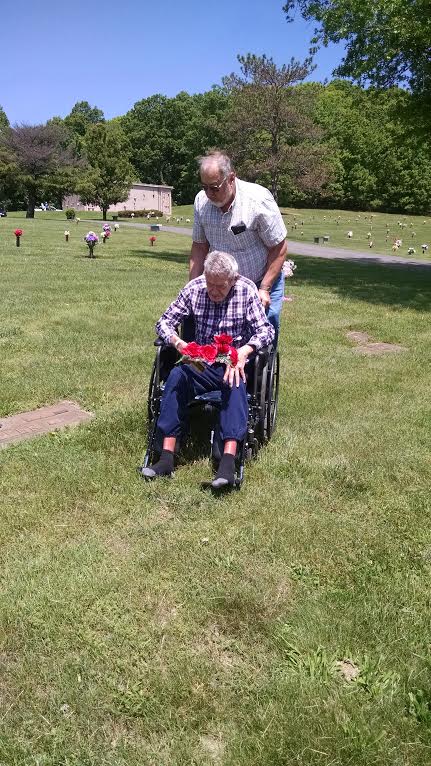
My husband pushing Charles’ wheelchair over the bumpy terrain.
Letha died 13 years ago this month; life has been lonely but livable for Charles ever since. At age 91, he’s had a hard life, and now is legally blind. For a time he managed to live by himself with the help of the local social services folks, and frozen “meals on wheels.” Aides came in several mornings a week to assist him. Then after a bad fall, he could no longer live alone. Only one stepson lives nearby, but lives in a group home and is not independent. The stepson calls and is brought to see Charles every few weeks. A few other neighbors and a long time mail carrier are pretty much Charles’s only other visitors. His biggest wish, now that it’s summer, is that he could sit again under his old outdoor canopied swing enjoying the breezes and sun. We do take him to the courtyard outside his nursing home window whenever possible.
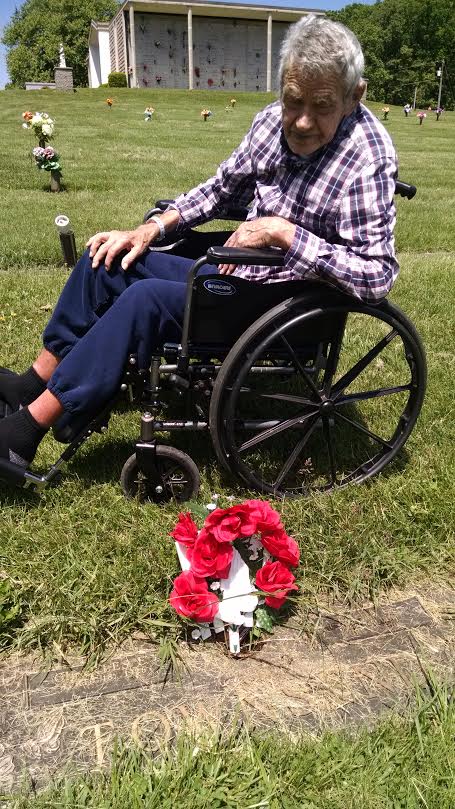 On Mother’s Day, we were able to sign Charles out of his nursing home (we hadn’t known we could do that) to visit his wife’s grave, nearby. He can transfer from a wheelchair to our minivan okay, so my husband pushed Charles’s wheelchair over uneven ground and up a hill at the cemetery. Charles broke down and just sobbed to be there once again. Theirs was a second marriage that lasted nearly fifty years. After her death, he was a loyal visitor to her grave. He kept saying, “You have no idea how much this means.” I think it was good for him to be able to let his sorrow out like that. Afterwards we picked up a fast food lunch to enjoy with him back in his room—so tasty after institutional food.
I write this not to brag on us in any way—I wish we could go visit several times a week. What we do is so meager. But when we do go, I am always struck by how very many lonely and friendless folks there are in long term care facilities throughout the land.
I’m sure many readers of this column visit friends, relatives, and church members. Many more of us could visit more often if we would but carve out time. And even if you are visiting someone who cannot speak, and perhaps it seems like they don’t even know you are there, the staff and caretakers know and take notice.
We all know we may someday be in those wheelchairs, those beds, those halls, eating those lunches. Perhaps recognizing that stark truth is what keeps some of us away. Is there someone who would enjoy a visit from you today or sometime this week? Or perhaps a card or phone call?
***
Any stories or memories this brings to mind?
Another Way is a column by Melodie Davis, in syndication since 1987. Another Way columns are posted at FindingHarmonyBlog.com a week after newspaper publication. Charles gave permission for me to take and use photos.
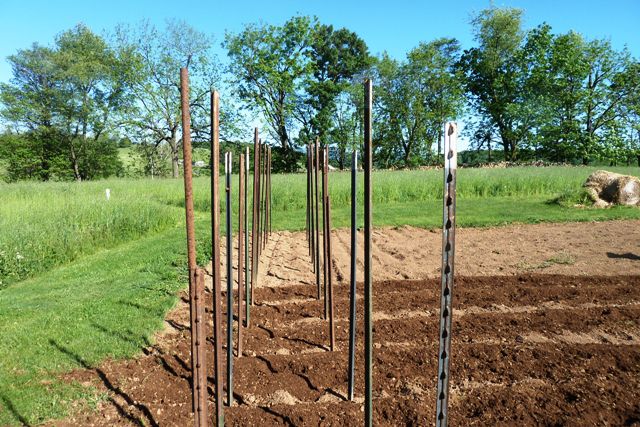
Not perfect, but good enough!
Another Way for week of May 26, 2017
Forty-One Years of Eat, Pray, Love.
The annual setting out of our tomato stakes is often a barometer of our marriage. We bicker about how far apart the stakes should be, whether they are straight, and move the stake back and forth a mere inch or so to get it just right. I feel like a have a reasonably good eye for spacing stakes evenly, although we can both get off track and the stakes gently wind a slow curve. As we age, the job becomes less a test of marriage and more a trial of physical strength getting the stakes in the ground.
If you’re going w-w-w-what is she talking about, a brief primer is in order on planting and raising tomatoes the Hershel Davis way. Hershel was my father-in-law—who modeled and instructed us in the fine art of growing tomatoes. He put out hundreds of tomato plants each summer and staked them all, tying the vines ever further up the stakes as they grew. He loved growing tomatoes and giving many away—especially if you praised them. He also sold some to local independent groceries or regular customers.
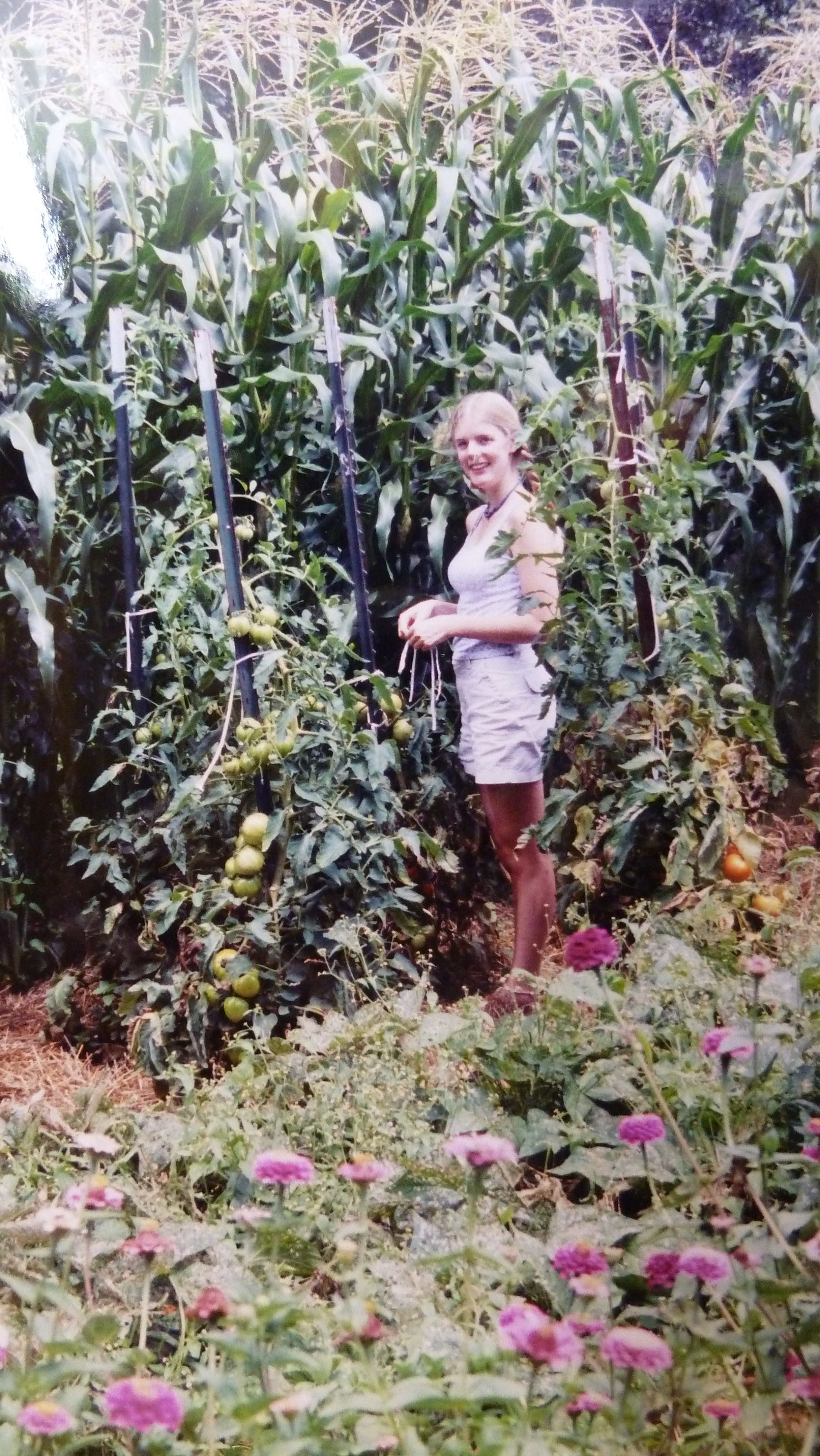
Daughter Doreen standing beside staked up tomatoes at our 30-year-home. And yes, that is even taller corn behind her.
My husband—great tinkerer that he is—went one better for awhile and put extensions on his tomato stakes so the plants could grow even taller. I think he was heading for Jack-and-the-beanstalk’s-giant territory. Stuart has to stand on a step stool in order to get high enough to pound the stakes into the ground using a device he made for the purpose, like a fence post driver. It is a heavy, hollow, steel tube, closed on top with handles on each side that you slide down over the stake to hammer it into the ground. We used to use wooden stakes but some years ago we changed to using metal fencing posts. The hollow steel tube clanging on the metal fence post rings out as we work like we were building a railroad. And feels like that.
So, each year I dread the setting out of the stakes. I dislike it as much for the marital spats it brings out in both of us, as for the hard labor it involves. If you’ve been married 10, 15 or more years I’m guessing there are certain annual rituals and tasks that you get a little heated about every year, too. Choosing or retrieving a Christmas tree, if you buy an actual tree each year. Packing the car for vacation. Figuring out where you’ll go on vacation. How best to shovel snow or wash windows. Or perhaps it’s cleaning the basement or garage that gets you going with irritations and squabbles.
It does get easier with time, because you know your marriage will survive the bickering, and can take it in better stride.
Last year we celebrated 40 years of marriage on May 29. How do we—and millions of other couples manage to keep their wedding vows for 30, 40, 50 or more years?
- You keep the vows because you promised each other you would.
- You find ways to practice daily love expressed through a kiss, a kind word, a special smile, a favor or deed done for your loved one.
- You make getaways—weekend trips or longer if you can—when it is just the two of you. You treat yourselves to the luxury of a nice motel or cabin or camping if that’s your thing, and enjoy the snuggles.
- If you’re not into traveling—just keep date nights when you put away your phones and find things to talk about, like you did when you were dating.
- If you have an argument, you let it cool and then both work at making up later with a genuine “I’m sorry” and repeating any of the love expressions in #2.
- You build memories as a couple or family which keep you hanging on even when the love feels in small supply.
- You get help if necessary when going through a bad patch, depression, grief, or a seemingly irresolvable conflict.
- You let your family support and help you in times of need—and return the favor for all those kin you keep close.
- You pray.
- You eat together.
- You just keep loving.
For my free booklet (sized to fit into wedding or anniversary cards), “Secrets of Long Marriage: Six C’s of Marriage,” write to me at anotherwaymedia@yahoo.com or Another Way Media, Box 363, Singers Glen, Va. 22850. Two or three per request as long as they last. Send one standard U.S. postage stamp for each booklet.
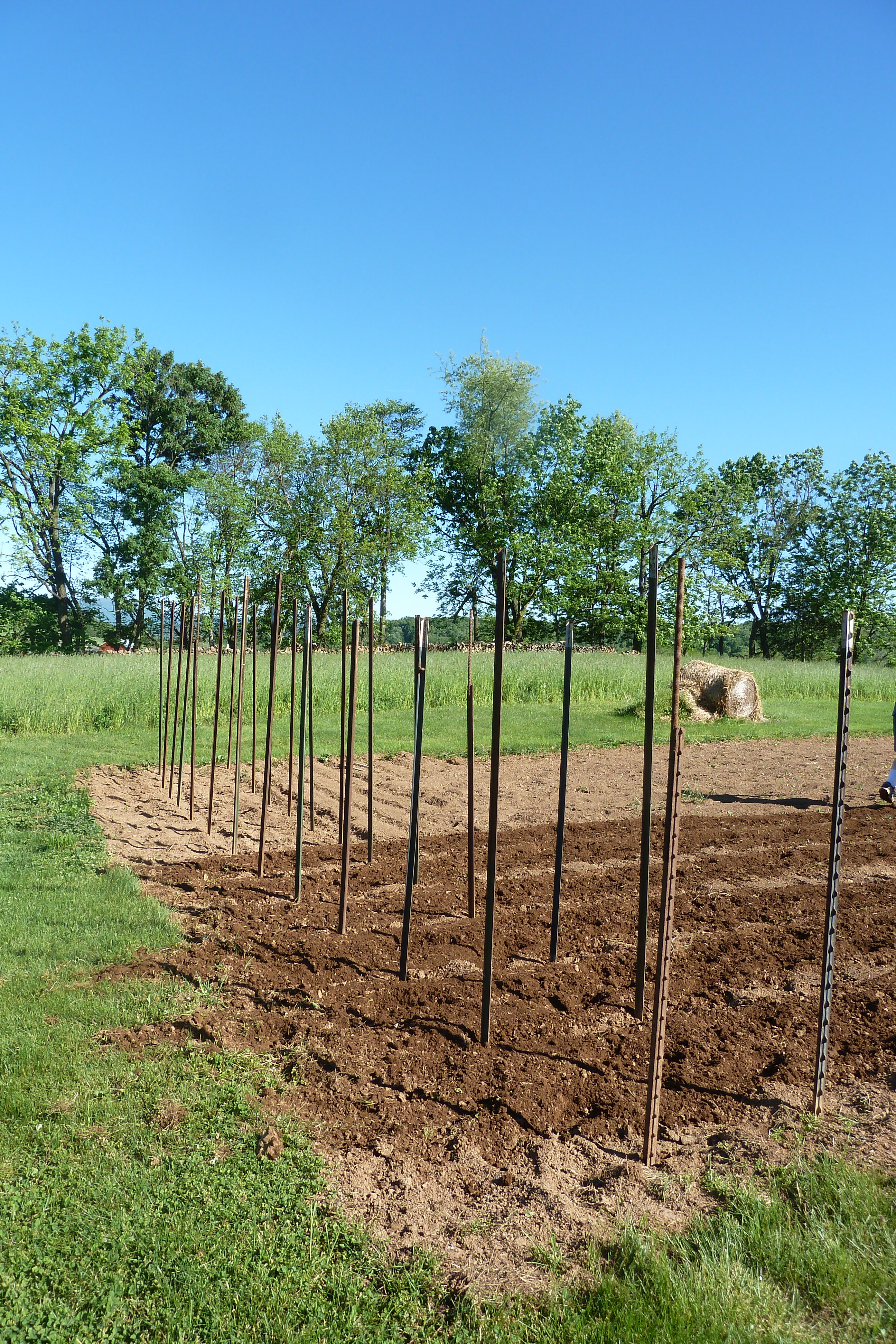
We used to put in stakes after the tomatoes were planted which is even harder. For the last two years we’ve driven in the stakes first. As with marriage, you learn things as you go.
***
What are your top 3 tips for keeping a long marriage going–or perhaps better said, keeping love alive?
I always love to connect with readers.
***
For my free booklet (sized to fit into wedding or anniversary cards), “Secrets of Long Marriage: Six C’s of Marriage,” write to me at anotherwaymedia@yahoo.com or Another Way Media, Box 363, Singers Glen, Va. 22850. Two or three per request as long as they last. Send one standard U.S. postage stamp for each booklet
Another Way is a column by Melodie Davis, in syndication since 1987. Another Way columns are posted at FindingHarmonyBlog.com a week after newspaper publication.

Do you do cilantro, or not?
I had cilantro pop up in my garden very early this year. In fact I had to save some of it from being destroyed by the man who plows our garden, back in late February. We had some very warm spells in February and even though we didn’t end up planting much garden in March, by the end of April we had nice volunteer cilantro—but of course no home grown tomatoes yet, for that delicious pairing.
Nevertheless, I splurged on a small supply of Romas and stirred up a batch of pico de gallo for a staff potluck where we were supposed to bring dishes on the theme “Cinco de Mayo” in early May. Mexican, in other words.
I found my friend and former colleague Wayne’s recipe for pico that he once made for a staff potluck. At that time, I had been so blown away by the flavors of his Chicken Fajitas that I begged his recipe, and tried it at home. Some of our children were still at home at the time and I’ll just say they were so not impressed.
Nowadays I think all of my kids enjoy dishes flavored with cilantro, but for that first time with cilantro, at least at my table they were pretty much all thumbs down. I was pretty devastated. Where had I gone wrong?
It was a few more years until I learned the truth that some of us may literally have a gene which allows us to like cilantro, and some of us don’t. A New York Times article gives a decent explanation of the why. So no judgment here if you are not all rave-y about a dish that, according to my husband, reminds him too much of the smell of stink bugs. Or soap, if that’s the way it hits you. Yes there’s that, and I get it, but if the pico is properly marinated and chopped, it is so complex with flavors and in my book, yummy.
First the pico, full name Pico de Gallo, which literally means “beak of the rooster”—with no special meaning attached to that. (No rooster beaks are used in the making of this recipe.)

Pico de Gallo
2 – 3 fresh Roma tomatoes, chopped fairly fine
1/3 cup onion, chopped
1 cup chopped cilantro (don’t use stems)

garlic clove, minced
¼ cup olive oil
2 tablespoons fresh lime juice
salt and pepper to taste
small amount chopped jalapeño pepper, to taste
Mix a day ahead, or let marinate overnight. Use as a salsa dip on anything you like salsa with. Makes about 2 cups.

Chicken Fajitas (not pictured)
2-3 skinless, boneless chicken tenderloins, chopped
juice of 3-4 limes
1 clump cilantro, chopped
½ cup olive oil
2-3 cloves garlic, minced
salt and pepper to taste
Marinate chopped chicken in above mixture. Grill chicken. Serve on tortillas with pico. (Extra tomatoes, cheese, and lettuce optional.)

***
So of course the question of the day is: do you like cilantro, or not.
Let us know! I’d love to hear your story.
Between 5-15 % of the population seems to be adverse to cilantro according to various sources, and according to your country of orgin. Google it. Some feel/claim you can become acclimated if you try.

Wayne and his wife Carmen, who was one of the food editors for my book Whatever Happened to Dinner, have multiple wonderful recipes in it! Check it out if you never have.
Another Way for week of May 19, 2017
Discovering More about Native Life: Christian’s Hope
Although I grew up in the 50s, I didn’t grow up playing cowboys and Indians. This was because:
- We weren’t allowed any games that simulated shooting. My dad hated any play that had to do with guns.
- We didn’t have a TV so we didn’t know the “TV cowboy” genre.
- I had two older sisters and one baby brother so our games involved playing “house,” school, or church with poor Terry as our “baby.”
- I do remember making bows and arrows out of branches and sticks, including attaching arrowhead-shaped stones to the sticks with strings or rubber bands.
My father also often found (well, maybe five or six times) real arrowheads as he was working his northern Indiana farm.

Dad’s collection of arrowheads.
It always kind of thrilled him and we saved those stones. At the time I had no idea that meant our farm was probably a location where Native Americans had lived, nor had I put together why they may have moved on.
In general, my understanding and knowledge through high school and even college about the indigenous people who lived on this continent was limited to the typical stories in history textbooks. We learned about early settler/native attempts at friendship and understanding, broken treaties and conflicts, misunderstandings and wars, and a native culture with such a different way of life it was “foreign.”

Photo courtesy of Ervin Stutzman
A distant cousin, Ervin Stutzman has completed a novel trilogy about a common ancestor, Jacob Hochstetler, regarding what might have happened to Jacob and two of his sons, Joseph and Christian. All three were captured by natives during the French and Indian war in the 1700s in a raid and massacre in the Northkill area of Pennsylvania. Jacob’s wife and two of his other children were brutally killed. The books are titled Jacob’s Choice, Joseph’s Dilemma, and Christian’s Hope, all published by Herald Press.
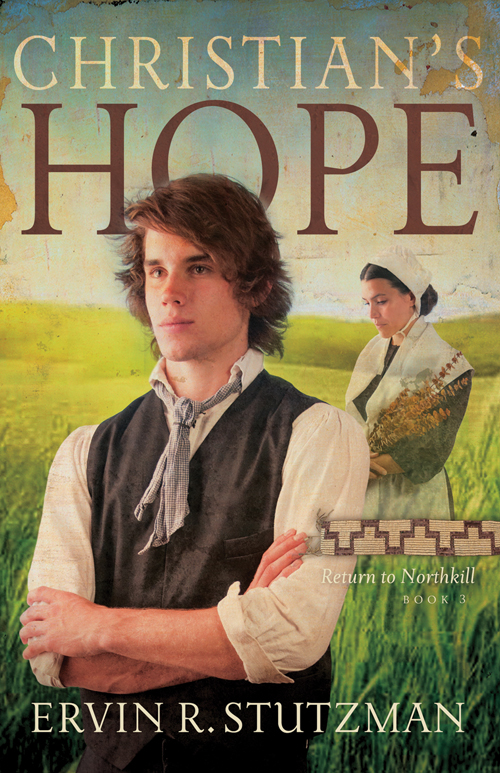 I have now finished reading the third volume, Christian’s Hope, and it especially takes us inside the mind of what it might have been like to live and think like a native in those days. Young Christian lived for about seven years as a native with the Shawnee tribe, adopted by a family he came to love. But after treaties were signed, he is forced to return to his home and while he was interested in seeing his father and family, he is depicted as having an extremely difficult time adjusting to life back in his Amish community. He chooses to retain the dress and hairstyle of the Shawnees. The small wigwam he built for himself is burned down. The hatred and misunderstanding he senses, sees and hears from white settlers is so strong at some points he fears for his life.
Ervin is by now a prolific writer along with being a seasoned church leader, getting ready to retire from his recent years at the helm of Mennonite Church USA as executive director. In this third novel, underlying his well-developed plot, Ervin drives home the point that Native Americans were repeatedly moved westward to accommodate incoming settlers from Europe—in some cases political or religious refugees. The settlers were farmers rather than hunter-gatherers, so they desired land. Possessing their own land was a concept totally foreign to natives who believed all land belonged only to the Creator. Many of us today live on land occupied originally by natives who were pushed to poorer land.
The second and third volumes in Ervin’s trilogy set out to help all of us understand a bit better both the lives and values of Native Americans (in Canada often called First Nations peoples). It is well worth the read to absorb some of the insights Ervin found through extensive research into native religious faith, customs, and history.
Many of us born in North America have indigenous peoples ancestry from many different family trees. While some are inclined to want to forget the terrible deals, fighting, injustice, and sacrifices, the more we understand about the past can help us truly appreciate what others have went through before us.
What the often troubled young man Christian eventually became in this novelist’s imagining, and what researchers know from records regarding what actually happened in his life, weaves a hopeful and rewarding tale.
***
How important is your heritage to you?
***
I’d love to hear of any connections you have to the Jacob Hochstetler family, or native peoples. Write to me at anotherwaymedia@yahoo.com or Another Way Media, Box 363, Singers Glen, Va. 22850. For more on the three novels go to store.mennomedia.org or call 800-245-7894.
***
Another Way is a column by Melodie Davis, in syndication since 1987. She is the author of nine books, most recently Whatever Happened to Dinner. Another Way columns are posted at FindingHarmonyBlog.com a week after newspaper publication.
Another Way for week of May 12, 2017
Habitat Brings Brighter Futures: A Simple, Decent, Place to Live
What does having your own home mean to you, if indeed you are so fortunate? What does it mean for your children?
We went to a fundraising banquet for our local chapter of Habitat for Humanity recently. It was meaningful to be reminded of what having a simple, decent place to live (one of the mottoes of this fine organization) can mean in the life of a child and family. It can mean the difference between a child’s ability to thrive and succeed in school, with friends, and in life–or not.
Jeff Carr was the keynote speaker at this annual fundraising dinner and I think I would have enjoyed Jeff’s speech even if he hadn’t been one of my oldest daughter’s first playmates at the age of one year. Jeff is senior pastor for a large Church of the Brethren congregation, and he called his speech, “Bright Futures and a Peanuts Mailbox.”
Jeff may be a “senior” pastor but he’s only in his mid thirties. I was not too surprised to hear that when his oldest son Gabe was just three going on four, he proposed the idea to collect donations for Habitat for Humanity in his little red Peanuts mailbox.

In the run up to his birthday that year, he let his parents know he wanted presents of course, but he also wanted to collect money and give it to Habitat for his birthday. This likely sprang from his parents’ avid support of our Central Valley Habitat for Humanity Chapter for many years.
The apple doesn’t fall far from the tree. Young Gabe’s grandmother, Gwen is my friend who was recently ordained to ministry in the Presbyterian Church, a latecomer to ordination. She is one of the most caring, giving, creative, and all round beautiful people I know. Her son Jeff and my oldest daughter Michelle were born nine months apart, and I’ll never forget how Gwen reached out to me as a new mother with tips (she put together a whole notebook), moral support, gifts for our newborn, hand-me-downs, and play dates once Michelle was old enough to toddle. Little Jeff (and his family) attended her very first birthday party.

Gabe’s great grandparents, Mac and Ellen (above), were charter members of the church we’ve been a part of for over 45 years. If Gwen and her son Jeff, and his sons Gabe and Nate have generosity and “thinking of others” as part of their natures, I know where they got at least part of their inclination for kindness: great grandma and grandpa. Serving others through whatever means possible has always been part of the DNA of our small but bighearted congregation.
People such as Gabe, Jeff, his grandma, great grandparents, and oodles of others support and volunteer with Habitat because it so transformational: changing the lives of families as it helps lower-income persons find affordable housing and achieve the dream of home ownership. Millard Fuller, founder of Habitat, had the idea that people who were willing to invest their own “sweat equity” into helping build their own home and also homes for others, could end up with an affordable mortgage for a small decent home. Many become homeowners for the first time in their lives.
Habitat also transforms and solidifies communities because home ownership means families who care about their house, yard, and investment, which begets more stable communities, and often surrounds families with caring neighbors. Marsha Smith, who just finished nine years serving as executive director of the Central Valley chapter, summarized it this way: “The simple, decent homes we build with families provide the foundation for safety and security and serve as the center for family interaction, study and growth.”
Personally, there was no better motivation for me to give than seeing young Gabe holding up his little Peanuts mailbox for Habitat for Humanity. And I have no doubt his little brother Nate will be right behind him! (When he gets done scooping up the sweets. 🙂 )

***
Who or what inspires you to give or to volunteer? Comment below or send your stories or comments to anotherwaymedia@yahoo.com or Another Way Media, Box 363, Singers Glen, Va. 22850.
Another Way is a column by Melodie Davis, in syndication since 1987. She is the author of nine books, most recently Whatever Happened to Dinner. Another Way columns are posted at FindingHarmonyBlog.com a week after newspaper publication.
***
Ten years ago I helped to produce the TV documentary, Building on Faith: Making Poverty Housing History, for Habitat, NBC-TV, and other organizations. More info on that here (although the documentary is dated and no longer for sale).

 findingharmonyblog