


Gluten Free Cupcakes: The secret story of what happened to my first batch
These are cupcakes with a long story. Skip the tale and go straight to the recipe below if you want.
But the germ, (ahem, I use that word for a reason) of this story started in January when everyone was getting sick left and right. At work, at home, at church, among friends, among family.
We had planned to go celebrate my third grandson’s birthday at his house (two hours away), and I volunteered to make some gluten free homemade cupcakes from scratch, especially for his older brother but for the rest of us too. I had found what sounded like a fine recipe and I still had all those weird rice and tapioca and other flours that I purchased at Christmas, which I told about here. I spent a Saturday morning making the cupcakes for the celebration planned for the following weekend. And then I froze them as I always do cakes before frosting them. They frost easier and it makes the cake moister, too, I believe.
And then. That evening, I got as sick as a dog. Sicker if that’s possible. I had not, you know, made that many trips to hug the porcelain throne since I don’t know when. I was down for two days. It wasn’t influenza, I still think it was just a stomach bug that laid me out. A couple days later, I came down with a cold that I had been fighting since Christmas. So did my grandsons. two hours away. And their mom and dad didn’t feel so great either. The party was postponed until the following weekend and we hoped all of us would be better. Luckily it was the little guy’s first birthday so he didn’t complain about waiting seven days.
What to do with the cupcakes? My daughter called me to politely but firmly caution me she didn’t think we should use the cupcakes. Everyone had been so sick. She didn’t want to risk more illness. I understood. I would have felt just terrible if any of them had gotten sick again and had to miss more work and daycare. I would have hated to be in her shoes to make the call. I told her I would just buy a gluten free cake mix and make some new cupcakes from a mix for the party.

She ordered a small birthday cake from a bakery decorated as a cute little bright blue drum for the musical theme. The one-year-old enjoyed it very much and so did the rest of us, with the gluten-free boy making do with his cake mix cupcakes.

Back home, I couldn’t bring myself to throw those precious original cupcakes away. I hated to see the expensive flours and other ingredients go to waste. I had tasted one the day I made them and I knew they had an extra earthiness and wholesome flavor I loved.
Could I take them to the office and share them there—everyone’s fallback for helping clean up aging desserts or recipe failures? I immediately chastised myself for even pondering the thought. If my daughter felt there was a chance the cupcakes would make their family sick, how could I imagine foisting the cupcakes on my unsuspecting office mates! Of course not. But it was a thought, in order to not waste them.
So I left them sit in the freezer. Weeks passed. We were getting ready to go visit my other two grandsons five hours away (and of course their parents—always!) and I didn’t want my husband or I to get sick before we went. So we didn’t sample any more of those cupcakes in my freezer.
We had a grand trip to visit the other family, and neither one of us got sick. Small miracle. The two little boys already had colds and runny noses, but we didn’t pick up anything, and they held their own without fevers or ear infections. A big deal after all the illnesses, including (right before Christmas) a hospitalization and a trip in the rescue squad for those two young’in’s (separate illnesses).
Back from our trip, my mind kept returning to those cupcakes. Dare I eat them? Should I toss them? I decided to stealthily eat the cupcakes and see if I got sick—either with a cold or stomach flu. I had one after dinner one night (gave my husband an alternative brownie for his dessert). I ate several more that week with no signs of illness returning. Had I frozen any residual germs out of the cupcakes?
I’ll never know but I finally told my husband what was up with the stealth cupcakes. We ate the rest of them and neither of us got sick. Or anything. And. They. Were. Delicious. At least in my book.

Again, they had a full-bodied texture that was quite satisfying—not just fluffy cake. They tasted similar to the gluten free cake we had purchased from a local food truck baker who said she had worked very hard to perfect a gluten free cake recipe she liked. I decorated these cupcakes to share with you here, even though they never made it to any party.
End of story. Now my daughter knows my secret too. And here’s the recipe. Try it if you have a gluten-free family member. Or to delight your gluten free kid—keep a stash in your freezer when there’s a birthday party whenever he or she need to bring their own cupcakes.
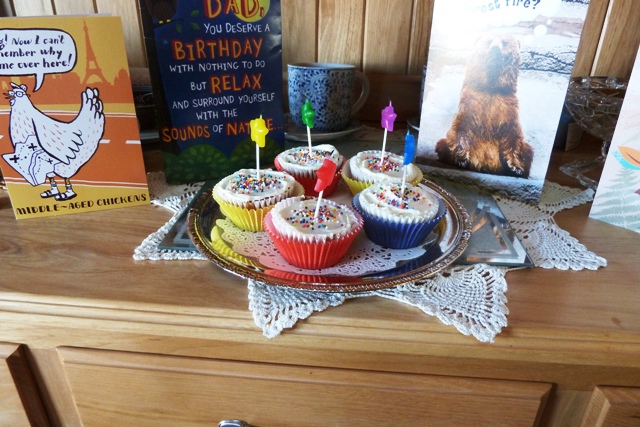
Eat them if you dare!
Yellow Gluten Free Cupcakes
1 ½ cups white rice flour
¾ cup tapioca flour
1 teaspoon salt
1 teaspoon baking soda
3 teaspoons baking powder (most is gluten free)
1 teaspoon xanthangum
4 eggs
1 ¼ cup sugar
2/3 cup mayonnaise
1 cup milk
2 teaspoons gluten free vanilla
Mix flours and other dry ingredients. In a separate bowl, mix eggs, sugar and mayo until fluffy. Add to the flour mixture. Add milk and vanilla. Pour into 12-15 muffin tins lined with cupcake papers. Bake at 350 for 22 – 25 minutes, or until a toothpick inserted in middle of a cupcake comes out clean.
Freeze (if desired) then frost and decorate. (I used canned white frosting and sprinkles.)

***
What would you have done? Stories?
***
Have you ever shared aging or less-than-perfect treats
or dessert with the “break room” crowd? Results?
***
Mennonite Girls Can Cook Cookbooks and blog have a bunch of great gluten free recipes. Purchase here.


Another Way for week of March 10, 2017
Lenten Conversations: Martin Marty on Family Time
Editor’s note: Third in a six-week Lenten series of interviews Melodie Davis conducted with influential Christians.
One of the persons I felt most privileged to interview several years ago was Dr. Martin Marty, longtime editor, prolific author, and columnist at Christian Century magazine. That he would agree to an interview with a pretty much unknown writer/producer says something about his humble spirit. Among many laurels, The University of Chicago Divinity School named their institute for advanced research in the study of religion “The Martin Marty Center.”
As a Lutheran, Marty was named of course for Martin Luther, the great reformer. 2017 marks 500 years since Martin Luther wrote and nailed his “95 Theses” (on why the church needed reforming) to the door of the Wittenberg church in Germany. What an inspirational model for the young Martin Marty.
For years I enjoyed his weekly “M.E.M.O” column in the Christian Century. If Marty’s good health and remarkable mind continue, he will soon be 90 and still publishing (now contributes to the Sightings column). I will admit that his writing is sometimes too thick and academic for my inadequate brain.

Dr. Martin Marty with his trademark bow tie, and frames of family on the walls.
Yet I will forever treasure his humor, his spirit (he always seems to be smiling as if keeping a
secret joke), and his willingness to welcome me into his Chicago condo and office looking out on a glorious view of Lake Michigan. I was recording an interview for the Mennonite church’s radio program on family issues, a denominational group which Marty respects highly. Marty of course is amply familiar with Mennonites from his wide academic study of religion, but he also came to know the small denomination through Richard Kauffman, book review editor at the Century for many years.

Dr. Marty’s rather abundant personal library in his office. Photos by Melodie Davis
Marty also wrote the foreword for my book, Whatever Happened to Dinner: Recipes and Reflections for Family Mealtime. Publishers today have a bit of age bias as they look for up and coming younger names as foreword writers for books. But there’s nothing wrong, I hope, with folks pushing 90 and still publishing.
I started by asking Marty where he grew up: “I have a very strong sense of place and heritage, and though I’m very far from it, every day I somehow draw on my Nebraska roots,” he replied with feeling.
The Martys lived in a small town, but the children spent summers on the farms of relatives. It was the 1930s Dust Bowl era, and Marty says his parents had to have felt the agony of the Depression. “But we children were kind of protected from that.” His father went to summer school every year, so for six weeks he and his siblings were “farmed out” to relatives (grandfather and an aunt and uncle) on literal Nebraska farms. “They were almost a parallel family to us,” said Marty. They lived 65 miles away and costly to buy gas to go that far. “So summer was just unbroken pleasure on the farm. It was a warm, rich community environment, everybody knew everybody, and took care of each other,” Marty noted.
Marty and Elsa (his first wife, who died of cancer), also had the goal and joy of camping in almost every state with five kids plus two who joined the family as foster children. “We got to all states except Hawaii and Alaska, (and forgot Delaware!),” he recalled. Marty reflected: “If you take a three-or-so-week camping trip with each other, you really get to know each other. Each had his own assignment on tent set-ups and camping gear and so on.” Marty is happy to observe his children following the camping tradition with their own families.
At one point the Martys had seven boys aged 9-14 around the table every night. “My sainted wife managed that more than I did, although the kids always remember how every day when I came home, we’d toss the football. We lived near parks and had a swimming pool; of course a lot of friends came over.”
Even though Marty traveled a lot because of his professional life, he worked very hard to spend time with the family together, and on an individual basis. The children took turns traveling with him on business when it could be arranged. They also didn’t watch television during the week. “They’d watch hockey on Saturday some, but we watched very little during the week. We had a reading circle every night around the table.”
As Lutherans I’m sure they observed a “holy Lent” and read frequently from the Bible. They enjoyed rich discussions involving theology, the world and how Christians should put faith into action. I’m also sure they argued as well (because we all do)—even Mary and Martha in the oft-told story of Jesus visiting their home for a meal when Martha was all a flutter with meal prep. Mary, however, relished sitting at the feet of Jesus to hear his teachings and stories.
This past Sunday was “Children’s Sunday” at my daughter’s church, and we enjoyed a short children’s musical of the Mary and Martha story, ending with this reminder which is good for all of us as we find time to meditate this Lent: “Martha, Martha, you are worried and upset about many things, but only one thing is needed. Mary has chosen what is better, and it will not be taken away.” (Luke 10:41-42).
***
These Lenten Conversations will be available as a free small booklet by clicking here (Lenten Conversations PDF). Or, send your name, address, and two U.S. postage stamps and I’ll mail a copy. Send to anotherwaymedia@yahoo.com or Another Way Media, Box 363 , Singers Glen, Va. 22850.
Another Way is a column by Melodie Davis, in syndication since 1987. Another Way columns are posted at FindingHarmonyBlog.com a week after newspaper publication.
Easy cut-up oranges for fresh fruit salad
This is the simplest of recipes; I wouldn’t even call it a recipe. It is mainly a tip for cutting up oranges to put into fruit salad that you may already practice. But I can imagine that beginning cooks might have not discovered this easy method, illustrated below. Basically it involves taking an orange, slicing it horizontally into 3 or four circular slices, then eliminating the middle fleshy part where all the segment skins join together. That leaves you with nice juicy sections that can mix with other fruits for flavoring. 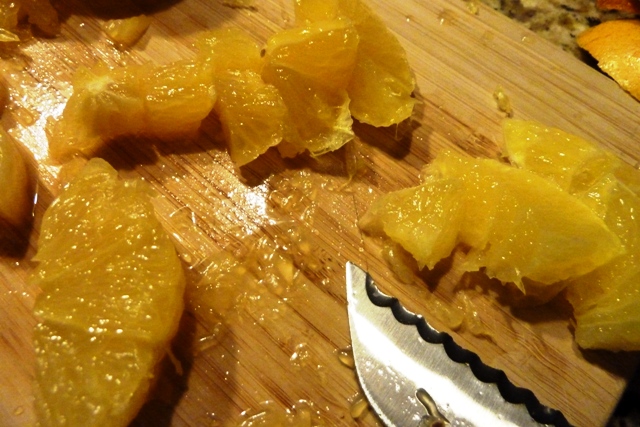
We purchased a bushel of Florida oranges this past December from a great nephew who’s a high school band student, and I’m having trouble using them up, mainly because we didn’t quite have the Christmas we planned and I didn’t give away as many as I thought I would to my daughters, etc. So I’ve been making a lot of fruit salad (it goes particularly well to top off a “pancakes for dinner” meal like we had on Shrove Tuesday). Or anytime you have a heavier meal but want to grace it with something sweet, this fills the bill.
But at get togethers with certain friends, I have been asked to “bring your fruit salad” so I guess you could call it a recipe if people like it that much. In the 50s and 60s, our Mennonite mothers would make red Jello fruit salad using canned fruit cocktail for another easy dessert. I know some families who had a Jello salad for almost every dinner–and certainly for any company dinner! It was a thing. My kids were never fans of any Jello salad or even plain canned fruit cocktail but they did enjoy fresh fruit salad. Funny how habits and customs change over time and in families. The Bible is certainly full of references to fruit and comparing the benefits of following Christ to simple and glorious fruit.
Basic fruit salad
1 cup cut up oranges
1 cup purple or green grapes, left whole or cut in half
1 container canned mandarin oranges, with juice
1 banana
1 teaspoon lemon juice
Add any other of your favorite fruits you have on hand: fresh pineapple, apples, tangerines, blueberries or raspberries. In summer, I add cantaloupe, watermelon, or honeydew melons. Add banana right before serving if possible, and squirt with some lemon juice to keep some fruits from turning brown.
To cut oranges into pieces for salad:

Slice peeled orange horizontally into about four rounds of the orange. Then cut off sections of orange to get rid of the round seedy center.

Cut good orange pieces away from center where the segment partitions meet. Throw these fleshy centers away or eat them if you wish, but don’t put into salad, especially if small children are eating the fruit salad.
What you have left are the good parts. Chop into smaller bites.

Lightly mix grapes, orange pieces, and mandarin oranges in bowl.

Slice banana and add just before serving; use about 1 teaspoon of lemon juice (fresh or bottled) to keep bananas or apples from turning brown.
That’s a simple and healthy dessert! For us, it often hits the spot.
***
So, did you grow up having Jello salad frequently? Good memories or not so much?
***
Do you have a better method of cutting up oranges?

Esther Shank’s Mennonite Country-Style Recipes and Kitchen Secrets is full of great tips like these that she prepared especially for her own daughters, which has gone on to be a continuing great-selling book. Order here.

Mike Berenstain signs a copy of one of his books in 2011. (Melodie Davis photo)
Lenten Conversations: Mike Berenstain of “Bear” Book Fame
Another Way Column for week of March 3, 2017
Editor’s note: Second in a six-week Lenten series of interviews Melodie Davis conducted with influential Christians over several years.
I was surprised when I learned that Mike Berenstain was to be commencement speaker at my alma mater, Eastern Mennonite University in 2011. But his son was graduating so I was pleased when Mike took time out of a very busy weekend for an interview for our little radio program, Shaping Families. I had to think how the stories and artwork he and his parents created were quite significant in shaping my own little family!
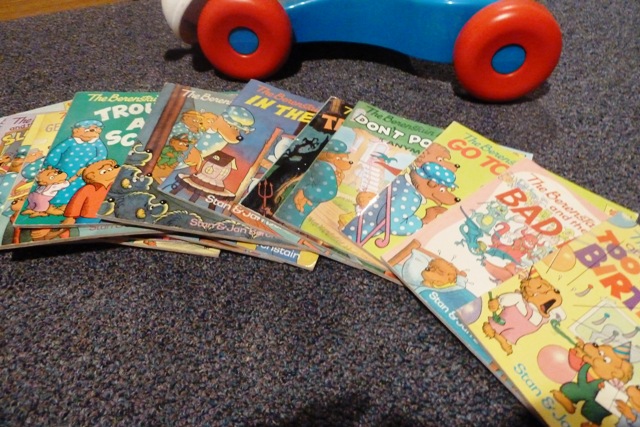
Berenstain Bear books were an almost nightly ritual at our house for a number of years. I still have 19 of the lovable books which teach so many good values, awaiting the years when my own grandsons will enjoy them. Both of the older Berenstains, Stan and Jan, who wrote and illustrated the books, are now deceased (Mike’s father in 2005 and mother in 2012). Mike counts it a privilege to have worked with them after the books spun off into TV shows and other products. He said his parents could barely keep up with the demands on their time in the late 80s. They never pushed Mike into the “family business” but he chose to study illustration in art school, and briefly worked in design for Random House. There he learned the ropes of publishing children’s books.
I loved that the Berenstains chose bears for their family of characters not because of the similarity to their last name, but for the simple reason that “bears were easy to draw.” As a kid, Mike was amused when fans would assume the Berenstain bears somehow represented Stan and Jan’s own family. People would say to Mike, “Well, are you Brother Bear?” Mike told me, “I always said, well, no, I have an older brother. So I must be Sister Bear.” Mike said his own kids took bear comparisons mostly in stride, enjoying the attention their grandparents received as the famous illustrator/authors.
I was interested in how Mike came to launch a separate line of Berenstain Bear books which are more directly religious. His father was culturally of Jewish background and his mother raised Episcopalian. Mike explained that “they taught us ethics from the Judeo-Christian tradition, but they dealt with their mixed marriage by really not teaching us religion.” But as an adult, Mike became a Christian and later in publishing, he wanted to express his own faith and launched “Living Lights” through Zondervan publishers.
Mike recalled the Berenstains had received an immense amount of feedback from people over the years saying that they would like books with a more overt faith message. “A huge proportion of our audience—our most dedicated, faithful audience —were people of very traditional backgrounds,” Mike pointed out.

The Davis family collection of Berenstain Bear books.
There are about 12 original classic Berenstain Bear books that have been perennial best sellers. “But of the more recent ones published since then, the Living Lights faith books are the most popular,” Mike commented.
It was encouraging to hear that even though he wasn’t taught specific Christian faith stories as a child, his work has now been helpful for parents in raising their children to love God and follow Christ’s basic teachings. Lent and Easter traditions and activities can be special times with your children to bring attention to Christian faith and stories from the Bible.
This author added, “It’s very important that [in teaching good values] you try to give kids books that will give them a story which is attractive, entertaining, and interesting. It’s much less effective to give a kid a lecture.” Of course!
Mike is my age (born the same month in 1951) and if he is able to continue coming up with great story lines and ideas as long as his parents did (well into their 80s), he won’t be retiring anytime soon. His mother always quipped when she was asked if she was going to retire, “I think I’ll retire and take up painting!”
When I interviewed Mike, his mother was still living. He gave her great credit as she continued to paint. He said his mother would always be a “much a better illustrator because she had so much more experience.”
Mike’s faith story brings me to several verses for your Lenten reflection from the poetry of Isaiah 46:4 and 9-10. The verses concern the time when the children of Israel were in captivity in Babylon. “I will still be carrying you when you are old. Your hair will turn gray, and I will still carry you. I made you, and I will carry you to safety. … I am God, and there is no other; … there is none like me. I make known the end from the beginning, from ancient times, what is still to come.” We can take comfort that no matter what comes in the world, in our families, or with our aging bodies, God is there.
***
These Lenten Conversations are available as free small PDF booklet by clicking here: Lenten Conversations PDF. Or, send your name, address, and two U.S. postage stamps and I’ll mail a copy. Send to anotherwaymedia@yahoo.com or Another Way Media, Box 363, Singers Glen, Va. 22850.
***
What is or was you or your child’s favorite Berenstain Bear book? Or… maybe not a fan?? Feel free to comment either way!

My husband and I recently spent almost a week (hence this late posting of Another Way column) at the home of two of our grandsons, helping with childcare during an especially busy time for their parents. We look forward to the time when the grandsons can come for part or all of a week for Grandkid Kamp at our house!
***
I’d love to hear your experiences with grandchildren or as a grandchild at your own grandma/grandpa’s house!
Jacket photo by Lydia Halldorf, used on Hannah’s Child memoir by Stanley Hauerwas
Another Way for week of February 24, 2017
Lenten Conversations: Stanley Hauerwas on Prayers for Our Children
Editor’s note: First in a six-week Lenten series of interviews Melodie Davis conducted with influential Christians over several years.
Can you imagine going to bed at night not sure if you or your child will be alive the next day?
Stanley Hauerwas is a renowned theologian, prolific author, and a distinguished professor emeritus from Duke University in Durham, North Carolina.
Over the years I’ve been fortunate to interview some folks with names you might recognize. Sometimes the interviews were for TV documentaries we worked on at Mennonite Media, or for the Shaping Families radio program which had a sweet but short life from 2010-2012. For the six weeks of Lent which begins March 1, through the week before Easter, I’ll share highlights from some of those encounters.
I first became aware of Stanley Hauerwas’s writing and work when he and Will Willimon wrote the noteworthy and prophetic book Resident Aliens: A Provocative Christian Assessment of Culture and Ministry for People Who Know that Something is Wrong (Abingdon Press) in the late 80s. This now being 2017, perhaps I should note that Hauerwas and Willimon were not talking of immigrants here, but rather how Christians all are perhaps aliens living in a culture away from our true home in God’s kingdom or heaven.
Hauerwas’s lofty books and highly respected teaching didn’t stop him from living a nightmare. He endured the difficult personal circumstances facing many families living with someone with bipolar illness. Both he and his son have deep faith and gratefulness for the prayers of friends and colleagues who rallied to their support in those days.
“Prayer meant everything to me,” Hauerwas said in his interview. “I know that I would not have survived without intercessory prayer, I just know that. So we can always pray for one another in that way. “
Fast forward to 2012 when his memoir, Hannah’s Child had just been published, and he was speaking to a group of Mennonites meeting in Raleigh at North Carolina State University. The topic of that book was more domestic, not only about Dr. Hauerwas’s childhood, but how he came to deal with his wife’s mental illness.
In Hannah’s Child, he writes about his own mother, named Hannah. Like Hannah in the Old Testament book of Samuel (1 Samuel, chapter 2), Hauerwas’s mother prayed for a son and promised to devote her life to raising that son for God. Hauerwas jokes that that was “perfectly appropriate, but why did she have to tell me about it when I was just six?” Later in life he learned how those prayers and even being told of her dreams for him surely “had a great shaping on my life. It took me many years to understand that’s the way it’s supposed to work.”
Think of the Psalm that goes, “Your eyes saw my unformed body; all the days ordained for me were written in your book before one of them came to be,” (Psalms 139:5). Also in the book of Jeremiah, who was also a teaching prophet, Jeremiah was told, “Before I formed you in the womb I knew you, before you were born I set you apart; I appointed you as a prophet to the nations” (1:5).
Hauerwas’ father was a brick layer and at first Hauerwas was inclined to follow in his father’s footsteps. I loved the tribute Hauerwas gave his father in our interview:
My father was a wonderful, gentle man, who was in a very hard line of work. He was a craftsman of first order, and when I was taken on the job when I was 7, you have to learn all the subsidiary skills of the laborer before you’re allowed to lay brick. My father was a little hesitant to teach me because he wanted me to go on to college and he didn’t want me into the money [of bricklaying]. But I learned from my father essential work habits that have stayed with me my whole life.
I have no doubt that this early introduction to hard work did help Hauerwas as he lived through the manic episodes in his first marriage until she left him. He also credits his parents as instrumental for his calling: “My mother and father exemplified for me a very straightforward and unapologetic dedication of lives shaped by the church and the gospel, which always stayed with me. Their faith always gave them something to do. That is what faith does. It gives you something to do. Just think how wonderful that is, to have something to do with your life. You don’t have to make it up.”
What were or are your prayers for your children? Reflect on Psalm 139:5 printed above: “All the days ordained for me were written in your book before one of them came to be.”
***
These Lenten Conversations are available in a PDF by clicking here: Lenten Conversations PDF (portable document format). Or, send me your name and address and two U.S. postage stamps and I’ll mail a copy. Send to anotherwaymedia@yahoo.com or Another Way Media, Box 363, Singers Glen, Va. 22850.

My mother had a hobby, or perhaps it would be better called a pastime, that enchanted me when I was a young girl.
She doodled or sketched women’s faces. For a Mennonite deacon’s and farmer’s wife, kind of an unusual pastime and especially because of this: the faces looked like fashion models, usually because they had lots of make up, full lips, glorious eyes, long skinny necks, and frequently sported fancy necklaces or necklines. They also looked like models on a Simplicity or McCall’s pattern if you have sewn your own clothing. My momma was good at drawing, sewing and designing variations on her sewing patterns, and making us laugh.
She would sketch while waiting at the doctor’s office, or at the desk writing letters, or making a list for the grocery store, or planning a menu if company was coming—her lists often had one or more drawings on them. And, we would beg her to draw faces to entertain us while we were in church, on the bulletin. Gasp! The deacon’s wife! (For more on the proper and traditional role of a deacon’s wife in some Mennonites’ tradition, follow my link but scroll down to “Father’s Ordination.”)
I recently begged Mom to draw some faces and send them by mail so I could share them here. She said she was rusty and they ended up not proportioned as well as she would have liked, but you get the idea. In the letter Mom sent with the sketches she wrote, “The more I make the uglier they get.” I think she only sent me the best ones, for they aren’t bad!
When we were kids most of her sketches ended up in the trash can, but in her letter to me, she noted that the artistic bent came from her father Ivan Stauffer’s side of the family. In fact, her mother, may she rest in peace, would get mad at Mom and scold her for drawing when she was supposed to be doing other things such as chores. Of course. That is what mothers do, right?
Her classmates would also beg her to draw the lady pictures. “Why my classmates wanted them so bad, I don’t know.” She got A’s and an “A+ once” in art. She also drew flowers, especially roses, by studying an actual rose. She had a set of pastel chalks with which she drew flowers but, “too bad I didn’t keep my pastels when we moved. They were what I liked best.”
Her father Ivan (who I never knew; he was killed in a car accident the year I was born) would draw cartoons for them on the asbestos pipes in their basement. As she wrote in her letter, that’s poisonous now. She’s 92 and her mother lived to be 95, so…. (No lawsuit needed there, but I’m not making light of the dangers of asbestos.)
Her father’s cartoons were knock offs of an old comic strip known as Jiggs and Maggie, begun about a hundred years ago. You can see a sample here. Jiggs and Maggie were Irish who had come to America and won a lottery or something; as with most comics, their antics are fun and silly but apparently the deeper layer dealt with immigration, ethnicity, and classism. Still so current.
Mother’s sister, Florence, was a bonafide artist whose work was shown over northern Indiana winning frequent prizes and some acclaim, which I wrote about here.
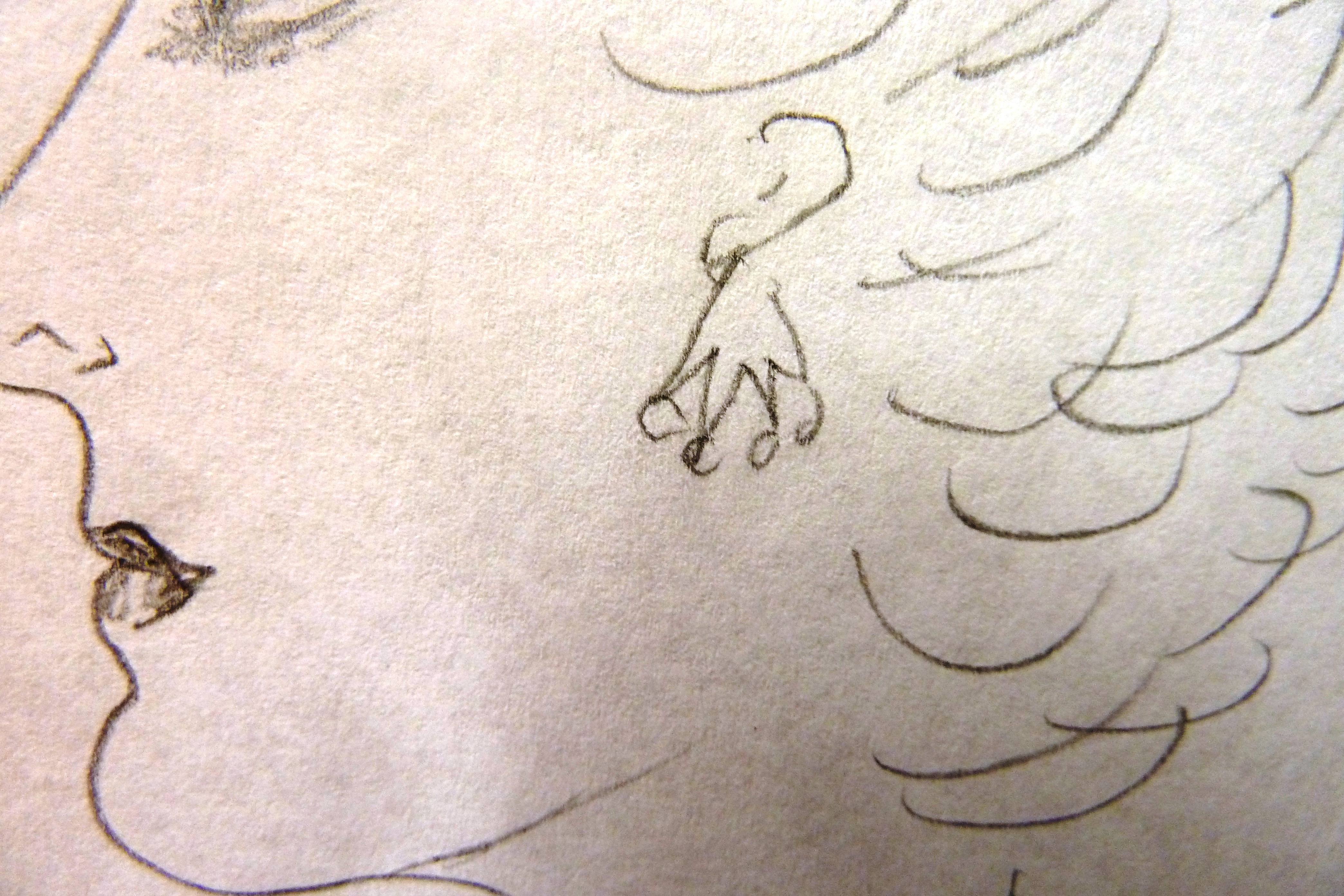
All sketches by Bertha M. Miller
Thank you, Mother, for entertaining me once again and hundreds of readers who may happen by this blog post.
***
Do you doodle? Where, when and why?
Or do you enjoy coloring? With your children or grandchildren, or in an “adult” coloring book?
Here are links to two coloring books you might enjoy. I wrote the quilt descriptions in this one for Herald Press: Beloved Amish & Mennonite Quilts. Available now.


Another Way for week of February 17, 2017
Let’s Hear it for Quiet
Are you an introvert, extrovert, or ambivert (meaning a little of both)?
Susan Cain, a Harvard Law School graduate is basically an introvert. But she left law behind and is now a sought-after author and public speaker on the topic of why being quiet is okay in spite of what some feel is a stigma about shyness. It should be noted that shyness and introversion are not necessarily the same, even though they are often used interchangeably, as I am here.
I had made a note to check out Cain’s bestselling book in 2012, Quiet: The Power of Introverts in a World That Can’t Stop Talking, when it rose to the top of the New York Times bestseller list. But I never took time to find out more. I still haven’t read the book but I downloaded a free summary and watched her TED talk: good stuff for this mostly-introvert.
Cain feels we often get the message that being on the quiet side is not okay, especially in our educational system. The child who speaks up in class, works well interacting with a group of others on a project, and has a lively circle around him or her in the lunchroom is not only usually popular, but also frequently well-liked by teachers. Which is fine, except when quiet students are not similarly respected and admired.
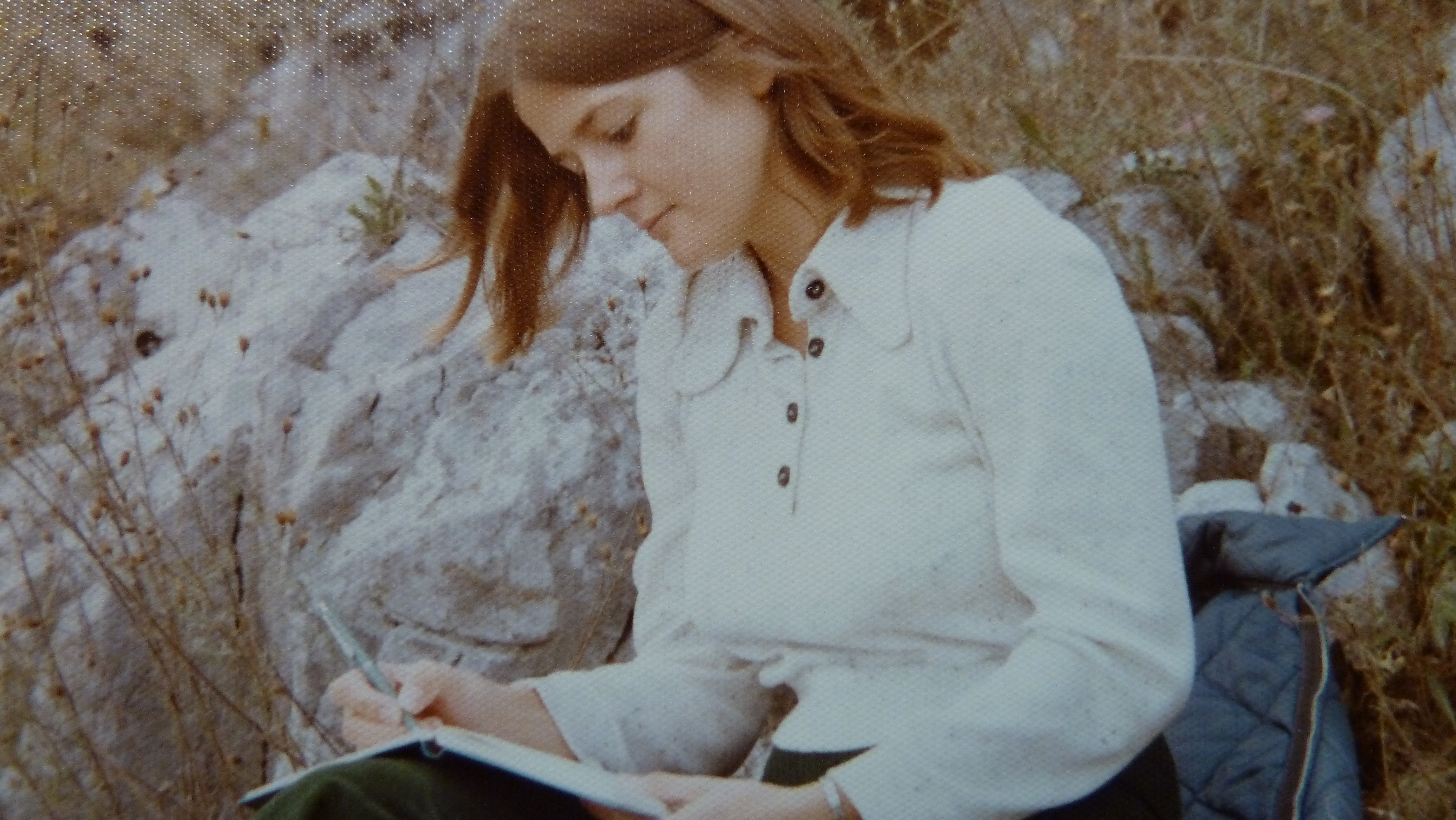
A favorite place for writing and introspection. Photo for my college yearbook, The Shen. 1975.
A quiet child often hangs back, stammers, or studies his desk when called upon, and ends up sitting by herself in the cafeteria. Quiet and shy children are sometimes picked on and bullied, but more to Cain’s point, are not appreciated for the strengths of quiet ways of working.
Cain says that a third to one half of people are introverts, so it’s crying shame there’s any stigma against introverts who enjoying being or working alone. Cain notes our schools and work places are designed for gregariousness, such as open space environments (without privacy walls); in schools, students are frequently assigned to work in groups to research and complete projects.
She goes on to emphasize that solitude for many of us is not only a good thing, it can help restore energy and perspective after hours of immersion in activity and people.
Perhaps I’m something of an ambivert. As a writer, I need solitude to do my job, but I love to throw a big party or have company over. In a group, I’m not too shy to speak up, but I like to think I also know when to keep quiet. I enjoy public speaking, but at a banquet or wedding reception where everyone is sitting around before the real action begins, I don’t enjoy making small talk very much, but I try. I’m always quite relieved when the speaker or toasts begin. I think I have changed as I’ve gotten older, perhaps learning from my super-outgoing husband. He wasn’t always an extrovert; he was one of the kids who got picked on in school.
I also have trouble writing in a group. If I’m on a team or committee, someone is sure to say, “Melodie, you’re the writer. How would you word this proposal?” Trying to put words together in a group to express complicated thoughts leaves me stymied. I freeze. I beg off saying, “I’ll submit a draft and others can add to or edit it.”
Cain’s quote from William Whyte in The Organization Man makes a lot of sense: “People very rarely think in groups; they talk together, they exchange information, they adjudicate, they make compromises, but they do not think; they create.” (From Cain’s free PDF, “The Power of Introverts.”)
In another type of work setting, one of my daughters worked in a store which required her to try to sell those add-on warranties for certain products. She liked her job except for that. Since she was an excellent actress in high school I told her, “Just pretend you’re acting, like you’re on stage. Get ‘in character’ to be a different person when you’re pushing those warranties!”
I’m not sure it ever really worked for her because she knew she wasn’t on stage. But this can apply to other settings. Act more extroverted than you feel and see what happens. However, remember Cain’s emphasis: you’re fine just being you. If you’re perceived as quiet, God bless your creatively cogging brain!
One of the best take-aways from Cain’s TED talk is her suggestion for parents, teachers and children: “If I had one wish, it would be to reverse the stigma against introversion for children so that the next generation doesn’t grow up with the secret self-loathing that plagues so many introverted grown-ups today.”
If you are worried about your child suffering because they seem too introverted and you wish they were more “social,” Cain reminds us that we don’t have to provide the perfect environment or stimulus or protection for a child who is struggling. There may be physical, mental, or severe social issues they and you must deal with—which I won’t go into here. But for most kids, if you provide love, affirmation, acceptance, opportunities, and lots of prayer, sometimes that’s being the “good enough” parent; we have to leave room for the child to grow into his or her own skin.
Which way of life is more natural to you: introvert, extrovert? I’d love to hear your thoughts in the comment section!
***
Read much more at Susan Cain’s website: www.quietrev.com or download her free PDF “Quiet Revolution.” Send comments and stories to anotherwaymedia@yahoo.com or Another Way Media, Box 363, Singers Glen, Va. 22850.
Another Way is a column by Melodie Davis, in syndication since 1987. She is the author of nine books, most recently Whatever Happened to Dinner. Another Way columns are posted at FindingHarmonyBlog.com a week after newspaper publication.
Another Way for week February 10, 2017
One Who Died Way Too Young
Why should a 40-year-old father of two kids ages 10 and 12 be whisked away in the prime of life when many of us far older are still tinkering around? Those of us who had been his coworkers sat in awe of his geeky techno know-how, plus his carefree joie de vie, not to mention his ability to let ideas spin around in his head as he did workarounds to make something work.
 Russ Neufeld was a whiz at many things. His most recent employer, Hesston College said Russ was also one of the most well-liked people working at Hesston and that he “knew a lot about a lot.” Good thing for an I.T. director. When he was first diagnosed with lymphoma about 18 months ago, he endeavored to learn all he could about his illness and the various treatments available, describing on Facebook exactly how this chemo thing works anyway, in terms of the chemistry.
Who does that when they’re fighting cancer? Russ. He said it was his way of dealing. He did everything the doctors knew to do, and then some. One could even say Russ beat his cancer, even though his body did not survive. One Facebook post said Russ did not let cancer define him, destroy him, or his family. My heart goes out to his dear family: wife Kendra, children Ethan and Natalie.
Russ was geared to tackle any challenge—even a tough one—with a lighthearted rejoinder, “Piece of cake.” That was his signature line that I loved; he probably got tired of hearing that from me.
One friend on Facebook said his best memory with Russ was the day he rode along with Russ to watch him sky dive. “You were a regular and they joked about how you loved sky diving so much you paid for it with your blood … selling plasma as often as you could to pay for your next jump! You inspired me to put sky diving on my bucket list and the day I checked it off was amazing!”
Russ beat his cancer because he did not let it beat him down. Just ten days before he died, he was telling all of his friends on Facebook, family and church (stealing this idea from a friend, he noted), “Take the love you’ve been sending me and spread it around. Do something positive. Volunteer for a homeless shelter …” That kind of thing. In his very worst hour (from our view) he was able to rise above his own pain, his own great disappointment and indeed tragedy to remind others: spread the love. Who does that? Only a few.
I say tragedy because anytime two wonderful, smart, loving, great kids lose a father who loved them with the same ferocity he applied to everything else, that’s more than a crying shame. It’s heartbreak.
I worked with Russ from roughly 1999-2009; some of those years he lived here in Harrisonburg; some he commuted to Elkhart, Ind. to work for Mennonite Church headquarters once a month, and some he lived in Newton, Kansas. When he started he was just a kid—early 20s—doing part time audio work in our studio while he finished a degree in physics.
Later, he worked to hand-build the back end of a major website, ThirdWay.com, using html coding and whatever tools he could grab online (before the days when anyone could get a website all coded up by just signing on to WordPress or Blogspot). His office was catawampus across the hall from me. He kept white mini-Christmas lights up year round: dorm-room-chic. He defied office protocol by frequently wearing a hat and blue jeans.
 Russ was fearless, whether it was sky diving or white water rafting or riding a motorcycle across washboard rough rock in the Baja. He wouldn’t try to hide a beer he’d order at a Mennonite church convention open air restaurant after working 8-20 hour days. For several of the biennial Mennonite church conventions, he was Mr. Cyber Café, setting up and running 15-20 desk top computers (oh the work!) for the very popular “Third Way” cyber café in the early days of email. People would wait in line 30 minutes to check if they had mail.
It was Russ who beckoned me across the hall on September 11, 2001, to see (online) the crumbling World Trade Center, New York City. I quickly wrapped up the interview I was doing, headed to our assembly room TV, and sat there stunned with everyone else. It was surreal of course. Those days are seared into the memory of anyone over the age of 30.
Later when he worked with our website crew from a distance we had team meetings by phone. As webmaster, Russ showed us how he could take over our computers through cyberspace to fix or demonstrate something—another surreal feeling when another hand is guiding your cursor around the screen.
We can only ponder now what kind of view Russ has of our computers and indeed our puny lives as he’s off exploring a whole new reality.
***
You can watch the memorial service for Russ on YouTube. If you don’t have time for the whole thing, don’t miss the ending music “Parting Glass” which Russ especially appreciated in his final days. Or, check out the bulletin/program for his service, including the haunting and beautiful lyrics to “Parting Glass” by House of Doc musicians, (a group no longer active).
***
How can you share the love you’ve been given? Send thoughts, prayers or memories to anotherwaymedia@yahoo.com or Another Way Media, Box 363, Singers Glen, Va. 22850.
Another Way is a column by Melodie Davis, in syndication since 1987. She is the author of nine books, most recently Whatever Happened to Dinner. Another Way columns are posted at FindingHarmonyBlog.com a week after newspaper publication.
***
I am personally indebted to Russ for much of my “back end” website knowledge and comfort with “poking around” with such things to figure them out, and the courage to start up a blog. “Piece of cake.” Not always that easy, but bless you, Russ, for everything you gave to us.

Another Way for week of February 3, 2017
Thoughts on a Cold Winter’s Night
Ruby is friend from elementary school. I have enjoyed getting to know her a bit again from a distance through Facebook, where she posted this recently:
“I find winter to be the peaceful time I really need—that’s what I love about it. I don’t have to mow or hoe or put up produce any more.”
We may think of shoveling snow and scraping ice (let alone falling on slick sidewalks/steps) as the not-so-peaceful parts of winter, but for many of us, the quiet and calm of a snow covered landscape is indeed very peaceful.
Hutterite writer Linda Maendel, author of Hutterite Diaries lives on the cold stark prairies of Manitoba. For her, winter has to include deep cold and yes, blizzards: Linda wrote recently at her blog, Hutt-Write Voice:
“The temperature’s hovering around -30°C, [-20 for those of us who stick to Fahrenheit] and with the wind chill, that means it feels like -40°C. Yes, extremely cold! But, I still wouldn’t want to live where there is no snow – my winter has to have cold, blizzards and lots of snow.”
She says you get used to the cold, dressing warmly to go out, and enjoying being cozy inside.
Even in parts of North America where there is less change in seasons than Manitoba, Indiana, or Virginia, there are subtle changes during winter.
Being cozy is usually not an option for the many who are homeless. We all know there are myriad reasons why people end up on the streets: poor choices, family disintegration, addictions, mental illness, a streak of bad luck, accidents, a lack of affordable housing. I am grateful for our city’s movable thermal shelter, Open Doors, that operates with the help of churches and the local synagogue and mosque: an interfaith effort.
Besides providing a warm safe place and one hot meal plus breakfast, the program has provided an eye-opening first hand encounter with those who are homeless. In the past I have been struck by how many of those at the shelter appear to be young–ages 21-25. Perhaps some even save up money for a security deposit or first month’s rent by couch surfing or staying at a shelter on coldest nights. Many homeless also manage to hold down jobs—amazingly. As much sickness as our family has had this winter, I cannot imagine having to be sick in a shelter or refugee camp, but of course germs and colds are rampant in those settings.
Those who follow my column regularly may remember that I spent my junior year of college abroad in Barcelona, Spain (and wrote a memoir about that year, called Departure (Herald Press, 1993). Barcelona is of course a timeless and beautiful city on the Mediterranean with basically a mild climate but with cold that seeps deep into your bones in the winters. At that time, most apartments and flats only had space heaters for use during the coldest months of the year. So even in our boarding house, which was once a Catholic nun’s convent, we bundled up with blankets, sweaters and bathrobes while studying because you just couldn’t get warm on coldest days.
I was saddened and shocked to read recently of the approximately 3000 people in Barcelona who are homeless—a phenomenon unknown to me in 1973’s Spain. I’m sure there were homeless people then, but Spain was still under the authoritarian rule of General Francisco Franco. There was little street crime or homelessness because the “Guardia Civil” (wearing their signature tri-cornered hats) or police kept things clean on the streets. Which can be a good thing when you’re a college kid coming home from a late night on the town. We, and our parents, had few worries about physical safety.
At any rate, today Barcelona has a significant problem with homelessness due—as everywhere—to many complicating factors. The article I read was about a small company, “Hidden City Tours,” offering educational tours revealing the “hidden” side of the artsy, flower-lined, medieval city. Its purpose was not all expose or to embarrass anyone, but to offer socially-conscious travelers a chance to see a part of Barcelona they likely wouldn’t see otherwise. It hires some of the homeless as part-time tour guides which brings them a small income.

Whether you enjoy winter or not, or have frozen or flower-lined streets, the problem of affordable housing for all likely won’t just go away. But I encourage all of us to do what we can to explore and help out in ways that go beyond tossing a dollar on the street to someone with a “homeless” sign, and work for long-lasting, far reaching help.
Send any comments to anotherwaymedia@yahoo.com. For a free copy of Departure about my year in Spain, send your address to Another Way Media, Box 363, Singers Glen, Va. 22850. Please include $3 or postage stamps to help defray shipping costs.
Another Way is a column by Melodie Davis, in syndication since 1987. She is the author of nine books, most recently Whatever Happened to Dinner. Another Way columns are posted at FindingHarmonyBlog.com a week after newspaper publication.
Another Way for week of January 27, 2017
A Mole Inside Lovina Eicher’s Test Kitchen
To say people are fascinated with the Amish or Old Order Mennonites is a great understatement.
In September 2015, I got to spend a day in the home of Lovina Eicher and help her and her daughters cook a flurry of dishes to be photographed for Lovina’s forthcoming cookbook, The Essential Amish Cookbook: Everyday Recipes from Farm and Pantry.
One of my great privileges of the last several years has been working with Amish columnist Lovina Eicher. I say privilege because I know that thousands of her followers would be fascinated to be in my shoes.
Yes, it takes a long time to make a real cookbook and now I feel even more fortunate to be an editor bringing it to birth. We’re excited that it comes out April 17, 2017.
I’m grateful for my background growing up Mennonite among the Amish of northern Indiana where one of my friends in first grade was Bertha—same name as my mother—who had a big brother named Vernon—same name as my father. Bertha and Vernon were Amish and rode my bus along with numerous other Amish children in the days before there were very many parochial schools. Amish now build their own schools and provide their own teachers in most Amish communities, sparing children some of the teasing, different-ness and religious/cultural discrimination they surely felt going to traditional public school. My grandparents and father could talk Pennsylvania Dutch quite fluently and loved using the dialect in visiting our Amish neighbors, doing business, or encounters in town.
So it wasn’t altogether strange to walk into Lovina’s kitchen where no electric lights or stoves, mixers or blenders were running even though she and two of her daughters were already busily mixing and baking. The younger children had already left for school. There were gas lights of course, and a gas stove (often preferred by fine cooks everywhere), and a modern bathroom and running water.
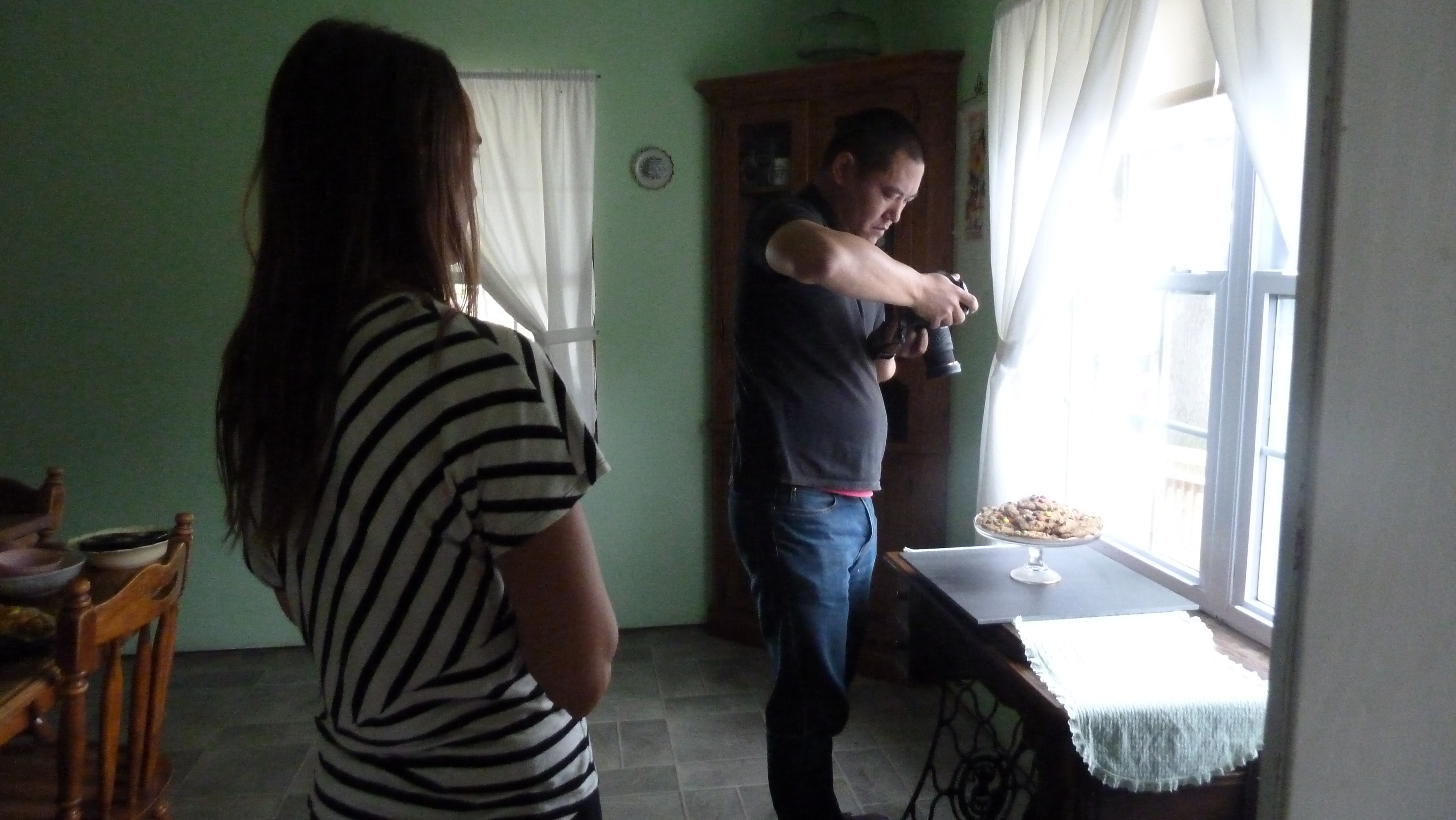
Tara and Lucas Swartzentruber-Landis in Lovina’s home.
I knew it would be a special day. The main food photographer, Lucas Swartzentruber-Landis and wife Tara, who is a part-time food stylist (making food and dishes pretty for photos), would be there shortly. I was there mainly to observe, be available for consulting as to final choices on recipes, and pitch in where and when Lovina needed another set of hands.
Dishes, pans, mixing bowls, measuring cups, and spoons were constantly being used and needed rewashing, so helping out with the dishwashing and drying seemed like as good of place as any to plug in and feel useful. I picked up a towel and went to work.
Oh and did I mention sampling? Of course everything was to be tasted. Such a hard job, and I was up to the task.
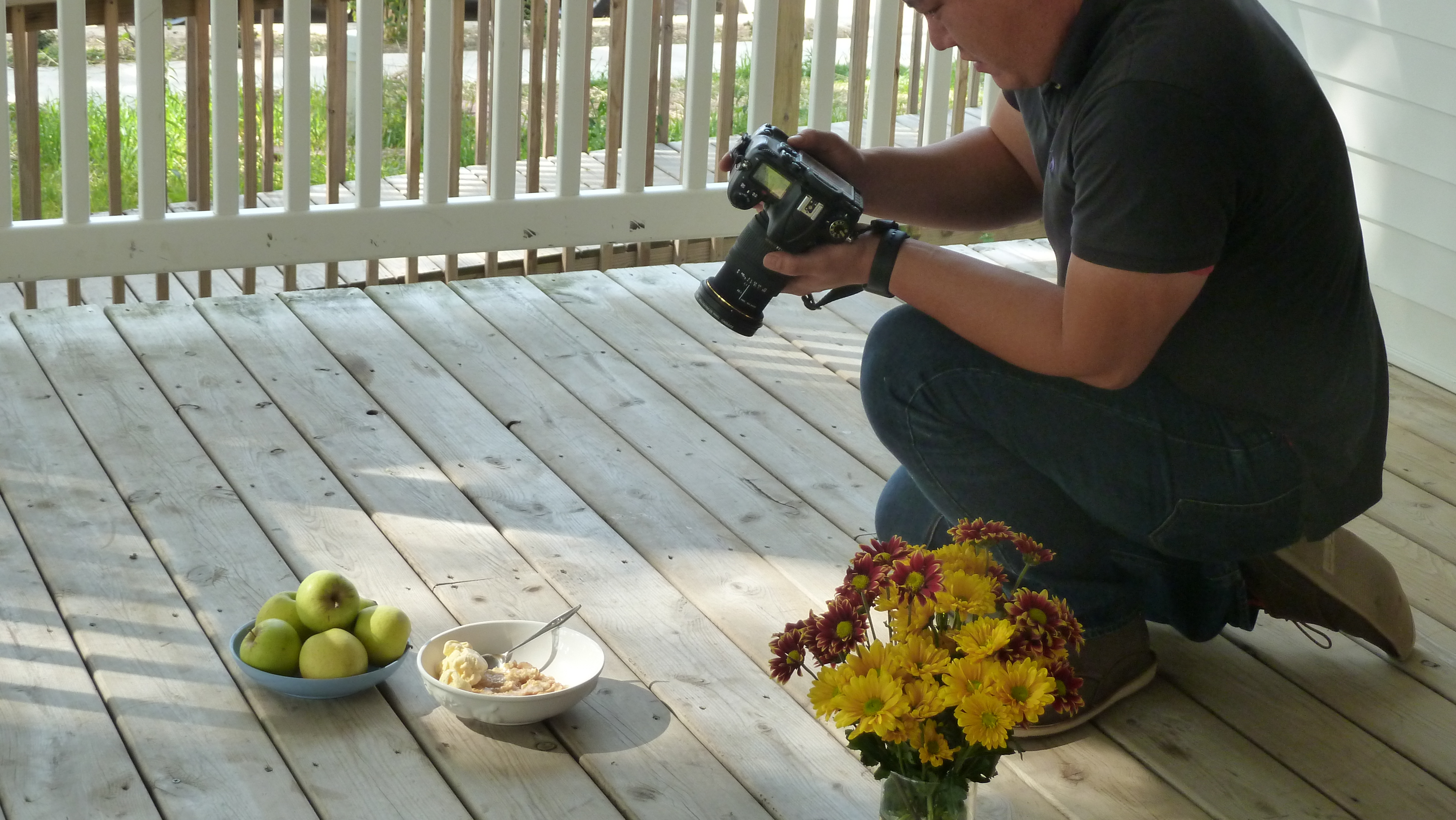
Lucas finding new angles for his photography.
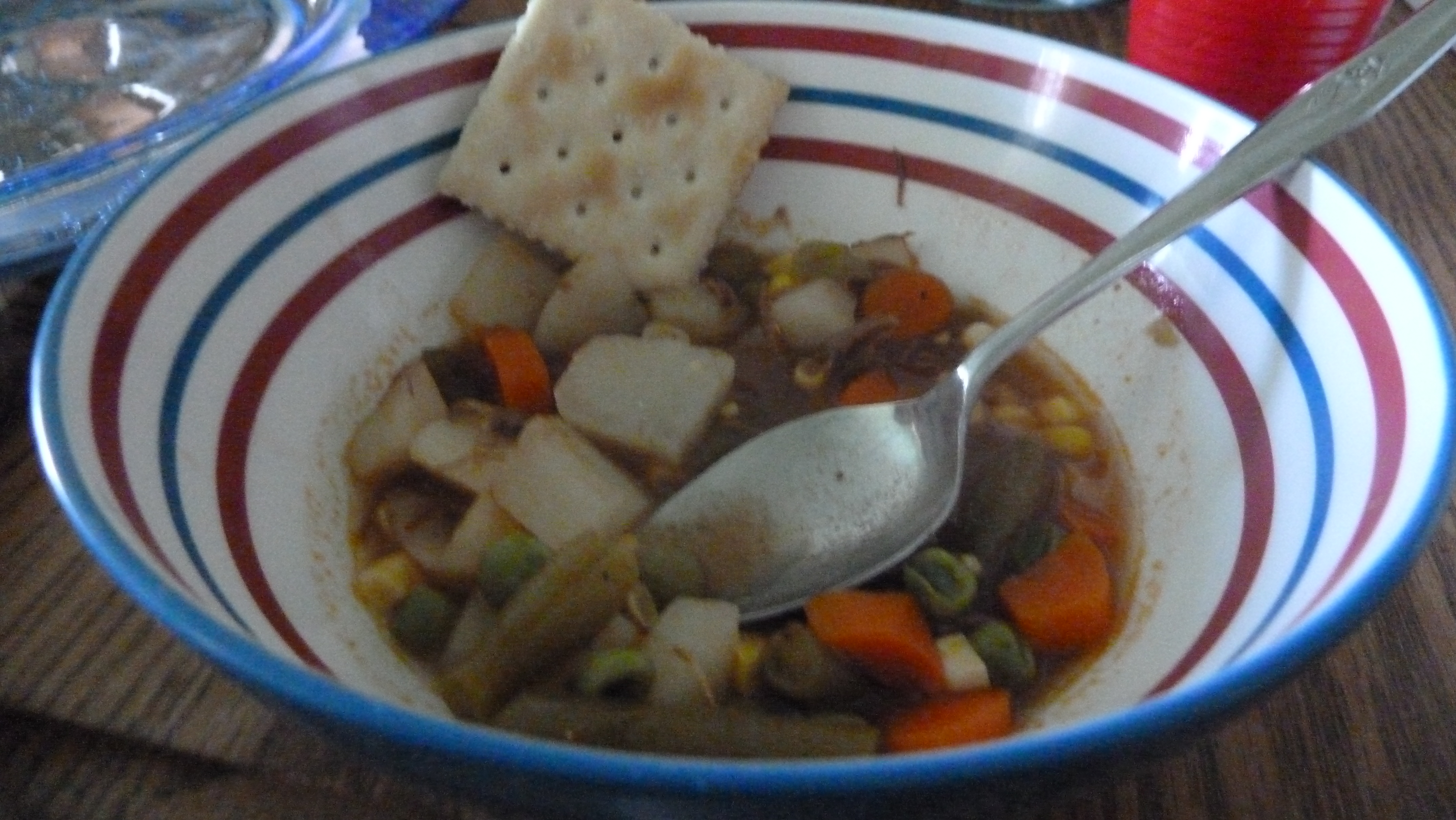
Lovina’s homemade vegetable soup. The recipe’s in her cookbook!
Lovina had around nine or ten recipes lined up to be made that day—a breakfast pizza in the morning, a vegetable soup for lunch, and cookies and pies woven into the menu and baking plan for the day. I shouldn’t have been surprised to find her so well organized: she’s been part of co-authoring four other cookbooks for previous editors and publishers.
Lovina’s loyal friend Ruth Boss soon arrived bearing sweet rolls and long johns (rolls, not underwear) to keep us well supplied. Ruth is not Amish and lives at some distance, but organized a team of some 27 women to later test all of the recipes for the book.
Not all of the dishes turned out quite like Lovina wanted: perhaps too many hands spoiling the outcome? She was teaching as well as directing the cooking and it was a joy to observe how hard her older daughters worked on this project of their mother’s. They seemed to enjoy the cooking and the interaction with those of us who came to photograph and “help,” but standing on your feet eight to ten hours wears anyone down.
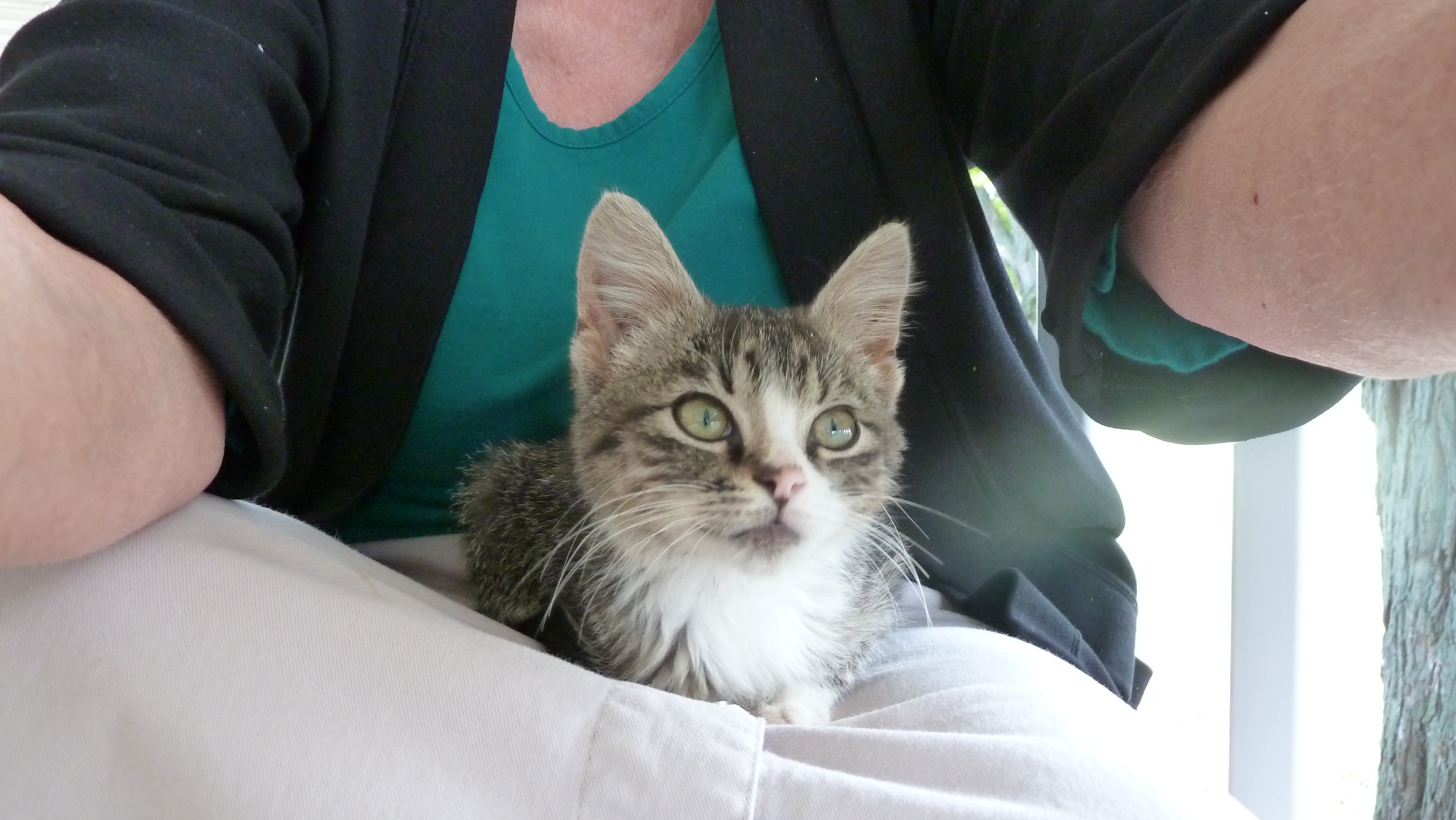
The Eicher kitten and me, doing a selfie.
Even more than the food, what impressed me about spending the day in Lovina’s kitchen was how authentic she is: she is the real deal, a busy and caring mother of eight who was taking on a daunting project. She is good spirited, funny, natural, leaving no question that her Amish traditions and faith in God are genuine. I didn’t expect anything else and I was not disappointed.
We wish this new cookbook all the success in the world!
***
You can get a free 16-page sampler of the cookbook with recipes by writing to me at anotherwaymedia@yahoo.com or at Another Way Media, Box 363, Singers Glen, Va. 22850. (If you send for it, including two first class postage stamps would be helpful, but not an envelope because it is larger than a normal envelope.)
You can also download the sampler in a PDF document right here!
***
To reserve your copy of the actual cookbook, you can purchase it here and it will be mailed to you upon publication around April 17, 2017.
Another Way is a column by Melodie Davis, in syndication since 1987. She is the author of nine books, most recently Whatever Happened to Dinner. Another Way columns are posted at FindingHarmonyBlog.com a week after newspaper publication.

 findingharmonyblog