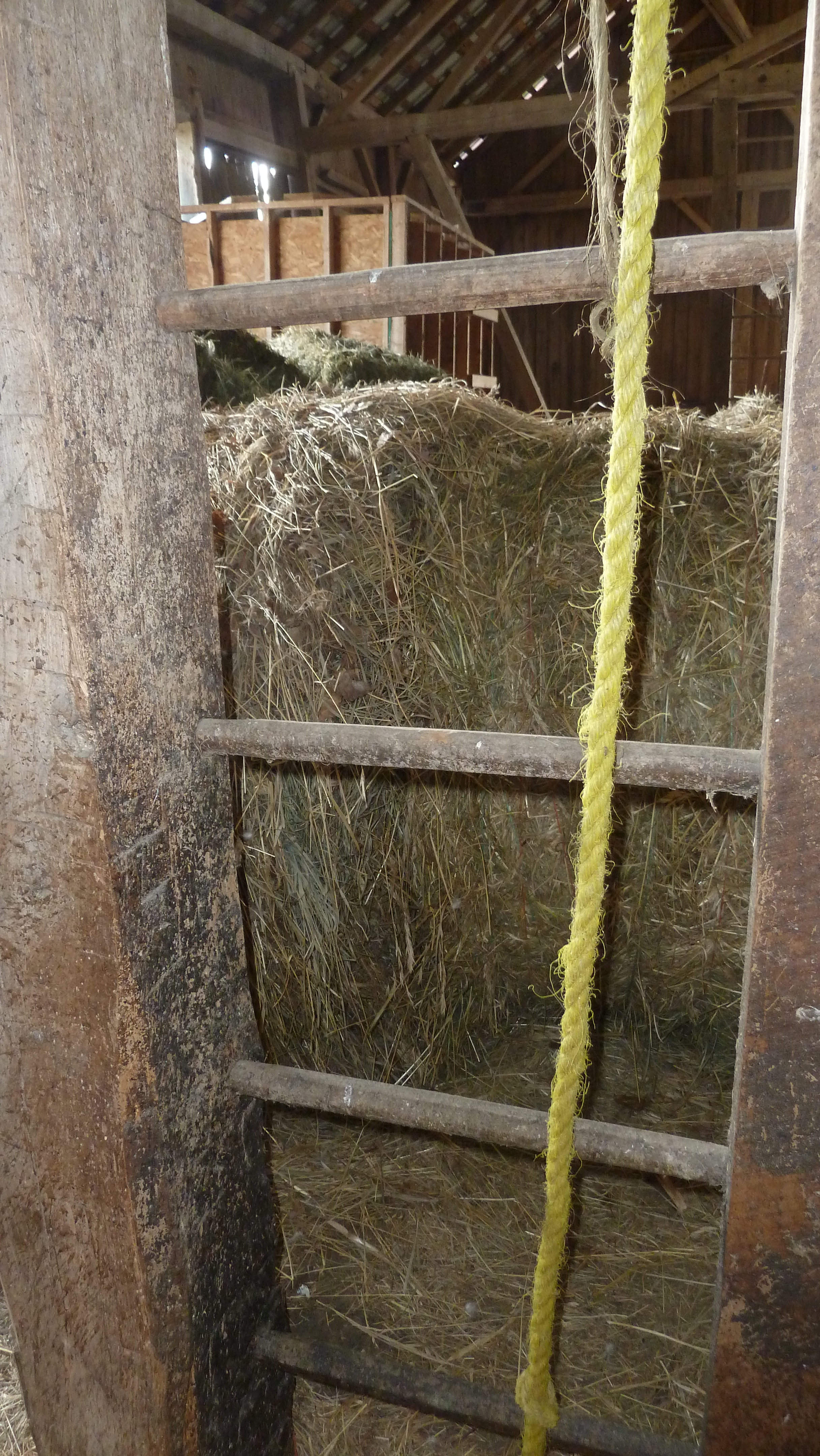
When I was growing up, I lived on a farm. I know now how lucky I was. Back then, living on a farm just meant chores, and bad smells. We had everything: cows, pigs, sheep, chickens, a pony—and our cousins and friends from the city loved to come visit. They thought it was a great excursion—especially when our grandparents lived there with us and they could visit Grandma and Grandpa Miller and also pet kitties, the sheep, “pick eggs” as they called it (we called it gathering eggs, and it was a chore, not something fun to do).

(Me dealing with stacks and stacks of eggs back on the Indiana farm.)
So I was farm, they were city. They were in, I felt backwards. Now I know the truth of how fortunate we were growing up with that country wealth.
So how fun it was to flip the tables recently and take my city-born grandson to visit the nearby farmette of the Murch family, of Jennifer Murch blogging fame. Before I got into blogging, she was the first blogger I knew and followed and have watched their little ones grow up—mostly online but occasionally face to face as they’ve cared for our pets a couple times, traded vegetables, things like that. I would have loved to take both of my two-and-a-half-year old grandsons to visit but that will have to come another time. So this is about Sam’s Visit to the Farm. Never mind that the farm is only five acres. Jennifer’s two youngest kids seemed happy to show us the animals—and we lucked out showing them a turtle we discovered as we drove in their lane! A bonus score!
When Sam visited at Easter, we got a kick out of how everywhere we drove with him, he exclaimed over the “Moo cows” he saw all over the countryside. “Moo cow!” he’d yell. And also a line from a book, “How now, brown cow?” So when Jennifer announced recently they’d added two cows to their farmette, I knew a visit would be the thing to try. She called her post “moo.”
Sam was fun to watch, never quite sure if these large, picture-book-friends-come-to-life were his friends, or if he needed to be a little bit wary. Smart boy in that—yes and yes. Friends, but cautious when it comes to little kids and big mammals, as zookeepers know.
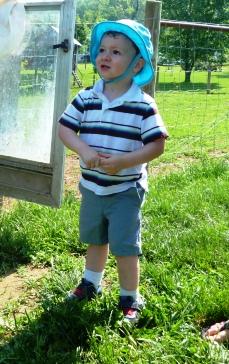
Sam wears a slightly citified hat because it is such a beautiful sunny day.

Arriving, we move a turtle who looked like he (she?) was about to cross the road. The youngest Murch boy is there in the middle of things.

Cautiously, Sam pokes the turtle for a half second, supervised by his doting daddy, Jon.

The youngest Murch daughter, and Sam’s mommy, Tanya, introduce Sam to one of the cats.

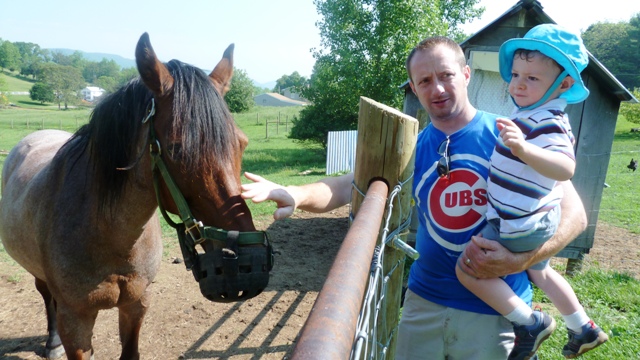
Now we get to the big stuff: Velvet. Sam thinks it is so cool that the horse has the same name as our dog Velvet and says “Velvet Horse” again and again.

But he’s not sure if he wants to pet her. Even with a bite guard on her mouth.

He loves the sheep, but they don’t stay close for long.
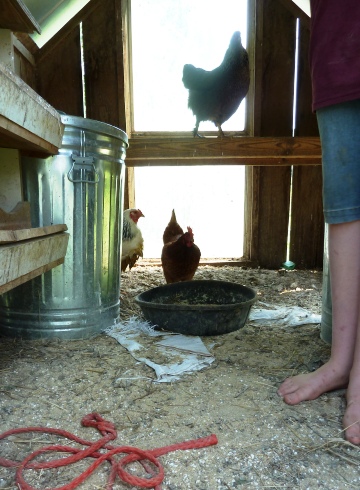
And of course the chickens look small and friendly.
The cows keep their distance and that’s actually fine by Sam.

It’s a storybook come to life.
Sam talks to himself all about his visit as he tries to fall to sleep that night. We hear him naming the different animals from his little monitor. Soon he is in dreamland.

What a gift the Murches have given their children on their five acre homestead.
I didn’t know it then, but I grew up living the dream.
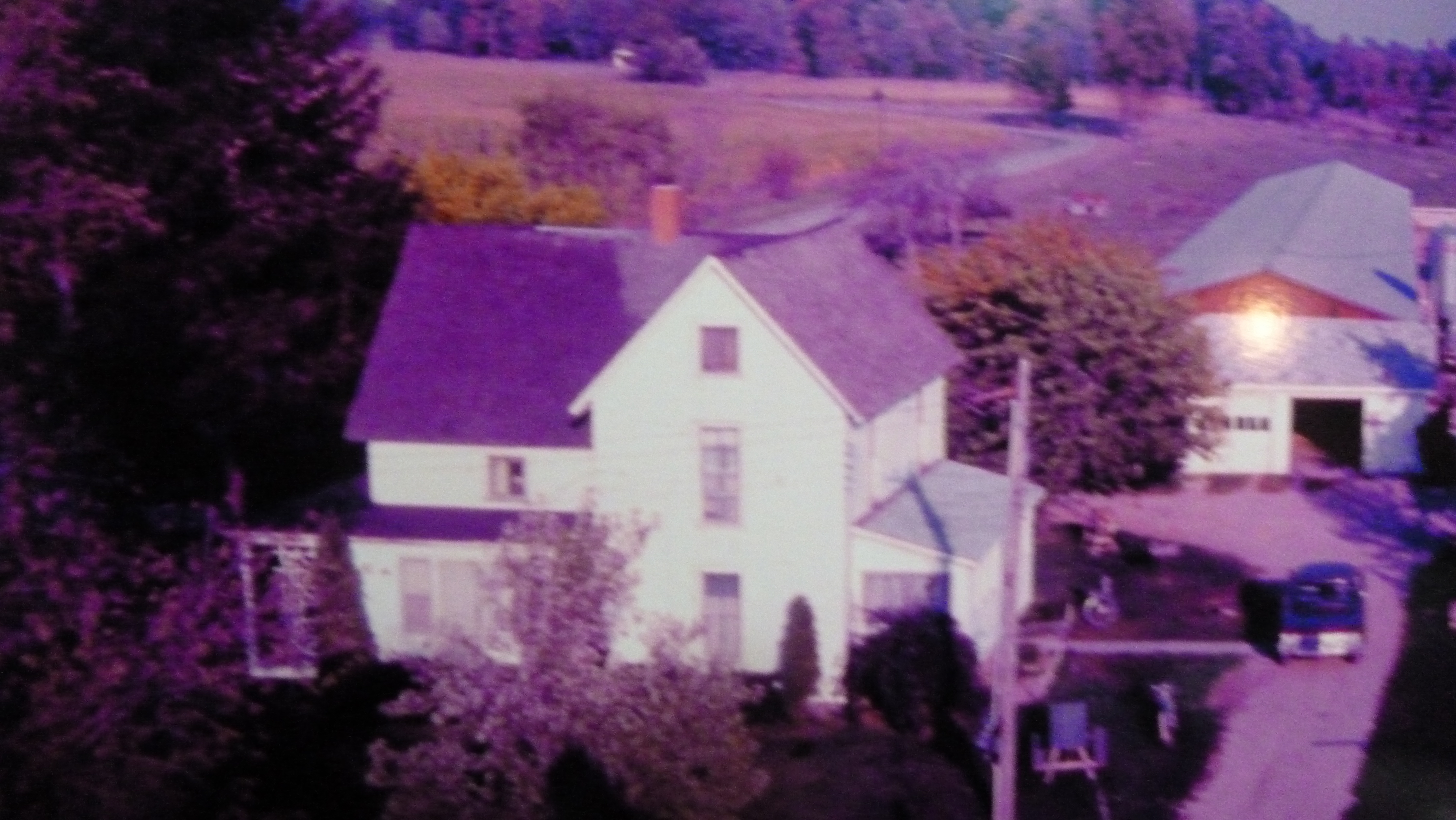
Our Indiana farm.
***
What gifts do you recognize now, that perhaps you didn’t as a child–or a teen?
***
Do you have farm stories to share?
***
Or, join the Facebook group, I Grew Up Country, just for fun and connections.
***
Visit Jennifer’s blog for the most awesome list of recipes ever. All Jennifer tested.

Part II of Orie O Miller biography by John Sharp: Orie’s 5-year plans and how Mennonite work spread all over the world. Read Part I here.

When I was near the beginning of My Calling to Fulfill, I met a Ukrainian immigrant, Nadezhda, at my church’s clothes closet and told a bit of her story here. At bedtime that day, my reading included a section of Sharp’s book about Orie’s yearning to go to Russia at the end of World War I to explore how Mennonites and the church could help with disastrous post-war conditions there. Meeting Nadezhda and hearing her passion to also help those less fortunate was a reverse reach-out from Orie’s story—but, unfortunately, also a keen and grim reminder of how much suffering still goes on all across our world.
While I had long heard of “Orie Miller,” I had never read how he was first exposed to the world far beyond his and my common Indiana farmland heritage (plus his Akron, Pennsylvania connections). He was among the first nine Mennonite relief workers—along with hundreds from other religious groups—to go abroad in a program called “Near East Relief” in 1919, to Beirut. This was in response to the Ottoman Empire’s ethnic cleansing of Armenian and Christian citizens in Syria. Again I thought of the refugee crisis from Syria we have heard so much about—and especially prayed for—in these first six months of 2016.
So roughly one hundred years ago, (1915-1918), one million were left dead and a million more orphaned and destitute, according to Sharp’s biography. A U.S. ambassador urged Americans to act; funds were raised and thus began Near East Relief. Orie was not only part of that effort, once on the ground in Beirut he learned quickly from Red Cross Major James Nichol, chief of Syrian relief operations, about how to do relief work, especially how to “organize and delegate work.”
A frequent theme in Sharp’s biography is that Orie was more gifted in administration than doing mechanical work, or hands-on labor. But in that desperate setting, as he wrote home to his bride Elta, he was learning quickly how to assemble the trucks and cars that had been shipped over to help in the relief efforts.
The history of this period before World War II, that we may have read about hurriedly in our history books, is worthwhile reading just for a refresher course. Sharp not only sets the stage and scene, he includes details the history books often leave out—the valuable contributions of volunteers who help clean up and rebuild after wars.
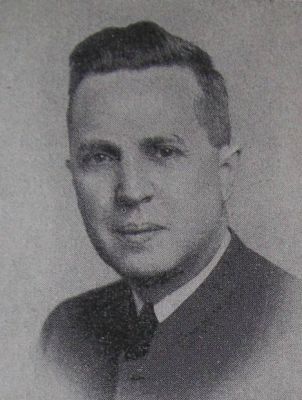
Orie O. Miller, with his trademark business necktie
under his Mennonite plaincoat suit. MCUSA archives.
Orie accomplished so much in one lifetime because he was constantly thinking in five or ten- year plans. He would ask his children, grandchildren, and colleagues about their five or ten-year plans (and I’m sure there were times the children eye-rolled behind his back). And if an overseas mission administrator was overly excited to show Orie around and let him know what was going on, and would brag about having recently installed a generator, (where there was no electricity) Orie would help them think better by saying, “Well, you know, Mennonites always manage to get generators installed. I want to know what’s your five-year plan?”
Sharp does not gloss over the fact that with a man who made dozens of ocean voyages taking weeks and months for the crossings alone and, according to, Robert Kreider, “saw more of the world than Marco Polo,” there was no way he could be home for every ball game or recital by his children. (Ha, as if!) He kept promising to “be a better father” and spend more time at home. But the call of the church—and his God—was strong in his veins—or was it more exciting and challenging to sojourn in so many countries in Europe, the Middle East, Africa, Asia, and South America over 60 years of active ministry? Still, he was living the way most men in those times lived—focused on career and calling, leaving wife and children to cope the best they could with his frequent absences.
My colleague Steve Carpenter summarized many of the highlights of Orie’s accomplishments in an article in The Mennonite comparing and contrasting Babe Ruth and Orie Miller, who were born with in a couple years of each other. This list (I shortened and adapted slightly) focusing on Orie’s early life doesn’t begin to cover everything, but it’s a great introduction. For more you really need to read the book, or peruse John Sharp’s blog with a complete chronology.
- At the age of 18 he taught for two years at a country school while taking classes part-time at Goshen College.
- Between 1912 and 1915, he was enrolled full-time at Goshen College. By 1913, he was the principal and an instructor at Goshen’s School of Business while also serving as a licensed minister at Barker Street Mission in Michigan.
- Upon graduation in 1915, Miller married Elta Wolf and moved to her hometown of Akron, Pa., where he became involved in his in-laws’ shoe business, beginning on the bottom as a shoe salesman. However,within two years he was helping direct the Miller-Hess Shoe Company, although Sharp frequently mentions the questions that his colleagues and father-in-law had about Miller’s frequent and extended absences from the business.
- Two years later, in 1919, at the conclusion of World War I, Miller did relief work in Beirut, Lebanon. The following year, he pioneered Mennonite relief work in Russia. Soon thereafter, he helped establish Mennonite Central Committee. His association with MCC lasted more than four decades, and he served as its executive secretary from 1935 to 1958.
- He simultaneously held positions on the executive committees of two of the Mennonite Church’s mission agencies currently known as Eastern Mennonite Missions and Mennonite Mission Network, Goshen College, Mennonite World Conference and numerous other church organizations.

Dedication service of Hall of Nations at EMU, April 2016.
He truly deserves the many accolades he received in his lifetime and after—most recently a “Hall of Nations” was named in his honor at Eastern Mennonite University, where he never even went to school, (which I wrote about over on the Mennobytes blog). I had heard about much of his agency leadership but through this book I learned much about my distant cousin’s passion for mission. I don’t think it is an overstatement to say that the breadth and reach of the Mennonite churches throughout the world owes much to Orie Miller—and God of course!
God’s providence should not be overlooked or understated. Orie would have been the first—absolutely the first, to want all the kudos to go to God.
But there was one fact that astounded me most of all, which I’ll share in a final wrap up on Orie coming up.
Part III – Biggest surprises in Orie Miller biography
To purchase the biography, click here.
***
What is in your five-year plan? Or perhaps you like to think in three-or ten years plans?
No matter what age you are, it’s great to have some goals and plans to keep you motivated, growing, and moving on! I’d love to hear your latest and perhaps inspire others.

About 4:30 a.m. on almost any Saturday morning from the first of April until late November, here in the Shenandoah Valley you can drive into almost any town or past a country church and get a whiff of charcoal, glimpse a flume of smoke.

Or maybe you’ll even see walls of fire flaring up from charcoal beds edged by 20 to 30 foot long walls of cement blocks or metal, forming the longest grill ever.

It could be organized by the Lions or the Ruritans or the Jaycees or the Moose Lodge or the Rotary or a high school marching band or the Baptists, Methodists, Mennonites, Church of the Brethren.
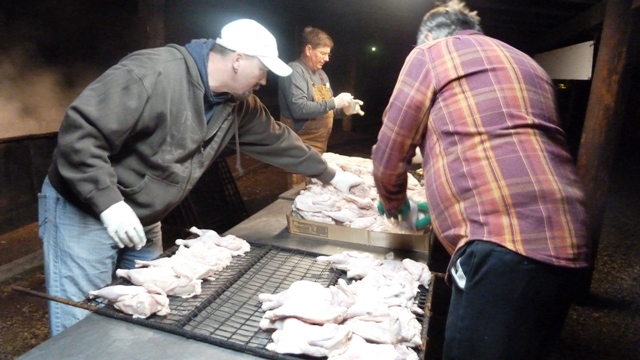
The groups of mostly men come together to grill 500 or 750 or 900-1000 halves of barbecue chicken for the easiest—and hardest—fundraiser ever: almost a guaranteed success with the leg-thigh-wing-breast half going for $3.50 or $4 each. You can buy cheaper whole rotisserie chicken at Costco, but it won’t be made by a community.
And that’s the real secret seared into the chicken: you cannot make chicken barbecue for 1000 people without a community of workers who—yes—argue sometimes about how to make the sauce, when to put it on, when to take the chicken off, yadda yadda. But, mellowed into the savory sauce, the succulent white meat, the juicier dark—is teamwork.

Yes, the literal stuff as in two muscled men gripping the racks loaded with 60 pounds of chicken twisting their arms in exact synchronization so the meat can flip sides. But also the emotional, memory-making stuff: the sometimes deep conversation, the catching up from a grueling week of work, the care expressed for the ailing or the grieving, the “our-chicken-is-better-than-their-chicken” boasts—and ultimately, helping fund projects that better the whole community without raising any taxes. This is fellowship at its best. This is what makes a place “home.”
The sales are so popular I’ve heard of groups that run out of chicken in 20 minutes. People wait in long lines for a half hour or more, in order to be sure and get some before the sellers run out. And this is at 8 or 9 o’clock in the morning. I always wonder, what meal are they serving the chicken for anyway? Breakfast? (Seriously, most folks take it home and refrigerate it and serve it later in the day.) A chicken barbecue seems like an easy money maker because it sells so fast. Generally, you don’t have to push it on people. In a few hours, you’ve netted $800-$1200 dollars, as opposed to selling candy or brooms or cheesy junk from a preschool fundraiser brochure.

But hefting 60-75 pound boxes of iced chicken,
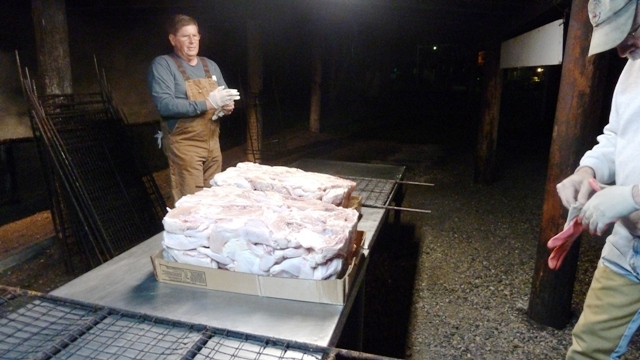
freezing your hands off (if it is chilly) putting iced chicken halves on the racks,

managing to keep the charcoal fires hot and burning without charring and blackening your chicken, flipping the huge racks filled with 30 or so halves without any falling out … well, it’s not for chickens. Err, light lifters.
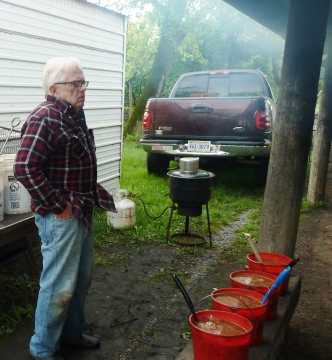
At our recent Broadway Lions barbecue, I did manage to douse the chicken frequently with the homemade “Lion Club sauce” (trade secret here of Lion Dan and Lion Churchill) and wore out my poor li’l ole’ wrists just doing that. Another time, maybe I’ll show up to help sell—which isn’t for the fainthearted either, when the clock nears noon and you still haven’t sold all your halves.

The recipe I will share here comes from another favorite source, my father, who back in the ’50s made barbecue chicken with an oil and vinegar type recipe—no tomato or ketchup or anything red in sight. Daddy loved nothing better than hosting a chicken barbecue at our farm—sometimes back at the cabin—using his half barrel homemade grill loaded with one full rack of chicken—probably about 30 halves, too. He went in full director mode and we kids or friends marched to keep things going: the fresh white work gloves he had to have for handling the chicken; the rack he kept carefully clean; the pot of sauce he stirred and sopped on using a special small “mop;” the squirty bottle to douse flare ups; and most of all the wondrous taste of his chicken fresh off the grill.

Vernon Miller/Stuart Davis Chicken BBQ
A country vinegar-based sauce from my father, Vernon Miller; his recipe came from the “Farm Bureau.” However, in these parts of Virginia, they claim it as a Virginia recipe, and a variation of this is used everywhere including the Virginia Mennonite Relief Sale. In the proportions I have below, this is a nice amount for a cookout for family or guests, and will do 5-6 chicken halves or 10-12 boneless chicken breasts or pieces.
Proportions can be multiplied and ingredients added to your taste.
1 cup vinegar
1 cup water
½ cup margarine (or vegetable oil)
¼ cup Worcestershire sauce
¼ cup salt
½ teaspoon pepper
Other seasoning as desired:
½ teaspoon chili
½ teaspoon garlic powder
Dash sugar or honey
Dry mustard
Dash Pete or Tabasco sauce
Heat together and keep hot, but not boiling. Douse chicken frequently as you grill: 2-3 hours for chicken halves, 30-35 minutes for chicken tenders. Turn chicken halves every 15- 20 minutes. Reserve some sauce to steam finished meat with when you take it off the grill: you can put it into a 5 qt.Dutch oven and pour small amount of “clean” sauce (some that has not encountered raw meat) over the chicken and keep warm until served, or steam for 5-10 minutes.
***
What experiences in “community cooking” have you enjoyed?
Or would you rather do your own thing in your own kitchen, thank you very much? (i.e. when too many bosses spoil the broth?)
What other values does this kind of teamwork teach/reinforce?
***
My book Whatever Happened to Dinner includes the recipe above, and a section on the values learned from community cooking (“Eat My Grits: Kitchen Culture Wars”). You can buy the book here.
Whatever Happened to Dinner?

Part 1: My Connections to the Orie O. Miller story

My Calling to Fulfill: The Orie O. Miller Story by John E. Sharp,
published by Herald Press, 2015.
If you are under 60 you are probably thinking, who was Orie O. Miller and why should I care? If you are a Mennonite and lived or grew up west of the Mississippi and are over 60, you may also not be familiar with him. But in my growing up home, his was a household name. And not just because he was a distant cousin.
If Orie’s life story were written as fiction, no one would believe it. Critics would call it not realistic to have a main character who was a pioneering visionary for the church who created real change impacting millions for generations, who was also a wealthy shoe salesman who made lots of money even through the Depression, but gave much of it away to the church institutions he served and from whom he never drew a salary, and married two women both named Elta. (Yes, the first Elta died.) There are also family dramas as children grew up to make adult choices, some of which did not make Orie or their mother happy. Finally, he was a man who wore both the plain suit of his Mennonite forbears just to keep conservatives happy, and underneath wore a necktie for his business counterparts!
If you enjoy history or biography and have any interest in the Mennonite church and one of its most influential members of the 20th century, you will be fascinated by this book. (And yes, there is an Orie O. Miller blog written by the biographer, where you can find details about many of the bolded items above.)
I was snagged just reading the author’s preface to My Calling to Fulfill, because author John Sharp’s personal history learning about Orie O. intersects with my own in an weird way.
John relates how on January 11, 1977, he was a recent college grad taking minutes at a meeting of the Mennonite Board of Education (MBE) at the Four Horsemen Hotel in Chicago. The room was abuzz that Orie Miller had died the day before. John was clueless.
“Who is Orie Miller?” John hissed to the person next to him. A long time MBE staff member leaned over and filled in the young whippersnapper.
I had also taken minutes at the Four Horsemen Hotel for a meeting of the Inter-Mennonite Media Group soon after graduating from college, probably 1977 or 1978. The Four Horsemen was popular with Mennonites because, yes, it had cheap rooms and probably did not charge for meeting space.
So I got to be part of the Four-Horsemen-hallowed-Mennonite-meeting-space with its bare, austere, late 70s low-priced (but clean) motel décor. I’m sure Orie attended many a Mennonite committee or board meeting there himself.

Our old farm, photo 2013. Orie Miller grew up not far away.
Similar roots. Unlike John, I did know the name Orie Miller from my parents. I never met Orie; perhaps I heard him speak at some event that I don’t recall. But growing up on a farm in Northern Indiana not more than 20 miles from a farm where Orie grew up, Mom and Dad often talked about Orie’s dad, bishop D. D. Miller. I don’t think I knew (or cared back then) that we were actually related, like thousands of other Mennonites who are offspring of Jacob Hochstetler, (see that history here).
Ok, Orie was a distant cousin, but that counts. That Hochstelter clan now even embraces the likes of actress Katey Sagal, as recently revealed on TLC’s Who Do You Think You Are? Show, with author/church administrator Ervin Stutzman.

My great grandfather Moses P. Miller, far left, and his wife Eva Hostetler in front (who pioneered in Hickory County Missouri during the same time Orie’s parents did).
Orie’s father D.D. Miller and my grandfather Uriah Miller were also both part of the Miller kinfolk who trekked westward to Hickory County, Missouri in search of cheap farm lands. After a miserable farming stint there, they moved back to northern Indiana where life was easier. D.D. was four. My grandfather Uriah was born in Missouri and his family moved back to Indiana when he was 3 months old. These stores were part of my family lore—wondering how on earth it was to wash diapers traveling in a covered wagon with a 3 month old baby. (My husband remembers my relatives attaching stories of Indians to this journey—probably mixing Uriah’s story up with the Indian attack of 1757 in the French and Indian War, while the Miller Missouri move happened more than 100 years later.)
D.D. went on to be a “widely traveled evangelist, bishop of a number of Amish Mennonite congregations, and an officer on numerous church boards” according to John’s biography. D.D. was known for being a very strong conservative Mennonite (for Indiana Mennonites, at least compared to Lancaster Pennsylvania Mennonites). In fact, the biography begins with D.D. making a snowy 15 mile carriage ride to visit his son Orie at Goshen College, extremely concerned about Orie perhaps turning too liberal under the influence of Goshen. (Orie had given him a college text to read.)
Orie’s early history. Orie graduated from Goshen College (where my two sisters both graduated), and early on, he often sensed a calling to ministry and had considered going to seminary.
One call almost came when Maple Grove congregation in Topeka (Ind.) needed a pastor. This was about a hundred years ago, 1917. A representative of the congregation approached Orie casually about the opening; but the call never came (search committee miscommunication) and finding his life work continued to be a prevailing theme for 10 years, triggered by multiple rounds of being selected for possible ordination through “the lot” in various locations including Ephrata Mennonite (Pa.) where he became a member after he got married. Yet he was never ordained, and the biographer writes about how this was a point of perplexity for the young Orie. Why was his “lot” not chosen, repeatedly? What did God mean for him to do?
In one such scenario, John writes, “Orie had little doubt the lot would fall on him.” The “lot” method used a slip of paper, typically inscribed with a scripture like Proverbs 16:33 (KJV) “The lot is cast into the lap, but the whole disposing thereof is of the Lord” inserted into a stack of Bibles (or sometimes hymnals). The candidates—carefully chosen and processed—would line up on a church bench and each be given the opportunity to pick a book—like drawing straws. The thinking was that a pastor’s call should not be based on congregational voting or popularity, but the Holy Spirit and God’s leading.
“With the drawing of the lot, one man’s life, and that of his family, would be changed forever,” writes John. Orie apparently first reached for one book, then paused and took another. The man next to him, Amos Horst, then took the book Orie passed over. You guessed it. The lot fell upon Amos instead.
That shook Orie’s confidence and sense of God’s call on his life—and even after multiple times of nomination for ordination, Orie was never ordained. But we will see how God mightily used Orie in amazing ways in several more posts I’ll write about his life as described in John’s captivating biography.

Daddy as deacon with his plain coat, at the rear entrance of church where we usually entered and left, long after everyone else.
My father’s ordination. But John’s sentence about ordination took hold of me as I thought of my own father. Dad drew the book with the slip of paper and was ordained as deacon of North Goshen Mennonite Church. His occupation was a full time farmer and he didn’t even have a high school education. But Daddy serving as a deacon (not paid) undoubtedly changed our family life, for the better, in ways I never truly pondered.
We grew up close to the pastor’s families—simply by nature of Dad serving alongside two wonderful pastors (in sequence), Russell Krabill and Don Augsburger. We were not quite PKs, but called ourselves DKs as we hung out frequently with the PKs. There was a certain sense of living under the ministerial microscope and that we’d better behave. Not that we always did.
My mother, as the deacon’s wife, often administered the sacrament of “the holy kiss” to newly baptized women; she helped prepare for communion by washing all the little glass communion cups; we washed and dried the towels for footwashing. I think some other women helped with that sometimes, and she was just glad she didn’t have to iron any strings on the towels as one church did which she belonged to later. The strings on the towels allowed each footwasher to “gird” him or herself with the towel, somewhat like Jesus did in the Biblical story!) But by far her most distasteful job was telling women when their dresses or sleeves were too short or their necklines too low. (To be fair, I don’t think she was asked to do that more than one time, but still.)
In those days a deacon’s job was to visit the widows and orphans, as it says in the New Testament, and Daddy often took us along on those visits, which was frequently eye opening to the suffering of those in the neighboring community. The area right around our church was and still is one of the economically struggling areas of Goshen.

North Goshen Mennonite church, 2013, at the same rear entrance where my family posed in the picture above.
It kept Daddy in an inner circle and placed him on committees or in positions where he eventually was asked to serve as treasurer of Indiana Michigan conference. Being in that circle helped make him a strong believer in and proponent of the local Christian (Mennonite) high school and Mennonite colleges.
But perhaps more importantly, his role brought us as a family in close relationship to people like the older deacon and his wife, who by that time was no longer was an active deacon: Henry and Lizzie Weaver. They were such beloved older saints by the time I was old enough to relate to and remember them. We would go to their home for “cottage prayer meetings” (before small groups were invented) and Lizzie would serve us some of her cookies, I’m sure.
These kinds of exposures, Dad’s own “education” in Civilian Public Service that I’ve written about several times, and Mother’s own faith and dedicated service, wielded enormous influence on our own lives as children and as a family. Thanks be to God.

Daddy reading his Bible faithfully every morning, here at Rocky Mountain Mennonite Camp.
Coming up:
Part II – Orie’s 5 year plan and how Mennonite work spread all over the world
Part III – Biggest surprises in Orie Miller biography
***
Was there an event, occurrence, person or persons – who changed your life or that of your family?
***
You can purchase My Calling to Fulfill: The Orie O. Miller Story here.

Last week I shared a recipe from a favorite pastor’s wife at my current church, Trinity Presbyterian. This week I’m reaching way way back to share a recipe from a truly sweet saint of my growing up years, Lizzie Weaver, at my home church, North Goshen Mennonite.
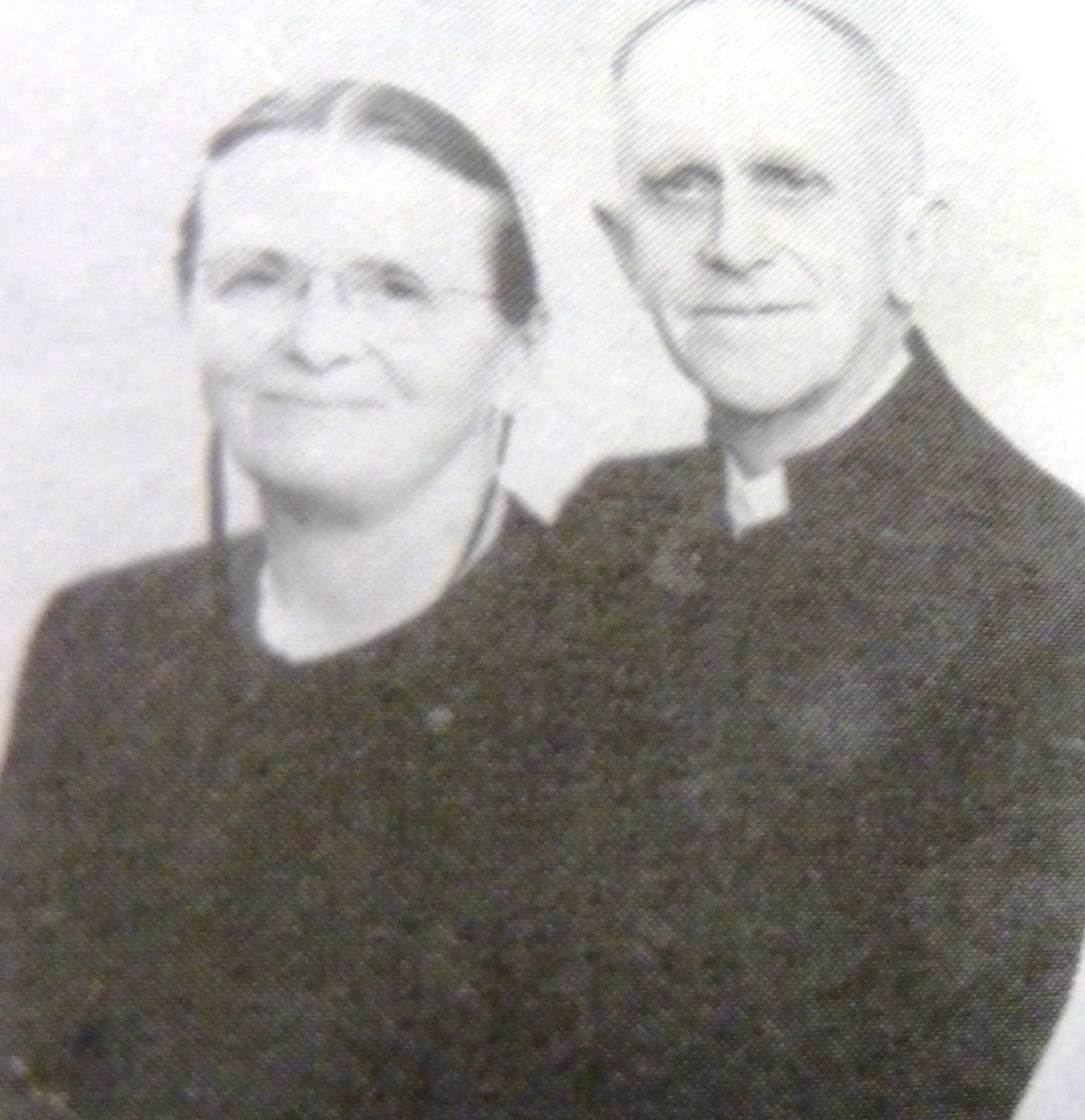
Lizzie and Henry Weaver
Isn’t she just the cutest? (Some of the older women of the church at that time would have still worn covering strings as shown here, as did my grandmother.)
Lizzie Weaver was the deacon’s wife at North Goshen Mennonite, before my mother became the deacon’s wife. (Wouldn’t The Deacon’s Wife make a lovely title for a novel? Wait til you read one of the dreaded duties of the deacon’s wife in my next blog post.) In the first half of the 20th century, a deacon in Mennonite practice was not just a trustee or an elder of the church, but an ordained pastoral assistant in the tradition of I Timothy 3:8.
J.C. Wenger’s history of North Goshen 1936-1986 documents my memory of “Cottage Meetings” held in homes as Wednesday night prayer meetings, and we enjoyed going to Henry and Lizzie Weaver’s home partly because they were both just dears; I’m sure as children we looked forward to the “Coffee Cookies” she served that my mother submitted for the North Goshen Cookbook published sometime during the 60s.

Lizzie lived to the age of 94 and died in 1980–long after my parents moved away from North Goshen. J.C. Wenger also commends the older women of North Goshen for the Pilgrim’s Prayer Circle they convened, which was “a veritable [prayer] power house for the congregation.” It was started by Paul Mininger’s mother Hettie Mininger (Paul served as president of Goshen College for a time). These women, though we as children thought of them as ancient and “cute little old ladies,” were undoubtedly strong matriarchs of the church.
Next week I look forward to sharing here the first of three blog posts out of the biography My Calling to Fulfill: The Orie O Miller Story by historian John Sharp. Orie was an Indiana contemporary of Lizzie, and my distant cousin (more well known for his ties to Akron, Pa.), whose father, D.D. Miller, served as bishop over North Goshen for a time. I’ll also delve more into Henry Weaver’s intersections with my father—and the impact on my own life.
For now, enjoy these old timey, easy-to-make cookies with me, at least vicariously!
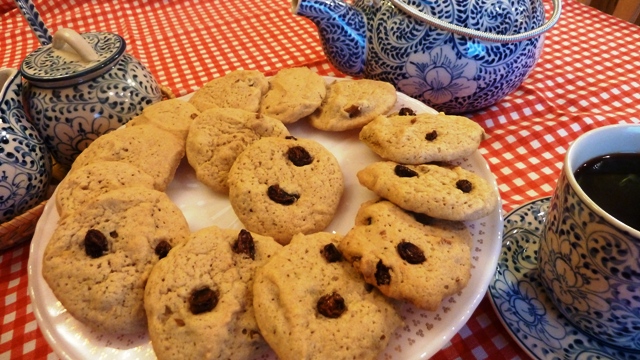
Lizzie Weaver’s Coffee Cookies
2 cups sugar (I used white but I bet Lizzie used brown)
½ cup liquid coffee
2 eggs beaten
4 cups flour
1 cup shortening
1 cup raisins or nuts or both
1 Tablespoon baking powder
½ cup boiling water
1 teaspoon soda
1 teaspoon vanilla
Cream the sugar and shortening. Add the boiling water. Dissolve the soda in the coffee and add to other ingredients. Add eggs, raisins, and vanilla. Sift the baking powder and flour together and add to the other ingredients. Stir well. Add nuts if desired. Drop on greased cookies sheets with teaspoon and bake at 350 degrees for 11-13 minutes.

These make great dunking cookies–evoking another powerful memory of dunking cookies with my grandma and grandpa–in coffee of course. (I “marked” those with raisins with two extra dots of raisins on top, so that those who don’t like raisins could just enjoy the nutty version with plain old pecans.)

Mildly amusing side story: These cookies were made most famous in our own family because of the time we could not eat them! My oldest sister baked a batch using a half cup of instant coffee as it comes out of the jar—not liquid coffee like you drink. Our family lore became “The cookies so bad even the dog didn’t eat them.” (Note: I changed the above version to specify liquid coffee so no one else would make that mistake.)
***
Looking for your stories here: memories of matriarchs of your church and why you remember them?
Did or does your church have deacons? What role do they serve?
Or, if you prefer, flopped recipe stories??

Betty Allen is a fantastic cook of southern heritage who grew up near Tallahassee Florida. For my senior year of high school (1969-1970) I lived an hour away over in Blountstown, so I know that heritage a bit.
But I first met her when my then boyfriend and I started going to Trinity Presbyterian Church in 1975, which was founded by Betty’s husband, Don Allen. I should say founded by the Allens with a lot of help from God and the people who became charter members in 1963.
Don was the minister we chose to marry us in May 1976. In 1980, Don finally persuaded us to finally join Trinity. We were never in a house church with them (like a small group but with a mission focus) so I never really got to know Betty during those years.
Soon after we joined they left for a new pastorate serving Capitol Hill Presbyterian Church in Washington D.C. Eventually Don and Betty retired and returned to the Shenandoah Valley in the late 1990s and ever since, I have been in the same house church with Don and have enjoyed finally getting to know Betty, although she belonged to a different house church for many years, until health issues got in the way.
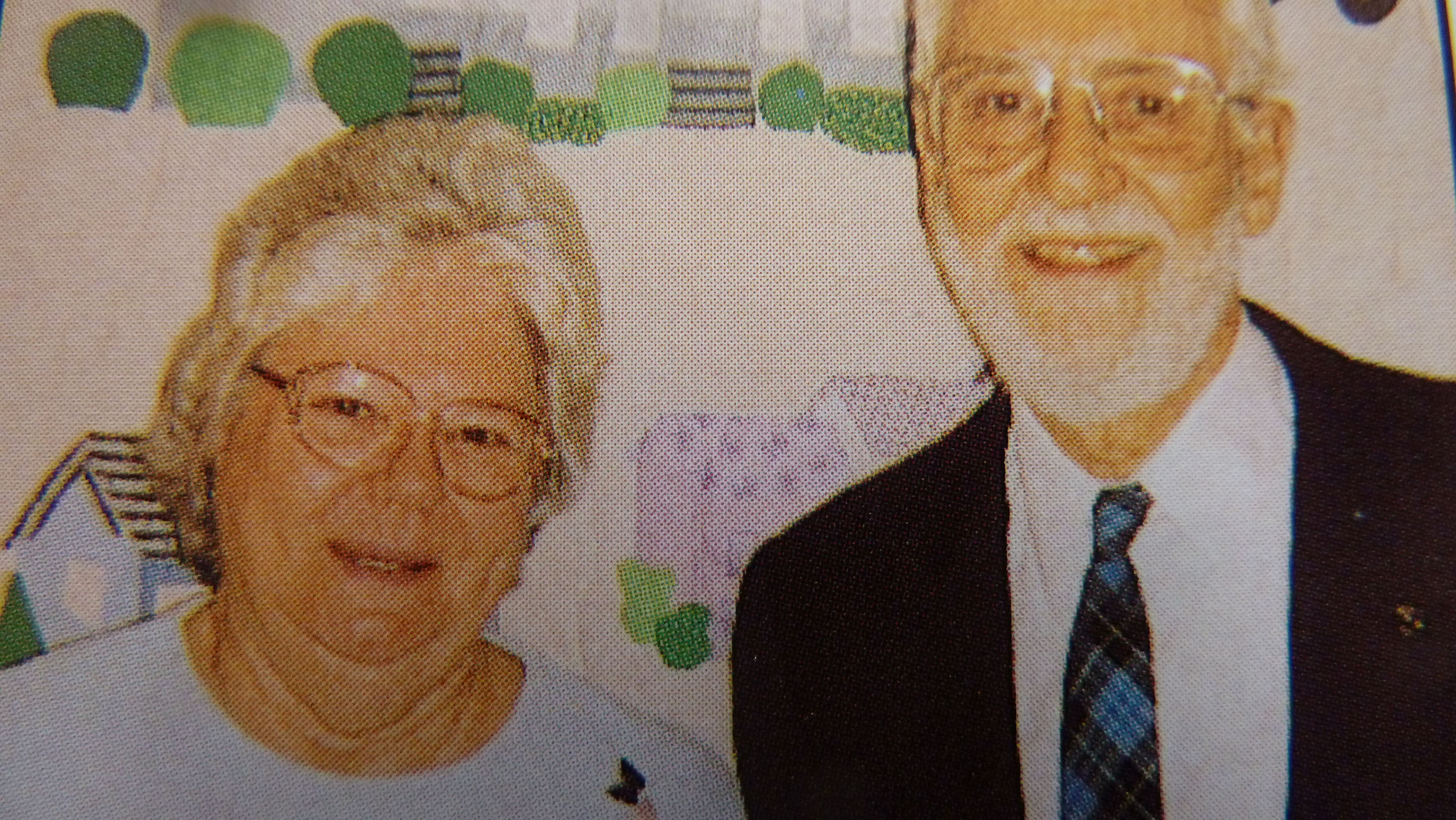
Betty and Don Allen
This woman is one of a kind both as a pastor’s wife and host. I love the tea carts she prepares when we meet at their house, and especially love her always delicious Chicken Casserole which is a standard fall back if she needs to take a covered dish somewhere. Without further ado:

Betty Allen’s Favorite Chicken Casserole
Bottom portion
2 cups cooked chicken, chopped/shredded
2 cans cream of chicken soup (low sodium, or make your own for healthier options)
2 cups cooked rice (brown or white)
½ cup mayonnaise
4-5 boiled eggs, peeled and diced
4 teaspoons lemon juice
Mix all together. Pour into greased 9 x 12 baking dish.
Topping
Combine:
1 small (2 oz or so) package slivered almonds
1 bag (14 oz) Pepperidge Farm cornbread stuffing
2 teaspoons butter or margarine melted
Stir topping together and spread out on top of chicken and creamed soup mixture in baking dish.
Bake in 325 degree oven for 45-60 minutes, until center bubbles like it is good and hot. Place foil on top of the pan if casserole gets too brown.
Let set 10 minutes and serve. Serves 6-8.

***
If you’re not familiar with Whatever Happened to Dinner, and all the recipes it includes, check the link.


Here’s yet another vegetable that I learned to love after I became an adult. I think I have written about how on the farm in the 50s, we consumed only the basics and mostly what we grew in our garden: green beans, corn, peas, carrots, celery, tomatoes, cucumbers, radishes, lettuce, onions, turnips, potatoes, squash, sweet potatoes.
No lovely spinach, limas, broccoli, cauliflower, zucchini, peppers or asparagus. What a shame.
Once I left home, I have learned to love all these. For my family, all these were outliers. I’d barely heard of the even more exotic ones like avocado, kale, kohlrabi, and leeks, or the southern trio of okra, turnip greens, and collard greens.
I’m happy to have grown up on a farm but even happier to widen my taste pallet after growing up to enjoy most of these, along with what to me were many new grains. When my family moved to north Florida, I was soon introduced to the “southern trio” at my high school cafeteria; a year in eastern Kentucky with a Voluntary Service unit of slightly older young adults expanded my repertoire even more; college friends and living in Spain brought a host of new foods to my tongue and tummy. I think most of us like many more foods as adults than we did growing up.
And so asparagus. In my boarding house in Spain, for the main meal served around 1-2 p.m., we usually had three courses, including an appetizer of various wonderful soups or pastas. My roommates and I also often experimented with many packaged Knorr soups for our lighter evening “cena” or supper that could be made on our one burner camping propane “stove,” in our room. The asparagus soup had a delightful taste and small flakes of dried asparagus. We often stirred in one or more of Spain’s excellent cheeses.
When my youngest daughter lived at home for four years after college (and worked hard at a bank, no sloucher!) she wanted us to start an asparagus bed. It has never done well, but I have now read of ways I need to improve it, including using our own wood ashes and even Epsom salts. This was my main picking this year. A few days later I found two more spears and stashed them in my lunch bag with a small bag of shredded Parmesan cheese, thinking I would maybe make them into a small batch of soup in the office kitchen. I knew I had some butter in a container in the office refrigerator, and I could lean on the office supply of half and half cream (and make sure I volunteer to provide the next quart sometime soon!)
I thought it may be worth sharing here if you have only a little asparagus (perhaps that you found on a hunt!) or it’s the first spear of the season, or the last. Or if you’re the only one who loves this stuff in your family! I was pretty happy with the way it turned out using my quick grabs for whatever was convenient at home and then at the office.
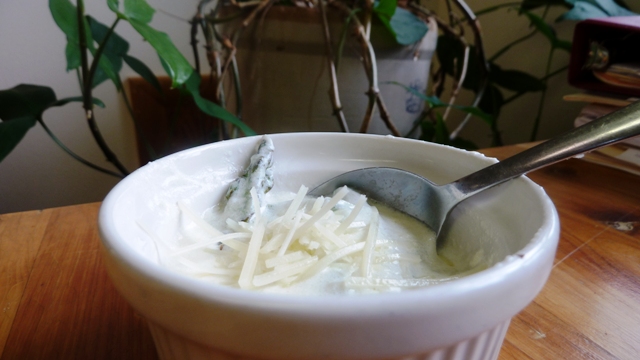
Quick and basic asparagus soup for one (my invention)
2 long spears fresh asparagus, chopped into 1 inch pieces
1 – 2 teaspoons water
1/2 cup of shredded fresh Parmesan cheese (not dried/grated)
1 tsp butter
1/4 cup half and half
In ramekin or other small bowl, boil asparagus pieces in water and butter for 1-2 minutes in microwave. Stir at 30 second intervals, and to gauge desired doneness.
Add half and half cream and Parmesan. Stir well. Cook 1 – 1 1/2 minutes more; stirring in 30 second intervals. Garnish with more Parmesan or parsley.
Makes 1 ramekin bowl. You can easily increase these quantities to serve 3 or 4.
The Parmesan cheese itself supplied a lot of flavor and “seasoning;” if I had been at home I might have added dried mustard, garlic flakes or seasoning salt.

***

Mary Beth Lind has a much more complete recipe for asparagus soup in Simply in Season cookbook, available here. There she recommends using low fat milk and dried milk in the soup to increase nutrition and cut fat. Of course!
***
What foods did you learn to like or adore as an adult?
***
I wonder now why our food and vegetable repertoire was so limited? I can understand not buying vegetables we didn’t or couldn’t raise (I don’t raise broccoli, for instance, too many worms and bugs). Ideas? Insights?
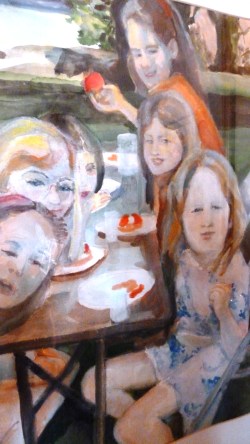
Pobai (pronounced “po-bee”) Hefelfinger was a pastor’s wife and also loved painting. We first met her when she and her husband William Hefelfinger retired and moved to Sunnyside Presbyterian Retirement Community in Harrisonburg, Virginia. Parkinson’s Disease stole away the smooth functioning body movements most of us enjoy, but it never stole her giving and loving spirit. Nor did it filch her ability to paint.
I recently came into possession of one of Pobai’s awesome watercolors (this one somehow reminds me of a Renoir painting) which includes our two oldest daughters, Michelle and Tanya. For the record and my Trinity Presbyterian friends, the girls in this painting include from bottom left and around the table, Michelle Davis, Rebecca Held, Pam Starick, Tanya Davis, Catherine Barber, and Eleanor Held.
I wanted to know more about Pobai and her paintings but I was having trouble finding anything online. Pobai died in 1997 at the age of 73, a few years after her husband succumbed to complications of Alzheimer’s. I sat down with our pastor of 24 years and still a good friend, Ann Held, now retired (young!). Ann’s daughters Rebecca and Eleanor were close in age to our daughters, Michelle and Tanya.
Ann’s husband, John Held, was the children’s choir director at Trinity which became a dear and valued part of their elementary years. Ann remembered that the scene in this painting, which was created from a photograph, was most likely taken at the end of the Sunday school year when the choir typically had a picnic at church or a park to celebrate the year. (And also, let’s face it, celebrating the end of trudging to late Sunday afternoon choir practice which John often made a fun delight, but sometimes girls—and their parents— don’t always like to quit playing or relaxing and hurry off to church.) They especially loved the annual trip to a weeklong Music and Worship Conference at Montreat, N.C. for children and adult choirs in the Presbyterian Church, and learned to know their pastor and choir director very well as they all shared a cabin together.

John Held, in a cabin at Montreat, checking music literature.
Ann said creating and giving paintings to people or the institutions that were important to her was Pobai’s gift and ministry.
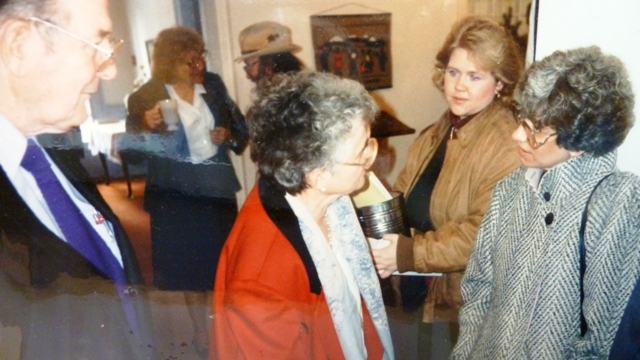
William Hefelfinger and Pobai, left, talking to two visitors at our church in the early 90s.
In those later years, I can imagine painting was also an outlet and survival mechanism for coping with her and her husband’s ailments. Pobai would assist with artistic efforts at church such as helping make a banner, artwork at a retreat, or help with Celebration Sundays several times a year where we typically enjoyed intergenerational activities often in an outdoor setting.
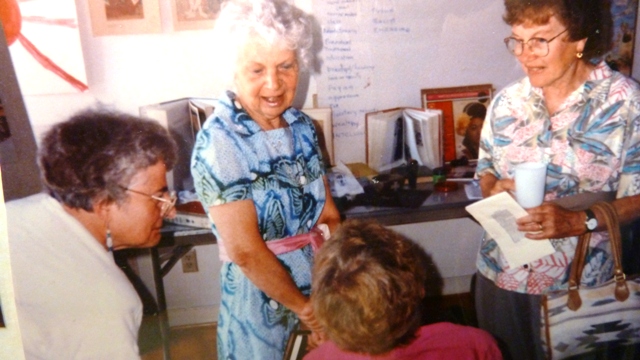
Pobai listening in with other women at a Trinity event.
I tracked down Pobai’s paintings at several nearby Presbyterian institutions including this large depiction of Massanetta Springs Conference Center (a synod-owned camp, conference and retreat center that anyone can rent or book for such occasions) that presides over the fireplace in the dining hall there.
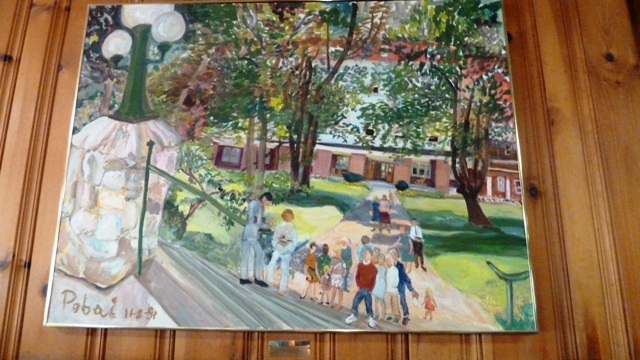
Pobai’s painting at Massanetta Springs, of the grounds and wonderful old hotel there.
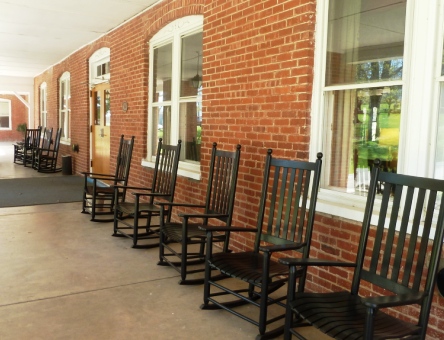
I love that the painting alludes to a favorite resting place at Massanetta: the rocking chairs on the front porch entrance way. (below)
At the nearby Sunnyside Communities for retirement living, one of Pobai’s best paintings of irises is found on the third floor of the Pannel Health Center. When our church goes Christmas caroling to those in health care there, we old-timers are sure to point out the Pobai painting.

Pobia’s watercolor on the third floor of Pannel Health Center, Sunnyside.
Ann owns a lovely chalk drawing of her two daughters created by Pobai. Ann’s husband, John, died of cancer in 2010, a traumatic loss for our whole congregation but especially his daughters and wife.
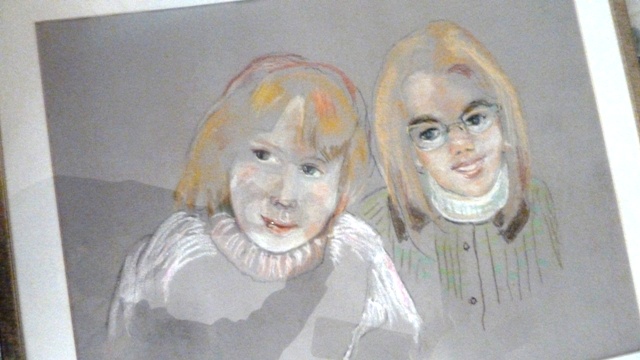
Left to right: Eleanor and Rebecca Held.
There’s also a flower painting in the church administrative office at Trinity.
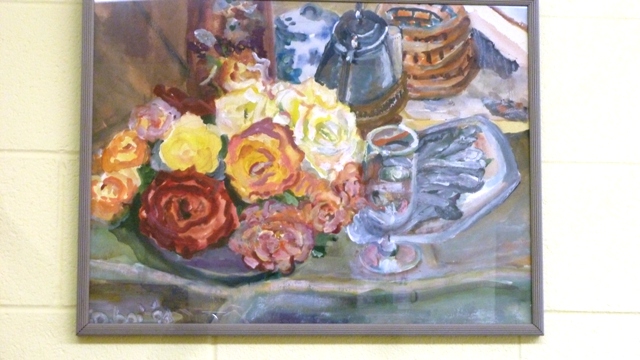
Still life in Trinity’s administrative office.
Before our new pastor, Stephanie Wing Sorge moved into her new pastor’s office, several of us painted her new digs and the “Children’s Choir Picnic” was bequeathed to me in order to make room for whatever the new pastor wanted to hang on her new office walls.
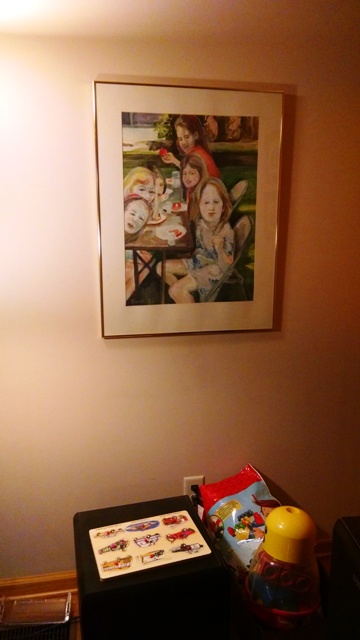
Pobai’s painting “Children’s Choir Picnic” will watch over my grandchildren’s toy corner in the living room of our home.
I’m happy to be the painting’s temporary steward until someone wants it back for the church walls or elsewhere. We will enjoy it and the memories as we pay tribute to a woman who never stopped painting and reached out to touch others in beautiful ways until she was just too ill.

Just before finishing and publishing this, I looked closer at Pobai’s signature on one of her paintings. I had been spelling it Pobie (which is how the church memorial plaque spells it). Wrong! Her true spelling was Pobai!
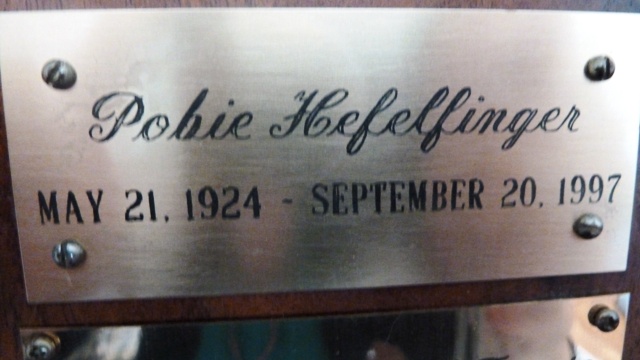
Using the new spelling, I was able to find a current painter in the arts guild in Rockbridge County, Lexington Va., Eleanor Penn, who mentions studying with Pobai as being important for her own artistic style. Pobai and her husband lived and pastored there for a number of years. I’m sure there were many others.
But my real find—was an article in the local James Madison University’s student newspaper The Breeze, where Pobai is quoted saying, “My artistic intention is to paint for the sheer joy of painting. I try to communicate some of the joy I feel in the presence of beauty.”
Now that sounds like the sweet and lovely woman who was Pobai! The article also mentioned that there was a display at JMU’s Women’s Resource Center celebrating women artists (usually students, but they had chosen Pobai’s work and another artist Rebecca Flores because “They not only offer visual stimulation, but also intellectual stimulation.” The director of the center at the time met Pobai in an art class and was so impressed with her work that she asked her to submit her pieces to the art committee.
Pobai is quoted saying, “I want to be famous and there are not so many years left,” and that she paints every chance she gets. Pobai was recognized for her art with a John Singleton Copley award in Boston, Mass., and was a charter member of the National Museum of Women in Arts.
My blog and writing is not so famous either but I’m thrilled to let Pobai’s work and joyful spirit shine a little longer through this medium—now that I know how to spell her name correctly! (Please don’t tell me I have Hefelfinger wrong.)
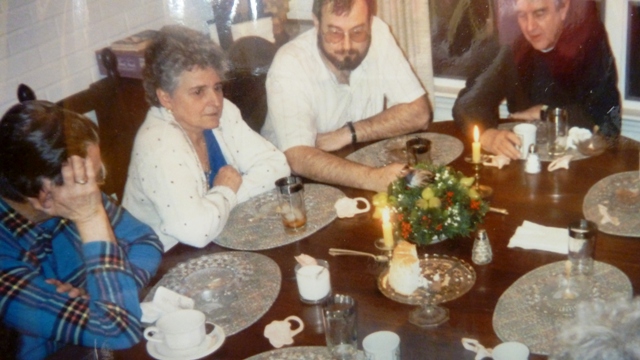
Pobai, between her husband William, left, and my husband, right, at a church Epiphany dinner in the home of Jim and Mae Guthrie. Jim (far right) was the chaplain at Sunnyside before retiring.
What do you do for the sheer joy of doing it?
What would you like to be remembered for?
I found another of Pobai’s paintings at Invaluable.com’s art auction. Which of Pobai’s paintings you’ve seen here would be your favorite?

My great niece has got me way beat. This is my sister’s granddaughter and she is only 11.
She has had her own children’s book published, in hardback, complete with color illustrations (drawn with markers). It is for sale on a website. I love it!

I love that creative and industrious teachers make the effort to give their students lasting keepsakes of their work—and introducing them to the world of publishing. I love that Jade had to write a bio for herself in third person just like in the back of any book, design a cover, and think through the story’s pacing. I don’t know Mrs. Cook at Jade’s school, Elm Road Elementary but I think I would l love her for my child’s teacher.
The youngest of five children in her immediate family, Jade has two brothers at home, a married sister, a grown brother, and lots of cousins, step-cousins, two nephews, a niece in heaven, and some step-nieces. Anyone with more than one or two children knows how easy it is to get lost in the “herd” of children of a bigger family, as Jade’s grandmother once said.
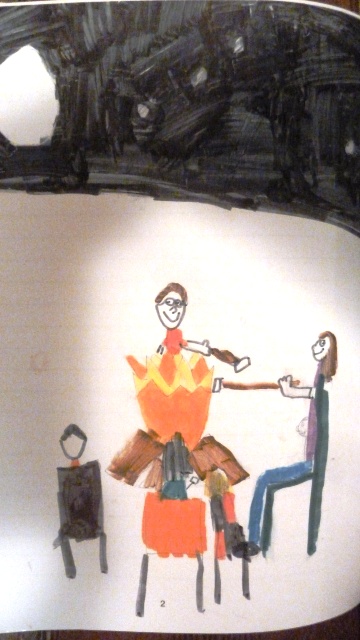
In Falling, Jade writes of a picnic where her grandmother—my sister—dropped by to enjoy s’mores over a campfire but had a bit of a surprise. Don’t worry, the short tale ends well! I love the opening line of Jade’s book, and detect a teacher’s prompt to help the children remember or think of sensory details here:

“I could feel the hot fire on my face and cheeks.”
Nice evocative opening. (Jade, if you read this, “evocative” just means it helps me feel what you felt and remember. And “sensory” means things that you feel with your senses like touch, smell, taste, sound.)
On page 5, Jade has another good sensory detail: “Crack!” (That’s when the “falling” happens.)
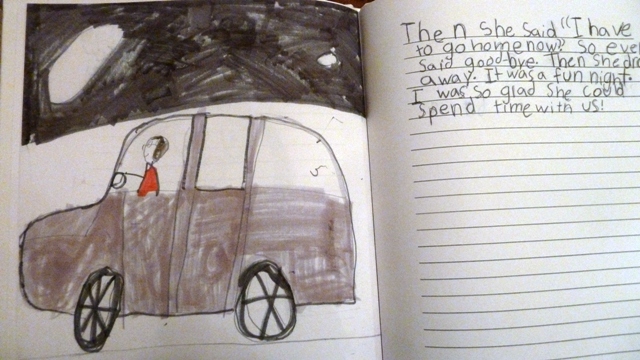
Jade’s drawing of her grandma driving away into the night.
That’s enough of a book review for this short book so I don’t give it all away. Jade chose a good title too, Falling, which makes me wonder “Who fell?” “What happened?” “Is whoever or whatever fell ok?”
And I was pleased to read that THAT was the first question Jade asked the person after the fall happened. “Are you ok?”
On her author page with her bio and classroom photo, Jade gives great advice to other young authors: “Write from the heart and be positive.” She also tells what she enjoys doing in her free time and that “one day Jade would love to travel to Disney World.”

Jade has great parents who love each other and all the children very much, but like many others, they’ve had their struggles. So now I have some advice for my great niece: I hope too you get to go to Disney World someday, even if you have to wait until you are grown. With your positive and caring outlook—and one book already published—(not to mention life with three older brothers) I’m sure you can accomplish whatever you set out to do.

One of my favorite photos of Jade as a toddler 🙂
Love,
Your great aunt Mel.
***
Student Treasures is one website where teachers and students can get their books published. Do you know of others?
***
What advice would you have for young author Jade or any aspiring writer or artist?

This past year I loved working with Marianne Jantzi, a young Amish mother near Kitchener, Ontario, to publish her first book, Simple Pleasures: Stories from My Life as an Amish Mother.
It was especially enjoyable for me because she is about the age of one of my daughters and while a little ahead of them in the number of children she has (four), her youngest child is sandwiched between my grandchildren in age. So I felt a little like a grandma-at-a-distance in hearing her aside about promising a popsicle if they were good while she talked to me on the phone.
I also felt like maybe a mentor in helping her figure out how to take magazine columns for The Connection she’d written over the past five years and synthesize them into a book. Which is exactly what I have done 4-5 times in the books I’ve been able to have published over the last 30 something years. (You can read two shorter excerpts from Marianne’s book here, download an entire free chapter here, read more about the publishing process with an Amish author who writes her work by hand, and an exclusive interview with Marianne by Ardell Stauffer on our company blog, Mennobytes. (Scroll to the end for the interview.)
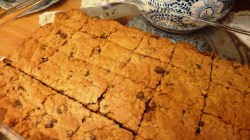
I would love to meet her family someday, but meanwhile her oldest daughter Alyssa first baked one of the recipes shared in Marianne’s book, a simple four-ingredient recipe for chocolate chip bars. Everyone has a recipe for chocolate chip cookies or bars, but I am dumbfounded as I look at this simple recipe and wonder how many other cookies or bars could be streamlined to this simplicity.
Alyssa’s Chocolate Chip Bars
1 cup butter
1 cup brown sugar
2 cups flour
1 cup chocolate chips
Cream butter and brown sugar.
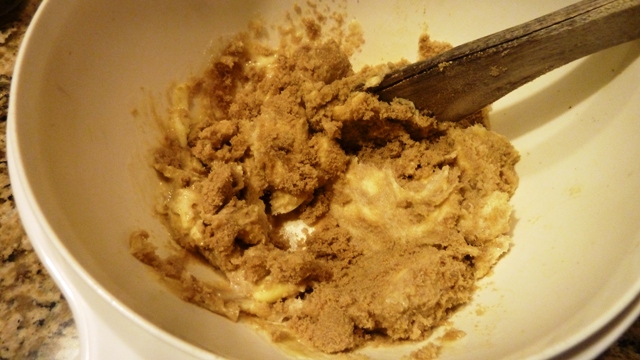
Add flour and chips.
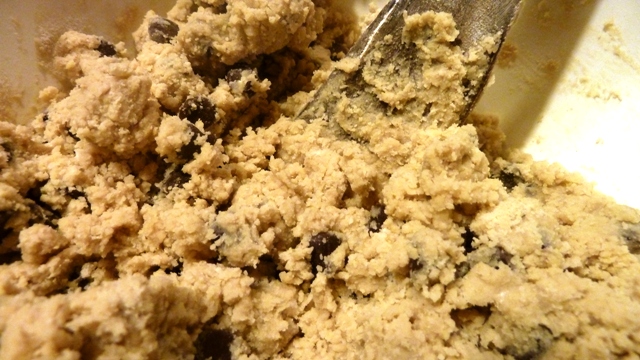
Mix well. Spread in greased 9 x 12 pan.

Bake at 350 degrees until golden brown, about 25 minutes. Cut into bars after 10-15 minutes. Makes about 32 bars.

Of course I “tested” these at the MennoMedia/Herald Press office. One man emailed his thanks: “Yum. How can you go wrong with flour, sugar, chocolate and butter?”
They are rich and buttery good—and delicious warm right out of the oven. In defense of the other ingredients most of us usually add to a bar type cookie like this, I think the normal eggs, baking soda/powder and vanilla added help keep the bars a little moister as time goes on. But in an Amish family of 7-10 children, leftover bars wouldn’t last that long anyway.

So for a simple recipe the kids or grandkids can almost master themselves, this is an awesome find! Thanks, Marianne and Alyssa!


 findingharmonyblog