

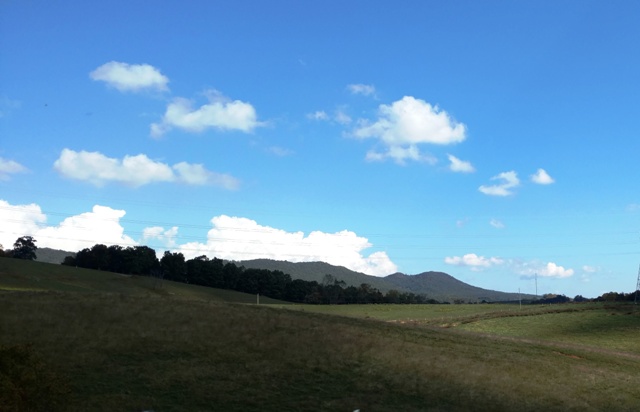
Approaching southern Virginia mountains.
The Man Who Moved a Mountain
My friends at church were talking about a book—a person really, who they were sure I would love reading about. The man was a mountain pastor named Bob Childress and the book is called The Man Who Moved a Mountain, by Richard C. Davids, (Fortress Press, 1970).
The book is staggering in its opening chapters as it describes the bloody life on and around Buffalo Mountain in southern Virginia, not far from 1-81 and I-77 which my husband and I travel frequently to visit our family in North Carolina. If you think the old West was wild as portrayed in movies and on TV, Buffalo Mountain was just as wild or worse: men fighting and drawing guns slick and quick, just because they didn’t have anything any better to do. “The Waltons” or “Andy Griffith” it was not.
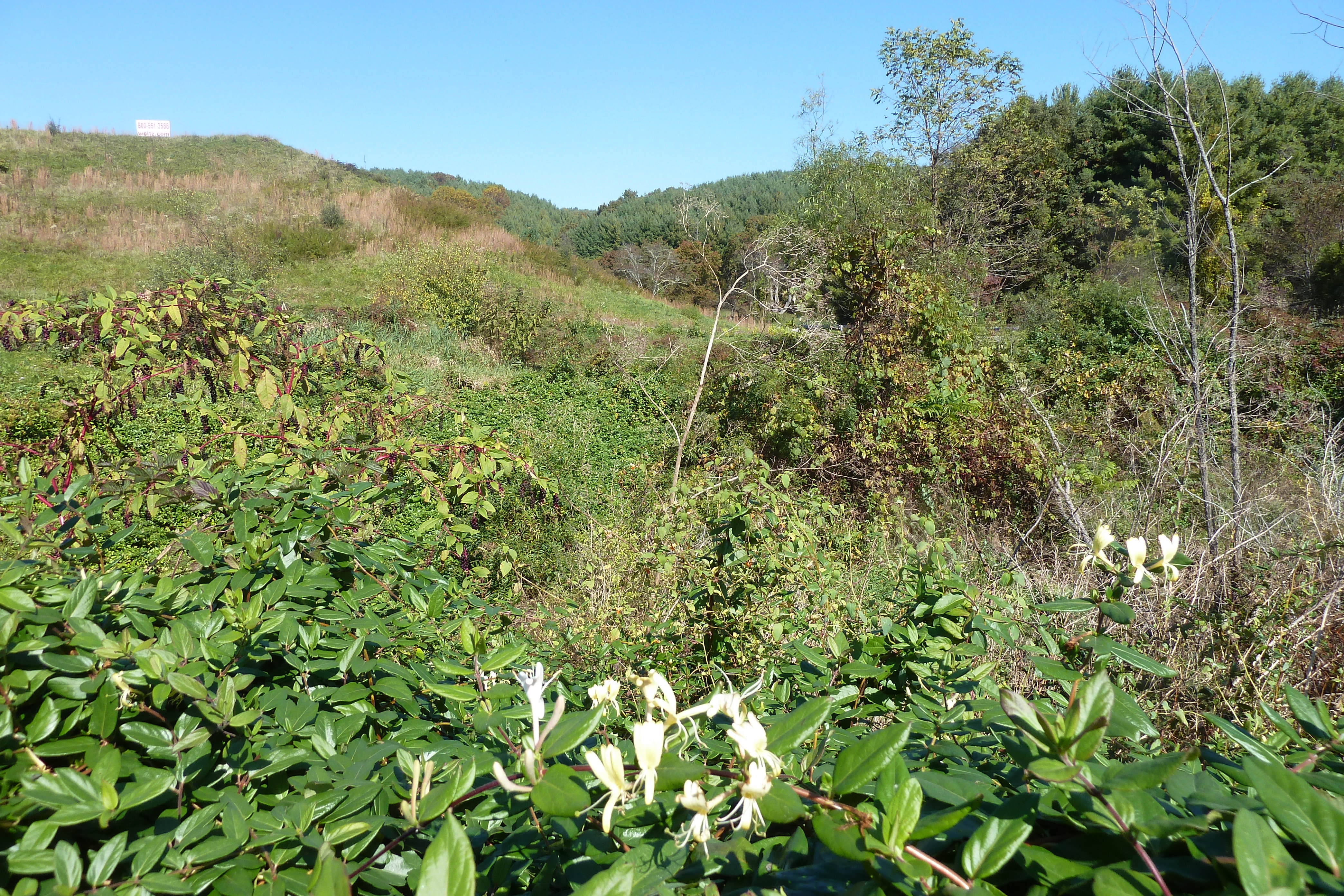
Near Hillsville, Va.
Usually we stop near Hillsville, Va., for a quick bathroom break or cheap gas, about 12-15 miles from the mountain and five miles west of the Blue Ridge Parkway. The book quickly hooked me, as powerfully as the moonshine that a few still spread through the hollows surrounding the Buffalo.
Writer Richard Davids uses shorthand like that to refer to Buffalo, sometimes treating it like a place, a lifestyle, a culture—much more than a single mountain.
Reverend Bob Childress was a young fellow who grew up tough and fighting and drinking like his family and neighbors until God got a hold of him. The good Lord used Bob to charismatically bring many to the kind of faith Jesus talked about in Matthew 17:20, a faith that can move mountains.
The religion that these folks practiced seemed to teach them (falsely) that if someone died in a gun fight or brawl, well, it was his time to go and nothing could be done about it. That’s just the way it was. God’s timing. Their fatalism contributed to the defeatist spirit of those who knew no other way of life.
But something stirred young tough Bob to return to the education he abandoned after a young teacher dearly loved moved away. Something egged him to want to be a preacher—get a seminary degree no less, after he was already married and supporting five children. He faced tremendous odds just getting into seminary without a high school diploma. The Presbytery (a higher ruling body than the local congregation) discouraged him but eventually through their support and years down the road, Childress was a star pastor preaching throughout the southeast sharing tales of God’s movement in and around the Buffalo. Everyone loved him.
Again I was struck with how some stories are hard to swallow: if it were fiction, it would be critiqued for not being realistic.
One paragraph was especially telling—and chilling. “Killing served as more than a final act of justice or safety, however. Killings provided the excitement—almost the entertainment—that lent savor to the dreary struggle of existence. Tales of gunfights were told and retold wherever men met” (p. 7). Writer Davids goes on to tell the details of some of the gorier stories he heard from the older mountaineers as he lived among them to gather stories for this partial biography. I’ll spare you the imagery, it’s as R-rated for violence as it comes. Another line says the people of Buffalo Mountan lived at war with one another: “Killing was a habit of generations. To argue was womanish. A buffalo boy didn’t become a man until he came to discard words for action,” (p.8).
The earliest memory of Bob Childress himself was getting drunk at not quite three. .. “It was brandy that made life bearable,” (p. 11) Davids writes. You can read most of the book right on Google Books.
But the book became alive for me when I was talking to a fellow Lion club member, Mary Beth. I had vaguely recalled from earlier conversation that she hailed originally from the Hillsville area. So I asked her if she’d read the book about her home area. Her face lit up and I couldn’t finish saying the title before she filled in, “Oh, The Man Who Moved a Mountain? and I responded, “yes, I’m reading it!”
Mary Beth quickly added, “Bob Childress was one of the pastors who married my parents!” Suddenly the book became very real. “They had two pastors for the ceremony because my Dad said he had to have Bob Childress do his wedding.”
That told me how truly magnetic, loved and effective pastor Childress was in his ministry. Over the years of following God’s call, and up until he had to cut back for health reasons from his speaking and preaching travels, Childress spurred improvement and change. Some of the changes came partially just because of the revolutionary betterments of the 20th century, but also undeniably how he embraced and egged the people on to education (building the area’s first school), and working at infrastructure like roads and bridges to end the extreme isolation. He was known also for building up churches (both the people and lovely stone edifices), and bravely pushing mountain men to come to those churches, giving up moonshine (in spite of it being their livelihood and the drink as common as orange juice for breakfast).
It is truly an amazing story or God’s leading and a man’s following—supported, as usual, by a strong faithful wife and loving family.
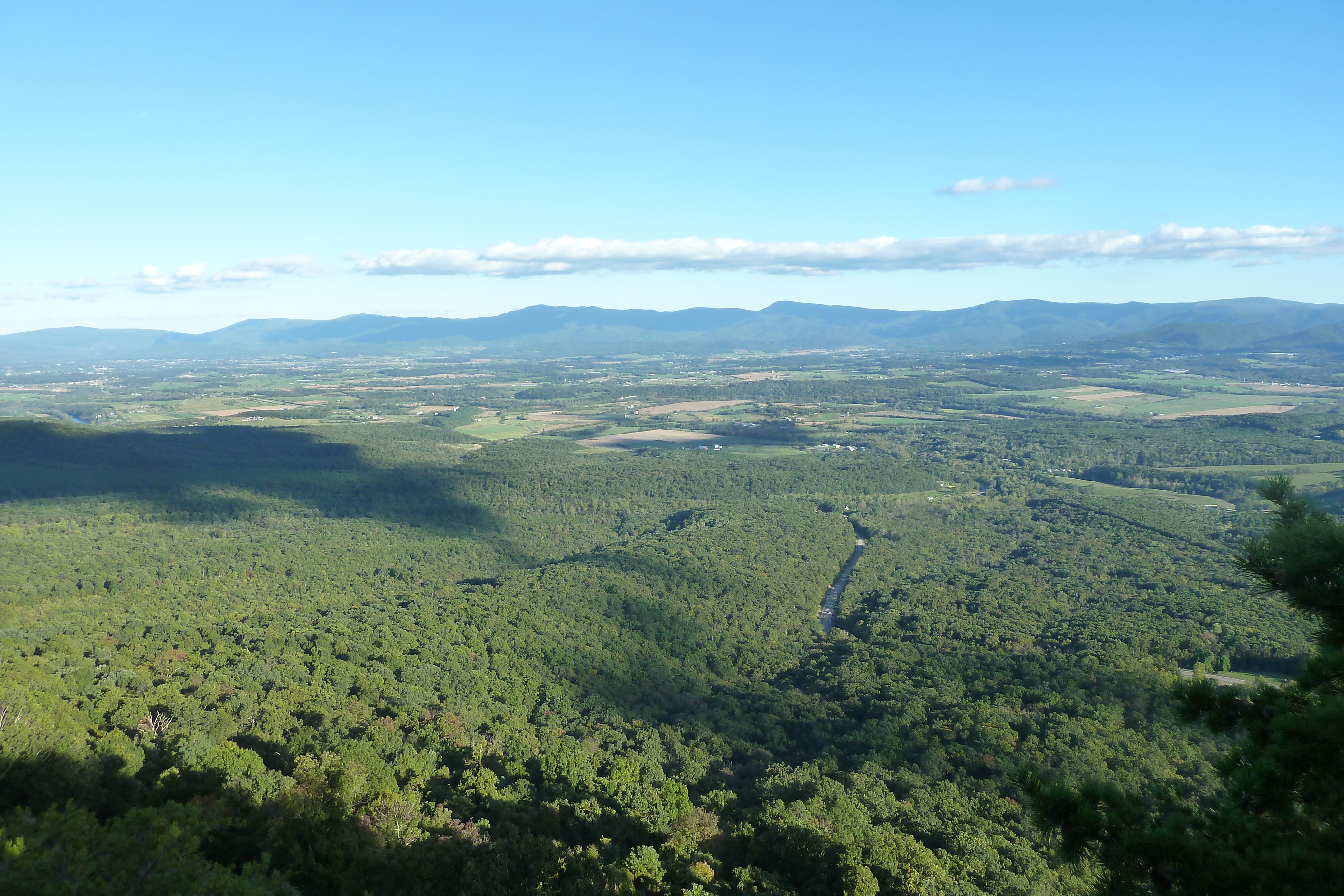
Blue Ridge Mountains, further up in the Shenandoah Valley.
***
What mentor, pastor, or even a dear friend would you place in the category of Pastor Childress? Who not only changed your life or life of faith–but also brought signficant change to a community? I’d love to add to this honor roll of great change agents for God.
***
This book reminded me of those written by southern Virginia Radford professor emeritus Peggy Shifflett, reviewed earlier on my blog:
How one woman lost her label arriving at school on a different bus
Old Time Religion in Hopkins Gap
***
I have not yet managed to snag an image of Buffalo Mountain but you can easily google “Buffalo Mountain Images” to get an idea of why they called the massave sloping shape of the mountain, “Buffalo.” Or look at one of several YouTube amatuer videos: https://youtu.be/72YdGmJtwVo
***
My memoir of living in the nearby hills of Eastern Kentucky for one year can be found as a used book on Amazon, On Troublesome Creek, Herald Press, 1983.
Quantity cooking – Sausage gravy
In the years since I began working with a team of people at MennoMedia to help syndicate Lovina Eicher’s Amish Kitchen newspaper column, I’ve become not only a faithful reader but a star struck fan in wonderment of how does she do it—especially when it comes to cooking for a wedding crowd? How does any woman manage to pull together a menu, stock the supplies (to say nothing of paying for it all), to feed upwards of 1000 meals all in one day: the day your daughter or son gets married, no less? Most of it is all homemade from scratch. How do they handle the last minute panics of “oh no, someone bought this kind of flour or sugar rather than that, or the order list said this rather than that?”

Stuart cooking sausages 2016.
I got my own dip into quantity cooking the other week helping with the Lions Club Pancake Days that have been a tradition in the little town of Broadway, Va. for at least 30 or more years. My husband talked me—no, volunteered me into—making the homemade sausage gravy (no mix for this Lions Club, no sireee). Our faithful normal gravy maker had to be out of town at a Lions state convention for the second half of our planned Pancake Days so my husband sweetly said he thought I could do it.
Thus I got to learn the ropes first hand from John Knepper, our seasoned sausage gravy maker—always the best way to learn to cook a new dish.
In this case it wasn’t a matter of me learning to cook a new dish: ever since we began our involvement with the Lions and I learned to love sausage gravy on pancakes (the topic of my very first post for this blog back in 2013!), and make it regularly particularly in the fall and winter. The quantity aspect was what was new—and daunting. Would I run out of gravy at a critical time and there would be folks in line yammering for their gravy—an abundance of pancakes and sausages cooling all the while? Would I scorch a batch? Would it turn lumpy and be ruined?
The answers are no, no, and no, thank the sausage gravy angels of the universe. The gravy by all accounts was delicious; we had people wondering what was the name of the mix we used, and when we told them it was homemade, not a mix, one woman looked triumphantly at her table mates declaring, “I’ll have to tell the team at our church!” Score, score.
Here, shared with permission from the true gravy maker, John Knepper, is how to feed the multitude delicious homemade gravy (and if you count the milk, this gravy is more like a creamed sausage soup than a greasy gravy).
 John Knepper stirring his famous and great sausage gravy. Photo courtesy of Dawn Turner from 2014.
And if you’re going eeewww, “Pancakes are eaten with syrup, not gravy!” you can do the way many Broadway Lions Club Pancake Days fans do: eat your first course of pancakes as a meal with gravy, and your second course with syrup, for dessert. Viola! At home I serve fresh fruit after these two courses for a more nutritious dessert.
The answer about how Lovina or any Amish woman or man who helps cook for a wedding feeding 400-500 people for lunch, and then feeding another 400-500 for an evening meals is: You. Are. Exhausted. Period. And you need help from others cleaning up the very large mess made by quantity cooking. But the adrenaline rush from successfully managing to cook and feed a large number of people in a short amount of time is not only rewarding, but addicting, and you know you’ll enjoy doing it again. Next year.
You might enjoy Jennifer Murch’s account of how she masterminded the making of 12,000 homemade yeast raised donuts for our local Virginia Mennonite Relief Sale recently!
P.S. Since I was focused on making gravy and not taking pictures, I don’t have many pictures. But here’s how I serve it at home.
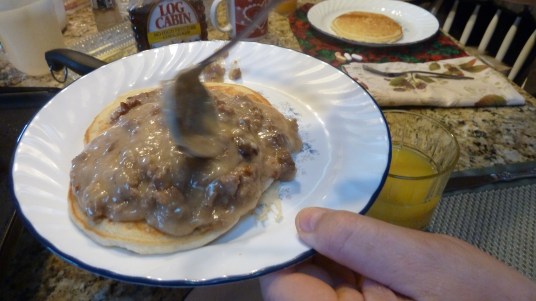
Sausage Gravy – large quantity – recipe from John Knepper
Makes one large kettle serving 40-50 people, depending on how much gravy they want dolloped onto their pancakes. See size of kettle John is using.
1 – 1 ¼ pound high quality sausage (not a lot of fatty content. I use Gunnoes. For this pancake sale, we buy from a local meat warehouser called Gore’s.)
1 cup vegetable oil
2 cups flour
1 ½ teaspoon salt
1 ½ teaspoon pepper
Brown 1- 1 ¼ pound sausage in one cup vegetable oil in skillet. Mix in flour and mix and heat well, stirring and mashing down with spatula to keep out lumps. Add salt and pepper to taste. Once flour/sausage mixture is well mixed and browned, stir in 1 gallon whole milk. Stir continuously allowing it to heat until bubbly and thickened over medium heat. Do not to let it scorch. Completed gravy usually stays very hot once removed from fire, although we use a warming commercial buffet line to keep pancakes, sausages and gravy hot as people come through the lines.
(To reheat gravy that has been refrigerated reheat in small batches, stirring very frequently or continuously. Add small amounts of boiling water as needed to help thin it down, which also helps reheat it more quickly.)
And here is my much smaller quantity recipe from an early blog post.
Sausage Gravy – small quantity
1/3 lb. Gunnoes whole hog sausage, mild (or the highest quality favorite sausage you can buy)
1 Tb. shortening – Crisco as needed, or fat remaining from frying sausage
1/3 c. regular flour
1-1/2 c. water or milk
1/4. tsp. salt
1/4 tsp. pepper
Additional notes on prep time, etc.
For a “Shrove Sunday” pancake brunch at church 2018, made large 6 quart batch gravy:
Timetable
Began frying sausage in oil 7 a.m.
When brown, added flour, salt, pepper 7:20 a.m.
Added milk in small increments, heating slowly and stirring almost constantly.
Gravy finished cooking up about 8:00 a.m.
Left for church at 8:30 a.m.
Stuart cooked sausages at medium 300 degrees on the griddle. Started about 9:30 a.m. for 10:45 brunch serving.
***
My mother always hated to work in crowded church kitchens to prepare meals.
Do you enjoy quantity cooking? Why or why not?
***
If you know of newspapers who might be interested in carrying Lovina’s Amish Kitchen newspaper column, here is contact info.
***
The Mennonite Community Cookbook is known for its section on cooking enough food for a barn raising. You might want to check it out!

Last weekend my husband and I were both exhausted so went out for dinner (well, just pizza, but at a homey Italian place we enjoy in the town where the kids all went to high school).
The small restaurant was filled with high schoolers all decked out for their homecoming dance later that evening. We enjoyed checking out what was in, what was out in terms of boutonniere, wrist corsages, lacy short short dresses, and cute bow ties and suspenders. I was thrown back to my Senior Homecoming weekend in 1969 in Blountstown, Florida. Oh my.
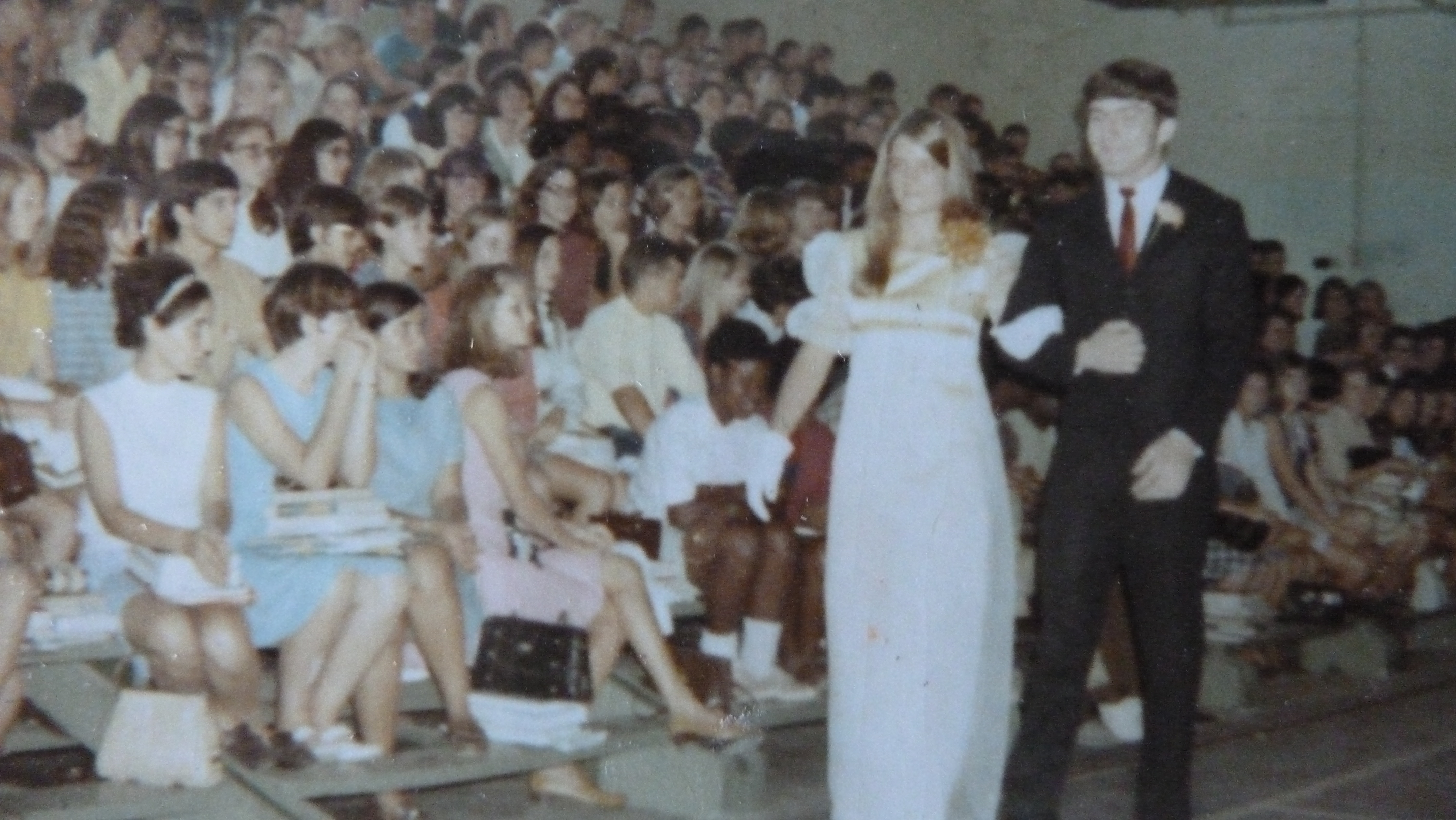
Your truly with my homecoming escort, Garland. He actually looks like he was smiling!
You may recall my history of moving with my family to north Florida which was my senior year of high school. I didn’t mind the move because I had always wanted to be “the new girl in school.” Well I got my chance, and with it, was nominated to be on the homecoming court. I know that happened only because I was a new girl and some of the other girls were being snubbed by classmate votes because of … who knows … but somehow I lived the dream of many young teens–to ride through town on the back trunk of a convertible, waving. To walk on the field at a homecoming game, smiling. To walk up to be on stage in the old gym, heart beating out-the-kazoo over who would win. Along with most others in the school, I expected the queen to be the drum majorette who dated the star of the football team, but you never know.
My dress (above) was the dress I wore for my oldest sister’s wedding earlier that year, before we moved. My mother hurriedly sewed me a beautiful green corduroy suit to wear to the game. And for the parade, she remade another formal dress we had on hand. More-with-less.
But the reason I’m sharing this is my delight in this past year at being able to reconnect with two of the girls who I got to know much better by being on the homecoming court, Suzanne Knight and Sandra Stokes. I first stumbled on to Sandy through a mutual friend on Facebook, and then Sandy got me connected with Suzanne (not knowing who either married prevented me from doing searches before.)
The three of us got dressed for the homecoming ceremony together at Suzanne’s house. And while I was not allowed to go to the dance (Mennonites did not dance in those days!) I loved going to the homecoming football game, which was actually the very first football game I ever attended. Imagine my chagrin in telling the shy but handsome young football player I asked to be my escort that I couldn’t attend the dance, but would he be my escort for the other festivities anyway? (We were allowed to go to football games, but at my small Mennonite high school in Indiana, the fall sport was soccer, not football.)
Going to a public school that year ended up being a hard, lonely year; I’m thankful for the few friends I made, Suzanne, Sandy, Delilah, and Becky among them, and for the experience of being lonely. Moving into a town and then leaving a year later for a church voluntary service program and then after that college meant I never put roots down there. But I treasure the girls who did reach out to me that year and am overjoyed to follow their lives a bit through the technological homecoming “dance” that is Facebook.
***
Did you ever have to sit out some activity everyone else got to do?
What difference did your church or faith make in your activities as you were growing up?
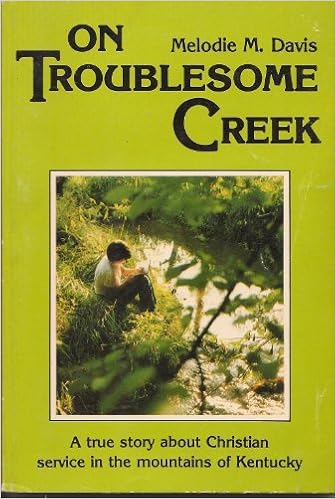
For the full scoop on what I did the year after high school, read a copy of my old “memoir” of a year spent in Voluntary Service in Kentucky, titled On Troublesome Creek. Published by Herald Press.
Check for used copies on Amazon.

Happiness is not perfect until it is shared.
I was pleasantly surprised to be included in this Amish Wisdom giveaway–but happy because the timing ties wonderfully to the yearly “Family Dinner Day” emphasized in my book, Whatever Happened to Dinner? which encourages families to keep regular family meal times, even when it isn’t always easy or everyone is glued to their “devices.”
Suzanne Woods Fisher and the Amish Wisdom contributors want to celebrate the changing of seasons with a special Harvest Bounty giveaway! Enter the giveaway widget below for the chance to win to a set of 14 books, plus autumn-inspired goodies handpicked by some of the contributors. See below for a list of participating authors and prizes. One entrant will win, and he or she will be announced next Friday, September 30th, on the Amish Wisdom blog.

Suzanne Woods Fisher:
The Devoted and an Amish potholder set
Kate Lloyd:
Signed copy of Leaving Lancaster and folding tote-bag
Laura Hilton:
Winner’s choice of book, a dishtowel, potholders, a prayer journal and an adult coloring book
Jennifer Beckstrand:
Honeybee Sisters Cookbook and mini beeswax candle
Melodie Davis:
Amy Clipston:
An Amish Harvest, The Courtship Basket, and Amish goodies
Shelley Shepard Gray:
Signed copy of Snowfall and an Amish-made potholder
Emma Miller:
The Amish Bride and a fall-themed item
Adina Senft:
The Longest Road and an Amish-made pot holder from Lancaster county
Ruth Reid:
Signed copy of A Dream of Miracles and a Starbucks giftcard
Mindy Starns Clark:
The Amish Clockmaker, an autumn table runner and fall-themed decorative container
Molly Jebber:
Grace’s Forgiveness and potholders
Jan Drexler:
Mattie’s Pledge and a fruit of the Spirit coffee mug
*Only U.S. addresses are eligible to win.
Back in June, my husband and I took a train trip to nowhere. You know the kind: excursion trains that haul mostly grandfathers and grandsons on a trip down memory lane, but with plenty of womenfolk along mainly just for the ride. At least that described me.

Pulling our train was a locomotive known technically as the “Class J 611,” or “611” for short, one of three locomotives from the historic Norfolk & Western line currently based at the Virginia Transportation Museum about two hours south of us in Roanoke Virginia. Railroad buffs, history fans, preservationists and interested volunteers provide opportunities throughout our region (North Carolina, Virginia, and northern Virginia right outside Washington, D.C.) where you can still see Norfolk & Western’s “golden age of steam power” in action and ride in cars being pulled up decent grades by old fashioned coal and water.
The Norfolk & Western was the last major steam railroad in America, and lost steam, so to speak, when train power changed from steam to diesel. A photographer of the day loved those steam locomotives. His name was Winston Conway Link and he was known for his classic and iconic photos of trains puffing through the countryside especially at night—photos carefully crafted with lighting, lens, and posed Norman Rockwell-type moments—a father and son heading home after chopping down a Christmas tree, for example. Link wanted the photos to honor both the people who relied on the 611 running on schedule through their countryside every day, which gave them “pride and [was] a testament to rail workers they personally knew” (611 Magazine, Spring 2016, p. 20).
Link wanted to preserve one sample of each of the N&W steam locomotives, called Class A, Class J and Class Y* (all built in Roanoke in the 1940s – 50s). Winston kept the Class J 611 out of the scrap yard with his offer to buy the locomotive. He never acquired it, but his goal to have it saved was accomplished never-the-less. (Link’s work can be found in the O Winston Link Museum in Roanoke and books; he died in 2001).
So we got to board a passenger car being pulled by the “611” in Manassas, Virginia where we had to make way for early morning farmer’s market vendors which usually occupy the streets on Saturday mornings. The lines for us to stand in were all well-marked on the street: more than 1000 passengers boarding about 20 cars in a squeeze of time. But that wonderful pre-planning got scrubbed as the vendors made clear who had right of way there: their food and market trucks.
No matter. The excursion bound riders were all in great spirits, chatting up our line mates and anxious for the big 611 to roll into the station.
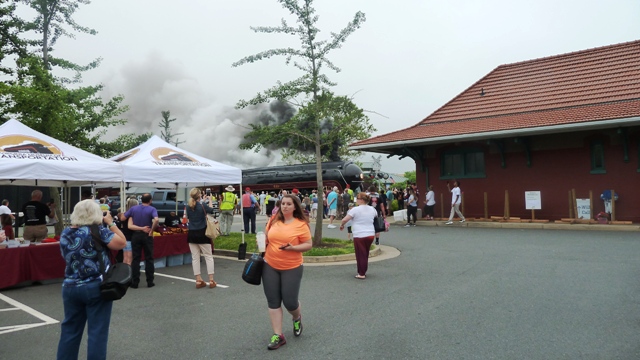
I was not positioned well, but you can see the 611 pulling in to the Manassas station here.
I’ll never forget the adrenaline that shot in with the 611 engine and the cars it was pulling. And it was pretty. A kid, about nine, began shouting, “It’s coming, it’s coming,” and started running towards our crowd, the better to get the best possible view. The cry was electric, charging us all up for the trip to nowhere. And the 611 did her best to belch out the blackest smoke she could manage. EPA, look the other way.
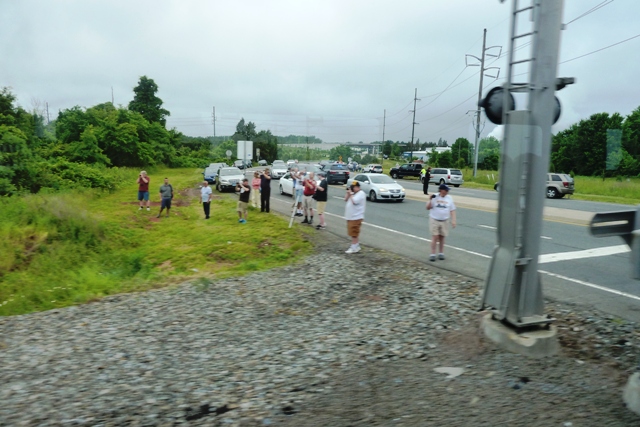
We rode the rails back to the town of Front Royal, which we had already passed that morning on our way to Manassas from Harrisonburg. But, we were a little surprised to learn, (had not read the fine print very well) that we wouldn’t be allowed to get off in Front Royal at all. Actually, the logistical nightmare of boarding and reboarding 1000 passengers, in the relative middle of nowhere, would not have been wise and would have made the excursion even longer. And no offense to Front Royal: a lovely old timey town with antique stores, vintage 50’s motels, and a popular ice cream and hamburger joint, Spelunkers among many other attractions.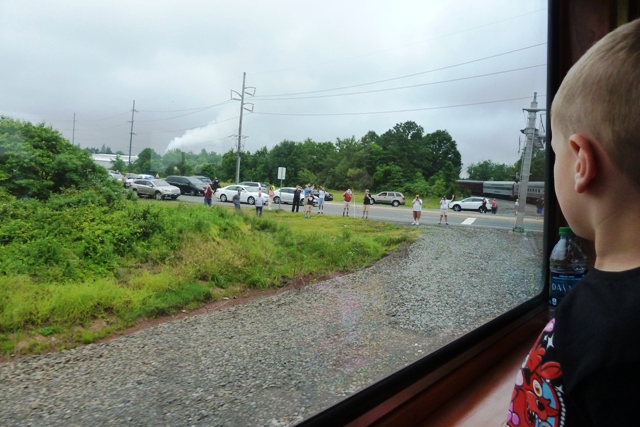
But the best part for me, a train buff only because it means I get to travel somewhere, was feeling like we were celebrities or presidential candidates passing by all those country intersections lined with tripods, cameras, and video equipment. People raced to capture images and movies of the 611 passing through like it was 1916 instead of 2016. The hordes of photographers would quickly run to their vehicles as soon as we passed to head to the next viewing spot, called “chasing” the train. What a gas. Or a lot of steam. I soon discovered that it looked like the people out chasing the train were having the most fun.
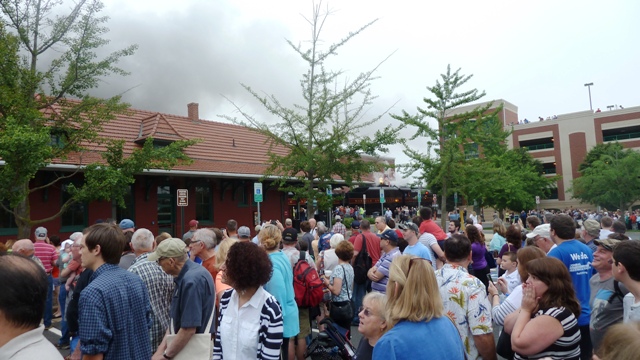
When we pulled back into the station after our 4.5 hour excursion, (good thing they warned us to bring a lunch) the crowds in Manassas had swelled to thousands attending a 22nd annual Manassas Heritage Railway Festival. The festival featured memorabilia, vendors, model trains and lots of food. Our daughter, son-in-law, and two grandsons were there in the crowd—straining for a view of us and the train. My daughter kept texting their location to me; so I waved wildly, hoping they could see us; young James claimed to have spotted Grandma inside the train. It was like we were coming home from a cross-country jaunt instead of 102 miles in the green Virginia countryside.
I should have bought the two-year-old a souvenir from the 611, but gave him instead a colorful brochure showing a picture of the train. He adores that brochure and keeps it with him in the car to look at as they run suburban errands, drive to visit us or his other grandma, or head to preschool. Who knew a brochure could sub for a knick knack?
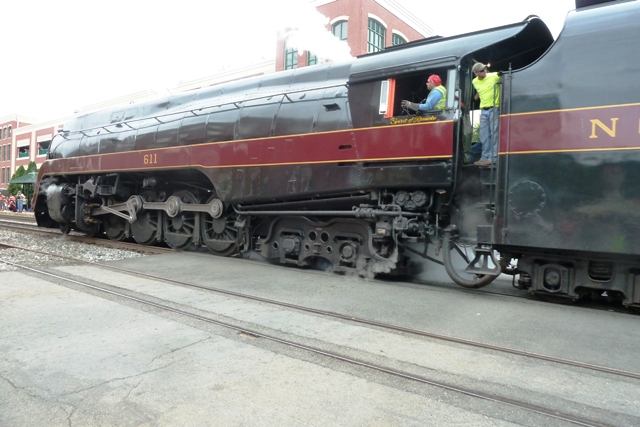
I am not very knowledgeable about trains or the 611, but much more info can be found at FireUp611.org. The 611 Magazine, which goes to supporters and anyone who’s bought an excursion ticket, provided much of the factual information for this post.
You may recall me writing about my husband retiring at the end of May. This was a fun way to celebrate. We may try “chasing the train” when it comes ‘round the bend again.
***
Since most of my readers here seem to be women, I’ll cast my comment bait this way: Are there hobbies your hubby pursues that you enjoy just to do things together? Or that he indulges in for you, for the same reason?
***
What have you been surprised to discover on an expedition(s) you did to humor your mate or a friend? For instance, what I enjoyed most was learning about photographer Winston Link.
***
There are multiple videos on YouTube of the 611 under steam. Try one on just for fun. Here’s one of the actual train we were on from Manassas to Front Royal and back. Linden is next town up from Front Royal. 🙂
And if you happen to be in Danville, Va., this weekend Sept. 24-25, 2016, I’m told the 611 will be “under steam” at the Danville Rail Heritage Days although not making an excursion.
(*To be technical, the Class Y 6a 2156 is on loan from the Museum of Transportation in St. Louis, Missouri, which we have also visited. Also, the Class J was a series of 14 engines, and the 611 is the only remaining example that didn’t get scrapped. True train buff, my husband. Two prior family excursions with grandsons recorded here and here.)
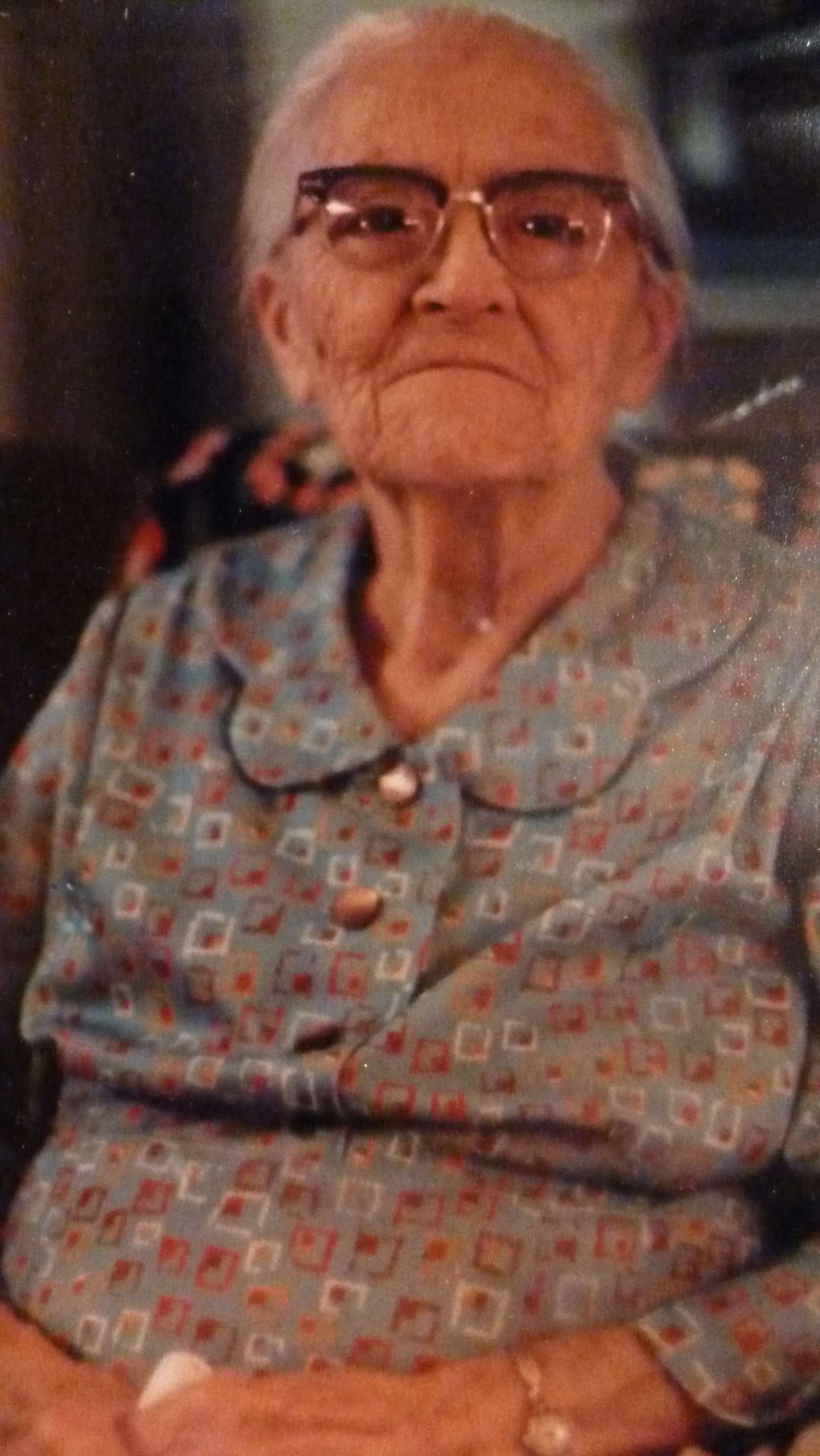
My mother’s mother was Ruth Loucks Stauffer who lived a rewarding long life; she succumbed to complications of a fall which put her in a nursing home for several months until she died in 1991 at the age of 95.
Grandmas are often remembered for their cookies. I remember her more for her roast beef, perfect beef or ham gravy, mashed potatoes, corn, and pickles. I loved all these things at her house, where we would often go for Sunday dinner and always, Christmas dinner. I’m sure we had dessert—perhaps canned fruit and cookies, or, seasonally, certainly pumpkin pie, for which I have the best recipe from her.
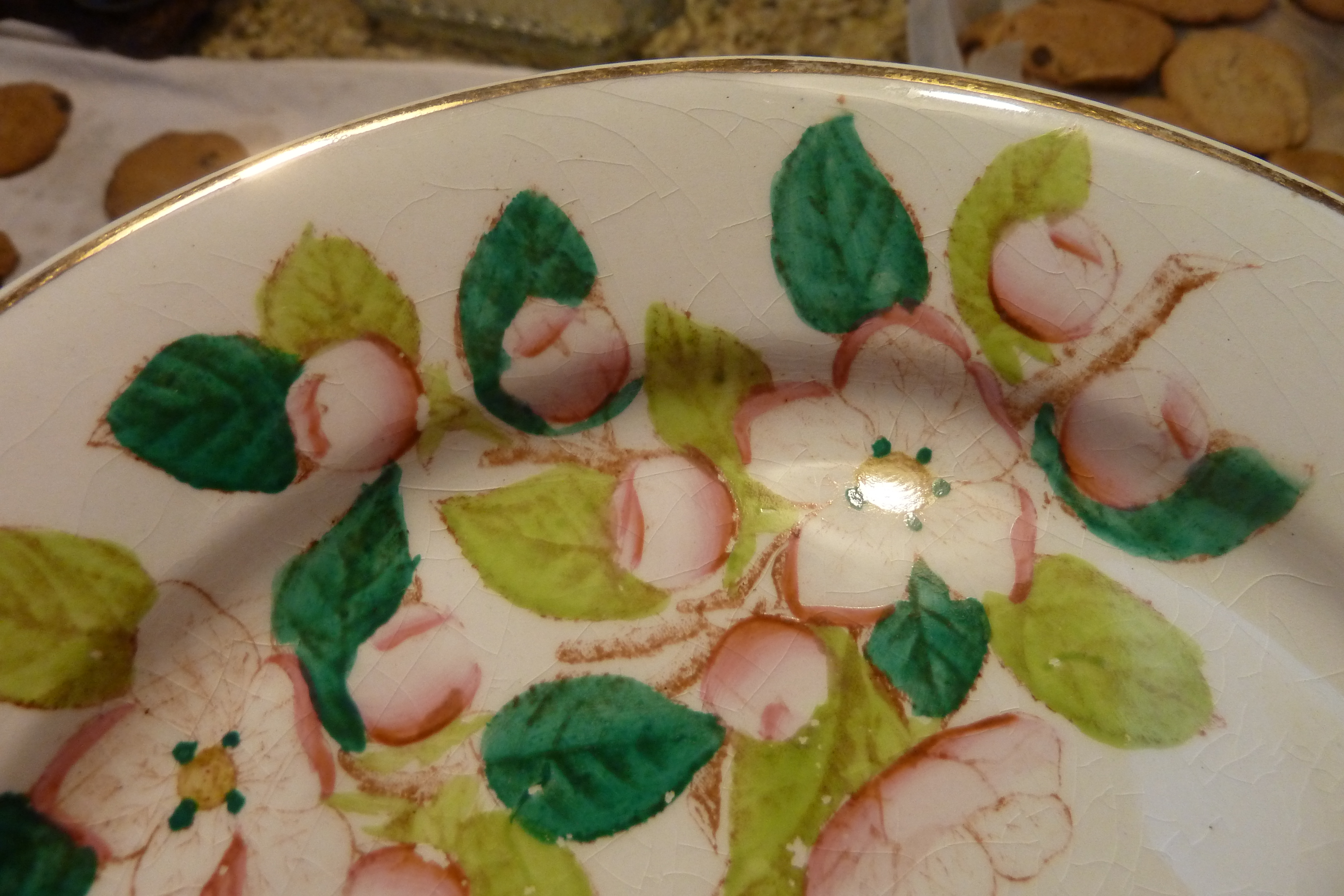
This was not the china she used for Sundays, but I received one plate which was her mother’s, and of course I treasure it. Her mother was Fannie Martin Loucks, but I never knew Fannie. I do remember Grandma’s father though, my great grandfather Melvin Loucks. He was the only living great grandparent I ever had.
And sadly, my Grandpa Stauffer, Ivan, died in a car accident when I was just a baby, about eight months old. Grandma lived the rest of her life as a widow, supporting herself by doing sewing alterations, making “dust bonnets” which homemakers wore doing heavy-duty cleaning so as not to get dust and cobwebs in their hair.

Two dust bonnets my grandmother made.
We wore them in the chicken house to keep the awful smell of poultry manure off our hair.
The devotional coverings we wore as Mennonites in the 50s and 60s. Many women in the Wakarusa area of Indiana would have had their little white “hats” made by my grandmother in those years.

My covering worn at some point in college. Made by Grandma Stauffer.
Unfortunately, this is the best example I still have of my grandmother’s handiwork along those lines.
But I digress. This is more about the cookies and this plate. On a piece of adhesive tape, my grandma wrote these words “My mother’s as long as I can remember.”

She also wrote on it “Bertha” which means she passed it on to my mother, who passed it to me. My mother has written similar lines and “who is to get this” instructions on a paper in her dining room hutch. I have not yet done so. One of these days I will do so, too. (I wrote about other notes I found from this grandma, here.)
I asked my mother what cookies she remembers her mother making and her best memory is of what they called “Overnight day cookies” which were a simple cake type cookie that were supposed to be refrigerated overnight, but grandma didn’t want to do that step, so she baked them the same day and called them her overnight day cookies. I do not remember the name, but I love the story, and this insight into this grandma who obviously, though I loved her dearly, wasn’t the kind of grandma with whom I made cookies.
The plate has a prominent place in my dining room china cabinet, the gold trim echoing the gold trim on another treasure, an almost complete set of vintage 50s pitcher and matching glasses, from my husband’s Aunt Ressie. I love using those items in food photography here on my blog.
I have three daughters. So far, four grandsons. Who will get this plate? The pitcher and glasses? Will anyone care, down the line? My friends who are slightly older say, no one wants the antique dishes we carefully saved, and they really aren’t worth anything online. Even preserving them here with photos and prose may not last. Will this blog record still exist, down the line?
For now, enjoy these cookies—my favorite chocolate chip cookie recipe, vicariously. Virtual vicarious cookies and calories truly don’t count! The recipe comes from Glenda Leonard, who taught math to two of my daughters in middle school; I also enjoyed interviewing her for a radio program about the two daughters she and her husband adopted while they taught at Rosslyn Academy in Nairobi, Kenya Africa, which you can still hear, here!
Glenda’s Soft Chocolate Chip Cookies
2/3 cup solid shortening
2/3 cup butter, softened
1 cup sugar
1 cup packed brown sugar
2 eggs
2 teaspoons vanilla
3 rounded cups flour
1 teaspoon baking soda
½ teaspoon salt
About 2/3 package of semisweet chocolate chips (of a 12 oz package; I try to cut back on the chocolate)
1 cup chopped pecans, optional
Cream together shortening, butter, the sugars, eggs, and vanilla.
Stir in remaining ingredients.
Drop by teaspoonfuls onto cookie sheets lightly sprayed with vegetable shortening.
Bake at 375 for 8-10 minutes or until light brown. Cool slightly before removing from baking sheet.
Hint: When storing, keep a piece of bread with the cookies. The bread gets stale but the cookies remain moist.
Makes 6 dozen.
Adapted slightly from Mennonite Recipes from the Shenandoah Valley, Good Books, 1999. And yes, it is very similar to the recipe on Toll House Chocolate Chips—and I love the story behind THOSE famous cookies.
***
Favorite cookies your grandma makes or used to make? Do you have dishes from her? Have you marked or indicated heirloom dishes for your kids? Do you think they’ll want them?
What makes these things special to you? Or not? I’d love to hear from anyone regarding why hang on to family heirlooms–regardless of monetary value.
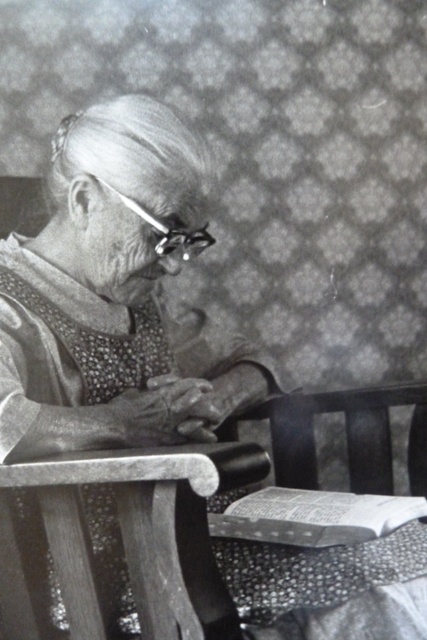
My grandmother Stauffer, praying. Photo courtesy of my cousin Judy Yoder.
***
I’ll write more about Grandma Stauffer, and this beloved photo of her by my cousin and artist Judy Yoder, in a future post.
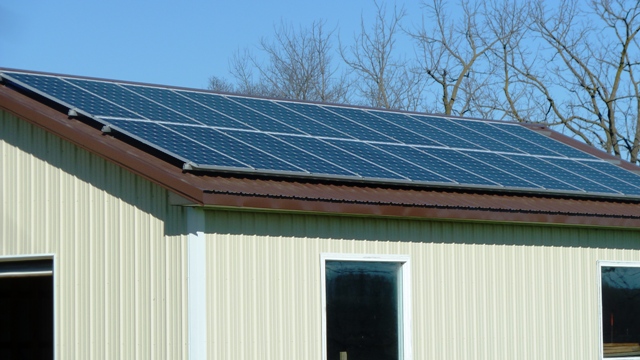
The 22 panels on our shed.
Earlier this year, we went solar. My husband called it his “retirement gift” to himself. Some men get sporty red convertibles or take a month long cruise: we spent the money on 24 panels on top of my husband’s shop, which is wired up to our house. This has resulted in electric bills of only $15.30 for the entire household each of the last 3 months. Those bills rock! So our bills have fallen to the bare minimum (basic fees and local taxes) we pay our electric company, Shenandoah Valley Electric, while still “on the grid.”
So yes, we are still on the grid and also feeding back power into the grid for other users. That’s the part that feels really really weird, and good! We, or rather God’s creation up there called the sun, makes possible electrical power that we are able to use ourselves, and when we (plus the sun) “manufacture” extra, the literal power is “banked” and used by others.
We have learned a lot and that is perhaps the best part of this whole endeavor: learning how it works and also learning to know some new people in the process. Last fall we began exploring the options through a local branch, Massanutten Regional Solar Co-op of a larger cooperative, Virginia Solar United Neighborhoods (VA Sun), which provided numerous educational opportunities (and lobbying at the state level, we learned). Any and all interested parties who wanted could go the next step to sign on to this cooperative in seeking competitive bids for our individual solar projects. My husband and I could have done the same thing on our own (researching and shopping), but it was helpful to go to informational meetings and then be part of an actual meeting where we reviewed bids from about five nearby solar companies, including voting on which company we would go with as a cooperative. The numbers (bids) they gave us are proprietary to the companies and not for public information.
Some of the niftier electronic aspects of the project were how the cooperative was able to do a roof review, using GPS and Google Maps of our property regarding where we wanted to put our “solar array” (as a set up is called), whether it was at a good slant for the sun, and whether trees or other obstacles would cast too much shadow.
If you’re interested in the technicalities, we got a 6.84 kW solar system with these specs:
- 22 x 285w Solarworld
- 22 x P 300w Optimizer
- 6kW SolarEdge Inverter

We were so excited to see the work truck finally at our place one day.
The installation company we worked was Independent Solar Solutions LLC out of Bluemont, Va. and they were wonderful to work with, even though it took longer than expected due to winter weather and the total number of customers they were working with from the cooperative at the same time. We signed on in January and were functional by the end of April. We paid an initial 10% deposit down, another 20% when they ordered materials, another 30% when materials were delivered to the job site, another 30 upon completion of installation, and 20% after they got the inspection completed with the local building folks. Something we overlooked going into this was the need to add additional homeowners insurance on our house and property. It was not a big increase, but just saying.
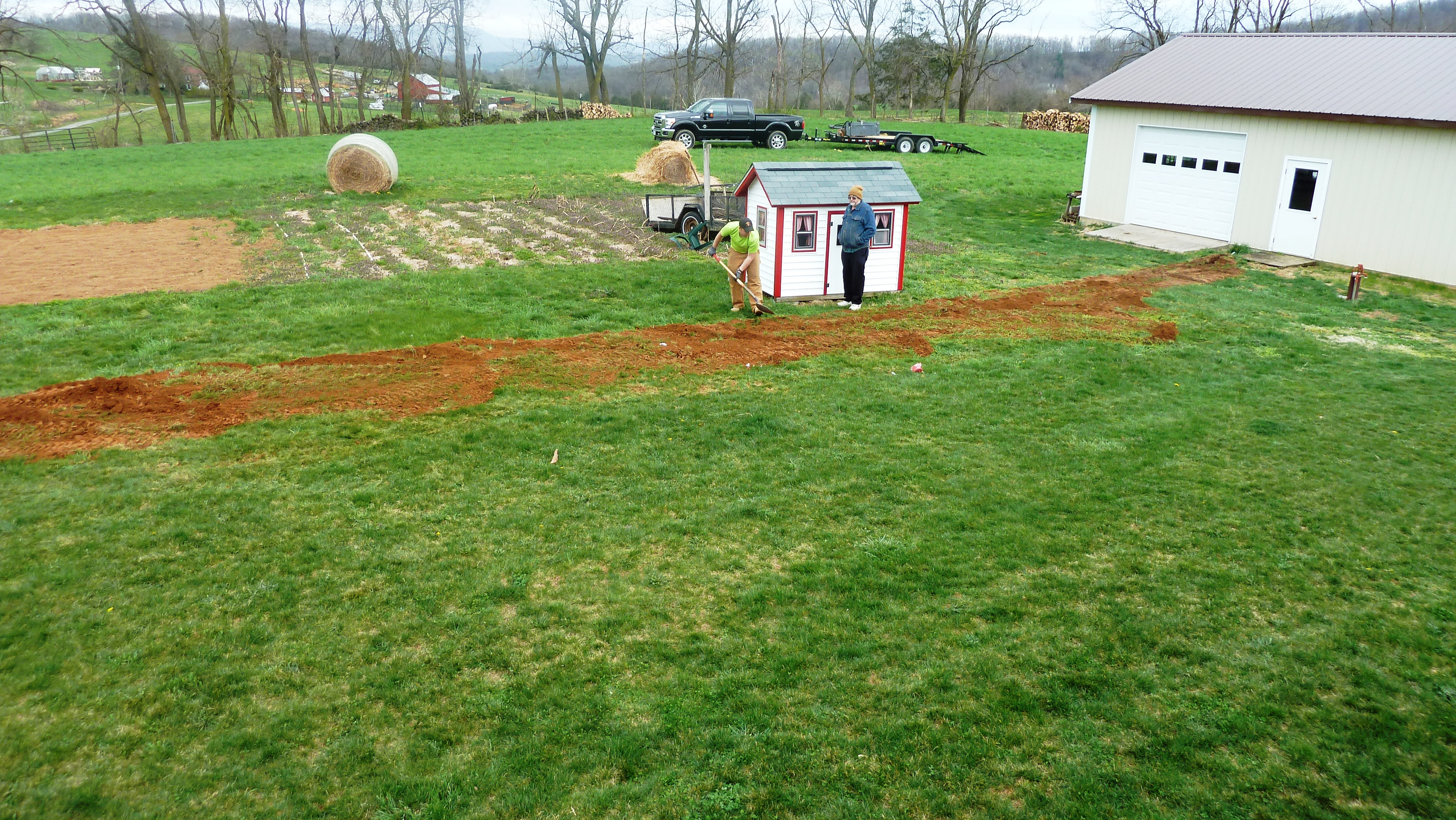
Husband chats while a worker finishes covering the conduit to our building.
Money wise, we hope to take advantage of the U.S. energy tax credit of 30% and at this time, we have no battery storage with the system—battery storage being pretty expensive. In Virginia, we are eligible for the net-metering program.
The bonus for us was being able to have electricity in our building, (including them digging a trench for the conduit to the building) which we’d been hoping to do for five years. So we can plug things in out there! My husband plans to finish wiring the rest of the building for his shop.

Another guy moves dirt with a bobcat.
After the array was installed and we were up and running, the company also provided our own webpage or monitoring platform (you can see a sample, although this doesn’t take you to our personal platform which of course is password protected) to keep up with our daily status. My husband loves this and is as regular with checking our usage as I check status updates on Facebook.
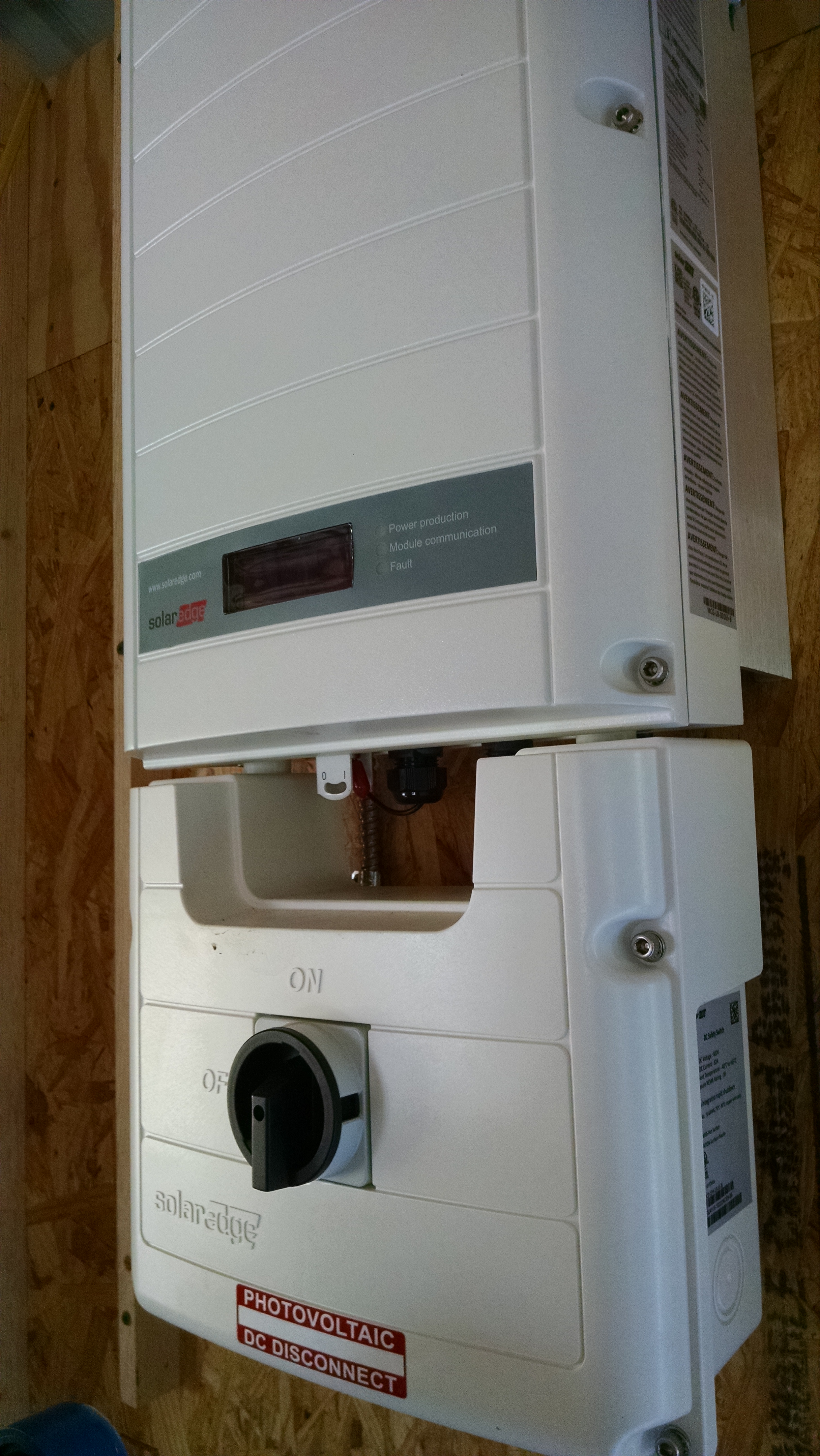
Solar Inverter, installed in the shed. It is about 3.5 feet tall.
We are happy we made the system as big as we did (adding 2 panels at the last minute when the installers discovered there was room for 2 more on that roof). Husband is already saying he’d have been kicking himself the rest of his life if he hadn’t added that additional capacity. A really good day is when we generate 40 kilowatts of electricity. A mediocre cloudy day results in production of 10-15 kws.
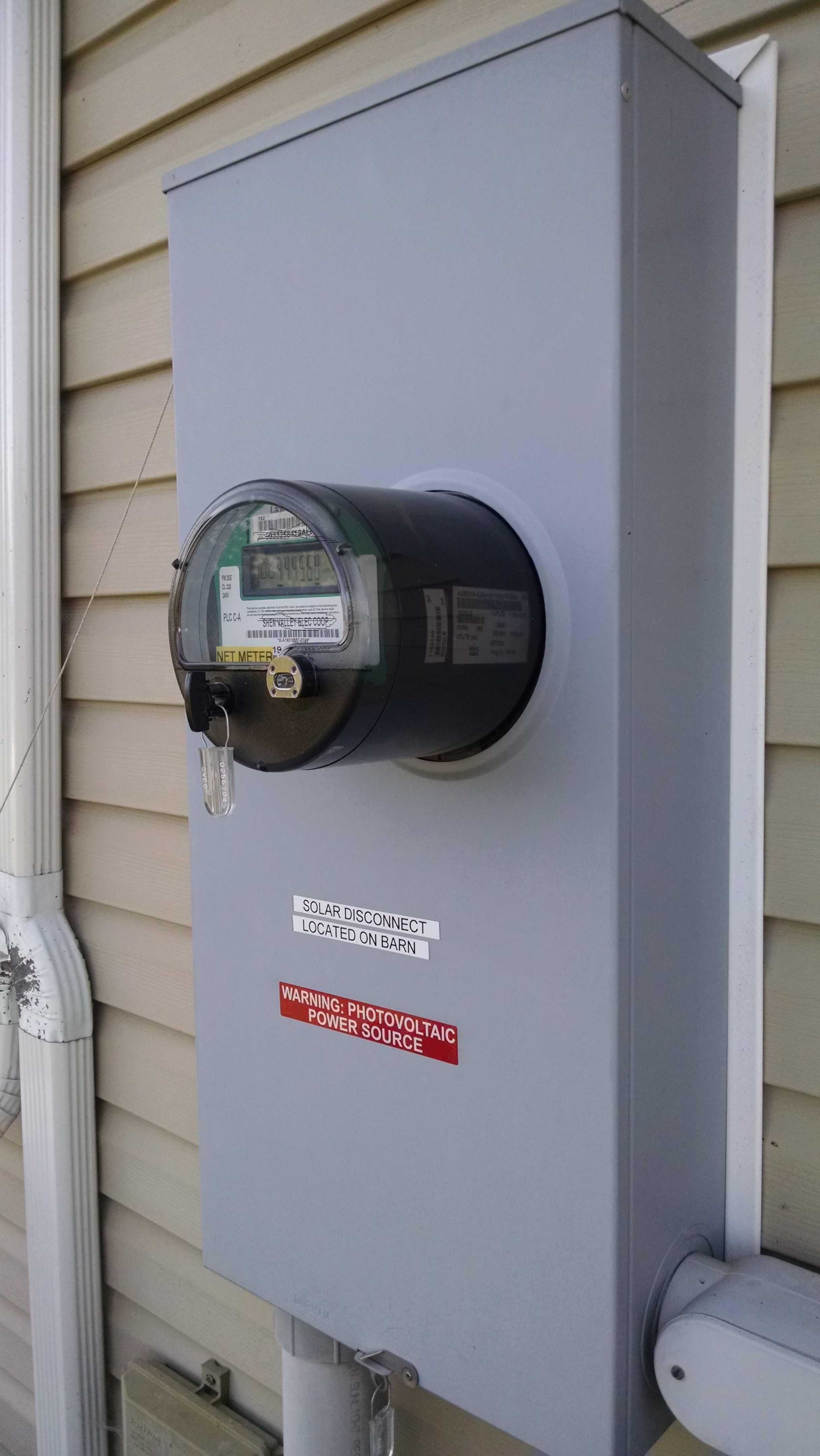
Meter installed on our house which shows whether we are feeding electrical power back into the grid, or using it.
Payback: Where electricity rates rise 3% a year, payback is considered complete in about 12-13 years, according to notes I have from one installer (not the one we went with).
As my husband also says, “This is more for future generations than for us. It’s just something we wanted to do for a long time.”
Since May 1 this is what our little system has done for the environment:
***
Going solar? Gone that way already? I’d love to hear your experience and results here.
***
Here’s someone else’s great list on “Why go solar.”
***
Postlude to a post: after a long hiatus ….
I have been away too long—not posted anything on this blog for almost 2 months. The reasons are myriad (which will be obvious as I hope to resume posting regularly or if you read my Another Way column where things will leak out too), but I have missed this part of my life so much. It is here where I pause and try to make sense of both the routine, and the game changing. When I look back over notes about things I want to write about, and scroll through photos I have taken but not written about yet, it is like snippets of life have escaped me without true pondering and processing—and remembering.
I dreaded looking at my blog stats; surely they had dwindled to almost nothing. But no! They are driven by a few bellwether posts that somehow show up when people search for “Rise N Roll Amish Donuts,” or “How to plan a different 60th birthday party,” or this time of year, “Sweet Midget Pickles.” My stats are only down by about half. An amazing number of people each month are still reading what I write and connecting and even signing up to receive new posts. So I’ve been able to have a blog vacation without loosing too much ground.
So here’s back at it: sporadic, eclectic: partly for me and partly for friends/relatives/fans and sometimes complete strangers that I haven’t met yet who nevertheless seem to find something here worthwhile. I’m also celebrating a regular gig for Amish Wisdom, supplying a recipe and food photos every other month which began Sept. 1. A big thank you to loyal fans and welcome to new ones.
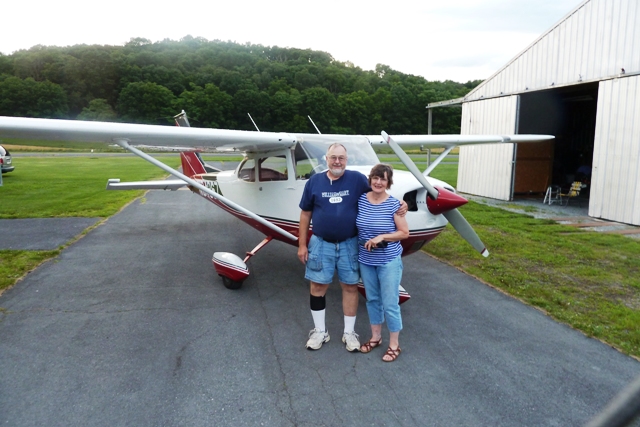
Flyover: Christmas in July, or How Green is My Valley?
We live on one of many flight paths to Dulles International Airport in northern Virginia, although we are about two hours out (without traffic). I often look up from gardening, hear jets slowing down their engines as they gently decrease their altitude, and imagine the flight attendant’s or captain’s voice coming on saying “We’re beginning our approach to Dulles Airport serving the metropolitan Washington D.C. area, where the weather is …”
I sometimes look up and wave just for the sheer silliness of it, knowing no one up there can see me down here, but just because I love traveling and the places planes take me.
We also frequently see small planes flying over, sometimes dusting crops but more often, just sightseeing.
One day my husband said casually, “I’d love to be able to fly over our place and around the valley,” I made a mental note to check into such an adventure maybe for a Christmas gift for him. He’s gotten to the place in life where he doesn’t really need another drill or saw, so excursions and special events and family occasions are high on our family list of things to give to him. He’d been up in a small plane once before with our youngest daughter for a birthday present to her when the Shenandoah Valley Airport at Weyers Cave offered trial flying lessons for just $25.
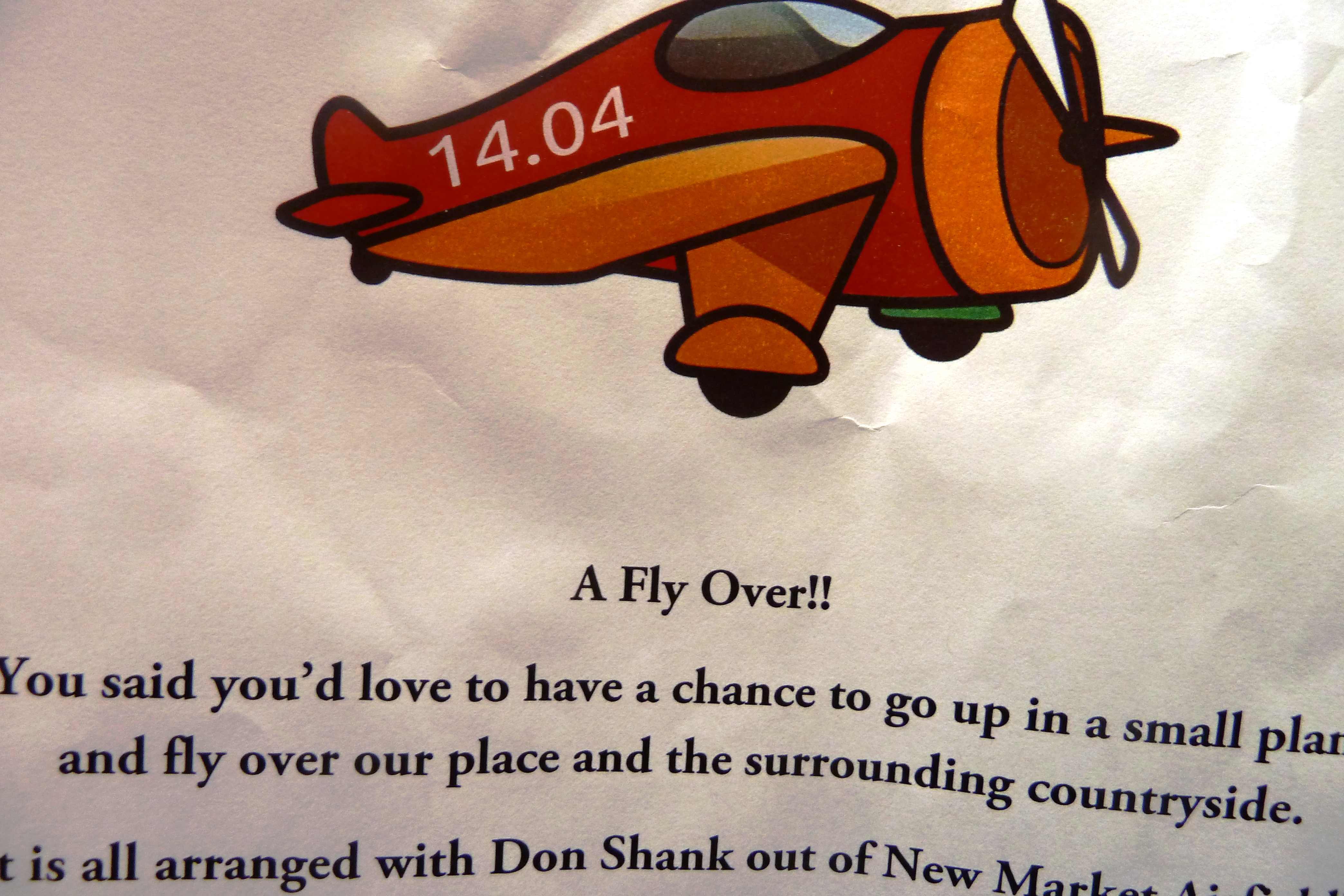
Last Christmas this is what he got from me. The pilot, Don Shank, said there was easily room for 2-3 passengers and he had 30 years experience, including being a commercial pilot for Piedmont Air back when they still flew in and out of the above airport.
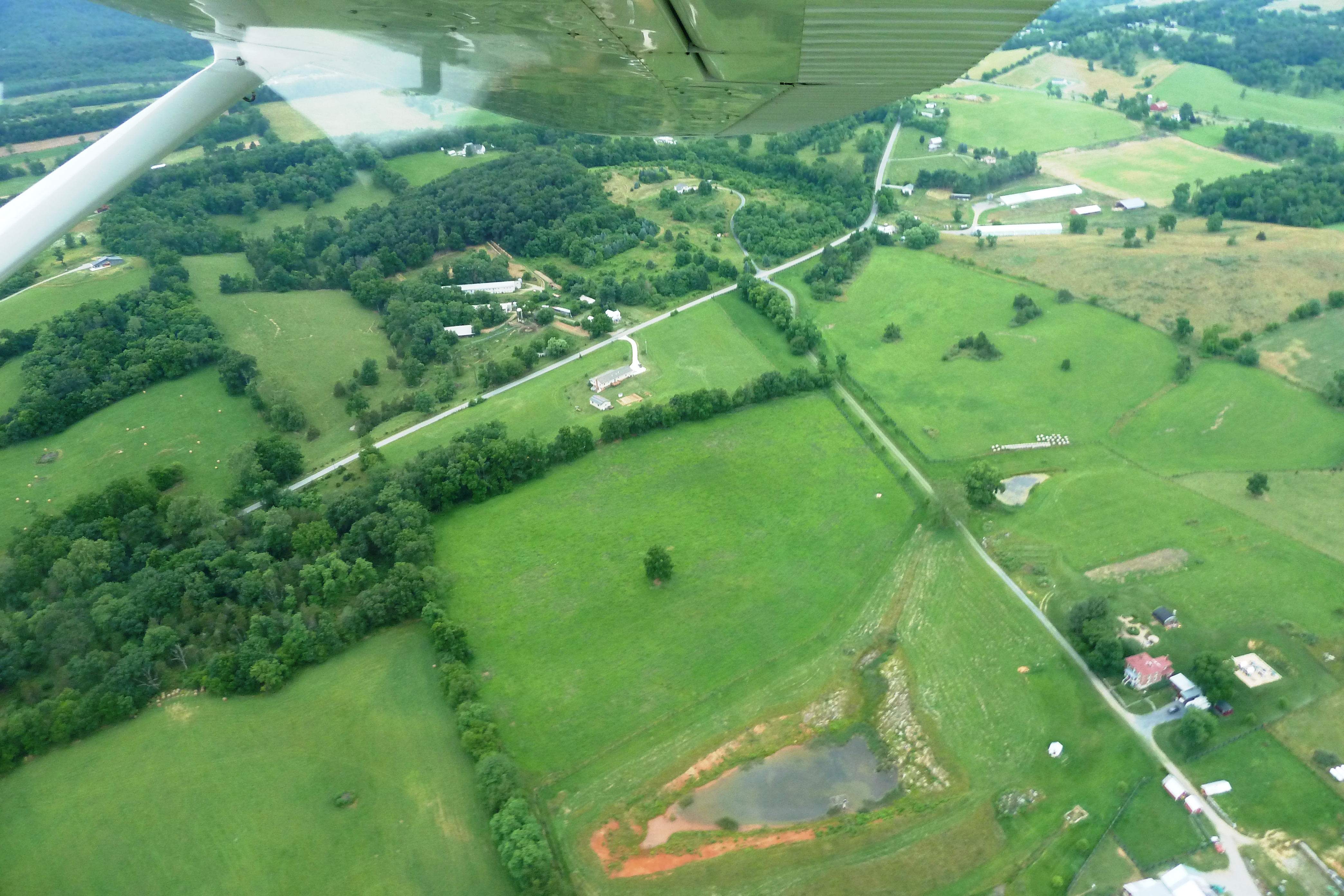
We had a beautiful, restorative time.
But more than just checking out how big the neighbor’s new pond is, or being able to peek in at our old home and find to our delight the new owners are still planting a garden down the back hill there, I realized what the flyover reminded me of was feeling like I know so much of our community. This has been home now for over 45 years.
There’s where I went to college. (On the slight hill near the top left of the photo, right under the airplane support.)
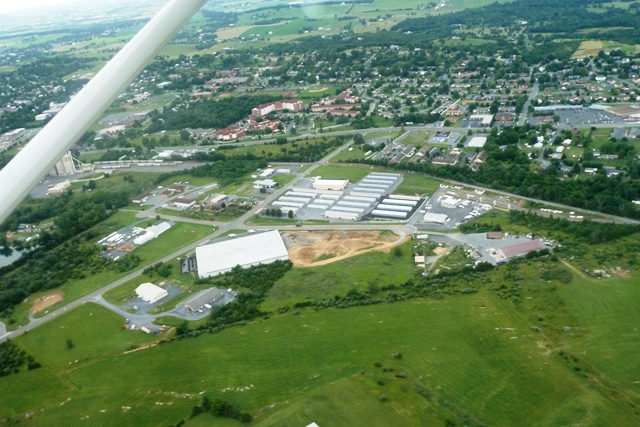
Yonder’s the brick office building that I’ve called home for 41 years. (Directly across from the lovely high rise grain towers.)
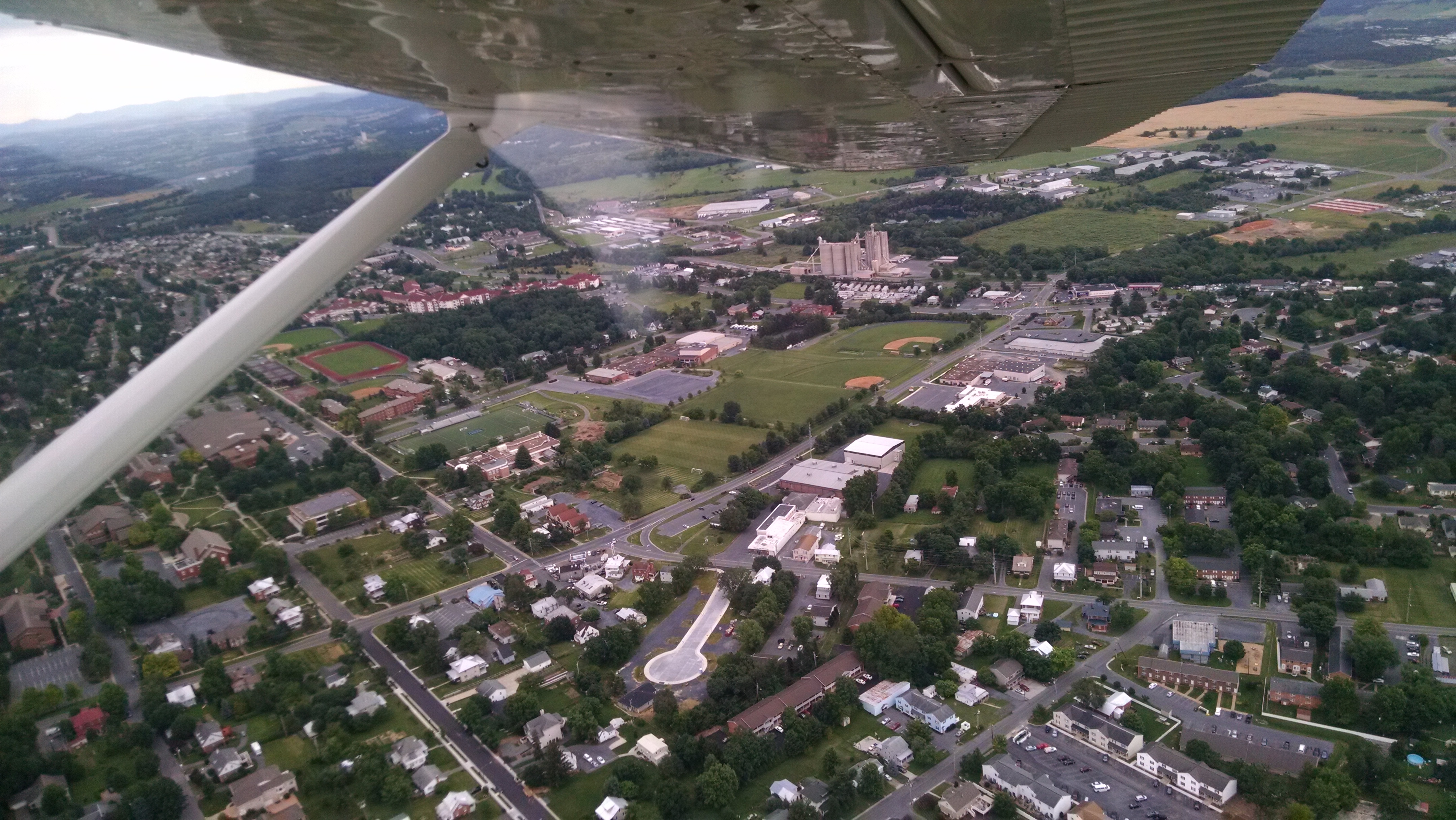
We flew over our church since 1975.
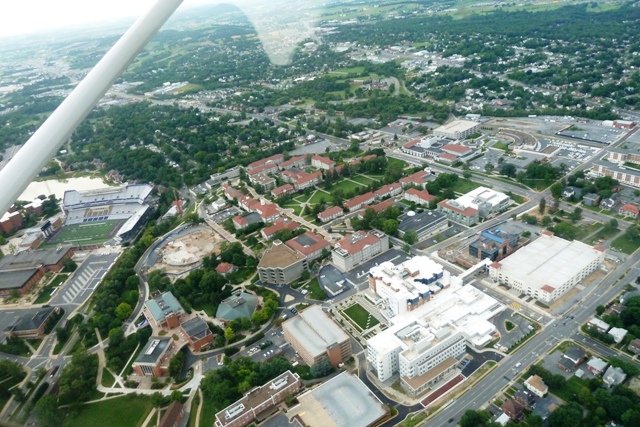
Above is where one daughter went to college. Below is where one went to the old high school and the other two sweated out middle school.
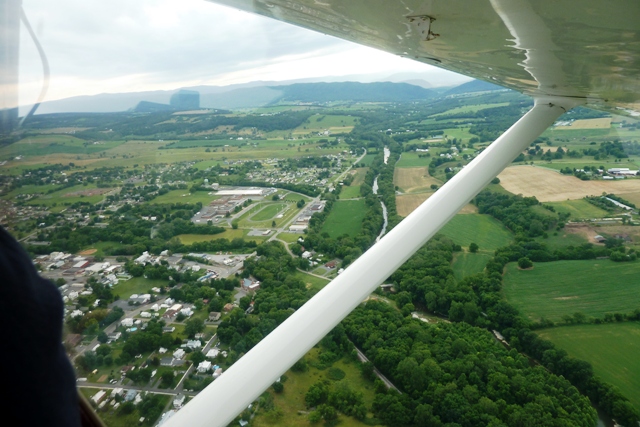
Here are the rivers and valleys and hills that have threaded through and framed our views. I don’t think it would have meant nearly as much to do a flyover of a new area or someplace I didn’t know. I glimpsed a little of why our pilot said he takes people up just for a hobby because he enjoys flying so much.
As a person who believes in God, my mind couldn’t help but soar even higher in the heavens and contemplate the perch God enjoys looking at our planet and even the larger universe. Being up there takes you to another place where problems are maybe positioned more in scale. I could not see any weeds in my garden! I couldn’t see my to do list, or the edges of our yard that hadn’t been trimmed.
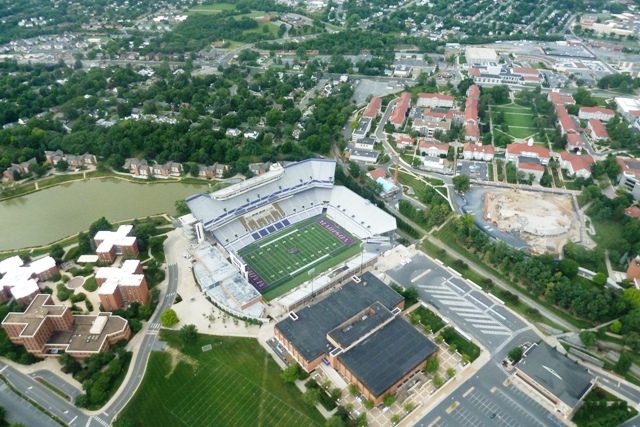
I knew the streets and boroughs of our fair city have problems a plenty, but nothing felt as immediate. Hopefully, the time above restores one’s soul for the problems below.
There was only one scene that marred our sweet flight and that was flashing red lights of a fire engine and rescue squad out in a nearby field, with what looked like the wing of a small airplane peeking out from under a tree. Could it be a plane wreck? The pilot thought so, which was sobering to all of us, and his wife had messages waiting for him on his cell as soon as we landed. She had heard news of a crash that happened just minutes before we took off. A father and son went down and the father pilot was airlifted to University of Virginia Medical Center, and thankfully survived although his recovery may take awhile. His son was treated and released at the local hospital. Their plane had not cleared trees at the end of a farm runway. I’m kind of glad I didn’t steal a shot of someone else’s misery.
I breathed some quiet prayers for those in the accident, recalling another small plane I had once been in with a load of teens heading to our Mennonite church youth convention in 1970 at Lake Junaluska, N.C. The pilot from our church taxied three times down the small local town’s airport runway in Blountstown, Fla. He was not getting up enough speed to clear the tall pines at the end. Wisely, he made the call to have us all get out, have his wife drive us to a larger airport 25 miles away in Mariana, Fla., meet him there with his plane, and then safely take off. Which we did.
There are inherent risks anytime we drive to town, or even head down or up the stairways in our homes. Somehow the risks seem bigger (even though the odds smaller) of having an accident when we go up in the air, and yes, I said my prayers.
I thanked the good Lord again for safety when we touched ground, for the beauty of creation; and after learning the people in the accident would be ok, thanked God for that too.
***
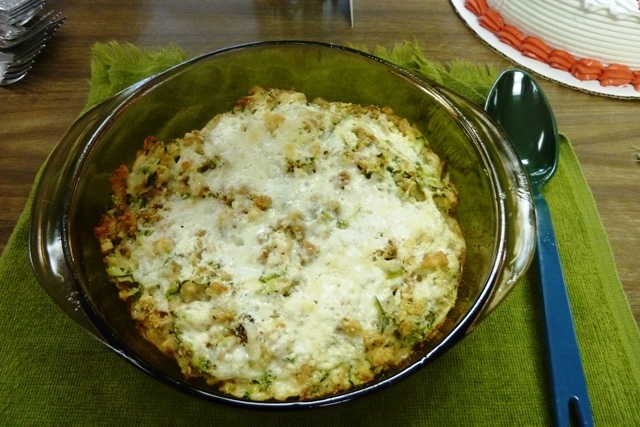
Easy Zucchini Soufflé, or Zucchini Casserole
I have never raised zucchinis (always get plenty from everyone else) except for the years my daughter lived at home after college and she twisted our arms to raise a number of things she wanted to try.
But this year I set out one plant because she gave me an extra one she had and of course it is flourishing. So now I’m facing the great zucchini question of every gardener: what to do with them.
I do like them roasted in the oven and on the grill; I also enjoy them sliced and coated with crumbs and fried; they also do fine n breads, brownies, cakes, and pancakes. The pancakes have been my favorites.
But I ate a squash (yellow) casserole last year that was so delicious that I thought well, I’ll try a zucchini casserole recipe. Which, of many, to pick?
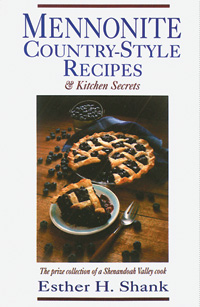
Esther H. Shank’s Mennonite Country-Style Recipes & Kitchen Secrets to the rescue. Esther, who wrote an endorsement for my own cookbook, Whatever Happened to Dinner, compiled her rich resource initially for her own daughters to learn all the basics of cooking, and includes more than 1,000 recipes.

Doris opens her card as Steve and Neal look on.
I made this dish for a recent staff lunch celebrating the 88th birthday of our office janitor, Doris. Yes, you read right, she’s 88 and going strong, which I wrote about last year over on Mennobytes.

The theme was recipes for summer. The ice cream cake featured a piano with “88” keys–not quite.
There was only one spoonful left of zucchini casserole so I couldn’t shoot artful photos of the dish, but at any potluck when there is only one spoonful left, you know people enjoyed it. And a number of folks commented on how good it was. Sweet music to a cook’s ears.
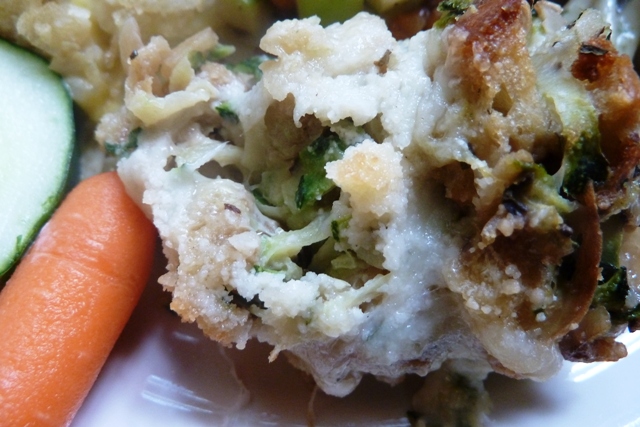
Without further ado, here’s Esther’s recipe, adapted slightly. With all the eggs in this recipe and the cheese, and the buoyancy added by the bread crumbs, I like the exoticism of calling it Zucchini Soufflé.
But call it whatever you want. Assembly is super easy!
Favorite Zucchini Casserole or Zucchini Soufflé

3 cups shredded raw zucchini (I leave the peelings on for more nutrition)
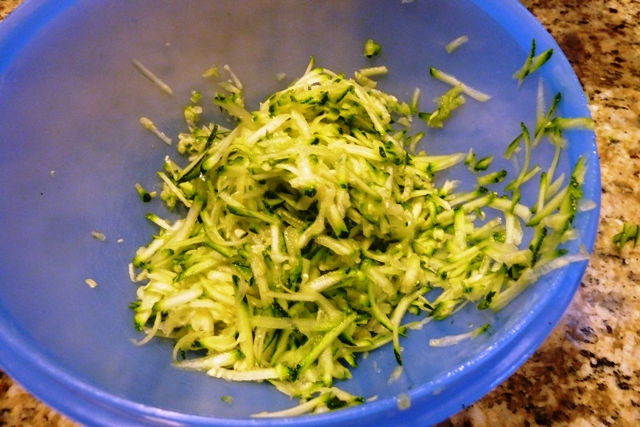
1 ½ cups dry bread crumbs (I used Stove Top Stuffing that has some herbs and flavoring in it)
1 envelope onion soup mix
1 teaspoon salt
1 teaspoon crushed basil leaves
4 eggs lightly beaten
1/3 cup milk
1 cup shredded Swiss cheese (reserve half)
2 tablespoons grated Parmesan cheese (reserve half)
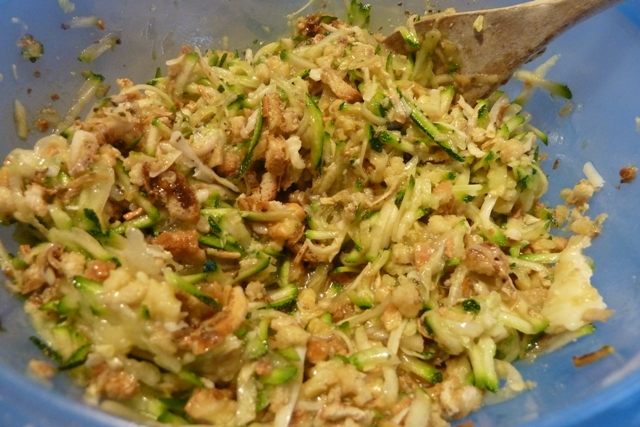
Combine all ingredients and pour into greased 2 quart casserole or 8-inch square baking dish. Sprinkle reserved cheeses over top.
Bake at 350 degrees for 40-45 minutes.
Yield: 6-8 servings
Adapted from Mennonite Country-Style Recipes and Kitchen Secrets, Esther H. Shank, Herald Press, 1987.
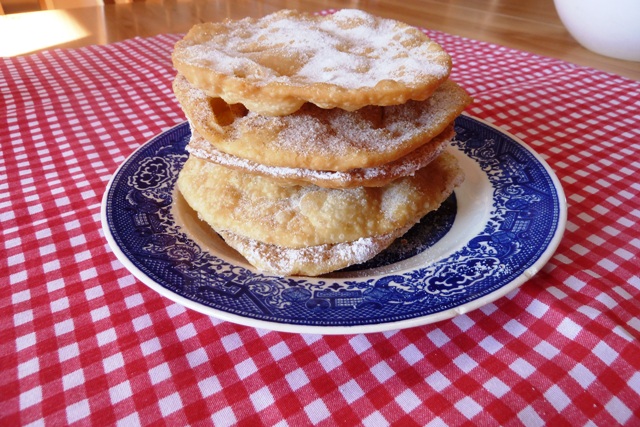
On summer holidays like Memorial Day, July 4, and Labor Day, many times I would treat my family to a batch of Funnel Cakes because of the long lazy morning when we didn’t have to go anywhere. The children looked forward to those summer holidays when no one got them out of bed, and norms for healthy breakfasts were thrown out the window. We pretended we were at the county fair or a lawn party indulging in deep fat fried pastries dribbled with powdered or other sugared toppings—without paying $3 a pop. (Earlier I shared the funnel cake recipe we made for Stuart’s 60th birthday.)
This July 4 weekend I made a similar type “treat” that is frequently found at Amish weddings, I’m told, depending on where you live, and northern Indiana apparently is one of those areas (where I grew up).
I got this recipe from Lovina Eicher, with whom I work (from a distance) in my job at MennoMedia/Herald Press, and was privileged to visit in her home last fall.
Lovina’s second oldest daughter, Susan, is getting married this summer and Lovina is pondering making these for an extra treat at Susan’s wedding and because it a family tradition that Lovina kept at her own wedding. Lovina hasn’t made the final decision yet, but I also wanted to test them for the cookbook we’re working on with Lovina.
If it was my daughter getting married, I don’t think I would have time to fry Amish Nothings on the day of the wedding, and these are the most delicious when eaten fresh. But then, I’ve never been to or cooked for an Amish wedding, but I know that in addition to all the foods made ahead of the day, there are various cooks or crews assigned to make “the mashed potatoes” or “the dressing” or making the barbecue or fried chicken the day OF the wedding—so I imagine it could work if they had an Amish crew doing nothing but “nothings.” After all, the Amish are famous for raising barns in a day. The community strength of “we can do this” is part of what increases the fascination, respect and admiration for these faithful Christians.
At any rate, I enjoyed making these and sharing them with our neighbors since our kids were not home. If you love pie dough, you’ll love these, because that’s basically what it is: deep fat fried pie dough with sugar on top, very similar to “Elephant Ear” pastries made at lawn parties here in Virginia. I may have not rolled them as thin as I should have, looking at another photo of this delicacy. It reminds me of the little rolled up scraps of dough my mother used from pie baking, adding melted butter and cinnamon sugar and rolling them up for little pie dough cinnamon rolls. This treat is about making memories and keeping family traditions!
Amish Wedding Nothings
(The first item on each list is exactly the way the recipe was given to me, which Lovina got of course from her own mother; the additions in ( ) came from online sources that gave some exact quantities, along with the step-by-step directions. Thank you very much, Internet.)
3 large “cook spoons” of heavy cream (3/4 cup cream)
1 egg well beaten
Flour (2 cups)
Sugar (for topping only)
Shortening (for cooking)

Free-range egg
Beat egg and stir in cream, salt, and enough flour to make elastic dough.
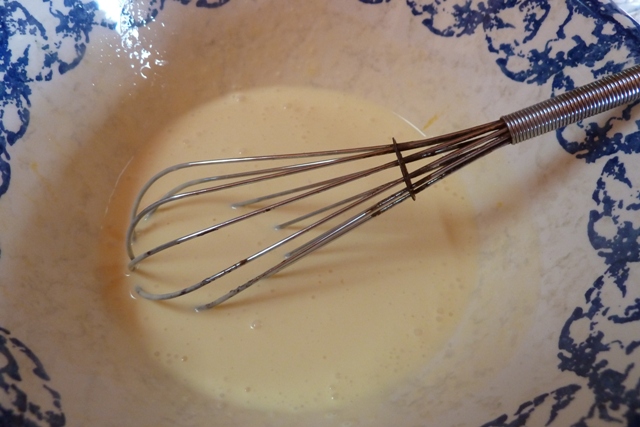

Make 6 or 7 balls out of the dough.

Roll out each ball of dough very flat and thin, about 1/16″.

Cut three-inch or so slits, one above the other, in the middle of the circles.
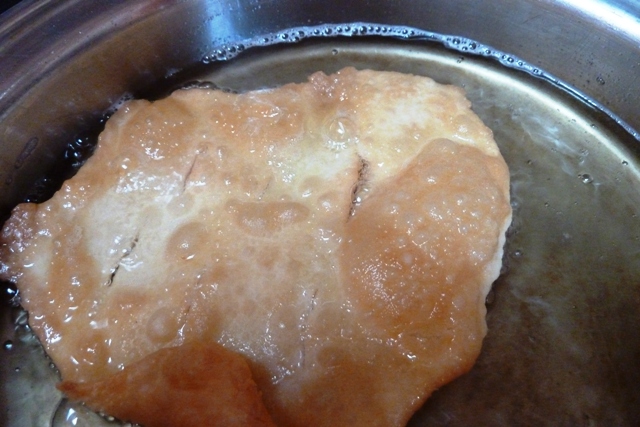
Heat shortening in a large kettle over high heat (or use an electric frying pan with a temperature control.) When the shortening is 365 degrees F, try testing a piece of dough to see if it cooks or sizzles; put the rolled out “Nothing” into the kettle or fry pan (fry one at a time, unless you have a huge kettle). Turn each piece over with two forks or large spatula once it turns golden on the bottom. Remove from oil and place on plate covered with paper towels to drain.

Sprinkle powder sugar over top while warm. Stack all the nothings on top of each other to serve.
P.S. We tried these with plain white sugar, powdered sugar, cinnamon powdered sugar, and white sugar with cinnamon. All go well with milk or coffee!
Source www.recipelink.com from The Amish Cook: Recollections and Recipes from an Old Oder Family—compiled by Lovina’s mother, Elizabeth Coblentz.
***
To follow Lovina’s weekly column online, sign up here, under “Subscribe.”
***
If you would like to see Lovina’s weekly column, “Lovina’s Amish Kitchen” published in a local newspaper, send me an editor’s name and name of paper you think might be interested. We’ll be happy to contact them!
***
If you are on Facebook, Lovina has a growing following, nearing 3,000! Sign up here!


