

I happen to think that all children are creative. It’s a gift from our creator God.
This is mostly for local readers in the Shenandoah Valley who have children or grandchildren or students or friends ages 4-12 who enjoy coloring or other creative artwork.
The magazine for which I’ve served as editor for many years, Valley Living, is sponsoring an art contest with some great prizes—especially the grand prize donated by the wonderful folks at Take Them a Meal. Many folks use the Take Them a Meal great website to coordinate meals for folks when someone is in special need of TLC—like after a new baby, or when serious illness strikes, or the new pastor’s family has just moved to town! Only recently did I learn that it was started up right here in the Shenandoah Valley by two creative young people that went to the same church, Adina Bailey and Scott Rodgers, and you can read all about that here!

But our Valley Living art contest—the idea for that is to involve more young families and readers in this magazine dedicated to improving family living. The winning artwork will be published in the magazine! Hurry fast–the deadline is March 18, midnight!
We have two awesome judges standing by ready to judge the artwork:
- Ashley Sauder Miller
- Brandy Somers
Here’s all the info and the contest rules!
Art Contest For Kids
Celebrating 25 years publishing Valley Living!
Theme: “What I Like About Living in The Shenandoah Valley”
Who: Children ages 4-12 who love to draw, color, paint, make collages and more!
Contest to be judged in three different age categories (4-6, 7-9 and 10-12), and winners announced with the winner’s artwork published in the Summer issue of Valley Living.
Prizes!
One overall Grand prize Winner: An engaging Kids Activity Set (above) donated byTakeThemAMeal.com, an online meal scheduling tool and service.

First prize for each age category: A supply of decorative paper, artfoam, thick cardboard and special markers—all sure to help keep a budding artist busy for days.

Second prize for each age category: Box of age-appropriate markers.
Rules:
1. Entry should be created on either 8 ½ x 11 or 9 x 12 paper and submitted by March 18.
2. Winners will be announced on valleyliving.org by March 28, and on the Valley Living Facebook page. Like the page so you’ll see announcements of our winners! Decisions of judges are final.
3. All submissions will be available for pick-up after April 1 at Red Front Supermarket.
4. All entries not picked up by Apr. 11 will be discarded.
How to enter:
By mail: Send artwork and entry form (download below) to Art Contest, Valley Living, 1251 Virginia Avenue, Harrisonburg, VA 22802. Entry must be postmarked by March 18.
By email: Artwork can be photographed/scanned, saved as a high resolution (300 dpi) JPEG, and emailed as an attachment to info@valleyliving.org. Entry form (download below and photograph/scan) should be included. Entry must be received by midnight March 18.
In person: Artwork and entry form (download here) can be dropped off at Red Front Supermarket in Harrisonburg by March 18.
***
When your kids or grandkids ask for something to do today, tell them to draw a picture illustrating what they like about living in the Shenandoah Valley and they might win a prize, or have their art published in Valley Living! And they just might have fun doing it. We can’t wait to see what they come up with!

I was a little surprised to find, in scouring my blog, that I had not yet featured my all-time go-to recipe for homemade rolls—whether enjoyed as dinner rolls or cinnamon sweet rolls for breakfast. I probably started making them when I was 14 or younger from a Co-Ed Magazine recipe.
If you’ve never heard of Co-Ed Magazine you are likely not AARP age (or its equivalent in Canada). And yes, you can find and view Co-Ed’s nostalgia online, here! I think, if memory serves me correctly, that our subscription was purchased through our high school, Bethany Christian, and it either came to my older sisters through school or to our home. At any rate, I loved it. Ate. It. Up. Sometimes literally. It had recipes, fashions, teen advice, fun quizzes (which I loved!)—all very proper and home-ec ish. It was teacher and parent approved of course. Not like Seventeen or the other more Madison Avenue-ish mags.

Eventually I could make this recipe without even looking at it. I made it for bake sales, for friends with sick moms, for potlucks I suppose—and eventually my mother and I supplied “Mennonite Homemade Sweet Rolls” to the small Carpenter’s Steak House Restaurant in north Florida after we moved there in 1969 where I waited tables the summer after high school. The rolls were a great hit at the restaurant—people stopped by to enjoy them with their morning coffee—a shift I rarely worked, but I was told it was a treat for as long as they lasted.

Mom used them for extra income for awhile—she was always looking for ways to earn “homemaker” money—to buy the little extras or splurges the normal farmer family budget didn’t cover. I wonder what they sold for at the restaurant—I’m guessing no more than 25-35 cents a piece in 1970—given that a complete entre of chopped steak with trimmings could be had for $1.99.
At any rate, these are some of the things I think about as I stir up this old recipe—which can easily be given more texture and fiber with the addition of a cup or so of whole wheat flour.
At one point I increased this recipe by 1/3 to make more at a time. I’ll give the amounts for both a full recipe and a smaller recipe.*

Melodie Davis Favorite Homemade Rolls and Sweet Rolls
Roll Dough (My variation from Co-Ed Magazine.)
1 ½ cup milk (scaled)
½ cup sugar (dissolve in milk while warm)
2 teaspoons salt (dissolve in milk while warm)
¾ stick butter or margarine (dissolve in milk while warm)
¾ cup warm water
3 packages yeast (dissolve yeast in warm water in a large bowl)
3 eggs beaten
7 ¾ cups flour (approx.) added a little at a time
When water with yeast has started to rise and activate, add about one cup of the flour to yeast mixture and stir by hand. Add eggs to milk mixture, and then add those to the yeast, water, and flour in the large bowl. Begin stirring all together. If using stand mixer, you should be able to use the standard beater and then switch to dough hook when it gets stiff.
Beat for 4-5 minutes. Remove from bowl and knead it 2-3 minutes on flour covered surface. A slightly sticky dough makes the best rolls, but it should not stick to your hands.
Place in greased bowl, cover with cloth, and allow to rise in warm place (under hood light of stove usually works) or in oven with only the oven light turned on, til double in bulk (1-hour). Punch down, let rise again til double, another hour or so.
Punch down and form into small balls size of large walnuts or small tennis balls for dinner rolls, or take half of dough and roll it out to ½ inch thick to make cinnamon rolls. Place in greased pan. Let rise until double in size.
Bake at 350-375 for 15-20 minutes. Watch closely so they don’t get too brown. Remove from oven and immediately spread butter over tops.
Makes approximately 18-24 dinner rolls plus one 9 x 12 pan of cinnamon rolls.
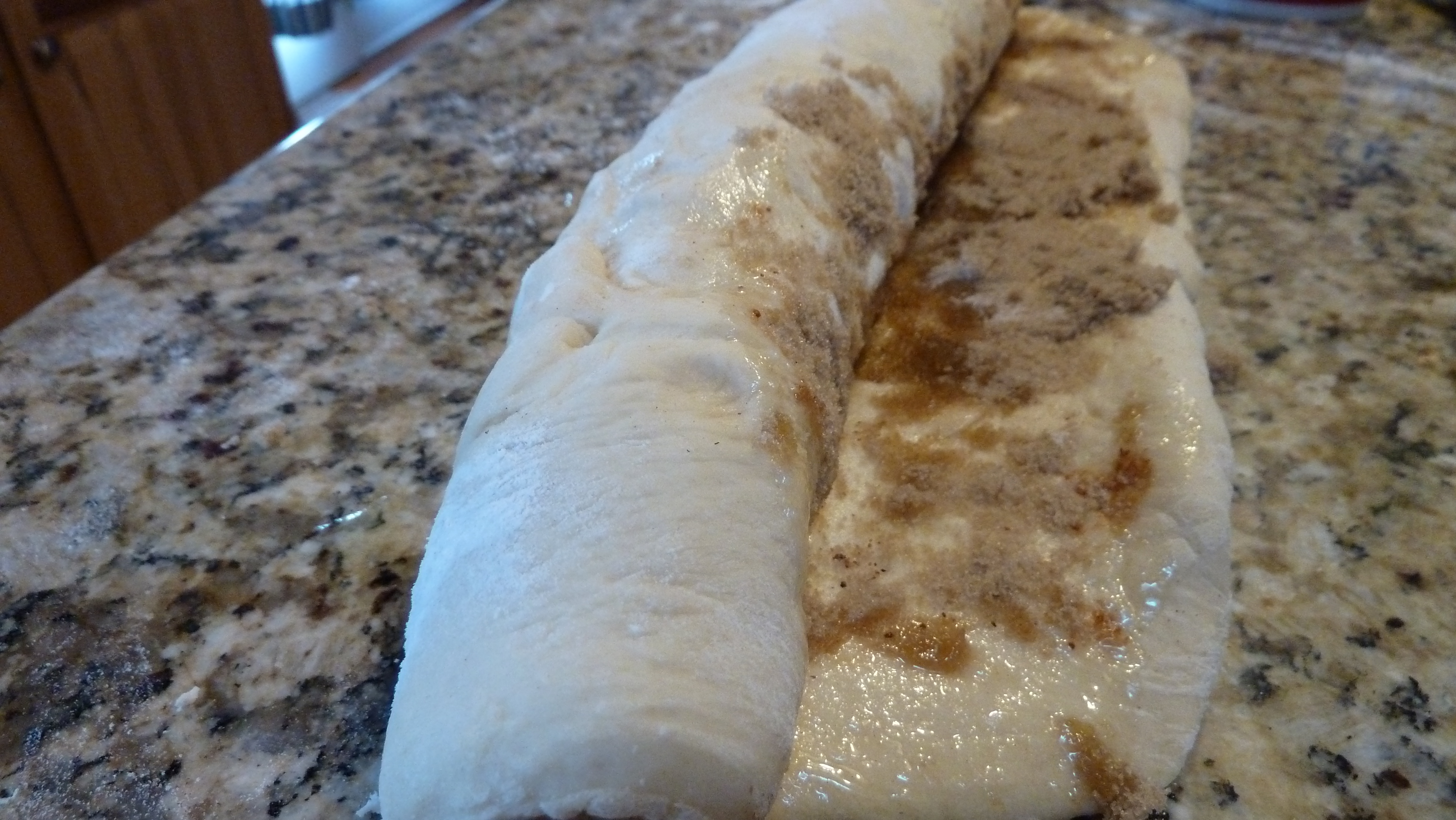
(See my post on how to make cinnamon rolls here, which also includes my roll frosting recipe.)
*Smaller quantities here. (I KNOW you could do the math, but since they’re on my recipe card, I’ll share them for free!):
1 cup milk
1/3 cup sugar
1 1/3 teaspoons salt
½ stick butter
½ cup warm water
2 packages yeast
2 eggs
4 ½ to 5 cups flour
***
Do you remember Co-Ed Magazine? Did you take Home-Ec and did you enjoy it or not?
What was the first recipe you made and claimed as “your” recipe or you became known for it?
***
If you don’t know about my recipe book (that has at least 75-80 percent from other cooks), here it is!


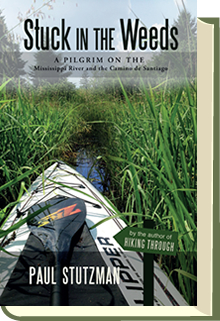
Writer Wednesday: Book review of Stuck in the Weeds
Paul Stutzman is the writer of Hiking Through, about hiking the entire Appalachian Trail (AT) in five months, Biking Across America, two Amish novels in his “Wandering” series, and now, Stuck in the Weeds.
I read Hiking Through soon after it was published and enjoyed it immensely as it tells the compelling story of his heartbreak and grief from his wife dying of cancer, and how the tremendous discipline and strength (physical and mental) to hike the tough AT in one swoop (OK, with numerous off trail respites in B&Bs), helps him to heal and move on from his distressing, life-altering loss.

I’m sure my enjoyment of Hiking Through was heightened because we live so close to the famous trail and have crossed or hiked portions of it over the years in frequent forays to Shenandoah National Park. (For the best virtual AT through-hike re-creation, I still like my friend Kevin Gallagher’s photo collection that flips through in five minutes, here.)
When I realized Stuck in the Weeds was about more than just apparently a somewhat failed adventure along the Mississippi River and would take me, vicariously, along the now famed Camino de Santiago across the entire northern half of Spain, I was more eager to dig in. Faithful readers here will know why the Spain part of the book drew me in, having lived there a year as a college student in 1973-74 and authoring my own “travel memoir” published by Herald Press in 1992, Departure. (My boss at the time, who otherwise was a big fan and supporter of my writing efforts, never did quite get why anyone would want to read someone else’s glorified journal, as he considered my books On Troublesome Creek and Departure to be. I forgave him his opinion!)
At first I found myself kind of wondering the same thing about Stuck in the Weeds, especially the title (Stutzman could have used some help maybe finding a better title—maybe something along the lines of “From Peril on the Mississippi to Plodding Spain’s Camino”). I quibbled with the true stuff I knew about life in Spain that Paul glossed over or didn’t get quite right, such as the inference that all Spaniards take a nap from roughly 2 to 5 p.m. Siesta time lasts that long but it includes the family gathering for a leisurely main meal of the day around 2 p.m., and then napping or respite before heading back to work or school for a second stint from 5-7 or 8 p.m. At least that’s how it was when I was there in the 70s. But things change and I don’t claim to be up to date on life in Spain now!
I also thought a former restaurant manager such as Stutzman, well versed in foods, would have described the thinly sliced and cured “jamón serrano” ham (very much like the country ham we enjoy here in Virginia, and also a little like the prosciutto delicacy from Italy) as something other than “tough, almost like jerky, and sliced so thin it had only one side.” I’m also not quite ready to let his description of coastal Spain’s beloved paella dish as a “rice and vegetable dish with rice and more rice” go unchallenged. He adds that sometimes it includes chicken or seafood. Um, no. In my experience chicken or sea food is almost always present but perhaps it is now more frequently offered as a vegetarian offering. In any case, it was one of my favorite dishes in Spain, even though I’d heard that Spanish cooks often use up the leftovers in their fridge by throwing the week’s scraps in the paella. Maybe that’s what he didn’t like. Sorry, Paul.
But eventually I was drawn into the daily-ness of the pilgrimage trail, and the community spirit and bonds developed by the hikers. I was transported back to similar experiences I had, especially in the rural parts of northern Spain, particularly the unforgettable meal I had with my Spanish roommate and her friends on a trip back from skiing (they skied; me, not so much) in the Pyrenees mountain area, in an inn she had described as “muy encantadora y typico” (very enchanting and typical) of the area. As I read a little each evening, I began to look forward to traveling the pilgrimage with Stutzman, since at this point in my life I doubt I’ll ever have the opportunity to hike the Camino in person, although I certainly do hope to get back to Spain. Camino, by the way, is Spanish for road.
Stutzman does a good job writing descriptive action while holding you in a moderate amount of suspense for what is to come. Through a casual read you absorb snippets of the history of Spain, the biblical background of St. James (for whom the 491 mile Camino de Santiago is named), and a feel for the atmosphere of Spain’s centuries’ old monasteries and inns-turned-hostels, dedicated mostly to cheap lodging ($15-30 a night for pilgrims). Many of these serve communal meals of authentic Spanish fare.
Those on pilgrimage learn to sleep with the noises of 100 others in the same room (snoring, flatulence), and without seeming necessities like towels. Stutzman didn’t take along a bath towel and ends up using a T-shirt to dry off most of his trip. Stutzman felt that thankfully there has not been much commercialization along the Camino, even though the hostels and cafes mainly serve the needs of pilgrims in the tiny picturesque villages—and indeed thrive because of the many hikers.
Stutzman takes me back with lines like “scenes from the life of a town that had existed for centuries” as he scans Spain’s horizon, and descriptions of brightly colored geraniums in village window boxes brightening stone walls.
Hiking the Camino has long been a profoundly religious pilgrimage for the majority of hikers, which has rebounded in popularity in just the past 25 years; it is that for Paul. As a formerly conservative Mennonite who now considers himself somewhat of an outcast among certain religious persons while still deeply Christian, he longs to be invited to the communion table in the cathedrals they frequent in their trek, but understands the doctrines that prohibit him as a non-Catholic. He explains the historical roots of the pilgrimage going back to the time of the apostles after Christ’s death, including how the bones of the disciple James end up in the magnificent cathedral in Santiago—a high point for most on the spiritual pilgrimage. Weaving back and forth between a Camino journal that anyone (non-religious) would enjoy, to chapters that focus more on faith applications or narrative may seem like an incongruent leap for some. Paul’s faith shines keenest in the Mississippi River portion of the journal where he has a turn of heart about the trip and experiences the Providence of God in a pretty amazing way.
I must confess I skimmed parts of the Mississippi River adventure portion of the book. I’m sure if I had ever tried a similar expedition—or even a Mississippi River cruise which does sort of sound like an interesting adventure—I would have identified more with that portion. Although it did bring to mind various river trips my husband and family have done: rafting, fishing, and canoeing–and memories of how miserable you can become in too-long of day on an almost-dried up river … (Miller family—remember the Cumberland??)
Bottom line: this is a great read for anyone planning or even dreaming of a pilgrimage like Camino de Santiago or elsewhere. It is also a cautionary tale for anyone who thinks a lazy float down the Mississippi sounds like a fun Tom Sawyer kind of thing to do. I have nothing but admiration for a writer and adventure lover to have undertaken the kinds of trips Stutzman has tackled since his mid 50’s. What will he try next?! I’ll be along for the journey—at least in the book that is sure to come.
***
Have you read any of Paul’s books or heard him speak? Your favorite?
***
I like the main question on Paul’s blog:
Have you ever wanted to walk away from life?
He says, “I did; and in the process, I walked to new life.”
Your comments? Stories?
This is a blog post indulging the grandma in me, ok? No great revelations, just a grandma travelogue to share with my mom, too. End of apologies.
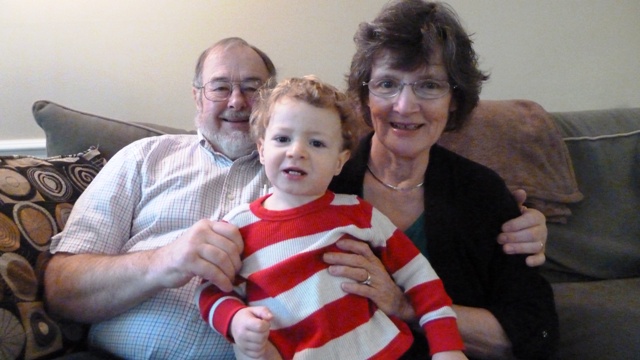
But oh my goodness what fun it is to be around a happy two-year-old, who is able to actually run out the door to greet you, and call you and your husband gramma and grampa and keep a running commentary going about everything in his small world even though you can only understand about half of what he says. Although you kind of learn the language after about three days! We’ll call that language Sam-ese. He likes to imitate what you say and what you do, especially if he knows it will get a laugh—like mimicking grandma or daddy by propping his hand under his chin while sitting around after dinner talking at the table.
We first started our February visits to Sam and his parents the February he was baptized. February is just warm enough where they live that you can escape the north’s snow and hope to get in some park time and glimpse some early daffodils.
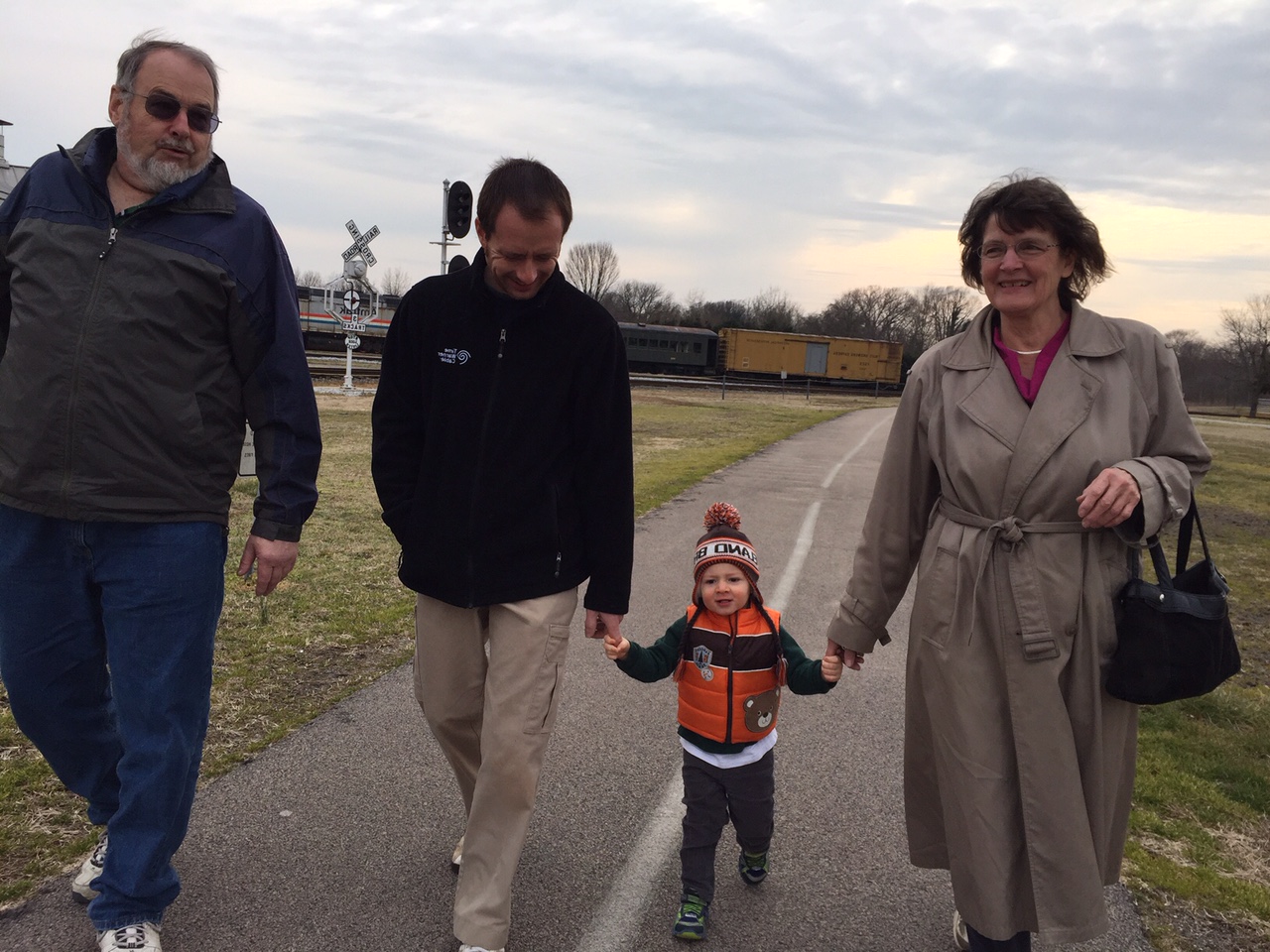
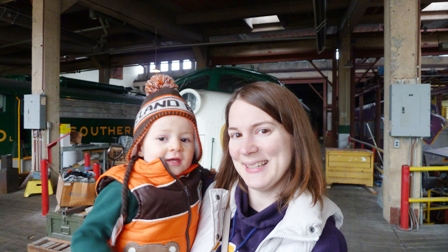
Our main excursion this trip was to the North Carolina Transportation Museum (and if you think you’ve seen Sam and his cousin on a train before, you may recall this post).
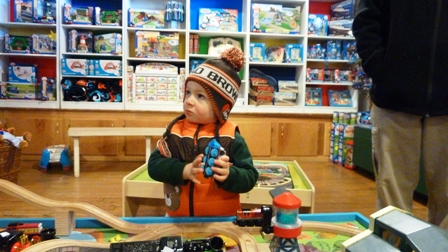
A whole store full of train stuff for this little Cleveland Browns guy.
No trip to a train yard is complete without a visit to the gift shop and of course grandma can be counted on to indulge in a small souvenir for the kid: a pair of train socks! Daughter had nabbed some discounted tickets on Groupon which made a wonderful early birthday gift for my husband.
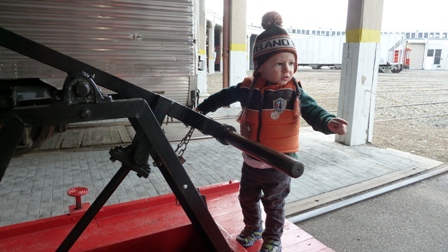
Sam on the pump car (or hand car)
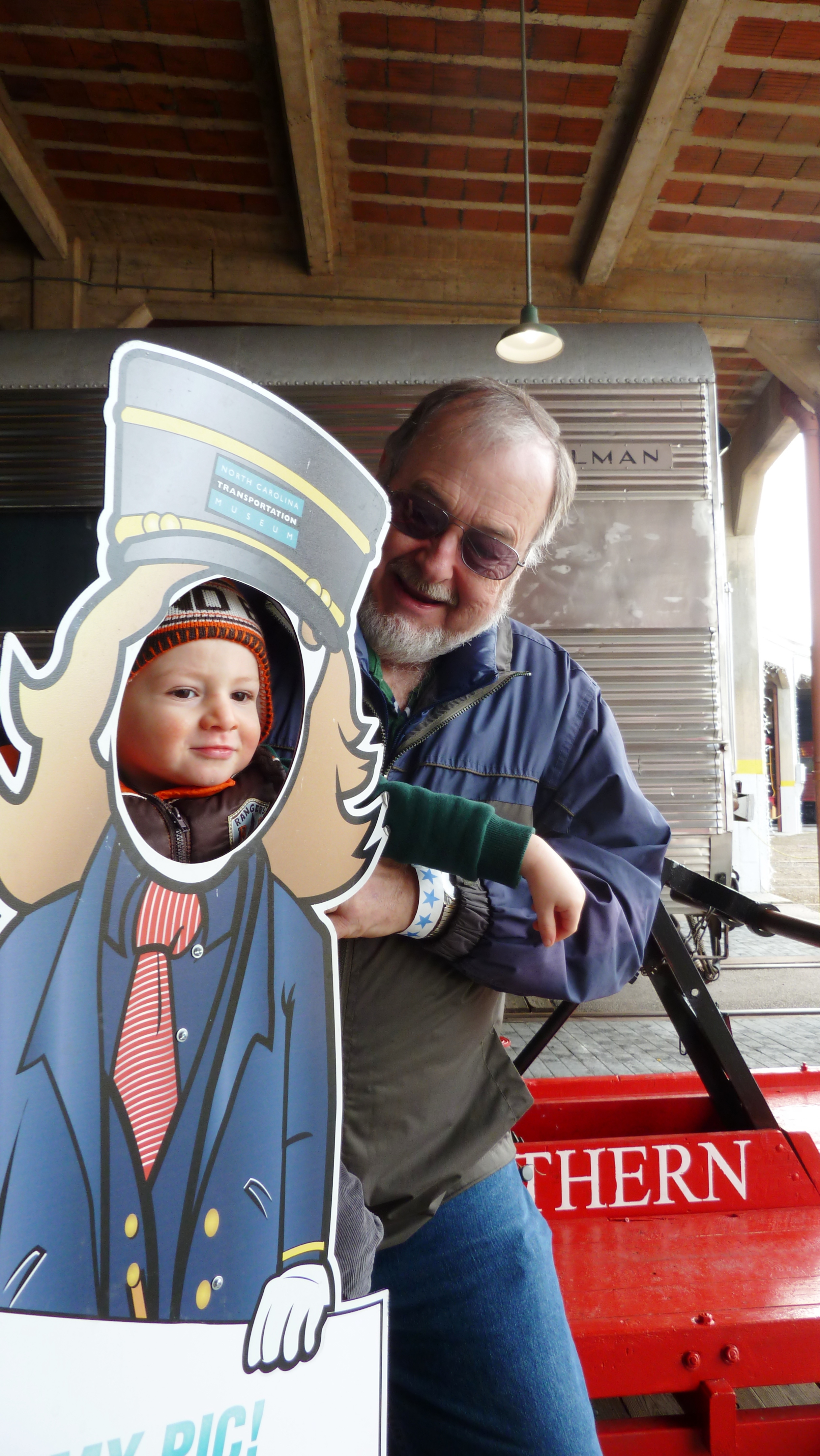
Social media stop: to post on Twitter, it said.
Tanya had given fair warning to her poppa that with a little one in tow, he wouldn’t have time to read every placard in the place (as he always lingers to do), but Stuart read up on the various special displays and trains ahead of time online which satisfied his inner train buff and need for learning the background and special stories of some trains.

The roundhouse
I especially enjoyed watching some employees doing current restoration in the active work area.

Restoration work is ongoing.
The 11 a.m. excursion was so full of eager children, parents and grandparents enjoying a beautiful Saturday (after being cooped up in the cold and ice the weekend before) that there was no room for us, and we had to wait for an extra trip they quickly added to the day’s schedule, at 11:20.
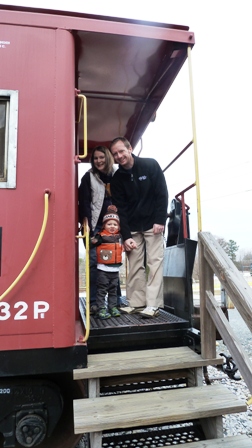
Tanya, Sam, and Jon.
While we waited, Sam enjoyed sweetly waving to a little girl perched in the “Birthday caboose” excursion car.
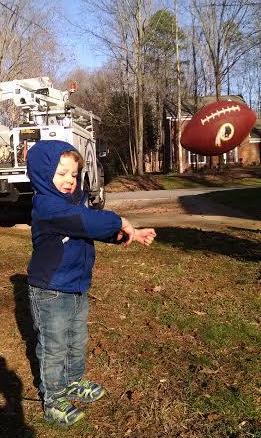
Back at his home, this boy is all about playing—especially with a ball in his hands. He has watched some football and baseball games on TV with his father and while his parents would love to see him take up music lessons when he’s old enough, he is undeniably fascinated with tossing a football back and forth (great form too for such a little squirt),
shooting hoops,
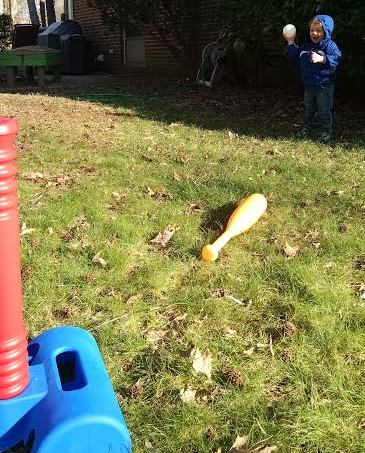
and taking a swing at his little T-ball set.
He has a soccer ball too but hasn’t quite mastered kicking it around.
But Sam woke up Sunday morning with a small temperature and his cold having slid into his chest. His little lungs were heaving very rapidly and noticeably. After making a few phone calls, and counting the number of breaths per minute to the triage nurse on the phone, we ended up spending Sunday morning in the pediatrician’s office instead of church like we’d planned, and were a little stunned to finally learn that Sam had pneumonia as well as a double ear infection.
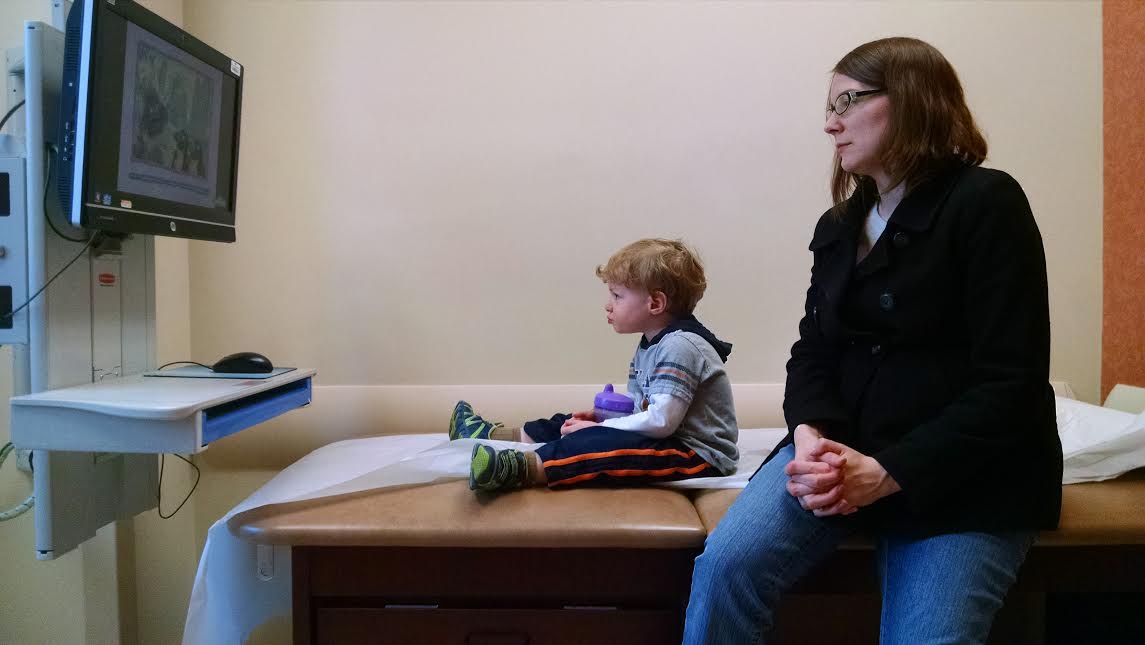
Watching Elmo while waiting for his shot.
He was a trooper though, even when the nurse came to give him shots to start his treatment. Even though he screamed at the shot’s insult like his heart was broken, he quickly recovered. (He’s now been cleared of the pneumonia.)
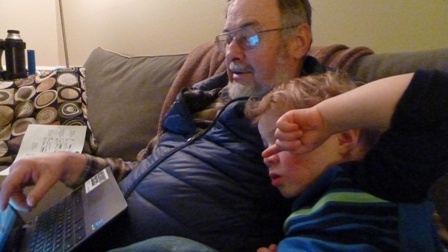
Helping Grandpa with his laptop.
The rest of the day we tried to think of ways to play with Sam quietly: reading tons of books, coloring and drawing boatloads of pictures, and rolling the balls on the floor instead of throwing them.
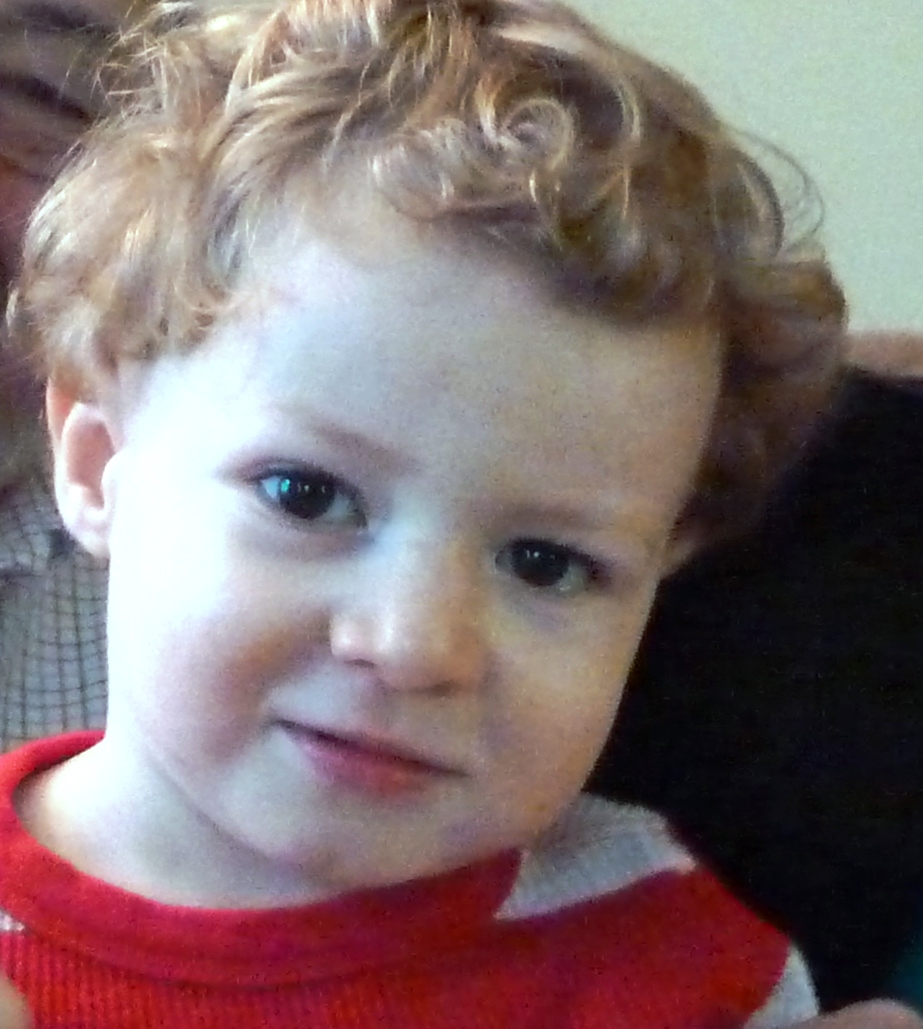
I do not ever want to take having grandchildren for granted. I know plenty of people—some dear friends—who for whatever reason, do not have grandchildren (and in some cases don’t have children). I am so so grateful and enjoying these days. Even the writer of Proverbs proclaimed “Children’s children are a crown to the aged” (Proverbs 17:6 English Standard Version).
***
What is the best part about growing older, regardless of whether you have grandchildren?
Or, what do you enjoy about grandparents being around your kids? What advice do you have for grandparents?
***
I wrote about some of my surprises on being a new grandma (and picked apart some myths) in my Another Way column called “So Is Grandparenting Great? Some Reflections”

At the beginning of Lent, the same lectionary passage of the temptation of Jesus from Luke 4 was read two times at our church because we had two services that day, one being an afternoon installation of our new pastor, Stephanie Sorge Wing.
As it happened, I was lay leader during the morning worship and anytime that happens, I find it more difficult to actually enter into a state of worship because of having too many things on my mind. When do I get up next? Do I stand or sit for the next reading or song? Will I stumble or mispronounce a word?
So at the afternoon service the scripture passages, read by Stephanie’s father, who is also a minister, spoke to me in totally new ways.
When Sheldon Sorge read aloud the story of “The Temptation of Jesus” in Luke 4: 1-13, he lingered over the words “…When the devil had finished every test, he departed from him until an opportune time (v. 13, NRSV).
Dr. Sorge pointed out we sometimes forget that Jesus’ temptations were not once and done. In that very passage, the scripture says Jesus was “tempted in every way,” and elsewhere we read that Christ was tempted in all ways and is therefore able to help us as we are tempted. That’s something we forget as we struggle along and often end up confessing the same old tired sins Sunday after Sunday: pride, arrogance, thinking bad thoughts (or however you fill in those blanks).
So Jesus was tempted many times after his well known wilderness temptations. Now of course Jesus did not sin, but he was tempted. There’s a difference.
Jesus struggled with his mission on earth right up to the end, where he wrestled in the Garden of Gethsemane. This was not drama, or an act. Jesus must have been torn at the heart not wanting to go through with what he knew lay ahead. Now Jesus was also God, so there was internal warring with himself and with God’s overall plan for the world. If the human/divine Christ had not gone to the cross … would there have been a plan B?
Never mind. Jesus took plan A, and that has made all the difference for the millions who profess faith in Christ.
I am moved and reassured in my faith as I learn from scholars, theologians and pastors whose education, intelligence and IQs go far beyond mine, to hear and know that they have explored and plumbed the scriptures in original languages, read the great philosophers and biblical historians, and proclaim with the beloved but oh so human disciple, Peter, “You are the Messiah.” Peter, of course would be tempted to deny that he ever knew Jesus a short time later, and sinned as he succumbed to powerful self-protective urges by swearing that he never knew Jesus. Yet still later, the early Christian church was built upon the faith, preaching and servanthood of Peter.
So if we worry that we’ll mess up (on things greater than sneaking some chocolate or a donut), we can look at both Jesus and Peter and know that Jesus did not mess up, even though the great tempter continued to jab and belittle and attempt to veer Jesus as he “set his face like flint” to Jerusalem, and the cross.
As we struggle through these days of Lent aware in new ways of the many small ways we fail, thanks be to God for the love, forgiveness and redemption we receive through Christ!
***
As you reflect on the ongoing temptations of Jesus, what thoughts come to mind? Is it helpful or not helpful to look at Christ’s life this way?
***
What helps you overcome the ways you are tempted?
***
During my first year blogging, I offered a meditation for each weekday of Lent (ambitious!). They began here.

Baked Virginia Apples
I’ve lived in Virginia over 45 years (counting college) and have never ever made baked apples that I can remember.
What is wrong with this woman?
Baked apples are as Virginian as well, a beloved dish at Massanetta Springs Camp and Conference Center (Presbyterian), a traditional standby for Thanksgiving and other holiday or festive meals, potlucks, a homey side dish at Cracker Barrel restaurants, and as simple as throwing cinnamon candy hearts in a baking dish with apples cut in half. Bingo. Dessert. Somewhat healthy.

I guess if I have fresh great baking apples on hand I’d rather have an apple pie, and my hub is kind of the same way. Even though it is a whole lot more work.
Once again this year our church is providing meals and workers for the emergency homeless shelter (Valley Open Doors) that many congregations help with, including the local mosque. And once again I used this (is that shameful?) as an opportunity to make a different dish with this blog in mind. So here goes.
And okay, I didn’t get to taste the final result (but I should’ve made a side dish with one or two to do so) but I know the sugary-buttery-cinnamon-y syrup was, yum, just lovely. I may have to try it again.
For my batch, I did NOT want to use candy hearts because I didn’t have any on hand plus, well, candy. Is brown sugar and butter healthier? I don’t know but here’s an adapted recipe from a PBS Foods recipe. I didn’t have time to slice the apples so I made them as halves. You can mix this dish up ahead of time and pop it in the oven about 45 minutes before dinner. Serve warm with ice cream, whipped cream, or just plain.
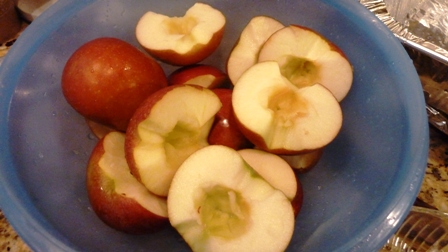
Baked Apples
8 large tart apples (I used Stayman; any good baking apple)
juice of one lemon (optional, to keep apples from turning brown, and adds vitamin C)
½ cup brown sugar
½ cup melted butter
3 teaspoons cinnamon
¾ cup water
Wash and slice apples in half, and cut out core. Do not peel or slice.

Mix lemon juice thoroughly (stir) with apple halves in large bowl. Add the rest of the ingredients and stir some more.
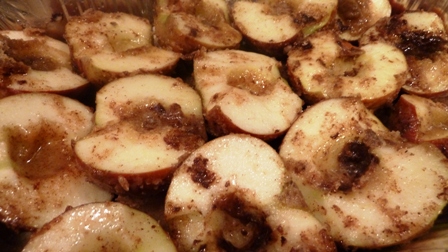
Place apple halves with peeling side down in greased 9 x 12 baking dish. Bake at 375 degrees for 35-45 minutes, depending on the type of apples you use. Pierce with fork to determine when apples are soft. Serve warm. Serves 16.

For more great Virginia recipes from cooks associated with the Mennonite Media offices in Harrisonburg, Va., of 2010, check out my part cookbook, part inspiration for keeping family mealtime: Whatever Happened to Dinner?
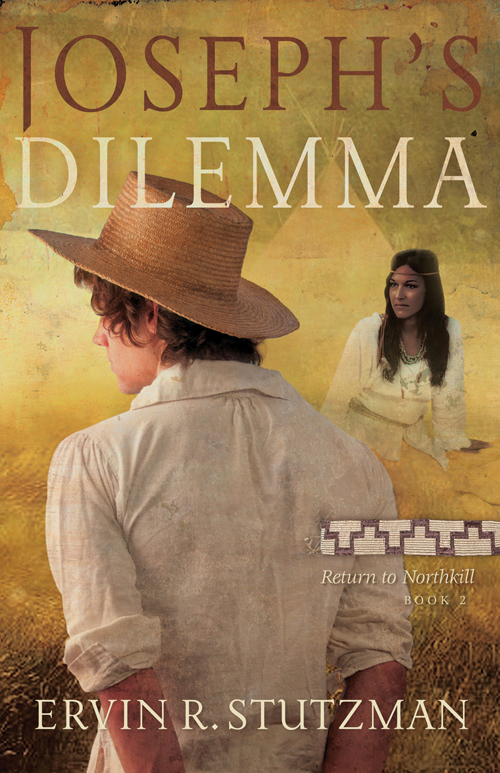
About 250 years ago in the 1750s, lived a young man, Joseph Hochstetler, a very early and distant relative of mine (and of thousands born into that Mennonite “tribe”). His family was tragically attacked by original occupants of lands “settled” by some of my original tribe. Joseph’s mother and young sister were scalped and killed, and he, his father and one brother were taken into captivity by Native Americans during the French and Indian War in eastern Pennsylvania.
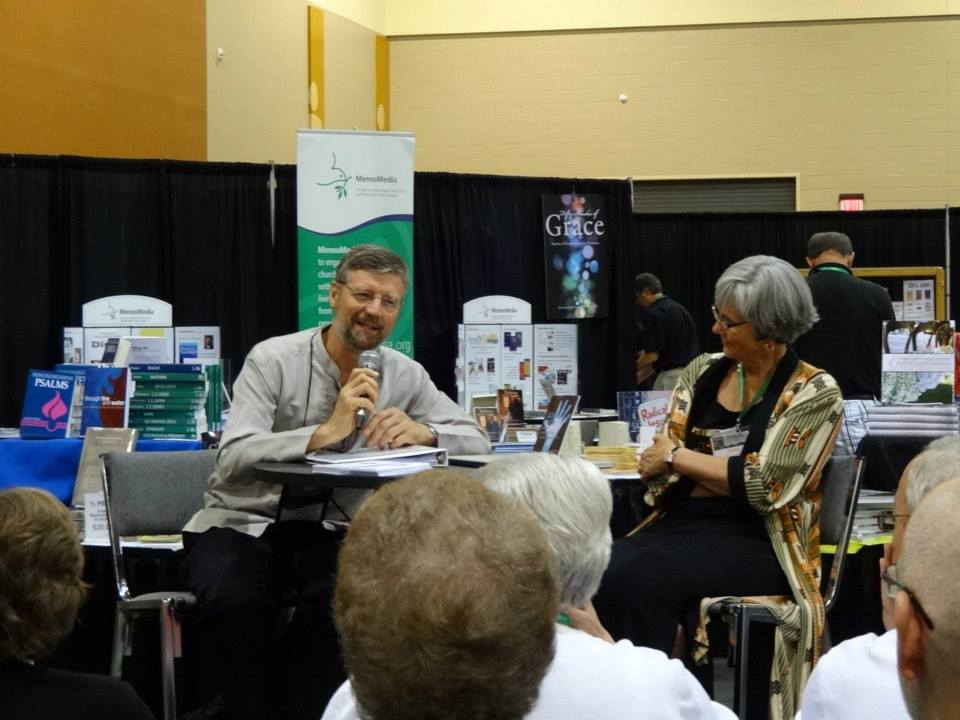
Ervin Stutzman, left, and Shirley Showalter, right, talk about their books at the 2013 Phoenix Mennonite Church USA convention.
Another distant relative, Ervin Stutzman has been imagining, researching, and laboriously writing three fictional accounts of what might have transpired after such a tragic scenario. Joseph’s Dilemma (published May 2015) weds historical fiction—and romance, if you will. I admire Stutzman tremendously for writing the whole Return to Northkill trilogy; the first book called Jacob’s Choice (about the father) was published in 2013 which I wrote about here. The final book is set to come out this October 2016, titled Christian’s Hope, the story of Joseph’s other brother. Over the last 10-15 years, Stutzman’s ability to doggedly research and churn out prose all the while holding down other jobs as Eastern Mennonite Seminary dean (earlier) and now executive director of Mennonite Church USA is amazing and can be motivating for other writers who must keep a “day job.”
Fiction writing is not easy in my opinion. Stutzman is improving greatly in the genre. Here he does a reasonable job of showing us the action in progress rather than just telling us what happens. He gives us surprising plot turns, even when the main dilemma is set up by the cover artwork, depicting the basic premise of the novel. Through the fiction we are allowed to enter a different and realistically portrayed reality: we meet a Delaware Indian mother who longs for a son to ease the emotional and physical woes of a widow and single mom (someone to hunt meat for her and her young daughter), after losing both a son and a husband in hostilities. The main points of view shift between young Joseph and his eventual adoptive mother, Touching Sky. Another Amish romance author, Adina Senft, calls Stutzman’s prose “spare” (that’s a good thing in my book!) and recognizes “a tour de force of research.”

In an email, Stutzman allows that other readers have also told him that his fiction writing skills have grown, and in person, he gets a glint in the eye and promises that the new book, Christian’s Hope, will be his best yet. I doubt that is just writer hope or advertising hype. In his first book in this series, Jacob’s Choice, I felt Stutzman almost got bogged down in trying to write a fictionalized version of true history with too much detail. In this volume about Joseph, since much less is known about this main character and real life historical person, Stutzman takes freer reign (within the bounds of accurately portraying his research) to imagine what it could have been like for a young captive like Joseph. The awakening of a young man’s interest in the opposite gender over the course of six years of captivity is particularly winsome and played with just the right touch.
So it was pleasurable* to finally sit down and crack the pages of Joseph’s Dilemma. Yes, I’m behind, and have a large stack of books I continue to plow through.
My mother and I ended up reading the book at the same time. She too was impressed by the insights the book offers about Native American customs of the 1700s, and the turmoil brought about after being captured by an “enemy;” how could one ever grow to like and love those enemies, and then what happens when as part of a treaty, you are forced to go back to your original people?
In the first book in the series (and of course it’s best to read this trilogy in order), we meet young Joseph as a teen who picked up a gun to try to defend his family against the attackers but is ordered by his father not to shoot. While loving his father, he does not understand why his father’s religious beliefs do not allow him to protect his family. One of the first books I ever owned (but got rid of long ago), was Captive of the Delaware, a book of fiction for children published by Herald Press, using some of these same themes.
Joseph learns to speak in Delaware and eventually finds himself dreaming in his new language—a definite sign that he is acclimating. Joseph explores the faith of his adopted mother as expressed by the Delaware (also known as Lenape) tribe, and Stutzman steps back enough from his own deep seated Anabaptist Christian convictions regarding the power of forgiveness and the ultimate futility of weapons of war, to help us also better understand some of the beliefs original peoples share with many people of Christian faith. But he doesn’t gloss over the sharp distinctions, either. As the book’s ending nears, the reader is as torn as Joseph—a sure sign also that as a fiction writer, Stutzman has done an excellent job of engaging us.
I’m also happily anticipating reading Christian’s Hope for what I hope is a satisfying end to the stories of these three men—cousins by both blood and faith!

Author Ervin Stutzman
***
[Disclosure: While I work as one of several managing editors for Herald Press, I have not been involved in editing or marketing Stutzman’s books other than to help do news releases and social media; for the entire Northkill series, I also had the opportunity to weigh in on the models chosen for the cover shoots for the series and what was the right clothing for that period? Great fun!]
***
* One of the things I enjoy so much about books is just opening one up, no electronics, and turning one page after the other as I drift off to sleep. No, I don’t have or want an ebook reader (but I’m happy for those who do. We authors love readers however we can get them!) But with a plain old book, I don’t have to worry about a charged battery, having yet more screen time in my day, losing a cord (if I travel with it), spilling water or coffee on it, or cracking the screen. And really, one less electronic thing in my life is a good thing.
***

You can buy Joseph’s Dilemma here, (paper or ebook) or through your favorite local bookstore and other online retailers.
***
Are you part of the Hostetler/Hochstetler clan? Let me know or visit the official Hochstetler website, or join the Facebook group “Descendants of Jacob Hochstetler.”
***
Do you enjoy an ebook reader? Which one? Or are you a hold out like me?
***
How does the story of Joseph compare to hostages today who begin to identify strongly with their captors?
What was the first place like which you and your spouse lived in as a married couple? Your love nest, the place you came home to after your honeymoon? Why do we remember those pathetic first places with such rose colored glasses?
I was telling someone the other day we lived in a 10 by 45 foot trailer, which included the outside length of the trailer hitch. Roughly 400 square feet inside. Even that is bigger than today’s “tiny houses” that run from 100 to 400 well-arranged square feet.
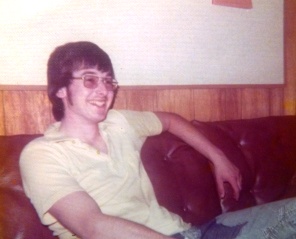
Stuart’s bachelor pad, before.
I worked very hard with my fiancé to turn his bachelor pad (above) into a suitable honeymoon haven. The interior walls of the mobile home were covered, as were most, in the typical faux wood paneling of the day.
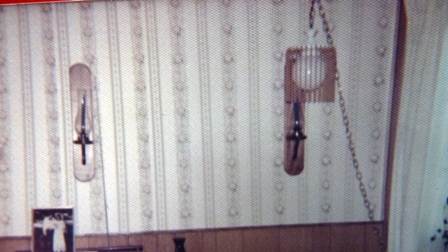
Same wall after I supplied some homey touches.
I brightened the living room with stripped wall paper and new drapery, both ordered from Sears of course. (I had almost forgotten about the hip bangle light there!)

Kitchen in our mobile home.
I made cute little curtains for the kitchen. Stuart installed blue carpeting throughout which helped warm the nondescript beige vinyl flooring tremendously. In the living room we also used a mod 5 x 6 foot area rug which I duck taped together in college (shag multi-colored samples from a carpet store, but I can’t remember if I got them free).
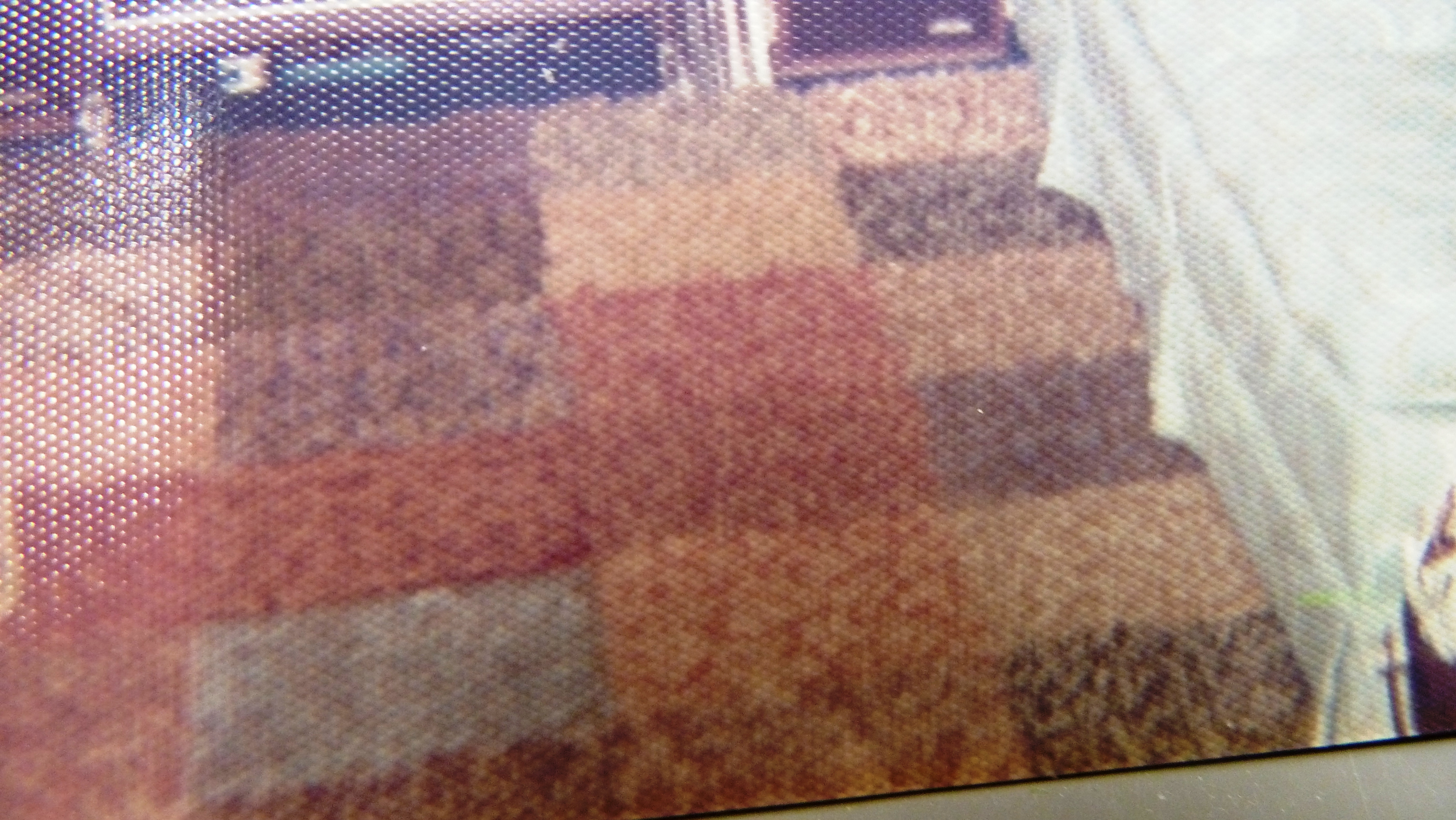
Shag! carpet.
But I loved the high dollar sofa we were able to have (blue and green floral). Somewhere along the line while engaged I won or received a $150 gift certificate to a small custom home decorating/furniture place called Mary Glick’s (long since out of business). The sofa, originally in the $300-400 range (1976 prices) had been marked down to maybe $190 and thus our first sofa was low cost but well made. We kept that sofa when we eventually moved to a much bigger abode in 1977, and it lasted through the first 10-15 years or so of raising our family.
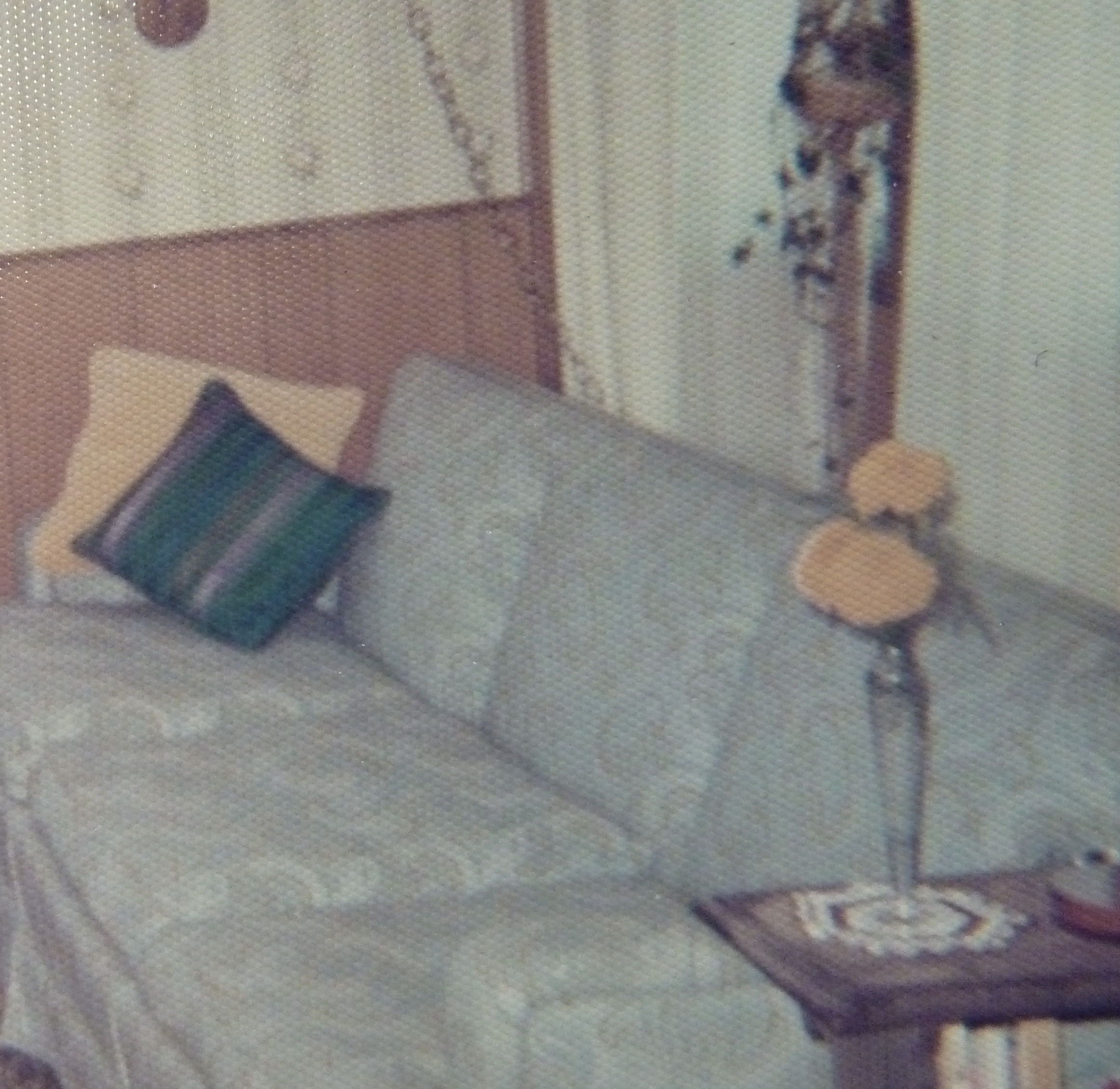
Sofa.
But more than the space, it was special because it was ours (paid off), and we only had to pay $45 or 50 a month in lot rent. Cheapest living year ever. And yes, we used that opportunity to save up for a down payment on our first home.
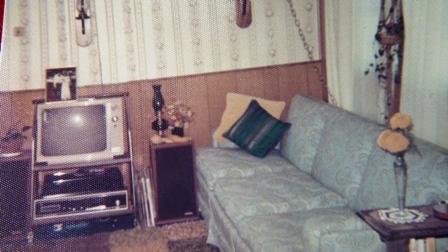
Living area. The trailer also had 2 bedrooms.
I think that those first apartments, trailers/mobile homes, basements, or houses most of us occupy the first year or two of married life feel special because for many of us (especially when we hang on to that partner for 30, 40, 50 or more years), it is the first time we ever truly had the opportunity to make a space our own. The memory of all those new household gifts from family and friends from showers and the wedding, add to the shiny memories.

Contented husband and cat, with a throw protecting the new sofa.
As children many of us “played house” endlessly, creating homes out of blankets tossed over tables, or among sticks gathered and stacked in the woods, or on stones using leaves and nuts for “food,” or forts of snow and ice, or playhouses if we were lucky.
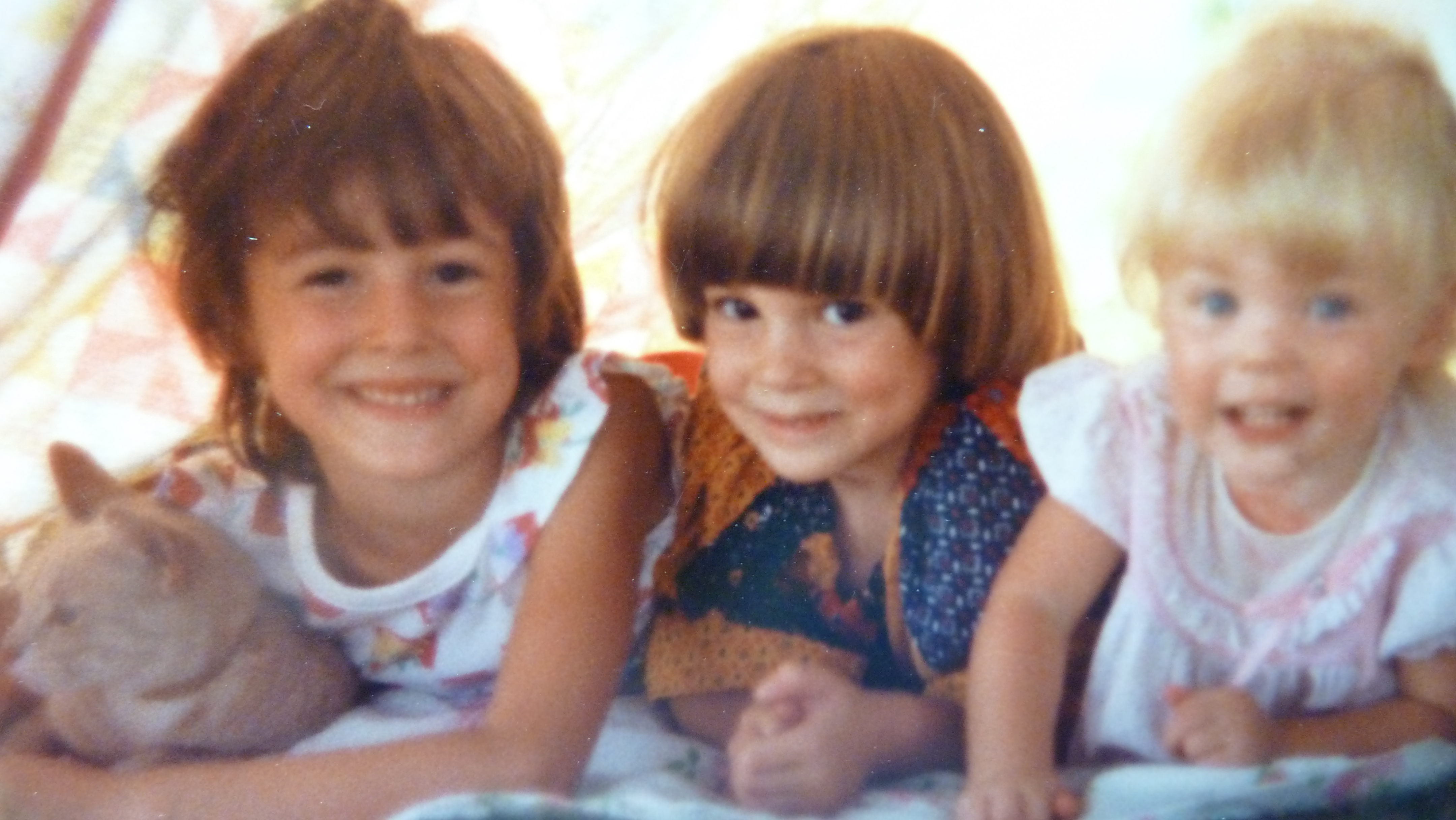
Our three daughters playing house years later. Notice the design of the now faded throw.
Thus it is not only the romance of new love that makes our memories special, but the move from playing house to establishing a new real home that lingers in our memories.
That first place is also often where we have our first arguments and marital disappointments, when we burn the dinner and discover their (or our own) major flaws.
Those of us with enduring and loving marriages (hanging on in times of disillusionment and apologizing after driving off in a huff) look back on our first home, no matter how humble, cramped or miserable, as the tender incubator of young love.
Many of us need this reminder from 1 Peter 4:8: frequently throughout marriage: “Above all, love each other deeply, because love covers a multitude of sins.”
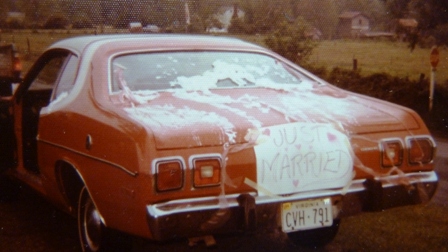
Our honeymoon car, a 1974 Dodge Dart.
***
What was your first space like after you got married?
What do you think helps us treasure those memories?
For my regular weekly newspaper column, Another Way, click here. Or to subscribe to receive it each Friday, here’s the subscribe option.
Busy days mean you hear less from bloggers. (Maybe that’s a good thing.) I feel like I’ve been AWOL and here’s a little of why since the first of the year (not a complete list!):
- New grandson born!
- Blizzard of 2016 blew in.
- New pastor moved in and I helped paint her office.
- Lined up finances for a solar installation.
- Difficult decisions about retirement finances for my husband.
- And then the dog got hit by a skunk.
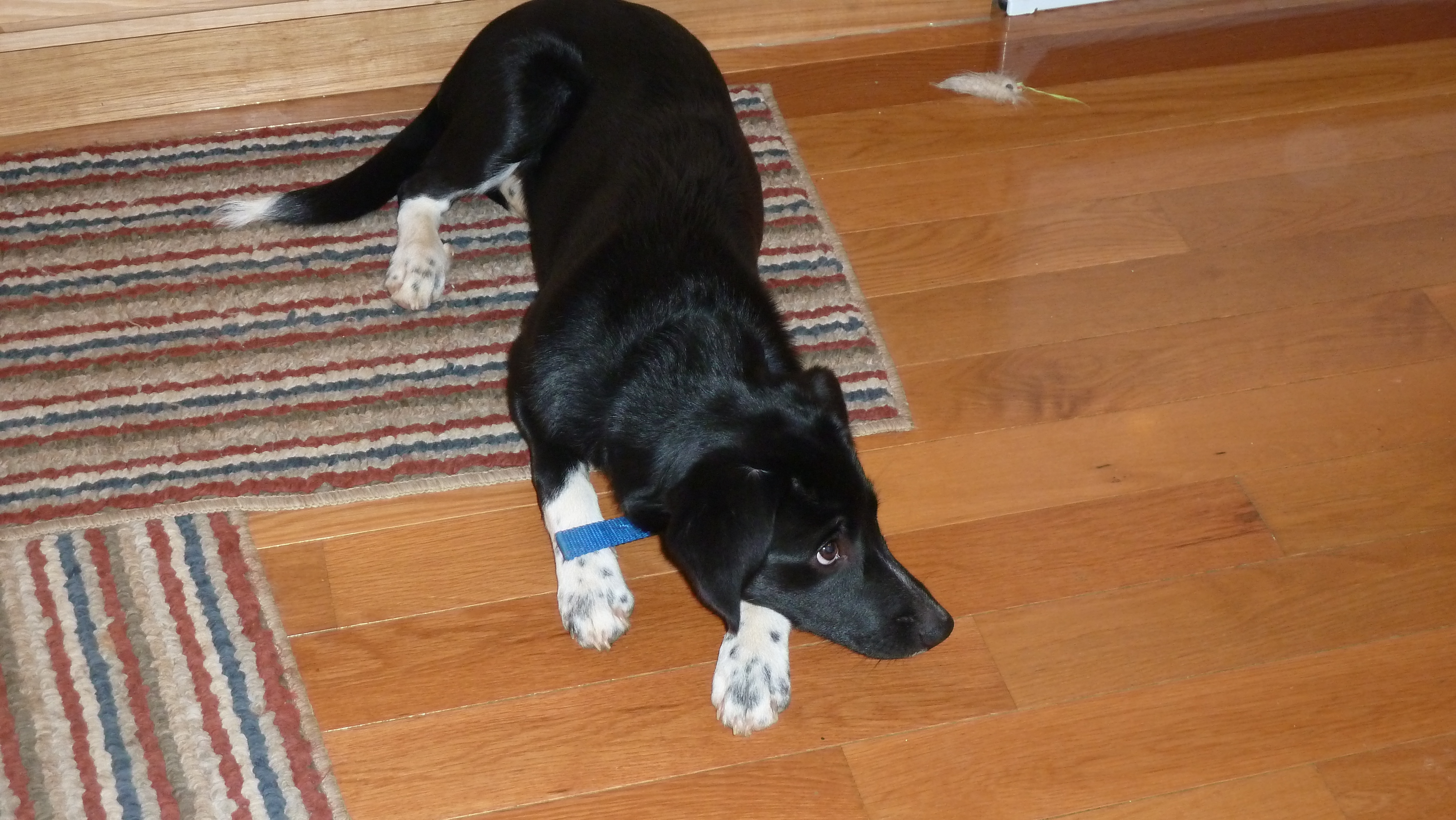
It was this last item, the SKUNK, that threatened to do me in.
The skunk episode reminded me of how overwhelmed I felt long ago when our two older girls brought home lice from school and we learned that they WOULD NOT BE ALLOWED TO GO BACK until they were cleared of lice, nits and all.
Three daughters, all with thick, longish beautiful hair, with hundreds of miniscule nits (lice eggs) that you literally had to scoot off each shaft of hair with your fingers. Endless work.
Oh yes nit combs helped some, and we shampooed multiple times with special lice shampoo that you have to wait forever to rinse out, and finally got shorter haircuts for the two hit worst. I’m told that now over-the-counter shampoos are not even effective.
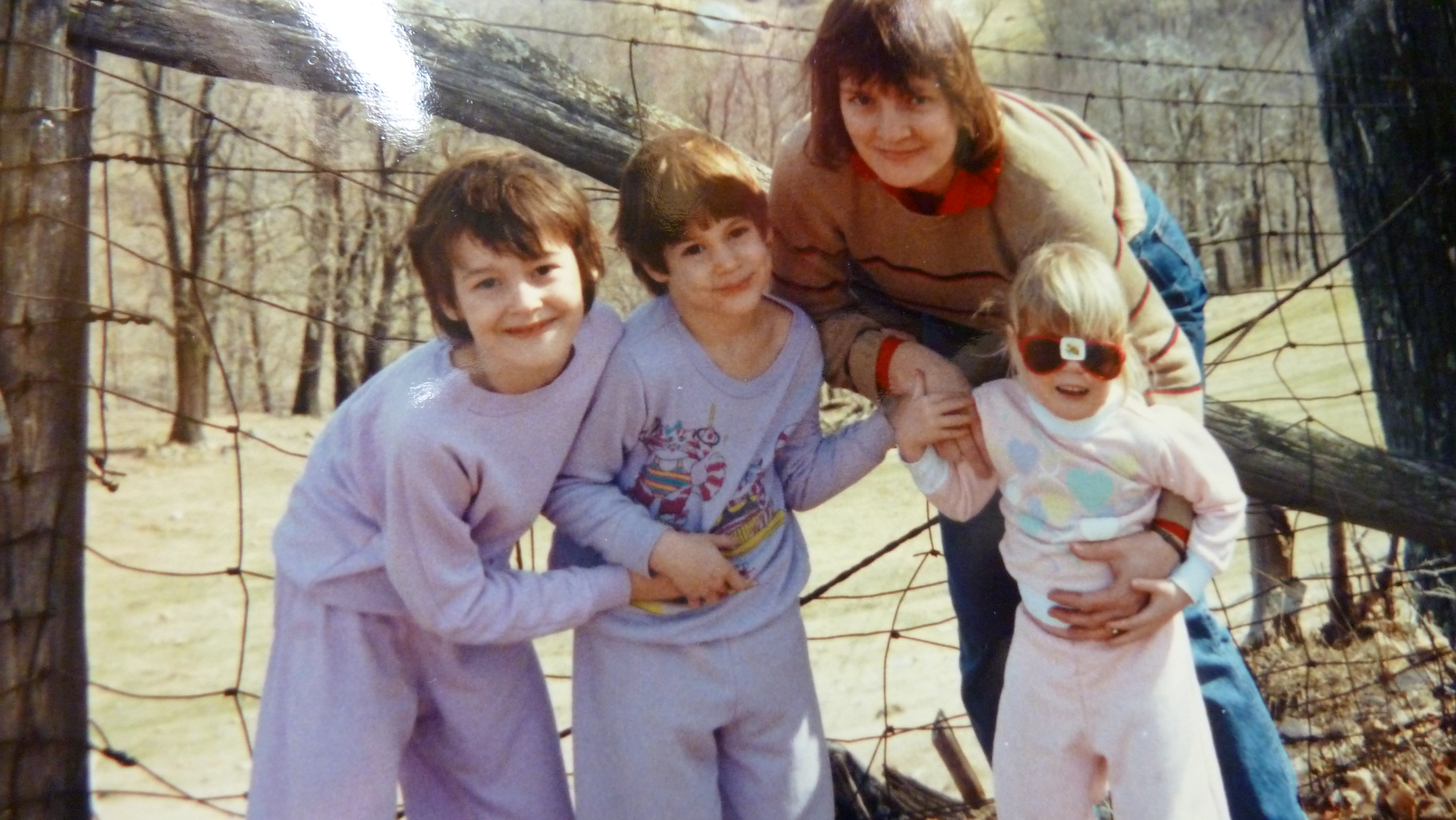
A photo soon after their lice-induced haircuts, at Highland County Maple Syrup Festival. Rockin’ those sweat pants outfits.
If they had been boys I would have just shaved all their hair off.
Doing endless laundry: sheets, blankets, mattress pads, and mounds of clothing had to all be washed. Heaps of stuffed animals and pillows had to be stuffed into garbage bags and closed tightly for two weeks so the darn things would DIE (I mean the lice, not the stuffed animals).
Plus the shame. Lice are not only despicable and a bother, but tend to make your children into pariahs too. Dare they go to a birthday party if they’re not allowed back in school yet? Should I tell the haircutter at the beauty school about the lice? (Yes!)
It was probably one of our lowest periods in parenting.
But when you put it in perspective, well, I had not even thought of it in years. Years! On the grand scale of things, lice and getting spewed by a skunk are not cancer, not a bad accident, not a brain injury, not rapidly progressing macular degeneration! Nothing to really cry about. I thought of these things as I shampooed the dog, washed rugs and dog blankets, set out dishes of vinegar to absorb odors, and mopped the entire basement floor with Lysol, then cleansed the washing machine with several loads of Clorox water.
Frustrating and time consuming yes, but a reminder to be oh so thankful. (Plus, friends noted there are so many dead skunks on our roads right now with February-March being skunk mating season. Who knew?)
Most of the things on my list above are more or less happy and exciting occasions. The new grandson makes us heady with happiness and while his parents are cautious about oversharing (a valid concern!) you can bet we are pleased and proud.
There were other distressing events and while blizzards never bring about happy dances any more at our house, it definitely could have been worse.
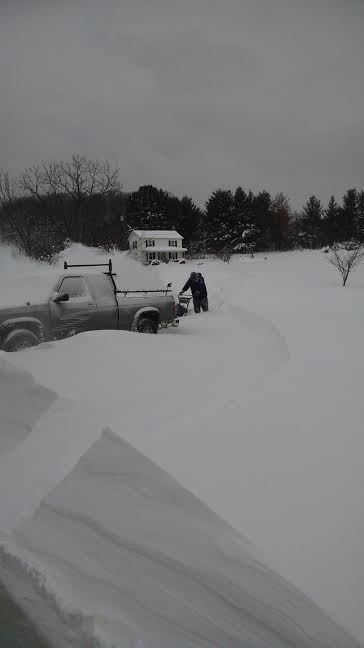
Plowing out: note, this is not a black and white photo.
Our electricity stayed on the whole time! Yay—just a few blink outs which sent me scurrying to set aside clean water in big stainless steel kettles and extra pitchers, just in case.
We feel blessed, unworthy, and ever thankful, even when going through crazy stressful times.
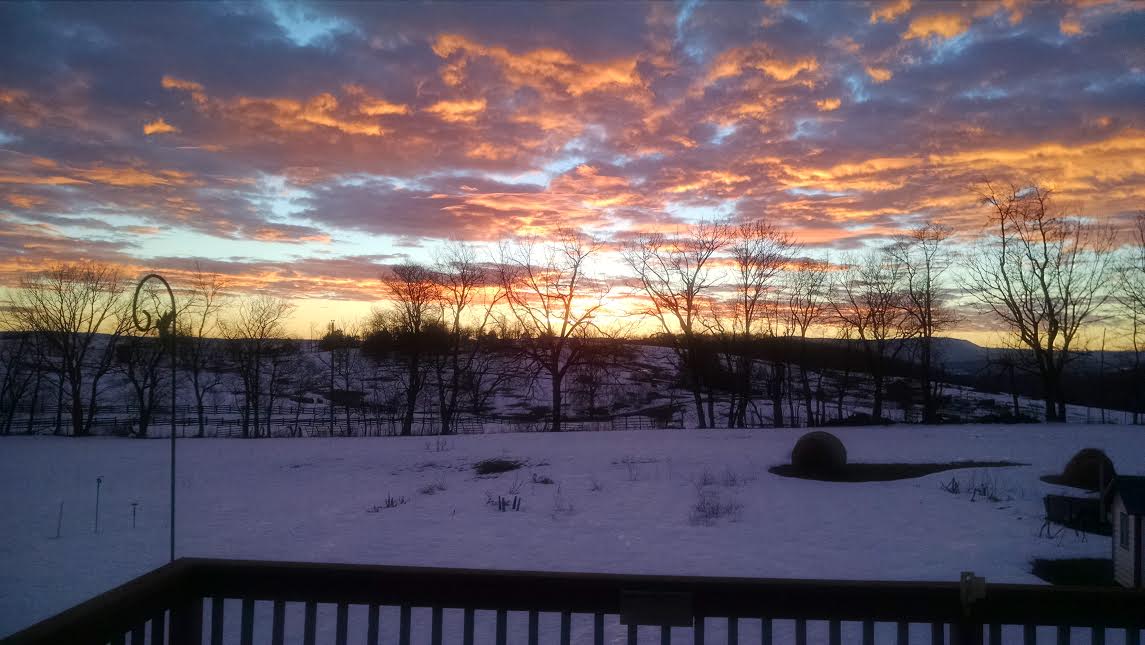
Do not be anxious about anything, but in everything by prayer and supplication with thanksgiving let your requests be made known to God. (Phil 4:6)
***
What was a difficult (shareable) time you recall in raising children?
***
When you are overwhelmed or depressed by situations, (not clinical depression) how do you cope?
When my husband and I left the movie Star Wars: The Force Awakens recently, I sent a text to my oldest daughter who writes movie reviews for ThirdWay.com.
“Great fun and sad,” I wrote.
She texted back: “Good succinct review.”
Maybe that’s enough said, but if you want to know the back story, I have one.
I’m sure many other baby boomers like my husband and I were touched, stunned and ultimately heartened by this movie showing again the characters we came to love back in the 70s.
I had to dig out a review I wrote which was actually published in a magazine of the day, WITH, a Mennonite denominational publication for youth. It has sadly gone the way of so many print publications, but the force still lives! (Frankly I was surprised that then editor Richard Kauffman paid MONEY for my review—but I think he was just anxious for hot topics for his teen readers. Kauffman went on to serve as an editor at Christian Century for many years, and just retired in January. WITH, and editors like Kauffman, nourished my writing career.)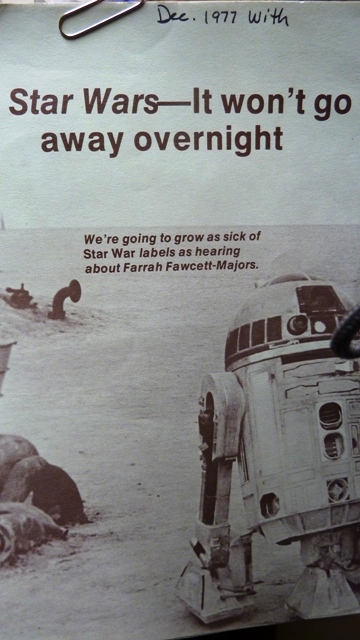
The article in WITH was titled “Star Wars—It Won’t Go Away Overnight.” I wasn’t being prophetic—just reading articles in a magazine I kept up with at the time, Advertising Age. They pointed out the long list of spin offs envisioned by original director George Lucas for “toys, games, crafts, T-shirts, posters, Halloween costumes, bedspreads, sleeping bags …” almost as if franchising a movie was something relatively new then. The spacecraft and characters were designed in part with toys in mind, according to published interviews with Lucas at the time. Now that’s a duh.
Star Wars gained popularity on the basis of a good story and memorable characters and the special effects that now look so ho hum. According to my review then, it had brought in one hundred million ($100,000,000) at the box office four months after its release (at the time I wrote that review). In contrast, Star Wars The Force Awakens made one quarter of that in just its first opening weekend, 247 million. We paid $2.50 then, and $8.50 now with discount tickets.)
In my earlier review I noted my husband and I saw it before it was a household word or on any T-shirts, and thus had a crack at “unprejudiced viewing,” to form my own opinion. In fact, we selected it as the lesser of several evils on the marquee in a small town while visiting my parents in 1977; my husband always loved science fiction and especially Star Trek so he wanted to see what Star Wars was like; I went with low expectations and feared the movie would offer “… blood and gore at worst, boredom at best.”
I reported that I was pleasantly entertained, and “surprised that it wasn’t as bad as I expected.” I called it clean: no four letter words, no sex, no real blood. Those three elements still mark the 2015 release! Oh I found the 1977 Darth Vader a “gruesome representation of evil and maybe even a science-fictionized Satan; … his wheezing and omen-like presence made me shudder every time he came on the scene.”

Darth Vader Humidifer
Speaking of shudders, after we saw The Force Awakens, we stopped by Lowes and the first thing that I saw in the store was a Darth Vader humidifier for a children’s room. One two-year-old grandson has a “Choo Choo” humidifier that he adores but I don’t think Darth Vader would sooth him to sleep.

Newlyweds: 1976
Which gets me to this: my husband and I were practically newlyweds (married just over a year) when we saw the original Star Wars in 1977. Now I’m a grandmother. As a 60+ something who followed the Star Wars franchise through the years, you can’t watch this movie without being thrown back to your much younger self—in my 20’s!—with all the hopes and dreams and aspirations of those early years. You can’t help but ponder how you look compared to the actors and realize that if THEY look old, you do too. As I sat in the theater with my smart phone on vibrate just in case our oldest daughter went into labor—I thought how in 1977 I wouldn’t have dreamed of cell phones, let alone mini computers (smart phones) that we would carry with us keeping us in touch not only by phone, but by text, instant message, and email. I wouldn’t have known what any of those words even meant, except “phone.”
Stunning, when you dwell on it.
And its fun to see the movie getting mostly high marks.
- The Force Awakens, directed by Gen-Xer J.J. Abrams, has opened to universally strong notices, and, in the summary of Rotten Tomatoes, “successfully recalls the series’ former glory while injecting it with renewed energy.” http://reason.com/blog/2015/12/19/how-star-wars-unmasks-baby-boomers-as-am
- In The New Yorker we read movie critic Anthony Lane’s suggestion of weakness: “Is Abrams a chronic nostalgist, bowing so low to the fan base that his nose is rubbing against the floor? Or has he wisely concluded that, if it ain’t broke, he should not be fool enough to fix it?”
- After critiquing how The Force Awakens is a better film, overall, than the original, Lane writes, “The new movie, as an act of pure storytelling, streams by with fluency and zip. To sum up: “Star Wars” was broke, and it did need fixing. And here is the answer.” http://www.newyorker.com/culture/cultural-comment/star-wars-the-force-awakens-reviewed
- I looked for reviewers talking about the theme of aging in this movie. Here’s one hitting the reality head on: “There aren’t many boomer monoculture events like Star Wars left. After The Force Awakens, and boomers start to hit that age when people start to die for no reason, those events [throw back movies] will mostly be eulogies for boomer icons.” http://www.vice.com/read/the-force-awakens-is-the-last-great-monument-of-the-baby-boomers
- However, regarding Lucas bowing out of producer role for a new generation of Star Wars films, one snarky reviewer at Reason.com noted: “As aging boomers such as Hillary Clinton (aged 68), Donald Trump (69), and Jeb Bush (62) desperately try to become the next president, Lucas has abdicated his throne and graciously allowed younger generations to take control of his prized possession, the most beloved and valuable property in the history of popular culture.”
I noted some deep clefts or wrinkles in Harrison Ford, not unlike one I’ve been noticing on my own face. (How terribly young he looks here!)

I noticed how he ran like an older man—like my husband or me. I admired Carrie Fisher as Princess Leia’s (now General Leia) still classic good looks in a face with noticeable wrinkles setting in.

The normal response to such stark reminders of the passing of time which no one escapes (and other movies have shown us we don’t WANT to escape getting older) is either embrace it (even the stars age and people still love them) or denial (shall I do plastic surgery and Botox to avoid looking older as long as I can?).
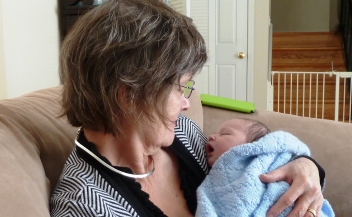
Newest grandson, 2016.
I hope I don’t have to tell you which choice I’ll take. I’m so glad for a husband who loves even the way I look now.
Not a bad take away on a pleasant Sunday afternoon.
***
Does seeing aging movie, TV, politicians, or music stars still rocking it–doing their thing–depress or impress you?
Have you followed the Star Wars movies? What did you think of The Force Awakens?
***
If you enjoy movies and movie reviews written from the perspective of various Mennonite/Anabaptist Christian critics, head over to ThirdWay.com and sign up for timely weekly reviews.


