


Lizzy
A three-part series
How many 12-year-old kids do you know who cook dinner for their family almost every night?
I had heard her mother, Virginia, say repeatedly “Oh Lizzy made that” at church potlucks. “She does most of the cooking.”
Most recently, Lizzy brought a scrumptious peach cobbler made from scratch to the church picnic in a cast iron skillet. That impressed me. Her own cast iron skillet. Given to her by her grandmother’s neighbor who apparently has great collections of things. He had a brand new one just sitting around. Lizzy seasoned the cast iron skillet and uses it regularly. She also owns several other kitchen appliances, pans, and food prep equipment. She asks for these things for birthday and Christmas gifts.

Lizzy’s Food Processor
(About cast iron: I once tried to season a cast iron skillet as a new bride but somehow it rusted anyway. Eventually I got rid of it and, this quasi-cooking blogger is ashamed to say, I have not tried to own one since.)
“Other kids like to go hang out or shop at the mall,” says her mom. “Lizzy loves to go to specialty kitchen and gourmet grocery stores.”
Lizzy is your ordinary (well not really, but we’ll get to that in a minute) 12-year-old bouncy kid with gorgeous hazel eyes and a face that lights up whenever she’s excited, especially talking about or demonstrating cooking. She runs cross country at her middle school and participates in spring musicals, but otherwise after school on most weekdays, you’ll find her stirring, dredging, frying, baking, pulsing in the kitchen of her family’s suburban split level.
This she loves, and so does her family, especially her parents. She tries to appease the food likes of her 15-year-old brother, Sam, who plays football in the fall and lives for it the rest of the year.
“My dad and brother are mostly meat and bread guys,” Lizzy notes, not unkindly. “When it is just my mother and I, we’re kind of more adventuresome, and we try other things.”
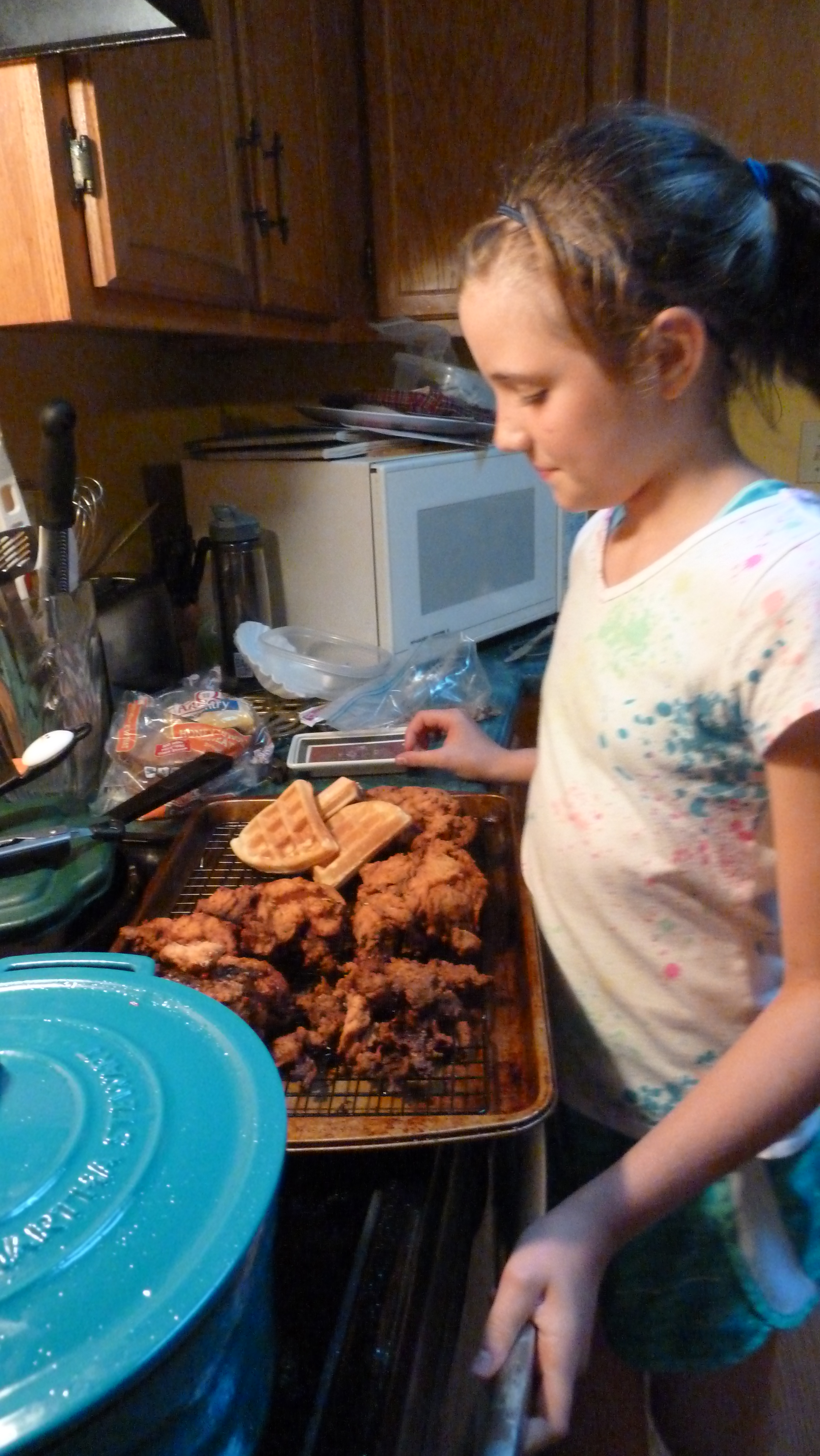 This night she is indeed cooking up a meat and bread kind of supper—deep fat fried chicken, with homemade-from-scratch waffles supplying the “bread” portion of the meal. “Sam is a big fried chicken aficionado. Big fan! And if he says something is good, it’s really good. If it is ‘eh’—that equals ‘pretty good.’”
Most everything Lizzy makes is from scratch: even the dressing for the salad. She throws a salad and dressing together, like a chef on the Food Network, as the final touch for her meal.

Homemade Dressing
She calls out the dressing ingredients as she adds them to a shaker: olive oil, apple cider vinegar, a little brown sugar, a grinder turn from a pepper mill, and a literal pinch of salt from her salt bowl. She tosses some spinach leaves in a bowl, adds some blue cheese crumbles and dried cranberries—two of her favorite foods. Presto: salad to round out the evening supper.

She is 12 years old. Not 42 or even 22. Children today only make cookies and occasional muffins, boxed cakes or scrambled eggs maybe. Right? Not fried chicken, homemade waffles, and salads plus dressing with such a flourish. Or maybe I’m behind the times. At least that was the case when I grew up, and with my own girls. I always felt I did pretty good “letting” them try their hand in the kitchen. But not take over.

This girl almost owns the kitchen. Her mother, a middle school science teacher (background, above), circulates in and out of the kitchen putting things away from her day preparing for the first day of school. Virginia starts putting tomatoes and other fresh ingredients for salsa into a blender. “Mom does make good salsa,” Lizzy chats. “I’ll have to give her that. She makes good soups too but I’ve mostly taken over on the soups.”
Virginia will have to attend the local school board meeting tonight; she’s head of the Harrisonburg Education Association. She’ll leave before Lizzy’s brother and dad get home from football practice, which means they won’t actually get to eat all together, which is often how it is for many families with school-age children. Lizzy keeps things warm in the oven. Her dad teaches AP courses in European history and psychology, and is a defensive football coach at the local high school.
Back in the day—say the 1930s and 40s, children were more frequently called on to take over the cooking at an early age, perhaps even on a wood cookstove. I delved into that last fall in several posts reviewing books of Appalachian sociologist Peggy Shifflett. In her book Mom’s Family Pie, Shifflett talks about 8-10 year old girls often taking on cooking responsibilities and definitely by the time they were teens.
But who does this in 2015? I did find at least one other 12-year-old cook who reminds me somewhat of Lizzy in her kitchen.

Lizzy says she started learning to cook when she was 7 or so, especially making typical cookies and muffins; she loved learning at the side of her grandmother who lives about 50 miles away, who taught her the waffle recipe she’ll be making tonight. Another recipe Lizzy loves came from Alton Brown on Food Network, and won a blue ribbon (first place) for Lizzy last year in the county fair. This year she won 15 ribbons in various craft and cooking categories.
I was delighted to try a new recipe for biscuits, because mine were always crumbly and flat in taste and size. These turned out great: they held together very well and were mouth-watering delicious!

Alton Brown’s Prize Winning Biscuits (via Lizzy)
2 cups flour
4 Tablespoons butter
1 teaspoon salt
4 teaspoons baking powder
¼ teaspoon baking soda
1 cup buttermilk
Put all of that in a food processor to mix it (or cut in the butter with a pastry blender and mix that way). Knead together gently a few turns on floured board.
Roll out dough ¼ inch thick. (Alton Brown says 1 inch thick. I’ll try that next time!) Cut out with floured biscuit cutter. Place biscuits close together with sides touching in a lightly greased pan. Bake at 350 degrees for 10-15 minutes (Alton’s recipe says 400 degrees). Serve while warm.

Next time we’ll watch, step-by-step, how to make fried chicken the Lizzy way.
***
When did you or your children start cooking? What favorites did they or you like to make?
***

This series posted with a salute to Family Dinner Day, the last Monday in September (February dates in Canada), originally launched from CASA, which encourages eating together as a family as one way to fight the societal influences that sometimes lead to addictions in youth. This is the theme of my most recent book, Whatever Happened to Dinner: Recipes and Reflections for Family Mealtime.
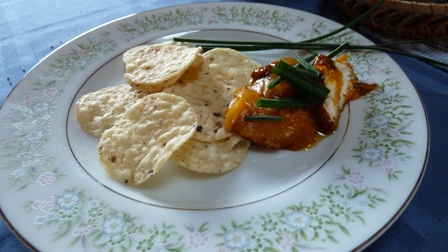
If last week’s recipe took half a day to make, this one took no more than half a shake. For real.
Furthermore, I was floored when my husband came home from work one day recently saying “I have a new recipe you’ve got to try.” Husband? Bearing a new recipe?
A coworker had brought in a hot dip and it is good. Healthy? Not so much. But hey, for a quick dip if friends or family are coming over, small group, a potluck or break at work, a hungry soccer team, a tail gate party, this works beautifully. I whipped it up because I knew we were headed to town on some errands and then out to eat. I knew it would be awhile until we would possibly wait for a table, order and get our food. So this can work as a homemade appetizer, sparing the expense at a restaurant. (I halved the recipe below and put it in the bottom of a bread pan, and froze the canned chili I didn’t use for later projects.)
Chili and cream cheese dip
1 can Hormel chili, without meat
1 8 oz. bar cream cheese
2 cups shredded cheese

Spread softened cream cheese in bottom of 9 inch pie pan (use knife or spatula).
Spread chili on top of cream cheese.
Cover with shredded sharp or cheddar cheese (or any mix of cheese you like).
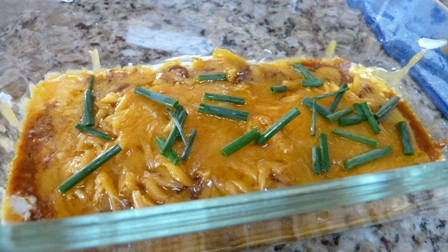
Microwave on high for 45-60 seconds, watching to see when cheese melts and mixture seems hot in center.
Options: chopped chives
The recipe I was given did not call for chives but they make a nice addition. You might also add halved cherry tomatoes, black olives, green olives, chopped hot peppers, chopped basil—if you use these things you know what to try.
You could also easily substitute your own thickened chili, or use refried beans.

Cautions: There are no preservatives in Hormel chili, but the sodium content is pretty high. Surprise surprise.
***
Do you order appetizers in restaurants? While I don’t have a lot of use for them (usually get too full anyway with calorie-laden food) sometimes they make a meal in themselves.
***
Does your spouse bring home recipes or suggestions to try? Do you welcome them? Why or why not?
***
There’s a chapter with appetizers and party foods in my book, Whatever Happened to Dinner: Recipes and Reflections for Family Mealtime.
My husband’s Aunt Mary R., now she was a cook. I say was because even though she’s still living, she is not able to cook for herself anymore. But the great passion of her life—in addition to the husband she lost in the Korean War and never found—was cooking for family. I got the impression sitting down to her groaning table that she was the happiest when feeding a huge meal to others—frequently using her best dishes.
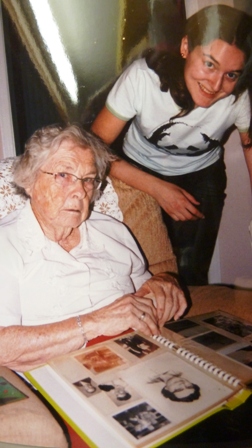
Aunt Mary with oldest daughter, Michelle.
I thought of her this past weekend as I made a coconut cake for a family reunion and recalled the time she drove from Montgomery, Alabama to visit us here in Virginia, all by herself and probably in her high seventies. She came with the goal of making several of her brother’s (my husband’s father, Hershal) special favorites including a barbecue sauce for pork, and a coconut cake. I wish I could say co-co-nut cake the way she does in her deep Alabama drawl.
She stayed with us that fall and attended the kids’ homecoming parade and we made more than one stop at grocery stores hunting for the exact brand name of ingredients so she could make everything “just like mamma made.”

So for her coconut cake, she had to use a real coconut—never mind the work. I had never opened one before her visit, and until last Saturday, had never opened one since. But after I wrote (here) about making Mary Emma Showalter’s coconut cake (of Mennonite Community Cookbook fame), another Mary V. (hang on to your hats, this story is filled with Marys. Mary V., my husband’s cousin on his mother’s side), pounced on that post and proclaimed I had to make it for the family’s summer picnic. I squirmed, not anxious to repeat the three layer huge cake and Mary Emma’s arduous mixing process. I reminded Mary V. that it might go better for the Christmas get together but she hinted that ever since the older aunts stopped baking—and have all now passed on—the reunion had been missing its coconut cake. I told my husband what I was planning and he flinched only slightly: he wasn’t going to get one of my reunion mainstays, Arnold Felcher cake.
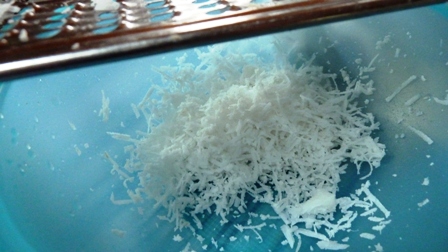
Finally I resolved to make the cake, but to look for another recipe and use freshly grated coconut. Might as well get the real “foodie” thing going: drill the hole; drain the milk; break open the coconut (not easy either); separate the coconut meat from the shell (ugh); scrape the brown liner off the white meat; and THEN grate the pieces into fine fluffy coconut.
(Video help here.)
All of that took un-expert-me hours all by my lonely self (husband working), when I could have just opened a bag. But I was determined.
So it wasn’t until I had gotten to the last step of slowly making my pile of fluffy grated coconut that I decided to sit down for the job. I flashed back 20 or so years to Aunt Mary’s visit and recalled how she had sat in my kitchen at the table grating that coconut while I went about my other chores. Suddenly she was with me in the kitchen—not in Aunt Mary’s charismatic religious way of visions and prophecies—but her love and spirit of pouring out her life for her family.

Each coconut has a face. Did you know? The facial features are the best places to make a hole.
I reflected on how this was probably going to be the last time I would use a real coconut, grating and all, and how for anyone to do this on a regular basis—it would be a labor of love.
The other truth that also hit me was that her making that cake was a true toil of love for her only living brother, for the memories of their mother, for family. Their family relationships were complicated to be sure—(aren’t most?)—but down beneath the connections ran deep.
The things we do for love and family. Now coconut—fresh or otherwise—seems to be something you either enjoy or you don’t. As some of us enjoyed the reunion cake, my sister-in-law Barbara said what it made her think of was grating coconut at Christmas as a family; her father would always drill the hole and dig it out of the shell and they’d all help grate and enjoy the fluffy stuff.

All that to say, here’s a recipe that was easy and turned out perfectly. The nutty flavor of fresh coconut was a treat—and my husband and I enjoyed the cake even more a day later when we could eat it with a dollop of ice cream. But on this we agreed: we both like Arnold Felcher’s Cake a tad better!

And if one of my grandkids develops a taste for real homemade fresh coconut cake, they might get me to do it again. Especially if they help.
Coconut Cake
Adapted from recipe by Esther B. Rodes, (correct spelling) McGaheysville, Va. in Mennonite Recipes from the Shenandoah Valley, Good Books.
1 ½ cups sugar
2 cups flour
3 ½ teaspoons baking powder
1 teaspoon salt
½ cup shortening
1 cup milk (or substitute in enough “milk” from the coconut to make one cup)
1 teaspoon vanilla
1 teaspoon coconut flavoring (or milk from the coconut)
6 egg whites
12-ounce container whipped topping
1 ½ cups freshly grated or frozen coconut
- Mix together sugar, flour, baking powder, and salt.
- Add shortening, milk, vanilla and flavoring. Beat for 3 minutes with mixer.
- Add egg whites and beat on high speed for another 3 minutes.
- Pour into 2 greased and floured 8 or 9-inch round pans. Bake at 360 degrees for 30-40 minutes.
- Remove from oven. Let rest for 5 minutes. Remove from pans and place on cooking racks. Before cake is completely cooled, place cake layers in airtight containers to retain moisture. (MD note: I always freeze my layer cakes before frosting them, makes the layers so much easier to handle and I think it improves moisture content too.)
- When completely cooled, spread whipped topping over bottom layer. Sprinkle with coconut. Place top layer on cake and spread with whipped topping. Add remaining coconut. Refrigerate. The cake is best if refrigerated for at least 6 hours to firm topping.
Serves 12-16.
***
What stories from your own family does this bring to mind?
What dish or dishes do you make “for love” of family?
Do you have a favorite coconut cake recipe you recommend?
***
Find Mennonite Recipes from the Shenandoah Valley here.

Another wonderful and now-classic Mennonite Shenandoah Valley cookbook is the 600+ page Mennonite Country-Style Recipes and Kitchen Secrets : The Prize Collection of a Shenandoah Valley Cook by Esther Shank, who also wrote an endorsement for my cookbook, Whatever Happened to Dinner.

Over the last 30 years, Mennonites and Lutherans have been working on a reconciliation process stirring from struggle with “the condemnation of Anabaptists” in Lutheran printed confessions of the 16th century. The persecution and death of many of the early Anabaptists through burning, drowning and other methods of the day is documented and well known. The Lutheran World Federation and Mennonite World Conference bodies specifically have worked on moving beyond the past.
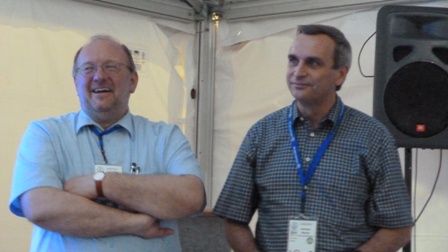
As a born and bred former Mennonite married to a born and bred former Lutheran, you can understand why attending a workshop listed as “From Condemnation to Healing of Memories: Lutheran-Mennonite Reconciliation,” drew me. It was led by two German pastors, one a Mennonite, Rainer W. Burkhart (below left), and the other a Lutheran, Michael Martin.
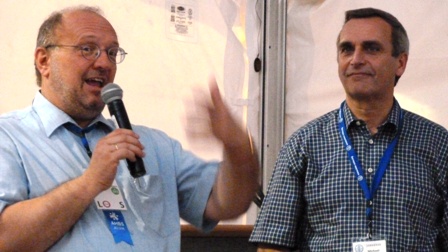
Seeing and hearing Martin and Burkhart was like having the early discussions—even arguments —that my future husband and I engaged in during our early dating days brought to life, and to positive fruition. Stuart and I lived Mennonite/Lutheran differences in theology and practice, and these two men helped to bring about a reconciled relationship of the worldwide denominational groups that resulted not in a marriage—I don’t think anyone wants or needs that—but harmony, forgiveness, and, if you will, healing. What better topic for my Finding Harmony blog, and indeed, writ through our family backgrounds (which I shared here of my father’s faith background, my father-in-law’s faith and upbringing, and most recently writing about charming little Lutheran-Mennonite-Presbyterian handbooks posted here).
The story of Lutheran-Mennonite reconciliation began in 1980 with the 450th anniversary of the writing of the Augsburg Confession in which Anabaptists (and many others) were condemned—sealing the fate of the Anabaptist movement’s early leaders and peasant believers. Following that 450th anniversary event, Lutheran leaders invited Mennonite leaders to help launch a dialogue process to understand and bring about healing for past differences. By 1988, formal negotiations were in place to proceed.

Rainer and Martin* both began their theological studies at a Lutheran seminary in Germany. Rainer recalls, upon first meeting Martin, with a nod to the historical background of the two groups, he said something like “I’m a Mennonite, but don’t be afraid. It’s not a contagious disease.”
A friendship between the two men developed and eventually Martin even served a Mennonite congregation for a number of years in Munich who were in need of a pastor, so the two were well suited to help with and even embody the reconciliation process.
Today both men serve congregations in their respective faith groups, and the two outlined their long friendship from seminary days when they stayed up half the night (“we were younger then”) hammering out the sharp and often fatal differences of the 1500s that resulted in Lutheran outright condemnation of Anabaptists, and a persecution complex for Anabaptists. “Anabaptist,” for the unacquainted, means re-baptized as an adult, which was punishable by death because it was a sin against the state church of the day where everyone had to belong to the church. (In a lighter aside, Rainer spent a moment consulting with the translator working to translate the workshop into German and noted to the audience that “Anabaptist” was a very difficult word to translate into German.)

Rainer and Martin’s long seminary discussions, (including suddenly realizing at 3 a.m. they were starving and cooking up a mess of spaghetti together) were the questions that were vital in the reconciliation consultations such as:
–What role does an older doctrinal writing (The Augsburg Confession) play in the church today?
–Should a denominational confession go so far as to condemn others?
–What do we believe about infant baptism and God? What role do humans take on (deciding when to actively believe and practice Christian faith (as in the theology supporting adult or believer’s baptism) and what is the role of God–how God acts on our behalf before we can even acknowledge God (as in theology supporting infant baptism)?
–Do we believe that God’s action takes priority over human action?
–What about Christian discipleship?
–What is the role of God’s grace?
–Why does one group encourage followers of Jesus to be conscientious objectors and the other support military service for its members?
–Is there a just war?
I won’t go further into the long process of consultations but the two men noted also practical outcomes like results for accepting the baptismal process of the other denomination:
–Mennonites would refrain from requiring re-baptism for Lutherans joining their ranks.
–Pastors could respect individual conscience on matters of military service and baptism.
–Both would be welcome at each other’s communion or Eucharistic services.
And regarding age old persecution and condemnation—(which was likely originally worded so strongly to prove or demonstrate the orthodoxy of Lutherans at a time when they were stepping away from the Catholic church), it was decided that even though today’s Lutheran and Mennonites had nothing to do with those old writings or actions, Lutherans as a body would ask for forgiveness as a healing step.
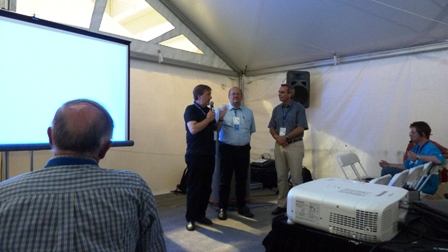
But Lutherans were not the only ones needing to make confession. At times Mennonite were guilty of (eek, can it be?) arrogance, name calling, and enjoying the victim role of “past martyr.” (Not active martyr, but throwing that past up in the heat of argument.) Anabaptists had for so long lived with their past history of “sons and daughters of those martyred for their faith”—would they find a new identity going forward?

Larry Miller (above left), former head of Mennonite World Conference for many years, noted that the gift of the Lutheran Church to Mennonites in this process was an opportunity for Mennonites to be freed from the past (should never be buried or forgotten) and freed to be brothers and sisters in the Lord, today.
This was all an unexpected and welcome gift for me. Praise be to God.
In Stuttgart, Germany, July 2010, at the meeting of the Lutheran World Federation, a healing service was included where persons were given the opportunity of accepting an anointing with healing oil shared by other participants.
Viewing that short video was a moving moment for me, too.
The equally long and painful conversations between me and my boyfriend—then fiance—and eventually husband played in the back of my mind. Here were two men, who were a living embodiment of not only the 1500s but the 21st century—who charted a path mirroring Stuart and I coming together across faith lines. This was a personal path which wasn’t always easy either, resulting in my father basically boycotting the Presbyterian baptismal services of our first two daughters, and mom “coming anyway” to the baptism of our youngest.

Our daughter, Tanya, with son Sam and husband Jon upon Sam’s baptism.
So it goes. Stuart and my dealings with “personal merger” resulted in joining a middle ground as Presbyterians. Scratch us and we might bleed Lutheran or Mennonite, but underneath we bleed Christian. We can be thankful that truly bleeding for the devotion of our ancestral fathers and mothers, in faithfulness to Christ’s own martyrdom, is rare. But not rare enough (thinking of Charleston SC) in these times.
***
What personal or church stories does this bring to mind for you?
***
That’s all of my posts from Mennonite World Conference, I think! Link to first one; link to 2nd one.
***
*Bios for Burkhart and Martin in English are hard to track down online, so here is a little more about them in English, from the Mennonite World Conference program book:
[Rainer W. Burkhart is a Mennonite pastor in Germany, member of MWC executive committee and Faith and Life Commission, co-secretary of Lutheran-Mennonite dialogue in Germany 1989-1993, and co-chair of International Lutheran-Mennonite Study Commission 2005-2008. Michael Martin is a Lutheran pastor in Germany, member of the church governing board of the Evangelical Lutheran Church of Bavaria, and head of the department for ecumenical affairs and church life. He ministered in a Mennonite congregation in Munich from 1992-1996, and is chair of the task force of the Lutheran World Federation to follow up on the reconciliation process.]
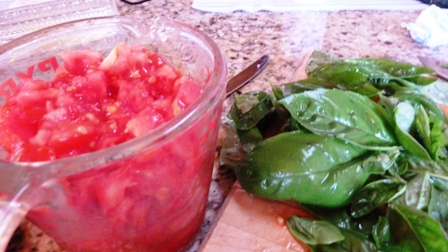 One of the things I learned to make and adore with my recent plea asking “What to Do With a Lot of Basil” (if you saw that post) is a versatile mash up of tomatoes, basil, garlic and some sort of vinegar and oil.
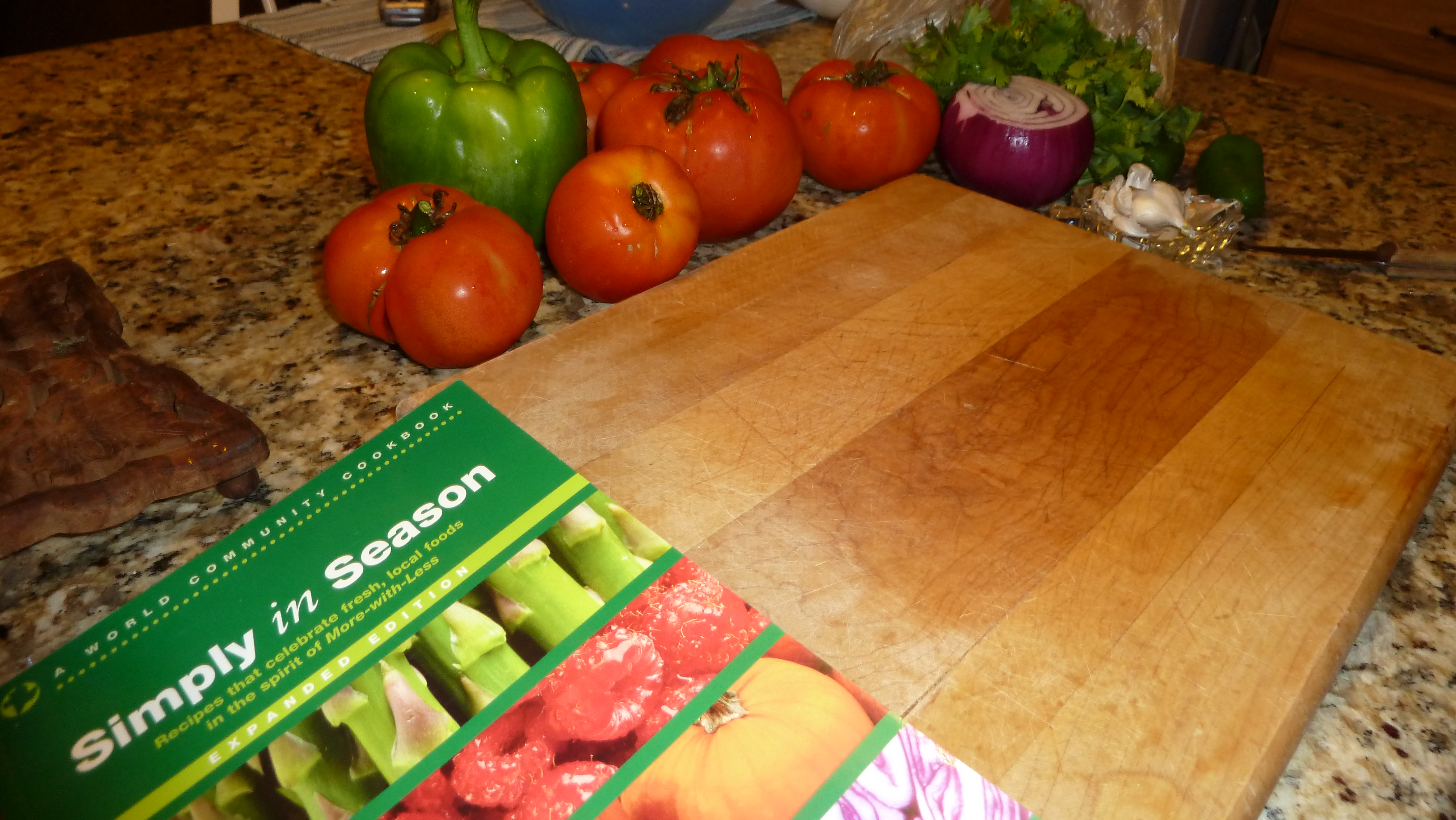
I had read Jennifer Murch’s swoony serenade to bruschetta, and checked the Simply in Season recipes for Greek Tomato Salad and for bruschetta (p. 102 and 172 in the original edition respectively, and also included in the new 10th anniversary expanded edition). Technically, Wikipedia says bruschetta is an antipasto (appetizer) from Italy consisting of grilled bread rubbed with garlic and usually topped with olive oil and salt.
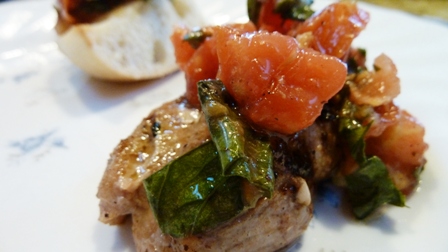
When I made Jennifer’s version, I did not have any balsamic vinegar so I used plain old apple cider vinegar. I also used about twice as much basil because, well, you know, I wanted to use my plentiful supply. It was splendid and I plunked it on half a Torta roll (Costco) with fresh mozzarella. I took the extra to the office with some tortilla scoopers because, well, you know, that’s where you get rid of things. There were raves there as well (would the office lie?).
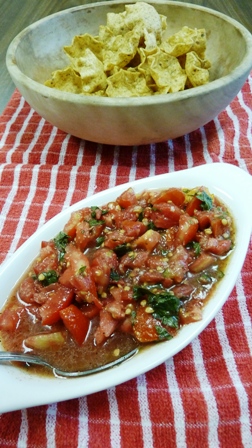
My youngest daughter was home last weekend so I made another batch of bruschetta-y stuff while she gathered and washed bunches of basil to make into pesto. She couldn’t believe how much basil was out there—like a CROP—half a garden row, not just a plant or two.
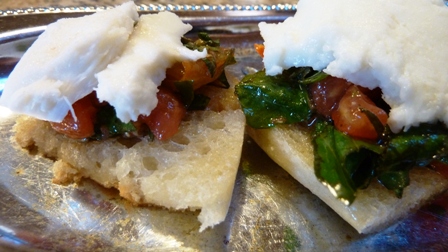
I bought balsamic vinegar for my new batch and still used about twice as much minced basil as the recipe called for. We had more bruschetta on Torta rolls.
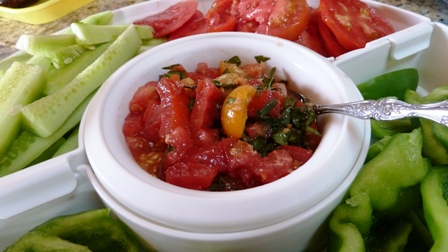
It was also excellent and I took it the next day to the church picnic with green peppers for scoopers and other fresh garden veggies.
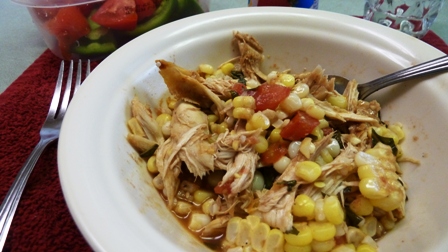
Finally, I used up the rest mixing it with fresh but leftover cut-off-the-cob corn, and hunks of barbecue chicken for a quick lunch. That was tangy but I would say the spices of the barbecue chicken (made with oil, vinegar, and lots of Pete sauce) competed just a little with the spices of the bruschetta mix. I’d guess using plain old hunks of sautéed or roasted chicken leftovers would be perfect.
And that is some of what I’ve done with the basil! It survived a round of Japanese beetles and keeps on coming. Guess I finally need to freeze some, using the method Carmen Wyse describes in my Whatever Happened to Dinner book. Carmen and her partner-in-crime Jodi Nisly Hertzler, food editors for that book, Jennifer Murch, my daughters, and great cooks among my many nieces and nephews have introduced me and others of my generation to some wonderful “gut” (like they say in Pennsylvania Dutch) flavors and dishes. My mouth will never be the same!
My variation for bruschetta type topping, or you might also call this a salsa without hot or green peppers:
Bruschetta topping or tomato/basil salsa
4 cups tomatoes, chopped
2 cups minced fresh basil (or less as you wish)
1/2 cup olive oil
1/4 cup balsamic vinegar (or apple cider vinegar)
3 cloves garlic, minced
1 Tablespoon sugar
1 Tablespoon salt, or less
1/4 teaspoon pepper
Combine tomatoes, basil, and minced garlic. Mix oil, vinegar, sugar, salt and pepper. Pour over tomato/basil/garlic mixture. Cover and let it sit at room temperature for one hour. Will keep refrigerated several days (3-5) and you can add chopped tomatoes to freshen.
Place on French or Italian bread slices that you’ve toasted or grilled in a skillet drizzled with olive oil. Or prepare the way I do garlic bread: toast slices covered with butter and garlic powder under broiler. See also Jennifer’s directions on toasting with olive oil. Or use as a salsa dip or whatever.
***

You can buy the new expanded, with recipe photos, Simply in Season here.
***
Or to sample what’s in the cookbook, download the PDF Sampler here!
***
Or, what’s your favorite recipe using lots of tomatoes from this now classic and well-loved best seller?
Last time I wrote a bit about why I wanted to go to Mennonite World Conference in Harrisburg, Pa. in July. While there, I loved the fact that at this MWC, as is the case at most Mennonite Church USA conventions for many years, those who would rather DO than just listen and talk are able to translate their beliefs into concrete service.

I also loved that the facility, the Farm Show Complex, has to be hosed down as it moves from farm and animal venue (they can house 5,000 large animals there) to people. I heard one conference-goer exclaim, “I wonder how much power washing it took to get it clean?”.
Richard Kauffman, an editor at Christian Century and long time resident of Pennsylvania who grew up going to the Farm Show Complex, wrote in a post on Facebook about the MWC’s search to find a suitable venue for the event. I asked his permission to share part of his backgrounder here, where he spoke of hearing friend Larry Miller, former executive head of Mennonite World Conference, reflect on how the decision was made to hold the event at the Farm Show Complex (also the annual site of the Pennsylvania Mennonite Relief Sale):

Larry Miller, left, with Rainer W. Burkart, a German Mennonite pastor.
“After having MWC a number of times in a row in Southern Hemisphere locales in a deliberate attempt to move the center of gravity toward where the church is growing and away from the European-North American orbit, it was decided to hold it again in North America. But then the question arose as to what kind of place.
[They didn’t choose] a big inner city convention center where people have to stay in expensive downtown hotels. Harrisburg was good because it is close to large communities of Mennonites and Brethren in Christ who can serve as hosts and help in all the logistical work. The Farm Show Complex, in comparison to many convention centers, seems much more modest yet spacious and is really seeming to accommodate our needs quite well.”—Larry Miller, as quoted by Richard Kauffman.
One of those needs or desires was to offer participants opportunities for action—both in half-day service assignments in the local area, but also right on the grounds. Here are the descriptions of the service projects that were planned. I wonder if other national or international denominational conferences offer this service dimension—certainly a part of their faith experience, but I do not have enough experience with other such meetings to know.
Mennonite Disaster Service set up a site to frame walls for two homes for people who’ve lost theirs. I loved seeing the inside of the disaster recovery trailer: the kind of organization many a homeowner would LOVE in their shop, garage or basement.

It looked and felt hot out there on the macadam of the Farm Show Complex, so pounding a few nails was not for the faint of heart (I spied one woman among the six or so workers when I did a quick walk by).

Mennonite Central Committee set up their amazing cannery on wheels.


Placards told the larger story, and I’m told that green beans and corn (what else, in July?) were processed in the facility that week, but I did not see it in action.

Later I learned this was the first time the cannery was used for veggie packing (3500 cans!). I was a little disappointed to learn though they used frozen beans purchased through a local grocery. (Well, okay, that would have been a lot of ripened green beans to find, pick, and get to Harrisburg!)
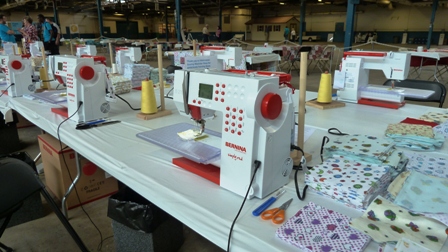 Finally, for those wanting a sit down job inside, there was a massive comforter making effort, and even quilting (see last two photos). Here is a photo essay of sorts, including instructions to the crew who set up the machines loaned from the Hinkletown Sewing Machine Shop,
 and helpful steps in daily organization of 80 volunteers!


Monthly sewings, on a much smaller scale. produce much more than conversation and camaraderie in many Mennonite, Brethren and Conservative churches throughout the U.S. and Canada.
All of this, in retrospect has one huge theme running through it and its not just service, relief, love, or Christian help. It is O.R.G.A.N.I.Z.A.T.I.O.N. and truly that is a key behind what makes this work. MCC and MDS are smart enough to know that too many volunteers can be as unhelpful as too few. For this week, instructions indicated that: “During each time slot, we will have space for 84 people to make comforters, 20 people to prepare corn for canning and 30 people to help build houses with MDS.”
When my parents visited the various countries and relief sites in 1967 after going to MWC in Amsterdam, they reported how Christian helping agencies were so much better organized and efficient in getting donated and purchased goods and foods distributed than the governmental agencies there. Dad was both fascinated and appalled to learn that so much of the seed or grain shipped at that time to help feed the hungry rotted in the warehouses or holds of ships because of lack of organization on the ground to get the materials to people who needed them. Dad was touched to see how after bags of seed were divvied out to recipients, on one distribution platform he watched as first one man gathered up what was left over, and then a second cleaned up what even the earlier scavenger had left. True story? I cannot vouch for it or prove it now, but Daddy told it to dozens of organizations and churches who invited him and my mother to come and share their learning in the year following their trip around the world.
That penchant for well organized service helps to make MDS and MCC so successful and consistently win praise from local people and media alike. Personally, one of the most frustrating and common aspects of doing a day of volunteer work in a new setting is the amount of time you spend doing nothing—people standing around until they have clear direction, instruction or specific work assigned for the day—and the tools to get it done. If I’d had more time there, I likely would have opted for cutting out squares or shapes for comforters—especially with the time-consuming organizational part all taken care of!

I loved seeing even men, who sounded like they were talking Spanish—tying comforters, and the finished piles of many blankets to warm and cheer folks around the world.*

I would be remiss not to mention that what I also saw at Mennonite World Conference were faces–some familiar:
My former Mennonite Media boss, film maker Burton Buller (left);

Former Mennonite Publishing House editor, J. Lorne Peachey, one of my first editors, passing out the nifty recycled registration bags:

MennoMedia’s former board chair, Melissa Miller (far left), a pastor near Winnipeg;
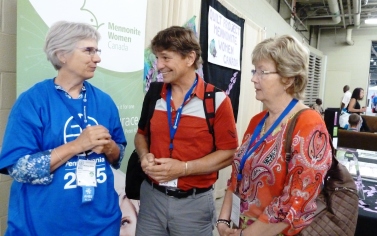
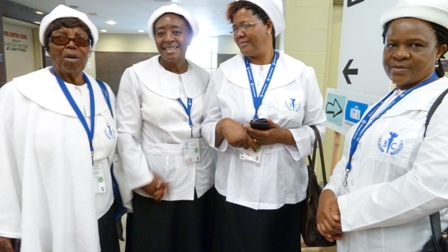
Some new sisters in the faith from Zimbabwe I spoke to briefly and got permission to show their outfits, white blazers and hats–traditionally worn for special church occasions like baptisms or celebrations;

Some European Mennonites–two German pastors, one Mennonite and one Lutheran (I’ll write about their workshop in a final post from MWC);
And too many old friends (some from high school) and former colleagues too numerous to mention.
Truly for many, these meetings are like family reunions–a family that now reaches around the world. As Larry Miller hinted at above, about 81% of baptized believers in MWC member churches (including Brethren in Christ) are in Africa, Asia and Latin America; only about 19% are located in Europe and North America. The Mennonite/Anabaptist world has shifted.
Thanks be to God.
*Find many more MWC photos of people engaged in all of the service activities on the MWC Facebook page.
***
Which service activity would you choose? Comforter making, canning or building?
***
Any stories or shout outs about well-organized service activities? Any service disaster stories? (Be kind, don’t name names.)
***
My very first book was written about a year of voluntary service near Hazard, Kentucky, and published by my current employer, MennoMedia/Herald Press. You can still get used copies on Amazon!

So, I do NOT have cucumbers coming out my ears this year. Last year and the year before, we picked and gave away literally thousands, that’s THOUSANDS of the sometimes prolific vegetable that is every dieter’s friend in its raw state. Hundreds of web searchers found my recipe for Midget Sweet Pickles. (Which are NOT a dieter’s friend in their super sweet state.) The recipe ranks 7th in popularity posts from this past year! Who would have guessed? Midget sweet pickle are also known as sweet gherkins especially in the U.K. and Australia.

But this recipe is one hundred times easier and also great! I was delighted to find that Lois Priest’s recipe below, which she submitted for the Whatever Happened to Dinner recipe collection a couple years ago, is truly as fast (at least when it comes to pickles) as Lois always told me. (Lois is the shipping supervisor for all those books and Sunday school materials going out from MennoMedia and Herald Press.)
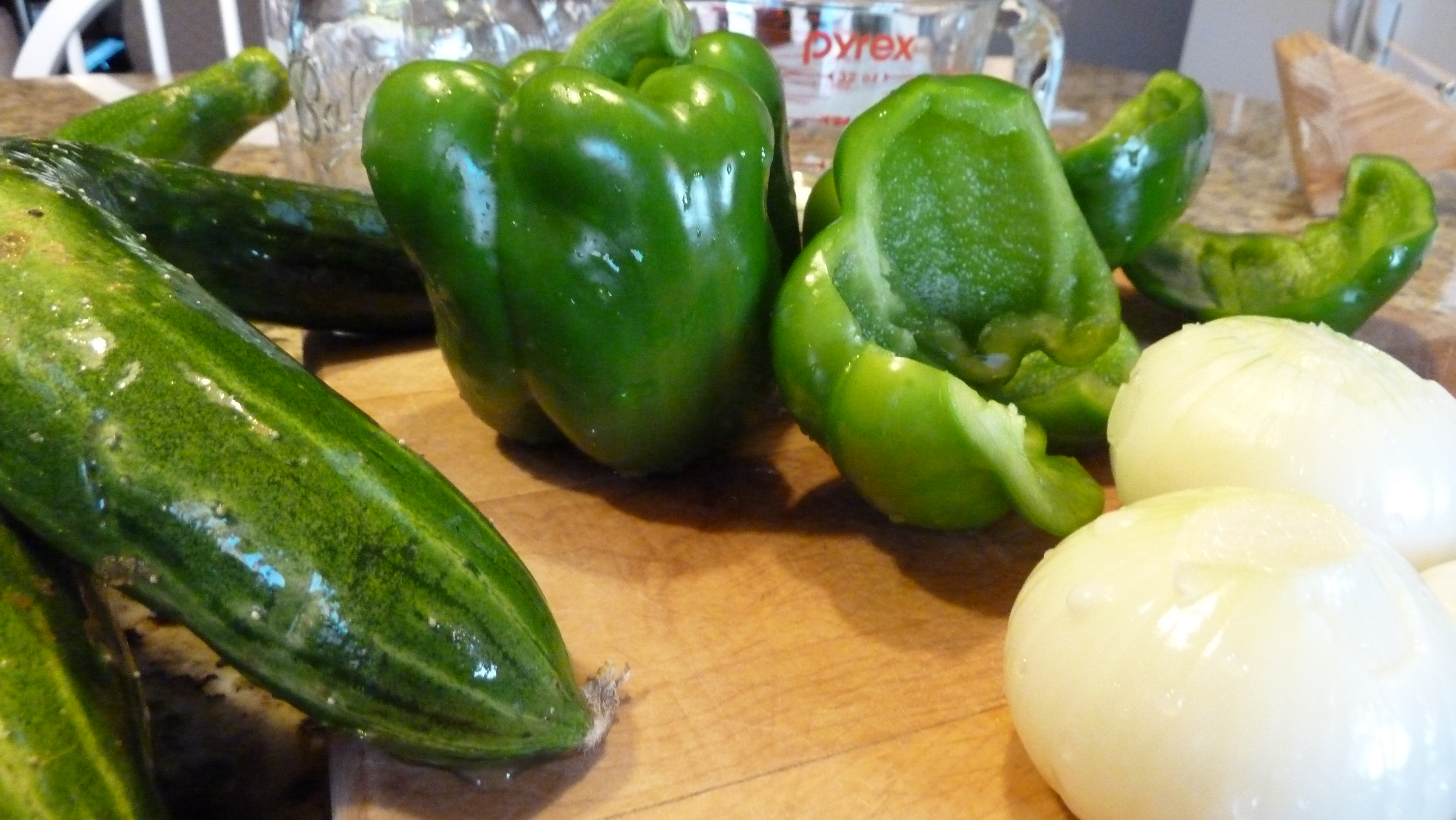
So, if you have cukes, green peppers, onions and a few pickling spices, you’re in business. I whipped these out in about one hour, two small batches (taking about one half hour each), 4 pints altogether. If you have hundreds to can like I did last year, you’d be better off looking for a recipe that process gallons at a time, not cups. But if you have small dribbles of cucumbers and wish to do something with them so they don’t go to waste, Lois says she often does just a batch after work in the evening. This recipe is perfect for that.
(Note to self: do not plant the super long variety of cucumbers again. I don’t much like them. The vines seem to have been susceptible to a blight or something that killed vines off very early (see issues here) and the cucumbers themselves soon shrivel up after they’ve been picked. Other cucumbers I’ve raised other years kept beautifully in the fridge for at least a week, sometimes two.)
Microwave Pickle
From Lois Priest, with her note included in Whatever Happened to Dinner.
This was given to me by a friend several years ago. It is the only pickle I make, because it is so easy and quick—and good too. I even chop some to put in salads. I make many batches each year, usually 30–40 pints.
3–4 cups / 750–1 L sliced cucumbers
½ cup / 125 ml green peppers, cut in strips
½ cup / 125 ml onion, cut in strips
1 teaspoon salt
½ teaspoon turmeric
½ teaspoon mustard seed
4 teaspoons celery seed
½ cup / 125 ml vinegar
1 cup / 250 ml sugar
Photos and instructions below:

Put sliced ingredients in large bowl.
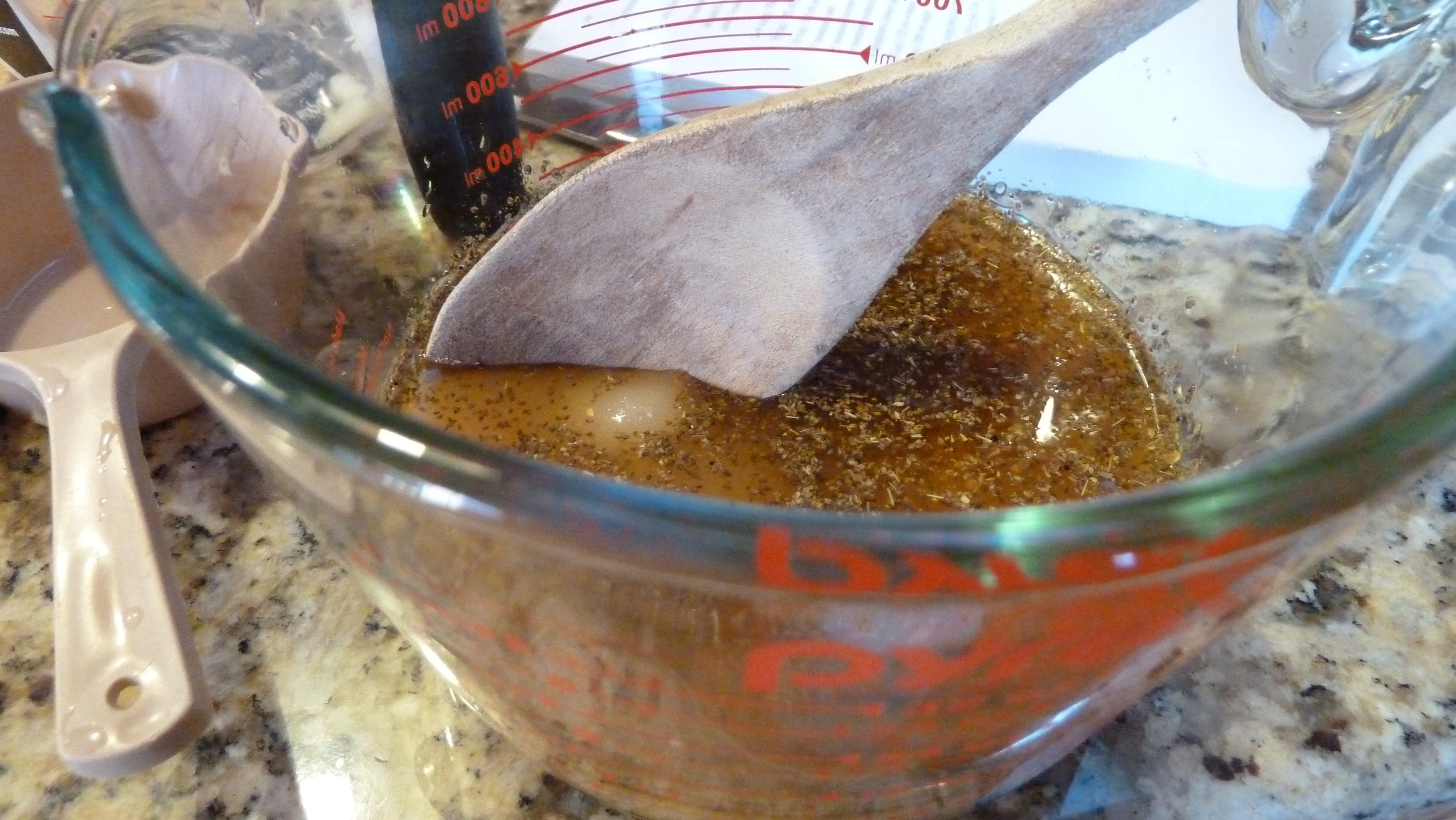
Combine spices, sugar, and vinegar, and pour over the vegetables.
Stir to coat well. Cover bowl tightly with plastic wrap. Microwave for 7 minutes.

This is what they looked like when they came out of the microwave, all air sucked out and plastic down tight on the contents, but no plastic melted.
Remove and place into pint jars. Put on canning jar type lids and rings to seal.
[My note: these do not need to be placed in a boiling water bath. They will seal themselves as they cool off.]
Makes 2 pints. (I made two batches with 2 pints each.)
Cleaning up the dishes and utensils after took about as long as making the pickle!

There are two pickle recipes in my book, Whatever Happened to Dinner, one for cucumber relish, and one for these microwave pickles.
And if you haven’t heard, there’s a giveaway for this book going on over at Amish Wisdom, until August 7, 2015.
Three copies are offered. Check it out!

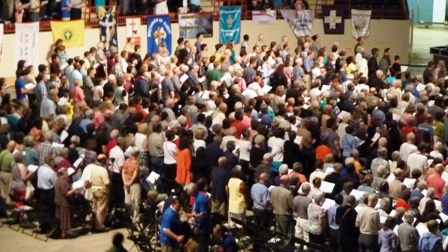
Why Did I Want to Go to Mennonite World Conference in Pennsylvania?
I went for my father.
My father, Vernon Miller, (mostly of Goshen, Indiana,) was a farmer most of his life who dropped out of school but caught a bigger version of the world through his service experience during World War II. As a conscientious objector, he served God and country in Civilian Public Service camps for four years where leaders, church historians and theologians gave him the “college” education he did not get otherwise, exposing him to Mennonite history and thought. He preached to us all of his life of what he learned—about Jesus as the way of peace and how we needed to love our fellow brothers and sisters all over the world no matter what color, creed or occupation. Dad invited into our home international visitors (with mother’s support, but she worried more about the extra work visitors entailed) whenever that opportunity presented itself: international students at Christmas, longer term exchange students, agricultural interns, singing nuns from Brazil, and more.
Thus it was that he and mom decided to sell a few hogs in order to go to Mennonite World Conference in Amsterdam, Netherlands in 1967—and while planning to cross the pond decided “rather than turning around and just flying back home” they would visit some of the many people we had hosted in our home. They would take in the Holy Lands and continue on to India and the Far East. They “Mennonited their way,” staying on mission compounds with people they had long supported and prayed for through Mennonite Board of Missions, and saw first hand how food and material goods or animals sent through MCC, CROP/Church World Service, and Heifer projects were actually distributed.
They ate up World Conference and the rest of their around-the-world trip. I guess the seed for my own desire to someday go to a Mennonite World Conference was planted, which only happens every six years and rotates among five continents. I doubted a closer opportunity would ever come in my lifetime.
I went for my mother.
My mother still enjoys recalling the social and cultural surprises of their far flung journey. My mother and her first cousin, an avid singer and worship leader who also attended that World Conference, recalls now the “shock of seeing those cigarette-smoking Holland Mennonites” (the photo that rocked many a Mennonite’s world is still often shared today through social media.
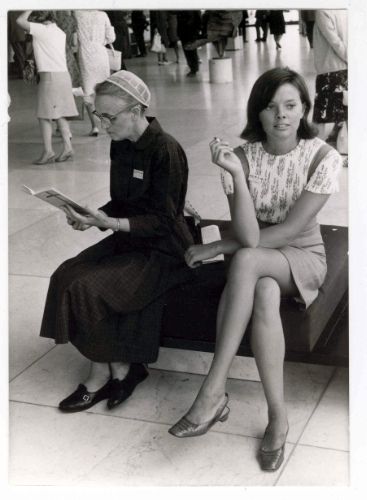
Amsterdam 1967: Left, Fannie Peachey, Rosedale, Ohio, USA; (on right) non-Mennonite guest attending the conference and staying with a Mennonite couple in Amsterdam. Photographer: Tijn Olij-Spaan
In Amsterdam, Mom and Dad were hosted by a Dutch couple who ran a bakery. Yum, what smells and pastries they enjoyed, and they told us their stories of communication gaffes across languages, and how they craved plain old simple water but couldn’t get anything but seltzer in restaurants. And how they were surprised and a bit saddened to see that their hosts—and other local Dutch Mennonites—didn’t pay that much attention to the events at the conference, and did not have time to attend. While many many Pennsylvania Mennonites attended this conference, of course, there were many more who didn’t or couldn’t attend, nor maybe have much interest in attending. Indeed, if they had, there wouldn’t have been room for the thousands of guests from around the world. It’s the old story of when something is in your backyard or your own town, you seldom take time to visit what travelers go out of their way to see.
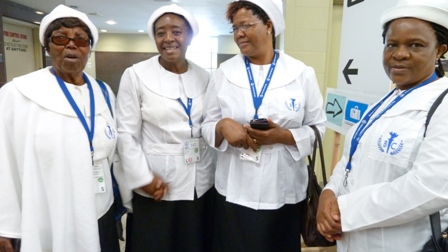
Four women from Zimbawbe, wearing the traditional “celebration dress” they wear for church baptisms and special days. MWC was indeed a celebration time. They gave their permission for this photo.
My mother loved and still loves to travel; she turns 91 this week and while going to something like a major meeting would have been over the top for her to tackle at this age, she was so excited that I planned to go, remembering how much Amsterdam 1967 meant to her and Dad.
I went for me.
Truth be told, my parents’ travel bug passed down to me and as a writer, I hunger after and feed on new experiences, sights, sounds, connections, conversations and inspiration. My dear husband gets this, and did not question or complain about me heading off on this adventure on our dime. Even though I work for a Mennonite organization, our budget there is stretched to the max and I did not have the opportunity to go there on a work assignment. But it was kind of nice to just go and not have duties at the convention like I have worked so many national church or regional conferences, or professional and trade association conventions.
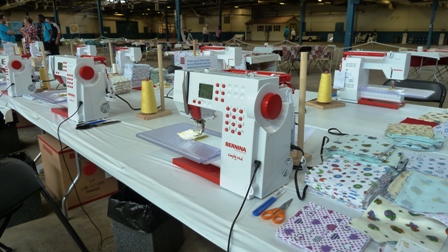
So even though I could only go for one day, I tried to soak up all that I could. Sometime I’ll write more about what all these sewing machines were doing at a Mennonite convention;
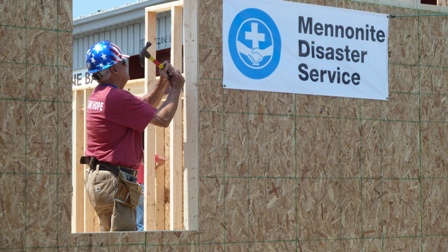
what a guy wearing this hard hat was up to;

and what this unusually-equipped semi truck trailer was doing in the parking lot of the Pennsylvania Farm Show grounds and complex.
I was able to take in two fascinating workshops—one led by two German pastors—one Lutheran and one Mennonite talking about the Mennonite/Lutheran reconciliation of the last decade or so (and if you read my recent blog post here you’ll know why I wanted to go to that one). The other workshop was led by a woman from the Netherlands and I could imagine my parents’ Dutch hosts through her charm, trendy haircut and European style.
I went for future generations.
I was “trip morning excited” as I loaded my minivan at 5 a.m. for my short three hour drive up to Harrisburg. I took in the fresh summer air and thought of my parents in 1967 packing for their around the world trip of a lifetime, and how pinch-myself-is-this-real-thrilled they must have been. I also thought about how keyed up many of the visitors from Zimbabwe, Tanzania, India, Japan, Indonesia, France, England, Mexico, Paraguay and South Africa and many more countries must have been as they prepared to come to the U.S.—for some, surely also the trip of a lifetime. Travel and hosting others, when done with the right approach along with equal measures of care, compassion, and patience, is one way to reach across so many fences and walls that threaten to divide us as a world wide family.
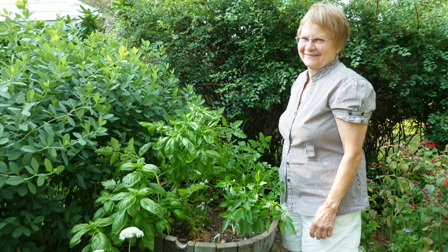
College friend, Nancy Landis.
Oh and P.S., I too Mennonited-my-way staying overnight with a college friend. That was a treat and a good reminder to keep and nourish the friendship connections we have whether in our backyard, the next state, or another country. Thanks, Nancy!
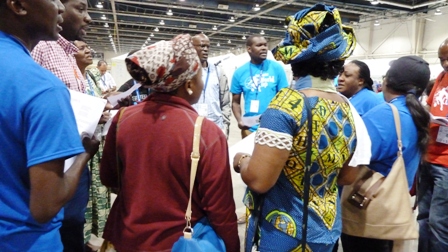
One of many informal singing groups sharing music from their own culture.
Finally, I went for the music.
It was awesome and pretty close to my vision of heaven. Here’s one I got to enjoy.
***
Do you enjoy large church assemblies or gatherings, no matter what denomination? Mennonite World Conference calls their every-six-years gathering a “reunion.” What is your take on the purpose and meaning of such gatherings? Your thing or not? If you went, what did you enjoy most? What was hard?
***
For a playlist of 14 music videos from MWC, check here.
***
For more on Mennonites, go to the website I help curate: www.ThirdWay.com
Book review: Called to Be Amish
The back of the book asks, “Ever wish you were Amish?”
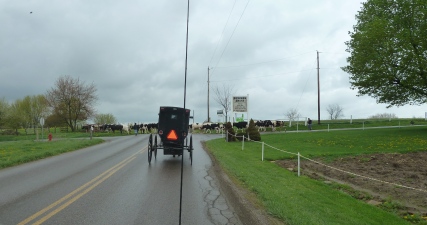 Cows crossing the road in Ohio Amish country.
I know some people who have wished that–perhaps fleetingly–traveling through scenic rolling Amish countryside where horses, buggies, kids in cute carts, and neat farms with beautiful vegetable and flower gardens line the highways. We sometimes think of Amish life as quaint, picturesque and all about family, food and farm.
I can’t say that I’ve ever wished to be Amish but in reading a memoir recently, Called to Be Amish, I was taken back powerfully to my own Amish roots (grandparents who grew up Amish) and made to think of my wonderful Amish neighbors growing up, and close grade school friends.
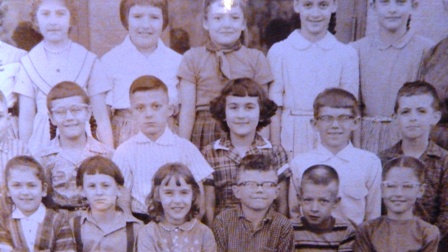 3rd grade class at Middlebury Elementary. Bertha, lower right, first row, rode my bus and we sometimes sat together. Ten of those pictured were Mennonite, Conservative, or Amish. I’m middle of “tall” row.
Marlene Miller’s book in the Plainspoken series from Herald Press (disclosure: one of my employers) destroys some of the picture-perfect myth with its relentless portrayal of the hard work inherent with this lifestyle: barn chores, field work, housework, childcare, cooking, canning and cleaning—in addition to Marlene’s husband working in a factory 8-10 hours a day. While this memoir is also a sweet lifelong romance story, much of it deals with the hard realities of every day life.
I was charmed when I read how Marlene met her husband-to-be in almost the same way I met mine—on skates! Different kinds of skates and rinks, and a small difference in who spoke to whom first, and different faith backgrounds, but the same scenario.
First a romantic passage from Called to Be Amish:
As I was making my way around the ice, I noticed a very nice-looking eighteen-year-old Amish boy and his friends skating very well. This boy wasn’t wearing Amish clothes, but I knew he was Amish because of his accent. He really impressed me. I thought he could skate like a pro because he could skate backward just as well as forward.
“Hey, would you teach me how to do that?” I asked. He took off, demonstrating some of his skating techniques … especially making beautiful circles going backward. I took off trying to skate just as he had done …
“No,” he said, you’re crossing your feet over the wrong way. Don’t pick up your foot so much; just let it flow on the ice.”
Then the whiz skater noticed her loose laces and bent over her feet to tighten them, which he said would help her skate better. Marlene writes:
Johnny Miller was so kind and gentle while he tightened the strings on my skates I think I started to fall in love with him right then.
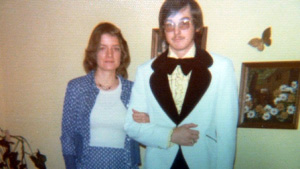
And now a maybe-romantic scene from my own first encounter with my husband-to-be (which I’ve long promised to share and which I’ve never actually published, but I’ll set it up like a quoted passage):
One of my apartment mates my senior year at Eastern Mennonite College was going skating at the new roller skating rink in Harrisonburg and invited me to go along on a Saturday night. I had planned an enticing evening of study. Barbra explained how some of her friends had started skating just to unwind from stress and homework, and how it would do me good, too.
So I agreed to join them. But as I was making my way gingerly around the rink after not having been on roller skates since junior high or high school at Eby Pines Rink near Middlebury, Ind., a guy I’d noticed hot-dogging around the rink skating backward and forward called out to me, “Bend your knees, you’ll skate better.” Was it a pick up line?
I blushed and tried to do so but still likely looked as stiff as I felt. As he passed me again, I probably smiled and shrugged in a gesture of “this is the best I can do” and at some point asked him how everyone took curves so smoothly.
After hanging out with Eastern Mennonite guys the three years I’d spent on campus where everyone was “just friends” and dates were rare, it was, frankly, nice to be noticed. When he finally asked me to skate on a “couples only,” lower-the-lights skate, I panicked momentarily, worrying about what my EMC friends would think of me skating with a “local.” But then I decided I didn’t care.
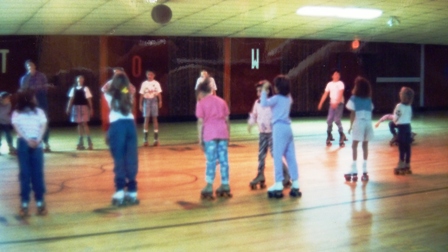 Skatetown in Harrisonburg at our daughter’s birthday party many years later.
Under the red light hanging from the ceiling is near the spot we first met.
So even though Marlene was an Englisher who became Amish as she dated and eventually married Amish-raised Johnny Miller she met ice skating, and I was a Mennonite girl who eventually left the Mennonite church as I dated and married Stuart, a Lutheran, (and together we became Presbyterian, touched on briefly here), I could identify with that fluttery butterflies-in-your stomach feeling.
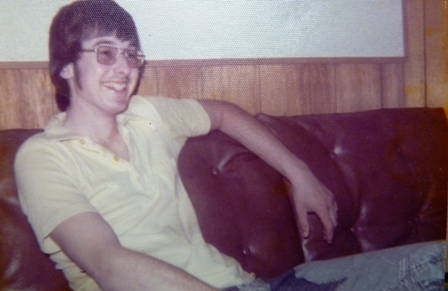 Top, my husband-to-be when I first met him.
Bottom, dressed up for his brother’s wedding, 1975.
I did not come from a difficult or abusive home background like Marlene, but when she also describes the flirting between Amish and English that could go on even while doing the backbreaking, intense, filthy, and stinking job of catching chickens and loading them on trucks in the dark of night, I found other connecting points in Called to Be Amish.
Marlene writes of making and wearing her first buttonless cape dress, the kind where Amish use straight pins pushed through the cloth opening to hold things together, and the gicks you receive to your flesh as you move about in the dress. Oh my! Gicks was a Pennsylvania Dutch word? We had always used that in our home for something that pricked or stuck your skin, but I do not think I knew it came from Pa. Dutch.
The same mouth-dropped-open feeling came to me when she talks about teaching her child that something was bache or yucky (and she uses the word yucky in her book to help explain the meaning). If I ever knew bache was Dutch, I do not remember that now. I was well aware of many other Pa. Dutch words that sprinkled our conversation because my father loved using it on us, and whenever he’d talk to his Amish friends, or occasionally with his dad and mom who lived in a “dawdy” type apartment attached to our own farm house. Schushlick, (uncoordinated); strubblich, (messy, as in hair); doppich, (inclined to drop things) and oh yes, shiesh stihl (shut up, slightly vulgar)—were all words we knew and used (and my spellings may not be quite right here.)
I also stepped back in time as Marlene wrote about her husband or oldest son climbing up the silo rungs to throw pitchforkfuls of silage down the chute. The dangerous levels of fumes in silos are something to be very careful about of course, and my dad was always careful about making sure proper ventilation was maintained. Somehow as the third daughter, I don’t specifically recall throwing down silage but I certainly remember the smells and watching my older sisters climb those high rungs. (We no longer used the silo when I would have been big enough to handle that responsibility.)
Back to the present: these days one of my tasks is working long distance with Old Order Amish columnist and cook Lovina Eicher, which MennoMedia began syndicating a year ago as “Lovina’s Amish Kitchen.” Lovina and her mother before her, the late Elizabeth Coblentz, has made a cottage business out of sharing a weekly recipe along with the ups and downs of her family of eight children, the oldest of which is planning to get married this August. So Marlene’s descriptions of preparations necessary for an Amish wedding and holding church service for hundreds in one’s home (or barn, as the case may be) are fascinating, and a reality which Lovina, my work colleague, (from a distance) is living.
If you want to catch up with that kind of authentic Amish living from scribe Lovina Eicher, head over to Lovina’s Amish Kitchen blog where her column is posted each Friday after it has appeared in newspapers, or join the Facebook page we manage for her at Lovina’s Amish Kitchen.
And if you want to read 50 years worth of Amish living from the viewpoint of a non-Amish woman turned faithful and committed Amish—with homemade cape dresses, pinpricks and all—check out Marlene’s memoir. This is an Amish romance in real life, complete with Marlene’s own unplanned pregnancy, deep despair when life with three children all in diapers threatens to overwhelm her, tragic turns, and ultimately a faithful love that lasts a lifetime.
 ***
***
Have you ever thought you wanted to be Amish? How and why? Why not?
Or if you are formerly Amish, or your parents were, we’d love to hear from you her here!

When it’s hot like it’s going to be today, this fruit slush is refreshing, nourishing and satisfying (and oh yes, it just might spike your sugar level). Or, for a breakfast treat with morning coffee.
My friend at work, Kimberly Metzler, made this for a special break once and shared the recipe. She says when she makes this she also freezes some in individual sized containers to pack in her husband’s lunch thermos. It thaws just right by lunch time and helps keep the rest of his lunch cold, too. He has a lawn mowing business so I’m sure it tastes really good in the middle of a hot day.

Peachy Fruit Slush
6 oz. can frozen orange juice (my grocery store doesn’t carry 6 oz. sizes so I just used half a 12 oz. can)
3 cups water
1 cup sugar
Heat water to melt the orange juice and sugar; mix together. Chill.
Add
1 – 20 oz. can crushed pineapple (and natural juice)
2 quarts or 2 – 29 oz. cans peaches and juice, chopped slightly in blender (I used lite sugar sliced/canned)
(If you have fresh peaches to use, I’m sure they’d be divine!)
Plus add any other fruit you want and have on hand, to your liking
½ cup blueberries
1 cup sliced strawberries
1 bananas, chopped

Mix together, freeze. Thaw slightly to serve.
Adapted slightly from Kimberly Metzler.
***

What’s your favorite cooler on a hot day?
***
Kimberly and other colleagues from MennoMedia/Third Way contributed numerous recipes to the collection of nearly 100 tasty dishes in my book, Whatever Happened To Dinner? Find out more here or purchase.
***
This is my 300th post on this blog! The recipes I share here were inspired by the experience of working on the Whatever Happened to Dinner book with my colleagues. If you’re on Facebook, head over to the Whatever Happened to Dinner Facebook page to spy the recent cover picture (courtesy of my daughter) of grandson Sam, learning how to blow his food to edible temperature! And if you’ve never “liked” the page, I’d love it if you would click that! Thanks.

 findingharmonyblog