

A Kitty Living Will
I wrote this for our daughter 15 years ago when she was a freshman at College of William & Mary and her beloved cat, Boots, had already had one surgery for a malignant lump on her back; Michelle helped pay for one operation and we paid for the second, but beyond the money, I began to feel like too much treatment for animals bordered on inhumane and there comes a point at which you just have to let go … and I hoped this would help Michelle deal with her pain and grief.
If cats could speak (or write) for themselves, maybe they would say something like this. Michelle recently ran across this in her files and emailed it to me, sniffling some tears.
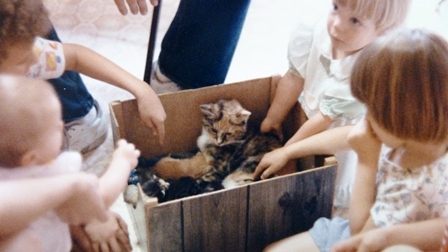

Bottom left: Boots at birth with her mother Shelly. Upper right: Shelly with her litter of five kittens including Boots, admired by sisters Doreen and Tanya, right, and first cousins Cathy and baby Robin, left.
A Kitty Living Will
I, Boots, having just gone through a second major operation in three months, being of relatively sound body and slightly peeved mind, do hereby state that I do not wish to be subjected to any more such ordeals.
Everyone has been most kind; I’ve been handled lovingly, gently, cooed at, admired, praised for being so gentle. But that can’t make up for the fact that, as a cat, my very catness has been invaded.
I’ve been made to go to bed without any supper, made to stay inside against my will, even when I had to GO all because I had this stupid appointment at the veterinarian’s. Moreover I had to get up and not have any breakfast: you humans can be told what is going on, but all I could do was guess: okay, what’s up with this? Are they just being mean, or are they planning to sneak me off to the hospital again. It can’t be that, not again, so soon. I don’t ever want to go back to that place.
The indignity! Going to a place that serves … dogs! In the same place. I know I’m not supposed to be prejudiced, but come on, dogs? Our arch enemies?
Being put in a cage, like a wild animal? Oh sure, I hiss with the best of ‘em, but I am meek and gentle of heart. A genuine lap cat, even if I still like a little roaming and hunting now and then to keep me young.
At the hospital someone pokes me, sticks me, shaves me.

Well, soon after that, I don’t feel anything, but buddy when I wake up, it is hangover city, staggering around like someone who’s drank too much. (I think they drugged me.) I don’t feel too bad, just look like …. a cat out of you know where. Then I have to retch. The mortification!
Well at least I got to go home by evening this time and not stay overnight in that dark and smelly place in a cage while all the nice people go home. No one to tuck me in. No one to talk to, except other cats meowing madly and dogs yelping like wimps.
Even now I face a daily ordeal of swallowing pills morning and night, – count em! Why do they keep choking those things down my throat? And for what? Then I will have to go back to the doctor where he pinches and hurts me to remove my stitches.
No, a true cat, a real cat, just lives his or her nine lives as they come, none of this pussyfooting in and out of vet offices, getting poked, pilled, puked and “puffed” (to use Aunt Debbe’s term).


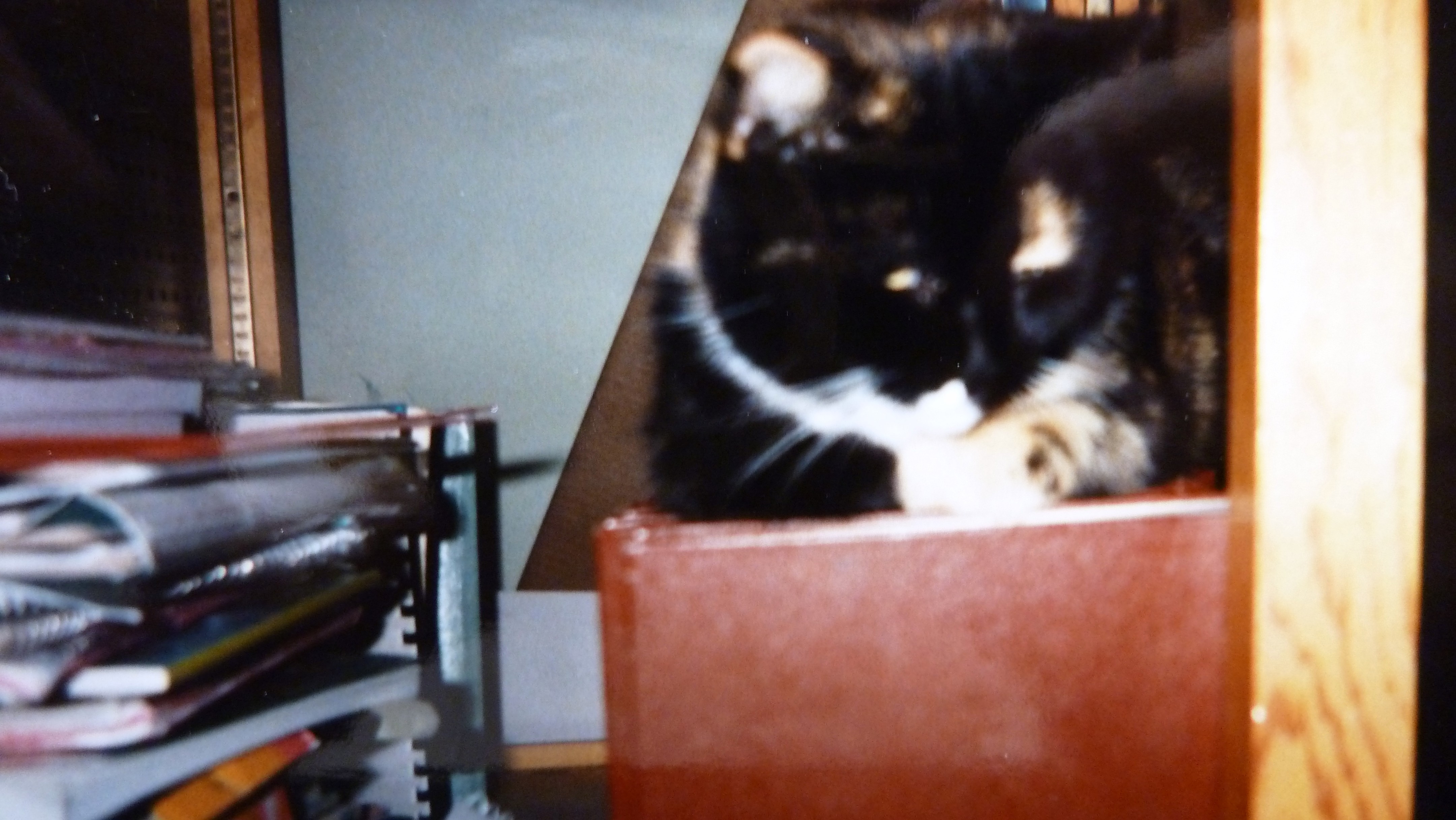
Therefore, as a true brave cat, who has been more loved than most cats in this world and better than I probably deserve, I do humbly request that you just let me be; if the growth comes back, I’ll just take my lumps and with a little bit of luck maybe it’ll just go into remission for awhile. Maybe my nine lives are about up. I don’t know.
I do know this: I’ve been a lucky lucky kitten to have you for my mistress all these wonderful years, far longer than anyone ever dreamed a cat could live at the Davis house. Remember how I broke that spell of bad luck, and taught every kitten after me the wonderful Art of Skillfully Dodging Cars While Fearlessly Hunting Mice Across the Road? Rats, that was fun! Remember how you used to dress me up like I was a living doll? Hey, I kind of like that name, living doll.
Oh, don’t get me started, I’ll have you crying, and you need to be at your best right now, going through your first major exams of your college career.
Speaking of which, don’t feel badly; we both knew this time was coming, when you would go off to college; but would I have traded all those years of being “most loved cat?” I think not.
 Boots and her special box of Kitten Chow she
received from Michelle every Christmas.
In fact, that fact of being “most loved cat” gets me through this tough time even now. Knowing you are happy (except when thinking about me) makes me feel very smug and perfect: I sure did a good job of raising you.
I do not delude myself. After all, I am a cat. I’m quite happy with what I am, and that means cats stay home and girls go to college. And since I am a cat, please, please don’t worry too much about not doing all you can for me in my sickness. After all, they shoot horses, don’t they, not to coin a phrase. And don’t cry, except for tears of joy, maybe, because you have made me probably the happiest cat in the world!
Or maybe go ahead and have a good cry, it seems to be what humans do. You will feel better then. Just don’t worry. I’ll be just fine, whatever happens. –“Hakuna ma ta ta.”
Your loving cat,
Boots, “Bootie,” whatever.

Boots and Michelle after Boots’ first surgery.
***
I’m sure there are situations under which others are compelled to make different choices regarding invasive procedures for much-loved pets, but this is what felt proper for us and Boots. Two years ago we faced similar dilemmas with our beloved dog, Fable.
***
Dedicated to dear Dr. Kathy, an A+ veterinarian at Waterway Animal Hospital,
who would be ours if she didn’t live in another state.
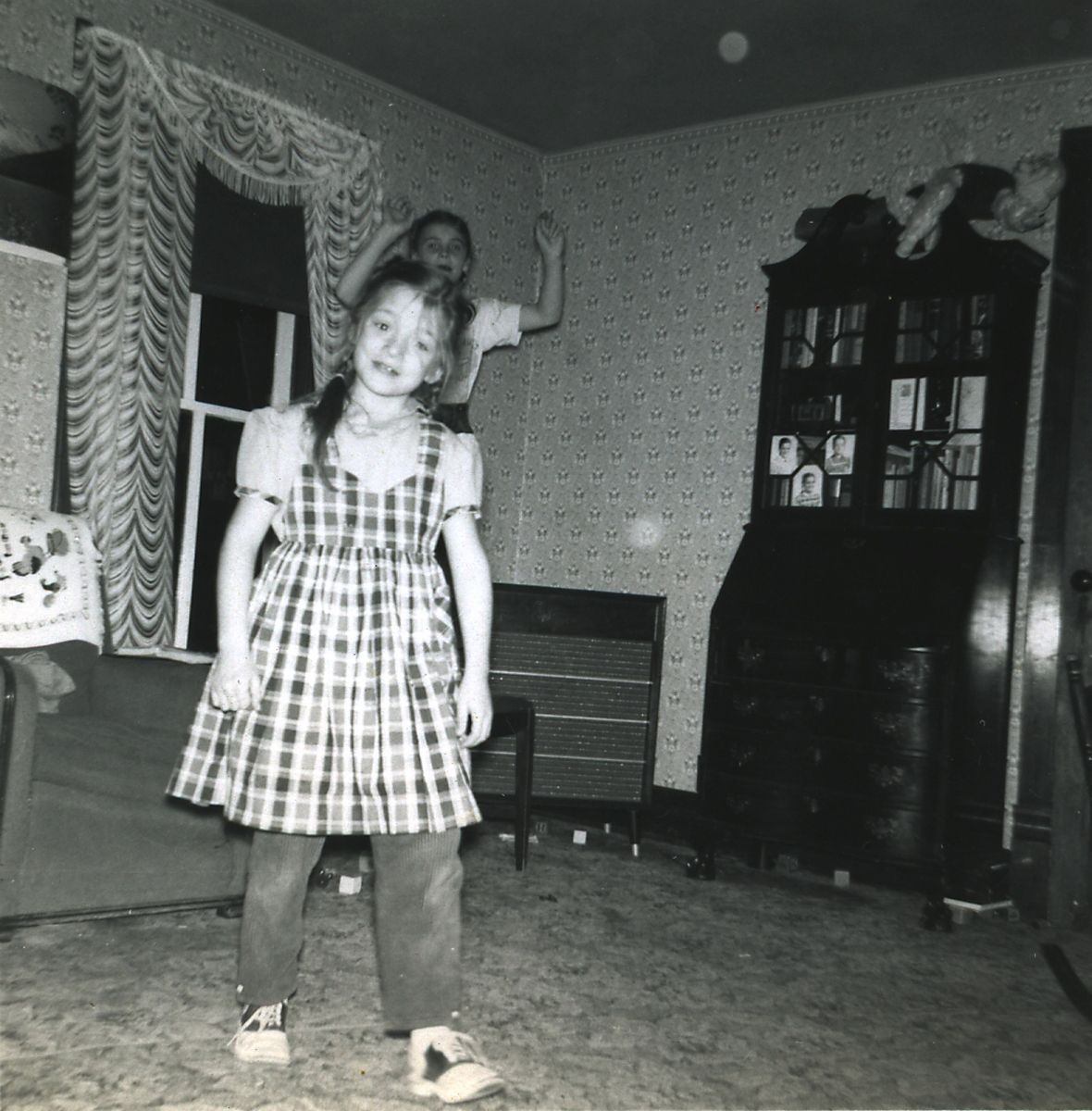
I love this picture even though I am ditzy-looking and have on a horrible outfit. It shows how we used to wear pants under our dresses for warmth even when not allowed to wear them (unless helping with heavy-duty farm work). I love the throwback wallpaper, hi-fi, the plastic curtains. I especially love seeing my saddle shoes again. This calls up so many good memories and if you are a child of the 50s or 60s, I hope it does for you, too. I think the year was 1958.
So what is going on? Just one of our favorite activities when Mom and Dad would go away for an evening. When they went away to a banquet or program of some kind related to the farm or church organizations they belonged to, we would crank up the hi-fi in the corner of the room. My middle sister would stand on a chair and conduct an imaginary orchestra. My little brother and I would stroll around “dancing” to the music. My older sister may have waltzed like this too but she would have been in junior high by this time and likely had too much homework to do silly kid stuff like this. And she likely snapped the photo—she was the first of us to have a real camera. (And my grandparents lived in attached in-law quarters so it wasn’t like we were totally on our own.)
Indulge me to take apart the photo some more.
- My dress: homemade (absolutely) and a pretty tricky pattern at that; mom must have sewed a blouse type top into a jumper-looking dress—all in one, I’m pretty sure. Mom made most of our dresses, which we wore to school and church. We bought some skirts, blouses and sweaters; the “bought” clothes were always my favorite items.
- My hair: What a mess. End-of-the-day pigtails, is all I can say. No bangs—we were not yet allowed to have cut hair.
- My expression: Loopy lane, I believe. My best imitation of waltzy and dreamy actresses and dancers on TV or in the movies. This was before we had TV, circa 1960, before I ever went to a movie, but had seen TV shows at neighbor’s or friend’s houses—when hour-long music/dancing/comedy shows like Jack Benny or Bob Hope were popular and acceptable family fare.
- My middle sister: You can’t see her outfit here, but it was a T-shirt tucked into jeans (sans the dress), which marked her status as Dad’s farm helper—allowed to wear jeans out on the farm as she worked in the barn or drove tractor or whatever.
- The “secretary” desk: The tall hutchy-looking thing with bookshelves was one of my mother’s favorite pieces of furniture: it moved with us to Florida, back to Indiana, and eventually to mom’s apartment in the retirement complex. She still writes cards and letters sitting at that desk with a front leaf folded down. Our school pictures from that year are stuck in the windows of the cabinet doors.
- The living room: Pre-remodeling and the advent of modern storm windows, old timey carpet. Looking back, it was a rather simple and spare living room.
But this photo also says exercise, enjoyment of music, making our own entertainment, interaction with siblings. If we fought, we also had to live with each other or were punished later. We all remember the time Dad went away to a committee meeting or something and one of us got into that precious desk and left crayon shavings in his pencil sharpener in the desk. Crayon shavings! No one would admit to it. We three youngest were severely scolded and sent upstairs to kneel down by our beds and ask God to forgive us for lying. I remember crying as I prayed, “God, I ask you to forgive me, but I didn’t do it.”
But those were mostly carefree times for those of us lucky enough to live in a home where yes, we were punished, sometimes harsher than we deserved, but also loved and respected and made to listen and work hard. We were never abused nor went hungry. I never had to deal with an alcoholic parent. Dad never touched the stuff, nor cigarettes, to my knowledge.
 L to r: Linda (Pert), Terry, Vernon (Dad), Nancy, me, Bertha (Mom).
We played together, vacationed together, read the Bible every morning together as this other picture shows from a similar era (although note we have cut bangs here, and my oldest sister Nancy has shorter hair). While this photo was very posed for a Christmas card one year, it reminds me of how much Dad and Mom invested in fun times for the family. The photo was taken in the log cabin Dad built by a pond in our pasture field. Dad chopped the logs for the cabin and mortared the space between the logs. It had a loft so there was space for 8-9 kids on floors for sleepovers and such. We’d retreat there on summer evenings for a picnic, a swim, a little fishing, horsing around rowing a pontoon raft, or a bigger party with chicken BBQ for groups from church or extended family.
We were not perfect, nor were our parents, but how grateful I am for the childhood I had.
Happy Birthday Poppa. He would have been 98 years old today.

What will your children remember about their childhood days?
Do you have a photo that takes you back to your childhood?


Barbara and Anna’s Cheesy Chicken
I’m not sure if I can legitimately name this chicken recipe for my sister-in-law Barbara who made the first batch I ever tasted, or for her youngest daughter who loves it too. It came out of an unnamed magazine and I enjoyed it because:
- it is super easy
- my husband could eat chicken every day of the week while I get tired of the same old
- anything with lots of cheese and butter is going to be tasty
Okay, so it won’t win any awards from the health department. But if you round out the meal with freshly steamed broccoli or carrots or a California mix, your favorite vegetable or fruit salad, and maybe a rice pilaf, it moves up on the nutritional scale. I have made the cheesy chicken twice for large groups. I wanted to have plenty of a main meat dish, so I also prepared baked chicken tenderloins covered simply with an Italian type dressing for those who preferred something lighter and not breaded.
So that makes an easy menu alternative to offer alongside the cheesy chicken when serving a larger group. People seemed to like having a choice, and both were eagerly consumed, with a few leftovers from each choice.
Cheesy Chicken
1 sleeve Ritz (or other) crackers, crushed
6 oz. sharp grated cheese (we swear by Extra Sharp Cracker Barrel Cheese)
Salt and pepper to taste
6-8 boneless skinless chicken tenderloin or breast pieces
4 Tablespoons melted butter

Mix crushed crackers and grated cheese together. Melt butter, place in bowl that you can dip chicken pieces in. Dip each tenderloin first in butter, and then cracker/cheese mixture. Place in lightly sprayed 9 x 12 baking dish. 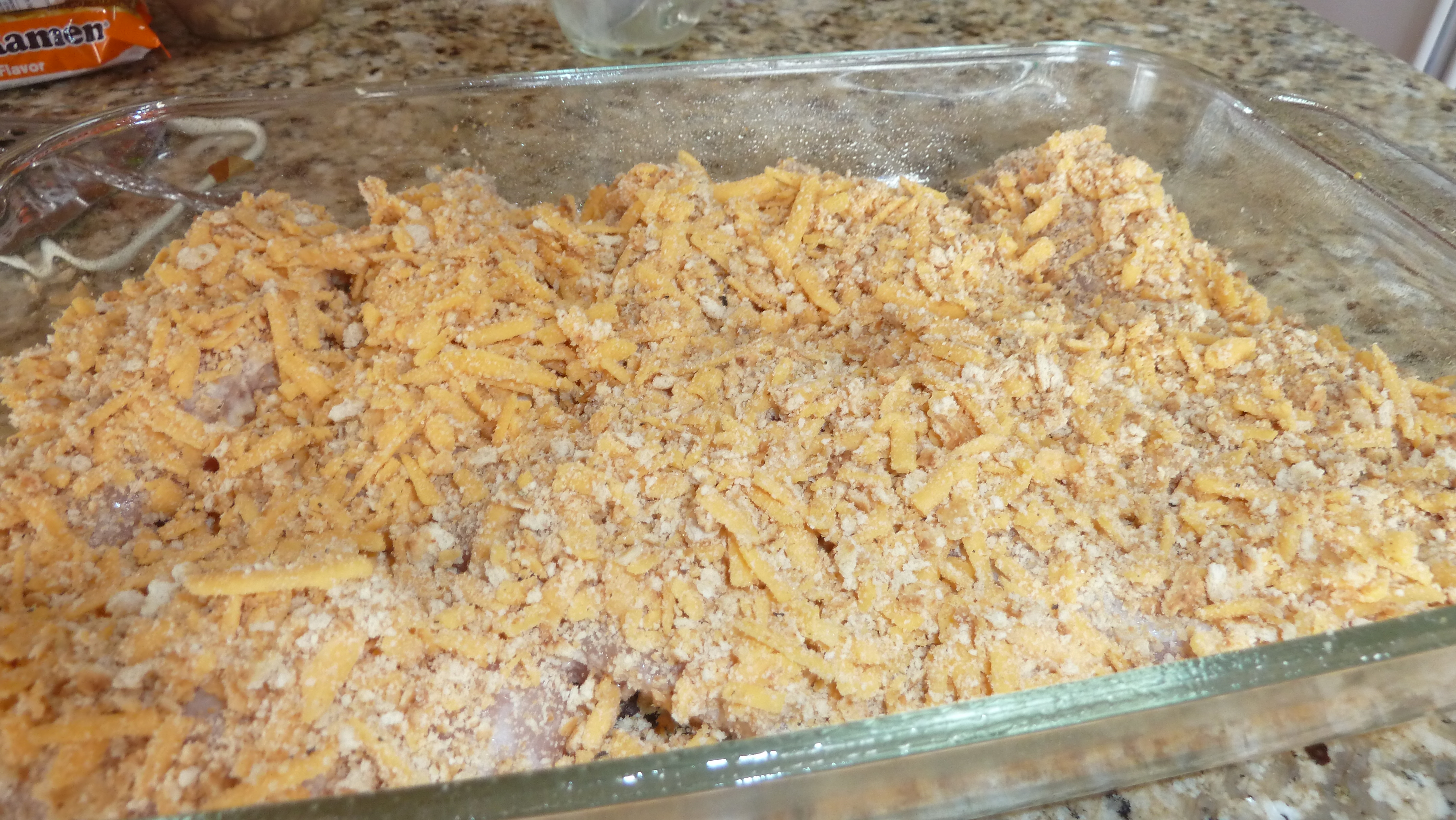 Cover with remaining crumbs, as desired. You may end up with extra crumbs, depending on how big your chicken pieces are.
Bake for 30-40 minutes in 350 degree oven.
Two tips:
1) As easy as this is, don’t screw it up the way I did one time, mixing the butter with the crackers and cheese. Globby mess. Don’t do it.
2) If your chicken pieces are frozen, the melted butter congeals very quickly on the frozen meat; better to use pieces that have thawed in the fridge and aren’t so cold.
***
I also wrote about Barbara recently in an Another Way newspaper column, here. One of these days I’ll get one of her talented children to video her as she makes her oft-requested Shenandoah Valley Renowned Macaroni and Cheese.
***

My book, Whatever Happened to Dinner? has some family favorites in it, but also recipes from a wider group of families from my office.
WRITER WEDNESDAY: A BOOK REVIEW 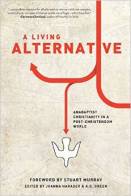 A Living Alternative: Anabaptist Christianity in a Post-Christendom World is a big book. Edited by Joanna Harader and A.O. Green, it squeezes in much with narrow margins and almost 300 pages. So this is a book to pick up and savor when you want to read a chapter at a time from one of the 20 authors on spiritual pilgrimages, experiments and experiences in being church, heavier stuff on our post-Christendom world, and living out faith. It is not a book best crammed through hurriedly for a class, or to write a review in a short amount of time!
Which is what I felt I needed to do, since I accepted the offer of a free copy in exchange for a review! Especially when I had about four other books of this nature (mostly Mennonite-written) ahead of it in line. The book functions as a “reader” in contemporary Anabaptism by a variety of current writers, pastors and theologians who speak, blog and engage in conversation about such things. It is not comprehensive in terms of who contributed—I think an invitation went out broadly to and through the MennoNerds network of bloggers. I suspect many passed feeling that they didn’t have the time or had other projects looming.
In an anthology such as this, you tend to first read the chapters from those you know personally, or by whose lives have somehow intersected (online or real life) with your own. So I first turned to Donald Clymer, an author for whom I recently served as editor for a book on spirituality he co-wrote with one of his sisters, Sharon Clymer Landis, The Spacious Heart (Herald Press, Sept, 2014). In The Spacious Heart they both touch frequently on their spiritual pilgrimages but in this anthology, Don fills in the missing pieces while adding his particular take on post-Christendom Christianity. His chapter is called “Conversion from Ethnic Mennonite to a Convinced Anabaptist” and follows the path of many others who grew up culturally and ethnically Mennonite, but not really understanding what the Anabaptist faith was all about.
Brian Gumm, who also lived in Harrisonburg a number of years, now “telecommutes” from Iowa for his main bread and butter doing online educational programming for Eastern Mennonite University. I first took the plunge into blogging after hearing him speak convincingly about his own experiences blogging. His chapter titled “Seeking the Peace of the Farm Town: Anabaptist Mission and Ministry in the Midwest” speaks of his vision as a bi-vocational pastor for Church of the Brethren. The approach he describes is sometimes called “slow church” or more broadly “missional,” where you emphasize getting to know the community, neighbors, and becoming an everyday part of it. This approach bears in mind that God is already at work in a given community, so there is less of parachuting into a situation attempting to change or fix things that don’t work culturally.
I’ve never met this next author, Jamie Arpin‑Ricci, writing “What Anabaptists can learn from St. Francis of Assisi” but I was intrigued to learn more of his background and thinking. The first time I encountered Jamie was when he first contacted Third Way website, for which I also work, as he did social media contacts asking websites for links to The Naked Anabaptist book (Herald Press) by Stuart Murray after it first came out. Jamie leans towards a Franciscan spirituality—that is following the example of St. Francis of Assisi—even to the extend that when he and others first started Little Flowers Community in Winnipeg, Manitoba, he wished to call it “St. Francis Mennonite Church.” No one thought that would go over too well so they settled on Little Flowers—probably one of the more unusual names for a Mennonite church—as tribute to the flowers and animals that we associate with the nature-loving St. Francis. Jamie’s chapter is fascinating and one of the easier reads in the book, and he has numerous books of his own including a forthcoming title: “Vulnerable Faith: Missional Living in the Radical Way of St. Patrick.”
From my work curating content for Third Way website and hearing from many folks interested in Mennonite or Anabaptist churches over the years, I know that many people live in areas where they desperately wish there was a local Mennonite church. So it is insightful to hear from some of these writers who are pastors or lay persons in underserved communities. Justin Hiebert addresses this need directly, a Mennonite Brethren pastor who says he realizes he does not wish to pastor a church plant per se, but rather to be in a congregation being planted. In a chapter called “The ministry of availability and community transformation,” he notes that the Mennonite Brethren denomination set a goal (like many denominations) several years ago to plant six new and stable churches a year. Hiebert terms it a practical goal aiming “to create and reproduce more incarnational-missional churches in local communities to disciple more people under the lordship of Jesus” (p. 151). Justin includes great ideas for involving ourselves more intentionally in whatever neighborhood we live in, and notes the first step: get to know your neighbors. 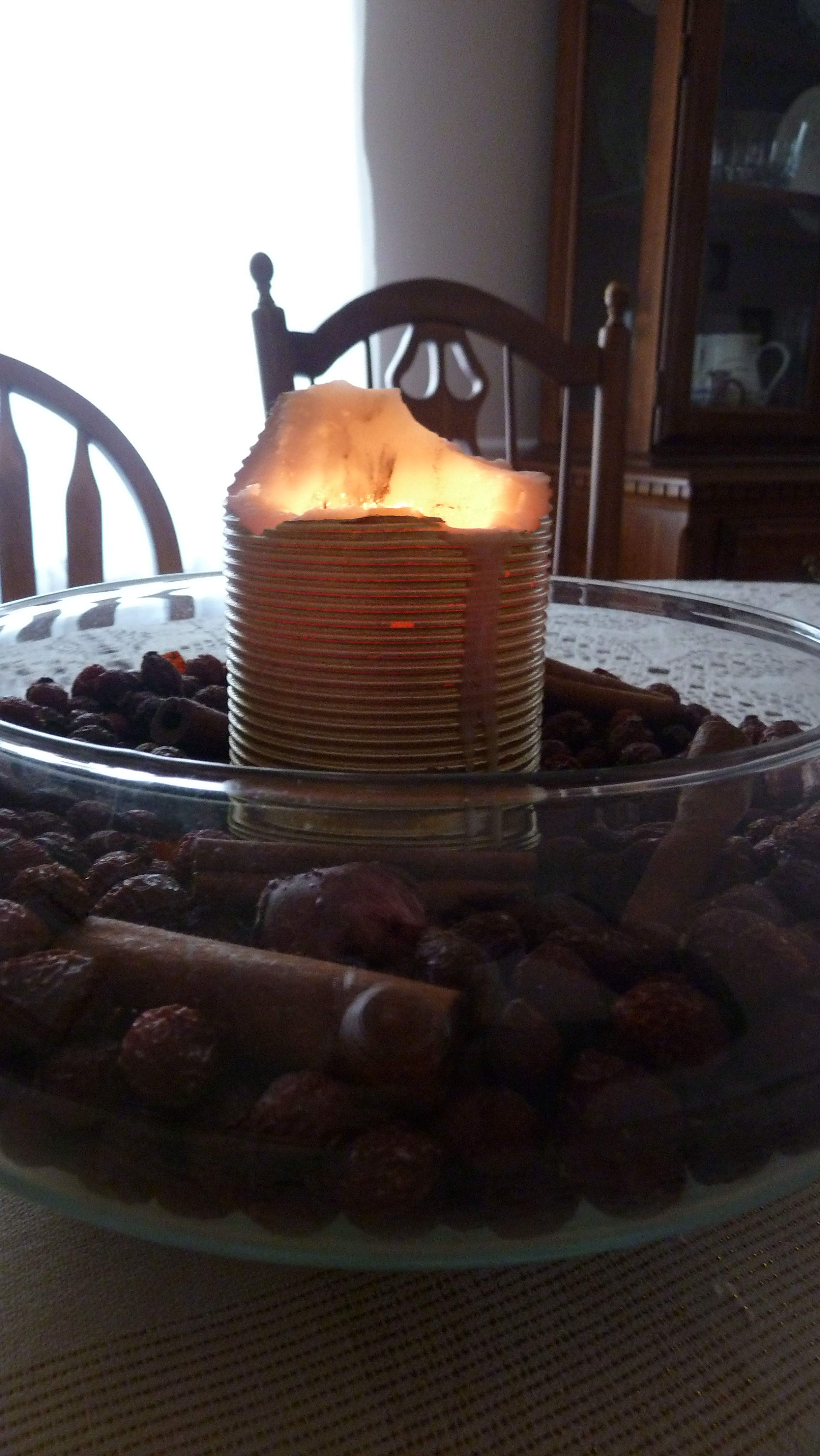 I also resonated with the chapter from Chris Nickels exploring the concept of Table Fellowship – not the food or cooking but the practice of gathering around tables to just talk, hang out, and fellowship. As a pastor, he notes “the table’s effectiveness as a tool for ministry is that it helps theory become practice.… Sitting down at a table invites us to break from our regular activity and shift our focus. It is a place where we intentionally choose to slow down and really be present with other people” (p. 157). He tells how his congregation, Spring Mount Mennonite Church in suburban Philadelphia, tried a table church liturgy for an experiment. A member who works in construction came across some handsome but well used round tables being discarded from a work site, and asked Chris if the congregation wanted them. They did and the result was that they’ve used the tables in a variety of settings, including a once-a-month worship liturgy incorporating a meal—making use of the particular gifts in the congregation more towards cooking than professional music, for instance. Their “potluck theology” also helps members think about the home table as a place for fellowship and spiritual growth and discipleship. This chapter beautifully provides theological and philosophical framework for the book I called Whatever Happened to Dinner: Recipes and Reflections for Family Mealtime. His thoughts take this kind of approach a step further for worshipping communities.
Drew Hart is another Philadelphia pastor, young and hard at work on many fronts—which means he is a man to watch in the years ahead as he cuts through the make-nice racial conversations to face down ongoing prejudice and systemic racism even when people know better. Did he coin the word he uses to pinpoint his vision?: Anablacktivism. In his chapter he recounts how he stumbled upon Anabaptists, has researched black theology and Anabaptism, and is currently working on a Ph.D on that topic, along with a more popular-level book. His chapter is much too in depth to summarize here other than to use his own appeal at the end, “Those who desire to find inspiration from the Anabaptist legacy, ought to consider and pursue this by also engaging the Black church and Black theology, all while joining the struggle against white supremacy and the systemic racial violence that continues to disproportionately devastate Black life in America” (p. 215).
The book includes some of the brightest new voices emerging from and about the Anabaptist tradition. Hannah Heinzekehr and Deborah-Ruth Ferber and editor Joanna Harader are the lone female voices but I can hardly criticize the collection for that because other women (including yours truly) had the opportunity and invitation to contribute but either didn’t find the time or didn’t feel they had something worthwhile to add on the topic. Of these I found Deborah-Ruth’s on singleness most engaging—probably because I gravitate towards personal journeys and stories and recall experiencing while age 23 and still single, many of the same feelings myself.
The endorsers and foreword writer are all names known to me as an editor/writer working in this general field: whew: Greg Boyd, Stuart Murrary, Sarah Bessey, Shane Claiborne, Christena Clevland. Good job, editors Joanna Harader and A.O. Green in tagging this book with this depth of Anabaptist-related thinkers. Published by indie house Ettelloc – one might wish for a more winning cover, but that’s a weak criticism, knowing how difficult cover decisions can be. With the diligent study questions closing each chapter and ample bibliographies provided by the authors offering additional resources, any Sunday school class or small group or book discussion group could cherry pick this rich volume and create a study tailor-made for your group’s particular interests and issues.
***
How do you live your own faith in our current society? What are you guiding principles?
***
Have you read this book? Comments?
This book is available on Amazon and other locations and at the MennoNerds collective.
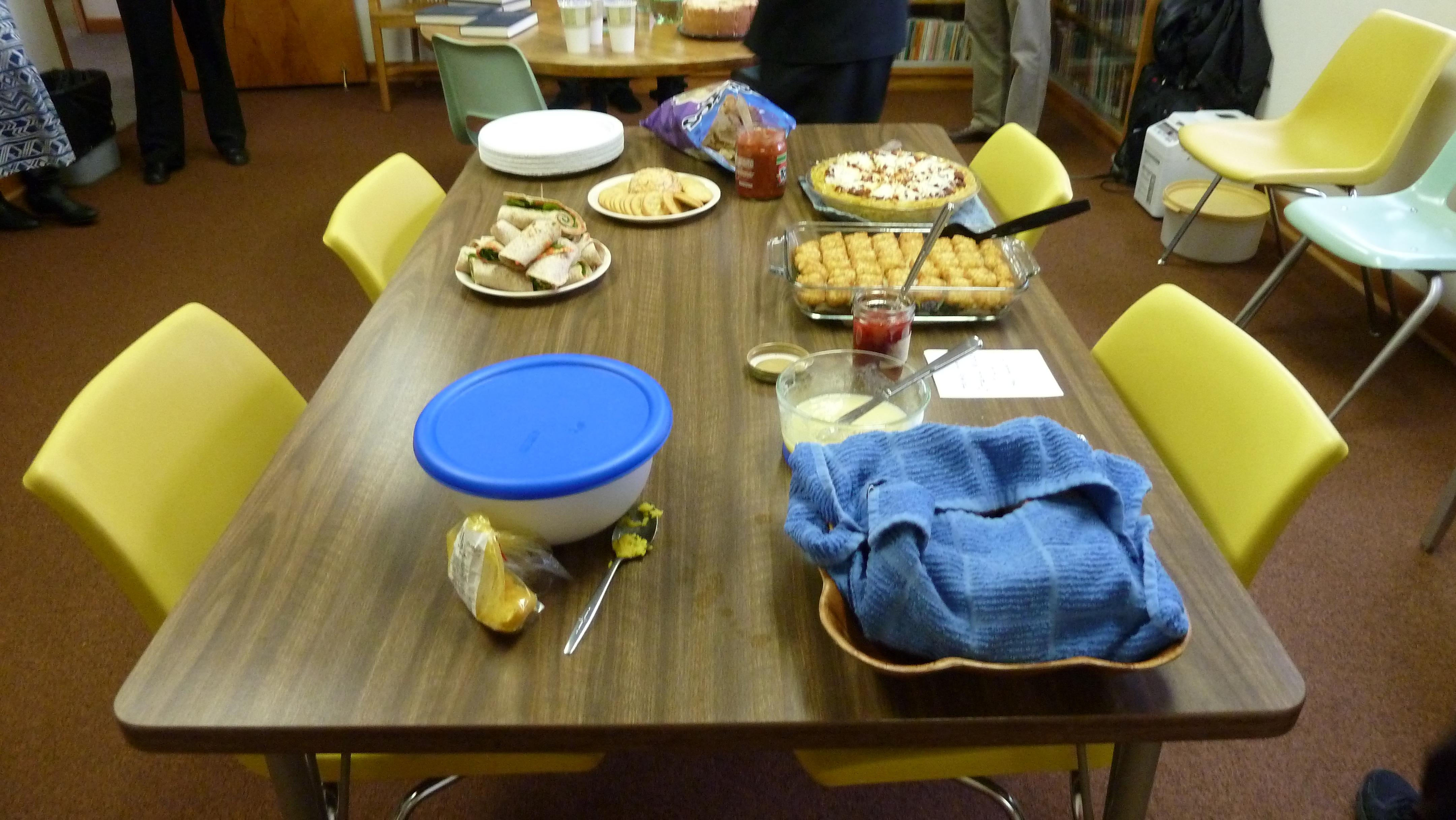
Every month we have an office potluck lunch at the MennoMedia office where I work. About once a year we take a coffee break to brainstorm the sometimes off beat but interesting themes around foods we’d like to share. (Such as here, and here.) The idea is to spend minimal work time planning, and maximum time fellowshipping/building camaraderie.
So this month was “Funeral Foods” and you’re going … those weird Mennonites. In many Mennonite churches, the Food Committee is in charge of serving a sit down dinner to the family and close friends of deceased loved ones, usually after the actual funeral or memorial service is finished. This is generally more than a finger-foods reception that I’m now more familiar with in the Presbyterian church where we’ve been members for 30 some years. (There are some interesting posts on Funeral Foods if you google that, like here.)
Most times a traditional Mennonite church Food Committee (and believe me, that’s a big assignment for someone who is extremely good organizing people and working a kitchen full of helpers, a job my mother always politely if adamantly turned down—“Just Don’t Make Me Chair of the Food Committee!”—I can hear her saying) sends out the call for a number of volunteers to make a certain recipe—everyone making the same thing for a casserole, a jello or other salad, a yummy dessert. Or, if the bereaved family prefers, perhaps a soup, sandwich and veggie type lunch. The meal is kept simple and focused: not a huge spread or variety.

One of those typical casseroles, at least in the past, has been Tater Tot Casserole. When my father died in 2006, we told the Food Committee we’d love it if they fixed that dish that came into vogue when we were kids, with the roll-out of Ore Ida Tater Tots. I wonder who ever assembled the first combination using, of course, the standard (and sodium filled) can of Cream of Mushroom soup, ground beef, green beans and topped off with crispy tater tots in neat rows?
So when “Funeral Foods” came out on the office potluck list for 2015, I knew what I’d be making, something I had not tasted since 2006 at my Dad’s memorial.
The dish was quite good and satisfying. But maybe over the years my tastes have changed and grown to the place many other foods are much more interesting and palate pleasing. Our assemblage of “funeral foods” included quite an array of stuff I would never have called by that label including pinwheel type roll up sandwiches. I thought—funeral food? And then smacked myself thinking of the Presbyterian receptions at my church where, indeed, pinwheels are often frequently served—picked up I’m sure at a deli or Costco. (Yeah, pinwheels and pimento cheese sandwiches with the crusts cut off are my Presbyterian go-to funeral foods!)
But if you want a throwback or cozy comfort food, try this super easy warming and filling traditional Mennonite funeral food from the 60s -70s era.
North Goshen Mennonite Cookbook Tater Tot Casserole
1 can cream of mushroom soup
1 lb ground beef
1 medium chopped onion
1 quart or large size can green beans, (drained and chopped slightly on a cutting board)
1 pound or 16 ounces tater tots
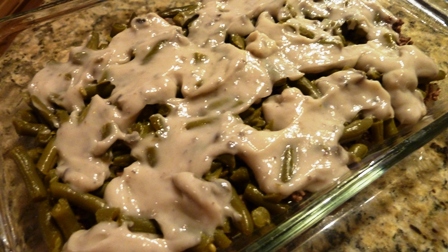 (Spread mushroom soup over layer of hamburger and green beans. Kind of patchy, but it spreads out in cooking.)
Brown ground beef and onion in skillet. Place in bottom of 9 x 13 inch baking dish. Sprinkle with salt and pepper. Add layer of green beans, chopped to about half of normal size. Spread mushroom soup to cover as much as possible. Top with layer of frozen tater tots—can be placed in rows or just jumbled.
Bake at 375 degrees for one hour. Serves 6-8.
Adapted from North Goshen Mennonite Cookbook, provided by RuthAnn Wittrig
***
Do you have a favorite comfort food served frequently at funerals or memorial dinners? What is the tradition in your church or family?
***
For many other recipes (both Mennonite, Presbyterian and even no special religion!) check out Whatever Happened to Dinner.
Locals are invited to an upcomingspeaking gig on the theme of this book, with United Methodist Women of the Harrisonburg District, at Bridgewater United Methodist Church, February 19, 7 p.m. Any and all are invited. The United Methodist Women’s Reading Program selected Whatever Happened to Dinner as one of its recommended books for the year. See more here. The complete list for 2015 is also available on Amazon, right here, which has boosted sales for this book significantly! (I love United Methodist Women!)
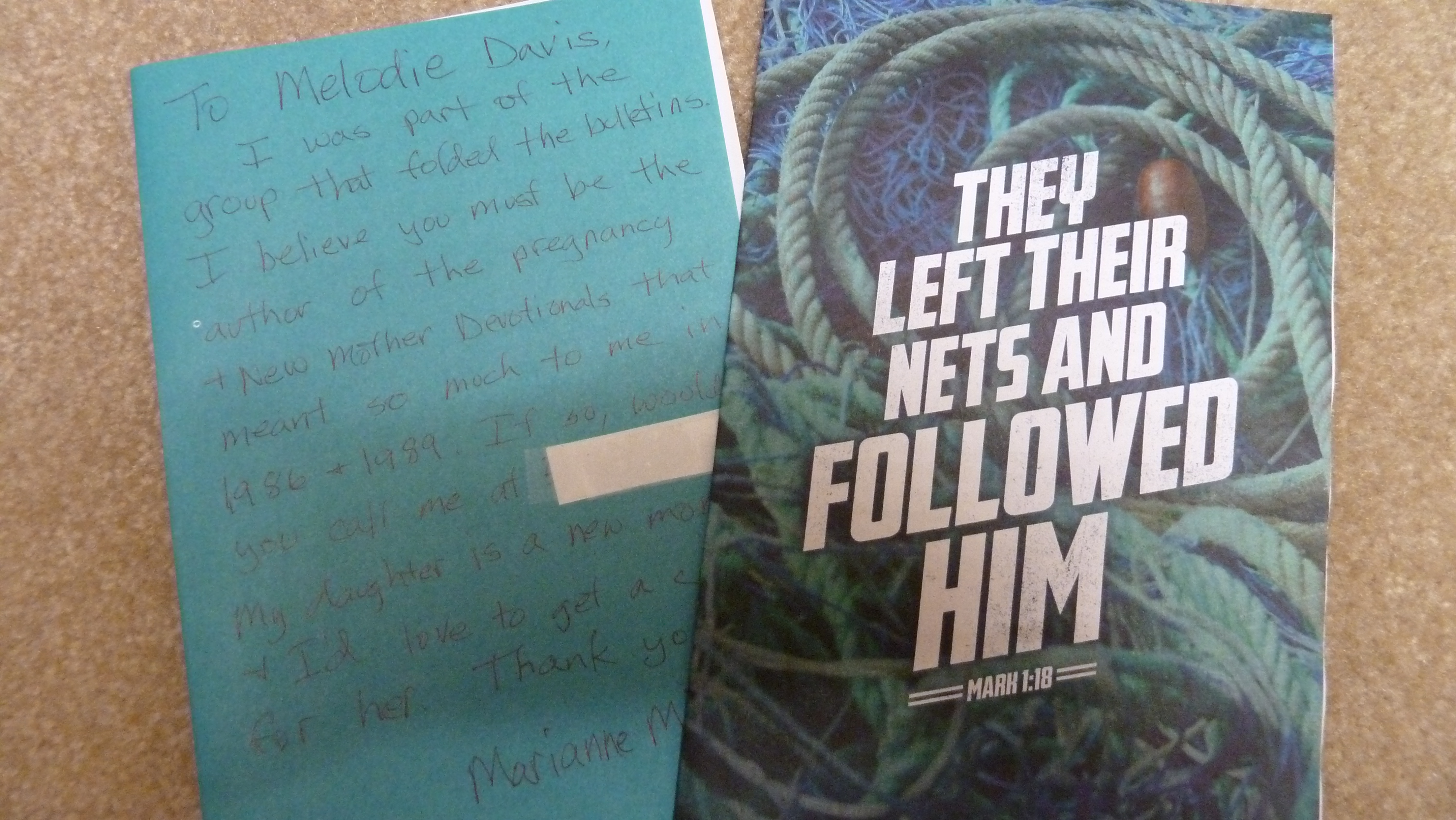
Last Sunday my husband and I were greeters at church. When we finally finished greeting folks and headed into the sanctuary, the usher handing out bulletins handed me a personal note that someone had written covering my bulletin. It had been left with the stack of bulletins by a woman who helps bring a group of volunteers from Pleasant View Inc., a wonderful agency in our community serving adults with special needs. The volunteers come every Friday to our church to fold our bulletins because it is something they enjoy doing and it is a way for them to experience the joy and camaraderie of volunteering.

Here’s the note. (Click or flick to enlarge.)
Of all the ways I have received communication from readers of things I’ve written, this was the most unusual. I walked into church all pumped up. To hear from a reader who had obviously been moved by one of my early books—after almost 30 years! I was blown away and grateful to Marianne for writing the note.
The first book she was referring to is called For the Next Nine Months: Meditations for Expectant Mothers, published by Zondervan in 1982. I wrote the journal type entries and prayers, and found scripture verses to accompany each meditation, while expecting our first child in 1981.

This story gets even more special. I called the number she gave and yesterday we spoke by phone. Not only had she loved the book, she had planned to name her baby after me if it was a girl. Her mother’s last name had been Davis and so she felt that was special too. (My own mother found my own name in a book, too, by an early prolific Mennonite novelist, Christmas Carol Kauffman. That writer had a character with the slightly unusual spelling of Melodie.)
Marianne and her husband ended up having a boy and named him Michael. My oldest daughter, the one about whom the meditations were written while she was gestating, we named Michelle. Pretty close—they come from the same root name of course!
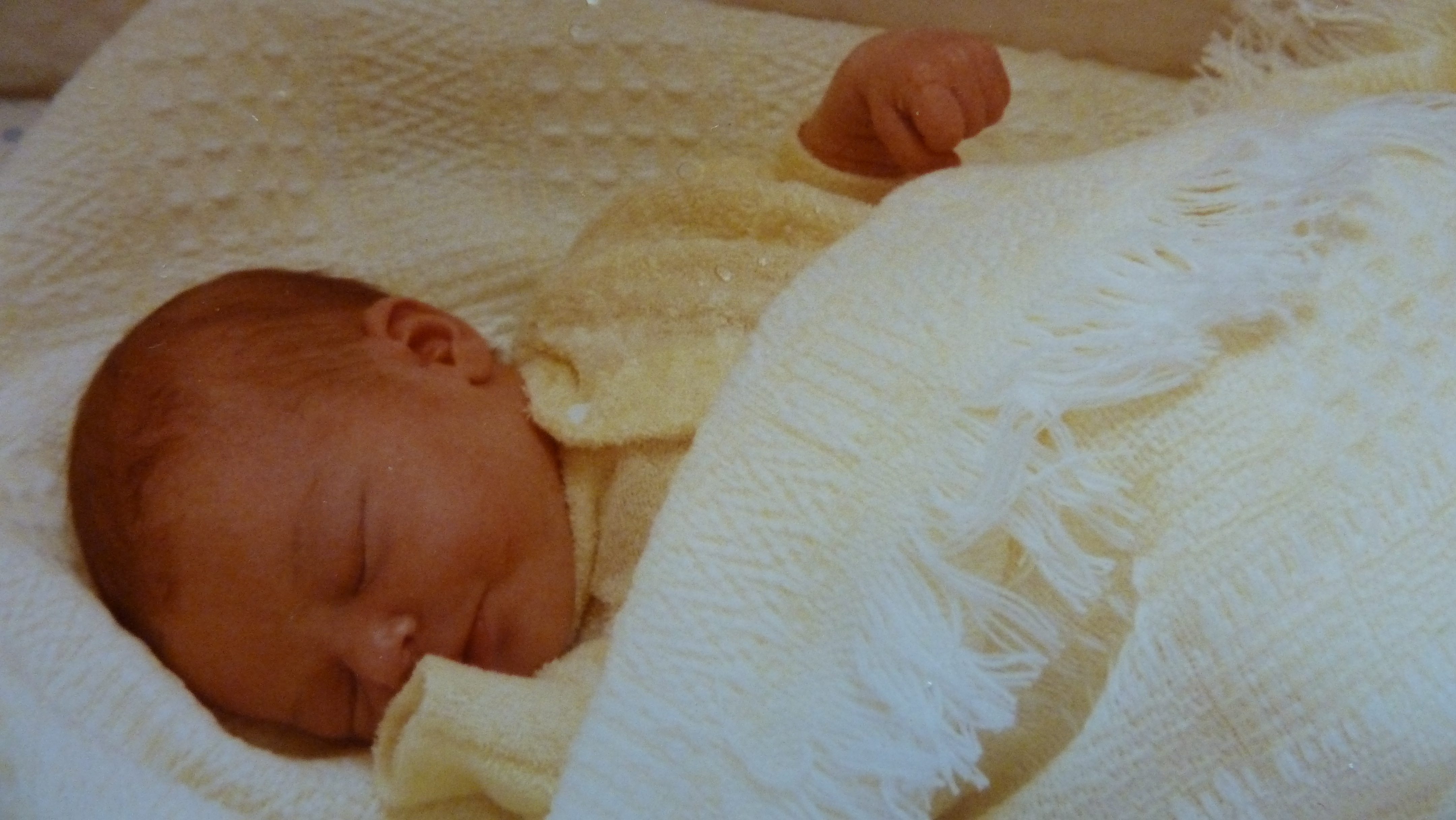 Michelle when she was four days old.
Michael is now married but it his sister, Marianne’s daughter, who just had a baby. Marianne wanted me to know that the baby she prayed over every day as he was growing inside her while reading my book “turned out well”—a good son with a great job. And obviously she feels the same way about her daughter that just had a baby!
Very cool. How amazing to hear the back story. Marianne did not live in our community at the time she read my book, so when she saw my name in the church bulletin: “Stuart and Melodie Davis, greeters” she knew she had to find out if I was the same one who had written the devotional book.
My daughters also enjoyed reading the meditation book while they were expecting in 2013—even though to read it, it feels dated now. So much has changed about how we have babies in North America today, from baby registries (one of the first tasks of many expectant parents) to husband involvement in labor and delivery (now almost always husbands or boyfriends participate in those phases, which was pretty new in 1981), to routine, sophisticated ultrasound pictures. (Our daughters’ labor and delivery experiences here and here.)
 Early ultrasound of Michelle, three months gestation, 1980.
But I hope that the emotions and basic experiences of pregnancy are somewhat universal and timeless as we go through the miracle that has happened since the beginning of time.
***
Did you ever receive a note or letter that blew you away with surprise and wonderful feelings? I’d love to hear your story!
***
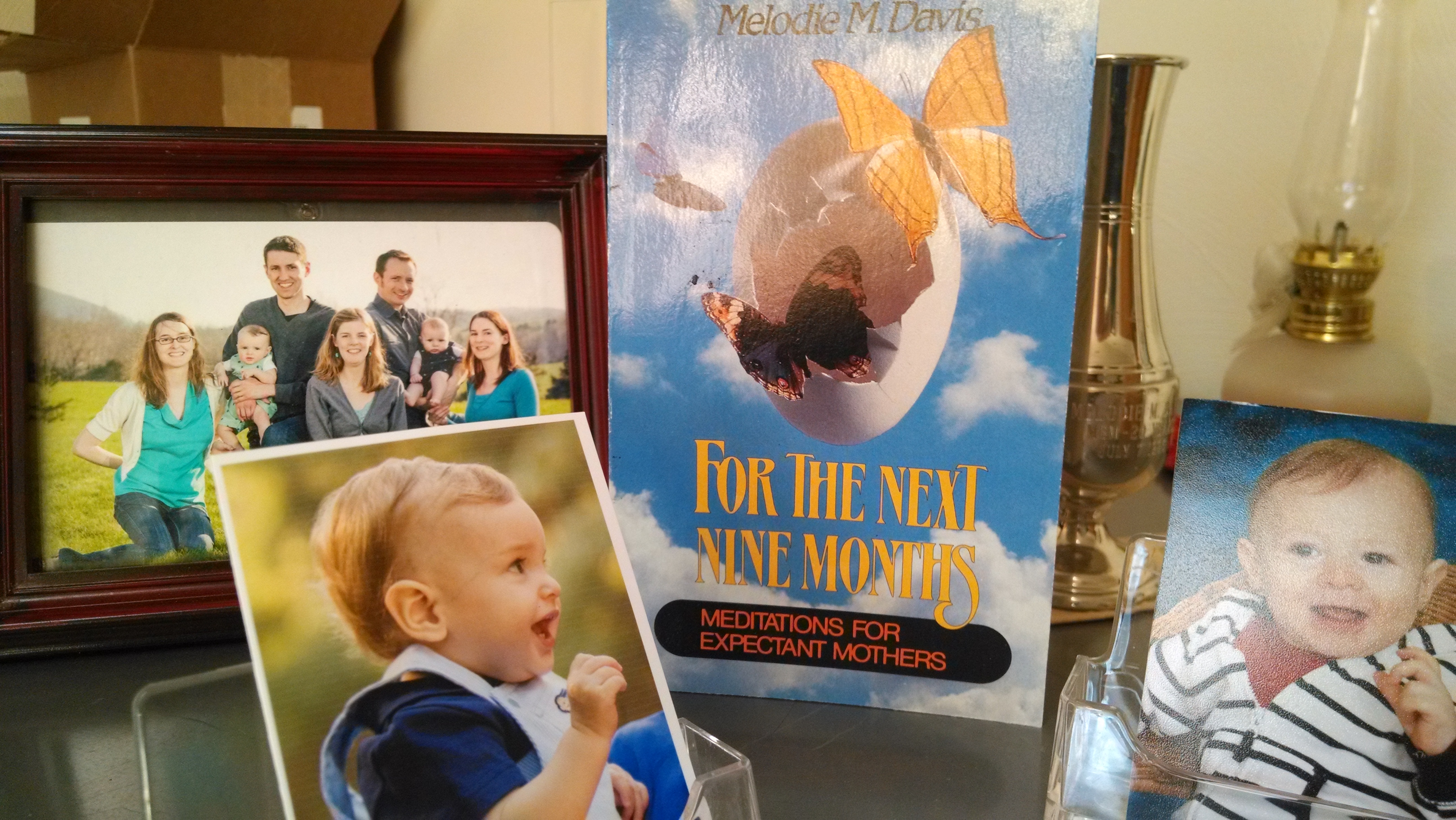
The For the Next Nine Months book is only available from used book sellers online and through Amazon.
In conversation with Marianne, the devotional book for new mothers she was remembering may have not written by me, but my book Why Didn’t I Just Raise Radishes: Finding God in the Everyday comes close to that with stories and prayers from our early days of raising children, also available only as a used book on Amazon etc.
However, the publisher I work for, Herald Press, has just brought back into print three books for expectant or new parents, Meditations for the Expectant Mother and Mediations for the New Mother, by Helen Good Brenneman, (mother of my high school friend Tobi) and also Meditations for New Parents by my college friends, Sara and Gerald Wenger. Check them out and stock up—on sale now until Feb. 2 for just $5.99 each.
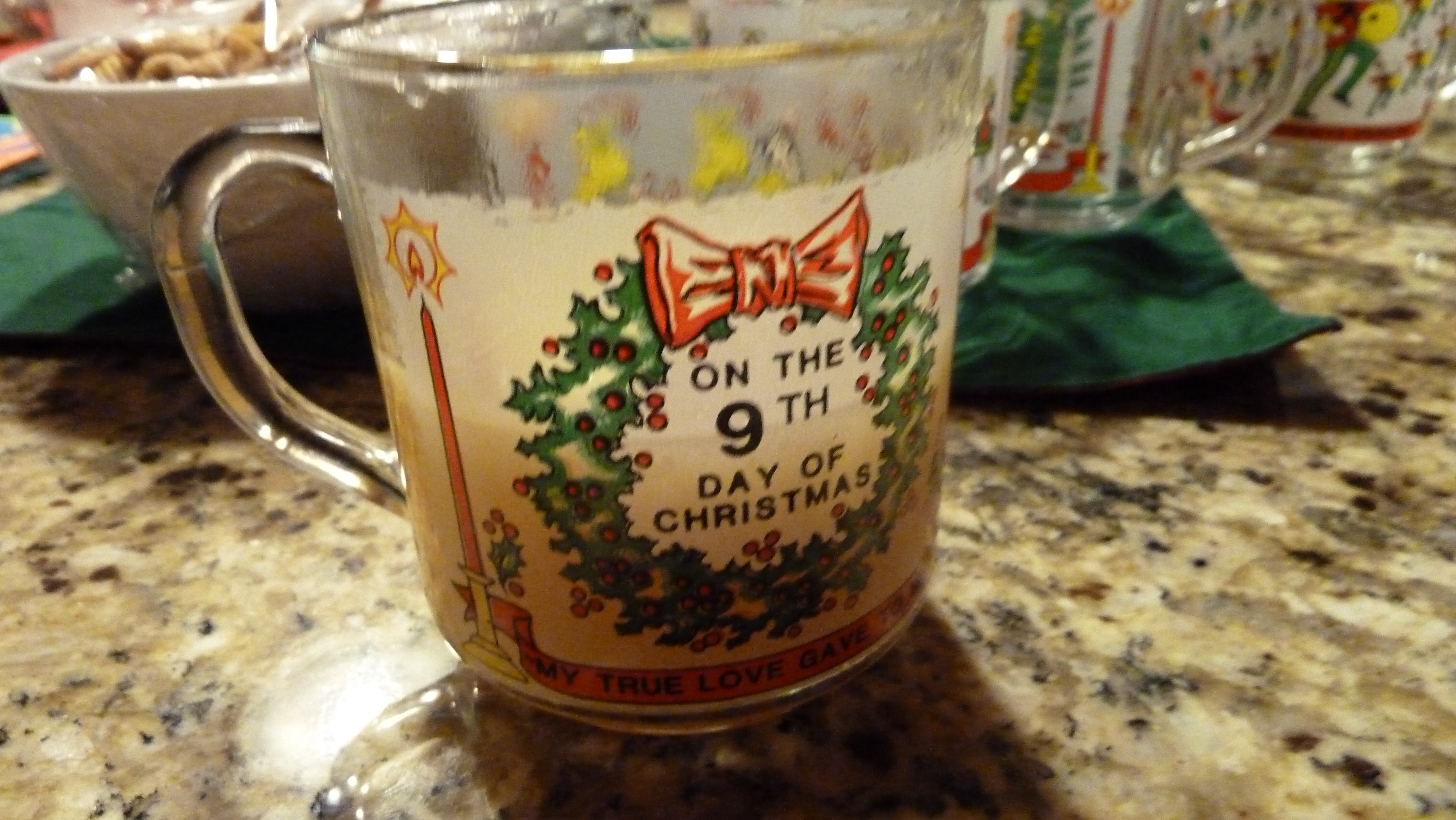
Our church goes in for Epiphany in a big way, emphasizing how Christmas only begins on Dec. 25 and runs through January 6. Last weekend we held our “Epiphany Dinners” in homes as a way of having small fellowships with people NOT in our small groups or house churches, and totally mixed up by organizers who pair people who want to host, with people who want to be “guests.” Everyone makes a dish and viola, a lovely dinner in a private home is enjoyed by all who wish to participate!
We hosted this year and I prepared a Wassail to enjoy as folks gathered, which turned out to be perfect on a frigid January evening. Now that I’m finally un-decorating the house, I think I’ll stir up another batch to enjoy.
In a nod to those who don’t want a long story before they get to the recipe (you know who you are), here goes.
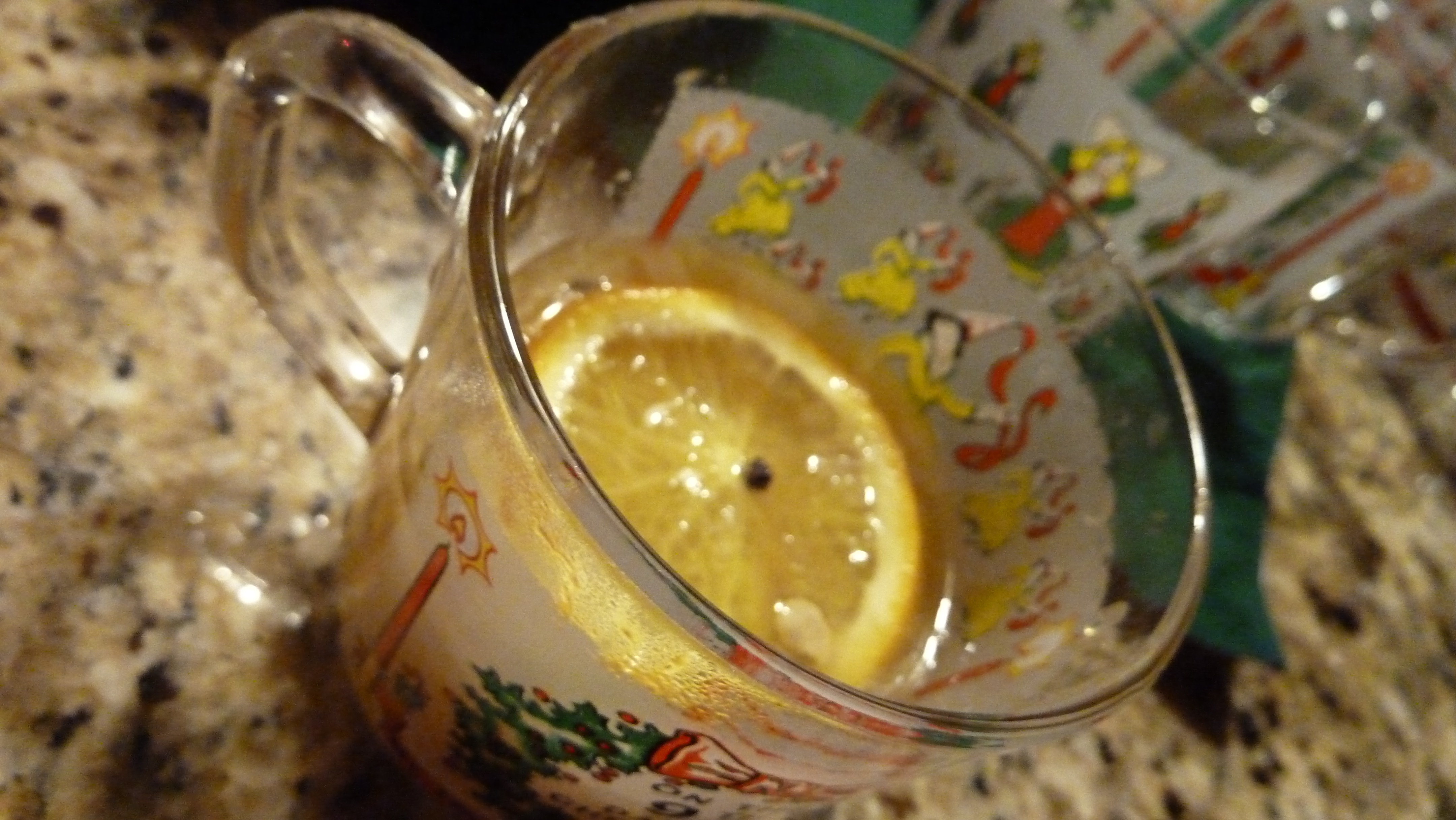
Wassail
Note: I halved this recipe to serve approximately eight.
1 gallon apple cider
1 cup brown sugar
1 – 6 oz can frozen lemonade concentrate (or use lemonade Koolaid, with juice of a whole lemon added)
1 6 oz can frozen orange juice
1 Tablespoon whole cloves
1 Tablespoon whole allspice (can put whole spices in steaming bag or just throw in whole)
1 teaspoon nutmeg
Cinnamon sticks
Lemon or orange slices
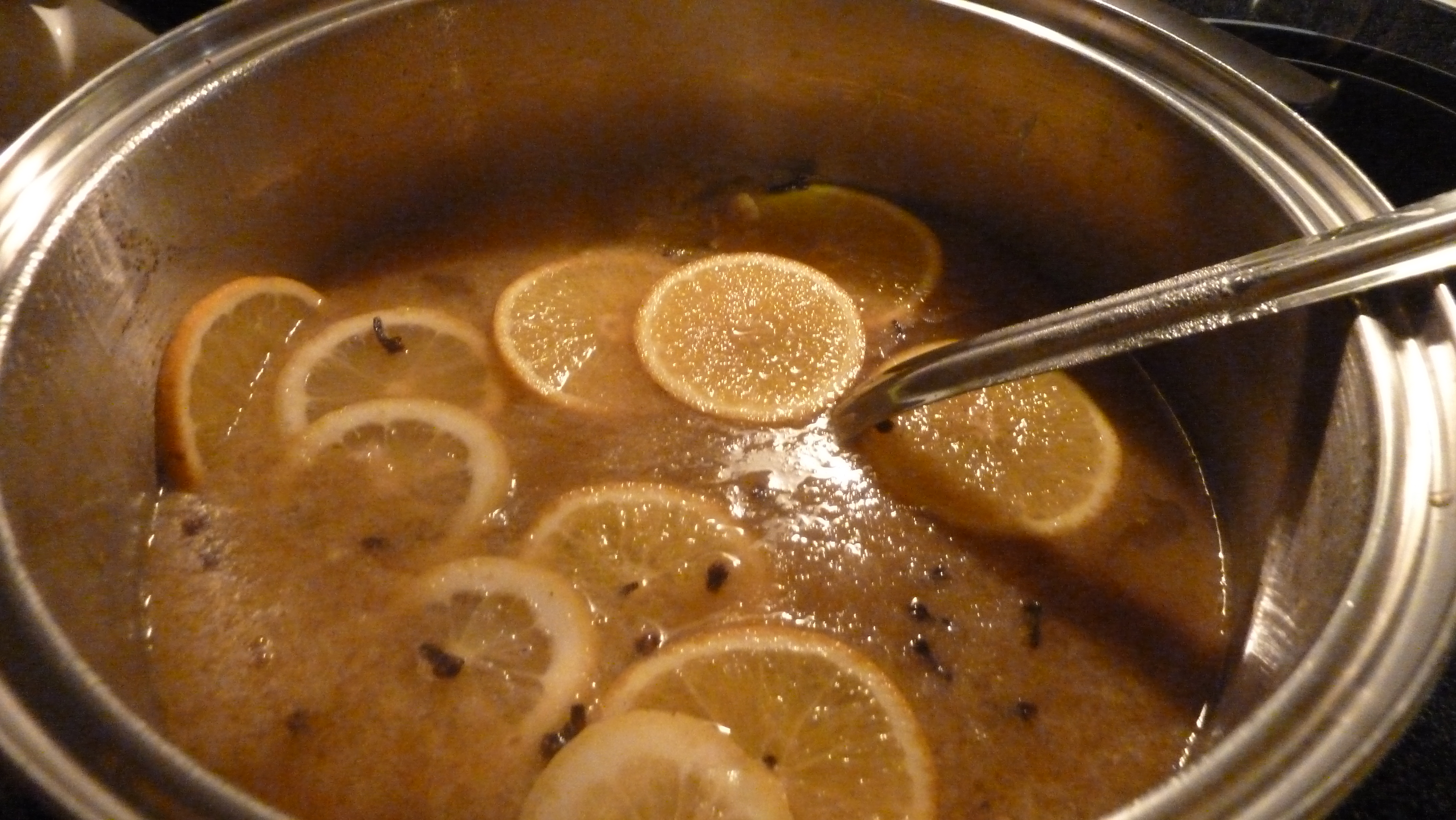
Simmer 20 minutes.
***
Any Epiphany celebrations to share?
***
How do you cheer yourself up for the dismal, disheartening, depressing work of un-decorating??
Buster, the Thousand Dollar Dog
The bones of this true story were written by my father, circa 1995, which I finessed into this piece which appeared in several papers at the time. It spoke to me recently and I’m happy to share it here—with the photo opportunity a blog allows.
By Vernon U. Miller
Dad, Buster, and Mom on their farm near Wakarusa, Indiana.
We bought Buster as a baby Border Collie. He was very smart and easy to train from the very beginning.
One of his first lessons was to halt at the road as I went across to get the mail. Naturally he wanted to follow. So I took the newspaper and lightly spanked him saying, “No, no.” After that I don’t recall that he ever tried to cross the road with me to get the paper. Indeed, he could be tearing along chasing a rabbit, but if the rabbit ran across the road, Buster stopped.
Buster and I soon became the best of friends. He followed me constantly on the farm. Even when I was plowing my field that was a half mile long, Buster would follow. So I would pick him up and perch him on the fender of my Ford tractor, so he wouldn’t wear himself out tagging along. This soon became his favorite place, because he could scout out mice, rabbits and ground hogs from there.
The ground hogs were his favorite to chase. As soon as he spotted one he would want to jump off the tractor. But I knew it was too far away. So I’d tell Buster, “No, not yet.” We crawled along on the tractor and when we were close enough, I’d urge him, “Go!” and he shot off: usually he got his ground hog.
In the barn yard, he knew which sow was always left out first, and saw to it that she would go where she was supposed to go. After the sow did her business, Buster would bring her back in. He spent so much time with the pigs he often smelled like a pig and padded around happily with mud caked to his underside.
As a working dog, he enjoyed the freedom to roam within the confines of the farm. He humored me and anyone I could gather for an audience, by hopping through our tire swing, posing on a 50 gallon drum, or on the porch swing. He was gentle with the grandchildren even when they were toddlers.
 Dad with my oldest daughter, Michelle, circa 1983, and Buster on his beloved tractor.
But life is not always kind to dogs or men. When Buster was about 12, I developed diabetic neuropathy, and became confined to a wheelchair for a period of time. I could no longer farm. We had to sell all our farming equipment and made plans to move.
Friends, relatives and church members helped to get everything ready for the sale. I begged the doctor to let me go home from rehab for the day of the sale. He said if my oldest daughter, a nurse, would take care of me, he would let me go.
The sale went along well, but the bidding slowed down when it came to selling Buster’s favorite Ford tractor. The auctioneer knew the tractor was worth more money and he also knew Buster’s many tricks. He looked around, spied me, and called, “Vernon, where is that dog?”
 Buster posing on the tractor at Mom and Dad’s farm equipment auction.
I called Buster and he tore through the crowd to my side. “Get on the tractor, Buster,” I said. He jumped to his perch on the fender. Everyone clapped. The bidding started up again and went up another $1000 until the auctioneer was finally satisfied, earning him the moniker, “Thousand Dollar Dog.”
That summer we built a barrier-free house to accommodate my wheelchair on a plot next to our old place. Buster moved with us to the new house, but he didn’t understand why.
The farm was as much in his blood as it was in mine. Buster thought he needed to go up to the barn to help chase the hogs and do chores. He growled at the strange man tending his pigs. The new owner was afraid; he couldn’t trust a snarling dog. They said he snipped at one of their daughters.
There was nothing we could do but tie up Buster at our new home. He was old, too old to learn new tricks. Buster cried and cried; we shed some tears too. Where was the freedom he longed for? What kind of life was this for a hard working farm dog? What good was he? These were questions I asked myself too, as I massaged my useless legs.
Buster became more and more feeble, with no reason to live. He stopped eating and drinking. Finally we knew that there are things worse than death. If we couldn’t give him back the farm, we could free him from his broken heart.
I think there were some who thought I would soon be gone, too: a farmer deprived of his work and life. Over the years, through therapy, prayer and hard work, I gradually regained the use of my legs. I practiced standing and taking steps until one day I walked free of my wheelchair. Even while I was in my wheelchair, I set up a shop in our garage where I enjoyed building doll houses and toy barns for children who will probably only ever be farmers in their dreams.
But as I putter, I enjoy remembering every farmer’s dream dog: Buster tearing across a field at the word “go.” Stopping short if a rabbit foiled him by crossing the road. And dear old Buster hopping up on that trusty tractor when the bidding was slow.
***
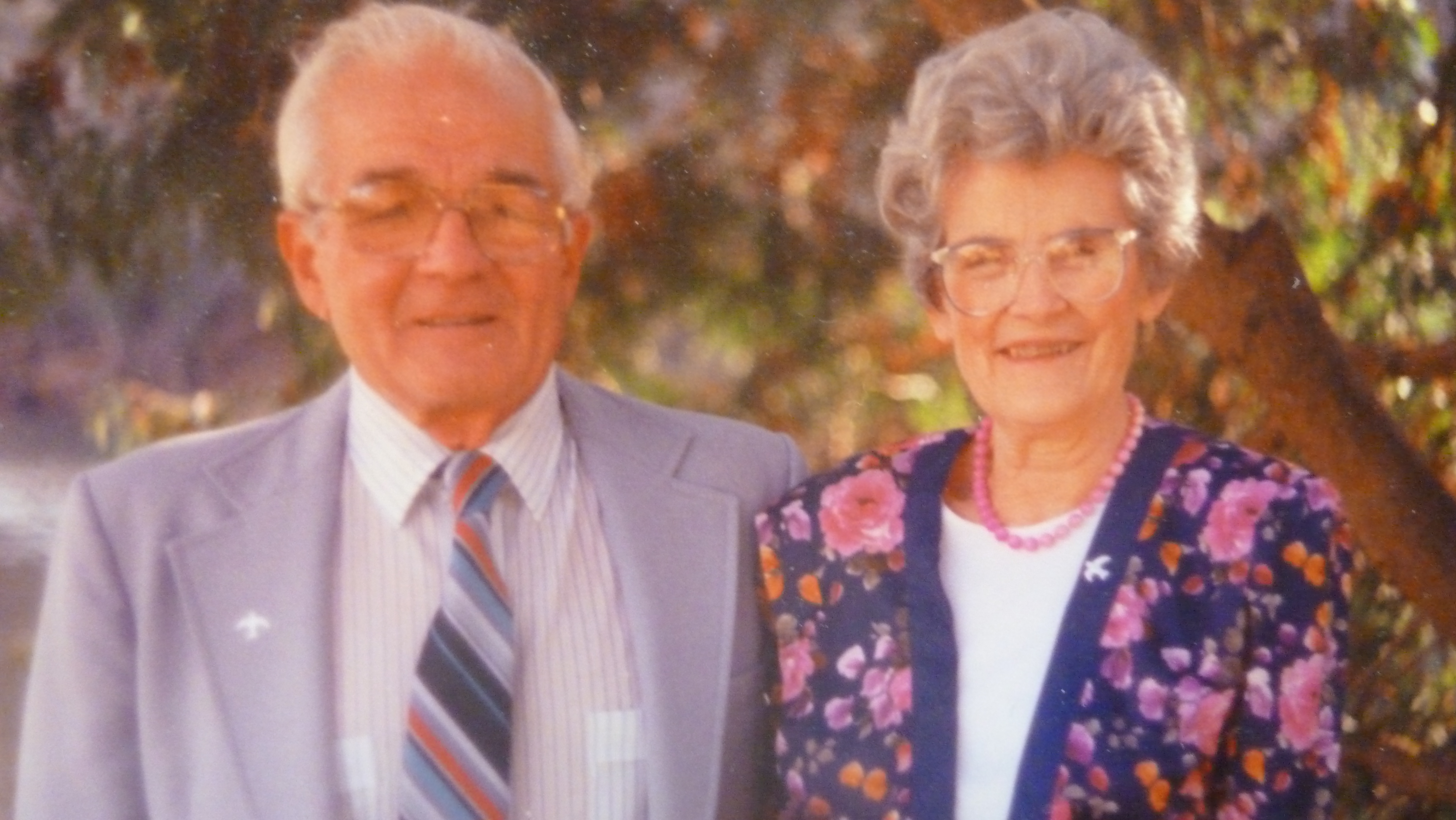
Epilogue: After the onset of his illness/disability in 1986, Daddy lived 20 more years, gradually adding the use of a cane, walker and then again a wheelchair. Mom took care of him until the last week of his life in 2006 when he had to move to nursing care. Mom is still amazing and active at 90. The photos below are an early photo from when they were just dating, and a later one from the 1980s.

***
Has a pet ever helped you cope with illness, disability, change? I’d love to hear your story!
***
How does a parent or grandparent’s example speak to you?
***
This story was originally published in Living magazine. Today the magazine I serve as editor is called Valley Living and is online here.
***
Here are two of my favorite posts on Mom and Dad; other links may automatically show up below.
Writer Wednesday

There are certain kinds of books we write for ourselves, our families, our friends, fans and colleagues—especially when they say, you need to write a book about this!
Seeking Saúl is that kind of book (prounounced sa-ouul). It beautifully chronicles a year of exploration by Rebecca Thatcher Murcia and her two sons, Mario and Gabriel, in tribute to their beloved father and husband after he died of a rare bone cancer. Saúl grew up in Colombia so Rebecca and Saúl and family had traveled there numerous times previously and she was fluent in the language. For her year-long sojourn with her two sons, she gratefully relied on Saúl’s family to get acclimated and outfitted for their year.
Even though I did not know Rebecca and Saúl well, I had worked with them both and I was anxious to read Rebecca’s book. Rebecca is an accomplished and published author many times over, focusing on books for youthful readers especially biographies of people like soccer stars David Beckham and Landon Donovan, and other heroes and histories such as of Americo Parades. Her Twitter page bio simply states: “Author of many books and articles. Translator and Interpreter. Soccer Fanatic.” She has worked for several newspapers including the Brownsville (Texas) Herald as a health reporter, and then a federal agencies reporter, once so angering a drug trafficker with her articles that he apparently mailed her an animal’s tongue as a threat. Later she wrote for the Austin American-Statesman from 1993 to 2000.
Saúl Murcia
When I knew her husband, Saúl, he was co-director of Mennonite Voluntary Service as we both worked for (then) Mennonite Board of Missions and had agreed to be on the organization’s anti-racism team. We both attended nine days of “Damascus Road” intensive training (four days in one setting, five days in another) to become anti-racism leaders in our organization. As one of the few persons of color participating, his voice was invaluable as we sorted our way through the history of racism in the U.S, personal backgrounds, experiences in church and school, and life in the late 1990s in a Christian organization committed to being as anti-racist as possible and yet failing so many times. There were long discussions and not a few tears during the draining sessions.
Saúl was, outside of the racism team meetings, a trooper: always an eager participant, smiling, engaging, friendly, fun-filled, and down to earth. So it didn’t surprise me too much in reading this book, which includes numerous excerpts of Saúl’s own writing from sermons and letters home, that although he was a dedicated and devout Mennonite leader, he could swear, drink and even dance a sensual salsa if he “was drunk enough” (his words).
From Saúl’s descriptions of Rebecca’s career as an investigative reporter for the Brownsville and Austin papers and as a fellow journalist, I respected and envied her work. So I had high expectations for this book, even though I did not realize that her bent for investigative writing—which is all facts, no feelings or personal views inserted—she had trouble, she said, in injecting the proper amount of emotion in this memoir. I would also say the book succeeds in telling a memorable adventure but doesn’t go the next step in memoir writing of universalizing the experience. Although how do you universalize her unusual year: widow of a Colombian, wanting her two sons to know their father’s homeland and relatives, and being an accomplished writer and awesome soccer coach and player herself? It is meant to be more of a memorial than a memoir.
After Saúl’s death I worked—from a distance—for three years with Rebecca on a radio program called Shaping Families. She was one of six rotating commentators who prepared recorded responses to the guest of the week. Through that I learned she was willing to try almost anything (including self-recording her segments in a closet to reduce noise) to make things work, and that while accommodating and eager to please, she also had firm opinions and stands around which she would not budge. Which is a good thing. So I know she was a formidable force as she jumped through hoops and dodged curves by paper pushers at consulates and government offices as she pursued their family goal for a year long visa.
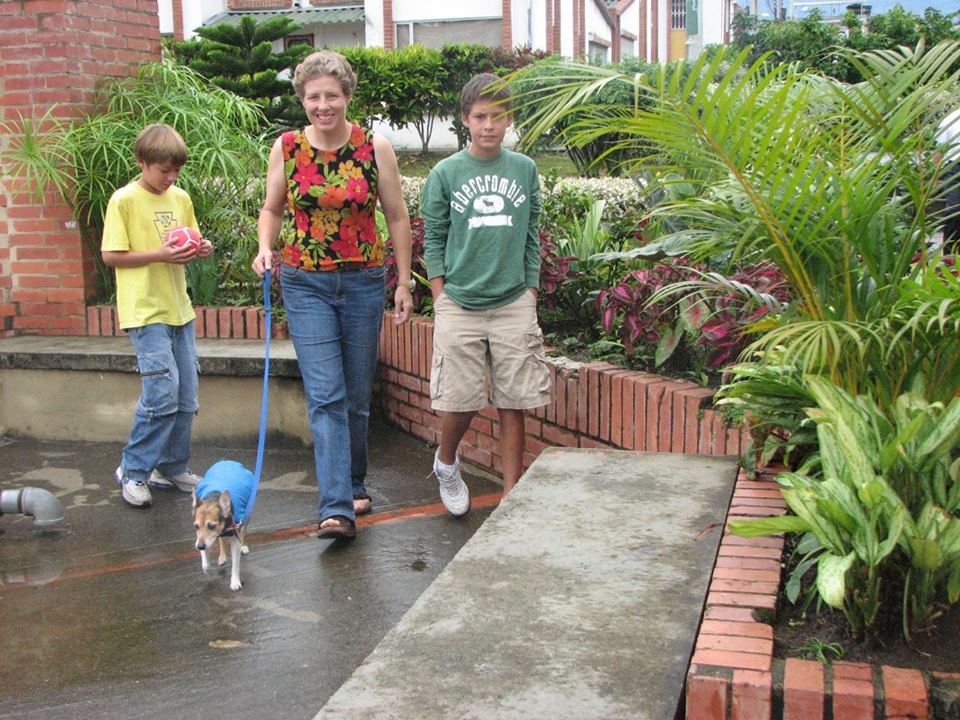 Gabriel, Rebecca and Mario walking their dog Crystal, in Colombia.
In the end, this year in Colombia and this book is a gift she gave her sons so that they will forever appreciate the countries their father had come to love: Colombia and the U.S., with a better grasp of what Saul went through to arrive at the kind of faith convictions and compassion he always demonstrated. Peeking in on that gift, you feel like you too have lived through an amazing experience without exactly filing the paperwork, going without water, trying helplessly to resuscitate your mother-in-law, living with mosquito nets, and worrying through your child’s medical needs. If they could do it, you can probably manage whatever life transforming adventure you feel God calling you to.
Years ago I wrote my first published book about a year of service and adventure in the Appalachian mountains of Kentucky, On Troublesome Creek. Ten years later I wrote another memoir type book, Departure, about a junior year abroad studying in Barcelona, Spain. After they were published, my boss—an excellent boss and may he live forever—kind of scoffed at the books saying “I don’t know why anyone would want to read a book out of someone else’s journal.” The first book was quite successful, went into a second printing thanks to the United Methodist Women’s reading program, and while Departure did not do so well, I’m happy I was able to preserve and publish those years for me and my family, if no one else. But increasingly in today’s very competitive publishing market—unless you are famous or an extraordinary writer—books like this must be self-published, which is a shame, because they don’t get the attention of those published by a regular publisher. They may also be marred by some small errors because they don’t undergo numerous rounds of proofreading.
If you are toying with writing a memoir—of your life or a particular period of your life, head over to the blog by Shirley Hershey Showalter who did a very thorough and wonderful job of studying 100 memoirs before launching her own book, Blush: Mennonite Girl Meets a Glittering World. I also believe it is easier to pick up on universal themes in a memoir covering one’s childhood, for instance, because we all go through early experiences that shape us, have relatives who don’t get along, struggle with adolescence and faith questions, and so on.
Seeking Saúl is entertaining reading for anyone who enjoys memoir type books, has spent a year or more in another culture or is considering it, who knows Saúl or Rebecca or the family, or anyone who has survived widowhood while parenting young children. It is also a story of adventure that nonfiction fans of Rebecca will enjoy—she does not assume the reader knows or understands Mennonites!
Rebecca Thatcher Murcia at a book reading.
***
All photos supplied by permission of Rebecca Thatcher Murcia.
Rebecca Thatcher Murcia has her hand firmly in the commercial publishing market with her series of 14 other books for children and young adults, all published by Mitchell Lane, (some with other authors) whose mission is publishing books to help kids who don’t want to read, to get into reading. Check those out! Rebecca’s books can be found on Goodreads, Amazon, and Barnes & Noble. You can also check out her Facebook page for the book, Seeking Saúl.
***
You can read (and listen to) more of Rebecca’s experiences in Colombia and the U.S. on the website for the former Shaping Families radio program. Here’s one.
We were talking at work about how 2015 shows up in the first “Back to the Future” film of 1985. Remember “Doc” traveling, at the end, from 1985 to 2015? Remember how far ahead that seemed, how unimaginable for all but the futurists among us? Well here we are, on the cusp of 2015. I for one could not truly have believed then that I would have participated in my family’s Christmas gathering 600 miles away via video on a smart phone.
In case you are still pondering what to make or take for a 2014 New Year’s Eve party or New Year’s Day gathering or weekend family get together, Party Mix is always nice to have around and adaptable to whatever you have on hand in terms of specific cereals and ingredients. And if you use healthy cereals, can it substitute for a healthy breakfast??
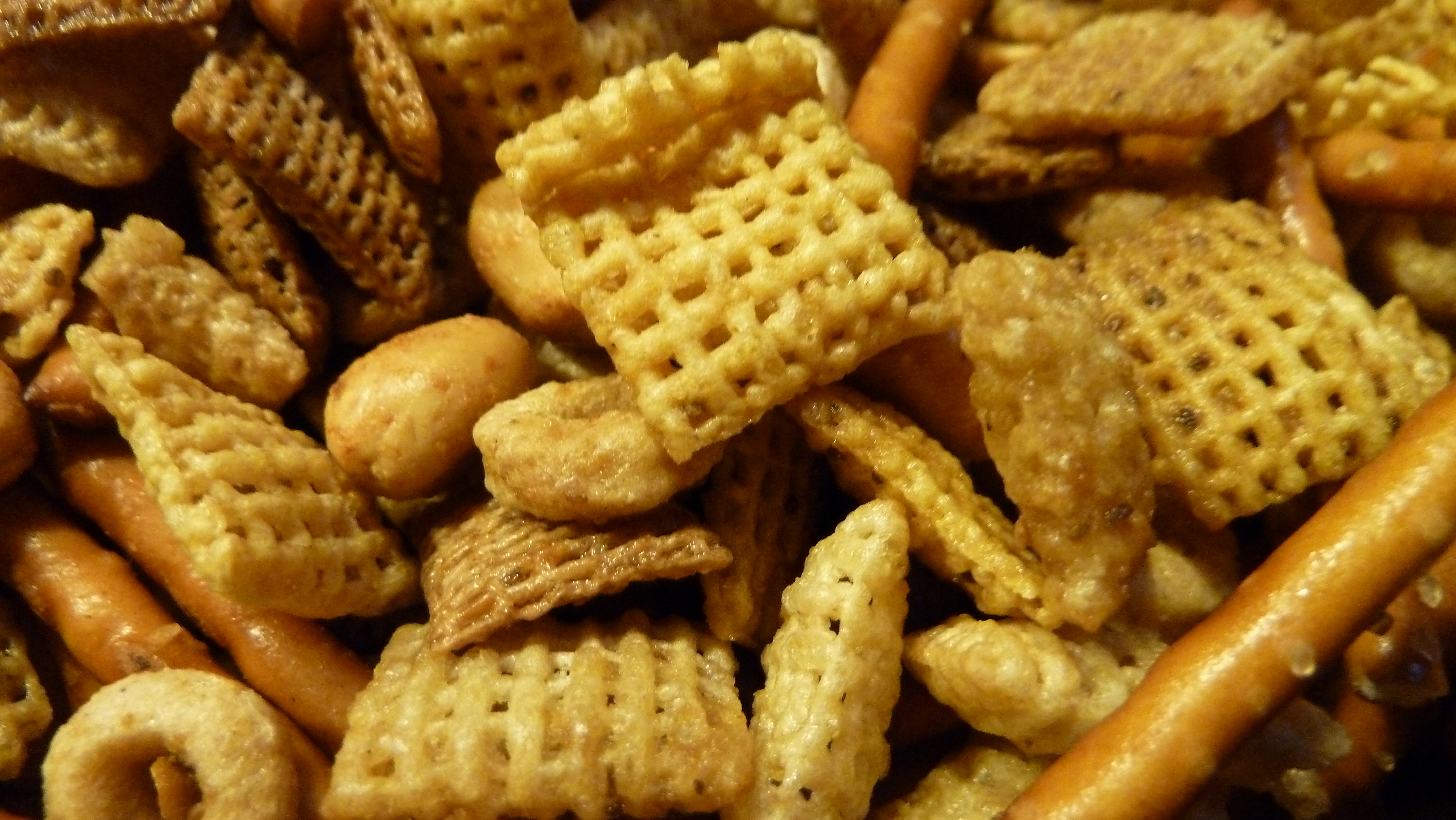
This is a recipe I’ve used over many years and adapted and corrected, see below. This year I had just finished making my batch shortly before Christmas when I was talking to my mother on the phone. She mentioned that a woman from my home congregation, North Goshen, had died unexpectedly, Viola Miller. No relation, but she was a fond church friend, and mother of one of my brother’s best buddies at church. Viola was still a vibrant and active church member, grandmother and all around good woman who will be greatly missed. When I visited my home church earlier this year, Viola was telling me about her numerous grandchildren with eyes sparkling with pride and love. And now I just noticed that another of my favorite recipes came from Viola, Strawberry Pie, posted here.

So I made this batch remembering her and thinking about how our named recipes—those we get from family and friends and cookbooks where we know the authors or cooks—are indeed special, bringing back memories, relationships, mentoring and good feelings along with the good food. That is the best of what this old church cookbook addresses as well: Titled “Fellowship Cooking,” the dedication states that “Fellowship is sharing.”

Speaking of old family recipes, I’m helping to launch a new blog for MennoMedia/Herald Press featuring Mennonite Community Cookbook. We have a new 65th anniversary edition coming out in early 2015, with contests and giveaways of great cookbooks each week. See here for an earlier post about this project. And keep your eyes open for news and posts about all the fun!
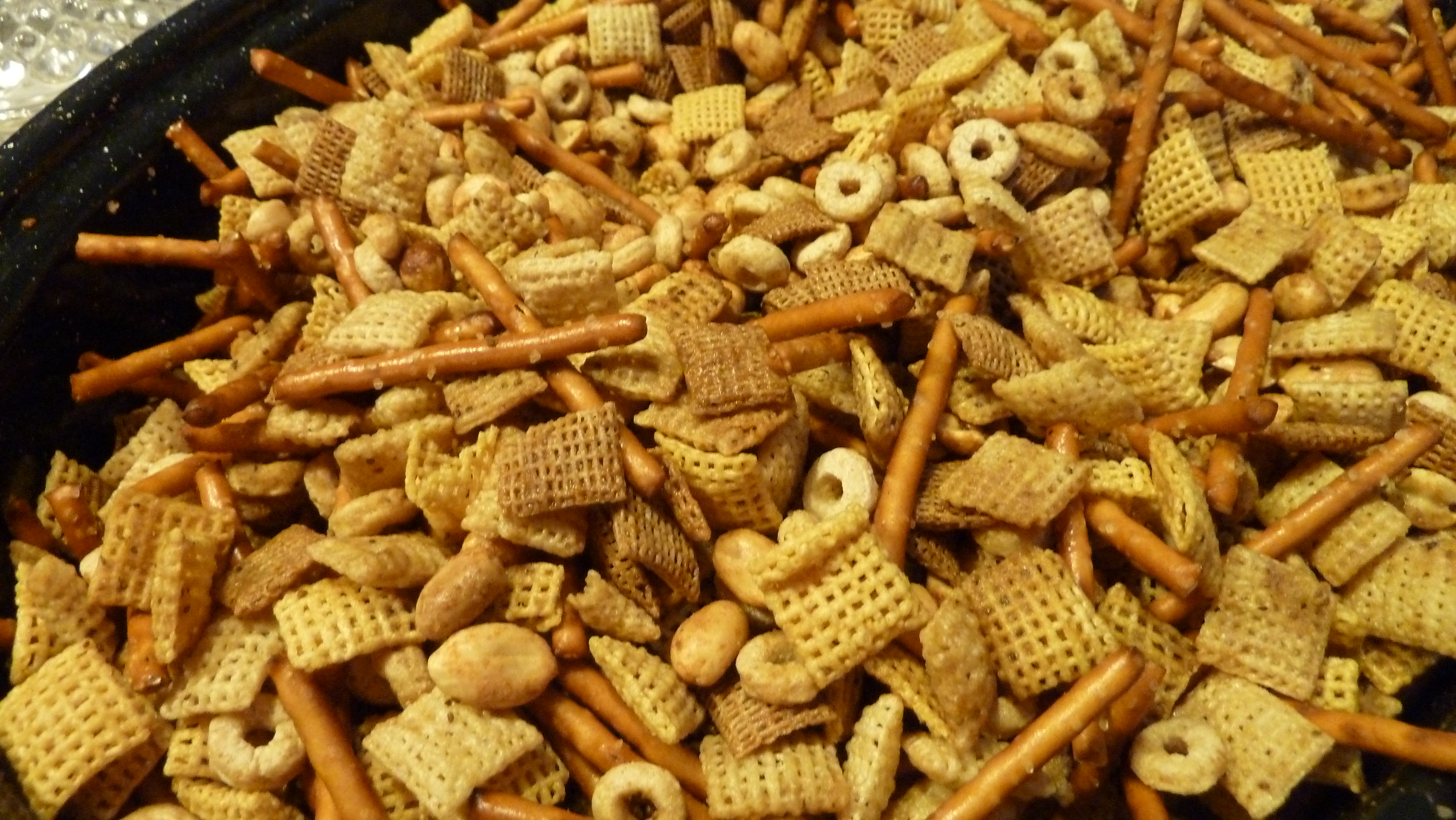
Party Mix
3 sticks (1 ½ cups) butter
¼ cup Worcestershire sauce
2 teaspoons each of garlic salt, celery salt, onion salt (original said 2 Tablespoons each, which I followed one time, but the result was way too salty and too much sodium for us.)
1 lb mixed salted nuts (or just peanuts)
12 oz.* shredded wheat squares (or wheat Chex is what I use)
6 oz. rice Chex
6 oz. corn Chex
7 oz. Cheerios (honey nut flavored or plain, or a mix)
6 oz. thin pretzel sticks
Melt butter in a small sauce pan; add Worcestershire sauce and seasoned salts and warm until all is dissolved. Remove from heat. Combine all dry ingredients in large turkey roaster pan. Pour the butter and seasoning mixture over the dry ingredients. Stir carefully to mix in butter and seasonings. Bake uncovered at low temperature, 225 degrees for two hours, stirring every 15-20 minutes. All amounts of cereals can be more or less to your taste.
*How I guess these ounce amounts is looking at the total ounces on the package, I eyeball how much would be 12 ounces or 6 ounces or whatever.
Adapted from recipe of Viola Miller and Mabel Nisley – Both these mothers had sons named Kenny who were both the age of my brother and therefore all three were great friends!
***
Recipes for Party Mix abound. What is a favorite for you, or what would you add to the above recipe?
***
Great gift idea: A woman from our church, Beverly, makes a huge batch of Party Mix, gives a pint away in a glass pint jar to many of her friends, and asks for the jars back to recycle next year! We are always happy to get a pint and to return the jar back to her!
***
Happy 2015 and thanks for liking, following and commenting on this blog! It has grown a nice step up this year and I appreciate all the blog love, and especially enjoy knowing some new friends.


