

An Ode to Marching Band Kids and Parents Everywhere
 Daughter Michelle, 2nd from left, with Broadway High School Fighting Gobblers Band.
If you are lucky
… you just might live near a local high school and hear the marching band practicing on the football field during these still-long September evenings. Jaunty marching tunes float through the neighborhood, compliments of a hard working bunch of teenagers who get their kicks playing nerdy and difficult band instruments rather than pushing an odd shaped ball into an endzone.
 Broadway High School playing at Gate City, Va., in state football championship game, December, 1997.
… you just might get to the state high school football championship game for the first time in your school’s history and the day is below freezing and the valves freeze on your daughter’s trumpet during her solo and your team plays with all their hearts but loses anyway (nevermind the mud, the refs, the yada yada).
 James Madison University fans celebrating one of 10 wins the year they went 10-2 and played in the national playoffs.
… you might even get to the national I-AA college football championship game in 2004. Your team plays with all their hearts AND WINS and even though you (and some of the sideline players) are freezing, you are so glad you drove the 400+ miles to see your middle daughter play in the band (but can’t find the pictures now).

… you just might finally finally get to the Macy’s Thanksgiving Parade in New York City (2001) which you have dreamed of all your life.
 Our daughter Tanya is on the right side with JMU marchers in the Macy Parade, middle one turning and smiling at us.
… you might get to see your own child marching into Columbus Circle and Herald Square in that wonderful city, and the kids are allowed to ignore normal marching band etiquette and actually turn their heads and smile, and you are just so happy even though freezing, especially when the post Sept. 11 crowd of strangers around you, barely two months after the terrible trauma, joins in yelling your daughter’s name so she turns and smiles happily and you capture it on camera because the bystanders have left you squeeze up to the front.
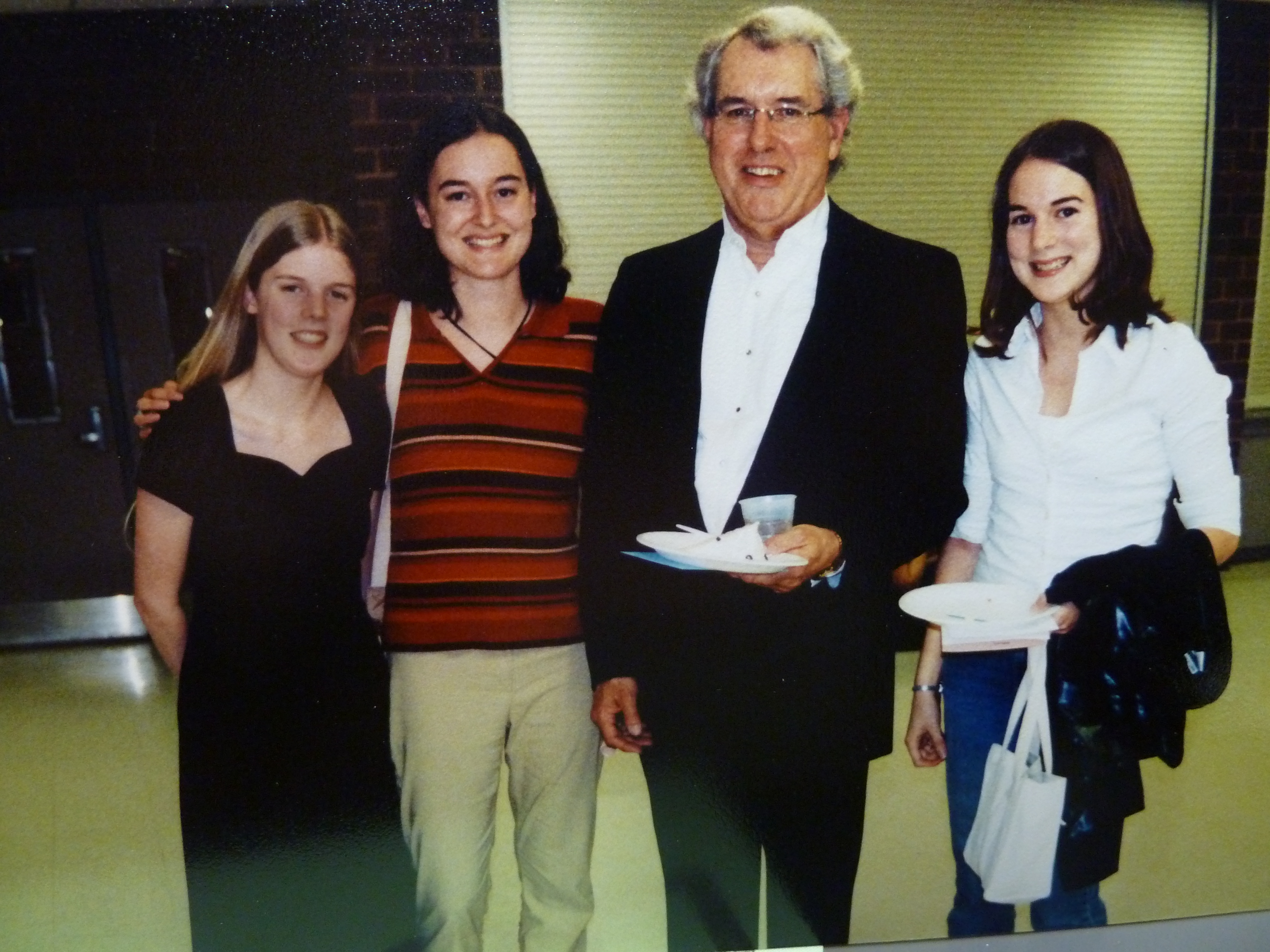 Doreen, Michelle, Mr. David Snively and Tanya, at his retirement party.
… you just might have the good fortune of your kids having dedicated, funny, fun (and sometimes cranky) band directors who give themselves to this crazy, quirky bunch of teenagers going through all the stuff that teenagers go through, such that when he retires from this crazy band life, all your daughters come back home to help fete him.
 Nashville Symphony warming up at Schermerhorn Symphony Center.
… you just might end up so happy that this crazy band life has led to a fantastic career for one, working for some great mid-sized city symphonies in an artistic administrator role she totally seems cut out for.
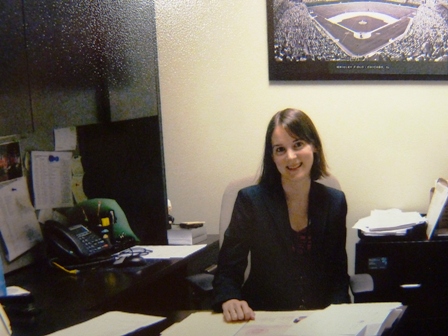 Tanya while working for Nashville Symphony.
.. you just might feel that all of the 4 a.m. risings and midnight pick ups and bad bus behaviors and $$ for lessons, raising money for uniforms and trips, $$ for gas running 10 miles back and forth to school yada yada seem worth it.
 Tanya comforting Michelle at “last” game at old Broadway high school field
… you just know your children are gonna make it through good times and bad when you snag a rare photo like this of deep sisterly camaraderie when the band plays what everyone thinks will be its final time on the “old” high school field before moving to a new school building the following year, and your very sentimental oldest daughter’s heart is torn right in two even though they’ve just beaten their arch city rival (and then they end up playing one more game with a half time show on that very field because that is the year they get in the playoffs and on to the finals at the state level, mentioned above). If you are so lucky.
***
Our family back story on band.
 Michelle and her first trumpet in middle school.
Neither my husband nor I had ever been interested in band in school (band?? Huh? No thanks!). When my oldest daughter began middle school, she let us know she wanted to try band. Her instrument of choice was a trumpet so we went to the local band store and rented a trumpet for the first three months, not sure she would stick with it. Even though her sisters took piano lessons, she had never been interested, so, whatever. We weren’t overly-pushy-get-them-in-everything kind of parents. She did like music and had learned to read music through the children’s choir at church. So as she began on the trumpet, we suffered through the pfllts that wouldn’t quite come out, the screeches and off notes while she practiced in her very small bedroom in our 1100-square foot house, doors closed.
But when she got to high school, we soon learned marching band took on a life of its own and would forever impact her choice of friends, her activities, her history—and the lives of her sisters, as they also chose to participate in band.
 Tanya, second from left, with best buds Edie, far left, and Gina, far right, all flute players.
One day waiting with other band moms to pick Michelle up after a day at summer band camp, I so well remember Becky Dean’s mom informally orienting me to the world of band parents: the parades, the trips, feeding the kids before games, how the Stoops family took care of transporting larger equipment to away games in an old open bed truck (yes, really!), and especially emphasizing how this was a good bunch of kids who basically did not get in a lot of trouble (unless on the band bus) and the kids became family to each other. She also clued me in on the band parent meetings, the fundraisers, the annual auctions, the chicken barbecues, the pizza and candy sales.
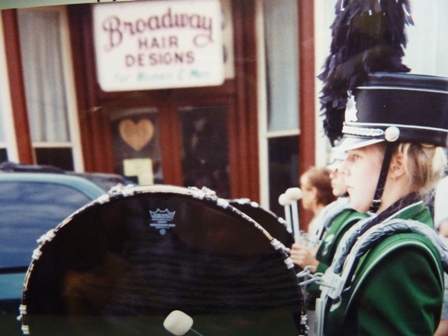 Doreen carrying one of the big ones in a Broadway Homecoming Parade.
So the band world became our world for the next dozen or so years, as all three girls were adopted into the band family including one who went on to play flute for four years in the pretty awesome Marching Royal Dukes (hear them below in YouTube videos) at nearby James Madison University, a huge band of 400-475 participants, depending on the year.
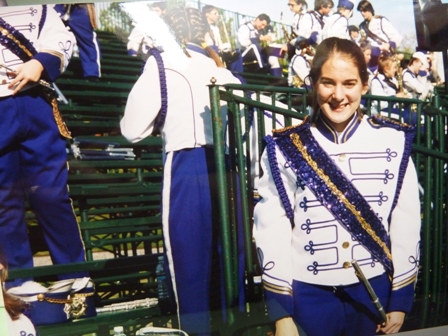 Tanya as a Marching Royal Duke member from 2001-2005.
Our youngest daughter even joined the pit band while in high school—the percussion section playing xylophone, cymbals, bass, or wherever needed most, and loving almost every minute of it, except at the end of a very long parade on a hot day as a relatively small girl carrying a good sized drum.
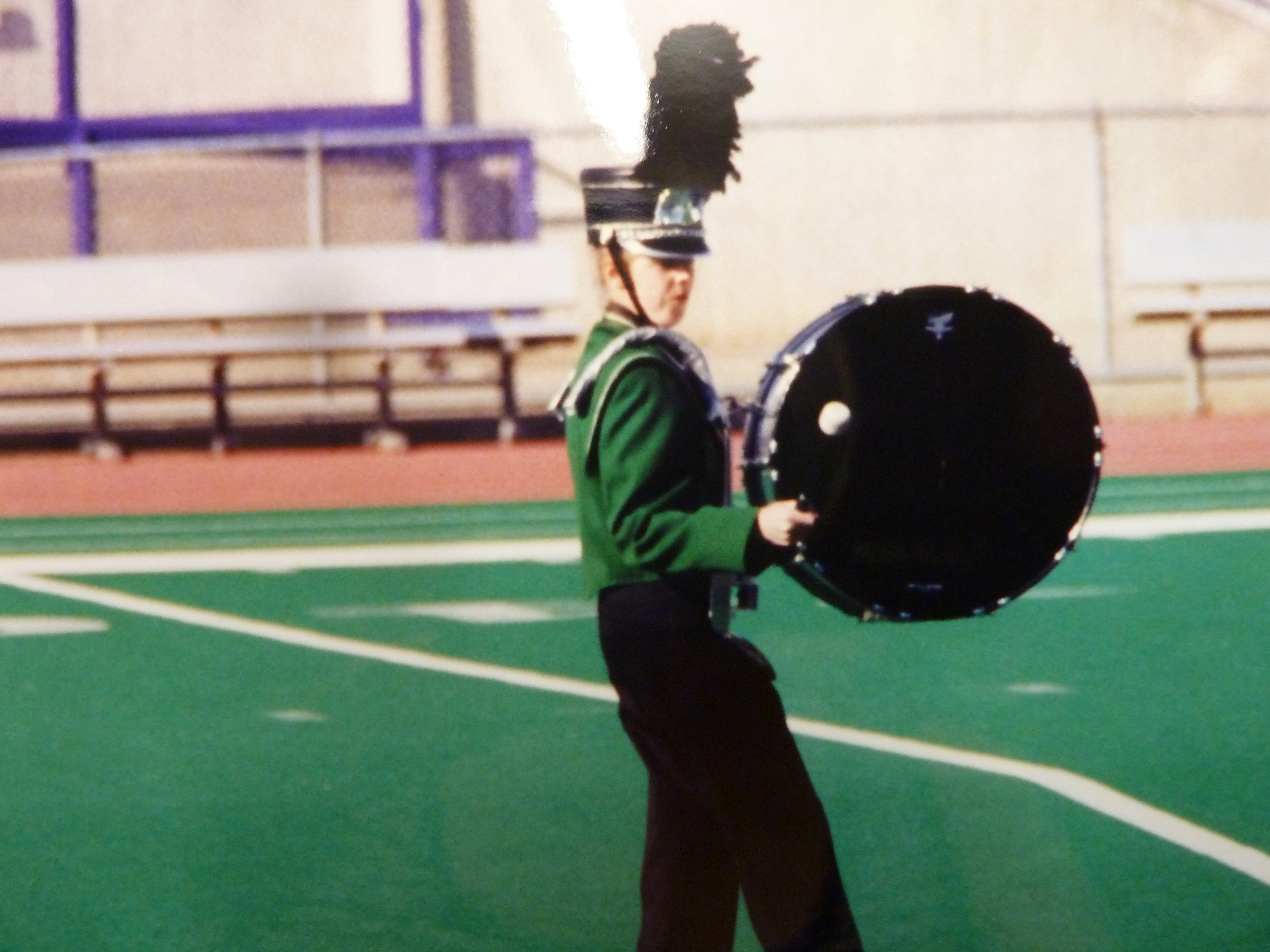 Doreen in competition at Parade of Champions, JMU.
By the time Doreen participated, Broadway High School band had finally graduated to taking part in marching band competitions, so all of our kids (in one setting or another) got to taste what it was like to stand on the field of a large college stadium while the stands went wild. One of them once said “I felt like I was a rock star!” During the years when their school football teams (high school and college) lost far more games than they won, we went to the games to see the band on the field, not the team.
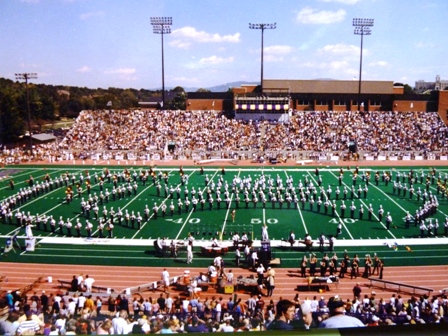
So each fall when I’m traveling near a school or university and hear strains of a rousing John Phillips Sousa tune, a current movie theme song, or a stirring trumpet screeching out the high notes on “Firedance,” a big lump rises and I squeeze back tears, remembering, and being moved by music that speaks of our daughters, their loves, their friends, their lives–and by extension what they gave to our lives. A new found love of music and being in the band.
In the Bible, from the book of Exodus to Revelation, trumpet or trumpets are mentioned at least 129 times, flute or flutes 16 times, and cymbal or cymbals 16 times. But my favorite is Psalm 150 where the Psalmist seems to go wild throwing out a whole string of wonderful instruments:
Praise him with trumpet sound;
praise him with lute and harp!
Praise him with tambourine and dance;
praise him with strings and pipe!
Praise him with clanging cymbals;
praise him with loud clashing cymbals!
Let everything that breathes praise the Lord! Psalm 150.
So go, marching bands everywhere, and follow, you lucky parents. Enjoy this wonderful fall season of music and football!
A 1999 version, my favorite, of the JMU MRD playing Firedance.
A 2006 version, showing the much larger stadium at JMU.
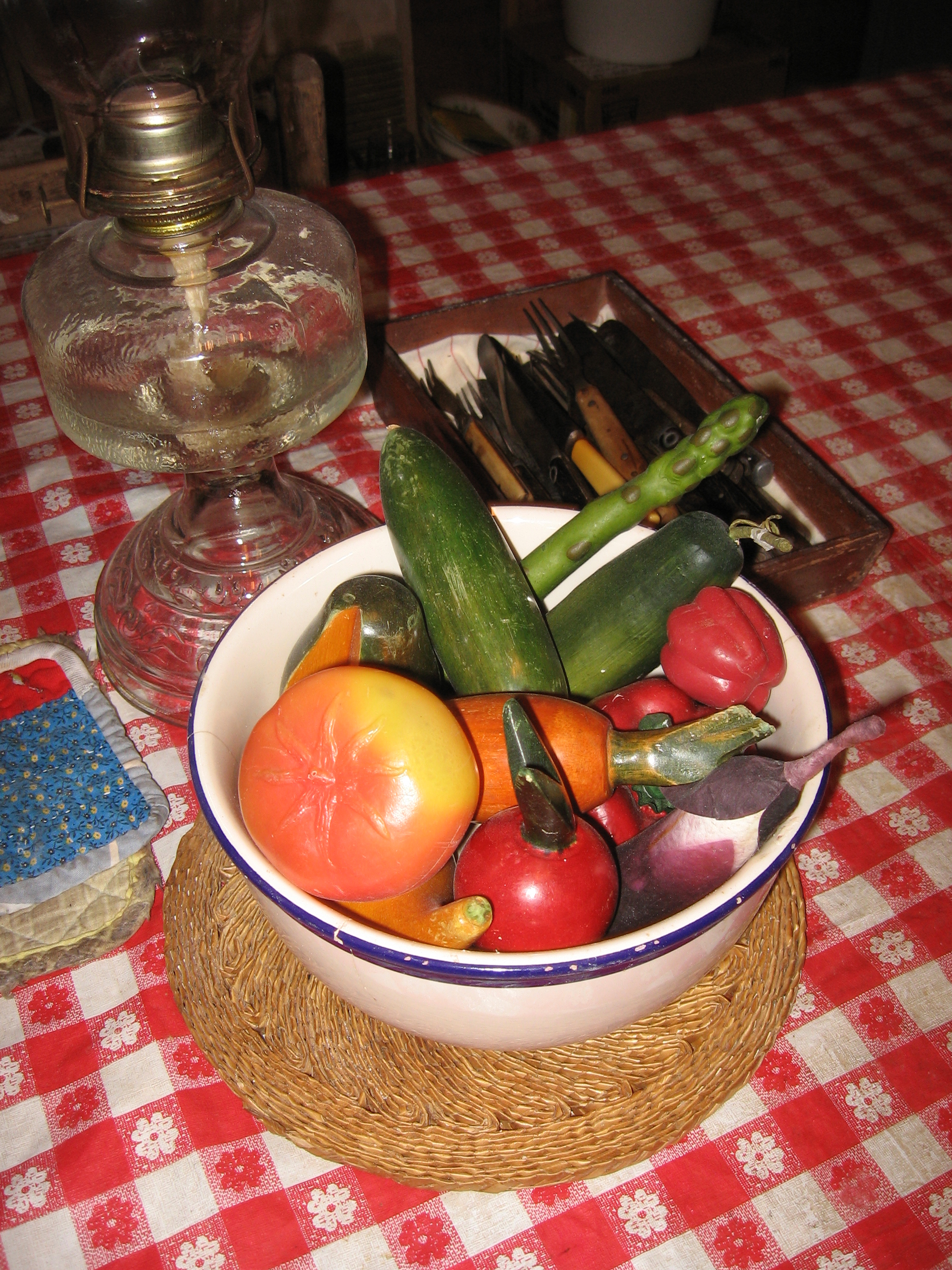
Part 2 of two posts on Dr. Peggy Ann Shifflett’s book, Mom’s Family Pie. Part 1 here.
Eating locally and in season is nothing new. Barbara Kingsolver, the novelist and author of Animal, Vegetable, Mineral, did not invent it; she and many others like her may have rediscovered and made it popular but folks have been eating what was available seasonally from the beginning of time–UNTIL the discovery of electricity and invention of refrigerators, freezers, and plastics for packaging.
Sociology professor and folklorist Peggy Ann Shifflett reminds us of this truth in her book on the food traditions of families in her part of Appalachia, and recalls the era when her family moved from keep foods cool in the “spring house” and with ice, to real refrigerators.
She points out further that “The bounty of each season brought the family and community together to forage for the ingredients and to help prepare the recipes. Seasonal food connected family and community members to each other because at least three generations were usually helping with or watching the work being done.”
She talks about apple butter boiling, butchering, and making sauerkraut as some of the labor intensive activities where a couple generations gather, bring out specialized equipment used only once a year, and pitch in.
This past Labor Day, I thought of how we and my brother-in-law’s family used to load up our kids and all the five-gallon buckets, bushel baskets, milk crates and tubs we owned and drove to their homeplace for potato digging. Someone would run the tractor down the rows with a potato plow, and out would flow Yukon gold. Truly, the kids loved diving on those potatoes as they rolled out as much as they loved hunting Easter eggs. When they were really young, we would pump their enthusiasm by oohing and ahhing loudly at the great fountain of potatoes spinning out. But by the end of the day, everyone was exhausted and cranky from finding and lugging the equivalent of 30 bushels (thousands of potatoes, conservative estimate) out of the garden and into grandpa’s garage and our trucks to haul home.
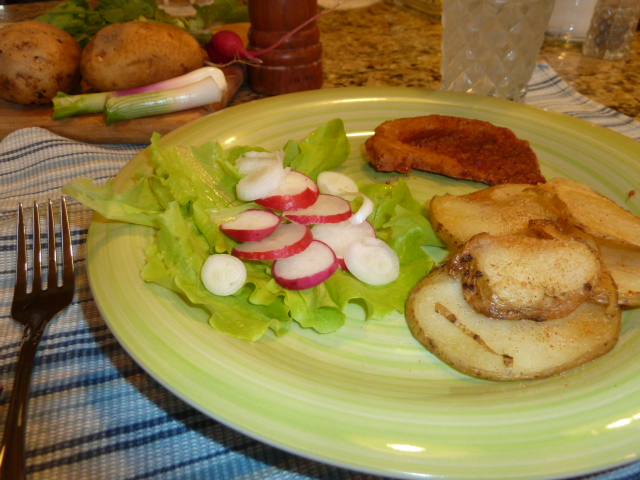
Funny, but I don’t think I have one photo of digging potatoes at my father-in-law’s. That evening I’d cook fresh French fried potatoes and grill hot dogs and we’d chill out around food. Digging potatoes together will be our kid’s main memory of working together as a family to harvest food we would use all winter. The potatoes did usually last all winter, until a new crop was ready for early digging the following summer. I am personally happy that the other family tradition of butchering each year around Thanksgiving fell by the wayside (for reasons I wrote briefly about here) a few years after I joined the family.
In Mom’s Family Pie, families did much more massive food harvest/preparation together. Their social life revolved around family getting together, at least weekly for Sunday dinner. But the term “family pie” was a new one for me, and I loved Shifflett’s description of “family pie” as something that brought her family together and oiled spots where friction was causing hurt and pain. Food provided a place and time for healing and bonding. I wondered how that worked.
Knowing some background on Shifflett’s family from her other book, The Red Flannel Rag, where she speaks of family fights—verbal and some throwing of objects or fists especially when their homemade whiskey was involved—I knew that sometimes her kinfolk didn’t talk for weeks at a time. So “often just the smell of family pie drifting around the house and out the windows and doors might be enough to tempt them all to the table again. Differences were resolved while the meal was consumed.” (p. 20).
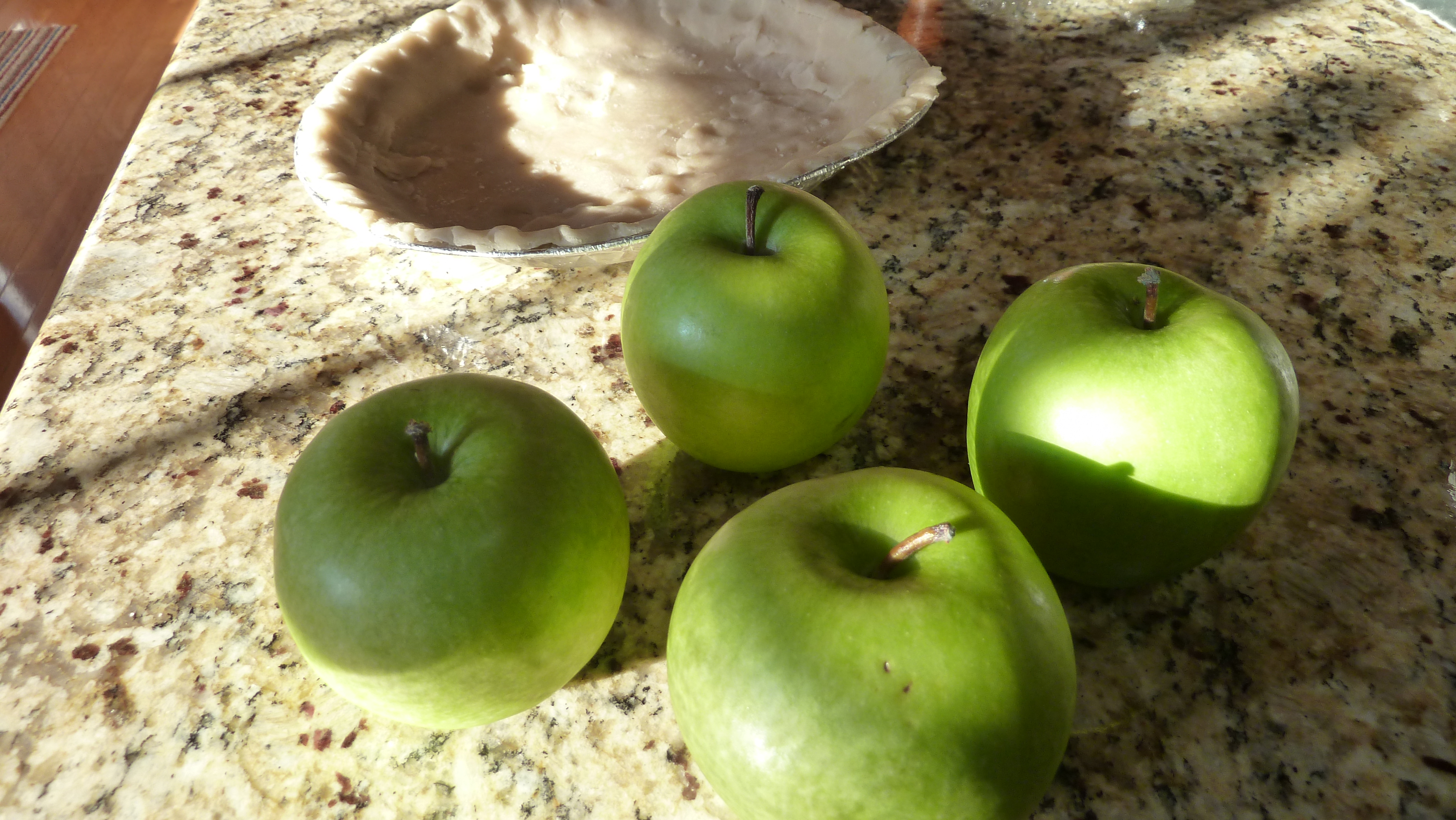
A family pie is not round and fancy with curly edges and markings like most of us are accustomed to on a standard pie. Instead, it was thrown together in an oblong pan, a quick crust layer in the bottom, some apples or canned cherries added from the pantry, and then a top crust just kind of lopped over the edges and was quickly pinched together. Hilda, Shifflett’s sister-in-law from an early age, would start making a meal by putting this pie together and letting it bake while she made the rest of the meal. Hilda said the smell of freshly baked family pie coming out her door on an ordinary busy work day was enough to call her husband in for supper.
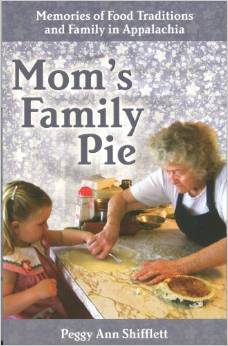
On the cover of this book, Mom’s Family Pie, there’s a photo of pie making. By luck Shifflett happened on to it one day when she went to her Aunt Ethel’s house. Aunt Ethel was in the middle of a pie baking session with the help of a great granddaughter, and Shifflett knew it was the perfect cover photo for her book. As a book editor who works on a team of folks to come up with book covers and images (a colleague wrote about that just yesterday, here), I can understand how elated Shifflett was to stumble onto that scene.
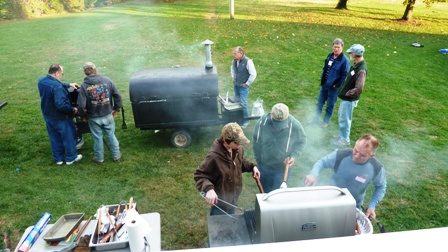
I have often thought of how a family or community’s particular food customs—that takes a group to prepare—functions as family/community tradition and glue. Here in the Shenandoah Valley we have countless groups preparing barbecue chicken at a church, community, or civic group pit: getting up at 3 or 4 a.m. to start the charcoal fire and then put the chicken on so that it is ready to sell by 8 or 9 a.m. The Lions club we belong to does BBQ chicken and also hosts a Pancake breakfast, lunch and dinner (coming up locally Oct. 17-18 in Broadway, Va.). There’s also a huge Mennonite Relief Sale in the Shenandoah Valley each year (this year Oct.3-4), also held across the U.S. and Canada, raising money for world wide relief and development programs.
Working together provides a way to get to know others so much better than just attending church, club or civic group meetings. Of course even that is not friction-free as too many cooks “in the broth” have differing opinions on how to determine when a piece of chicken is done, how to make the best BBQ sauce, or the pancake is ready to flip.
This second book, Mom’s Family Pie, provides numerous recipes, some which are interesting only for the food history that most cooks are not going to bother with today: pinto beans with rivels, Creasy greens, peach whirligigs, pig feet and hocks. But if you are looking for a particular old-timey recipe or basic procedure for doing apple butter, fried squirrel and gravy, or venison steak that has been lost to your family or tradition over the years, it might be a place to look. But I liked the narrative–the stories and tales–more than the recipes.
I also enjoyed comparing notes between my husband’s family and Shifflett’s traditions, and feeling very happy that my husband—who loves my cooking—never developed a custom which was a “have to” for her father at least once a day, every day: fried ‘taters, as he called them. When I make fried potatoes it is simply an occasional way of using up left over boiled or baked potatoes, for an easy starch with a meal. But for Shifflett’s mother, it meant a pan of fresh potatoes, peeled and fried in a cast iron skillet on a wood stove—all of which took not a little effort. Peggy’s mother would ask her husband what he wanted for supper on Saturday and Sunday nights and he would invariably say “just cook me some fried ‘taters” and her mother’s weariness couldn’t help raising its head as she went to the basement with a loud curse saying “I fry potatoes every day of the week for you. Couldn’t you at least give me a rest from peeling potatoes on Saturday and Sunday?” (p. 247)
Overall Shifflett’s love for both her parents, and fond memories and admiration especially for the hard, unceasing daily work of the women in her family preparing food shines through with only occasional critique. With young girls taking on adult responsibilities as 8 to 10-year-old girls and definitely by the time they were teenagers, these women (her mother and her aunt famous for cooking) usually said they could not remember how they learned to cook something when first pumped for specific recipes. Shifflett says she finally understood their frequent response (and I can just hear one of my husband’s aunts who would have said this very thing): “I ought to know how to cook. I’ve been doin’ it all my life.”
You and your family may not have grown up in Appalachia, but I think each and every family and community has their particular food and family customs that are worth remembering and preserving. Thankfully, some are relearning the art of cooking without so much pre-packaged and prepared foods.
***
What is a community food preparation event where you enjoy working with others for a common purpose?
***
Does your family have certain foods or customs that bring the family together–such as around a bowl of popcorn on Sunday evening?
***
In Whatever Happened to Dinner, I include stories on the value and tradition of community cooking. See more in the Table of Contents or purchase the book here.
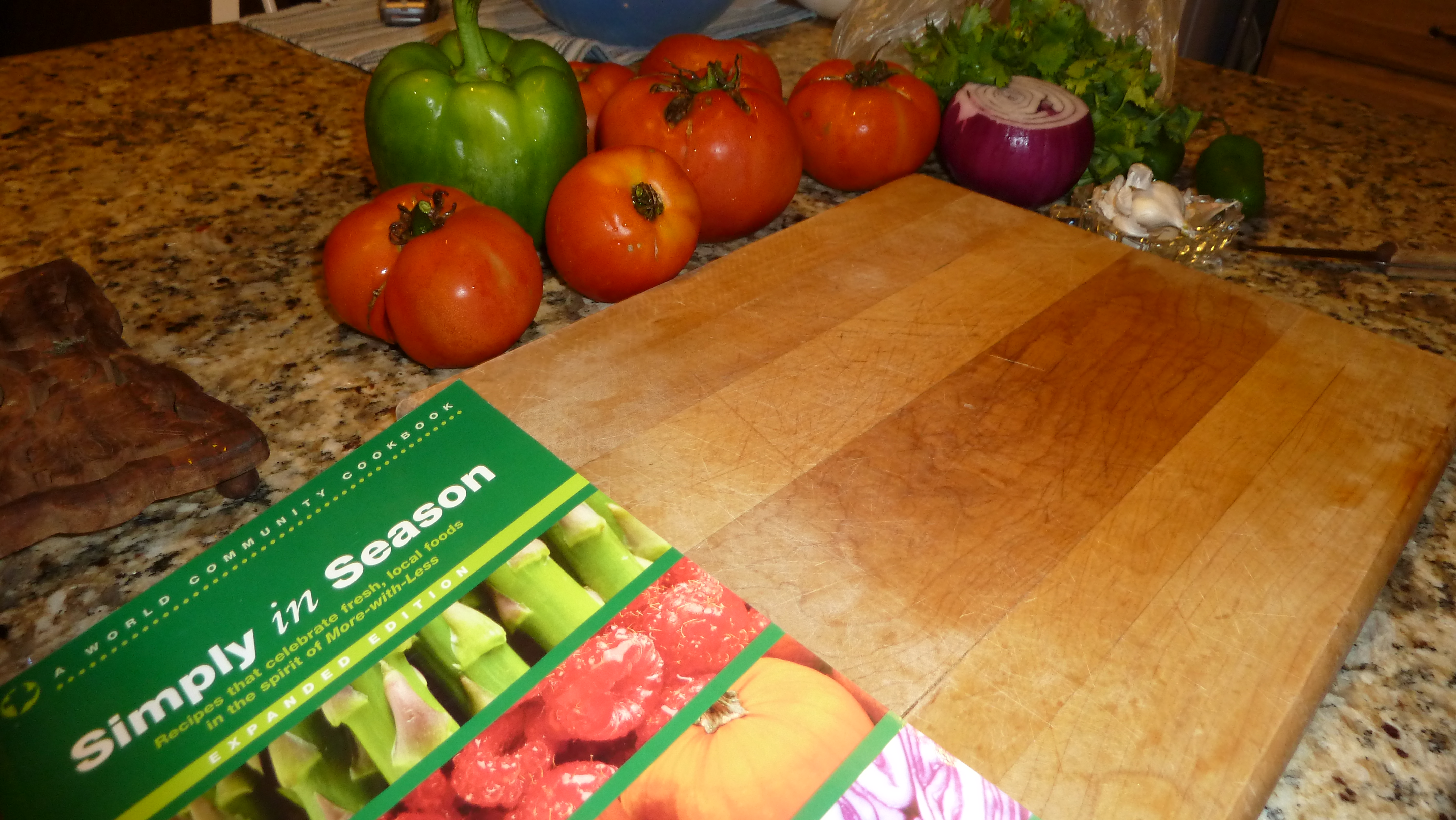
Tomatoes. Here in the Shenandoah Valley, most heavy-duty gardeners are still swimming in tomatoes. We’re running out of cans, running out of recipes, almost running out of patience. For something I crave so strongly the rest of the year that I buy pathetic hot house imitations, I am tired of having them every meal. And I’m not really bragging or complaining, just stating facts.
Or maybe it is just me. Some of us are ready to put away the canner.
But not quite yet.
So I hustled up a recipe for canned tomato sauce and made a small batch. One daughter called me last night to say she and her housemate were cooking up a shared dinner of fresh eggplant from her garden, mozzarella, and my canned sauce. That sounded wonderful to me and I’m so glad the kids branch out from my cooking that tends to be more traditional as in meat, starch, vegetable, salad.
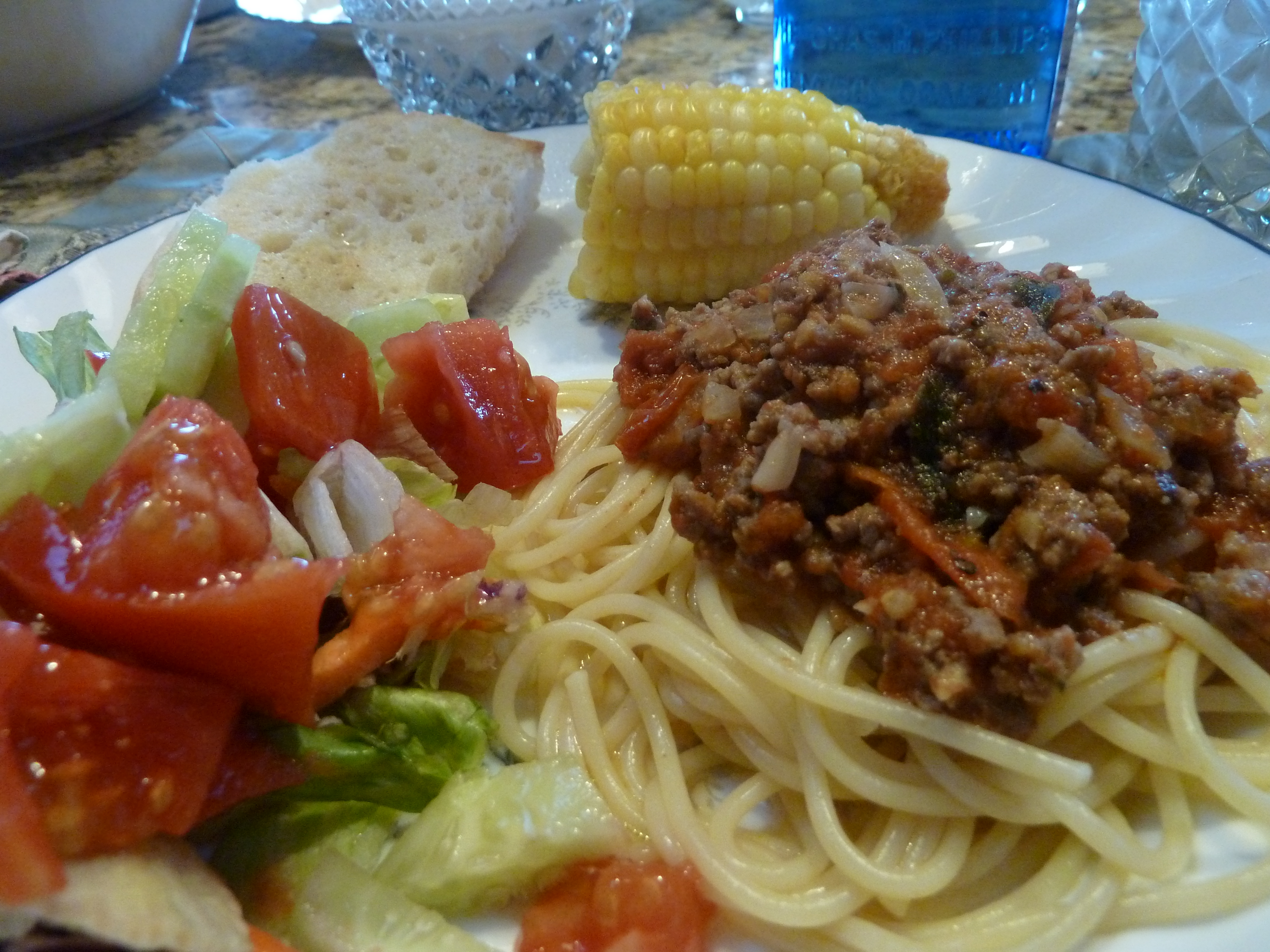
My very traditional meal
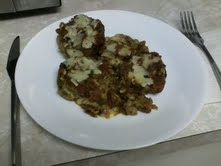
My daughter’s meal: sautéed eggplant rounds (egg and flour breading), with parmesan, spaghetti sauce, mozzarella, & basil sprinkled on top if desired. Better Homes and Garden’s Cookbook. Yummy even if the “presentation” could be improved. 🙂
So here’s the recipe to use any way you can. Mary Beth Lind, co-author of Simply in Season says with the recipe, “I use this for spaghetti sauce, pizza sauce, or any time I need a marinara-type sauce. I really like the added nutrition of the carrot.” Mary Beth is a registered dietitian and nutritional consultant, so it is not surprising to find her squeezing in Vitamin A into this Vitamin C-and-antioxidant-rich sauce. (This link has more about the healthy lycopene in tomatoes .)
I doubled Mary Beth’s recipe, to make a batch yielding 6 pints.
Basic Tomato Sauce
2 onions (chopped)
4 cloves garlic (minced)
Sauté until soft in 4 tablespoons olive oil
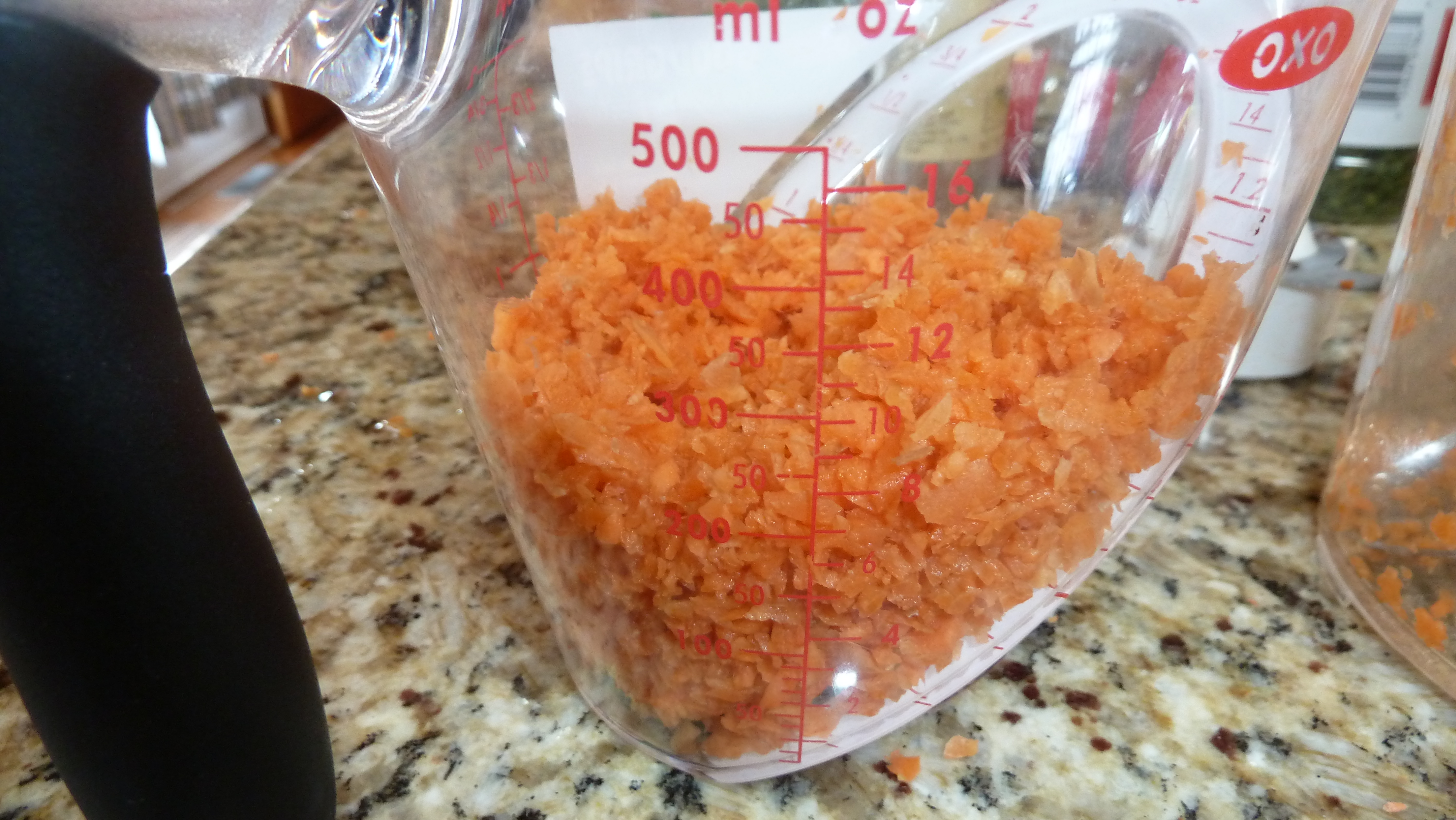
4 carrots or 1 cup (shredded)
1 green pepper (chopped)
4 bay leaves
½ cup fresh parsley (chopped; I used dried)
4 tablespoons fresh basil (chopped, or 4 teaspoons dried)
2 tablespoons fresh oregano (chopped, or 2 teaspoons dried)
2 tablespoons fresh thyme (chopped, or 1 teaspoon dried)
Add. Stir well.
12 cups fresh plum or Roma tomatoes (peeled or skins slipped off, and chopped)
12 ounces tomato paste (I didn’t have any and subbed in a 12 ounce can of store tomato sauce)
2 tablespoons honey (optional)
Salt and pepper to taste
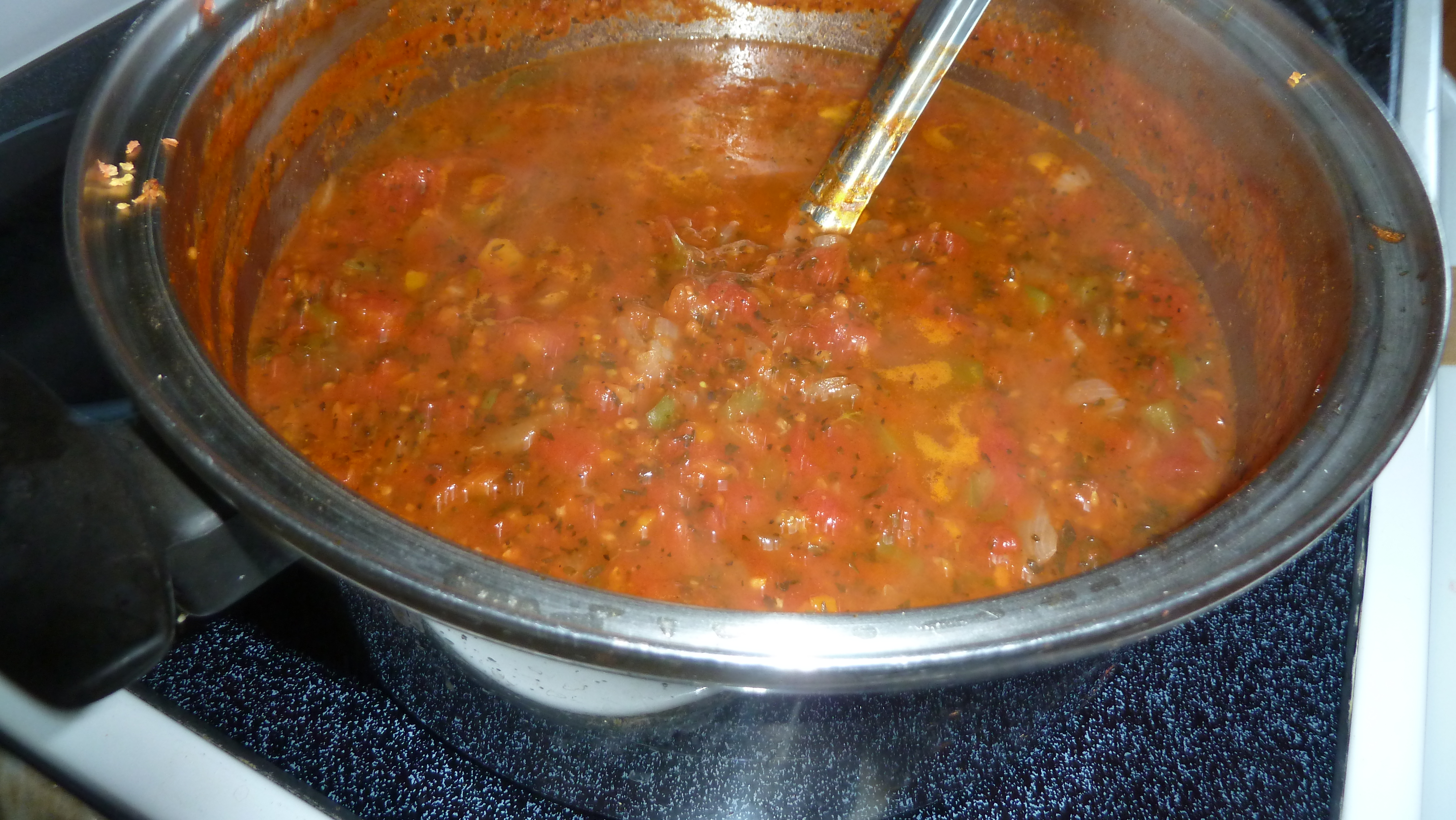
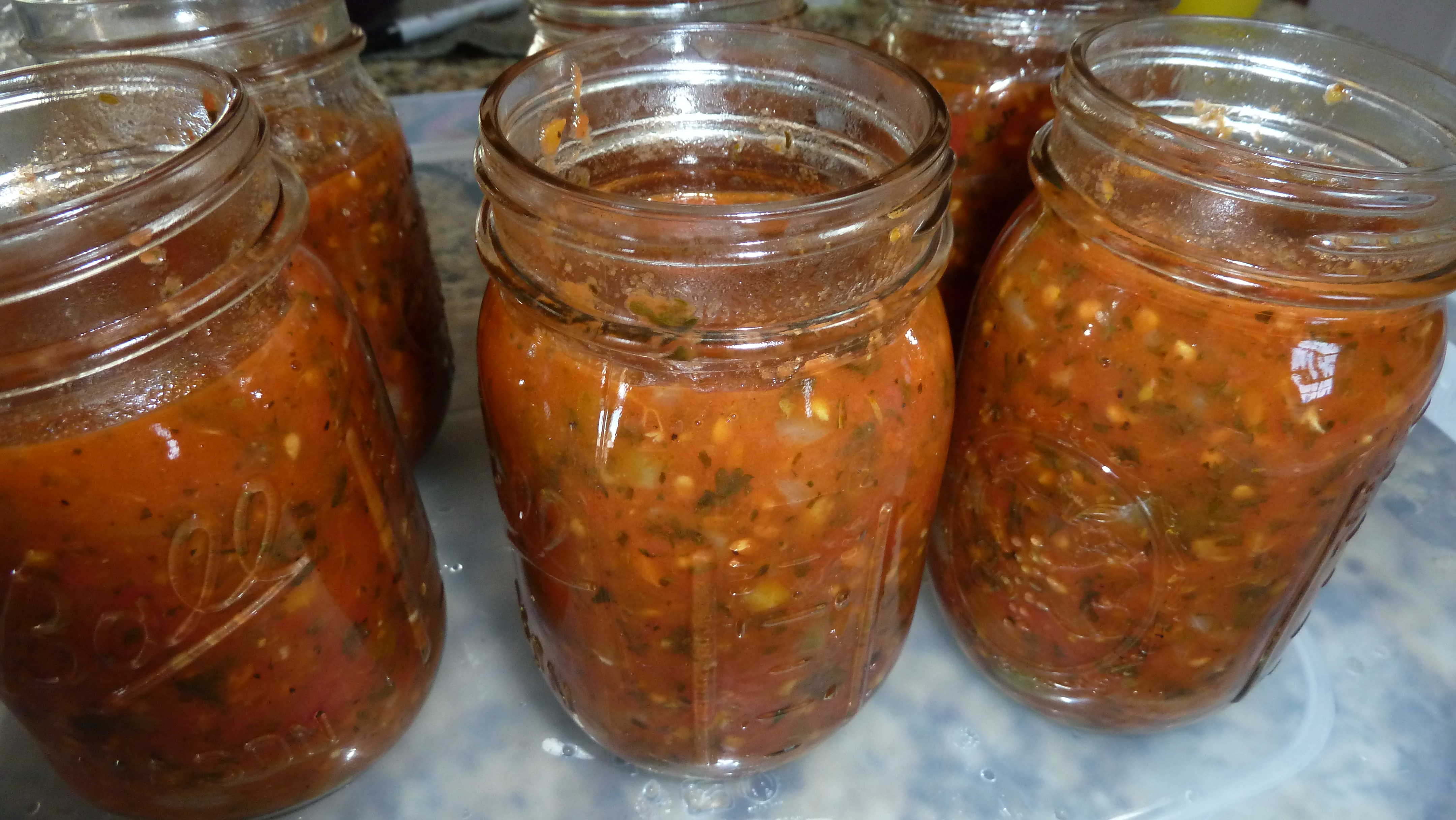
Add and season to taste. Simmer 15 minutes. Remove bay leaf and serve or freeze. Or, to can, ladle into hot sterilized pint jars to within ½ inch of top; add 1 tablespoon lemon juice or vinegar per pint to assure acidity; seal with sterilized lids and process full jars in boiling water bath for 35 minutes.
From Simply in Season, Herald Press, 2009. Adapted from Mary Beth Lind and Ellen Miller.
***
Are you tired of tomatoes? Or what’s your newest favorite way to serve them?
Do you have a copy of Simply in Season?
It has great ideas and recipes for seasonal foods, all year.
Married at ages 11 and 14. Child brides. Where? Some far off place like India? Afghanistan? Sure, but also here in the U.S. not far from where I live, and not that long ago.
Earlier I wrote about Peggy Shifflett’s fascinating book, The Red Flannel Rag: Memories of an Appalachian Childhood sharing the traditions, folk lore and cultural differences among the people of a certain “hollow” near where I live, Hopkins Gap.
I was eager to read her second book focusing on the food traditions and actual recipes from her extended family—filling in the gaps of my own knowledge of southern Appalachian cooking. I’ve picked up varying tidbits from my husband’s family who hail from Bergton, Va., Tuscaloosa Ala., and from a year I spent near Hazard, Kentucky.
Shifflett’s book is called Mom’s Family Pie: Memories of Food Traditions and Family in Appalachia. Peggy is a retired professor of sociology at nearby Radford University. I can’t begin to cover all the recipes and experiences she covers in her 344-page book. In some ways it reminded me of Barbara Kingsolver’s classic, Animal, Vegetable, Miracle: A Year of Food Life. We meet the family and the typical Appalachian homestead of the 40s and 50s, the cooks, the tools used (woodstove and wood), the milk cows and various products they provide (homemade butter, clabber—like sour cream), the springhouse where such items were stored before widespread refrigeration, gardening, preserving (making sauerkraut, what a production!), butchering, making apple butter and more. They were almost self sufficient—a goal for those today who are into homesteading or backyard farming. Even making their own spirits, (moonshine), covered more extensively in her other book.
But here cooking with a woodstove was the first major item that captured my attention, having watched and tried to learn from my brother-in-law as he demonstrated how to master this fine art at his mountain cabin.

It is no wonder cooking temperatures are not given in some old recipes which folks have tried to write down. Unless you use a thermostat with your wood stove, you cook according to the area of the stove where you set your pan or skillet, and according to the type of wood you use: some wood is great for quick hot fires, and other is better for the slow and steady heat needed for baking.
According to Shifflett this is a fine skill learned with practice and over time—there is no way to pick it up from a book or blog, but her mother apparently shuffled that pan around with the ease and expertise of a gourmet chef. Shifflett says at one point that her mother stood in front of that stove practically her whole life, as she never worked away from home.
Shifflett says her mother, Myrtle, and her Aunt Ethel were widely regarded as the “two best cooks in Hopkins Gap” and some even extended that to the Shenandoah Valley and added “damned” to the description (two best damned cooks). I’m sure there are plenty of others who wore that title informally, but Shifflett’s love and admiration for her mother’s hard hard work shines through the whole book: Myrtle would start a fire before dawn in the cookstove; head to the barn to milk cows (always her chore); put three hot meals on the table each day; grow, harvest and preserve most of the food her family ate in a year, including the meat; and often stay up to finish up chores and clean the kitchen one final time after the rest of the family had gone to bed (her mother couldn’t stand to wake up to a messy/dirty kitchen). This is the pattern of millions of women the world over who still work this hard to feed families. Especially at this season of the year.

But there was great pride in all this work and food production, and a compliment over the food would likely bring on more of it. I chuckled about an aunt who fixed Shifflett a sandwich one day of sausage, dill pickle and mustard. Peggy raved over the sandwich. “To this day, every time I go to visit Aunt Ethel, she fixes me a sausage sandwich with mustard and dill pickles. She had been doing this for over 40 years.” (p. 32).
That these women lived as long as they did was no mean feat. A generation earlier, Peggy’s grandmother, and Peggy’s great aunt (mothers of these famous cooks, Myrtle and Ethel) married at age 14 and 11, respectively. Eleven. A child bride, not even a teenager. Of course they began having babies right away. “It was very common for couples to have between 8-12 children. Both of these women died young: 35 and 37, respectively—one several months after giving birth to her 18th child” (from the book, p. 32-33). Again I think of women around the world who still today marry early, have a ton of babies, and die young, working hard the whole while. This was not so unusual here in the U.S. just 3 generations back from me. My grandmother’s mother died when she was just five, leaving her an orphan; again, very common.
 Grandpa and Grandma Miller’s wedding picture, she was just 17.
Peggy Shifflett has provided an admirable, if plainly written, history of those earlier times. I’ll follow up with one more post talking about traditions and origins for some of the recipes and ways of cooking she shares which are familiar to many of our grandparents and parents.
To be continued.
***
How old was your grandma or great grandma when she got married? What food traditions do you remember her talking about?
***
Was there a food your grandmother or other relative you loved that they always fixed for you?

I needed to test a recipe for an upcoming Amish cookbook, that is actually a remake of an earlier book, Countryside Cooking and Chatting: Traditional Recipes and Wisdom from Amish & Mennonites, compiled by Lucy Leid, Herald Press, 2004. Next year it is being renamed and republished as Gather Round the Amish Table. The new cookbook will be illustrated with appetizing full color photos.
The book has many lovely, delicious and authentic Amish and Mennonite recipes. In fact they are so authentic they’re a little loose on directions and specifics. So the project editor had several questions she needed answered about this particular recipe which didn’t have enough detail. The Amish women, readers of a weekly “plain” newspaper, Die Botschaft, submitted recipes but last names were not published, which we understand to be out of modesty and community values. So there was/is no way to contact the original recipe submitters.
So the questions were: How long to bake it? What size of pan to use? The way it was written sounded like it was for one pan, but how big, since the recipe calls for 6 cups of flour and 4 cups of sugar, enough for two normal cakes!
Indeed it was a huge amount of batter, needing an Amish family-size mixing bowl, my quart sized measuring cup and an 11 x 15 inch baking pan. When I asked at the office whether anyone had an 11 x 14/15 inch pan, no. So I went to Bed, Bath and Beyond which did have one (for a huge lasagna pan) and I could imagine several uses for it in the future so, uncharacteristically for me, I bought one. (Slow to purchase new gadgets or kitchen items for myself: I even put spatulas and potholders on my Christmas list.)
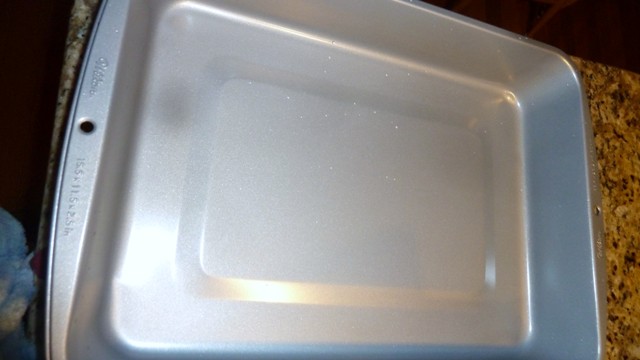
Two key differences in this recipe from most cake recipes is that it calls for no eggs, and asks for lard. Of course other shortening can be substituted, and sometimes you have to hunt or ask around where/whether old fashioned lard can be found in your area. But I knew just where to go because of having used lard in my Amish noodle experiments last year.
It is nice to have a fall-back homemade cake recipe that doesn’t call for eggs since we all run out from time to time. Cooks in older times or homesteaders today, who depend on their own flock for all their eggs, know why there was a definite need for recipes without eggs: chickens, normally in the fall but it can vary as length of day shortens, go through a hormonal change resulting in a molting period and losing their feathers where they get a break from laying eggs. Here’s a pretty good beginner’s description. So there may be 6-8 weeks of no eggs. Hence, in times or areas where you can’t just run to the grocery store, there was a need for recipes without eggs.
Turns out, it had the same basic ingredients as one used in my own cookbook, Whatever Happened to Dinner: Sheri’s cake, which I shared here, which also doesn’t call for eggs.
Why would anyone make this much cake at a time? Amish families often have 8 -12 or more children. Many families longer ago had this many (and more children). A book I’m reading which I’ll cover in an upcoming post speaks of a family with 18 children, long before the Duggar family. You get the idea.
But, if you have just 2-4 kids and need a monster cake for the soccer team, a potluck at church, signing up to bring a cake for a funeral dinner, soup kitchen, or other large feeding program, this is a great recipe. I had enough to test with two different groups (knowing my empty nest household would take forever to finish it and suffer from too many calories). Or, if you bake it in two 9 x 13 inch pans, eat one and freeze one—it freezes well.

Ruth’s Chocolate Cake (Original from Countryside Cooking and Chatting)
Makes 2 – 9 x13 cakes or 1 – 11 x 15 inch cake
In a big bowl, mix:
4 cups sugar
½ cup unsweetened cocoa powder
1 cup lard
1 ½ cups hot water
2 cups sour milk (If you don’t have sour milk on hand, make it sour by first putting 2 teaspoons vinegar in a measuring cup, than adding enough milk to make the needed 2 cups of sour milk.)
6 cups flour
1 Tablespoon baking soda
3 teaspoons baking powder
1 teaspoon vanilla
1 teaspoon salt
In a big bowl, mix sugar, coca, and lard. Add hot water and milk. Add rest of ingredients, mixing well. Pour in two 9 x 13 pans or one 11 x 15 pan. Bake at 350 degrees for 30 minutes if using the 9 x 13 pans, (or until a toothpick comes out clean), or 45 minutes for a 11 x 15 inch pan. Frost with your favorite frosting.
Bonus topping, wherein I turned a mistake into a success!
I topped this with Carmen Wyse and Wayne Gehman’s Penuche frosting from my book, Whatever Happened to Dinner, recipe here (and photos showing normal process!) I was in a hurry and make a mistake: instead of adding the milk to the brown sugar and butter and bringing it to a second boil, I put in the powdered sugar and milk after taking it off the heat. Oops, a mistake I couldn’t rectify except by beating the frosting smooth. It ended up like a glaze with a few powdered sugar lumps I couldn’t beat out, which easily covered the whole 11 x 14 inch cake; I covered up the slightly lumpy glaze with chopped pecans. The normal penuche frosting is very thick and paste-like and hard to spread (although delicious) and would never have covered the whole 11 x 15 inch size. Just sayin’ if you want to benefit from my mistake. The pecany glaze made a great, thinner topping, with candy-like sweetness on the chocolate. I’m getting hungry again.
***
If you enjoy cooking and following new recipes, and would like to volunteer for occasional recipe testing for cookbooks we are publishing at Herald Press, let me know! We’ll put you on a list.
***
Have you had a cooking mistake that you turned out to like?

For over 15 years I’ve helped maintain the Clothes Closet ministry at our church that followers of this blog or my newspaper column have heard me mention in stories from time to time, such as here and here.


Saturday was our twice yearly “Switchover Day:” restocking the racks of our church clothes closet with the next season’s clothes, a chore that becomes fun when you do it with a group of willing workers. Conversation flows more freely and deeper than even the coffee hour at church allows. Every week, a smaller group of volunteers hangs fresh clothing on the racks, but it is a bigger operation to remove all of the prior season’s clothes, and bring out clothes for the coming weather. (And there are just two seasons in Virginia when it comes to clothing, right? Warm weather clothing and colder weather clothing.)
Most of us are more than busy with a long list of to-do’s at home, so volunteering your labor at a food pantry or free clinic or clothes closet or Habitat build is something you choose to do because you believe in the community that is built as you give of your time. I so enjoyed the work on Saturday for some of these reasons:
–Helping “train” a new volunteer and member of our larger congregation—what a great way to get better acquainted. 
–A beautiful mother and children whose family immigrated from Iraq have helped us for several years in this biannual activity, and we have enjoyed learning to know her and her family, and appreciating Basima’s growing language skills.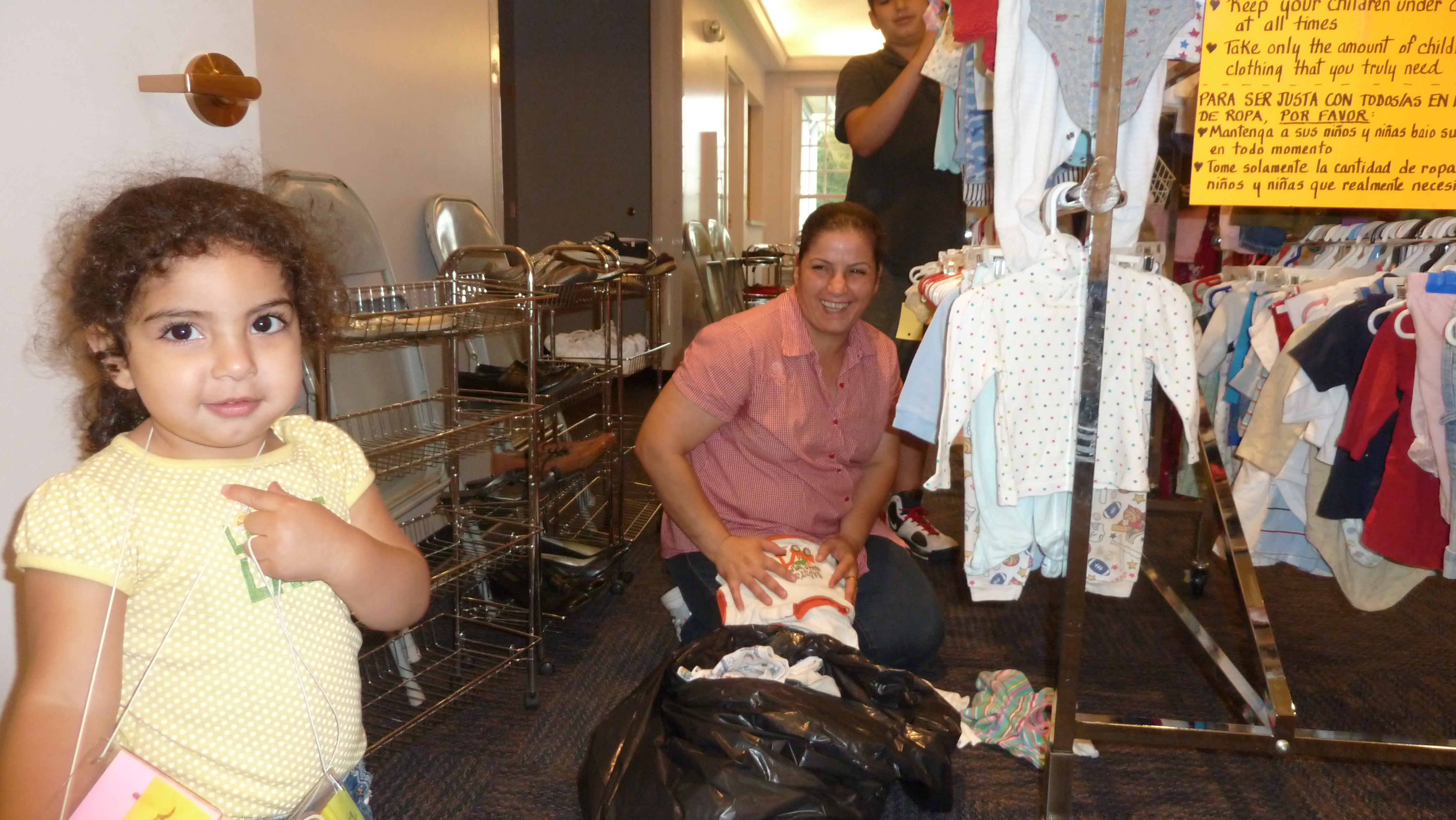 –Over the morning, Lana, (left) who was at first either sleepy or worried about leaving her mommy out of her sight, gradually warmed up and began casting shy smiles my way.
 –It is a time to catch up with each other about summer highlights, grandchildren, new jobs for children, illnesses and other trials.
 –It is one way we help our community recycle clothing and save it from the landfill.

There are suitable jobs for all. Our oldest helper, Jim, helps by making tags for the clothing that we remove from racks and take to Mercy House’s Used Clothing Store.

Children have frequently helped through the years. Here is a shot of my daughter Tanya, middle, and Kevin, far left, helping out William Ramkey at the Closet, a retired Presbyterian minister. The Closet has been in several locations around town, and at that point was housed at Community Mennonite Church.
 Basima’s son, Mustafa, is old enough now to be a great help moving and lifting boxes in the storage.
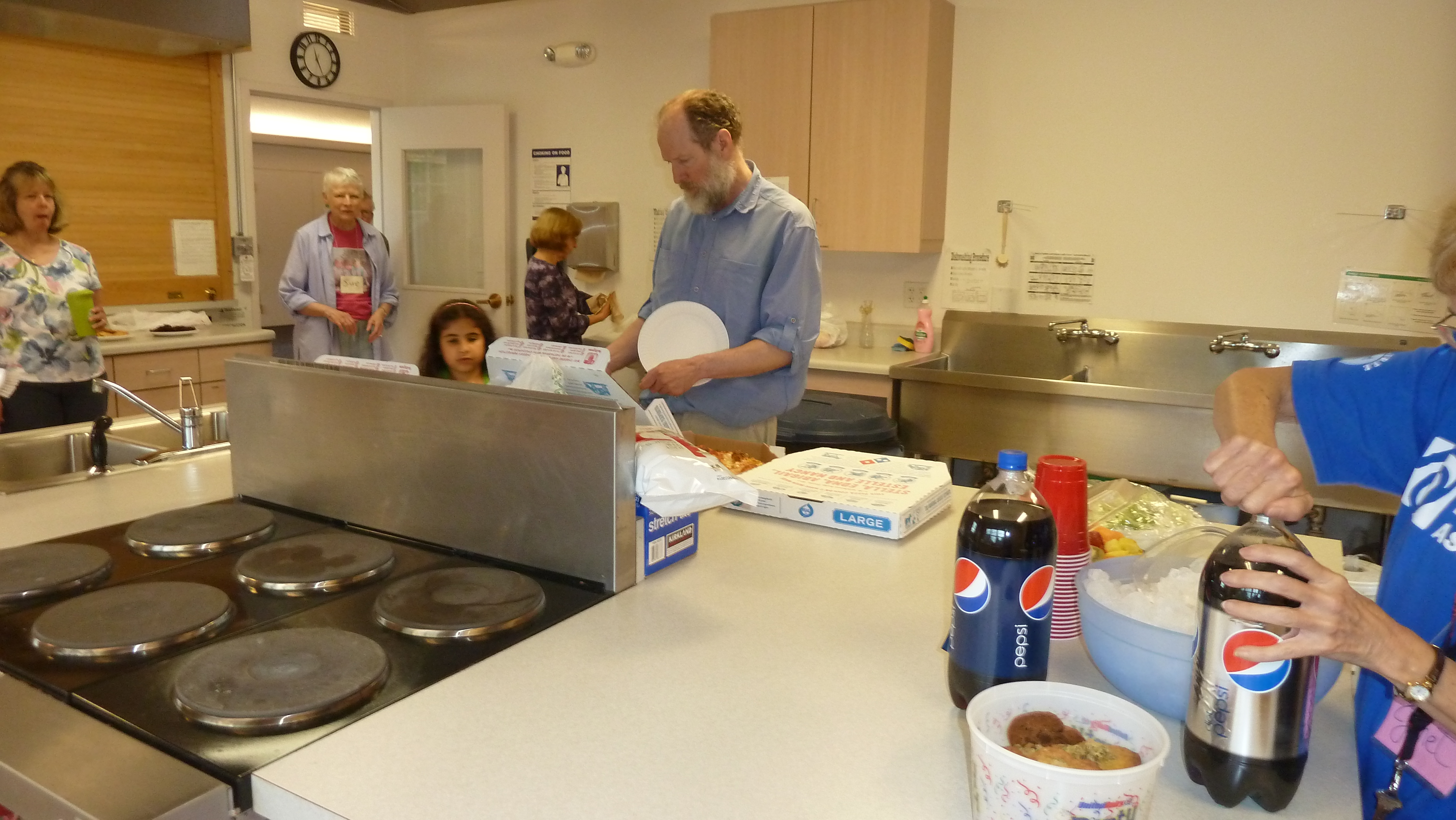

And what crew of workers is not spurred on by the promise of a pizza lunch!
It is a simple, straightforward operation, this clothing closet. We take in clothing donated by the church, other churches, community, and often from many of the clients. And we give it away, absolutely free. That is the best part, which sometimes amazes new clients. The founding pastor of this congregation, Don, now pastor emeritus and a member of the group which keeps the Clothes Closet going, says giving out free clothes reminds him of God’s grace and the Bible passage in Matthew 10:8: “Freely you have received, freely give.”
 Pastor emeritus Don Allen pouring out communion
grape juice at a house church worship service.
It is also a literal living out of the powerful parable told by Jesus himself in Matthew 25:36: “I was naked and you gave me clothing.”
 Our crew on Saturday morning “Switchover Day”:
Front row: Janet, our awesome mission coordinator; Mustafa; mother Basima with daughters Lana and Danella; Patti, Karla.
Back row: Fred, Cheryl, John, Jim, Bill, Sue and her son home for a visit, Mark. Also missing from this photo, Elaine and her adult granddaughter.
What do you enjoy about volunteering or giving of your time in the community?
***
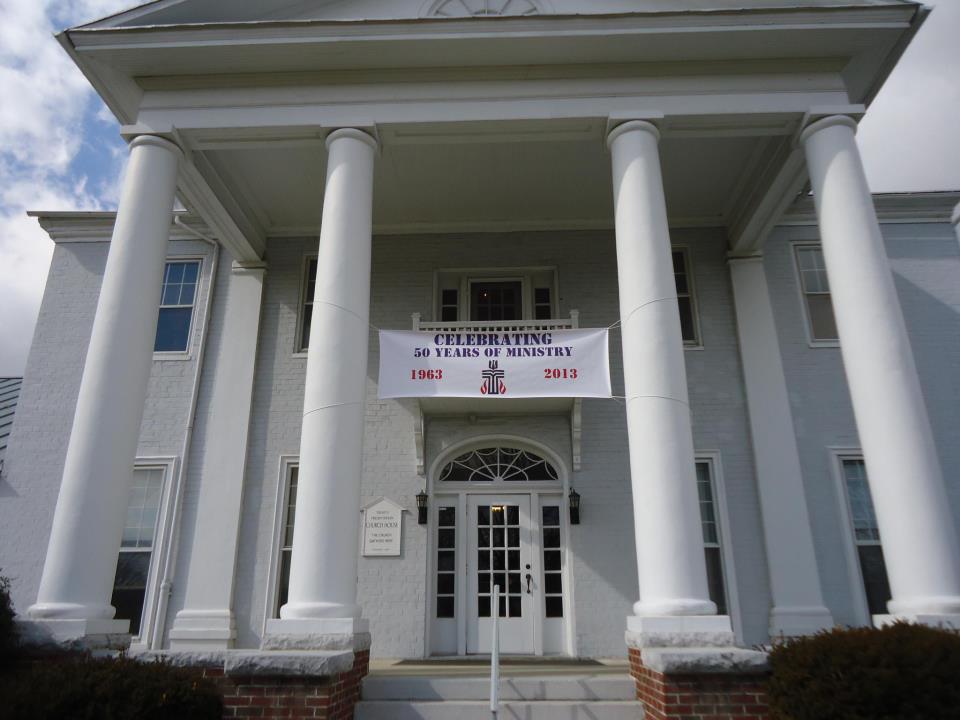
Here’s the front of our church building, Trinity Presbyterian, a historic pre-civil war home. To get to the Clothes Closet, you drive around to the back parking lot. Anyone is welcome, regardless of income: college students, friends, family. We are able to accept donations of clothing only on Wednesday mornings from 9-11 a.m.
The Closet is open for clients Wednesday evenings 6:30-7:30 p.m., and the first Saturday of each month from 10-11 a.m. Two other churches help us staff the Clothes Closet for which we are very grateful: Muhlehburg Lutheran and Harrisonburg Baptist Youth Group.
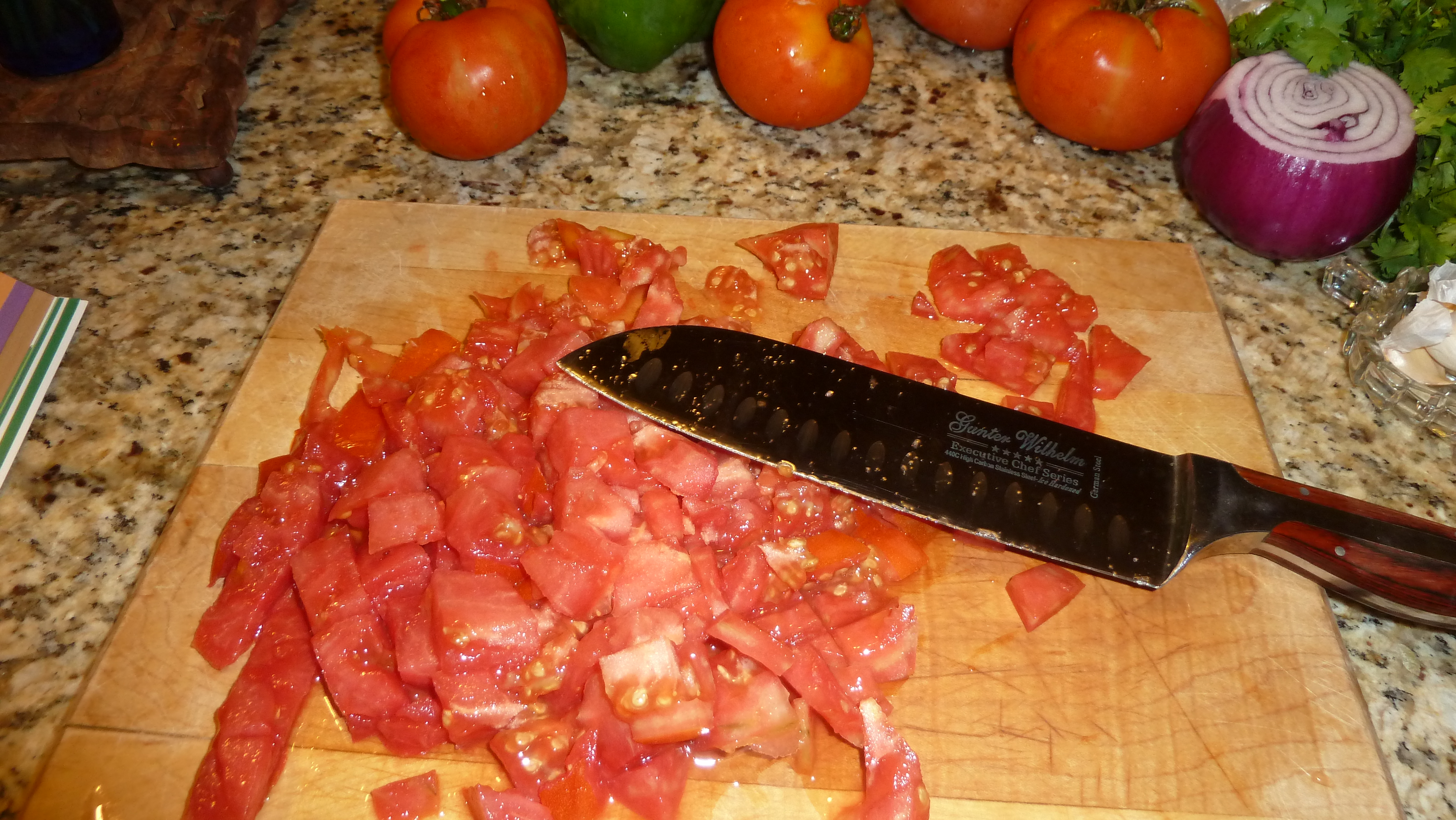
Fresh homemade salsa! Salsa is one of those things that does not taste at all like the cooked or canned store variety. I like the canned store variety o.k., but fresh—it feels like a vegetable dish instead of just a condiment.
But the question is cilantro. Do you like it or not? Is your salsa not salsa unless it has cilantro? Fresh basil? How hot is too hot? Or not hot enough? These were all questions I stared down as I made a batch to take to our monthly themed potluck lunch at work, the “Summer Vegetable” bonanza.
The first time I remember having cilantro where I knew what it was, was in Pico de Gallo Fajitas, with grilled chicken breast/tenders, marinated in juice of limes, cilantro, olive oil, minced garlic and salt and pepper. Wayne Gehman, husband of Carmen Wyse (one of the food editors/recipe testers for my book/cookbook Whatever Happened to Dinner) made Pico de Gallo Fajitas years ago for a similar office potluck event. I fell in love with that sauce and cilantro. So I tried to duplicate the dish for my family a couple weeks later.
They liked the chicken but not the cilantro taste peeking through. Huh? Who were these morons, I wondered, not to like all that deliciousness. When I learned that the taste for cilantro is somewhat genetic and that even great chef Julia Child picked cilantro out of any dish, I didn’t feel so bad about my family’s first reaction. Several of them love it now.
If you wondered if salsa and pico de gallo is basically the same thing, Kitchen Savvy does a decent job of plumbing out the differences.
Fresh Summer Salsa – adapted from Simply in Season, Herald Press.

6 medium fresh tomatoes (diced)
1 medium red onion (diced)
1 large green pepper (diced)
2-3 hot chili peppers (diced)
1 large peach (diced)
¼ bunch fresh cilantro (chopped)
4 cloves garlic (minced)
3 tablespoons fresh basil (chopped) or 2 tablespoons dried
2 tablespoons vinegar
1 tablespoon lime juice
½ teaspoon salt or to taste
Combine in bowl. Let stand 30 minutes and serve.
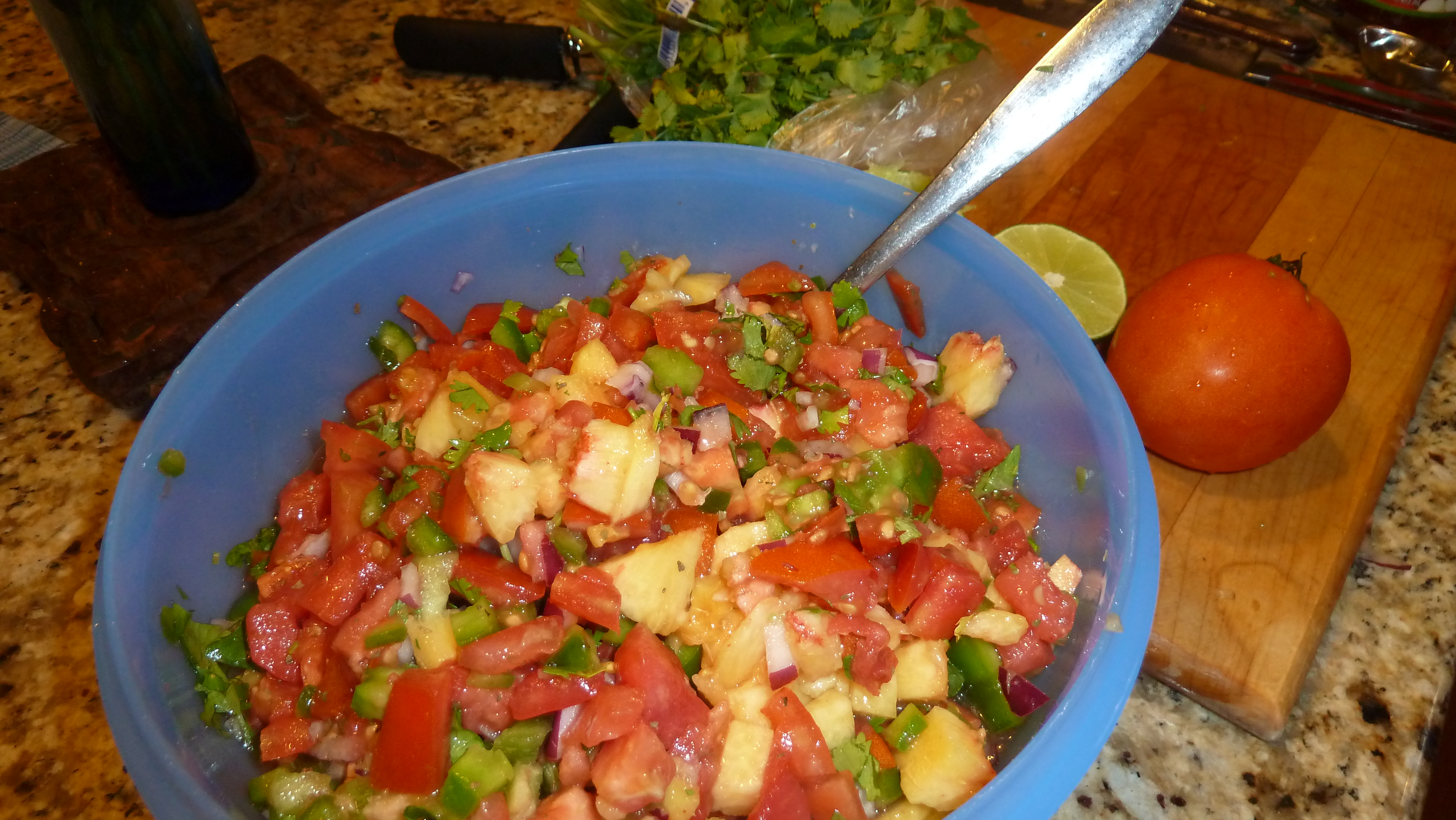
(Original from Marc and Hannah Gascho Rempel, Ardis Diller, Jo Ann Heiser)

I think fresh salsa is my new favorite condiment for grilled hotdogs. Does that make hot dogs healthy?
This salsa also makes a decent topping for garlic bread toasted and applied as in bruschetta, and you could certainly sprinkle shredded mozarella on top. Jennifer, over at Mama’s Minutia blog just yesterday posted a bruschetta recipe, (for which the tomato part is a lot like a salsa) which had her and her family (at least some of them?) swooning. Her pictures are to swoon over, too. I give you permission to go there now.
***
Are you a cilantro lover or hater? Or have you learned to accommodate it? How?
***
Carmen also has a recipe for a mango salsa, plus their original concoction for a huge batch of canned salsa in Whatever Happened to Dinner. If you have a lot of tomatoes to use up, this might be the ticket (makes 14 quarts).
I can send you a free copy of the canned salsa recipe by email. Let me know!
Mom had a small birthday bucket list wish for her 90th birthday. She knew her grandchildren and great grandchildren wouldn’t have a huge amount of fun at the cake, punch and ice cream reception in the dining hall of her retirement apartment complex. She also knew how difficult it is to entertain a passel of kids without them doing things they aren’t supposed to do (drown, skateboard/bike on the sidewalks, get lost, get carried away playing pool, wreck property).
So she wanted to do “something fun” the day after for the grandkids (and by now we have greats and great greats in this growing family).
We ran through the options and had at first settled on a day trip to Chicago 100 miles away by train, to avoid driving. Group tickets could be obtained for a decent price and we would visit Chicago’s Navy Pier where there is a huge, grand, Ferris wheel, and wild fast boat rides available on Lake Michigan.
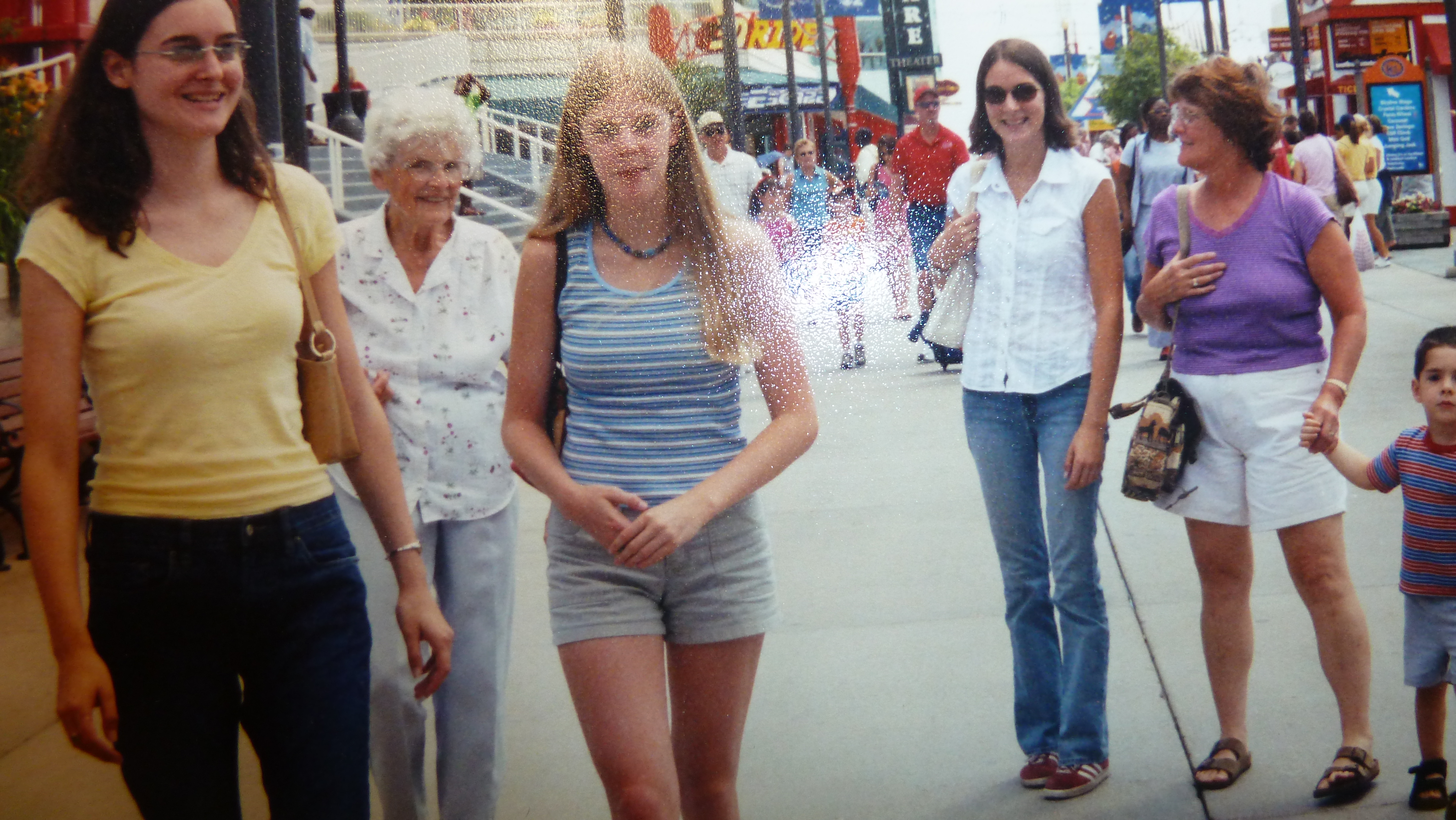 Chicago 2004: Daughter Michelle, Mom (at 80), Doreen, Tanya, sister Nancy, her grandson Jacob.
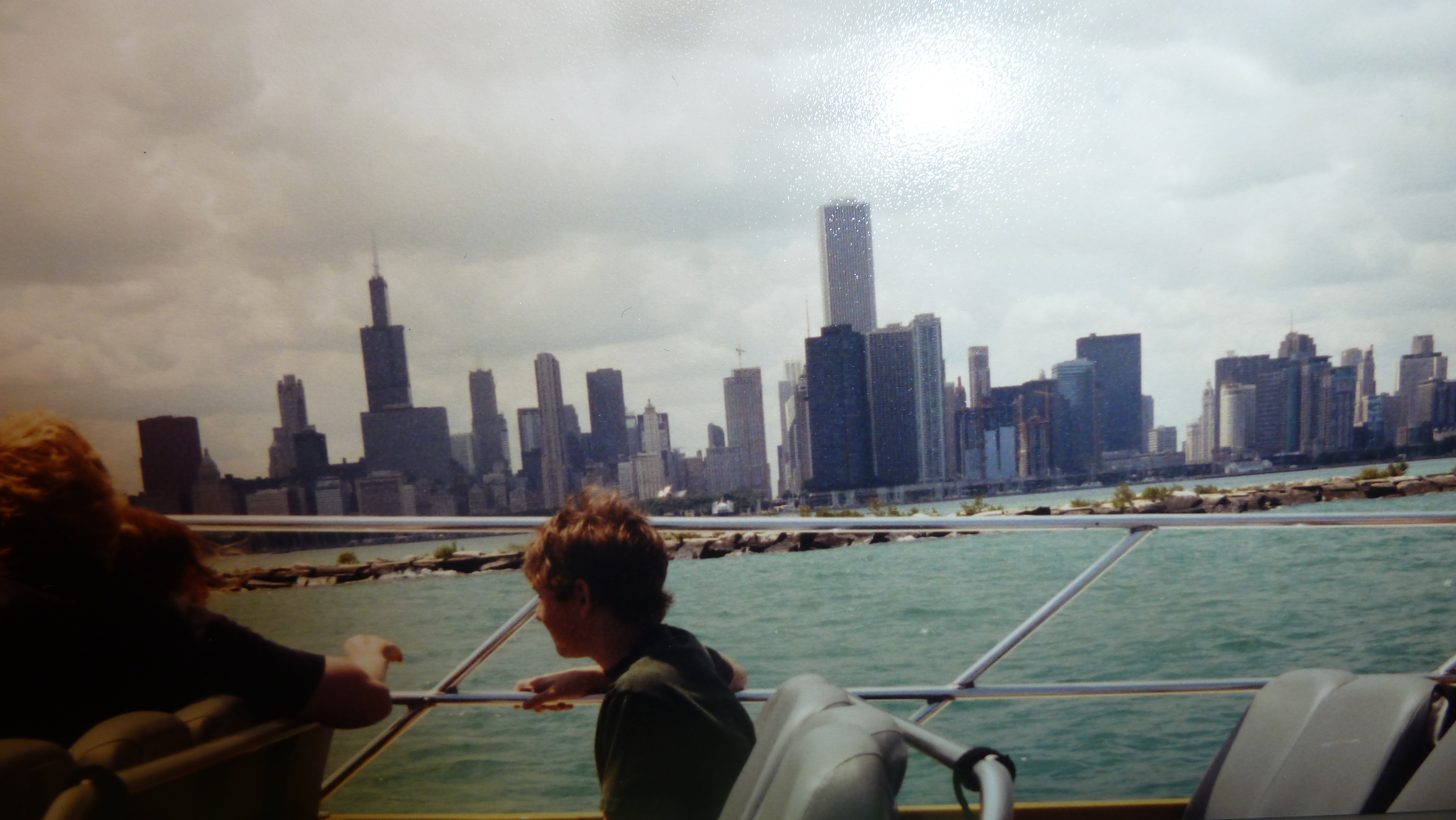 (Chicago skyline from Lake Michigan on the Seadog Extreme Thrill ride, which went so fast my Dad had to hold on to his hat.)
Some of us had made this trip by car for her 80th birthday when Dad was still living and had a splendid time, except for the drive home from Chicago in rush hour. (Not so fun.)
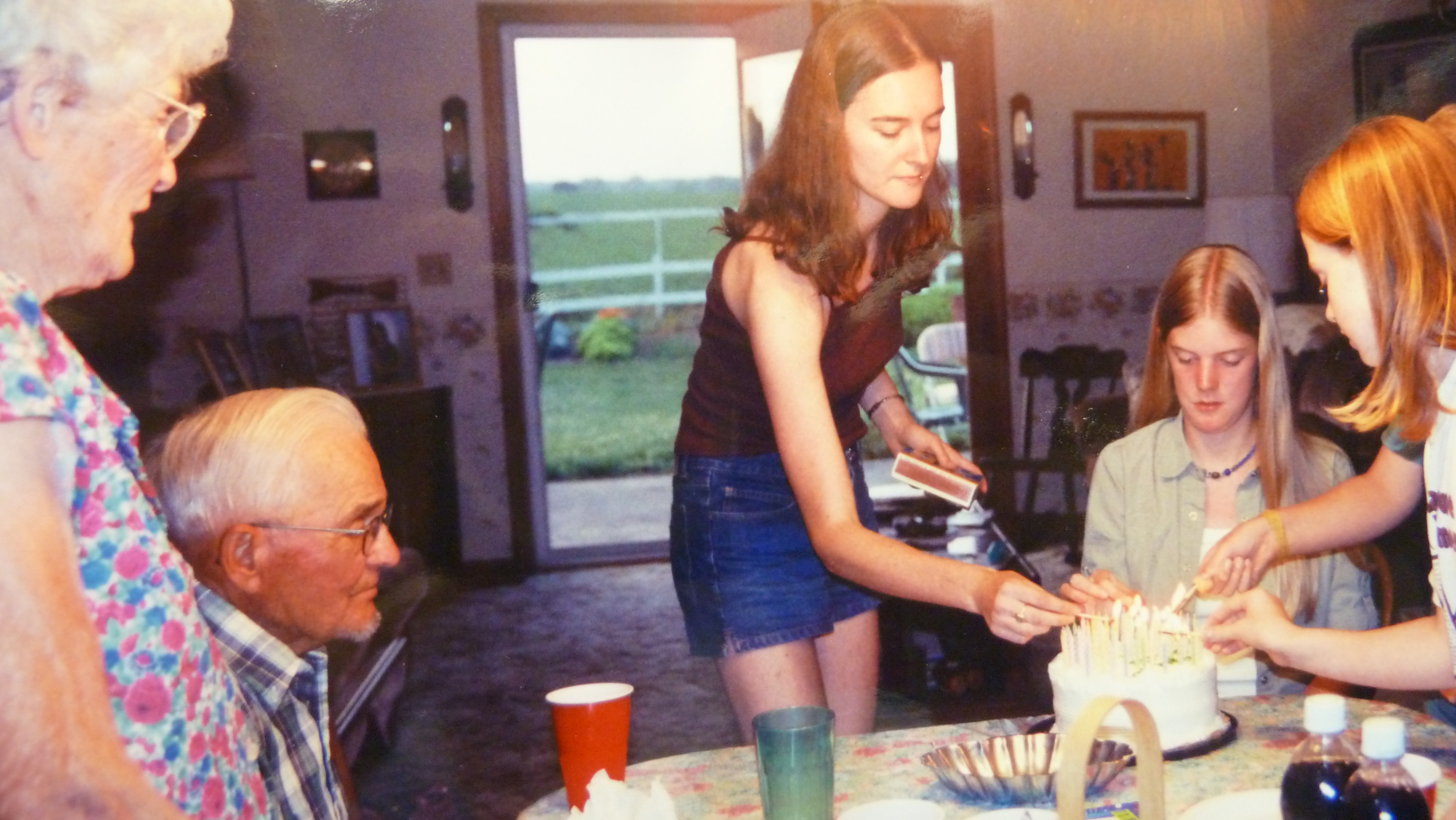
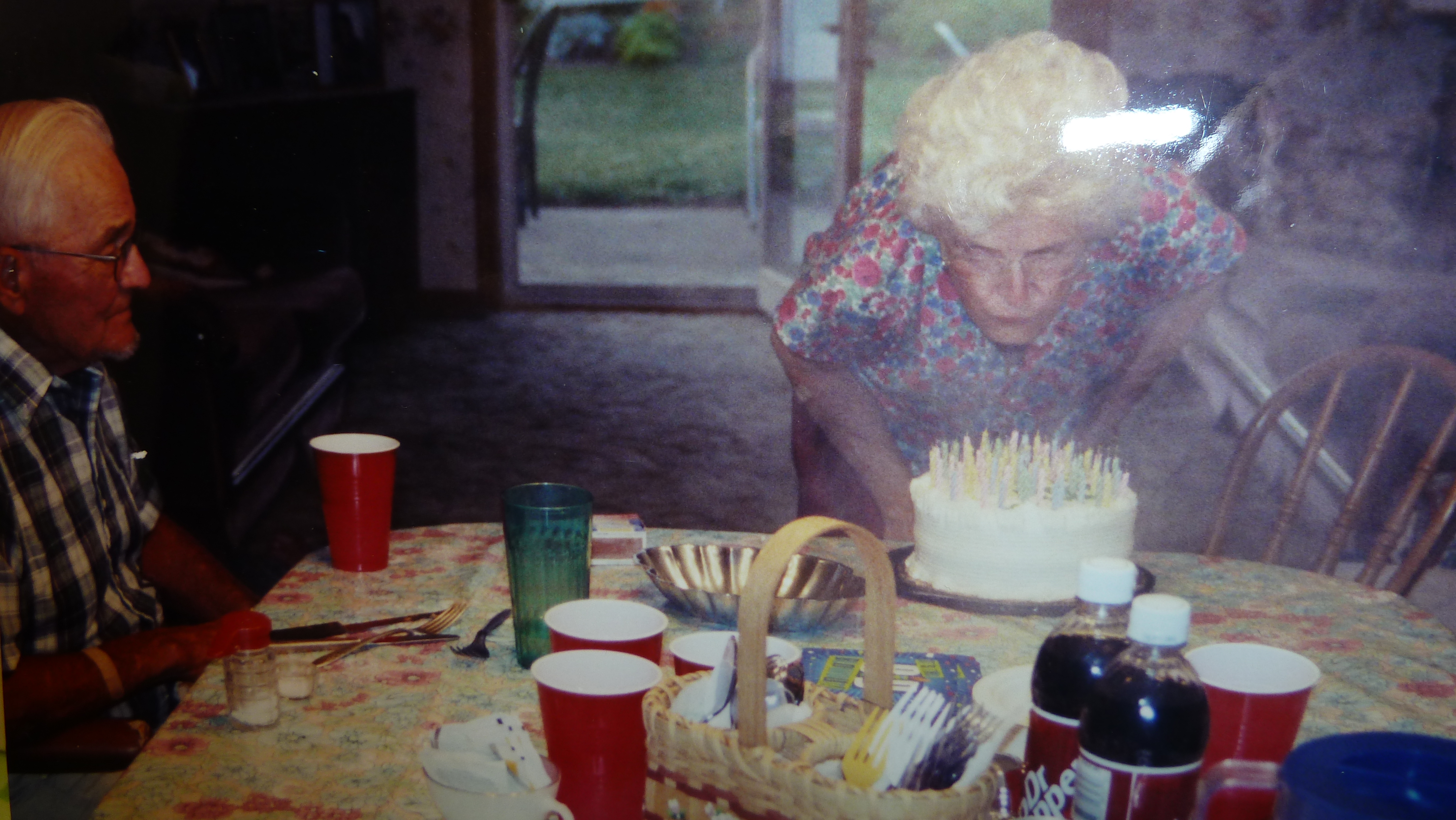
(Dad and Mom look on as grandchildren Michelle, Doreen, and great grand Brittney, light 80 candles at Mom’s 80th birthday, 2004)
We topped that day off though with a birthday cake back at home in which my father insisted we make a last minute run to a store to buy candles to put 80 candles on her cake, and light them. All. Which we did. (No mean feat.)
So Mom wanted a repeat visit to Chicago with more of the family and a Ferris wheel ride and boat ride.
Backstory & logistics for planning a group family vacation: Dad, in the early 1990s, had also come up with the idea of giving the family, in lieu of Christmas presents, a summer vacation together every other year, at scenic, and entertaining locations. He said instead of making us drive to Indiana (which, let’s face it, is a great place to be from, but not that great with touristy destinations)—why not all go to someplace scenic, different, and with large vacation cabins available where all or most of us could stay together for a couple of days. Zillions of families do this, I know, and I was so glad Dad started this tradition for our family. We went to the Smokies a couple of times (centrally located for us) where we navigated several whitewater rafting trips, the beach (Florida and North Carolina, including snorkeling) and the Rockies (rafting the Arkansas River), among other destinations over the years. Mom and Dad provided the lodging and in the beginning, money for all food (cooked in the cabins, all taking turns) and one dinner out; but eventually as the family grew (and cabin rental went up) us kids took on the food expenses. We also always paid our own ways for entertainment or activities like the rafting. It was a way for our far flung family to stay connected, at least every other year. As our families grew, it also became harder and harder to pick a date and work around the varying demands of jobs, so gradually we got used to the idea that not everyone could come even every other year. So those who could come, did, and those who couldn’t, just missed out. No guilt. Mom and Dad sometimes sent those who missed out the money they would have spent on our vacation.
So this year when Mom had serious surgery in late April, all plans and bets were temporarily laid aside for a post-90th birthday party family excursion. Her recovery looked promising though so we knew we could still have some kind of party. But all of us getting up the next day to drive 45 minutes to a train station by 6:30 a.m. looked a little, er, daunting.
We ran through other options: the zoo, the Indiana Dunes (on Lake Michigan), a park with a swimming pool, an afternoon of mini-golf. Everything seemed like a “been there, done that” option.
Then Mom saw an advertisement for Indiana Beach, a small amusement park about 2 hours away in Monticello, almost in the middle of nowhere. Getting there wouldn’t be difficult traffic-wise, although in the end my one daughter, husband and 8-month-old decided not to go because of the long car trip (on top of having driven to Indiana from Virginia). There was a Ferris wheel and a boat excursion, both on Mom’s birthday bucket list. Then Mother came up with the idea that she would give the park fee as this year’s Christmas present for all who could make it. Sweet!
So, the day after her party, some 25 of us headed to Indiana Beach. A day which could have been miserably hot at the end of July was just right. There was no rain, and Mom (with the help of a wheelchair) enjoyed the day to the max.
I would say it was a toss up on who enjoyed the day more:
This trio?
Mom and two step great grandchildren on the Shafer Queen
Or this one?
 Three of my great nephews on the Skycoaster (Photo courtesy of Katie Gross)
I know this little one won’t really remember it, but his parents will tell him about his first amusement park, his “first carousel ride.”

Jon, Sam and Tanya on the carousel
There were surprises, too: Mom’s favorite ride turned out not to be the rather sedate Ferris wheel (and not at all swingy) in gondola type buckets …
Stuart, Mom, me and Doreen in Ferris wheel gondola (Photo courtesy of Pert Shetler)
but the park-crossing Skyride where legs swung free and no belts chained us in (like a ski lift). It was a little scary even for me (maybe cause I was in charge of a 6-year-old step great-nephew at that point), but it was Mom’s pick of the day.

Daughter Doreen and Mom on Skyride (Photo courtesy of Pert Shetler)
Like the old melancholy Jim Croce song says, maybe all we have are “photographs and memories” of a July day spent at a pretty ordinary Indiana amusement park, but the bonding that happens through such efforts to get together and be together are less tangible. When I look back over the summers when our family was able to get together, I know that when families are separated by many miles, these summer holidays planned by my parents were the only times my children could get to know their cousins.
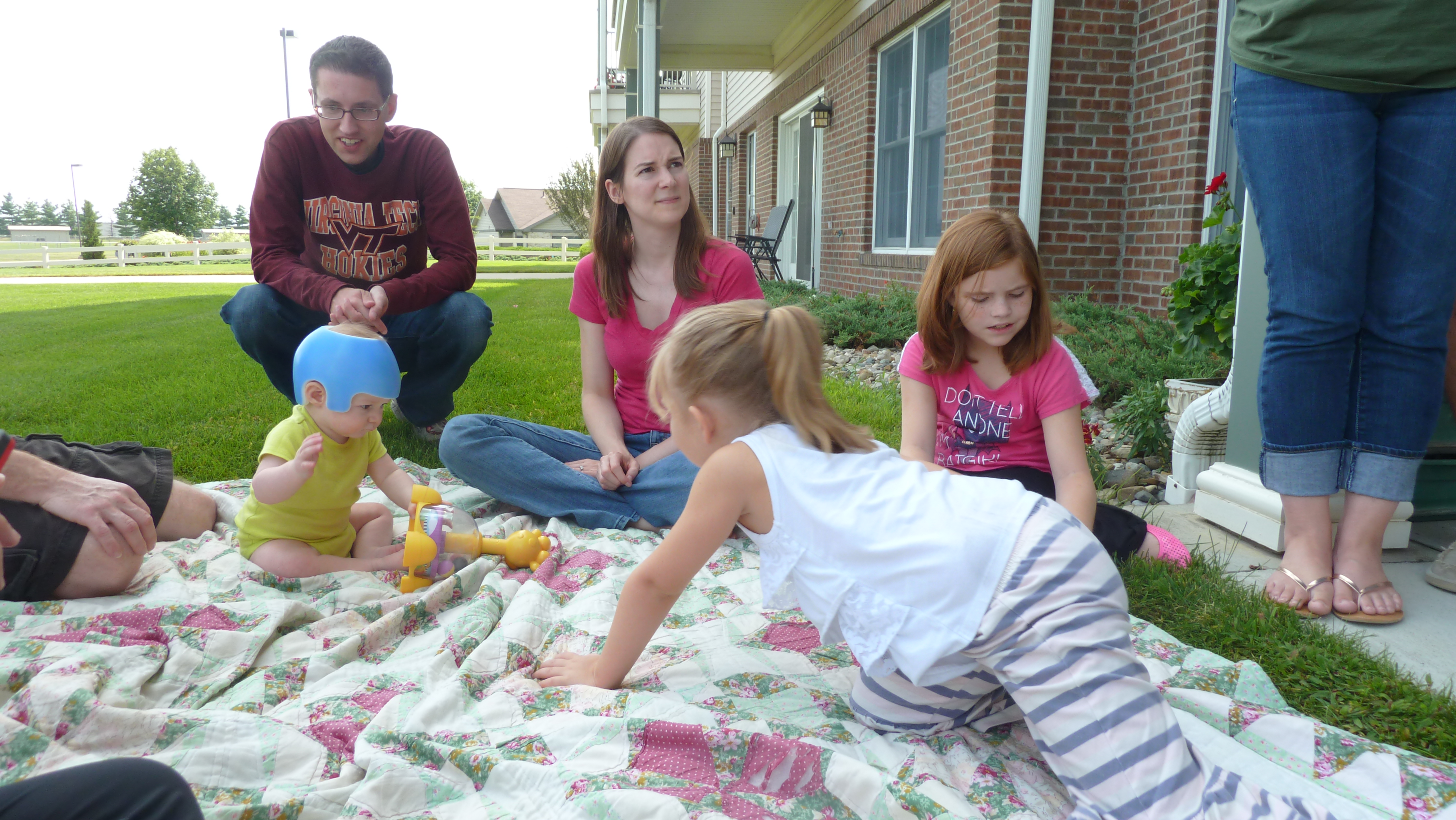 Second cousins meeting second cousins for the first time
 First cousins getting together after not seeing each other since Mother’s Day. Great Aunt Pert in back.
Many of us would rather spend time together than find room in our overstuffed houses for another sweater, do-dad or necktie from a Christmas gift exchange.

And I so much enjoyed getting to know this great nephew, Brady, and his older sister, Kristin, who came along on the trip even though their parents could not: he was full of inquisitive questions that revealed his fears and longings (especially about the rides!) and not just full of mischief. That was a gift to me, and a reminder and takeaway that children, and the adults who love them, are always deeper than they look on the surface.
Not a bad bucket gift for me. Thanks, Mom (and thanks to the great tradition initiated by Dad). And thanks to all the in-laws and other loved ones who help make very special times happen.
 Me and Mom (Photo courtesy of the boat attendant, his offer)
More vacation shots
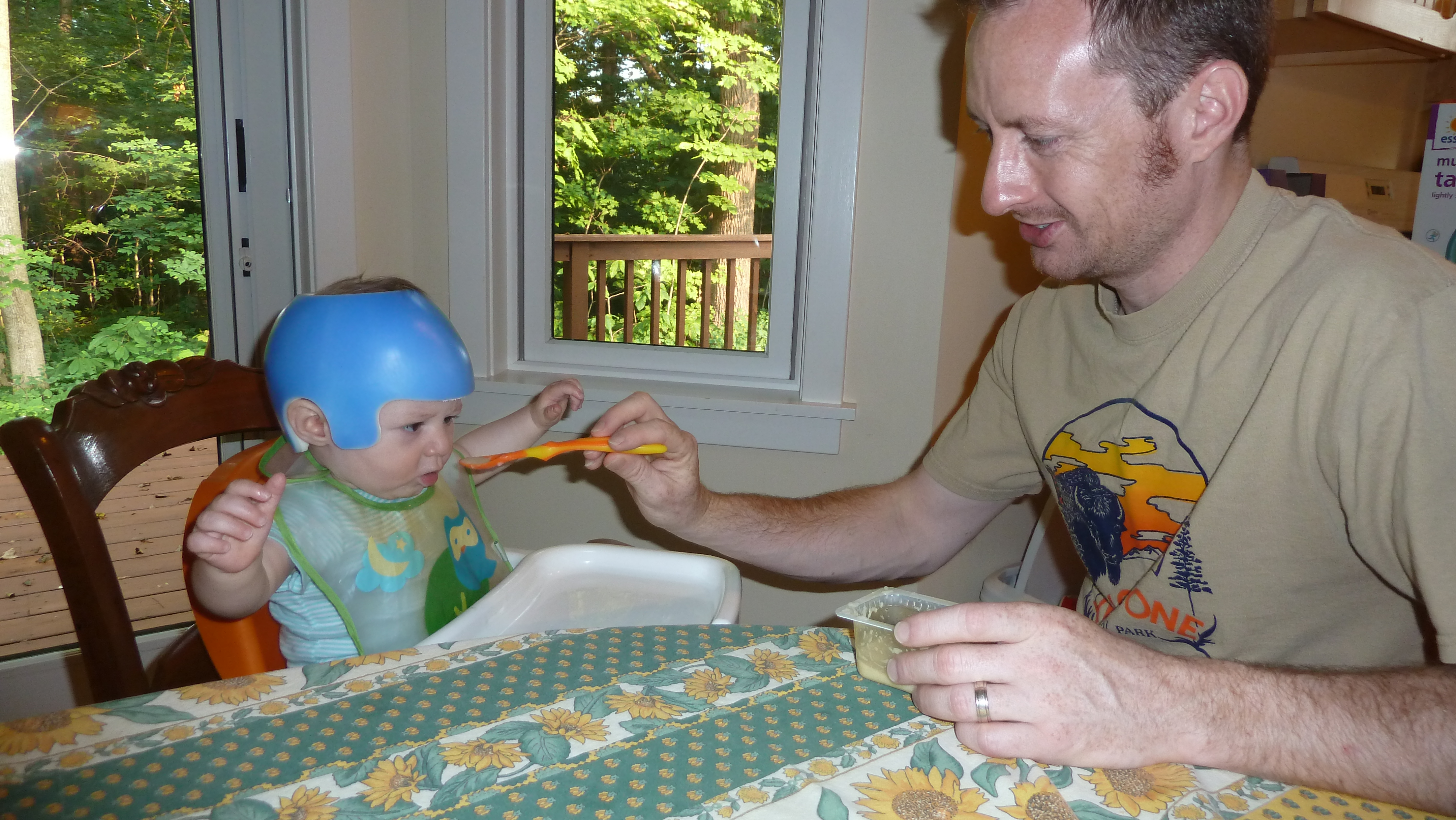 Son-in-law Jon feeding his son Sam at our cabin.
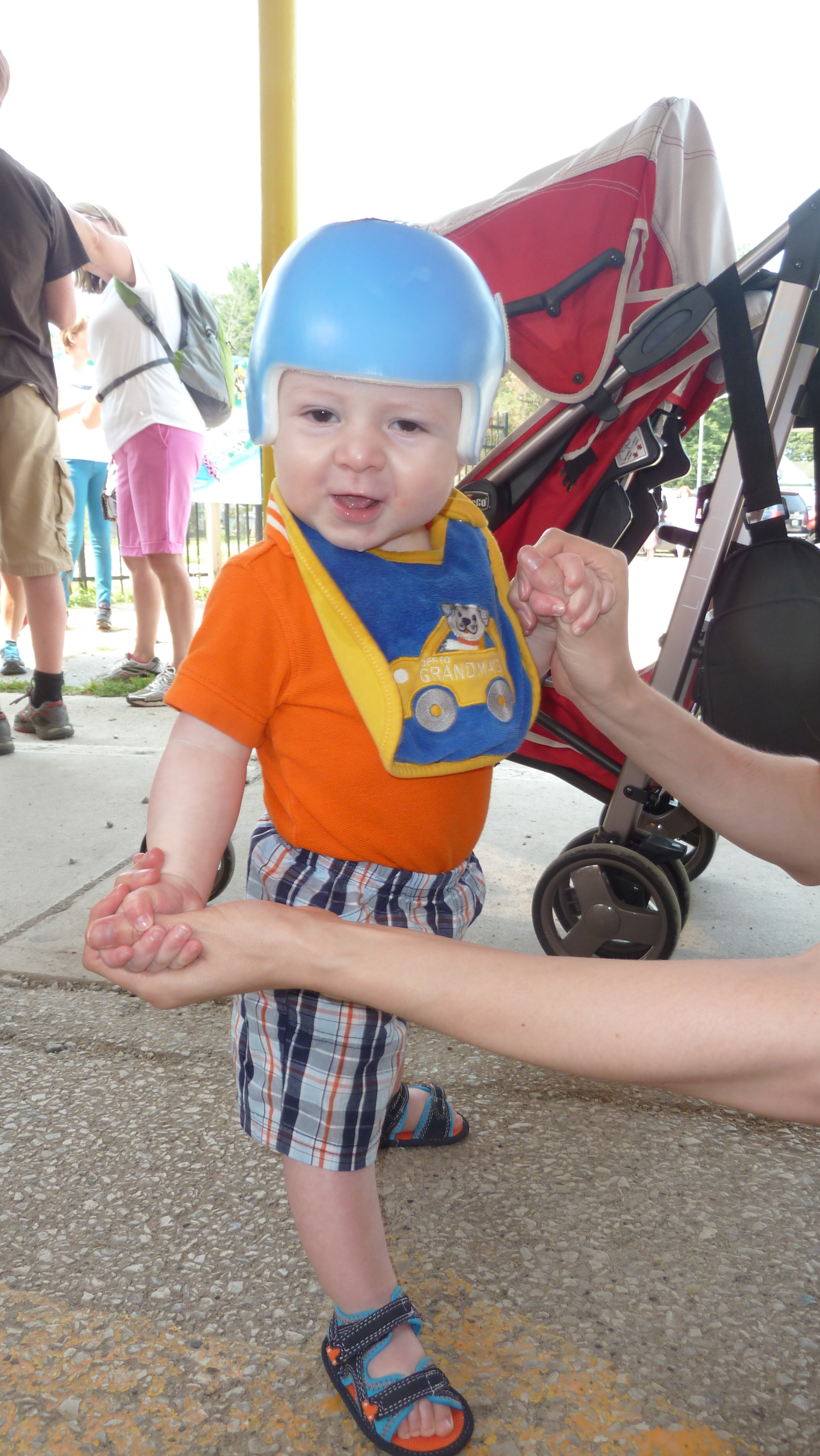 This little trooper took on the park. (Grandson Sam)
This little sweetie opted for other activities. (James with his mommy, Michelle)
***
How do you get together as a family? I admit it isn’t easy and takes some master calendar finagling, communication, and just plain hard work to make it happen. But so worth it. Don’t you think?
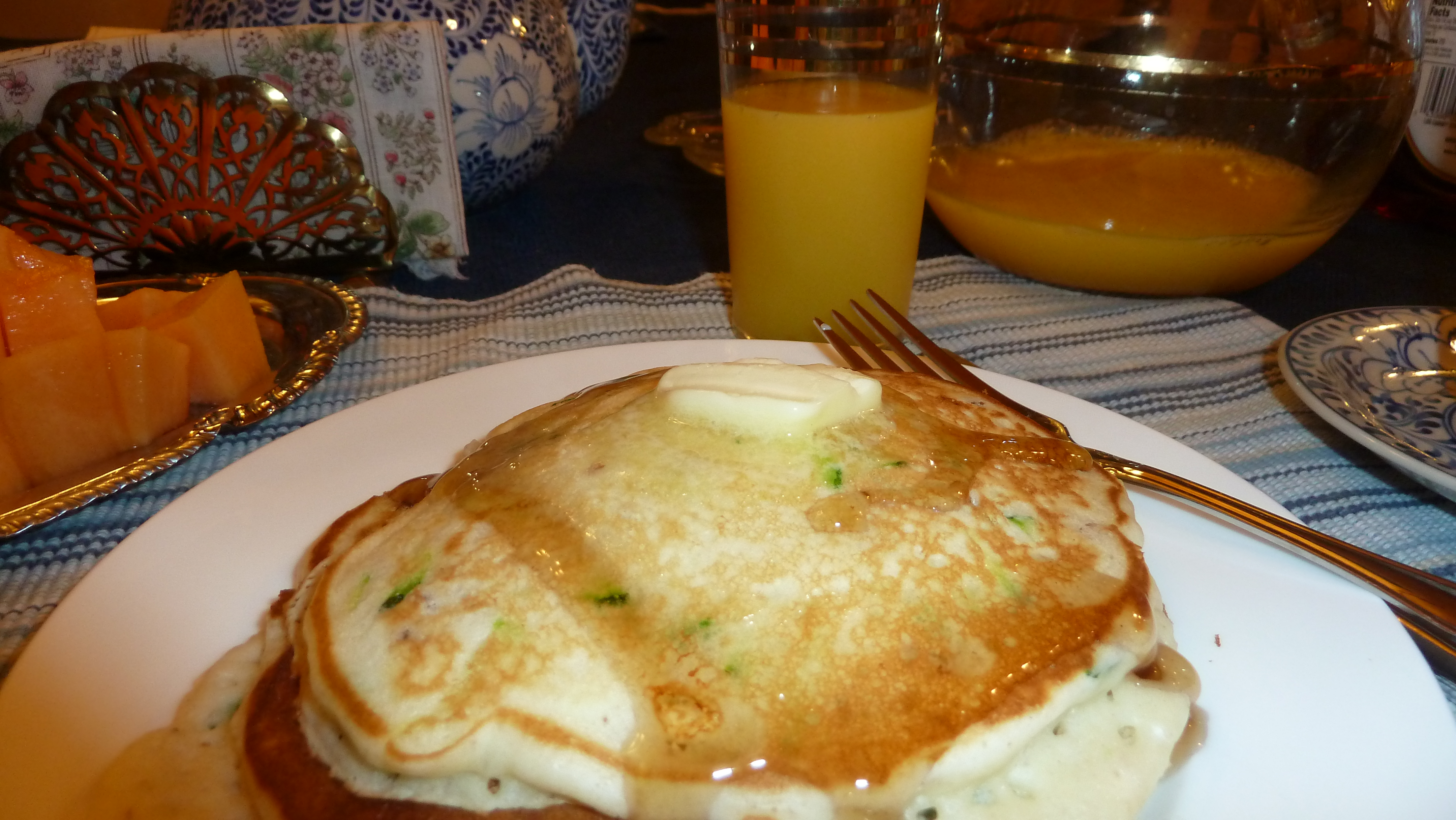
Zucchini for breakfast? If you are still swimming in zucchini (even the kind left anonymously in your car at church) here’s yet another way to use them and add some vegetable nutrition to your favorite breakfast pastry.
If I had not been served a variation of these in the lovely Twin Turrets B & B in Boyertown, Pa., I likely never would have tried them. But with sour cream and butter in the mixture, in addition to zucchini and pecans, these are light, delicate and the recipe makes me wonder if zucchini and pecans wouldn’t be a great twist on crepes, too.
At the Twin Turrets, then-chef Dorothea used walnuts in her pancakes instead of pecans, but the recipe she sent me as a follow up (so sweet) said pecans; since those are what I more commonly keep on hand, I tried pecans at home my first go round and never looked back.
Zucchini and Pecan Pancakes
1 1/3 cup milk
1 cup sour cream
2 eggs
2 Tablespoons melted butter
1 cup zucchini, shredded and squeezed dry
2 cups pancake mix
¼ cup chopped pecans
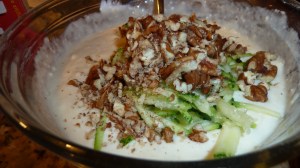
In large bowl, combine the milk, sour cream, eggs and melted butter. Mix thoroughly. Add the pancake mix and stir until just combined. The batter will be lumpy. Add the zucchini and pecans or walnuts.
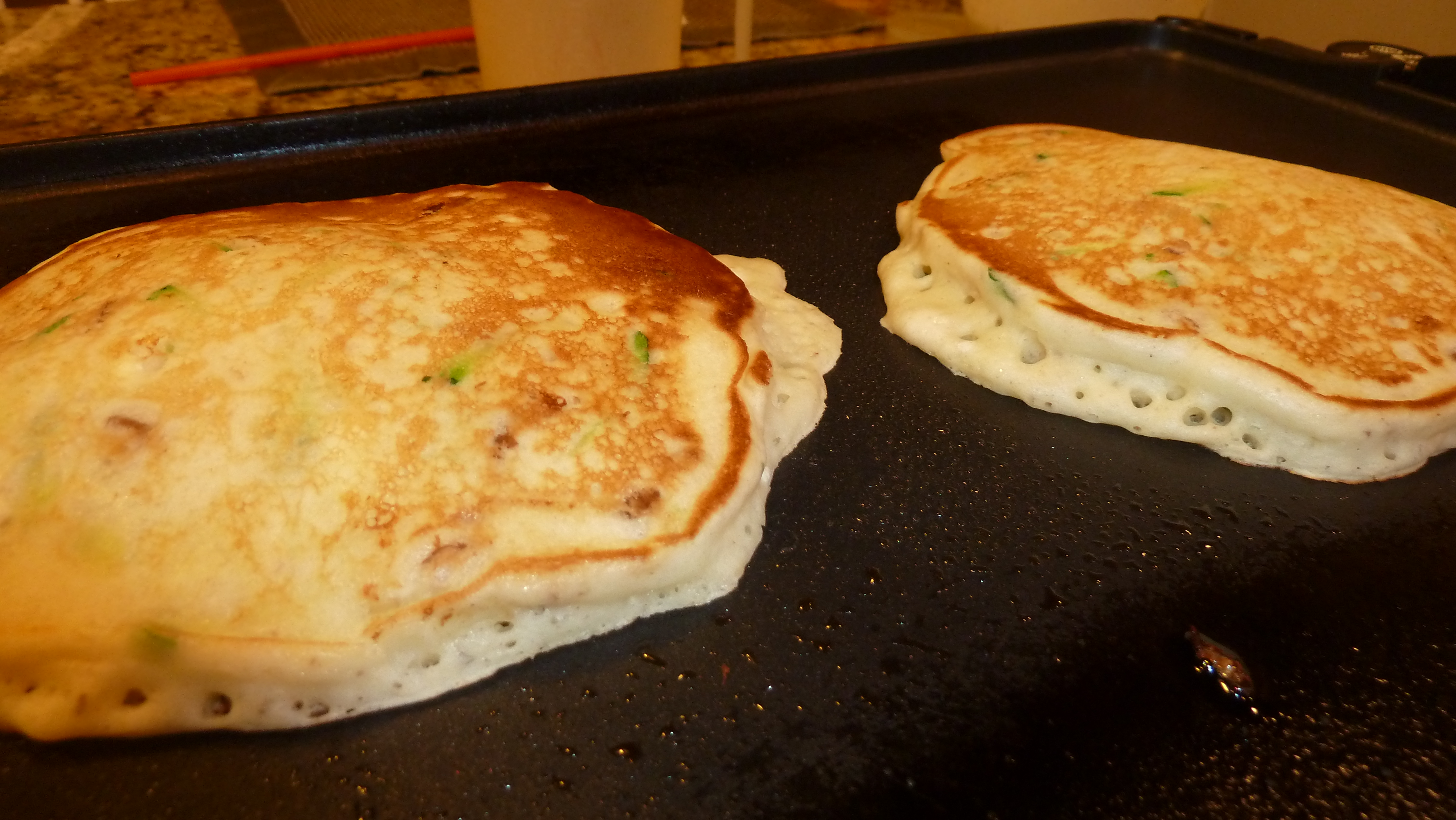
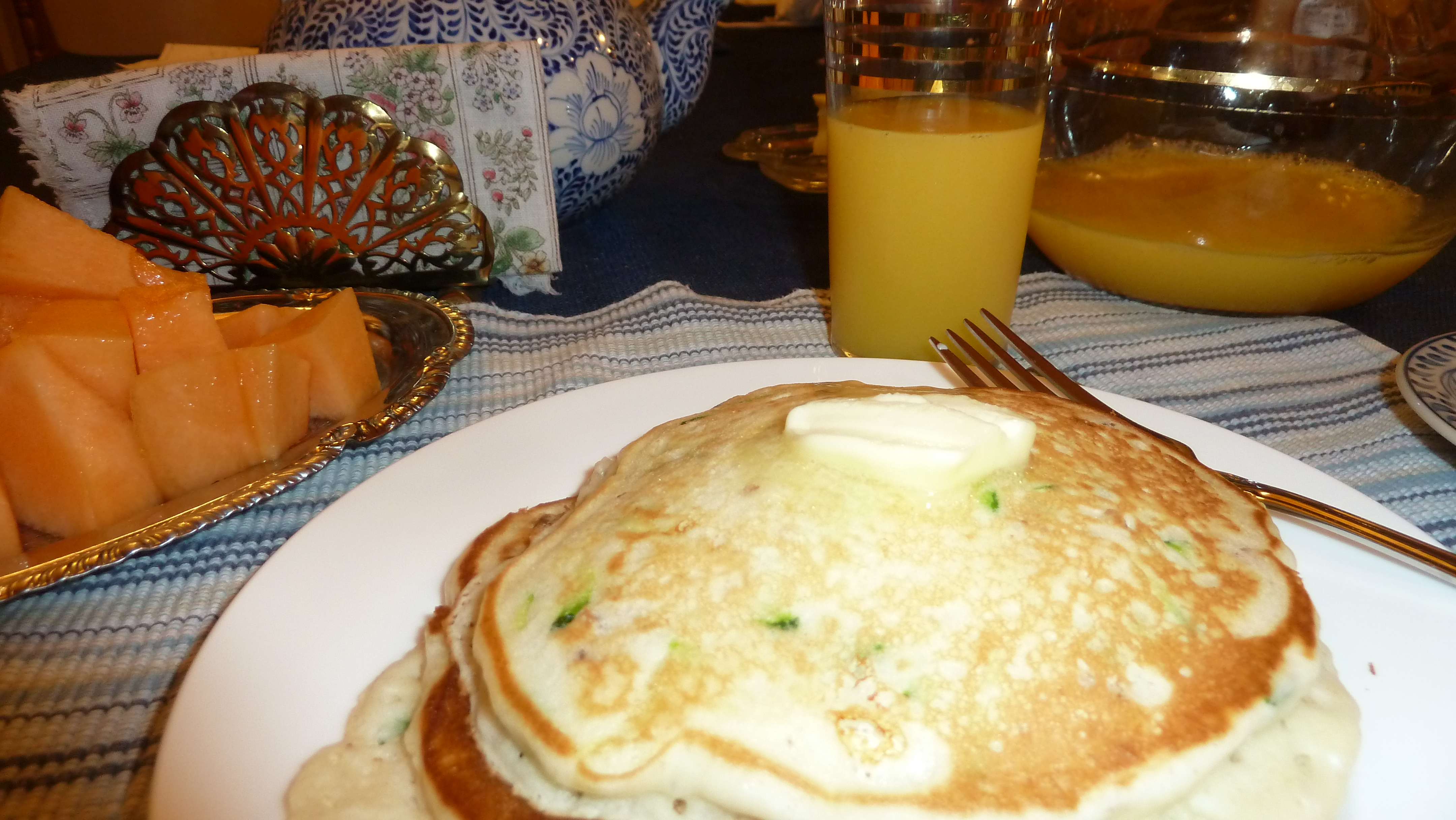
Pour onto a hot, lightly greased griddle or frying pan. Serve with plenty of butter and warm maple syrup. Serves 6 to 8 with 16 smallish pancakes.
I made a half batch recently and had leftover batter which was still good up to four days later.
Enjoy!
(And if the kids ask what the green specks are, call these Twin Turret Green Giant Pancakes. Or something.)
***
What is your favorite way to use zucchini?
***
Carmen Wyse has a recipe for Greek Zucchini Cakes–served as a side with any summer meal that looks great in my book, Whatever Happened to Dinner.
 Mom chatting with my sibs at our homeplace: first Mennonite, now Amish.
I was just 17 when we moved away from the farm where I grew up. Funny how things change with the perspective of a lifetime. I thought I was old, that I would always consider myself an Indiana farm girl.
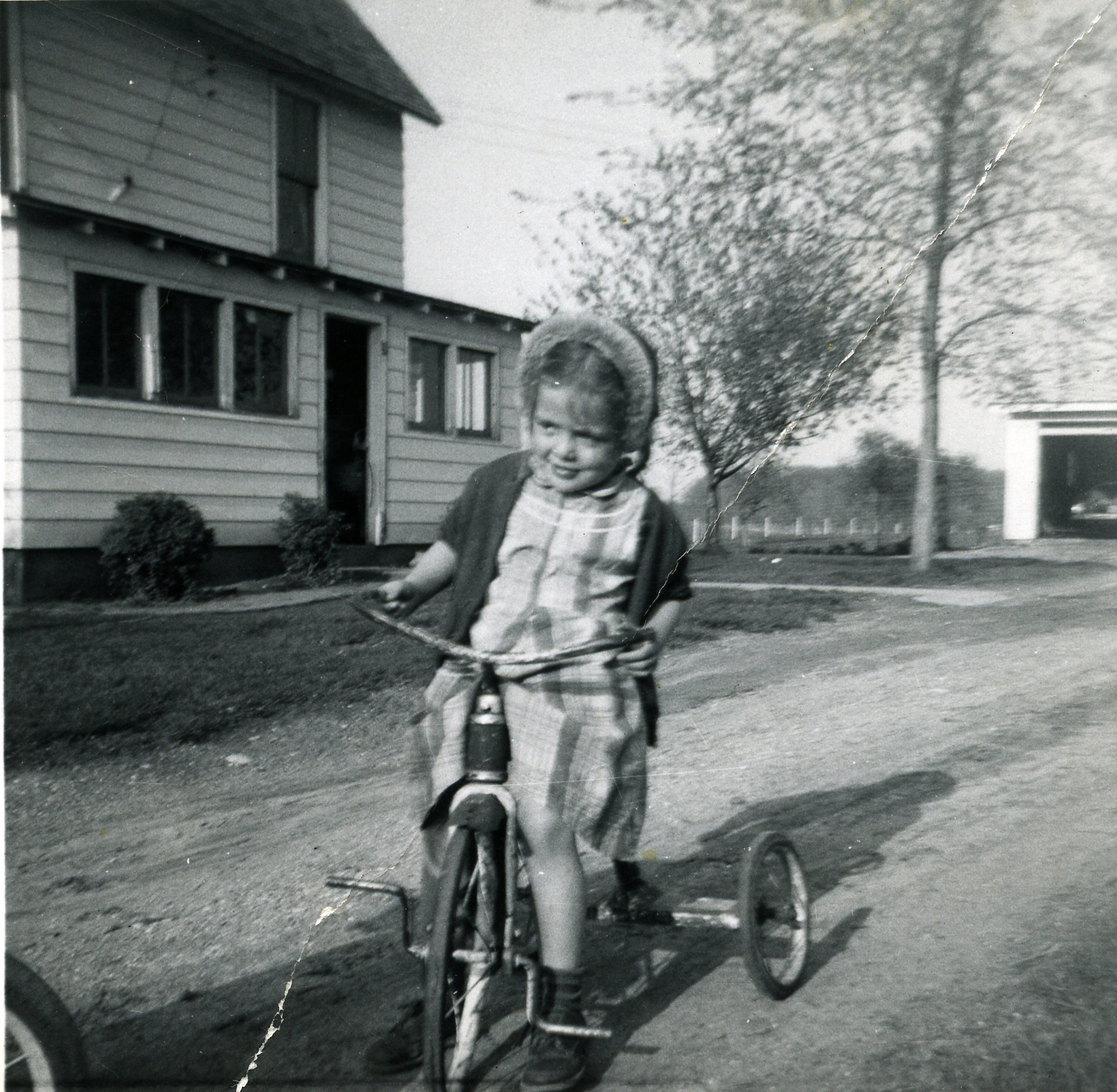 Me when I was about four on our farm, about the same angle as the above photo.
I couldn’t imagine living in one place longer than I had already spent my first 17 years. The farm and Indiana were part of who I was. There were holy places on the farm—thin places I would call them now—where I felt incredibly close to God and where I would talk things out with my Creator in the days of my youth—yell at God when I was mad and cry when I was happy or sad.
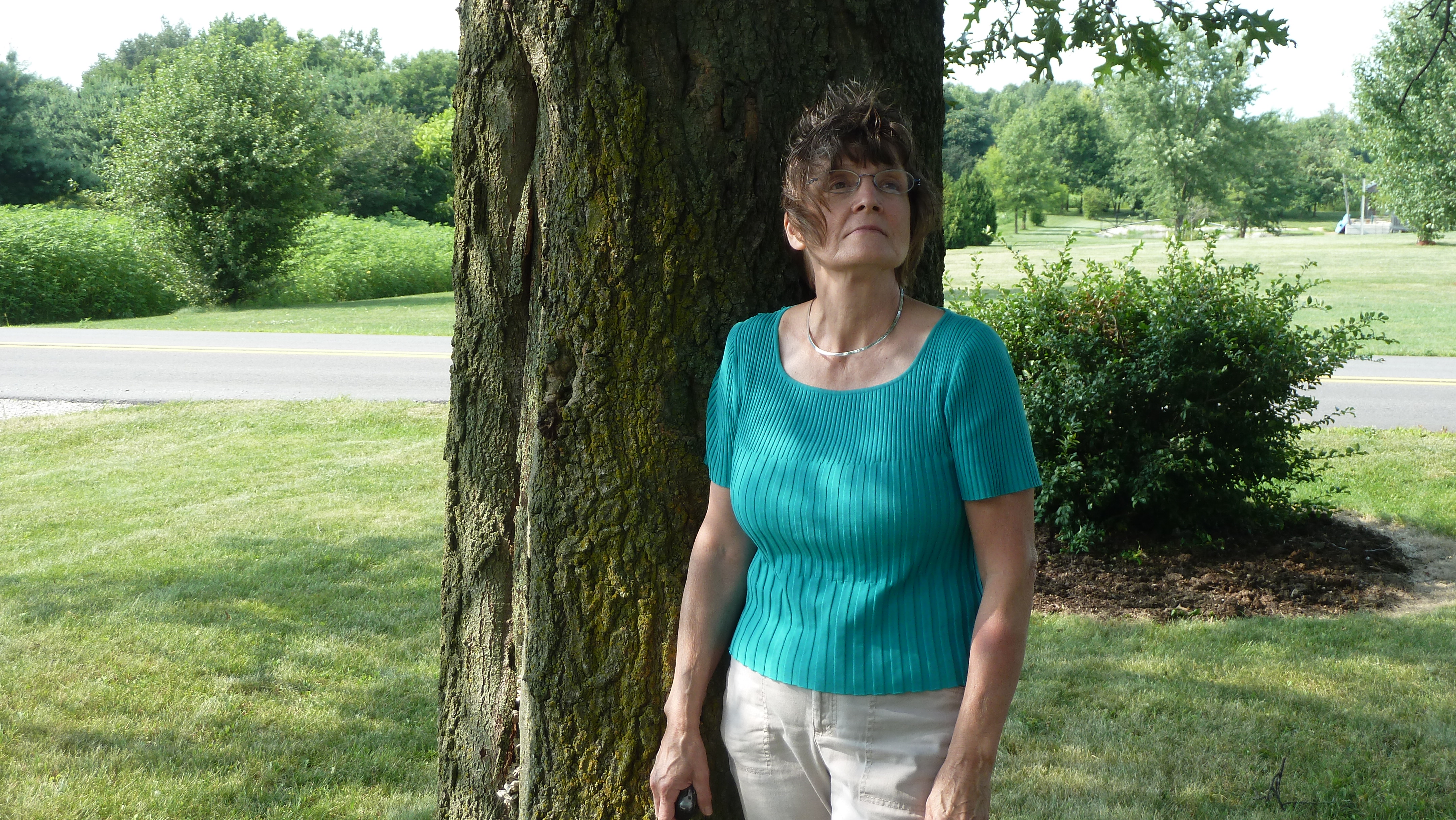 With the “tiny” oak tree our family planted. We all remember Dad wondering how big it would get to be. It survived a strike by lightning, see slash on the left.
I’m glad we moved off the farm but there were years when I yearned to go back to the roots which formed me—not just to visit, but to live. I think that’s because for 17 years I had lived in one place. I loved it without question or imagining it would ever change. Our family was happy (yes we had problems, but worked through them) and the farm was just part of who I was.
Then I went through a period where I changed locations or residences every year for eight years: the late teen and young adult years. While I loved the adventures, something in me missed that beauty of belonging so intimately that the land, the buildings and the trees were almost part of my DNA.
Our farm was first sold to a bachelor who later married my first cousin so of course we had a tie where we could go back, visit, walk through the old house, remember.
My cousin’s husband then sold the farm to an Amish family. We have also come to know them a bit—initiated first by my father, who would occasionally stop to chat—he loved to roll out his rusty Pennsylvania Dutch (switching to English as needed), and I think both the farmer and my Dad enjoyed those visits.
Now we encroach on this Amish family on special occasions, asking if we can visit: when my father died in 2006 and after the graveside service, the farm was where we wanted to go. More recently, on the day before my mother’s 90th birthday (covered here), the farm was where my brother and his family especially wanted to go, a sort of pilgrimage for his son, wife and their two little girls who had never been there. The rest of us were only too happy to oblige. Indeed the farm and land is a holy place for all of us where roots were put down deep and wide.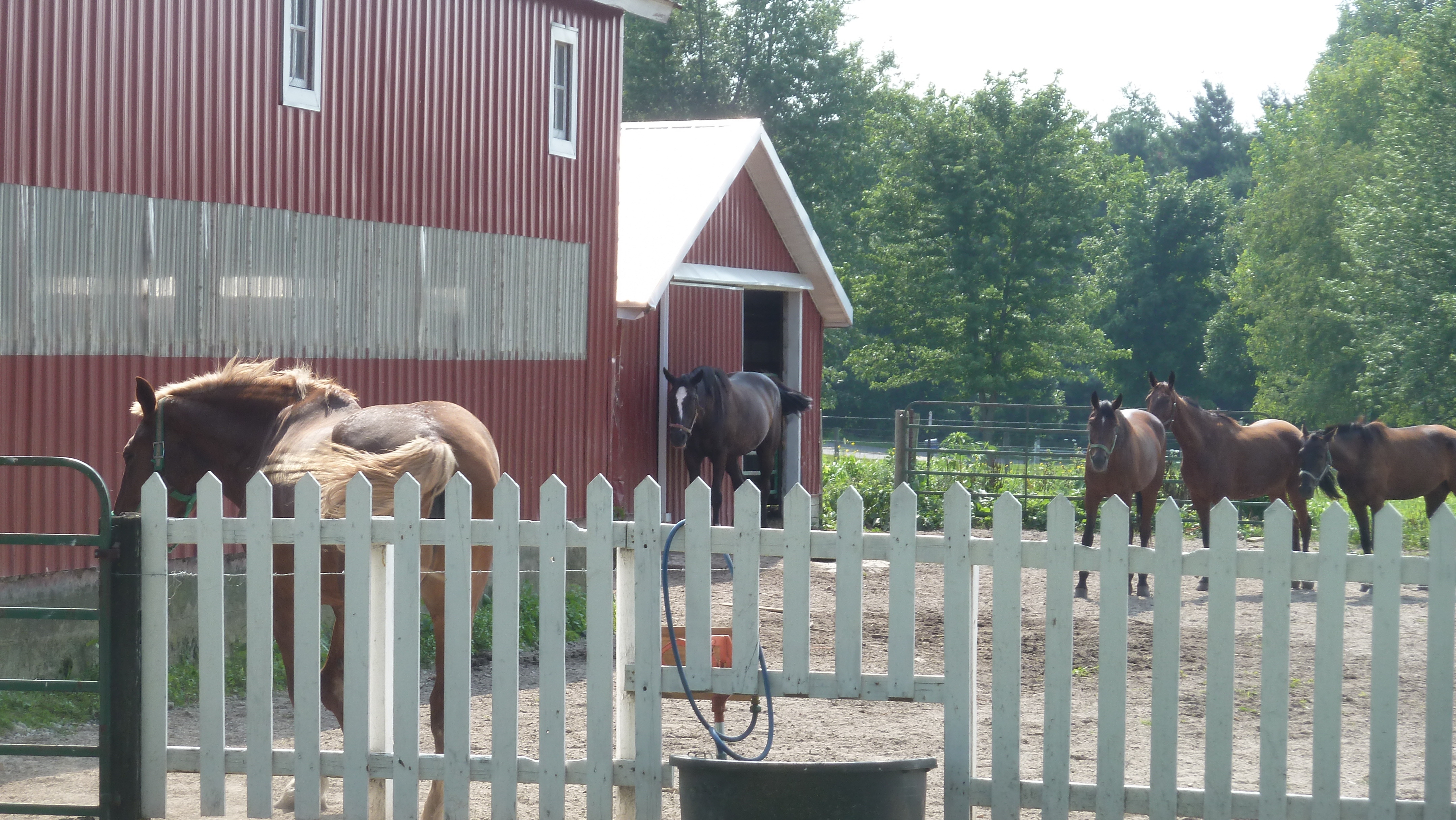 Our old barn, now with Amish work horses plus those for pulling buggies.
This time I was stunned to realize this farmer had owned the land longer than Dad had ever owned it, about 28 years to Dad’s 23; he was clearly busy but he recognized us immediately and paused to chat and catch up a bit; his wife and several daughters were gone for the day working with other women making preparations for a September wedding. He had had to sell off more of the land—that was hard, he said—the home place now down to some 30 acres from the original 128 we owned, bordered on all sides by lovely modern suburban type homes on large lots. The farmer was mainly raising cows and corn from what we could see. He welcomed us to walk around as we wished, but we did not ask to go in the house. Happily we went to the barn, laced with the familiar smells but more profoundly, memories.
 The bank hill at the back of our old barn.
Oh the barn. The silo now gone (the farmer said the extra yearly taxes were too much for something they were no longer using)—we walked up the barn hill which seemed so huge when we were little, now little more than a small rise. Inside it was mostly filled with hay and straw. The granary was still there, the sheep shed still attached, the bunker silo still in use, a square hole for throwing hay down to the floor beneath still gaping and dangerous for the little ones in our midst.
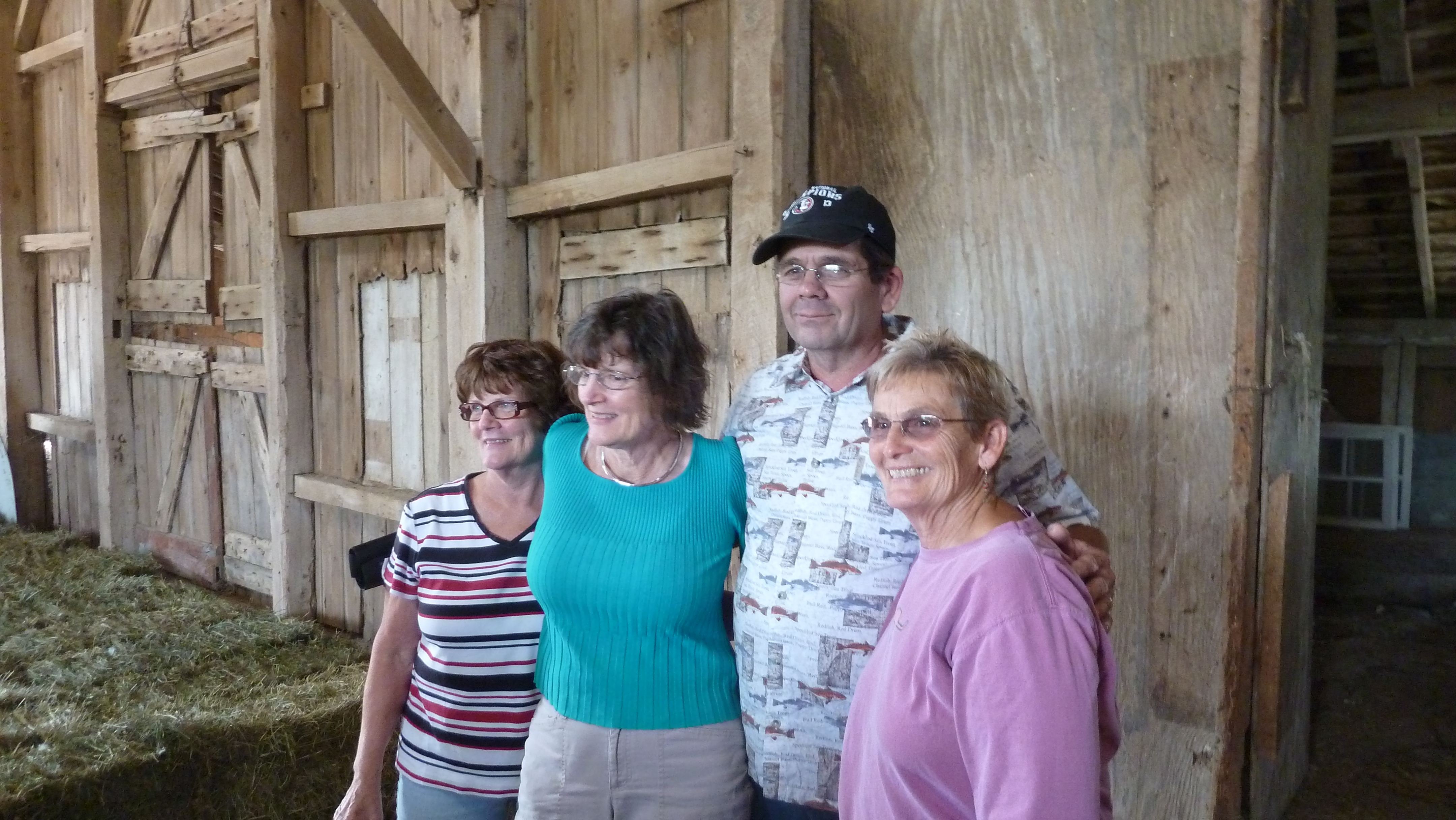 My sister Nancy, me, brother Terry, sister Pert.
 Circa 1965: Terry, me, Mom, Dad, Nancy, Pert.
But the rungs of the hay mow ladders were what reached out to me this visit: the same rungs we climbed as kids, still sturdy as you could ever want.
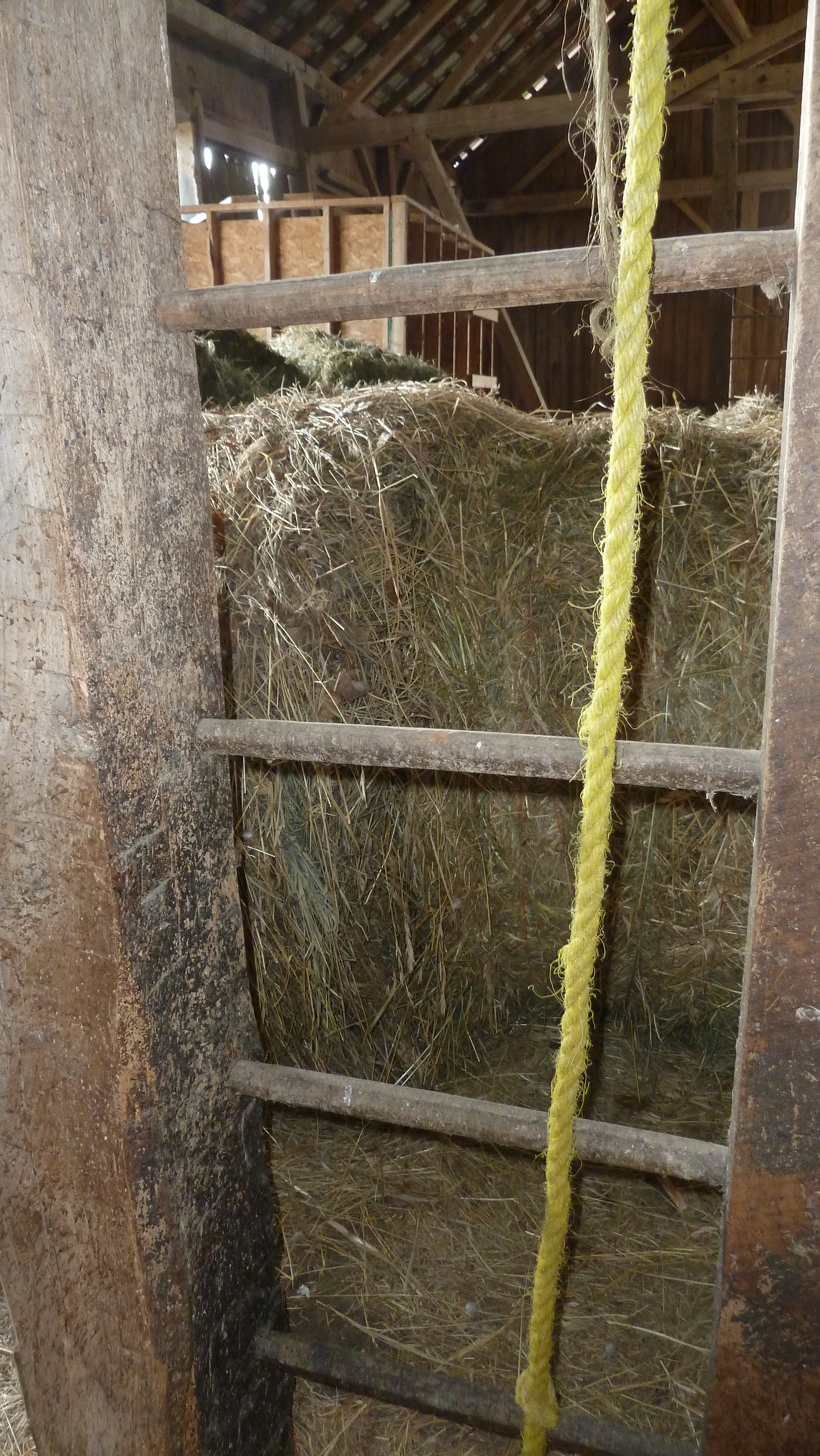
I put my hand snug around those rungs and felt 17 again: young and strong and ready to find my own life and love.
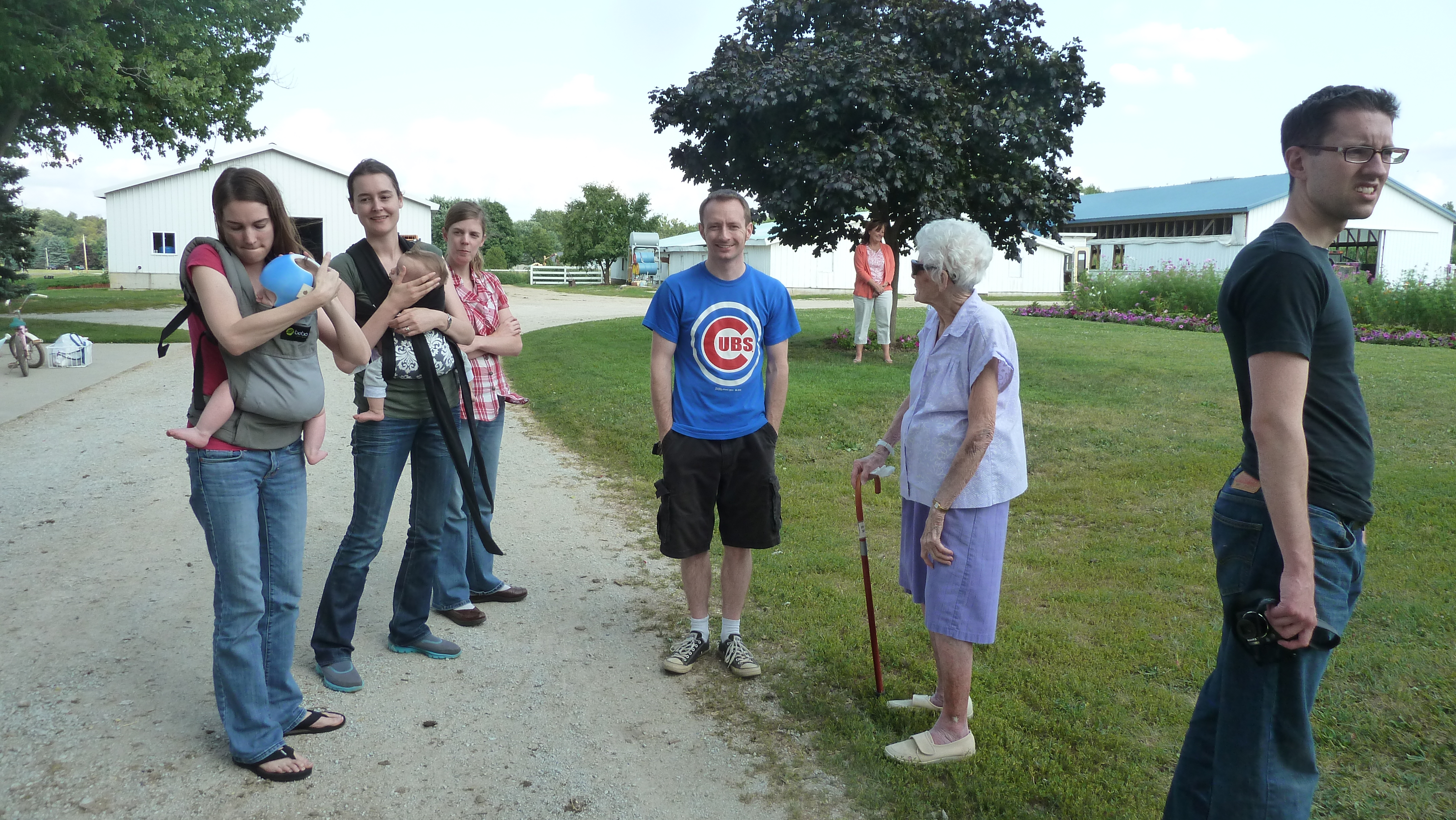 On the farm with daughter Tanya & grandson Sam; daughter Michelle with grandson James; Doreen; son-in-law Jon, Tanya’s husband; Mom; son-in-law Brian.
Which I did. And they were all there with me now: husband, three daughters, two sons-in-law, two grandsons, visiting my roots. How rich, how connected, how overwhelmed with joy and gratefulness I felt. There is something about the land, something about the house where you grew up that calls you back, catches you, but lets you go—happily back to your current life and chosen path, at least if you are happy in it. I no longer pine to go back to age 17 or that Indiana soil. But touching the past, we somehow feel more whole. More content perhaps, to know and remember all that has gone before: the thin places, the rough places and the high points. It helps you trust that your Creator is still with you, no matter where you land.
A rich time. Thanks always to the farmer and family who stewards the land that none of us ever really own—we just take care of it for a season.
As many ancient native proverbs go: “Treat the earth well: it was not given to you by your parents, it was loaned to you by your children. We do not inherit the Earth from our ancestors, we borrow it from our children.”
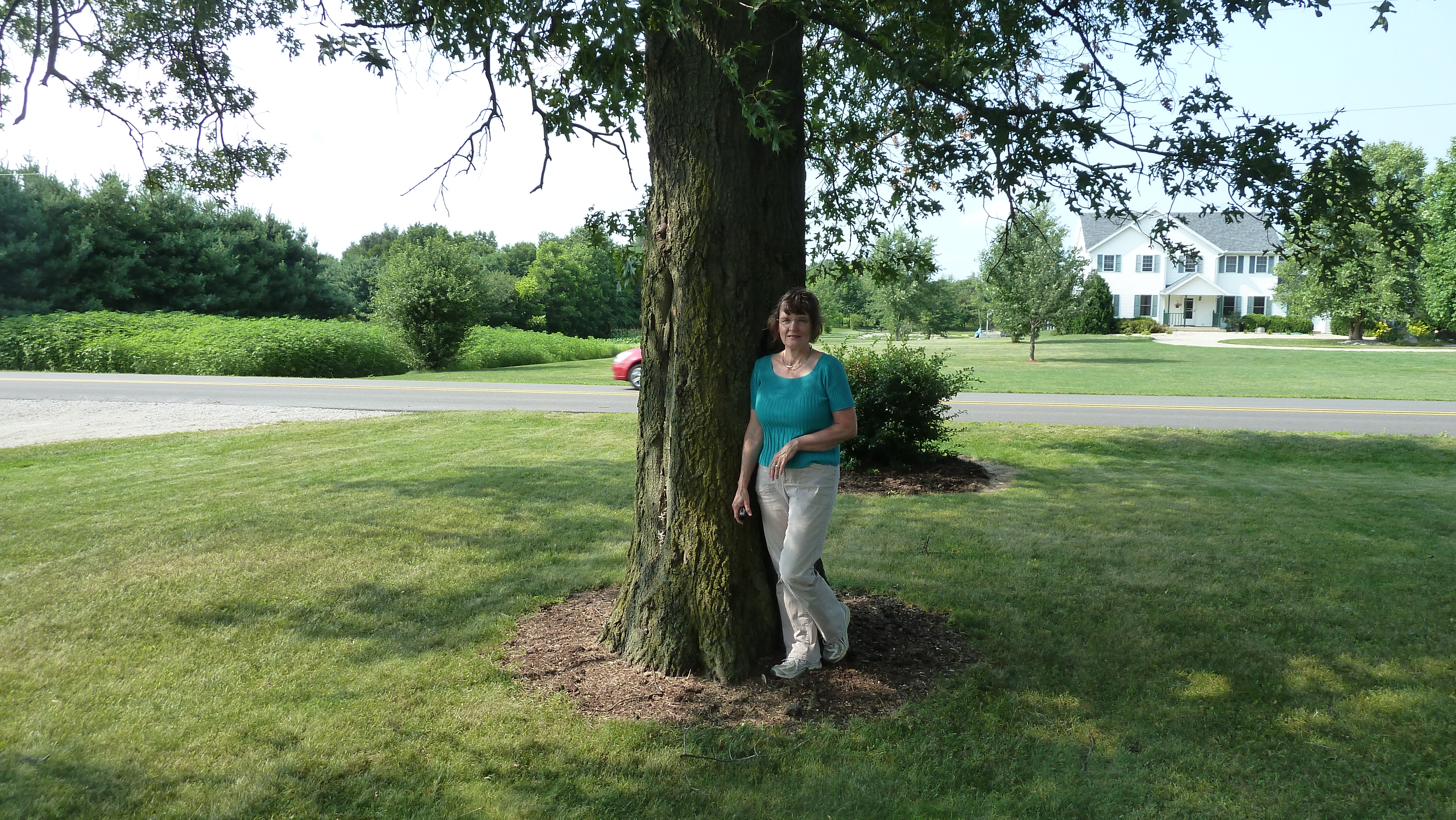 Me with our little oak tree.
***
What have you learned about yourself or your family when visiting places you used to live?
***
My favorite book teaching me to think about land differently is Great Possessions, written by Amish farmer David Kline.

 findingharmonyblog