

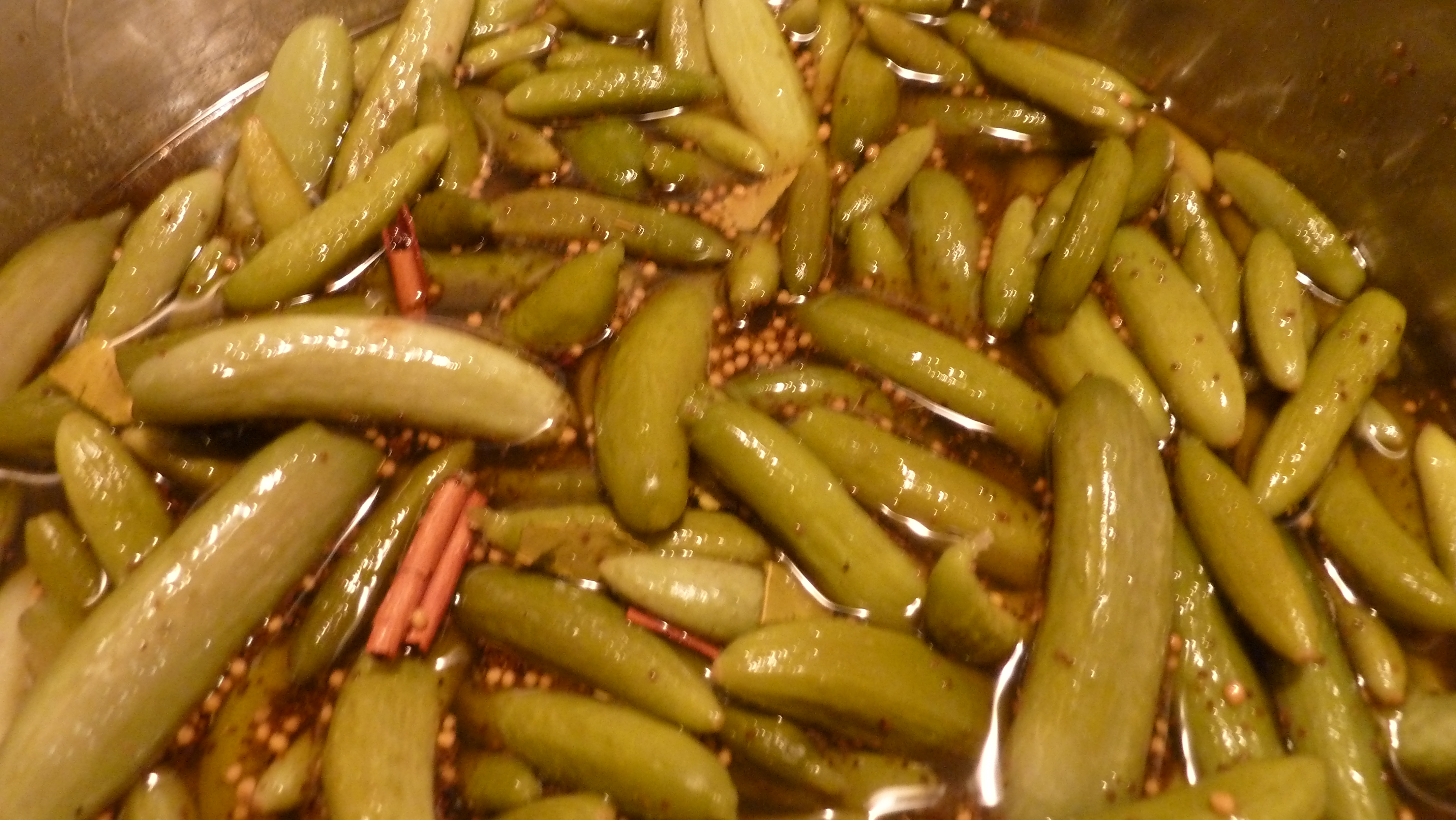
Making sweet midget pickles
Why would anyone collect 1-3 inch size cucumbers when the normal slicing cucumber size is more like 8-10 inches? Would I ever get enough to make a turn of sweet midgets?
I first made these two years ago pondering whether they would turn out. Would anyone like them? Were they worth the effort?
They are very sweet and oh so worth the effort. They soak up so much sugar that they become like little sweet candies with a pucker punch.
This is the perfect year for making them again: rain has been frequent and plentiful enough that yards, trees, and roadsides are to me, much greener than normal, especially for August here in the Shenandoah Valley.
My garden is just robust, and what started out to be six simple hills of cucumbers ended up being 10 when most of the starts that I bought had at least 2 plants per divider, and since some of my hills ALWAYS die off for unexplained reasons, I went ahead and plotted out a cucumber patch with 10 hills.
I am drowning in cucumbers, especially after being away for a week. So it is no great loss to rob the patch of every little cuke I can catch and save in the 1-3 inch stage. And they do save up well. I just put them in a closed plastic bag in the fridge for 5-6 days as the stash mounts up.
And what I discovered when I made them two years ago? They are so sweet they are like candy in a pickle, good enough to hoard, which is what I heard one recipient of one my jars did two years ago when I gave it as a hostess gift at a Christmas party we attended. “Richard hid the jar so no one else would eat them,” Janet told me.
Loving that story, for sure.
But you are either a fan, or you are not, so here’s the recipe and the method. This year I discovered I didn’t exactly have a container of “mixed pickling spice” in my cupboard like I thought so I also found a recipe (below, bottom) for making your own mixed pickle spice in a pinch.
In following the daily steps for the recipe below, it is helpful to write down what day of the week you start on so you can see at a glance where you are at. Unless you are really good with things like that. (The days all start to fuzz together for me.)
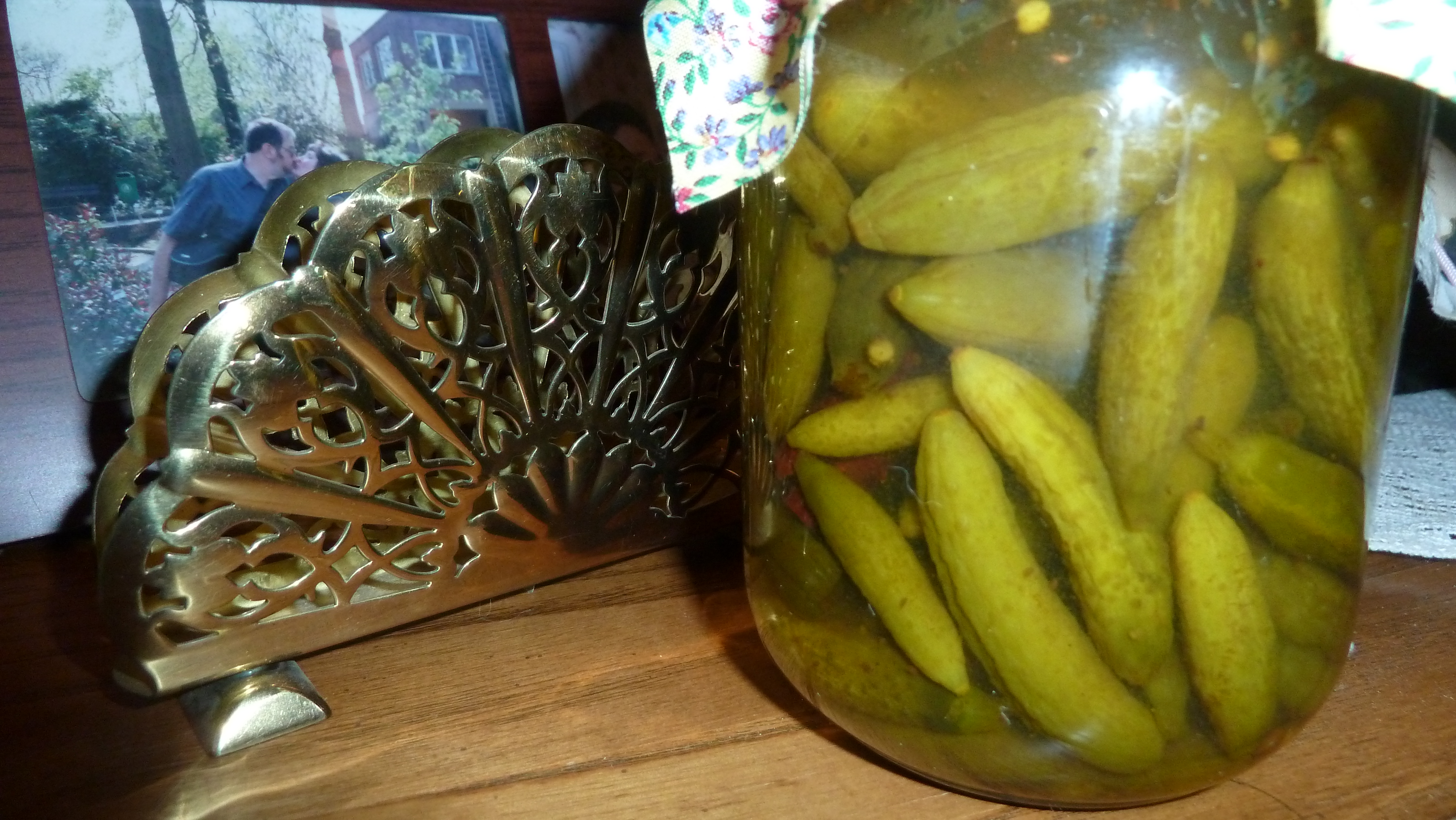
Sweet Midget Pickles
3.5 lbs. cukes, 1.5-2 inches long (I sneak in some 3 inchers too)
¼ cup pickling salt
4 cups sugar
3 cups vinegar
½ teaspoon turmeric
1 teaspoon celery seed
1 teaspoon mixed pickling spice
Cinnamon sticks
First Day. Place cukes in glass or stainless steel bowl or pan, cover with boiling water in morning. In afternoon, drain and re-cover with boiling water.
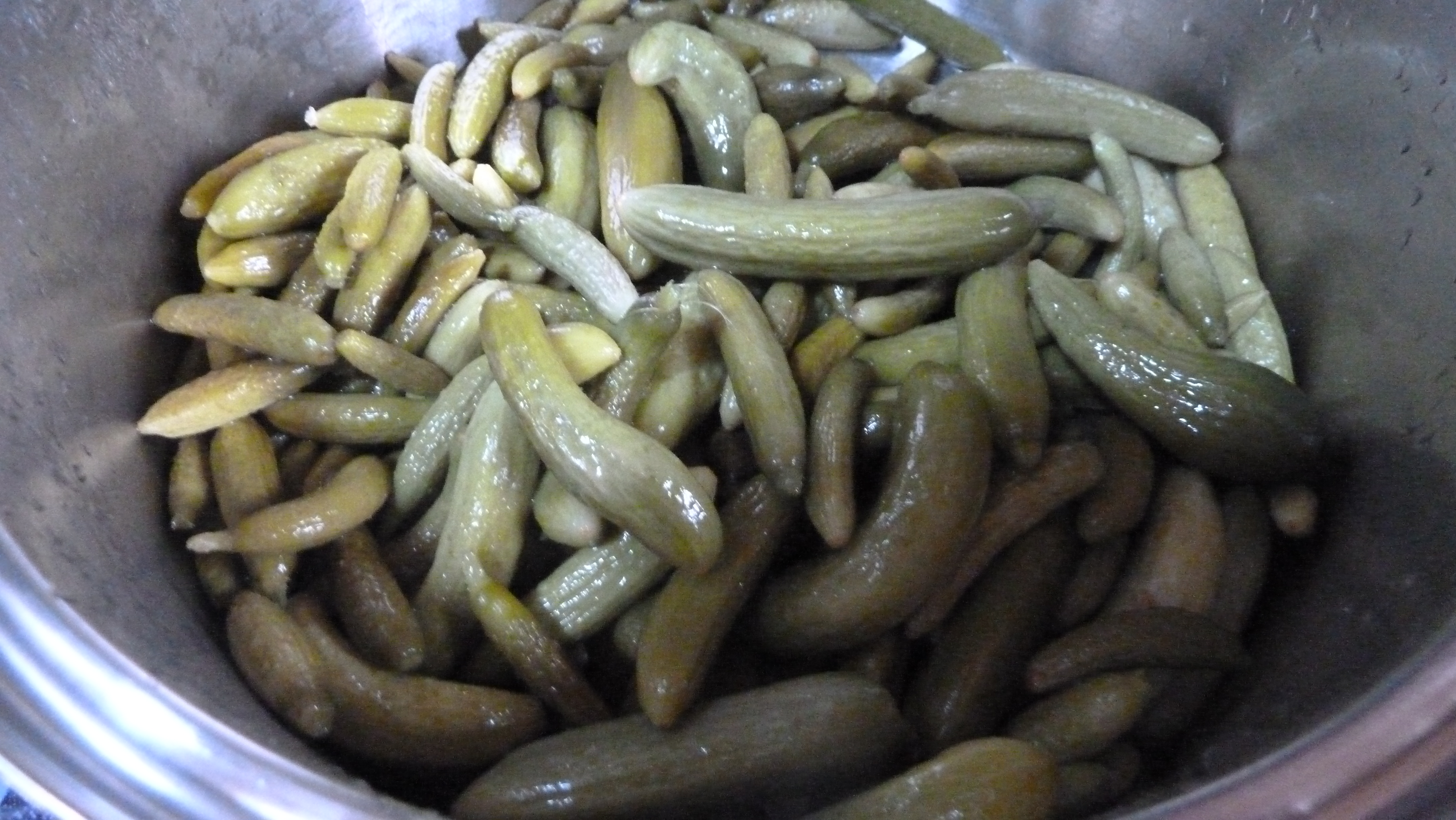 This is pretty much what they look like after a one day soak.
Second day. In morning, drain and cover with boiling water. In the afternoon, drain and cover with brine formed by adding salt to 3 qts. boiling water.
Third day. In the morning, drain, rinse and prick cukes.
I use an old fashioned 3 tined fork to prick the cucumbers with one tine. Toothpick works too.
Make syrup using 1.5 cups sugar, 1.5 cups vinegar, and all spices. Bring to boil and pour over cukes. In the afternoon, drain syrup into pan. Add 1 cup sugar, and 1 cup vinegar. Heat to boiling and pour over cukes.
Cukes with spices and sugary brine
Fourth day. In the morning, drain syrup into pan; add 1 cup sugar and ½ cup vinegar. Heat to boiling and pour over pickles. In the afternoon, drain into pan and add remaining sugar. Heat to boiling. Pour over pickles packed in jars. Leave ¼ inch headspace. Add ½ stick cinnamon to each jar. Process 10 minutes in boiling water. Makes 6-7 pints.
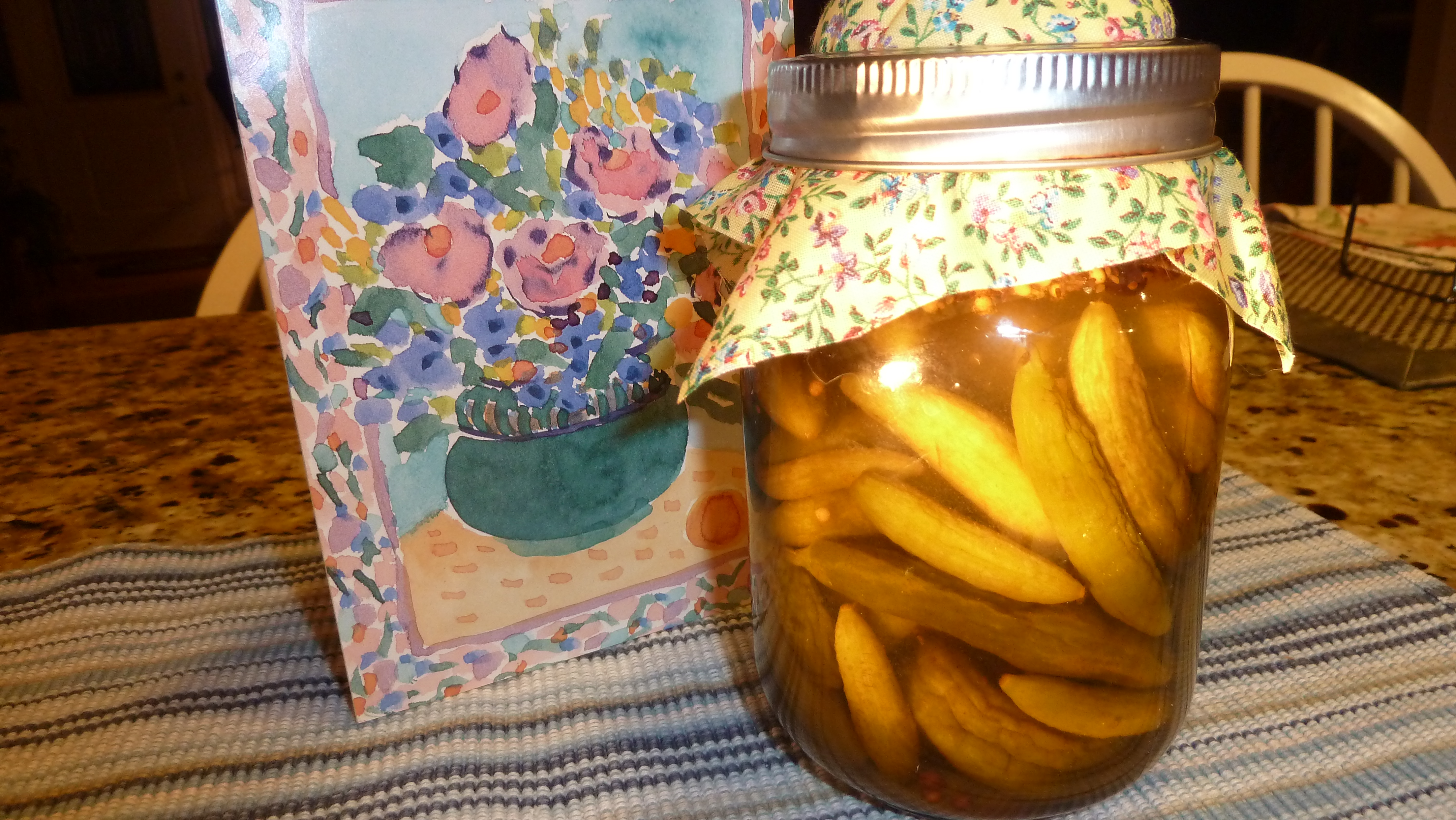
If you need a recipe for pickling spices, here’s one adapted from from Taste of Home:
Homemade Pickle Spice Mix
2 tablespoons whole mustard
1 Tablespoon whole allspice
2 teaspoons coriander seeds
1 teaspoon red pepper flakes
1 teaspoon ground ginger
2 bay leaves crumbled
2 cinnamon sticks broken in half
6 whole cloves
***
Do you have another recipe for sweet midget pickles? What’s a favorite pickle for your family?
***
There are two pickle recipes in my book, Whatever Happened to Dinner, one for cucumber relish, and one for super easy microwave pickle. (Can anyone tell what’s different on the cover below for this book from the original? It was revamped slightly for print on demand status?)
***
Or, if you’re up for a real hunt, can anyone find the photo bomb of someone stealing a quick pucker punch in a park in this post? And yes, I’m sowing my “P’s” heavily today.)

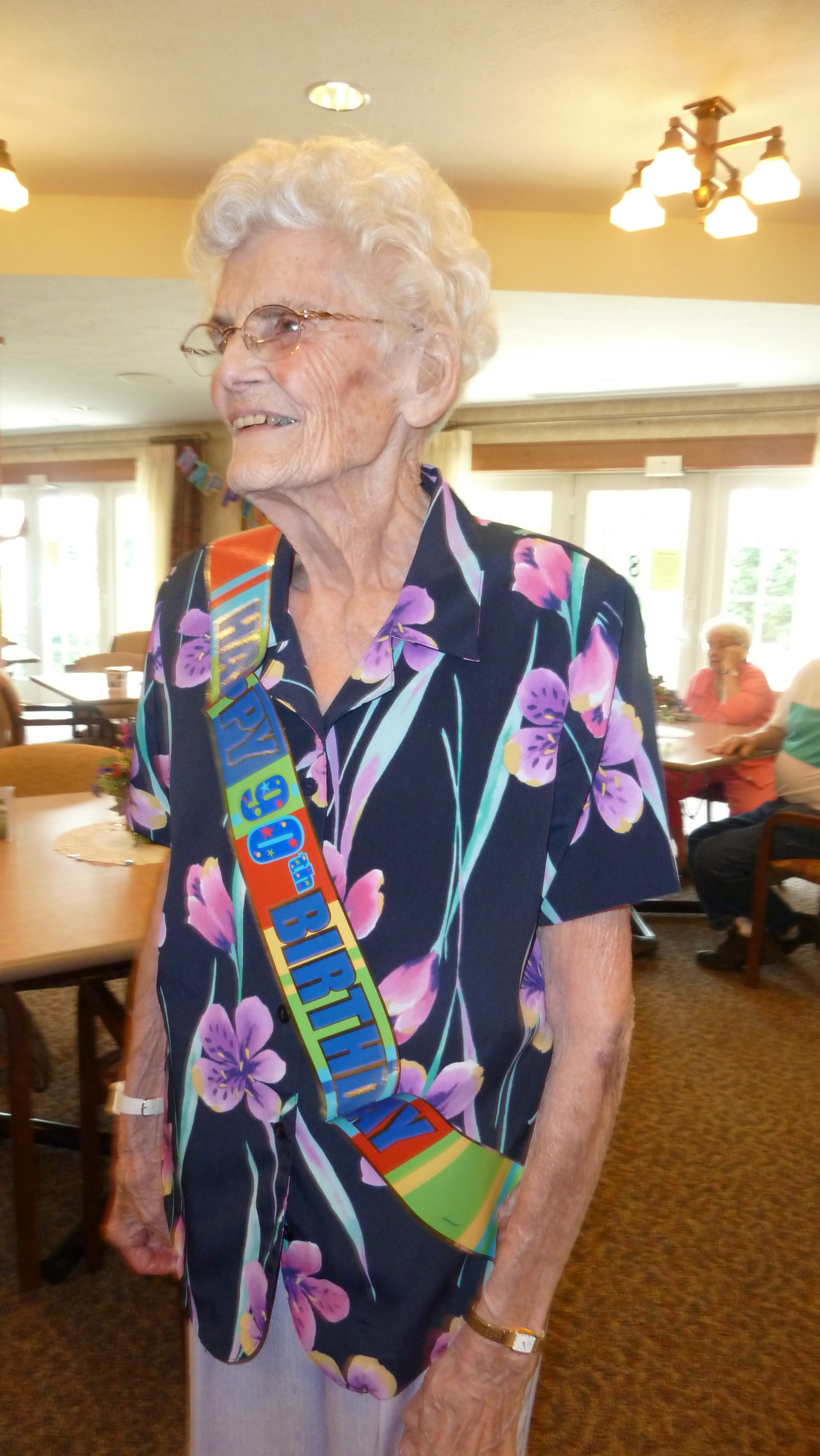
A little over a week ago my family celebrated my mother’s 90th birthday.
She’s joining an increasingly popular and not uncommon club. Walking the loop around the lovely pond at her retirement community later in the week, my mother and I ran into a tall and vigorous Mennonite leader, Simon.

At one time he was on the board of the organization I worked for as Mennonite Board of Missions. I greeted him enthusiastically and told him we had just feted my mother for her 90th birthday.
Simon said smiling, “You’ll have to run to keep up with me. I’m 91.”
Ninety is the new 80 is the new 70 and so on.
Two months earlier, I joined mom for her friend Cora’s 90th birthday party, where we kind of got some ideas about what we’d like to do or not do at Mom’s. They had a fantastic brunch which looked like a huge amount of work. We stuck with cake, ice cream, nuts and punch, and invited two very willing helpers to assist us from Mom’s church North Goshen Mennonite: Rachel and Ruth Ann.
 Rachel and Ruth Ann, gracious helpers
If they sound Biblical, they are in terms of being gracious servants—in fact Rachel had made it a practice for a period of years to plan 90th birthday parties for a total of 14 people from her church or family. Ruth Ann is amazing because she had survived a brain aneurysm a few years ago, and was privileged to interview her about for a short-lived radio program (you can read or hear her program here).

With my sibs and Mom: me, Mom, Pert, Nancy and Terry.
However, tempering my joy in helping mom celebrate this big milestone birthday, I had to think of those so much younger whose lives were snuffed out before they could see their kids graduate from high school, before they could see their daughters married, before they could jiggle a grandson on the knee. Why do so many reach the age of 90, 100 and even 105 and up, while folks in their 50s and 60s are succumbing to cancer, heart attacks, brain tumors? Mom had just survived her own cancer scare with major surgery two months earlier. Why was she living at age 90 and my pastor’s husband did not live to see 60?

Cousin Miriam greets Mom at the party.
The whys are unanswerable and they give pause to all of us. When big birthdays roll around, the celebrations remind us to just be grateful for the present, pull our loved ones a little tighter, let loose of old arguments a little quicker, and reach out with all the love and compassion and attention we can muster for those going through the difficult times that do come to us all.

Those who gathered for Mom’s evening pizza party for family. Mom’s great granddaughter Asa, sitting on grass second from left with head on her sister Eve’s shoulder, also celebrated her 5th birthday that evening! Asa said the prayer for our pizza.
The day after Mom’s party, she wanted two things: a Ferris wheel ride and a boat ride. She had heard about Indiana Beach Amusement Park, a smallish, older style park close to Lafayette which had reasonable weekday rates. To her, the park was huge, overwhelming. She was thinking of the amusement park she and Dad went to in the 40s when they were dating. Would she be able to keep up with toddlers, teenagers and her kids, just two months out from surgery? With the help of a wheelchair, she could and did, and a grand time was had by all on a comfortable Indiana day.
 My husband Stuart, Mom, yours truly, and our youngest daughter, Doreen, on Ferris wheel (more like a gondola) at Indiana Beach.
Mom said she was reading the last chapter in Ecclesiastes the day after her birthday, which she found fitting. It’s good to excerpt here:
“Remember your creator in the days of your youth, before the days of trouble come, and the years draw near when you will say, ‘I have no pleasure in them’; before the silver cord is snapped, and the golden bowl is broken, and the pitcher is broken at the fountain, and the wheel broken at the cistern, and the dust returns to the earth as it was, and the breath returns to God who gave it. ‘Vanity of vanities,’ says the Teacher; ‘all is vanity.'” (Ecclesiastes 12: 1, 6-8 NRSV)
Go Mom. We are grateful, for each and every day.
***
Who is the oldest person you know personally? How old would you like to live to be?
***

We gave our helpers each a copy of Mennonite Girls Can Cook Celebrations, (now with new dust jacket) which seemed like a fitting book for their efforts. If you’ve never checked it out or the blog it comes from, head over here for the blog and here for the book.

My mother holding me as an infant in 1951.
When did my daughters learn to be such good mothers?
We were planning to stay at a friend’s guest house on a trip to my home area for my mother’s 90th birthday celebration. (More on that later; also note I’ve been on a short blog vacation and totally offline for the duration.)

“Do they have a rocker?” one of my daughters asked.
Flash back 30 years when I would have asked the same question of a vacation spot, wondering how I would put my baby to bed or to nap without a rocker?
My daughter’s question made me flush with happiness. While this child enjoyed children and childlike play all her life, she had never been particularly baby-struck or begging to hold other people’s babies. But both my grandsons, born September and November of 2013, have their moms caught tightly in their little fists, the hearts of their mothers snagged forever.
Of course I wouldn’t have it any other way. But how did this happen? What course did they take? How did they—how does any mother—learn Baby Love 101?
Our daughters Doreen, Tanya and Michelle, in an earlier time.
It’s a crash course for all of us as new parents.
Perhaps even more remarkable is the transformation of their fathers, from two regular guys doing guy things while also taking on their share (and more) of household tasks along with full time jobs, gradually and suddenly immersed as pappas. Awesome pappas whose little ones reach out or smile with pure joy or crawl to them.
Son-in-law Brian with our grandson James.
It is partly instinct. The mother house finch currently feeding and ferociously guarding her four baby birds (with the help of a mate) in my fern on the front porch did not read any blog post or book or speak to any doctor or lactation consultant on how to feed and mother her babies.
James, Michelle and Brian on our front porch earlier this year.
It is partly friends and family, observing over many years how proud and protective moms and dads become once thrust into the role of Mom and Dad.
It is a lot of reading of books and of children, watching their own offspring for clues and sounds that hint of frustration and happiness, pain and contentment, sharp hunger and satiation.
And maybe oh maybe they learned a little bit from me. From us. Maybe we weren’t half bad as parents, for them to turn out to be so dedicated, so loving, so committed to doing the right thing for their little ones that it makes me think maybe we did something right too. Maybe that’s what it’s all about anyway: we all bumble through the early days, weeks and even years, learning as we go, but somehow that deep love that comes along with the child, tunes us in to have their best interests at heart. They in turn can take heart knowing their blundering will likely still serve their children well.
Son-in-law Jon with our grandson Sam, plus Aunt Doreen.
And this rich love is not born from the act of labor and delivery—it comes no matter how you get your children.
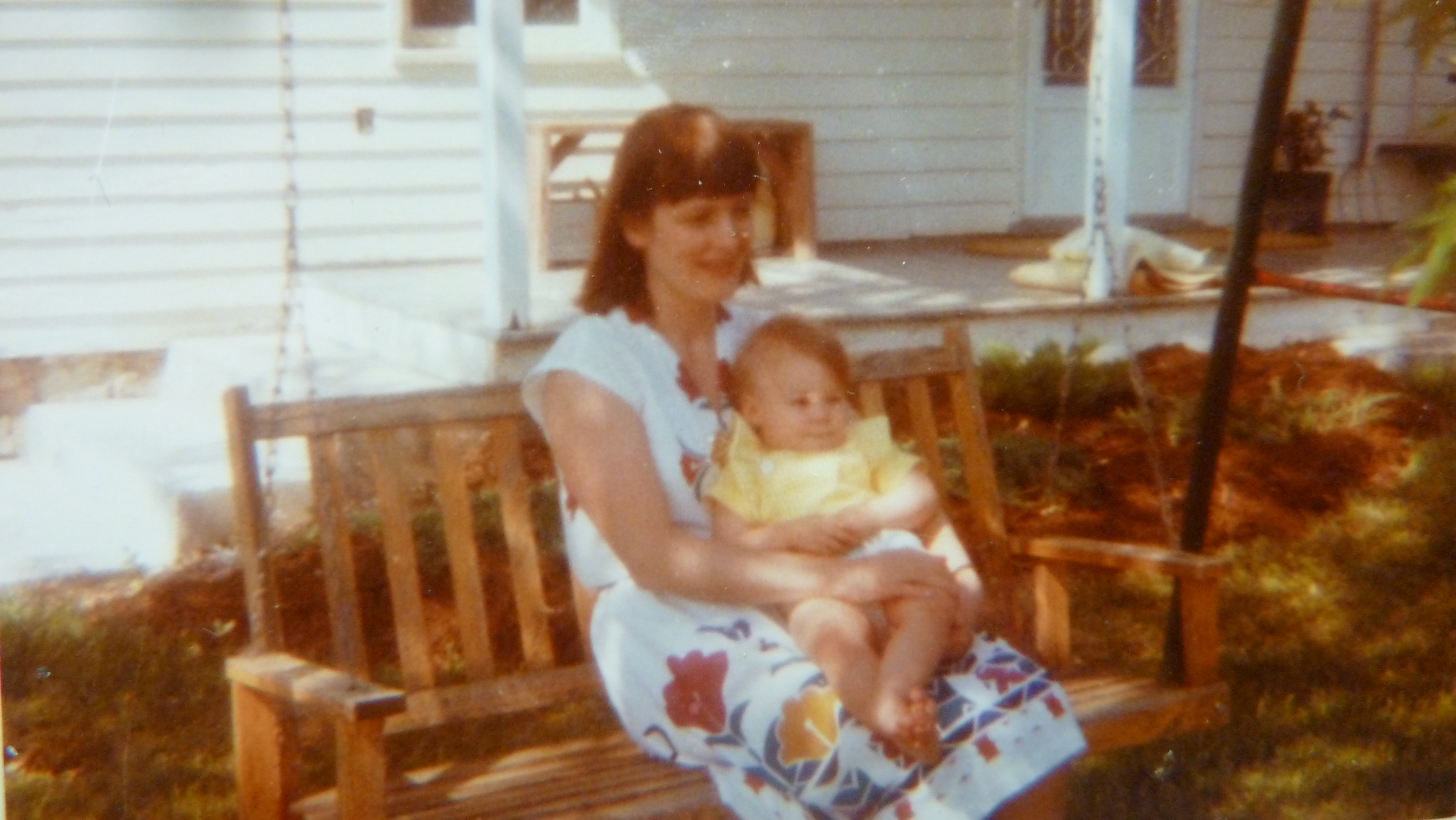
Me and daughter Tanya, circa 1984, mother of Sam, above.
As people of faith we believe that love comes from God and in fact God IS love. Right? Love, instinct, nurture, training/environment and generous heapings of patience to get you through the toughest nights or longest days which sometimes look fearsome, bleak and even at times boring—when you are waiting for them to grow up when you’re not so tied down.
The gift of love—with all its challenges—is rewound for a new generation.
***
What has surprised you about parenting? Or about being a grandparent?
***
Earlier post about becoming a grandma.
***
Also read my weekly Another Way Newspaper Column here or subscribe.

I wanted to make Mom’s very quick and easy oatmeal cake but had a small recipe emergency. Couldn’t find the index card in my box and was in a rush to throw the cake together before heading to work, to have for the annual Lion Club family summer potluck that evening. I had a nagging thought that maybe it was typed and on my computer, but I couldn’t walk 20 steps to go find it. Plus I couldn’t print it out, no printer. So I would have to commute between the back bedroom and the kitchen for the whole recipe. Not good.
So I grabbed one of my favorite recipe books where I thought I most logically would find a similar recipe, Mennonite Recipes from the Shenandoah Valley. Bingo.
As I worked, I realized it may have been practically the same recipe as my mother’s but instead of a one-bowl wonder, it dirtied 3 bowls in separate steps! Not my thing.
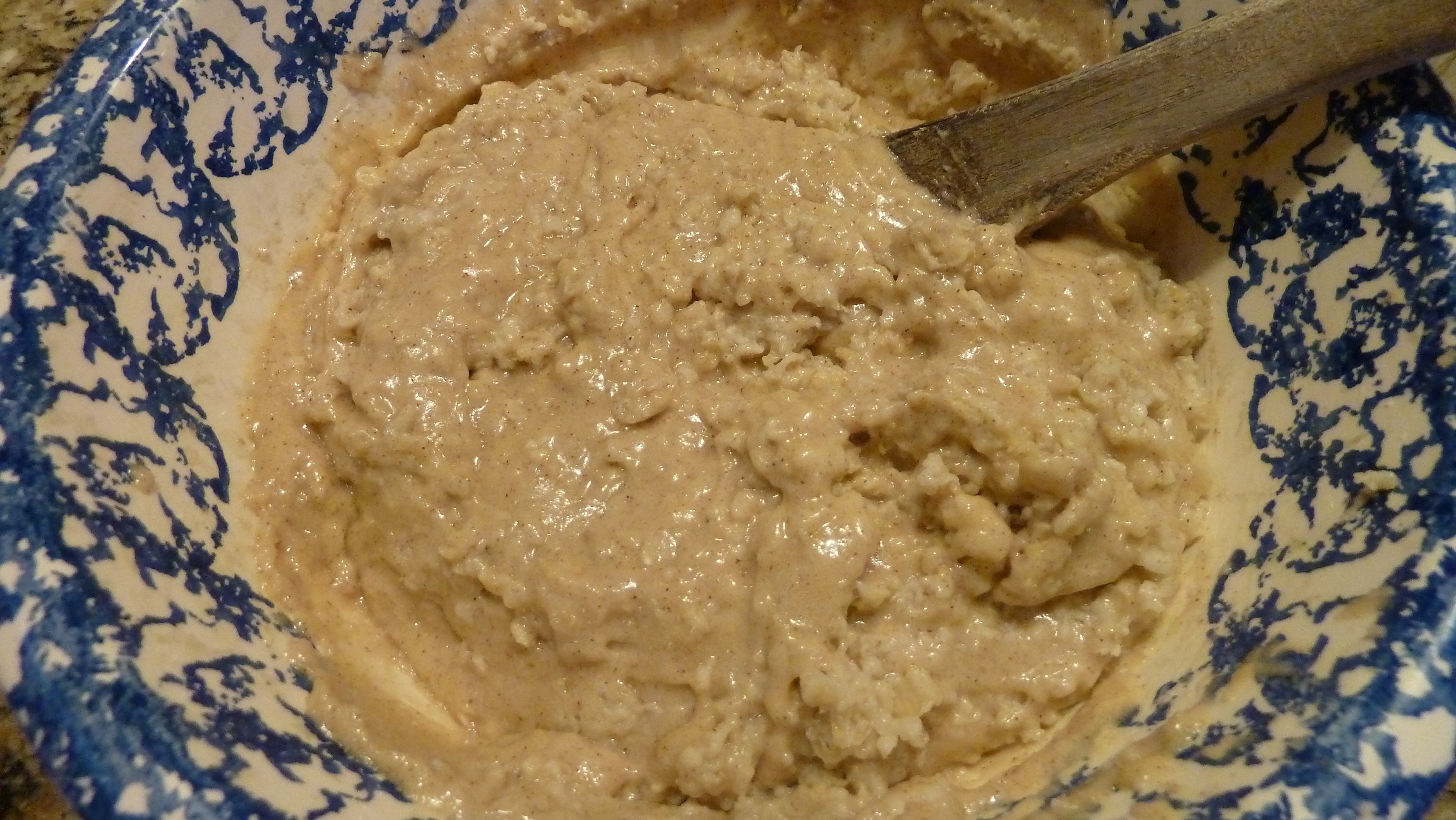
(I just realized my first three paragraphs ended with crisp one, two, or three word sentences. Grammar freaks be warned. The way mom writes her letters. Quick.)
I’ll first share the recipe from the above cookbook from Sandi Good (who also happens to be from Harrisonburg) and then the slightly easier one from my mom. You might find it interesting, as I did, the variation in steps resulting in much the same cake (Mom’s might be a little richer, using butter instead of oil) and calls for nutmeg in addition to cinnamon.
Oatmeal Nut Cake (from Sandi Good)
1 cup quick oats (dry)
1 ¼ cups boiling water
¾ cup white sugar
¾ cup brown sugar, packed*
½ cup oil
2 eggs
1 ½ cups sifted flour
1 teaspoon baking soda
½ teaspoon salt
1 teaspoon cinnamon
Topping
2/3 cup brown sugar, packed
4 Tablespoons butter or margarine, melted
3 Tablespoons cream or milk
1 cup coconut
1 cup chopped pecans
- Add boiling water to oats and let stand for 20 minutes. (First dirty bowl)
- Mix together sugars, oil, and eggs. (Second dirty bowl) Beat for 5 minutes. Add to oats when oats have softened.
- Sift together flour, baking soda, salt and cinnamon. Add to creamed oats batter.
- Pour into greased 9 x 13 in pan. (Third dirty pan) Bake at 350 degrees for 35 minutes.
- While cake is baking, mix together topping ingredients.
- Spread over baked cake while cake is still hot. Return to oven for 10 minutes of until bubbly.
* I had another recipe emergency while throwing this together: not enough brown sugar on hand. I pulled out More with Less Cookbook to find the right ratios for making your own out of dark Karo syrup (or molasses) plus white sugar, which is 1 tablespoon syrup to 1 cup sugar. Emergency averted.

My Mother’s Oatmeal Cake
Note that all of the ingredients for this are mixed in one bowl. No mixer needed. You can even mix the topping in the used cake bowl (maybe rinse out) when the cake is in the oven. Both cakes are very moist. This one uses slightly more sugar.
Oatmeal Cake – from Bertha Miller
Cut 1 stick (1/2 cup) of margarine into pieces in bowl.
Add 1 ¼ cup boiling water
1 cup quick oatmeal
Let stand 20 minutes.
Add
1 cup brown sugar
1 cup white sugar
2 eggs, beaten lightly
Mix well by stirring.
Add
1 and 1/3 cups flour
1 teaspoon cinnamon
1 teaspoon vanilla
1 teaspoon nutmeg
1 teaspoon salt
1 teaspoon soda
Mix well. Pour into greased 9 x 12 pan.
Bake in moderate oven 35-40 minutes.

While baking, prepare icing:
1 ¼ cup packed brown sugar
6-7 Tablespoons melted margarine
4 Tablespoons milk or cream
1 ¼ cup shredded coconut
1 cup chopped pecans or other nuts
Put icing on top of warm cake; put in oven for 10 minutes until bubbly or under broiler for 2 minutes till browned (but not burned).
Either of these cakes are great to take to a summer potluck, reunion, picnic, or cake walk. I like the fact they use a hearty cup of oatmeal and nuts to add more nutritional value than a standard cake. And almost as easy as a box cake, especially my mom’s version. Goes well with ice cream, but what doesn’t?

Do you have a recipe for oatmeal cake? How does it compare?
***
What are your favorite substitutions?
***
What makes these Mennonite recipes, besides the fact that I got them from two Mennonite women? I’m not sure, but it helps when people search for things like that. There are lots of duplications online.
Pillsbury calls their’s old fashioned. Another good search term.
Taste of Home likes old fashioned too.
When I wrote about my flower garden recently, built by friendships, my youngest daughter pointed out I had left out her rose bush.
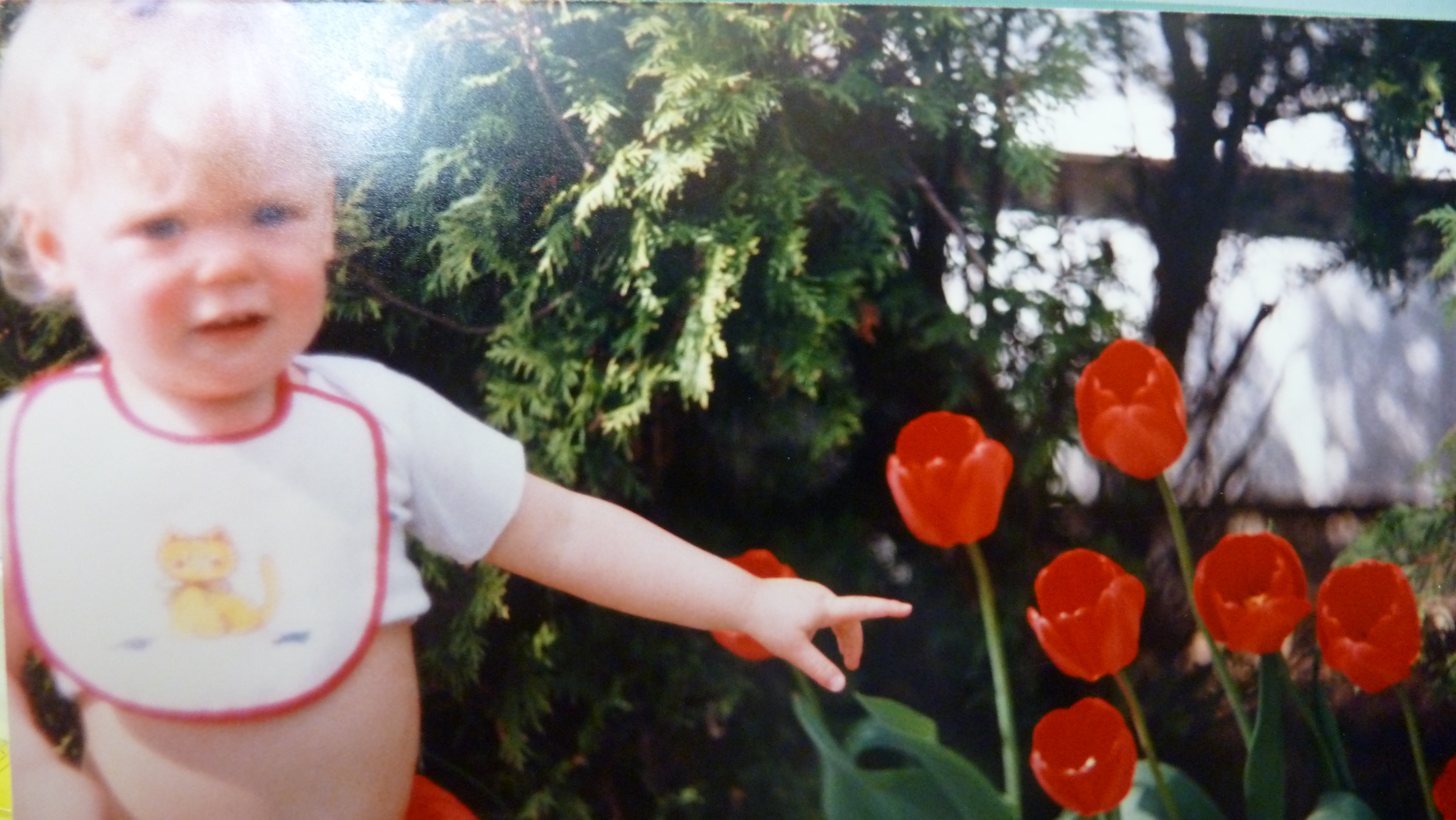 Doreen, at a much younger age, pointing to our lovely red tulips.
True. I felt it was a separate story, one that I am equally proud of, but it deserved its own post.
I could say that Doreen has always shown an interest in nature and flowers but then, all of my girls love flowers and will one day likely be even more knowledgeable and eager in this department than me.
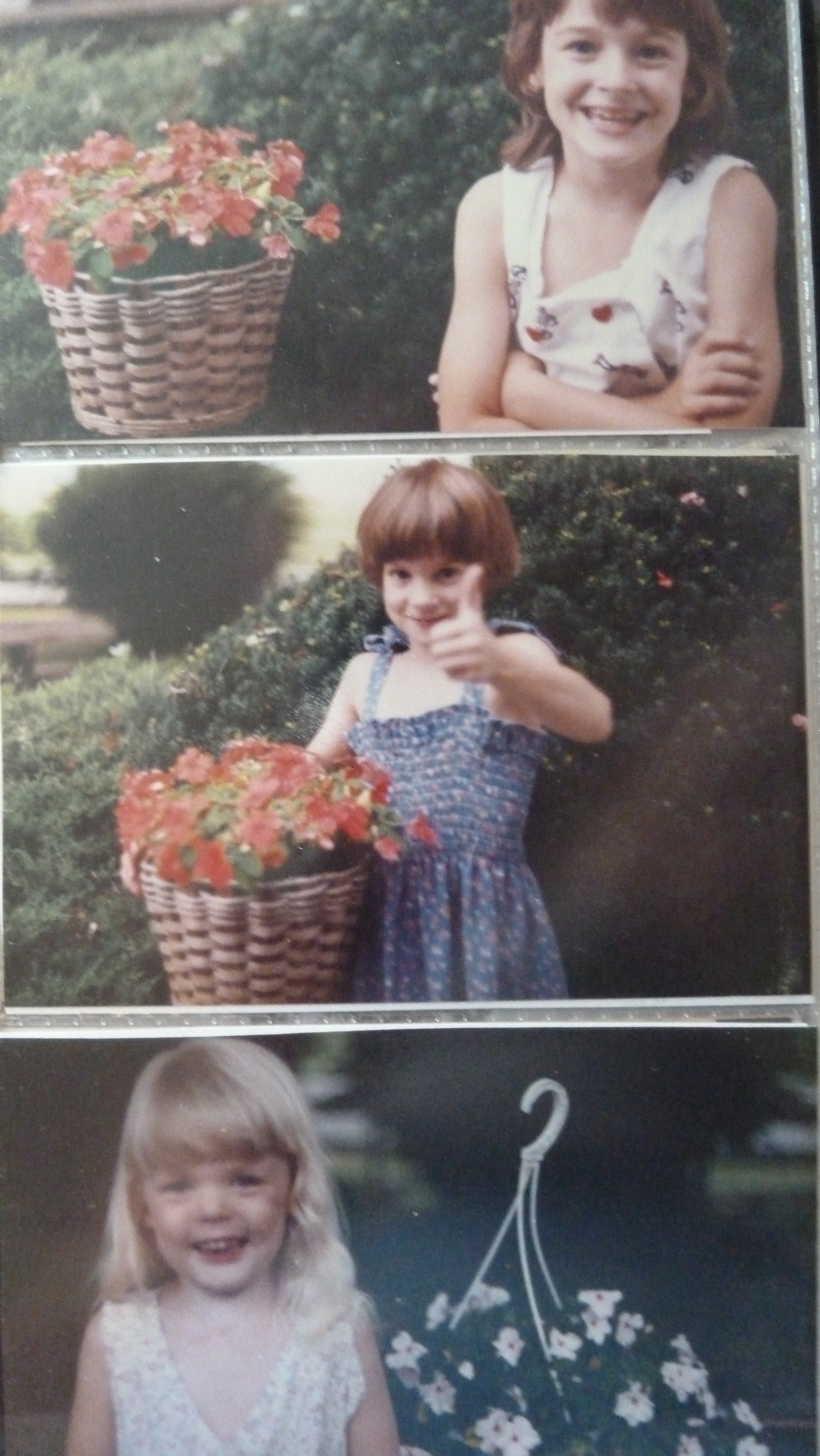 Top to bottom: Michelle, 8; Tanya, 6; Doreen, 3.
But Doreen was the one to bargain for a little flower garden of her own, and even purchased and planted her own rose bush sometime while she was in middle or high school. I was always worried I didn’t have a green enough thumb to grow roses, but she plunged right in.
 The first home for the rose bush. It had a nice rustic look, but too shady. I always wondered about the age/history on those old wagon wheels we inherited with the place, but never found out.
After we planted the rose, we realized it needed more sun than the shady nook behind a garden shed provided, so we moved it behind the house.
I warned her that it might not survive the move, but she wanted to try it anyway. Over the years I had planted many different flowers there, trying to figure out what worked best. The white rose bush flourished, and my daughter dug up this photo from her collection.

When we moved to our current home in 2007, of course the white rose bush moved along, I believe the only plant which we brought along—the first bush and landscaping at our new home.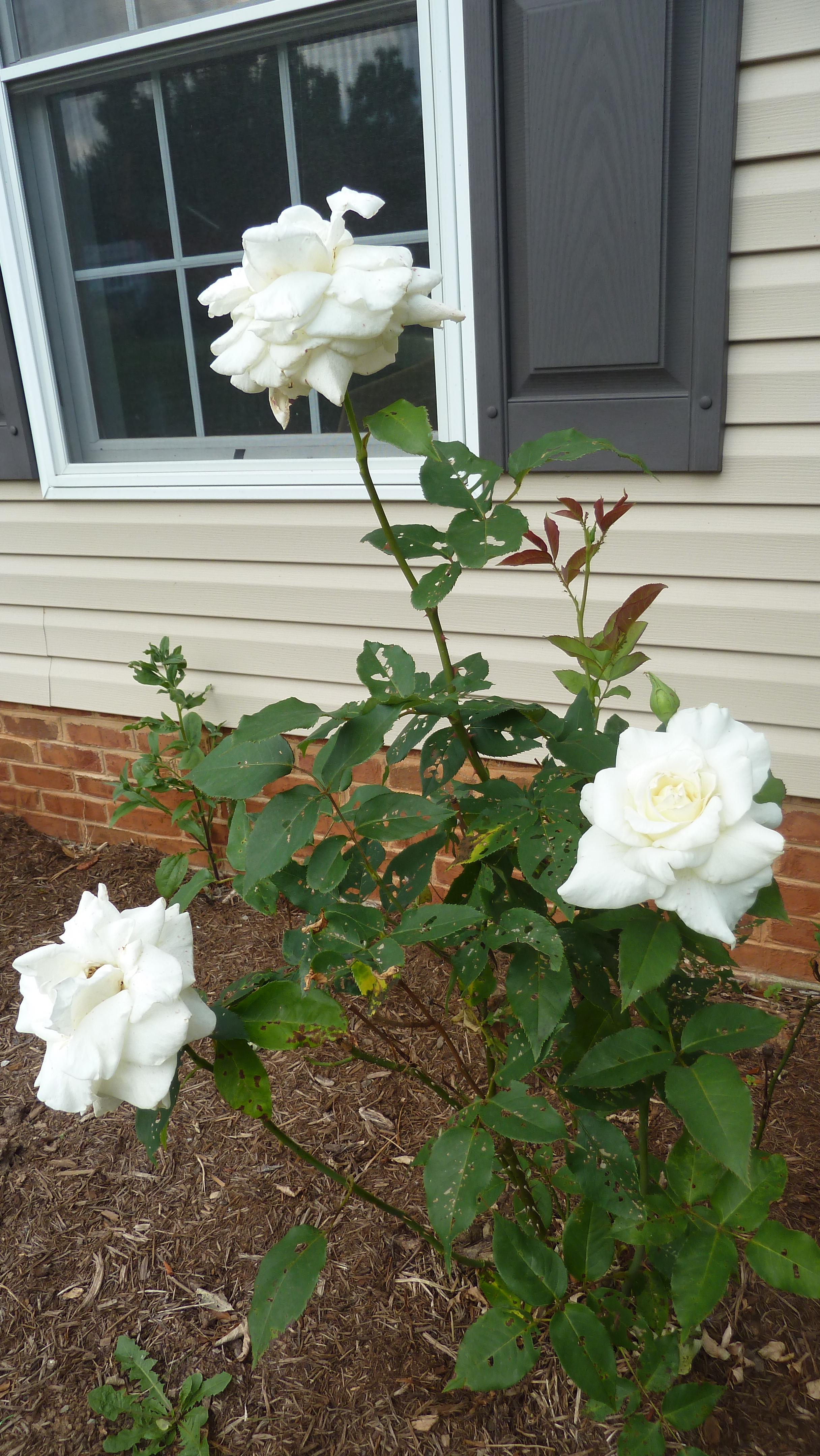
So it has survived several moves already, and I am the current happy host of the lovely white flower bush she chose, although it has had its ups and downs (bugs, holes in leaves).
 (It began blooming again yesterday, but can anyone tell me what to do for the rusty edges on the petals??)
It will likely have to survive more moves if it is to follow her to where she eventually settles in a non-rental location. I was just happy it eked out this past winter, as my other rose bush succumbed to the cold (and I was negligent and did not cover it with straw as she always did so carefully).
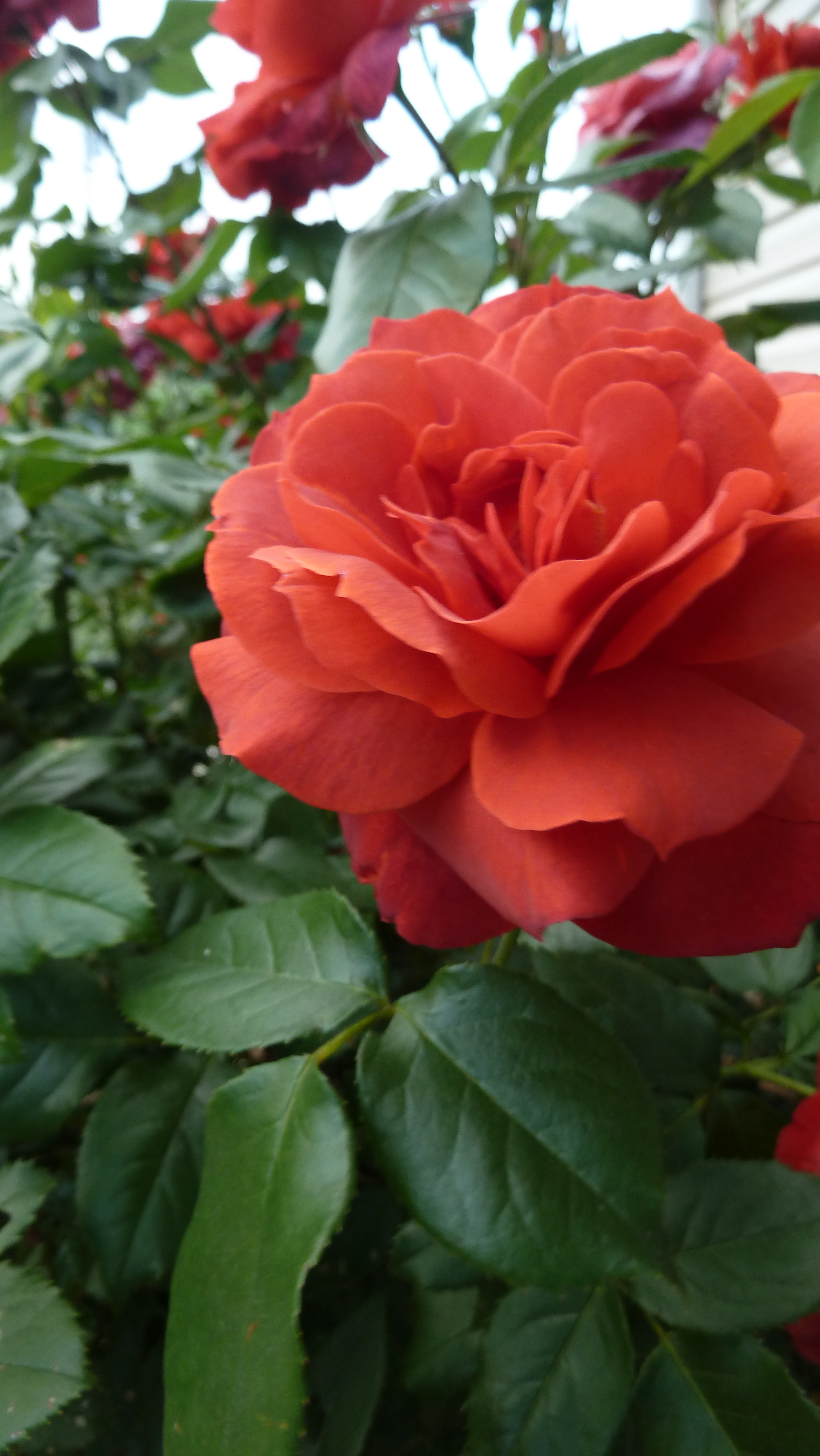 My formerly lovely knock out rose bush (modified, the blooms were always bigger than most knock out roses)
which did not survive Virginia’s harsh winter.
Doreen has also become an avid gardener—although I hate parental typecasting of one’s children and will not rule out where my other daughters go in this area, who are happily focused on raising babies right now. For instance, I did not start out loving gardening, and was mostly a “we-garden-to-eat” variety of gardener. But I confess that now that we have a garden which is very close to our back deck, on level land and where the weeds are visible from my kitchen window, I’m taking some joy and satisfaction (and a little cursing of bugs) in almost daily work and exercise in our patch which is really much too big for a pair of empty nesters.
 Doreen posing with our gigantic corn stalks (Silver Queen) a few years back,
(10 or more), in our old garden at the bottom of a big hill.
My point here is two fold: to celebrate Doreen’s interest in nature and the career path she has followed into environmental science.
 Doreen more recently in one of the fields where she studied habitat at urban/forest edges for her master’s degree in urban ecology.
It’s also a reminder not to fall into the parent trap of bragging up a child “oh this kid has always loved swimming, she is so good” when another child is going (in her head), “well Mom, I love swimming too and I’m not that bad” or whatever their interest, sport or hobby. We tend to classify and stereotype: “Timmy has always loved cooking even when he was small,” and Bobby is thinking, “I like baking too …” Or “Tiffany was always so good at math,” yada yada.
Whether it is skills, grades, looks, or mischievousness, or whatever, no one wants to be cast into a mold. Our children are great and tender gifts, as beautiful and sensitive to their environment as any flower or rose, and deserving of our best support. We want them to “grow and be strong in spirit,” like Luke says of both John the Baptist and of Jesus.
***
Did your parents typecast and stereotype? Do you do that? Or am I the only one who ever felt that way?
Do you wish there was someone you could tell: stop typecasting me!
***
*The name for my blog post today inspired by the the novel Fair and Tender Ladies by Lee Smith.
***
Somehow this all reminds me of an earlier book I wrote, Why Didn’t I Just Raise Radishes, published by Herald Press in the early ’90s, not a book on gardening but meditations on the challenges of raising children. You can still buy it used online. And no, that is not a picture of me on the cover. 🙂

For years I have made the same old cucumber salad, using the homemade all-purpose salad dressing I shared here, which I basically got from my mother.
This summer I have already picked at least seven 5-galloon buckets of cucumbers from our patch of 10 plants and the season is just getting started. I’ve given most of them away, and we eat cucumber salad almost every evening.
We had a staff potluck this week and of course I knew I would bring something cucumber-y, and then I wondered: what if I took my standard sliced cucumbers and onion, and used the tangy soy sauce-based dressing from Jessica’s Cabbage Slaw recipe, and added her toasted and slivered almonds, and then threw in sesame seeds just because it seems like something to go with soy sauce. It had to be good, didn’t it?
It was. The proof? A woman I consider a great cook asked me for the recipe. I couldn’t find similar recipes readily online–most added garlic or other herbs but I wanted to keep this pretty plain jane.
Here goes:
Tangy Cucumber Salad
5 medium to large cucumbers, peeled and sliced
1 small onion, cut in rings, pulled apart, and chopped to the size you prefer
½ cup slivered almonds, toasted in 300 degree oven for 5-7 minutes; do not over bake
Optional: Add small amount chopped green or red pepper as desired for color and crunch
Dressing
½ cup sugar
3/8 cup olive oil
¼ cup apple cider vinegar
1 Tablespoons soy sauce
1 Tablespoon sesame seeds
Slice salad ingredients into large bowl.
Mix ingredients for dressing in shaker or bowl with leak proof lid. Pour over salad right before serving and stir. (As the salad sits with dressing on, the cucumbers become limper, but still good later for leftovers.)
Serves 8-10
(And a shout out to commenter SK who clued me in that it was likely easier to just brown slivered almonds (or pecans in her case) in the oven than sauteing them in a fry pan. Thanks!)
***
What’s your favorite way to serve cucumbers (other than raw or in tossed salads) in the summer when they’re plentiful? I’d love to hear about other recipes.

Could I have survived as a hunter/gatherer? Would I have been happy, or happier?
I think we all wonder that at times. Many folks not so long ago in these parts lived naturally off the land, and I’m not talking about the 1400s. I’m talking about the early 1900s. I’m reading a second book right now about cooking in the early 1900s in Appalachia by Peggy Shifflett called Mom’s Family Pie and I’m looking forward to sharing highlights here in a few weeks when I finish the book. (Her other book on the folk traditions of Hopkins Gap, Va., I looked at here and here.)
Recently I did a little foraging of my own and was amazed how pleased I felt making a pie out of raspberries that we had not planted nor pruned nor sprayed—the old fashioned way. It was a dirt-cheap pie.
Earlier this year when walking along our fence row, I saw that scrub, briar-y canes were forming real raspberries, the purple kind.
I kept watch and sure enough, through two pickings along the fence and down by our very small woods, eating while I picked, and still ended up with 3.5 cups of berries.
I was excited. It felt like I had enough for a pie for the first time since moving here (we also have one red raspberry bush from which I could only collect small pickings at a time, which I froze or turned into jam). For me, I’m glad to be living in 2014 but enjoy using as much as possible from my own garden, fence rows, and farmers market or roadside stands.
Psalm 65, a lectionary text this week feels appropriate here, in praise to the God of the raspberries and all the summer bounty (at least around here things seem plentiful with frequent rains):
You care for the land and water it;
you enrich it abundantly.
The streams of God are filled with water
to provide the people with grain,
for so you have ordained it.
You drench its furrows and level its ridges;
you soften it with showers and bless its crops.
You crown the year with your bounty,
and your carts overflow with abundance.
The grasslands of the wilderness overflow;
the hills are clothed with gladness.
The meadows are covered with flocks
and the valleys are mantled with grain;
they shout for joy and sing. (Psalm 65: 9-13, NIV, Bible Gateway)***
For this pie, I found and adapted a simple recipe off of the PBS website. While this is too late for some readers, many live where raspberries and other wild fruits are just ripening.
Raspberry Pie
Make (or buy) your standard pie dough recipe for a 2 crust pie. My standard pie dough recipe is first.
Pie dough: (two crusts)
2 cups flour
1 teaspoon salt
2/3 cups lard, or add 2 Tablespoons to quantity if using Crisco or generic brand
¼ cup water
Mix salt with flour. Cut in shortening. Add water. Mix by hand until dough clings together. Form two balls.
Pie Filling:
4 cups fresh raspberries
Juice of 1/2 lemon
1/3 cup cornstarch
1 cup sugar
1 teaspoon vanilla
Directions
For the filling, mix together raspberries, lemon juice, cornstarch, sugar and vanilla in bowl. Let sit while you roll out the pie dough. Or, if you use purchased crusts, let the above mixture sit for about 10 minutes.
Preheat oven to 400 degrees.
Take ½ of the pie dough, reserving other half for lattice top. Roll out first ball of dough til thin and place bottom crust in pie pan. Place raspberry filling in pie but don’t overfill. You may not use all of the filling.
To make lattice top:
Take the rest of the dough and roll out thin. Cut long one-inch wide strips of dough and weave onto the pie, beginning with center strips and laying each piece loosely because you will lift each piece back up many times to create the up and down weave. Alternate with horizontal and vertical strips.
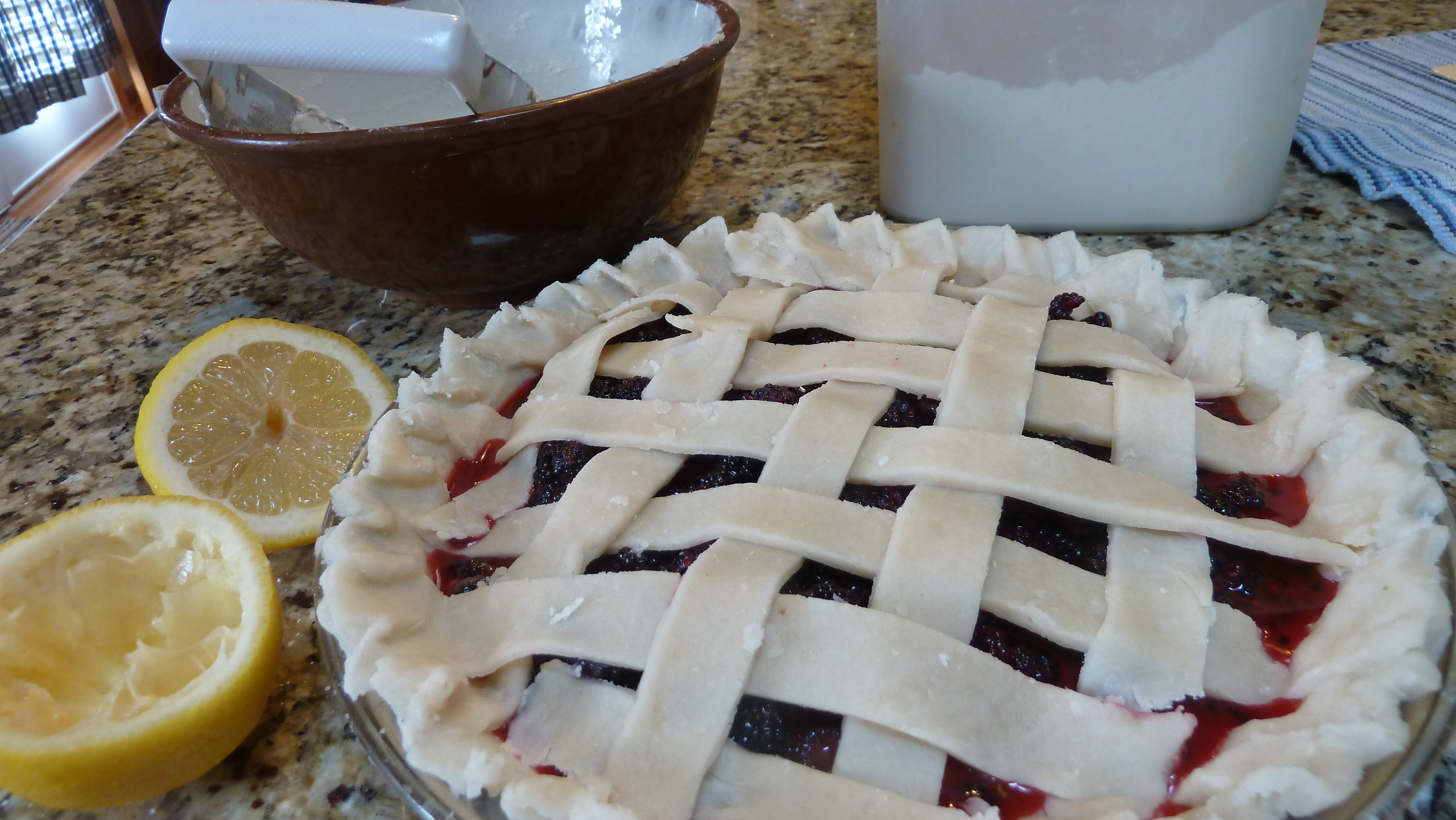
Seal edges of pie with your usual method, either pressing with a fork or twisting with your fingers (an art in itself: I can finally come close to my mother’s slick twisting, which used to amaze me as a child). Bake for 40 minutes or until golden brown. Let cool for 30 minutes before slicing. We enjoyed this pie for four meals.


***
For a video demonstrating how to do lattice, check here:
***
Do you enjoy going wild raspberry or blackberry picking? Or do you dislike foraging with the thought of snakes in your mind? How do you think you would have done as a cook in 1914 instead of 2014? What stories from your mother or grandmother or older have you heard about foraging or cooking in the “old days”?
***
You can sign up for a free e-mail subscription to my Another Way newspaper column at www.thirdway.com/aw

I love my flower garden. Somehow in the almost eight years we have lived here, it has slowly evolved. Like one daughter said recently, “It may look a little messy but I like it.”
I like it personally because almost every perennial in it was given to me by someone I know and therefore represents a relationship—mostly close friends and relatives—and memories. Not to mention, flowers from friends create a low cost garden. Mostly free, a few purchased, with a story attached.
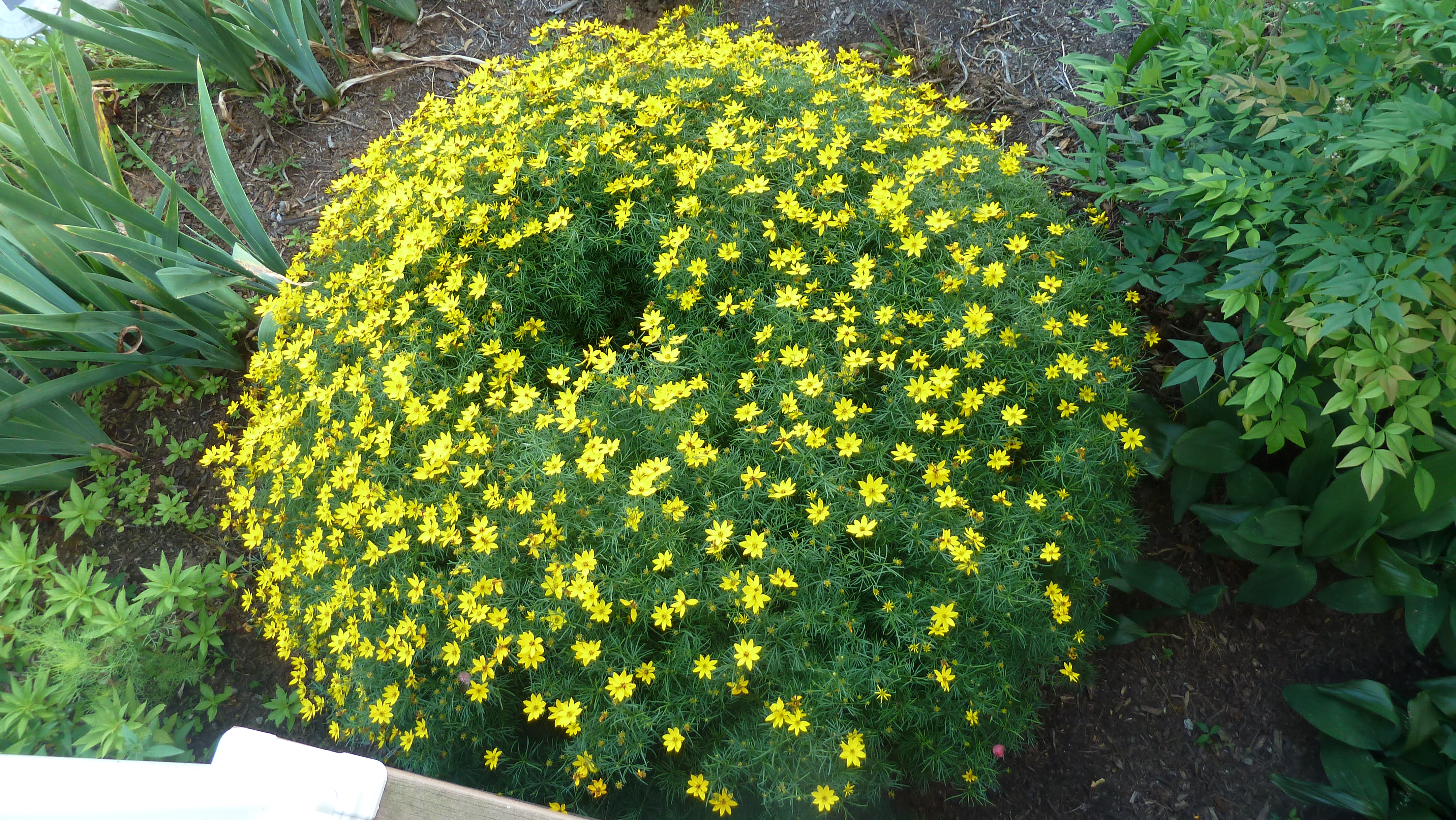
Barbara’s Coreopsis. First I’ll show you the coreopsis that has just grown huge this year. It even seeded a baby, growing nearby.

This is how my coreopsis started out, a transplant from my beloved sister-in-law, Barbara. Sometime I’ll take you on a walk through her flower garden. Now there is a real green thumb, and she knows so much about flowers I try to learn from her all I can. (I do have the name right, don’t I? Let me know if it’s wrong!)

Willie’s Flowers. My neighbor Willie gave me these and I can never remember their names but once started, they come so prolifically I have to weed out and throw away many many plants each year. Anybody want some starts? Anyone know the name?
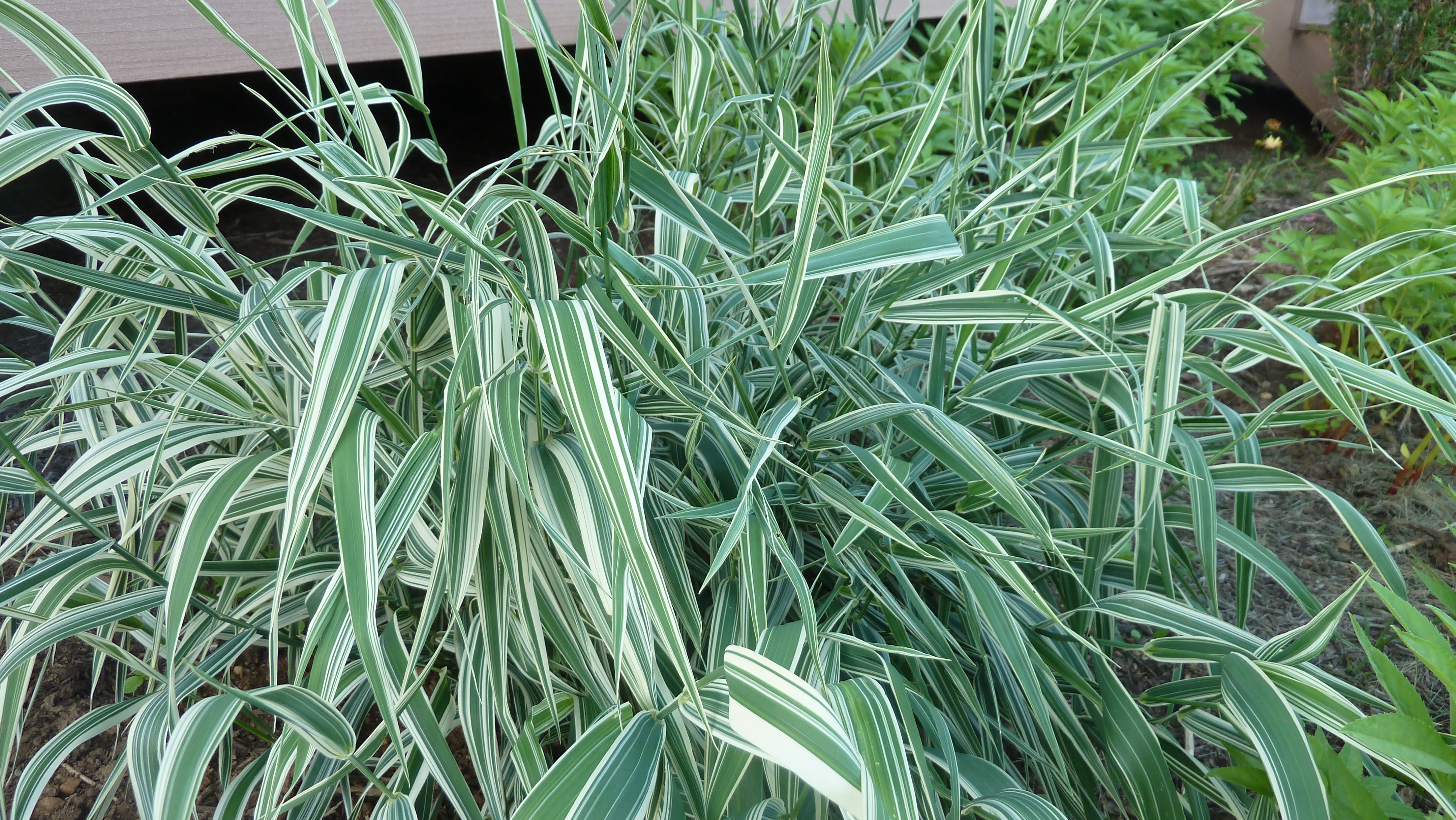
Kimberly’s Ribbon Grass. This is one of my newest additions. The closest I can come to identifying it is that it must be: Feesey’s ribbon grass (Phalaris arundinaecea). Can anyone verify? It has astounded me how quickly it has taken off. Please don’t tell me it’s invasive. Last year we had a retirement party for a staff member and several of us brought flowers and made up bouquets, and Kimberly brought a bunch of these. I liked them so much for fill in for flower arrangements that when Kimberly thinned her garden last fall, she put a start of these in my car. I left them go several days til I got around to planting them and still: this!

Cosmos. The cosmos shown here I started in my vegetable garden from a little pack of seeds, so technically I bought them for likely less than $2, but they are such good self seeders (or birds dropped them?) that I now have them throughout the front flower bed.
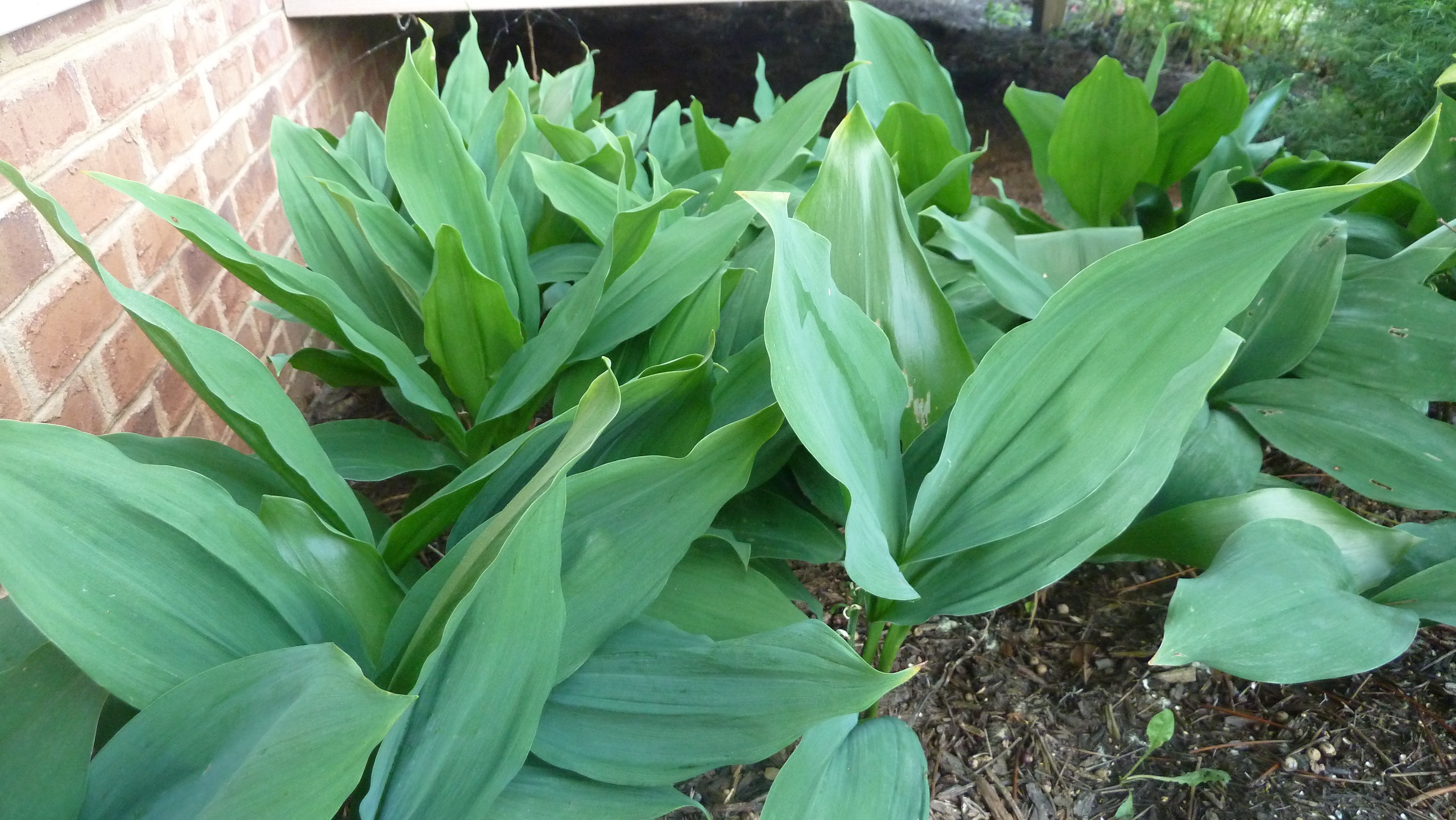
Janet’s Lily of the Valley. I love my bed of Lillies of the Valley, which was my very favorite flower growing up, which grew in a shaded bed next to our front porch at this house. When my dear church friend Janet offered me a few starts, I was eager to plant them in this shaded spot next to the front porch of my house. I think I’ve had this bed no more than 3 years: my how they’ve spread.

Black Eyed Susan. I used to stop and pick Black Eyed Susans from beside the road but I don’t have to anymore. Janet took me once to a small event that is a flower lover’s delight—some friends of hers who annually get rid of “extras” from their garden by inviting folks to a morning tea and brunch in their flower garden (a mother and daughter) and offering starts for sale (at low cost). These have also self sowed—aggressively. I now pull them out to make space around other flowers.

Nolan’s Ground Cover. This is another nameless ground cover plants received from my brother-in-law, Nolan. He warned me it grows nonstop. I left it sit in a bag of dirt in the garage for a week or more, but it took off anyway, and I have to keep it trimmed back several times a summer. But it makes great greenery for cut flowers.
There are some other special plants in my flower garden that are not in bloom now:
Rhododendron for Dad – This has never done well, due to this west facing bed, and a lack of soil acidity. But you can’t blame a woman for trying to raise one of her favorite ornamental bushes. I purchased this with money given to me in memory of my father after he died in 2006, who filled his grounds with so many flowers that he ran out of flower beds. I suspect that there might be enough flower beds in heaven for him.
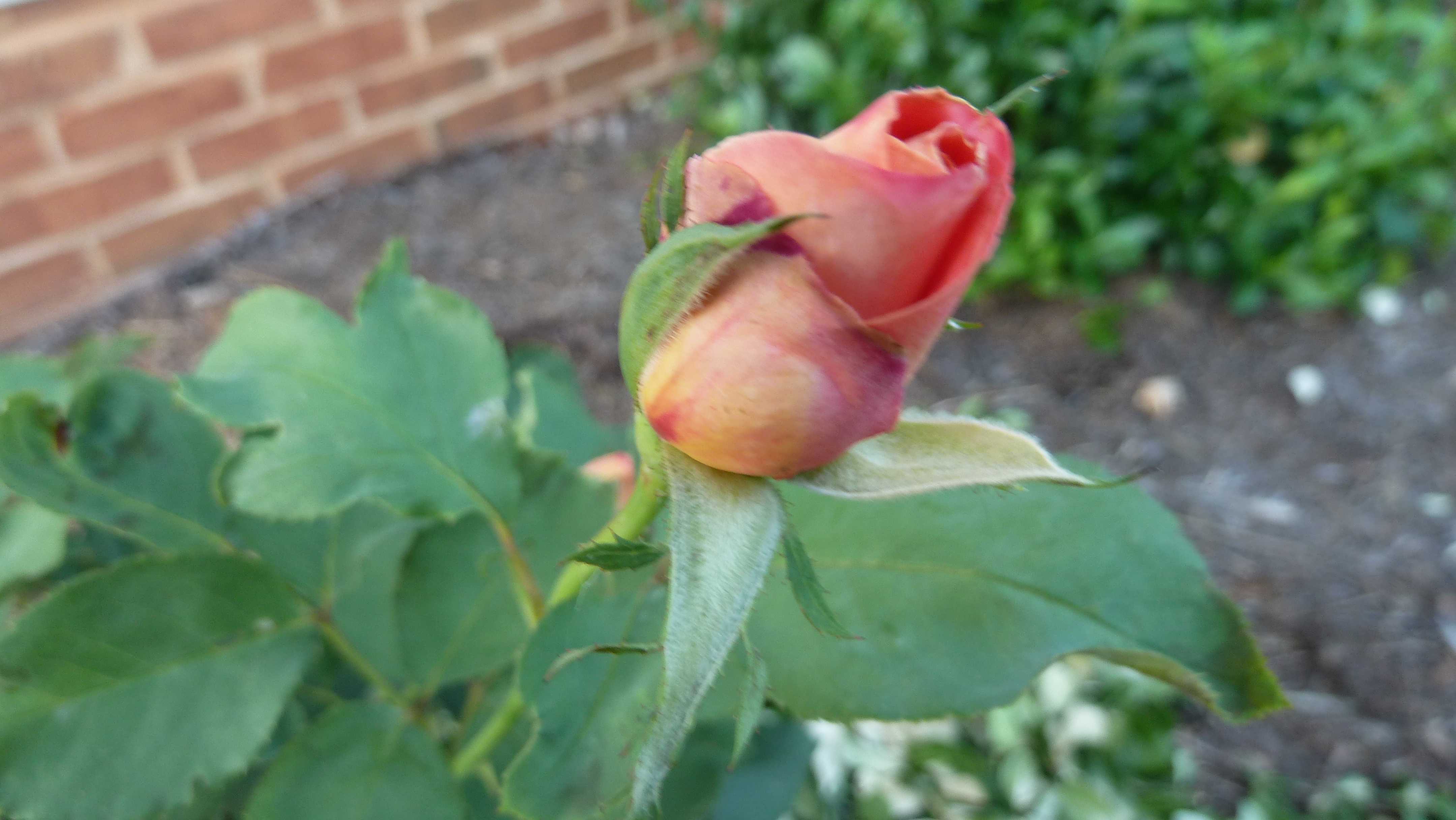
Rose. One of my rose bushes died over this harsh winter, so I replaced it with a purchased rose bush from Home Depot. When I planted it, there were two separate rose bushes in the pot. Should I separate them or plant together? I thought it was great to get two for one price, so I separated them, and they are now getting ready to bloom on their own. Happiness!
Charles’ Iris. Our dear friend and former neighbor, Charles, gave me a start of his Irises when we moved to this house. Sorry I can’t find photos right now!

Don and Betty Tulips. Most of our tulips were a housewarming gift from the pastor who married us Don and his flower loving wife, Betty. I enjoy the tulips so much.

Weeds. Occasionally there are flowers that crop up which are nothing but weeds, but I let them grow awhile anyway.
My flower garden reminds me of the poem, “I am growing a glorious garden,” once lovingly transcribed by my middle daughter, Tanya, which I found likely in the bottom of a book bag or notebook at the end of the year.

It begins:
“I am growing a glorious garden
Resplendent with trumpets and flutes …”
I had never read this beautiful poem by Jack Prelutsky, but I instantly fell in love. Neither she nor I remember when she wrote it down for herself, but I treasure how it combines our love of flowers with her special love for an instrument garden—a garden she tends professionally as the artistic manager of her city’s symphony. Online I found a child performing this poem at a school assembly, likely about the same age as Tanya when she transcribed the poem, and this girl’s delight and recitation is just perfect for the poem. Enjoy!
Thanks for taking a walk through my garden with me today, and you didn’t even have to stop and pull any weeds, like I always have to.
***
Be a dear and leave a note or comment, especially if you can help identify Nolan’s Ground Cover or Willie’s Flowers.
***
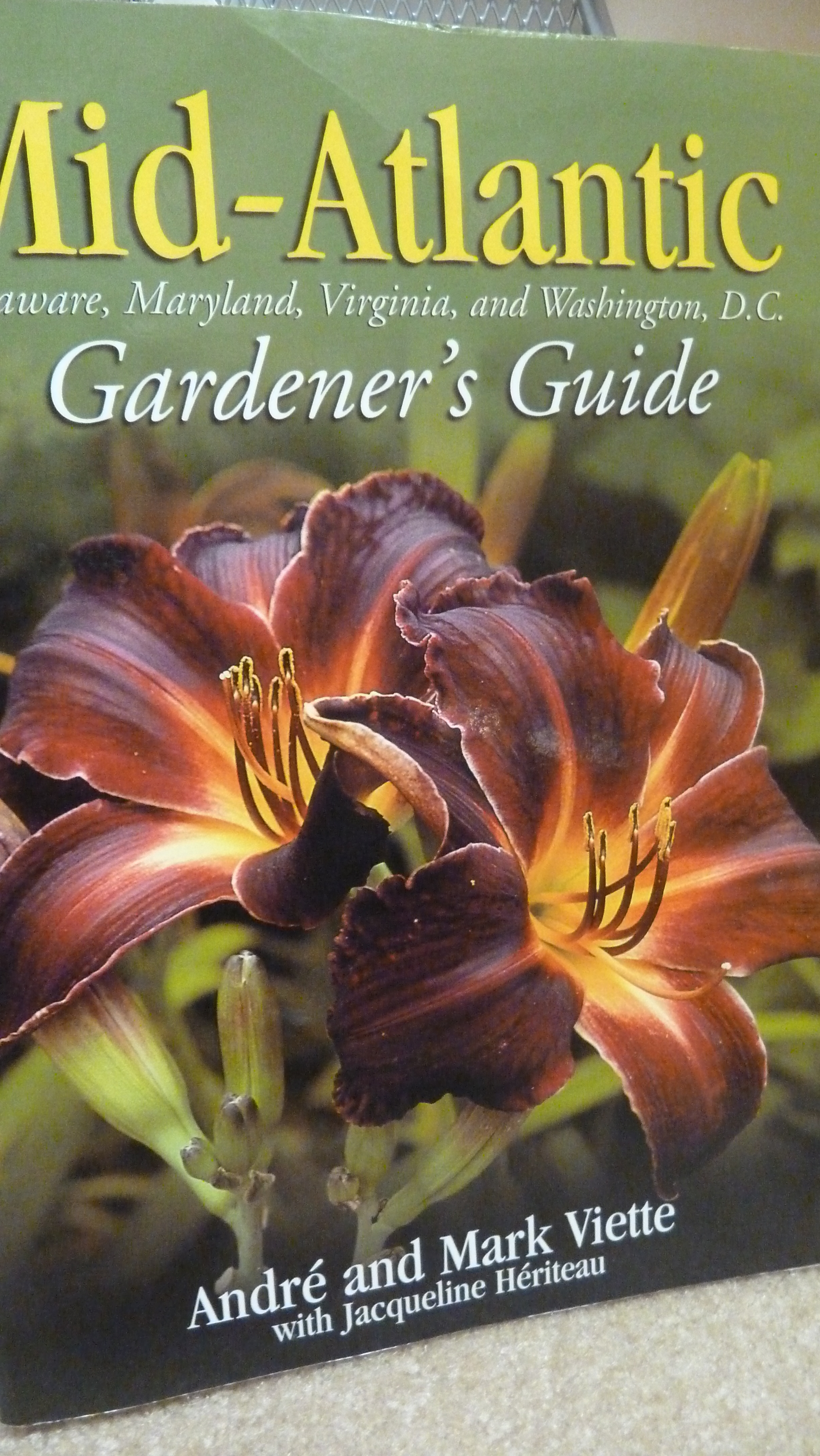
Andre and Mark Viette, horticulturists and growers of vast daylilies in the Shenandoah Valley near us, are my go to source for gardening advice, either on radio (show named “In the Garden”), or the book, Mid-Atlantic Gardener’s Guide (covering Delaware, Maryland, Virginia, and Washington, D.C. One of these days I must go visit their farm and gardens in Fishersville.
Mother and many mid-century cooks at the time knew and served only their homemade dressings with any lettuce or salad of greens. Mom’s was a simple salad-dressing based (always Miracle Whip for us, she liked her brand names and while she watched her pennies, didn’t blink at the extra cost) concoction that added milk (or cream), vinegar, sugar, a dash of salt, pepper and occasional celery seed. Very simple but it was the way we ate our salad greens from the garden in the spring and summer. In the fall and winter, our salad was made using only iceberg lettuce. How boring! Not really nutritious, nothing but crunch and some tangy sweetness. In the summer we would add tomatoes from the garden.
People still seem to enjoy this salad dressing (and ask how I make it) whenever I serve it with a salad of ample greens, tomatoes, cucumbers, carrots, celery, sometimes onion, or whatever combo you come up with.
I use it not only for tossed salad, but spinach, Cole slaw, and cucumber/onion salads as well. I usually make it fresh for each use but in the summer I might make a small batch to keep in the fridge because we use it so often.
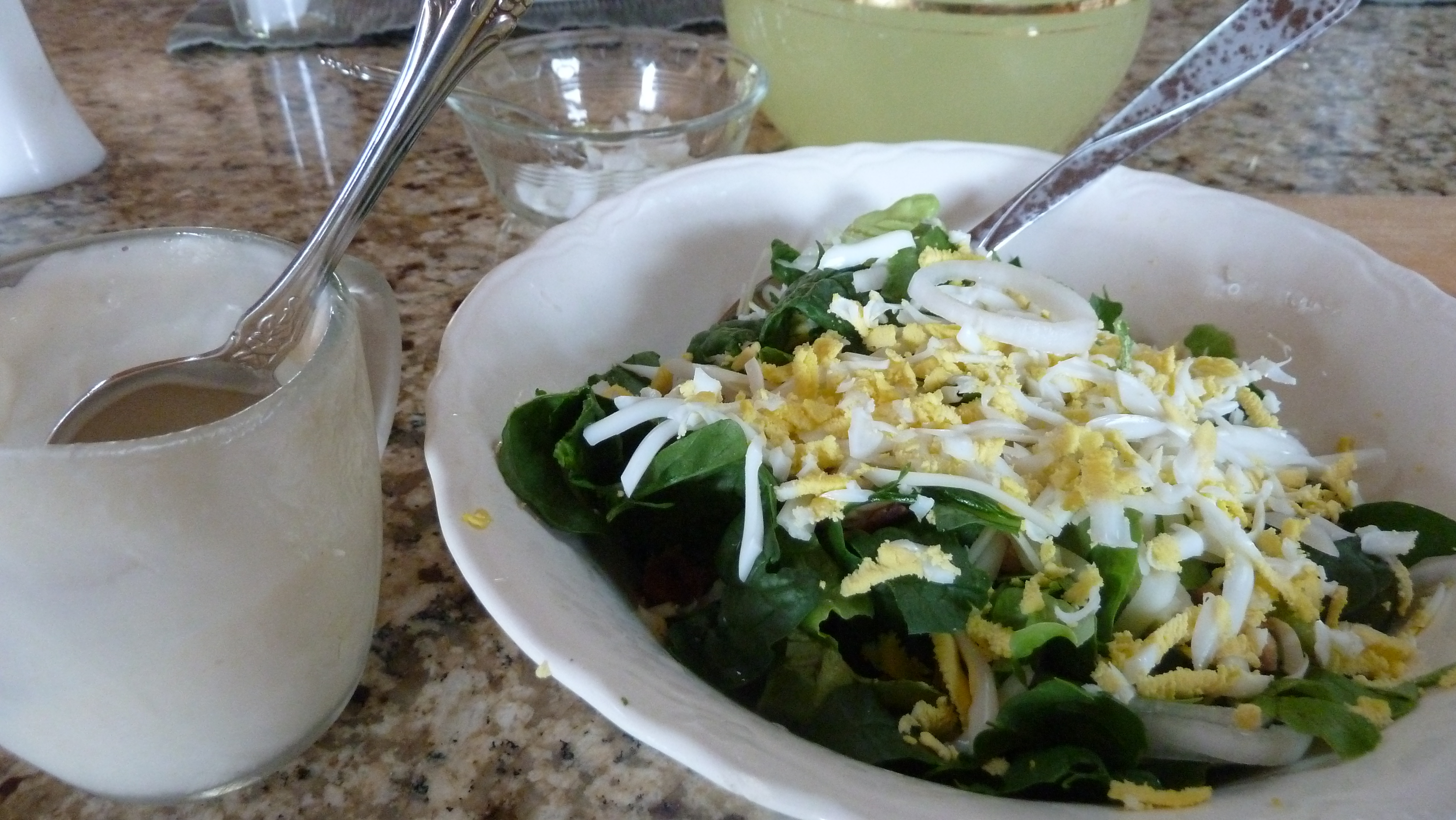
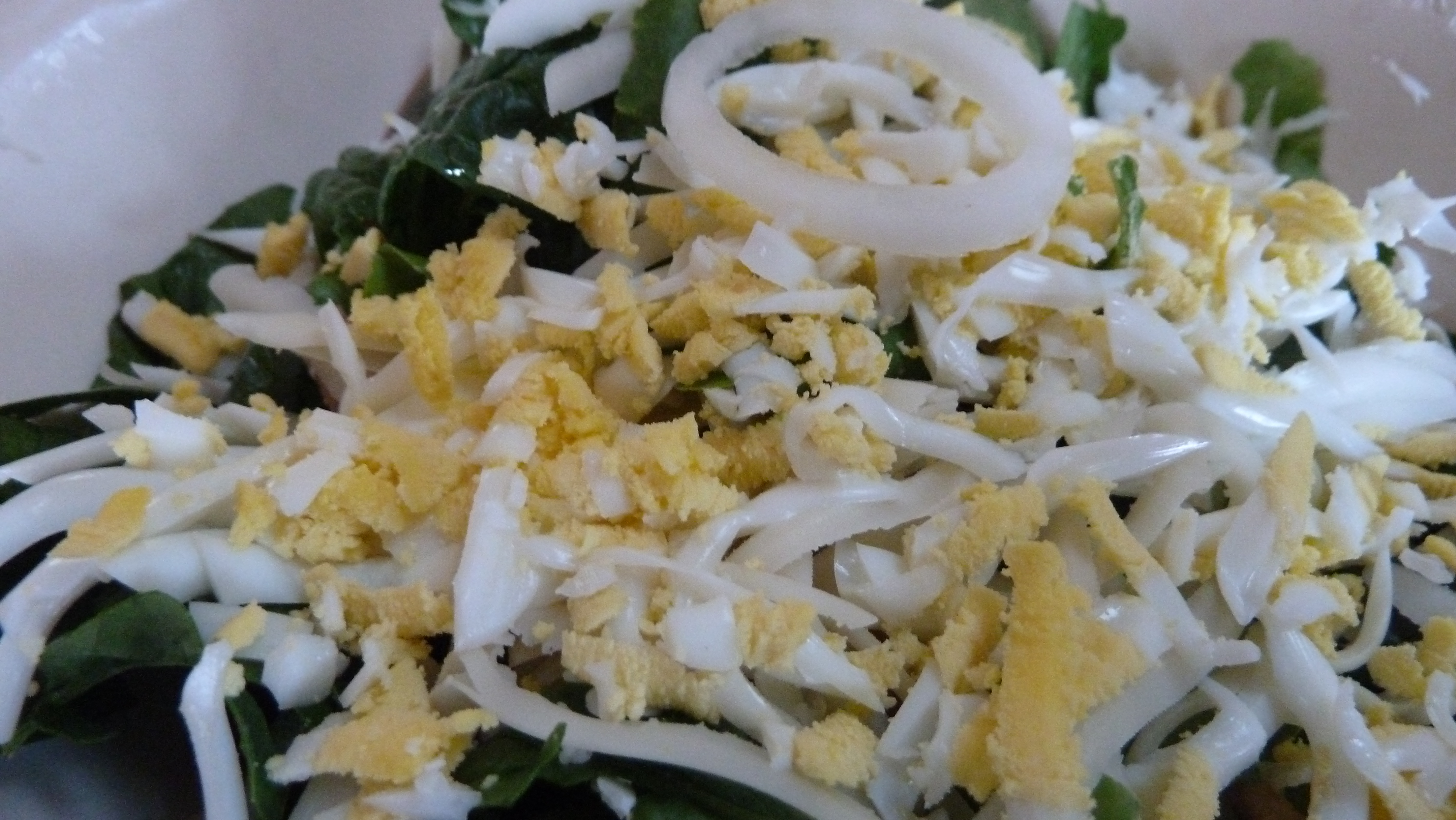
So here is an all purpose salad dressing, simple to make, and as used in this photo, with a mix of spinach, sweet white onion, and shredded boiled egg.
Mother’s Salad Dressing
½ cup Miracle Whip Salad Dressing
¼ cup milk or cream
1 teaspoon apple cider vinegar
2 Tablespoons sugar
Dash salt, pepper, celery seed
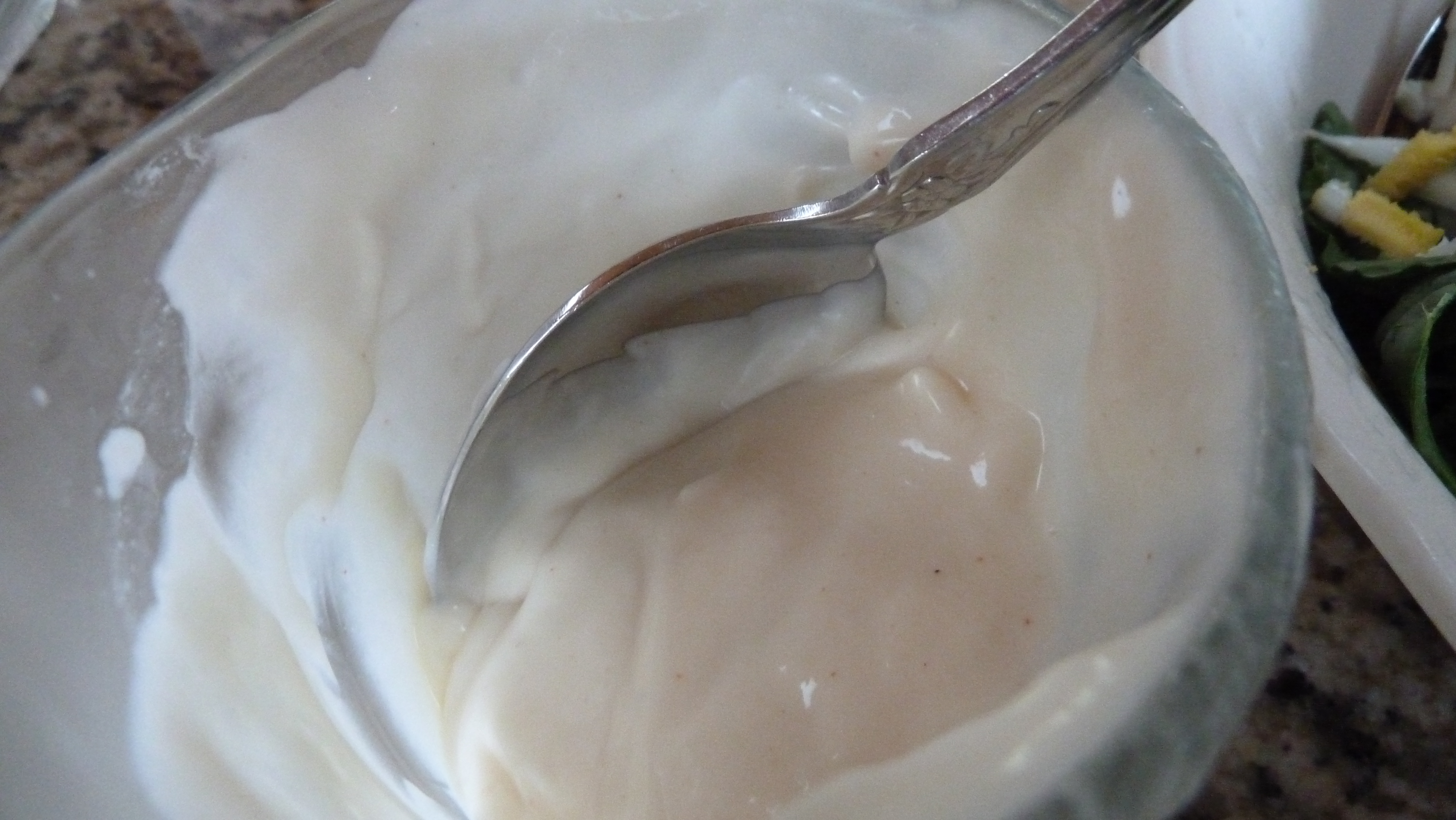
Put all ingredients in small bowl and stir with spoon until well mixed. It should be creamy like the consistency of most salad dressings out of a bottle. Add more milk if thinner consistency is desired. Taste. If it is tangy sweet to your liking, go with it. If not, play with the vinegar and sugar until you like it.
***
What do you recall from your mother or grandmother in terms of salads and salad dressing? Plain & simple or a dish with a variety of fruits and veggies?
***
There’s another recipe for Raspberry Poppy Seed dressing in my book, Whatever Happened to Dinner? Check it out or purchase here.
When the day of Pentecost had come, they were all together in one place. And suddenly a sound came from heaven like the rush of a mighty wind, and it filled all the house where they were sitting. And there appeared to them tongues as of fire, distributed and resting on each one of them. 4 And they were all filled with the Holy Spirit. Acts 2: 1-3
June took me on an interesting unplanned journey beginning with Pentecost Sunday, a time lapse of my faith journey over the last 40 years and my family’s three faith traditions: Mennonite, Presbyterian, Lutheran. On Pentecost Sunday Christians celebrate the coming of the Holy Spirit to all the church after Jesus ascended into heaven. It is often known as the “birthday of the church.” Indeed, the first Pentecost Sunday I remember while attending Trinity Presbyterian featured red helium balloons strategically placed around the entrance way and sanctuary, and a huge birthday cake afterwards.
 The Paul Klemt family greet Mark Fachnitz at Trinity a few years ago.
Gradually over the years, Trinity folks were encouraged to wear a celebratory red on Pentecost, just for the beauty and whimsy of it. That never happened in my Mennonite upbringing back in the day.
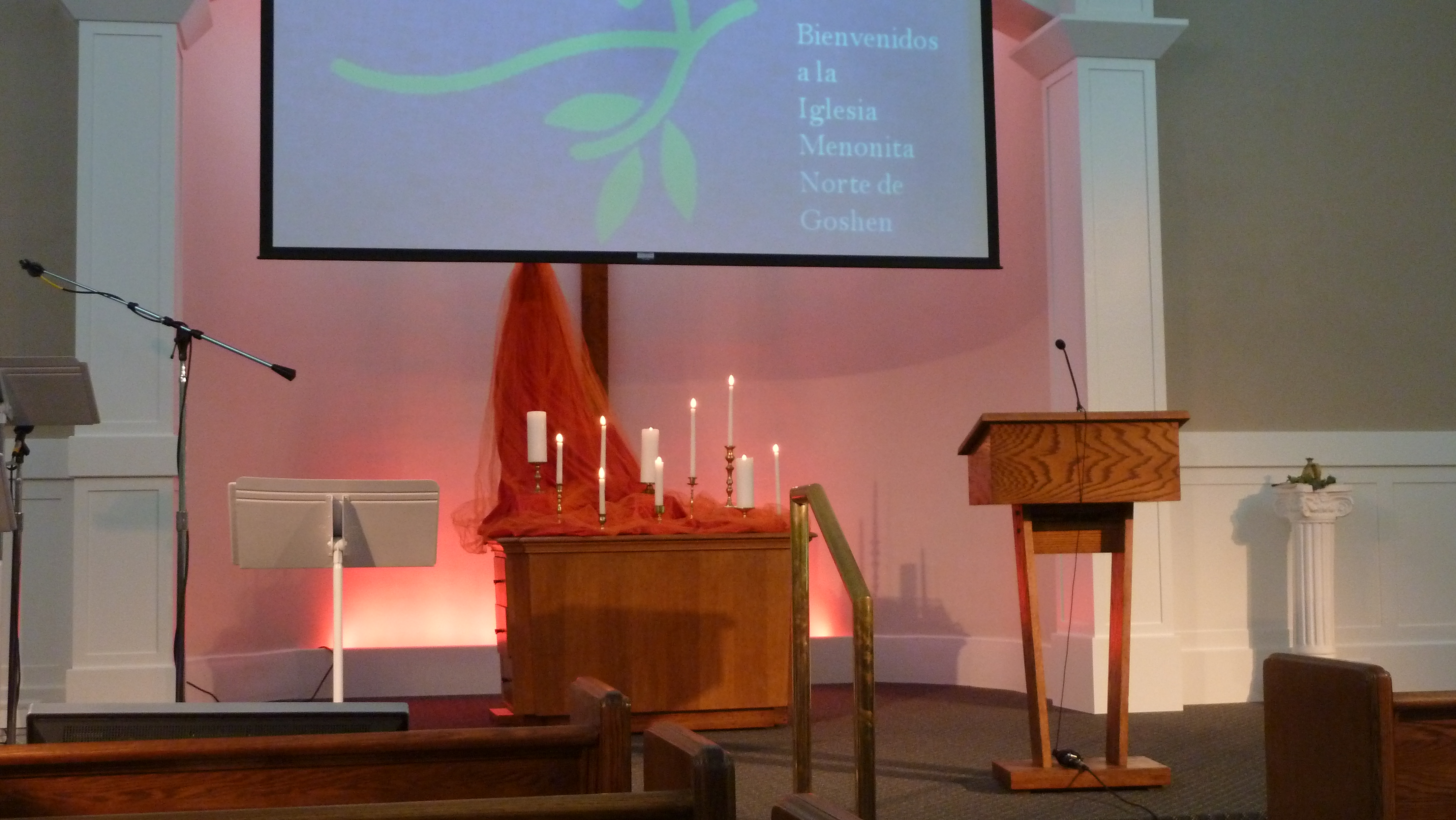 North Goshen Mennonite podium on June 8, 2014.
June 8. So this year on Pentecost, June 8, I found myself meditating on the artful and surprising display of red in the church where I spent the first, most formative 17 years of my faith journey, North Goshen Mennonite, Indiana. I was visiting my mother as a follow up to surgery in early May, which I touched on here
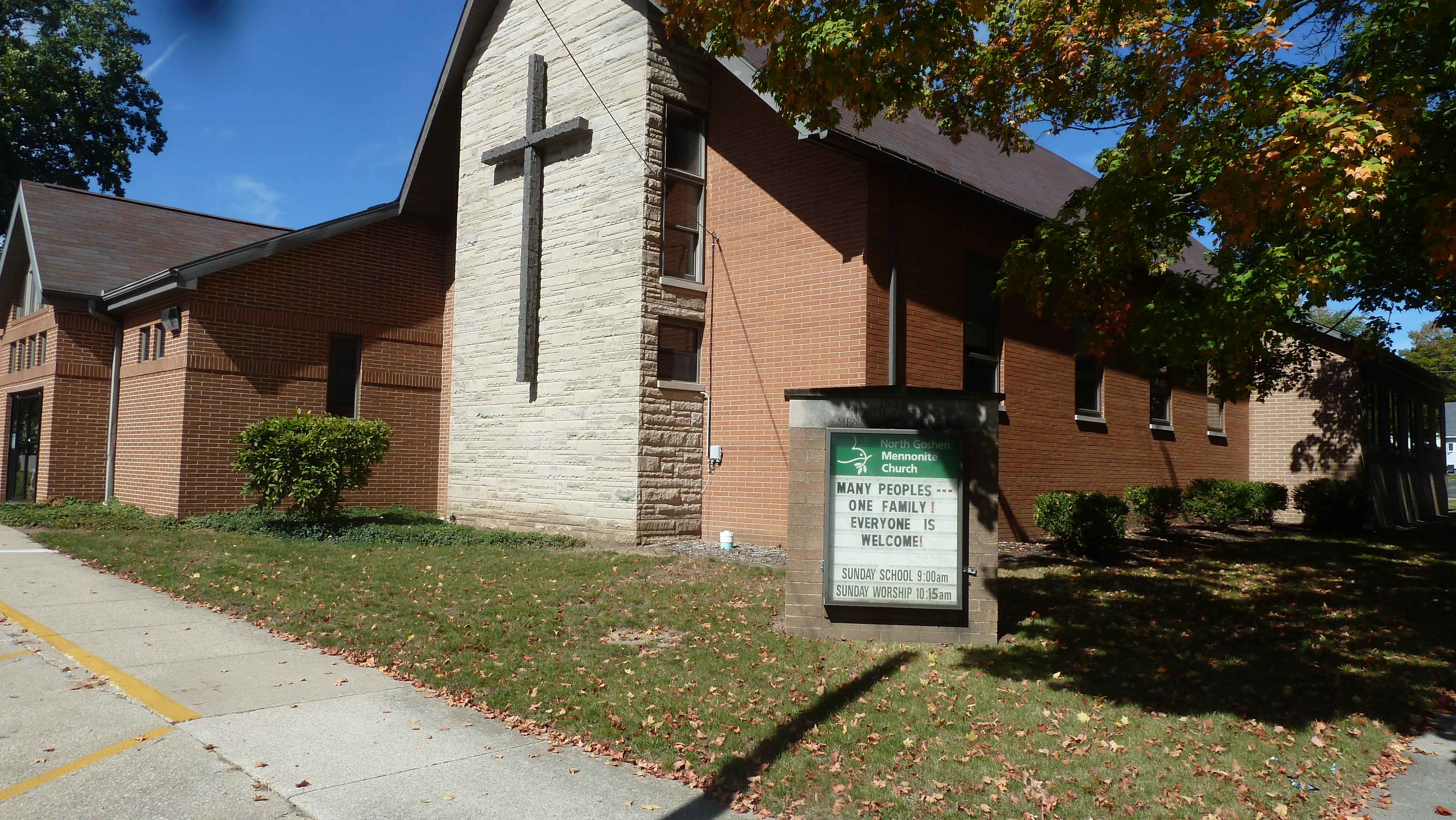 North Goshen Mennonite Church, Ind.
I was pleasantly surprised when I stepped into North Goshen and noticed 90 percent of the people were wearing red. The newish pastor there Mark Schloneger, a former attorney who most recently was pastor at Springdale Mennonite the Shenandoah Valley where I live, had stirred up an interesting experiment for this congregation. As I mentioned, it was not their tradition to wear red so like a whisper that became a roaring wind, at 2 p.m. on the Friday before Pentecost, he told one woman to begin a phone chain by calling 5 other members from North Goshen. She was to tell them to wear red for Pentecost, and to call 5 other people. There was no list, no one knew who would be calling who, but gradually by 9 a.m. Sunday morning, the word got around (and as Pastor Mark shared, yes, some got left out and some got repeated calls, but that was ok) Schloneger is not averse to making waves for important causes—as one of the key instigators behind another ecumenical wind of the spirit calling churches to Election Day Communion which has begun forming around each national U.S. election day (Presidential) to reunite as Christians on many sides of political and other issues by calling for a joint community communion service. The North Goshen congregation is a mix of traditional white mostly ethnic Mennonites and brown ethnic Hispanics delightfully (but not without controversy) following Christ’s call to be the church in that mixed neighborhood.
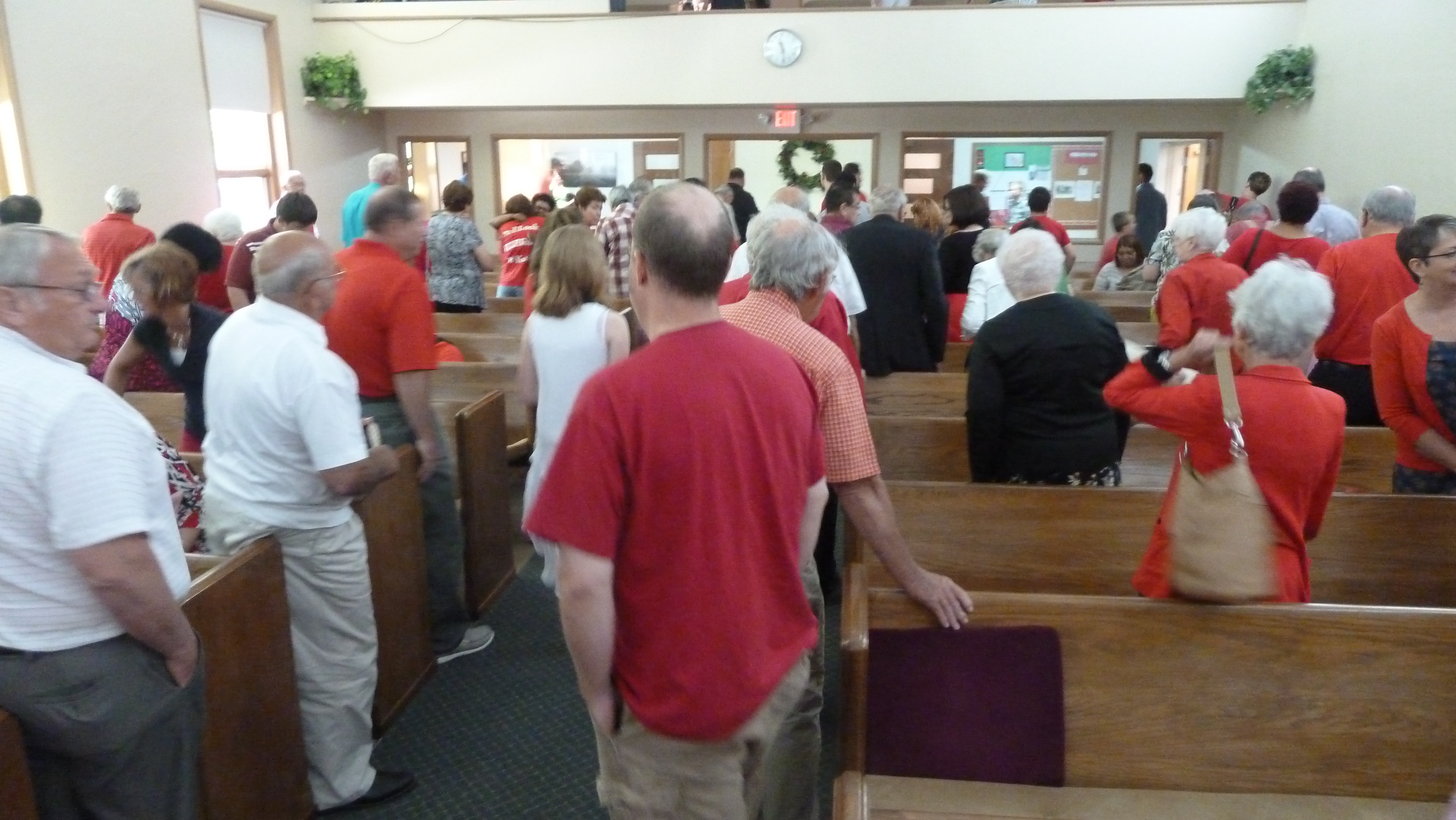 North Goshen congregation facing rear of the church at time of dismissal.
I loved the red, loved the sermon focusing on Pentecost, the singing (some led by a praise band, some traditional 4- part a cappella) and especially liked Pastor Mark’s additional new custom of turning around to face the exit as the charge and benediction are given, symbolic of the call to carry faith with us into the world.
June 15. On Father’s Day we joined my daughter at her church, Northern Virginia Mennonite in Fairfax, Va., with another daughter currently living in that area and 6 ½ month old grandson James, who gripped that hymnal like he could sing too. (Last fall the congregation hosted a baby shower for James which I covered here.)
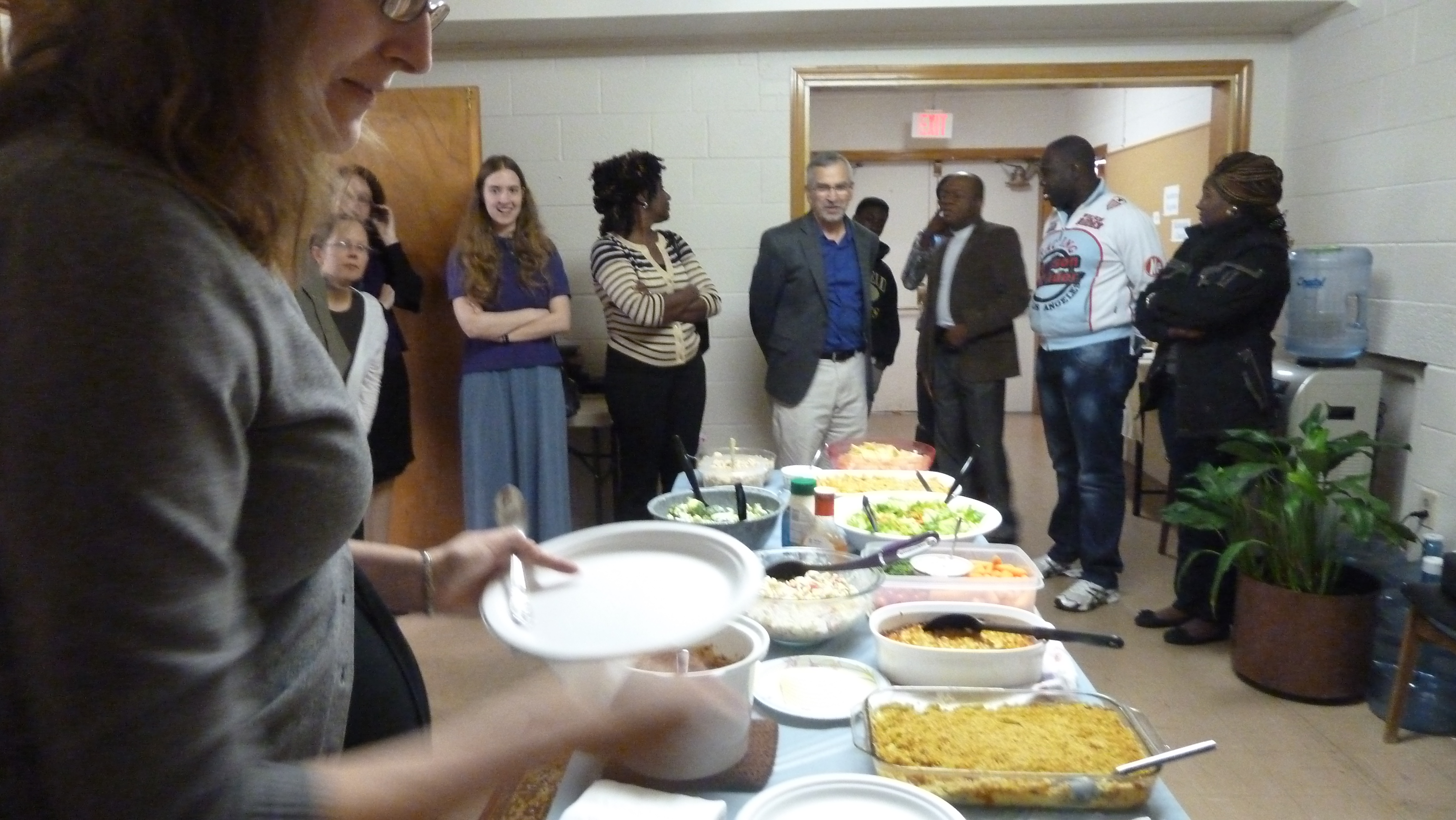 Northern Virginia Mennonite hosts almost weekly potlucks, this time for our daughter and son-in-law’s baby shower.
We and several members of the congregation had helped my daughter’s family move to a newly purchased home that weekend. This is a small congregation, somewhere between 30-40 on a Sunday morning that meets on the third floor a converted office building. Because of that smallness, they frequently singing several of their morning hymns physically gathered around the piano because it helps them sound better. It is therefore participatory, you feel like you are in a choir, and my heart was so touched to hold my grandson as he grabbed and held on to that Mennonite hymnal—just because he loves to be doing what everyone else is doing.

The pastor Earl Zimmerman spoke on enjoying God in nature and looking at the world around them—even in that very urban/suburban setting, where some homeless persons have been known to “camp” in the tree-lined area at the edge of their property.
June 22. I was back at my congregation of some 39 years, Trinity Presbyterian in Harrisonburg, Va., a house-church based PCUSA congregation where I’ve written about here and here (and more).
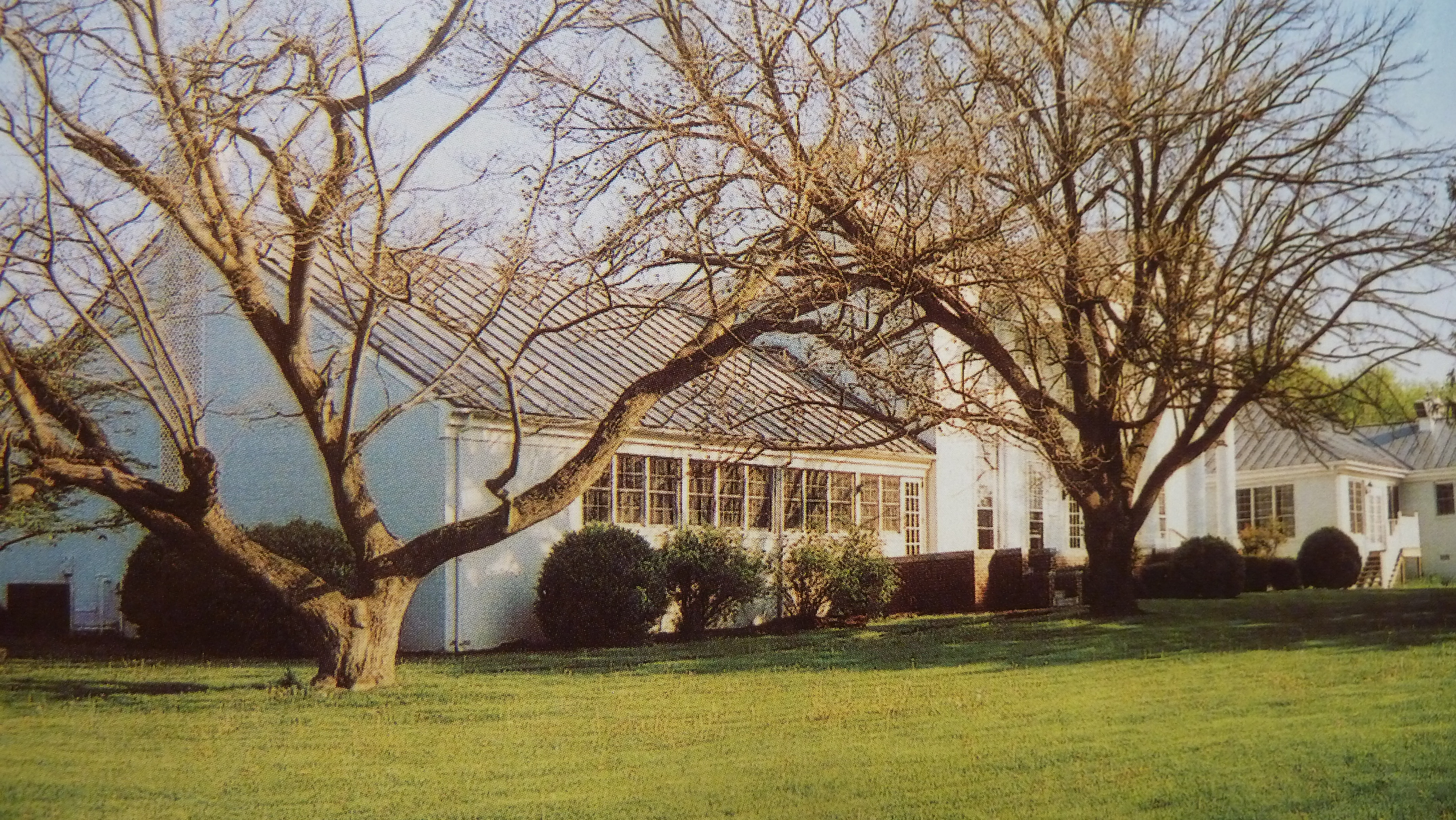 Trinity Presbyterian, before several grand old trees had to be cut down.
Since 1990, we were privileged to have been pastored by ONE pastor, Ann Held, who retired at the end of May. Having been gone so much, it was also my first time to hear a sermon by our interim minister, Sally Robinson, a professional interim in our Presbytery serving around 12 congregations in the past 15 years or so. It was a little like trying to go back to “normal” after a death in the family, where everything has changed yet you want to move forward to a new normal. We had chosen Trinity while we were dating, a lifetime ago, because it was “neutral” turf for this born Mennonite and born Lutheran, and we both knew people who went there. So any of you who have gone through the transition from a very long term pastor (24 years) to starting over, you know the wilderness that can feel like. Sally wisely chose the theme of “Family of God.”
June 29. I joined four members of my house church visiting Muhlenburg Lutheran Church which is where my husband spent the first 19 years of his faith journey, a born and baptized Lutheran. Haven’t written about that so much, but my first experience in this grand old Harrisonburg landmark was when my eventual dear sister-in-law and brother-in-law got married, pictured here.
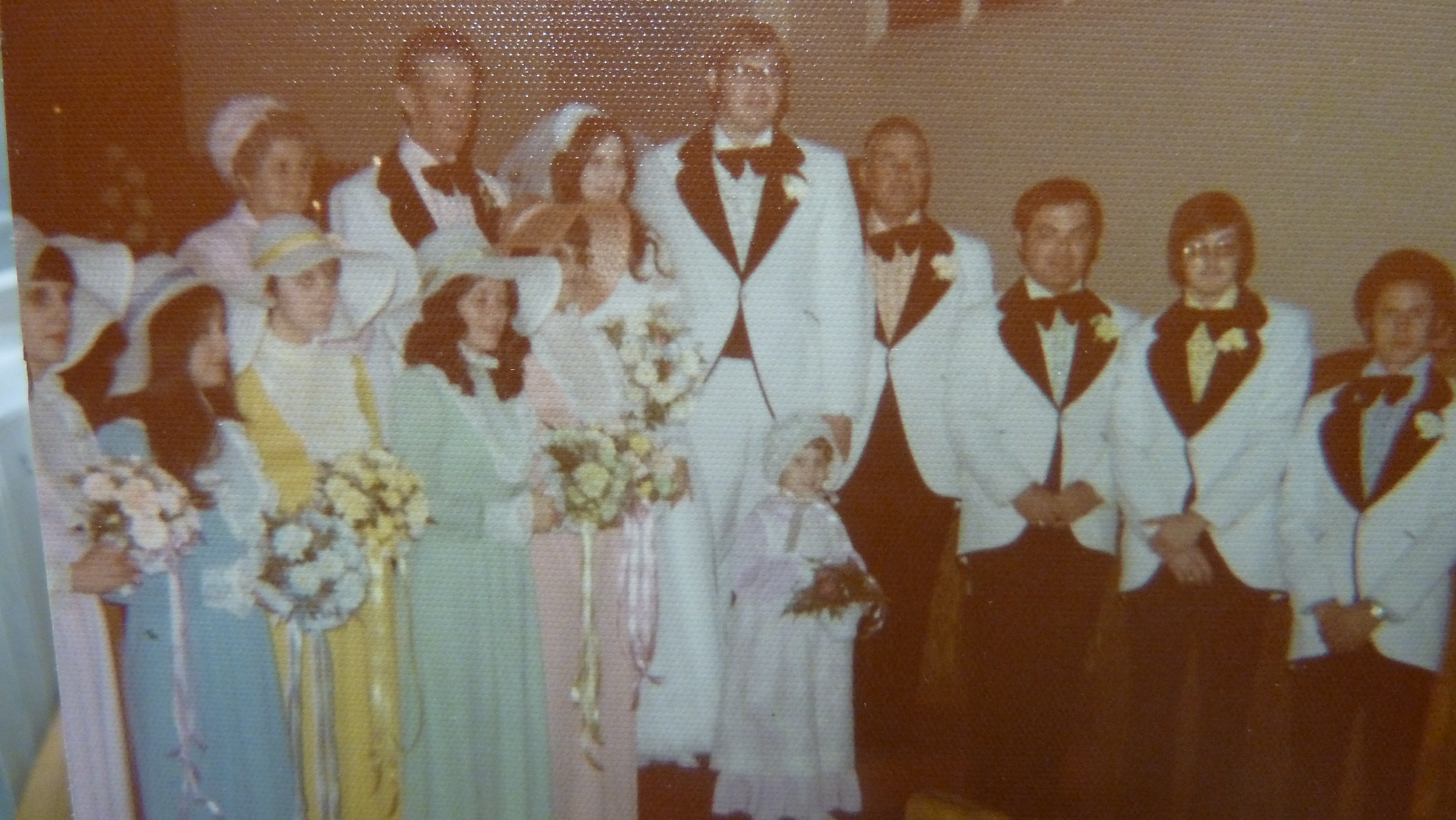 Richard and Barbara Davis wedding party, Oct. 1975.
Not only has Muhlenburg seen a sea change of people in 40 years, but architectural and liturgical changes of course. We go back frequently for weddings, baptisms, confirmations, funerals and Christmas Eve services (among the most impressive of the Protestant churches here).
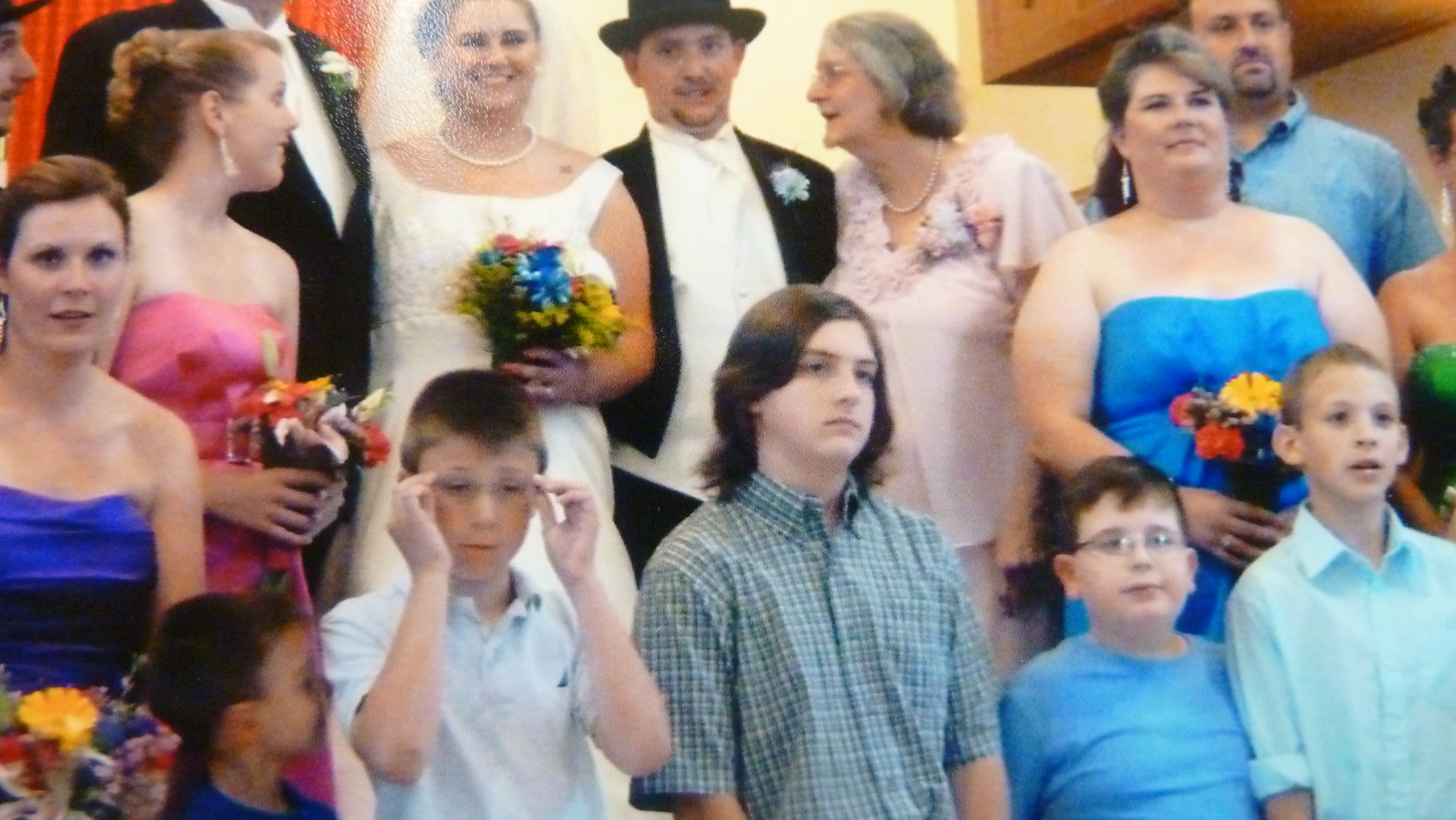
 Posing and waiting for pictures at another family wedding at Muhlenberg June 2012.
I went on June 29 because my house church at Trinity has a mission of hosting a community (free) clothes closet, and two other churches, Muhlenberg and Harrisonburg Baptist, help us out by staffing it two Wednesdays out of the month. Our house churches normally meet in homes at least once or several times a month through the week, and four times a year we meet in homes for our Sunday morning worship time, (see more about that here). June 29 was one of those Sundays so instead of planning and holding our own worship service, we opted to visit Muhlenberg. The Lutheran liturgy–in words said for communion, before and after reading scripture, confession of sins, passing of peace and so on are very much like we practice at Trinity, even though there is a whole lot more standing up and sitting down going on. J Here Pastor Bob Humphrey had an excellent sermon on things that hold us in bondage, including time for conversation with the people sitting next to us—something I had never experienced in that used-to-be very formal service. Kudos to Pastor Bob. A far cry from the days when my sister-in-law and brother-in-law very much wanted to write their own wedding vows but were not allowed to just because it wasn’t done. End of discussion.
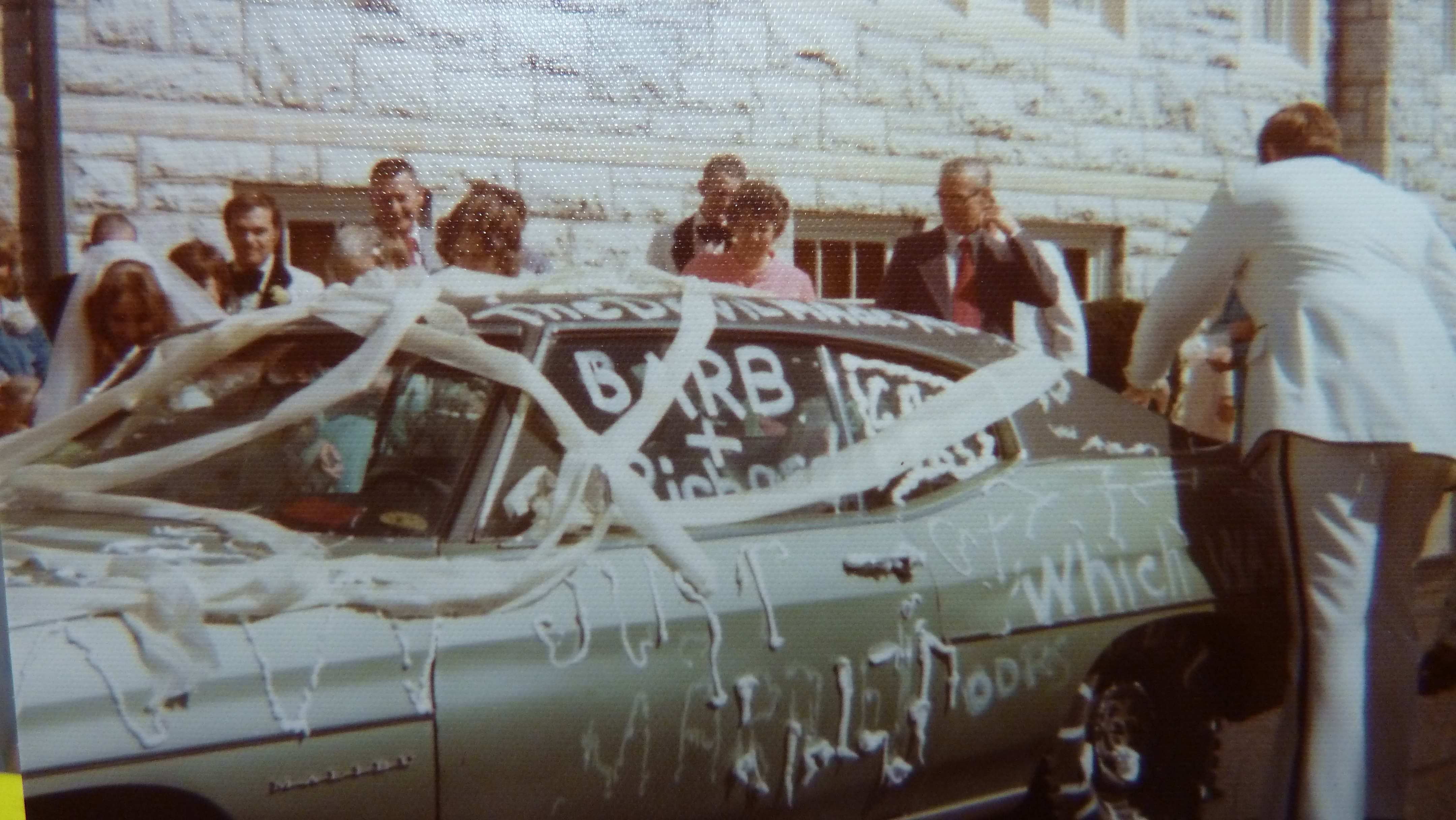
Four Sundays reminding me of my ecumenical faith journey—not church hopping, but broadening my understandings of how as Christians we belong to local churches, filled, we hope, with God’s presence and Holy Spirit sent at the time of Pentecost. The church is a human institution and the danger, always, is that our humanness out-shadows the Spirit of the Living God as we struggle through policies, beliefs, human interactions, faith, love, disagreement. My personal belief has long been that the varieties of faith expressions and beliefs held dear by the various denominations—whether an emphasis on grace, peace, good deeds—can all help to balance each other out and keep God’s spirit and truth functioning among us in powerful ways. For that to happen, we need to allow Jesus’ love to have the upper hand in our lives.
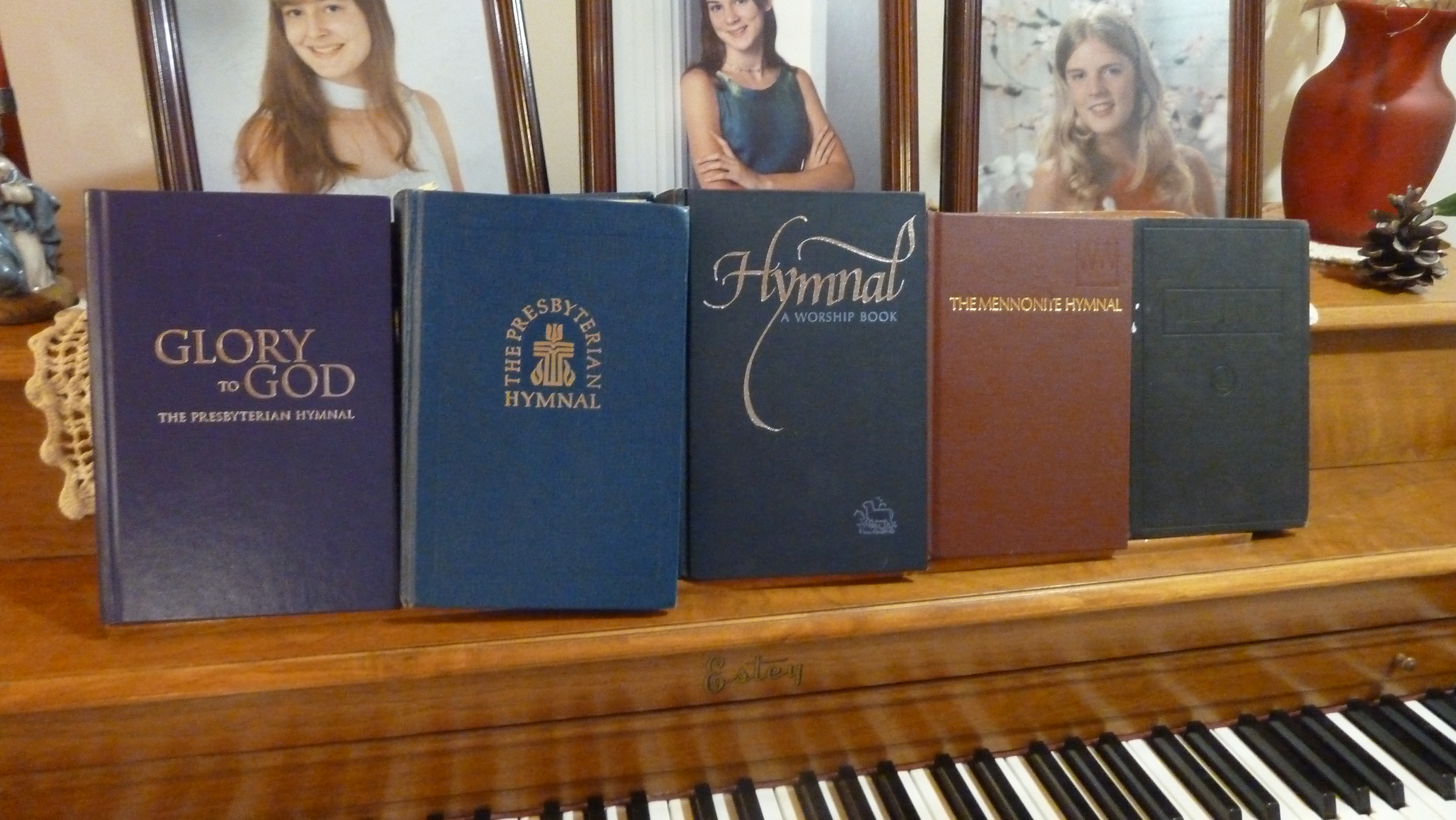
For more of my husband’s and my family’s faith background, here’s an earlier series of posts.
For more on Pentecost or the liturgical year check here.
***
I’d love to hear about the churches that have been important in your faith formation over the years. Stories? Comments?

 findingharmonyblog