

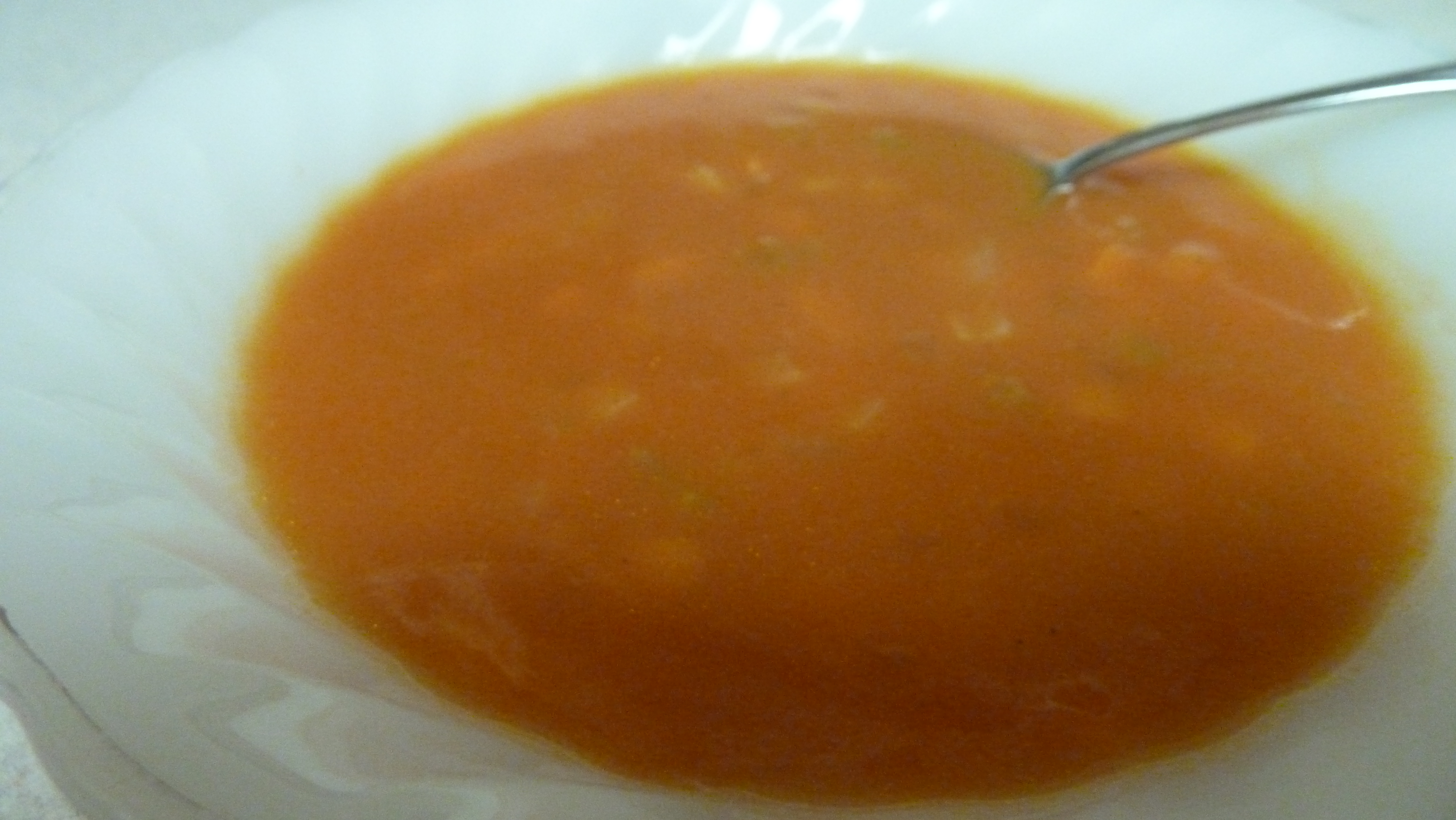
I think it was when my father took ill in 2006 (in what became his last illness) that I first tasted Miriam’s tomato soup. Miriam is my mother’s first cousin and she lives at the same retirement complex (different buildings) and has been a great companion and confidant for Mom these past years as they both deal with the issues of aging, and life becomes more confined (Miriam has macular degeneration and Mom has hearing degeneration).
Mom talking with cousin Miriam
But in 2006, Miriam was still cooking and brought over some of her delicious homemade tomato soup for the family because she knew Mom and the rest of us were busy scurrying back and forth between home and hospital, and then nursing care for Dad. (Dad died March 26 of that year.) It was a thoughtful gift of the kind you welcome when dealing with the stress of serious illness, and it tasted so good. With its bounty of chopped onions, carrots and celery added in, and with a grilled cheese sandwich or shredded cheese on top, it makes a pretty complete meal. At the bottom of Miriam’s recipe she says “Sometimes I add finely chopped broccoli.” Mother was so happy for the soup and her enthusiasm caused me to fall in love with it too.
I got the recipe right then and there and later tried making some for my family at home, some of whom love tomato soup just out of the can. My daughter was living at home at the time. She was not impressed. Oooh. Too sweet! Too much sugar!
On my recent visit to Mom’s she had a request. Well several requests, as mothers do when their children come home, but this was in the food category. “Can you make me a batch of Miriam’s soup to put in my freezer?”
Love to. And here it is. We modified the amount of sugar and it was delicious.
Miriam calls her recipe “Tomato Juice Soup” because it is built off of plain old canned tomato juice. Miriam’s friends and relatives have argued about what cookbook it is published in and have scoured her church’s recipe book (Holdeman Mennonite Church) to no avail. So, unless someone else can find it somewhere, you read it here first!
Miriam Weldy’s Tomato Juice Soup
1 15 ounce can tomato juice
¼ cup sugar (original said ½ cup but we think that is too sweet)
1 stick butter
1 ½ cups water
½ cup chopped celery
1 cup chopped onions
½ cup chopped carrots
Optional: ½ cup finely chopped broccoli
(Note, additional ingredients of water, milk, salt and pepper listed in directions below.)
In a large pot heat tomato juice. Add water, celery, onions, carrots and sugar. Cook.
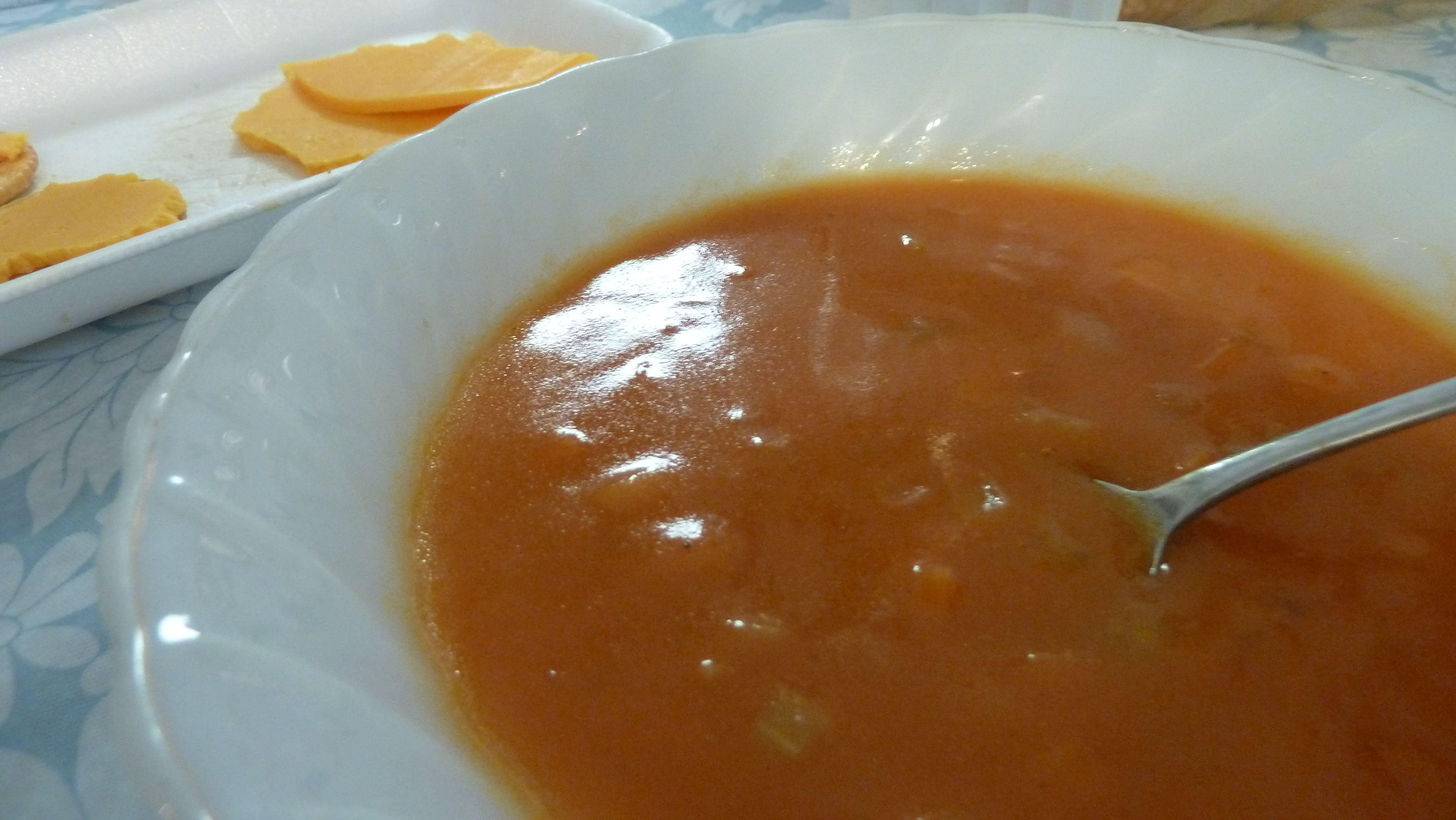
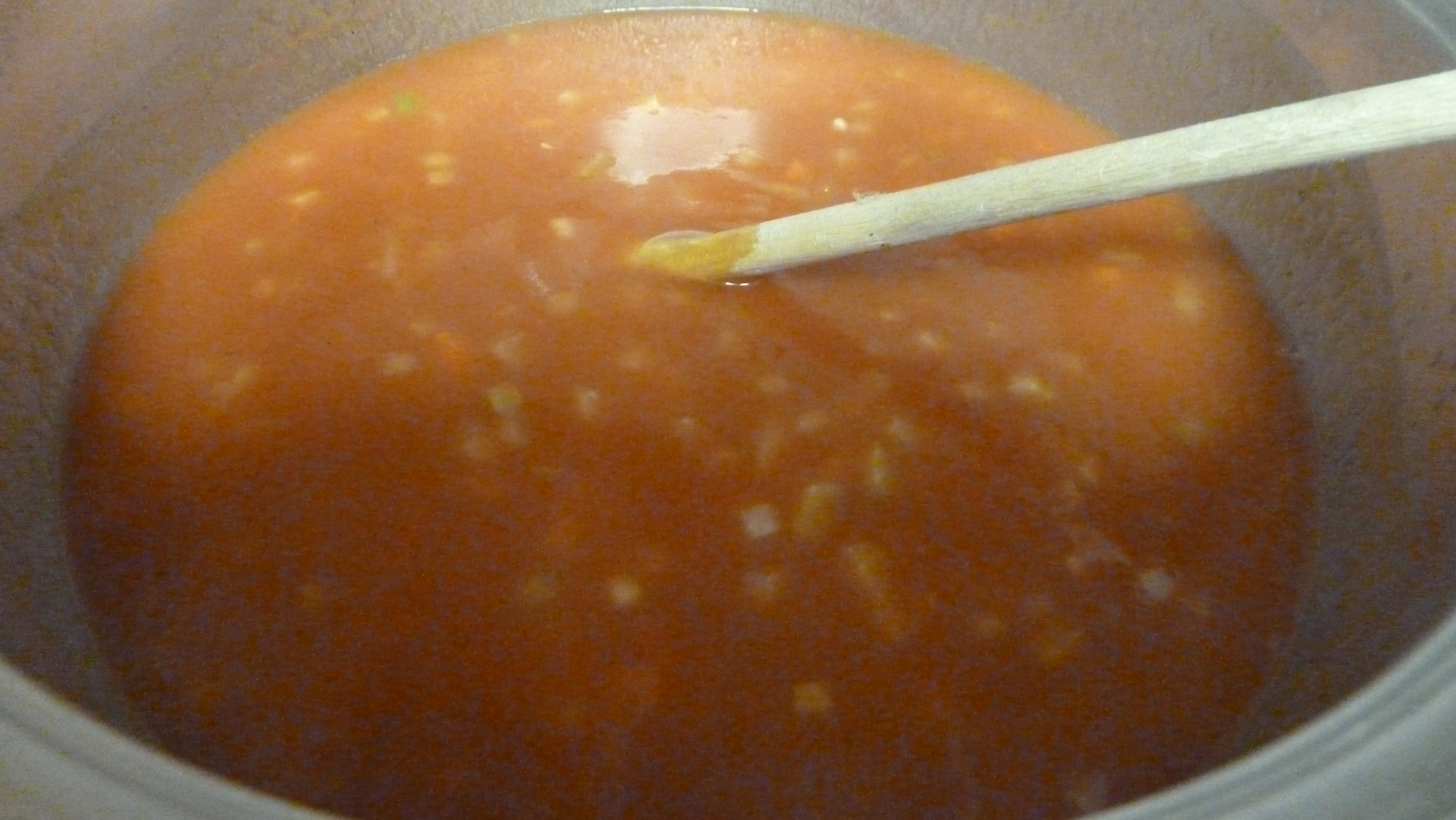 In a shaker, add an additional 1 cup water and ½ cup flour. Shake. Add to the mixture carefully and stir until thickened. Then add ½ cup milk (or cream), and stir frequently. Add ½ teaspoon salt and pepper, or to taste. Add the butter. Stir. Simmer on very low for ½ hour or whatever time you have, stirring frequently. When serving add shredded cheese for topping or sliced cheese on side.
***
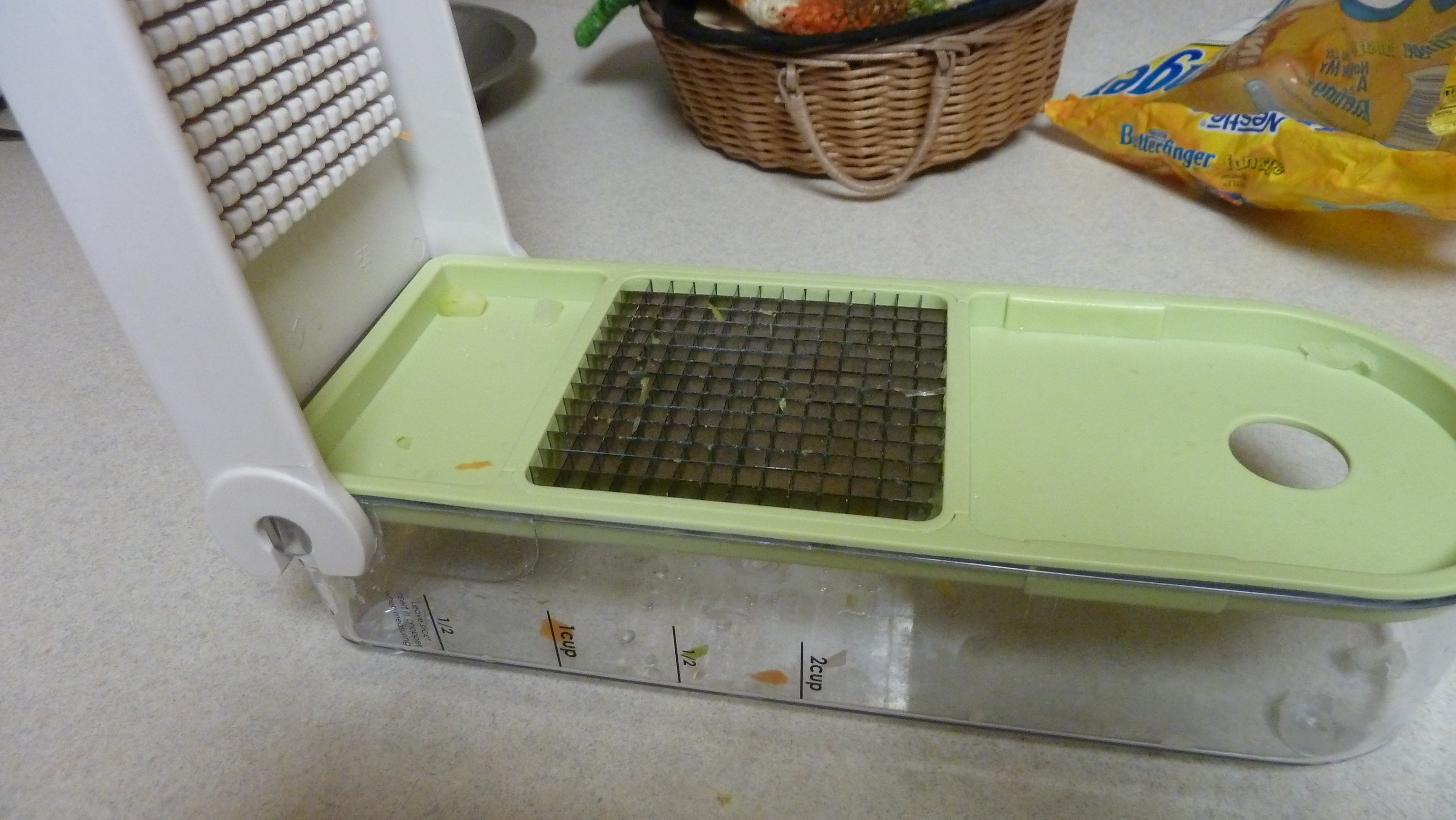
Mom also wanted me to help her try out her handy dandy new vegetable chopper, which she thought might be easier to use than a small electrical chopper that took a lot of assembling and cleaning up. Well guess what, this one did too, and for the record, was hard enough for me to chop through carrots, she definitely did not have the strength to use it at the age of 89. Just sayin’. So the handy dandy chopper is now mine.
What do you use to chop vegetables? Cutting board and knife? Electrical chopper? One of those choppers “As Sold on TV”?
***
Natalie Francisco included a lovely tomato bisque recipe (adapted from a French restaurant) for a Tomato Basil Soup in my Whatever Happened to Dinner book a few years ago that I need to try sometime too! If you wonder (like I did) what is the difference between a bisque and a soup (besides sounding fancier), it includes cream or in this recipe butter. Check out my link to the about.com definition which includes the note that “some thick soups made with vegetables, poultry or meat are sometimes referred to as bisques.” So you could probably call this soup a bisque if you want it to sound like a French restaurant.
For other favorite recipes see my book, Whatever Happened to Dinner: Recipes and Reflections on Family Mealtime.

I had just finished writing the piece below about a book I enjoyed, and was excited as I prepared to share it on my blog. Then I did some more research and realized things had changed for Anne Rice. First you’ll find the blog post as I originally wrote it, and then a postscript.
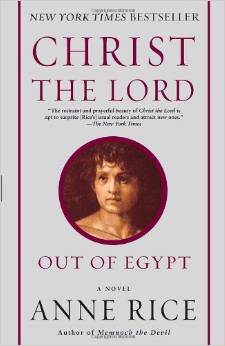
I first met Anne Rice through the pages of Christ the Lord: Out of Egypt. I loved it and wondered more about what had propelled her to write a book that seemed like a book inspired by deep Christian faith. I’m not a fan of vampire type books or much in the way of fantasy, so her rich backlist of best selling novels of those genres, and awareness of the novelist herself, had largely passed me by.
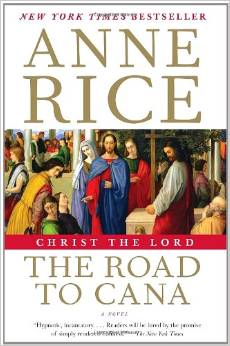
Later I read her second Christ the Lord book called The Road to Cana. It too was refreshing, gripping and “masterful” according to reviewers. “Simply rendered holiness,” said The New York Times.
Who is Anne Rice and what does she believe? Now we can know some of that through her spiritual memoir, Called Out of Darkness: A Spiritual Confession published in 2008.
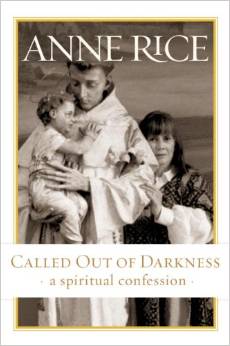
Yeah, I’m late in the game and would never have picked this up had a copy of it not shown up in the Little Free Library, a movement I wrote about here.
The book starts out slowly with many reflections in passive past tense, “Another important element of my childhood was radio;” and “I remember …”– a little too filled with repetitious lines of her early memories of her Catholic upbringing in the very Catholic city of New Orleans, dripping in cathedrals, statuary, stained glass, flickering candles.

But for anyone who is Catholic, or has had a Catholic or formerly Catholic friend or family member, or likes any of Anne Rice’s 28 novels, it slowly sucks you in. This great wordsmith and storyteller was not much of a reader in childhood, nor well into adulthood, and in fact struggled with reading even in college. She says it was the visual aspect of her church background that communicated and formed her first inklings of faith, long before she could read. She writes about her dedicated, loving and film/art buff mother who was nevertheless desperately alcoholic, and the too early death of her own daughter. All this and more begins to enmesh you like a good novel with an unfolding, engaging plot. I enjoyed her fierce and surprising rejection of childhood (she didn’t like to be considered a child), and descriptions of her developing career as a writer.
Called Out of Darkness gradually becomes one of the most astounding faith testimonies of our times (but who am I to say that, I’m not a prolific leisure reader because I have to read so much for my job but keep plugging away at leisure reading when traveling or mostly before bedtime). I say astounding in that as Rice herself says, for a liberal Berkley (California) atheist for much of her adult life to return to Christian faith at the age of 57—well it gives me hope and faith for just about anyone. She details how the interior work of her own faith journey played out in the dark characters and plots of some of her novels.
I will not spoil a reading of the book for anyone else by revealing more of her journey except to say, in her words, a little of what her faith has come to mean for her, and can speak to us all of what is needed in this day of such raking conflict and controversy in the church universal:
“The more I study the New Testament, the more I see the contradictions enshrined within it. But I see something else there too. We have been a quarreling religion from the beginning, born out of an earlier quarreling religion—Judaism—and in a sense the New Testament enshrines us as such very clearly, with no easy solution as to how we handle our quarrels or the contradictory passages except that we must love! The voice of Christ speaks so loudly in the Sermon the Mount that surely it downs out those passages that urge us to condemn or to shun. But how is one to say so for sure?
To accept the canon [of the Bible] means to accept all of the canon. And that means there will be no easy resolution ever, and that learning to live with this tension, in love, is what we must do.
This may come across as simplistic. It is not simplistic. It is life changing and endlessly difficult and the steadfast determination to love is threatened at every moment. We walk a tightrope over a pit of grasping demons when we insist upon love. And sometimes we walk alone.
The more I study this, the more I listen to people around me talk about their experience with Jesus Christ and with religion, the more I realize as well that what drives people away from Christ is the Christian who does not know how to love. A string of cruel words from a Christian can destroy another Christian.”
And she goes on. I tell you, the book is rich and redeeming and hope-filled. She is as dedicated of Christian as my mother (and both of them would be quick to admit and confess their sins and shortcomings).
Anne Rice, thank you for writing this book, for sharing your faith and your story. It is a story for thinking persons anywhere—for those who are willing to go to the hard places and ask the unanswerable questions about God and faith and Jesus, and say with the father in Mark 9 who said in asking Jesus to heal his son, “Lord, I believe. Help my unbelief.”
Postscript
Right before I posted the above, I learned that a few years ago Ann Rice had “recanted” so to speak and moved more to a position of secular humanism, or so said Wikipedia. Rice also calls it belief in a higher power.
I couldn’t help but be severely disappointed by this twist. I felt sucker punched (and a little behind on the news). I’m sure I heard the news at the time but it didn’t mean much to me not having read her memoir at that time. I thought of the line from her book which I quoted above, “A string of cruel words from a Christian can destroy another Christian.” Undoubtedly that has been part of what played as she met with criticism from some for her activist stances.
I still love her two Christ the Lord books (and I’m happy to hear there is a movie in production stages). Of course our faith is always evolving, is it not? In 2010, she said in The Christian Century she still believed in Christ, but was separating herself from the Christian church. In a story on NPR in 2010) she said she didn’t think she would ever return to writing vampire novels (but subsequently did a string of werewolf books), and now in 2014 a new vampire book is slated for publication in October.
I will move on, and let others decide for themselves whether this book is still worth reading as a memoir and history. I have come to be wary of ever placing my trust or Christian faith in the hands of others who might disappoint me, especially in the hands of well known authors, politicians, trusted spokespersons, even pastors.
Perhaps Anne and all of us could pray with the father in Mark 9 “Lord, I believe. Help my unbelief.”

***
Have you ever been disappointed by the actions or statements of a “public person” in terms of your own faith beliefs? What happened and how did you deal with it?
***
If you’ve read any of the above books, I’d love to hear your response to them.

The other week I was in Indiana just at the start of their strawberry season. I hankered to enjoy an evening meal of shortcake and strawberries. When I learned there was a U-Pick patch a stone’s throw from Mom’s retirement complex, I went over early the next morning. Only $1.25 a pound. What a delight to dig into a bounty of delicious berries in long straight rows after picking on my somewhat difficult hillside patch, described here.
You’re thinking they eat shortcake as a meal? How healthy is that?
Well, the kind of shortcake we like for a meal is not a sweet cake, more like a biscuit, made from a mix and doctored up just a tad. Cheating, I know. We use either Bisquik ® or Jiffy ® Mix.
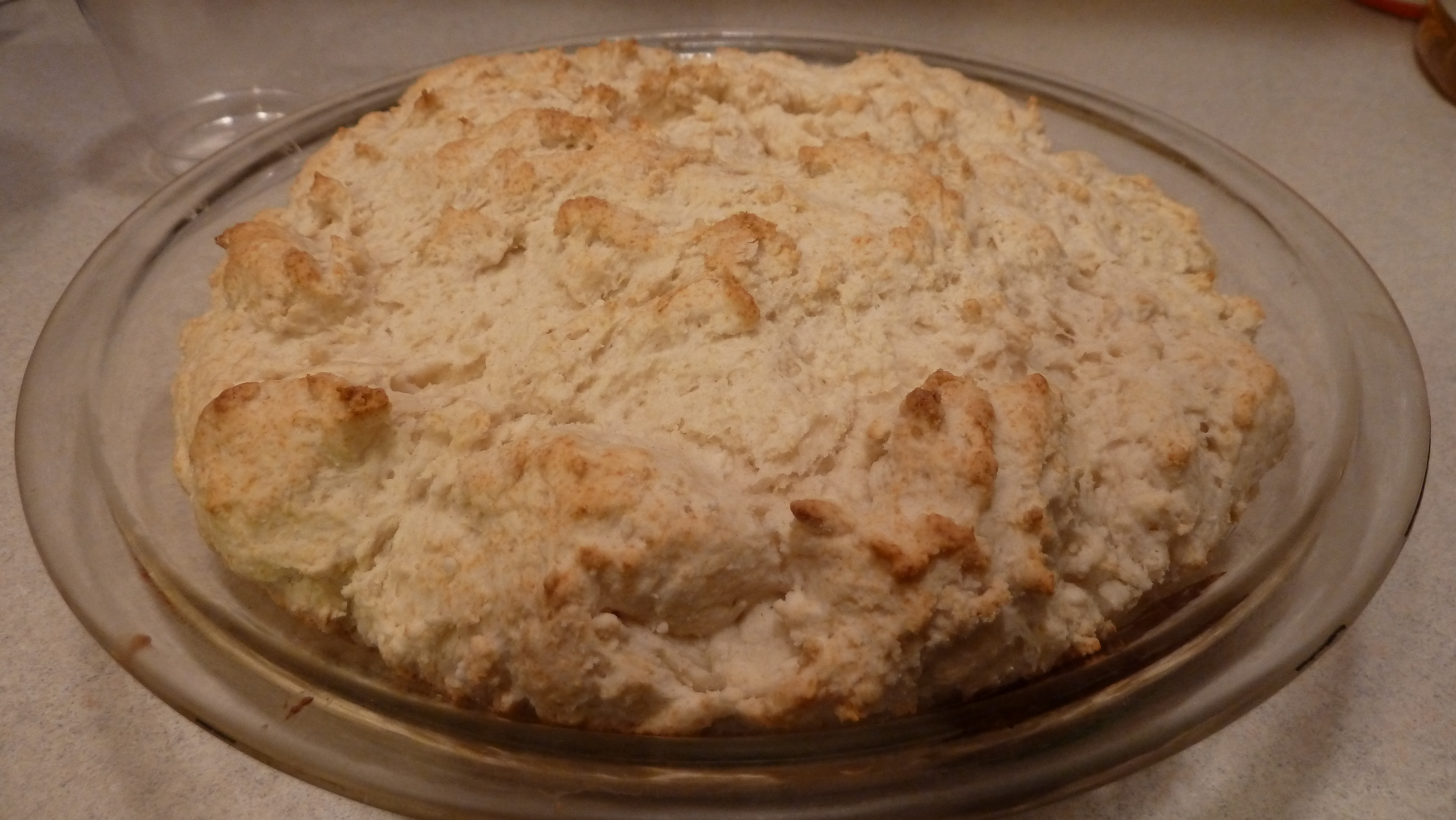
Back to the healthy. A traditional Strawberry Shortcake meal at the Miller household consisted of (for each person):
Menu:
A cup or so of chopped, lightly sugared fresh berries.
A half cup of milk.
Bisquik ® type shortcake
Cheese or bologna or deli smoked turkey as a “side” – not on bread
Perhaps fresh garden lettuce as a wrapper for the cheese/bologna/turkey
Four food groups. A cup of strawberries supplies 160 percent of your daily Vitamin C, plus some fiber and potassium. Protein and calcium in your milk and cheese or deli meat. A small amount of veggie/fiber in your lettuce, or perhaps a carrot on the side if you insist on a traditional veggie.
Where the healthy comes in too, lest we forget, is that this is pretty much a low-effort, stressless meal. That has to count for something. You clean the berries, you bake up the shortcake, the house fills with delicious scents, you serve, you eat. Pure enjoyment. I’m mostly about eating simply which counts for a lot in the summer.
I laud my parents who practiced local simple eating before it was trendy, because that’s what we did frequently for an evening meal in summer. (As farmers, our main meal of the day came at noon, where Mom served traditional dinners of meat, a starch, veggie and salad.)
But once spring fruits got under way, for our evening meal there was a steady succession of bread and milk topped with the fruit of the week: strawberries, raspberries, blueberries, peaches. These were our favorites. We did not grow blueberries in our orchard but Mom would buy those in bulk, as I do now, from those who did or, if necessary, shipped in. (You gotta have blueberries however you can get your hands on them.)
Then the surprise. On my recent visit, Mom shocked me by saying she NEVER LIKED the soggy bread part of these meals. And now that Daddy is gone, she feels free to skip the milk-soaked bread, and just have milk and strawberries, milk and peaches, and her bread on the side, not all mushy like Daddy loved.
Now I’m wondering what if Daddy ate it that way because he thought Mom liked it that way?
Kind of rocks the underpinnings of your understandings about your parents, you know, if they could live with such secrets.
But that’s always the way I liked Mom’s shortcake best too—I crumbled a little for my strawberries and milk, but saved a nice hunk to eat on the side, warm and slathered in butter.
I was never able to get my husband and three daughters to enjoy this as an evening meal except for when we were at Grandma and Grandpa’s house. They ate it then. If I served at home, someone was sure to ask, “Is this all we’re having for supper?” (But then, we do not have our main meal of the day at noon!) So it remains a special treat just for strawberry season, just at Grandma’s house. Some foods are like that. But maybe your family will think it’s cool.
And the results from the “How do you like to eat your strawberries” poll a couple of posts ago?
55 % love shortcake best
44 % pie
Neither jam or cheesecake got a single vote.
(Jiffy ® used to make a versatile version Mom used called “Baking Mix” (here) but after scouring two grocery stores, I’m not sure they make it anymore. Anyone know?)
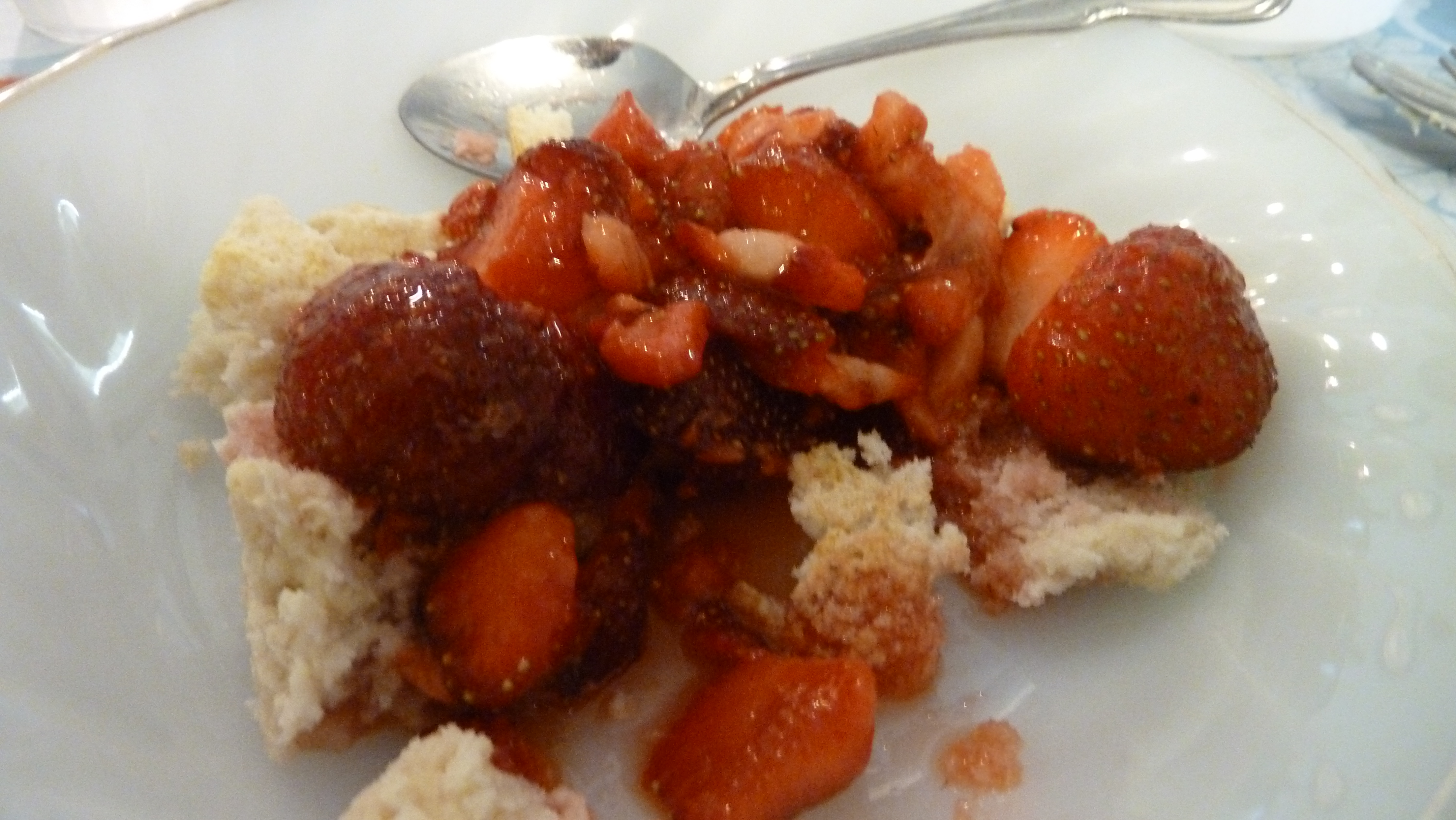
Shortcake (Using the standard recipe on the box)
2 1/2 cups Bisquick ®
2/3 cup milk
3 Tablespoons sugar
3 Tablespoons butter or margarine, melted
Stir mix, milk, sugar and melted butter until it hangs together. Spread into greased 9 inch pie pan or other baking dish of those approximate dimensions. Bake in 425 degree oven for 10-12 minutes or until golden brown. Slice into pie-sized servings of your choice, for 6-8. Serve while warm.
***
Did you ever learn something new about your parents, or your mom or dad that surprised you or changed your picture of them?
Or, did your mom or dad ever stop doing something once their partner was deceased? I’d love to hear more.
***
For hundreds of recipes helping you cook whatever is in season, check out Simply in Season, from Herald Press.
![[Simply In Season Cover]](https://i0.wp.com/store.mpn.net/client/products/ProdimageLg/9493.jpg)
I was privileged to attend two birthday parties recently. Both were rather grand affairs with 150 or more in attendance at the first one: a brunch for a 90-year-old friend of my mother’s, Cora Schrock. Cora has been a great confidant over the years for mom and I was delighted to be able to take my mother to the party during a visit to my home area in Indiana as Mom continued to recuperates from early May surgery; I wrote about the train trip here.
Cora left, and my mother, Bertha.
There was a “queen for the day” crown that embarrassed Cora slightly but she played along regally, greeting friends, family, church members and fellow residents in her retirement home complex.
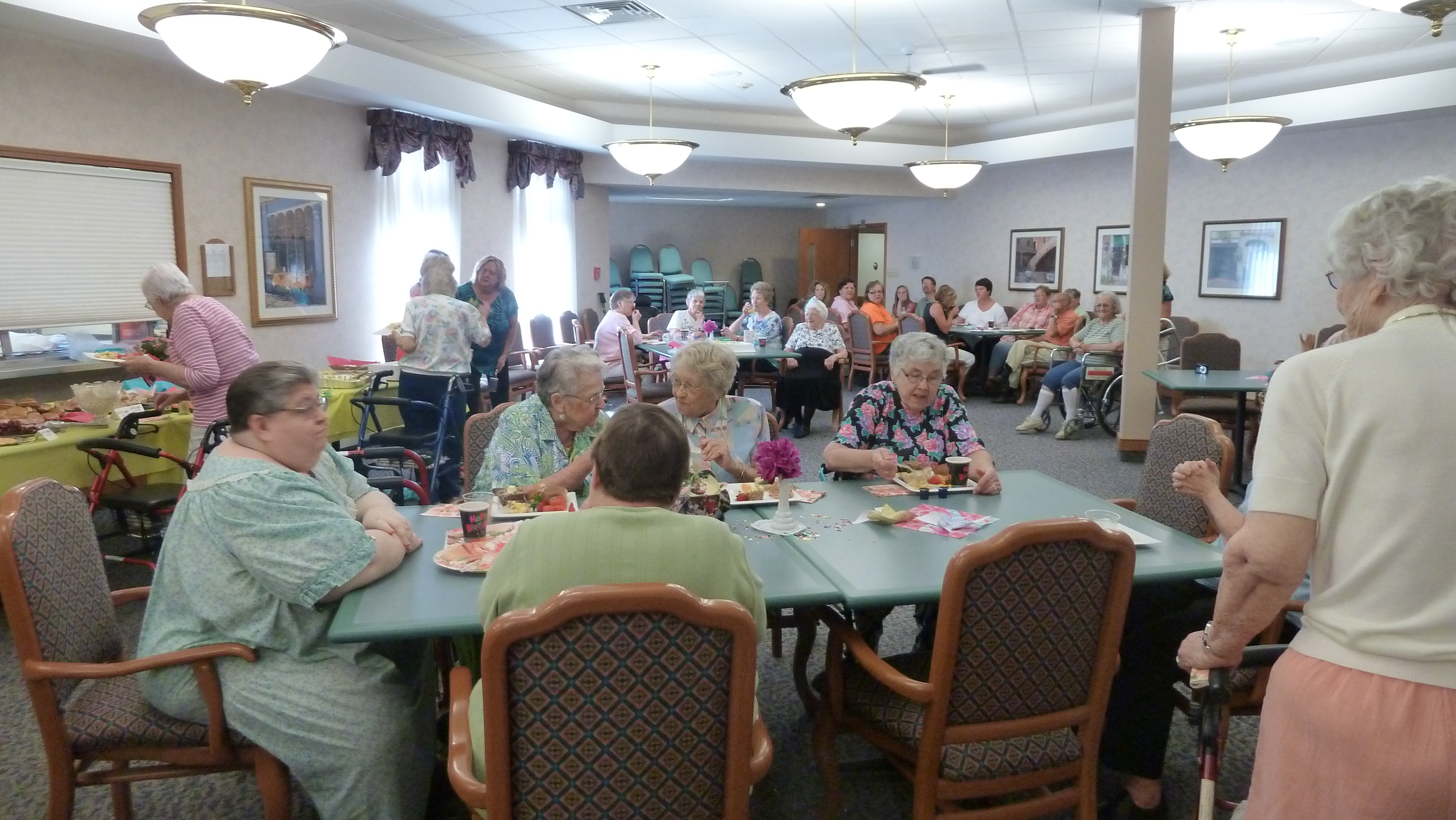
There was plentiful good food: homemade omelets, home baked cinnamon rolls and other sweets, fruits, and of course, birthday cake.
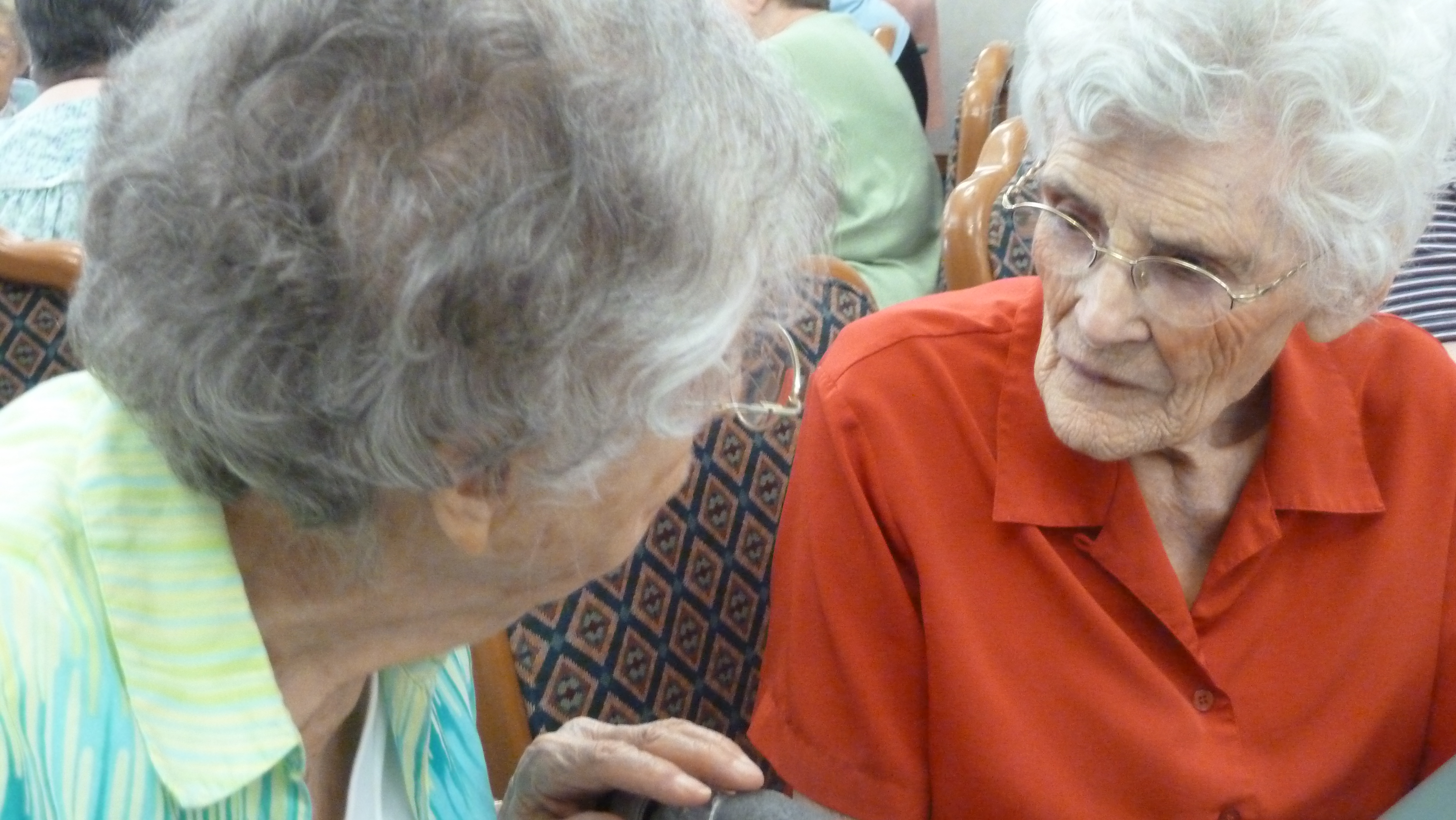
Mom and a cousin catch up, even though they talk by phone almost every day.
But mostly there were a hundred conversations all over the ample dining room of people reconnecting, sometimes after many years: emotionally close brothers who still had not seen each other in four years, a brother who recalled baling hay with my husband–helping my father many years ago.
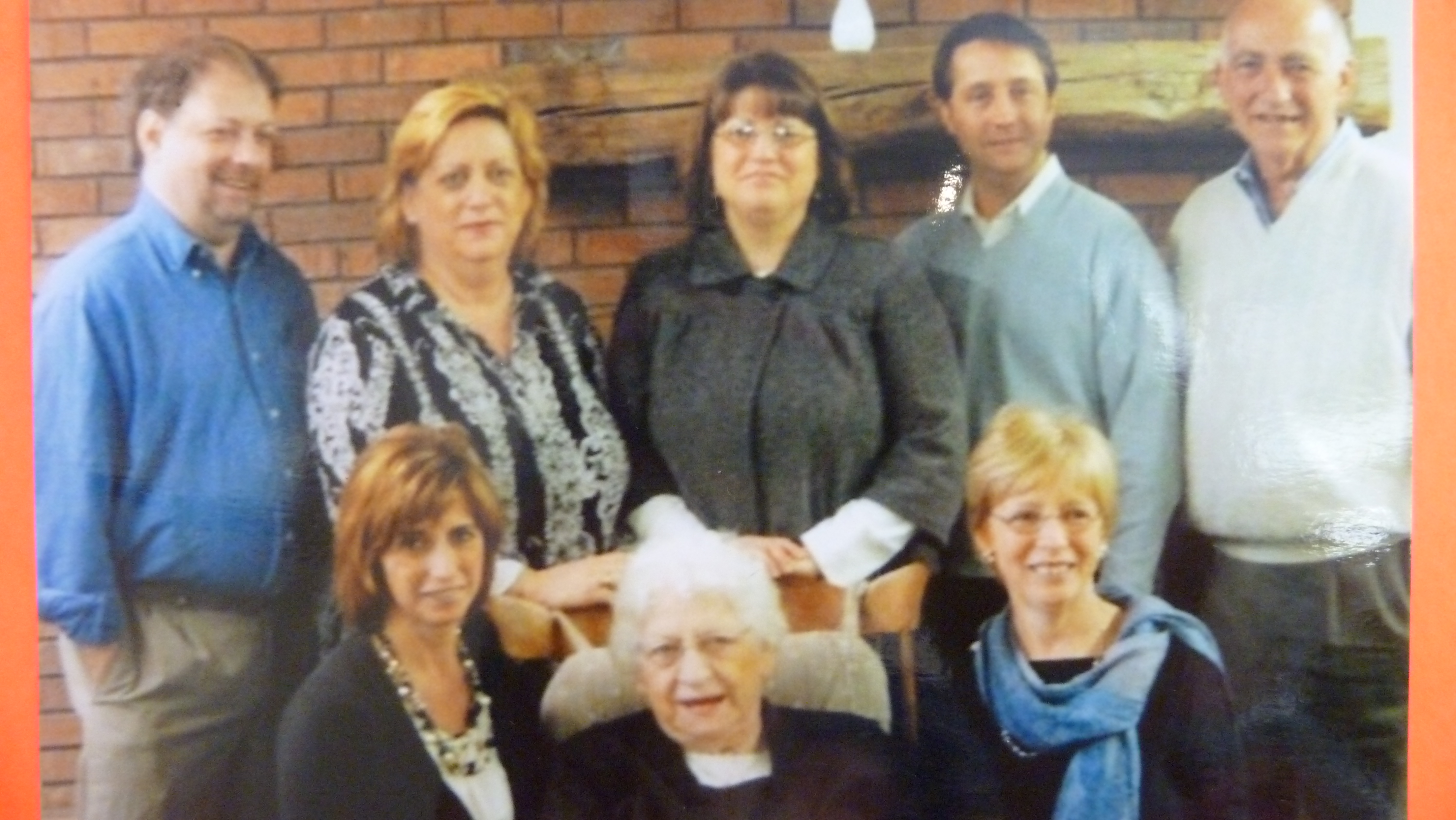
The Schrock family, in an earlier photo, on display at the party.
But one conversation was especially meaningful to me: a woman who was first on the scene (with her father) when my maternal grandfather Ivan was tragically killed in a single car accident when I was just a baby—a scene so gruesome I’ll spare you the details but which understandably haunted her as an 11-year-old child for a number of years.
Rather than cause me nightmares or aversion it somehow made me feel closer to this grandfather, being right next to a woman who experienced my Grandpa in that terrible moment, horn still blaring on his vehicle in awful serenade. She said her father then sought help (long before cell phones, 911, or even much in the way of rescue squads). Many years later her own sister was killed by a drunken driver, her only sibling. Yet she seems to have healed as well as you can from that kind of tragedy. Such is life.

At the other end of life’s spectrum, I got to join in the joyful mayhem of a party for two three-year-olds, step-siblings.

There was a rented bouncy house (as I call them), kids playing steal-the-flag in wild woodsy terrain behind the church cabin where the party was held (I think they fancied they were acting out a movie, maybe), a sprinkler, swing set and of course, adults sitting around reconnecting and eating pizza.
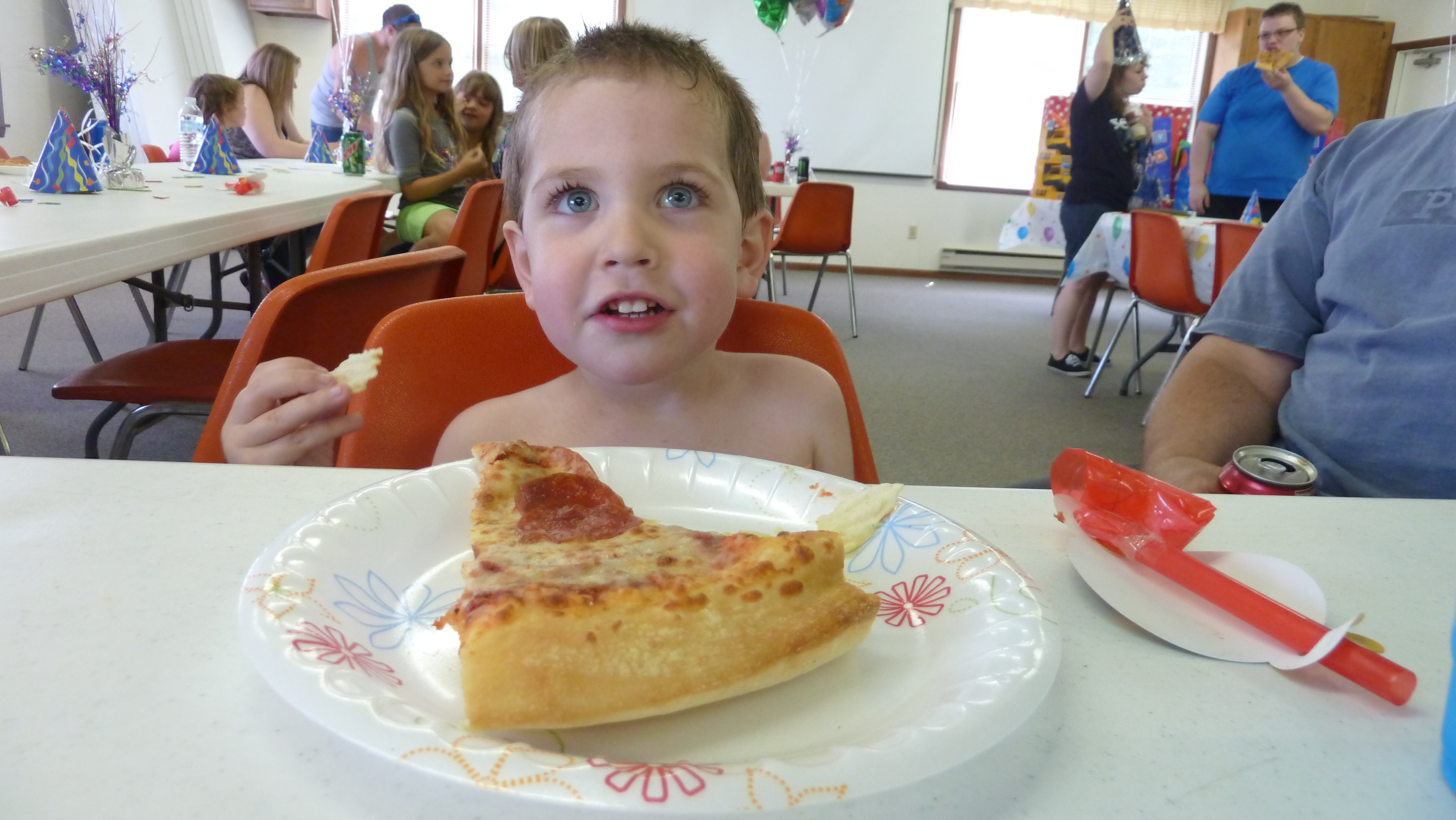

Given all of the various grandparents, steps, ex’s and generations, I’m guessing there were 40 at this party, all connected through their love of these children.
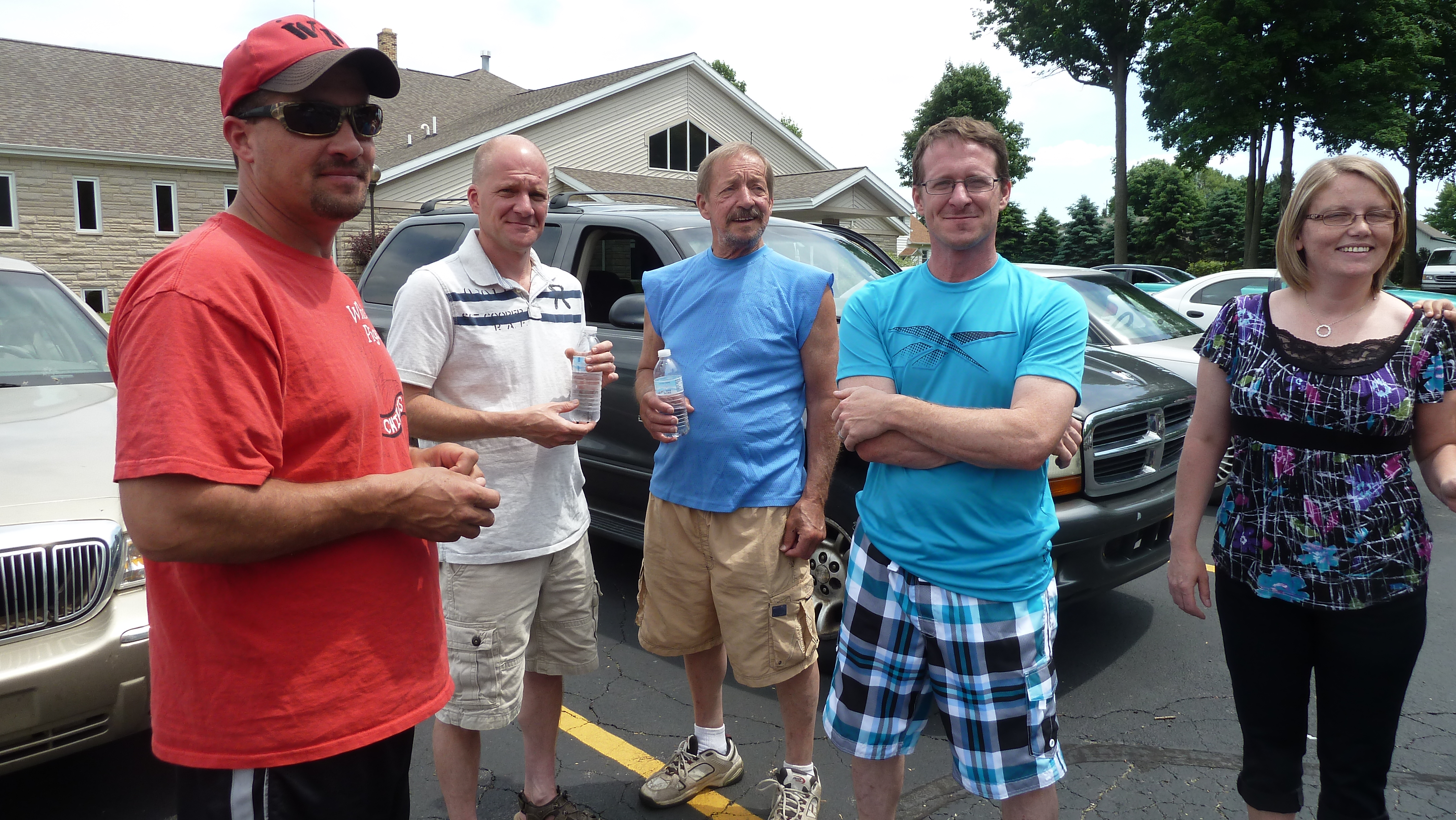
Several members of the Kemp family, including a great grandfather.
I couldn’t help but reflect: what will life be like for the pair of three-year-olds if they are blessed to reach 90 years of age? What was life like for baby Cora in 1924? I can imagine that at most a 3-year-old girl in 1927 would have gotten no more than a special cake, a small toy or new dress.
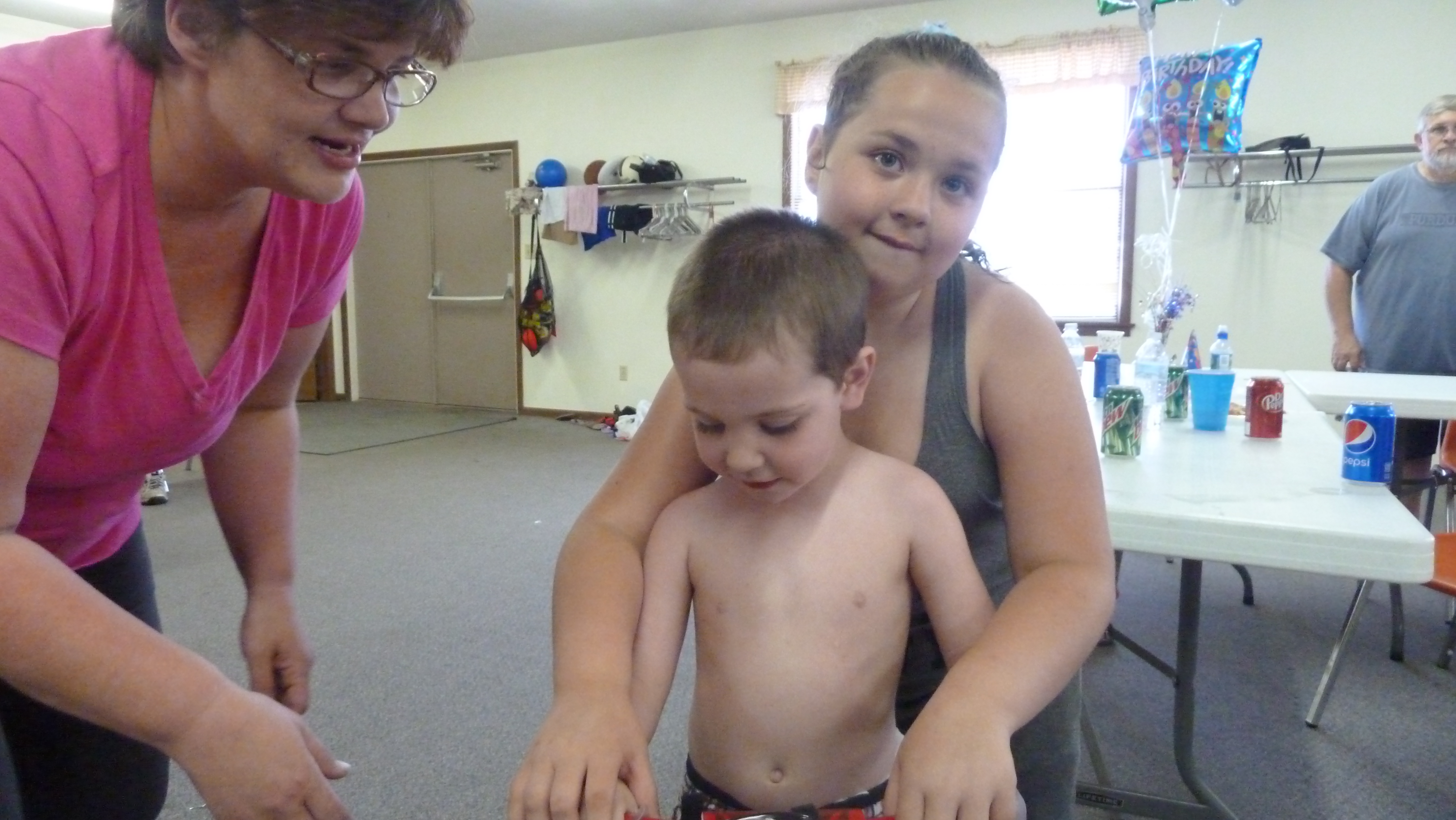
These three-year-olds each got little scooters, a plastic sandbox set, mini basketball goal, some dolls and trucks/bulldozers. I was glad for the active, creative play these gifts signaled rather than too much in the way of electronics at this early age.
Is it too obvious to suggest that whatever the age, the gifts of love we share with the three-year-old or the 90-year-old are what matter, what’s important, the true treasure.
I once had the opportunity to interview Amish farmer David Kline. author of the book Great Possessions; in it he’s talking mostly about farming and stewarding God’s gifts in nature, but the application here is family as great gifts, our possessions. Not in the sense of “owning” anyone–but in the sense of belonging to a group of people or having a place that is truly “home.” As another author/poet Robert Frost said so memorably in the voice of two characters in his long poem , The Death of the Hired Man:
“Home is the place where, when you have to go there, they have to take you in.”
“I should have called it something you somehow haven’t to deserve.”
Our families are great gifts–and the important thing is to treasure them always, whether through hard times or great days celebrating birthdays. Even two or three at once!
I also always like this verse: “God sets the lonely in families.” Psalms 68:6

And when you don’t have family nearby, a good friend is a great gift, too.
***
Which definition of “home” from the Robert Frost poem do you like the best/resonate with?

Grits were made famous for much of America on the TV sitcom, Alice. If you are old enough to remember Alice’s trademark “Well kiss mah grits” as she waitressed at Mel’s Diner set in Phoenix, Arizona, you are old. Enough.
If you’re not, here’s Alice’s classic rejoinder anytime she was mildly (or a lot) irritated or just wanted a laugh:
https://www.youtube.com/watch?v=ftbm8EZZDqI
Grits used to be mainly a southern thing but now that gluten-free diets are such a big necessity for thousands of families, grits are a marvelous, cheap, quick, and hot breakfast that grow on you whether lathered in butter, salt and pepper (the way I like them, with an egg, over medium), or dolled up with honey, syrup, milk and sugar or whatever you fancy.
But grits have now become popular enough you even find them in northern restaurants and Amtrak’s Capitol Limited running between Washington D.C. and Chicago like I wrote about here. How northern is that?
I remember a stay at an Embassy Suites in Richmond, Va. where a northern women’s college sports team of some description was also staying. One young women paused at the breakfast buffet’s large container of white steaming grits. “What is THAT?” she queried as if it were pig’s feet. I was happy to fill her in on the southern delicacy.
“It’s a little like cream of wheat only not. Much better. Eat it with butter and pepper.” I’m certain she passed on it.
One of my daughter’s friends was allergic to wheat and I think she always appreciated coming to our house for sleepovers because I would always serve her up a plate of grits and eggs for breakfast. Sarah was a totally conscientious and responsible child who even when she was just 8 or 9, would make and bring her own wheat-free cupcakes to parties, so the least I could do was humor her with some grits for breakfast.
Now when I want to humor and treat myself, I stir up a quick batch. Here’s all it takes:
Grits for One – As supplied by a Quaker box of grits.
¼ cup quick 5-minute grits (a grain made from corn)
1 cup water
Dash salt
Stir grits and salt into briskly boiling water.
Reduce heat to low and cover.
Cook 5-7 minutes or until thickened, stirring occasionally.
Remove from heat. Serve.
That is it.
My pastor for many years, Ann Held, just retired (and was featured yesterday on our local public radio station; photos and podcast here). At our church potlucks she was famous for her Cheese Grits. I’ve only made them once. They are delicious, and in spite of this dish being supposedly the “only thing I know how to cook,” it is a little more complicated that just cooking up plain grits. I’ll have to try them again sometime, especially since Ann won’t be bringing them to our church potlucks anymore. Wah. Her recipe for Cheese Grits is included in my book featuring almost 100 recipes, below.
For other favorite recipes see my book, Whatever Happened to Dinner: Recipes and Reflections on Family Mealtime.
 (Model train track layout in Baltimore, Maryland)
A week ago last night I was huffing down Interstate 81 in Virginia trying to catch a train by 5:45 p.m.
Would I make it?
I truly did not know. But I did know the only thing I could do was inch forward, stop, wait, go, breathe slowly.
I had left in plenty of time—even allowing enough time to go the local city hall in Martinsburg, West Virginia, and obtain a dollar parking permit before they closed at 5 p.m. That’s the joy of traveling by Amtrak where many stations remain totally unstaffed, no bag inspection, no way to pay for parking at the station. (Why couldn’t they at least put a locked box there?) Anyway, the deal is if you leave your car, you need a permit, and you have to send for it by snail mail a week ahead, or go visit city hall.
My first alert that something was up on my intended route down I-81 was a blurb on the radio—tractor trailer accident on I-81. So it was my turn to be caught in one of those numerous dangerous and dreaded snares. I dialed 511-Virginia. Yes, I would need to get off about milepost 292 or earlier. Traffic backed up for 8 miles southbound, 4 miles northward, my direction. It must have been a bad one. I prayed no one died. And began to get nervous. I still had time, but not THAT much time, especially if I had to go to city hall. You can’t fight it.
When I realized there was no way I could make it to city hall before they closed, I called them (luckily I had grabbed the phone number online before I left, no smart phones yet for the Davises); after they took down my license number, make and model of car, and phone number, they said I could just pay the $1 a day fee by stopping at city hall when I got back. Whew. Very decent and trusting of them, sweet enough to make up for not just having a pay box at the train station.
It took about an extra hour navigating the traffic dumped onto Route 11 which threads alongside I-81 through much of Virginia, and state police were directing traffic as I detoured through the small towns of Strasburg, Middletown, and Stephens City until I could finally get back on the Interstate. I won’t pace you through every squeal of breaks and one enormous pop once I got back on I-81, that sounded like yes, a bomb. That turned out to be just a retread blowing on a truck in front of me. For that I steadied my steering wheel, straddled the rubbish. Safe.
Suffice it to say I got to the train station with maybe ten minutes to spare, long enough to drive through the parking lot twice, hunting desperately for a parking space. I had to resort to rolling down my window and calling out to a man with a backpack, “Where is more parking?” He directed me to the other side of the station, across the highway. More thanks going up for the kindness of strangers. Once safely at the train station, I even had time to dash up one level to the station restroom (the historic roundhouse there is worth a visit all by itself, with displays of interest to children.)

It was a blessedly uneventful trip the rest of the way on Amtrak’s Capitol Limited, lounging in the sightseeing car, watching the backyards and swollen rivers of West Virginia, Maryland, Pennsylvania, Ohio and Indiana go by in train time.

Slow but sure.
***
For a 2009 article from The Washington Post on the frequency and severity of crashes along I-81 check here.
***
Have you enjoyed train travel? Stories? I’d love to hear yours.
***
For more tales from the train, see my Another Way newspaper column today. Two trips in one month’s time is about enough. My mother had surgery in early May and is doing well. To sign up to receive my newspaper column by email every week, go here.
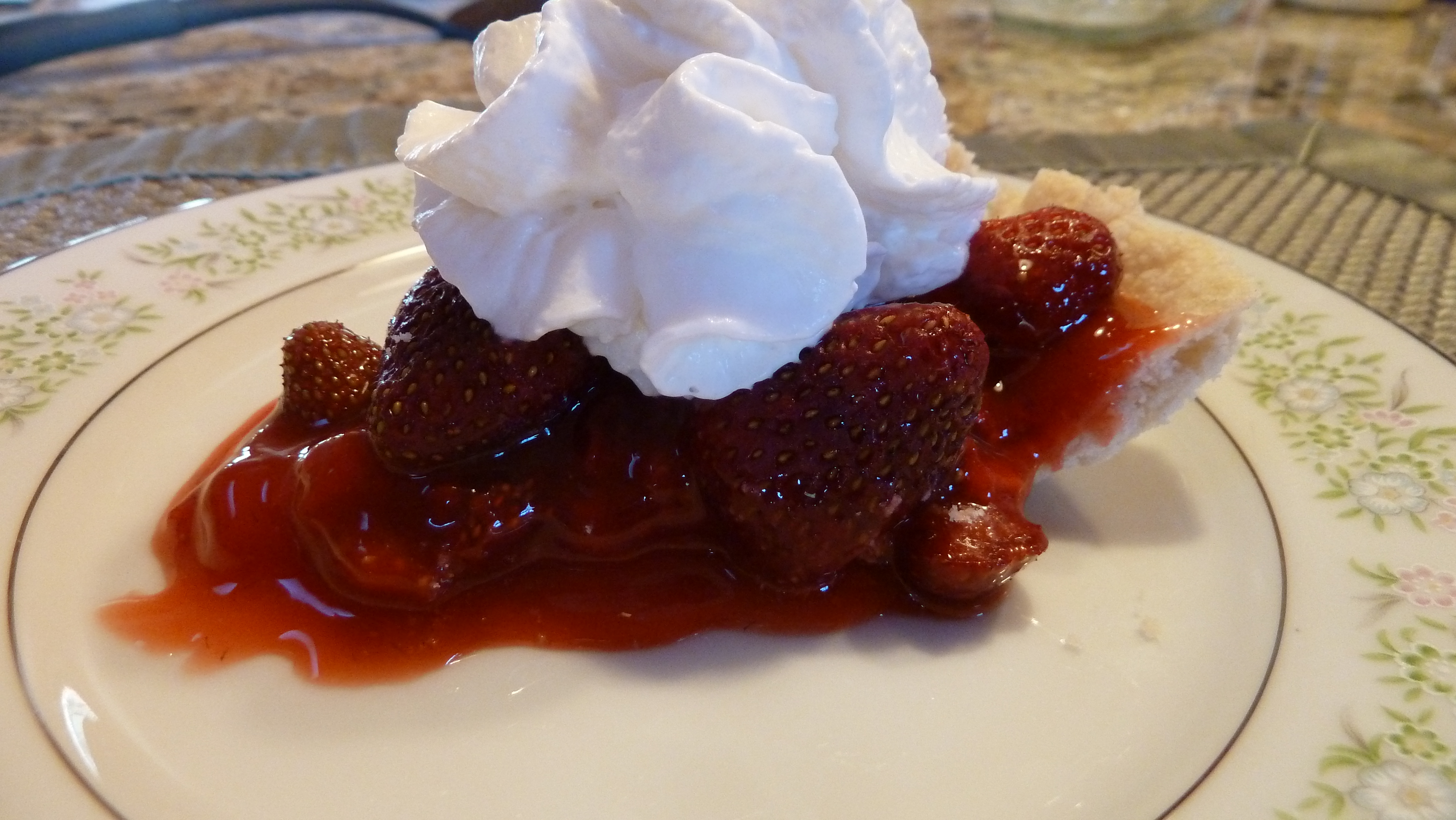
I promised in my most recent post on picking strawberries, that today I’d write about my favorite thing to make out of strawberries.
Did you guess: jam, shortcake, pie, cheesecake, or maybe a trifle? Or maybe I should ask, what is YOUR favorite thing made with strawberries?
My hands down favorite strawberry thing, besides eating them fresh from the patch, is pie.
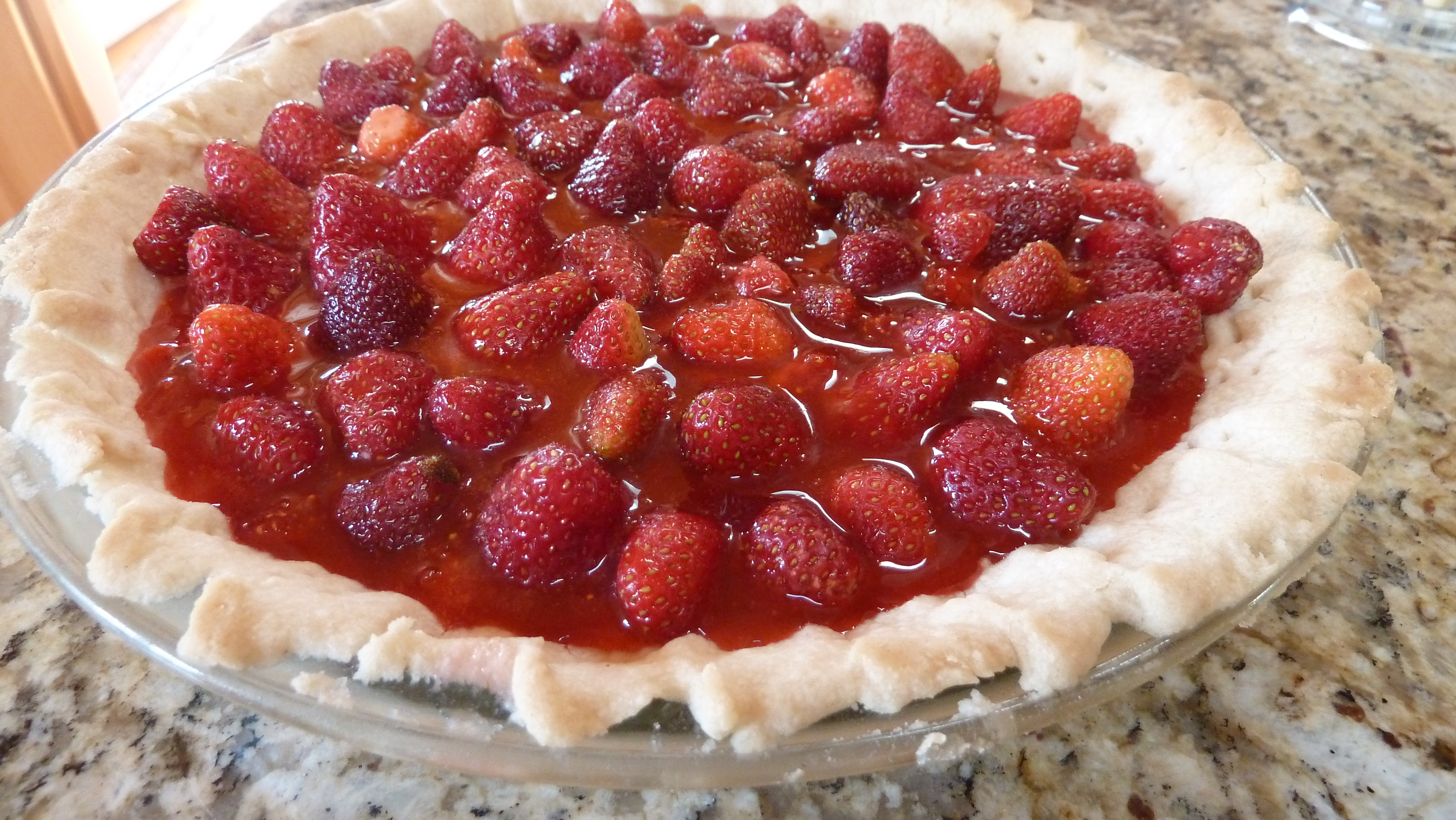
Okay, so my strawberry pies are not as beautiful as the ones you see at a restaurant. But what they lack in eye appeal they make up for in full bodied sweetness and nutrition. Did you ever succumb to a beautiful piece of strawberry pie at a restaurant and then think, oh, how tasteless? All sugary glue/glaze and hard strawberries shipped from who knows where?

My recipe comes from Fellowship Cooking from my home congregation, North Goshen Mennonite (Ind.), dog-eared and grease stained, so you know it is good. Counting a strawberry chiffon pie listed there, there are FOUR strawberry pie recipes in one cookbook, but my favorite I’ve adapted from Viola Miller, the mother of one of my brother’s childhood friends.
Strawberry Pie
1 pint strawberries, crushed
2 ½ Tablespoons cornstarch
2 Tablespoons lemon juice
2 Tablespoons strawberry jello mix, (as powder)
1 cup sugar
1 pint whole or sliced strawberries, as you prefer
Baked pie shell
Add sugar, cornstarch, jello and lemon juice to the 1 pint of crushed strawberries; cook until clear and thick, stirring constantly.
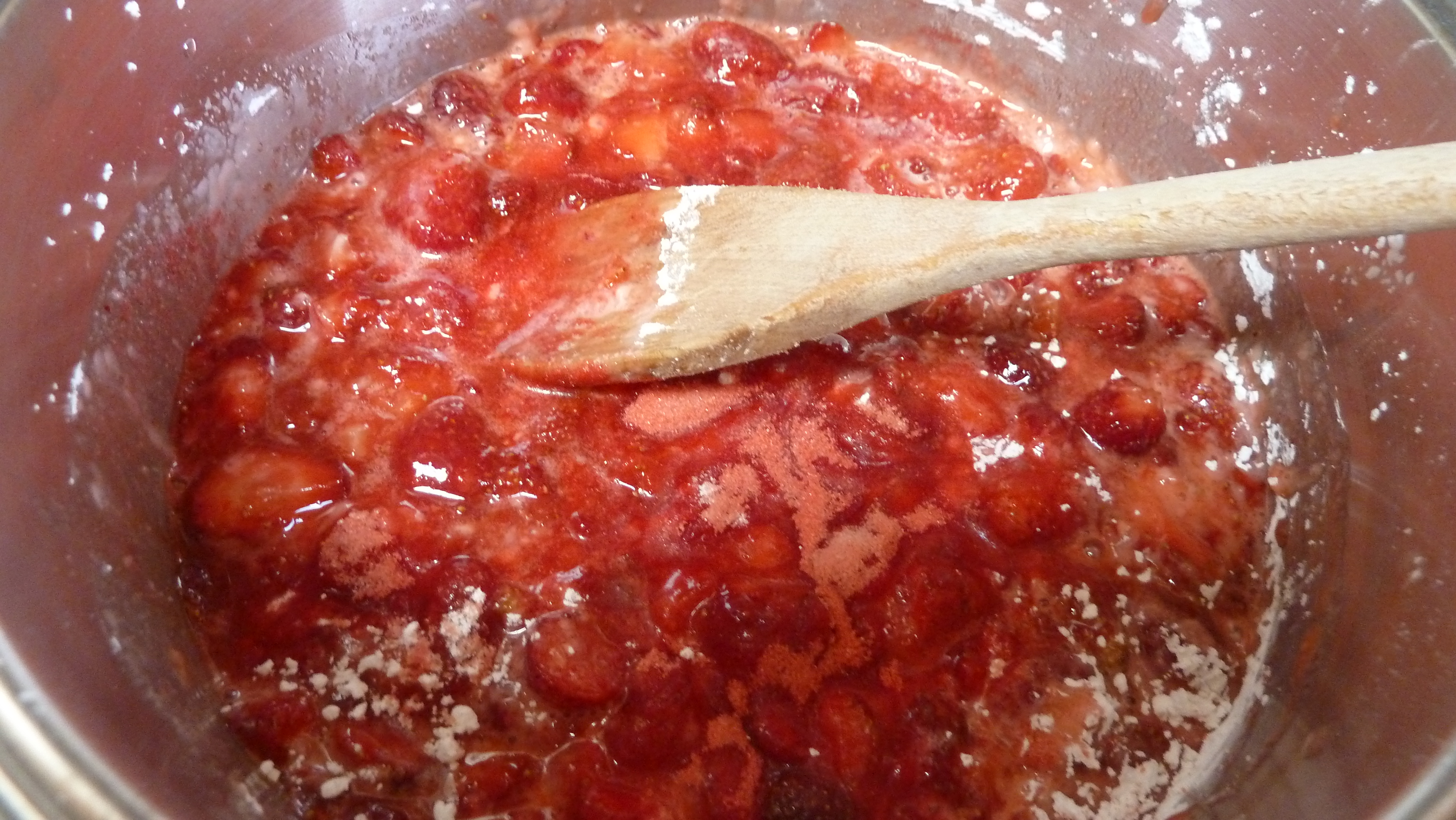
Remove from heat. When cool, put into previously baked and cooled pie shell.
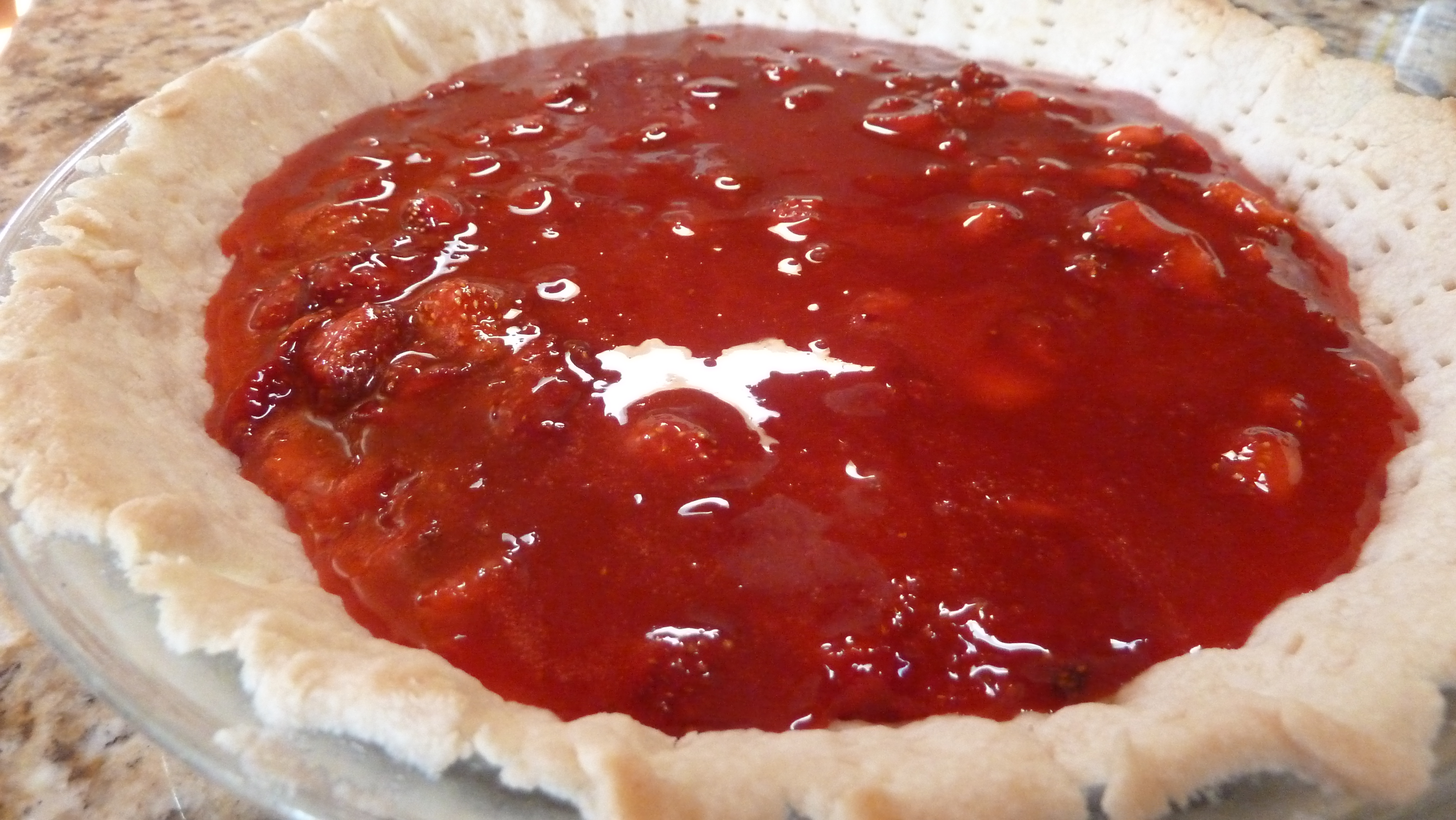
Add the second pint of whole or sliced strawberries—placing them one at a time for a prettier pie, or just add willy nilly.
Refrigerate at least one hour before serving. Serves 6-8. May be topped with whipped cream.
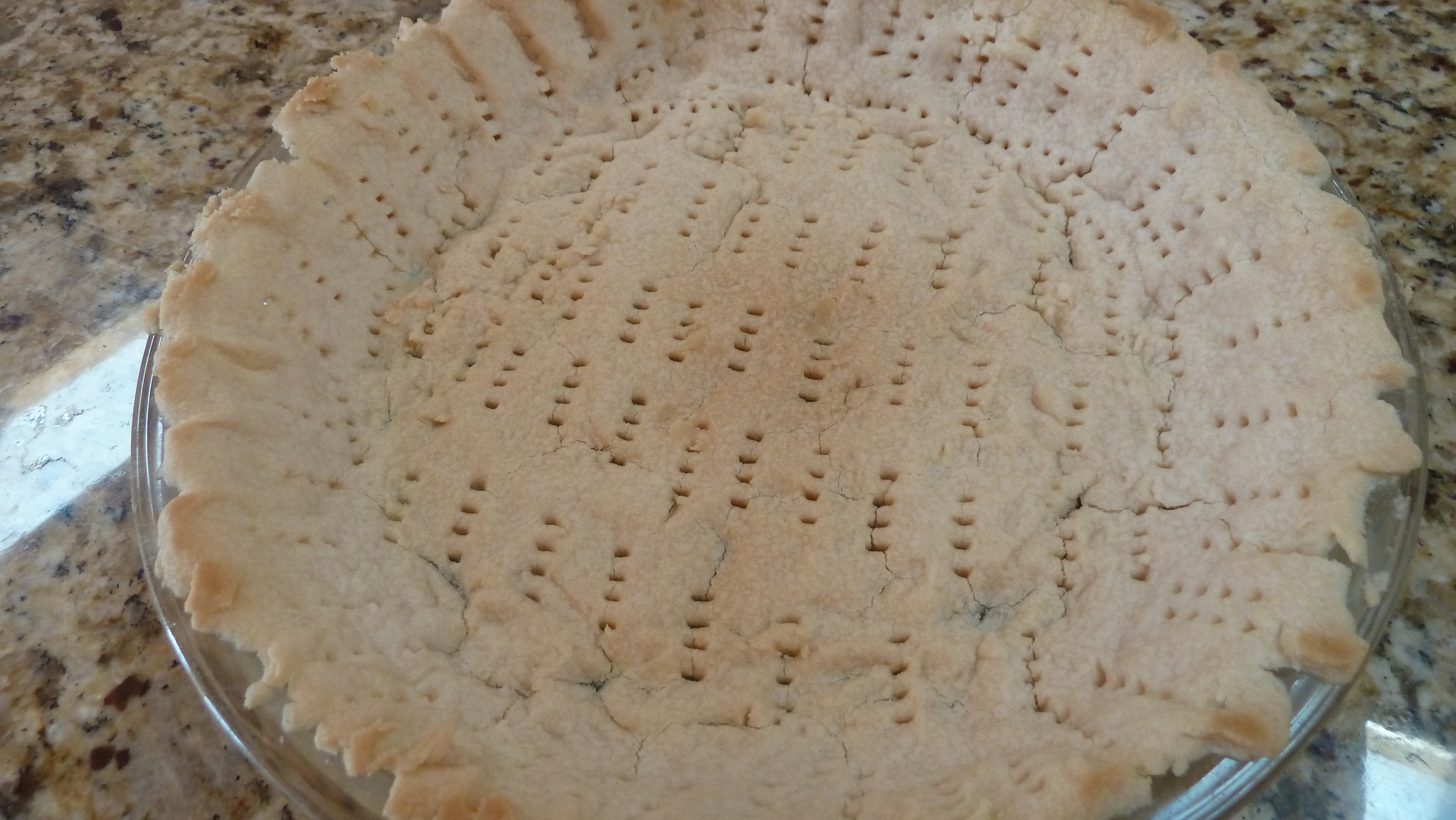
For this pie crust, I used up a half cup of lard (made 2 crusts, froze one for later use) I had in my cupboard from another cooking project. The lard was older, but not rancid, and had softened. I pieced this crust together like I was playing with Play-Doh, pinching and merging it together. It made for a very rich crust which my husband drooled over each time I served it. He has no problems with a crust that falls apart on slicing: the better the crust, the worse it looks.
Raindrops on roses and whiskers on kittens … fresh homemade strawberry pie is one of my favorite things.
Mom’s shortcake with strawberries is another, but that’s for another day.
***
For hundreds of recipes helping you cook whatever’s in season, check out Simply in Season, from Herald Press.
For other favorite recipes see my book, Whatever Happened to Dinner: Recipes and Reflections on Family Mealtime.

We used to have nearby neighbors who, instead of flowers or shrubs in the landscaping around their house, grew strawberries. The Sachs were and are lovely smart people who raised lovely smart kids and I never really set out to copy them. But lo and behold when we moved to a new home my daughter, who lived at home for several years after college and since we were still working on landscaping stuff, said why don’t we plant strawberries instead of bushes or flowers in that bed. (See above.)
I hemmed and hawed and drug my feet. I had tried to grow a bed of strawberries once, before kids, and when they came along I gave up trying to weed and maintain that small bed.
Oh she would do most of the work, she said. But you won’t always live here, will you, I said. No, of course not, but we all love strawberries. And they are so good for you! Think of stepping out our front door …
Well of course she won and for 3 1/2 years she did most of the work in terms of taking care of the beds (while we both picked them and fought the dreaded slugs). Now I’m happy for not just one but two strawberry beds that function as ground cover. And on the steepest slope on our property, the strawberry plants keep the bank from eroding. They seem to thrive in only a little bit of not-great-soil.
It beats weed eating this dang bank.
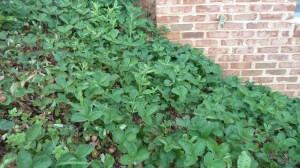
The strawberry beds also function as my morning exercise a few weeks out of the year. Talk about building your core—stooping over a patch of strawberries with feet planted in bare spots in the bed, and holding that pose while reaching far to gather all the berries your fingers can reach. And then when you maneuver your position just a little, you see another whole clump of berries.

But the reward: three quarts (plus a handful) of fresh berries right out your front door and down the bank at the end of the house, that you didn’t have to drive 10 or 15 miles or more to pick. Not as big and pretty, but homegrown.
Sure there is weeding (always), and transplanting and thinning when the bed gets too full (which should have happened last year but it didn’t, so this year the berries are kind of small) and covering up the bed in the fall with straw (which again, didn’t quite happen this year, but even with the harsh winter we had, those plants survived). They are hearty. I just wish I knew what type we planted.
But not to worry. They keep spreading their love and juicy goodness further down the bank and out from the original patches.
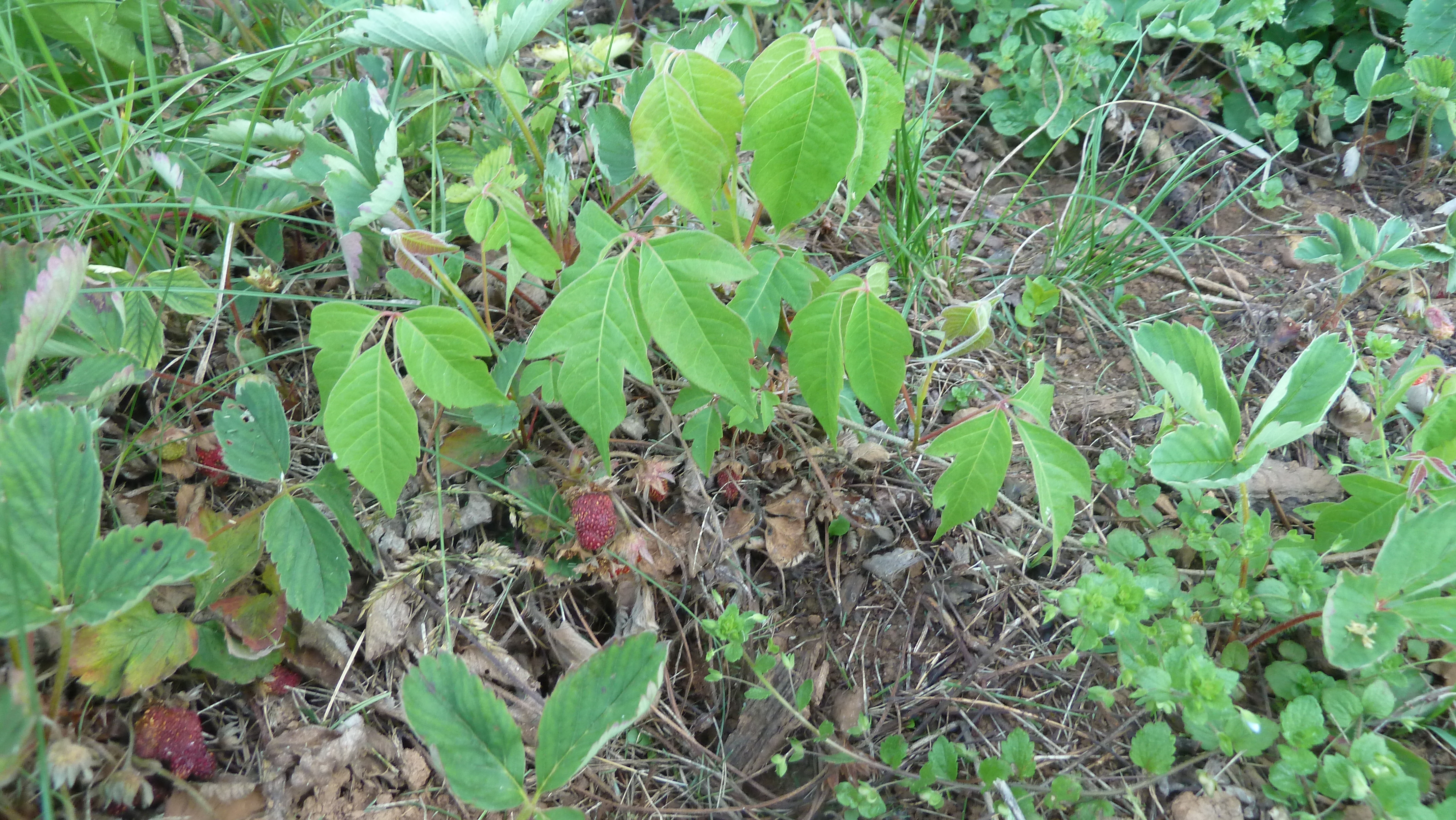
There is one small worry: the poison ivy that stands as a menacing guard over a small portion of the bank patch. And I’m notorious for getting a bad case most years from somewhere on our property. Like last year. So I pick carefully, and just in case, scrub my hands with the mechanic’s friend, GoJo when I’m done.
***
Coming up on my Friday recipe of the week, my favorite thing to make out of strawberries.
What’s your favorite strawberry dish or recipe?
***
Here’s one tasty salad recipe I shared earlier using strawberries and lambsquarter (weeds).
***
Are strawberries found in the Bible? Not really, just if you are reading the paraphrase, The Message, you find some. But it is a passage worth remembering, speaking about how difficult is to control the tongue–kind of like a spreading berry patch, or poison ivy.
“This is scary: You can tame a tiger, but you can’t tame a tongue—it’s never been done. The tongue runs wild, a wanton killer. With our tongues we bless God our Father; with the same tongues we curse the very men and women he made in his image. Curses and blessings out of the same mouth!My friends, this can’t go on. A spring doesn’t gush fresh water one day and brackish the next, does it? Apple trees don’t bear strawberries, do they? Raspberry bushes don’t bear apples, do they? You’re not going to dip into a polluted mud hole and get a cup of clear, cool water, are you?” James 3: 7-12

This is a recipe variously known as Cherry Delight, George Washington Pudding, and probably some other names. Google it, you get plenty of options and photos and all of them a delight to look at.
I loved it as a child and my mother made it from a recipe in our church cookbook which was called “North Goshen Fellowship Cooking,” one of those marvelous collections which is generally only special to the families of the particular church.
In that book a recipe called “George Washington Pudding” (so named I’m sure because of the generous use of cherries from canned cherry pie filling) uses 2 eggs mixed with cream cheese and baked for 25 minutes at a low temperature before you add your cherry pie filling with whipped cream on top. The baking was a bother.
Eventually I found a much easier and better recipe just called “Cherry Delight,” and what is special now is that it came from the kitchen of a woman who became a teacher for at least 2 of my daughters, and a beloved one at that, Sara Ann Showalter.
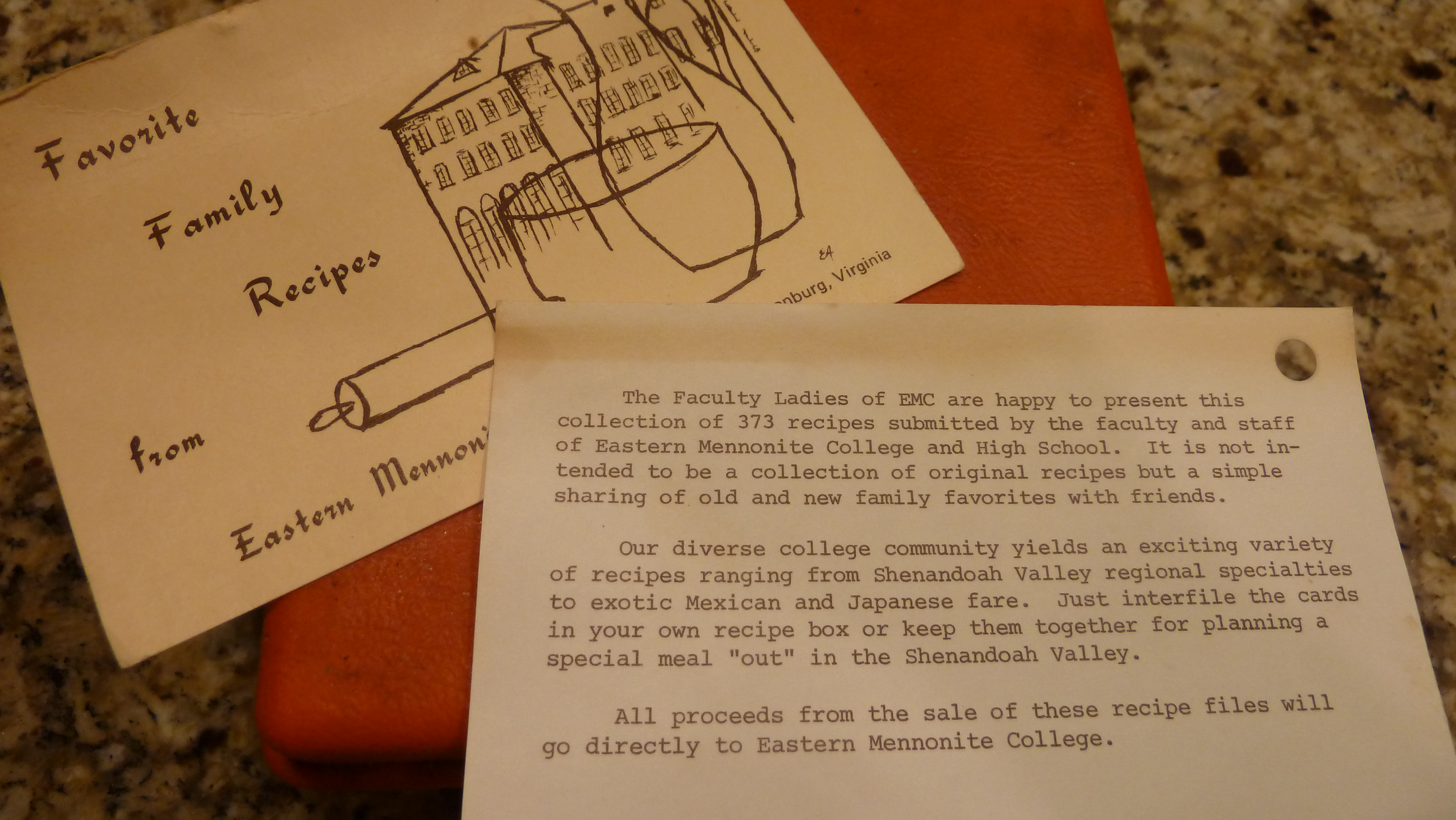
But the back story is that the recipe card comes from a recipe box collection created by the faculty, staff, and spouses of what was then Eastern Mennonite College in a valiant fund raising effort of some kind on behalf of the college. I do not know or recall the particular financial crisis but I’m sure it was some threatened budget cuts which the faculty rallied to raise some funds—token, I’m sure. (See notation at the bottom of this card. Also note they were called “the faculty ladies.” Click on card to enlarge as needed.) The cards were hand typed and then printed off and cut into the proper 3 x 5 standard index card size.

But the memorable part of this effort was that someone came up with the idea to collect the recipes onto cards and real boxes (plastic). Students, families and staff spent an evening in the North Lawn basement cafeteria collating the collection.

The index cards were laid out in proper order on the dining room tables and each volunteer would go up and down the rows adding recipe card after recipe card in order. The names on the cards are a trip down that memory lane for sure—Anna Frey’s “Orientation Punch” which she served to me in her home when I was in her freshman orientation group, and who died much too young of a heart attack.
On to the recipe.
Cherry Delight – adapted from Sara Ann Showalter* (and as the card adds, Mrs. Millard)
First layer:
2 cups Graham cracker crumbs
½ c. melted butter
1 Tablespoon powdered sugar
2 teaspoons clear gelatin powder
Mix together and pat into 9 x 12 baking dish. Press down with hands to flatten (can use waxed paper if you don’t want to use bare hands since this is not a baked crumb crust). Chill in refrigerator for 15 minutes to harden.
Second layer:
1 8-ounce container whipped topping
1 8-ounce package cream cheese (softened)
½ cup powdered sugar
1 teaspoon vanilla
Mix together and beat with mixer to combine well. Spread layer of cream cheese mixture onto the Graham cracker crumb layer (a bit challenging, but take your time).

Third layer:
Spread 1 can cherry pie filling on top.
Chill. Cut into squares to serve. Delicioso!

My family all loves it, especially my youngest, who often requests it instead of a birthday cake, and even tried to make it the semester she was a student in Scotland using canned cherries (without any cornstarch), spray whipped cream (the only kind she could find that didn’t require a mixer) and the sprayed cream of course lasted only long enough to become a disastrous mess. It went down in infamy. I have a photo she sent but, perhaps mercifully, I can’t find it now.
* Sara Ann Showalter taught fourth and second grades (and maybe some others) at Linville-Edom Elementary School for many years, a beautiful woman and awesome teacher. She died much too young too, of cancer. I remember her “grandparent” circle–a day when the children invited grandparents or other beloved senior citizens to come to school to share memories and traditions. Her husband, Millard, had a hobby of memorizing and reciting poetry and long passages of scripture. He’s still living and regularly greets guests at the nearby (country) McMullen Funeral Home.
***
What memories or persons do the cards in your recipe files bring to mind?
***
What memorable fundraising projects do you recall from your school or college days?
***
For more favorite recipes see my book, Whatever Happened to Dinner: Recipes and Reflections on Family Mealtime.
I have written before (here) of our practice as a congregation to hold Sunday morning worship services in homes 3-4 times a year as a way of being more “New Testament” or like the early church. We meet as small groups or house churches, which form the basic structure of our church, a congregation of about 130 people (not everyone participates in house churches, and that’s o.k.).
This past April, I hosted my house church meeting at our home (my husband had to work that Sunday) and in a quiet moment of reflection during our service that morning I was stunned to notice something in my house (built seven years ago) I had never observed before.
I looked up after a prayer and my eyes were drawn to a cross in our living room.
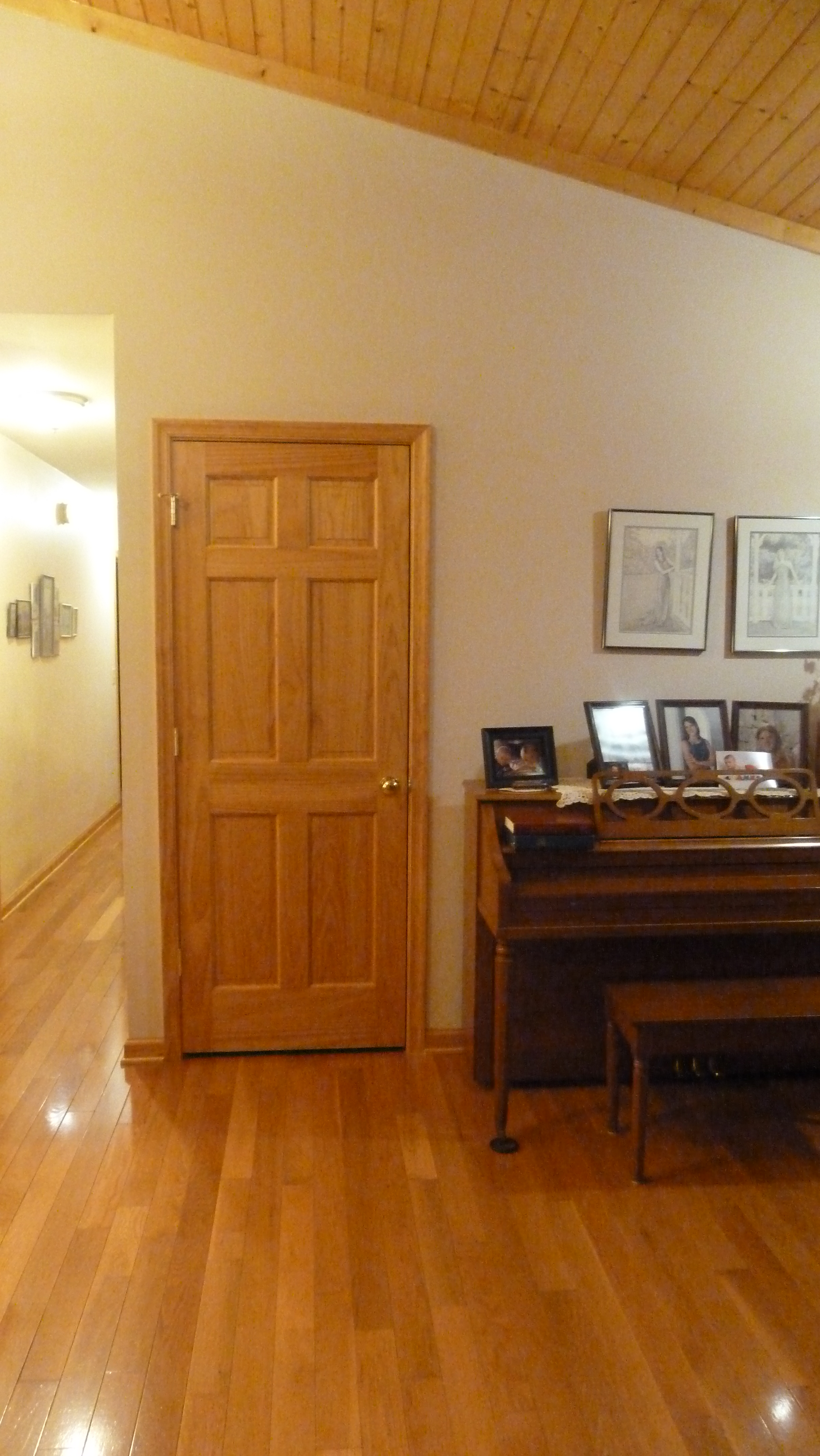
There on a closet door in the living room was a perfect, stunning cross. Then I realized it was visible everywhere we had an inside door: on closet doors, bedroom doors, bathroom doors.
Why had I never become aware of it before? Why did I suddenly see it in that moment?
The doors are just simple six-panel wooden doors available in any big box home improvement store, but the cross bars and upright are dimensioned as a typical cross.

Now you’re going to think I’m going to mention seeing a shrouded Jesus in my toast this morning too. I don’t wish to make too much of it, but if the photographer* who looked up and saw this skyline configuration and realized it formed a cross and submitted it as a church bulletin cover, he or she too was noticing a nice symbolic image in his or her daily landscape.

We are people of the cross. Theologians debate various theories and some try to downplay the role of the cross in the Christian faith, believing a good and loving God would not “demand” such violence as integral to Christian faith, or ask that God’s son die such a cruel and horrible death. Isn’t that the same as abuse, they ponder? How is it different than Abraham “almost” sacrificing his son Isaac before the little lamb shows up? How can Christians be comforted and believe such things?
I believe that God and Jesus and the Holy Spirit are the great Three-in-One however, so it is God who also suffered the agony of the cross in the form of Jesus. It is God who endured that intense pain. It is God who so loved the world …
If we can’t believe in the truth of the cross then we don’t have much of a religion. I will leave it to minds greater than mine to debate and theorize (and the link I included above does a decent job of covering some of the issues being debated). But I believe with the Apostle Paul:
“… We proclaim Christ crucified, a stumbling block to Jews and foolishness to Gentiles, but to those who are the called, both Jews and Greeks, Christ the power of God and the wisdom of God. For God’s foolishness is wiser than human wisdom, and God’s weakness is stronger than human strength.” (I Corinthians 1:22-25)
We are still in the Easter season, and as the song says “Every morning is Easter morning from now on.” Thanks be to God our faith doesn’t end with the cross, but with the empty tomb and life everlasting in the presence of that loving God.
So my house is filled with these gentle (albeit horrific) reminders of the love and grace extended to all humans, and the potential by faith to grasp and claim God’s love for all.
***
Is the cross a difficult symbol for you? Why or why not?
***
* I wish the people who made bulletin covers would identify photographers and locations for their photos but they never do, so I’ll just identify it with the copyright as printed on cover, MWM Dexter, Inc., Aurora, Missouri © and indicate it was selected as PC9USA) Bulletin No. 14F04.
(My slightly late but sincere entry for a special May Mennonerds blog series on Anabaptist convictions, one of which needs to be believing in the centrality of Jesus and his death on the cross.)
For more on what some believe about the cross, check Third Way Cafe.

 findingharmonyblog