

Part 2.
As noted yesterday, my daughters and I came up with the idea of having a “lawn party” theme for my husband’s 60th birthday. Here is the lowdown.
First I need to explain that in Virginia, a “lawn party” is a euphemism for a carnival, a term which came into play during a time when carnivals were considered not quite decent or kosher for members of some churches (I have not documented this).

A lawn party is put on as a major fundraiser by fire departments, rescue squads, Ruritan or any club and requires the all-hands-on-deck cooperation of dozens, even hundreds, of volunteers. You have multiple food booths, fair or carnival type games, maybe rides (or at least a jumping cage for the kiddies) and at the really big ones, a Tractor Pull. The general community gets in the act by coming out in droves for two or three nights over the weekend for their evening meal (Thursday, Friday, and Saturday) and many happily donate cakes for a “cake walk” (to be explained shortly). Small town—or up and coming regional bands (or bad karoke music) supply mostly country or blue grass music from a small stage.
So here is how our indoor lawn party went down.
Music. Two daughters prepared a playlist of their father’s favorite music of the 60s and 70s, back when we actually listened to pop music. Great music like: Monster Mash, Up Around the Bend (Creedence Clearwater Revival was one of my husband’s fav bands), Proud Mary, Heard it through the Grapevine, Lookin Out My Back Door, Bad Moon Rising, Smoke on the Water, Radar Love, In-A-Gadda-Da-Vida (by Iron Butterfly), You Don’t Mess Around with Jim. You get the idea. Good stuff.
Food. I tried to serve typical lawn party food, adapted to the home scene: barbecues, (fried chicken, no I didn’t fry it myself), chips (instead of French Fries), soft drinks—with the addition of veggies and cheese which you would never find at a lawn party but, well, there had to be something a little nutritious! There was not much left at the end of the evening.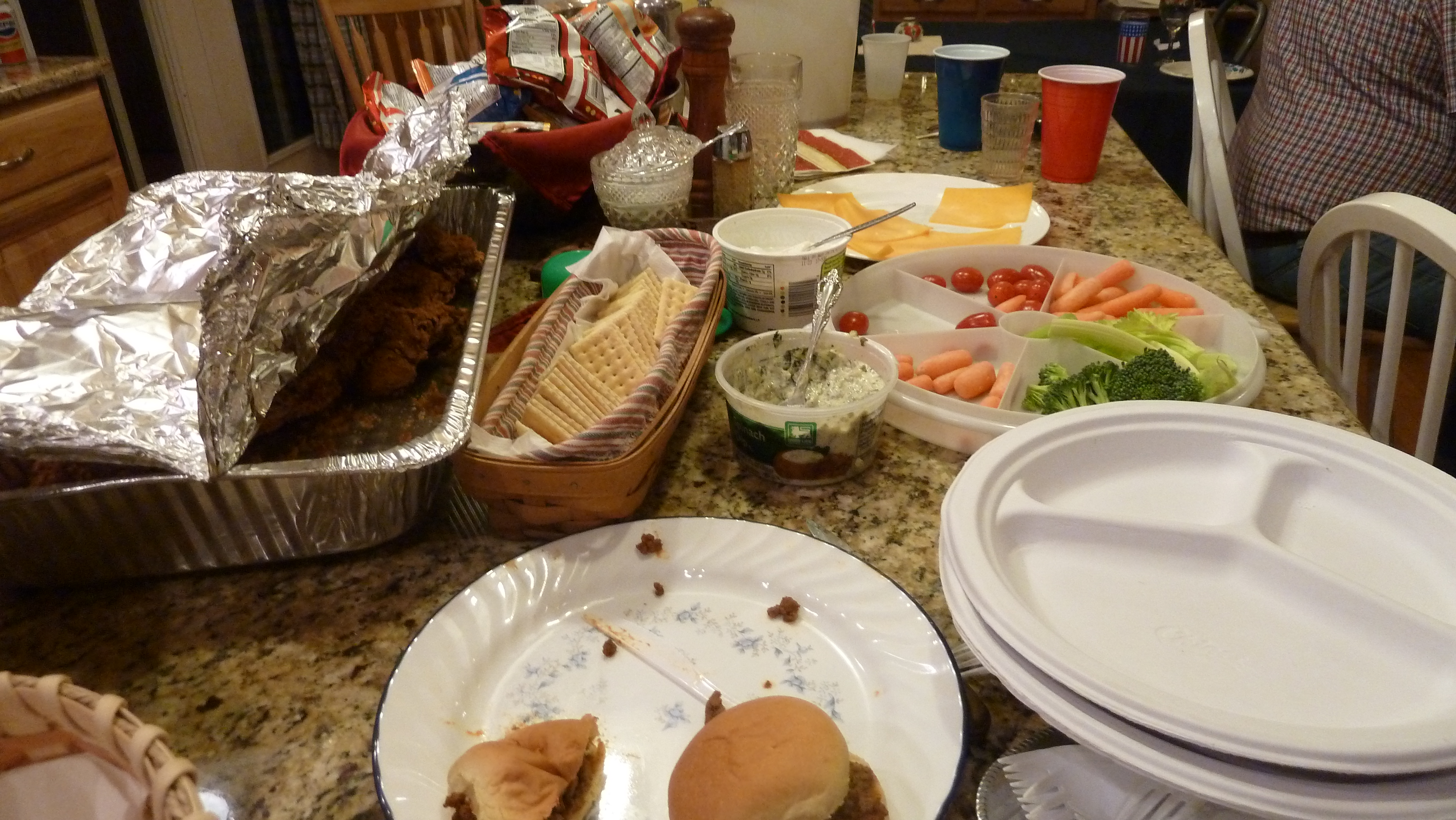
Games. Let me tell you, I had no idea how we’d actually do some of the games below going in, but my daughters helped think through plans that would work.
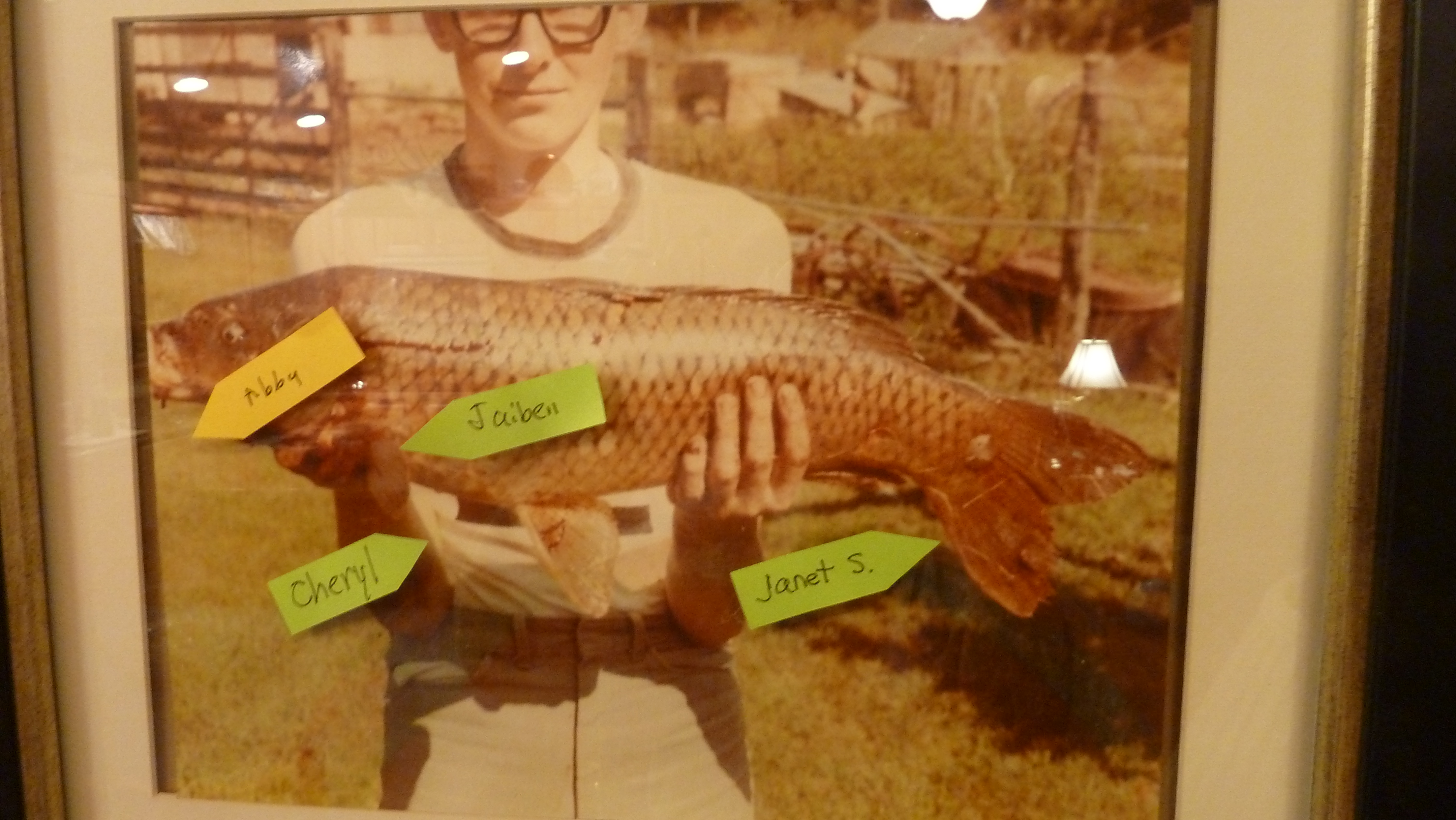
Go Fish! Or Pin the hook on the Fishie. I blew up a picture of likely the biggest fish my husband ever caught as a kid, and we stuck post it notes on the picture with the closest “hook” winning a prize.
Dime Toss. I invited my daughters to scour their cupboards for mugs and cups and saucers they were not using; I also visited the local MCC Gift and Thrift Store and bought up a small supply. I dug up all of the dimes I could find in the house and allotted each player 5 dimes for their turn of tossing a dime, one at a time, trying to land one in a cup or dish. One vase had a dollar bill rubber-banded to it as a special prize. We used the dining room table (but forgot to get a picture of it in action) and for a while the dimes were flying everywhere (but not dangerously, which was a slight concern). Two of the boys later turned it into a ping pong table, using one of the prizes (a small ping pong set) he had won.

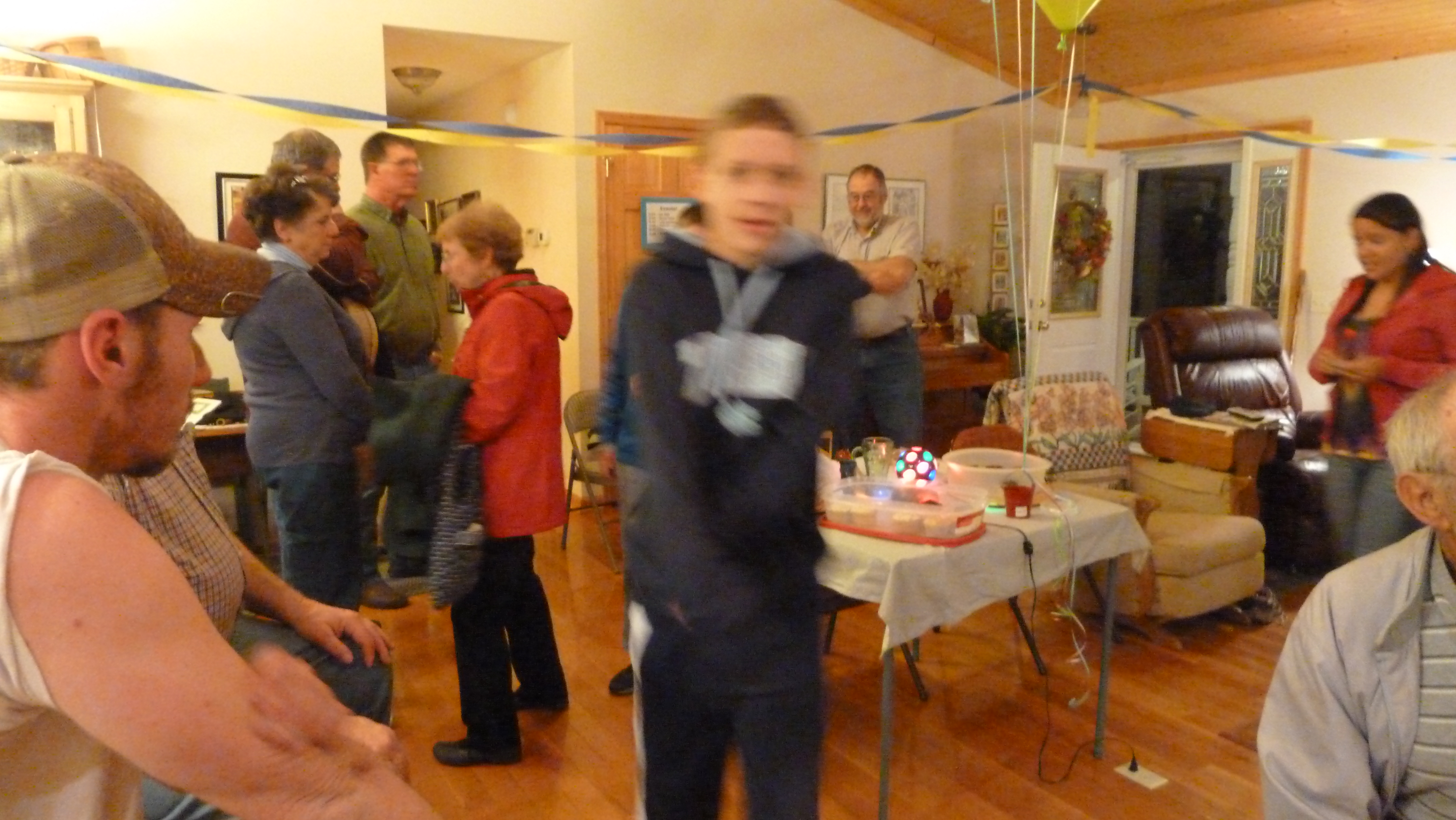
Cake Walk. Our version was a little like musical chairs with small posters on the floor each bearing the name of one of Stuart’s vehicles (or our family vehicles) through the years, more than 11 different cars/trucks/minivans. It was fun reminiscing and would have been more fun to blow up old pictures of each one, but that would have taken a lot of digging for photos. So while the music played, players walked around the “cake table” (which was bearing cupcakes), and land on one of the posters stating vehicle brands, and the game chief drew small slips out of a basket bearing the names of the vehicles. Whoever stood on that poster would then win his/her cupcake. (At a real lawn party, each winner would have received a real whole cake. Too much for our small scale party. Cake table shown below).
Log Guessing Game. I’ve never seen this at a lawn party, but taking my husband’s affinity for cutting wood, burning wood, and frequently expecting that his daughters and I just “know” the different types of wood as well as he has come to know them over the years, we came up with 10 samples of wood growing on our property and let people do their best guess of which was which, from a multiple choice list. My environmental scientist daughter prepared a careful answer key, also shown below.
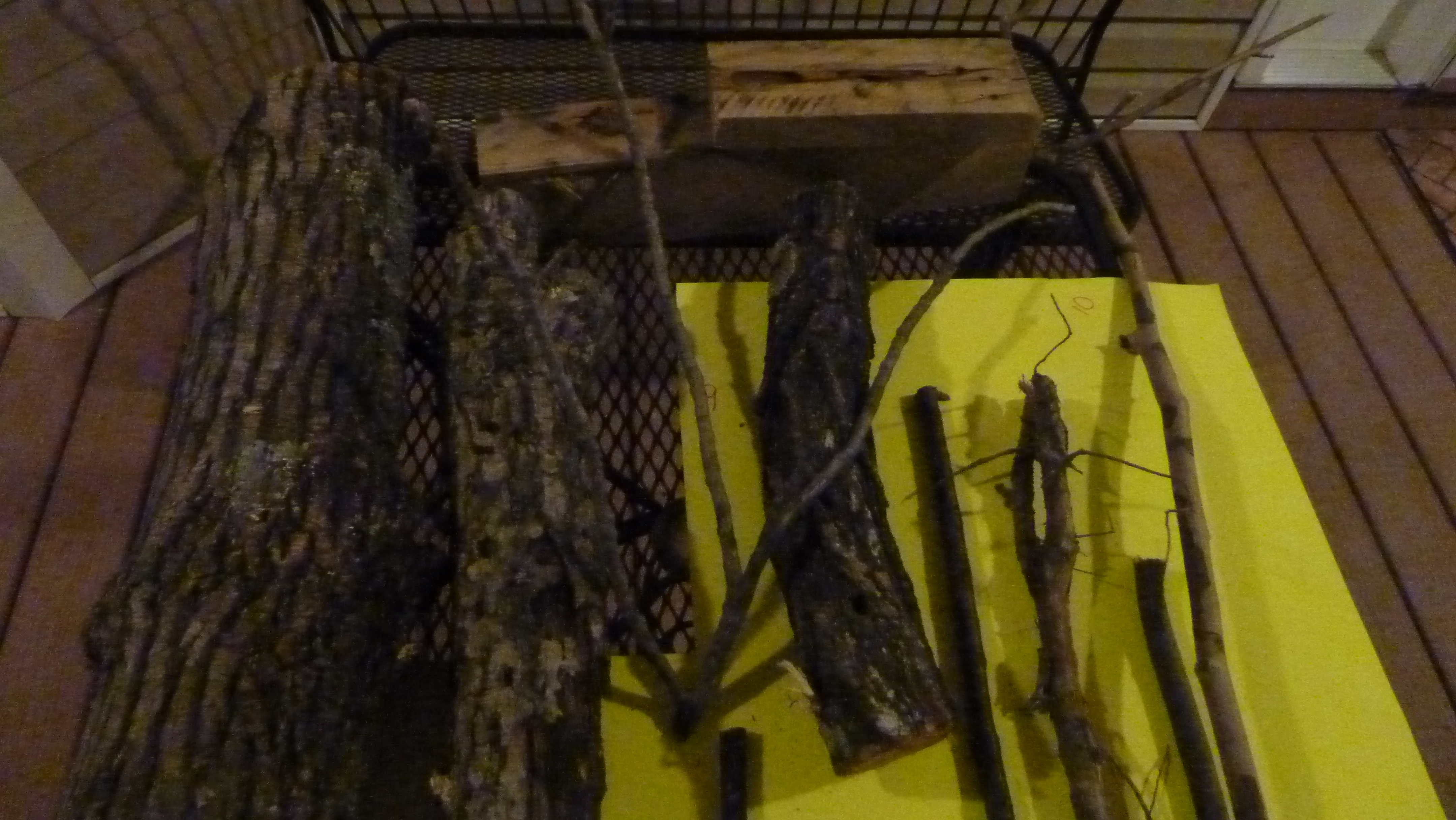


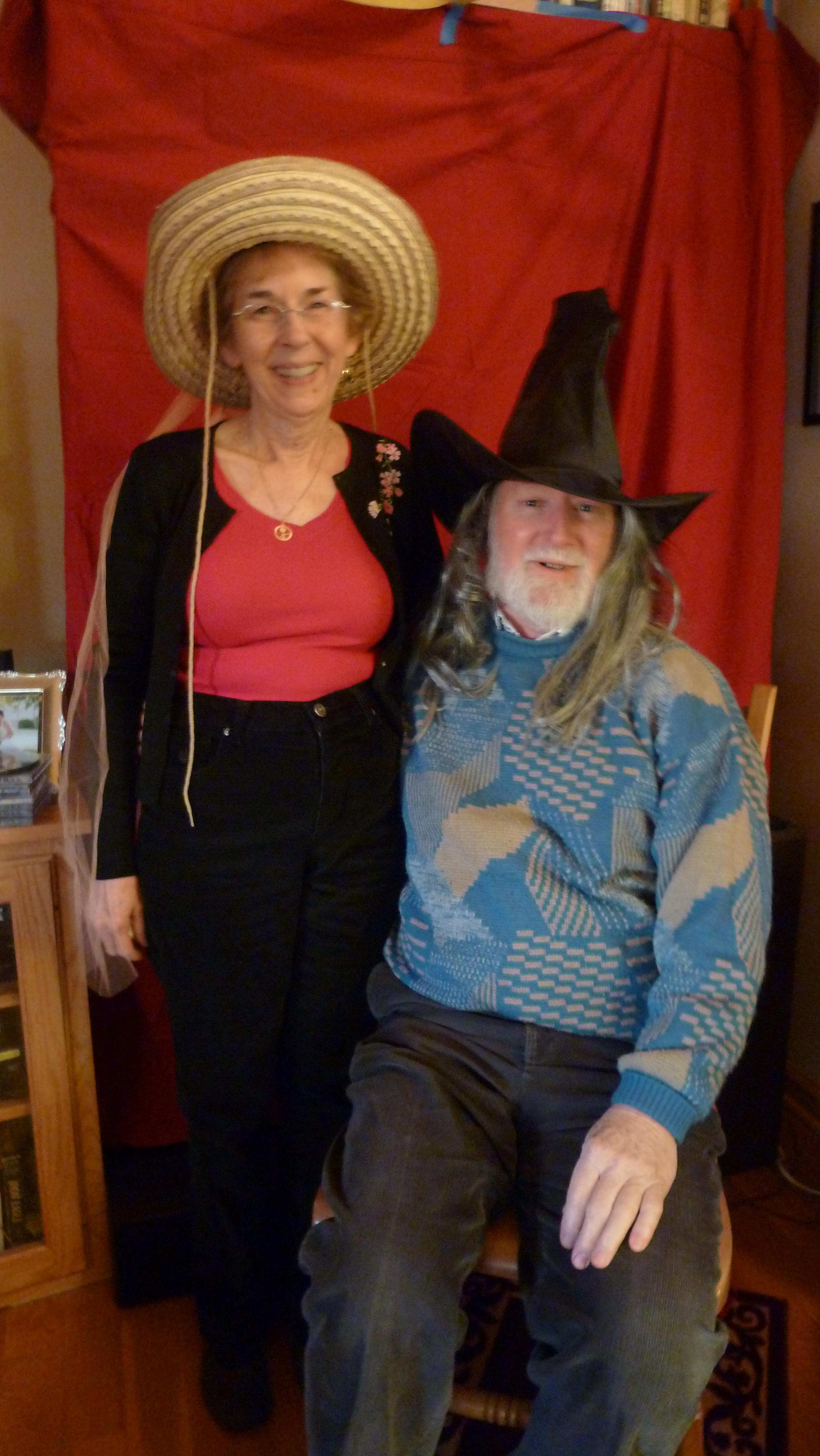
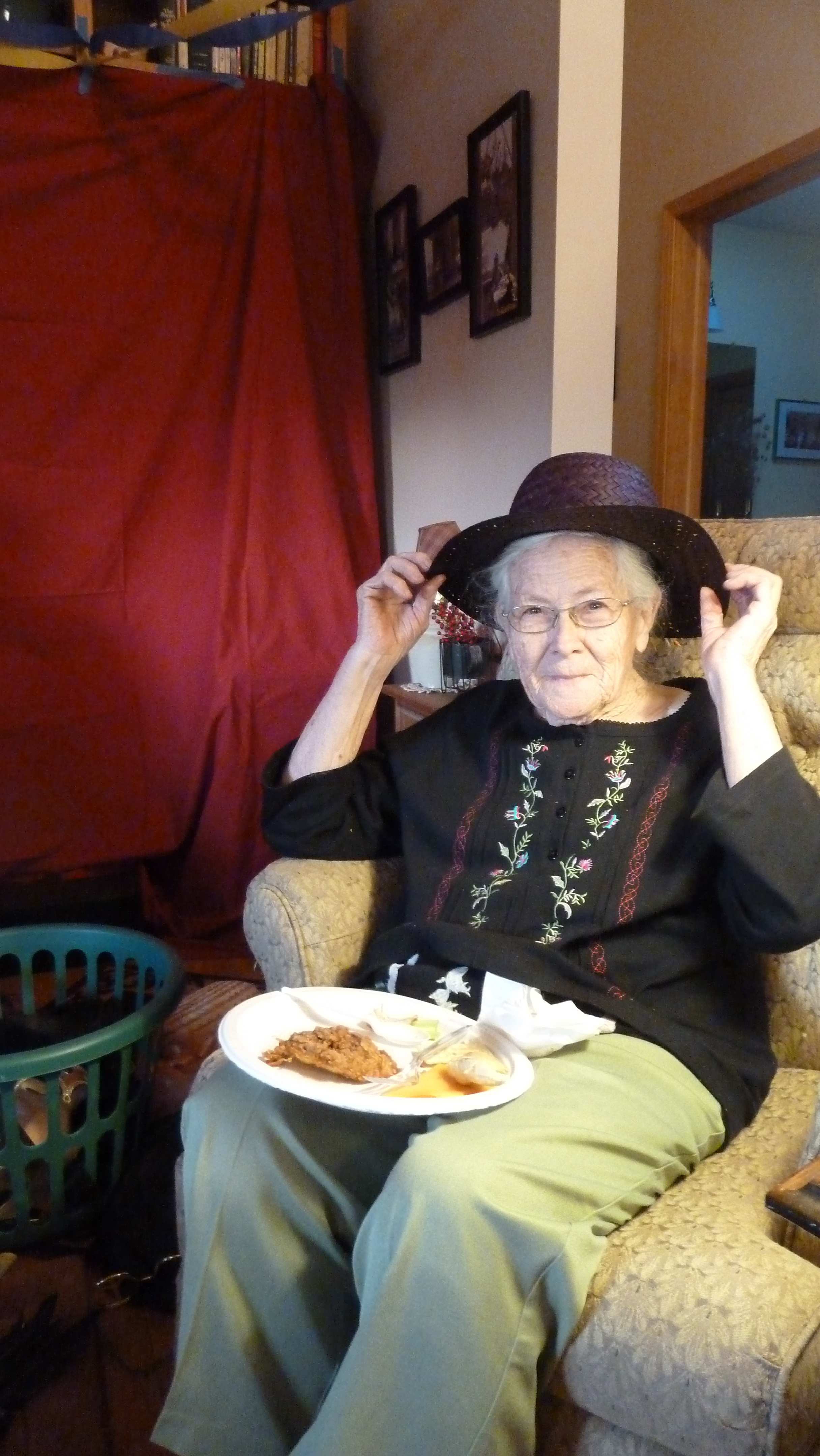
Photo Booth. I’ve never actually seen a photo booth at a lawn party either but this idea was kind of culled from amusement parks where you can dress up in old style clothing. So two daughters brought props and I combed the attic for old musical and Halloween costumes. Some guests seemed to enjoy hamming it up a little for the camera. Especially Abby and Jaiben.
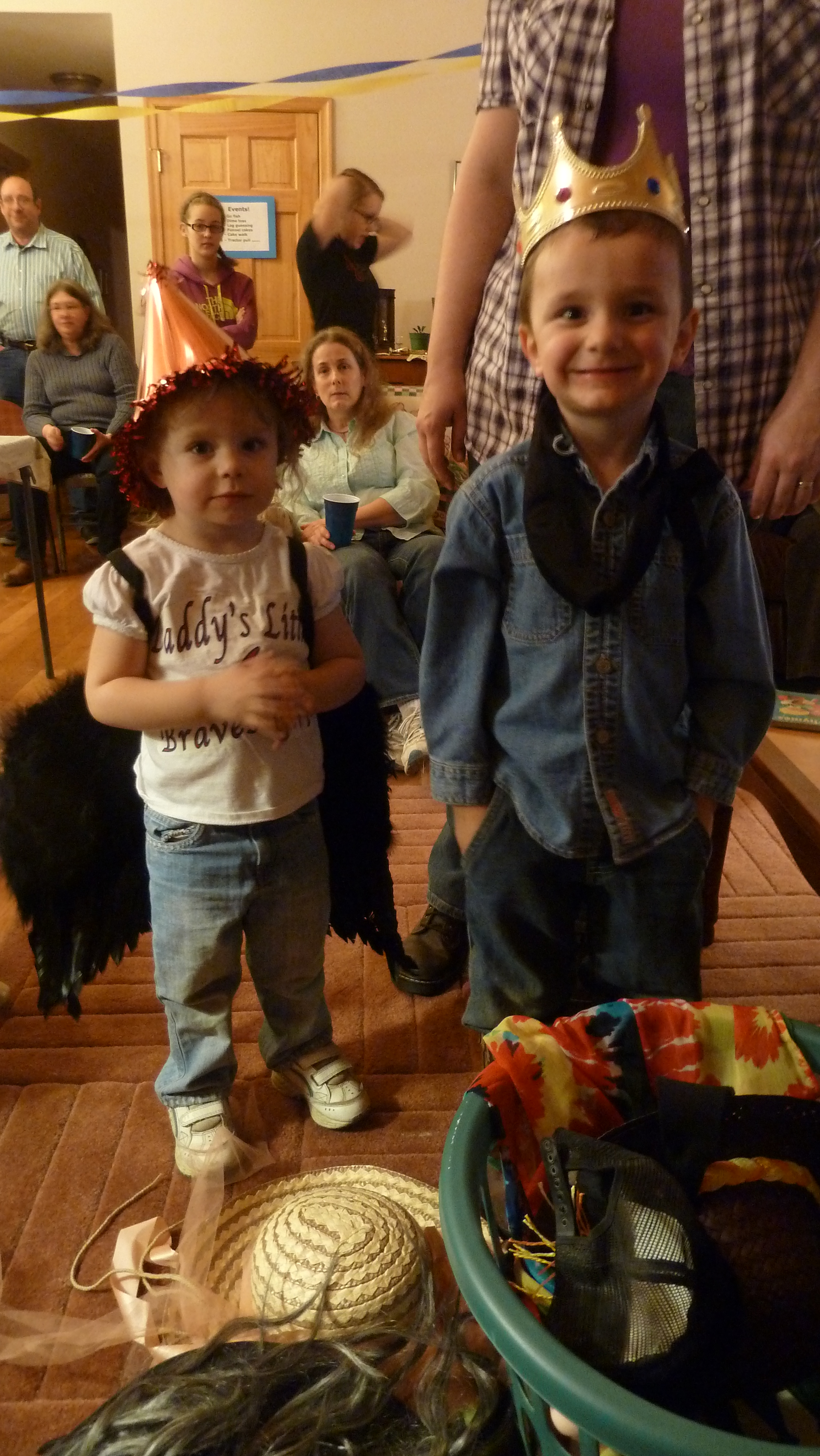
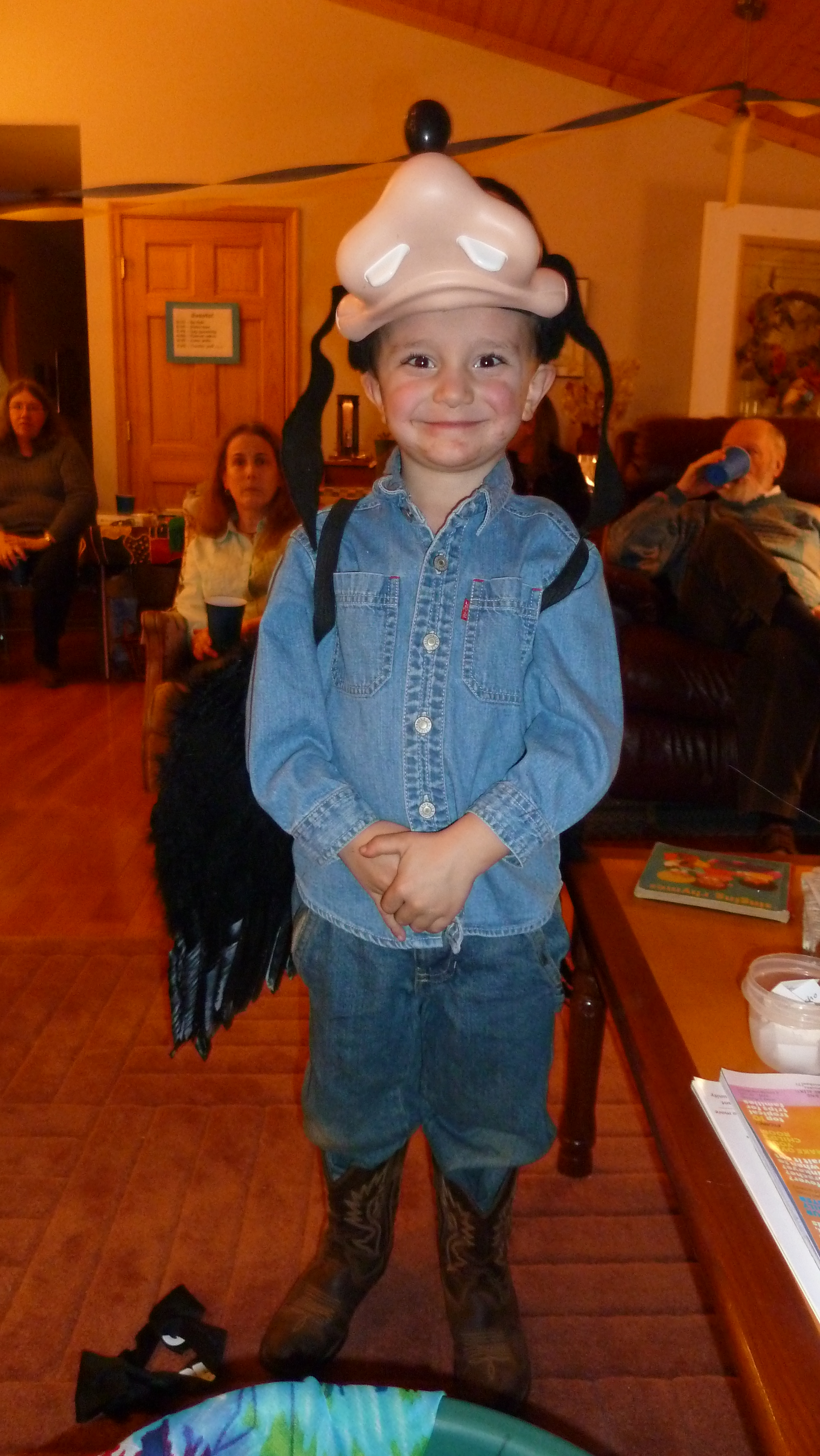
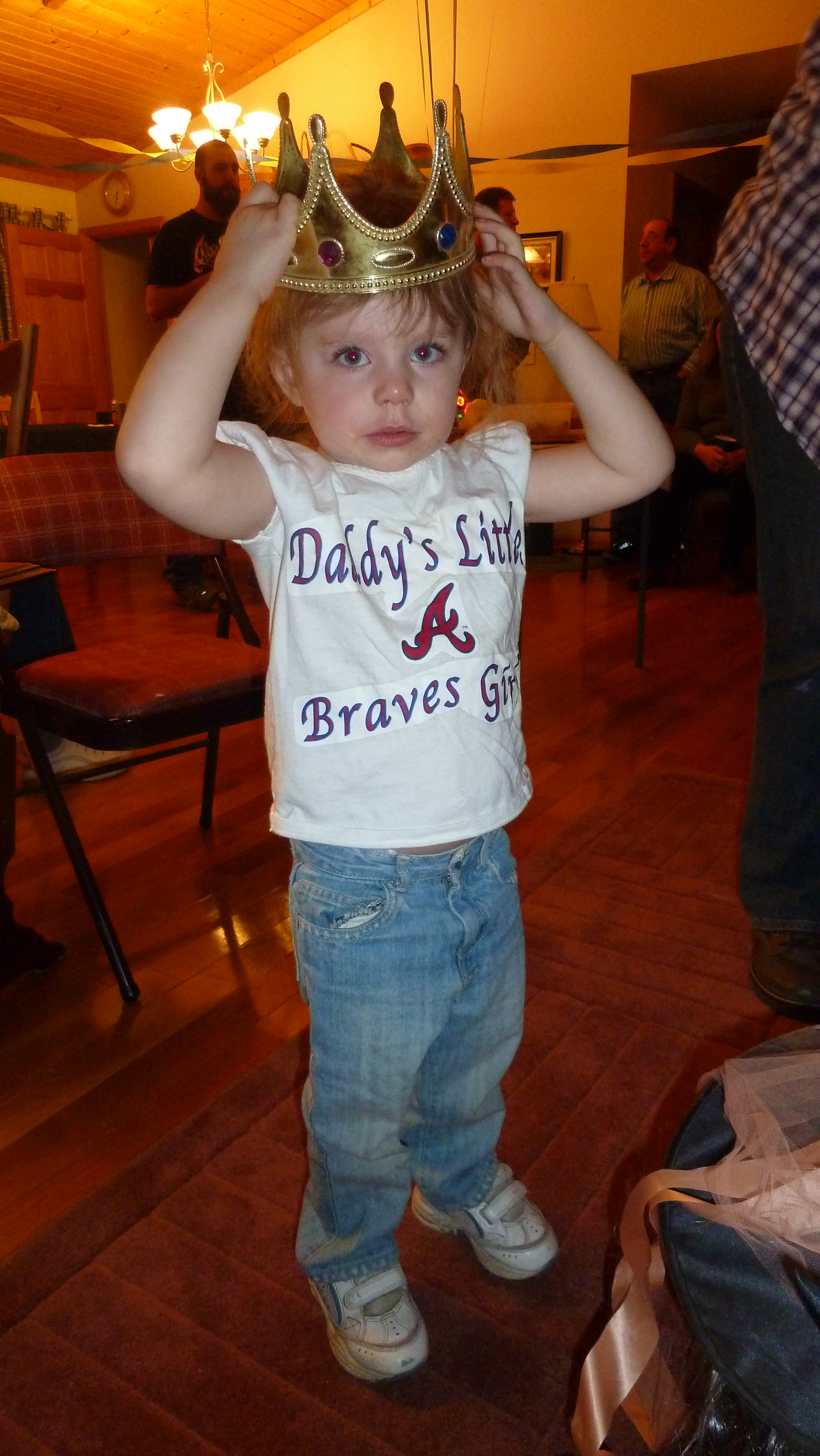

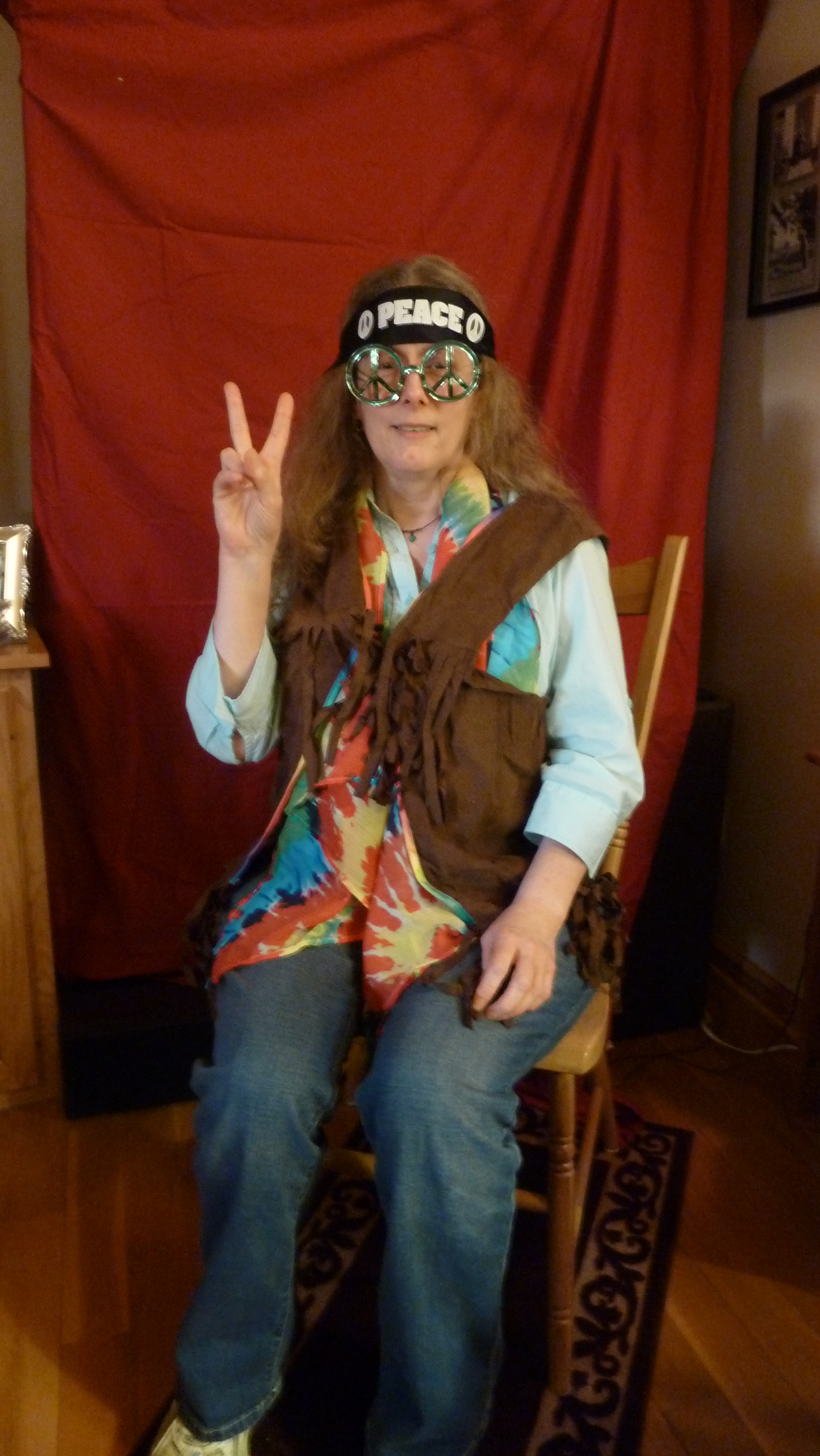
Is Mary a great hippie or what? (she even has the right kind of name)!

Tractor Pull. The game that some of the kids were excited to try was our version of a tractor pull. Again, for the uninitiated, this is where tractors of all sizes and descriptions, and in some cases old antique tractors, line up for a chance to pull a “sled” that increases its resistance as the tractor putts down the smooth dirt track. The tractors belch puffs of smoke, the crowd cheers, and the guy who manages to get the farthest down the track wins.
Our “sled” was an upside down dolly, the “track” was two lines in the basement cement, and we added resistance with increasing weights—up to 70 pounds.
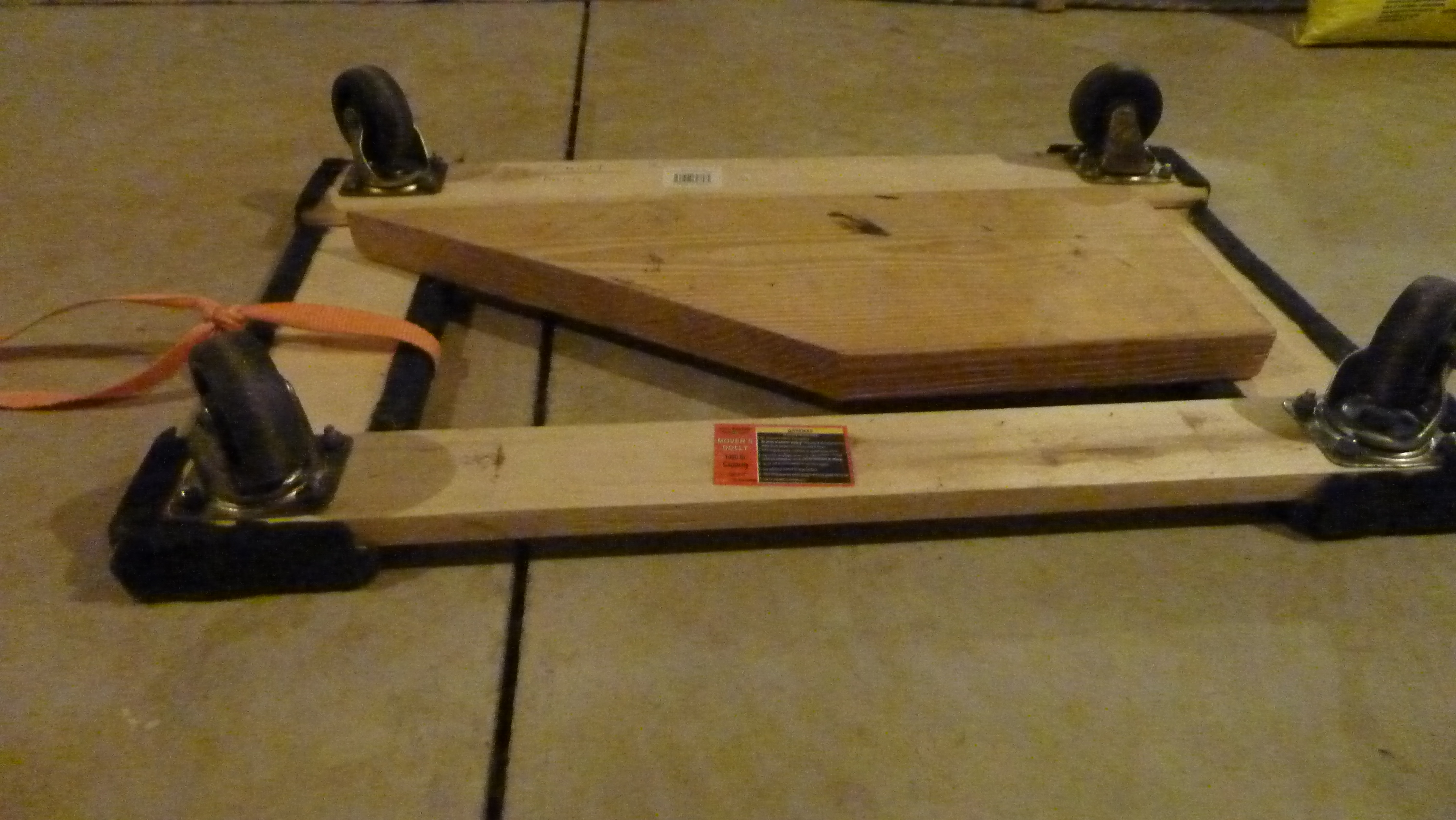
Upside down dolly base
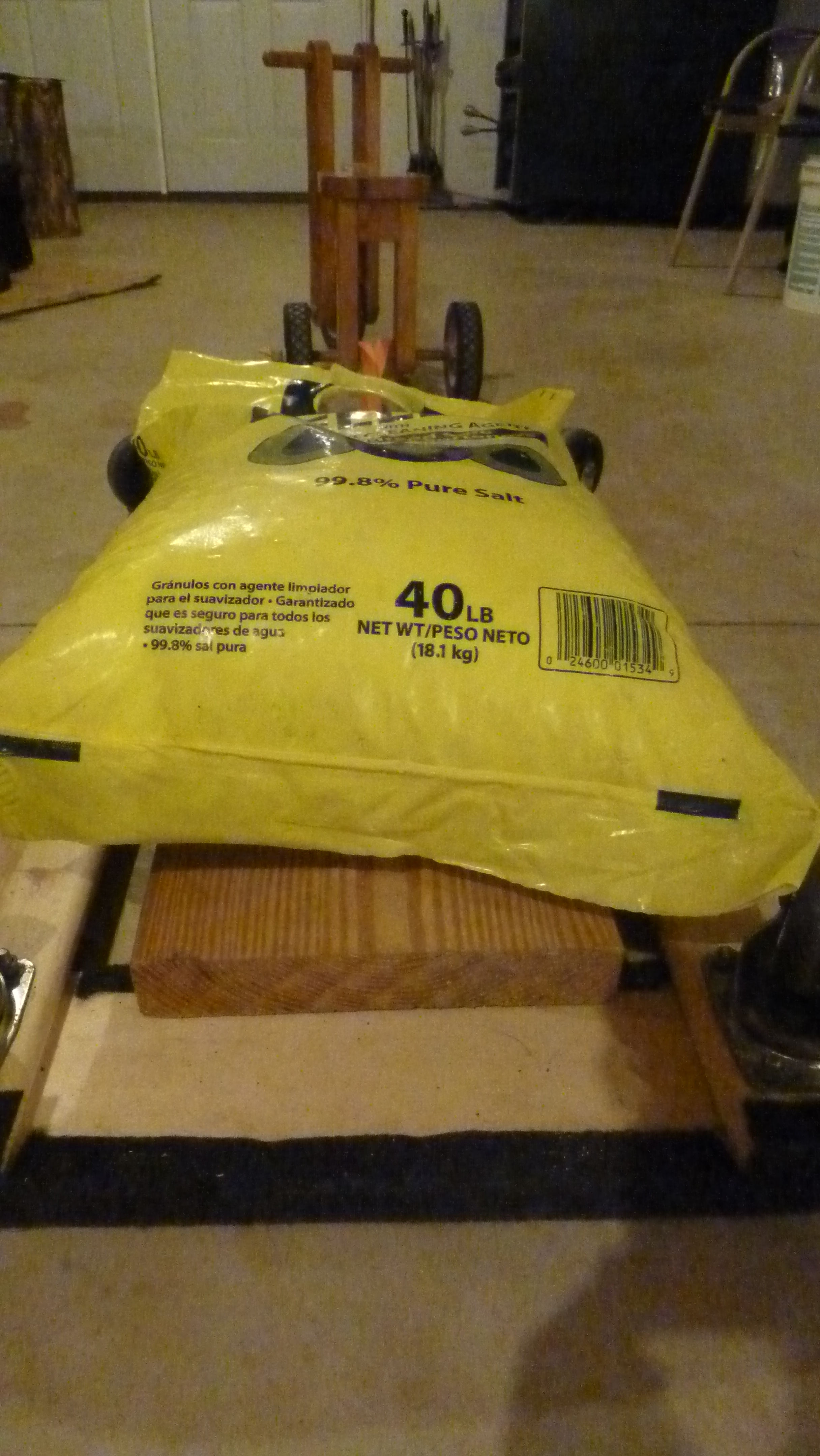
First “weight:” 40 lbs salt

Second weight added: 14 lbs cat litter
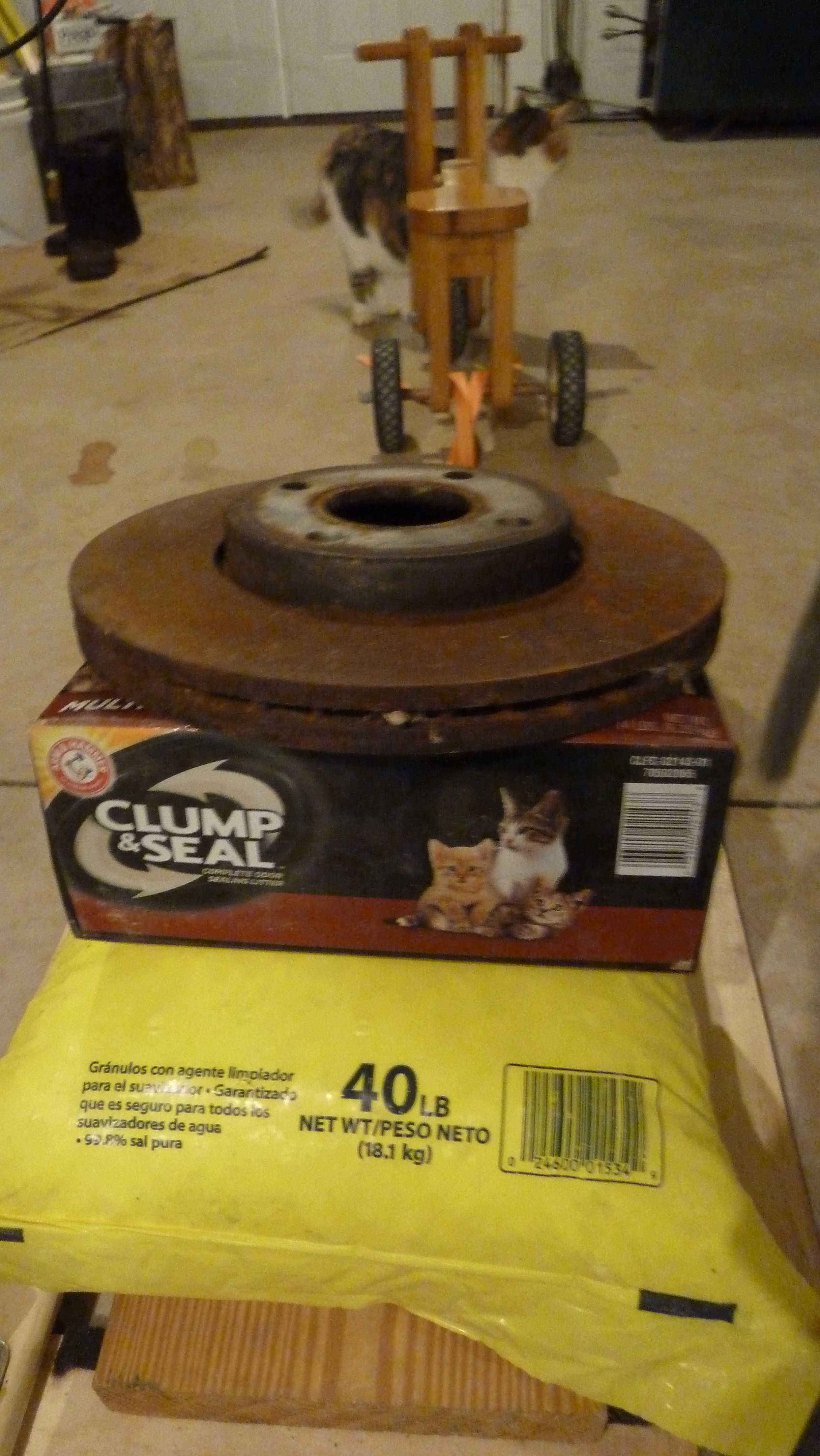
Final weight: old brake drum, 16 pounds
The “tractor” was an awesome little wooden riding toy my husband built about 30 years ago for the children (in an adult woodworking class) which is rumored to be indestructible (even a 250-pound man can sit on it with no ill effects to the toy).
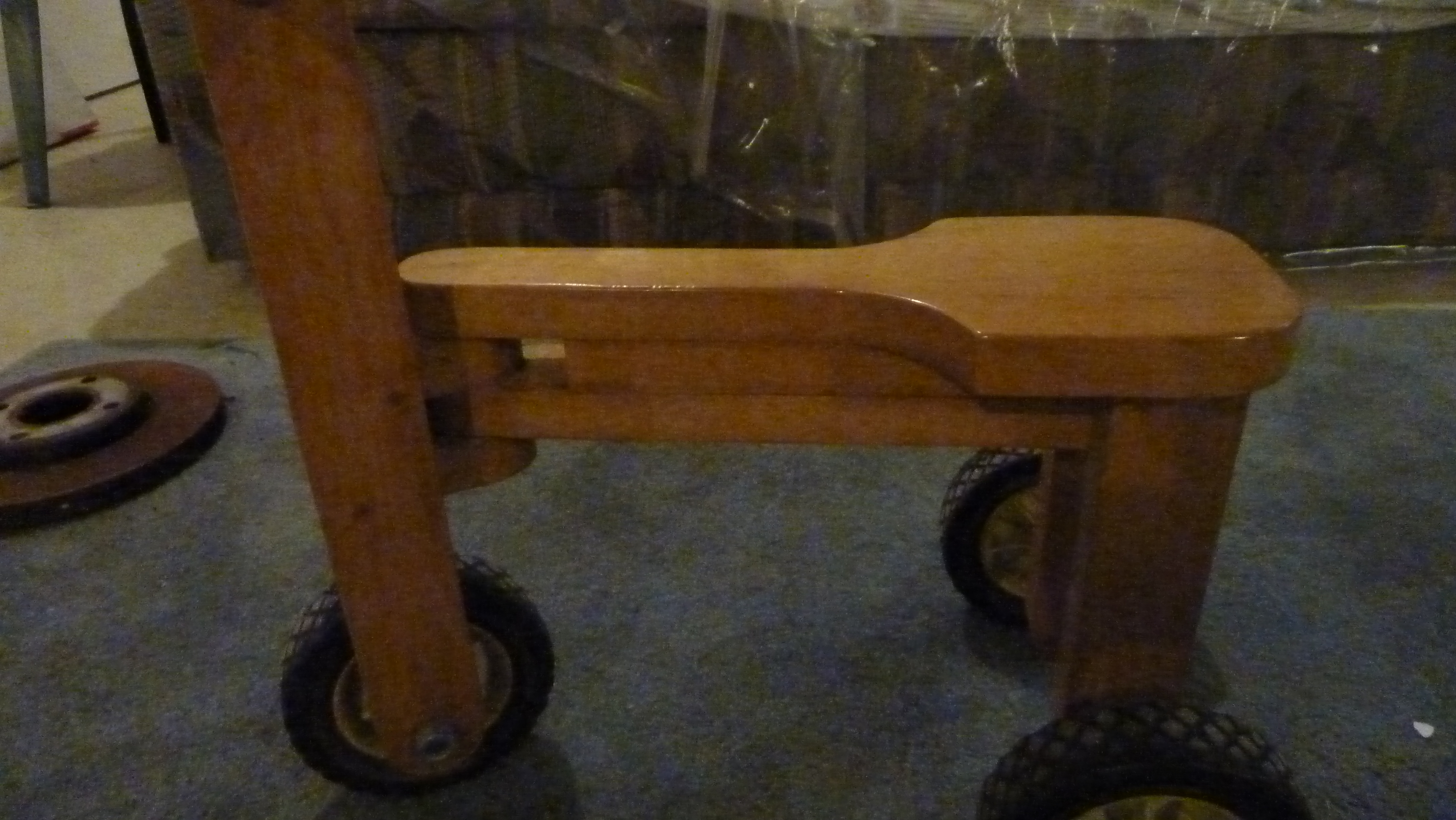
The “crowd” in this case were impressed that the toy could pull 70 pounds.
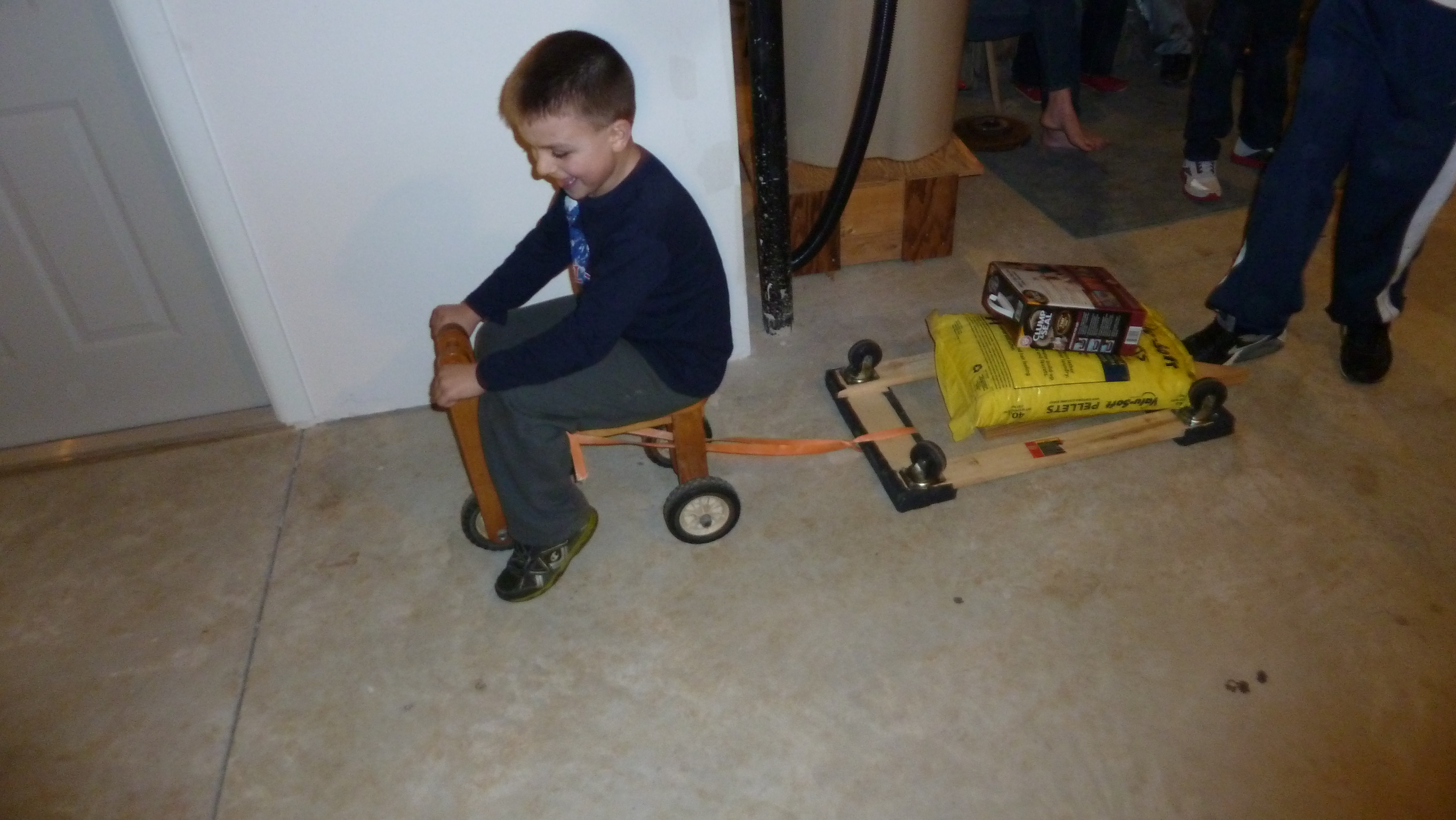
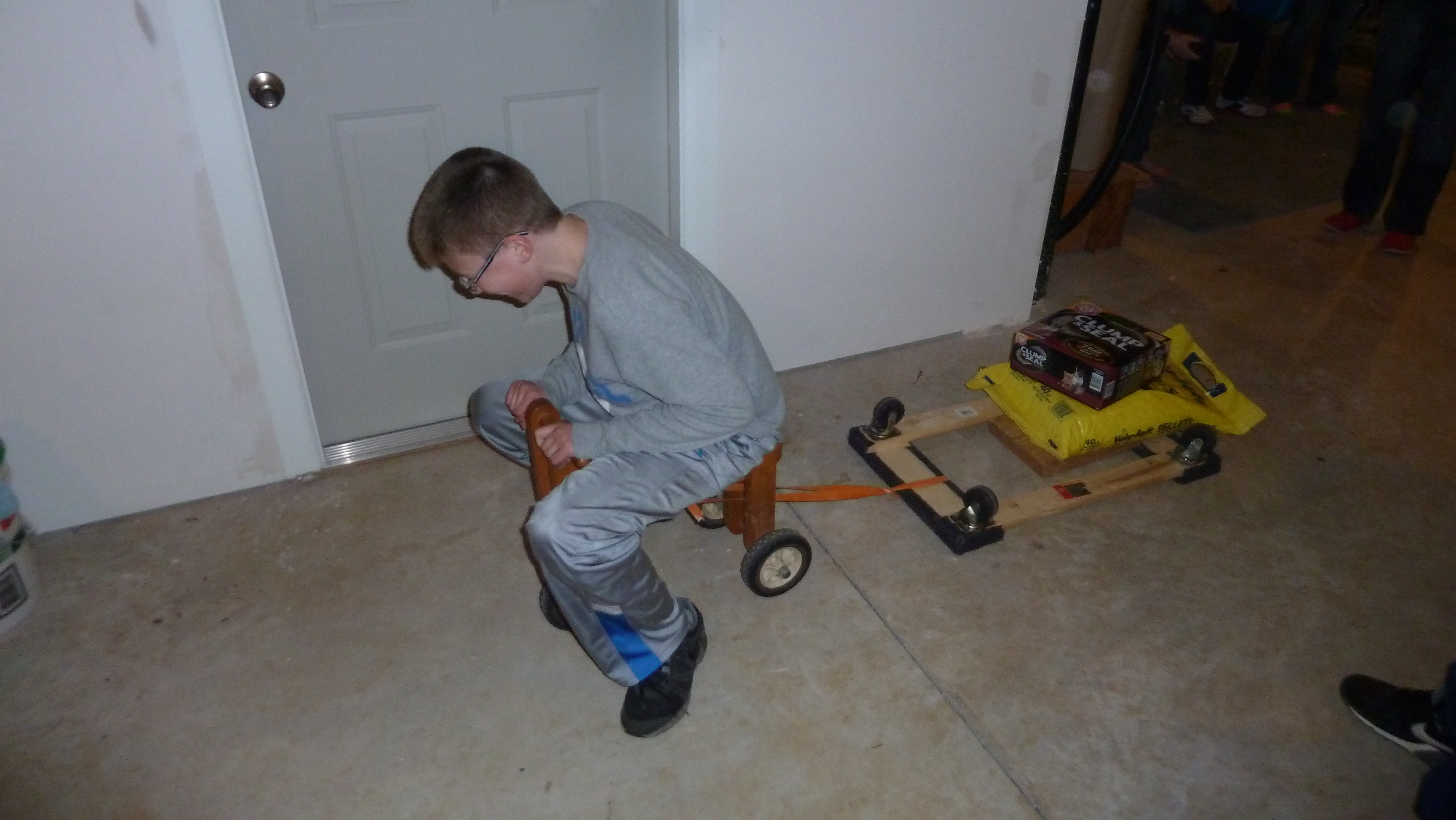
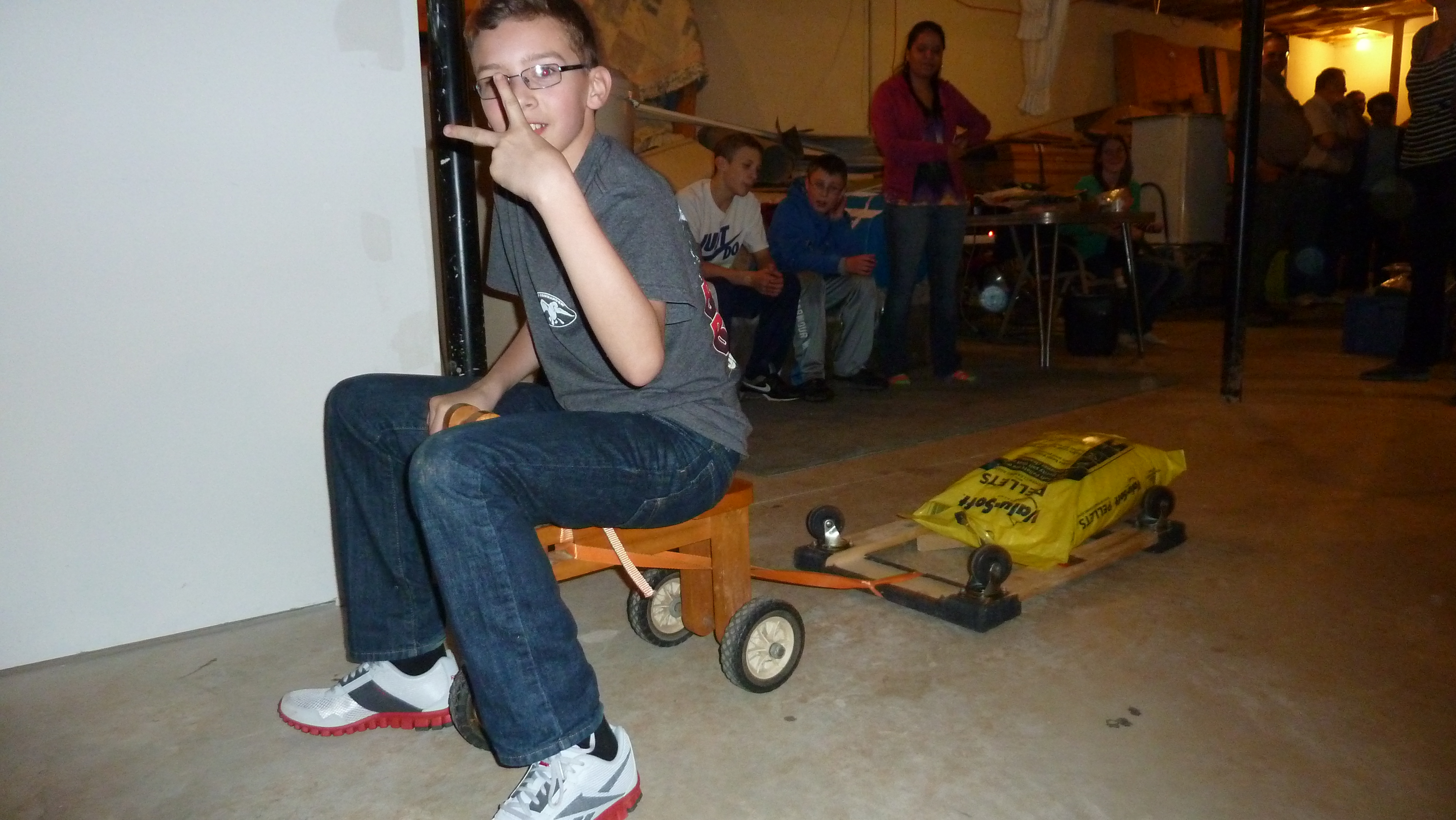
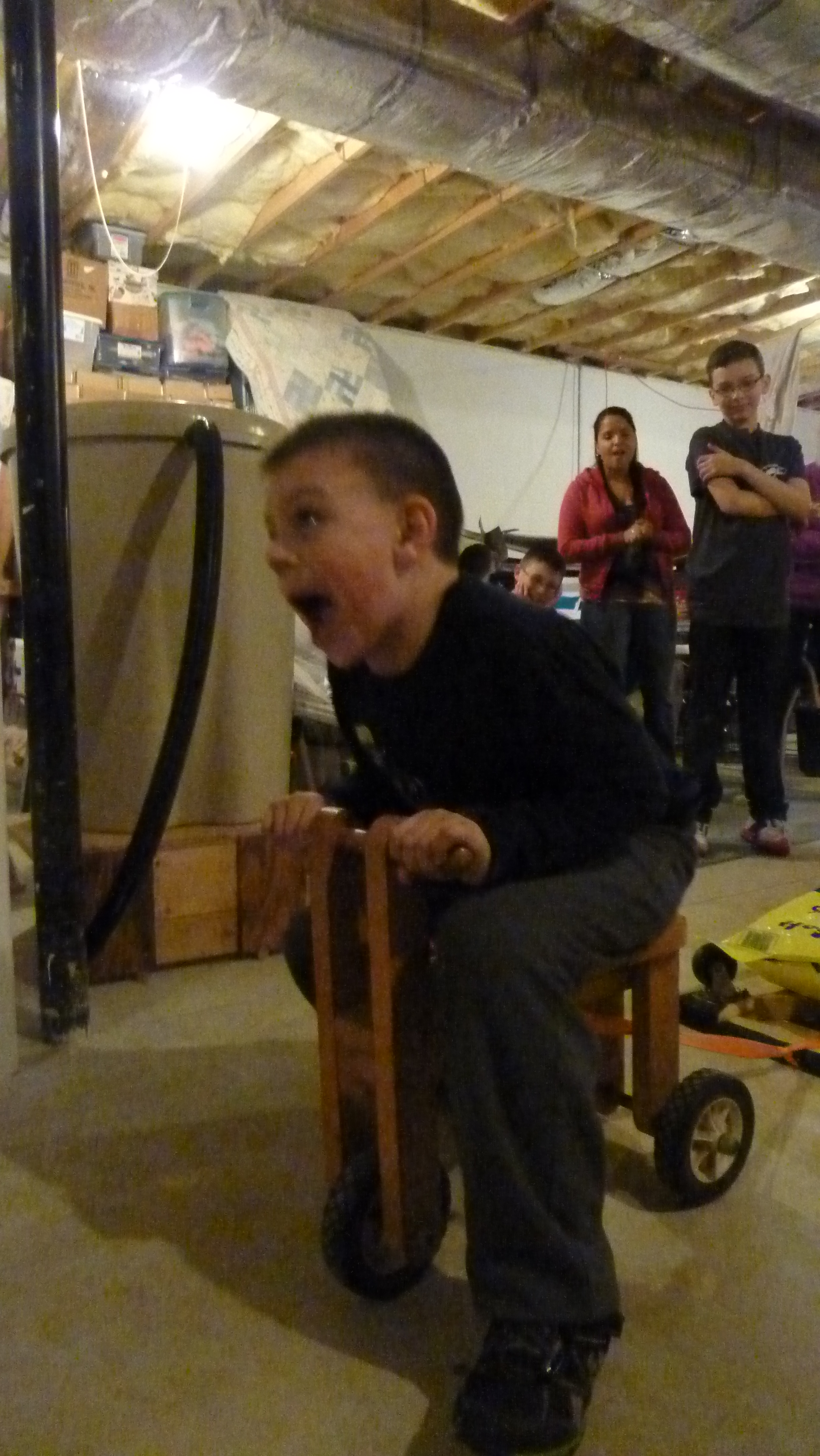
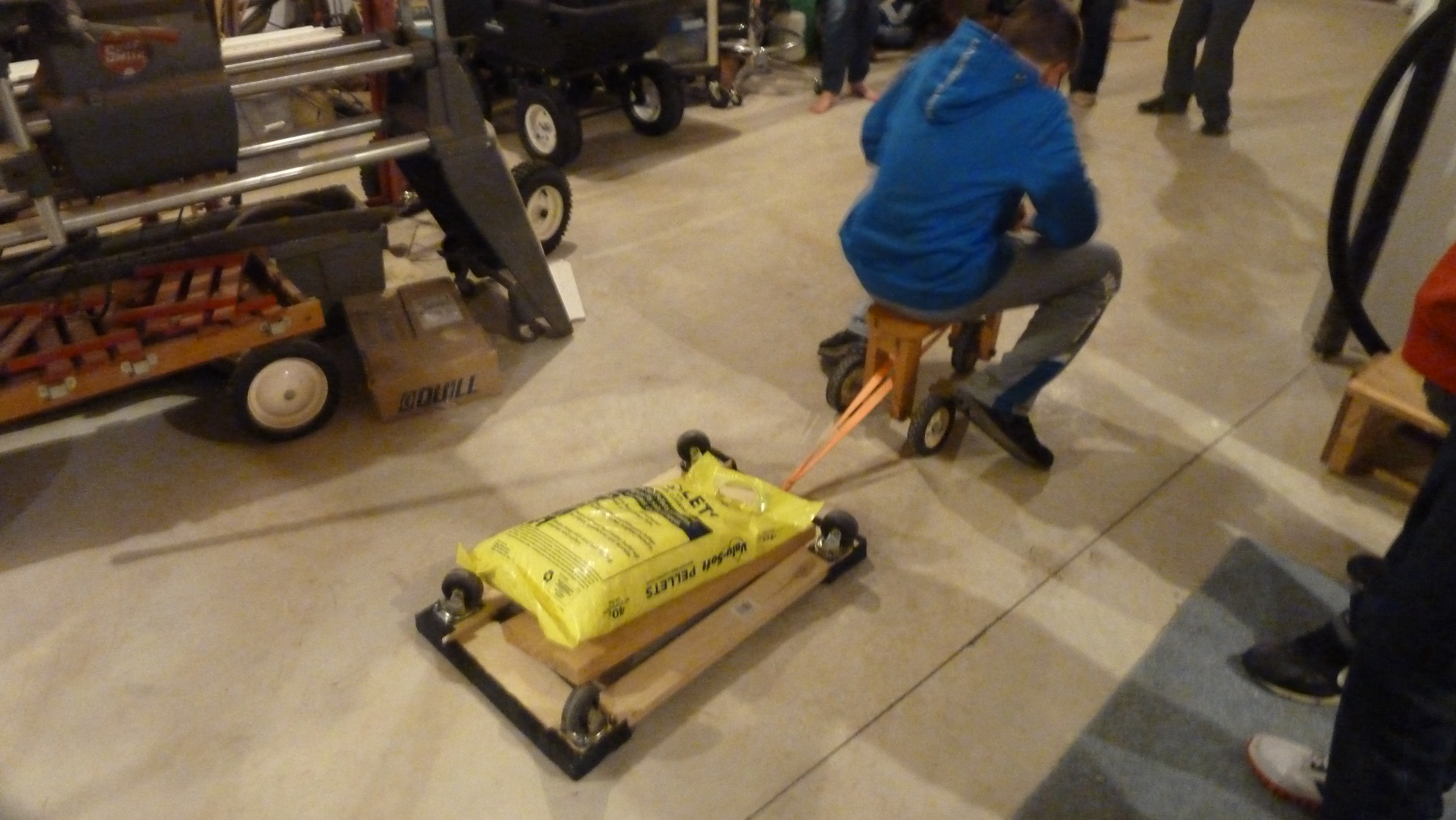
The tractor pull also gave us confidence the riding toy will likely stand up to any punishment our growing grandsons will give it. 
All participants were declared winners, and encouraged to please please please grab a gift from the prize table (mostly while elephants I was happy to move out of my closet).
In the end, yes, it took a little creativity and a little leg work and elbow grease, and I think we had as much fun working together, as friends and family had in participating (and thanks to dads who pitched in to take care of little ones).
We would have loved to invite even more friends and relatives. Weather wise, it was the most beautiful Saturday we’ve had in a while so I hope everyone else had just as much fun doing other things on that fine day. Everyone has busy schedules and we so appreciate all who took the time to come celebrate with us–which is what birthday parties are really about.
On Friday, I’ll blog about making real lawn party food, funnel cakes. As I was preparing for this party, flipping through reams of old photos to find the fishing picture of my husband, I was struck by all the photos of birthday parties in my boxes and albums. That is because it is one of the times parents and everyone is more inclined to snap pictures. I know a family whose grandchildren live 630 miles away yet they frequently drive the 1200+ mile round trip in order to be present for those important occasions. We didn’t often do that—drive to my folks’ for birthdays nor did my parents drive here—but sometimes celebrated in conjunction with other events which 1) made me glad we celebrated as often as we did, but also 2) mindful that you can never get together often enough.
As we planned this decade birthday party, I particularly remembered the line of Helen Poindexter from my church, a beautiful English prof for many years and now in her 90s. At a 40th birthday celebration for our pastor, Helen quipped, “Oh to be 40 again.”
How true. Someday we’ll wish we were “just 60” again. So it goes. The moral is to enjoy each day as you live it, like Thorton Wilder wrote in the play, “Our Town.”
(Most photos courtesy of Brian Sinclair and other family photographers.)
***
Do you have “lawn parties” in your area as described above? I have not run into them, really, in any area other than Virginia. I’m sure there are similar carnivals and small fairs and fundraisers, but does anyone else call them lawn parties? Hope you’ll comment!
Have you ever driven a ridiculous distance for a birthday party of a family member or friend?
Part 1. Hatching the idea.
I’ve been to plenty over-the-hill parties given at the ripe age of turning 40 (and 50, 60, 65), and after about the second one, I was tired of the gravestone themes (especially when so many loved ones die for real way too early); the boxes of “senior” diapers given (especially when your own dad has to start wearing them); and the gag gifts of prune juice and fanny floss.
So for my husband’s 60th, I wanted to do something a little different that was in the spirit of my husband’s many interests and loves through his life so far. Two years ago when I had a decade birthday my daughters threw a wonderful surprise (not to be topped) party where the highlight was everyone pitching in to make homemade yeast raised donuts in the church kitchen. We had made such donuts at least one other time for a party and they wanted to repeat that.
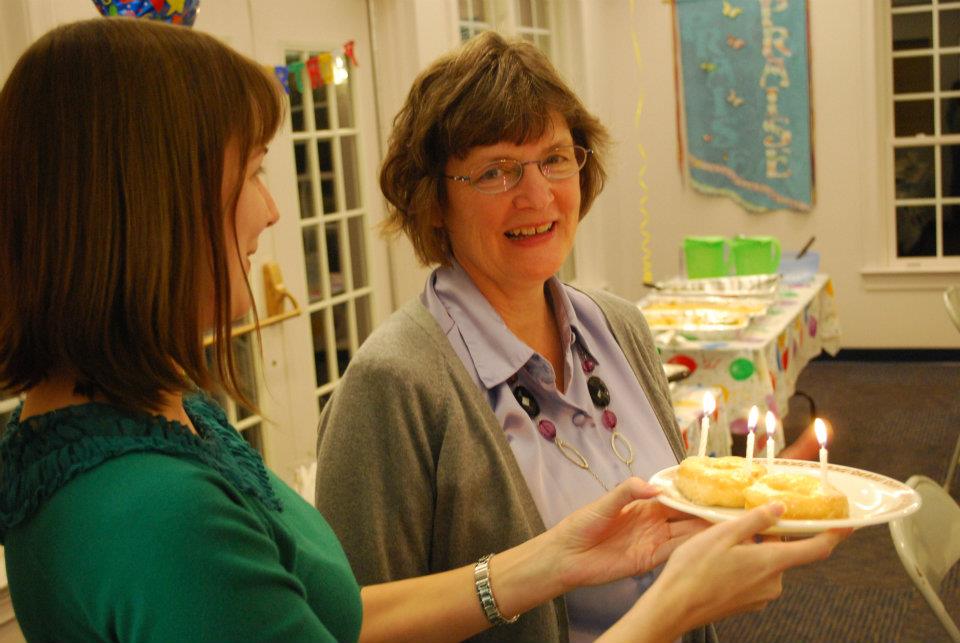 The donut party. Photo by Brian Sinclair
Now that was a party to pull off without your mother’s knowledge, but just beneath surface of her kitchen activity. One daughter gradually whisked all of the supplies out of our kitchen and transported them to the church kitchen, and then disappeared for the day (under the ruse of doing Christmas shopping) to mix, knead and raise the dough—and meanwhile decorate and pull all of the other birthday elements together. I still marvel at how they pulled that off—and arranged for one sister who lives about 400 miles away to come and REALLY surprise me. I was blown away (read more about that one, here.)
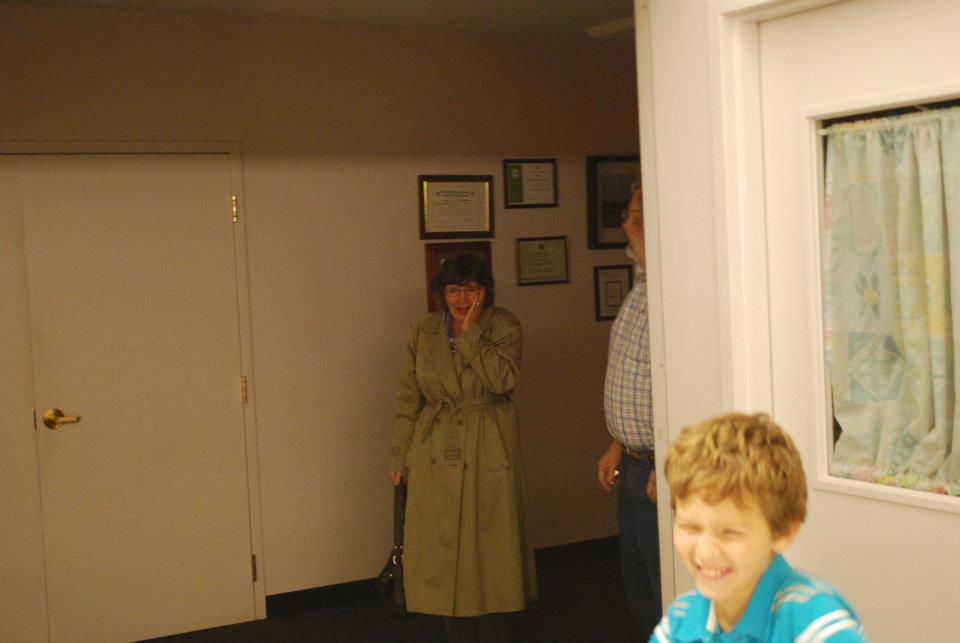 The surprise. Photo by Brian Sinclair
So in asking my daughters what we should do for their father’s 60th, I proposed continuing the Davis theme of holding a homemade donut party, but this time at our house. One of them suggested why not make homemade funnel cakes instead—wouldn’t that be a little easier? Yes! Absolutely. We frequently (read, I) made them on for breakfast on holidays when we didn’t have any other big plans: Memorial Day, Labor Day, New Year’s Day.
From there my mind took the next logical leap: here in the Shenandoah Valley, funnel cakes are lawn party food. Why not re-create a lawn party right in our own living room/kitchen/dining room (it being early March and all, in the winter that just wouldn’t go away.) I’ve already written about how through the summer, where there are local lawn parties going on almost every weekend, that’s one of my husband’s favorite weekend activities.
By e-mail, the girls and I brainstormed activities and foods.


We made invitations.
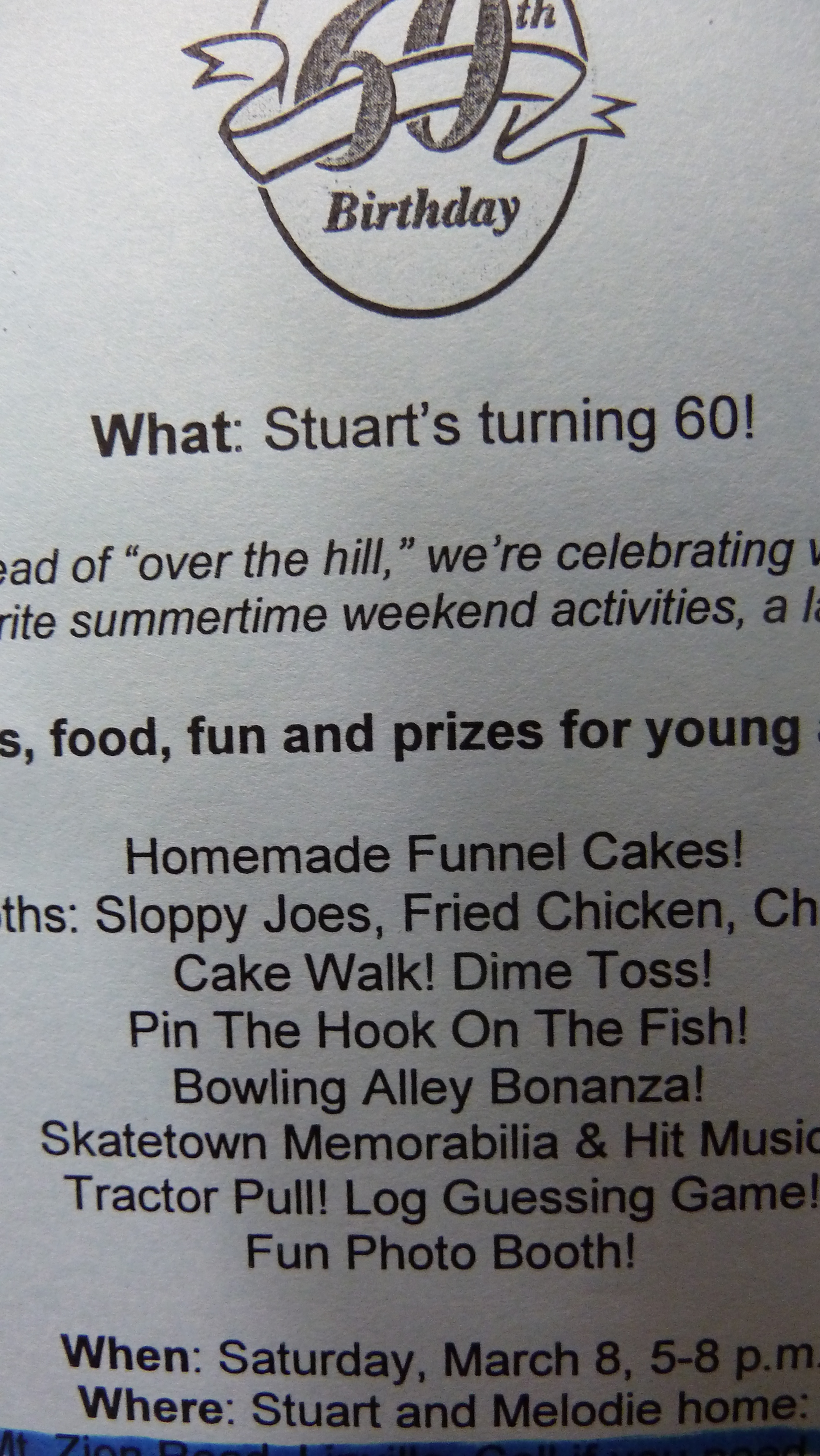
Those were the easy parts. The next steps were actually carrying out the grandiose and somewhat half baked ideas. To be continued.
An indoor carnival of sorts is not your thing? The key is finding something that is “the thing” of whoever you are celebrating. They are big into sports? Hunting? Fashion/shopping? Foodie? Hiking? What do they enjoy doing? That might be a theme and help pull something together they’ll remember until at least the next decade. We hope.
Part 2: On my blog this Thursday, how my three daughters helped pulled off an indoor lawn party without an entire ladies auxiliary or Ruritan Club helping. Working around the needs of two babies who let their needs be known frequently.

Part 3: On Friday, making the homemade funnel cakes–the recipe and how to’s.
***
Have you planned a different kind of decade birthday party? What worked? What didn’t? I’d love to hear from you.
Here are some more “commercial” ideas, and a Pinterest Board of more ideas.
And here is a beautiful recipe and coffee table book with Celebration ideas throughout family life.
I don’t recall my mother making cornbread when I was growing up but I can’t imagine serving chili soup without that option. (See my chili recipe here.) But then, she was a Yankee. No southern cook (dare I be so bold to put myself halfway in that camp) can be without a go-to recipe to stir up on a busy day.

Some cornbread doesn’t do much for me—if it is too crumbly, dry, or hard. I guess I also like mine best with a little sugar in it, which by most accounts is not true southern cornbread. The real thing, according to some, also has to be baked in a cast iron skillet.
From my experiments, reading recipes, and trying the cornbread others make, I think the best combination includes enough flour that the cornbread is not super crumbly, and just enough sugar to make it a little sweet. Some recipes call for a cup of sugar (for a 9 x 12 pan); my recipe, which came from a cornmeal box, just includes ¼ cup sugar. I’m betting you could weasel that back to 2 tablespoons if you wanted.
I love this recipe because it takes liquid shortening (vegetable oil) which makes for super easy mixing and clean up, just one bowl with one spoon and one measuring cup. I cut this recipe in half now that the children are gone and it bakes up just fine in a bread pan.

Corn Bread (adapted from cornmeal box; original used 1 cup corn meal and 1 cup flour)
¾ cup yellow corn meal
1 ¼ cup flour
¼ cup sugar
4 tsp. baking powder
½ tsp. salt
1 egg
1 cup milk
¼ cup vegetable oil or other shortening, soft
Sift dry ingredients (first five) together.
Add next three ingredients.
Beat with spoon until smooth.
Bake at 425 degrees for 20-25 minutes.
Makes enough for a 9 x 9 inch pan, or 12 muffins.
How easy is that? I’ve whipped this up while doing a load of laundry, unloading the dishwasher and entertaining a clingy toddler or two. While a pot of chili is simmering. Not because I was a supermom, this recipe is that easy.

For more recipes from Shenandoah Valley cooks, turn to Whatever Happened to Dinner: Recipes and Reflections on Family Mealtime.
The last snow we got, when I got up the second morning, the world was still covered with snow. I looked out my window and thought I was dreaming.
There were three beautiful horses in our backyard. And, um, we don’t own or keep horses on our eight acres.
It was still almost dark. I was just waking up. I blinked and looked again. I would not have been surprised by cows (there are close neighbors with cows on both sides of us) or deer, or one horse. But three beautiful, tame, well-cared for horses made me think I had died and woke up in almost-every-little-girl’s la la land.
My husband was still sleeping so I just let him sleep. No biggy. Likely the next door neighbor’s horses just crossing over into greener (snow-covered) pastures. We’ll call him later.
Long story short, after contacting all the neighbors we knew who had horses, after posting on Facebook and calling the local radio station, no luck. So several hours later we called the local sheriff’s office which said they would send out someone from animal control. We were leaving on a trip, so we never saw how or when the animals eventually got to where they needed to be. But the point is this:

It looked like our yard had been hit by 12 Budweiser Clydesdales. Those three productive ladies (?), in just several hours, left manure like they were a herd.


When life gives you horses, you collect the manure as compost for your garden.
I felt like my father-in-law with the free booty, who used to find (usually free), deliver, and pitch horse manure for people’s gardens to earn a little “pocket money” as he called it. Many people for miles around knew Hershel as the horse manure man. And knew him as the best gardener in Bridgewater, Va. (We’ve been thinking of him a lot these days as he died 16 years ago on March 1.)
I felt like my sister who, if she had her choice, would choose mucking the cow, hog or sheep manure over housework because … it got her out of the house and into the barn. We always suspected (the two sisters who got stuck with the housework) that she chose barnwork because it gave her a chance to sneak off to the hayloft to play with the kittens.
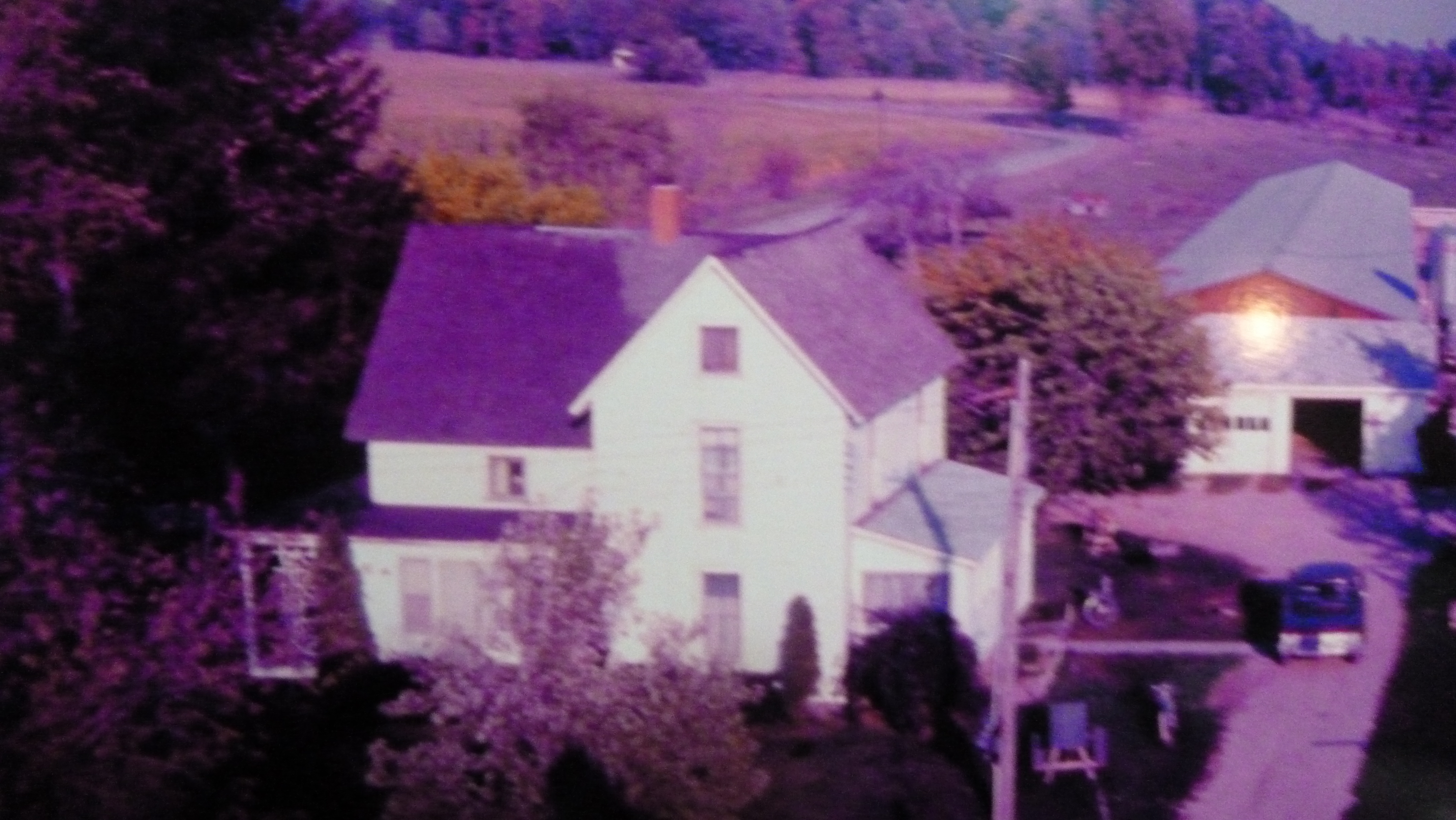
(View of our house, garage and chicken house from the upper window of the barn’s hayloft, where kitties played.)
My main surprise with the free barnyard booty? How light and dry it was after a week or two: nothing more than dried grass. Not gross at all. I know that in rural parts of some countries, people still burn cow dung for fuel.
But mainly, I felt like a farm girl again, when there was always a lot of manure to muck. Not too much different than a lot of workplaces these days.
This post is be “rich” in metaphoric (and punning) possibilities. And even the Bible uses the dung heap as a metaphor. In the passage from Luke where Jesus talks about the cost of being a disciple–of the need to count the cost of following him–Jesus said disciples who are not committed are useless to him, and then finishes with this example:
“Salt is good, but if it loses its saltiness, how can it be made salty again? It is fit neither for the soil nor for the manure pile; it is thrown out.” (Luke 14:34-35).


I was left with a nice pile of manure for my garden. Jesus implies that there is value in the manure pile–but not in unsalty Christians or disciples. As Jesus finished that particular story he gives his slightly cryptic, “Whoever has ears to hear, let them hear.”
Am I listening?

February is finally almost over. The shortest month, stretched into the longest winter ever since Laura Ingalls Wilder. Right?
Of course we all exaggerate and have short memories. Because family harmony is frequently ruined arguing about such things, I keep a notebook that has some of the big snowfalls of past winters in Harrisonburg, Va., in case anyone’s interested (from the Daily News Record, 2010). By these figures, this winter’s snowfall has been just a little below some of the years I’ve highlighted below showing some of the bigger snowfall accumulations for our area.

Area Snow by Winter season (and this is nuttin’ compared to states like New York recording upwards of 100 inches so far this year.)
1993-94 35.25 inches
1995-96 53 inches
2002-03 28.5 inches
2003-04 29.75 inches
2009-10 29 inches
2013-14 23.5 inches so far (From WSVA’s Weather Data, added together.)
And from another helpful chart comparing Harrisonburg’s average annual snowfall to Virginia’s and then to the U.S.:
Average Annual Snowfall, #57
|
Harrisonburg, VA |
25.12 inches |
|
Virginia |
14.85 inches |
|
U.S. |
23.27 inches |
And as my husband always warns, some of the biggest snowfalls in our area seem to come in March, frequently just in time for his birthday.
Now we’re getting to the yummy part, a fresh take on a quick bread: cheese muffins, and a great way to warm up an early March meal. I will confess I never would have made these if Valerie Weaver-Zercher, the managing editor for a new edition of Extending the Table Cookbook, had not been looking for friends and colleagues to try out recipes. I also tested this slightly more exotic recipe, Het Fang Shei Khaii for this new edition.
But a recipe for cheese muffins originally from El Salvador sounded easy peasy, and it was. Would they taste like Red Lobster’s beloved cheesy biscuits? The cookbook says that in El Salvador they call these little breads “quesadillas,” not to be confused with Mexican type quesadillas which are cheese-filled tortillas. “Both derive their name from the Spanish word for cheese—queso.” (From Extending the Table, 1991 edition, p. 57.)
Take any hot bread, add cheese, add butter (if you dare) or a jam and you’ve pretty much got something wonderful to sink your taste buds into. Without paying a Red Lobster price. Great to go along with a pot of homemade vegetable soup, chili, or for a brunchy breakfast.
And yes, the new revised cookbook with gorgeous food photography will soon be here—scheduled for release in May, 2014. See pictures from a photo shoot for the new edition, here. If you can’t wait, see or purchase the original cookbook here.

Cheese Muffins (El Salvador)
Cream:
½ c. margarine or butter, melted
¾ c. sugar
2 eggs
Combine:
2 c. flour
2 t. baking powder
Add to creamed mixture, alternatively with the flour mix:
1 c. milk or sour cream

Beat until smooth.
Stir in
1 ½ c. grated cheese (Mozzarella, cheddar, or combo)
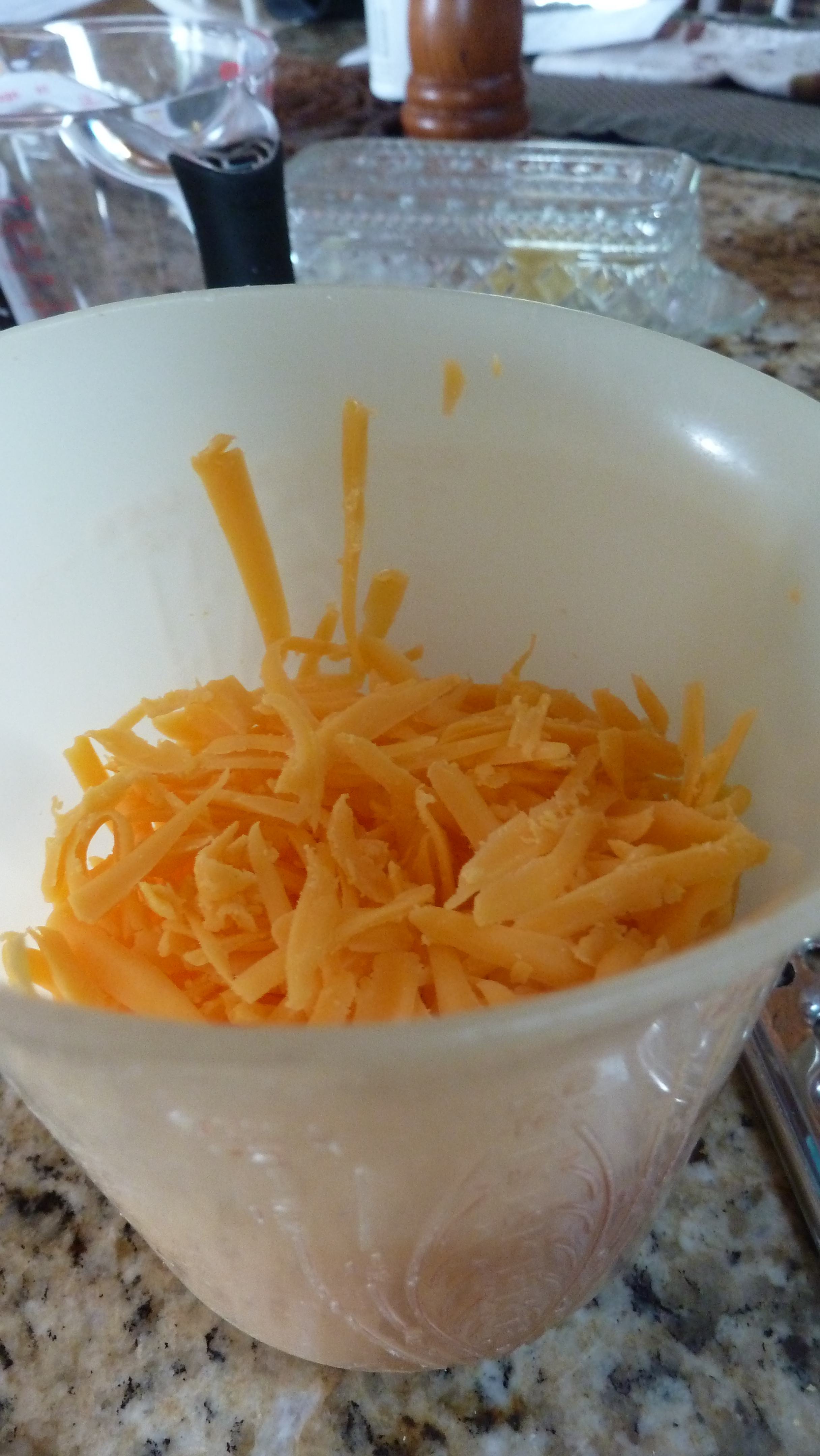
Put paper baking cups into muffin pans and fill ¾ full of batter.
Sprinkle with sesame seeds.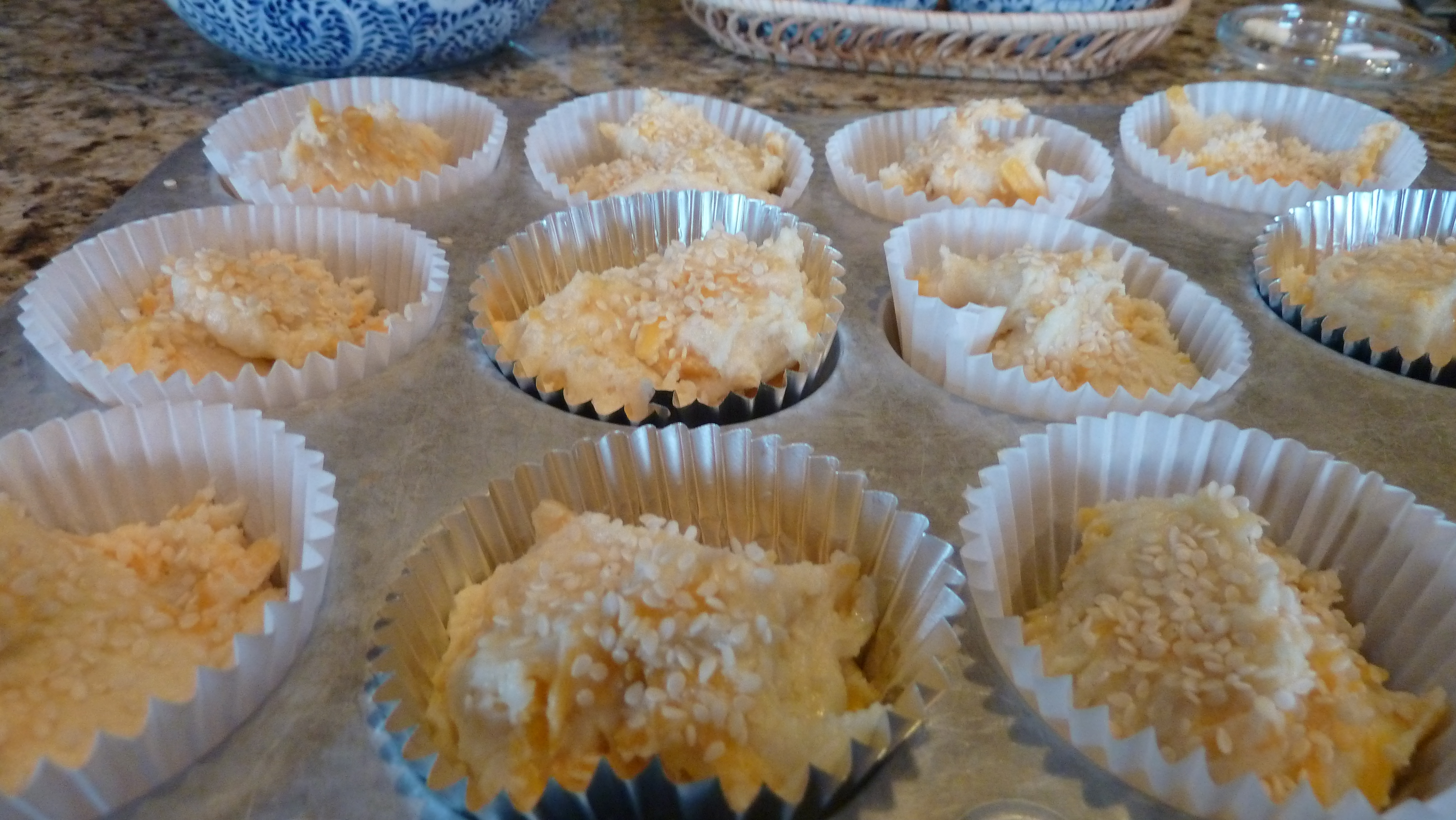
Bake at 350 degrees for 15-18 minutes until golden, or toothpick comes out clean. Muffins freeze well. Makes 18.

–Submitted by Karen Canales and Dolores Braun, Saskatoon Saskatchewan; Angela Mendez and Edna Hohnstein, Edmonton, Alberta
Not sure they’d use cupcake papers like this in El Salvador… Anyone know?
 Image courtesy of Gualberto107 / FreeDigitalPhotos.net
The moon is great and big and bright as I sit momentarily, cross legged on the living room floor, peering out to the West where the moon lingers over an early morning sky. Suddenly aware that I have too few moments like this, I let its beam reconnect me with the God of the Universe. How many miles away, and our eyes can still see this light. Marvelous.
Let’s see, how that light gets there … ah yes, it is but a reflection of the sun’s light burning elsewhere in the universe. In line to cast a light so luminous from the moon that my husband called me on his way to work just the other day to make sure I didn’t miss the great ball of light edging down between the trees on the next farm. How did God plan all of that? Oh yeah, it just happened. Right.

No, I believe that somewhere in God’s creative goodness the Almighty had at least a master plan, a grand design. What fun. What a window into the mind and majesty of God! Imagine a being so magnificent to dream and scheme and connect all the dots. God may have used many years, may have used the process of evolution, may have figured it out as it progressed. But all that stuff didn’t just happen. Things—creation—the ways of nature—the wit and grace of mammals—couldn’t have just happened.
And God was lonely at one point in the process (tradition, the Bible, many creation stories say); so lonely that God made humans. The human body—the human mind—the interrelationships between people—procreation—all with the ability to connect powerfully with the spirit of this great God.

Hello, God. It’s been too long that I just sat here or somewhere and basked in that companionship, friendship, awe, love. You are still too often lonely, missing the connection and friendship of all these beings. Us. Me. Sorry.
I’ve been busy. You know that. But, that’s no excuse not to linger and absorb your great love.
Yes, I believe. How could I not?
See you around. I’ll try not let it go so long next time til I just sit and soak up the love and goodness you have for us if we but take it in. Not praying, not reading something, not even reading your good book. Just hanging out. Thanks for being there.
Your friend, Melodie
O Lord, our Sovereign, how majestic is your name in all the earth!
You have set your glory above the heavens.
When I look at your heavens, the work of your fingers,
The moon and the stars that you have established; what are human beings that you are mindful of them, mortals that you care for them?
How do you get in touch with God? How does God get in touch with you? Where do you best reflect on God’s glory and goodness and friendship?

If given the choice, would you rather receive an object type gift for your birthday or Christmas—or an activity, gathering, adventure-type gift for the same?
Do you like, need, and collect things (useful or not) —or do you crave experiences?
If you are married, you are likely married to the opposite of you in this department. At least I am. Give my husband a new tool or even a new flannel shirt or jacket and he’s gonna be happy. I am just as happy with going to a concert, eating out, a trip, or adventure. Ultimately, both of us are quite happy with any kind of gift or remembrance.

Over a year ago when I first heard that virtuoso (that just means expert) violinist Itzhak Perlman was going to solo with the symphony where our daughter works, I knew I wanted to go. In fact I said “I’m going,” come you-know-what or high water. Well, as it turned out, it was the biggest snow in ten years for that city but we made it anyway. My daughters all chipped in to buy us some very nice tickets for my birthday present back in December for the concert, which took place Feb 15. (Yeah, I took a blog break this past week, with other travels and responsibilities playing, um, first fiddle.)

Hearing Perlman live in concert was truly as virtuoso and marvelous as I could have wanted, a bucket list event, for me. I believe I’ve heard of Perlman most of my life, who first appeared in the U.S. on the Ed Sullivan show in the late 50s as an 11 year old child, with his polio crutches. Not that I saw him then, we didn’t have TV. So that little subtext had escaped my notice all these years in just hearing conversation about him. In fact my daughter, who has twice helped to host him as a guest artist in two cities, never mentioned polio. To her credit. Why mention a little thing like motor issues with legs and feet when you can make a violin talk like Itzhak Perlman? The strains from his strings pierced my inner spirit in a spine-tingling way. You can read much more about Perlman at his website, including the fact that it was Perlman who played the haunting violin solos in the Academy Award winning Steven Spielberg movie, Schindler’s List. You may also remember seeing him play at President Obama’s first inauguration in bitterly cold weather.

The Charlotte Observer gave a beautiful review of the performance we saw (here) playing Felix Mendelssohn’s “Violin Concerto in E Minor” so I’ll not repeat that. What I personally loved though was watching the showmanship of Christopher Warren-Green, the orchestra’s usual conductor in absolute command during the first half of the concert when Perlman was not soloing, complete with gloriously wavy white hair blazing like Leonard Bernstein. And then, like an ambassador or vice-president standing aside in deference to a queen or a president, Warren-Green graciously turned aside from the limelight as he “allowed” Perlman to basically conduct the second half of the concert. Every now and then Perlman would glance up like a little boy at Warren-Green as if to say “Oh, yes, I’m supposed to be following a conductor here, oops.” But it was Perlman romancing his sweet little Stradivarius as Warren-Green and the symphony orchestra followed along. British born Warren-Green, if you’ve forgotten, is no stranger to royalty himself, having conducted an orchestra for the 2011 wedding of Prince William and Kate (now Duke and Duchess of Cambridge) at Westminster Abbey, and other royal events over the Big Pond.
It’s always fun to be in the presence of people you’ve heard of for a long time but never thought you’d hear/see in person. My daughter was too smart to let us go gaga over the stars so we toured backstage without seeing either Warren-Green or Perlman, but it was marvelous just the same. We didn’t want to be like groupies, heaven forbid.
And what a birthday-Valentine’s treat I will treasure a long time. Thanks, kids.
***
Do you like experiences or events over gifts? I’d love to hear your favorite adventure or experience given or received as a gift.
Incarnation—the idea that God became human and lived among us in the form and spirit of Jesus—what does that look like in 2014? That is what I agreed to write about for this syncroblog post with the MennoNerds blogger group.
What does it mean to live as if God is still living among us?
It may look like one thing for the women (two) who blog at MamaCongo living as expatriates in Congo, Africa. It may look like another thing with my friends living in Tembisa, South Africa, who I’ve gotten to know through our church’s partnership with St. Peters Uniting Presbyterian Church, some of whom I “see” frequently on Facebook. Local doesn’t feel like just Harrisonburg, Virginia anymore, with the World Wide Web.
 Youth from St. Peters Presbyterian Church in South Africa came to spend three weeks with youth from Trinity in Harrisonburg, Va.
What I know of local mission though, doesn’t just come out of a vacuum. In my last post for this “missional” syncroblog series, I talked about my own family and church background and its powerful influence on “incarnating in the local context.”
The church we have been a part of since 1975 was organized and founded on the principles of Church of the Savior in Washington, D.C. which is nothing if it is not local mission. When I was a student at Eastern Mennonite University, one of our Freshmen required field trips included a stop at this exemplary congregation in the middle of the nation’s capital to see what we could learn. Founded by the late Gordon and Mary Cosby, the church taught that the organizing bedrock of the church and its small groups or covenanting communities (called house churches at my church) is mission: the more local and present tense, the better.
Why? Our church has four core values or areas of focus, which we name “marks of the church”: worship, nurture, fellowship and mission. Each house church is to actively practice each of these values, and include mission as one focus. In fact, we “issue a call” around a mission vision. Someone wants to deal with homelessness in the community. Fine, organize around that. Someone sees a need to connect with individuals and families dealing with AIDS in the early 80s when nobody knew much about it. Etc.
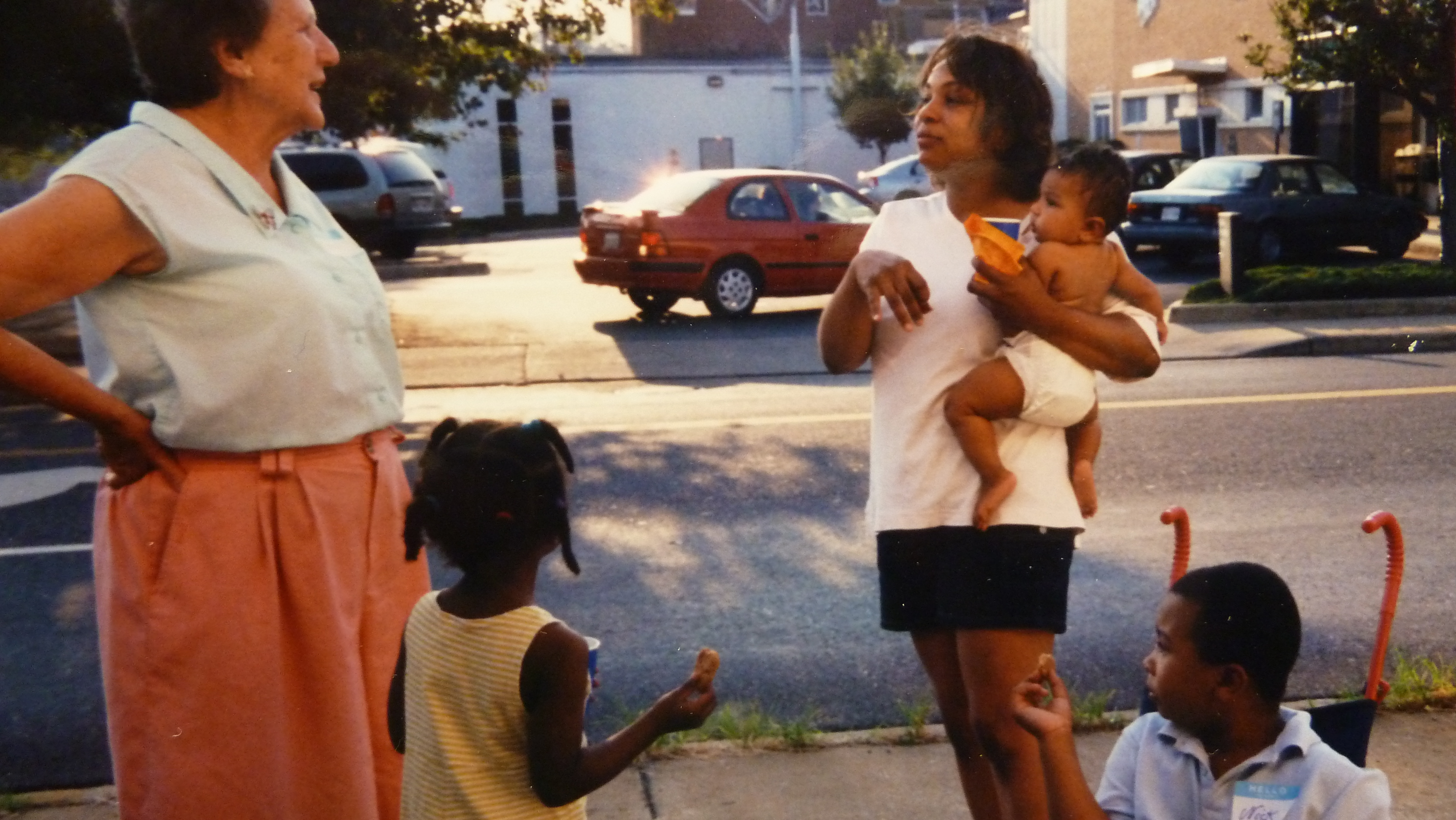 Emily Gilkeson, left, long time mainstay behind the Clothes Closet house church, always enjoyed
greeting and talking with the children and babies who came to the Clothes Closet.
Through the years house churches have been organized around calls to look at or minister with offenders/inmates, adult day care, youth in trouble, arts/drama outreach, needs of those with intellectual and physical disabilities, international students and families in our midst, refugees, poverty, housing, racial relations, hunger, health issues, loneliness, those with head injuries and permanent disability, environmental issues, a coffeehouse ministry, emergency housing, a mobile homeless shelter, and more. This in a congregation which has never had more 100-150 members, founded in 1963.
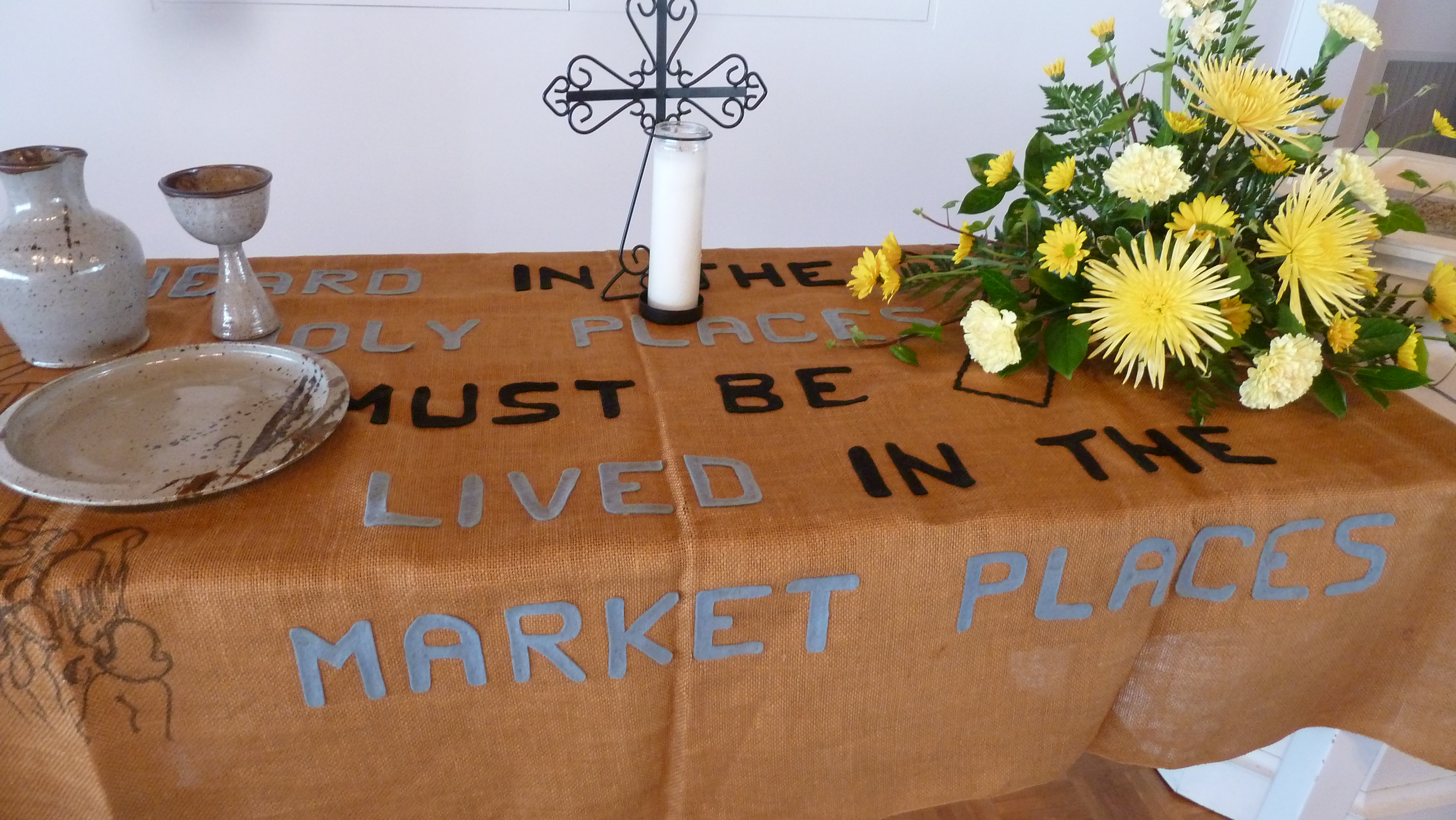
The quote on the banner, which we used at our church’s 50th anniversary last fall, says “That which is heard in the holy places, must be lived in the marketplaces.” The banner represented the long ministry of “The Marketplace Coffee House” in Harrisonburg.
The South Africa house church, eventually dubbed African Partnership has been one effort that bridges across continents. While you might wonder how that could be considered “local ministry,” it has been foundational in shaping an awareness that the church is never just local, but international and helps us keep in touch with the bigger fellowship and ministry of Christians around the globe. The fact that it was first called into being by the youth of the church helped too in stretching us to be involved.
Being a faithful follower of Jesus in 2014 goes right back to about the year 33 when Jesus asked his followers then, and us now, to “Go into all the world and make disciples.” Sometimes the world is next door or the next town. Sometimes it is 5,000 miles away. The heart of the gospel is living faith wherever we are and responding to the needs we see around us, just like Jesus did.
In the recent winter issue of Leader magazine (published by MennoMedia) most of the articles focus on families and church, but Dave Maurer, pastor of Bethel Mennonite Church, West Liberty, Ohio, talks also about “building relationships in the neighborhood. He points out that congregations need to remain intentional about the fact that church isn’t just about teaching the church’s own children and enjoying a clubby type of fellowship ourselves. The church is about reaching out. He references Jesus’ words in Luke 4: 14-30 where Jesus is in his hometown, reads from the scroll in the synagogue about Elijah ministering to the widow of Zarephath (different city/region) rather than the widows of Israel. “[Jesus was] suggesting that the people minister to those outside of their circle and the people trying to throw him off a cliff for saying it.”
Sometimes we’re that way too—not ready to listen to the words of Jesus about reaching out beyond our own flock.
Jesus left excellent operating instructions for how to go on without him. In Matthew 28 we read, “Therefore go and make disciples of all nations …” And in Act 1:8 we get “Ye shall be witnesses unto me both in Jerusalem, and in all Judea, and in Samaria, and unto the uttermost part of the earth.”
How does your church engage the surrounding community?
Is it as outward focused as it is inward? How do you balance?
This post is part of a MennoNerds Synchro-Blog on Missionary Spirituality for the month of February. MennoNerds is exploring “spirituality through an Anabaptist-Christian lens” and what it means concerning participation in the mission of God. Find other MennoNerds blogger posts on this theme here.
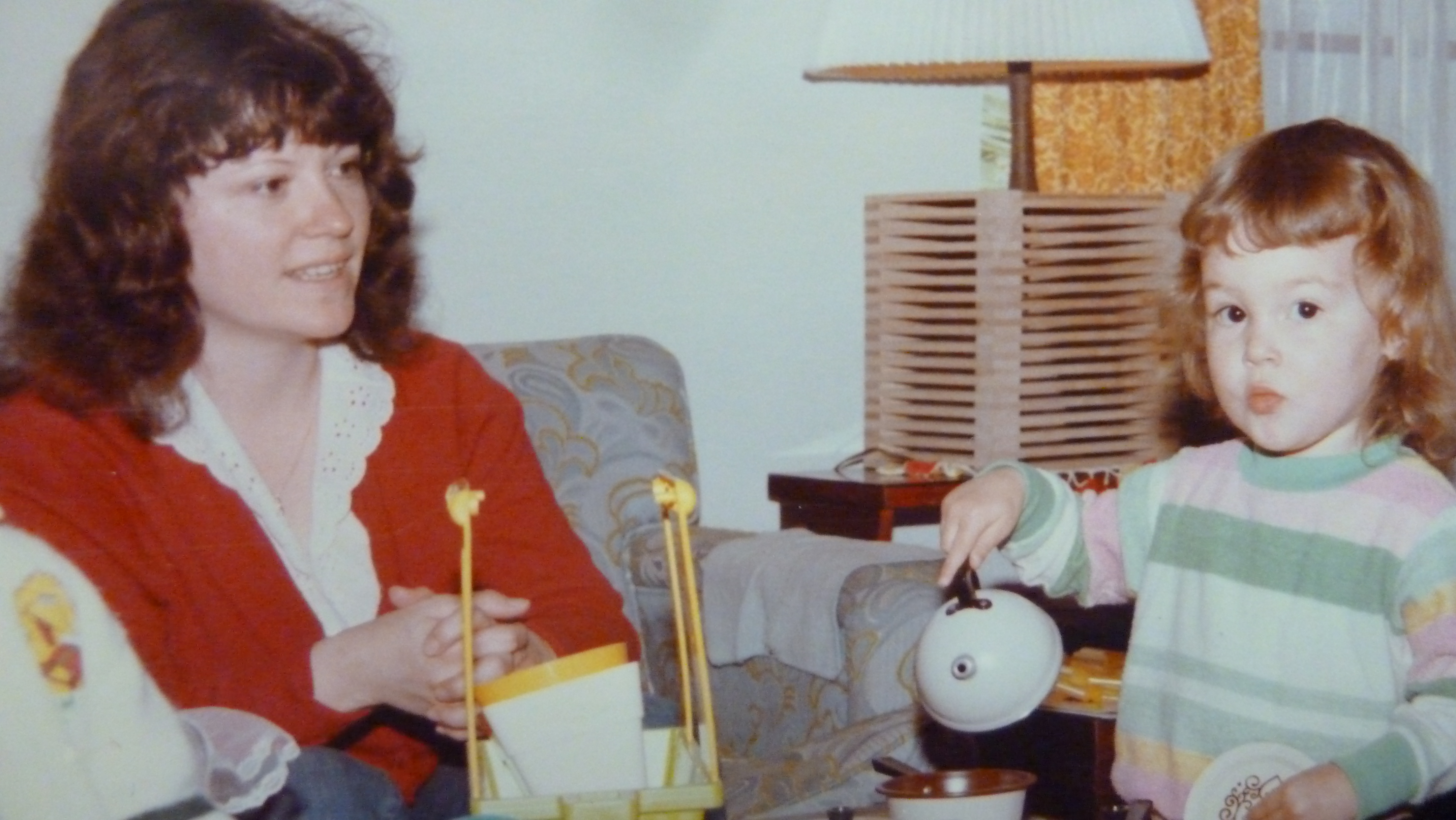 Michelle at age 2 with her home daycare provider, Linda.
My daughter, now mother of two-month-old James, started a mini-avalanche of emails among our family when she sent the following paragraph from a baby advice website:
“While a home daycare provider is likely to have lots of hands-on “mom” experience, if she isn’t also educated (ideally, with at least two years of college and a background in early childhood development), you might want to think twice. If she isn’t trained in child development, she might not be able to encourage your child appropriately.” (From babycenter.com)
Michelle typed in her opinion along with the paragraph: “Say wha? This is the most patently preposterous published thing I’ve read (like that alliteration?) on the subject of babies.”
Daughter Doreen responded: “Tell that to Aunt Barbara. Or Linda.”
Tanya, mother of four-month-old Sam wrote: “This is crazy.”
My husband had a one word response: “Ignoramuses,” referring to the writers, not my daughters.
***
 Two of our daughters enjoying lazy summer days with friends at the babysitter’s house.
For about fourteen years, Linda, a wonderful neighbor who became a friend, was chief childcare provider for our daughters. I worked 3 days a week before they went to school, then gradually increased to 4 days a week, which I wrote more about earlier here.
The family setting also provided extra siblings, cousins and playmates for the kids. Linda was everything you might want in a loving caregiver for your child, but no, she didn’t have any college or a background in early childhood development, except what she learned from years of practice.
Linda was a laid back kind of mother and caregiver, attentive, a good listener, affectionate, creative, and just sat down and read to or played with the kids which is what I think they liked so much. She had her normal household work to accomplish too, which they helped with—doing laundry, cleaning up, baking, yardwork as they got older. A second mother. What more could you ask?
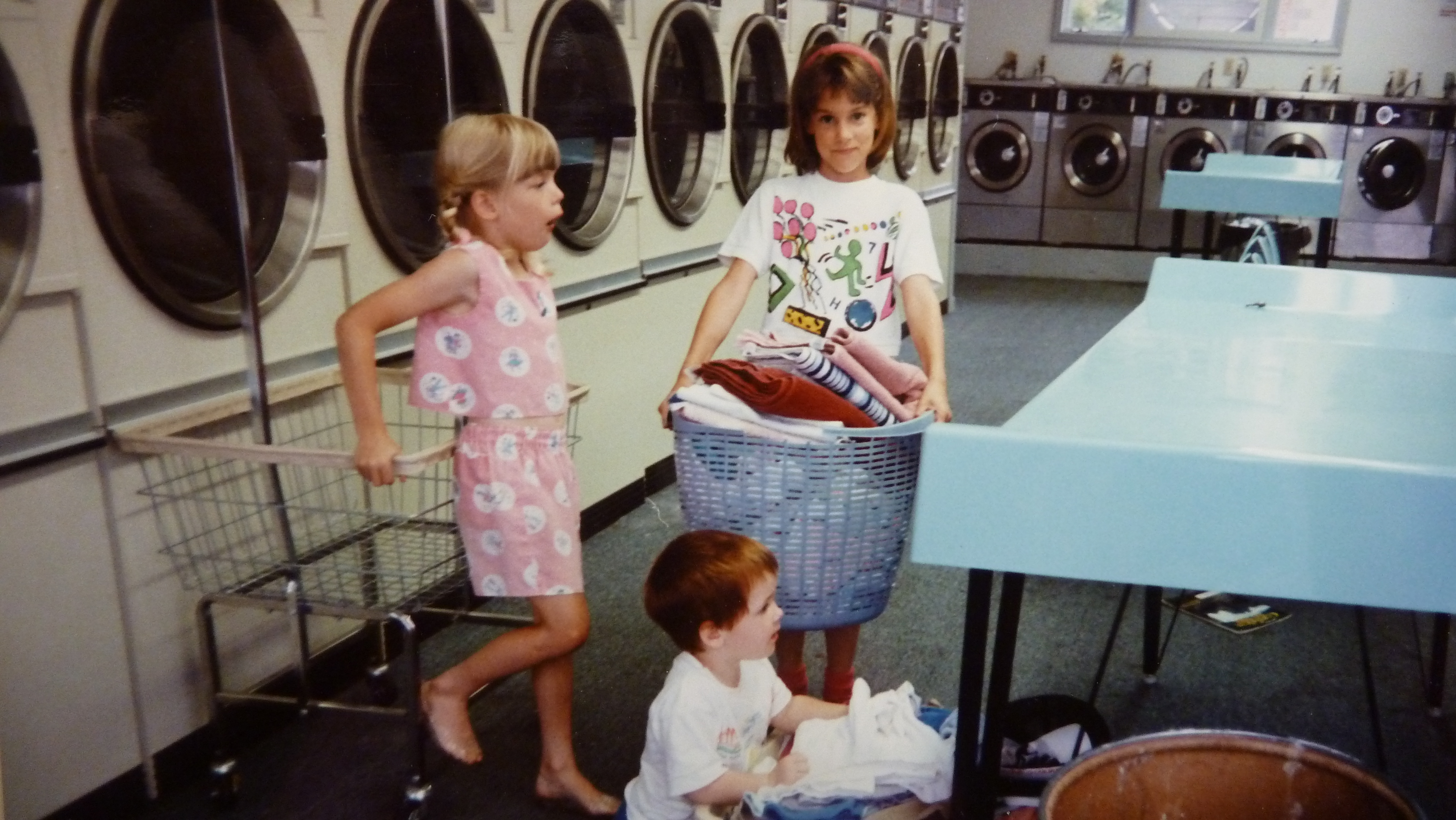 A trip to the laundromat when old enough to actually help.
She only asked off for several summers, particularly when, tragically, her only son died in a terrible motorcycle accident (who was indeed like an older brother to the girls). The grief we all felt was cutting; his death incomprehensible but real. We all needed time off.
So there were three periods of time when we needed to find alternate childcare arrangements. We opted each time for home caregivers, all of whom were also just fine, even exemplary women/mothers/sitters, save one. We did not last long with that situation; when word got back to Linda that that particular sitter was not working out, Linda said she was ready to take our daughters again.
I will not pick apart the babycenter.com comment; I do agree that one should always “think twice” about any childcare arrangement. Most of us spend much emotional energy not only thinking twice but endlessly second guessing our decisions on that front. Some of the most stressful times in my years of working and mothering were the times when I needed to find alternate and back up childcare arrangements, (grandmothers from church who filled in, or I just stayed home if I could if our sitter was sick).
But this little exchange with my kids reminded me I am so very grateful for a couple of things about their experiences:
- That my daughters are able to interpret and parse a website comment on the topic of the necessity of trained educators for child care, in light of their own experiences and memories growing up. Their Aunt Barbara who also took care of children in her home for many many years also influences their opinion.
- That we were blessed to have a neighbor who not only loved them almost as much as her own children, but who entered into their play and activities almost like a kid herself.
- That my daughters turned out as beautifully as they have (and I’m not talking looks, but they do ok there too) in spite of being so deprived of trained early childhood specialists.
I will let a small collection of photos from those years, all taken by our able sitter, Linda, speak for themselves. Don’t miss scrolling to the bottom photo.
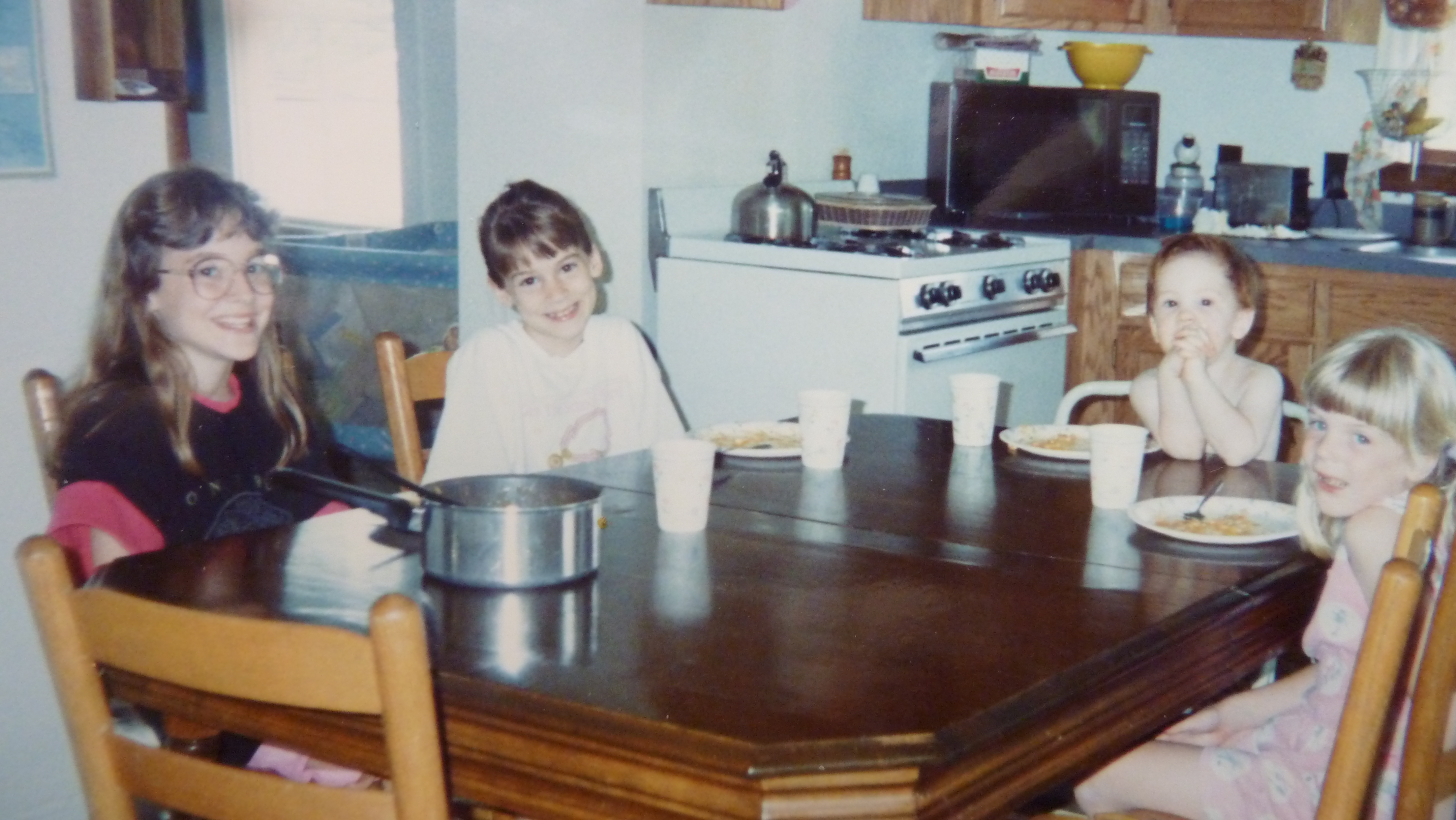
Lunchtime at the sitter’s house.
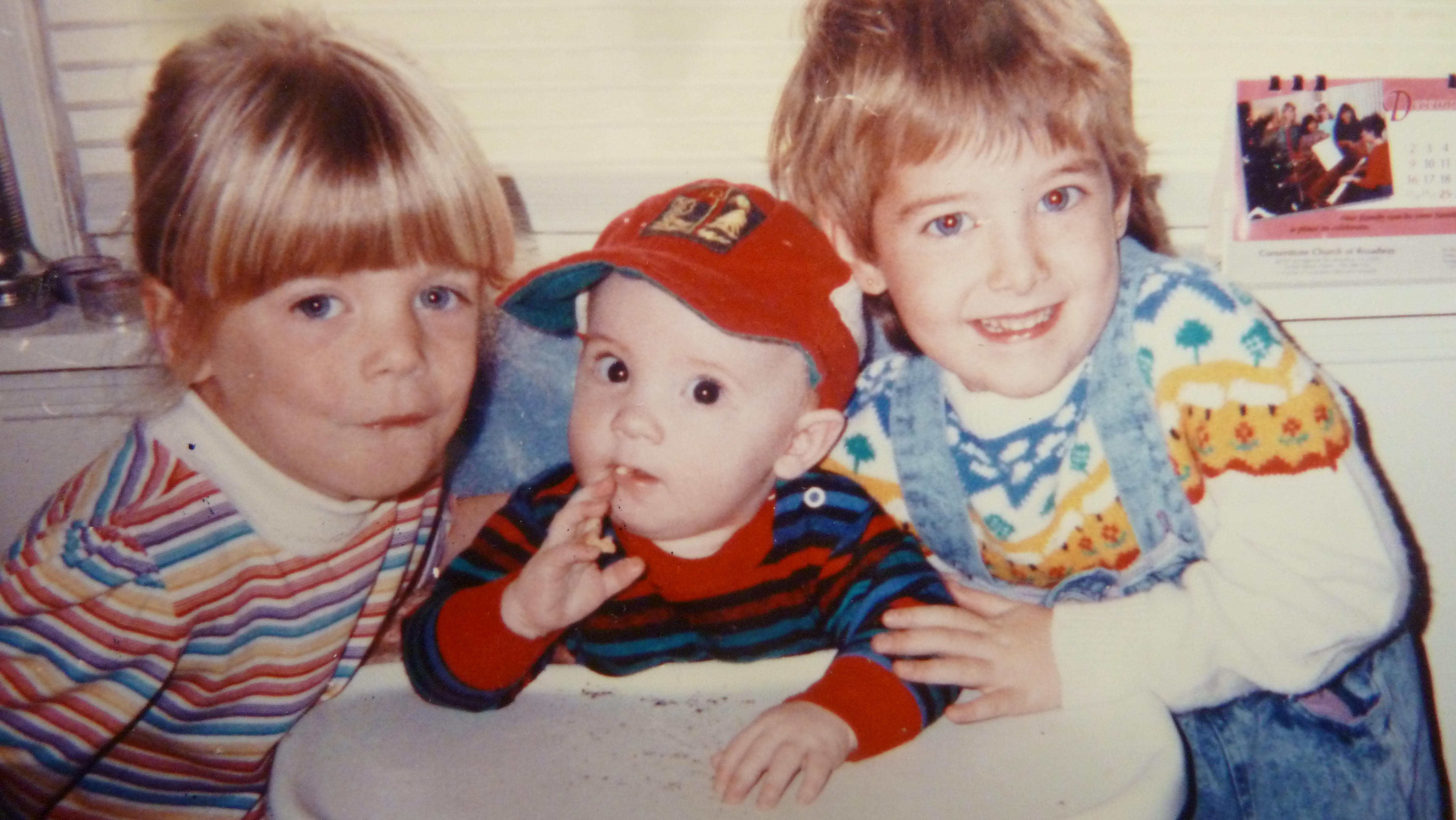
As with siblings, older children love helping out with younger charges in home day care.
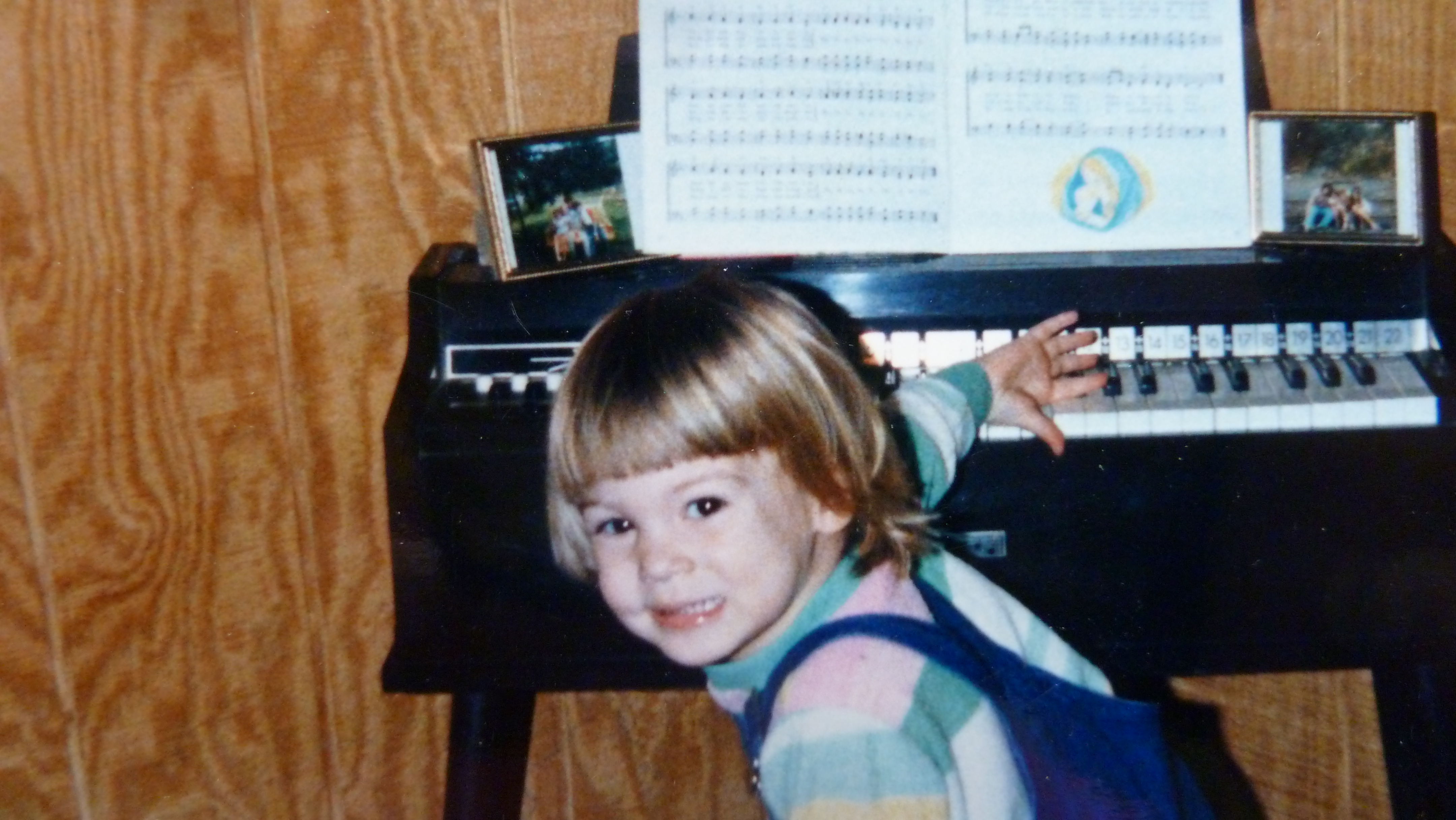
Remember these? I think we called them chord organs back then. This one still keeps her fingers on the piano.
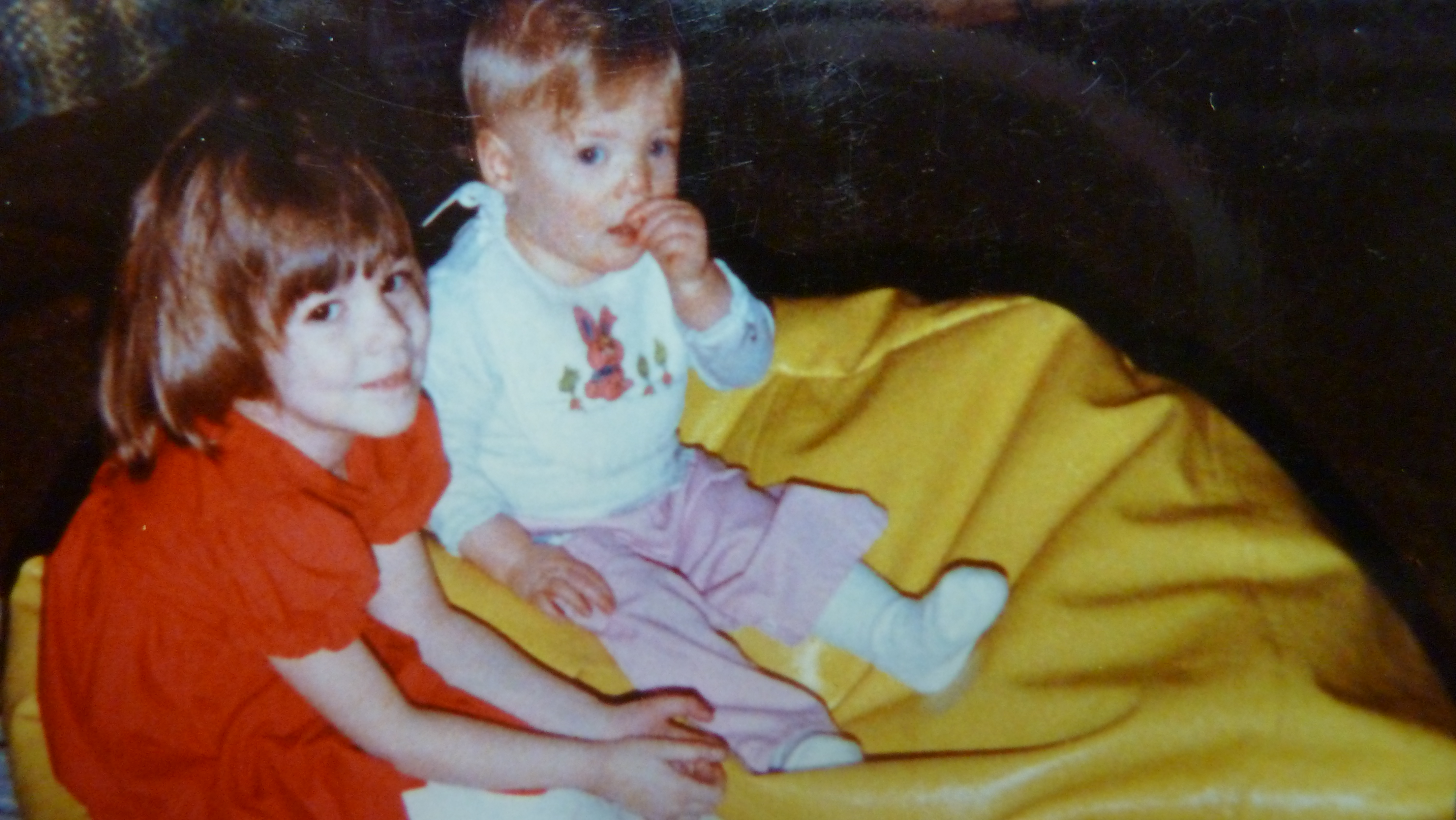
Coveted bean bag at the sitter’s house.
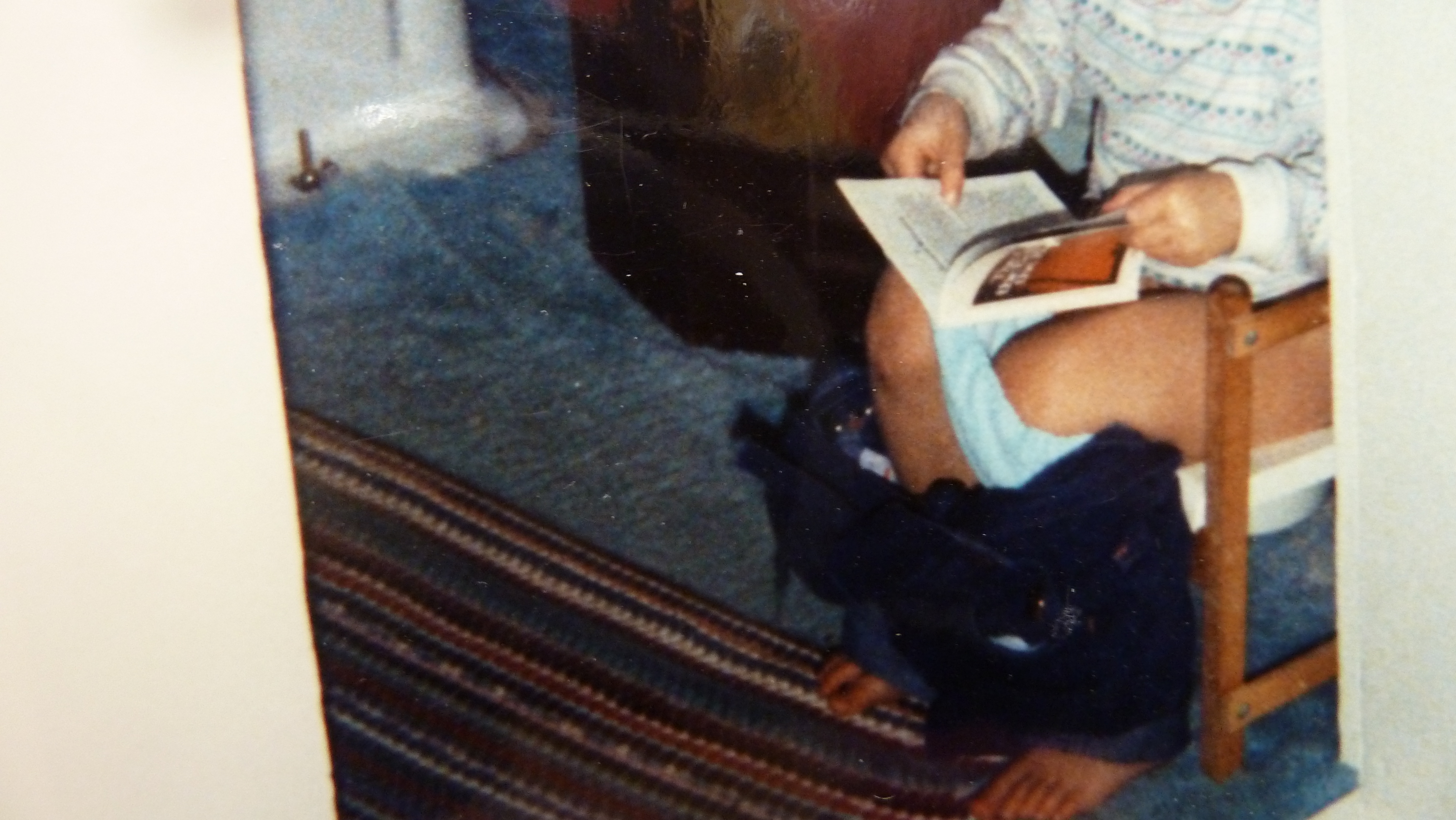
Potty training sometimes goes better at the sitter’s house.
This post dedicated to Linda and all of the great home childcare providers out there.
***
I’d love to hear from you on any of these questions:
What do you think about the statement from babycenter.com?
How did or do you manage childcare arrangements, and how did or do you feel about it?
Have you been a home childcare provider? Do you have some words of advice for parents?
I remember my reaction to the word missional when I first heard it back in the early 2000’s. Missional, smishional. A new gadgety word. A new way of saying mission work or mission oriented, or something.
But as I learned more about it through my job at Mennonite Mission Network with in-depth training and exposure to the concept, I realized missional was how many of us grew up without calling it that: being involved in God’s work in the world right where we are at, beginning at home. The church’s primary activity is not just serving its members with programs (Sunday school, uplifting worship) but an understanding that the purpose of our gathered worshiping communities was and is for the purpose of helping us be about God’s work in the world.
You can see why when the Mennonerds bloggers group (that my blog links to, here) invited bloggers to contribute on the topic of being missional Christians, I quickly signed on to explore the family aspect. I’ll divide this into four brief areas: 1) what I experienced growing up with a missional father and mother (they just didn’t know it); 2) why I never became the Spanish missionary I thought I might; 3) how it worked out with our own children; 4) how I’m involved missionally today. Whew. That’s a least a four-part blog that I’ll likely say more about somewhere down the line, but you’re in luck that I’m pushed for time this week so I’ll keep it pithy. Maybe.
One more (long) has-to-be-said sentence: it is not just my own experiences that lead me to the title of this post, but the experience of hundreds of thousands of folks who believe a lived faith and putting faith into action through service is a great way to grow into an adult faith, such as the network of people connected to Faith Forward, some of whom I had the opportunity to interview on this topic: Brian McLaren, Joyce Mercer, Tony Campolo.
 Dad as an active part of CROP’s Indiana Friendship Acres program.
My own family background. Dad was a farmer: by nature a doer. But he also had the servant theology down in his 8th grade-educated way, greatly amped by the real education he received as he spent four years in Civilian Public Service during World War II (which I wrote about here). So in his deacon work he took us visiting the “widows and orphans” including literally a widow with two sons with mental challenges, who lived in a woebegone shack not one mile from our church. On family vacations, Dad made sure we not only visited churches on Sundays (Mennonite if available, any denomination if not), but also Mennonite voluntary service units and mission work (Navajo Nation mention here). 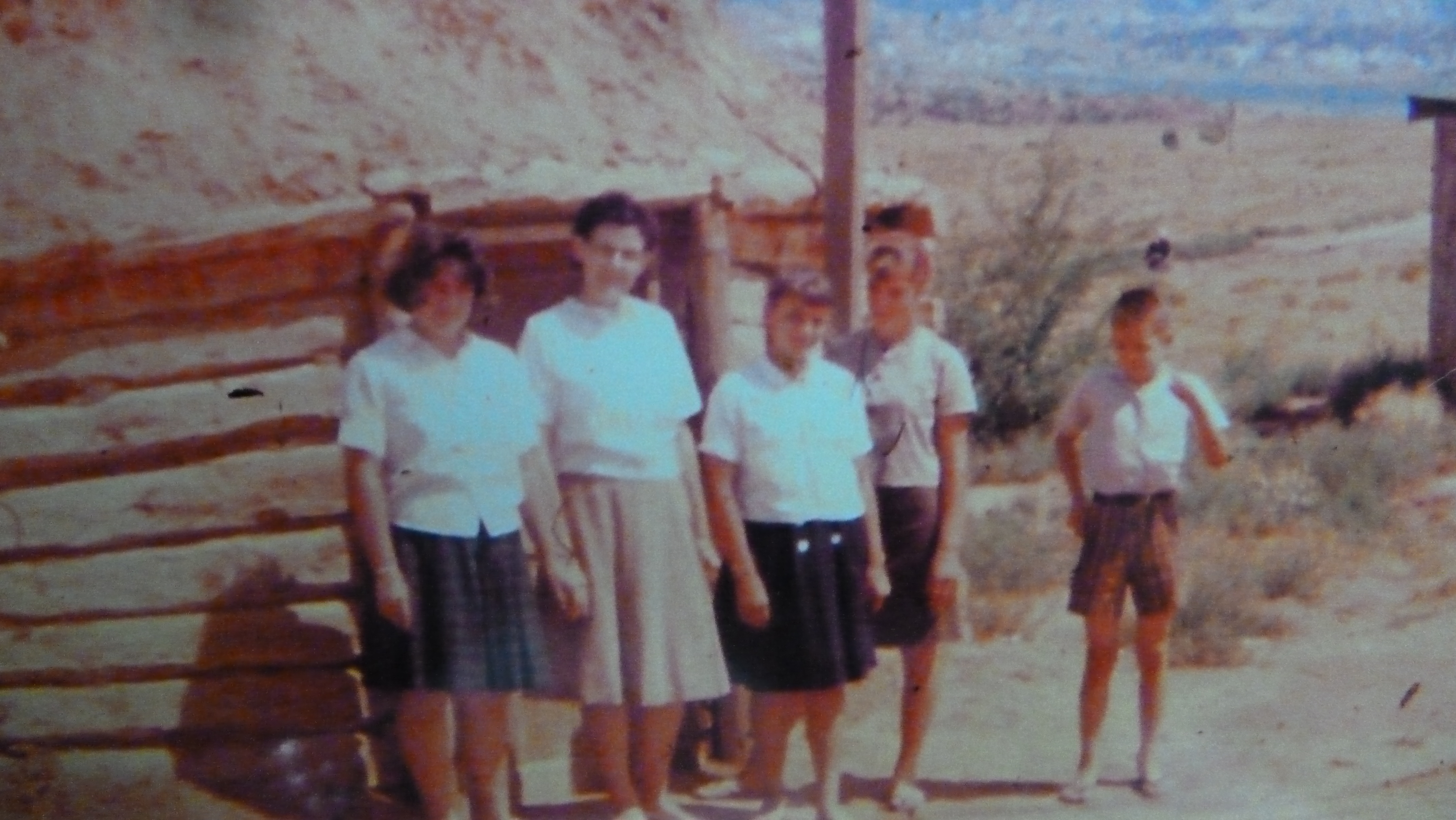
Family vacation out west where we visited various Mennonite churches and mission activity; here on the Navajo reservation.
I remember a trip to Hannibal, Missouri where we enjoyed after-Sunday-evening-service refreshments at the VS unit home and thinking wow, this would be fun to live with a bunch of cool young adults in a city setting with no mom or dad. Daddy preached “I sure hope one of my kids grows up to be a voluntary service worker” and I took the bait (spending a year in the program in a rural setting in Kentucky, mentioned recently here). 
My VS unit leader Judi Brenneman teaching a craft for local girl’s club on Troublesome Creek, Kentucky.
Without calling it missional, Dad innately understood that being a Christian meant reaching out to others, connecting with those of different races, cultures, and even faith, all because of our own love of God and commitment to Christ. Mom and Dad encouraged our youth group in its (then) slightly edgy and ground breaking connections to the migrants and poultry plant workers in our community who lived in barracks type housing (owned by Mennonites). At first our goal was to learn Spanish better. Along the way, we made friendships which led us to want to go to their home community in South Texas. My parents willingly signed on as chaperones for a three week youth mission trip to south Texas in 1969 for a cross cultural learning. (Long before every youth group did mission trips.)
My personal call. This all led to Eastern Mennonite University in 1971 with initial plans to major in Spanish and Bible with the thought of actually being a missionary in Spanish speaking countries. But through my years at EMU, including a year abroad in Spain where I did learn a lot of Spanish and also how difficult it was to try to share my faith with agnostic roommates (both U.S. and Spanish), I began to see and feel that with language and cultural barriers, perhaps the best way for me to be about God’s work in the world was just relating to people in my own culture and language and not necessarily seek to serve in another country.
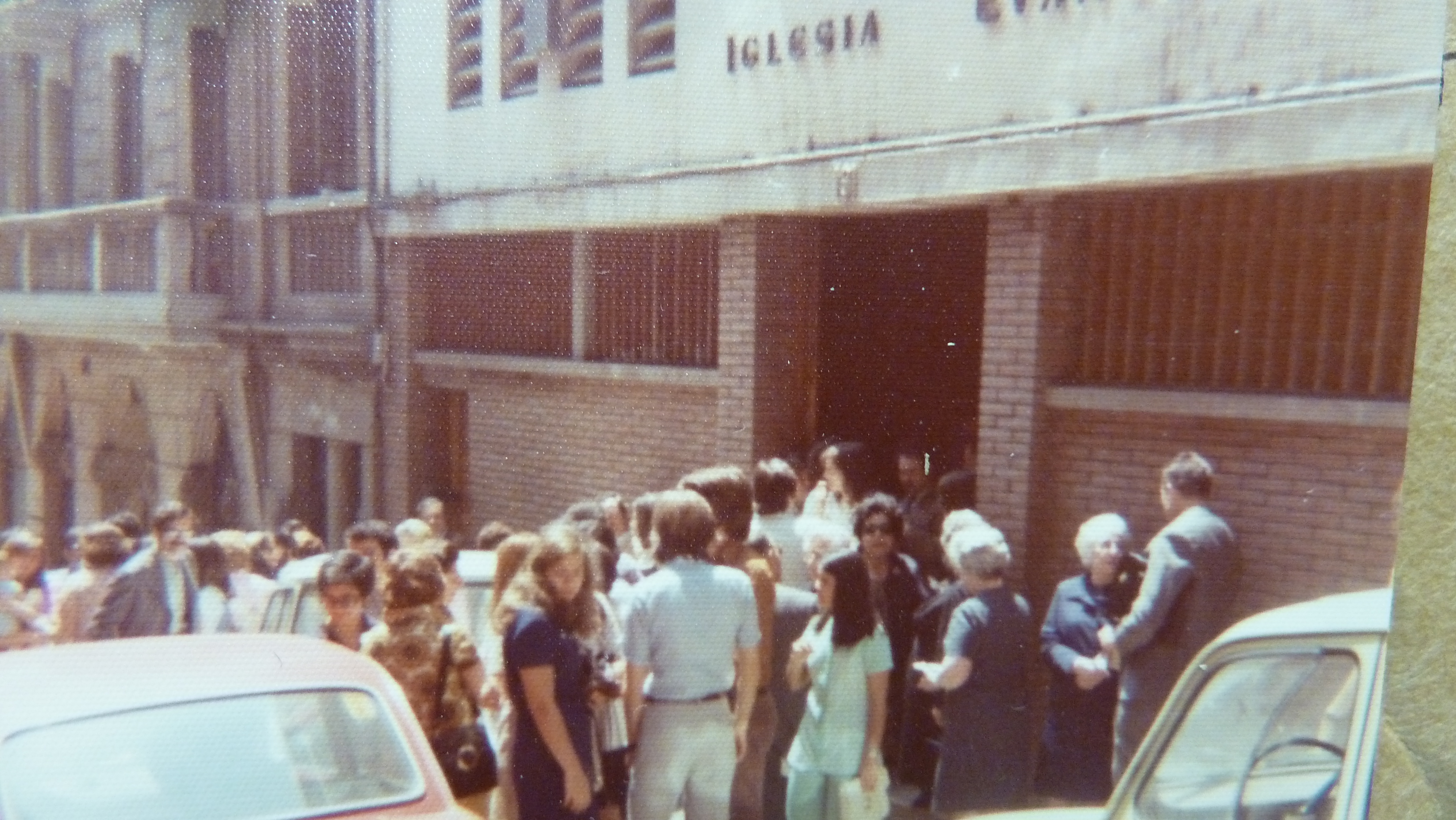
Outside of “Iglesia Evangelica” with friends in Barcelona, Spain, one of only a handful (then) of Protestant churches in the city. Friend in navy blue dress, Cathy Bewley Martin, was instrumental in helping organize a Bible study with agnostic and atheist friends in our boarding house.
Conversations, lecturers, professors and friends through those college years opened my eyes and faith to a maturing sense of Christian call.

Apartment mates my senior year of college: Barbra Graber, left, and Sara Wenger Shenk, right. Great conversations around that table, as you can imagine!
So when I graduated, I deliberately decided to look for jobs in the U.S. rather than entering more years of volunteer or mission service in settings abroad—which had always sounded like the most exciting thing to do. While God calls some to new settings in other lands, some are called to the trailer court (where my husband and I first lived when we got married in 1976) and bowling alley (where we hung out some in those early married years). Our church attendance was sometimes sporadic during those years but there were plenty of opportunities right in our backyard of connecting with kids who needed love, a listening ear, understanding.
 Stuart (corner) working with kids from the trailer park who thought it was a hoot to help paint our storage building. We went hiking with them and frequently just let them hang out around our stair steps.
It was only years later when learning about the concept of “missional” that I could call these relationships that. Because the Presbyterian congregation we attended was very mission-oriented, we faced some pretty keen challenges such as visiting a local low-security prison every week, including helping those getting out of prison—housing, transportation, jobs. It was fulfilling even though one learning curve was getting stuck with a small unpaid car loan for which we had co-signed.
The family we raised. Fast forward a couple years as we finally put down roots in that congregation and decided to join it—not unusual among young adults—when we were expecting our first child. As we approached the threshold of parenthood, we felt it was time—even though we came from different denominations (me Mennonite, him Lutheran) to go ahead and join Trinity Presbyterian, structured around house churches—small groups that were called and formed around specific missions. The emphasis was on local mission, and without calling it that, definitely missional, in that the priority was hands on involvement with people. (I’ll write more about “incarnating in the local context” in my next blog post on this topic, 2/17/2014.) But family faith building in my experience is in a local context, so it’s hard to separate that out here.)
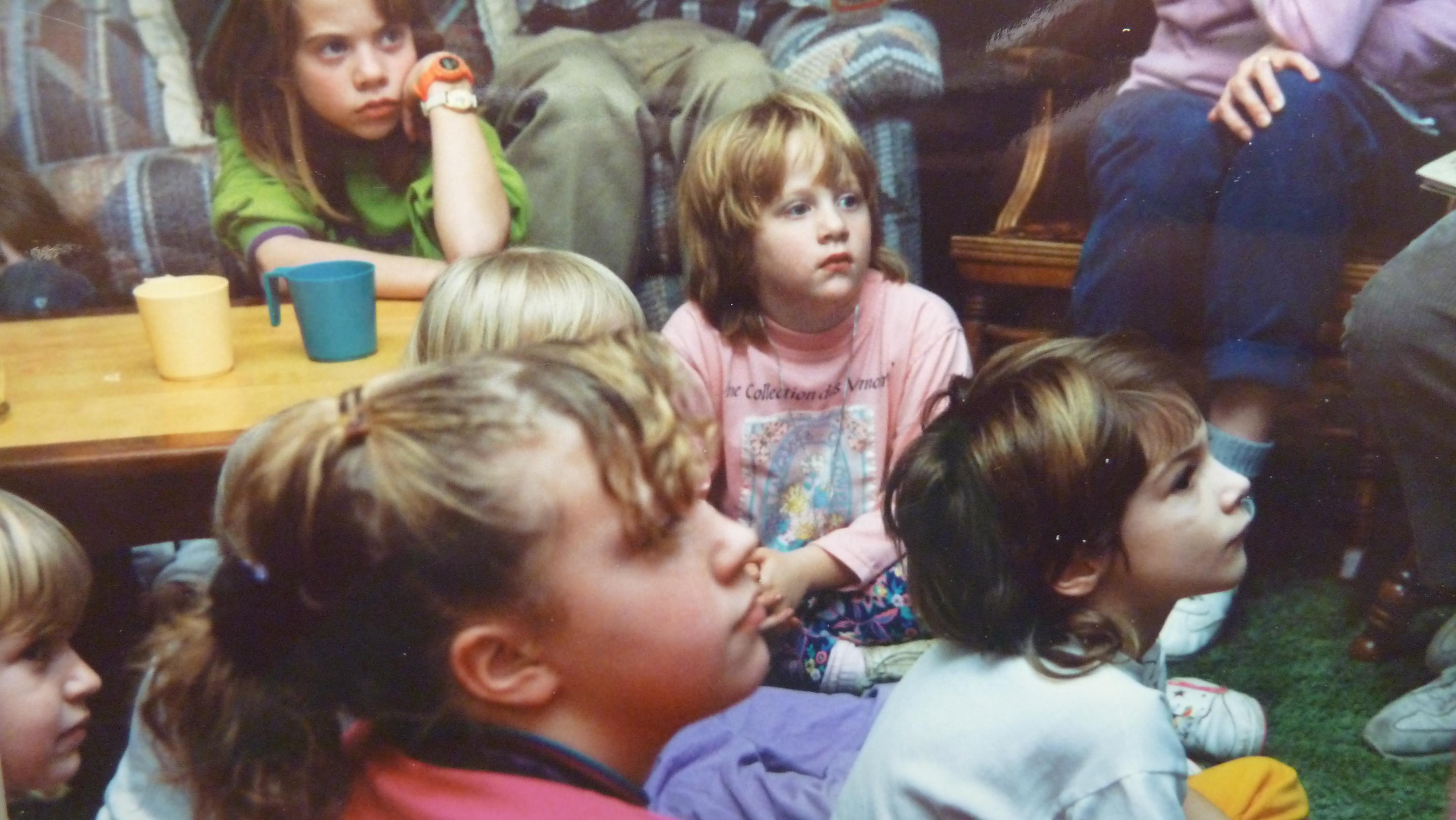 Kids from Helping Hands house church listening intently to a story by master storyteller, Donna Barber.
When the kids were really small it was hard to be very involved in any house church but when they reached school age, one house church we participated in was called “Helping Hands” where we took on home maintenance projects for others, helping with Habitat for Humanity builds, doing local disaster relief. Our tongue-in-cheek motto for that group was “We try to do more good than harm.” More emphasis was on doing, rather than preaching or sharing faith in verbal ways, but that’s another aspect of missional that works especially well in the family setting.

Outdoor worship at Riven Rock park near Harrisonburg with house church.
Our children may have struggled to put words on why they liked hanging out with church friends in our house church setting, but—and I’m so thankful—I feel it helped each of them claim a faith without going through the immense struggle (rebellion) of many kids and youth who grow up feeling the church was only about rules and right answers and doing things certain ways and not about a lived faith struggling with doubts and questions and failure.
Missional today. None of this is to in any way brag. We, our church, our house churches, our family, are all human, imperfect, blazing failures in many ways. I won’t detail those imperfections and failures but I believe God is faithful anyway and keeps working God’s purposes out in all the mess.
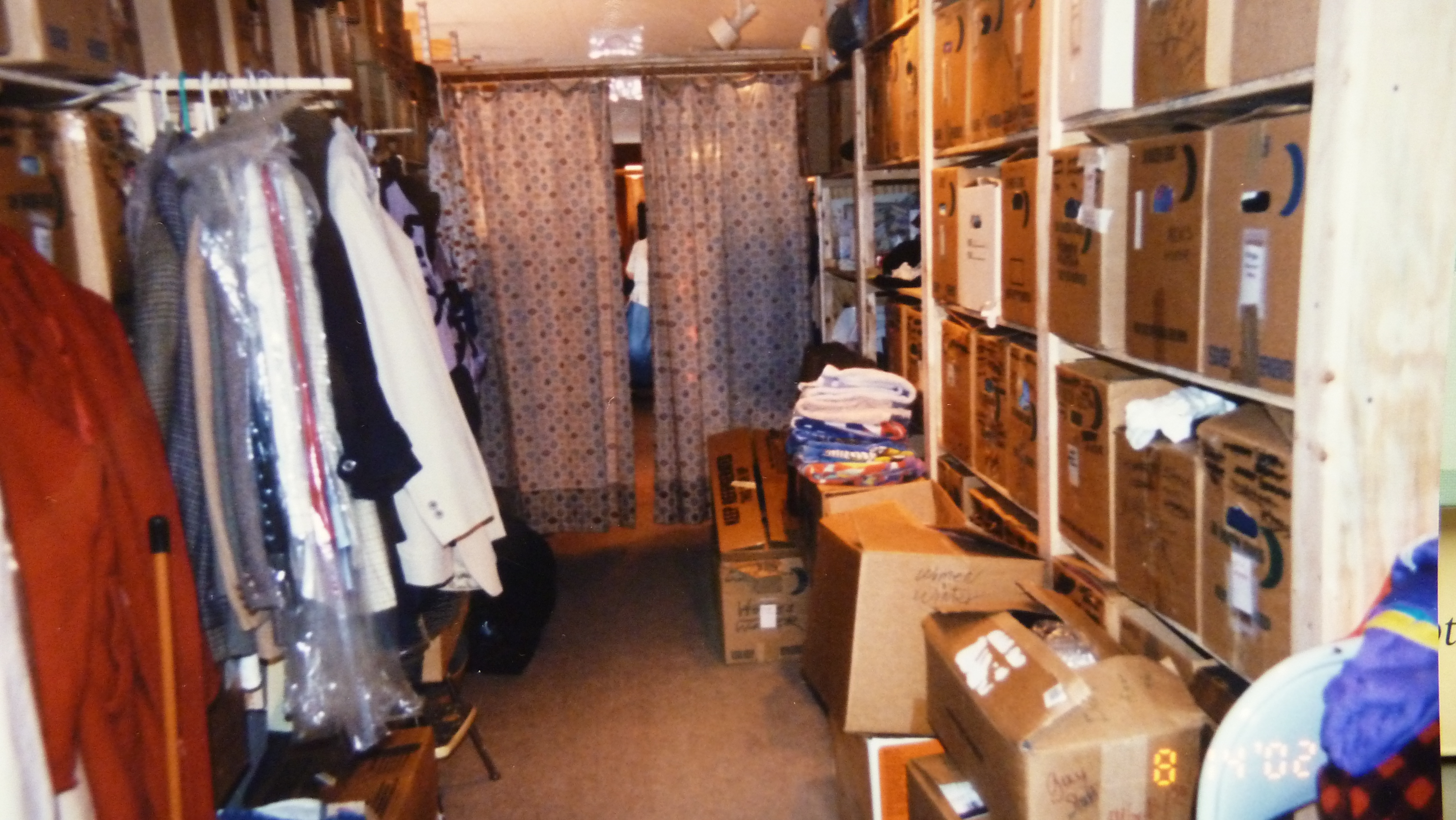 Trinity Clothes Closet outreach.
My personal main involvement is with a Clothes Closet ministry which not only distributes and recycles an amazing amount of free clothing, it gives me opportunity to still use my Spanish at least once a month.
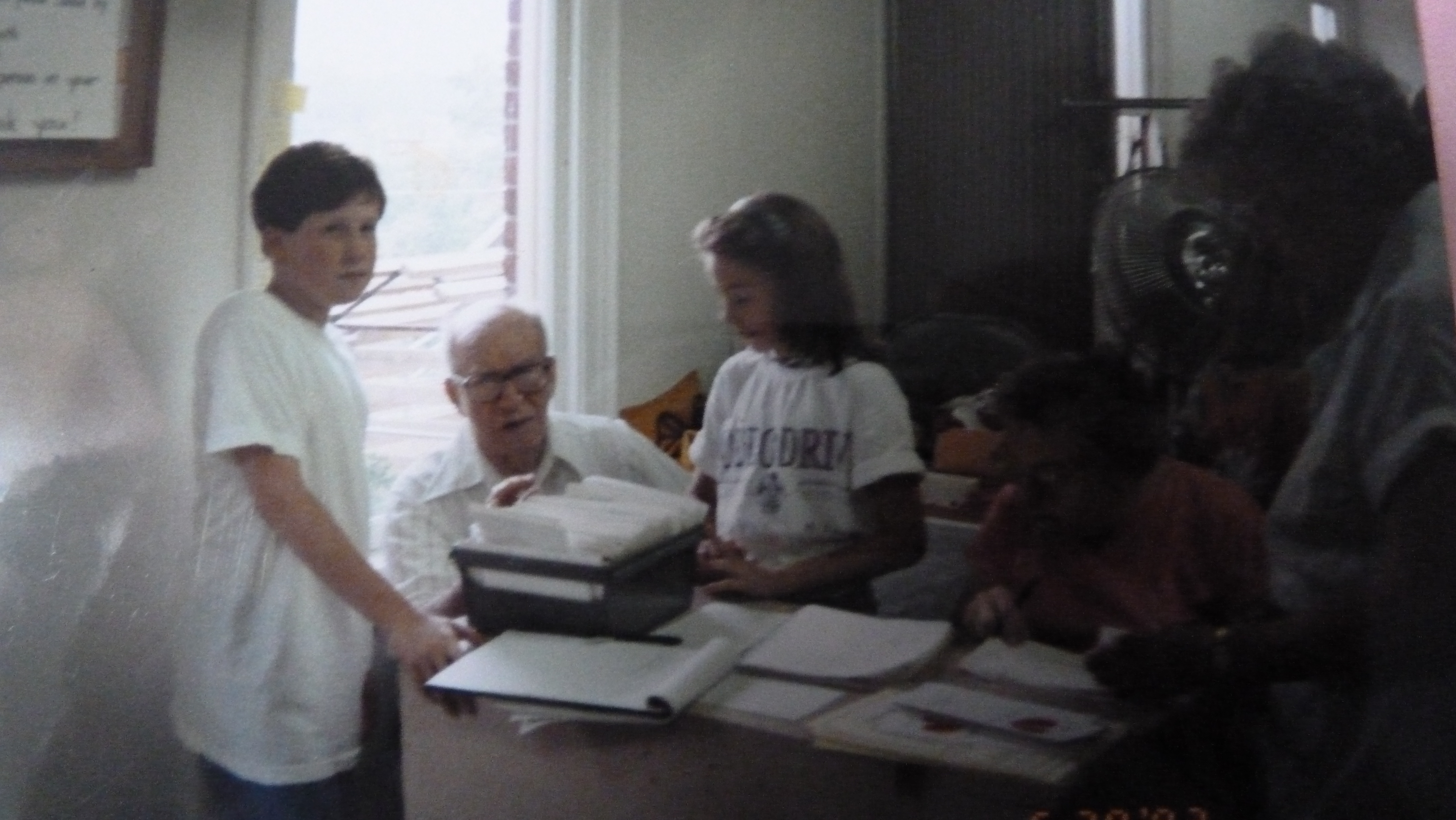
Daughter Tanya, right, helping with Clothes Closet check in, with Kevin Gallagher, left and the late Rev. William Ramkey, center.
Over the years, as we’ve experienced waves of new immigrants and refugees, I’ve also tried to learn a few words of Russian and Arabic, and currently some of the volunteers who help organize and bag the clothing are Iraqi Muslim women and children. A Muslim teen issued a call for others to help with the Clothes Closet ministry from the Trinity pulpit last fall during our annual recalling/re-covenanting season. Nice turnaround.
So the world has come to our backyard—and that is true in almost every community in North America, right, with all the attendant difficulties–but also the joys and learnings. Families especially are a great place to connect with all that messiness, all that world-in-our- backyardness.
The take away? Children who grow up seeing faith lived out in a variety of ways–and have opportunities from a young age to actively participate in mission or service activities–have a better chance (not guaranteed, ever) of growing up to embrace faith.
And these words that I command you today shall be on your heart. You shall teach them diligently to your children, and shall talk of them when you sit in your house, and when you walk by the way, and when you lie down, and when you rise. You shall bind them as a sign on your hand, and they shall be as frontlets between your eyes. You shall write them on the doorposts of your house and on your gates. Deuteronomy 6:6-9 Bible Gateway.
***
What do you think? How have mission and service activities impacted your life or the live of your family? Is looking at service this way self serving?
This post is part of a MennoNerds Synchro-Blog on Missionary Spirituality for the month of February. MennoNerds is exploring “spirituality through an Anabaptist-Christian lens” and what it means concerning participation in the mission of God. Find other MennoNerds blogger posts on this theme here.
And here’s one family that took missional a step further!


