


Joseph
When a fight almost broke out at church
For many years at our church, in addition to lighting the Advent wreath each Sunday, the children put up Velcro-backed animals and characters on a special Advent banner depicting the nativity, with different characters added each Sunday during Advent.
But one day a fight almost broke out between two brothers. “I WANT TO PUT ONE UP TOO!” wailed Paul loudly.
“There aren’t any more figures to put up today,” the young college girl doing the children’s time tried to reason with Paul. Older brother Alex quickly indicated to Paul that he could share the job of putting up the coveted Joseph figure. Alex lifted his little brother up to reach the banner. The adults all breathed audible sighs of relief—almost an awww moment.
Such are the sweet little disasters of Christmas, when everyone holds their breath and then somehow everything turns out okay and you know you’ve just witnessed something precious.
It is at home where the real wars break out over who gets to light the candle, or who gets to strike the match.
Why bother? Why keep Advent in families? Because it is one way to hold, even if just for a season, family worship or a quiet period of reading, singing and reflection in the home. It is a way to help keep kids’ minds off of Santa Claus and gift lists, and back on the original reason for Christmas. It is a way to help children hear familiar Bible stories year after year, today highlighting the courageously quiet way Joesph responded to Mary’s news:
Now the birth of Jesus the Messiah took place in this way. When his mother Mary had been engaged to Joseph, but before they lived together, she was found to be with child from the Holy Spirit. Her husband Joseph, being a righteous man and unwilling to expose her to public disgrace, planned to dismiss her quietly. But just when he had resolved to do this, an angel of the Lord appeared to him in a dream and said, “Joseph, son of David, do not be afraid to take Mary as your wife, for the child conceived in her is from the Holy Spirit. She will bear a son, and you are to name him Jesus, for he will save his people from their sins.” Matthew 1: 18-21
We’ll look more at Joseph’s difficult dilemma tomorrow.
Keeping Advent traditions is a way of holding holy moments in your household, whether it is just you, or you and your spouse, or a passel of not-so-holy munchkins.
How do you keep Advent in your home?
***
My photos each day in this Advent series feature figures from a handmade advent calendar I picked up long ago at a yard sale. It quickly became the kids’ favorite, and a permanent addition to our Advent collection and celebrations. I hope you enjoy watching the parade of characters on this virtual advent calendar.
***
This story was first published in my regular syndicated weekly newspaper column, Another Way, see www.thirdway.com/aw (which can be used in any local paper, email me for details).

The angel Gabriel
Finding Harmony between divine and human
In the sixth month the angel Gabriel was sent by God to a town in Galilee called Nazareth, to a virgin engaged to a man whose name was Joseph, of the house of David. The virgin’s name was Mary. And he came to her and said, “Greetings, favored one! The Lord is with you.”But she was much perplexed by his words and pondered what sort of greeting this might be. The angel said to her, “Do not be afraid, Mary, for you have found favor with God. And now, you will conceive in your womb and bear a son, and you will name him Jesus. (Luke 1: 26-31)
The birth of a baby is commonplace.
Four babies (around the world) are born every second of the day (according to Yahoo Answers). 15,000 every hour. 360,000 every day. In the hospital where my newest grandson was born, there were 500 babies born last month, a dozen or so the day he was born.
The safe arrival of a new baby—from the womb to the world—is an event marked with flowers and calls and texts and posts on Facebook and birth certificates and DNA samples and newspaper notices.
Yet the birth of a baby is a miracle, too.
The odds of each particular baby—sperm uniting successfully with egg and growing 40 weeks to full term, surviving delivery, and belting out that welcome borning cry—makes each little baby a true miracle.
The announcement delivered by the angel Gabriel that Mary would have a baby boy (no sonogram needed here to find out the gender ahead of time) was in a class by itself: a human infant, a divine child.
The truly profound takeaway is that every child has a touch of the divine: we are created in the image of God. We are God’s children (whether or not we recognize or claim it or act like it). We can even become like Jesus: “little Christs” is one way to interpret the name “Christian” given to followers of Jesus (first mentioned by C.S. Lewis?).
We’ll encounter these divine messengers again towards the end of Advent, but for today, what message is God (through Gabriel or another messenger) speaking to you?
Perhaps that you, too, are a miracle, placed on earth for a divine reason? Can we see our children or other loved ones that way?
***
For a lot of us, the angel Gabriel will forever be etched in our minds played by the late Lee Eshleman in “DoveTale.” Gabriel’s announcement can be viewed here.
The DVD is available from Ted & Company here.
***
My photos each day in this series feature figures from a handmade advent calendar I picked up long ago at a yard sale. It quickly became the kids’ favorite, and a permanent addition to our Advent collection and celebrations. I hope you enjoy watching the parade of characters on this virtual advent calendar.

Mary, mother of Jesus
Looking for the harmony: take the plunge
Despite this being the most wonderful and magical season of the year leading up to December 25, everyone knows days can end up filled with friction and frustration. We end up frazzled and wanting the preparations to be over. Especially as adults who sometimes get carried away trying to make sure everything is just right for children and family, we overdo, overspend, and of course, eat too much.
Beginning Sunday Dec. 1 and for 22 days in Advent (I’ll take Saturdays off and you can too), I invite you to set aside five or ten minutes for quiet and calm anticipation by lighting a candle (on your advent wreath or any old candle) and waiting, with Mary, for the birth of the Christ child. As my pastor says, even five or ten minutes can bring some tranquility to the rest of your day and allow you to focus on the things that last.
The stories I’ll share from the raucous days of raising three children, mixed in with tales from church family and friends, will remind you (I hope) that you can find harmony even walking through difficult or even sad circumstances. So we look for the harmony: some days we find it, and some days despite best plans, we end up disappointed and looking to tomorrow.
Most days the meditations will be quite brief and include a scripture and suggested prayer. So take the plunge: sign up to follow my blog so you can get them straight to your email as a reminder, and share your favorites with friends. I hope you’ll respond with any thoughts, reflections, or stories the mediations bring to mind for you. And one of these days soon I’ll tell our very own story of our second grandbaby born two days before Thanksgiving this year (and just two months after the first grandbaby,) which brings extra joy and poignancy during this season of waiting for a special baby. (Which also explains my mini blog vacation for the last week.)
Along these lines, for today’s very brief meditation, I like the words of Elizabeth O’Connor, one of the well known writers and longtime members of Church of the Savior, Washington, D.C., upon whose principles our local congregation was founded. Elizabeth writes:
“It is not what happens to us in any day that gives content to our lives, but whether or not we let its experience sink into us. ” — (Cry Pain, Cry Hope, Servant Leadership School, 1993, p. 33)
The first Psalm puts the above thought this way (one of my dad’s favorite passages and I can hear him reciting it now): “Their delight is in the law of the Lord, and on God’s law they meditate day and night. They are like trees planted by streams of water, which yield their fruit in its season, and their leaves do not wither.” (Psalm 1:1-3)
Like Mary, plan to spend time this December reflecting on life and truths deeper than the latest advertising jingle. We’ll have much more on Mary in the days to come.
***
Some background facts on Advent if you are not very familiar:
Length and timing. The beginning of Advent is determined by St. Andrew’s Day, which falls on November 30. Advent begins the nearest Sunday to November 30.
Advent didn’t become a part of the church’s calendar until after the Festival of Christmas itself had been established, around A.D. 336.
Originally Advent was 40 days long, like Lent, representing the 4000 years of patient waiting by the Hebrews for the Messiah. In some religious groups it is observed as a time of prayer and fasting–like Lent. Many families and individuals reserve daily time to gather in front of a wreath and candles known as the “Advent Wreath,” for a meditation, song, or prayer. Some use purple candles to represent royalty, with a pink candle as the “Mary” candle representing joy. Sometimes the argument is over which candle gets lighted next (my daughters shook their heads in dismay at church many Sundays when someone lit the “wrong” candle. Very worshipful family harmony those days!) But I see we’re not the only one with these debates, and what to call the different candles.
What color the candles? A few years ago my denomination, Presbyterian Church USA went to using blue representing royalty. Of course purple represents royalty too, and it all depends on what kind of berries were available long ago in a king’s country for making various dyes. I love David Hansen’s blog post on this topic, here.
I know in many Mennonite churches (the two denominations I am most familiar with) use red candles, just representing traditional Christmas colors I guess. Since we were first introduced to the purple and pink when our children were small, that’s what we like to stick with.
When to start singing carols? The other new thing for me when I first became part of a Presbyterian church was getting used to not singing carols until Christmas Eve, or at least the last Sunday before Christmas or when we went caroling. In light of the fact that Advent is supposed to be a time of deprivation or fasting, some groups sing only the more somber, minor “carols of waiting” like “O Come, O Come Immanuel” and “Lo How a Rose Er Blooming.”
I chuckled when I read a pastor’s story about his church group on a weekend retreat during December. They were in the mood to sing Christmas carols so sing they did: carol after carol, enjoying the camaraderie and memories the carols stirred. But this minister said he felt “naughty” singing joyful carols during the mournful time of Advent. I thought, only a minister could feel naughty singing a Christmas carol!
Deeper theological meaning? Advent also refers to the “second advent:” the belief in Jesus’ second time of appearing. Christians have been waiting for that “advent” a long time, too. Thus, the season is a profoundly spiritual time—if we set aside time to soak it in, and not just go through the motions.
Family customs? One more thing: the photos each day feature figures from a handmade advent calendar I picked up long ago at the annual Belmont Community Yard Sale famous in these parts for quality merchandise. It quickly became the kid’s favorite, and a permanent addition to our Advent collection and celebrations. I hope you enjoy watching the parade of characters on this virtual advent calendar. These traditions become a kind of glue for families.
***
For my regular syndicated weekly newspaper column, Another Way, see www.thirdway.com/aw (which can be used in any local paper, email me for details).
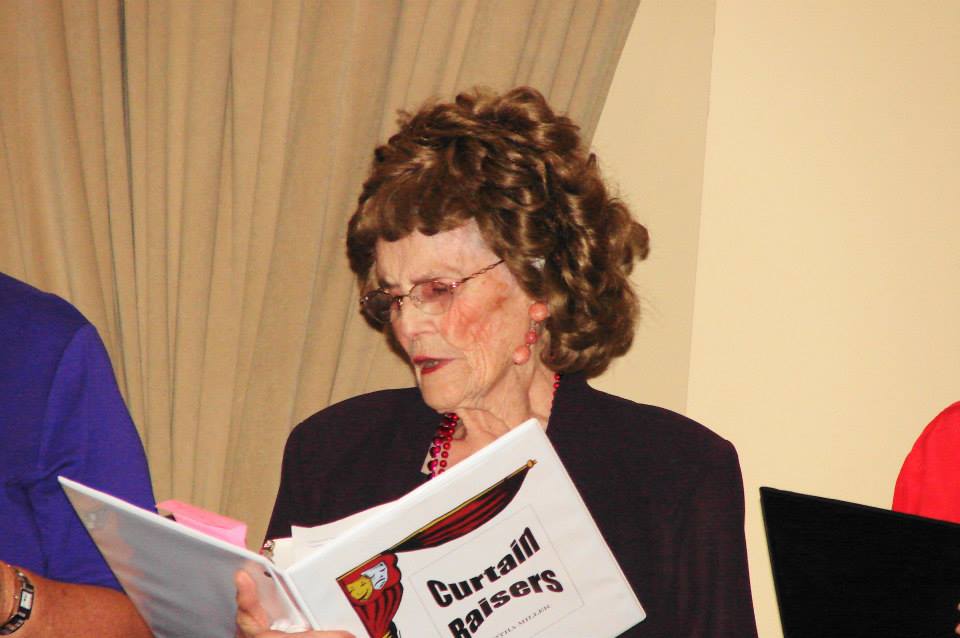
“I’m 89 and I’m still da-ting,” Mom says in a production of “Memories Radio” put on by the Curtain Raisers, a group of senior citizens who are obviously enjoying themselves at Greencroft Retirement Community. Her sing-songy lilt and coy smile is just perfect and the line brings a nice laugh and applause.
When I visited Mom in late September, she was working on assembling her costume for the production. The women had decided to dress up as if they were members of the Red Hat Society, and mom had borrowed a beautiful dark purple gauzy dress, hat, wig, and was still hunting for clamp style dangly earrings. So she cavorted a bit for me in her wig, showing how they were supposed to sashay like models as they entered the stage.
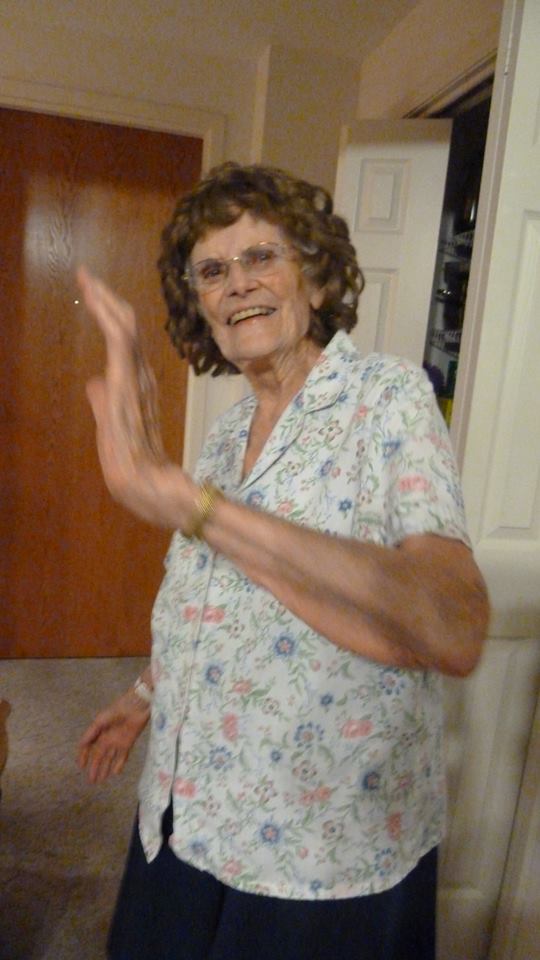
Neither of us have ever had pierced ears but she wanted earrings to complete her look as a pitch woman for a “Mortuary” in one of the segments. Getting all gussied up is half the fun of Halloween or any campy production, right?
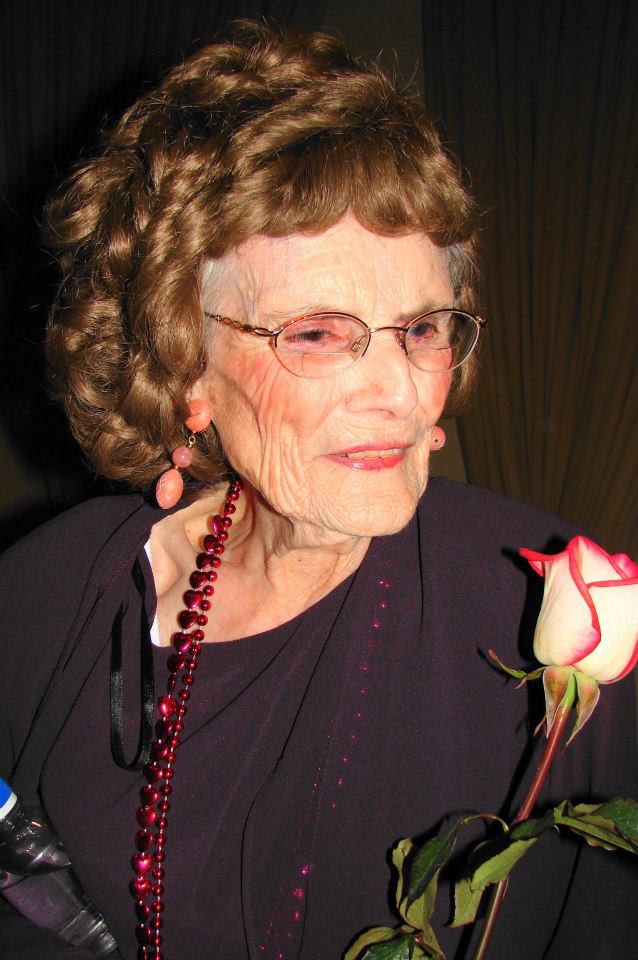
Mom has always enjoyed performing in skits and even being asked to read the scripture for church. She’ll practice and make sure she enunciates slowly, clearly and loudly—one of her biggest frustrations is when speakers don’t get close to microphones and she and many others with hearing loss are left guessing at what’s going on. She uses hearing aids and assisted hearing devices at church but they don’t help if people don’t talk into the mic.
Years ago she and other women of her church fellowship (not the church she goes to now) put on some kind of skit for a talent show or fun evening. Mom recalls being handed a gospel tract later from one of the older women that implied the group had gone overboard–that the skit was maybe “too silly” for a church women’s get together.

Silly, yes! That is the point. This production by the Curtain Raisers consisted of a series of readings related to the woes of getting older: older people essentially making good fun of themselves.
The performers worked hard, getting lines right (this was “radio,” right, so thankfully they didn’t have to memorize their scripts,) and adding flourishes and meaningful looks to add to the effect.
The show was a combination of jokes, things your parents used to say, church bulletin bloopers, and old sayings that could be taken two ways: “My mother taught me hypocrisy. ‘If I told you once, I’ve told you a million times: Don’t exaggerate!’” And, “My mother taught me about roots: ‘Do you think you were born in a barn?’” A woman dubbed “Miles to go Mabel” did a review of things younger folks don’t remember like living in a “time before television, frozen foods, and panty hose.”
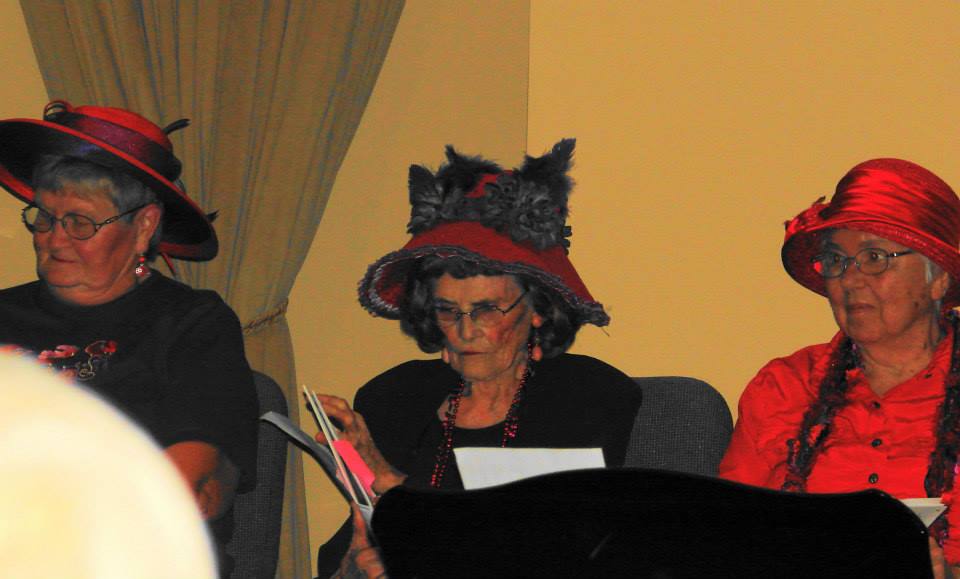
The women, dubbed “The Swinging Senile Sisters” sang a new version of “My Favorite Things,” recalling favorites like false teeth and hearing aids. No, senility is not funny, and I’m guessing that most if not all of the performers have experienced loved ones with this issue. Sometimes the only thing that helps you survive is being able to laugh.
Mom had to read an obituary for the “Pillsbury Dough Boy” who died of a yeast infection and complications of being punched too often in the belly.” She added things like pushing up her partial as she delivered lines like “He was a man who never knew how much he was kneaded and was kind of flakey.
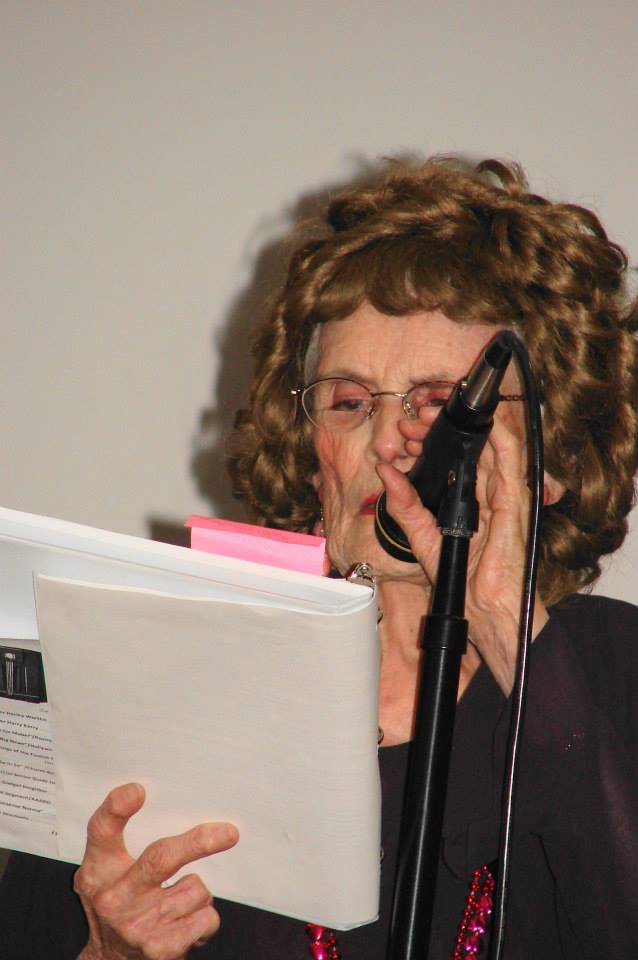
The week of production was pretty exhausting, with dress rehearsals for the hour show and then two performances, one at 3 p.m. on a Tuesday afternoon, the second at 6 p.m. on Thursday evening, the better to accommodate friends, family, and fellow senior citizens. As one of the oldest members of the cast, Mom rested up on Wednesday and didn’t try to do much or go anywhere, saving energy for Thursday.
The show was such a success they were asked to do an encore performance in November for social work and nursing students at nearby Goshen College studying gerontology and aging. The students did a talkback with the actors after the performance and Mother was pleased to hear questions and comments reflecting how the college students were impressed that “you could be older and still actively do fun stuff” –perhaps a revelation for those kids.
And Mom wanted to clarify something for the students. At one point in the conversation Mom spoke up and said, “I am 89 but I’m not dating,” which earned her another laugh.
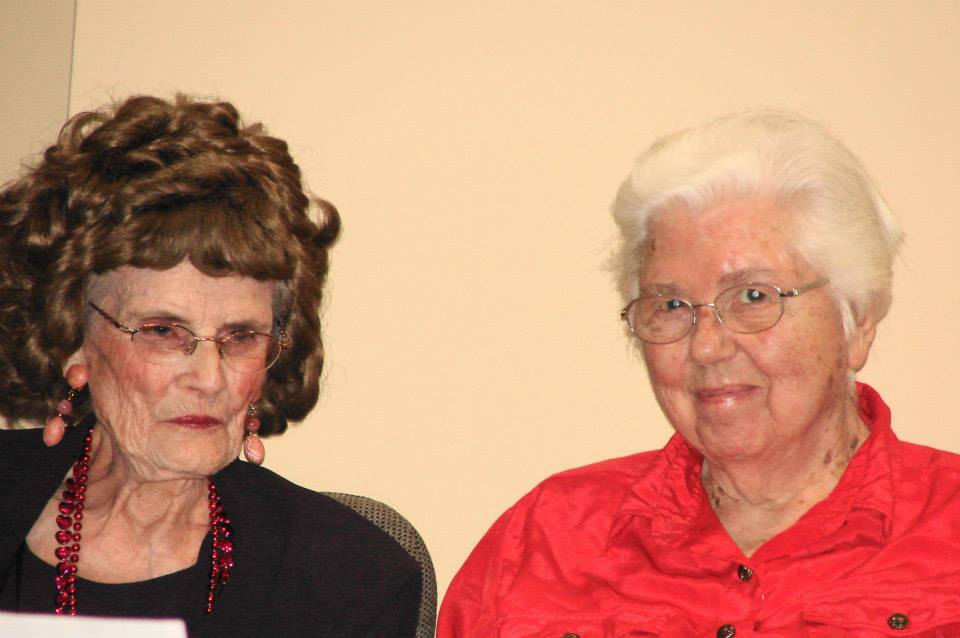
And that’s what its all about, right? Laughter, living, enjoying oneself, being stretched, maybe even doing something at 89 you’ve never really done—working with a director and even having the show videotaped (which is how I got to see the show).
After the show, the actors were mostly drained and just glad it was over, but after recouping their energies, they are looking forward to working on a new show in the new year. Someone even suggested they call themselves the Comedy Club, and invited them for another encore. Life is more fun when you have things to look forward to.
Maybe someday soon you’ll see them on YouTube.
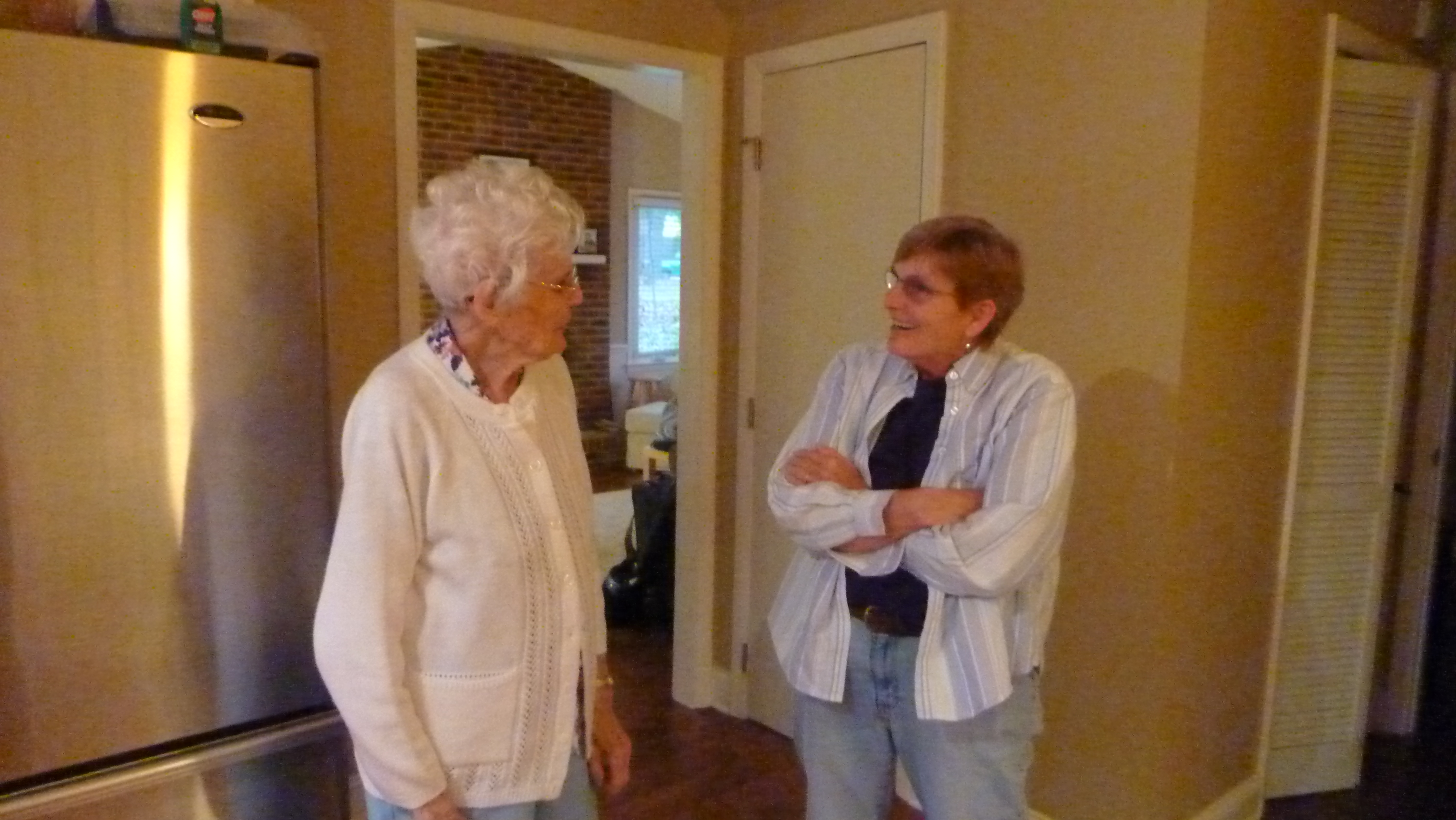
This is mom with her normal beautiful white head of hair, talking with my sister, Pert.
With a big thank you to my sister Nancy and her son Larry who were able to attend the production and take these lovely photos.
***
Greencroft Communities are continuing care communities, with Mennonite roots and connections but open to all who share similar values.

I don’t know why meatloaf gets such a bad rap. Maybe it was school lunches. Maybe because it’s a fallback or go to when mom or dad (maybe?) doesn’t know what else to make.
My mother used to take her meatloaf to potlucks and it was a dish that always felt “safe” to me, but that was because it was MY mother’s. If I remember correctly, it was usually all taken, so others must have considered it safe too. She would put about 3 strips of bacon on top that added some flavor so maybe the bacon attracted takers too.
Other meatloaf might be loaded with big chunky onion and celery and green or red pepper bits and who knows, maybe some mashed potato to hold it together. I’ve even seen canned peas in meatloaf. No wonder it has a bad rep. I do remember going to the homes of friends (no, I can’t remember anyone specifically, really,) where the meatloaf might have some surprises in it. I had a hard time getting those surprises down.
Mom’s was safe. It was top quality ground beef (their own beef of raised by local farmers) mixed with crushed cornflakes, eggs, milk, and salt and pepper. Very basic. That’s still how I prefer my meatloaf. In a pinch I’ve also used crushed saltine crackers as the “glue” that holds it together, but I think I prefer the slight addition of flavor cornflakes add. Corn makes everything better, right? (Ironic oops: I first wrote “slight addiction” there until I proofed it. Hmm.)
Throw a couple of baked potatoes in the oven for an hour along with the loaf, get a vegetable or salad ready, and go do something else until supper is ready.
There is something about the smell of meatloaf baking in the oven that says “home” as much as a whiff of ham or pot roast or fried chicken.
I don’t think I got much pushback from the kids on my meatloaf; it may have not been their favorite meal, but when I explained to them it was just hamburger in square pieces (think Wendy’s?) and they could put ketchup on it, they could deal with that.
Just don’t throw everything in the refrigerator into the meatloaf. Save that for your homemade vegetable soup.
Did you like your mother’s meatloaf?
What was there about it that you loved? Or didn’t?
What memories does it evoke for you, or not?
Mother’s Meatloaf – Serves 2-4
1 lb ground beef
1 cup corn flakes, crushed
1 egg
¾ cup milk
½ – ¾ tsp salt or to your preference
¼ tsp pepper
Garlic powder or onion powder or flakes if desired

Throw everything into a mixing bowl, letting the cornflakes soften in the milk at the bottom of the bowl. After a minute or two, take your hand and mush it all together. “Knead” a minute or two to mix well. Make sure cornflakes are well distributed through mixture.
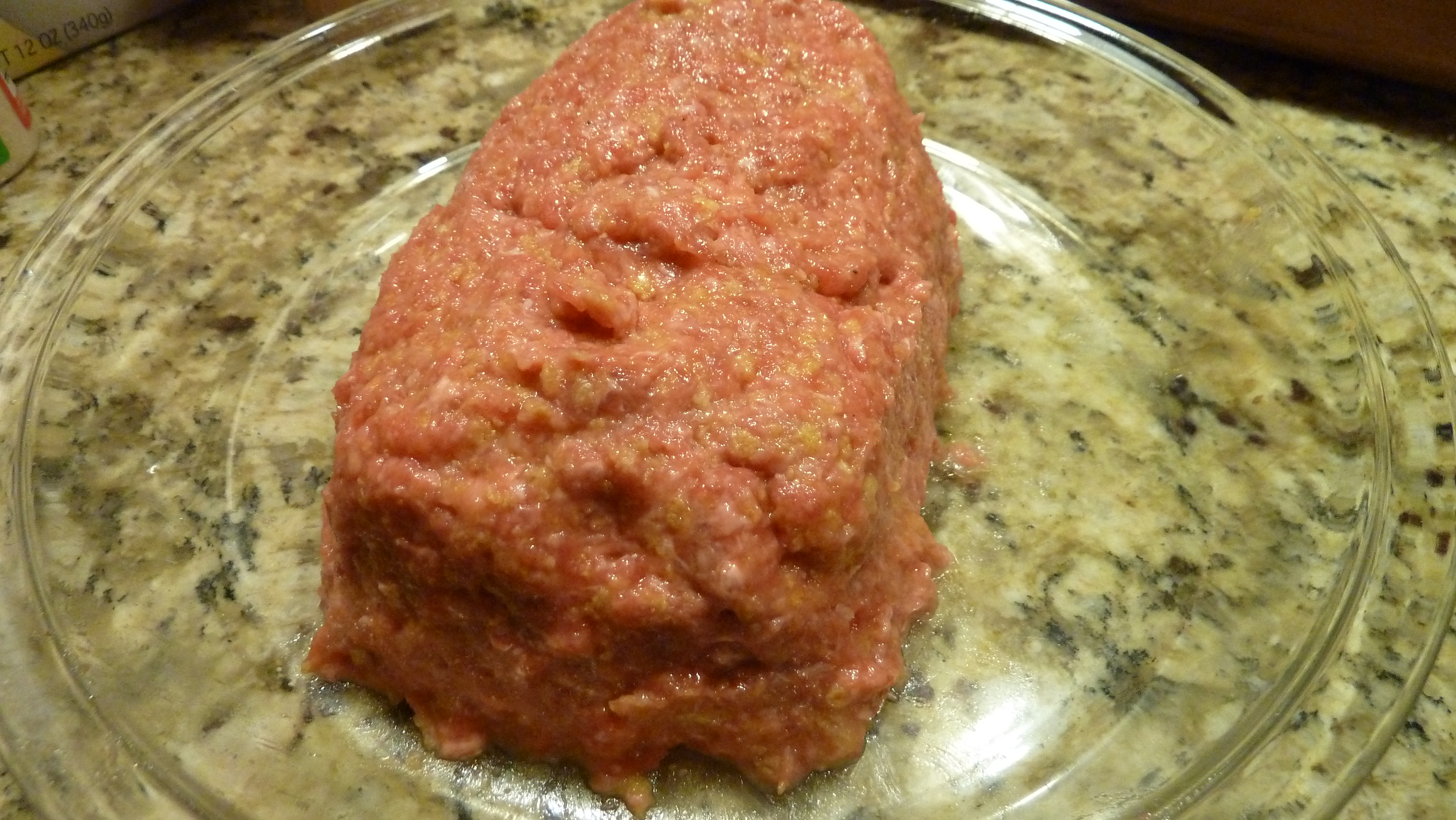
Place ball of meat in a baking dish or pie pan and form into loaf shape . Bake at 375 degrees for one hour. Slice and serve.
***
You can buy a copy of my book Whatever Happened to Dinner: Recipes and Reflections for Mealtime here.
Then David and all Israel played music before God with all their might, with singing, on harps, on stringed instruments, on tambourines, on cymbals, and with trumpets. (I Chronicles 13:8 NKJV)
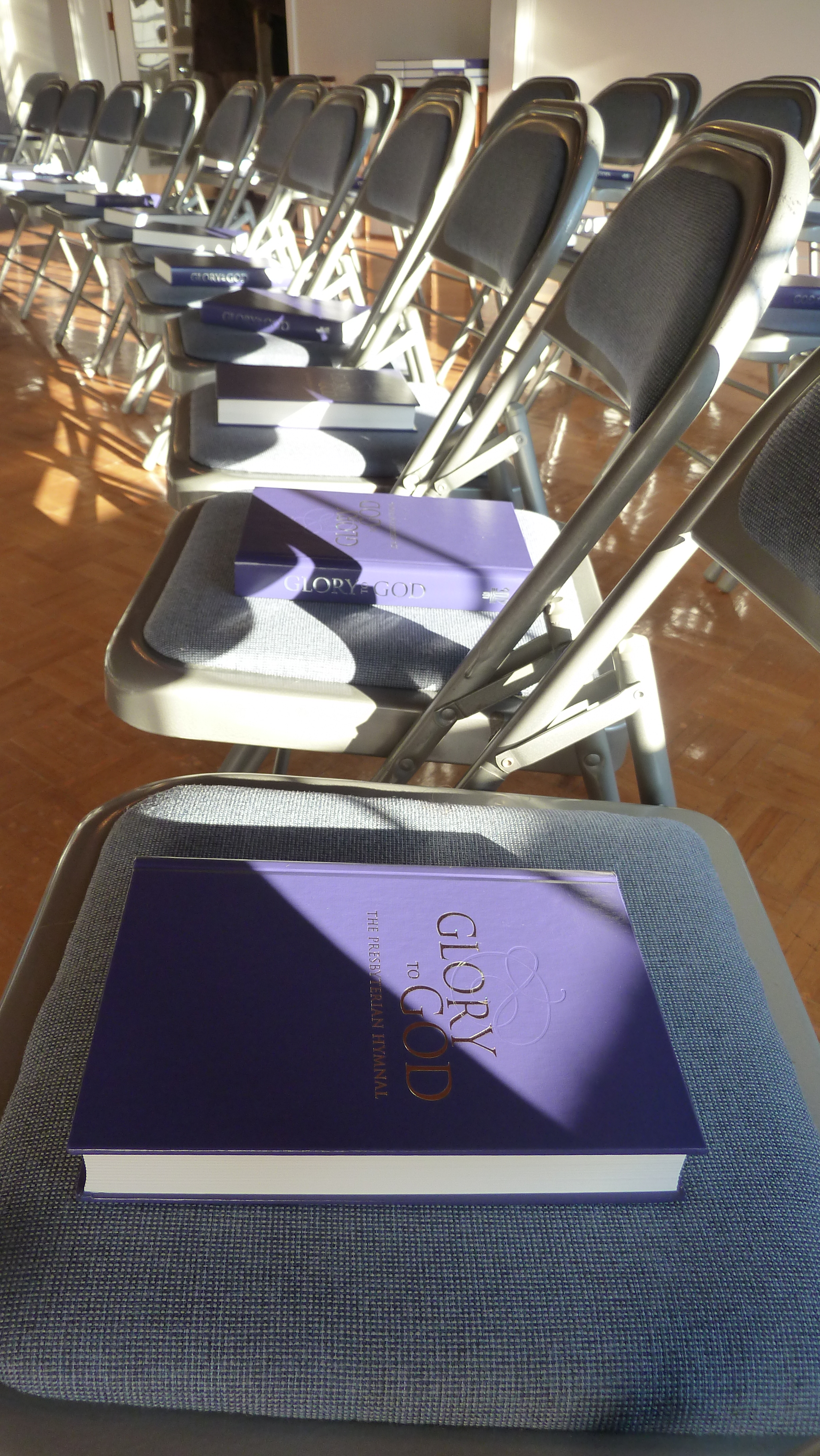
We dedicated the new Presbyterian hymnal at our church on Sunday.

I remember dedicating buildings, pastors, Sunday school teachers and babies, but if I participated in a hymnal dedication before, I don’t really remember it.
Glorious music from the new book filled the service: 15 songs or pieces of music in all—far beyond the staid old 3 hymns and a (choir) anthem of many services. At least 12 of our own sang solos, helped with special music or accompanied—all as various parts of the service, so it didn’t feel like a talent show or school music program.
Even for a small congregation of about 115-125 on an average Sunday morning, we put out. Of course it helps that half the music department of James Madison University are members (another joined Sunday), and of course I exaggerate. Good music attracts those who like to sing, and we owe some of that to three tenor “Johns:” John Lyon (longtime head of the music department at JMU, now retired), John Held, children’s choir director who I’ve written about before here, and John Henderson, a songwriter, guitarist (pictured here) and faithful choir member.
The lovely music tradition at Trinity is also because of our pastors: Ann Held has served the last 23 years and has put a welcome emphasis on music in the congregation, including chaperoning our youth to national “Music and Worship” conferences held at Montreat, N.C. If you come away from music week at Montreat uninspired about the role of music in worshiping God, something’s wrong.

I might also mention we do not have an organ. While I enjoy good, appropriately used organ, (like they use occasionally at Montreat) everyone knows it can kill congregational singing, so we stick with piano.

And some well-placed drums, occasional violin, flute, trumpet, or oboe, (whatever the youth of our congregation are good enough at to not embarrass their parents).
Back to the new Presbyterian hymnal, called Glory to God. Splendid name, instead of the obvious as used in prior rounds, Presbyterian Hymnal or Hymnal or Mennonite Hymnal or Church Hymnal —all collections which I either own or have used at various points in my life. At one point in the approximately 9 years it took to produce Glory to God, the hymnal committee opened the name choice up so anyone could vote online for suggested names, colors, design, type style and look.

Glory to God seems to have hit all the right notes IMHO: bringing together many musical traditions and eras, yet with the goal of imparting the salvation history of the Christian faith, with inclusive language when it comes to talking about people, but appropriate theological language when it comes to talking about God and Jesus and Holy Spirit, even (gasp) daring to call the three Father, Son and Holy Spirit—along with other images used in the Bible as well: mother hen, female prophet. Here’s more about all that. We’re not afraid to use “Lord” anymore to refer to Jesus and God and the final verse of “Be Thou My Vision” summons the “High King of Heaven” once again.
It includes old favorites like “How Great Thou Art” (once deemed theologically shallow, I remember someone once saying), “Be Still My Soul” (Finlandia tune), and newer tunes like the rousing and rapid Brazilian “Cantai ao Senhor,” (Sing to the Lord) with the most fascinating back story which my harmony seeking soul enjoyed. A Lutheran missionary musician heard it first at a pastor’s conference in southern Brazil in 1982, then went home to Argentina where he was serving, translated it to Spanish. Later, when back in the U.S. he translated it to English (my husband grew up Lutheran). Which leads me to a song in this new collection which I first heard and learned to love at a hymn sing at Stuart’s home church: the emotional baptismal hymn, “I Was There To Hear Your Borning Cry.” Originally created to accompany a video series on baptism, the words speak of God of course, but parents and grandparents can’t help but feel connected through stunning verse like:
“I rejoiced the day you were baptized to see your life unfold … If you find someone to share your time and you join your hearts as one, I’ll be there to make your verses rhyme from dusk till rising sun.”
To hear some of the music we sang Sunday morning, by different groups as found on YouTube (the videos aren’t much, but the music here can sweeten your computer time–I love it as background as I work)
Be Still My Soul*, a cappella
Cantad al Senor (Spanish with guitar)Posted by Jim Tabor
Rain Down – Mennonite women singing informally, a cappella
The Servant Song – what our pastor called the “theme song” for our church.
***
My dual Presbyterian/Mennonite journey is well known on this blog (or if you know me) and I was awed how this hymnal brings together my Mennonite and Presbyterian ties. The new Presbyterian hymnal Glory to God even lists as its main designer, longtime Mennonite Gwen Stamm, who also designed at least the cover of Hymnal (navy blue, above). As I’ve worked for the Mennonite church in media for over 38 years while worshiping in a Presbyterian congregation for 37, I’ve always enjoyed participating in Mennonite office retreats, meetings, conferences and conventions because:
- I got to sing awesome Mennonite a cappella music
- There were always many songs, spirituals and choruses with an African beat and we drummed with our set of car keys, chairbacks, whatever was handy
- Loved singing African-American spirituals that went on and on and on – in a soul-stirring way – like singing “Amen” with John Powell
- And got to frequently sing, “Praise God From Whole All Blessings Flow” in the long long version (606 or 118, and you have to be a Mennonite to get the numbers) with Mary Oyer. If you don’t know what the long version of Praise God is, check here or Google “Youtube Mennonite 606” for numerous renditions.
Now, working for the Mennonite publisher MennoMedia and knowing that the Mennonite church is also in need of a new song collection which is in the long range plan, I’m looking at this fantastic Presbyterian collection and thinking: wonder if we could just skip the long long selection process and expense and just adopt or copy this book?
Or not. Of course not. A new Mennonite hymnal or song collection will be equally marvelous and theologically appropriate and all that jazz, but, still.
***
For more on Glory to God and to puchase at $17.50 each through December 2013, go here.
A whole collection of Mennonite a cappella CDs is available from the MennoMedia store.
*Be Still My Soul is available on an album Angel Voices, available from Amazon
http://snipurl.com/angelvoices
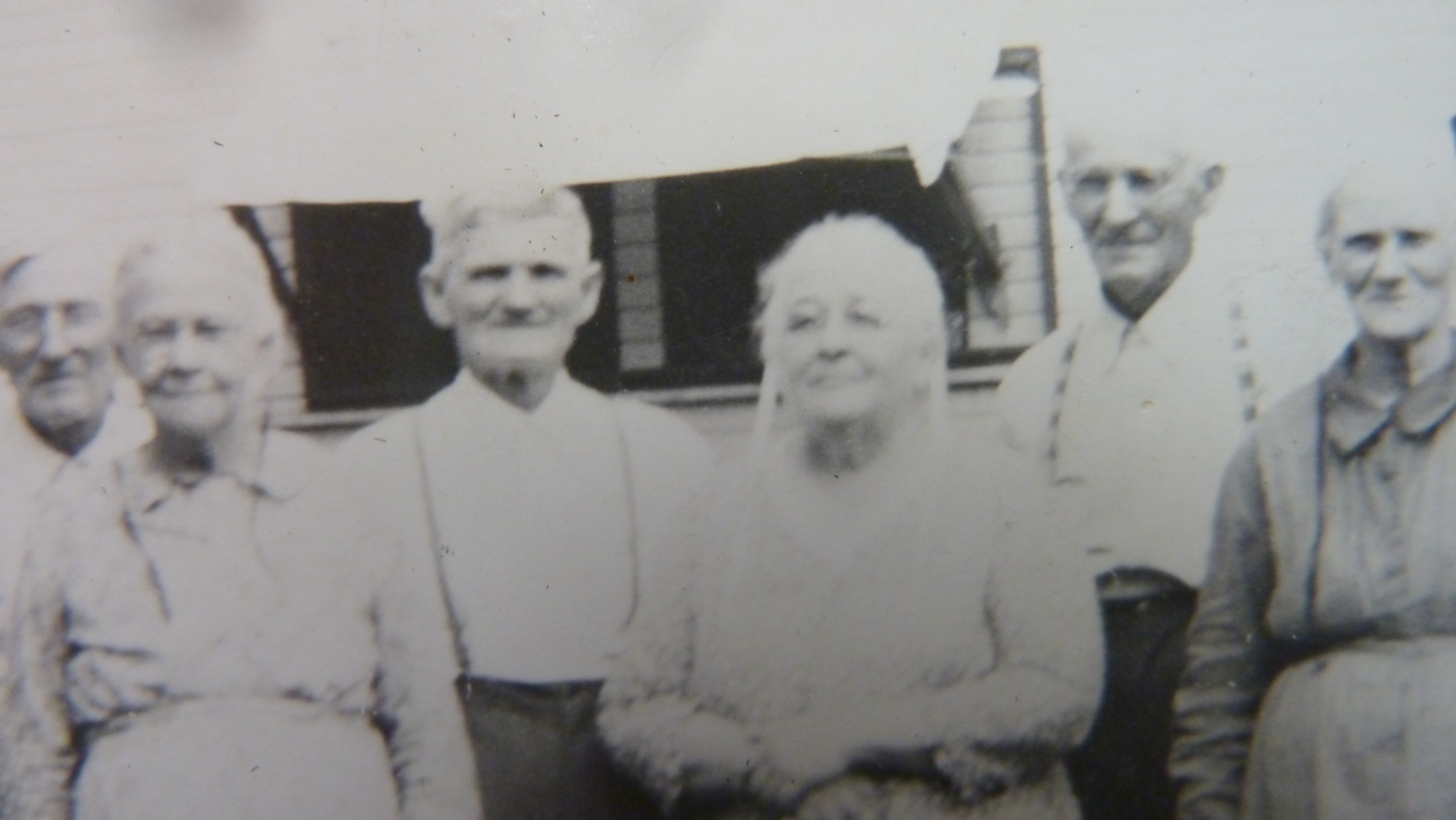 My paternal grandmother, Barbara Kauffman Miller, center, in the 50s when they lived with my family.
Since I just wrote about Grandpa Uriah Miller, I thought I would feature Grandma Miller’s famous sugar cookies for my recipe of the week. Plus my cousin just asked my mother for the recipe.
But I never make these any more, and have a simpler, not-roll-out cookie that has become my favorite sugar cookie. I hope the Miller family will forgive me. Sometimes you savor the recipes of your youth, but most of us grow up to learn to treasure many new additional recipes. The first recipe is died-in-the-wool Mennonite or Amish in origin. The second comes from a well known Presbyterian Christian educator in our valley, Mary Lou McMillin, and the Shenandoah Presbytery named it’s Resource Center named after her. So together these recipes find harmony in my blog.
Grandma and Grandpa Miller started my love affair with cookies and coffee. Since their two room apartment (kitchen, bedroom/living area and small bathroom) were right off of our kitchen all through my childhood, I enjoyed going over to Grandma’s in the morning while she and Grandpa had their breakfast of cornflakes, coffee and cookies.
Grandma would pour me half a cup of coffee in a big cup with a big saucer underneath, add half a cup of milk to the coffee (so yeah, it was really more like café con leche like I learned to love in Spain) and we would dunk our cookies in that coffee/milk. At times the cup overflowed with the coffee and milk, especially for childish rambunctious dunkers, but that was okay because it only slopped onto the saucer beneath. This is NOT, however, where the term Dunkard Brethren came from, which always confused me in my youth.
So, I have my Grandma and Grandpa to blame for my love of coffee and sugar cookies. Grandma suffered from diabetes (eventually a stroke) so I’m well aware of the hazards of too much sugar.
When I first started serious cooking after I got married, I tried Grandma’s roll out cookies once or twice and they simply seemed like they were pasty with too much flour. Did that ever happen to you with a recipe or food from childhood that you didn’t really like as an adult?
Here’s Grandma’s recipe.
Grandma Miller’s Favorite Sugar Cookies (Rolled)
6 c. flour
1 c. milk
2 t. baking powder
2 c. sugar
1 c. lard (yes, lard)
1 t. soda
2 eggs beaten
1 T. vanilla or lemon flavoring
½ t. salt
Dissolve soda in milk. Cream sugar and lard. Add eggs and flavoring. Sift baking powder and salt with flour and add to sugar mixture alternately with milk at soda.
Add enough flour to make them easy to roll out and not stick to rolling pin. Roll out to ¼ inch thick. Cut shapes with cookie cutters. Bake at 350 degrees for 12 minutes. Makes a bunch. (As written down by my mother, Bertha Miller)
Recipe 2:
But my favorite sugar cookie recipe for many years is “Mary Lou McMillin’s Sugar Cookies.” They are rich, a half-soft/half-crunchy sugar cookie. They use butter and don’t have to be rolled out (just spoon them onto a cookie sheet and flatten with the bottom of a cup) and can be prettily decorated with red and green sugars or other sweets for very quick Christmas cookies. I usually bake up a batch right about now just to have something Christmasy on hand when the parties and get togethers start where you want to take a plate of cookies or your kid forgets to tell you that you need to bring Christmas cookies to the PTA meeting or to youth group at church. Kids love to add the sugars or squash the dough down with a flour-bottomed cup.
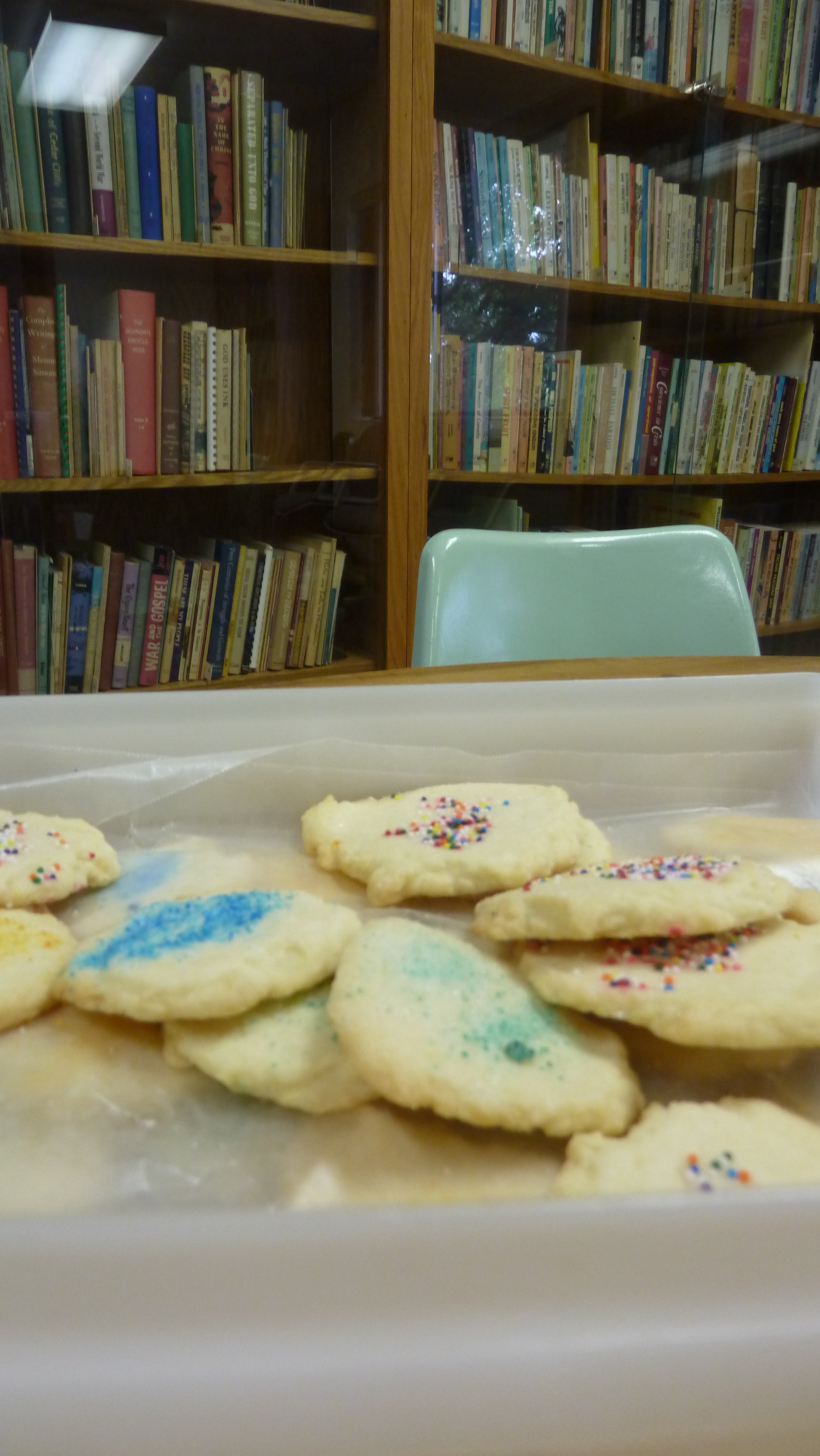
They are great to keep on hand anytime of year (using different colors for different seasons). The ones above I made a while back for break at work, to share my good news of an expected 2nd grandbaby in late November. Which is now! Soon!
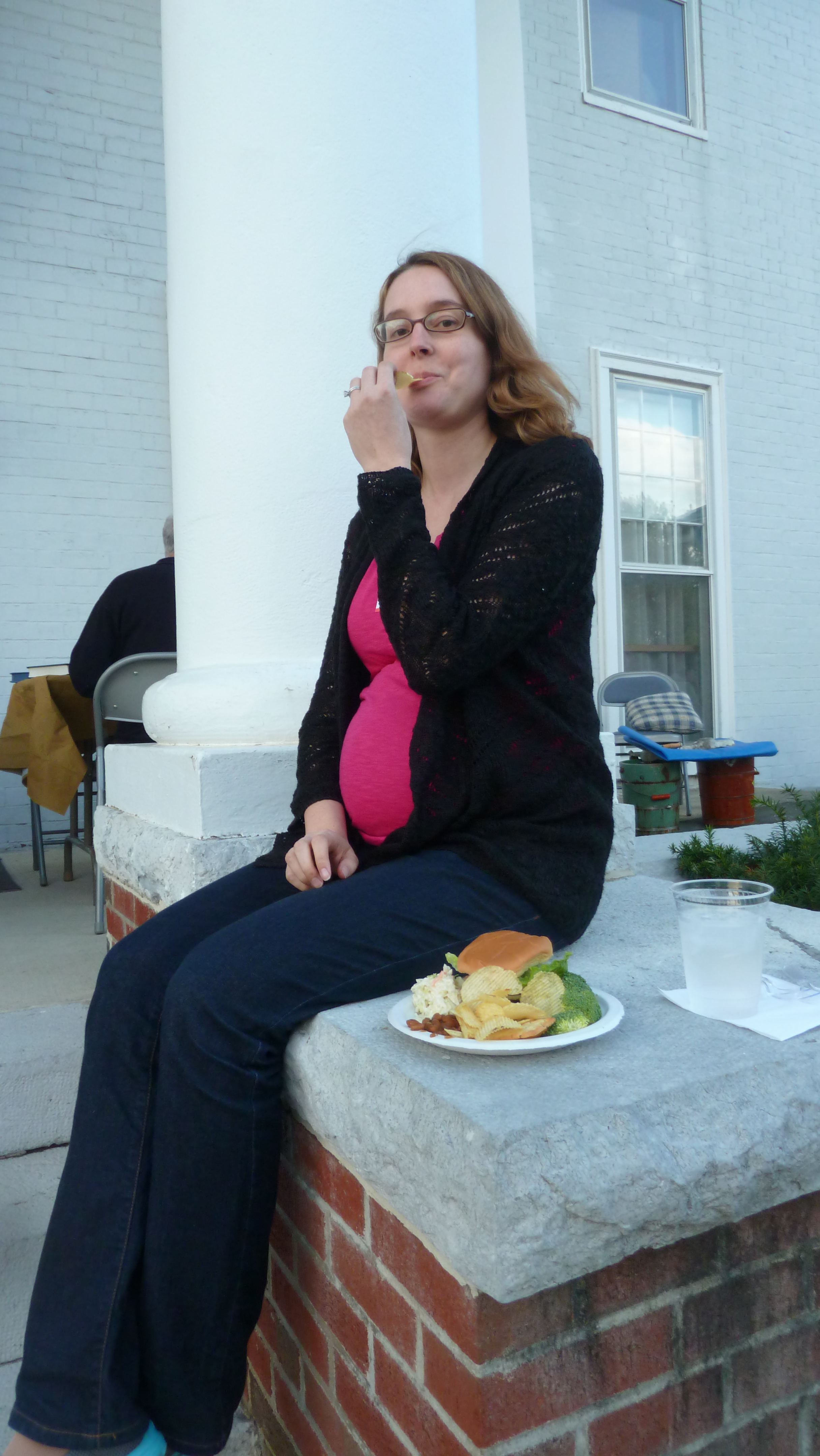 Daughter Michelle in late October, enjoying “eating for two” at our church’s 50th anniversary homecoming. Michelle is still a member of Trinity Presbyterian while an active worship leader at her local church Northern Virginia Mennonite (now that’s Mennonite/Presbyterian harmony).
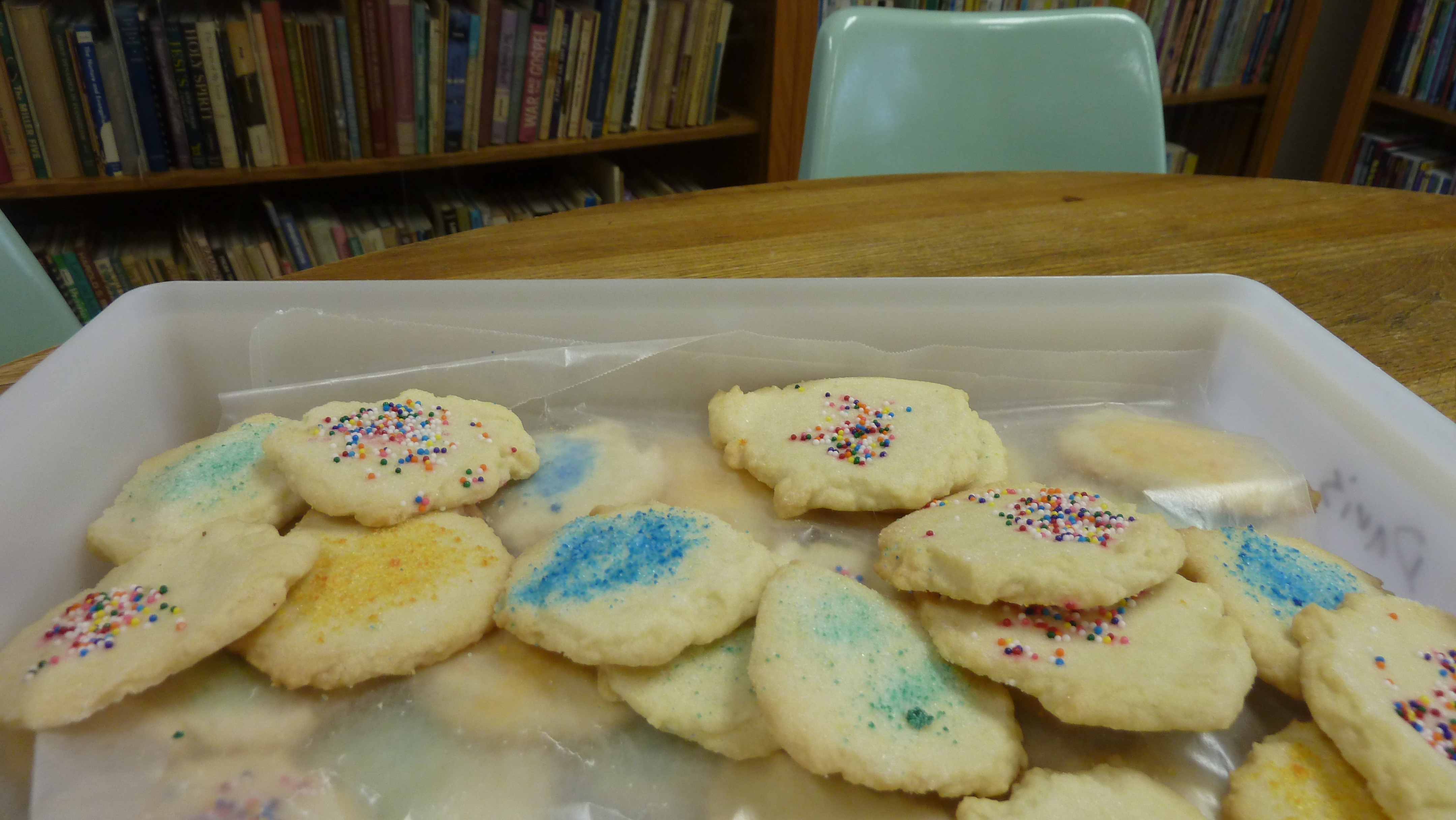
Mary Lou McMillin’s Sugar Cookies
1 c. powdered sugar
1 c. white sugar
1 c. butter (can use margarine)
1 c. vegetable oil
2 eggs
1 t. vanilla
1 t. salt
1 t. soda
1 t. cream of tartar
4 c. and 4 heaping t. flour
Cream sugar and shortenings; add eggs and vanilla; add dry ingredients. Drop by teaspoon onto greased cookie sheet. Flatten with a cup that you’ve greased and dipped in sugar. Sprinkle with white sugar, colored sugars, or purchased decorative sprinkles.
Bake at 350 – 375 degrees for about 10 minutes. Do not overcook. Approx. 9 dozen.
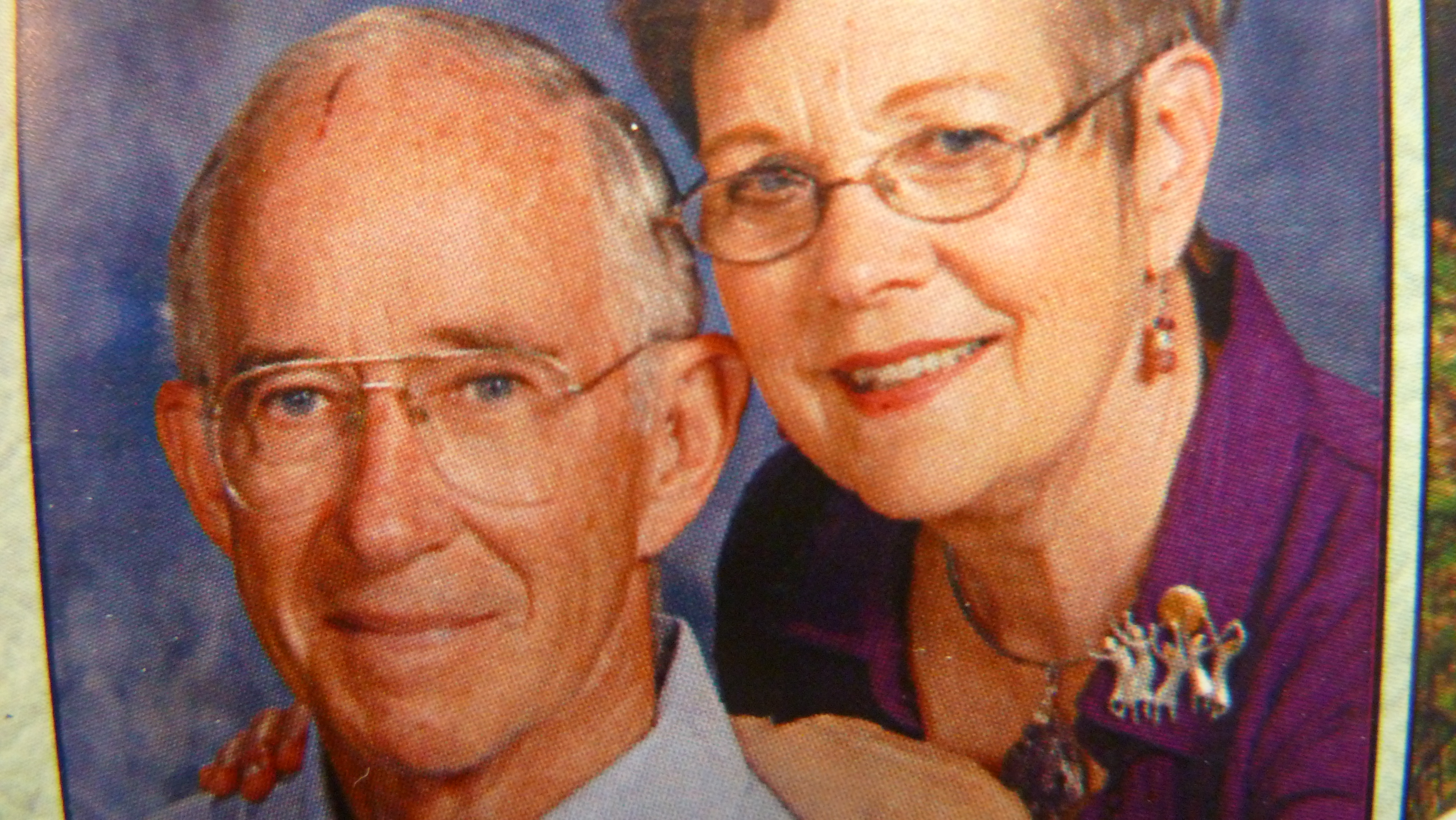
Mary Lou McMillin and her husband, Challace, the first football coach at James Madison University.
***
What is your favorite Christmas cookie? I’d love to see links to your favorites.
Are there recipes and foods you loved as a child but don’t care much for now?
My book with 100 recipes, Whatever Happened to Dinner, includes these favorite cookie recipes: Snowball Cookies, Whole Grain Chocolate Chip Cookies, No Bake Bars, Blondies, Magic Cookie Bars, Gingerbread Cookies. Purchase at the MennoMedia store.
 Uriah and Barbara’s wedding picture, 1893. They were married just eight years later than Laura Ingalls & Almanzo Wilder.
Only eight generations back, my forebears came to America. Like a lot of other folks who grew up Mennonite, my early relatives were Amish. One of the most well-researched and documented genealogies is the Jacob Hochstetler family, with members numbering many hundreds of thousands today.
I’m one.
Much is known about this ancestor Jacob Hochstetler, because his family suffered a tragic massacre during the French and Indian war in the Northkill Amish community in Berks County, Pa. Jacob’s young teenage sons reached for their hunting rifles in an attempt to scare off or kill the attackers, but Jacob was a true pacifist and would not allow them to shoot, even at the risk of their own death.
I’m excited about a fictional trilogy recreating this history being written by Ervin Stutzman, moderator of Mennonite Church USA who during the last number of years has written about his own parents, Tobias of the Amish and Emma: A Widow Among the Amish. The first book in his “Northkill” trilogy is scheduled to be released next February in a volume called Jacob’s Choice.
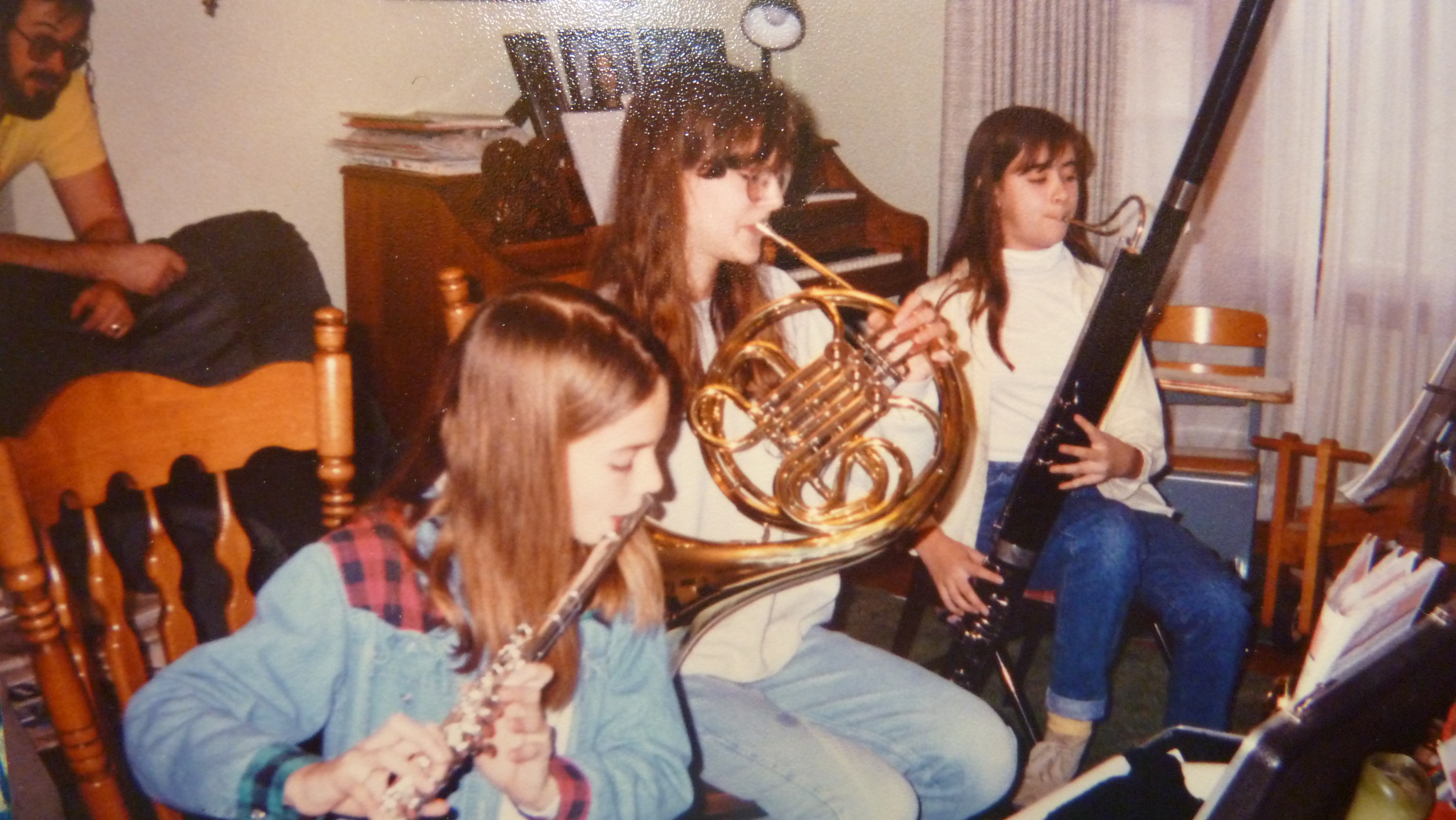
But here I want to tell you more about my grandfather on my father’s side Uriah Miller, a direct descendant of Jacob Hostetler. Some begats: my grandfather Uriah was the son of Moses, the son of Joseph, the son of Daniel, the son of Anna, the daughter of John, the son of Jacob Hochstetler the guy whose family was attacked. (John, who emigrated with his parents from Europe, was already married and living away from his parents when they were attacked.) That’s a lot of “begats” and eight generations by my calculation, starting with my father (I’m no genealogist or historian, so correct me if I’m not counting correctly). I knew Grandpa Uriah for the first 13 years of my life until he died in 1964, pictured here with his father Moses.
 Bottom row: my great grandfather, Moses, with beard; my grandfather, Uriah, and grandmother, Barbara Kauffman Miller. I don’t know who else is in the photo.
So Grandpa Miller was already 79 by the time I was born. My own father was the youngest of nine children, and 27 before he get married (not old by today’s standards, but old for those times). So that’s a little of why I had such an elderly grandpa.

The Uriah and Barbara Miller family, before their three youngest children (two sons, finally!) were born. Photo courtesy of Dennis Risser.
By the time I really had memories as a young child, Grandpa was already hunched and probably weighed less than 100 pounds. He was always small, especially compared to my robust Grandma (Barbara) Miller, but I like the above pictures because they show him as a much younger man, before he got hunched over and Grandma had a stroke. We were close to them because they lived in a “daughty” house (in-law quarters) attached to ours for about the last twenty years of their lives.
My grandparents, center.
Grandpa’s life story spans from the covered wagon to the jet age—he personally used both modes of transportation, a story carried by our local paper at the time. He and grandma, ages 84 and 81, flew to California to visit a granddaughter and family.
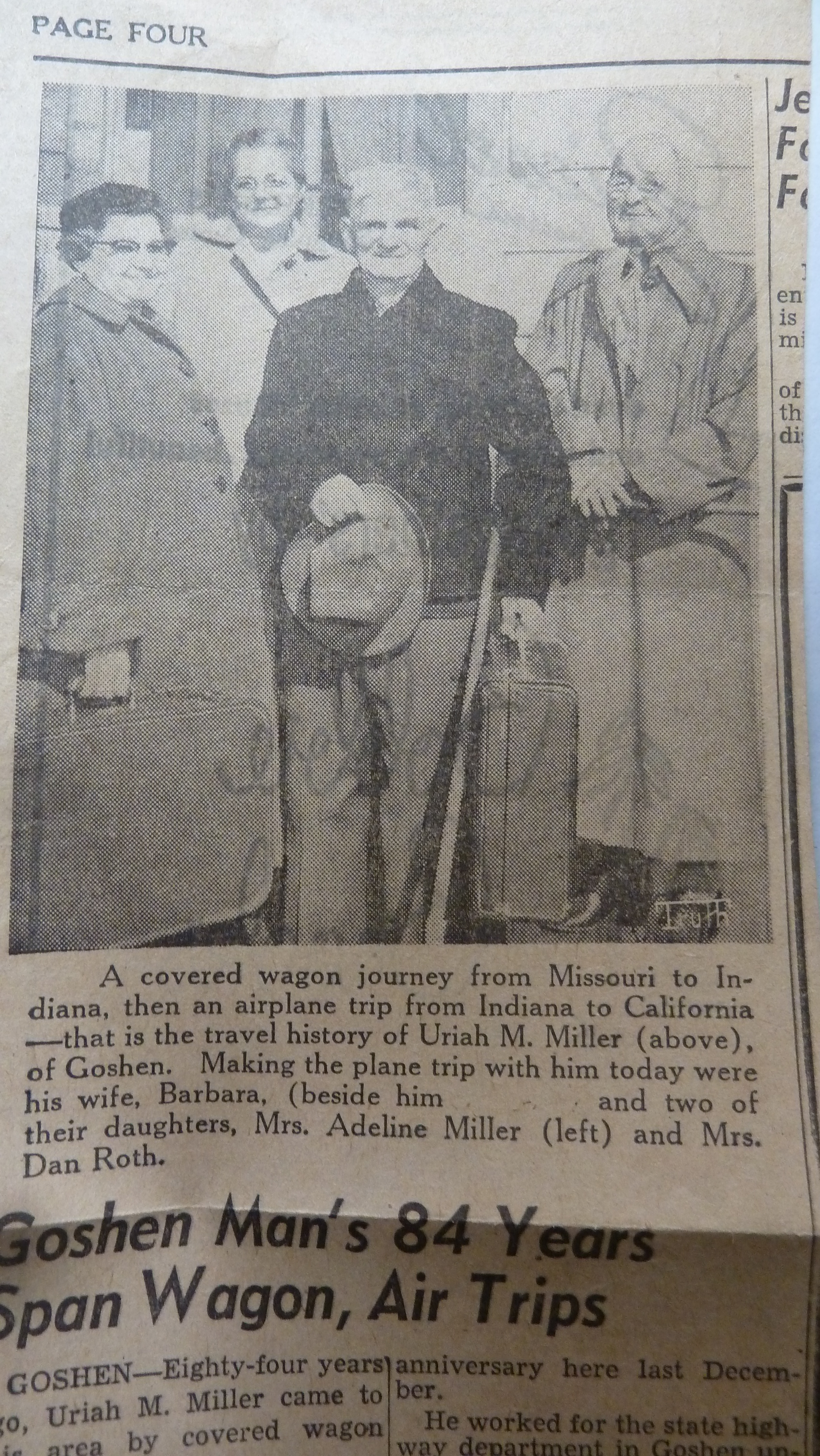
My Aunt Adeline, Aunt Susie, Grandpa and Grandma getting ready to fly to California to visit the Arleta and Marvin Mann family.
Grandpa was born in Wheatland, Missouri during his family’s several year attempt to farm “out west” under very harsh conditions. So the family moved back to Indiana, traveling by covered wagon.
When he grew up, he traded horses, earning him the nickname “Jock,” and spent 34 years as a farmer and thresher in northern Indiana and in lower Michigan , seen here.
 (Small man on top, in the very center of the picture. Double click to enlarge. Photo courtesy of Dennis Risser.)
Later he worked for the state highway commission and after retirement, helped Dad farm. He was a grower of raspberries, roses, and an egg sorter in our family egg business.
He was a lifelong Mennonite who chewed tobacco. As a kid I thought that was kind of edgy and cool. My Aunt Susie said that habit started because he had been told it would keep him from getting TB after his mother and several sisters died of the dreaded disease (11 children in that family).
He always carried pink or white wintergreen mints in the pocket of his suit jacket well into his 90s and kid would line up beside him after church waiting for a piece. My father carried on that tradition in his later years. When I was at Amigo Centre earlier this fall, I learned from program director Mandy Yoder that her father always carried those mints for kids at his church, too.
 Mandy’s bowl of wintergreen mints in honor of her grandfather.
 Grandpa and Grandma the way I remember them best in their later years, on a favorite glider in front of our childhood playhouse.
See more about the playhouse history in our family here.
We were all close to Grandma and Grandma Miller—they rocked us, babysat us, and I loved riding to town with Grandpa in his old black Chevy, circa 1950, for his haircut or to pick up more mints (or tobacco). The grandchildren and great grandchildren (my first and second cousins) would come out to the farm to play and visit. I remember Grandpa taking care of me one time when I was sick and had to stay home from school. Momma was busy that day—I don’t remember if she had to go away, but I know he brought me a bucket or tissue or glass of water when I needed to upchuck. That memory always stuck with me—my 90 year old grandfather taking care of a 12 year old girl. I still have his rocking chair.
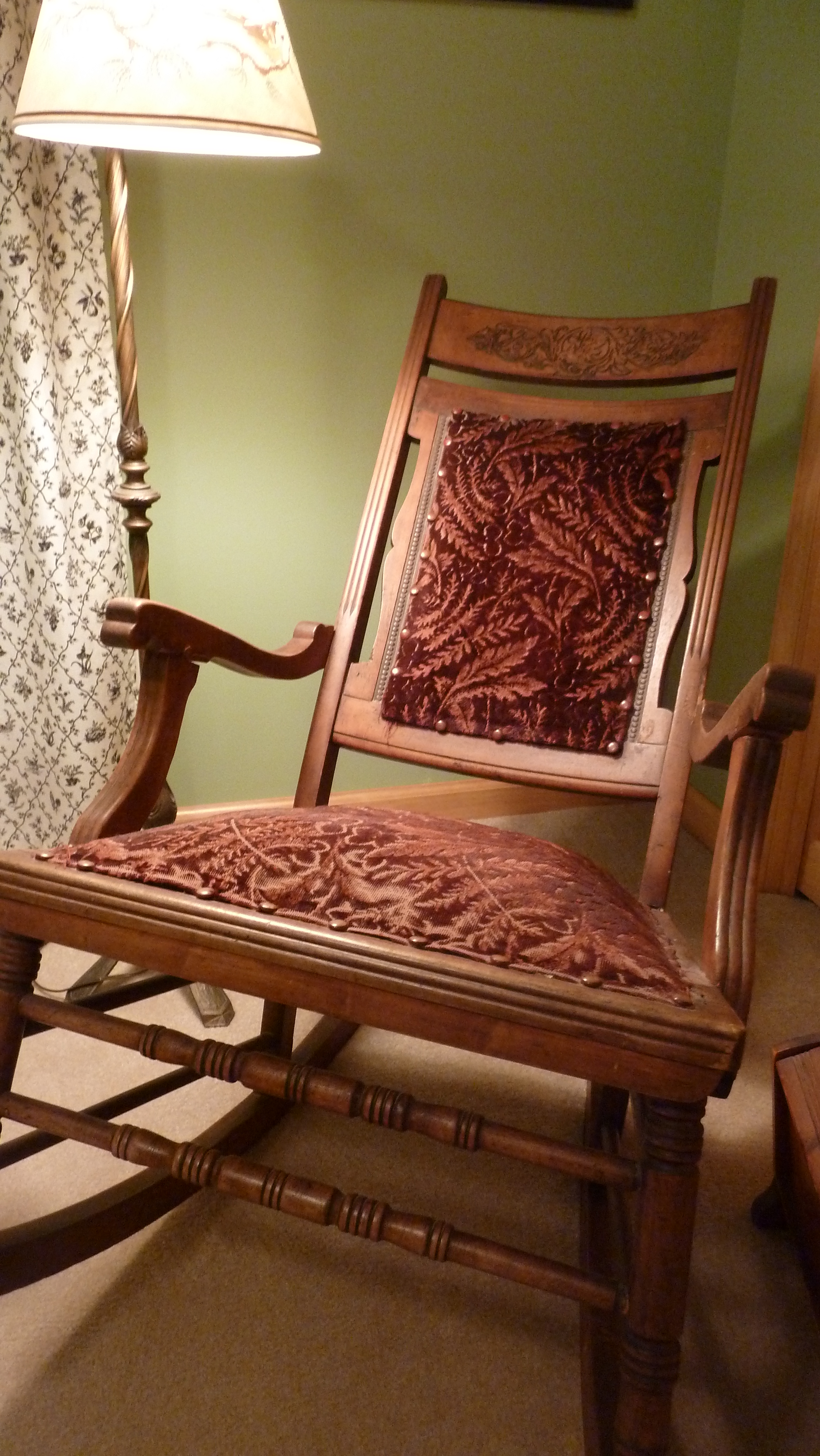
He and Grandma enjoyed 67 years of married life together. Grandmother died first in 1962 and Grandpa brought a fresh rose every day from the rose bushes they both loved to place in her hands at the funeral home as we received friends and sympathizers. Grandpa himself lived to within days of his 92nd birthday.
But more than these memories, I treasure the faith of my ancestors–those like Jacob Hochstetler, who lived their beliefs. My grandfather didn’t go through anything quite as dramatic as Jacob and his family, but quietly and steadfastly lived their faith through The Depression, through losing two daughters, and literally, thick and thin.

Grandpa holding one of his seven daughters. Grandma on right.
***
Are you part of the Hostetler clan? Let me know or visit the official Hostetler website.
More on Jacob’s Choice
To purchase a copy of Jacob’s Choice at the pre-publication discount price of just $10.50,
(regular price will be $14.99) go here. (Prepub price ends 2/8/2014)
(For more about how threshing works, here’s a fascinating video.)
I will never forget the first time I made stew for Stuart in the first year we were married.
My stew had big chunks of beef, potatoes, cabbage, onion, carrots, and beef broth–and that was about it. Perfectly fine stew in my book, and in my family’s tradition.
He looked at it, ate a few bites, asked “what is this?”—and you know how the newlywed conversation went downhill from there.
I was dumbfounded. What was wrong with my soup? My stew? My delicious wonderful dish?
So what kind of stew did the Davises fix? Well, turns out they call it homemade vegetable soup. Over the next weeks and months, I inquired and watched and tasted and gradually learned to make my own variation of the homemade vegetable soup that folks around here typically make and sell in quart jars at fall and Christmas bazaars and craft shows, or take to neighbors who are ill, or when a loved one passes away.
Love it, and I’ll never turn back to my staid old stew.
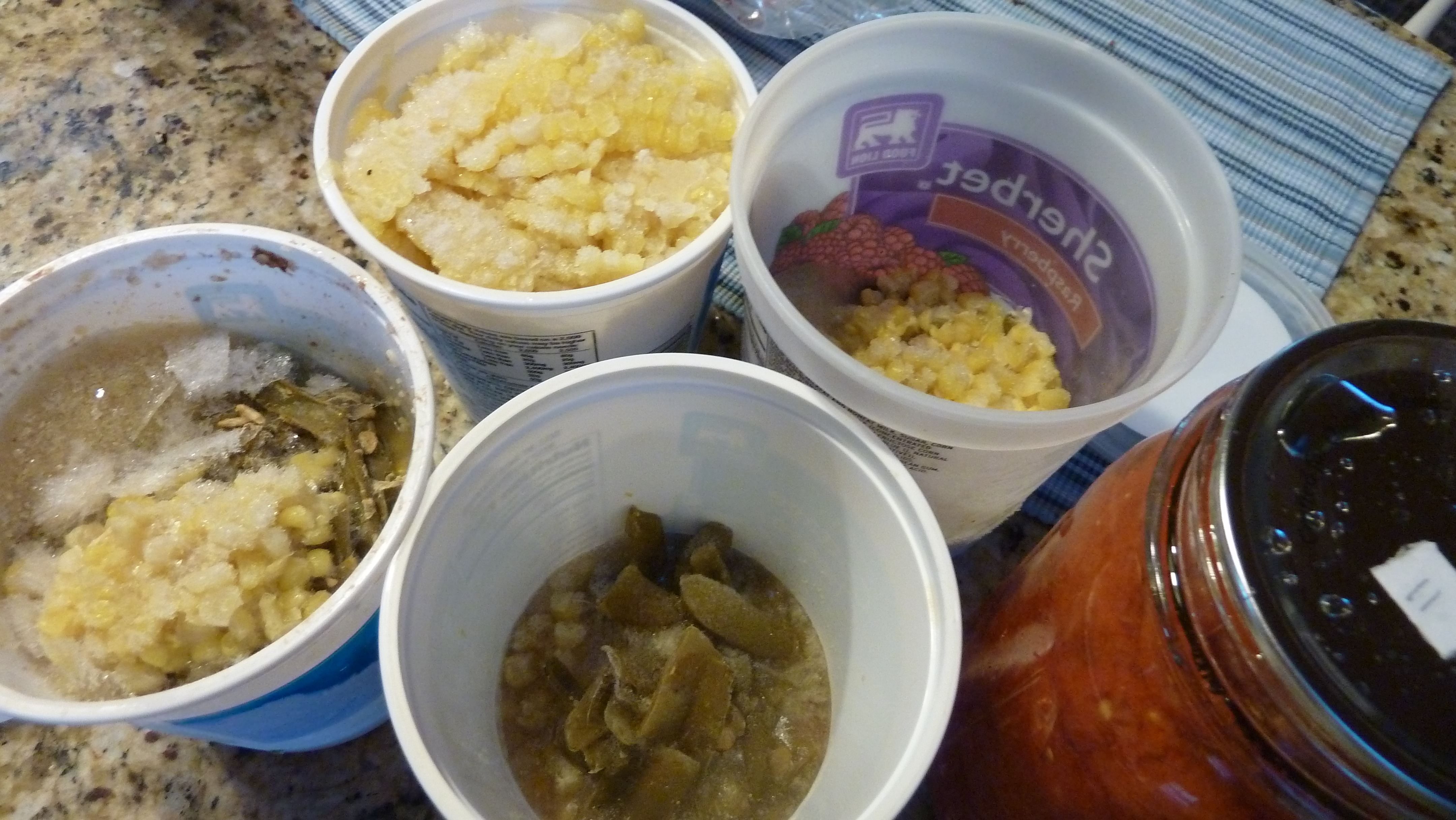

Now the biggest reason I love this soup is it becomes the repository for all those dribbles of green beans, corn or other leftover vegetables from many meals which you hate to throw away (especially if you’ve done the hard work of raising them) but the leftovers are too small of amount to serve for another meal. Or you’re just tired of eating them after three days in a row (happens a lot for empty nesters). I collect these dribbles in cottage cheese or other containers labeled “veggies” in the freezer, and keep them for a pot of soup every now and then. (Assuming you have such a container in your freezer. If not, start one.)
My actual recipe for this soup has evolved over the years, changes a little every time I make it, and now I throw in everything but the refrigerator.

When the leaves change and the thermometer drops, it is time for this soup. My husband likes it with hot bread and peanut butter; I like it with hot bread and cheese. The best homemade bread to serve with it is More with Less Cookbook’s oatmeal bread, which I talk about here.
I don’t know if this type soup is a Virginia thing, a southern thing, or a Shenandoah Valley thing. Anyone? (I talked about those regional or family food traditions here.) Another family favorite, Brunswick stew, is definitely a southern and Virginia thing, and I’ll talk about that (and give recipe for) sometime too.
What do you think? Do ya’ll make this kind of everything-but-the-refrigerator soup up north?
Homemade Vegetable Soup
1 lb stew meat, or approx. 2 cups leftover roast beef1 Table. olive or vegetable oil
3 large potaotes
3 carrots
1 oinion
1/4 head cabbage
2 stalks celery w/ leaves
1 – 2 quart canned tomatoes, to taste
beef or ham bone, optional
1 pint water (or add as needed)
2 tsp. salt
1 tsp. pepper
1-2 quarts canned or frozen vegetables, or leftovers you have frozen: corn, peas, green beans, lima beans
1 cup elbow macaroni
In 5 quart Dutch oven or other large kettle, brown diced stew meat in oil 5-10 minutes. While that’s browning, chop potatoes in small cubes, slice carrots, celery, chop cabbage. Set aside. Add tomatoes and then all raw vegetables to the meat.
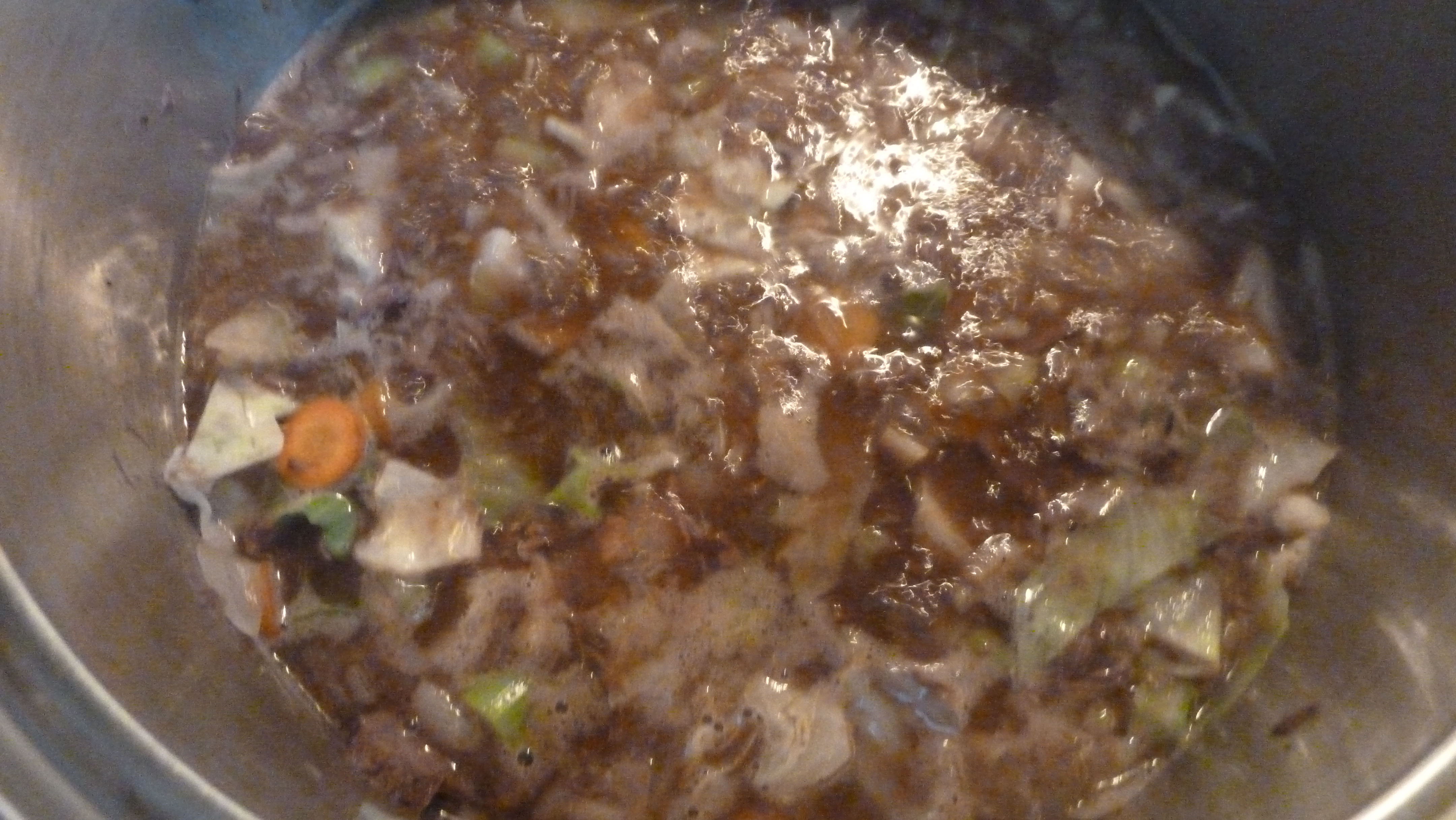
Add water, beef or ham bone if you have any (for flavoring, optional), salt and pepper. Bring to boil and simmer to cook vegetables for 30 minutes. Add leftover vegetables (as listed) or any quick cooking frozen vegetables you have.

Add macaroni. Stir frequently to keep macaroni from sticking. Cook 30 minutes more. Remove bone, celery leaves. Serve. Makes a large pot of soup, probably enough to serve at least 8.

P.S. The best part about this kettle of soup is you likely have enough for 2 or three meals, depending on the size of your family.
P.P. S. S. This soup didn’t make the cut for inclusion in my Whatever Happened to Dinner: Recipes and Reflections for Mealtime book but almost 100 delicious recipes from (mostly) Shenandoah Valley of Virginia families did. It does include Brunswick Stew. Check it out. Book sold here.
Another P.S. Notice I added a search tool and one of those nifty cloud things for frequent topics.
 I sat at a baby shower for my oldest daughter and husband on Sunday pondering my own days of being large with child, and the recipient of the largess of people who were not my relatives or even long term friends. At both baby showers held for my husband and I, the guests were people who were in my life at that stage: work and church colleagues mostly, since I lived 600+ miles from most of my family and friends from high school or earlier. In our mobile society, this is the norm.
At our daughter’s shower/potluck by her church in northern Virginia (Northern Virginia Mennonite), there was even a couple who had just arrived the night before from Congo.
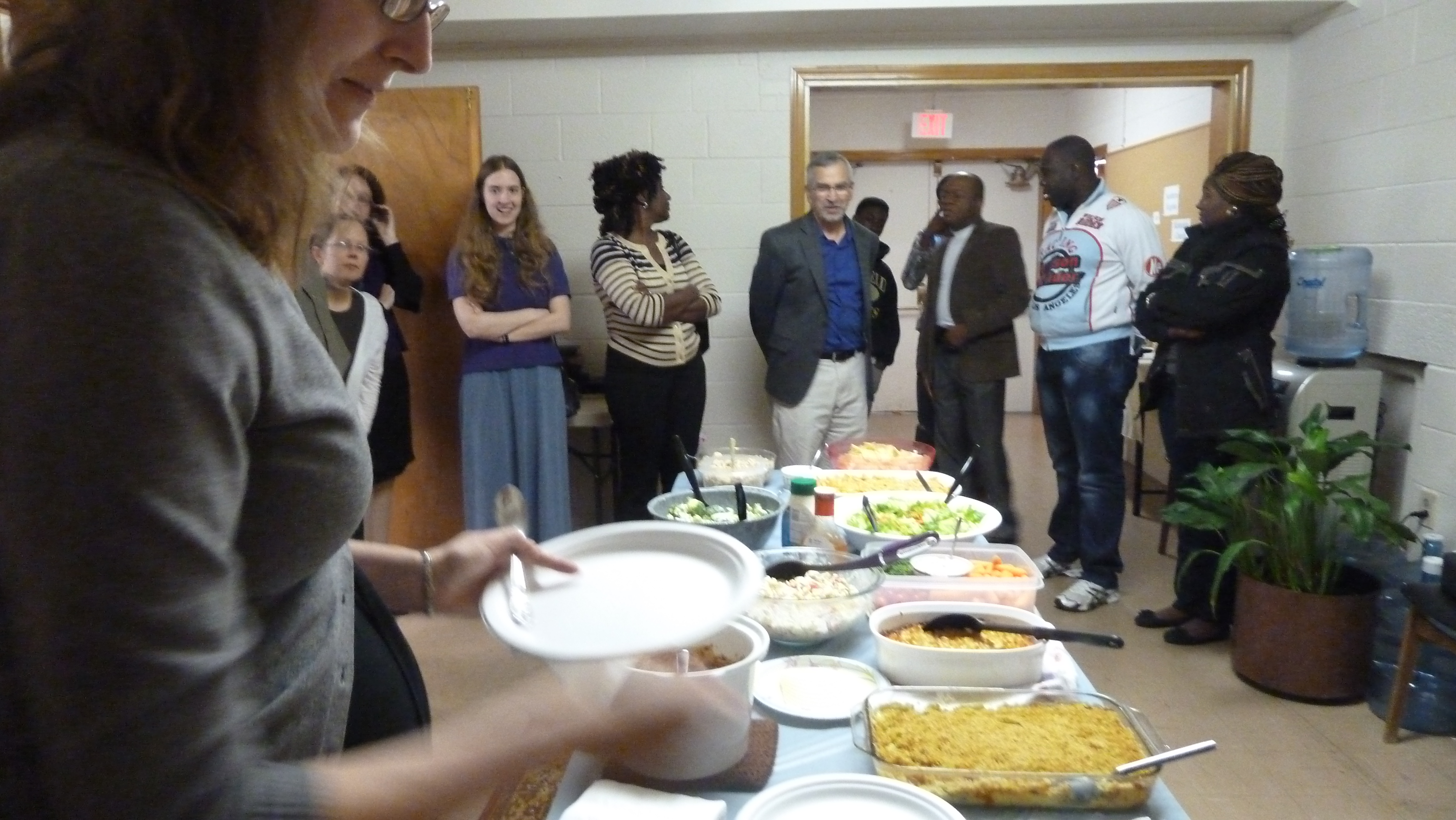
I had to wonder what they thought of the baby shower customs and rituals (thankfully, there were no shower games played–no little diapers with fake poo (mushed brown candy bars) in them passed for everyone to sniff and guess the type of candy bar, as I’ve played at least one shower).
 I thought about how the tables were turning, my daughters becoming mothers. This kind of development is maybe the opposite of the reversal explored in Nancy Friday’s 1970s’ classic book, My Mother, Myself, but just as interesting.
Regarding Nancy Friday’s timeless observations, my sisters and I notice, sometimes with laughter, sometimes with fright, how we are becoming our mother and even our grandmother, especially on mother’s side, who was with us well into adulthood.
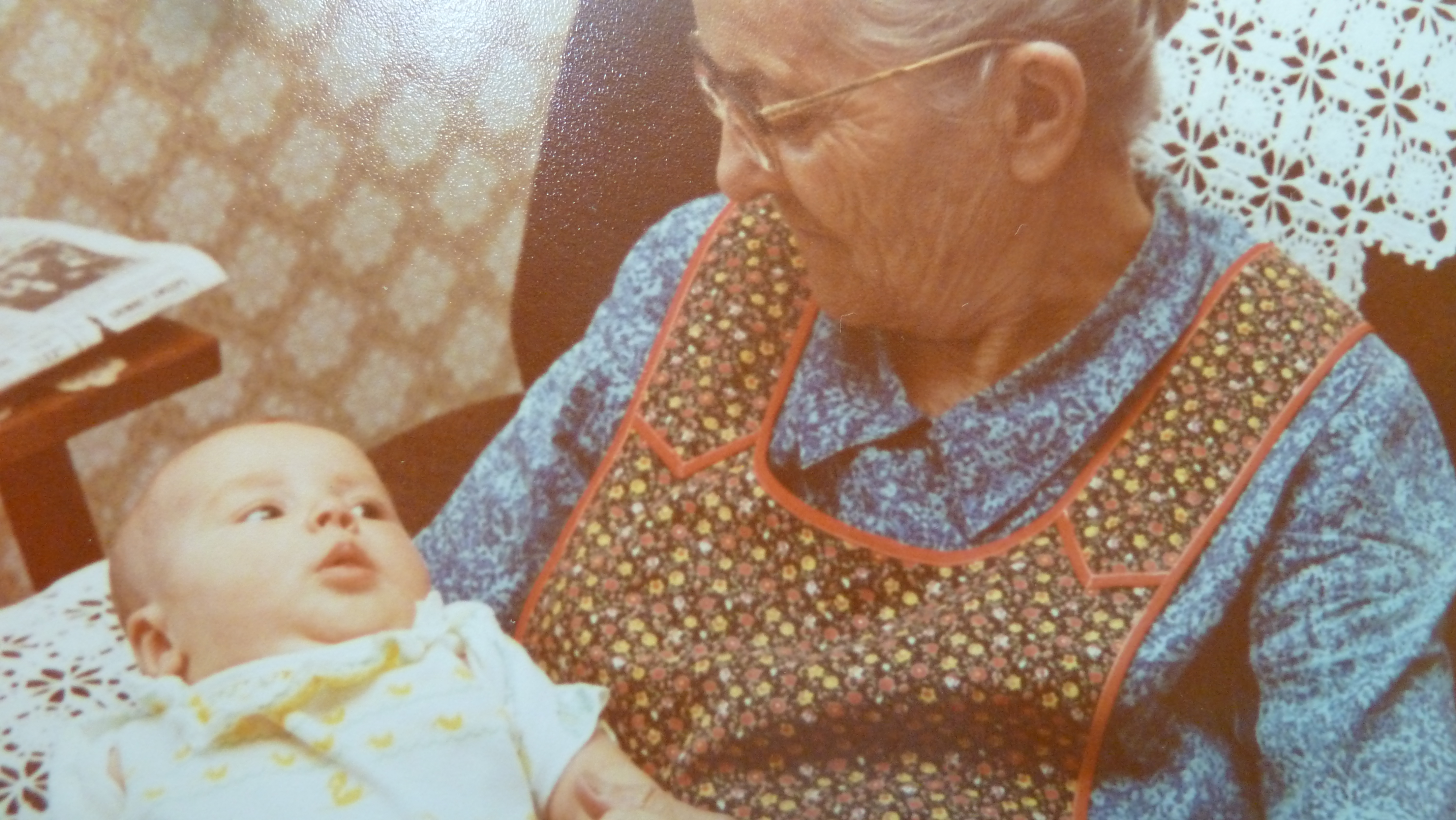 Grandma Stauffer with 2 month old Michelle, now 9 months pregnant with her first.
(My other grandma died when we were adolescents.) I’m even becoming my sisters: little mannerisms, my looks, people say.
 Yours truly, expecting our first born. About 8 months along.
In case the 70s and Friday’s generational “aha” passed you by, see here for a thumbnail description of her book. But my takeaway from that summary is this:
“The greatest gift a good mother can give remains unquestioning love planted deep in the first year of life, so deep and unassailable that the tiny child grown to womanhood is never held back by the fear of losing that love.” —Nancy Friday
I would modify that to say “grown to adulthood” to apply it to boys, too.
Watching my daughters become mothers (one baby is due in 2 weeks, the other is already almost six weeks old) is a gift, (earlier post on Grandma x 2 here) one I wasn’t sure I would be privileged to experience. I am deeply grateful. Those of us who were older mothers or whose pregnancies did not come easily, or ever at all, and found motherhood another way (adoption, foster, or even in vitro) are maybe less likely to take our offspring becoming parents for granted than, for instance, my one aunt who was famous for quipping “all my husband had to do was hang his pajamas on the bed post.” Thank you, Aunt Arlene. (Or was she talking about cousin Arleta??)

All three of my daughters at an earlier double baby shower; in the middle, youngest sister Doreen gets stuck passing out gifts.
I have loved hearing my daughters (mostly by email, Facebook post, or text) discussing varicose veins, having to pee a lot, ultrasound visits, what they’re finding to wear (love the maternity “belly band” which allows you to leave the zipper open on any pants or slacks and still hold them up. Wow, what a great innovation!), comparing weight gains, size of baby, various screenings like for diabetes, products for the nursery, wanting to avoid SUV-type strollers, the emotion of touring the hospital birthing center and realizing and hoping “Oh my, the next time I’m here, I will bring home a real baby! Our baby!”
Their enthusiasm for becoming mothers, even while struggling to sleep with a 15-pound or so basketball attached to their fronts, is gratifying, perhaps a reflection that somehow I and we as parents were able to plant that “unquestioning love deep in the first year of life.”
It is an amazing journey, whether as mother, father, grandmother, grandfather or beyond, and no matter how you follow it. The circle of life.


Top: Dog Ike gets introduced to baby brother Sam, 2013. Bottom: Dog Wendy gets introduced to little sister Michelle, with Aunt Barbara and Uncle Richard, 1981.
Some grandparents talk about payback, meaning that they enjoy grandkids returning the mischief and mayhem they endured as parents. But the payback of watching your kids prepare to become parents and give back the love and care you taught them through long sleepless nights, fussy, tedious days, and sacrificing your own comfort and priorities for theirs, is a far richer benefit.
Like grandmas everywhere, I ponder these harmonies and treasure them in my heart.
***
How have you enjoyed seeing your kids become parents? What stands out? If they’re still kids, what are you hoping to get in payback?
Then and Now Photo Gallery
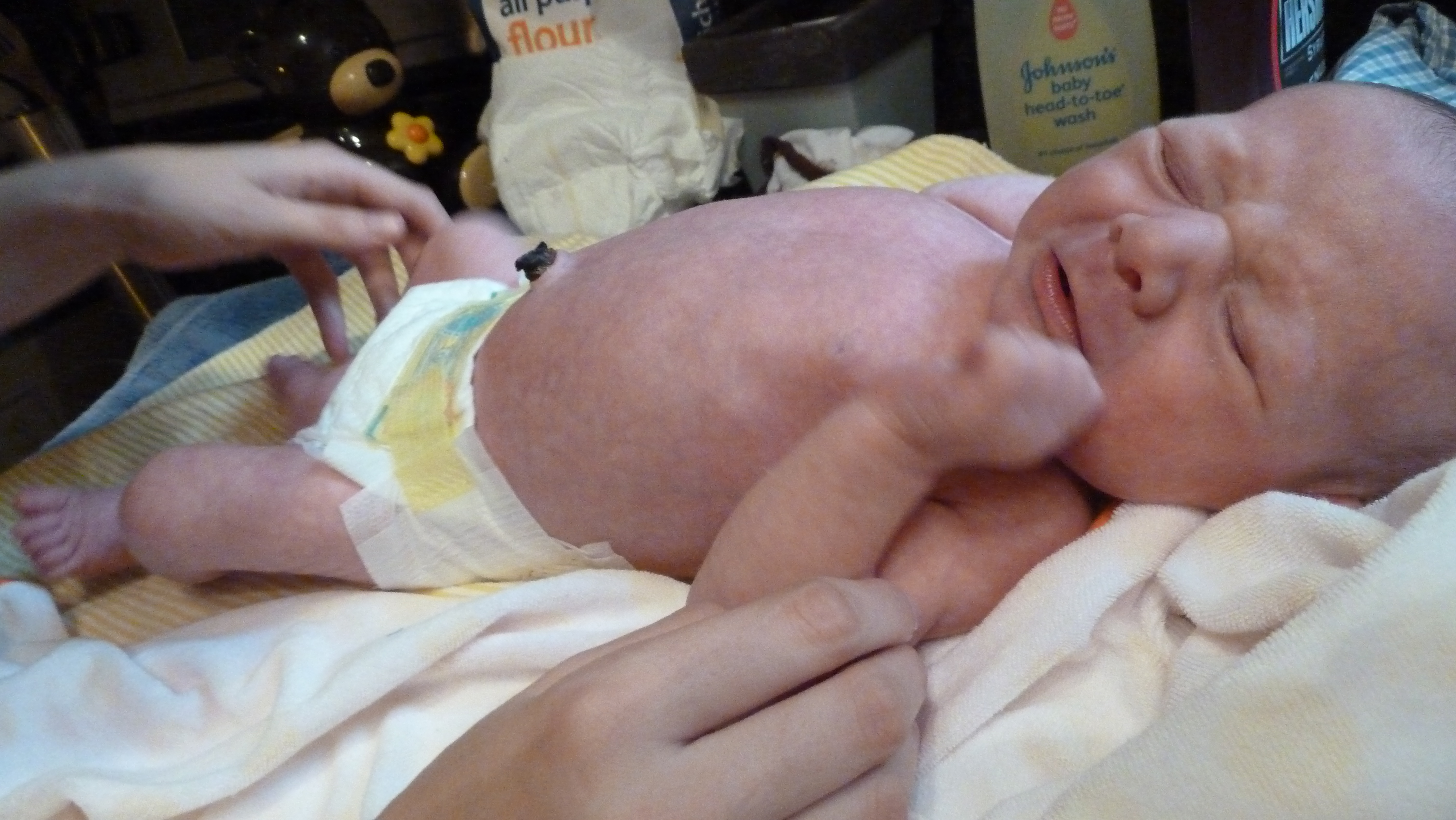

Sam gets his first kitchen sink bath with Grandma Melodie’s assistance. 2013. Michelle gets her first kitchen sink bath with Grandma Miller’s assistance, 1981. (Like all babies everywhere, there are more photos of baby #1’s first everythings than baby #2 or 3. Yeah.)


Baby Sam at three weeks with father Jon, 2013. Baby Tanya at two weeks, (Sam’s mother,) 1983. Do they look alike?
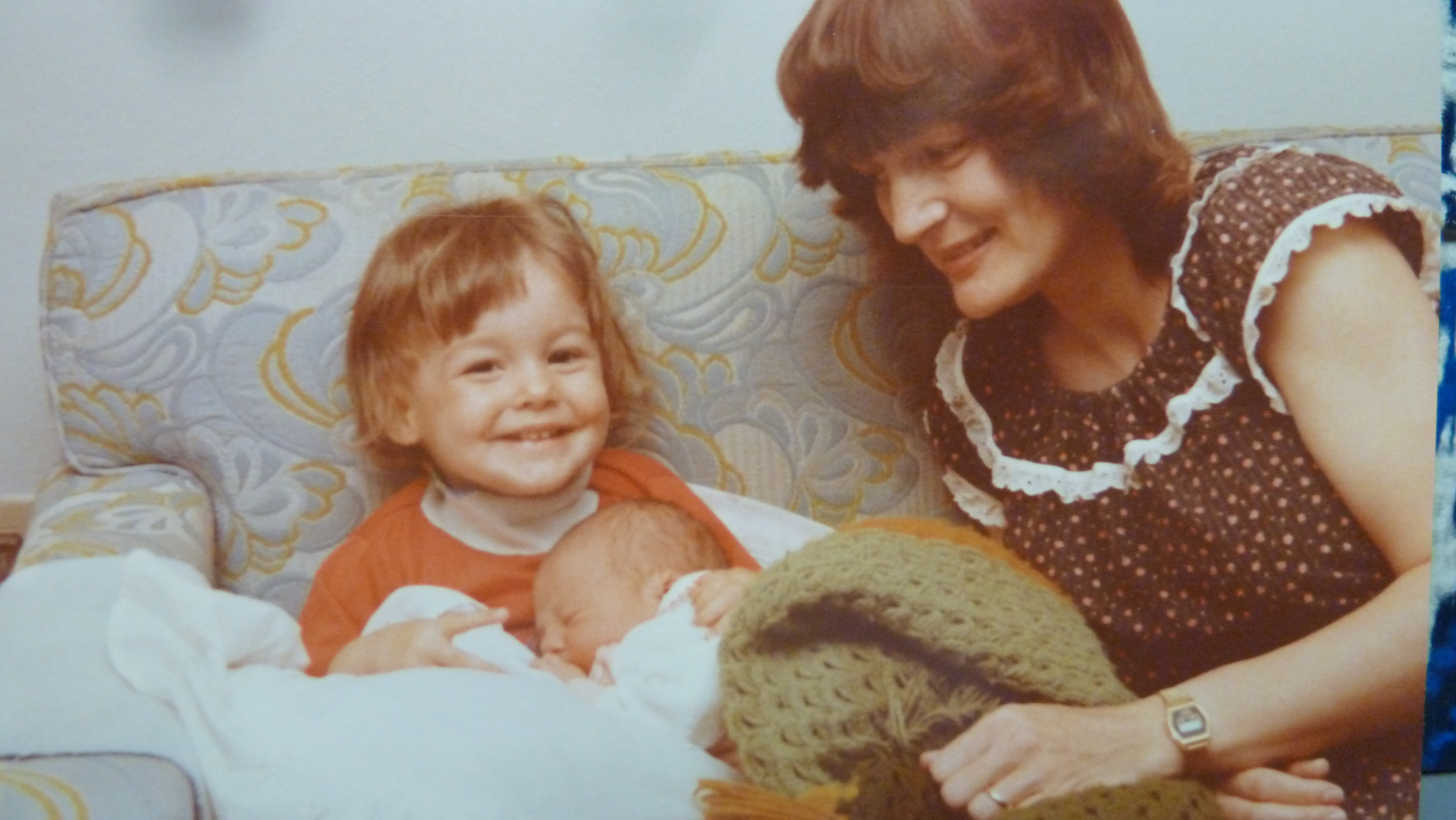

Top: Michelle meets baby sister Tanya, 1983. Bottom: Michelle waves hello to all the people out there in the far over Internet land, courtesy of Grandpa and Grandma Miller, 1981.
.

 findingharmonyblog