

Growing up, no one (at least in my sheltered northern Indiana community) ever heard of putting fruit in a green lettuce or tossed salad. The first time I ever had grapes in chicken salad I thought, ooh, that’s weird, how can it be good?
Of course, kids are notorious for not wanting their mashed potatoes to touch their chicken or green beans—ever. Mom made jello salads with fruit in them, or fruit salads with just mixed fruits, but put fruit in a lettuce or green salad? Not so much. (In those days, we only ever ate iceberg or garden lettuce.)
It’s amazing how cooking in North America has changed in the last 50 years—and fun to imagine how cooking and foods might change in the years ahead.
An elderly neighbor and good friend lost his wife about ten years ago. Charles wanted to pass on to me some of her cookbooks.
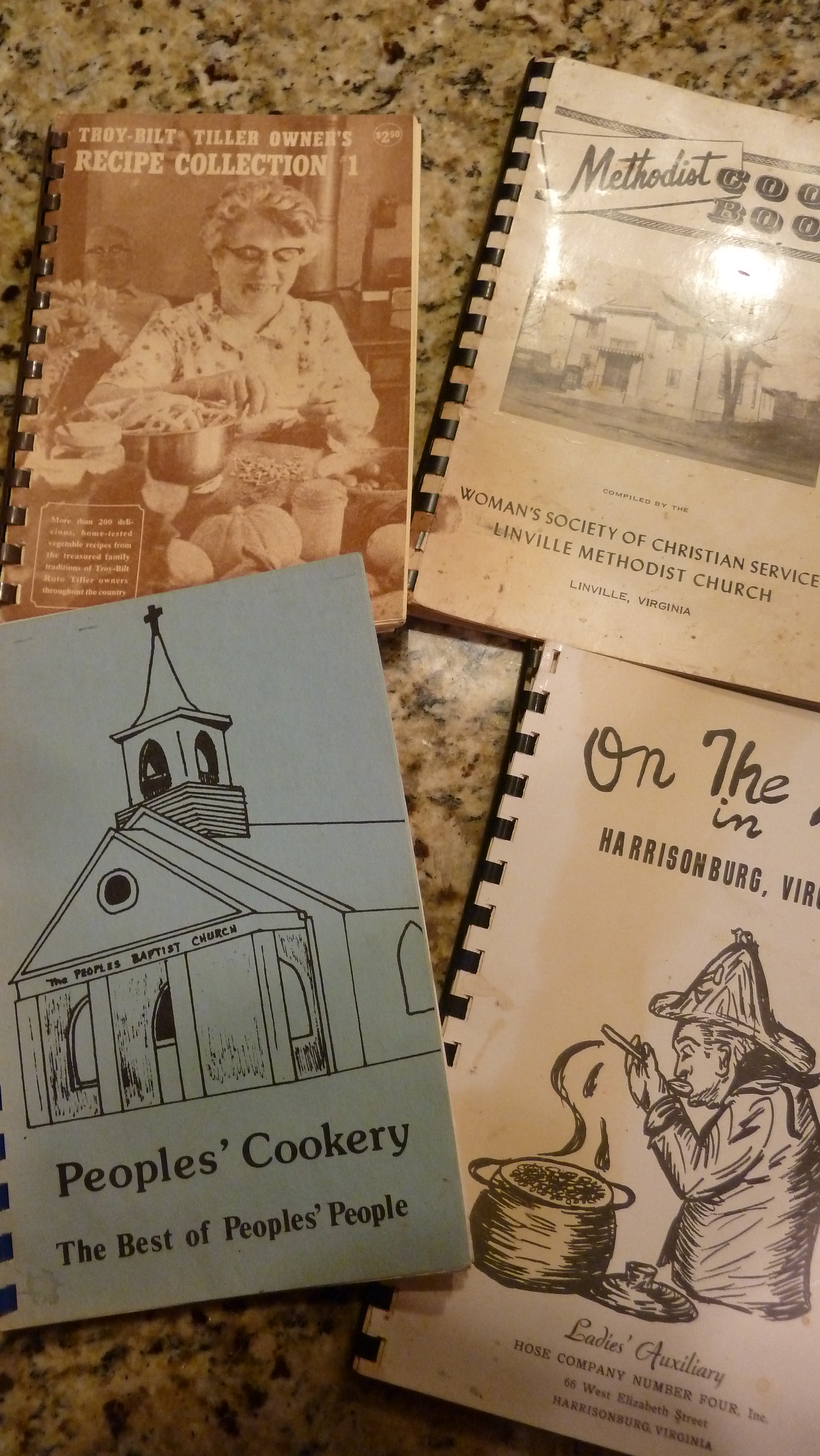
Partial cookbook collection of Letha Townsend, a renowned gardener and one of the first farmer/couples to bring goods to the Harrisonburg Farmers Market. After she died, I wrote a tribute in my Another Way newspaper column here.
Even though I have little use for the actual recipes, they are fascinating to browse for the history and the community connections.


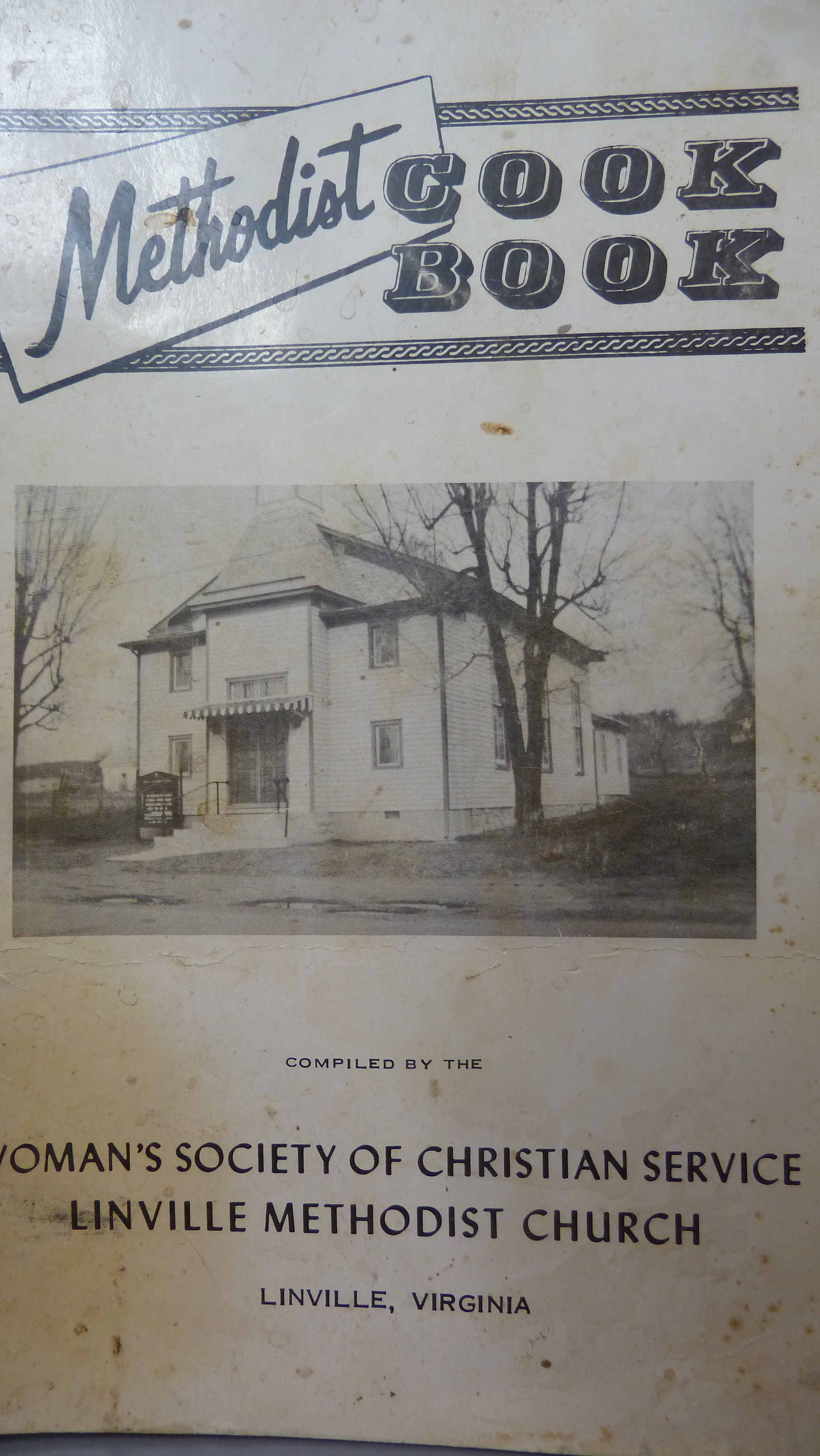
(I love the august names some of these have, such as “Woman’s Society of Christian Service.” Whoo. And I love the drawing of the firefighter on the front of the Ladies’ Auxiliary cookbook who ends up looking more like a witch stirring a brew, you know?)
Another type of cookbook that was very popular in the day was the one that came whenever you purchased a major piece of kitchen equipment, like a stove (of course) or a mixer, or even a piece of farm equipment: the famous Troy Bilt Tiller.
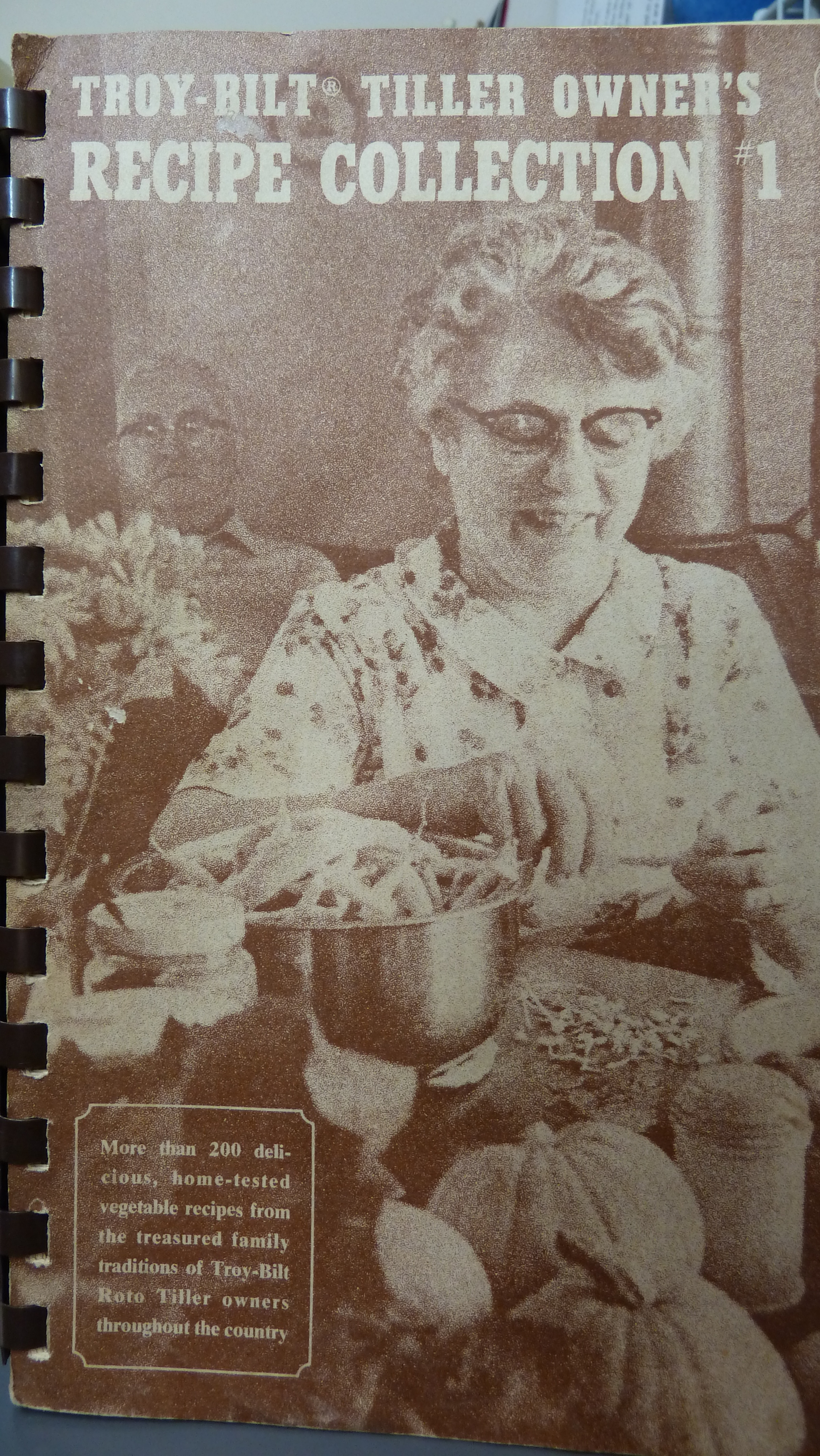
That one at least makes sense, given the fact that tillers are for gardens, ergo:

And in that cookbook, I did find a recipe mixing fruit in a garden salad: of course it comes from exotic California:

Unfortunately, most of these cookbooks don’t even have dates in them. If you’re going to the trouble of making a cookbook (and I have many more “fundraiser” cookbooks on my shelf) date them!
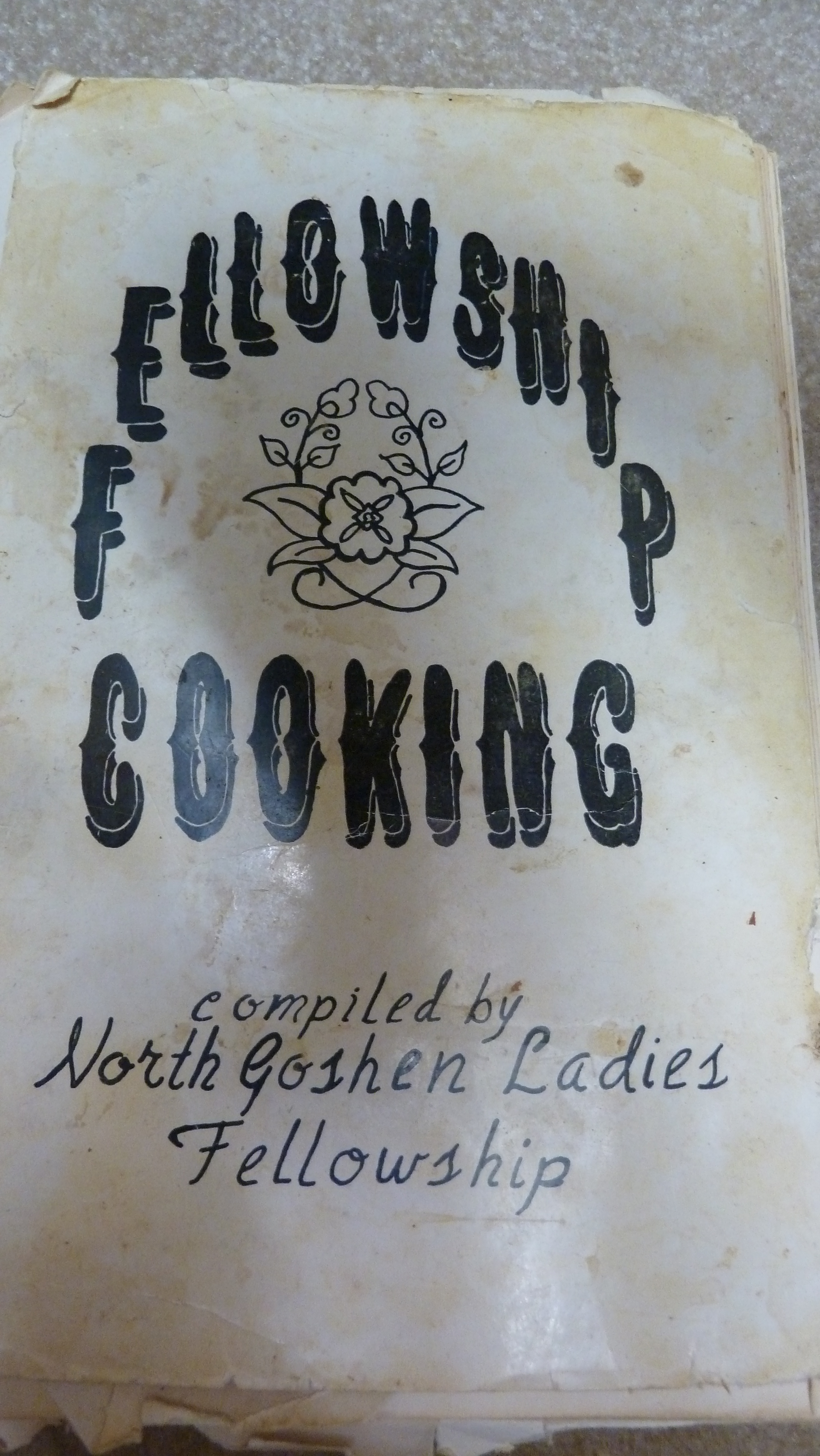
My most-used “fundraiser” cookbook, from my home congregation, North Goshen Mennonite, Ind.
But I have learned from friends, colleagues and church cooks the delicious art of mixing things up a little more, and the results are mostly enticingly good.
Here’s a simple salad perfect for the mid-Atlantic region in May when fresh strawberries are coming on, and some greens from the garden, and maybe some radishes. Add some nuts, crumbled feta cheese or other, and Kimberly’s simple but tartly tangy dressing and you have an awesome lunch or dinner side dish.
Finding harmony in the kitchen–between new dishes and older, or between the way your mom used to cook and what you enjoy now–can be a metaphor and example for appreciating diversity in other areas of life.
If you grew up in the 50s and 60s, what are your strong memories of foods from that era?
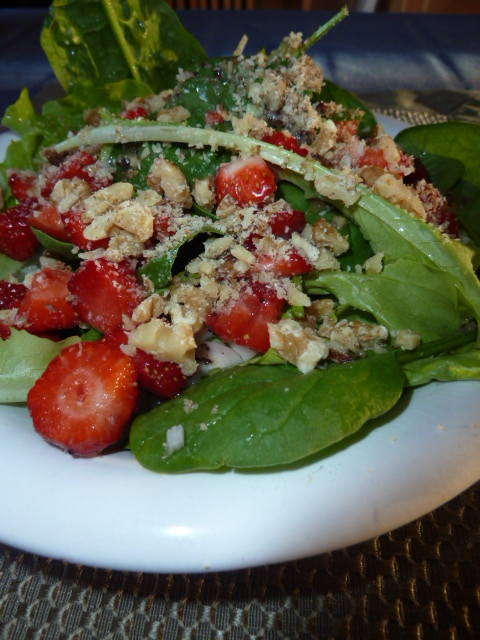
Enjoy. From my book with about 100 recipes, Whatever Happened to Dinner: Recipes and Reflections for Family Mealtime
Raspberry Poppy Seed Dressing
Kimberly Metzler
I tried a raspberry poppy seed dressing at Bear Trap Farm in Mt. Solon, Virginia, during one of my husband’s work Christmas parties. After hearing me talk about it, a friend made up this recipe for me.
1/3 cup / 75 ml red wine vinegar
1/3 cup / 75 ml canola oil
1/8 cup / 25 ml sugar (or splenda)
2 tablespoons red raspberry jam
1 teaspoon salt
½ teaspoon pepper
1 small onion, chopped
2 teaspoons poppy seeds
Blend all but the poppy seeds in blender until smooth. Then stir in poppy seeds. Refrigerate.
Someone recently did a Google search and found my blog using the search phrase, “finding harmony working and mothering.” It showed up in my blog stats and of course I pounced on it for a topic I’ve been meaning to write about.
But you see, I haven’t written about it because, let’s face it, I raised my kids while holding down a half time job a generation ago. Swallow. That makes me sound old but since I’m finally gonna be a grandma I can deal with it. (If you haven’t read about that yet, it is here.)
And truly, raising children in the 80s and working outside the home was done without cell phones or smart phones or texting or even the Internet or blogs or Facebook. Mostly I wonder how I managed childcare and a career and all that juggling without a cell phone. But I think I’m glad I didn’t have to deal with the distractions of Facebook and smart phones where you are tempted to be “always on” even when you’re playing with your kids.

Michelle enjoying the electronic piano at the sitter’s house.
Mostly we did it with the support and wiping-noses-and-bottoms help of a wonderful neighbor, Linda, who took care of our children when I worked, for most of their first five years, and before and after school until they were old enough to stay home on their own. Linda was loving, involved, nurturing, and took time to read, color, play and more with the children. She was in many ways their second mom.

Our children loved their “big brother and big sister”, the sitter’s children.
I have written about these years extensively in my column and also a book, Working, Mothering and other “Minor” Dilemmas that was published in 1984 by Word Books who even put out a hardcover edition (some hardcovers apparently still available thru Amazon). It was one of the first mainstream Christian books published on the topic, I believe. If I had written that book today I would have also had to be blogging about the topic, tweeting about it, Facebooking, yeah. Getting books published, especially by a major Christian publisher was a lot easier in those days. Our staff photographer, Al Brubaker, from Mennonite Media even did a low key photo shoot for an article and the book jacket.
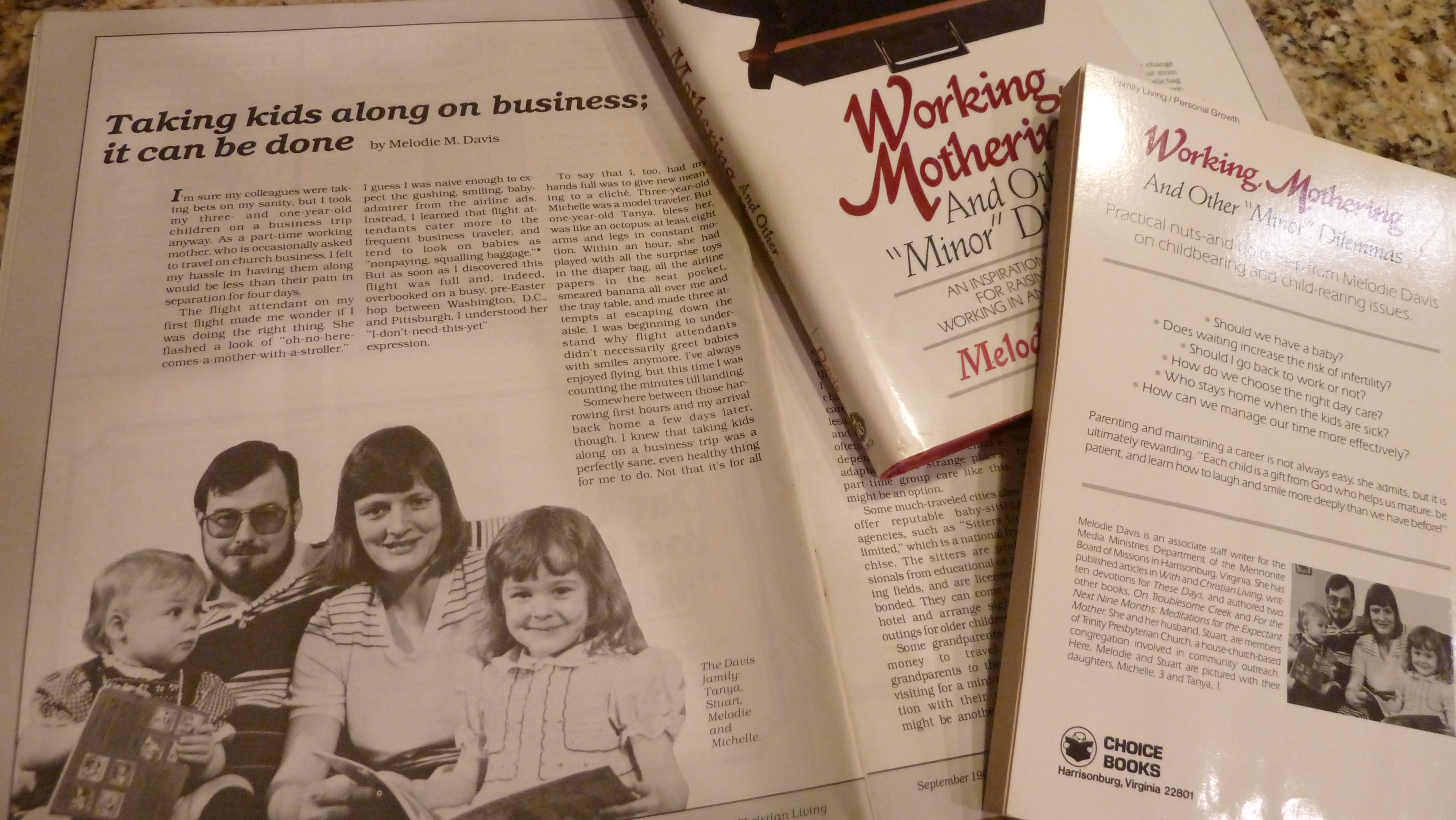
Article on “Taking kids along on business” appeared in Christian Living.
But the work of raising children, whether you are a mom or dad and holding down a full or part time job, either in or out of the home, has never been very easy. Many a morning my arms ached getting out the door with a baby in my arms, a toddler tagging along, while toting a diaper bag, briefcase, lunch bag, and pocketbook (if I was dumb enough to tackle that without making multiple trips). I’m afraid I drug my kids out of bed and to the sitter’s many a morning looking like rag muffins.

Honesty in blogs: Rag muffin number 3 looking bright eyed and very bushy tailed.
And even when you had the best babysitter in the county and the best back up and emergency plans, then chicken pox would come along and that changed everything.
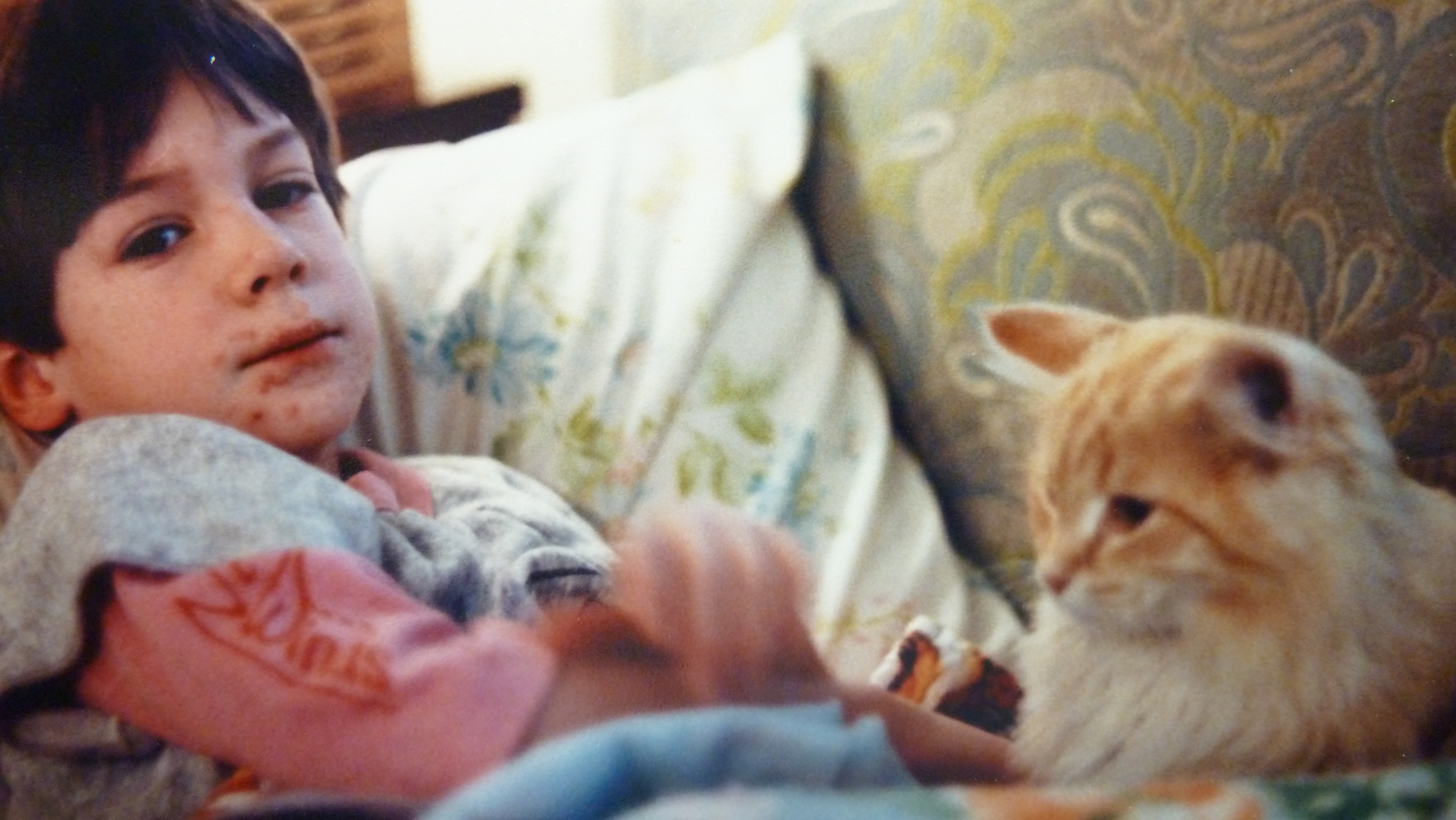
What do you do when the kids get chickenpox? You hire the cat sitter.
When the children reached the age they could go to preschool, that brought them new friends and activities, but also new juggling as we tried to manage running them to preschool, then back to the babysitter’s, and then back to work. I had a very understanding employer.

Tanya, smiling cheesily like kids do on the back row, light blue shirt.
My job did involve some travel which I enjoyed even though it was another “dilemma”—can I take one or more of the children along? Who could I drop off en-route at Grandma and Grandpa’s house? Can the whole family go?
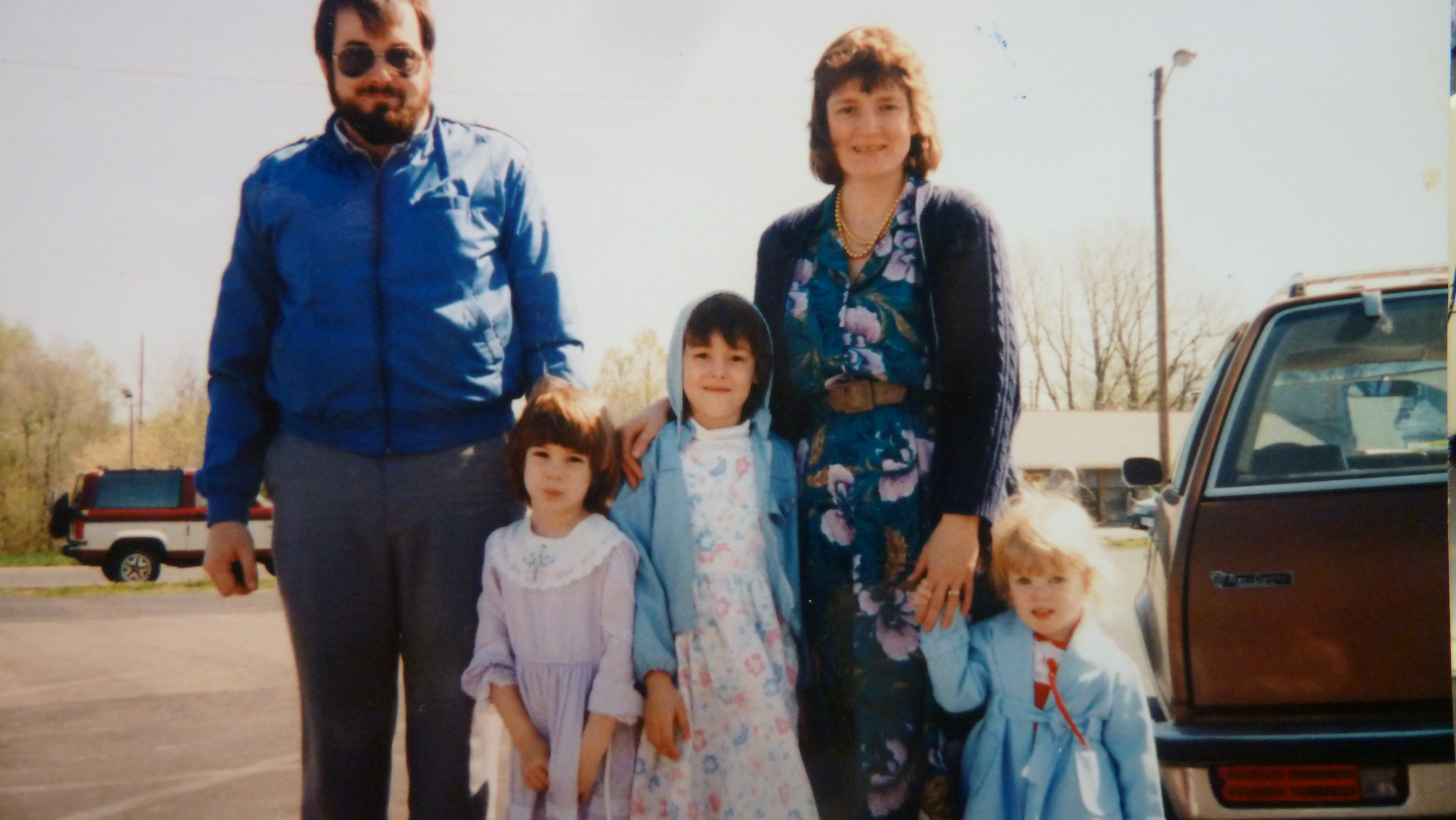
The trusty old station wagon carried us to Lancaster, Pa. for a Sunday night speaking gig.
I think each of my now-grown daughters would say they never really resented my work outside the home, and even find it somewhat reassuring as they contemplate how to do the same in the future.

Doreen’s very first dorm room, when I took her to the Mennonite convention, Normal, Illinois, 1989.
They turned out—with the help of Linda, a supportive family (Mom and Dad never complained when they had to help pitch in when I dropped them off on my way to Chicago or meetings in Indiana or one of many Mennonite church conventions), our church and their mostly wonderful teachers in our public schools—AMAZINGLY well. My oldest daughter wrote her own take,“The Daughter’s Revenge,” here.

Me and my oldest daughter, Michelle, lingering a few minutes on the babysitter’s porch.
But of course I’m prejudiced. And thanking-my-lucky-stars-and-the-good-Lord-happy.
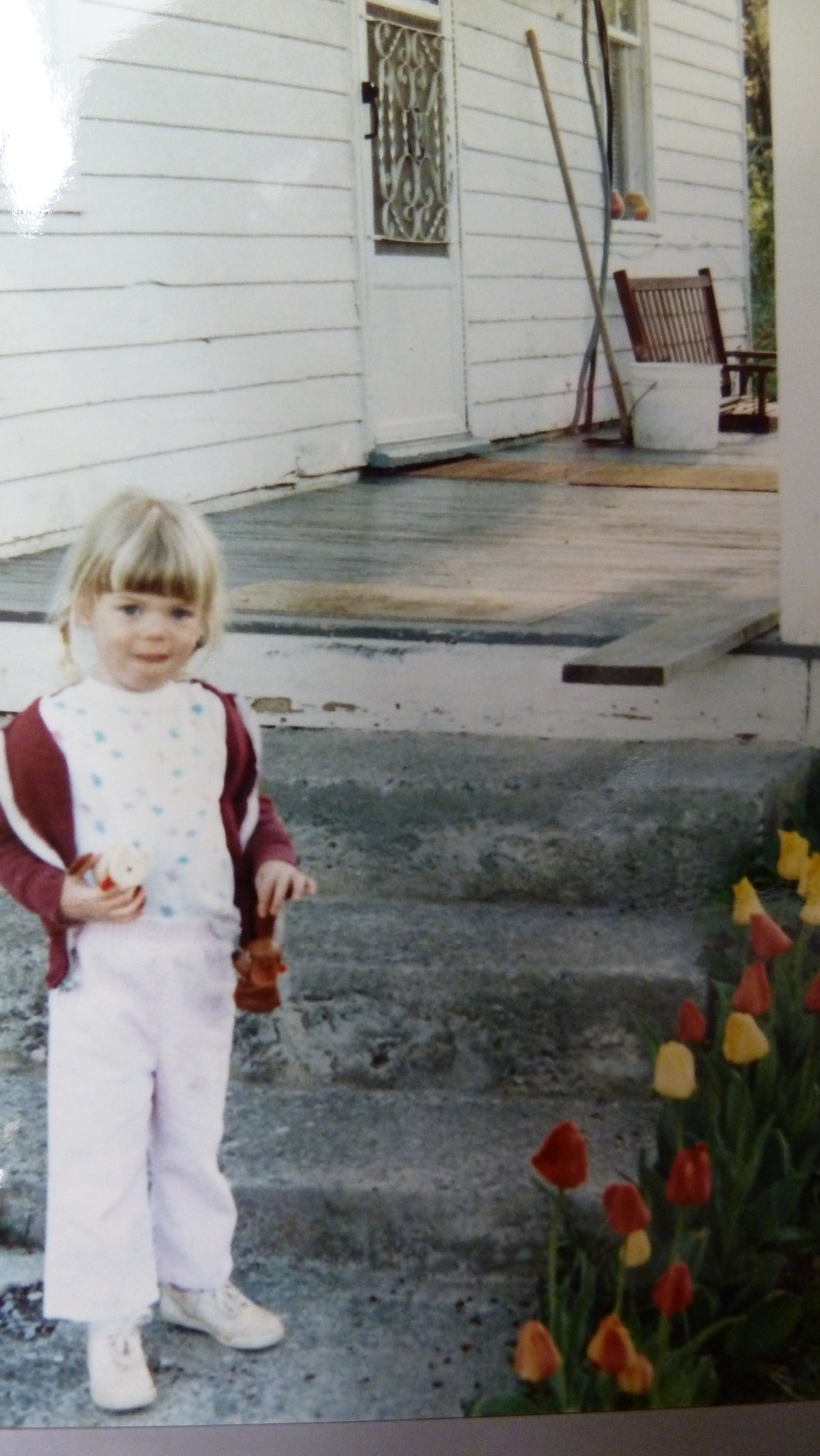
Dropping off Doreen at the babysitter’s house.
Photo credits and more: My unending thanks to our sitter for all her love and care, and also for the top two and bottom two photos from her home.
Many of us grow up and find that foods we couldn’t stand to eat in childhood are now favorites. Many things about us change as we grow and mature, including our taste buds.

Rhubarb is one of those things for a lot of people grow into. It may also be like cilantro in that some people truly have an aversion to something in cilantro that is repulsive. There is even a blog (wouldn’t you know) on it with a list of cilantro-free restaurants!
I decided if there is a blog on cilantro, there’s probably a blog of rhubarb recipes, here.
As a child, we liked to try and chow down some rhubarb raw just for the fun of feeling the pucker up. At our house, my dad liked it, so Mom would make a rhubarb pie especially for him, which I thought was pretty awful. So I went through many years of having nothing to do with rhubarb, until my youngest daughter somehow fell in love with it and during the almost four years she lived at home after college before starting grad school, she bought and started a plant. It is now going gangbusters.
And Doreen found and perfected making this recipe that is too easy, adapted from Mennonite Recipes from the Shenandoah Valley by Phyllis Pellman Good and Kate Good, (Good Books, 1999). It was originally shared by Karla Good from Harrisonburg. I also have a few recipes in that book.

Get your hands on some rhubarb either from your local farmer’s market or your own patch and get cooking!
And I’m curious, did you like rhubarb growing up? Do you like it now?
Rhubarb Crunch
1 cup flour
¾ cut quick dry oatmeal
1 cup brown sugar, packed
½ cup butter, melted
1 tsp cinnamon
2/3 – 1 cup sugar, depending upon your taste for tart rhubarb
2 Tbsp. cornstarch
1 cup water
2 cups diced rhubarb
(You can add 1 tsp. vanilla, but it is just as good without)
Mix together flour, dry oatmeal, brown sugar, butter, and cinnamon. Set aside.

In saucepan, mix together sugar, cornstarch, water and vanilla. Cook until thickened.
Place half of crumb mixture in an 8 x 8 pan.
Spread rhubarb over crumb mixture.
Pour cooked mixture over rhubarb.
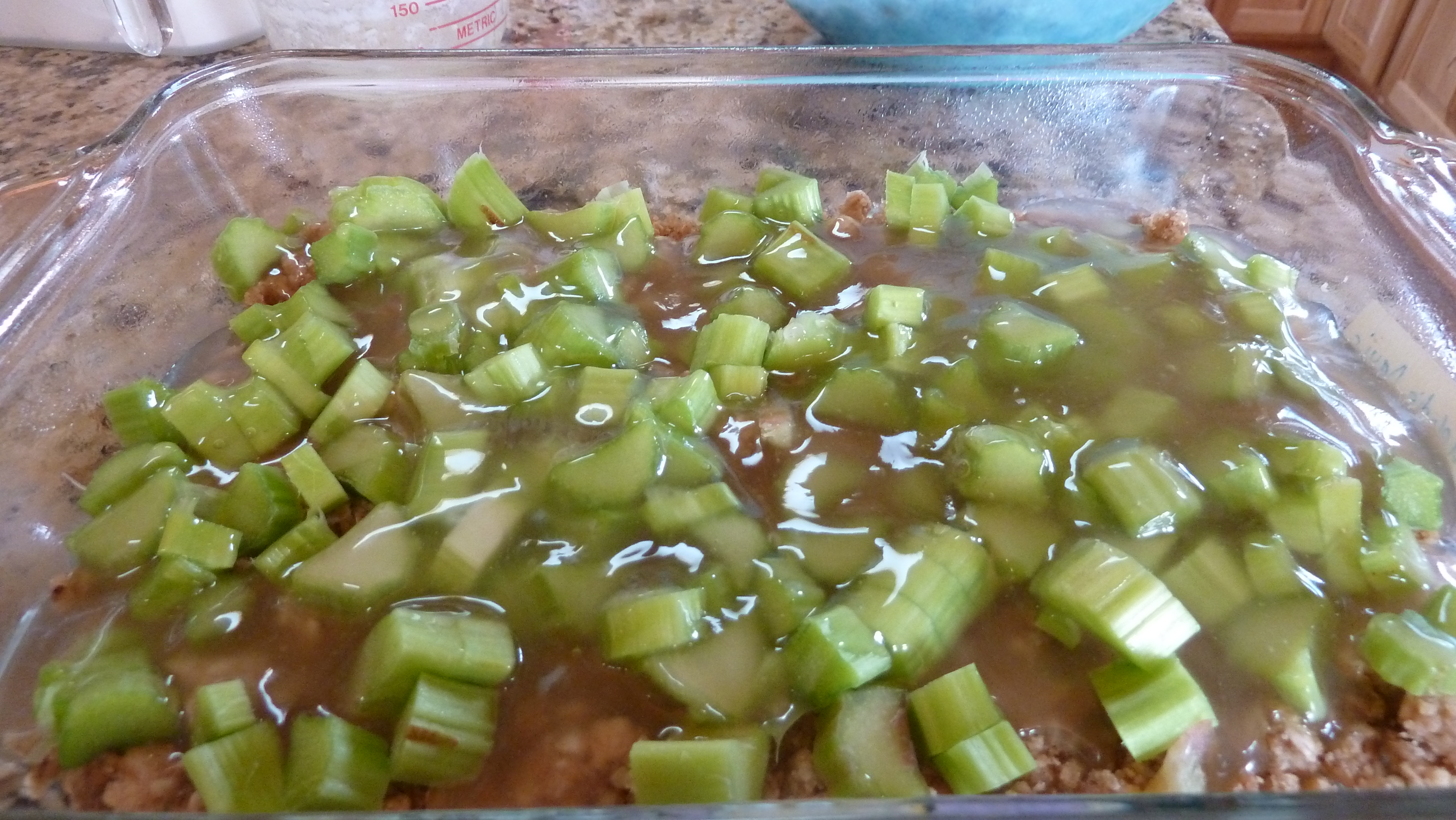
Top with remaining crumbs.

Bake at 450 degrees for 30-35 minutes, or until rhubarb is tender.
P.S. I forgot to photograph my final product, we were in such a hurry to eat it! If you have good recipe and picture of rhubarb something, send it and I’ll share it here!
Local peeps: if you want some fresh rhubarb, let me know and I’ll cut and share some for free. For sure!

Thanksgiving 2012, at my sister-in-law’s home.
Jay B. Landis recently published a book of fine poetry, “Verse Assignments” which I have been enjoying. He was a professor of mine at Eastern Mennonite University and taught in the English department over 50 years, which was my major. But I’m finding out much I didn’t know as I’ve been reading both his small volume and his wife, Peggy’s “Kitchenary” memoir, both published at the same time.
J. B., as we called him in college (not much reverence for professorial Dr. or Mr. or Mrs. at EMU, I’m afraid) includes in his collection an evocative short poem entitled “When To Pass the Bread:”
At home, in Pennsylvania, we passed the bread first.
Always, for company,
and in aunts’ and uncles’ dining rooms,
the bread went first,
afterwards butter and jelly.
Marrying a Virginian, I learned
you can pass the meat first,
the bread later,
perhaps after the potatoes or even with the salad.” … (excerpt)
For more information on the book see the website Verse Assignments. Used by permission.
I grew up in northern Indiana, a Yankee for sure, and married my Virginia-born and bread sweetheart, Stuart. Luckily for him (and me too) I had already been broken into southern ways, living in north Florida for a year, and then Kentucky for another, and had three years of Virginia living (although let’s face it you don’t really encounter true Virginia living on a college campus, right?) before I ever ran into him (or rather almost fell down at his knees, but that’s a story for another time).
I think that usually when we had company in Indiana, the tradition was to pass the bread first. Mom frequently invited folks from church, which we loved, especially if they had kids. I loved helping Mom “set the table pretty” (as we said) and I can still see it in my memory but I doubt we have any pictures of her clear and bright green bubble china and the simple but special glasses we saved only for such occasions.
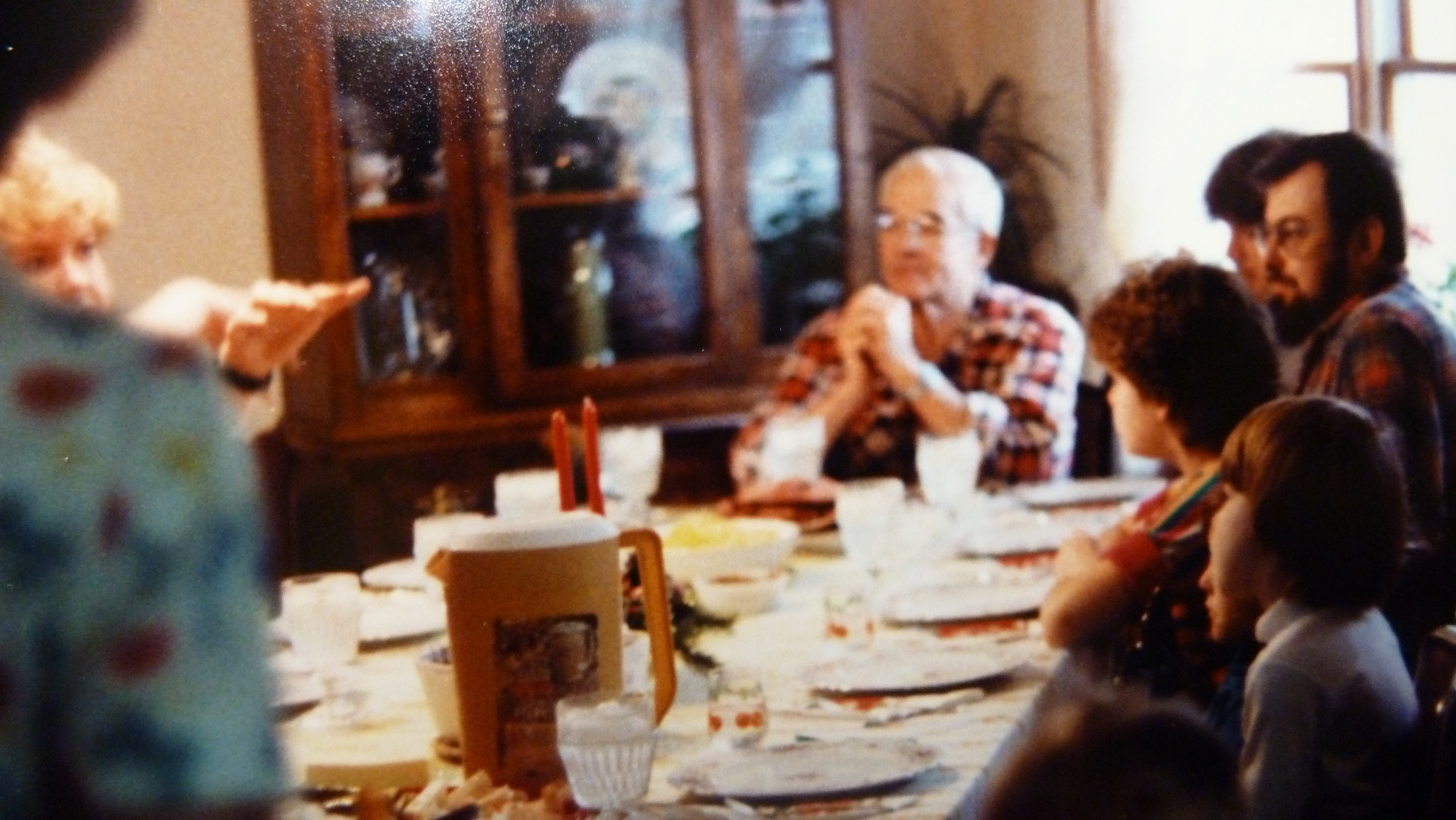
Dad ready for the blessing, my parent’s home, Indiana, Christmas dinner, circa 1988.
(Not Mom’s original green china or glasses.)
I still love to set the table pretty—and the moment when we all sit down and have a blessing. And then, well, somewhere along the line, without even realizing it, I guess I’ve gotten used to passing the meat first. I guess I’ve become Virginian or Southern if passing the meat first makes you that.
More likely, the controversy is whether you go clockwise or counterclockwise, and no matter how hard you try to get everything going one direction, something (the gravy, the butter, the salad) is sure to go the opposite. Not that it matters.
The thing I remember most though from my husband’s family is my late father-in-law’s usual post-prayer benediction of “Folks, take bread and eat.”
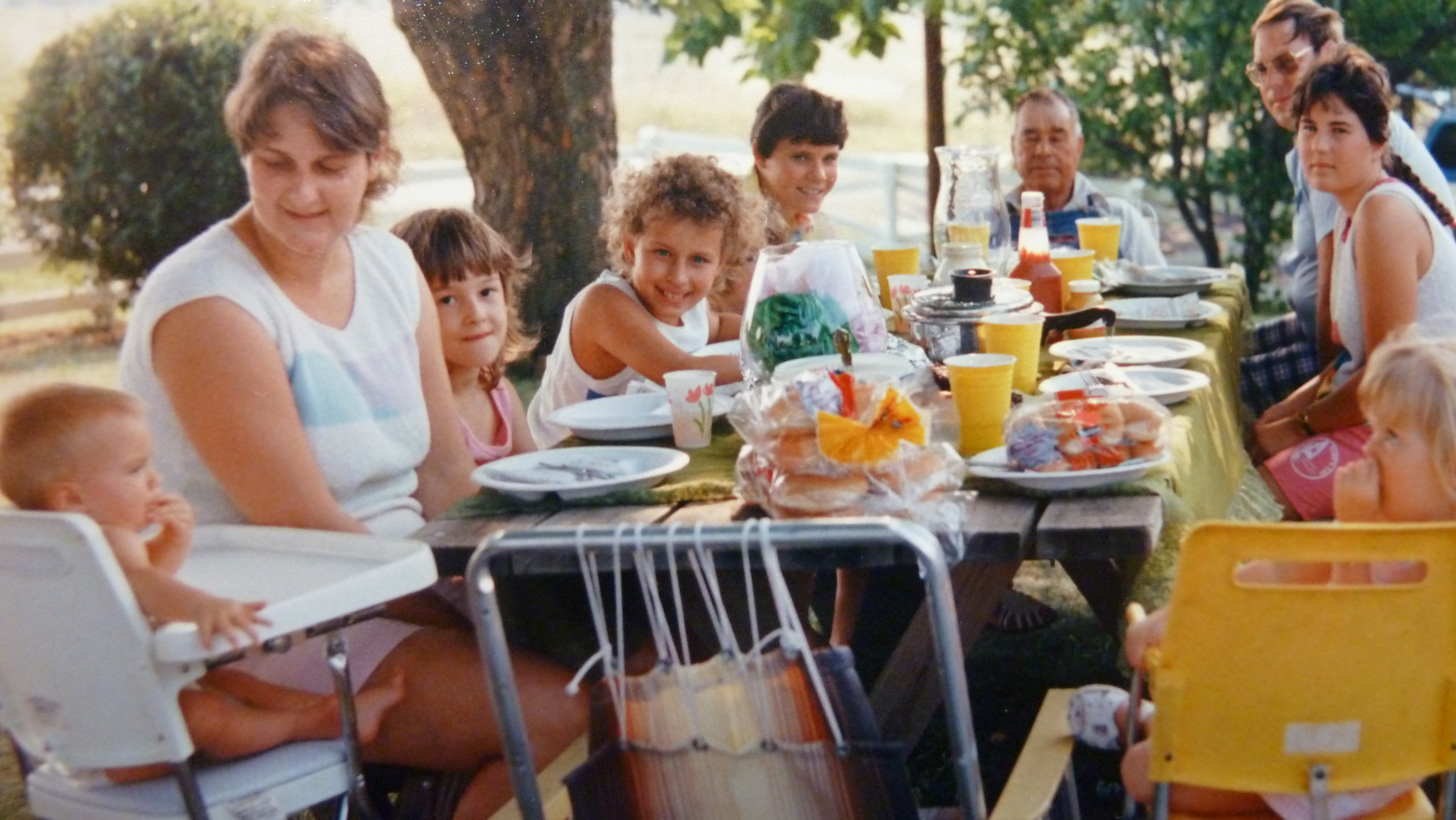
My father-in-law, Hershal, at the far end of this picnic table, circa 1987.
I think he said this partly to encourage us to get on with it—let’s pass stuff, I’m hungry. But it was also a blessing reminiscent of Christ’s own pronouncement and blessing at the last supper, in Matthew 26:26: “While they were eating, Jesus took bread, and when he had given thanks, he broke it and gave it to his disciples, saying, ‘Take and eat ….’” My professor’s poem also points to the sacramental quality of passing the bread before the meal.

I’ve learned many other southern or Virginia customs, traditions, and tastes over the years, including a love for sweet tea, grits, country ham, turnip or collard greens with a splash of vinegar, the savory taste of green beans cooked for an hour with ham or bacon seasoning. I know: the long cooking ruins any hint of vitamins, (and I also love gently cooked or sautéed green beans with garlic or maybe seasoning salt) that have just turned bright green. But if you look at long-cooked green beans as a “savory” side and not your main nourishment, you can learn to appreciate them.
When we try to find harmony across cultures and families, a great place to start is the dinner table.
When do you pass the bread at your table? Or maybe you’re saying, uh, who passes anything? Who sets the table? I’d love to hear comments!

A table of mostly bonafide Virginia eaters, and at this meal the meat and bread would have been passed at the same time: in a sandwich! My bro and sis in-law Richard and Barbara, daughter Doreen, yours truly, husband Stuart, friends/former neighbors Bob and Barbara, bro-in-law Nolan, and neighbor Harold. Photo taken by his wife, Willie, who does a great job taking the time to get photos right: people looking at camera, curtains closed in the back to avoid glare. Thanks, Willie, for sharing this photo.

Our immediate family, Christmas breakfast 2012, clockwise:
Doreen, Stuart, Michelle, her husband Brian, Tanya and her husband Jon.
***
My 2010 book, Whatever Happened to Dinner? has some Davis Virginia specialties in it, but also recipes from a wider group of families from my office.
Reblogged from www.Mennobytes.com

One of my favorite stories in Fifty Shades of Grace: Stories of Inspiration and Promise is that of John Perkins. John is the author of the now-classic Let Justice Roll Down.
First a little background.
In the mid-’90s I was asked to be on an anti-racism team for Mennonite Board of Missions (which became Mennonite Mission Network in 2001). Many teams from the church agencies, colleges and some churches attended intensive trainings: five days at a retreat center here, four days at a conference center there, and eventually many follow-up team meetings in various cities. My three daughters were still school age so they weren’t necessarily happy when I went away, especially for a week at a time.
After intensive training and team work, one of our final meetings in that process just blew up racially. It was painful for all involved. We had tried to come to a consensus about a statement that would be made to the denomination, and ultimately our caucuses could not agree. We were angry and I was fighting tears. I had never been so disillusioned about hope for understanding across racial and ethnic lines in my life. I could not bring myself to participate in the closing communion. I went home severely disappointed.
Several months later I heard John Perkins speak at the annual meeting of the American Bible Society. At that time, the ABS invited and paid for representatives from various denominations to attend their National Church Advisory Council. The agenda looked good but my boss couldn’t go, so he sent me. I’m always up for a trip to New York City.
I was quickly and emotionally swept up in Perkins’s message of God’s love and desire for reconciliation between races. Perkins shared his testimony and many stories from his long and painful work for racial reconciliation, and economic and social justice. He had been beaten and tortured in the days of boycotts, marches and unrest in the South. Here was a man who had truly suffered (not just attending long meetings): his brother was murdered because of racial misunderstanding.
Perkins restored my hope and faith that people could get along across the many boundaries that divide us. He went beyond reconciliation to development: understanding innately that unless people are empowered to find the means to economic development, they will continue to struggle in many realms. To the old “give a man/teach a man to fish” adage, Perkins said it is the man or woman who owns the pond that will eat fish for a lifetime. Perkins had to drop out of school when he was in third grade but has received five honorary doctorates over the years. I could see he carried the wisdom of a Solomon. I wept as I felt that Perkins, and God, were speaking directly to me. It was a time of healing. As I was leaving the meeting, Perkins and I were able to share a taxi to the airport. I tried to put into words a little of what his presentations had meant to me.

Vera Mae and John Perkins filmed by Jim L. Bowman for the documentary, Journey Toward Forgiveness
Fast forward a couple years when Mennonite Media (now morphed into MennoMedia) began working on a string of documentaries, which aired on national TV beginning with Journey Toward Forgiveness. Our production team researched unusual and profound stories of forgiveness and my mind went to John Perkins’s immense suffering and, ultimately, forgiveness. I gave him a call. Would he be willing to participate in our documentary, telling his story? He would and did and actively promoted the documentary for many years, taking along copies of the video to his many speaking engagements.Fast forward a bunch more years to working on Fifty Shades of Grace. (Earlier I wrote about the editing/compiling process here.) Now in his early 80s, I wondered if Perkins was still speaking and writing. Would he let us share his story in Fifty Shades? I emailed the contact person at the John M. Perkins Foundation for Reconciliation and Development (which is now named for his son, Spencer Perkins, who died suddenly in the late ’90s).
A week or two later, I got a phone call out of the blue. We receive numerous phone calls at MennoMedia that I sometimes handle, from people who have heard our radio spots on various topics like mental illness, drug addiction, grief. It took me 10-20 seconds to realize it wasn’t a radio spot caller. It was John Perkins himself. He was responding to my email message. He wanted to make sure I had gotten the message that he was happy to have his story included and would look for ways to promote the book in his speaking and appearances. (I just learned he is speaking in Richmond, Va., May 15, 2013.) He has two recent books of his own out: a memoir, Love is the Final Fight and Leadership Revolution: Developing the Vision & Practice of Freedom & Justice (with Wayne Gordon).
To read John’s brief but dramatic story in our book, I hope you’ll buy Fifty Shades of Grace. And if you’re in the Harrisonburg, Va., area May 9, bop on over to Park View Mennonite Church fellowship hall between 3:30-6 p.m. on your way home from work or before your dinner to pick up a couple of copies. It’s on 30 percent discount until May 9.

The other Saturday I was hungry for homemade apple pie and had a small pie crust calling my name in the freezer. But it is spring and Stayman apples, the longtime Davis favorite (and a popular Virginia apple, check here, if you want to know why) are no where to be found. Even in the fall, orchards seem to quickly run out of the popular cooking apple.
So I bought some Granny Smiths and went to work.
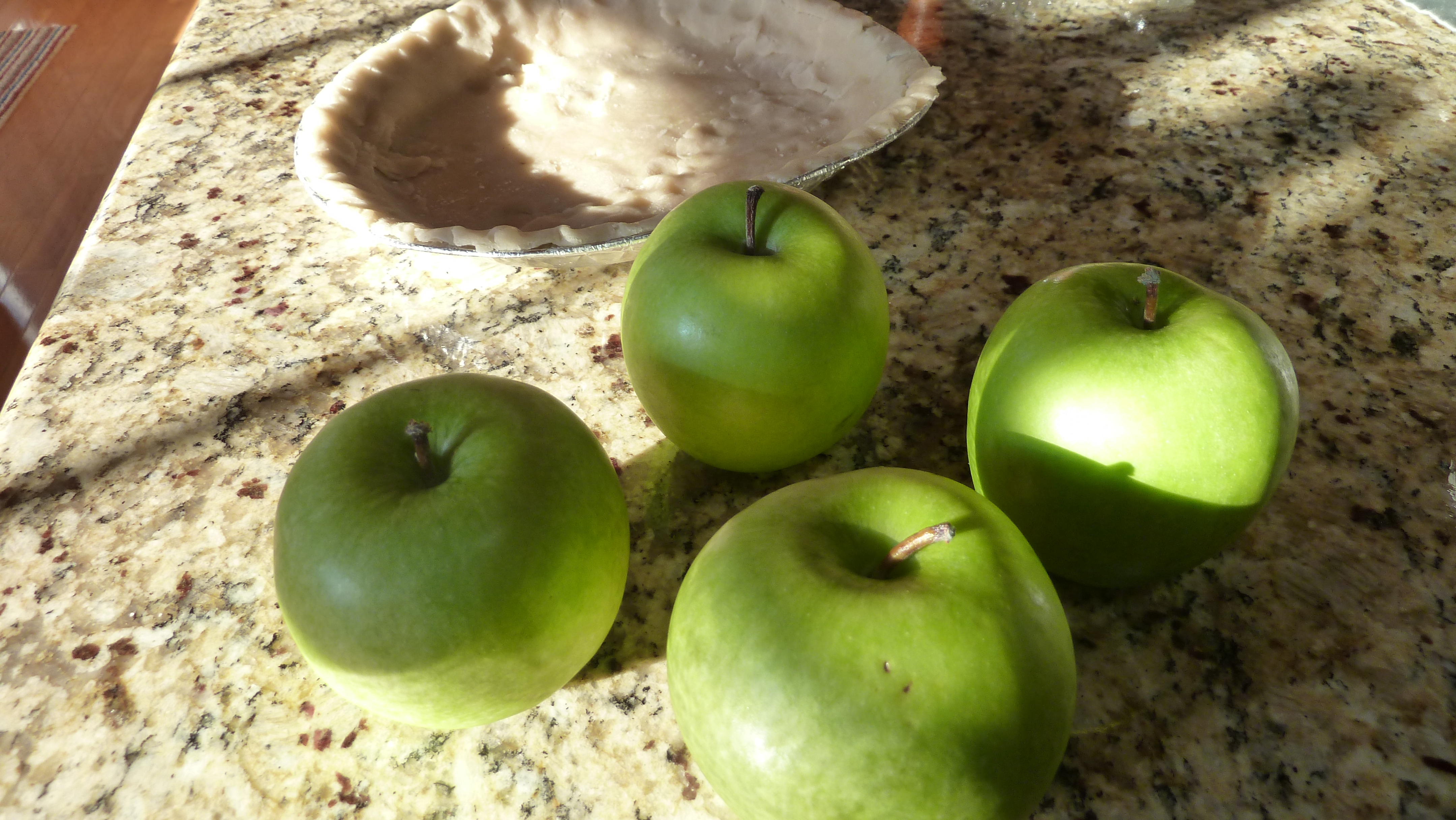
The recipe I use for apple pies comes from the Davises by memory from my husband and my husband’s family. His mother died when my husband was just 19, before I ever met him. By checking other pie recipes, I eventually settled on the quantities below.

(I slice the apples thin, and then cut each slice in half.)
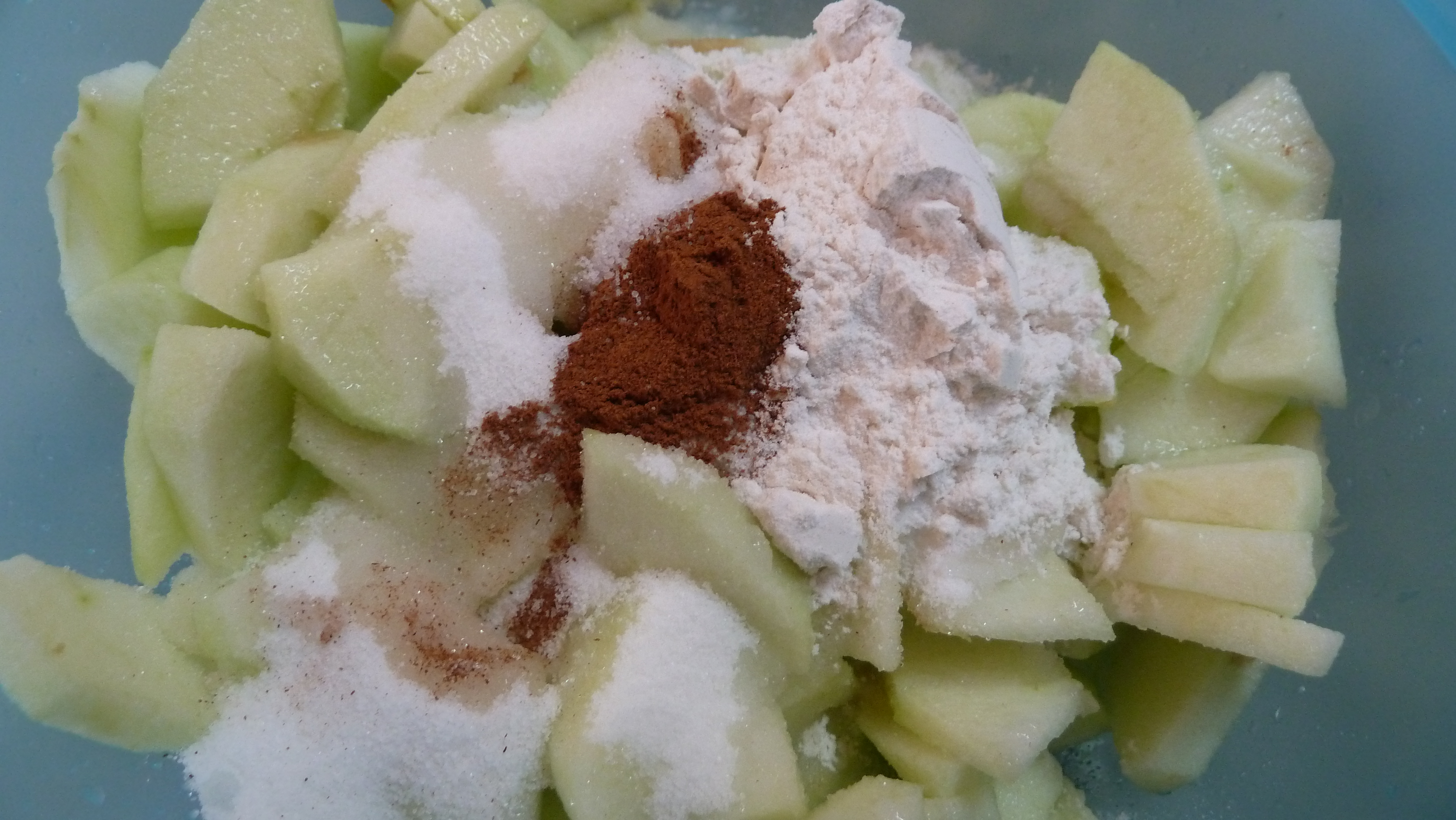
(My husband says the secret to good apple pie is lots of cinnamon, and its good for you.)
For another time, I want to share my daughter’s recipe and experiment with canning apples ready to pop into a pie. She and a friend who has gotten into canning stuff tried it last fall and it seems to work great. I’m so proud of her for trying it!
Michelle has also taken a pie she once fell in love with at a McCormick and Schmecks restaurant, upside down walnut crust apple pie, and turned it into a sought-after favorite at her office’s annual (?) bake off. We’ll save that variation for another time too.
Just now, there’s some a small patch of rhubarb calling my name and though I was never a big fan of rhubarb as a child, my youngest daughter, Doreen has turned this “first fruit of spring” into an anticipated treat. I’ll share the results NEXT week.
Happy bake something Saturday! And don’t miss blogger Nancy Babbitt’s recipe for how to make vinegar out of your apple peelings.

The pie recipe below is found in my book, Whatever Happened to Dinner, which is still on sale (along with all other Herald Press cookbooks until May 8, this week!

Davis Apple Pie
Crust (for a 2-crust 9” pie):
2 cups / 500 ml flour
1 teaspoon salt
2/3 cup / 150 ml shortening plus 2 tablespoons
¼ cup / 50 ml water
Mix flour and salt, then cut in shortening. When shortening and flour are mixed to make clumps the size of peas, add water. Mix by hand until clump of dough is formed. Divide into two balls. Roll out bottom crust for pie pan on a well-floured board with a floured rolling pin. Carefully lift with a turner and put in pan. Roll out second pie crust for top, slicing a few decorative holes with knife to allow steam to escape. Can follow this pattern ( = ) or variation. Leave crust to rest on board until you fill the pie with apple mixture.
Apple mixture:
5 cups / 1.3 L peeled and sliced tart apples
1 cup / 250 ml sugar
1 tablespoon flour
¼ teaspoon salt
1 teaspoon cinnamon
1 teaspoon lemon juice
Mix apples and all ingredients in bowl. Put in pie crust. Pat edge of crust with water to help bottom and top crust to seal. Put on top crust, and pinch together, pressing with fork or your own pattern of twists. Protect crust from getting overly brown by using foil around edge of pie pan. Bake in a 425° oven for 10 minutes, then lower heat to 350° to 375° for another 50 minutes. Remove from oven and let cool.

(Pie with crumb topping ready to go in the oven; the pan looked full, but it baked down and did not overrun the pan.)
Crumb topping – alternate to using a pastry topping (this part is not in my book if you’re looking)
½ cup / 125 ml brown sugar
½ cup /125 ml butter
1 cup / 250 ml flour
Mix until crumbs resemble coarse meal with lumps the size of peas. Sprinkle on top. Bake at 450 degrees for 15 minutes then 350 for 45 minutes.

My crumb topping mixture.
What’s your favorite apple for making pie??
I spent three days as “tourist” in eastern Ohio Amish country over a long weekend with my husband and brother-in-law and sister-in-law. Of course we enjoyed lots of fine Amish cooking in local restaurants.
But the highlight was stepping inside a home at about 5:30 p.m. on Saturday evening where the owner had a small handmade sign out by the road, “Baskets for sale.” Was it too late, were they closed? No, come on in. It’s fine.
And fine baskets they were: hand woven with beautiful artistry that look a lot like the brand name baskets that comes from Ohio but less than half or two thirds the price.
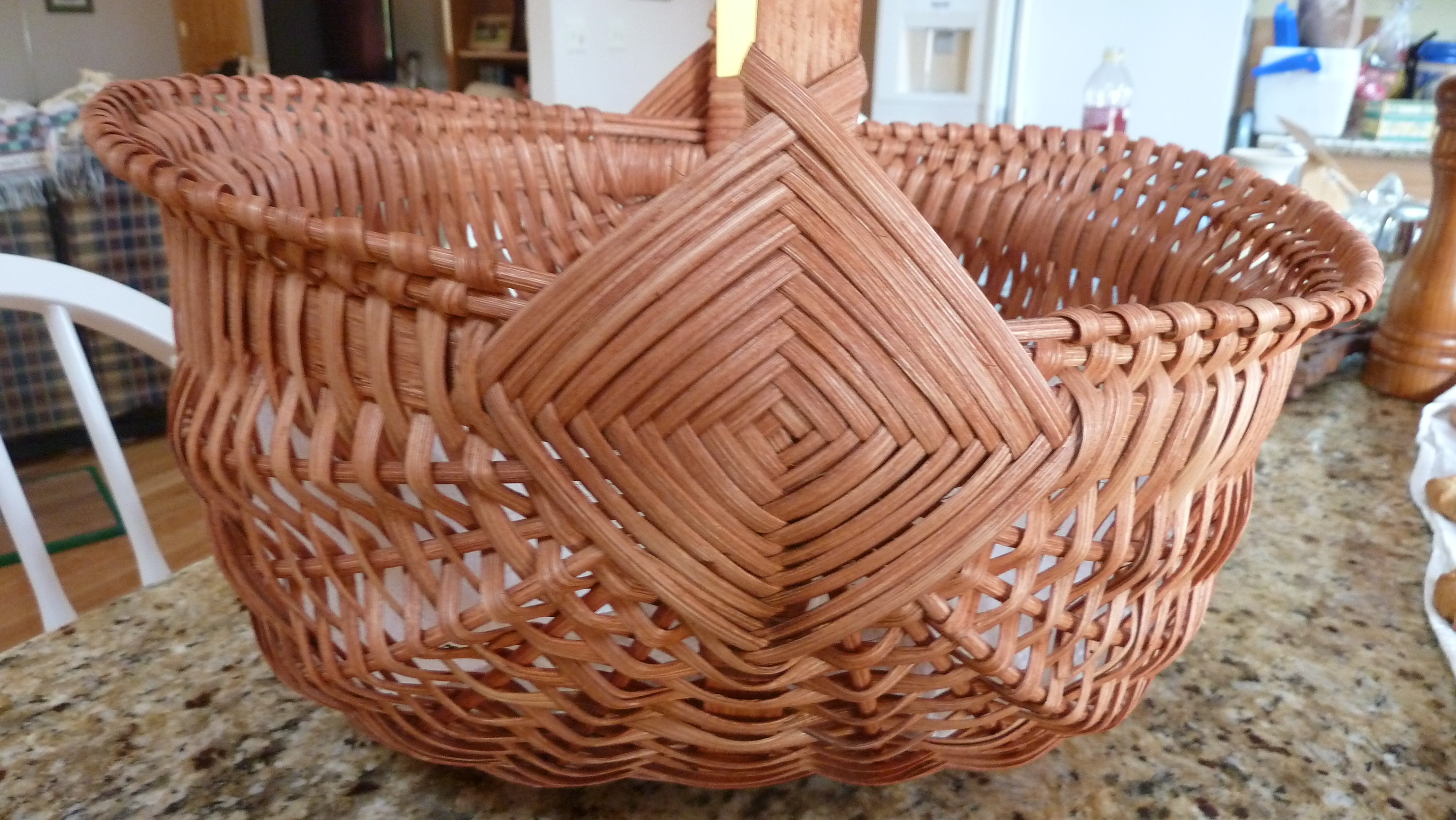
We walked in the back door to a mudroom where basically the only objects were a small bench and about four or five pair of boots, including small children’s. The next room held a variety of wares their were selling from other crafters, including rows of home canned pickles, apple butter, wedge pillows, a few odds and ends that might appeal to children, and around the edges, all shapes and designs of baskets: a three slot bill/correspondence holder, a basket filing system for on top of a desk, waste baskets, bread, eggs, and garden baskets, over the stairstep baskets, toilet paper holders, tissue holders, cutlery, napkin, casserole, pie carrier, blanket holder—anything that could be fashioned from reeds into a basket. A side room held basket making supplies, and still another room was filled with more baskets for sale.
But I was just as fascinated by what was in the simple and spare other rooms. In the kitchen was a beautiful old cook stove with several shiny stainless steel pots on it, already sending out good smelling whiffs of the family’s evening meal. There were two irons heating up. Besides a table with oilcloth tablecloth, there were a few plain chairs, ironing board, and a large calendar (with no pictures). There was nothing else in the room that I could see. The only light was from gas lighting or from daylight still lingering in the windows.
After making our selections and returning to our minivan, my sister-in-law sighed and said, “I could still live like this.” We were both remembering simpler times in our own childhoods where we washed clothes with wringer washing machines on Mondays and hung them out to dry, gathered eggs in wire baskets, and played in mud and truly had only a few simple dolls and toys, compared to today’s children.
I longed to capture these scenes in photos, but of course know and understand the Amish teaching against the vanity of photography. I figured animals were fair game though: twice now my husband and I have run up a farmer and helpers helping their cattle cross the road in these parts of Ohio.
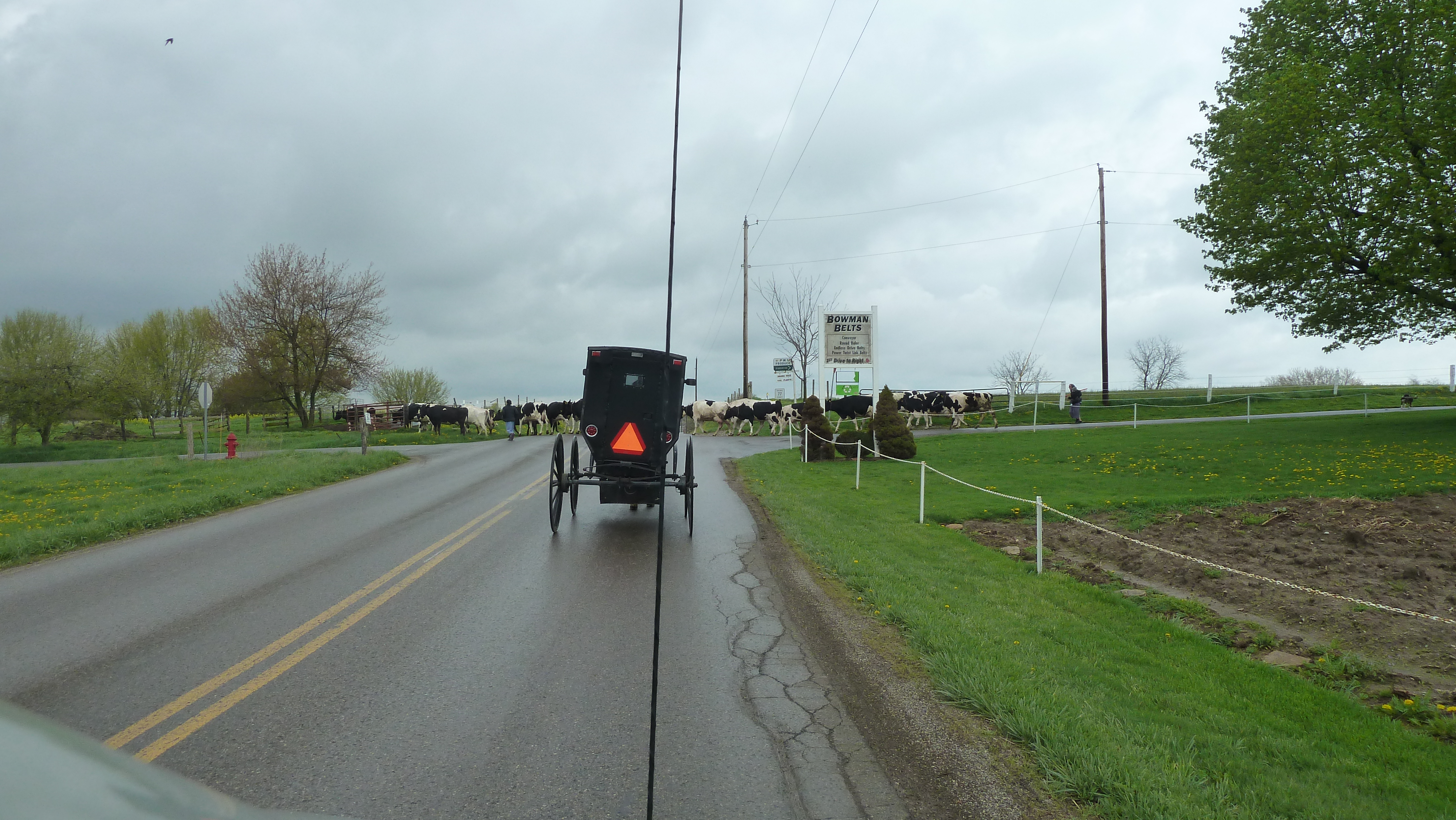
At another country store, a proud peacock (are there any other kind?) allowed us to admire his showy feathers.

But there were endearing rosy-cheeked kids in pony carts driving to town or to a neighbor house. In one backyard where we inquired about a furniture shop, there were two adorable pint sized boys, (had to be twins no more than three years of age), dressed in matching but plain denim coats and straw hats. Matching because that’s pretty much what all the little ones wear—either purchased locally in dozens of small country stores carrying the clothing, or handmade by a family member.
I told my sister-in-law the little denim coats were exactly like the coats my Amish neighbors in Indiana used to wear to school 50 years ago. Among them, my friend Bertha. I identified with her because her name was the same as my mom’s and the family lived only about two miles down the road from us and rode our school bus. Somehow my early school friends were allowed to be photographed in school pictures.
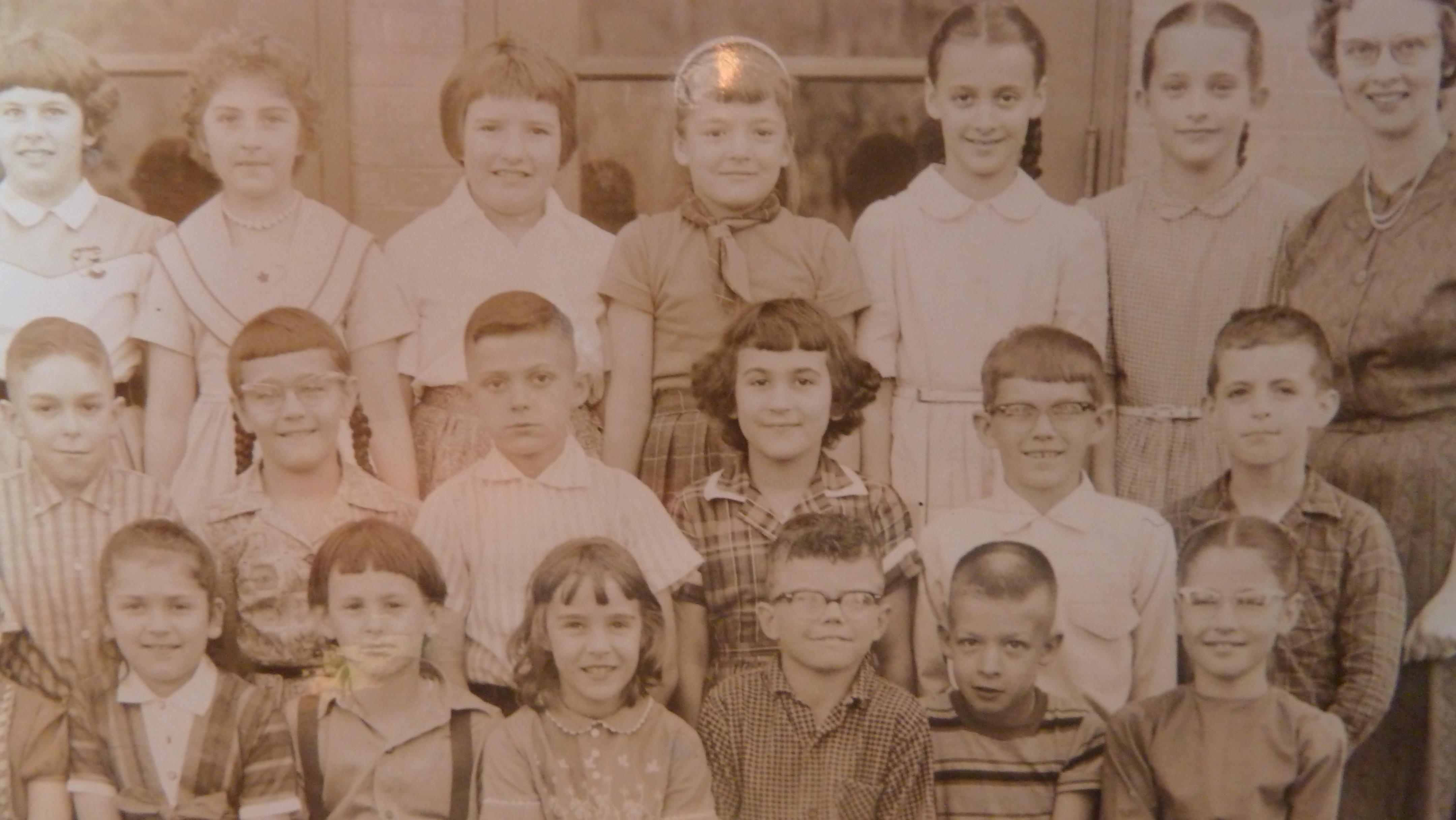
Bertha is in the front row, far right.
I’m the middle girl in the back row with a splotch (old photo) on my hair, one of the taller! kids.
Ten of us in this photo were either Amish, Conservative, or Mennonite.
My father could and did frequently talk Pennsylvania Dutch so I grew up hearing it when he spoke to neighbors or acquaintances in town. And while I knew they were my “cousins” in my Mennonite/Anabaptist faith family, I was always (shame on me) secretly glad that I didn’t have to wear the very plain clothing or drive buggies or wear a covering or “bonnet” to school. I was glad that I didn’t have to wear long dresses with straight pins instead of buttons.
There is, of course, a great deal of fascination and curiosity about Old Order and Amish folks. My in-laws live in a Virginia community where you can see or pass Old Order buggies almost every day, so it is not all strange. And growing up Mennonite, and working to help interpret Mennonite and Anabaptist beliefs for the general public at the Third Way Café website, I know many of the unusual, silly and even embarrassing questions that people sometimes have and ask.
Last year I got to interview David Kline, an Amish farmer in those parts of Ohio who also happens to be a lovely writer and observer of science and nature who has greatly expanded my appreciation of the Amish way of farming. This year I’m excited about working with an Amish cook demonstrating how to make “Amish noodles” this fall at Camp Amigo’s Road Scholar program, which I blogged about earlier. I have much to learn from my cousins in faith. We’re all just people.
And sometimes the best pictures are word portraits, even though my words here fail. Sometimes the best memories are those you hold in your heart, almost inexpressible. So be it.
***
There are many websites of course but here is one about the middle of Amish country. We stayed at a very fine motel, Dutch Host Inn. No one paid me to write about this!
By Melodie Miller Davis
When I was 17 and about to embark on my senior year of high school, my family packed up a car, pick-up truck and U-haul trailer and moved 900 miles from Indiana to north Florida.

Dad hoeing our garden on flat, north Florida farmland.
Now northern Florida is literally more than 1,000 miles away from south Florida and the kind of beach culture you find in Fort Lauderdale or Miami. North Florida is more like living in very rural Georgia or Alabama: Deep South, in everything from accents to attitudes.
The year was 1969: the Vietnam War was in full swing, it was the first year of full racial integration of public schools, and just a year after Robert Kennedy and Martin Luther King Jr. had been shot, for reasons not unrelated.
So I was the new girl in school; I can still remember one boy glaring at me and spitting out, “Damn Yankee. We don’t need any more of ya’ll down here. If we could fight the war again, we’d win this time.” And it was not the Vietnam War he was talking about.
We had a government class called “Americanism versus Communism,” and every day the teacher, Mr. Dickens (name changed) would rant about “g’vment,” religion, freedom, the fortunes of University of Alabama football, and huntin’.
Not only was I new and freshly imported from the North, but I was immediately categorized as Mennonite. Everyone knew Mennonites were different. Some of the local Mennonites were different in dress, but others like me were different mainly because of our beliefs.
I had lived a very sheltered life near Goshen, Indiana, where most of my friends, teachers and neighbors were either Mennonite, Brethren, Amish, or Conservative Mennonite. I went to the Mennonite high school my first three years and enjoyed a great bunch of friends. My biggest crisis was breaking up with my steady boyfriend shortly before we moved.
So even though I was initially excited about the move, once there I felt isolated, lonely, and very different from most of my peers. For the first time in my life, I hated and dreaded school.
Mr. Dickens had a chip on his shoulder when it came to religious people. Mostly, he thought they were a bunch of hypocrites: “Fiiine Babtists (his pronounciation) on Sunday morning, but who do you find drinking and driving home from Joe’s Bar on a Saturday night? Whoohie!”
Still, as a new southern transplant, I was fascinated with his stories. What high schooler wasn’t content to listen to tall tales and loud opinions for an hour rather than buckling down to discussing the assigned reading? At times his logic and opinions made sense, and I realized his mind went deeper than huntin’ dogs and ‘Bama football. He was, after all, editor of the town paper.
Mr. Dickens picked up early on my faith background and would buttonhole me with questions like, “How would Mennonites keep communists from taking over our country if it ever came to that?” I remember my face feeling hot as I stumbled for answers. I was raised to be a “nice” girl, so I never thought of it as bullying or badgering or a hostile classroom environment.
In our Mennonite family, one of the firm rules guiding our lives was that Sunday was a day of rest. We only did the necessary chores of taking care of animals — and “women’s work” of cooking and washing dishes. Dad, as a rule, would never drive a tractor or do any work that could wait until Monday.
But in Calhoun County, a day of rest for humans was also a day when hunters would take their huntin’ dogs and go scouting for deer.
One Sunday afternoon in the fall, when the ground was soggy and full from the hurricane season, Dad could hear a vehicle stuck in the mud across the fields. You could hear the tires whirring in the mud. So Dad went out quietly and got his tractor, fetched some sturdy chains, and went rambling down the paths between fields until he reached the source of the sound.
Who did he find there but Mr. Dickens and his dogs, with his truck stuck up to its axles.
Dad quickly pulled Mr. Dickens’ truck out of the mud. I don’t know if Dad worried about whether neighbors would think he was working on Sunday when they saw him on his tractor. But Dad did tell me he’d found and freed my government teacher.
On Monday morning, Mr. Dickens began class with, “I was out huntin’ with my hounds Red and Rowdy yesterday …” and we settled in for what we hoped would be a long diversion from civics, government and religion.
“Well, I was out near about the Miller farm,” he said with a nod to me. “And then Whoohie! Fooey! Hot dang! The ole’ truck jes mired down and wadn’t going nowhere, no way. I rocked it back and forth. Of course, it jes made the mud worse, and I knew that, but what was I to do? I was eight miles from town.
“And then I looked up and who did I see puttin’ across the fields but Mr. Miller, on his tractor, on a Sunday. And he commenced to putting his chains on my truck and had me out of there in no time at all.
“Now that’s a fine Christian man who don’t ker what his neighbors will think, that he’s disobeying the rule about not working on Sunday to help this poor ole’ teacher out of the mud.”
He turned to me. “I’ll never forget that, Miz Miller. You’ve got a fine father. If everybody who went to church was like that, we’d all be better off. Now that’s what Christian love is all about. You tell him thank you ag’in for me now, will you?”
And Mr. Dickens never did forget my father’s simple act of kindness. He brought it up often in our discussions of religion the rest of the year. I felt less “on trial” and less suspect in my faith tradition.
Dad’s bridge of grace to help someone in a ditch in spite of normal Sunday rules softened the opinion of a curmudgeonly teacher that day—and maybe of this young self-righteous northerner who needed to open herself to be more accepting of anyone, no matter what kind of opinions they expressed or where they lived. I doubt Dad thought of himself as extending grace when he went to get his tractor, but Mr. Dickens’ ideas about Christians, pacifists, and Mennonites would never be quite as hardened.
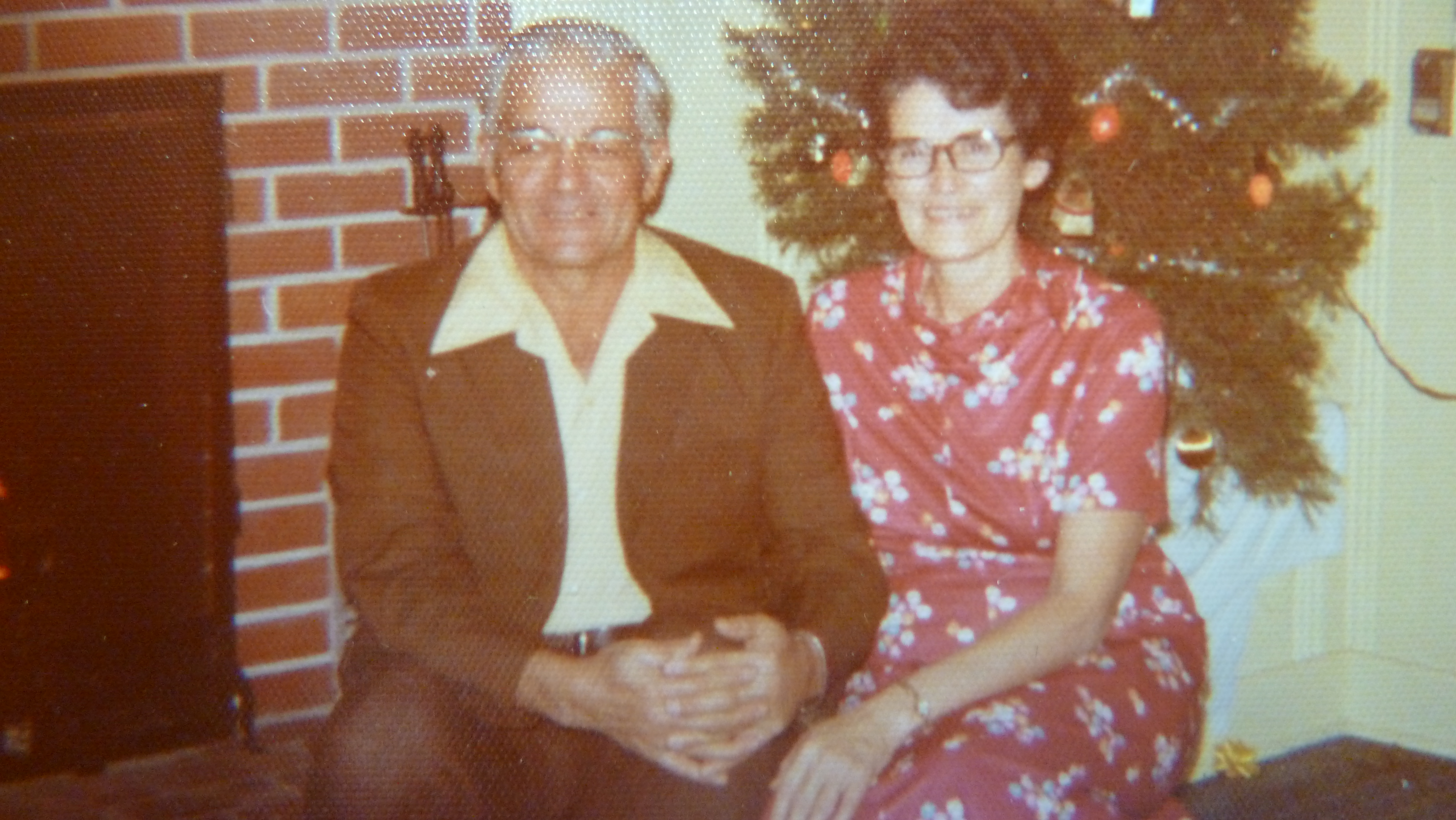
My dad and mom, Vernon and Bertha Miller, circa 1970’s, at our home in north Florida.
Finding Harmony Blog featured guest posts this week as excerpts from a just released book, Fifty Shades of Grace: Stories of Inspiration and Promise, published by Herald Press (April 17, 2013). This is my father’s story included in the book.
More stories like this: This story and 49 more like it can be found in the new book, Fifty Shades of Grace: Stories of Inspiration and Promise–a great Mother’s day gift or for birthdays, anniversaries, personal devotional, or a book to share with a friend or relative. A 30 percent discount is available until May 1, making the book just $9.09 plus shipping. You can also watch a trailer for the book here and find a news release here.
Finding Harmony Blog is featuring five guest posts all week as excerpts from a just released book, Fifty Shades of Grace: Stories of Inspiration and Promise, published by Herald Press (April 17, 2013). I served as compiler/editor for the book and wrote about that process on Mennobytes blog. Today’s story is by Sarah Ann Bixler; her bio appears below.
Guest post by Sarah Ann Bixler
It was the first day of spring. Bright yellow petals blinked on my giant daffodils as the sun chased the cold chill from the air. Robins flittered around the yard, playing tag and pecking the soft ground for plump worms and bugs. Signs of new life appeared everywhere. I should have been outside relaxing on the porch swing, enjoying the beautiful day, but I was in the dark, damp basement.
Sitting on the hard concrete floor, doubled over as far as my six-months-pregnant belly would allow, I scrubbed brown water marks from the vinyl tile. Two months earlier a pipe had burst in the nearby wall, the disastrous combination of a hard freeze and a garden hose left hooked up to the outside faucet. Gallons of water had come gushing down the basement walls and spread across the first floor, pouring from the ceiling tiles into the basement and bubbling up between the hardwood planks on the floor above. Washing the basement floor was one of the final clean-up tasks, after drying out and removing damaged boards and patching drywall, and before repainting walls and replacing half of the first floor. And my husband and I were doing the majority of the work.
Long before the entire floor was cleaned, my back hurt and my abdomen protested being folded in half with a baby blocking the way. I hauled my aching body up two flights of stairs and called to my husband that I was taking a nap. It didn’t take me long to fall asleep.
When I awoke, the aching feeling persisted. Not in my back anymore, but in my sides and my belly. I tried to find a comfortable position, but there was no relief. I went downstairs where Ben was preparing supper and tried to smile as our two-year-old, Calvin, pedaled around the exposed plywood kitchen floor on his tricycle.
I knew something was wrong. Ben encouraged me to call the doctor, so I placed a message at the hospital for the obstetrician on duty. But after an hour passed, I recognized that I had contractions occurring every five minutes. We drove to the hospital as the last rays of daylight faded from the spring sky.
The next hours became a blur of excruciating contractions, epidural needle, lower abdominal incision, “Do you have a name picked out?” and a glimpse of a small red mass who was our daughter. For three hours we waited for the report that she was still alive and her breathing had stabilized. We briefly touched a tiny hand, barely visible under a quilted aluminum blanket and tubes coming out every which way, before she was rushed to the neonatal intensive care unit (NICU) an hour away.
The doctors described Susannah Rose as feisty and strong at 13 weeks premature. But within two days, a sudden hemorrhage in her heart sent her fragile systems awry. That first week of spring, we looked at her through tearful eyes and prayed that the bleeding in her heart and brain would stop. Calvin met his little sister at five days old and clasped his small fingers around her hand. And on the seventh day, Ben and I held her in our arms for the first and last time. Shock, pain and grief hung like a pale haze over the beginning of a season meant to be joyous and full of life.

Sarah holds Susannah Rose.
Even easier than extending grace to God was offering grace to others who, along the way, had hurt me unintentionally. I offered grace to the doctor who didn’t return my call. To the entry nurse who wasted twenty precious minutes trying to determine whether I was really having contractions. To the birthplace nurse who cheerfully asked me if I wanted my baby in the room with me, a baby struggling for her life an hour away. To the NICU nurse who coolly snapped photos of Susannah after she pulled out her own breathing tube and gasped for air. To Susannah’s doctor who reduced her blood pressure medication, resulting in her heart hemorrhaging. To my elderly neighbor who brought a meal and said, “It was for the best. She might have been, you know, bad.” To a friend who complimented me on my post-pregnancy figure when all I wanted was to still be pregnant.
I had grace for everyone except myself. I could not shake the thought that I could have prevented Susannah from dying, that I was ultimately responsible for her fate. I could barely look at my shrinking figure in the mirror, a bright red scar in place of where Susannah should have still been growing. I focused my attention instead on the daffodils, tulips and hyacinths that bloomed in my flowerbeds. They were weeded, mulched and blooming vigorously long before my doctor had cleared me to begin post-surgery activity. And as my hands plunged deep into the warm soil, God’s Spirit taught me that Susannah, like a spring bulb, had blossomed briefly, died, but now knows life where she blooms eternal.
The passage of time and summer’s arrival helped me gain a new perspective on Susannah’s brief life. Slowly I came to accept that although I may have been able to prevent her early birth, I was still a mother to Susannah. The grief in my heart turned to gratitude for the few moments we spent together. And the longing for what could have been different deepened my love for the precious girl who will always be mine.
I discovered that there is grace for even me.

Photo by Sweet Amy’s Photography
BIO: Sarah Ann Bixler lives in Harrisonburg, Virginia with her husband, Ben, and two children, Calvin and Eve. She received a degree in English education from Eastern Mennonite University and enjoys creative writing. Sarah has worked as a youth minister, teacher, curriculum writer and administrator in Mennonite churches and institutions throughout her career. Currently, she works for Virginia Mennonite Conference and on Eastern Mennonite University’s residence life staff. Sarah will soon be enrolled at Princeton Theological Seminary studying for her master’s of divinity degree.
***
More stories like this: This story and 49 more like it can be found in the new book, Fifty Shades of Grace: Stories of Inspiration and Promise. It is easy reading and inspirational—a great Mother’s day gift or for birthdays, anniversaries, personal devotional, or a book to share with a friend or relative. A 30 percent discount is available until May 1, making the book just $9.09 plus shipping. You can also watch a trailer for the book here and find a news release here.
Finding Harmony Blog is featuring five guest posts all week as excerpts from a just released book, Fifty Shades of Grace: Stories of Inspiration and Promise, published by Herald Press (April 17, 2013). I served as compiler/editor for the book and wrote about that process on Mennobytes blog. Today’s story is by Jodi Nisly Hertzler; her bio appears below.
Guest post by Jodi Nisly Hertzler
Perhaps it was the chilly, drizzly morning (a drastic change from the muggy, sunny July weather we’d endured all week). Perhaps it was awakening too late to claim the favored corner of the couch. Or perhaps it was the fact that his younger brother had already selected the Saturday cartoon to be watched that morning. Whatever it was, my son was having a horrible morning. And things only worsened when an art project he’d labored over the last twenty-four hours disintegrated during the final steps. My husband and I winced at the shrieks of despair and anguish emitting from his bedroom. Flinched as he shouted at his brother to go away. Nearly fled the house as he stormed back downstairs, clearly caught between tears and the urge to break every window in the house.
Every attempt to defuse the situation resulted in bellowed disagreement. We tried to engage his help with the family jigsaw puzzle, then had to send him away for fear of injury to the puzzle or to his siblings. I attempted to provide a comfortable place for him to read in solitude, but his funk had robbed him of the ability to concentrate. Food didn’t help; time-outs didn’t help.
I was tempted to leave the boy to stew in his own angry juices. He was clearly ruining everyone’s relaxed Saturday morning with his eleven-year-old angst and I honestly didn’t feel like dealing with such a maelstrom of emotion. I poured myself a cup of coffee and prepared to just wait it out. But watching him, I was reminded of myself at his age, and I recalled the volatile mood swings I used to have . . . I saw myself in that angry boy huddled on the couch, growling at anyone who glanced his way. And I remembered my father’s method of dealing with me. When he’d see me caught up in my emotions—all tangled up in anger and frustration with no tools to free myself—my gentle, patient father would insist that we go for a walk. I have many memories of twilight walks around our neighborhood, talking with my dad, the air and exercise and company easing my troubled mind.
So I took a fortifying gulp of coffee and a deep breath and gingerly approached the seething dragon that lay within my son. “How about we go for a walk?”
I was sure he’d say no. The cold, wet drizzle outside was hardly inviting. But perhaps the miserable weather appealed to his inner tempest, because he agreed at once. So we set out. I wasn’t sure what to expect. I told myself not to bring up the morning’s troubles, but to allow him to dictate the level of interaction. We jogged to the intersection, crossed the busy highway, and progressed up the sidewalk, toward a small woodland not far away.

The rain-washed air and burst of exercise must have had a purging effect, because the treetops of our destination were barely in sight when my son started unloading. He took me step by step through his failed attempt at art. But his voice remained calm; he didn’t dissolve into tears or anger. I expressed my understanding. We considered options for repair. He sighed.
Then we moved on to other topics. We talked about the upcoming school year and he admitted to nervousness about how much harder things will be in middle school. I agreed that the work might be more difficult but assured him that he’s a quick learner, and that his main challenge will be organization. He considered that for a moment, then challenged me to a race to the edge of the woods. He won (barely).
We entered the woods, and the conversation turned to observations of the fallout from a recent violent windstorm. We marveled over felled trees and the park bench that lay splintered under one of them. We looked for poison ivy and studied stream levels. We breathed clean, fresh air, and admired the umbrella of trees sheltering us from the rain. We traversed muddy paths, jumped over puddles, and gingerly made our way across a wooden plank, wondering at the fate of the bridge that once lived there.
As we walked, I watched my son. My firstborn. This boy on the cusp of puberty. He’s small for his age, but he’s quick and strong and agile. And barefoot—even on hikes, my boy disdains shoes. Large hazel eyes belie the workings of a mischievous mind and remind me of his first year, when old ladies in grocery stores used to coo, “Hello, bright eyes” when they saw him. His persistent curiosity about the world is the reason we had to buy toilet locks when he was a toddler. He struggles to concentrate in school, but he’s an amazingly creative thinker and constantly surprises me with the things he comes up with. Of all my children, he’s the one who most often causes me to lose my temper, but he’s also the one who most often makes me laugh.
I pondered these things as we walked back home, and I acknowledged that we’re approaching a turning point. My boy is nearing the end of his boyhood. Male hormones will soon take over and change him into someone I can’t quite imagine yet. I have high hopes for the man he’ll become, but I already mourn the loss of the tree-climbing, Lego-building, creek-exploring child he is.
Months have passed since that day. My son still reminisces about that walk we took in the rain, but for me it’s more than a fun memory. It was a moment out of time. This walk that we took—the rain that chilled our cheeks and washed our ragged emotions, the trees that provided a sheltering canopy over us—did more than just calm an angry eleven-year-old. It helped me to put our present preteen frustrations into the perspective of the entire life path that my son is journeying, from his first breaths in my arms to the first time I watched him climb aboard a school bus, and on into the misty, unknowable future. I was granted a new connection to my son right at the time when he’s starting to become his own man.
That morning walk gave us time to think and to talk and to play together. A chilly, drizzly, wonderful space in time.

Jodi and Oliver at a tender age.
BIO
Jodi Nisly Hertzler is a tutor at Eastern Mennonite School, proofreader and copy editor for MennoMedia, and the author of Ask Third Way Café: 50 Quirky and Common Questions About Mennonites and a guest columnist for Another Way newspaper column. She and her husband, Shelby, have two sons and one daughter. They are members of Community Mennonite Church in Harrisonburg, Va.
More stories like this: This story and 49 more like it can be found in the new book, Fifty Shades of Grace: Stories of Inspiration and Promise. It is easy reading and inspirational—a great Mother’s day gift or for birthdays, anniversaries, personal devotional, or a book to share with a friend or relative. A 30 percent discount is available until May 1, making the book just $9.09 plus shipping. You can also watch a trailer for the book here and find a news release here.

 findingharmonyblog