

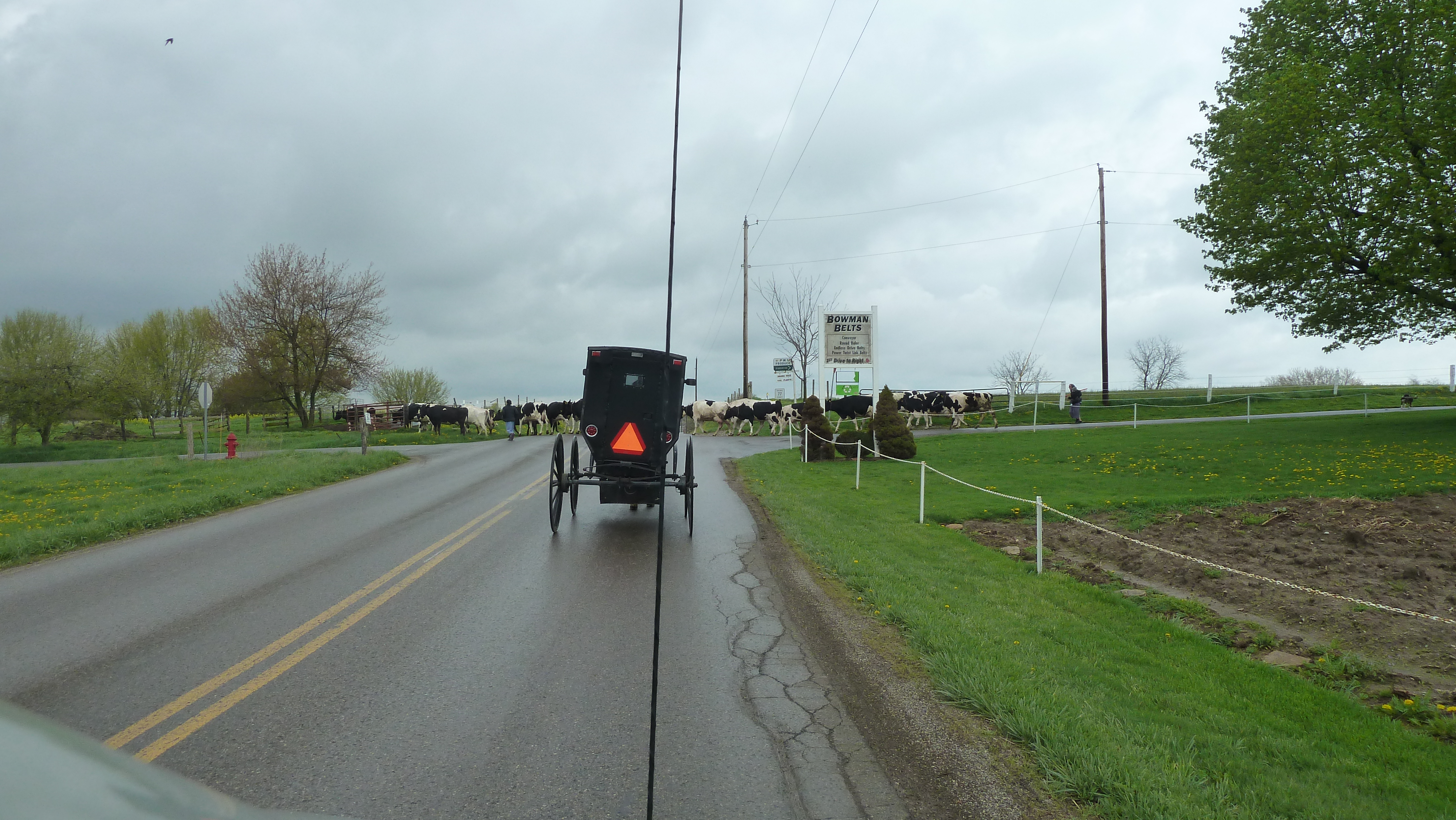
Cows crossing highway in Holmes County, Ohio.
The Thrill of the Chaste: The Allure of Amish Romance Novels by Valerie Weaver-Zercher (Johns Hopkins, 2013) might appear at first to be an expose on “bonnet rippers,” which of course is a play on “bodice rippers.” It might sound like a titillating read but it’s not—in the sense we usually think of that word.
It is an educated study, which had at least 24 words I had to look up, I’m slightly embarrassed to admit. More on that in a minute.
Romance novels are hot, so to speak, and within the genre, Amish romance novels sell very well: the top Amish romance novelists—Beverly Lewis, Wanda Brunstetter, and Cindy Woodsmall—had sold a combined total of 24 million books at the time of the writing of Weaver-Zercher’s book.
But The Thrill of the Chaste is fascinating reading for anyone interested in literature, publishing, marketing, religions, Mennonites, Amish, Anabaptists or inspirational fiction. That’s me in aces so although admittedly some of it may be a little over the top for a reader with only passing interest in the topic, I was eager to digest the whole thing. Although I was an English major in college and loved reading the wide variety of literature assigned in my studies, I have not formally kept up with anything related to the study of literature and literary theories and approaches. So in that sense it was very much like reading a college text on the topic. It would make an interesting and not-light-weight college course.
Indeed I was hit almost immediately with words I didn’t remember reading before, or have occasion to run into. So test yourself: how many of these do you know?
Anomic, bromidic, liminality, polysemy, somniferous, elision, vector, whorl, recondite, bricolage, cynosure, nonpareil, panoptic, truculently, ludic, anomalous, jejune, diegetic, sere, semaphore, ambit, antipode, synecdoche, bildungsroman.
Humph. I see that spellchecker doesn’t know a number of these either.
But don’t let these scare you away. In almost all of the cases, I could certainly get the meaning of what the author was saying without looking anything up. So it got to be a game with me and I started keeping track of the stoppers. In some ways the book reads like a scholarly journal but way more interesting and chatty.

Valerie Weaver-Zercher
Valerie (I’ll go with her first name since I’ve worked with her in a couple of settings) admits Amish romance novels are a very small subgenre and some would hesitate to call much of it “literature.” She thoroughly explores the hype and myths that some in the business or publishing world have trotted out as they’ve written about the explosion of the subgenre in the last 10 years, especially the last five. Bloomberg Businessweek in the summer of 2010, for instance, featured a cover of a book called Mennonite Romance, with a title “Getting Dirty in Dutch Country” (p. 67). See also Salon’s take, here. Valerie admits that Businessweek’s use of the lusty cover is mostly satirical but says that “many observers miss [that] sexed-up contemporary romance novels and steamy encounters between hunks with long black hair and lusty heroines like the one depicted in Mennonite Romance are exactly what Amish romance novels are not. Amish-themed romances are defined by the absence of overt sexuality, and loyal readers of the subgenre are as articulate about what they don’t want in their books as what they do.”
In short, Amish romance novels are written to find harmony with the main audience of evangelical Christian readers who are looking more for purity than the anything goes mentality of current culture. They are for women (and some men) who are looking for books that are “safe for kids to pick up” if they leave them laying around the house. Valerie quotes one editor of Amish fiction saying readers “want a clean read … a sweet story.” (p. 148).
Valerie is a superb writer: precise word choices, little redundancy, and lovely metaphors who has fun with her topic (to the point I found myself laughing delightedly in places) even as she harvests every conceivable angle of the field. She looks at how Amish romance novels take readers away from the hypermodern and hypersexualized times we live in, and how such books may be affecting the Amish themselves. There are many fans among the Amish and Valerie ventures that these books may possibly become like a “Trojan horse” into Amish communities. She delves into early examples of the genre from the early 1900s, including my own publisher and now employer, Herald Press’s early “novels” such as Rosanna of the Amish (based on a true story) by Joseph Yoder and others by Clara Bernice Miller and Mary Christner Bontrager.
Valerie examines her own motives in writing the book, a Mennonite who has Amish second cousins and also a husband who is a published spokesperson in the field. I liked how in her acknowledgments, she tips her hat to her three sons for “putting up with dinnertime conversation about cultural theory and Amish agency and commodification” as she and her husband discussed her project. “We can talk about other things now,” she says in tribute to her sons.
But the field of literary study and publishing in general is blessed for Valerie engaging with this topic in such a multifaceted and captivating way.

See my other blog posts on related topics:
Finding Harmony among my cousins in faith
Amish Noodles Test 2
Amish Noodles Test 1
For more on differences/similarities among Amish/Mennonites, see Third Way Café’s most popular FAQ.
A couple months ago in my Another Way column I wrote about expecting our first grandchild. What I didn’t reveal at that point was that we already knew we were also expecting our second grandchild, but we couldn’t tell anyone yet!
Which made for some interesting, complicating times but absolutely thrilling, times two.
Now my first born daughter, Michelle spills her beans as an Another Way guest columnist today.
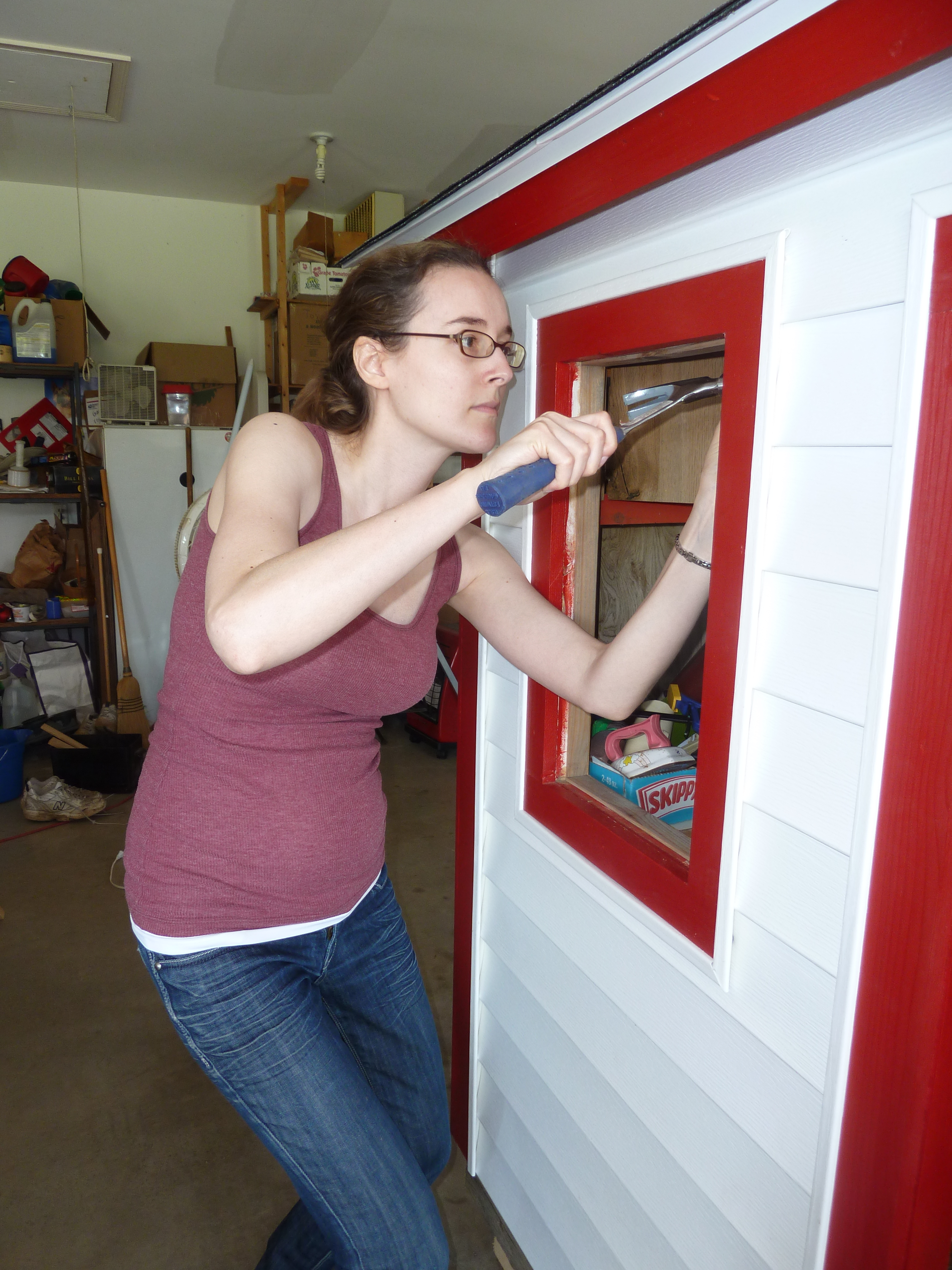
Yes, that’s a baby bump on Michelle. Makes working
on our playhouse renovation project more exciting!
Here you’ll get the Grandma side of the story.
When Tanya told us that she and Jon were expecting and I leaped into the air, my eyes immediately shot to my oldest daughter, Michelle, for her reaction. There was joy and surprise there for sure, but also a little quizzical glimmer across her face. I tried to read it, but soon dismissed it. So Michelle wouldn’t be “first” with something: she’s a grown woman, she can handle it, I thought in passing.
A couple weeks later at Easter when my husband and I were with Michelle and Brian and his mother, brother, and two of their dear friends, Michelle and Brian revealed their own wonderful surprise: they were expecting too! But it was so early (they hadn’t been to the doctor yet) that they didn’t want to even tell our other daughters who were not able to come home at Easter. Brian said something to his mother about “getting ready to babysit” and as the news sunk in, I was swept away with emotion, especially since Brian’s father had so recently died (last November) and that grief was so fresh. We all hugged, wiped tears and were excited and elated.
So every time I talked to or emailed Tanya and Doreen, I had to stifle or edit myself to not leak anything about Michelle and Brian’s news. Tough for a mom, especially one who has been known to let Christmas or birthday secrets slip. I managed to hold my tongue and finally when it was official from the doctor, Michelle was able to tell her sisters. I couldn’t resist bragging that I had been able to keep it from the sisters. But still Michelle and Brian didn’t want the news to go further: no social media, no columns. There were employers to inform, tests they wanted to wait for. I couldn’t tell my family.
But I was talking to Mom one night when I was really tired. I had left a message for her and she had called me back so I was kind of mindlessly yakking on about this and that. Michelle’s mother-in-law had called me earlier in the evening about a minor car accident Michelle had had so that was on my mind and I happened to mention it to my mom and then like a dummy went on to say the concern was whether it might have hurt the baby at all. I just plowed right on and then two sentences later, confused, my mother interrupted and said, “Well Michelle isn’t pregnant!” It was a statement, not a question.
And I thought, oh no, now what do I do? Lie to my mother? Fib? Flub around? So I just said, “Oh I must be tired and mixed up” and thankfully she left it at that! I still call my children by the wrong names sometimes, so why wouldn’t I get my stories mixed up?
So, so much for a braggy mom keeping secrets. But now it is official and we are filled with even more joy (there’s always room for more joy, more love) which I learned long ago when we were expecting our own second child. Like many others, I wondered, how will I ever love another baby? How can I steal from the closeness I feel with my child and add another to our family?

I’ve always loved this picture of me cuddling Michelle
many years ago on the babysitter’s front porch.
If you are fortunate enough to have more than one child, you know the answer to that question. There is always more love for more, no matter what order they come in.And I never want to take any child for granted. Each one is a special special gift.

The three sisters with T-shirts from the Shipshewana Flea Market, about 12 years ago.
It is stunning to be in the presence of a living, growing thing that was already growing when Jesus—and Socrates—and Plato walked the earth.

My husband and I, along with one brother, visited Sequoia National Forest in central California this summer and the giant Sequoia trees that thrive there.

It was easily one of our favorite stops in the western states of Arizona, Nevada, Utah and California, covering brand new ground for both of them. I had been to Sequoia as a child, but 49 years later, I appreciated it even more.

The groves of ancient trees were just magical, mysterious, almost supernatural. (Think Lord of the Rings movie or book). We stepped tenderly among the giants. One of the things that scientists and ecologists have learned in the last 49 years is that a million tourists tramping nearby all day does not make a good forest floor for tree seedlings to sprout nor help the fragile roots of the giants.

Signage and exhibits implored visitors to stay on trails. And since the giants are known to suddenly topple without warning, instead of chopping down 2000 to 3000-year-old trees that could have threatened campers while they slept, the National Park Service instead moved campgrounds. Like brilliant!

One of the areas that has grown new life after the
Park Service asked people not to walk too near the trees.


We finally found an example of a younger Sequoia
growing near the trail with its distinctive “needles.”
The woods were so peaceful and calming after desert dryness, the artificial neon of Vegas and the smoking hot concrete of Hoover Dam.


I enjoyed reading quotes at some of the exhibits from John Muir, the explorer and naturalist, filled with great wisdom.
 Here’s another quote from Muir:
Any fool can destroy trees. They cannot run away; and if they could, they would still be destroyed — chased and hunted down as long as fun or a dollar could be got out of their bark hides, branching horns, or magnificent bole backbones. Few that fell trees plant them; nor would planting avail much towards getting back anything like the noble primeval forests. … It took more than three thousand years to make some of the trees in these Western woods — trees that are still standing in perfect strength and beauty, waving and singing in the mighty forests of the Sierra. Through all the wonderful, eventful centuries … God has cared for these trees, saved them from drought, disease, avalanches, and a thousand straining, leveling tempests and floods; but he cannot save them from fools — only Uncle Sam can do that. –John Muir
– Our National Parks (1901) chapter 10.
I’ll write more later in Another Way or here about what else we learned about helping these giants thrive for our grandchildren and great grandchildren to enjoy, but for now, maybe a few photos can recreate a little of that peaceful calm of the filtered light of walking in the presence of living growing things that have been around since before the time of Christ.
How do you find harmony on vacation? What places fill up your senses? They don’t have to be far from home. I’d love to hear about your favorite spots.
It wasn’t until I stepped on a scales with a whole country ham in my arms did it hit me what 15 pounds amassed together felt like. Warning: this may be graphic if you are not a meat eater.
I was weighing the ham because I had used some of the ham and was curious how many pounds we had used. (If you don’t know how country ham works, see here.)

So I got on the scales and my weight from a year ago popped up before me on the scales. It hit me: WOW. I’m holding in my hands the “weight” I lost.
The ham was heavy. My arms felt weighted down. I wouldn’t want to carry it walking all the way around a track.
About a year ago in May, I’m not sure what started it—maybe seeing my son-in-law’s daily log sheet of weight loss when I stayed at my daughter’s townhouse a few days while attending a conference that gave me the final nudge I needed to try, try TRY to lose weight again even though I had failed so many times in the last 30 years.
Maybe it was his fierce will power to turn down food when everyone else is eating. (At the moment he does not need to lose weight at all, but goes into training times when he tries to lose fat and gain muscle.) When I spied his open notebook on their desk in the spare bedroom I was intrigued. I asked him about it and he sent me some stuff he had read.
The only other time I successfully lost weight was when I was around 19 and gained a bunch in one year; I counted calories religiously for about four months and was able to lose about 10-15 pounds at that time.
Well, the years went by. Babies came and the pounds just never quite all went away. I had begun walking several times a week about ten years ago, but while I enjoyed my walks and the way they made me feel, I didn’t really lose weight.
Then our company, in a move to encourage fitness, offered to pay so much towards gym memberships. That was the other nudge I needed, and when I found a gym offering free exercise classes along with the membership, I decided to enroll last May and tried to get to the gym two to three times a week to classes or work out until garden work began in earnest. (When I’m busy gardening, I feel it serves as my gym.) I also began counting and limiting calories to 1500-1800 a day (not always successful.). It was toughest on weekends, when my husband enjoys going to our local lawn parties almost every weekend through the summer. (I’ll write about those fundraisers for rescue squads and fire departments sometime.) This is what the food looks like. Every weekend.


I still ate the food, just less of it. Our Friday donut treat from the homemade donut truck that parks near my office on Fridays became just a half donut, that kind of thing. I started a spread sheet and every day faithfully recorded my calorie intake, length and type of exercise, and my weight. I also cut out my daily diet cola. My husband had been telling me for years that diet drinks were mostly counterproductive and I had read the same thing. I started drinking mint tea, either hot or cold, to help fill me up when I got the late afternoon hungries. And overall tried to increase exercise/strenuous activity 3-4 times a week in addition to walking. That was my regimen.
And the pounds started to come off. That was motivation to keep going. I had ups and downs but eventually lost enough I had to buy some new clothes.
I debated writing about it and was not going to because I didn’t want anyone to feel badly about their own efforts, because I truly know how discouraging and difficult and maddening it is to not be able to lose weight. I didn’t want anyone to feel I was judging anyone else. I don’t want to be prideful. It can be wonderfully freeing to accept your weight and your size and be the most beautiful person you are, and not obsess about it. I also know that when physical disabilities or limitations get in the way, exercise is very difficult.
But when I held that 15 pound country ham in my arms, it was like the “scales [no pun intended] fell from his eyes,” as the Bible says in Acts 9:18 of the Apostle Paul when his temporary blindness went away. I had been walking around with THIS much extra body.
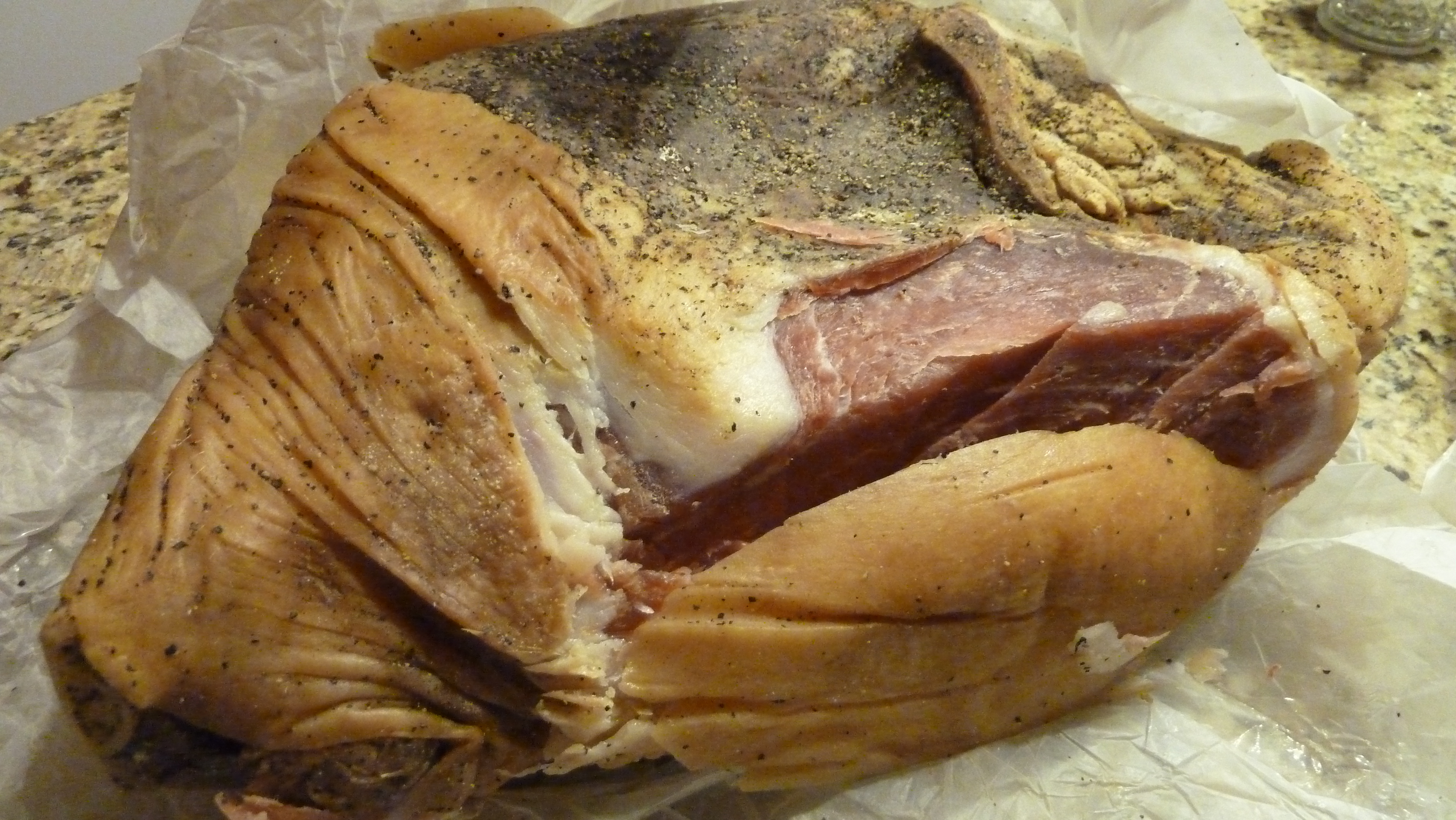
This much extra weight had been on my body.
This unneeded stress on my legs and bones which have long had terrible varicose veins (blame the babies) and increasing arthritis.
And I decided to write about it feeling that if I could do it at my age, others can do it too, even if you have tried tried tried and always ended up discouraged and frustrated.
I don’t know yet if I’ll keep it off forever. It’s been a year since I began, and about six months since I reached my lowest weight—that I hadn’t been at since before having children. I’ve gained back a few pounds (my husband really didn’t want me to lose “too much” he said, he liked me just fine the way I was). But I mostly bounce within three pounds of my target weight which is ok with me. I still don’t want to obsess about it.
To hold 15 pounds of “flesh” in your arms is an eye opening thing. The ham thing makes me more determined than ever to not get too weighted down again.
No pun intended.
***
There are wonderful calorie counters online, including one where you can find almost any restaurant food for chain restaurants. Here’s one I used. Oh, and I’m not counting calories anymore, just keeping track of weight and exercise amounts to keep me motivated.

Okay, so I’m not a big international cook. I love to eat most any dish from around the world (well, no eel, brain or tripe please) but beyond stir fry and occasionally paella and trying to do curry once or twice, tacos and lasagna is about as exotic as my cooking gets on a regular basis.
But I was pleased to help test recipes for a new edition of Extending the Table cookbook for Herald Press/MennoMedia (disclosure, which also puts food on my table in the form of a 90 percent time salary). Extending the Table, originally by Joetta Handrich Schlabach with editor Kristina Mast Burnett, is one of three cookbooks in the classic and bestselling World Community Cookbooks series from Herald Press. (Read more about the project here.)
The new book is scheduled for publication sometime in 2014 and it will have photos and new recipes, although fewer recipes (to make room for the photos and new stuff) and the delightful editorial hand of Valerie Weaver-Zercher who is pulling it together. (I’m also reading her wide-sweeping examination of Amish-themed fiction, Thrill of the Chaste: The Allure of Amish Romance Novels, John Hopkins Press, 2013) right now, which I hope to write about here soon.)

Valerie assigned to me a recipe for Het Fang Sai Khaai, a dish I’d never heard of, but it turns out to be simply Mushrooms with Eggs. Not so exotic I thought, that’s one of my favorite omelets. Only this is a LOT of mushrooms with a few eggs in a pungently Asian-flavored sauce.
Turns out that not even Google or Wikipedia could come up with a common recipe for it, but then maybe the particular ordering (or rendering of English spelling) of the words in the recipe name might be to blame for that. Confessing a great deal of ignorance here. Please let me know if you find another form of this recipe online!
The best part is that this was relatively easy to make and my recipe testers gave it two thumbs up.
Be watching for the new edition of Extending the Table—which has already extended MY table. I don’t know yet whether this recipe will make it into the book nor do I know the name of the contributor of this particular dish, but I’m happy to add it to my list of options when wanting a twist on something that turns out not to be so different after all. It’s nice to find common ground half way around the world: a love for eggs and mushrooms.

Het Fang Sai Khaai
Mushrooms with Eggs
Ingredients:
1 lb fresh mushrooms (cut into slices or quarters; white mushrooms are fine)
⅛ cup oil
5 cloves minced garlic
3 eggs
2-3 Tb pork, beef or chicken bouillon (I used beef, low-sodium)
1 ½ Tb sugar
¼ cup oyster sauce (could also use fish sauce or something similar)
Fresh cilantro and green onion, chopped
Directions:
Recipe contributor’s directions: “The Thai way of cooking happens pretty quickly so have all the ingredients ready to go and once your start cooking, add ingredients one right after the other until it’s done.”

Heat oil and sauté garlic for 1 minute. Add 2 eggs and whisk. Add mushrooms and stir. Add bouillon, sugar, oyster sauce, and 3rd egg and stir continuously until the egg is fully cooked. (Total cooking time, not more than 10 minutes. Have rice ready to serve.)

Top with fresh cilantro and green onion and serve over rice.

***
I told the editor that the cilantro and green onion really “made” this dish in my opinion and luckily I had fresh cuttings of both of these in my garden right now.
Find a recipe for a similar but even easier dish in my cookbook, Whatever Happened to Dinner, called “Dave Schrock’s Tuna/Egg Skillet Dinner” or ask me to email that recipe to you.
Last summer I wrote a series of four Another Way columns focusing on Mennonite cookbooks, the first of which is here.
How do you figure out your calling, your passion in life?
My sister, who is a nurse, found her calling through having appendicitis as a child. The experience of being in the hospital—scary or distasteful for some—left her awestruck and with an image of her as a nurse in a white uniform and a little white nurse’s cap with a black stripe. An old image for sure, but it got her adrenaline going then and she still loves her job today (now partially retired).

My oldest sister “Nancy Nurse,” who was once featured on the front
of the employee newsletter of her hospital which included this lovely picture.
For me it was a trip with the “Sunshine Girls Club” (for real!) from North Goshen Mennonite Church to tour the Chicago Tribune that got my blood pumping. I loved seeing the workings of a big city daily newspaper—the desks, the typewriters, the smartly dressed women in high heels (this was the late 50s or early 60s) and people dashing around like they had important deadlines. I tried to see if there were any young copy boys or copy girls. I had read the youth-reader type book Copy Girl describing the duties of a “common position at many papers in those days, of a younger worker who is a typically young and junior worker on a newspaper,” according to Wikipedia:
“The job involves taking typed stories from one section of a newspaper to another. Reporters typed their stories on slips of butcher’s paper…then a copy boy ran the story into the neighboring [editor] room, hence the cry of ‘copy’. Each slip of the story had about six carbon copies…stapled together and it was the job of the copy boy – or girl – to separate the original and run it …”
HuffPost Canada ran a piece last year about an award-winning journalist, Michael Ignatieff, and eventual professor and politician who started out as a copy boy. Interestingly, since the job is now archaic, there are no books on Amazon that look like they have anything to do with a copy girl, unfortunately.
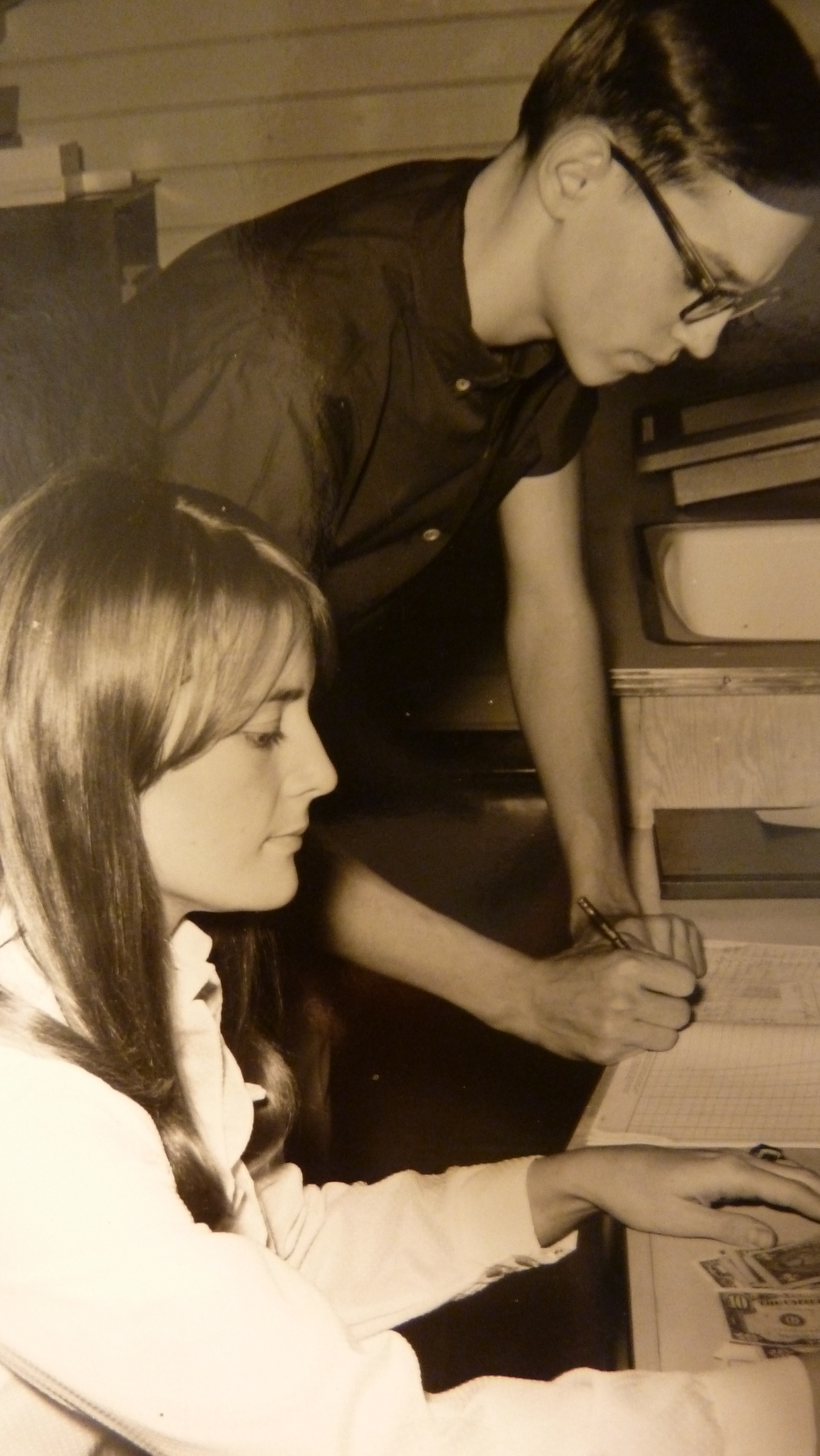
Working on my high school yearbook The Witmarsum,
as a business manager (um… yeah … not exactly my career aspiration). With Rodney Maust.
Anyway, I never was a copy girl but I began earning my writing creds in the years after I was first inspired by seeing the Chicago Trib in action, on a career path that I can trace only in retrospect. Who would have known that:
- An assignment writing about youth group activities for our church newsletter at North Goshen Mennonite where I tried to be a little bit creative rather than just reporting that the youth group had a car wash or a bake sale—got the attention of (at least) the pastor’s wife, Martha Krabill …
- When her son, James Krabill, was looking for staff as editor of the school paper, The Reflector at Bethany Christian High School, Martha suggested to James that maybe I would make a good writer for him. James asked me to do a column of profiles of senior class members, which led to …
- At Eastern Mennonite University, one of my high school and church friends, Chuck, recommended my name to the college newspaper, The Weather Vane. I well remember my first article writing about students who had done interesting things over the summer, and I was still writing in high school newspaper informal style. I’m sure the feature editor, Gretchen Hostetler Maust was aghast at my first attempt but she soon brought me up to speed …
- Eventually I was asked to serve as editor of the college yearbook my senior year, The Shen (the request arrived by telegram when I was studying in Spain, how quaint, they were desperate), which I turned down for fear of being too busy. But a smaller job as co-editor of the college literary magazine, The Phoenix, sounded like something I could manage …

Dorcas Kraybill and me working on The Phoenix my senior year of college.
- Along with a work-study job my senior year of college at WVPT-TV, the public broadcasting station in Harrisonburg where one of my first days I had to run a studio camera when they were short a camera person to tape a local public affairs show. That day I was introduced to the prettiest string of foul language my young Mennonite ears had ever heard when one of us failed to move the camera at the right time. The *&^%$ was piped directly into my ear from the director. I learned a lot of better things on that job which impressed my future employer on my resume—at least that is what I heard from him later …

Tear sheets from The Weather Vane.
- The experiences in college also gave me many tear sheets (official published pieces of writing) that I submitted as a portfolio with my application for my first job out of college at (then) Mennonite Broadcasts, Inc. There was a secretarial opening that I was applying for, but I wanted them to know I was interested in moving into writing positions. …
Which I did, and still am moving in to various writing/editing positions for 38 years now. I began July 7, 1975, about one month after graduating from EMU.
I could go on, but this is long enough. A couple weeks ago I wrote about some of the odd jobs I did along the way, and when I was done with that post, I realized oh! I didn’t even include the jobs (mostly unpaid) that actually took me to a job I continue to enjoy and that gets my adrenaline going almost every day.
Oh, and P.S., I still write volunteer articles for our church newsletter, The Nous at Trinity Presbyterian (sample here reused in Another Way, which originally appeared in The Nous).
What influenced you most in pursuing the job you have or aspire to? If you are currently a stay-at-home mom or dad what led to that decision and role and how do you feel about it?
What if you never have an adrenaline rush about work? How can hobbies fill that role?
***
An earlier post also talks about some of my early published works.
Part III
As I mentioned in my last post, when my sister, brother, and I had our children, my father told his “war” stories of service in a mental hospital to his grandchildren, so they would know this faith and family history too. (I also tell more of Dad’s story in an earlier Another Way column here.)
Our oldest daughter Michelle has always been drawn to history, something her father and I both enjoy. I don’t know if it was all those hours watching the History Channel which my husband frequently had on, (back in the days when all programs were historical, unlike today), or her own compulsion to want to go to the historical (and challenging) College of William and Mary (alma mater of George Washington, Thomas Jefferson etc.) as early as fourth grade, because of its role in U.S. history.

My husband’s only living aunt, Mary Russell,
tells family stories to our oldest daughter, Michelle.
At William & Mary she had friends who were even more involved in the study of history and she became intrigued by trying to find out if anyone in her family (either side) ever “fought in the Revolutionary War.” She studied bits and pieces of our own records and information. Finally last year, for her birthday, we gave her a subscription to Ancestry.com. As a novelist (still in search of an agent and publisher) who strives for historical accuracy, she has honed her research skills and over the next months she spent a lot of time researching a number of branches of her own and her husband’s family histories.
Interestingly, Michelle found her Revolutionary War veteran! Not on her father’s side with a long history of war veterans, but on my side of the family which included many, but certainly not all, pacifists. His name was Nathaniel Jefferies, Sr., my four-times great grandfather (on my grandmother’s side). Michelle wrote, “The tremendously sad thing I uncovered about him was that in 1777 he lost his father, his mother, his wife, and all six of his children, ages 10-18, to “camp fever” or typhus. That’s the very same winter as Valley Forge. Nathaniel may have survived the outbreak that took his entire family because he was with the Continental Army.” Irony of terrible ironies. He remarried around 1793, and my mother’s family descended from his second wife.
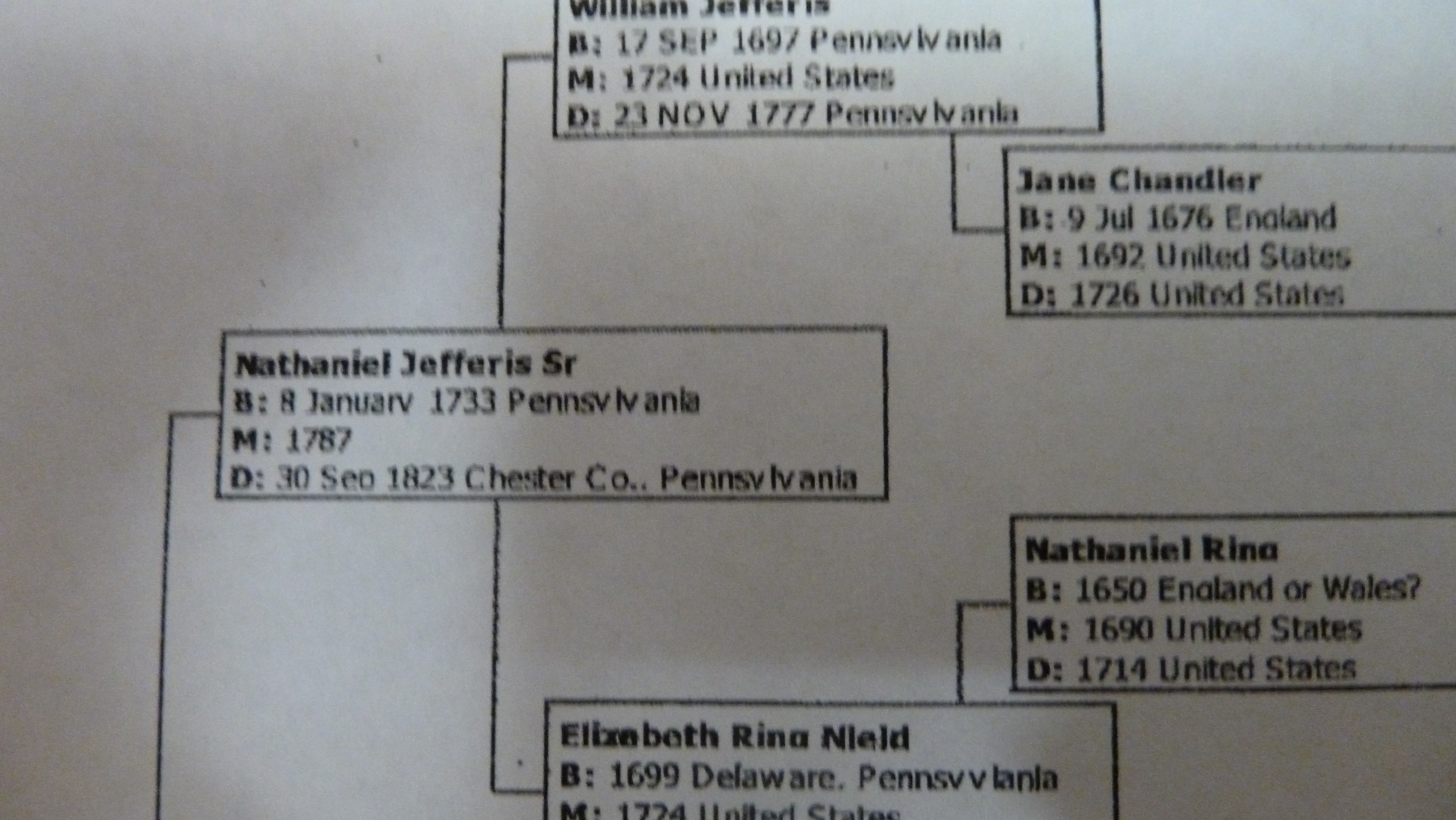
Part of Michelle’s research showing family tree of
Ruth Loucks Stauffer, my maternal grandmother.
My daughter further speculated from information she read that the Jefferies were either Quaker or Quaker sympathizers, so his involvement may have been compulsory. Michelle wrote in an e-mail:
“But it’s kind of odd to imagine the Continental Army forcing a 44-year-old man to join up. Nathaniel would have been 44 in 1777, the year of Valley Forge. Still, he must have been a healthy man, he lived to be 90 years old. Another possibility is that he wasn’t in the army at the time of the outbreak, managed to survive, and having lost his entire family, joined the army thinking he had nothing else to live for. The only records I’ve found of him in the service is a ‘leave card’ from 1780, so I know he was part of the rolls by then, but I don’t know exactly when he joined.”
More of her study and findings can be found here. Her own journey in understanding pacifist teachings and history has continued by learning from people at Northern Virginia Mennonite Church near where she lives, (while continuing official membership at her home congregation, Trinity Presbyterian, an official “peacemaking” congregation of PCUSA).
So, I am descended in part from a Revolutionary War veteran who was likely Quaker. My dad “would have been a medic” if he had not felt he would have just been part of the whole “war machine” as he called it. My brother-in-law was a medic who was wounded who still bears the pain of that experience in multiple ways. (My own husband’s draft number never came up, but for many younger years I knew that if called, he probably would probably go.)
Our very different histories on the surface are not as far apart as they look. I’ve often said I’m liberal and open enough in my thinking to love a conservative. So I’m still trying to build bridges, find harmony, and looking for paths toward peace in many ways.
Would you marry someone with different beliefs? How different?
(See Part I here of this blog post and Part II here.)
Part II
I was brought up in the home and religious training of committed conscientious objectors where I didn’t know any other way. But my faith and life journey took me to the place where I was okay marrying a man brought up in the home and religious training of a committed, patriotic, wounded war veteran who didn’t know any other way.

Easter Sunday when I was about three years old, before my little brother was born. Dad was one of the few men at church who still wore a “straight” coat because he was deacon.
That broadening journey started as my family stepped out of the “Mennonite ghetto”—as my father used to call it, of Goshen, Ind. and purposely moved to where there were only two small Mennonite churches in north Florida.
So I left my Mennonite high school and went to a public school overwhelmed by its first year of full racial integration of schools. As I dated a few guys I learned how very different their Christian orientation was. My journey continued as I entered Mennonite Voluntary Service and worked near Hazard, Kentucky, where one of my most vivid memories was a conversation in the “youth/young adult” class I taught for Summer Bible School at Talcum Mennonite Church with a young man who could not grasp how any Christian would refuse military service, or why. It was a foreign concept.
I went to Eastern Mennonite College where I took courses like “War, Peace and Revolution” with Grant Stoltzfus and studied books like Preachers Present Arms by Ray Abrams where I learned about a Lutheran pastor, Peter Muhlenberg during the Revolutionary War. Stoltzfus animatedly told how Muhlenberg, right down the road from us in Woodstock, Va., had preached a sermon in 1776, tore off his clerical robe revealing his Colonel’s uniform, and encouraged all the men to enlist in the Continental Army (which they did, right outside the church). My husband grew up in the Harrisonburg Muhlenberg Lutheran Church (named for Peter Muhlenberg, a fine church by the way. In addition to faculty at (now) EMU who influenced me, a steady stream of chapel speakers or lecturers like Art Gish presented a sometimes radical way of looking at the gospel.
During a junior year abroad spent in Barcelona, Spain, (then Brethren Colleges Abroad) one of my best friends was dating a West Point cadet; through her contacts we were invited onto an aircraft carrier in Barcelona’s port. While most of the men caroused off the ship in Barcelona, a group of Christians who didn’t want to do that held prayer meetings on the ship and my mind was just a little blown to be sitting in a cramped space on a huge U.S. aircraft carrier praying with enlisted men who were, obviously, committed Christians. Everything in my head was screaming, but … my dad wouldn’t get this … how can this be … who’s right, who’s wrong? What do I believe? These people just believe differently than I do, but we’re both, we’ve got to be, Christians.
My father’s own strong teachings were shaped by his own journey off the farm into Civilian Public Service during World War II, the arrangement between peace churches and the U.S. government for conscientious objectors to still serve their country and God by alternative service. He always said he would have went into military service as a medic if they would have allowed the possibility of treating anyone who was injured, including “the enemy.” But of course that wasn’t possible, at least officially.
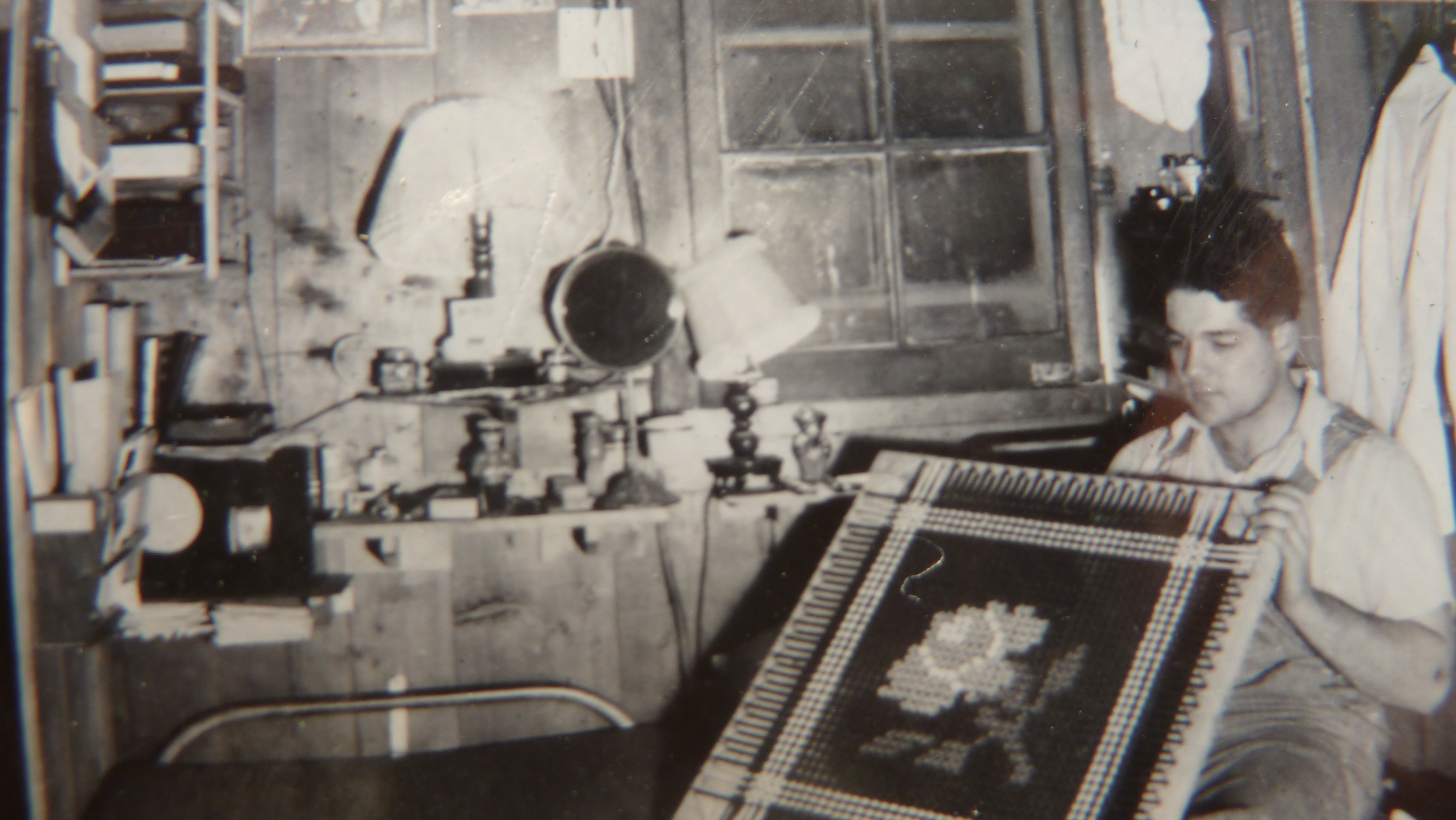
My dad keeping busy in the barracks in CPS camp.
CPS was his “college” and he too was influenced by a steady stream of speakers brought to the camps, and conversations with other CPSers who ended up being some of the Mennonite church’s outspoken leaders during the years following the war. In turn, he shared those convictions with us as children through mealtime conversations, musings in the car on the way home from church, through articles in the Gospel Herald and elsewhere which he would stick under our noses and ask us to read. I still have a treasured letter he sent after reading a piece in Mennonite Weekly Review from April 1996, highlighting the excerpted book, For Conscience’ Sake, a novel by Solomon Stucky, (Herald Press, 1983).
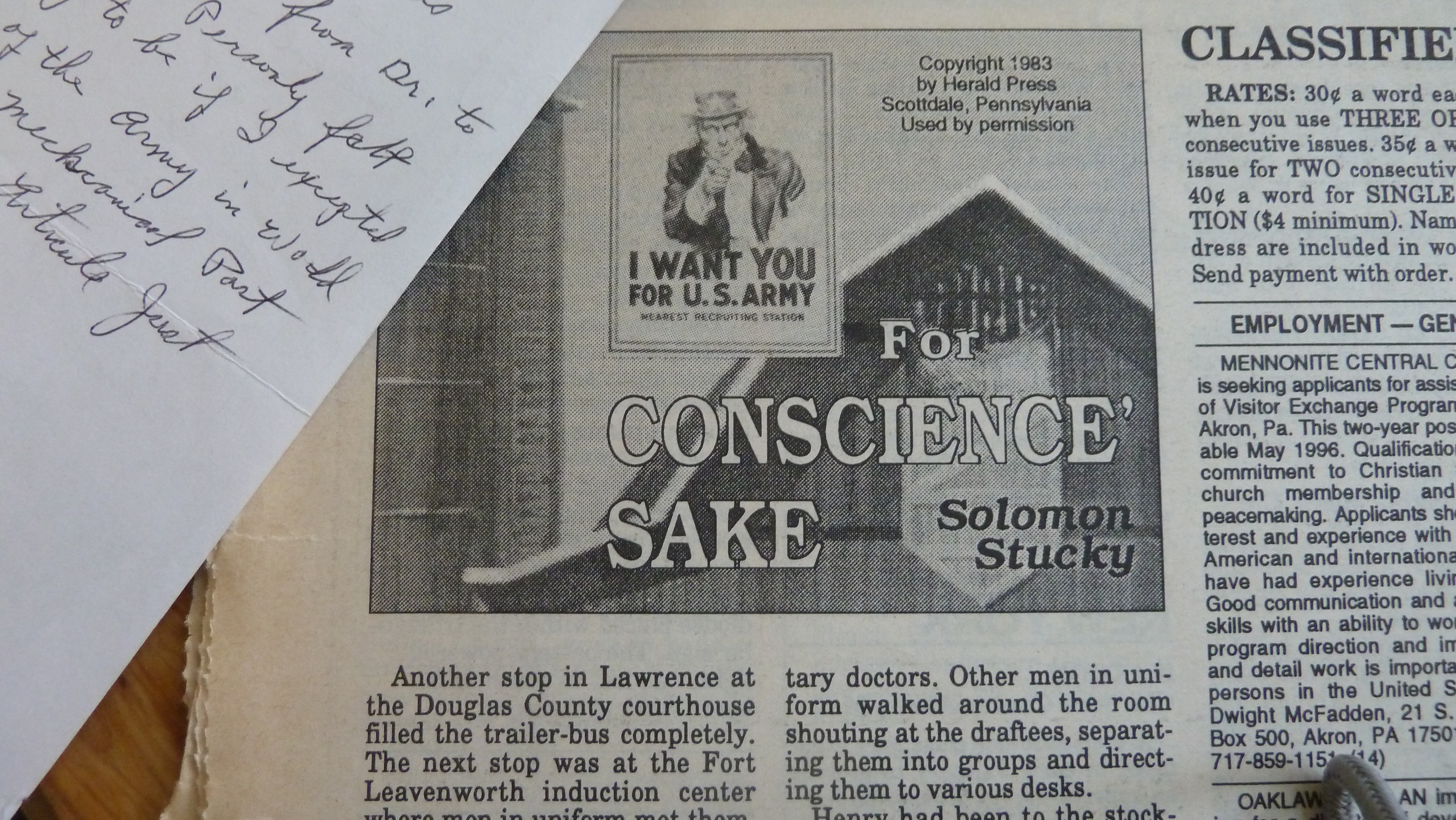 I saved Dad’s letter and page from Mennonite Weekly Review
many years, not knowing how I would ever use it. 🙂
The excerpt details how “Henry”—most likely Stucky himself, felt when as a conscientious objector, they were sent to the same induction center as enlisted man for physicals and completing paperwork. A crowd of several hundred recruits were herded into a huge locker room:
“A man in uniform stood on the top step in front of the closed door. He began yelling to the draftees below him. ‘All right men, get your clothes off, an’ I mean all of ‘em.’ … The room became so crowded that the men, pressed together shoulder to shoulder, had difficulty removing their clothes. … Several men had left their shorts on. The uniformed man pointed at them and bellowed, ‘You there, Get undressed. All of it.’ … Henry had been to the stockyards in Wichita … and he began to think of himself as part of a great herd of naked, vulnerable animals, goaded and pushed from place to place…”
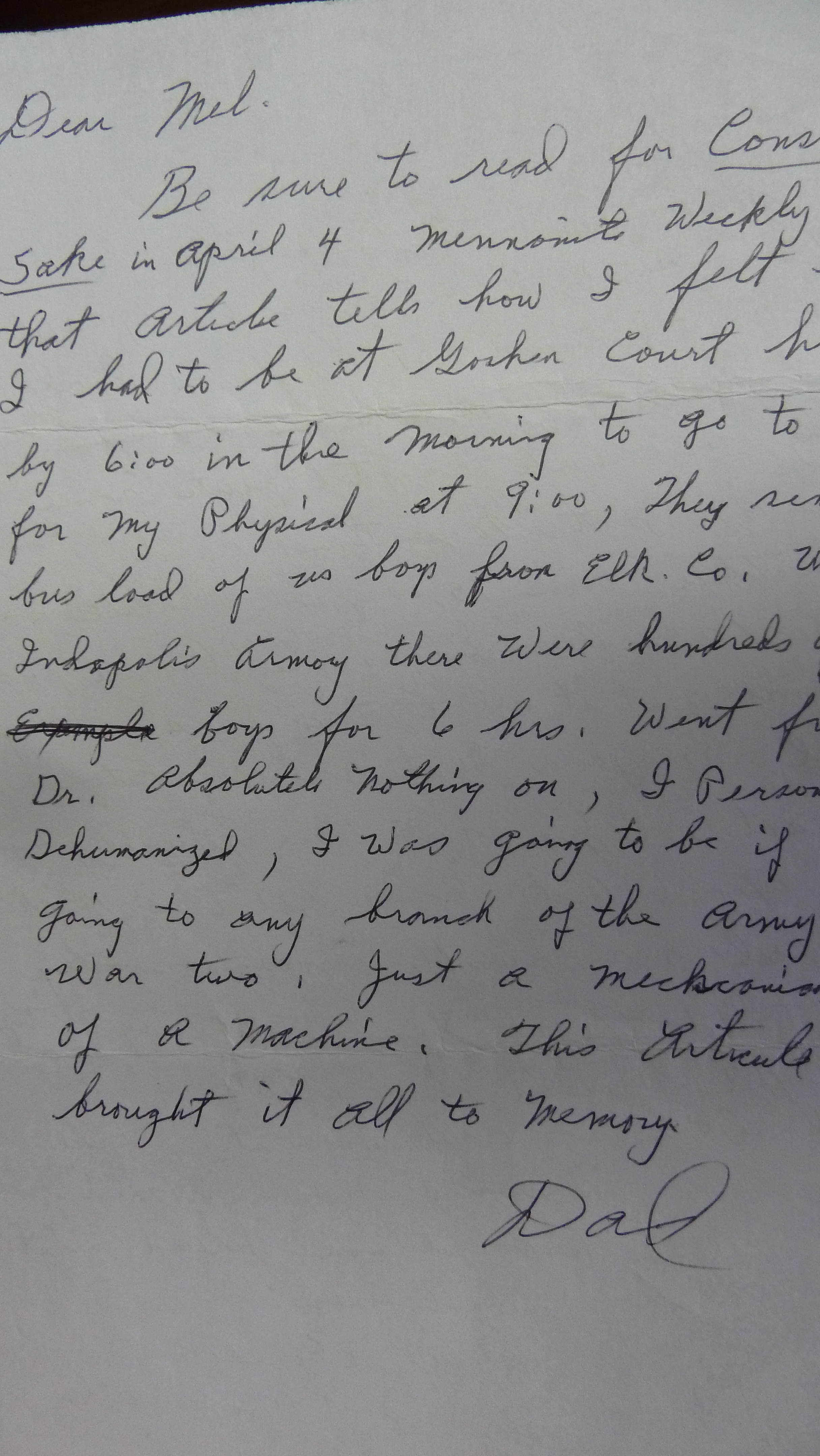
My dad’s note (above), in reference to this book excerpt, wrote:
“Be sure to read For Conscience Sake in April 4 Mennonite Weekly Review. That article tells how I felt when … in the Indianapolis Armory, there were hundreds of us boys … for six hours, went from Dr. to Dr., absolutely nothing on. I personally felt dehumanized, as I was going to be if accepted going into any branch of the army in World War two. Just a mechanical part of a machine. This article just brought it all to memory. Dad.”
Several years ago, a website about CPS was finally launched with a complete directory of persons who served, giving exact locations and dates of service. When I first found my dad’s name here, I felt goose bumps.
I loved that connection across history and generation. And I always wondered how we would raise our own children. What would they believe?
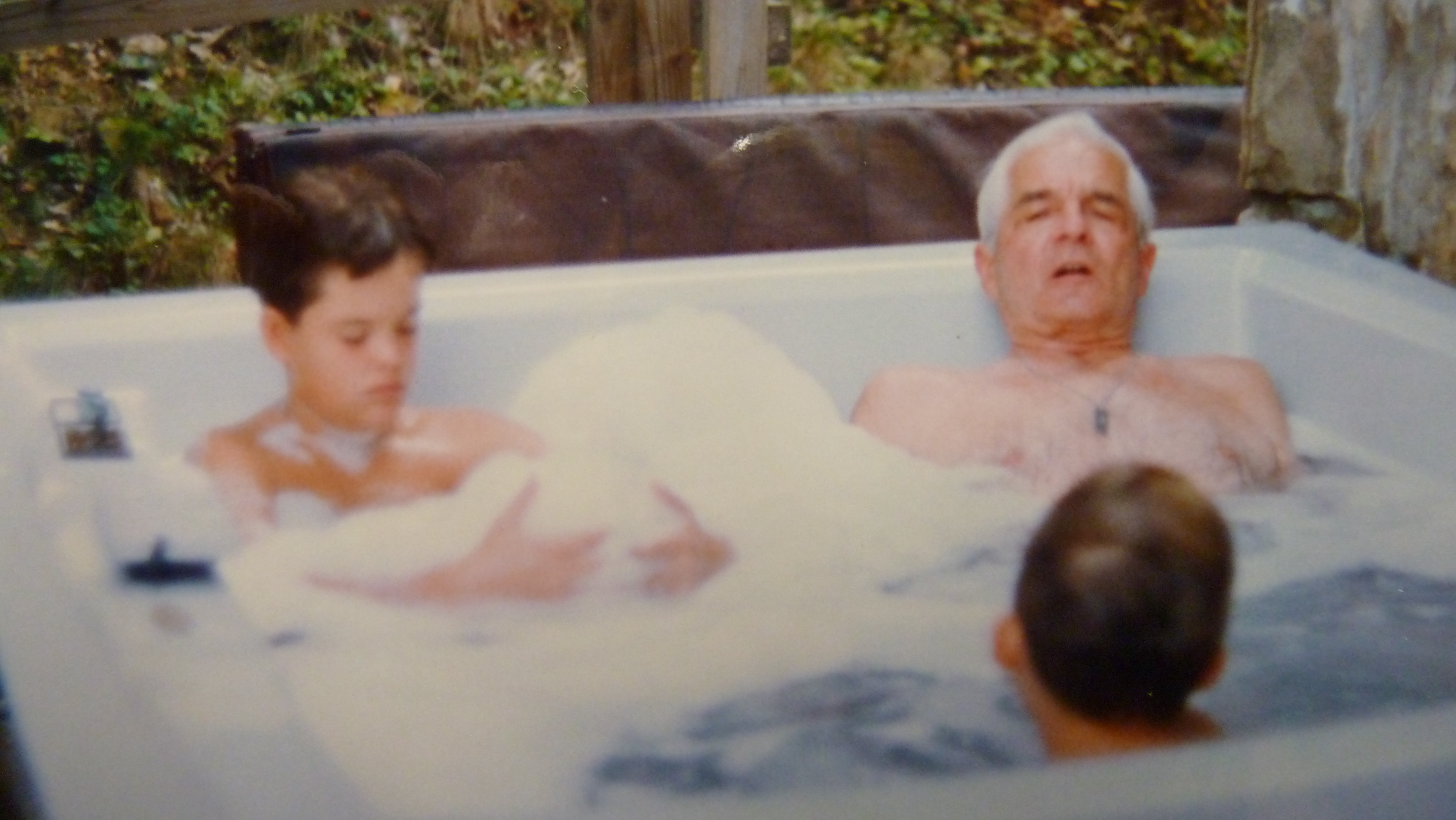
Dad telling CPS stories to his grandsons, Jamie (left) and Jeremy Miller,
while relaxing on vacation with the extended family.
***
Read Part I to this blog post here.
For more about a man who was instrumental in setting up the CPS program with the U.S. government, read my earlier blog post on Harold S. Bender.
And for even more see The CPS Story: An Illustrated History of Civilian Public Service, Albert N. Keim, Good Books, Intercourse, Pa., 1990.
For visual learners, a link to the PBS special from several years ago, The Good War and Those Who Refused to Fight It.
Part I
Dedicated in loving memory of my father and father-in-law.
The harmony of my married life has been coming to terms with the very different backgrounds and life experiences of my father and family, and my husband’s father and family.
My husband’s father, Hershel William Davis, was born and raised a Methodist near Tuskegee, in southern Alabama in 1916.
My dad, Vernon U. Miller was born and raised a Mennonite in northern Indiana in 1917.
I’ll explore a little of the lives of these two men in a three-part blog post.
Hershel’s family used to attend a Methodist Camp meeting and church here at Little Texas, Alabama.

Tabernacle at Little Texas, Ala.
There were five children in his family and they lived the hardscrabble lives of Alabama farmers. When 26-year-old Hershel was drafted during World War II, the army spelled it wrong and forever ever after he was known in veteran records as Herschel.
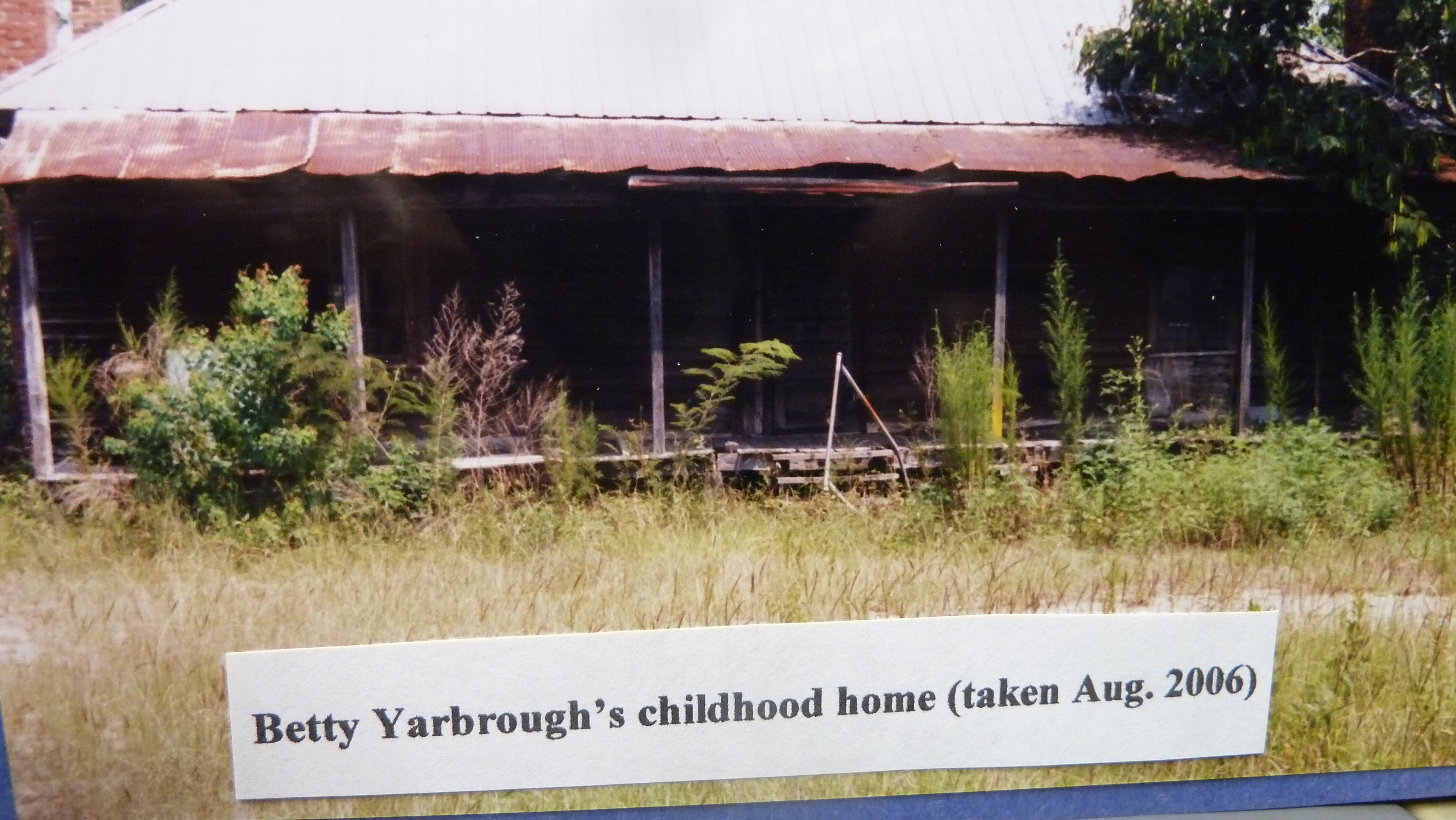
One of the tragedies of Hershel’s life was that his mother, Betty Mae Yarborough, which according to her obituary came from “one of Macon County’s large and prominent families,” died while her son was overseas in World War II. Hershel was not able to come home for the funeral.
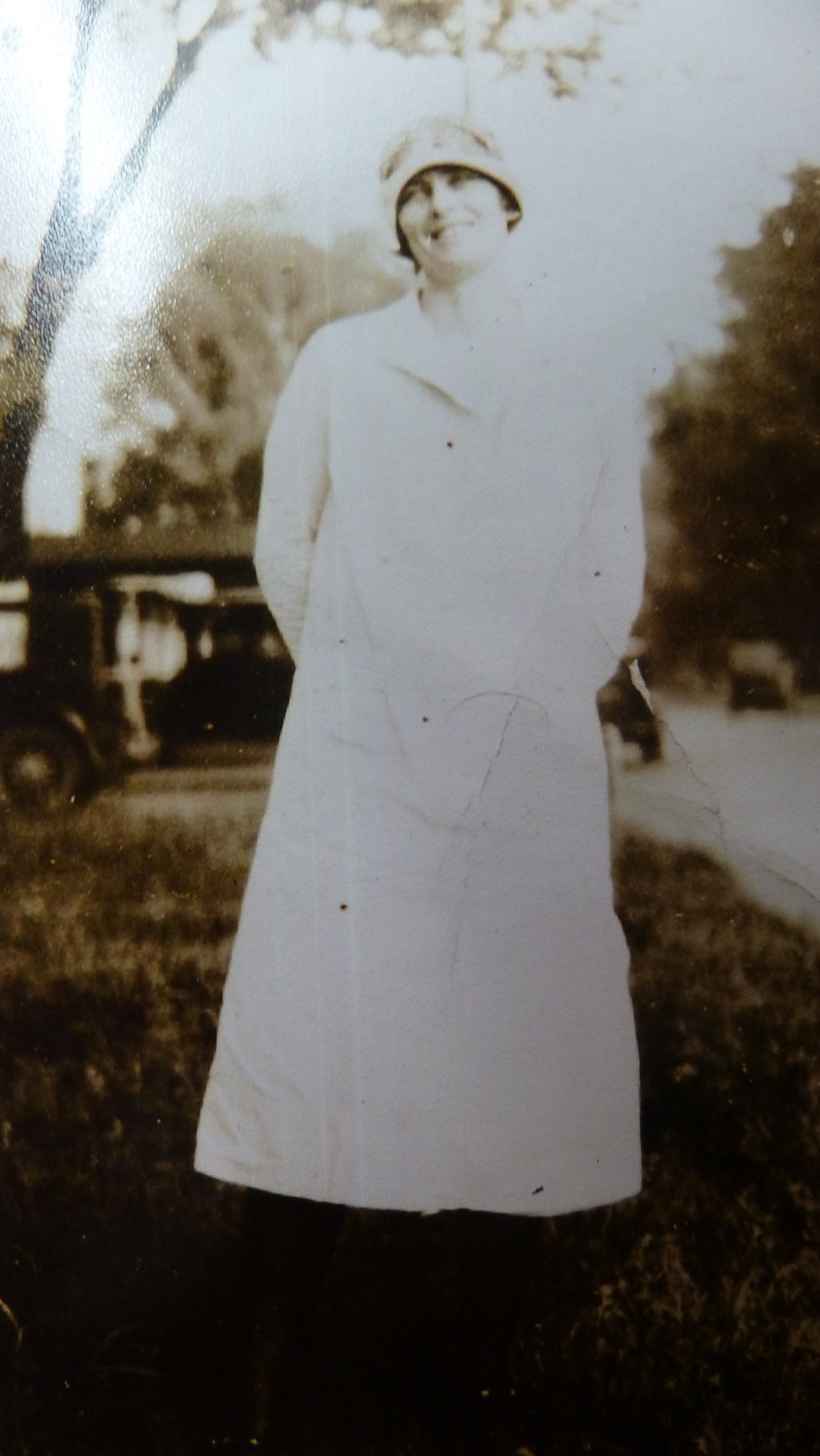
Hershel’s mother, Betty Mae Yarborough
Three years after Hershel died in 1998, we learned from some newly obtained letters how much this heartache grieved him. He had written regularly to Ruth Kerns Clatterbuck, a friend dating one of his friends. In 2001, Ruth contacted me because she was a frequent reader of my Another Way column and asked whether the Davis family wanted the letters Hershel had written since she was downsizing to an apartment and needed to get rid of things. She said she had written to Hershel out of friendship and patriotic duty.
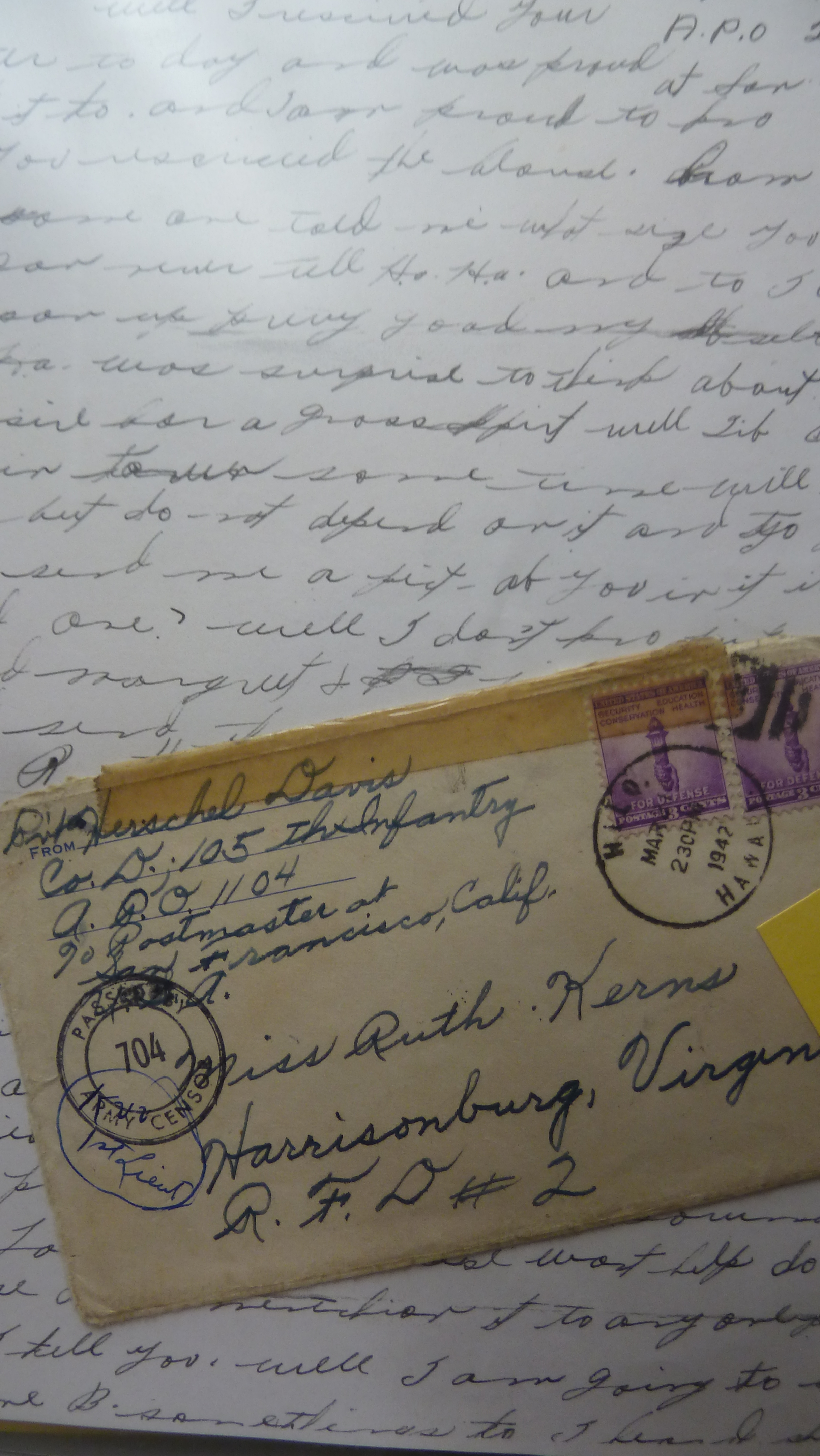
Letter from Hershel to Ruth, a friend.
Hershel most likely “hired” other men to pen his letters so they would be more legible, although some of the letters look like they may have been written by him. Here are some excerpts focusing on army camp life (he was initially stationed in Hawaii), and also the death of his mother.

Hershel in Hawaii.
April 1943. “Hello Ruth. You asked what I was doing [here] well, [to] tell the truth, it would be cut out or they would send the letter back telling me to write it over so see I am not allowed to tell anything; and speaking about working, we never know when we are going to be out from camp and Sunday is almost like Monday. Christmas Day we had to go out to work or go to church so I went to church but did not enjoy it at all.
(Hershel loved going to church. I remember him frequently saying, “If you don’t go to church on Sunday, it feels just like any other day.” Eventually the Davis family became Lutheran after he married Estella Hottinger.)
September 1943. “Well I guess you have heard about me losing my mother. Well it sure was a shock to me. … I hope your mother will soon be well and out again for I know when you lose your parents you have lost your best friend and my mother has passed on but I am proud she has gone in one way for from what everyone said she sure did suffer and from what the doctors say if she would have gotten well she would have never had her right mind and what hurt me so bad I couldn’t even go and it still worries me and think about home all the time.”
October 25, 1943. [Explaining more about his mother’s illness, which Ruth apparently had asked about]: “Well Ruth my mother was sick about four days and my dad had just come home [to Alabama] from a visit to Harrisonburg and when he arrived at my hometown mother was in the doctor office and went to Montgomery to the hospital and died down there. Well Ruth, you say cheer up but I just can’t and to know I have lost my mother and when I go home, she will not be there, and she would write me so often, I don’t hear from my sisters and brothers, guess I am not worth [it] … at least that is what I think.”
Eventually Hershel was wounded in combat on the island of Saipan and was sent home. This was the way he was brought up: this was what men did in time of war.
World War II was an example of a “just war” if there ever was one, for how could you seriously not want to halt the horrible advances and torture and mayhem of Hitler? So my father-in-law was a product of observing many of his family and friends serving “God and country” in military service. As he went off and endured the rigors and indignities of military training, missing his family, losing his mother and not being able to participate in her final services, all the horrors of war, watching his friends and comrades fight and die and then wounded himself—well, I must honor the sacrifices and commitment of my father-in-law—and his whole family, who never knew another way.
Two of Hershel’s sons later served in the Army; one as a MP in Germany and one as a medic in Vietnam. The medic was wounded too and more than just physically. He saw children blown up who had been booby trapped by their fellow countrymen as part of guerilla warfare. Today this brother-in-law, even though he can be stern, is one of the most generous and kind-hearted guys I have ever seen, especially around small children. He’s a “dog whisperer” and a “kid whisperer.”
So this is the family I married into, after many long and sometimes heated discussions with my boyfriend and then fiance. Could our very different belief systems somehow harmonize: find a way to come together?
Check back tomorrow for Part II.
***
You can sign up for a free e-mail subscription to my Another Way newspaper column at www.thirdway.com/aw
Then I had to grow up and get a real job.
Do you remember your first job? How much you were paid?
I don’t have the first dollar I ever earned or my first paycheck, but I still have scraps of paper listing most if not all of the jobs I have had. And now I will publish it for the world to see. I have lots of memories (aided by notes) but very few pictures of me in a work setting–funny how that is and I bet I’m not alone.
Like a lot of girls, my very first job was babysitting for neighbors, Jim and Christine, when I was 11 or 12. I was paid 35 cents an hour. Now I sound like I grew up in the Depression.
Then I got to the age when I actually ran an ad in the paper saying I would do ironing, babysitting and cleaning. Ironing, really? Yes! I felt grown up, running and paying for my own ad which cost about $3.75. So that got me my first gig for someone I didn’t know, and earning 75 cents an hour babysitting and ironing.
Over the years I also cleaned houses, scrubbed floors (and waxed them), painted, picked up pecans, pruned shrubbery, picked up corn in fields (my notes say to pay for homescoming dresses), and lots of odd jobs earning money for various youth groups trips and projects.
By the time I moved to Florida my senior year of high school, one summer I earned $5 a day as a waitress for Carpenter’s Steak House (plus tips). Over other summers during college, I cleaned for the town judge and a dentist at $1.70 an hour, drafted blueprints for the mobile home factory my father was involved in for a few years ($1.80 an hour) and did clerical work for the Calhoun County School Board at $2.10 an hour. I worked about two months at a steak house at Panama City Beach (which I thought would be a dream job), earning 75 cents an hour plus tips, averaging about $10 a night. My most unusual jobs were tutoring a businessman in Spain at $2.50 an hour while studying abroad my junior year of college, scrubbing pots and pans for a cookware demonstrator, and altering sleeves on the clothing of a woman whose arm enlarged inexplicably after she had surgery for breast cancer.
And oh yeah, I was also a camp counselor a couple weeks, and a short order cook in my college’s snack shop, and later a dishwasher in the college cafeteria.
Counselor at Lakewood Retreat Mennonite Camp, Fla., me far right. Circa 1972.
My worst job ever was working the night shift at a lumber mill in Florida. I was a “runner” for a huge plywood drying machine earning $2.05 an hour, which would have been ok, but there were no coffee or lunch breaks and when I asked about that my coworkers said you had to get fast enough to grab bathroom breaks or eat your lunch. After two nights, I decided there had to be a better job in town. There was, packing flannel shirts in bags at a sewing factory. I learned much from my coworkers as they talked about who was stepping out on whome, who was pregnant, who was getting a divorce.
During a year of Mennonite voluntary service, I also taught nursery school (and discovered I didn’t want to be a teacher), and organized cooking and sewing classes for middle school girls.

One of the many office spaces I’ve occupied at Mennonite Broadcasts, Inc.,
Mennonite Media Ministries, Media Ministries, Mennonite Media, Third Way Media, and now, MennoMedia.

Some of my coworkers over the years, at a time when Choice Books
was housed in our building. Circa 1995, I’m near the middle in a kelly green dress.

Choice Books used me as a “model” on one of their brochures circa 1975,
as they did most new female staff members. Funky glasses.
And you thought all I’ve done my whole life is just be a writer. Nearing 38 years here, I’m still with my first real full time employer (although the agency has gone through numerous name changes and one merger). I started as a secretary and had to take a typing test on an old electric typewriter. That was before the Depression. Ha. I remember my first training session on a computer, the first time I used a mouse and how foreign that felt, the first time I saw a FAX come in, the first time I got online.

Giving a speech at an award banquet by Skyline Girls Scouts (still circa 1995 with those pearls and fav green dress).
Finding harmony between work and personal life is a gift that not everyone gets or achieves. I know it is a rich blessing to not only have a job, but to enjoy my work. I try to be grateful every day.
What was your favorite weird job you love to remember? Your worst job ever?
Check also my editorial in the summer issue of the magazine I edit, Living, for a piece on kids and helping them get valuable work experience over summer.


