

Another Way for week of December 22, 2023
Why Can’t We See God?
Last in this five-week series on Biblical women—and their babies.
It was a few weeks before Christmas. Santa Clauses were everywhere: on the street, at the mall, in the yard, on porches or roofs.
This was back in the day when I shuttled nursery-schoolers back and forth to school, taking turns with other moms.
On their ride home, out of the blue a boy named Brian announced, “I don’t believe in Santa Claus.” I began preparing my speech or response. But before I could propose an answer, Brian settled the matter for himself: “’Cause how could he come down a chimney?”
But Brian wasn’t done, and before I could come up with a viable response, his wonderful mind had linked this problem with another. Pausing, he looked at me with big, black, beautiful eyes. “Why doesn’t God come down?”
“You mean to earth?” I asked.
“Yeah,” said Brian.
“You mean, why can’t we see God?” At that, Brian solemnly nodded. This daycare was held in a church basement and I had just come from a long meeting at my office talking about the shape of Christian education and its future. Here was a teaching moment more valuable than the best planned Sunday school lesson. Here was a bright four-year-old asking the question of the ages, a question theologians and philosophers have pondered and debated.
We were already at his stop. I put my van in “park” and gave him a big smile. “That’s a wonderful question, Brian, one that lots of people think about.”
Then I tried to put into brief, simple words that God did come down to earth in the form of baby, Jesus. But Jesus had to go back to live with God and that now, we can’t see Jesus anymore, except in the form of loving, sharing things people do for each other. That seemed to satisfy him as he hopped out of the van.
***

When the angel Gabriel popped in at Mary’s home over 2000 years ago, her questions must have gone way beyond a four-year-old’s musings. Indeed, the first question she asked was “How will this happen?” She knew her own life to that point and the angel assured her that “With God, nothing is impossible.”
***
Many of us have questions like Brian. As we reflect briefly on the mysterious appearance of an angel, and how and why Jesus came to earth, we wonder, why Mary? Why, of all the hundreds of thousands or maybe millions (population estimates vary from 170,000,000 to 300,000,000 people in the world when Jesus was born), why was Mary picked to give birth to the baby Jesus?
Everyone in the Jewish community knew full well that a Messiah had been promised to come among them. They knew from scriptures that God had promised this, and every young woman growing up (and her parents) wondered if she would be the one to birth this promised baby. I like the way Matthew 1:23 puts it in the New Life Version, quoting the prophet Isaiah: “The young woman, who has never had a man, will give birth to a son. They will give him the name Immanuel. This means God with us.”
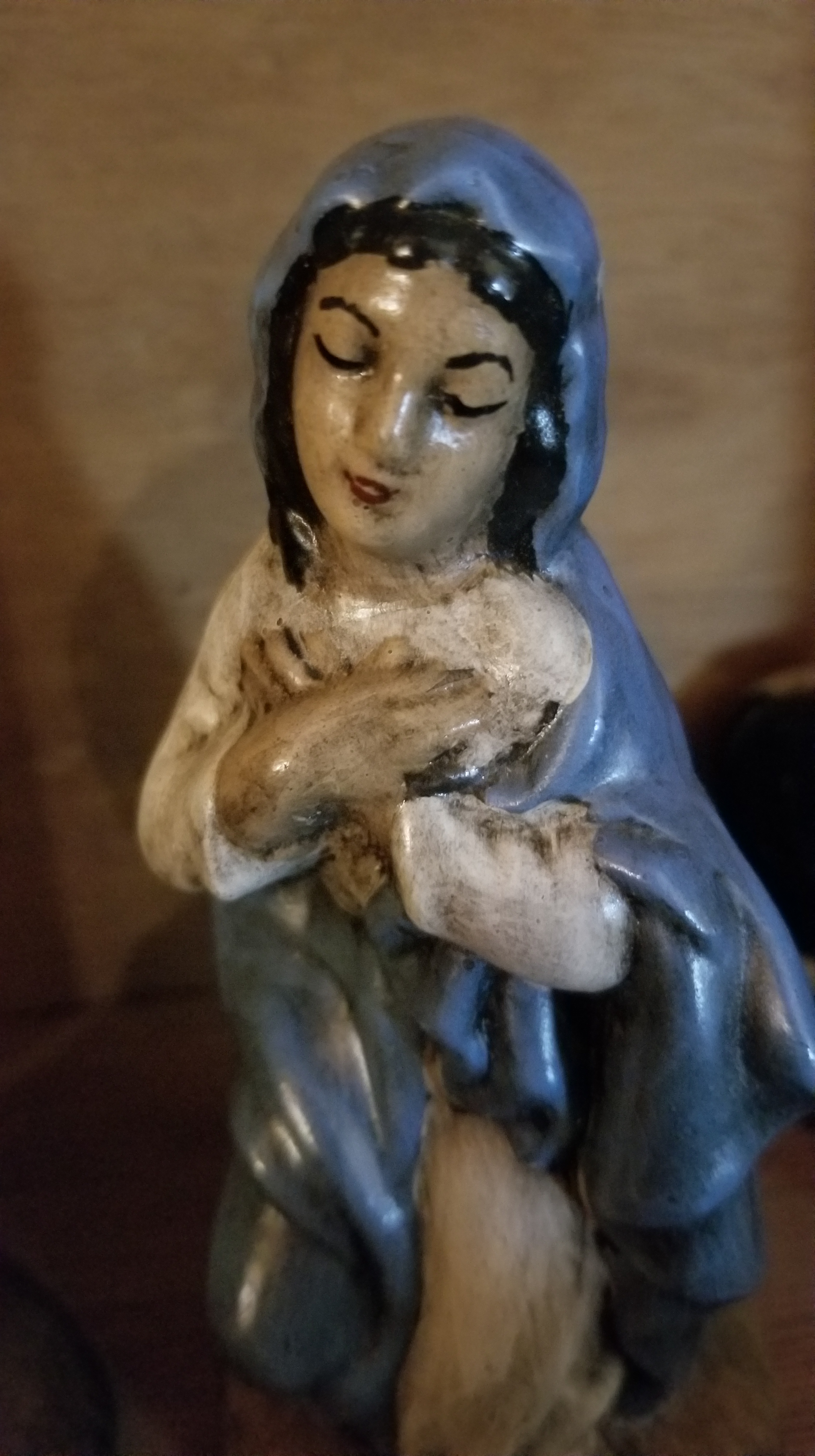
God is a mystery and we do not understand how the very special person who grew up to be Jesus came into being, but Mary was chosen for whatever reason. And the world has never been the same.
I hope you and yours had a blessed Christmas. God is with us! And our prayers go out to all those suffering illness, war, famine. This Christmas season (which goes to January 6), let us share with others and pray for an end to all war.
Amen.
***
Share your thoughts! Contact me at Another Way, P.O. Box 363, Singers Glen, VA 22834, or email anotherwaymedia@yahoo.com.
Get ready for an announcement early next week.
Another Way is a column by Melodie Davis, in syndication since 1987. She is the author of ten books, most recently Memoir of an Unimagined Career. Another Way columns are posted at FindingHarmonyBlog.com a week after newspaper publication.
Another Way for week of December 15, 2023
How Smart Women Saved a Future Religious Leader
Editor’s note: Fourth in a five-week series on Biblical women—and their babies.
Of all the stories of babies and mothers in the Bible (and even siblings as we’ll see in a minute), the mother of Moses and his sister is one of my favorite stories. We don’t usually think of it as a Christmas story at all, but there’s a link to the birth of Jesus and the insecurity that leaders feel when they sense or hear of a challenge coming from ordinary folk.
Baby Moses is one of the stories I recall and relish from my early childhood. We probably romanticized baby Moses’ predicament, coloring pictures of the baby floating in his little basket on the river while his big sister kept watch.
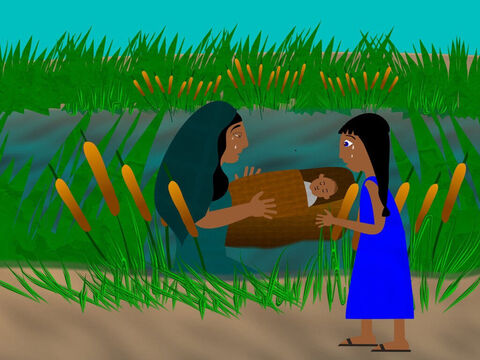
When I grew up, I learned more about the midwives named Shiphrah and Puah who helped save little Moses’ life. These women were not only dedicated to helping birth babies at the time, but pretty ingenious—and it is remarkable that this part of the story got recorded in the Bible at some point. Various writers of course wrote the text we know as Exodus. I’m skipping much background here but the upshot is that Joseph and his relatives (in the book of Genesis) settled in Egypt because of famine elsewhere. After that generation died, a new Pharaoh came into power who didn’t know the history and began to worry that the Hebrew peoples would become so numerous they might overtake the locals, and fight against them.
At the time, there were at least four women (one of them still a girl) whose response to the Pharaoh’s edict that all boy babies be killed (how absolutely horrible!) was “No!”
According to Exodus 1, the Pharaoh said to the Hebrew midwives, “When you help the Hebrew women in childbirth and see evidence of whether it is a boy or girl, if it is a boy, kill him. But if it is a girl, let her live.”
We learn in verses 17-18 that the midwives, however, believed in God, and did not do what Pharaoh had told them; they let the boys live. Later he summons the midwives and asks, “Why have you done this? Why have you let the boys live?”
The midwives coyly answer Pharaoh, “Hebrew women are not like Egyptian women; they have their babies so quickly that we can’t get there in time.”
The story wraps up by saying “So God was kind to the midwives, and the population of Hebrews increased.” And the Pharaoh’s edict continued to drown boy babies, but girl babies could live.
When one woman, Jochebed, got pregnant and gave birth to a son, she tried her best to hide him—imagine keeping an infant from crying!
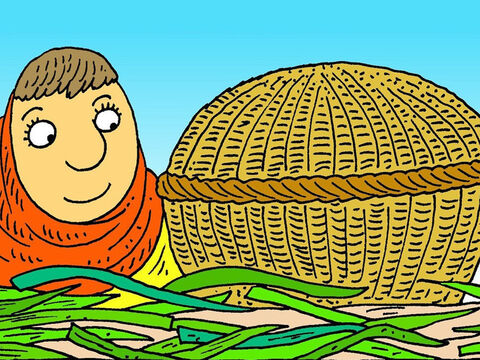
As he grew, after three months she waterproofed a basket the best she could. She put her little boy in the basket and placed it in the river. She directed her daughter (presumed to be Miriam), to hide at a distance to see what would happen. Then Pharaoh’s daughter goes to the Nile for a bath and sees the basket; her heart goes out to the little boy in the basket. Miriam quickly comes forward and volunteers to find a nursemaid for the baby (and sends her mother, Jochebed).
I do not claim to be a biblical scholar but the connection to the baby Jesus comes in the genealogy listed in Luke 3 which ends up with another Joseph, who married Mary the mother of Jesus.
We also know that Joseph and Mary faced the same kind of terrible terror as Jochabed, almost 1400 years later. King Herod in Jerusalem was a threat to the baby Jesus for many of the same reasons. (The Pharaoh had feared an expanding population of people different than themselves.)
This year, the biblical story of baby Jesus seems particularly real and close as we get news every day of the terror currently going on in that promised land. I have read that there will be no Christmas celebrated in Bethlehem this year, due to current atrocities and fighting. I’m pleased to learn of a movement called Mennonite Action in North America which is trying to send messages and make a stand working for peace and justice.
May all this horror soon cease as we prayerfully lean on our faith in God who knows the future.
***
Reach Another Way at P.O. Box 363, Singers Glen, VA 22834, or email anotherwaymedia@yahoo.com.
Another Way is a column by Melodie Davis, in syndication since 1987. Another Way columns are posted at FindingHarmonyBlog.com a week after newspaper publication.
Please note that I do not approve of any of the “sponsored” content that appears on my blog.
Another Way for week of December 8, 2023
How Naomi Finally Got a Grandchild
(Editor’s note: Third in a five-week series on Biblical women—and their babies.)
The biblical story of Naomi, Ruth and their offspring is truly a fascinating history. As my pastor noted in a sermon recently, Ruth’s story links directly to the Bethlehem story, which we will get to in coming weeks. Pastor Stephanie said Bethlehem means “House of Bread,” and we learn in Ruth chapter 1, verse 1 that Bethlehem and the surrounding area was suffering from lack of bread in a difficult famine.
So we meet Naomi, married to a man named Elimelech. As they migrate to find food, they end up settling in a country called Moab (today in the south of Jordan) with their sons Mahlon and Chilion. Then Elimelech dies and the sons marry two local Moabite women, Ruth and Orpah. Unfortunately, the couples don’t get a chance to have children before the two brothers die in Moab.
After about ten years, the drought subsides and Naomi decides she wants to return to Bethlehem where her relatives live. She begs her daughters-in-law, “Why don’t you go back to your mother’s house? I have nothing else to give you—too old to have a husband or to bear more sons.” Finally persuaded, Orpah and Naomi hugged and cried as Orpah decides to return to her mother.

Then Ruth refuses to leave Naomi and speaks the beautiful words that many have used at their wedding: “Where you go, I will go; and where you stay, I will stay. Your people will be my people and your God, my God. Where you die, I will die, and there I will be buried.” The Bible says that when Naomi realized that Ruth was determined to go with her, she stopped urging her.
When they got back to Bethlehem, the town came out to see them and some women exclaimed “Can this be Naomi?” At that, Naomi asked that she no longer be called Naomi: “Call me ‘Mara’, because my life has become very bitter.”
As they settled in and readjusted to life, Ruth said she would go out into the fields to pick up leftover grain so they would have food to eat. It was common for farmers to leave grain behind for those in need.
A man named Boaz was the owner of some land and after he inquired about Ruth as she gleaned, he made sure that the harvesters left grain for Ruth and to not hurt her. When the harvesting was done, Boaz celebrates, and Naomi encourages Ruth to lay down at the feet of Boaz. He eventually wakes up, quite surprised to find Ruth there. Boaz later sits down with a relative of Naomi’s to do as custom called for in those days, to see that widows are taken care of if a husband dies.
Thus, it was that wedding bells did ring for Ruth and Boaz and Ruth gave birth to her first born son, Obed. Naomi is delighted to have her first grandchild, and looks after him as things settle down. As a grandma I like this verse: “Naomi took the child, laid him in her lap, and cared for him.”
If you know your Biblical genealogy, you know Obed becomes the father of Jesse, and Jesse the father of David, who later becomes the first king of Israel. David of course had his faults but the Bible says David found favor with God in spite of his sins.

My grandma on my mother’s side was named Ruth (and we gave the middle name “Ruth” to one of our daughters). We were blessed to have three daughters when I was in my 30s and overjoyed with the five grandsons our daughters later brought to our family. Earlier this year, we were again super happy as our youngest daughter and her husband birthed our first granddaughter.

The Christmas season is certainly a time to not only give gifts and spread good will, but thank God for our families, friends and also the parents, relatives, and adoptive or foster parents who raised us.
***
Enter a drawing by December 22 for one of three copies of the new book my siblings and I put together titled Cultivating Fields, Faith and Family: Mom and Dad’s Memorable Mennonite Life.

***
Can also be purchased on Amazon, here.
For giveaway send your entry to Another Way, P.O. Box 363, Singers Glen, VA 22834, or email anotherwaymedia@yahoo.com, or enter on Facebook at Melodie.M.Davis. Deadline Dec. 22 2023.
Another Way is a column by Melodie Davis, in syndication since 1987. Another Way columns are posted at FindingHarmonyBlog.com a week after newspaper publication.
Another Way for December 1, 2023
Sarah’s Infertility and Abraham’s Folly
Editor’s note: Second in a five-week series on Biblical women—and their babies.
Last week we looked at Hannah’s extreme sorrow and stress due to infertility in the Old Testament book of 1st Samuel.
This week we’ll explore another husband and wife’s same issue: “We want to have a child.” But their story plays out quite differently.
Sarah and Abraham were originally named Sarai and Abram, and the book of Genesis tells us that it was originally Abram’s lament regarding their infertility to God, not Sarai’s, although I’m sure it was as much of a concern for her as it was for Hannah. Thus she even arranged for her maid to lay with Abram in order to have children.
But Abram prayed—or had a vision, about who or how he could plan for his eventual death saying: “Since I remain childless and I guess my household servant will have to be the heir of my estate” (paraphrase of Genesis 15:3).
According to Genesis, it was God who had first promised Abram a “great nation” would come from his eventual family. Abram was already 75 when this prediction was made, including the promise his children would own a vast territory of land.
Then came a desperate famine. Abram and Sarai moved to Egypt because there was food there. But there, old Abe worries that his “beautiful wife might attract attention from the Egyptians” and they might kill Abe to enjoy Sarai.
I remember my Bible teacher at high school shaking his head at Abe’s reasoning. He used the story to illustrate to us 16-year-olds who were beginning to date and have romantic encounters—that we would be wise to treat the road to romance and marriage very carefully, especially in how far we went in those encounters. Mr. Hostetler’s emphasis was instrumental in helping me vow to wait for marriage. He chastised Abram’s thinking saying “If he worried that the Egyptians might kill Abe, what on earth would they do to his beloved wife?”
Abram’s part of the story, though, can be a reminder that we all make mistakes and there is not only forgiveness, but a promise of a wiser future. He and Sarai were both given new names (and new spellings), Abraham and Sarah.
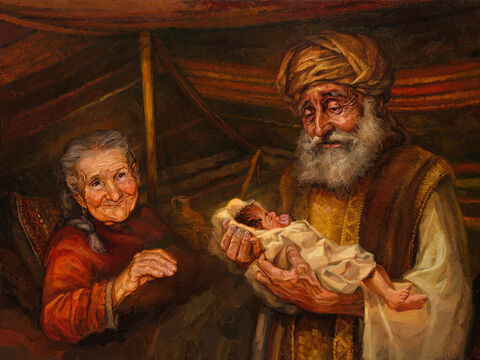
Later they moved to greener fields in the land of Canaan. The Sarah part of this story is her laughter when she was told by three visiting strangers that she was going to have a child in her 90s. She thought her time for childbearing was well past. We don’t understand (at least I don’t) the length of life in those days but the story in Genesis is that the visitors asked Abraham where his wife was. “There, in the tent” he said, where she was fixing food for them. The Bible says Sarah was eavesdropping and heard one of the visitors say “I will return about this time next year and Sarah your wife will have a son.”
Sarah laughs in unbelief, not at the joyous prediction that she would have a baby. Sarah is caught in a paradox: she knows that from a human standpoint, childbearing for her is literally impossible. Abraham also falls to the ground when he hears the news. The visitors reminded them, “Is anything too hard for the Lord?”
Sarah denied laughing to the visiting strangers, saying firmly “I did not laugh.”
One visitor said, “Yes, you did laugh.” At that comment, I’m guessing Sarah escaped back into the tent!
At any rate, Sarah’s dream and Abraham’s did come true when their son Isaac was born the following year, and indeed, Abraham’s family grew over many years and “prospered greatly.” The lesson here is if we’ve been blessed with the wonderful gift of children—no matter how they come to us whether through adoption or fostering—our children form the direction of our lives.
My Bible teacher clear back in 1968 gave me nuggets of truth that compel me to hold on to faith today. When times are tough, we can remember, “Is there anything too hard for God?”
***
What tough experiences can you share here?
Or, what nuggets do you glean (ah-ha, watch for that word in my column next week!) from the Abraham and Sarah history?
Comment here or contact me at Another Way, P.O. Box 363, Singers Glen, VA 22834, or email anotherwaymedia@yahoo.com.
Another Way is a column by Melodie Davis, in syndication since 1987. She is the author of ten books, most recently Memoir of an Unimagined Career. Another Way columns are posted at FindingHarmonyBlog.com a week after newspaper publication.
*Free Bible artwork courtesy of FreeBibleImages.org
[Please note: Ads on this blog have not been approved by me and I don’t earn anything from the ads.]
Another Way for November 24, 2023
The Miracle of Baby Samuel
Editor’s note: Melodie Davis begins a five-week series on women—and babies of the Bible.
One of the most poignant stories in the Bible is the story of Hannah and the infertility she experienced.
Not all women—or men want to have children. In ancient times, infertility was deemed a curse; women wore the sorrow on their faces. Today, not being able to have a baby is similarly difficult. And extremely sad.
The story of Samuel in the “New International Version” (NIV) begins with Hannah, married to Elkanah, who loved her very much but year after year she was unable to conceive. As was the custom at the time, they went yearly to give sacrificial offerings of meat to the priest, Eli. It was also the custom for a husband to have another wife if one did not conceive. Elkanah’s other wife, Peninnah, was prolific in the pregnancy department. Peninnah taunted Hannah, rubbing in her infertility. Elkanah would give each of Peninnah’s children a portion of the sacrificial meats.
The NIV titles the book of Samuel as “The birth of Samuel.” So we know Samuel is going to be the main character, but doesn’t immediately reveal how his birth came about. One year at the sacrificial ceremony, Hannah was so distraught she couldn’t eat. The priest, Eli, who received the sacrificial offerings, “was sitting on his chair by the doorpost of the Lord’s house.”
Now, I don’t recall ever hearing or reading the word “beer” in the Bible. In verse 9 of chapter 1, we read that finally Hannah had enough of her predicament. “In her deep anguish Hannah prayed to the Lord, weeping bitterly. She made a vow, saying, ‘Lord Almighty, if you will look on your servant’s misery and remember me, and not forget your servant but give her a son, then I will give him to the Lord for all the days of his life. No razor will ever be used on his head.’”
As she kept praying, Eli observed Hannah’s lips continuing to move. Eli couldn’t hear anything and thought she was drunk.He finally said to her, “How long are you going to stay drunk? Put away your wine.”
Hannah replied, “Not so, my lord. I am a woman who is deeply troubled and I haven’t been drinking wine or beer; I was pouring out my soul to the Lord. Do not take your servant for a wicked woman; I have been praying here out of my great anguish and grief.”
Eli answered, “Go in peace, and may the God of Israel grant you what you have asked of him.”
Hannah responded, “May this servant find favor in your eyes.” Then she left and finally ate something. Her face was “no longer downcast.”
When Elkanah and Hannah got home, the Bible says “The Lord remembered Hannah’s yearning. In the course of time Hannah became pregnant and gave birth to a son. She named him Samuel, saying, ‘Because I asked the Lord for him.’” How happy she was!
A year went by. When it came time for their annual trip (about 19 miles) to offer sacrifices before Eli, Hannah told Elkanah she would be staying home with Samuel until he was weaned. Thus when he was three or so, Hannah made good on her promise and took little Samuel to live with Eli and assist him in his chores. Hannah and Elkanah went to visit Samuel every year and Hannah would make him a new little coat.
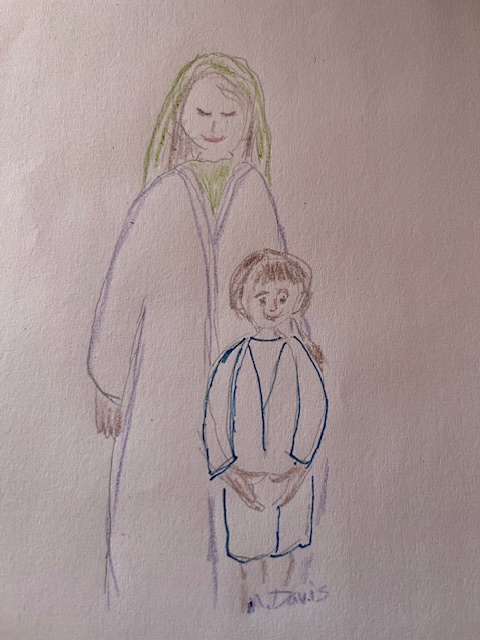
How dear and precious those times must have been. Eventually Hannah also gave birth to three sons and two daughters.
So Hannah took the pain of her situation and turned her curse into the birth of a very special prophet and leader in the Bible.
How many of us would willingly give a small child to serve a priest such as Eli? Samuel of course grew up to be the prophet who eventually chose the shepherd boy David to be King of Israel, a man of faith who was not perfect either. Hannah is one of my favorite women in the Bible.
To read the story of Hannah and her family, go to 1 Samuel verse 1 through 2:11.
***
Share your thoughts or stories! Comment here or write to me at Another Way, P.O. Box 363, Singers Glen, VA 22834, or email anotherwaymedia@yahoo.com.
Another Way is a column by Melodie Davis, in syndication since 1987. She is the author of ten books, most recently Memoir of an Unimagined Career. Another Way columns are posted at FindingHarmonyBlog.com a week after newspaper publication.
Another Way for week of November 17, 2023
Maybe Not a Best Seller, but Precious for Families
Last week I introduced a book my family has been working on, Cultivating Fields, Faith and Family: Mom and Dad’s Memorable Mennonite Life.
Some of the stories I’ve shared here over the years, but I don’t think I ever shared the story of the grandfather I never knew (my mother’s dad). It is only recently that we heard a part of his story that we’d never heard before.

[From the book]: “Grandma Stauffer’s husband and Mom’s father, Ivan, was killed in a car accident in 1952 [I was just an eight-month-old baby]. Ivan had spent the day at Vernon and Bertha’s [our Mom and Dad] doing a project of some kind, and then headed home. On the way, Ivan crashed into a tree. We still have the newspaper clipping.
Many years later, Mabel Steiner, one of mother’s longtime friends, shared how as the pastor’s wife, she had the difficult job of accompanying her husband, Elno, to Ruth’s house as bearers of the devastating news about Ivan.
Mabel said they drove up to Grandma Stauffer’s home and Grandma was out waiting on the front porch, likely wondering why her husband hadn’t come home yet. Ruth must have had an inkling that something was terribly wrong when he was late because she would have never been just waiting out on the porch—she was always a busy busy homemaker. Pastor Elno had to tell Grandma that Ivan’s car had gone off the road and hit a tree. Police said perhaps he had a stroke or heart attack; the cause was unknown.
Mabel remembers Grandma gasping and then kind of said, “Oh …” and likely had to sit down at the shocking news, but she didn’t fall to pieces. Mother remembers her mother crying later on when she was in the company of her children.
Mabel’s memories were very precious to us—an insight about Grandma Ruth at her moment of greatest crisis. It was revealing and very sad—a piece of a puzzle filled in (how Grandma found out and reacted). Mabel also added that Grandpa Ivan, who we never really knew, was a great joker and loved children very much. (Mabel and Elno had their own deep and devastating experiences with grief, losing three of their six children before they themselves passed away.)
Grandma Stauffer once wrote down a page full of memories and connections regarding her family. One of the things she wrote was how girls/women in those times did not want to have tanned skin, because it made them look like they were farm workers who had to work in the sun. They covered up their arms with stockings (toes cut out) to keep from getting tanned. Way to go, Grandma and her generation. They probably didn’t have as much skin cancer to deal with as our current generation, or the wrinkled skin of someone who has practiced sunbathing or visiting tanning salons. The irony in our family was that Bertha, while taught to cover up her skin when she was a child, went on to love sporting a tan while she lived in north Florida for eight years. We frequently went to nearby beaches. She, too, had to pay for her sun-loving ways, and had to have several basal cell carcinomas removed from her head and back.
Our Grandma spent her last forty or so years living alone and managing a farm, with the help of hired farmers to take care of crops. An adept seamstress, she also supported herself making clothing for various people, doing alterations on clothing, and also making Mennonite head coverings for women, which were required by Mennonite church doctrine at the time.”

This new book has dozens of short stories from our family life, which may stir memories of your own. It took some work but I encourage others to get some of their family stories and legacy down!
***
Jot your recent Thanksgiving memories down now … five years from now you’ll have the details!
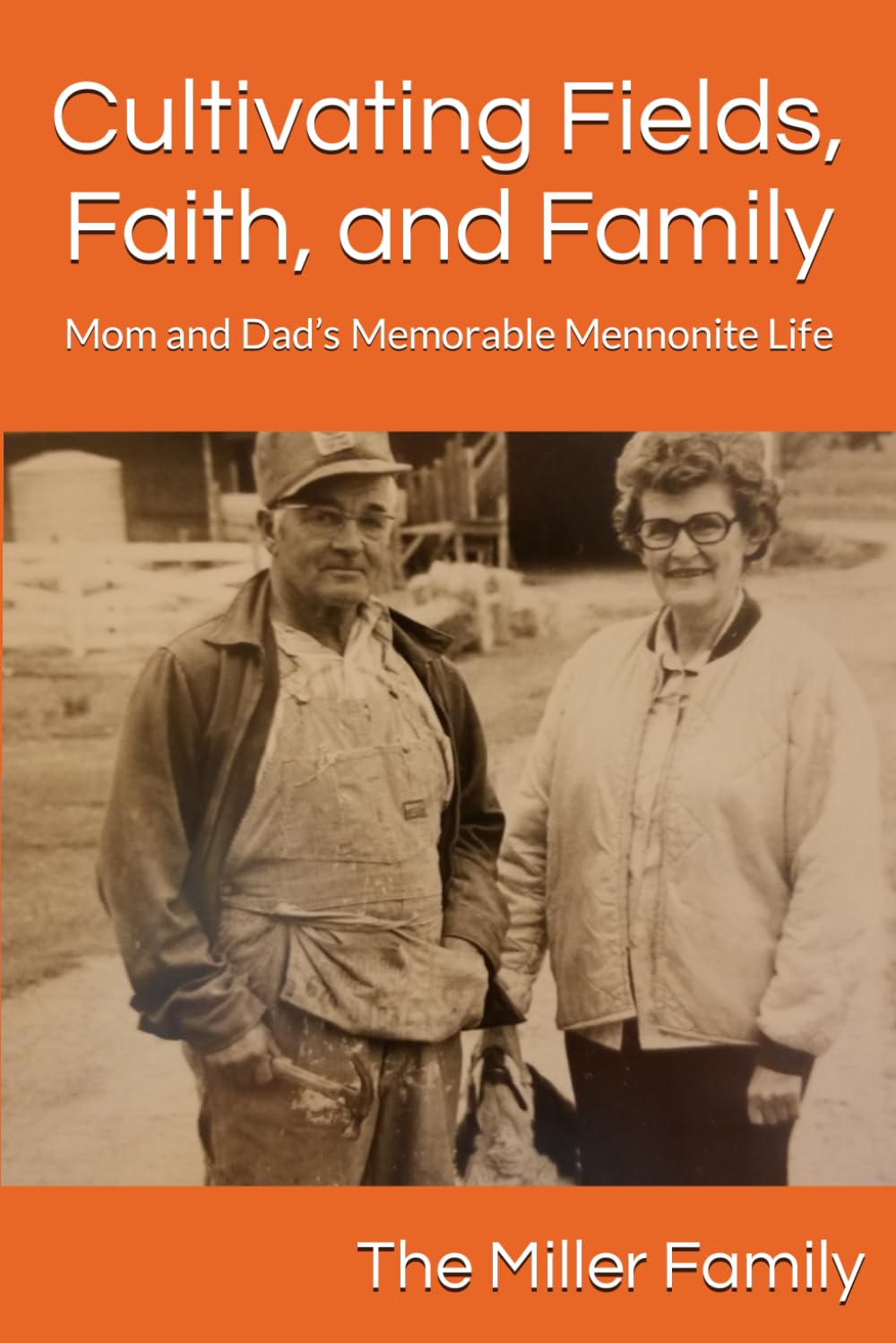
The book launched last weekend on Amazon for $18.99. If you do not go online or the Internet and want to get a copy, write to me at Another Way, P.O. Box 363, Singers Glen, VA 22834, or email anotherwaymedia@yahoo.com.
Another Way is a column by Melodie Davis, in syndication since 1987. She is the author of ten books, most recently Memoir of an Unimagined Career. Another Way columns are posted at FindingHarmonyBlog.com a week after newspaper publication.
[Please note: Ads on this blog have not been approved by me and I don’t earn anything from the ads.]
Another Way for week of November 10, 2023
Writing or Recording Snippets of Family History
[Please note: Ads on this blog have not been approved by me and I don’t earn anything from the ads.]
I’m getting older. Duh. We all are, even my darling baby granddaughter who is now scooting around on her hands and knees crawling, and pulling herself up at the gates her parents have lovingly installed in their townhouse to keep her safer.
And I’m using my Dad’s old cane when I walk around our seven acres with the dog to keep me safer. This is life. The cane always brings back precious memories.
I’m excited to share that one of the writing projects I’ve been working on this past year (when I haven’t been playing with grandkids or writing columns) is stories from my wonderful parents and their parents and grandparents. My siblings and I have spent time remembering and jotting down notes. Together we’re publishing a book we’re calling Cultivating Fields, Faith and Family: Mom and Dad’s Memorable Mennonite Life. It is now out and available on Amazon and I hope some of you will be interested enough to check it out. I also hope it may inspire some of you to write or pull together stories of your own.
A quote by writer Madeleine L‘Engle is part of my inspiration: “If you don’t recount your family history, it will be lost. Honor your own stories and tell them too. The tales may not seem very important, but they are what binds families together and makes each of us who we are.”
If you’re thinking, “I hate writing” or “not me, ever,” of course there are various ways to “recount your family history.” Today’s electronic tools make it relatively easy to interview family or friends on video or on your iPhone or other cell phone or iPad. Gathering such memories can give you opportunities to draw your family closer together and cherish the wild and crazy stories along with the sad, the heart wrenching, or difficult memories.
And you don’t have to share your family’s “dirty wash.” In fact, I urge you not to. We have plenty of stories in our family that we’re not sharing: the world doesn’t need to know. I encourage others to share the uplifting, fun, and inspiring times—and leave some things hiding in history. And of course, any sharing of family stories is not for everyone. My dental hygienist, whose daughters are nearing the age for marriage and babies, was asking about how I felt as a grandmother. Her own grandparents had been very mean and ugly to her and others in the family. She had no good example of grandparents as being loving or special to her. So sad.
My one sister had given my mother journaling books with specific prompts, and urged Mom to write things down for us as she grew older. We “promised” not to read them (other than a few fun glances) until after she died. (Mom died in October 2021 and Dad passed in March 2006.) Mom was a prolific letter writer and especially after her hearing (on phone) became so difficult, she enjoyed writing letters to all of us which also gave us a nice stash of memories to include in the book. Dad also wrote things occasionally, or I helped him write down a story or two so we include all six of us (Mom, Dad, and four siblings) as the “writers” for this volume.
Here’s one sample that opens the book: “Our grandmother, Ruth Stauffer, was afraid Mom’s shiny black curls would make Bertha proud or vain, so Ruth bristled and changed the topic whenever anyone praised Mom’s lovely curls. Mom also got on Grandma Ruth’s nerves with her chatter. “She even stuffed clean rags in my mouth to shut me up!” It sounds funny to us now but obviously was not appreciated by Mom.
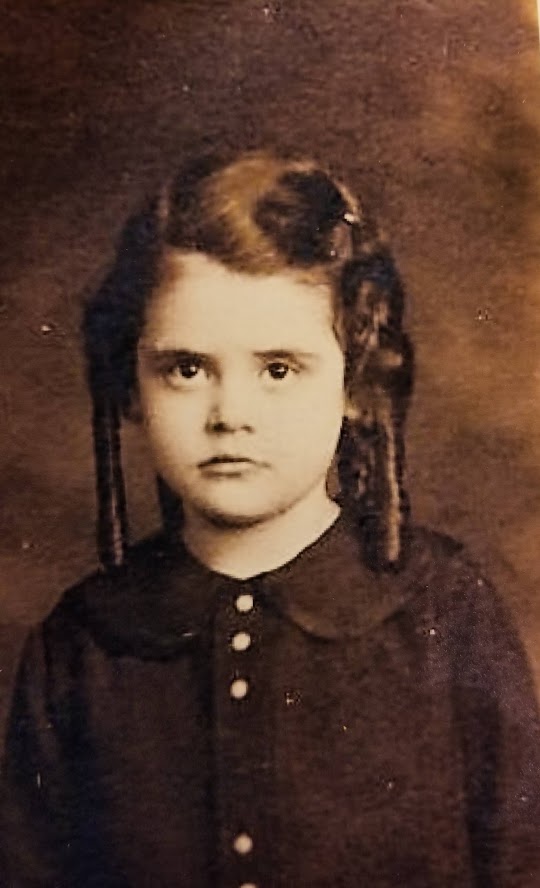
Mother, in describing Ruth as she reflected on her relationship with her mother, wrote “I know I got on her nerves a lot with my chatter.”
A sweet memory Mom shared of her mother was that (our) Grandma Ruth would “surround us with her arms if and when it stormed hard.” Like Maria in Sound of Music!
Next week, I’ll share a longer story from the book.
***
Let us hear about a special family memory! Or a fun or funny experience.
***

As of yesterday, this new book is being sold on Amazon published through Kindle Direct Publishing—a do-it-yourself effort! You can purchase it here. Or if you prefer, write to me at Another Way, P.O. Box 363, Singers Glen, VA 22834, or email anotherwaymedia@yahoo.com and I can mail you the book. The book is $18.99 plus shipping of $4, or $23 all together.
***
Another Way is a column by Melodie Davis, in syndication since 1987. She is the author of ten books, most recently Memoir of an Unimagined Career. Another Way columns are posted at FindingHarmonyBlog.com a week after newspaper publication.
E
Another Way for week of November 3, 2023
Leaves Cartwheeling Across the Lawn
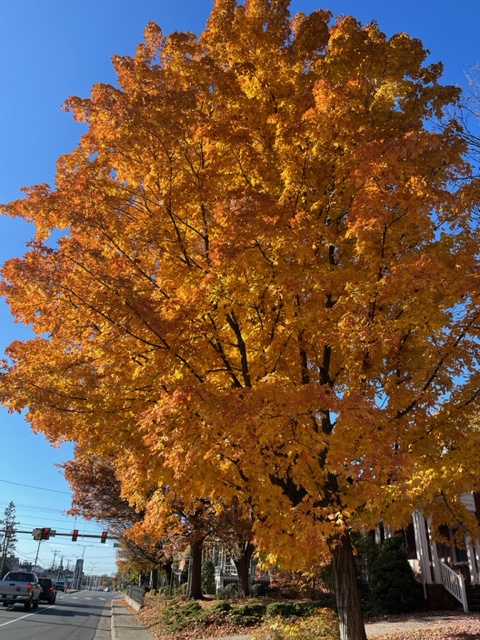
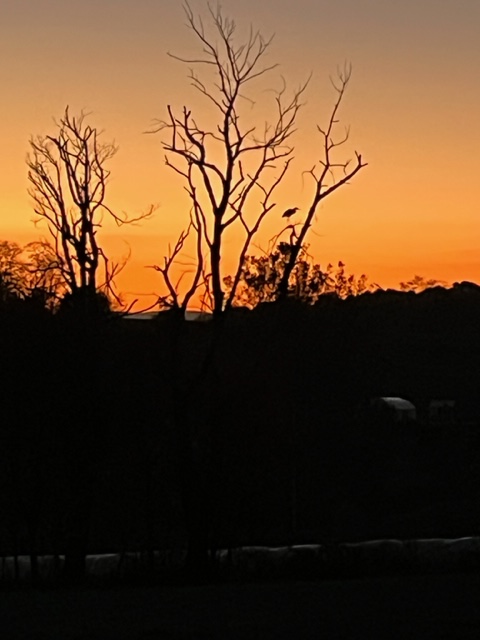
Here in the Shenandoah Valley, we have enjoyed weeks of rhapsody in orange, red, yellow, and green. It has been amazing, gorgeous, eye-opening … all the cliches. I’m lost for descriptors of the trees, leaves and mountains.
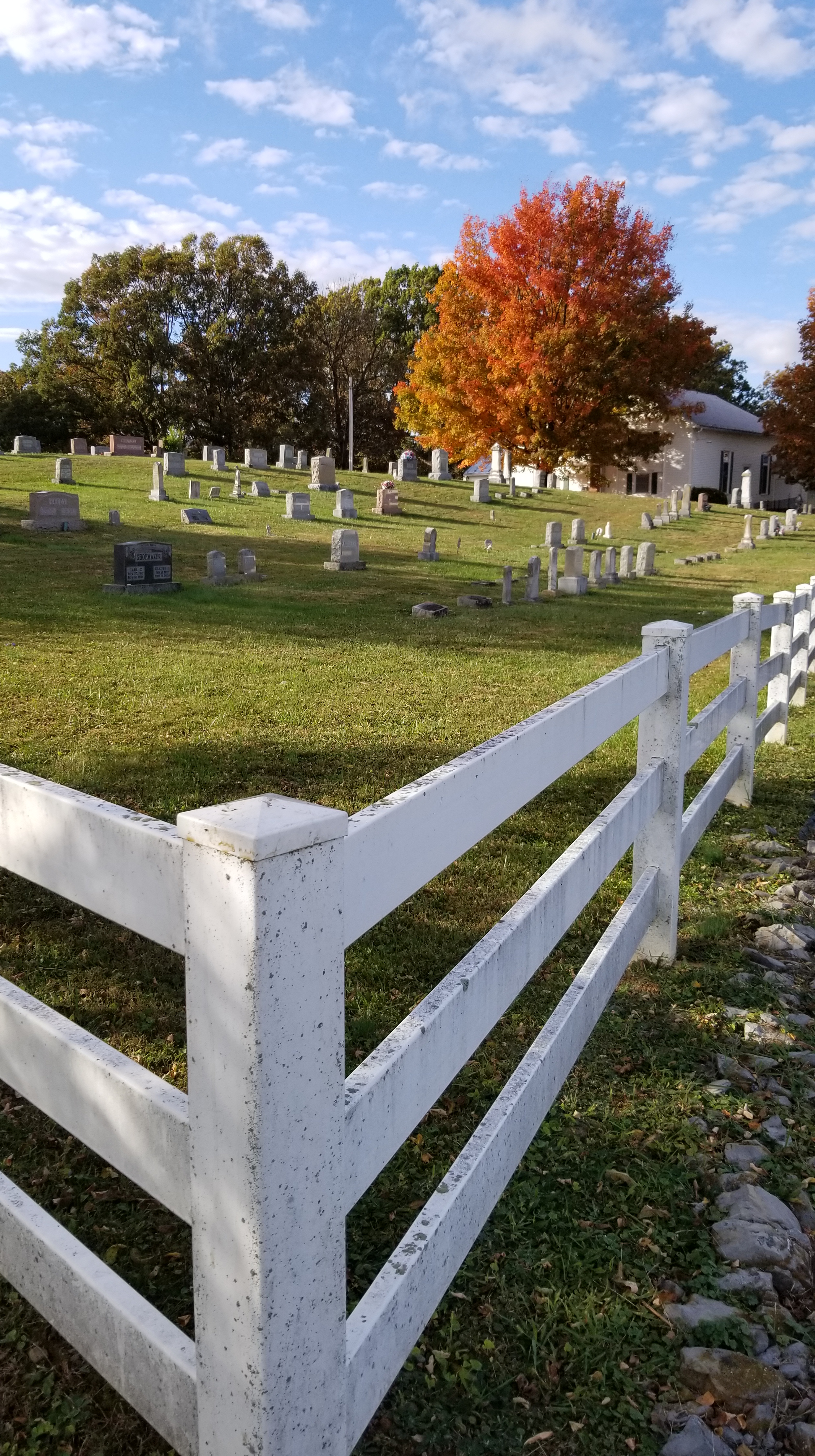
The foliage has been the best it has been in years, at least in my memory. One friend who traveled to New England this fall (where the autumn colors are almost always spectacular, yes?) came back to our Valley and said our colors here were as good as New England’s this year.
Luxuriating in the colors has caused me to stop in town, get out of my car, walk a few blocks and fire away with my phone camera.
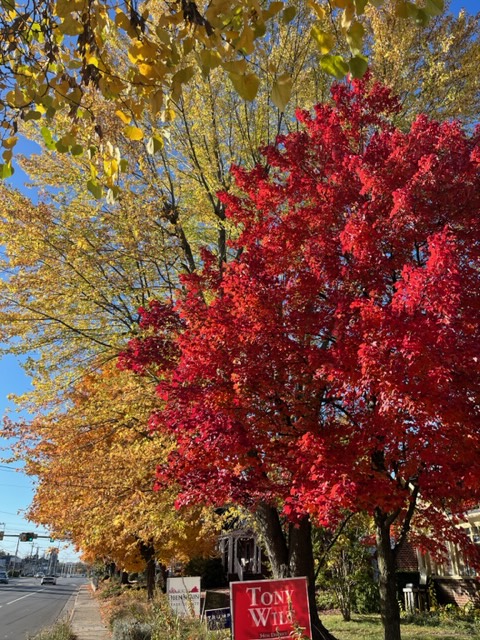
I want to learn more about how God paints, and why in this dry dry fall we could enjoy all this spectacular color. Botanist anyone? Tree expert? Climate professional?
It has been a gift. My husband and I are not tree professionals, but the four trees we have in our front yard have blessed my heart in these recent years. We built the house in 2007 and finally have shade in our front yard, enough that my husband is now “worried” that we put too many trees out there. I’m not concerned. They will likely outlast us here and we won’t really have to worry about whether there are too many. I do not like raking. For this fall, I am hoping that a few strong gusts will take leaves cartwheeling across the lawn to the hayfield.
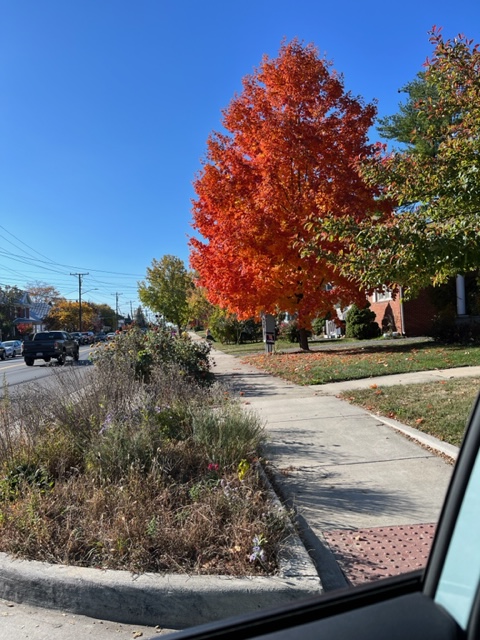
The U.S. Department of Agriculture, Forest Service division, has done a spectacular job of explaining everything about leaves and trees and colors and why here: https://www.fs.usda.gov/visit/fall-colors/science-of-fall-colors. In a nutshell, perhaps you remember the word chlorophyl from science classes. Chlorophyl gives leaves their basic green color, which is necessary for photosynthesis, by which a plant uses sunshine to make sugars (food for the trees). And different types of trees tend to produce different colors after the chlorophyl drives up. In a forest, the colors of different trees produce a glorious canopy. Weather, length of days and nights—as days get shorter—all affect color.

I grew up in northern Indiana over 17 years. We loved fall and the colors. Then I lived in north Florida one year. Yes, there was some colorful change in that flat area, but nothing like we experience in Virginia. I was happy to spend a few pre-marriage years living in the hills of eastern Kentucky, the city of Barcelona, Spain, and back to Virginia. In my memory, nothing compares to the blankets of color we see here. (Remember, I’ve never seen New England in fall, or the western U.S. mountains in fall.)
What’s important here maybe is remembering to let this season just “fall” around us as a special time of beauty with crunchy walks through woods if we get the chance.
I loved what I found on a friend’s (and now neighbor) Facebook page and am borrowing it here, with her permission. Sharon Landis describes herself as: “author, spiritual director, and naturalist” and I had the privilege of working with her and her brother on a book, The Spacious Heart: Room for Spiritual Awakening. She wrote this on a Sunday, reflecting on the deep desire most of us have for shalom or peace in this beautiful world.
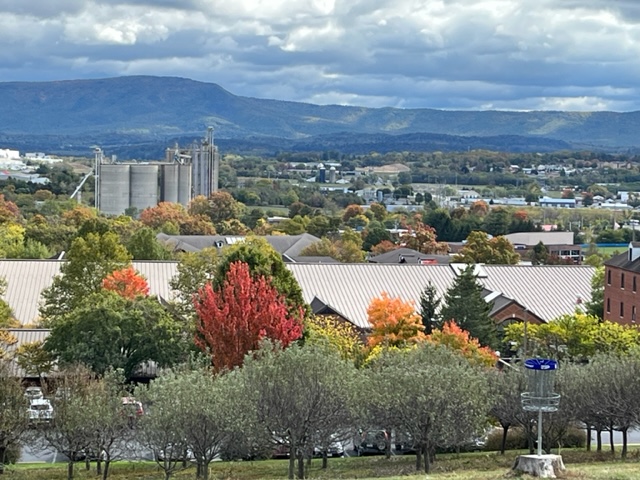
“Oh how my heart longs for [shalom] all over the world! I hold this prayerfully as I am quietly present to this precious autumn morning with its soft muted colors. After yesterday’s brilliance, this subtle beauty delights me. Fallen leaves cover our lawn, giving a sweet crunch to any movement. Hope for rain rises with the widening cloud cover. May each of us find a small rising of hope, beauty, and Divine comfort this day.”
To which I can only add, Amen.
***
Are you still seeing great colors, whether muted or robust?
Comments here or send to Another Way, P.O. Box 363, Singers Glen, VA 22834; email anotherwaymedia@yahoo.com.
Another Way is a column by Melodie Davis, in syndication since 1987. She is the author of ten books, most recently Memoir of an Unimagined Career. Another Way columns are posted at FindingHarmonyBlog.com a week after newspaper publication.
Another Way for week of October 28, 2023
My Pie Story: Don’t Do What I Did
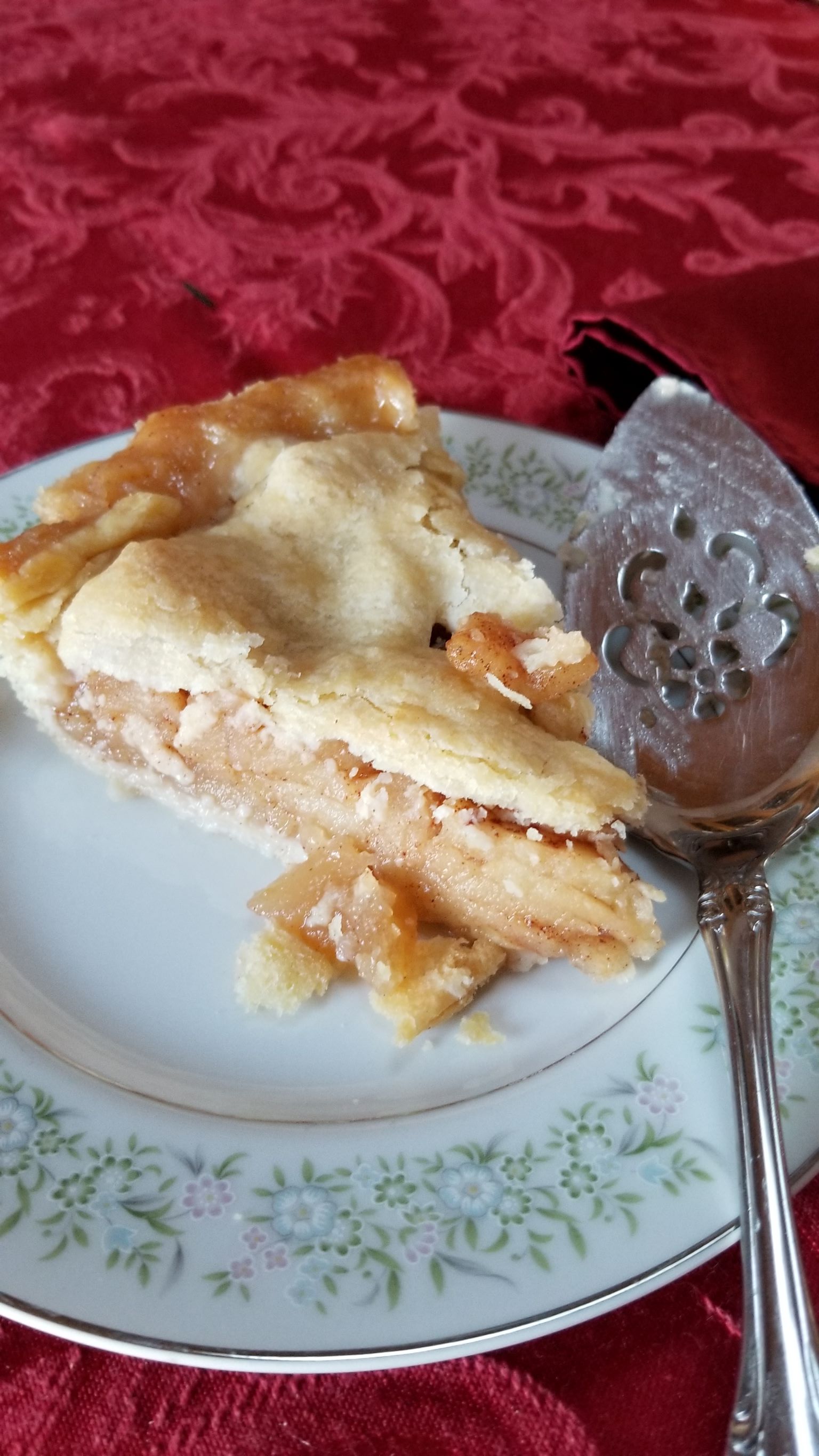
We had an early Thanksgiving meal at our house, in order to catch some out-of-state kids and grandkids, and we all looked forward to a sumptuous meal. It was toned down a bit because afterall, it was only October and we also want to celebrate in November! We ended up with around 20 people at our long long dining room table.
For me, I enjoy it all, but there’s nothing that can top a dessert of fresh delicious apple pie (warm) with ice cream.
So what happened at our early Thanksgiving?
Let me back up. When I was dating my husband-to-be, I made the “mistake” of making him an apple pie in the apartment where I was living with a roommate, Mary Ellen. I served it to him on a Sunday and he was an immediate fan.
In fact, his family’s fall butchering day was coming up. His mother had died several years before I ever met him. Stuart said she was a great pie baker when she was young before stricken with rheumatoid arthritis, which made all housework, cooking and other activities very difficult for her.
So he finagled me into making at least four apple pies for the family meal after the hog butchering. He said they had Stayman apples at his house and they had an ample supply of lard in the basement from previous days of butchering.
Well, baking day (the day before butchering) I went to his father’s house and they brought up the lard from the basement. But, as you might guess, the lard was a little rancid but I forged on and peeled apples and made pie crusts until I was more than a little exhausted. And nervous. What would the oldish lard taste like baked in the pie?
I shouldn’t have worried: the pies tasted fall-apart-rich and yummy sweet. They were a little rancid to my tongue.
Fast forward about 48 years. I still make pie and I was excited to make two apple pies for our early Thanksgiving-ish meal. I drove to three orchards to find the Stayman apples that we all love, and finally brought home a beautiful bushel of delicious tart apples.

The morning of our meal, I was up early to get the pies going and used my favorite recipe, barely looking at the ingredients. I’d made pies for over 48 years, after all.
We sat down to our supper of turkey breast, gravy, mashed potatoes, stuffing, my sister-in-law’s macaroni and cheese (which is to die for!), green beans, corn, cranberry salad, other veggies and grapes, hot rolls and more desserts than we could possibly consume. Then I brought out the pie, and served it with vanilla ice cream. When I finally got to sit down with my piece, I was a little disappointed. Something didn’t taste quite right. It was okay, but not great. People said it was “delicious” and I served about eight or so pieces.
The next day, I dug out the recipe I shared in my Whatever Happened to Dinner cookbook (Herald Press, 2010). There, third item on the list, was the call for one cup of sugar. I told my husband, “I now know what was wrong with the pie! I forgot the sugar!” He agreed it was not very sweet. Then I thought back to watching them bake in the oven and I thought the pies did not appear as juicy and bubbly as they usually did.
Of course, all of us could do with less sugar, so we ate both pies over the next several days and probably helped those with diabetes issues; but, it was quite disappointing after my long wait and anticipation.
Moral: Don’t forget the sugar. Maybe use only ½ to 2/3 cup sugar and maybe live longer when avoiding too many sweets.
But I do plan to make MORE pie for November 23 and this time, I’ll put in the sugar!

***
Most of us cooks have disaster stories to tell, or hide! I’d love to hear your worst baking story, or funniest disaster in cooking. Tell all here!
***
Find the recipe with this link: https://tinyurl.com/StaymanApplePie. Or write to me at Another Way, P.O. Box 363, Singers Glen, VA 22834, or email anotherwaymedia@yahoo.com.
Another Way is a column by Melodie Davis, in syndication since 1987. She is the author of ten books, most recently Memoir of an Unimagined Career. Another Way columns are posted at FindingHarmonyBlog.com a week after newspaper publication.
Another Way for week of October 20, 2023
Your Life in Six Hymns
Hymns are what carry our faith forward, because we remember words of hymns many many years after we have heard a sermon. Too often we’ve forgotten the sermon, even the main point, in one hour.

Someone posted a request online for people to share “Your Life in Five Hymns.” I decided to write about it, but couldn’t narrow down my list to five. My favorites include songs from very old, to more modern, and from other cultures. “Masithi Amen” is probably my favorite among those in the South African tribal language “Khosa.” This short and sweet song is easy to sing, even using the Khosa language which basically tells us to “Sing amen, amen, we praise your name O God,” repeated numerous times.
Why does music reach our hearts and inner emotions? Both the words and the tunes grab us and carry us through bad and difficult times and good. Funeral hymns are another category that have much emotion for many of us. And I don’t mind when hymnals use old archaic language, or if they switch to modern interpretations some people like better.
One family memory which is still powerful was my mother and sister singing duets at Hope Rescue Mission, a ministry in a larger city where persons (mainly men) went for a meal, a safe night’s sleep, and breakfast. What they also received was a sermon and music by whatever church group happened to be visiting that night. The song I remember was “The Love of God” and continued with the message, “is greater far than tongue or pen can ever tell; …It shall forevermore endure—the saints’ and angels’ song.” I think that song resonated in my mind because my mother and sister harmonized so beautifully as soprano and alto. And the younger me was slightly jealous I couldn’t sing alto yet.
Speaking of children, I cannot even think about this song without tears welling. It means so much. The triple punch comes in verse three of “My Shepherd Will Supply My Need,” which starts this way: “The sure provisions of my God, attend me all my days … no more a stranger, or a guest, but like a child at home.” The text was by great hymn writer Isaac Watts in the early 1700s.
Another hymn that has enriched baptismal services in many churches is a Lutheran baptismal hymn “I was there to hear your borning cry, I’ll be there when you are old. I rejoiced the day you were baptized, to see your life unfold.” John Ylvisaker wrote the text in 1985, and literally turned one piece around when encouraged to “personalize” what he had written earlier. So we get God singing the words of the hymn to us, “I was there to hear your borning cry.” Yes, borning is a newish word, but I like it.
A song of thanksgiving is always a lift, and for that I’ll nominate “I Thank Thee Lord.” Adelaide A. Procter wrote many hymns including this favorite, which continues, “that Thou hast kept the best in store; we have enough, yet not too much, to long for more.” Adelaide was born in the early 1800s in London: I marvel at how contemporary her words are for us today.
Finally, I’ll end this reverie of hymns with an old old favorite, “Blest be the tie that binds … the fellowship of kindred minds is like to that above.” It goes on to talk about the mutual woes and burdens we bear. John Fawcett wrote that one in the late 1700s, about the time the U.S. was forming.
My church background spans Mennonite, Presbyterian and Lutheran (married a Lutheran and we compromised by joining a Presbyterian church when our first baby came along). The hymns and music I love are rich in family memories, but I could include one hundred more beloved hymns if I had the room here! (These short quips should not encroach copyright issues.)
What top hymns do you love?
***
I’d love to hear from you; send to Another Way, P.O. Box 363, Singers Glen, VA 22834, or email anotherwaymedia@yahoo.com.
Another Way is a column by Melodie Davis, in syndication since 1987. She is the author of ten books, most recently Memoir of an Unimagined Career. Another Way columns are posted at FindingHarmonyBlog.com a week after newspaper publication.

 findingharmonyblog