

Finding Harmony Blog is featuring five guest posts all week as excerpts from a just released book, Fifty Shades of Grace: Stories of Inspiration and Promise, published by Herald Press (April 17, 2013). I served as compiler/editor for the book and wrote about that process on Mennobytes blog. Today’s story is by Jodi Nisly Hertzler; her bio appears below.
Guest post by Jodi Nisly Hertzler
Perhaps it was the chilly, drizzly morning (a drastic change from the muggy, sunny July weather we’d endured all week). Perhaps it was awakening too late to claim the favored corner of the couch. Or perhaps it was the fact that his younger brother had already selected the Saturday cartoon to be watched that morning. Whatever it was, my son was having a horrible morning. And things only worsened when an art project he’d labored over the last twenty-four hours disintegrated during the final steps. My husband and I winced at the shrieks of despair and anguish emitting from his bedroom. Flinched as he shouted at his brother to go away. Nearly fled the house as he stormed back downstairs, clearly caught between tears and the urge to break every window in the house.
Every attempt to defuse the situation resulted in bellowed disagreement. We tried to engage his help with the family jigsaw puzzle, then had to send him away for fear of injury to the puzzle or to his siblings. I attempted to provide a comfortable place for him to read in solitude, but his funk had robbed him of the ability to concentrate. Food didn’t help; time-outs didn’t help.
I was tempted to leave the boy to stew in his own angry juices. He was clearly ruining everyone’s relaxed Saturday morning with his eleven-year-old angst and I honestly didn’t feel like dealing with such a maelstrom of emotion. I poured myself a cup of coffee and prepared to just wait it out. But watching him, I was reminded of myself at his age, and I recalled the volatile mood swings I used to have . . . I saw myself in that angry boy huddled on the couch, growling at anyone who glanced his way. And I remembered my father’s method of dealing with me. When he’d see me caught up in my emotions—all tangled up in anger and frustration with no tools to free myself—my gentle, patient father would insist that we go for a walk. I have many memories of twilight walks around our neighborhood, talking with my dad, the air and exercise and company easing my troubled mind.
So I took a fortifying gulp of coffee and a deep breath and gingerly approached the seething dragon that lay within my son. “How about we go for a walk?”
I was sure he’d say no. The cold, wet drizzle outside was hardly inviting. But perhaps the miserable weather appealed to his inner tempest, because he agreed at once. So we set out. I wasn’t sure what to expect. I told myself not to bring up the morning’s troubles, but to allow him to dictate the level of interaction. We jogged to the intersection, crossed the busy highway, and progressed up the sidewalk, toward a small woodland not far away.

The rain-washed air and burst of exercise must have had a purging effect, because the treetops of our destination were barely in sight when my son started unloading. He took me step by step through his failed attempt at art. But his voice remained calm; he didn’t dissolve into tears or anger. I expressed my understanding. We considered options for repair. He sighed.
Then we moved on to other topics. We talked about the upcoming school year and he admitted to nervousness about how much harder things will be in middle school. I agreed that the work might be more difficult but assured him that he’s a quick learner, and that his main challenge will be organization. He considered that for a moment, then challenged me to a race to the edge of the woods. He won (barely).
We entered the woods, and the conversation turned to observations of the fallout from a recent violent windstorm. We marveled over felled trees and the park bench that lay splintered under one of them. We looked for poison ivy and studied stream levels. We breathed clean, fresh air, and admired the umbrella of trees sheltering us from the rain. We traversed muddy paths, jumped over puddles, and gingerly made our way across a wooden plank, wondering at the fate of the bridge that once lived there.
As we walked, I watched my son. My firstborn. This boy on the cusp of puberty. He’s small for his age, but he’s quick and strong and agile. And barefoot—even on hikes, my boy disdains shoes. Large hazel eyes belie the workings of a mischievous mind and remind me of his first year, when old ladies in grocery stores used to coo, “Hello, bright eyes” when they saw him. His persistent curiosity about the world is the reason we had to buy toilet locks when he was a toddler. He struggles to concentrate in school, but he’s an amazingly creative thinker and constantly surprises me with the things he comes up with. Of all my children, he’s the one who most often causes me to lose my temper, but he’s also the one who most often makes me laugh.
I pondered these things as we walked back home, and I acknowledged that we’re approaching a turning point. My boy is nearing the end of his boyhood. Male hormones will soon take over and change him into someone I can’t quite imagine yet. I have high hopes for the man he’ll become, but I already mourn the loss of the tree-climbing, Lego-building, creek-exploring child he is.
Months have passed since that day. My son still reminisces about that walk we took in the rain, but for me it’s more than a fun memory. It was a moment out of time. This walk that we took—the rain that chilled our cheeks and washed our ragged emotions, the trees that provided a sheltering canopy over us—did more than just calm an angry eleven-year-old. It helped me to put our present preteen frustrations into the perspective of the entire life path that my son is journeying, from his first breaths in my arms to the first time I watched him climb aboard a school bus, and on into the misty, unknowable future. I was granted a new connection to my son right at the time when he’s starting to become his own man.
That morning walk gave us time to think and to talk and to play together. A chilly, drizzly, wonderful space in time.

Jodi and Oliver at a tender age.
BIO
Jodi Nisly Hertzler is a tutor at Eastern Mennonite School, proofreader and copy editor for MennoMedia, and the author of Ask Third Way Café: 50 Quirky and Common Questions About Mennonites and a guest columnist for Another Way newspaper column. She and her husband, Shelby, have two sons and one daughter. They are members of Community Mennonite Church in Harrisonburg, Va.
More stories like this: This story and 49 more like it can be found in the new book, Fifty Shades of Grace: Stories of Inspiration and Promise. It is easy reading and inspirational—a great Mother’s day gift or for birthdays, anniversaries, personal devotional, or a book to share with a friend or relative. A 30 percent discount is available until May 1, making the book just $9.09 plus shipping. You can also watch a trailer for the book here and find a news release here.
Death, Divorce and Deliverance
Finding Harmony Blog is featuring five guest posts all week as excerpts from a just released book, Fifty Shades of Grace: Stories of Inspiration and Promise, published by Herald Press (April 17, 2013). I served as compiler/editor for the book and wrote about that process on Mennobytes blog. Today’s story is by Steve Carpenter; his bio appears below.
Guest post by Steve Carpenter
Grace often comes in unexpected ways and from unlikely places—but it always comes exactly when it is needed most.
On a Tuesday night, September 26, 1995, the car my former wife was driving collided with an automobile operated by a woman driving under the influence of alcohol. Both Cindy, age 36, and my youngest daughter Michelle, age 11, died that tragic night. Cindy was driving Michelle to gymnastics practice along a winding back road traversing the rolling hills of the Washington, D.C. suburbs.
Earlier that day, when the other driver left work, rather than going directly home she stopped by a bar for happy hour in an attempt to avoid rush hour traffic. No one knows exactly how many drinks she had, since the police didn’t order a blood alcohol test until the morning after the collision. Even with an allowance for wide variance in a person’s ability to metabolize alcohol, it was clear in a court of law that she had been driving “under the influence” the night before when, the car ahead of her slowed to turn right and pull into a driveway. However, the impaired driver grew impatient and crossed the two solid yellow lines in the center of the road to pass even though it was no-passing zone. Just then, Cindy, driving a compact Ford Escort in the opposite direction, crested a hill and came directly into the path of the drunk driver’s much larger vehicle.
Although Cindy and Michelle were both wearing seat belts, their car was not equipped with air bags. The resulting head-on collision killed Cindy instantly. Michelle’s back was broken, and she died shortly thereafter in a nearby hospital’s emergency room. The drunk driver’s car did have air bags. She suffered minor injuries and was released from the hospital after several days.
I know God hates divorce and so do I. Yet, on Valentine’s Day, 1989 I found myself divorced after a mere eight years of marriage to the beautiful young woman I met while stationed in Hawaii. Although we lived on separate islands, Cindy and I were in Honolulu attending the same Francis Schaeffer conference on Christian apologetics. When I first saw her she looked radiant with her long brown hair and infectious smile. Our courtship was short. Six months after meeting we were married. Two beautiful baby girls, Janelle and Michelle, came quickly thereafter. Yet, all was not well in paradise. Beauty is a two edged sword, whose fruit is sweet and alluring. After numerous indiscretions I could extend grace no further and filed for divorce. After a year of legal separation, our divorce was finalized. I wasn’t in a hurry to jump into marriage again, so I did not date for another year. Rather, I did some serious introspection asking myself, “How had I contributed to this failed marriage?” and “What do I need to change about myself to succeed in future relationships?”
At that point, I did what many a young man has done to escape a woman, I went to sea. I requested an assignment as Executive Officer on the sail training ship EAGLE, a three masted square rigged sailing vessel stationed at the Coast Guard (CG) Academy in New London, CT.
After two years of sailing on the EAGLE to Europe and up and down the eastern seaboard of the United States, I was transferred to CG Headquarters in Washington, D.C., an assignment I had requested in order to be closer to my daughters. It was then that I began attending Washington Community Fellowship (WCF), “an evangelical multi-denominational congregation affiliated with the Mennonite Church.” It was there I met Christine Alderfer, and she became God’s provision of grace for me.
Chris grew up in a Mennonite home and initially came to Washington, D.C. for a year of voluntary service as a nurse under the auspices of Mennonite Board of Missions. She was assigned to Columbia Road Health Services which works with an underserved inner-city population. We met in 1991 in an adult Sunday school class at WCF and were married three years later on July 16, 1994. I was on active duty while we were dating and for several years after we were married. When Chris first took me home to meet her parents they were extremely gracious. Here she was introducing her divorced, active duty military boyfriend with two small children to her conservative, pacifist Mennonite parents. Yet, they loved and accepted me, even before I became a Mennonite pacifist, which would not happen for three more years. This was grace.
Yet, the greatest provision of God’s grace happened on September 26, 1995 when I got the call from one of my ex-wife’s neighbors to “come to the hospital. There’s been an accident. And Steve, it’s bad.” My oldest daughter, Janelle was 13 years old at the time. Thankfully, she wasn’t in the car that day. Rather, she was at home doing her school work. Cindy hadn’t remarried, so when Cindy and Michelle died that day, Janelle was left alone. Her entire household was lost in a moment. After confirming the identities of the dead, I went to tell Janelle the sad news and to take her home to live with Chris and me.
Like most divorced men, I was a part-time Dad, bringing the girls to my townhouse on Capitol Hill on weekends. We had fun together visiting the Smithsonian museums or seeing the latest Disney movie. The first time they met Chris we took them to the circus. Chris was 39 years old, had never married but loved children. I was impressed with the significant relationships she had developed with her nephews and the children of close friends. Janelle and Michelle loved her immediately. I remember the day we told them we were engaged. We took a picnic lunch and headed to Great Falls, MD on the Potomac River just north of the city. They were climbing the rocky trails and admiring the rushing water when we shared our news. Their response was spontaneous and joyous.
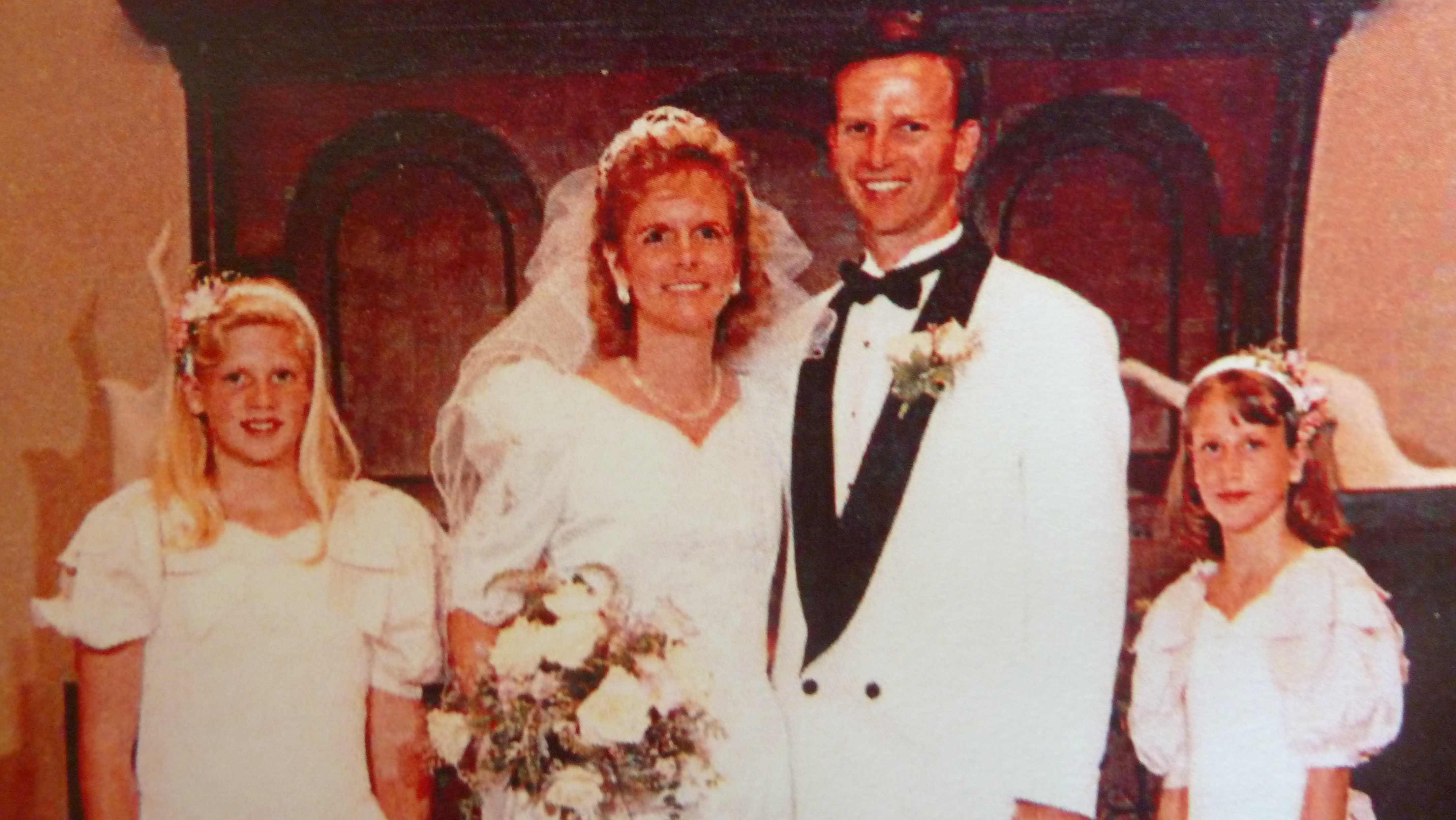
Janelle, Chris, Steve, and Michelle.
God, in his wisdom, had provided a readymade step-mom for Janelle; someone who was saddened, but not devastated, by Cindy’s and Michelle’s deaths; someone who could mother a grieving child and love a distraught father. Chris was God’s greatest gift of grace to me and to Janelle. Without her love and support I don’t think I could have made it through the darkness of the long nights which followed the accident. In the midst of Janelle’s turbulent teenage years, Chris hung in with us and helped us make it through.
For her love and God’s grace I am ever thankful.
BIO:

Steve Carpenter is MennoMedia’s Director of Development. He grew up in a Presbyterian home but embraced the Mennonite faith in 1997 after a twenty year career in the United States Coast Guard. Steve and his wife Christine, a nurse, live in Harrisonburg, VA where he served for more than eight years as Virginia Mennonite Conference Coordinator. Steve is a graduate of the Coast Guard Academy, BS; Tulane University, MBA; and Eastern Mennonite Seminary, MAR; where his thesis explored Mennonites and Media. Their daughter Janelle lives with her husband John in Washington D.C.
More stories like this: This story and 49 more like it can be found in the new book, Fifty Shades of Grace: Stories of Inspiration and Promise. It is easy reading and inspirational—a great Mother’s day gift or for birthdays, anniversaries, personal devotional, or a book to share with a friend or relative. A 30 percent discount is available until May 1, making the book just $9.09 plus shipping. You can also watch a trailer for the book here and find a news release here.
Beginning today, Finding Harmony Blog will feature five guest posts all week as excerpts from a just released book, Fifty Shades of Grace: Stories of Inspiration and Promise, published by Herald Press (April 17, 2013). I served as compiler/editor for the book and wrote about that process on Mennobytes blog. Today’s story is by Michelle Sinclair; her bio appears below. She also is my daughter but don’t hold that against her.
Guest post by Michelle Sinclair
Grace on Venomous Mountain
Cold mountaintop wind roared in my ears. The path through the snow had vanished, along with visibility beyond forty feet. I had no map, no compass, and no idea where the two-thousand foot cliffs I was supposed to be avoiding were lurking.
My sister Doreen had gone to Scotland for her study abroad experience and I went to visit her on her spring break. We thought it would be cool to hike Ben Nevis, the 4,409-foot highest peak in the British Isles. We figured it would be a bit of a trek, but we enjoy hiking, and Scotland’s not Nepal, right?

Without doing any real research, I learned Ben Nevis is the most popular Munro—the elite club of Scottish peaks higher than 3,000 feet—and attracts a wide variety of goers. One website claims the round trip takes five hours for experienced “Munro baggers.” (A “Munro” is any summit in Scotland that’s over is a summit over 3,000 feet, or 914.4 meters.) That’s about eight hours for the rest of us.
Our solution? Leave early in the morning and take our time. I read somewhere that it could be dangerous, but so long as we stuck to the trail, I figured we’d survive. That was supposed to be a figure of speech.
We checked into a hikers’ hostel in the nearby town of Fort William, where a staff member took one look at us and handed us a Ben Nevis survival pamphlet. We barely skimmed it, figuring this was just one of those overly cautious things they had to do to avoid being sued. But this was Scotland, not the U.S., and even though you don’t need oxygen tanks or belaying experience to reach the summit, its seeming mild nature and the cliffs on three sides are what make the Beinn Nibheis, or “Venomous Mountain,” so dangerous.
On a brisk April morning, we set out at 8 a.m. in jeans, tennis shoes (her), and cheap hiking boots (me). We enjoyed the scenery and the gradual climb. Grazing sheep probably laughed at our huffing and puffing. Other hikers all seemed to have maps and serious mountain gear, and as we ascended higher, we began to have doubts. Very few trees dotted the scrubby brown landscape—an enormous change from the lush Appalachians I knew from home. Above our heads, the overcast sky hid the peak from view.
After a lunch of sandwiches, we had one banana left and less than a bottle of water. We entered the cloud, and as the valley below vanished, our world narrowed to an unstable path of rocks winding around the mountainside. To our surprise, we started seeing patches of snow. It went from being a novelty to a nuisance to an expanse of white with nothing to mark the trail but a row of footprints. At that point, the safe, smart choice would have been to turn back, but we had been hiking for four hours and I wanted my view. We pressed on.
Until the footprints scattered—and with them, our path. Black rocks dotted the precipitous slope ahead. In the distance, gray fog and snow merged. Those cliffs had to be nearby. Some people with spiked trekking poles climbed straight up the steep hillside, while others walked to the right. But which was the safest route for two inexperienced hikers in jeans and tennis shoes?
Our careless pride had gotten us in this situation, but it certainly wasn’t going to get us out of it. I tucked my proverbial tail between my legs and asked a friendly caravan of Irish hikers which way we should go. These angels in insulated pants didn’t just point the way—they shared their trekking poles and welcomed us into their group. Of course they went straight up the incline, so with the help of the poles, we jammed our toes into the crusty surface and kept up the best we could.
The sharp wind drowned our voices. Bits of sky flashed through the wisps of clouds.
Then my heart beat hard as a low stone structure emerged through the distant fog. The summit! We’d made it!
Our mouths hanging open, we raced across the snow, fumbling in our coat pockets for our cameras. The cloud rushed overhead, unfurling the vista in maddeningly brief glimpses. We laughed with our heads tilted back, drinking in the day’s first blue sky until—at last—the fog cleared the summit and completely rolled away. Thanks to our saviors of the day, we were granted grace to make it to the top.
I don’t regret hiking Ben Nevis, but I do regret treating it like a Sunday afternoon hike. With the wealth of information at our fingertips, we had no excuse for going into an unfamiliar situation without doing proper research. Never again will I assume that warnings are just lawsuit avoidance and that I—in all my lofty self-reliance—can handle anything on my own.
But I’ll still get out there, to see God’s creation in all its varied splendor, because for the rest of my life I will see those majestic glens and ridges of Scotland laid bare before my eyes. I will remember the feeling that followed, when the field of white poured across the sky below the peak, leaving me uncovered, higher than the clouds, higher than the other mountaintops jutting through the mist. Forget Everest or McKinley—I was on top of the world. And I was newly thankful for the grace to survive a hike by the unprepared.


BIO: Michelle D. Sinclair is an account executive in the advertising department of The Washington Post and attends Northern Virginia Mennonite Church. She also writes monthly movie reviews for Third Way Café’s (website) Media Matters, as well as guest columns for the Another Way newspaper column. In her spare time, she enjoys writing young adult novels, spending time with her husband Brian, and playing with their cat, Josie.
More stories like this: This story and 49 more like it can be found in the new book, Fifty Shades of Grace: Stories of Inspiration and Promise. It is easy reading and inspirational—a great Mother’s day gift or for birthdays, anniversaries, personal devotional, or a book to share with a friend or relative. A 30 percent discount is available until May 1, making the book just $9.09 plus shipping. You can also watch a trailer for the book here and find a news release here.
I received an email the other day that did a mother/author’s heart much good.
“Just wanted to let you know that your book came in handy last night,” wrote my youngest daughter. “I went to eat what I had left of a French baguette roll (bought Friday) and it was rock hard. Not surprising. So I thought the best way to save it would be to make a French toast casserole out of it and I used the Christmas morning recipe [from Whatever Happened to Dinner: Recipes and Reflections for Family Mealtime.]
“I didn’t have enough bread for a whole 9 x13 pan full so I basically halved the recipe and made a pie size dish of it. It soaked overnight and while the oven re-hardened the bread on top [as it baked] it was nice and soft on the bottom and at least edible and pretty darn good flavor-wise if I do say so myself. Instead of chopped pecans I was at the bottom of a walnut bag anyway and used all of those crumbs up! Good way to ‘clean out the fridge.’ Nothing went to waste and now I have leftovers for the next two mornings!”

I was very proud of Doreen’s improvisation and thrifty desire to not waste food, especially on a graduate student’s limited budget.
Here’s the original recipe as shared by Jodi Nisly Hertzler, just as good in April for a Saturday morning breakfast, but that you need to prepare the night before. Hence my usual “Saturday Bake Something” post on Friday. Or halve the recipe like Doreen did.

Doreen in her element–as a grad student studying urban ecology.
P.S. The first time Doreen made this for us at home we purchased the challah (traditional Jewish) bread to use in the recipe, which Jodi mentions in the recipe instructions below. It is a slightly sweeter bread made with eggs which goes well with the French toast idea. But French bread is usually cheaper and easier to find.
And P. P. S. S., the Whatever Happened to Dinner book is on sale for 30 percent off until May 8, in time for Mother’s day. See bottom of recipe.
Christmas Morning French Toast
Jodi Nisly Hertzler
This dish is a specialty of a bed and breakfast that my husband and I visited when we lived in Oregon. We returned the following year, and I requested the same dish—it was that good. Rich and decadent, it’s perfect for a holiday brunch. Even better, it’s deceptively simple, and all the preparation is done the evening before, so all you have to do is pop it in the oven the next morning. I strongly recommend using challah in this dish, if you can find it. Option: Leave out the nuts and fruit for a simpler dish—that’s how it was originally served to me.
1 stick (½ cup) unsalted butter
1 cup / 250 ml packed brown sugar
2 tablespoons corn syrup
1 cup / 250 ml pecans, chopped fairly fine
½ cup / 125 ml dried cranberries
½ large Granny Smith apple, diced
1 loaf French bread, challah, baguette, or round country-style bread
5 large eggs
1½ cup / 375 ml half-and-half
2 teaspoons vanilla
¼ teaspoon salt
In a small, heavy saucepan, melt butter with brown sugar and corn syrup over moderate heat, stirring until smooth. Add the nuts, cranberries, and apples, and stir to coat. Pour into a 9×13 baking dish.
Cut ½-inch thick slices of bread and arrange them in one layer in the baking dish, squeezing them slightly to fit. (Alternatively, divide everything into 6 separate ramekins—small ceramic or glass serving bowls—and bake individual servings.)
In a bowl, whisk together the eggs, half-and-half, vanilla, and salt until well combined, and pour evenly over the bread. Refrigerate at least 8 hours and up to one day.
Preheat oven to 350° F/ 180° C and bring bread to room temperature. Bake uncovered, in middle of oven until puffed and edges are golden, 35–40 minutes. Makes 6–8 servings.
From Whatever Happened to Dinner: Recipes and Reflections for Family Mealtime, Herald Press, 2010.
Beginning April 22, Finding Harmony Blog will feature five guest posts as excerpts from a new book, Fifty Shades of Grace: Stories of Inspiration and Promise, published by Herald Press (April 17, 2013), for which I served as managing editor. I wrote about that process on the Mennobytes blog in February.
There is a woman in our town who many of us have spoken of, that we see her walking, always walking, like she’s going somewhere and not just meandering. The curious thing is that she carries a small bag or two (not a big bag like a bag woman) and always one of those Mexican blankets kind of thrown over her arm. She appears to be a fairly middle class woman with a pleasant look on her face like she is just walking somewhere and enjoys it. She must walk miles every day. Maybe she is walking too and from work. Maybe just for exercise. Maybe like Forrest Gump.
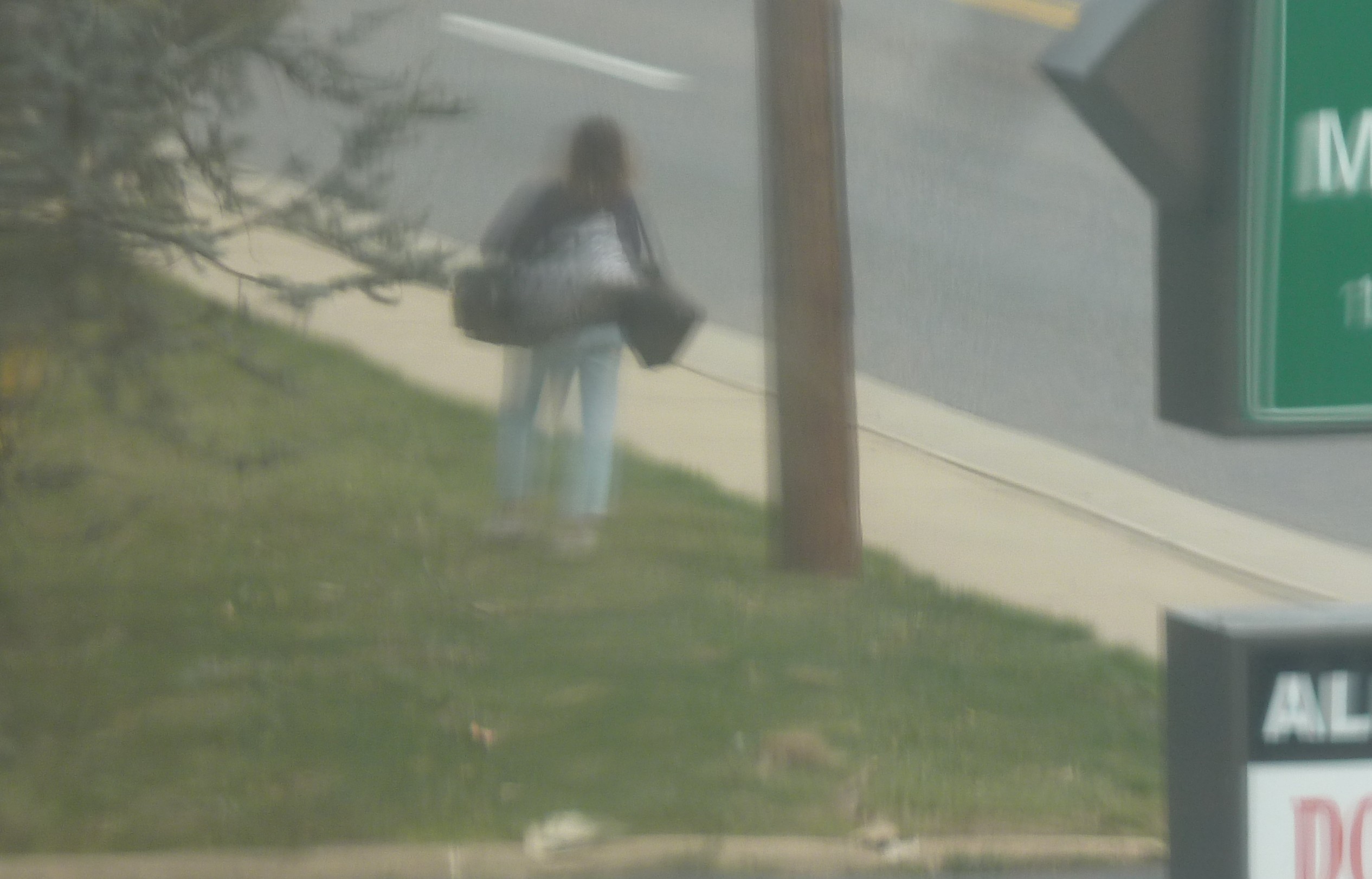
She passed our office again the other day and I grabbed my camera before she got completely out of sight. I’m glad my picture is a little fuzzy and from the back, because no one could every positively identify her from it. I didn’t ask permission to “take” this woman’s photo. I once heard marvelous photographer Howard Zehr talk about his philosophy and approach to photographing people and how he always (I think he used that word) gets permission or else it is truly “taking” something from that person to steal their image. He talks about the need to build community with our image taking. I hope I am trying to do that here–and not just be nosy.
Most small towns have certain people who make the rounds and cause our curiosity meters to zoom. Who is this woman, does she have a job, a home?
Maybe someone local will fill me in. Maybe sometime when I am out walking I’ll cross paths with her and be able to ask her my burning questions that are maybe no one’s business but her own. Or is she our business? Should I care?
Given the events in Boston this week, I’m reminded that we are all on this planet together and other people’s business is our business. If we see abandoned packages, we’re supposed to call numbers in subways. If we see strange people doing strange things, we’re supposed to speak up.
I’m sure this woman is just a normal woman who enjoys walking and saving gas (maybe people wonder about me walking on my lunch hour frequently). Can anyone enlighten me? Us? Do you care about such things? Should I take my nosy journalism nose and write about something else?
Are there persons you wonder about in your town?
My husband says he could eat chicken five days a week, but I like variety and hunt for new ways to fix it. Is there any more versatile meat available to us? I think he would be happy to just rotate between fried, roasted, and barbecued, but I love it in chicken salad, soup (I have a great Brunswick Stew recipe I’ll share sometime), white chili that my son-in-law introduced to us, tacos, burritos, enchiladas, fajitas, chicken alfredo, a chicken/cheese/broccoli casserole, paella (with more chicken than seafood in it for my tastes), curry, chicken & rice endless variations, … shall I go on?
Huffpost says we in North America (technically they said “America” but perhaps it is true north of the border too?) “buy chicken more than any other food” and that has only increased as fewer of us eat as much red meat.
I confess I’m not as versatile or experienced of cook as I’d like to be (happens when you try to keep harmony in a family who would sooner eat the same old stuff than branch out very much) so when I saw, in the spice aisle, a “Recipe Inspirations” gimmick with pre-measured spices and recipe card for Chicken Marsala I thought it was actually an Indian dish, a variation of a curry. (Obviously didn’t check the ingredients too thoroughly: no curry, and the Marsala, I learned comes from the Italian wine you add (I used an Italian cooking wine.)

But it was delish just the same and you probably have all of the ingredients in your cupboard already, except maybe the Marsala, and yes, you can substitute any other cooking wine (or sherry I suppose) but as one picky person online pointed out, then it isn’t really chicken Marsala. But, I’m a substituter so, who really cares about that? When you live eight miles from town, you make do. But if you haven’t gotten your groceries yet, you may want to try this for a fairly quick and easy Saturday night or Sunday dinner. Monday is good too! I’ve added some variations from the card.
Oh. The husband? He pronounced it “not bad.” That’s a score.
What is your favorite way (or newest favorite) to make chicken?
Chicken Marsala (adapted from McCormick Recipe Inspirations card) Prep time 10 minutes; cook time about 20 minutes.
Ingredients
1/3 c. flour
1 tsp. salt
6 thinly sliced boneless skinless chicken breasts (I took tenders and cross sliced them to about 3/8 inch thick)
3 tb. butter, divided
2 tb. olive oil
2 or 3 large sliced mushrooms
½ c. chicken broth
¾ cup Marsala cooking wine
1 tsp. minced garlic (or one clove minced and sautéed)
1 tsp. marjoram leaves
1 tsp. minced onions
½ tsp. black pepper
2 tsp. basil
3/4 tsp. parsley flakes (fresh or dried, optional)
- Mix flour, marjoram, minced (dry) onions, salt and pepper in shallow dish. Keep 1 tb. of the flour mixture back for later. Coat chicken with remaining flour mixture.
- Heat 2 tb. of the butter and oil in large nonstick skillet on medium high heat. Sauté minced garlic. Cook chicken pieces about 4-5 minutes per side or until golden brown. Remove from skillet. Keep warm. Add mushrooms to skillet; brown and stir 5 minutes until tender.
- Mix broth and reserved flour mixture in small shaker (the sauce ends up being pretty thin; if you like it thicker, add more flour). Add to skillet, stir; also add wine. Bring to boil, stir so that brown bits of floury chicken coating are mixed in, like you’re making gravy. Stir in remaining 1 tbsp butter and basil. Cook 2 minutes or until sauce is slightly thickened. Spoon sauce over chicken to serve. Sprinkle with parsley if desired.

Slice breast pieces very thin to cook faster.
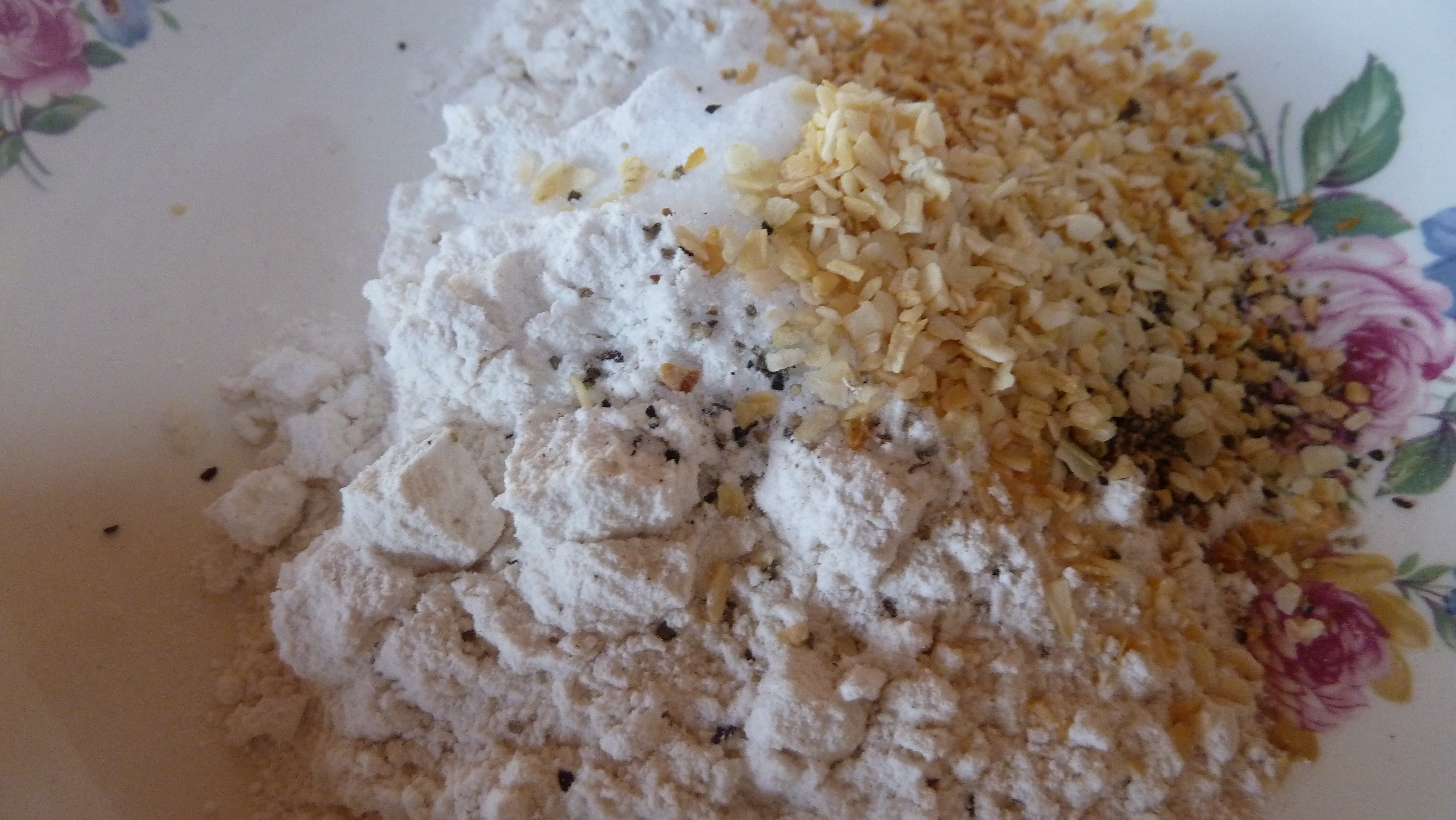
Dredge chicken pieces through flour and spice mixture.

Saute 5-6 minutes on each side or until golden brown.

Remove chicken or move to one side and saute mushrooms.

Add flour and broth mixture you have shaken, and bring to a boil.
Enjoy: rice or pasta make a nice side, missing here! We actually had leftover fried potatoes with it.
Reblogged from Mennobytes.com blog 4/13/2013
I will never forget the comment of my “little sister” as we were browsing the aisles of the religious bookstore at the mall one day back in the late ’70s. As I write this now, I’m thinking, wow, I can remember when we had two great religious bookstores in town, including one at the mall.
Barbara was a quiet girl from a low income home and I enjoyed knowing her through our city’s fledgling Big Brother/Big Sister program at the time. So her comment in the bookstore was all that more unusual. She asked, looking at the Bibles in the store, “You mean they sell Bibles?” I assured her yes, but probed a bit and learned the basis of her question was some disillusionment with the idea that someone was making money selling God’s word. Her assumption also came from the fact that she had received one free from the Salvation Army. But I had to wonder if she somehow sensed it felt a little crass.
So I had the same feeling recently looking at our MennoMedia sales report that frequently puts Martyrs Mirror in our “Top Ten” in sales. Part of my paycheck at this point in life comes from the blood and suffering of my theological ancestors. Interestingly, the Old Order Amish are the biggest purchasers of Martyrs Mirror.

- Copies of Martyrs Mirror on the shelves in MennoMedia’s warehouse.

At MennoMedia, we are grateful for those who purchase this grand old (and deeply moving) text and also those who purchase our Bibles (we sell some created by other publishers), and also all those who purchase cookbooks, (which some customers might consider frivolous or a waste of our time and resources, or maybe reinforcing impressions that to be Mennonite you need to eat or cook certain foods!), hymnals, children’s books, curriculum for all ages, magazines, DVDs, CDs, downloadable video clips, and more.

- Amy Gingerich, Editorial Director at MennoMedia is all smiles upon receiving the just published Mennonite Girls Can Cook Celebrations.

The newest Herald Press cookbook, Mennonite Girls Can Cook Celebrations, is now in the warehouse and we are obviously excited and pulling out all the stops to help sell this book. Early photos of the book on Facebook got at least one comment along the lines of “well good, now you can get back to providing more meaty content” (not exact quote, and I believe it has been removed).
An unapologetic strength of MennoMedia is in the area of “food and faith” and this book fits with that, especially the celebrative aspect. MennoMedia and Herald Press publish many crucial books on theology, Mennonite history, biography and church curricula. These are resources that are essential to keeping any faith group alive and well. But even cookbooks or the authors, convey practical theology.
While not every author or group of authors can do this, the women behind the popular blog and cookbook phenomenon known as “Mennonite Girls” are providing an outstanding example of Christian stewardship, sharing and service by donating all royalties to Mennonite Central Committee projects (so far in two locations, Russia for their first book, see photo, and Africa for this new release).

- A functioning greenhouse helps provide food for the 40 children from Good Shepherd Shelter (orphanage) as well as children from poor families in the surrounding area near Makeevka, Ukraine.

While the cooking and underlying message of the two Mennonite Girls Can Cook books so far are a little different than More with Less, or Simply in Season, the MennoMedia umbrella is wide enough to embrace a variety of cooks, authors, churches, communities and peoples. The original and continuing subtitle for More with Less: Suggestions by Mennonites on How to Eat Better and Consume Less of the World’s Limited Food Resources gives a hint at the theology it supports. As the “Who are the Mennonites” video/DVD (see short clip) says of the legacy of More with Less cookbook, “The ideas in this cookbook went well beyond the kitchen. Sure, thousands of us learned simple recipes, nutrition, and stir frying from its pages, but it also summarized our theology and conviction.”
A wide umbrella at MennoMedia. We look forward to the day when, who knows, there is a Mennonite Truck Food cookbook or Mennonite Soul Food cookbook or … name your poison! But I personally will quit when we come out with a Mennonite Happy Hour Cocktail guide.
P.S. Not to be crass, but if you are frugal, you may want to take advantage of the 30 % off sale on all Mennonite cookbooks including pre-ordering this newest Mennonite Girls Can Cook Celebrations until May 8. Thanks!

The first check I ever received for writing happened in high school. I got a check for $10. That was a lot of money in those days, as old people say. I was used to getting paid a penny a flat for gathering eggs. I was hooked.
It was the late 60s and our denominational magazine for Mennonite youth, WITH, had a writing contest and I submitted a poem and it was published. Here it is (the creative layout was the designer’s idea, not mine).

(Blow up the photo to read the text)
The editor of WITH at that time was Richard Kauffman, who went on to edit a series of Mennonite magazines and ended up as book review and senior editor at Christian Century. So I “knew” him back when. He keeps a very active Facebook feed which I enjoy and where we occasionally interact.
And my husband and I still have cats as you can see by my collection of cat photos. In fact, the “editor on my shoulder” is my boy Riley (all white Himalayan), who loves to watch me compose blogs and respond to manuscripts sitting on top of the printer in my home office.



Cats still cause me to ponder life, and their ways and our ways. I wonder if any magazine editor today would give my cat poem a second look. As an editor myself, we keep a blanket policy of never publishing poetry, to save ourselves from looking at “drivel,” as my creative writing teacher, Omar Eby, used to sniff about bad poetry.
That policy is kind of snobbish, I admit, but after trying unsuccessfully to market a collection of poetry (from other writers) called Heart to Heart Poetry Album II (because Mennonite Broadcasts, Inc., the name of my employer then, had first published Heart To Heart Poetry Album which sold tens of thousands of copies), we eventually dropped the project deciding that there was no longer a market for that kind of poetry. I sometimes think that too many readers have been put off too many times by hard-to-understand poetry, or turned off by overly sentimental and poorly rhyming stuff that is real in emotion but not polished in verse.
My own attempts at writing poetry came to a halt when I realized the same sentiments expressed in poetry could often be turned into prose and more people would read it (and buy it). I once illustrated this at a reading I gave to a poetry/writing group (with a lot of wanna be authors) in which I emphasized, perhaps not too astutely, that they may be able to find a market for their poetry by rewriting it as prose. I illustrated this by reading from my first book, On Troublesome Creek, which was built on journal entries written during a year of Voluntary Service in Kentucky; many of my journal entries were written in the typical style of a 19-year-old wanna be writer: quasi-poetry.
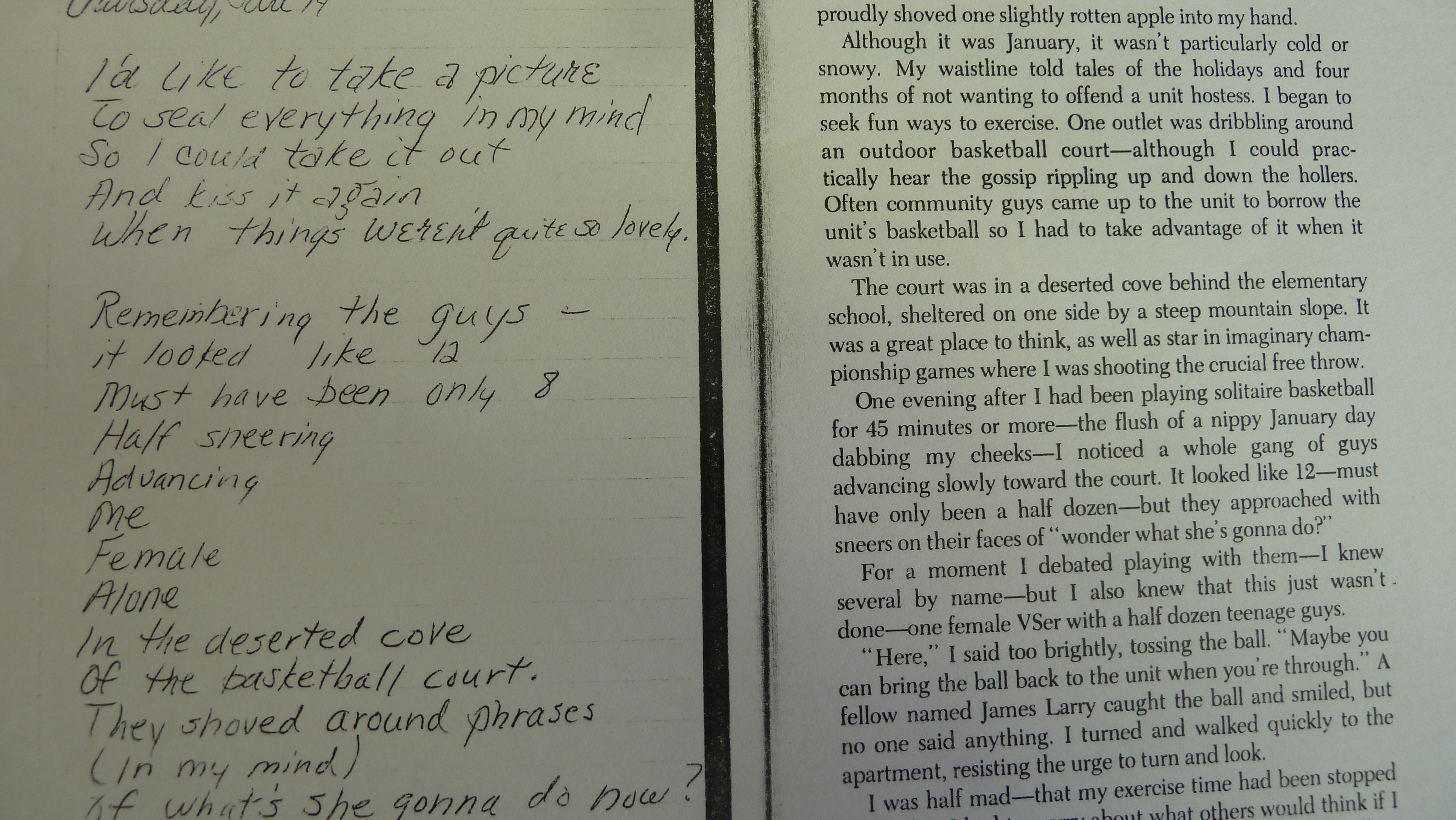

A page from my original Kentucky journal of “quasi” poetry, side by side with a comparable page in my first book, published by Herald Press.
This of course was heresy to a true poet, and there were a few really good writers/poets in that group. Juanita informed me it was a good thing I’d forsaken poetry because my “poetry” was better as prose.
Stung but not demoralized, I have not made a serious attempt at poetry since. And I forgave her when Juanita became a member of my church and I learned she was always outspoken about things.
***
If you are a fellow writer, what was your first time (being published)? Do you enjoy poetry? Do you buy it?
My heart, my mother’s heart, goes out to the Rick Warren family who son died by suicide last week. That people could even think of posting heartless and cruel judgments on blogs, Facebook pages, etc. is despicable. With a 27-year-old daughter myself, the pain would be unthinkable at any age. We weep with the Warrens and pray healing and consolation in due time.
For Christians who still haven’t wrapped their heads around the major cause of suicide being mental illness, I can only hope more people will be educated and wake up to that reality. My own education came about through work on the Fierce Goodbye documentary by Mennonite Media several years ago; the documentary aired as recently as this past December on ABC-TV prompting, again, callers in much the same shoes as the Warrens.
I went back and found “production notes” from when our team worked on this ground breaking program. I don’t think that’s hyperbole, because for many of us on the team and many viewers, it was the first time we really came to grips with up-to-date thelogical positions on suicide and getting past the stigma that many still associate with suicide. At the time, not a little unharmony was unleashed when mental illness advocacy groups at first protested the Fierce Goodbye program to Hallmark Channel (who aired it first) fearing it would continue misguided or outdated views on suicide. We did some more editing; in its final edit, the documentary still conveys the Orthodox church’s position on suicide, but offers more pastoral and enlightened views from other religious denominations. That’s what documentaries are for, to present a variety of viewpoints.
For those of us who had the oportunity to interview and learn from families who have endured this pain, the education was long-lasting and helpful as we’ve lived through our own encounters of loss and grief among family and friends. I pray that will happen for the Warrens as well, and their official email release on the topic is a witness to their long journey with the mental illness of their son.
For a trailer, see here, or for more information on this Mennonite-produced documentary, check here.![fred_and_gail[1]](https://findingharmonyblog.com/wp-content/uploads/2013/04/fred_and_gail1.jpg)
Fred and Gail Fox, one of the families in the documentary from our local community, continue to make themselves available to help other families dealing with the grief of suicide.
Like many Mennonite* girls who got married in the 70s, one of my favorite wedding presents was More with Less Cookbook. We got married the year it was first published, 1976, when it quickly became a kind of cult classic, on its way to best seller status.

Valerie Weaver-Zercher says the way you can find your favorite recipe in any book (or recipe box for that matter) is look for the page(s) that have the most stains or grease marks on them.
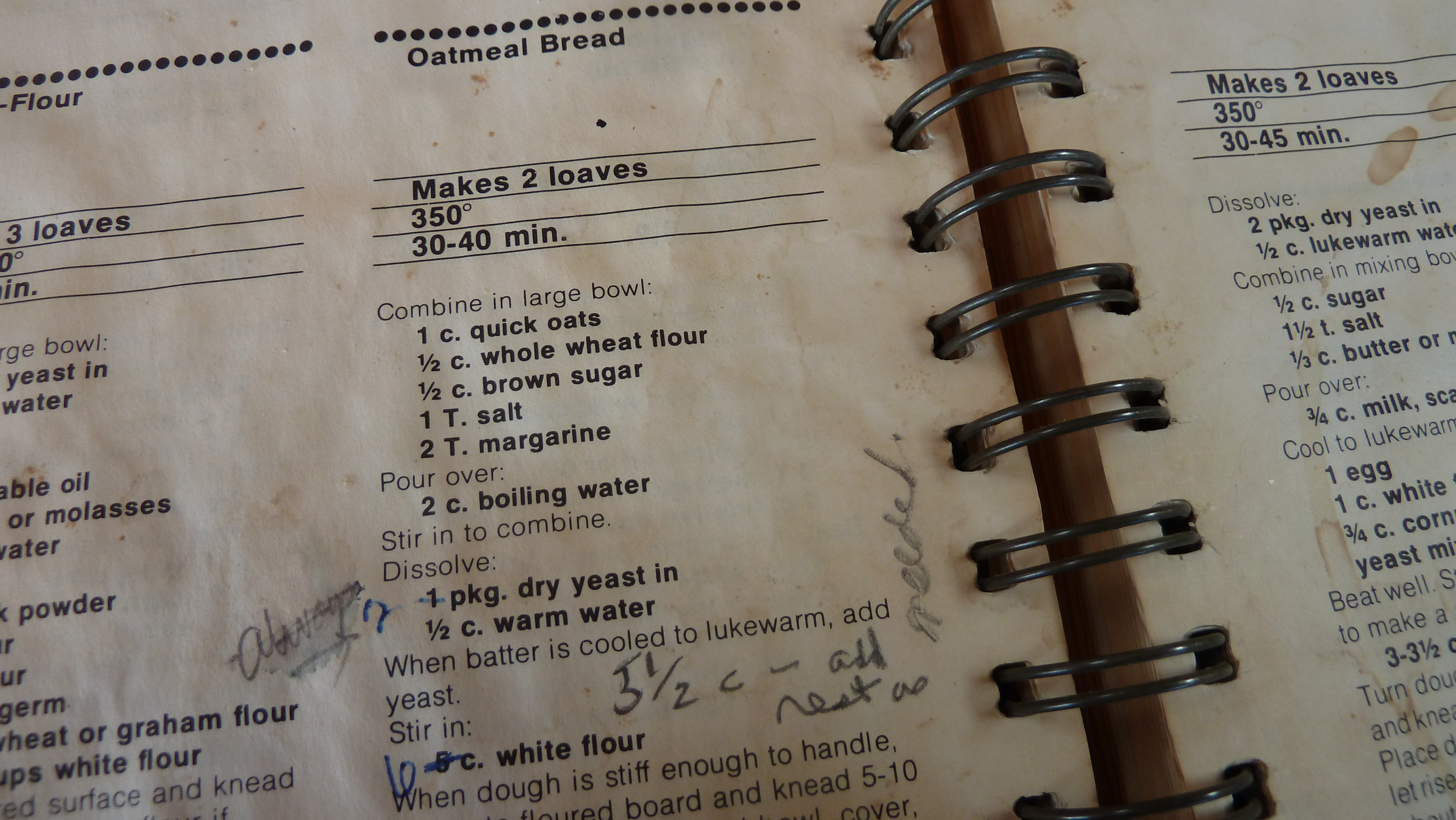
So it’s not hard to find my family’s all time favorite bread recipe in More With Less, oatmeal bread. I look for the messiest page.
(Valerie just published The Thrill of the Chaste: The Allure of Amish Romance Novels and is currently compiling a new version of one of the follow-up cookbooks in the Herald Press World Community Cookbook series, Extending the Table.)
I began baking this oatmeal bread when the children were all small; eventually my youngest daughter Doreen took over the bread baking to the point where the adaption I included in my book, Whatever Happened to Dinner: Recipes and Reflection for Family Mealtime is called “Doreen’s Oatmeal Bread.” We added a whole packet of yeast to the original recipe and some flour, but of course the genius of the bread comes straight from the heart of More with Less with its wonderful combination of three grains or forms of flour: oats, whole wheat flour, and regular flour. And hands down, Doreen forms a much nicer loaf than I can manage, so that’s why she earned the moniker on the recipe (and I’m sorry she didn’t form the loaves for this pictorial!)
Even if you’ve never baked bread, this is a fairly easy recipe and I’ll let the recipe and pictures tell the rest of the story.
Doreen’s Oatmeal Bread (adapted from More with Less Cookbook). This version appears in Whatever Happened to Dinner (see special offer below)
Combine in large bowl:
1 cup / 250 ml quick oats
½ cup / 125 ml whole wheat flour
½ cup / 125 ml brown sugar
1 tablespoon salt
2 tablespoons butter or margarine
Pour 2 cups / 500 ml boiling water over mixture in bowl.

Separately dissolve:
2 packages dry yeast in
½ cup / 125 ml warm water
When batter is cooled to lukewarm, add the yeast mixture to the batter. Then, gradually, stir in 5½ cups / 1.4 L ml white flour (you’ll probably add another ½ cup / 125 ml in kneading).
When dough is stiff, turn onto a floured board and knead by hand 5–10 minutes.


Place dough in greased bowl, cover, and let rise until doubled, below. Takes a good hour. (I find that putting it on my stove top, under the hood light which creates a little heat, is usually a nice warm place.)

Punch down and let rise again, about one hour.
When done rising, punch down, divide dough into two lumps, and shape each one into a loaf. This is how we do it. (And if you want, save a small wad of dough like we do to make a tiny loaf for tasting!)


Turn over the lump you have shaped so that the smooth side is up. (See loaves below) Place in greased 9x5x3-inch pans. Let rise again, about 30 minutes. The baby loaf is what we always set aside for early samples from the oven!


Bake at 350° F/ 180° C for 25–30 minutes. Brush baked loaves with butter or margarine for a soft crust. Allow to cool.

Suggestion: For a little added nutrition, you can substitute some or all whole wheat flour for the white flour. If you substitute more than half, the bread will have a denser texture, and you may need less flour, but the result is still tasty.

Slice and enjoy. My first taste, spread with real butter, is just bliss.
If you own the More with Less Cookbook, when and how did you get your first copy??? I’d love to hear. Comment below.
***
Sale. From now until May 8, 2013, all Herald Press cookbooks, including mine and More with Less Cookbook, are on sale for 30 % off. Stock up for wedding gifts and showers! And to take a sneak peek inside the new Mennonite Girls Can Cook Celebrations Cookbook, check it out on Amazon.
Special recipe-by-email offer: Become one of my “adopted children”: When my daughters want to use a recipe from Whatever Happened to Dinner but find it hard to make the book stay open to the recipe, they ask me to email them the recipe (from the electronic files I have) which they can then print out or bring up on a smart phone/notebook. If you purchase (or already have) a copy of Whatever Happen to Dinner, I will be happy to email you any recipe from my book. Just be in touch. If you comment below or sign up to receive blog posts, I’ll have your email.
***
*Footnote about my faith roots: I was Mennonite at the time, married a Lutheran, and we eventually joined a house church based congregation, Trinity Presbyterian, founded on the principles of Church of the Savior in Washington, D.C., whose beloved founder, Gordon Cosby, recently died.

 findingharmonyblog