
The Pastor Who Married Us
The Pastor Who Married Us
When my husband and I began to date (my senior year in college, 1975), he was open to moving away from his Lutheran church and upbringing, and me moving away from my Mennonite upbringing.
So we tried out a church I had heard about. It was a church called Trinity Presbyterian which met in an old house, which dated back to Civil war times, and contained a beautiful antebellum home (mansions built in the south prior to the Civil War, approximately 1825). I don’t know much about the history but it had beautiful fireplaces in various parts of the large brick home. Instead of razing the old house, a committee of the organizing Presbytery suggested remodeling it to serve as a temporary sanctuary until a larger, permanent church could be built. They decided to see what it “might be like to begin a church from the ground up. It had been deserted for three years and the lawn was grown high with weeds. The new group began meeting regularly on Wednesday evenings to scrub, paint, and repair, as well as to discuss, sing, and share.” (Longterm member Pat Churchman wrote most of this description, who died a few years ago.)
That developing congregation traveled to Washington DC to visit “Church of the Saviour,” and studied books on the mission of the church. They chose to make Trinity a mission-oriented congregation in Harrisonburg, Va. which focused on small-group life. Four house churches eventually were organized with 8 member leaders. I had heard a little about this kind of different church and suggested to my boyfriend, Stuart, that we check it out.
We began attending. At that time active “house churches” or small groups met often including Sunday mornings when each house church planned their own service as they met in homes. They participated in outreach avenues, such as visiting a nearby prison once a month. Like early disciples did in the Bible! This was a brainchild of our long-term pastor there, Don Allen, who deeply influenced us, and finally married us in 1976!
Five years later he moved to Washington D.C. for some 15 years to experience life among church goers in his district. Then he and his wife, Betty, moved back to Harrisonburg for retirement. Trinity organized a coffee house for many years called “The Marketplace” where there was lively discussion, quiet conversation, and sometimes solitary thought.”
As Pat wrote about the house church movement “many people were caught up in counter-culture, anti-establishment ways of looking at their culture. … Many of us were drawn to Trinity not just because it was non-traditional in many ways, but because we sensed a group of people challenged to be on mission, searching for authentic, meaningful[MD1] paths of service.”
In these recent years since about 2000, (of course many things have changed about the church meanwhile) and I have learned much from Don even though he was no longer an active pastor. But numerous members of various groups still met for conversation, checking in with each other on trials and adventures, studying a book or two, and sharing prayer. I appreciated commentary even if Don went into a long theological description with deep meaning. When he could no longer drive, I loved driving him and others who needed rides as we continued our tradition of meeting in homes as we could. In later years he was almost blind, but by george, he would always tell which street I needed to turn on.
Early in his ministry he wrote a book called “Barefoot in the Church” and when dear Don finally passed away at the age of 95 on a Sunday morning this July, his daughters and many friends kicked off their shoes to be barefoot like Don as a way of remembrance and communicating church renewal.
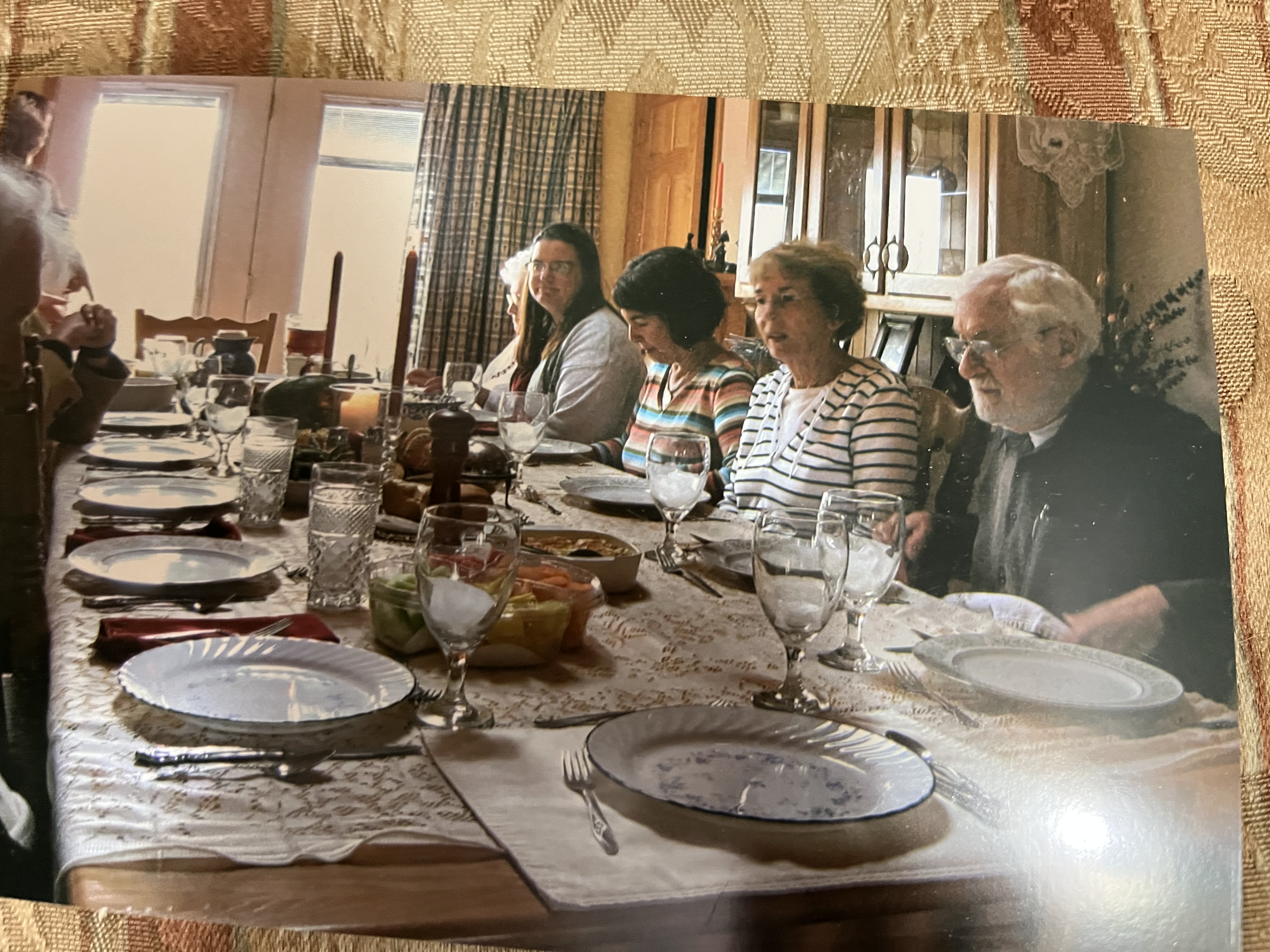
My other special memory is how every time we had a meeting in our home, he would exclaim about our long long dining table, and wished he had one that long. (Made by Amish in Indiana for us, seating at least 20.)
Don now sits at a table in eternity that will always be as lonnnnnng as God keeps it going, and we pray for persons of faith who will keep it going along the way, along with dozens and dozens of those who have passed on to their reward in the heavens.
Long may these remembrances remain. And we hope that this 200 year-old house—was God’s way of helping many many saints and sinners to find God’s love for us.


Thank you for this marvelous column. I wondered how you got connect at Trinity, and now I know. Your little church certainly does big things for the Harrisonburg community. Helping to finance the school backpack program for food insecure students in the city schools is just one example. Also, the writing group I belong to once met at your church. I loved that old building, and was told that ghosts have been seen in the upstairs area that overlooks the lower level. Im sure your congregation appreciates your services to the church.
Thanks for your comments!! Yes, the building has been special and yes, especially around Halloween, the ghosts used to bring out stories. Don himself used to tell those stories.
The school backpack program and many other programs have been a help. Interesting that you used to go to the writing group! I had forgotten that it existed–but yes, I remember it, I only went once or twice I guess because I had my own outlets for sharing stories etc. Bless you!
You are not the only Mennonite girl who became Presbyterian. (Chuckle!) Even married in a Presbyterian church in Charlotte, NC in 1967.
I’m glad your church values small groups and table fellowship as your photos demonstrate. All this is valuable to a church’s growth and vitality. This piece certainly belongs in your church’s archives. Great job, Melodie!
Yes, we have much in common, eh? (And interesting that my computer wasn’t working well, so frustrated with my not being able to remove that second photo … finally I decided to just let it go …
I’m glad you enjoyed the piece. Thank you so much.