

Another Way for week of December 20, 2019
What Mary Knew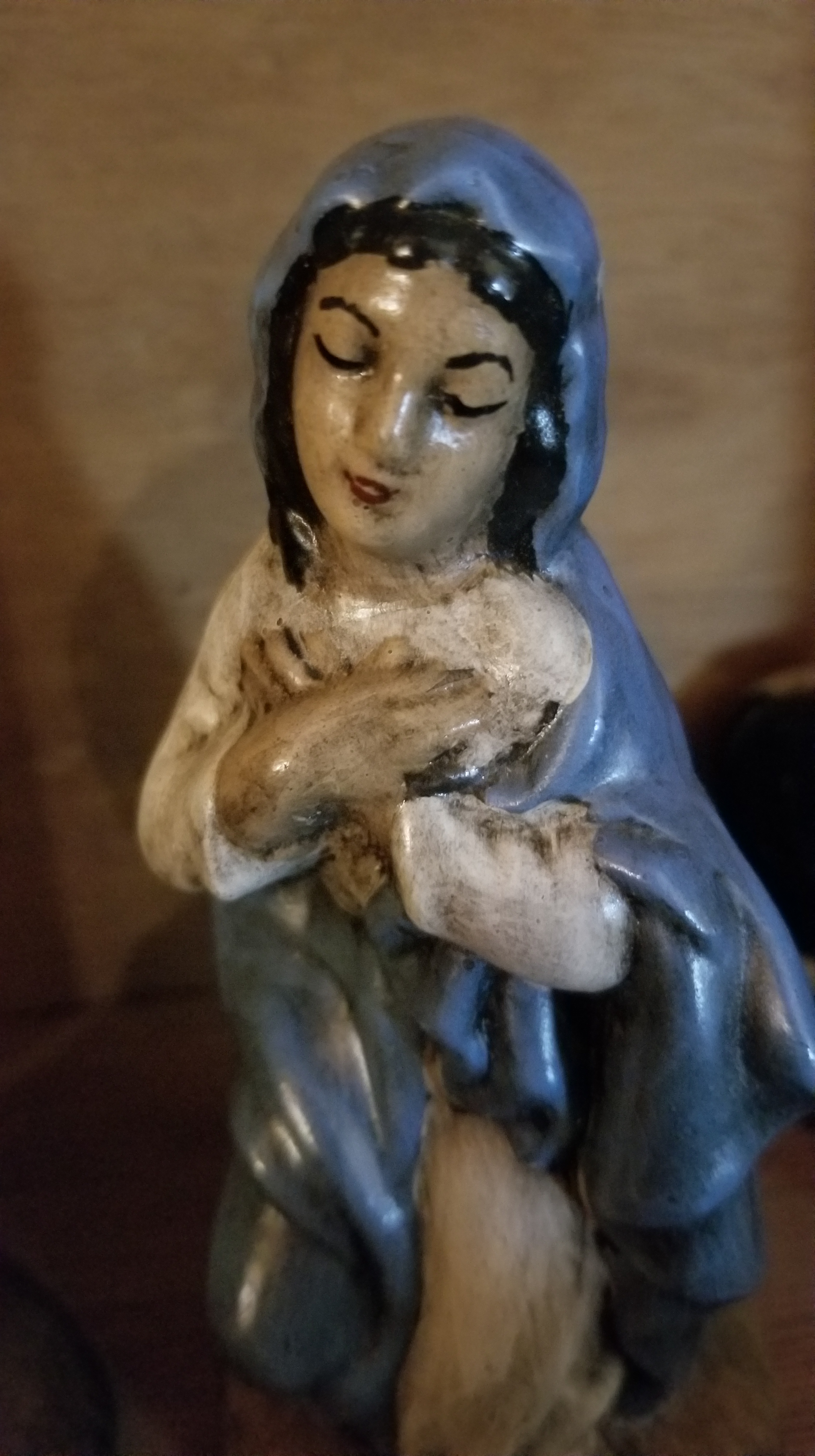
There’s a popular and haunting contemporary Christmas song, “Mary Did You Know?” which explores the future of Mary’s tiny baby. The lyrics mention things that Mary has no way of knowing while awaiting the birth of Jesus, such as did she know her baby would walk on water? Mary’s thoughts in this song focus on the miracles and servant posture that the future Jesus would adopt as he grew to be a man.
I’d like to explore the earthy reality of what Mary might have known about her pregnancy after the heavenly visitation she received announcing her dramatically changed future (found in the first chapter of Luke).
Mary, to say the least, was at first “greatly troubled” at the angel Gabriel’s revelation.
She knew that being pregnant and unwed in that time and era—was pretty much the end of her normal life, if not her actual life. She knew she could be stoned.
She knew that at the very least her betrothal to Joseph would be over. She knew he was a good man, but even good guys could hardly be expected to understand or deal with her out-of-this-world revelation.
She knew her family would likely disown her, making her flight to the home of a relative, Elizabeth, not surprising. Afterall, if her elderly relative was also with child, maybe it was really true as the angel said, “Nothing is impossible with God.”
Mary knew it would be extremely difficult to make a life for herself and the baby, and until Joseph’s own vision/dream/revelation occurred, she surely alternated between tears, depression, and wisps of hope.
She didn’t know how what the angel said about having a baby was even possible for her. We still don’t know.
Yet what did Mary do with this heavy announcement and knowledge? She rejoiced and sang a song of praise to her God. She was young, she was open to the spiritual, she may have been a bit of a mystic. She accepted the gift that God had given her as the Jewish mother of a special baby with an unknown future. What child was this to be?
As the days drew nearer for her to actually give birth, Mary must have been filled with frustration and anxiety about making the long journey to Bethlehem for the census. Where would they stay? Why did she have to go, anyway? Couldn’t Joseph just go? What would happen if the baby came—or was harmed— after such a jostling journey on a donkey’s back? We like to imagine that traveling with relatives as they likely did, she would have had female friends and family to help her, but the Luke passages do not indicate that.
She surely had no idea of what lay ahead for the baby or herself and Joseph. Her visit to Elizabeth, who was to become the mother of the prophet John the Baptist (a relative and close friend of Jesus) perhaps foreshadowed the destiny for both these men: their gruesome deaths at the hands of kings and conspirators.
You say why ruin the Christmas season with these dark realities? Far from ruining the holiday, Christians know it was this birth, life, and death that ensures eternal and joyous life with God for all those who seek to serve and follow Jesus. It is this birth (not Santa Claus) we remember and celebrate in the coming days.
We give gifts at Christmas to enter into the spirit of the great gifts God gave us when we were created and given life. May you have a meaningful, thoughtful, and blessed Christmas.
***
What stories, thoughts, or ideas does this bring to mind?
***
For a different interpretation of Mary, and some hilarious but devoutly faithful scenarios from the nativity, enjoy any of numerous videos from Ted & Company including some of the original actors: Ted, Lee and Ingrid. We were privileged to see most of this live one year.
***
A blessed Christmas to you.
Send thoughts or comments to anotherwaymedia@yahoo.com or Another Way Media, P.O. Box 363, Singers Glen, VA 22834.
Another Way is a column by Melodie Davis, in syndication since 1987. She is the author of nine books. Another Way columns are posted at FindingHarmonyBlog.com a week after newspaper publication.
 Another Way for week of Dec. 13, 2019
If Not Now, When?
Many of you have followed my embrace of retirement this year (officially crossed that bridge at the end of March). If you haven’t entered this wonderful stage, you have parents or grandparents who are there, are perhaps great grandparents who are (dare I be so bold as to imagine someone in her 20s reading this column?).
At any rate, I was getting ready for Thanksgiving and immensely enjoying all the preparations mainly because I had so much more time available to me: deep cleaning, washing and drying all china in the buffet, cooking all day on the big day and being almost giddy about it.
I was thinking about suitable festive dishes to use in putting food on the Thanksgiving table. I have plenty of great dishes, but somehow, I, along with you or your mother or father, grandmother or great grand have absorbed the perhaps old fashioned notion that you shouldn’t use the treasured antiques, dishes, or special household items for fear of breakage.
Of course no one wants to break a treasured dish that was passed down from your grandmother or mother or aunt, but where is the joy in not putting a beautiful piece of pottery or china to it’s intended use?
I have been saving, and using only very rarely, a beautiful handmade bowl that was presented to me on one of my work anniversaries—perhaps my 25th? It was a lovely blue-green serving bowl thrown by Dick Lehman, a well-known potter in Goshen, Indiana. Since I, myself, would never buy such a luxury, I do love the bowl. It makes me feel special and somehow wealthy just to admire or use it.
To have something special and beautiful and never share it with your friends or family is kind of a shame. If I don’t use it, will my daughters feel they should never use it either if it one day gets handed down to them? If not now here in the golden age of retirement when I still have enough energy and stamina to cook for a crowd and enjoy it, when? When will the bowl ever really get used?
So, happily I served a steaming hot bowl of mashed potatoes to those gathered around our table. No one particularly noticed it but they did enjoy and comment on the potatoes (kept hot by my newest cooking trick—make your mashed ‘taters before the last minute and keep them hot and fresh in your crockpot!). I think the thick pottery also helped to make a heat-holding cradle for our home grown potatoes.
Would I dare to use the gorgeous set of mid-century glassware we got from my husband’s dear aunt? What about the four tobacco jars passed down from a thrifty grandfather’s “chewing” habit? Will we bequeath those to our three daughters? Who should get the extra one? There won’t be enough to go around to the grandchildren, and anyway, who will care about their Great Grandpa Hottinger’s tobacco glasses by then?
Passing down knickknacks or beloved heirlooms is one way to try and preserve our life and heritage so that we will be remembered, isn’t it? The old rocking chair that I sit in as I type this on my laptop was my grandfather’s, who lived in the “daughty house” attached to our home (in-law quarters). In my mind’s eye I can see grandpa sitting in that chair in their sitting room that doubled as a bedroom. My Grandpa Miller would get up from his chair and wind his truly antique grandfather clock, passed down to him fro several generations, and we’d relish the sound of the chimes. I didn’t inherit the clock (it goes to the youngest sibling of a family), but I do love grandpa’s old rocking chair, even though it needs repair.
What about the more important things in life, that don’t break or fade away? Do we pass down the values that we cherish to our grandchildren? How do we help build a good foundation for them to thrive? These, of course are more vital and valuable than a lovely piece of pottery or china, or grandpa’s old saw or vise grip.
I’d love to hear your thoughts and stories regarding heirloom items.
***
Do your children or grandchildren seem to be interested in family keepsakes? Or not so much?
Comment here!
***
Send comments to anotherwaymedia@yahoo.com or Another Way Media, P.O. Box 363, Singers Glen, VA 22834.
Another Way is a column by Melodie Davis, in syndication since 1987. She is the author of nine books. Another Way columns are posted at FindingHarmonyBlog.com a week after newspaper publication.
Another Way for week of December 6, 2019
How Shall We Teach the Children?
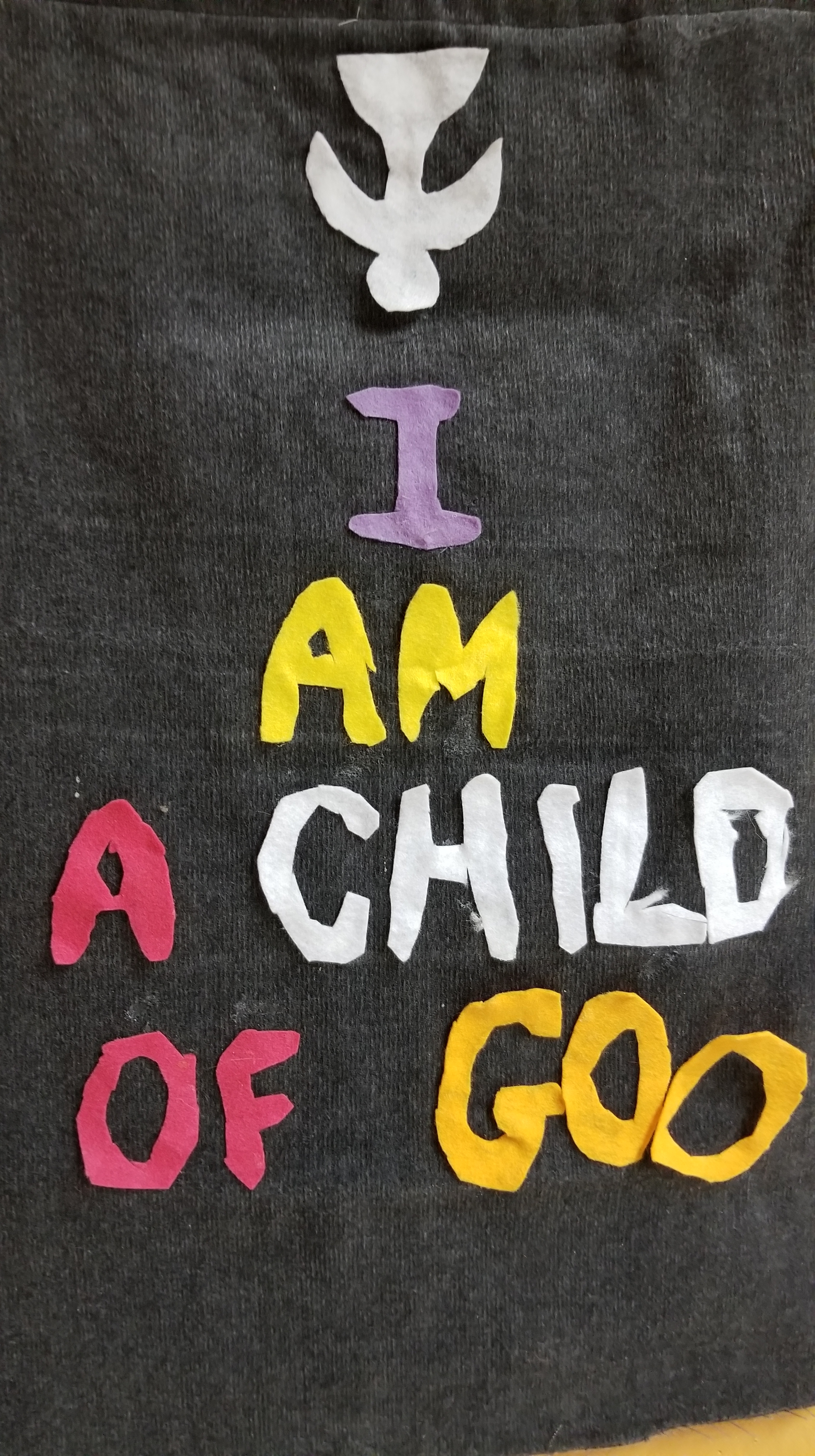 Our church has been struggling with how to do or reintroduce Sunday school, Christian education, church school, nurture, faith formation—whatever you want to call it for our children. I’m not referring to a “Children’s Church” for older children, or regular nursery care for those two and under. I’m calling for a planned regular way to make sure our children come out of their growing up years of church and be at least somewhat biblically literate.
Like many or perhaps most mainstream Protestant churches, our congregation has been struggling with the “too busy” aspect of family life, and for some years, no small children lighting our doors. Or, if they do come to worship, parents and children are sometimes too spent from a busy week to participate in church school whether before or after a worship service.
So our formal educational efforts fell by the wayside in the last few years. Research is rampant on how family life in the 2000s meant less church involvement. Sports teams play or practice all weekend including Sunday mornings. Or parents feel their family needs down time and don’t go anywhere on Sunday morning—or if they do, they go hiking, camping, amusement parks, weekend trips to visit grandparents, birthday parties, jump parks, escape rooms.
This fall, our small church took a leap back into a shortened faith formation time occurring during the second half of the worship service (the sermon etc.). We have a rotating team of about 12 volunteer teachers who are taking turns guiding the young ones to a classroom, anywhere from 0 to 10 on any given Sunday.
That makes preparation hard, but doable if you are committed to children growing up with basic biblical background. One couple shared a curriculum they thought was very flexible for our current situation, called Telling God’s Story, and it focuses on the New Testament. Another option I’m aware of from my former workplace is Shine children’s curriculum (find more info about either online).
 A couple weeks ago the lesson a retired minister and I led from Telling God’s Story was about Jesus healing a Roman Centurion’s servant boy. The Bible says the centurion had “great faith.” He told Jesus he didn’t even have to physically come to his house to heal the child, just say the word and “he’ll be healed” according to stories recorded in Matthew and Luke. Our art project was decorating a drawing of the centurion’s helmet with colored rice (or purchased colored sand). I chose to color the rice ahead of time. You use a mixture of rubbing alcohol and water and dry it. (I’ll send the recipe for those interested, see below.)
 When eight children showed up for our class that Sunday, ranging from 3 to age 9, I was a little overwhelmed. But two nursery workers assisted us as the children picked out what color of rice to use on what part of the picture, “painting” the picture with watered-down glue, sprinkling the rice on, and then shaking off the excess after it dried, and then moving on to a new part of the picture. Kind of complicated I’d say for a still-three-year old and a sleepy-and-at-first-bored nine-year-old. But I was pleased and fascinated with how well even this boy engaged as he got involved in this art project. The all quietly listened as Bill told the Bible story as they worked.
My friend and creative genius Dennis Benson recently put it this way: “I found that kids need to be engaged. Boredom drives them to be wild.”
Now, what will they remember years down the road? Will they remember the colored rice? Will they remember that Jesus had some unusual friends in high places and he taught us to love and help everyone? I hope so, but of course that’s anyone’s guess.
I was pleased to hear a young woman share how she fondly recalls the Bible given to her in second grade by her church. She remembers how fascinated she was by the stick figures in the Today’s English Version presented to her, and often studied those drawings for what they communicated. She recalled a very rich experience growing up in her church. That’s something we can all hope for children of the church.
***
More information on Telling God’s Story .
More info on Shine here.
***
Do you have children’s curriculum materials to recommend? I’d love to hear!
***
If you grew up in a church, what are your memories? Or anything from the experiences of your children in church? Share here!
***
For a free “How to Make Colored Rice” recipe by email or snail mail, send your request or comments to anotherwaymedia@yahoo.com or Another Way Media, P.O. Box 363, Singers Glen, VA 22834.
Another Way is a column by Melodie Davis, in syndication since 1987. She is the author of nine books. Another Way columns are posted at FindingHarmonyBlog.com a week after newspaper publication.

A recent Thanksgiving table at our house, before grandchildren.
Another Way for week of November 29, 2019
Hunger. Again.
Most of us in the U.S. have undoubtedly consumed multiple meals this week that could only be described as bountiful, tables groaning with platters and pots and dishes. And people groaning afterward.
Yes, I know that sadly, there are plenty of folks who don’t sit down to such tables. Or they may sit down to a table spread by one of many churches or clubs or do-gooders, just for the day of Thanksgiving, and then return to hunting in alleys or trash bins for crusts of food or cold French fries.

A holiday table at my Mom and Dad’s house: Dad is at the end with hands folded. My husband, and several daughters and cousins can also be seen.
My father, now departed 13 years ago, was a campaigner for feeding “the hungry people of the world.” I’ve written previously about his many efforts and accomplishments in that area through organizations like CROP and Heifer (see links at the end of this column). But his frequent harping to us about cleaning our plates and not wasting food echoes in my brain and heart to this day. A treasured legacy.
I have recently learned of updated efforts in partnering with those who often don’t know where their next meal is coming from, especially in the island country of Haiti. Two people behind a relatively new nonprofit go to my church, Kymber and Daniel Beers. They have assisted helping after natural disasters, and Daniel has worked there for longer periods doing various kinds of research. They’ve met beautiful and industrious Haitians who are feet on the ground with antennae up for ways to make a difference for people there, some of whom are also currently suffering from civil unrest and near-starvation. I love that the effort is not so much about giving handouts, but assisting Haitians who use their skills and opportunities to wrangle ways to support themselves and their families.
The organization is called Resources to Resources (online, http://www.r2rHaiti.org) because the people in Haiti are awesome resources themselves as they work to find innovative solutions for immense suffering. The storms/earthquake of recent years have left hundreds of thousands of people in precarious living situations, yet hanging on to hope—including hope and support for each other. In other words, community. The endeavor encourages economic development not by offering loans to begin businesses, but savings programs where people are motivated by the opportunity to get significant interest on any money they manage to save: save $1, receive $1 from interested donors to saving programs.
One of the issues in a place like Haiti is not having a secure place to keep money—and thus the tendency is to spend it quickly before it is lost or stolen. With the help of some large foreign aid organizations, a mobile banking system has been devised that operates quite well. Many families do have access to at least simple mobile phones and with training learn how to not only do their banking that way but attend classes on managing money.
According to the Beers, the current civil unrest in Haiti is threatening food supplies. “Supply chains have been disrupted, stockpiles are dwindling, and food prices have skyrocketed,” the Beers noted in an email to our church community. The “r2rHaiti” organization connects with a farmers’ cooperative and they indicated that now is a current planting season; if Haitian farmers can get supplies again (seeds, etc.) they will grow their own food instead of paying high prices in markets. “The cooperative has a plan to buy seeds for cabbage, tomatoes, carrots, leeks, and peppers, as well as rabbits for breeding,” explained the Beers.
This is a cooperative that has proven its know-how and resolve to get things done. Earlier they spearheaded a community replanting program in the aftermath of Hurricane Matthew. “We have seen firsthand what they are able to accomplish in challenging circumstances. They are committed to sustainable agriculture and we are proud to continue our partnership in this time of acute need,” write the Beers.

Some fall harvest bounty at our house this year.
Obviously, there are many many people and needy places all around the world and in our own cities and street corners, right? We all want to share wisely, so yes, give to programs where you know the resources reach people in need, and who take an active part in making changes that will benefit them and others in the long run.
See more about these efforts at www.r2rHaiti.org. Information on CROP Hunger Walks is at www.crophungerwalk.org/ and Heifer International at www.heifer.org.
You can immediately help by contributing at this GoFundMe project.
Read more about my father’s work related to hunger: https://tinyurl.com/VernonUMillerHunger Or send questions or comments to me at anotherwaymedia@yahoo.com or Another Way Media, P.O. Box 363, Singers Glen, VA 22834.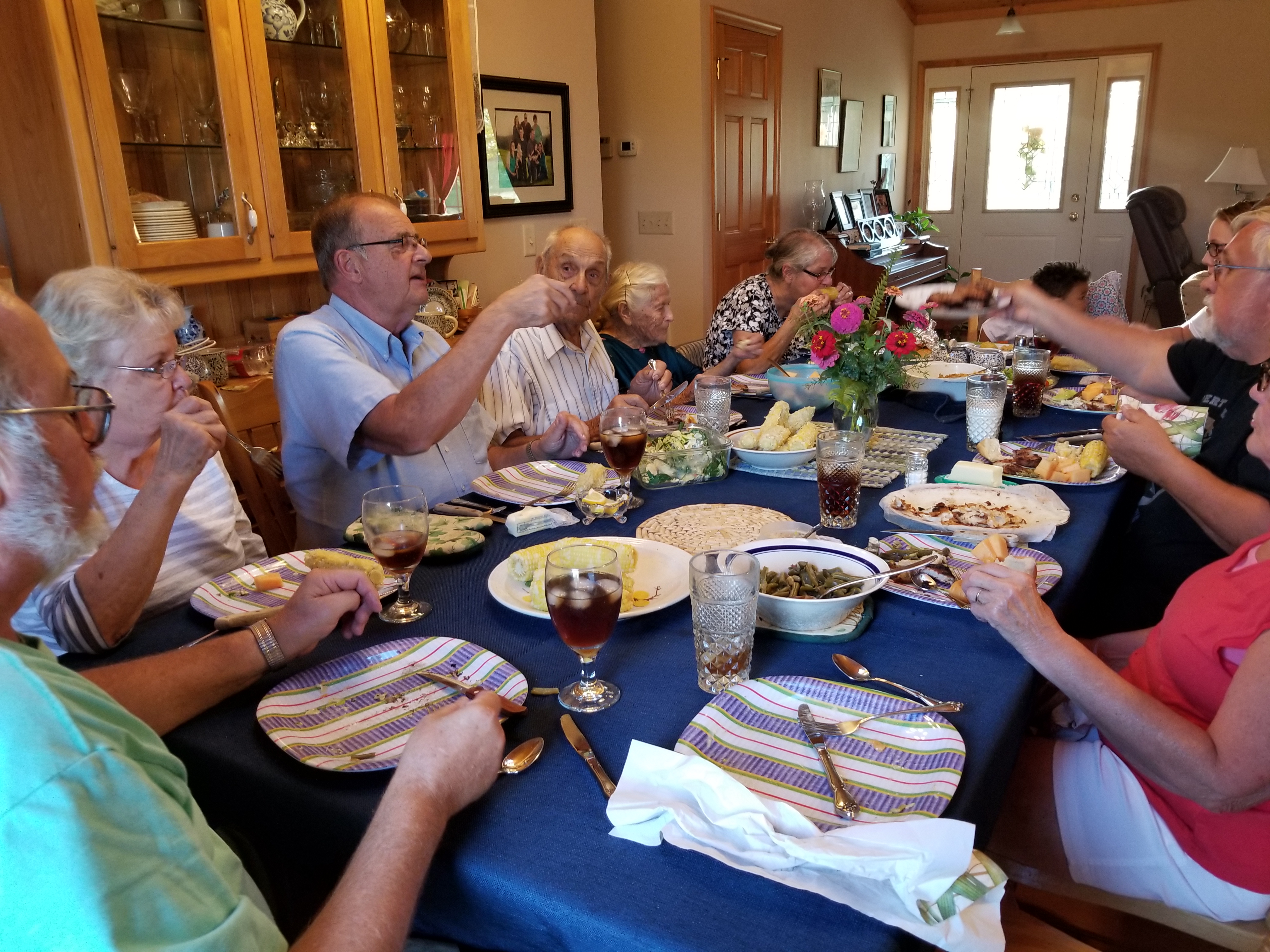
Another Way is a column by Melodie Davis, in syndication since 1987. She is the author of nine books. Another Way columns are posted at FindingHarmonyBlog.com a week after newspaper publication.
Another Way for week of November 22, 2019
A Crush of Stars
My husband and I love gazing at the exquisite night sky. We are lucky to live out in the country, far enough away from any town or city that we can frequently drink in of a crush of stars overhead.
If one of us goes out really early or late at night, we often call to the other one to come and see “how beautiful the stars” are. This week we both glimpsed the same falling star or meteor, always an amazement.

Photo by George Hodan, Public Domain license.
The stars look so close, surely not further away than say, a jet, yet we know their seeming nearness contradicts the truth: a Google search tells me the closest ones are about 5.8 trillion miles away and the furthest ones are billions of times farther than that. The Encyclopaedia Britannica website helps put this in terms we can understand, saying if you traveled as fast as the Apollo 11 spaceship did traveling to the moon, it would take you 43,000 years to get to the nearest star. Contemplate that!
When we first moved here after living only four miles from city lights, I remember a neighbor coming over to welcome us, but also to air his hope that we wouldn’t be putting up any nighttime outside light. We assured him that was not in our plans—a flood light on the garage perhaps that we could turn on or off, but no dusk-to-dawn light in the driveway or anywhere. I’m thankful for Mike’s effort to preserve as much of the “dark sky” that we have.
In recent years, both astronomy enthusiasts and environmentalists have encouraged actively preserving areas where night time lights are kept at a minimum—for the sake of humans and animals alike. Those are being called “Dark Sky” parks or preserves or similar names, and experts say that too much light can mess with our creator-given circadian rhythms, for both humans and animals. So yes, we need lights in cities for safety, obviously, but lights can be made that cast little or no light upward.
I love that even in Bible times 2000 to 4000 years ago, people saw these same stars, and the Bible gives the same names we have today for several constellations—Orion and Pleiades, for instance, in the books of Job and Amos. In Job’s poetic chapter 38, God says,
“Who are you to question my wisdom …
Does either the rain or the dew have a father?
Who is the mother of the ice and the frost?
Can you tie the Pleiades together
Or loosen the bonds that hold Orion?
Do you know the laws that govern the skies, and can you make them apply to the earth?” (Portions of Job 38, Good News Translation).
Another glorious passage on the sky is Psalm 19, here in the well-known but archaic King James Version:
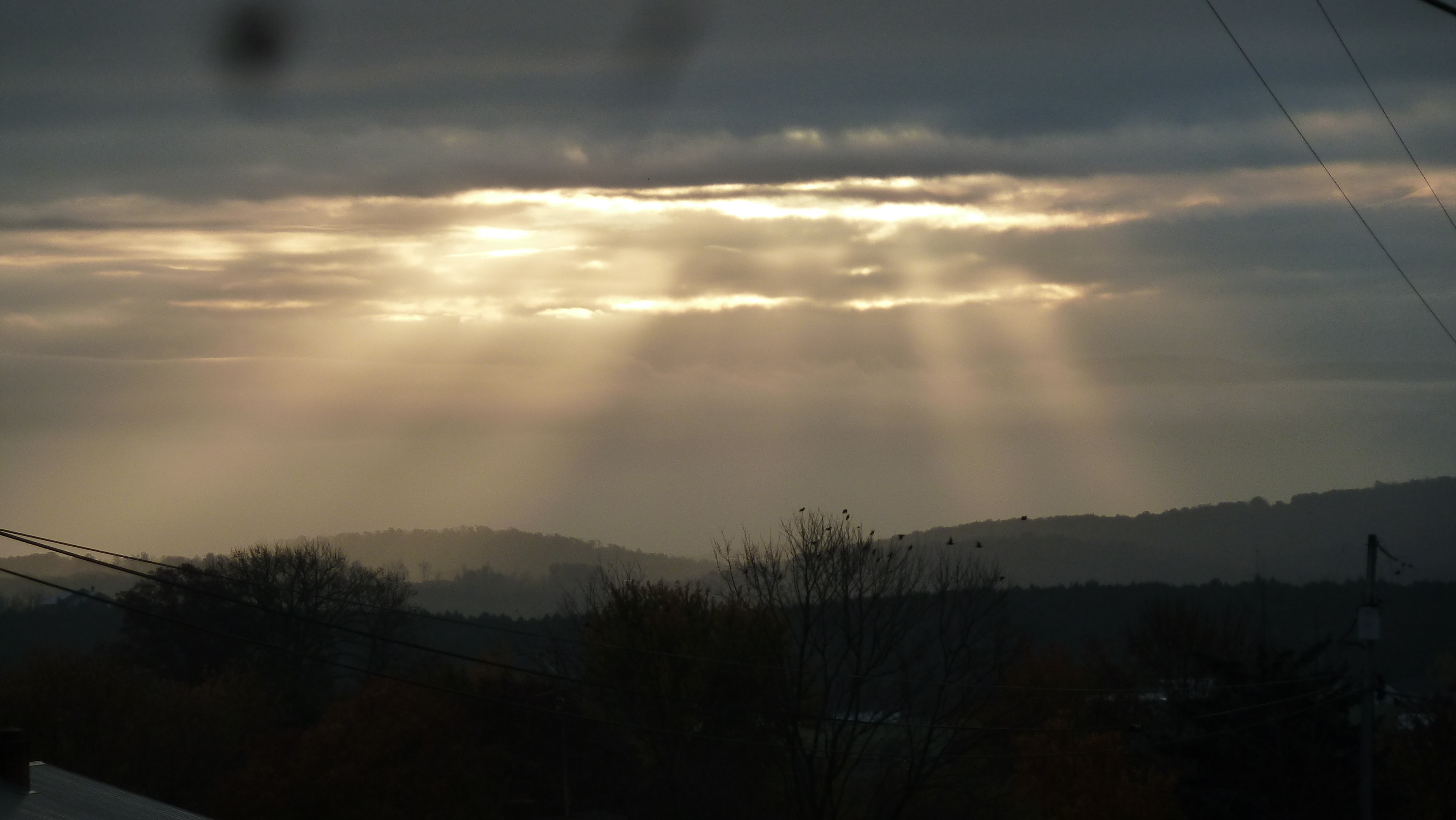 “The heavens declare the glory of God; and the firmament showeth his handiwork. Day unto day uttereth speech, and night unto night showeth knowledge. Their [the heavens] line is gone out through all the earth, and their words to the end of the world. In them hath he set a tabernacle for the sun, which is as a bridegroom coming out of his chamber…” (Psalm 19: 1-5).
What that passage says to me in plainer English: Be inspired as you look at the stars and the sky because they declare the existence of God, who conceived of this amazing creation. Daytime speaks to us of God, and nighttime does as well. In the heavens God has set a tabernacle for the sun!
I love that image. Think about these words next time you see a glorious sunrise or night sky, and thank God.
As November winds quickly down to December and the shortest day of the year, while we may miss the nice long days of summer, the longer nights of winter can cast their own spell as we contemplate how close stars appear while being billions of miles away. And these thoughts barely begin to describe how vast and great and unfathomable God’s universe is.
***
Do you have a good view of the stars where you live?
***
Catch any glimpses of the meteor showers this week? Your thoughts, stories, memories are welcome here!
Comment here or send to me at anotherwaymedia@yahoo.com or Another Way Media, P.O. Box 363, Singers Glen, VA 22834.
Another Way is a column by Melodie Davis, in syndication since 1987. She is the author of nine books. Another Way columns are posted at FindingHarmonyBlog.com a week after newspaper publication.
Another Way for week of November 15, 2019
Going Back to Gopher Prairie
I have a whole shelf of books I’ve saved for over 45 years—planning to re-read them. These are mostly books I was assigned to read in high school or college as an English major.
Many of us have a hard time tossing beloved books but also don’t have space for vast libraries in our homes. So it is important to do the Marie Kondo thing and put them in a “this gives me joy” pile, and offer others to friends or donate them to a local thrift store.
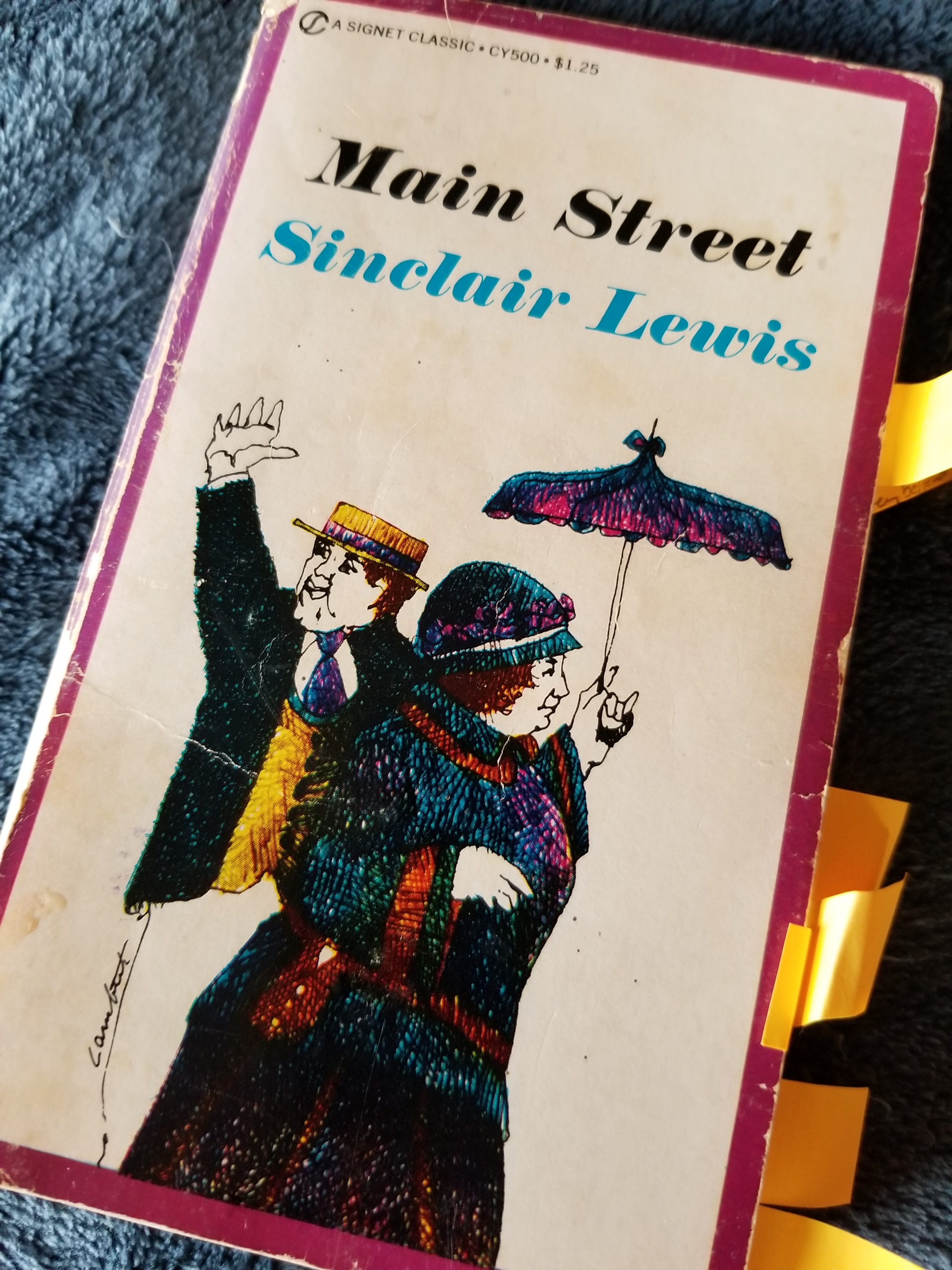 But it’s fun to get reacquainted with a book where you perhaps only remember the title, author, and main character. Such was the case with Main Street by Sinclair Lewis. I read several of Lewis’s books in college but loved re-reading this recently because it tells the story of Carol, a young woman just starting out on her adult journey, and trying to figure out if she can love small town life in the mythical Gopher Prairie, Minnesota. Sinclair describes Carol being affected by “the eternal aching comedy of expectant youth.” She, along with her friends, ponder “what shall we do when we finish college?”.
I first read Main Street while I was a senior in college. I worked on Saturdays in a small town yarn store near where I live now. Our daughters ended up going to high school there with a main street of aging buildings, complete with a drugstore and lunch counter where I enjoyed sitting down to tuna or grilled cheese sandwiches. I recall how one visitor to the knitting store (I don’t think she ever bought anything) reminded me of some of the women that the character Carol eventually encountered in Gopher Prairie as she moved there with her new husband, Dr. Will Kennicott, after a long honeymoon trip.
It was fascinating for me to pick up this book now that I’m retired and reflect on how much I was like Carol even while being very different. For one thing, I never married a doctor but in some ways my dear husband was/is similar to her husband in earnestly wanting to make me happy, even while I was/am very different from him. And while I never went off to live in a city for a year like Carol ends up doing to explore her dreams, I pretty much had that adventure of doing something different before I ever met my husband (I volunteered in Appalachia and later, studied in Barcelona, Spain for a year). Stuart seems to understand my love of travel and while he never appreciated my business travels which took me away from home, he never really complained.
Early adulthood is a great time to travel or volunteer, or in some way go down different paths before “settling down” to a job, marriage, and children. Someone else, in a book review on Amazon, said Sinclair Lewis, through his characters, “explains more about the two Americas” (rural and urban) than a more recent book, Hillbilly Elegy, (by J.D. Vance) manages. I will say that Lewis was obviously never a mother and his brief descriptions of Carol’s eventual years of motherhood fall short of reality and were disappointing as I read it. For me, our family life enriched and broadened our journey together as a couple and as individuals a great deal.
In the book, Carol is a champion of change (starts a small town theater group, wants to spruce up the way the town looks, inserts zany originality into their party or club conversations) and is not always wise in the things she promotes or organizes. Using satire, Lewis seems to encourage people with opposite viewpoints or lifestyles to look deeper and connect and try to understand the other’s point of view.
I was pleased with the way the book ends and I won’t spoil it here in case this inspires anyone to go back and read or re-read this classic piece of American literature by a Pulitzer and Nobel Prize winning author. This was a venture in reading a book while still young, living my life and retiring, and then re-reading the book from a totally different vantage point, helping me analyze my own life and escapades. Not a bad investment of time!
If you’d like to read the book I wrote about my year in Spain, Departure, I still have copies. Just send $4 to cover postage. Send to me at Another Way Media, P.O. Box 363, Singers Glen, VA 22834. Or send comments to anotherwaymedia@yahoo.com
Another Way is a column by Melodie Davis, in syndication since 1987. She is the author of nine books. Another Way columns are posted at FindingHarmonyBlog.com a week after newspaper publication.
Another Way for week of November 8, 2019
Take Me Out to the—Yes—Ballgame!
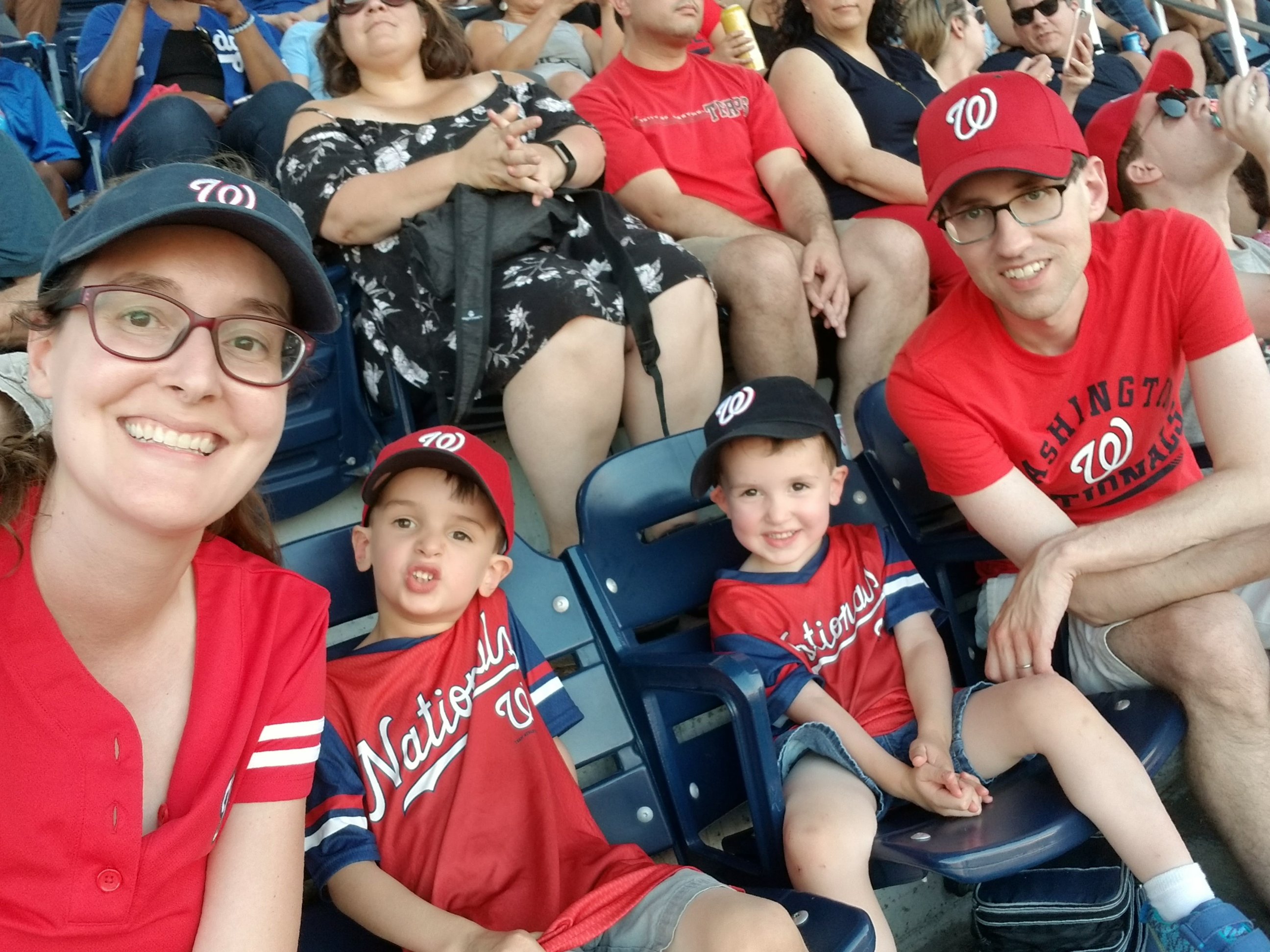
My daughter and part of her family at a Washington Nationals game earlier in the season.
After many years of shrugging off baseball as slow and boring, I have finally become a fan of the sport.
That may sound like an unusual proclamation for a sixty-something grandma, but the recent World Series has taught me what an exciting and excruciating game it is to play, especially for the pitcher.
With our nearby team, the Washington Nationals’ long-awaited triumphant win of the World Series, I actually sat down and watched hours of baseball.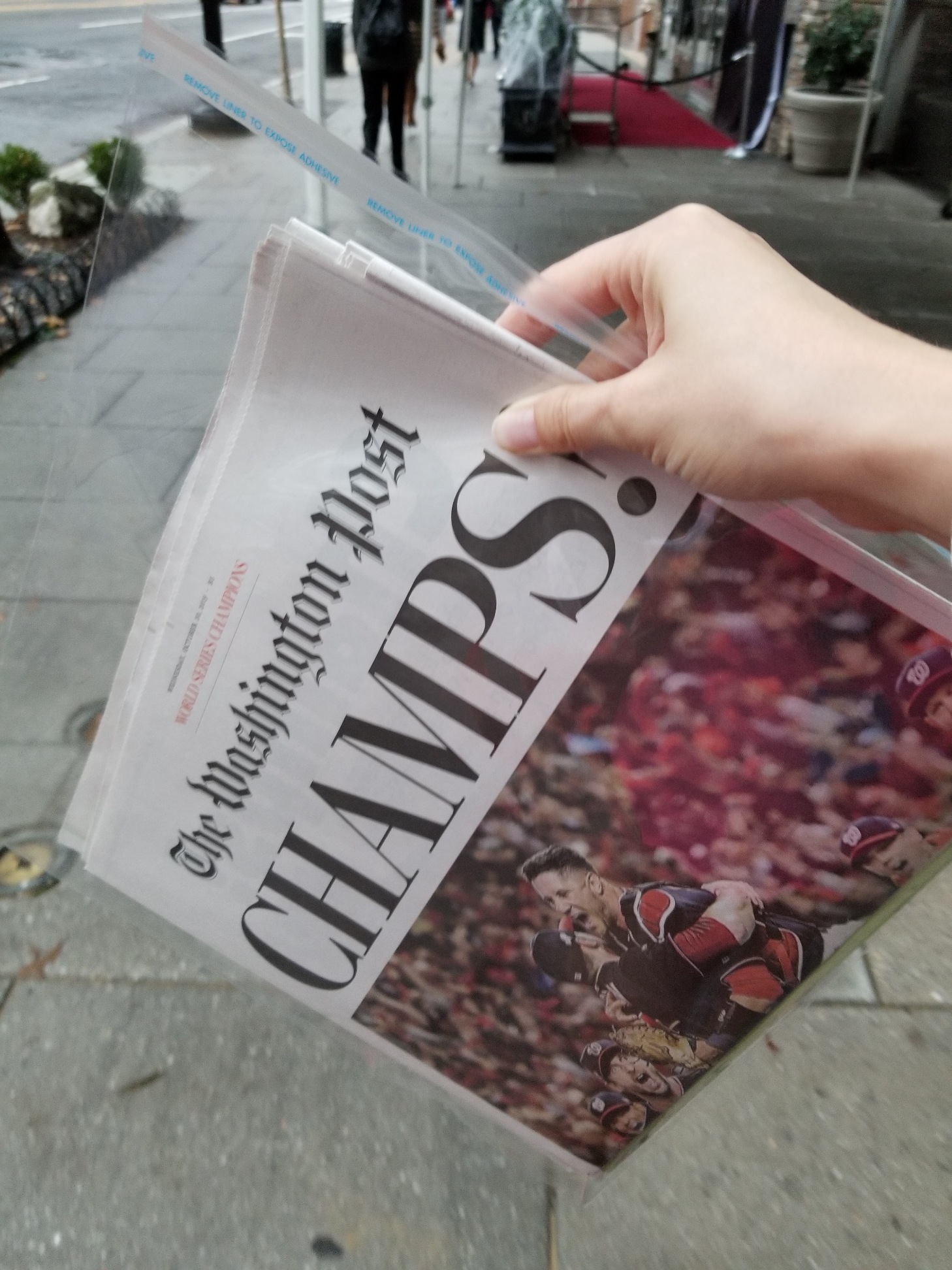
Now, let me hasten to add that my husband would scoff, loudly, because I couldn’t make it all the way through various games—except for the final one—without falling asleep on the couch. But I am newly impressed with the tensions; the almost 100-mile-an-hour whirls of the ball; the difficulty of keeping your eye on opponents attempting to steal bases while also pitching with laser focus; and being ready to field a ball yourself. I just say, Wow.
Some confessions: I grew up playing basketball, and that was the one sport we sometimes went to watch as a family, beginning when I was in elementary school. We also had a hoop and cement pad at the side of our garage. While my middle sister took top basketball billing all through high school and college and even toured several countries in Asia with a Christian exhibition team, we all loved the game. My 95-year-old mother still enjoys watching basketball on TV because she can understand the basics.
I also played softball one year in high school because my best friend went out for the team, but I never loved the sport. I was always terrified of getting hit with the ball or a bat, and thought being an outfielder was unendingly boring. And watching it on TV? Big yawn. With football I became an involved fan when our daughters began playing in marching band.

Oldest grandson at a special birthday at a real dugout.
But I have never been to a professional baseball game or even a minor league one: something all of my grandsons (except the youngest) have done.

Even the dog loves playing backyard baseball.
You could say my interest in baseball has grown considerably by playing ball with our grandsons. The two oldest are only six and nearly six, but they both love the game. Proud grandma believes they show promise. I have not yet actually seen them play in their T-ball league games, but boy-o-boy have I pitched, caught, hit, ran the bases, and chased foul balls and bad pitches in tiny back and front yards in three states with those tykes for hours on end.
We were happy to take care of three of our grandchildren recently so their parents could catch a play-off game in their city. When their boys found out where Mommy and Daddy were going, they understandably put up a fuss. But they were somewhat consoled when reminded that earlier in the season, they had gone to an afternoon game, and someday they would be old enough to go out in the evening.
This season I’ve learned about baseball traditions that somehow I had never really known: singing “Take me out to the ballgame” during the 7th inning stretch, and that the organist also plays “up to bat” songs that are different for each player, with the “Baby Shark” kiddo song becoming a thing for the Nationals this year.
The traditions associated with the game—including the constant adjusting of ball caps, the wrapping and unwrapping of batting gloves repeatedly after each pitch, the clearing of dirt from pitcher mounds that is “in the way,” nonverbal communication between pitcher and catcher, the spitting, the gum chewing, the meticulously followed dances in the dugout after a homerun, the overall camaraderie of players—even on opposing teams—was interesting to observe.
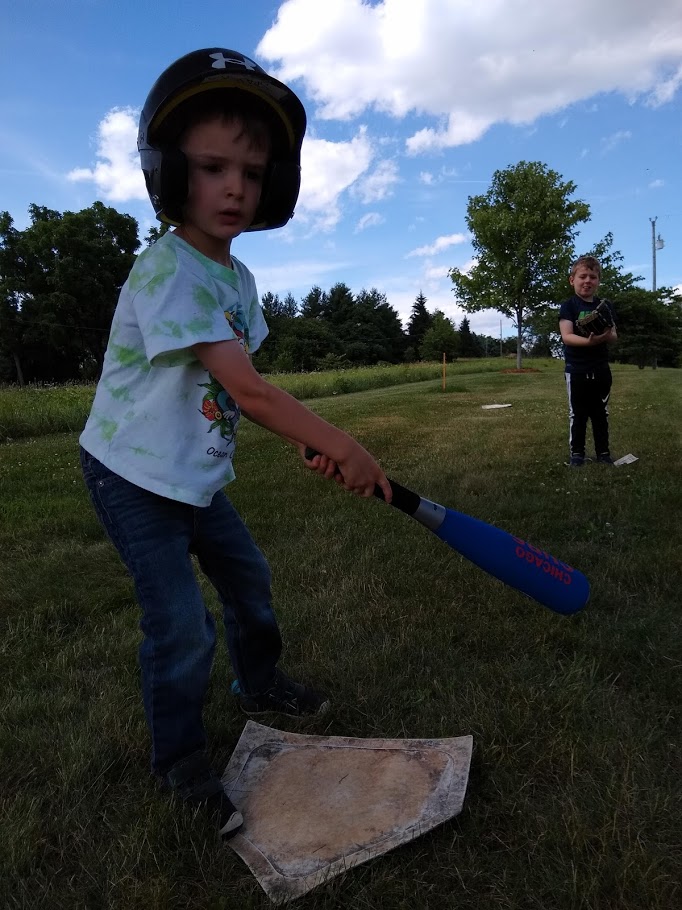
Two oldest grandsons getting in some swings (and misses) at our house.
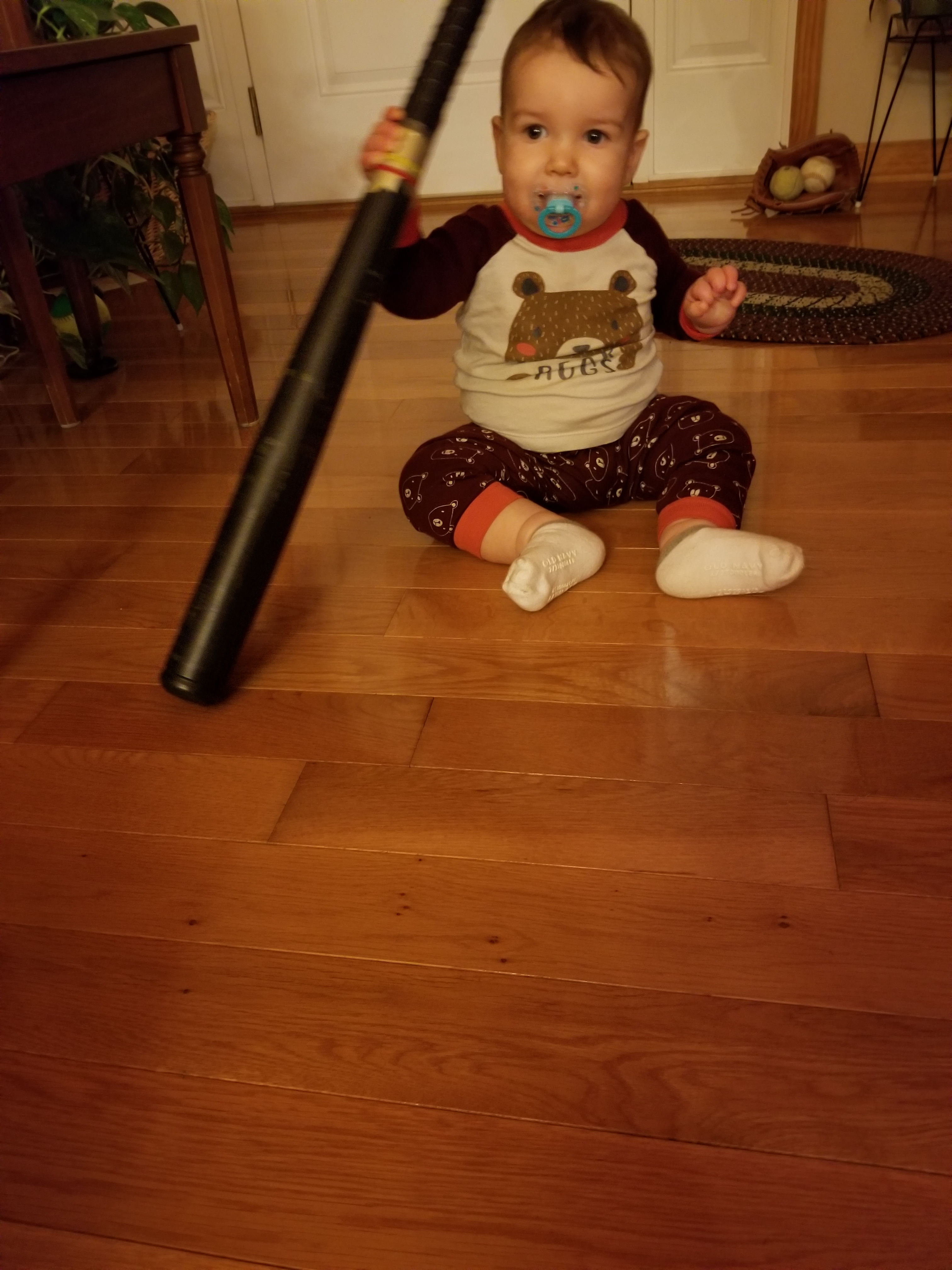
The youngest grandson, ready to join the fun.
I look forward to more that my little players will hopefully teach me in the years ahead even as they make sure I get a good workout chasing their fly and foul balls and tagging them when they practice their slides.
Maybe you can teach an aging grandma to enjoy a new/old sport.
***
Do you like, love, or not enjoy baseball? If so, when and how did you get your opinion or attitude?
Or, other sports memories, stories, insights, or opinions you want to share? Comment here!
Or send to me at anotherwaymedia@yahoo.com or write to Another Way Media, P.O. Box 363, Singers Glen, VA 22834.
Another Way is a column by Melodie Davis, in syndication since 1987. She is the author of nine books. Another Way columns are posted at FindingHarmonyBlog.com a week after newspaper publication.
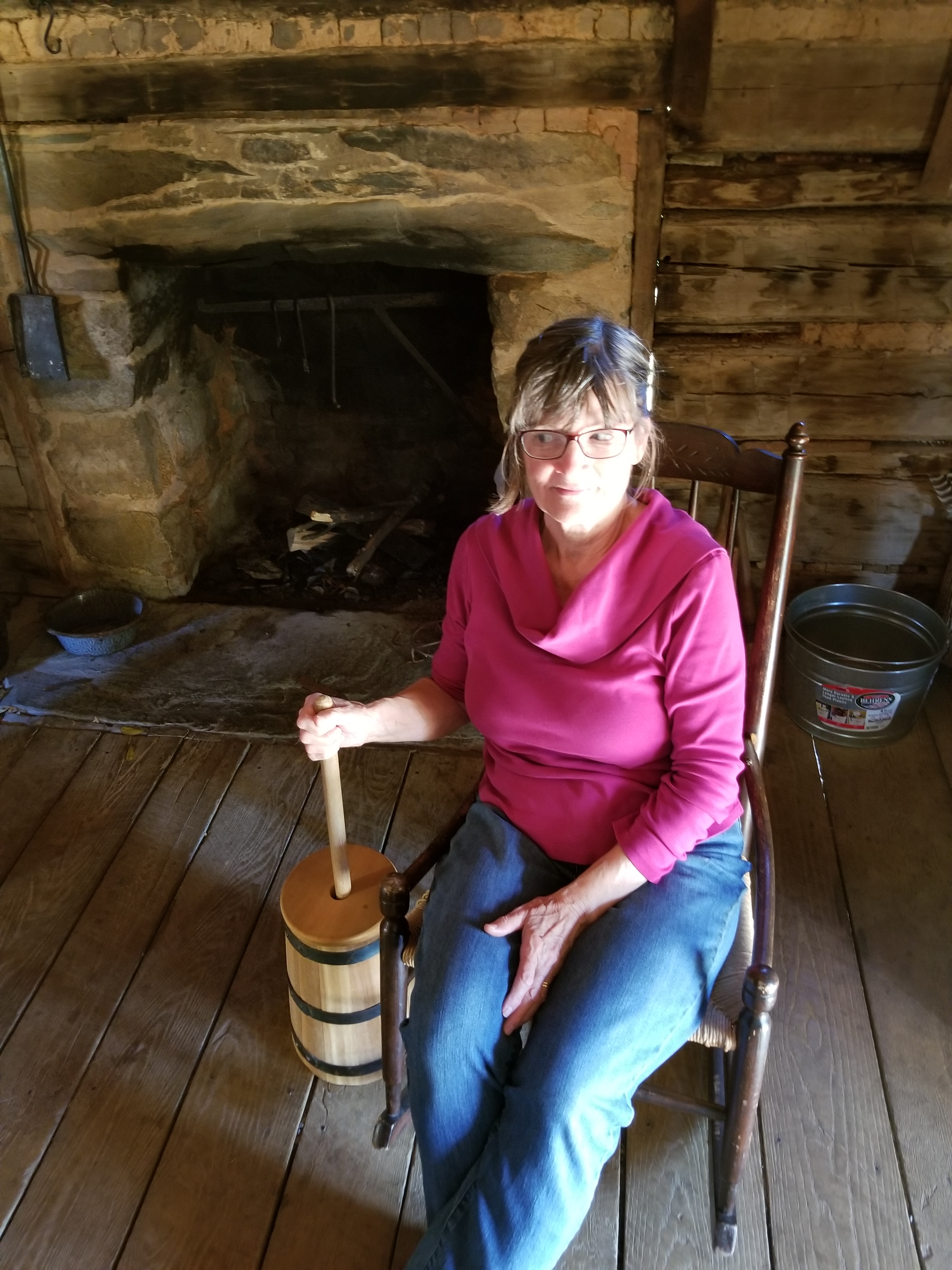
No, not likely to take up churning my own butter, but my husband and I enjoyed this step back in time at Humpback Rocks pioneer farm along the Blue Ridge Parkway recently.
Another Way for week of November 1, 2019
Driving Each Other Crazy in Retirement?
(Or, my latent, domestic side)
“Are you driving each other crazy yet?” This question from my dental hygienist caught me off guard because yes, I knew it was an issue for some couples. But in a word, no, we are not driving each other crazy yet, I’m happy to say. Frankly I’m a little surprised because, yes, that is something to worry/wonder about, along with preparing financially. But I’m currently feeling contented and perhaps curiously to some, cautiously celebrating a return—or perhaps launch—of a delayed domestic life.
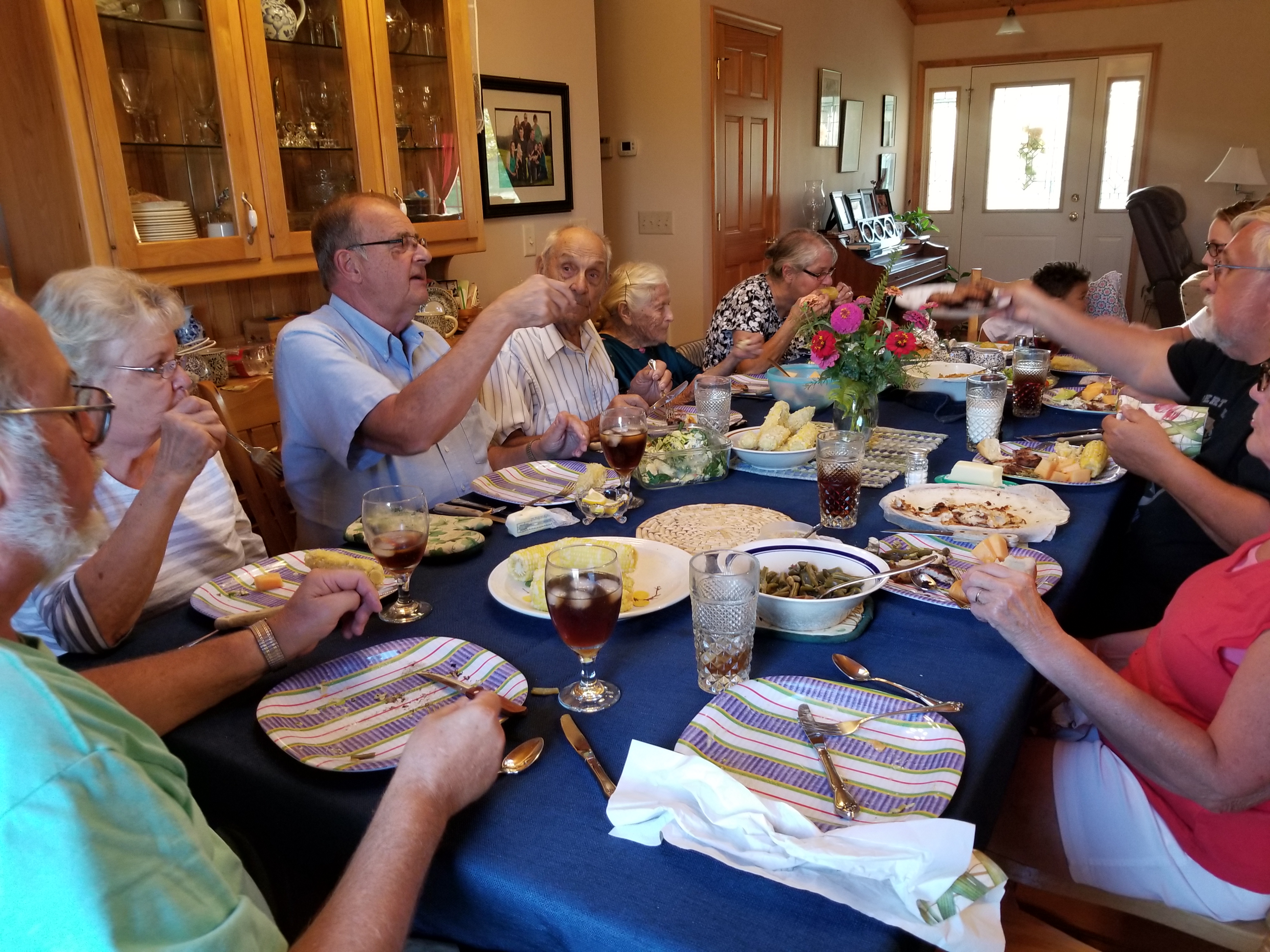
Loving a table full of friends and family.
I used to think what I wanted to do after high school was just get married and have children. I guess you could call me a domestic at heart. I looked forward to having a home and family of my own. The role models around me were mostly women doing just that: being homemakers and full-time mothers in their homes.
That bubble burst while I was a senior in high school participating in a retreat with other high schoolers. I will never forget the counselor who asked us what our hopes were for after graduation. I said something like “get married and have a family.” The wise man looked at me (no doubt a bit surprised) and pushed, “What if no husband comes along, Melodie? What then?” That was 1970 and the entry of large numbers of women and mothers into the work force had certainly begun; this may be a bit hard to believe now in 2019, but a career or longterm employment had not quite become a personal goal of mine at that time. I had never questioned that I would get married.
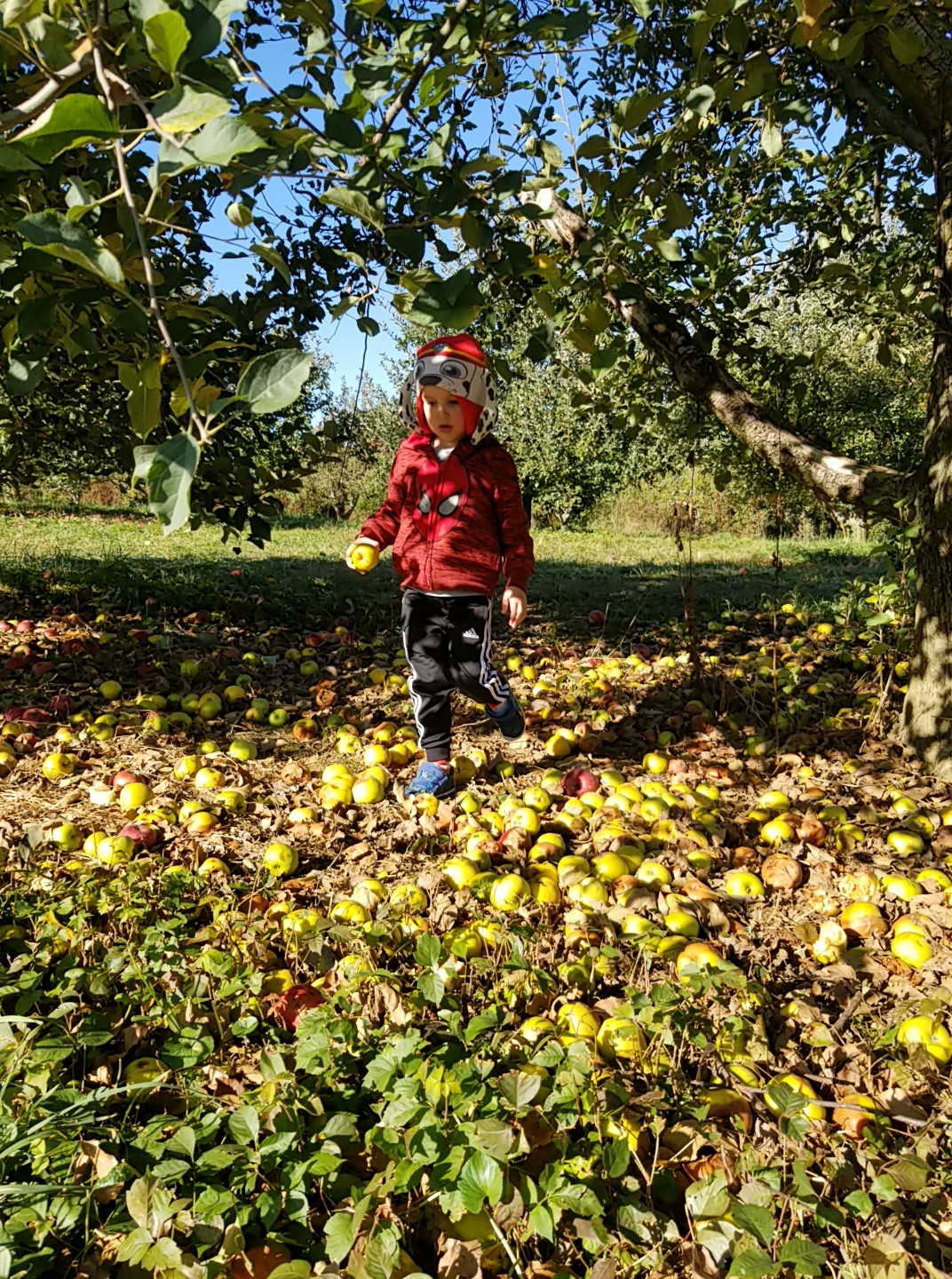
Picking apples with grandsons at amazing 200-years-in-the-same-family orchard, Stribling Orchard. http://striblingorchard.com/
Let me hasten to say that I went on to attend college and began a wonderful job and career that I enjoyed 99 percent of the time. I was able to be involved in exciting, creative, mind-stretching and life-changing work. Even when our children came along, my husband and I decided I would stay in my job half time to help make ends meet, and as they grew and started school I gradually increased my hours over the years until I was working about 36 hours a week. I loved reserving a little domestic “me” time.
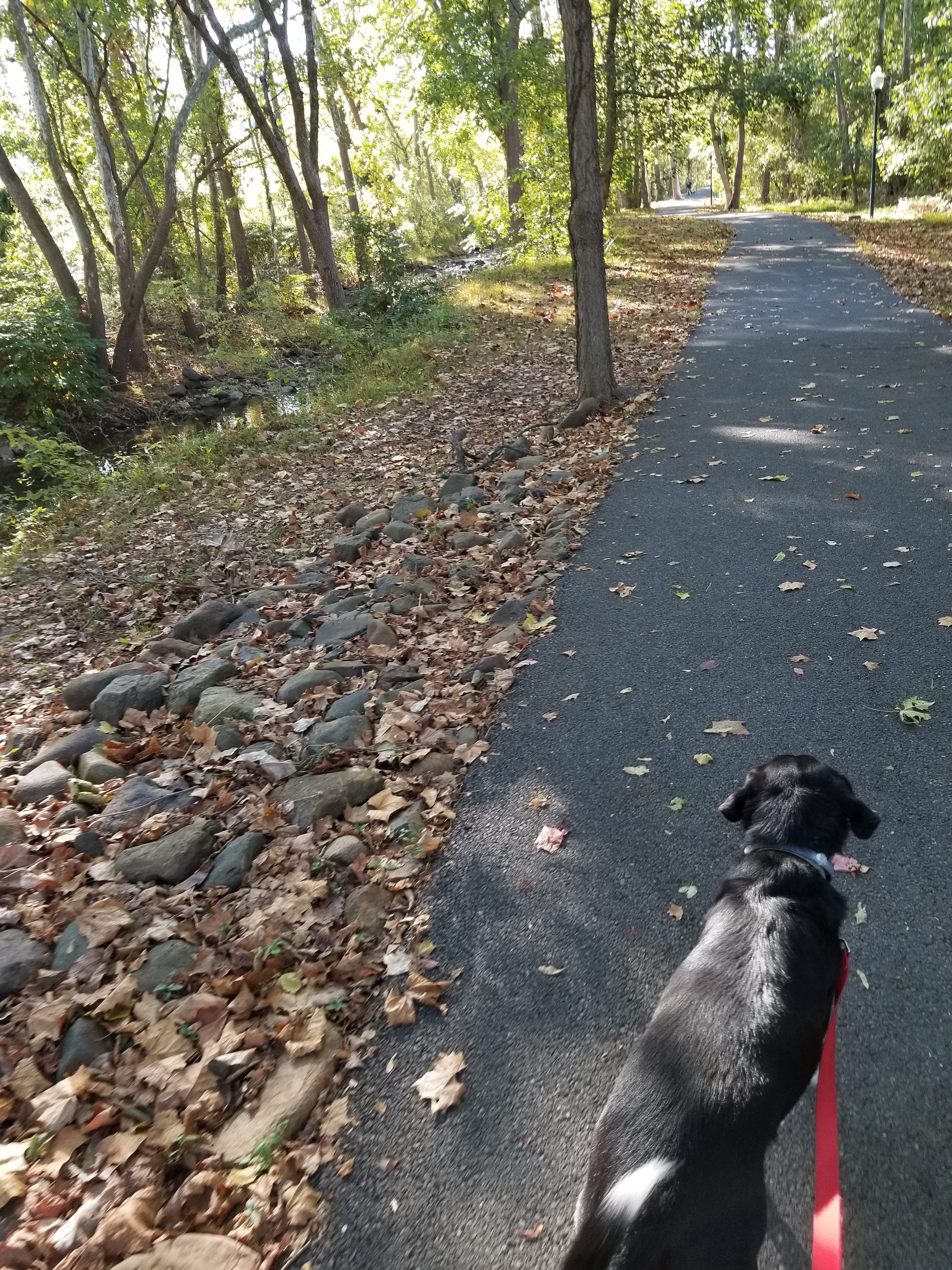
Walking our dog Velvet along a marvelous paved path (with stream) in Front Royal, Va.
I realize that at this point my husband and I are fortunate not to have to get up and go to work, although there are many that enjoy part time work long into retirement. Now that I am six months into retired status, I am relishing the opportunity to get up late, take a nap, read a book, work in the flower bed (during the day when I still have energy, not in the evening quickly before or after supper), clean out files, wipe the dust and lint from behind the dryer and refrigerator, go with my husband to the gym/pool, run errands around town, and travel to visit and help out with our growing grandchildren.
Late garden harvest–still producing through October.
This summer I enjoyed work like canning and freezing vegetables from our garden. Even though it’s still a chore, it’s much better to be canning at 11 in the morning than 11 at night. I’ve even done some mending and have many more deep cleaning and organizing projects to launch. I’m enjoying baking pies and taking meals to those with an ill or recuperating family member.
So yes, I’m a little surprised by the contented blooming of my domestic side. Not that life is perfect; patience, love, and forgiveness are required in all stages of life.
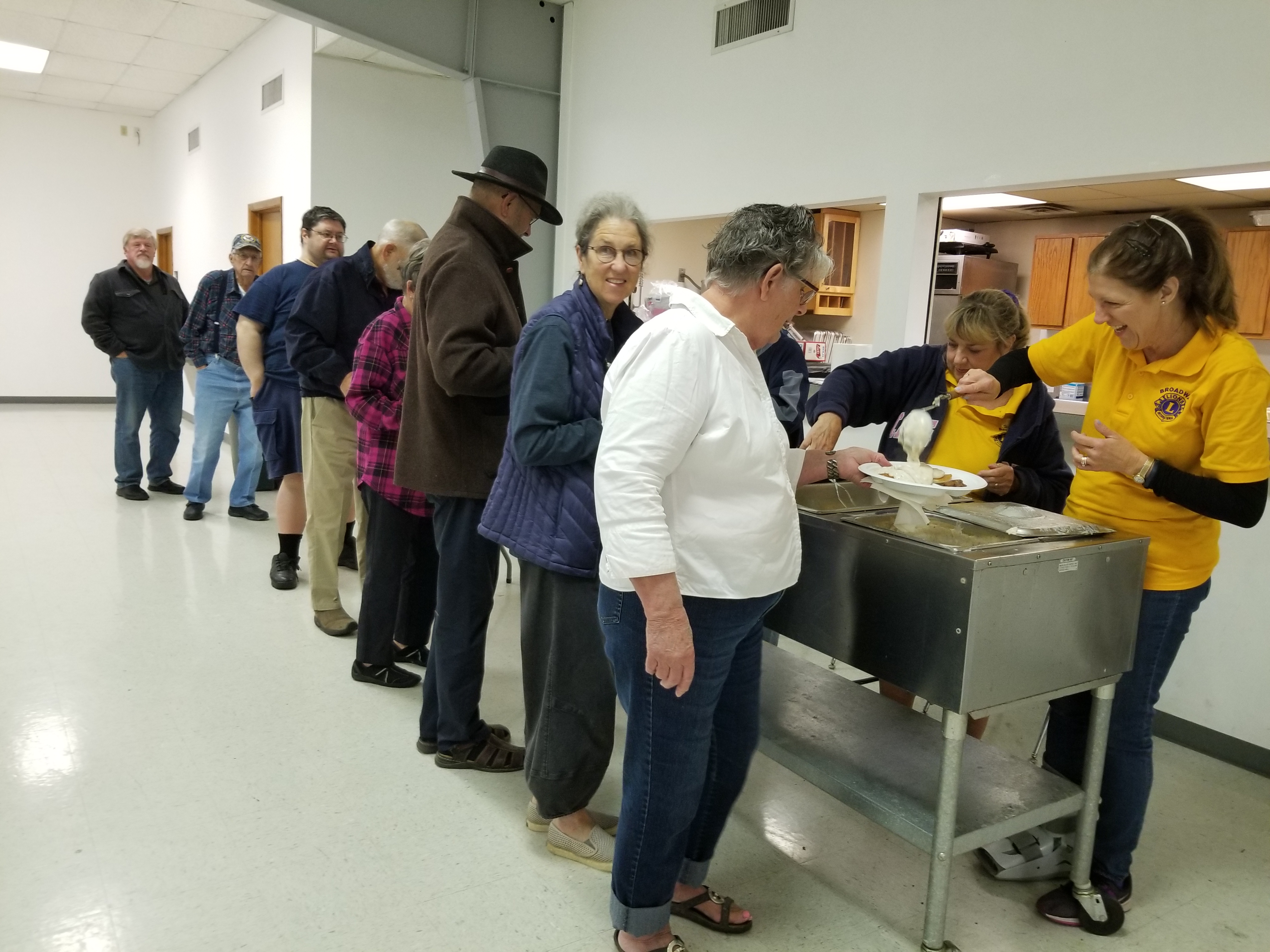
Enjoying volunteering with our local Broadway Lions Club, here at the annual Pancake Days.
Likely the spouse who is able to retire first ends up establishing somewhat of a routine. In our case it was my husband. One relative said she retired first and enjoyed her own routine of going to the gym, then having extended coffee time with women there, which she didn’t want to give up. After her husband retired several years later, he fell into his own routine—of always feeling like tomorrow would be a better day to get started on XYZ. “There’s always the next day to keep you procrastinating,” he warned.
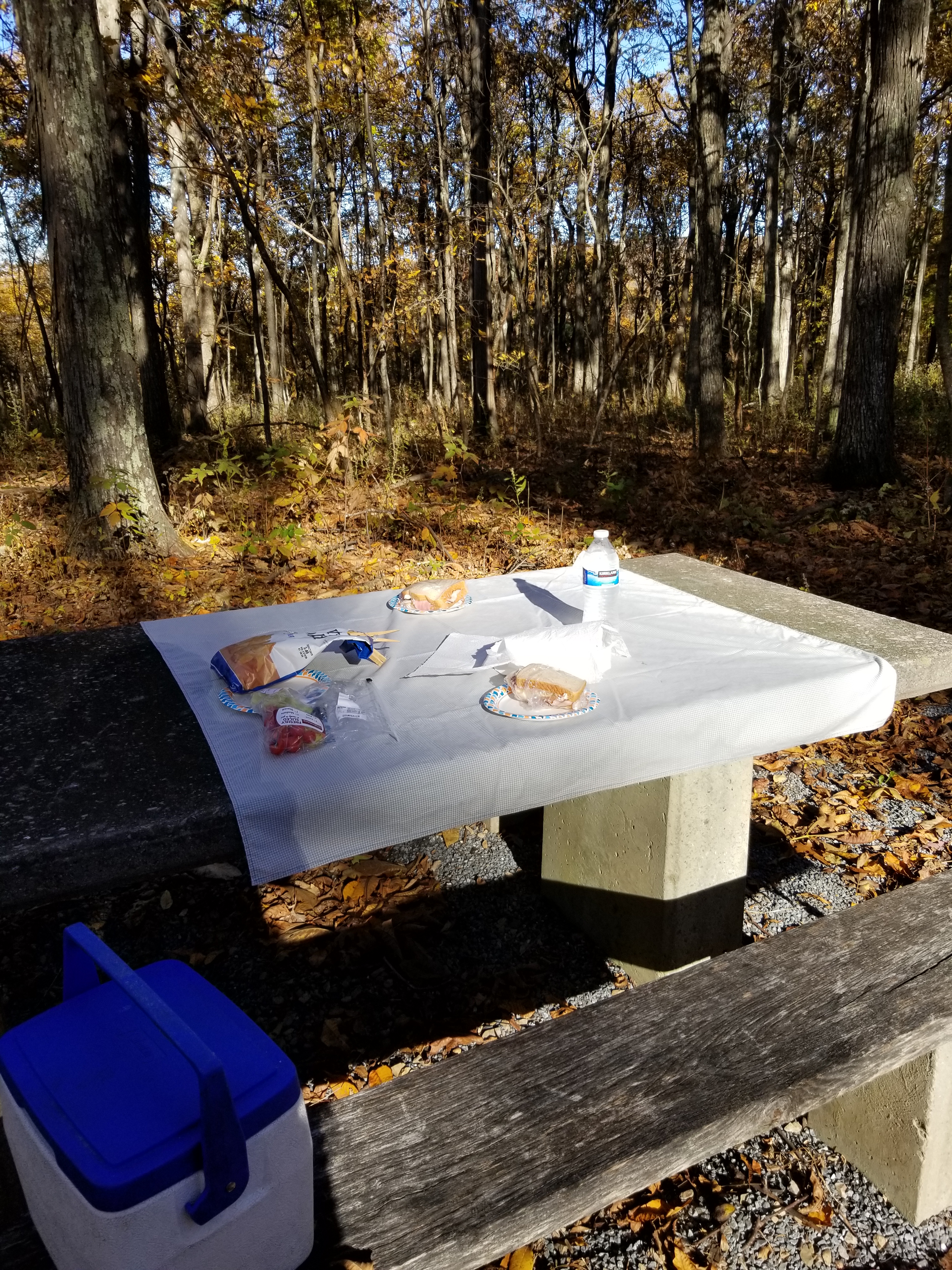
Thank you Lord for many simple blessings.
Until there’s not, of course. Again, no matter what age or stage we’re at, we all benefit by accepting each day as a gift, and NOT put off until tomorrow what we want to get done today.
***
What do you hope to do in retirement? Do you worry/wonder about whether you will be happy? I’d love to hear from you with your experiences, or wonderings about the future! Comment here or through the addresses below.
***
For a free short book, Work Therapy, contact me at anotherwaymedia@yahoo.com or write to Another Way Media, P.O. Box 363, Singers Glen, VA 22834.
Another Way is a column by Melodie Davis, in syndication since 1987. She is the author of nine books. Another Way columns are posted at FindingHarmonyBlog.com a week after newspaper publication.
 Another Way for week of October 25, 2019
How Well Do You Truly Listen?
Being part of a team that produced documentaries about the real-life experiences of ordinary people gave me many blessings, including a sharpened appreciation for the art of listening—truly listening to people’s stories.
I remember once when our producer was interviewing a woman who had lost her husband in a too-early death. Our video was focused on dealing with grief as survivors, and Jerry wanted her to tell about her experiences with that. But she had something she wanted to tell first: the story of her dear husband’s life. “You got the book backwards,” she chided the producer bravely. “First I want you to know how he lived.” Jerry was sensitive enough to listen as she shared even though he knew he could not end up using all the story in that documentary.
This story was brought to my mind recently in a book about how churches can better respond to the neighborhoods that surround them, listening to the stories of people: their hurts, triumphs, griefs, memories, and experiences. What does it take to truly listen? It means we listen for the back back back story, and refrain from jumping in with our own memories of similar stories.
 In Neighborhood Church by Krin Van Tatenhove and Rob Mueller (Westminster/John Knox Press, 2019), Krin tells of a Navajo neighbor she had while living in New Mexico. Sometimes she would stop and talk for friendly conversation with him. “I tend to be extremely verbal, and after sharing my animated thoughts, I would stop and wait for a response.” The man would sit there with “open eyes, a wide smile, and silence.”
This disturbed her. At first she wondered if he had disabilities, or a fear of socializing with others, but as she grew more comfortable with this long awkward pause, he would finally “respond with words that were often wise and precise.” The Navajo custom is to let another person finish talking, and allow silence to occur for a long pause—to make sure the other person is finished talking and allowing the conversation to sink in. “It is a sign of respect, and to make sure that they have heard the whole story before responding or reacting. Navajos believe listening is a sacred part of being in harmony with the world and others,” Krin writes.
That reminder helped me remember another interview our producer Jerry did with a Cheyenne chief and Mennonite pastor, Lawrence Hart. In that interview on forgiveness, Lawrence talked about the ills and wrongs committed against native peoples. He talked very very slowly—and with the great wisdom mentioned by Krin in her book. It was, frankly, a bit of an exercise to listen to without speeding on ahead and (of course was edited with great care). But I’ve tried to remember this skill in listening to others. We all want to be listened to.
Teens and young adults today speak so-o-o-o rapidly and as I’m getting harder of hearing, it is often hard to catch what they are saying. I’m sure other readers share this frustration. But older adults also have the problem of butting in to each other’s stories and not really listening to what the other one is saying. Right?
The Catholic custom of confessing regularly to a priest behind a veiled screen gives another example of deep listening. In a new novel, Light from Distant Stars, (Revell, 2019) the main character is dealing with the imminent death of his father. He suspects that his announcement to his father that he would not be taking over the family funeral home business may have brought about the situation where his father is being kept alive by a ventilator. The Catholic priest who comes in the middle of the night to listen to Cohen’s doubts and confessions (even though this longtime priest is technically retired) are revealing. The author, Shawn Smucker, asks and reflects on the important questions of faith as the priest models a listening ear.
Do you long to be heard—listened to? Are you good at giving time and space to others trying to get through the din to tell you their story, and how they are truly doing? Or do you too quickly move on to your own story and reflections? Good questions for us all.
 ***
***
How do you rate your listening skills?
What do you look for as signs that someone is truly listening?
How have you worked at being a better listener?
Comment here or send your thoughts and stories on this topic. Send to anotherwaymedia@yahoo.com or write to Another Way Media, P.O. Box 363, Singers Glen, VA 22834.
Learn here about a project called the Listen First Movement.
Another Way is a column by Melodie Davis, in syndication since 1987. She is the author of nine books. Another Way columns are posted at FindingHarmonyBlog.com a week after newspaper publication.
Another Way for week of October 18, 2019
Monday Morning Melancholy
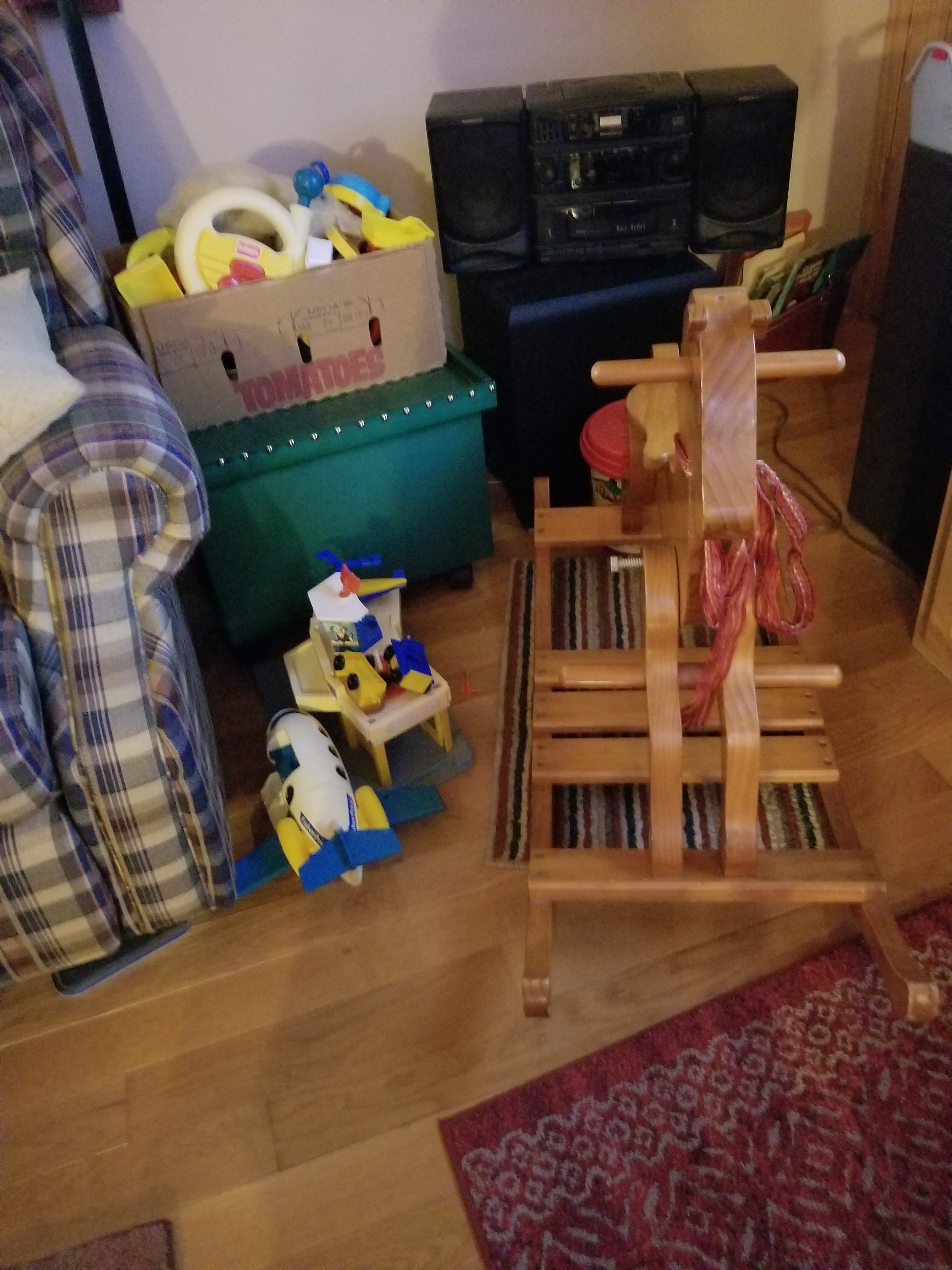
Order has mostly been restored in the toy corner.
The toys, books, and dirty dishes have been mostly cleaned up and put away after a 24-hour whirlwind visit of three grandchildren and their parents. All five of our grandchildren (in two families) live two to seven hours away. But signs of the brief visit of one family linger over into Monday.
Ever since we enthusiastically entered the grandparent years just six years ago, we alternately savor and go through “the morning after” melancholy that breathes in each room. Everywhere there are remnants of a too-brief but always-welcome stay.

Remnants of diaper changes remain.

The too-short pants that filled in for the three year old.
We strip beds, pick up the remaining odd plastic egg or baseball glove, and I spy the Cookie Monster overalls hanging in the guest bathroom. The story there was that three-year-old Henry got a mess of spaghetti on his blue jeans at supper. Since it was just a 24-hour pop-in, they didn’t bring a lot of extra clothes. The house was newly chilly with the first real days of fall, so I pulled out a pair of overalls I keep on hand just in case. The pants were about six inches too short for the lean and lanky almost-four-year-old, but he LOVES Cookie Monster so he happily padded around the rest of the evening in those pants.

Velvet seemed happy to reclaim her bed.

Grandma won’t mind if I empty the wastebaskets for her, will she?
The next morning, I loved watching the just-turned-one-year-old scoot from room to room doing a great army crawl, mostly on hardwood floors. In our bedroom as his parents got ready for my daughter’s 20th class reunion picnic lunch, he gleefully flopped himself into the dog’s cushy bed, much to my chagrin. I painstakingly ran the lint-picker-upper over his outfit. Now on Monday morning, the dog has rightly reclaimed her dog bed.
How can my oldest daughter have graduated 20 years ago already? It’s a question I pondered frequently that weekend. We marveled that some of her classmates had children who were already college-age, and here they are still chasing children in spaghetti-clad overalls and doggie-haired rompers.
On Saturday night, we wrangled the boys through dinner, baths, and bedtime. The evening was not without frustration and lost tempers—including my own. We raised three girls. Our girls had their own trials and temper tantrums I suppose but those memories are now foggy of mostly mild misbehaving. I apologized to the little one who triggered me losing my cool—who soon had his pajamas on thanks to an older brother’s help.
In my own defense, granny was exhausted too: it was also our Lions Club pancake weekend. My husband and I together worked a total of 34 hours over four days: getting things ready and then making and serving the sausage, pancakes, and gravy to hundreds of good folks. Pancake days always come homecoming weekend for our high school—the pancake sale being a tradition the locals look forward to. It was always hectic when our kids were in marching band too, and those weekends we also squeezed in watching their parade and halftime show, rushing away from Lion clean up duties. Now we dutifully try to take our turn making sure we don’t leave the pancake sale until the last pan is cleaned and the cooking tent is stored for another year. Yes, bone tired, and for me, a hangover headache the next morning. Not from alcohol but just too much going on.
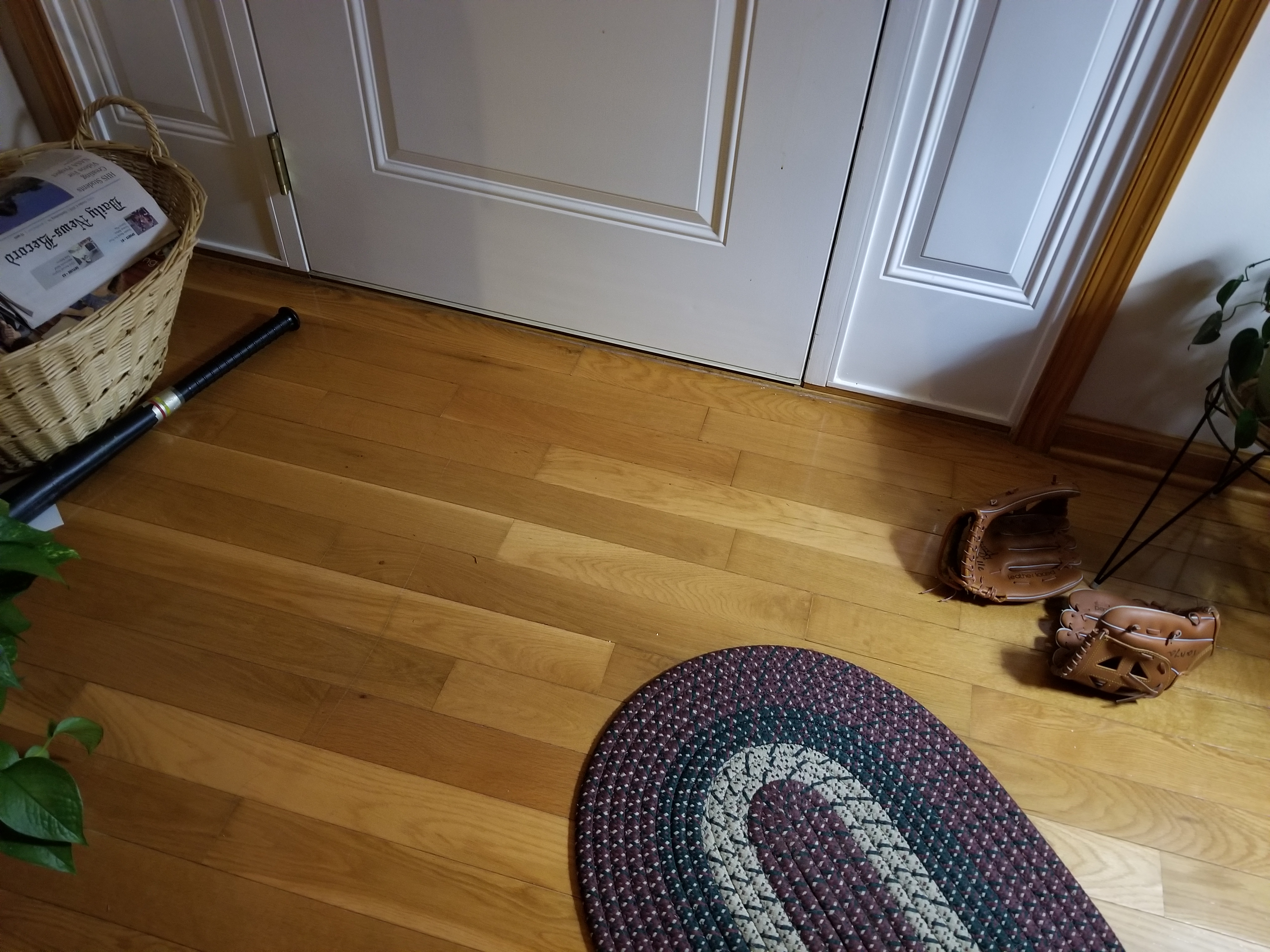
The mitts and plastic bat are right where some little boys left them.

Our favorite place as we wait for Mommy and Daddy to finish packing.
But by the time my daughter and husband are packing to leave around 1 p.m. on Sunday, hubby and I spend 15 or so minutes minding the grandchildren as they swing with us (go high Grandma!!) on the beloved porch swing, or race each other on the lengthy porch. Our little crawler cuddles safely on our laps. Henry launches slowly into a poetic description of the sights he is seeing as we swing on this windy day: “The trees are moving, the leaves are falling, the flowers are waving, the flag is blowing.” I compliment him that it sounds like a poem and he says, “What’s a poem?” Older brother and I try to explain it and I wish for a pencil to capture his words. Later I try to reconstruct it for his mamma and I think I’ve got more or less what he said—at least the spirit of his surprisingly poetic construction.
Ah yes, a budding writer, maybe. Or a ball player. Or just an ordinary boy whose words tug around my heart and make me wish for more golden October days and hours with all five of our grandsons—even when they act ornery or contrary or are just too tired to get their pajamas on.
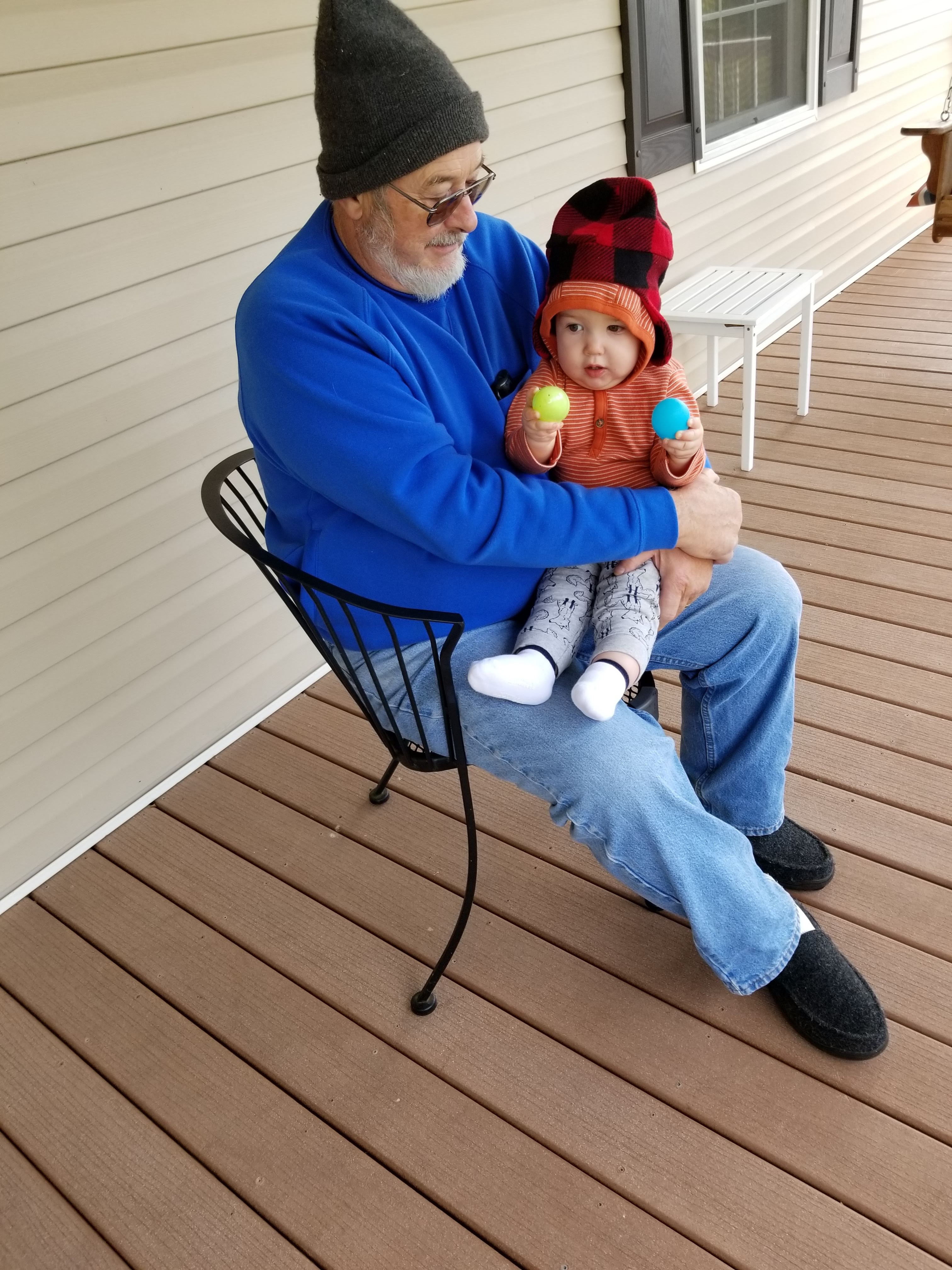
Waiting for the Easter bunny? The one-year-old somehow loved these little eggs in his hands and wouldn’t let go.
What marvelous and beautiful gifts these little boys are! We are so thankful. We love them all.
***
Sweet and tender, or tired times: share your ups and downs here!
***
When did your children or grandchildren surprise you with something they knew or did or loved?
I’d love to hear any sweet or fun stories from your children or grandchildren, with permission to quote them in a future column. As always, you can comment here or send to me at anotherwaymedia@yahoo.com.
Another Way is a column by Melodie Davis, in syndication since 1987. She is the author of nine books. Another Way columns are posted at FindingHarmonyBlog.com a week after newspaper publication.

 findingharmonyblog