


My 60th birthday donut party …. A “couple” years ago.
Another Way for week of June 14, 2019
Being My Own Boss Comes with a Price
I woke up Saturday, June 1, with a marvelously liberating thought on my mind: My whole summer is gloriously free like it was in elementary school and junior high. Remember that fly-through-the-air feeling, and crazy chant: “School’s out! School’s out, teacher left the monkeys out!”?
If you follow my recent columns you already know I worked part or full time most summers from about the time I was a freshman in high school, earning money for clothes, entertainment, and future college attendance. Then when I began a “real” job from age 23 to 67, usually I had only a week or two here and there in the summer off from work (except for three maternity leaves, and no one calls those a vacation).
But now as a new retiree, the years of endless summer stretch before me like a no-end-in-sight horizon. I can sleep in, work in the garden, go to the gym/pool wellness center, polish the granite countertops, wash windows, make a blackberry pie, deep clean the car, take care of a great nephew a few hours, play bingo once a week with a friend in a nursing home, or go babysit the youngest grandson so the older boys can go to a major league baseball game with mommy and daddy.
 Except you know what: it’s not just summer! The open schedule includes fall, winter, and spring! These seasons will eventually take shape day by day and week by week.
Nothing is truly free, however, for everywhere I turn as a new retiree, I’m reminded that the final third of life comes with a cost. Conversations at the pool (with mostly exercisers who are 10, 15, 20 years older than me) center on failing bodies and minds. Get togethers with friends or family frequently have those even older who can barely hear, who need walkers, or maybe don’t recognize who you are. Or those for whom chemo is not working. Sad and depressing.
So how do I get back to that exuberant “fresh out of school for the summer” feeling? Gratitude. Gratefulness that I woke up, that my husband makes my coffee, that we have food and enough money to pay the fee at the wellness center, that I made it to retirement and he did too, and just in time to save his ankles and feet from developing even worse mobility problems after 30 years on his feet in a warehouse. (These issues are the main reason we budget for the wellness center.)
How do you cultivate gratitude? The old hymn and favorite morning song of many offers one clue: “I owe the Lord a morning song; of gratitude and praise; for the kind mercies he has shown, in lengthening out my days.” The other verses of this hymn by Amos F. Herr gives additional ideas for counting your blessings.
A friend on Facebook shared how going for a walk and focusing on the lovely things she saw on a recent morning helped lift her out of a funk related to stress, a family member’s surgery, the state of the world, and too much to do. Which leads us to the role of self-care in helping us feel more thankfulness and appreciation. Self-care is not selfish if your goal is taking care of the life God gave you when he planned your future even—before you were born. Scripture reminds us in Jeremiah 29:11 “’For I know the plans I have for you,’ declares the Lord, ‘plans to prosper you and not to harm you, plans to give you hope and a future.’”
And that’s the thing: retirement would be no fun without plans and a future—of whatever length. None of us know—even as eighteen-year-olds—how many days we’ve been given. Start each day with a prayer or a hymn of praise in your heart and you will cultivate gratitude, graciousness, and God’s love in your heart for those you encounter this day.
What are the gifts that come with aging? Advice or stories?
Comment here or write to me at:
anotherwaymedia@yahoo.com or Another Way Media, P.O. Box 363, Singers Glen, VA 22834.

Jennifer Grant is a lovely writer who connects with these thoughts and feelings
in a humorous yet serious way. Check out her book!
Another Way is a column by Melodie Davis, in syndication since 1987. She is the author of nine books. Another Way columns are posted at FindingHarmonyBlog.com a week after newspaper publication.

Polly Taylor, left, greeting my husband and me on our wedding day, 1976. I’m sure she was giving my husband some great advice. Polly wore her hair long and straight for many years. The girl on the right was also in our house church group, I don’t remember her name. Photo by Galen Lehman.
Another Way for week of June 7, 2019
How Can You Make the World a Better Place?
If I could have as big of impact on others as my friend Polly had, I would feel my life to be worthwhile.
Her full name was as deliciously long as her influence and reach: Pauline “Polly” Elizabeth Hash Taylor. She died last November at 97 years of age. Her memorial service brought friends, relatives and community members from a rich variety of places to reminisce, tell stories, and celebrate her home going to be with God.

Polly circa 2004.
She was a charter member of our congregation. She loved watching birds, naming and growing flowers, and traveling to national parks. By occupation, she was a teacher who first taught second grade, and then took on seventh grade science—spanning over 30 years. Her students sometimes called her “Mother Nature” and “Tree Hugger.”
She took the mission of the “Peace House Church” she belonged to (a small group ministry) so seriously that for many years, every single Sunday during the “prayers of the people,” she would find many ways to beseech God that we really could use peace in the world. To me it was always a ray of hope, even in the darkest of times. In the early 60s she was in Washington D.C. and heard Martin Luther King, Jr.’s “I Have a Dream Speech.” She was also active in the community-wide interdenominational Bible Study Fellowship.
I wrote a tribute to Polly in a book published by Bethany House, Becoming a Better Friend (1988). If anyone epitomized that title, it was Polly. I’ll share part of it here:
“A cross stitched sign hangs right inside the front door of Polly’s house, in a place where you normally don’t look until you’re ready to leave. ‘A well-kept house is the sign of a misspent life.’ I liked Polly’s motto even more after she told me the story behind the sign. She had a relative whose house always looked lovely, and Polly was inclined to apologize profusely for her own house whenever this relative came to visit. One day the relative brought Polly the little cross-stitched motto.
“Before you assume her house is a pigpen, you should know that it is not. The living room is a picture of hominess, beauty, and good taste. Well-used books, and a lifetime of mementoes line one whole wall. Another section is a montage of family photos. Still another features lithographs, art from friends, signed posters. A low table in the middle may sport a huge bouquet of fresh lilacs, or nothing but fresh bread and grape juice for a small group communion service.
“Would people whose house is more orderly take offense at her posted motto? That’s doubtful, because all Polly really seems to be saying ‘If things seem chaotic or dusty here, it is because I have other priorities.’”
I admired how Polly cared for her husband as he became an invalid later in life. She opened her home to almost anyone needing a place to stay, as some of those at the memorial testified. One year, Polly, her husband, and another dear couple from our church took turns hosting every person in our small congregation for a no-strings-attached scrumptious meal with mashed potatoes, gravy and butter beans. We teased them that they could have opened a diner; Polly preferred to keep it a labor of love. Polly was the kind of person to whom I could take a special prayer request, knowing that she’d really pray and care about the outcome.

Polly at the 2008 wedding of our oldest daughter. Isn’t her smile beautiful?
Polly had exactly the opposite of a misspent life. She stayed lovely in person and spirit even after she stopped knowing who you were. I still miss her beautiful smile. There are many other “Polly’s” in our world and I thank God for so many lovely and loving people. What am I doing to make the world a better place?
***
Do you have a motto or sign in your home that people comment on? I’d love to know what turns their heads, or changes perspective.
Or, tell us about someone who has influenced your life or thinking. Comment here or send to me privately at the email below.
***
Plus! I still have several copies of Becoming a Better Friend. Some of it feels dated but I’d be happy to send copies as long as they last. Send $3 for postage to Another Way Media, P.O. Box 363, Singers Glen, VA 22834, or email comments to anotherwaymedia@yahoo.com
Another Way is a column by Melodie Davis, in syndication since 1987. She is the author of nine books. Another Way columns are posted at FindingHarmonyBlog.com a week after newspaper publication.

Not to judge anyone, but what violations do you see here? Perhaps the driver was buying fertilizer or other farm use materials? Taken on a city parking lot in Harrisonburg, Va. (And NOT a farm store.)
Another Way for week of May 31, 2019
Speculating on Farm Use Vehicle Tags
A trooper came to speak to our Lions Club recently. I like hearing state troopers talk, especially if they have a wry sense of humor. I believe it takes a healthy sense of humor to go out on the roads every day and hear some of our lame excuses for doing what we do.
Civic groups are places where troopers often speak because they usually get a free dinner, a rapt audience, and a few laughs. I’ll not use the trooper’s name but he wore his padded armor vest—I guess because he thought Lions were dangerous. But seriously, it’s a job that increasingly is hard to fill in our state and county, he said. Our state has budget for more troopers in our area but they cannot be hired or recruited. I pondered why this would be: the dangers, of course, but also the physical requirements to be in good shape to chase someone, and need it be said, intelligent enough to be smarter than some of the rest of us who do unwise things on the road. And if they are smart enough, they just might want a different, safer, line of work.
His main focus on “red and white farm use tags,” may seem like an unusual topic but here in Virginia, in this mostly rural and agriculturally rich area, he gets asked about tags a lot. Farm use tags are cheaper and don’t have to be renewed annually—plus you don’t have to have the vehicle inspected. So there are financial savings in just buying the tag once and using it forevermore. I’m not sure what the rules or colors of “farm use” tags are in other states or if people there also cheat on the use of them. Locally we often see questionable “farm use tags” on vehicles that don’t look like they are used primarily on the farm. The trooper and his staff also take a lot of gaff from those pulled over for infractions related to using the “farm use” designation, as in “Why pull me over for this: don’t ya’ll have anything better to do?”
Some examples of violations concerning the tags? “You can’t run your red and white farm use tags to town to get a part for your tractor and then stop in at the convenience store for a case of beer.” That’s not considered an “essential food,” he added in case there was any doubt.
But as he said, the main reason these laws exist is to keep roads and people safe, and that is why he does what he does, to keep highways safer for all. In Successful Farming magazine (April 2016) I read about one man who never worried about getting his farm use truck inspected—until a hydraulic line ruptured and his truck rushed rapidly toward a highway. He chose to crash the truck into a tree rather than risk endangering those on the highway.
There are other true stories and tragedies, of course, related to stupidity on the highway. This trooper said he will never forget how after a fatal accident, they discovered the man’s cell phone was still playing the porn he was watching when he veered off the road.
On the “don’t try this” end of things, he told how a high school kid who didn’t have a car to drive was putting “farm use” tags on a truck and driving it with his friends during spring break when his parents were at work, and then changed the tags back to regular tags before they came home. On the “too many times to count” list is people driving vehicles with no insurance, no title, no inspection and being irked to be found out.
We all make careless mistakes in driving. Sometimes they turn out ok, sometimes we are pulled over, and sometimes they turn out tragically. Let this be a reminder to wise up, keep our minds always focused on our driving and not be distracted by the radio, the coffee, finishing our grooming, or the cell phone.
***
Comments or stories? What are the practices and rules in your state, province, or area? What have you observed?
***
Or, perhaps you have farm use tags and use them legally. Have you ever been pulled over, rightly or wrongly?
Comment here to write to me at anotherwaymedia@yahoo.com or Another Way Media, P.O. Box 363, Singers Glen, VA 22834.
Another Way is a column by Melodie Davis, in syndication since 1987. She is the author of nine books. Another Way columns are posted at FindingHarmonyBlog.com a week after newspaper publication.
Another Way for week of May 24, 2019
Before We All Forget
I was privileged to see a local theater group put on the difficult play, “The Diary of Anne Frank.” As most people know, it is the true story of a young Jewish teenager hiding with her family and others during the dark days of World War II. The play is based on her actual writings in a diary her dear father presented for her 13th birthday.
Her father was a banker in Germany before emigrating to Amsterdam to escape Hitler’s campaign to kill all “undesirables” including millions of Jews. In the Netherlands Mr. Frank manufactured products used in jam. The family moved into an upstairs annex of that building, through a door hidden behind an office bookcase. A neighboring family of three also joined them in hiding, plus later another young man, eight people in all. Some Dutch employees and neighbors helped those in hiding by bringing food, supplies, and news for the more than two years they hid. The plot is gripping and disheartening although several scenes offer comic relief.
The space of the annex was not large, and in this stage portrayal, they slept on couches, chairs, the floor, and one very small bed and cot. Living with another family can be challenging in the best of circumstances, and with the tensions of the war, growing persecution, and the threat of being discovered, tempers and emotions get raw. When the mother, Edith Frank, finally loses her temper after one member of their group is caught stealing food at night which they all need and crave, the audience is spellbound as she explodes, speaking truths that need to be said. She finally gets control of her emotions and apologizes for the awful things she has said to their friends. Just one example of how even though the world is frightening and depressing, Anne’s often-quoted statement holds true: “In spite of everything, I still believe that people are really good at heart.”
The father, Otto Frank, was the only one from these families to survive the death camps; he emerged starving and too thin and weak to walk. But eventually he regained strength and lived until August 1980. Shortly before his death, he said in an interview: “I am almost ninety now and my strength is slowly fading. But the mission that Anne passed on, keeps giving me new strength—to fight for reconciliation and for human rights across the world.”

The World War II Memorial in Washington, D.C., with Stuart’s brother Nolan. Their father was wounded in the Pacific theater during WW II.
Today there are people who still don’t believe that the holocaust of Jewish people and others ever occurred. My husband accompanied his brother on a trip to Washington D.C. last fall as part of the Honor Flight organization which takes veterans and one “guardian” to tour various memorials, including the World War II veteran’s memorial there. Stuart talked to one of the greeters at the memorial and learned he had been one of the soldiers who had gone into a concentration camp to help liberate those who were still alive. Stuart asked him what he saw and experienced. The elderly veteran said he was among the first ones who went in and couldn’t believe what they found. “We were walking around, over stuff on the ground, and suddenly we realized we were walking over dead bodies. The holocaust was real and we never imagined that such things could have been happening. No one outside the system knew!”
Anne Frank’s words, written as a girl of just 14 or 15, gives us hope for our own dark places, thoughts and worries: “I simply can’t build up my hopes on a foundation consisting of confusion, misery, and death. … I think that it will all come right, that this cruelty too will end, and that peace and tranquility will return again.”

Older veterans from WW II or Korea service are mostly seated in front row wheelchairs.
This weekend we observe Memorial Day, and this year many people marked Holocaust Remembrance Day from the evening of May 1 to May 2. It is important that we remember and tell the stories of this terrible time, so that people don’t forget. For more on Anne Frank’s family visit https://www.annefrank.org/en/anne-frank/.
For more on Honor Flight check here: https://www.honorflight.org/ or call 937-521-2400.

Stuart’s oldest brother, a Vietnam war veteran (center of photo with name tag) went on a different Honor Flight trip this spring and was greeted by many family members and friends upon his return. Several WWII vets also went on Richard’s trip. (Photo courtesy of Cathy Crider.)
***
You can read more about Stuart’s father’s service here.
Your own stories? I’d love to hear from you. Send to me at anotherwaymedia@yahoo.com or Another Way Media, P.O. Box 363, Singers Glen, VA 22834.
Another Way is a column by Melodie Davis, in syndication since 1987. She is the author of nine books. Another Way columns are posted at FindingHarmonyBlog.com a week after newspaper publication.
Another Way for week of May 17, 2019
What I Learned from Some Unusual Jobs
Everywhere it seems I see signs shouting, “Job openings.” The newspaper heralds that unemployment is the lowest it’s been in 50 years. This summer should be a good time for kids to find summer work that not only pays steady money—jobs are ripe learning opportunities for all who take them seriously, even if it’s babysitting, cleaning, waiting tables, or painting walls. Like many girls or women, I have done plenty of each of those.
But here are ten of the more unusual jobs I’ve had. I’m so glad I took the time to write down the odd jobs I had from about age 12 until I took my first permanent job at 24. (And when I say permanent—I stuck with that job for almost 44 years until I retired two months ago—although with many changes in assignments.)
Draftswoman at Mobile Home Factory. My dad, a farmer all his life, went into business with three other men manufacturing mobile homes. They needed someone to sketch blueprints from other previously made plans, so I pretty much copied them, making small changes Dad or others requested. It was a hoot. What if I had taken that up as a career? I was always a doodler, and this job felt like getting paid to doodle. Made $1.80 an hour.
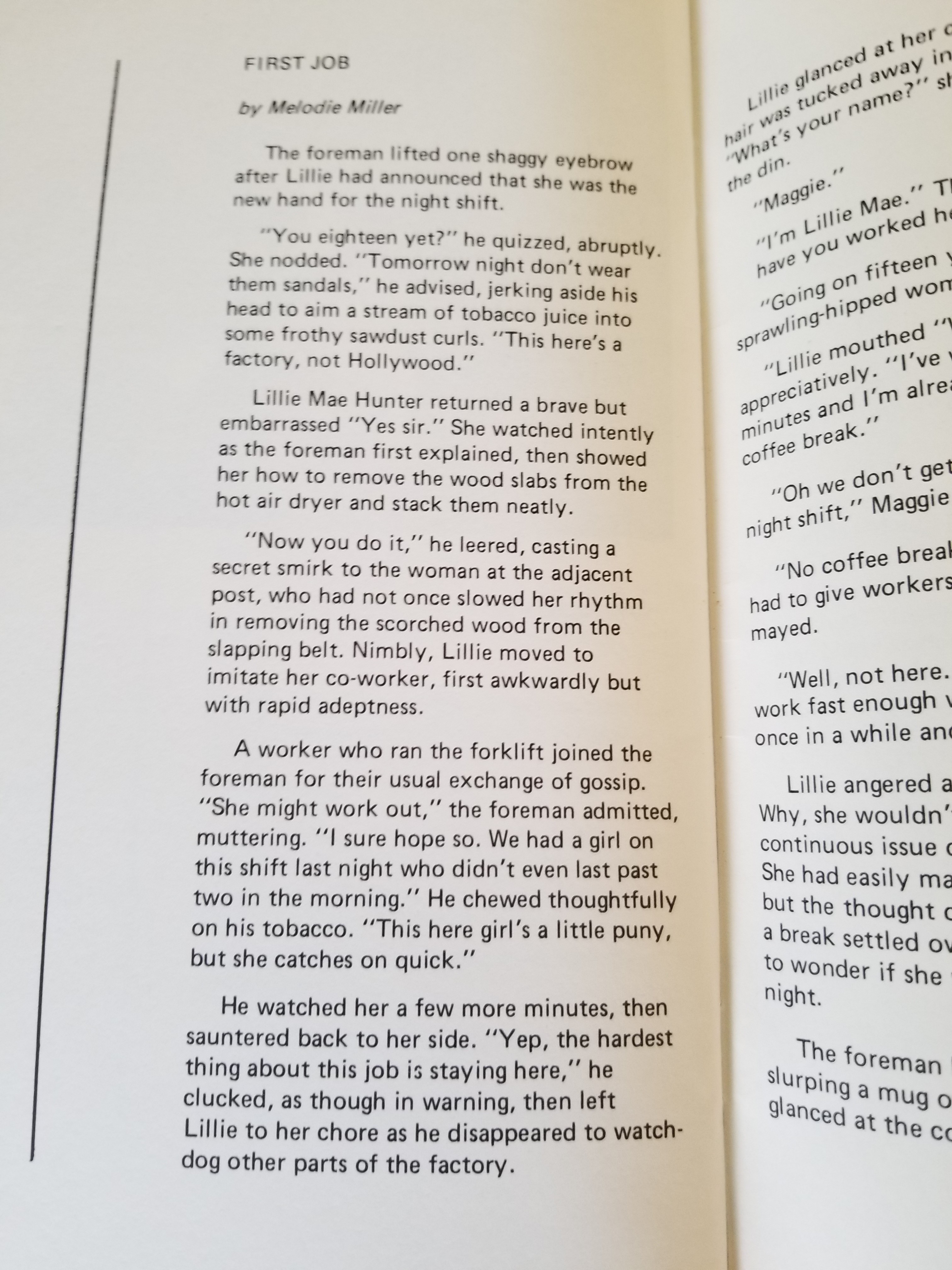
Double click on this to enlarge and you should be able to read more details about my job working in a lumber mill. Written as a fictional short story. Most of the details as written were true. I don’t remember now whether I worked one night or two.
The Worst Job I Ever Had. In a lumber mill taking plywood out of a hot air dryer. On the night shift. In a Florida summer. Pay: $2.05 an hour. No bathroom breaks. No lunch breaks. The other women said you just had to “get ahead enough” to dash to the bathroom or grab a bite to eat. I quit after two nights, the only job I ever quit so soon. I told myself, “There HAS to be a better job than this.”
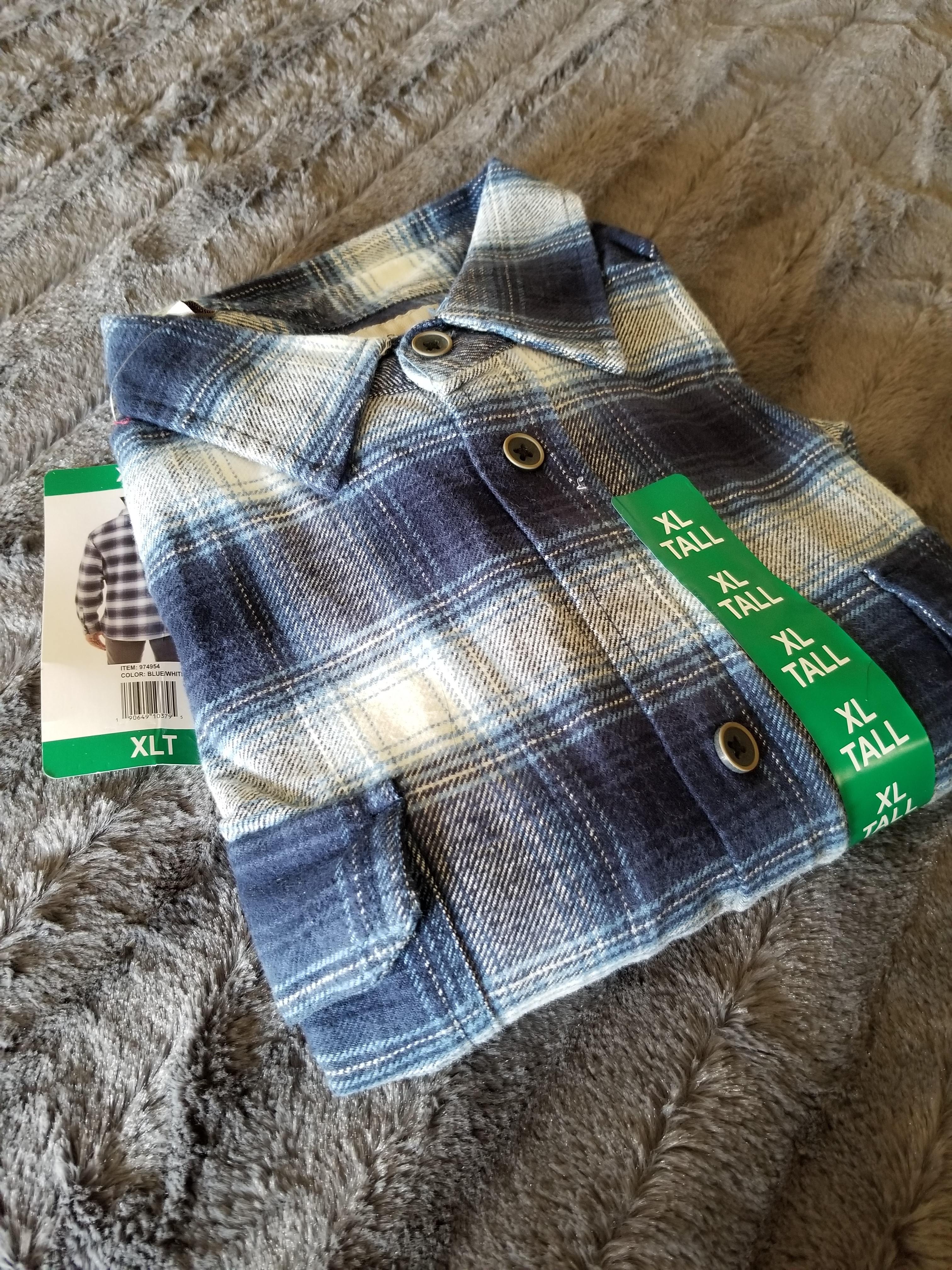
Ever wonder how those shirts get folded so neat and concise and filled with all kinds of straight pins? Humans did the job (1973) with the help of a gadget or machine or two.
The Shirt Factory. I applied the next day for a job packing shirts in a shirt factory. All those pins they put in men’s packaged shirts? I did that over and over. Pay $2.00 an hour. I learned about people’s marital affairs, cussing, gossip, and having each other’s back—even if there was occasional backstabbing.
Clerical Work for the School Board. I filed financial records and learned what everyone in the educational system earned, from janitor to superintendent. My pay: $2.10 an hour. A bonus was losing weight by taking long lunch hour walks after scarfing down a sandwich.
Party Prep. My fun Aunt Arlene was also a great party thrower (they go together, right?). She had a large house; I cleaned and helped get ready for parties, which I loved. Making everything pretty, watching her arrange flowers, beautiful tablecloths, napkins. She and her husband ran a home decorating store. Pay $1.25 an hour.
Dress Alterations. As a college student one year, I advertised my services for cooking, baking, sewing. A doctor’s wife who had an unusual permanent swelling reaction in her arm after breast cancer, needed someone to remake all the sleeves in her clothes to accommodate the larger size on one arm. Pay: $2 an hour.
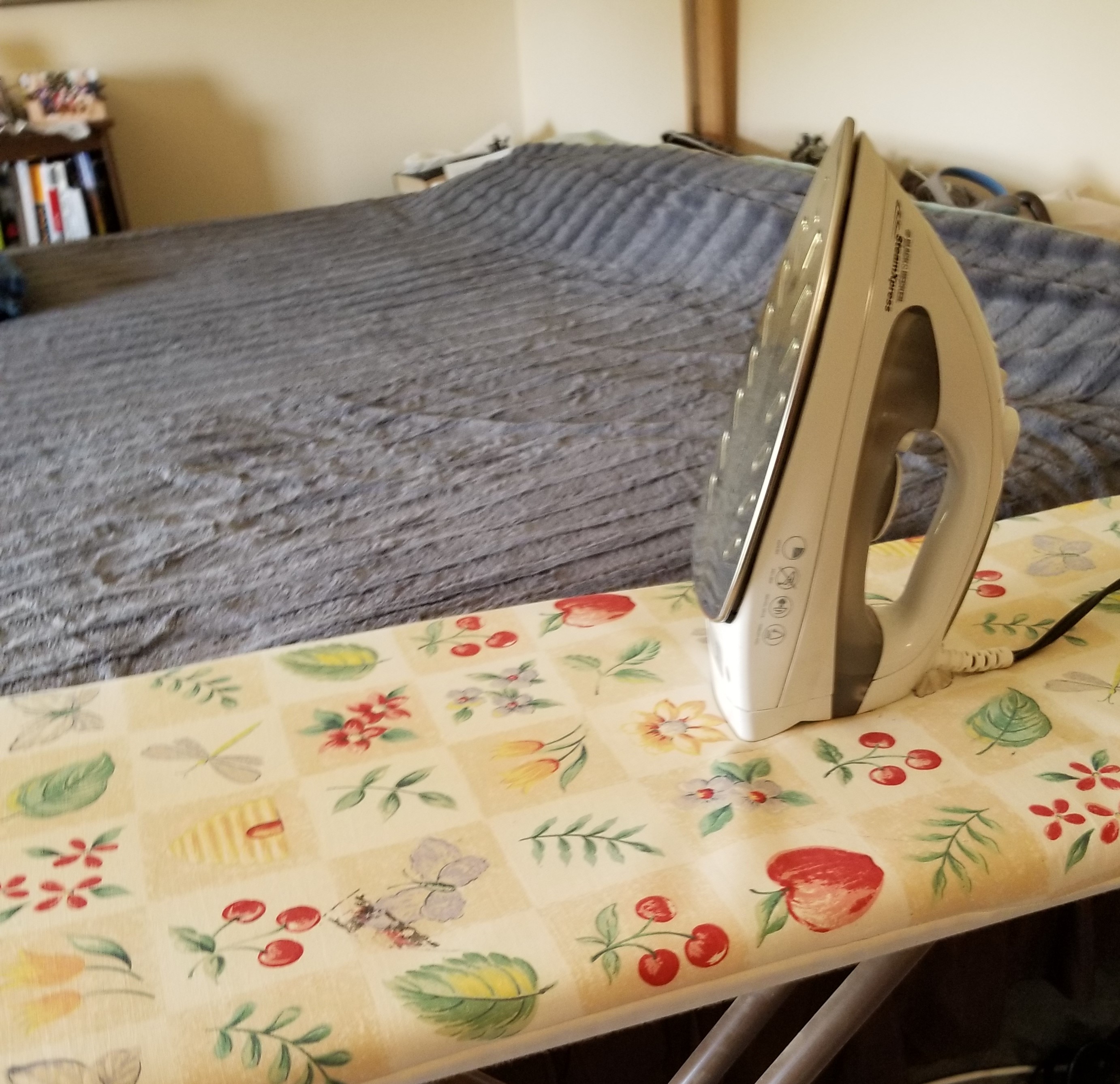 Ironing. Yes, it was a thing back then. Women spent whole days or at least half days ironing everything from sheets to underwear to shirts. I advertised that I would iron. Pay: $1.50 – $2.00 an hour. I actually enjoyed it, making clothes neat. Today I have a son-in-law who irons.
Picking up Pecans. These last three jobs were all for the same man, Fred, in north Florida: a single dad with three children close to my age, but he needed help. Paid 10 pennies for each pound of pecans picked. (Say that real fast three times.)
Picking Up Leftover Corn in Field. Farm help for Fred. Great exercise and it helped me pay for three new/remade outfits I needed when I was elected to the homecoming court as a high school senior in north Florida. Pay: $1.50 an hour.
Pruning Shrubbery. Somehow, there was never enough time for this farmer to also prune shrubs. I didn’t mind the outdoor work: better than cleaning. Pay $1.50 an hour.
What are your job memories and stories? I would truly love to hear.
What was your worst job? Best ever?
What did you learn? Earn?
Or, just for fun: do you iron? How often? Inquiring minds want to know! Comment here on any or all of the above.
For a free booklet “Work Therapy,” write to me at anotherwaymedia@yahoo.com or Another Way Media, P.O. Box 363, Singers Glen, VA 22834.
Another Way is a column by Melodie Davis, in syndication since 1987. She is the author of nine books. Another Way columns are posted at FindingHarmonyBlog.com a week after newspaper publication.
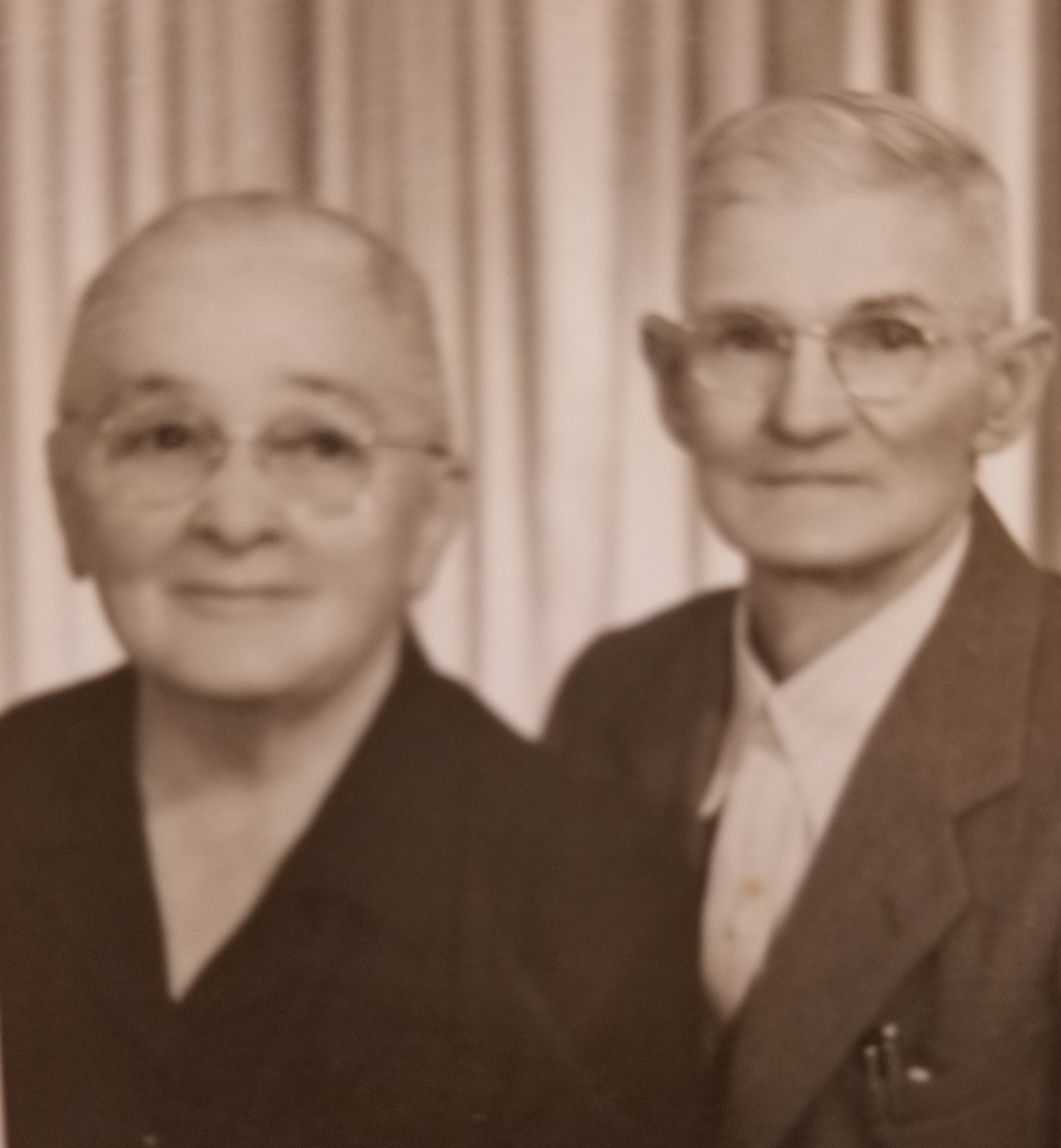
Grandma Barbara Miller and Grandpa Uriah Miller, a little younger than I remember them.
Another Way for week of May 10, 2019
My Grandma Miller: Orphaned
I was fortunate to grow up in a three generational home. Now that I’m a grandmother I’ve been thinking about what a having a grandmother means to children.
My Grandma Barbara Kauffman Miller and Grandpa Uriah Miller, on my dad’s side lived in an apartment or “dawdy haus” (in Pennsylvania Dutch) built on the side of our farm house. It was a precious way to grow up with Grandma and Grandpa just a door away. I remember her sugar cookies and dunking them into large wide coffee cups with a saucer underneath to catch the spills. We loved snuggling with Grandma on her lap: it was very ample, and grandmotherly. I know she loved us dearly even though she was not able to get down on the floor and play (although Grandpa did!).
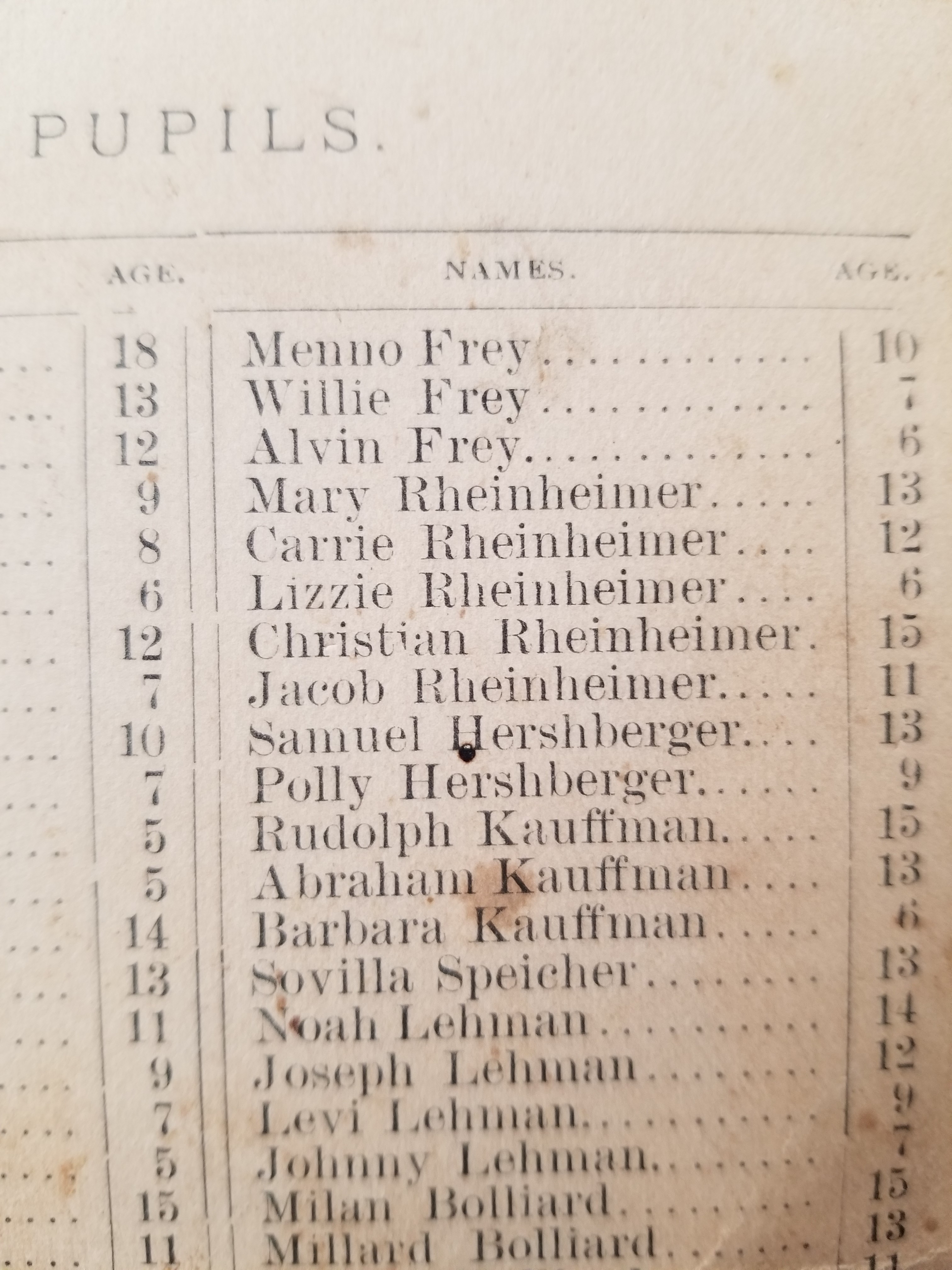
See Barbara’s name and age–6–and her older brothers. She had additional siblings who were already out of school and some married when she was 6.
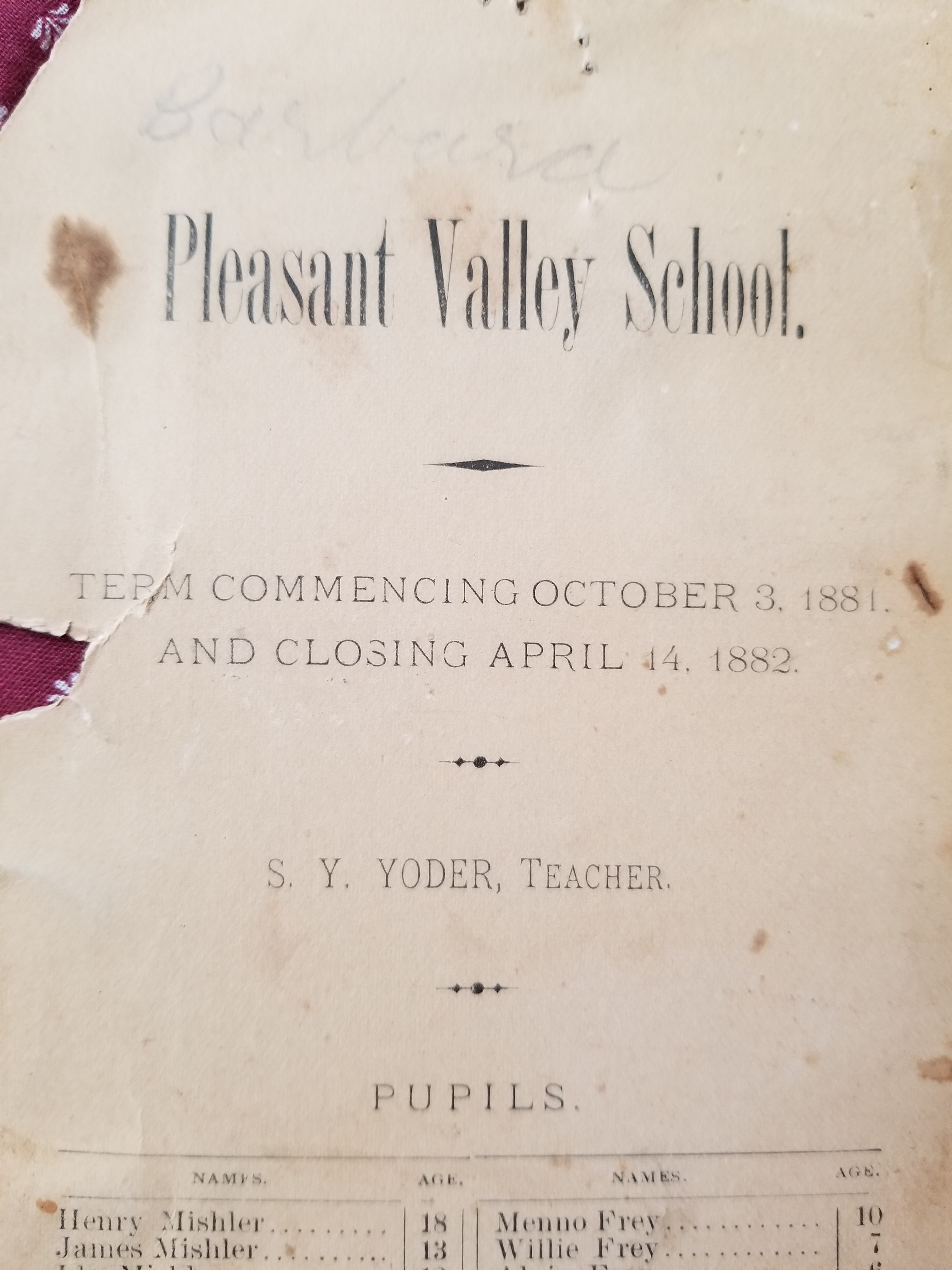 On a recent trip to visit my own mother, I was elated to discover a paper showing my grandmother’s enrollment in first grade at the age of six in 1886. That really turned my head: the original document with a list of the other students in her school, including the names and ages of her brothers. They were orphaned when she was five, and bravely she started school approximately a year later.
Barbara lost her mother just 11 hours after she was born. Her mother was 42. This kind of loss was more common at that time, but how sad. It reminds me that there are plenty of women during this month of celebrating mothers, who feel torn and tormented by not having children, losing a precious child, or having an abusive mother or family situation.
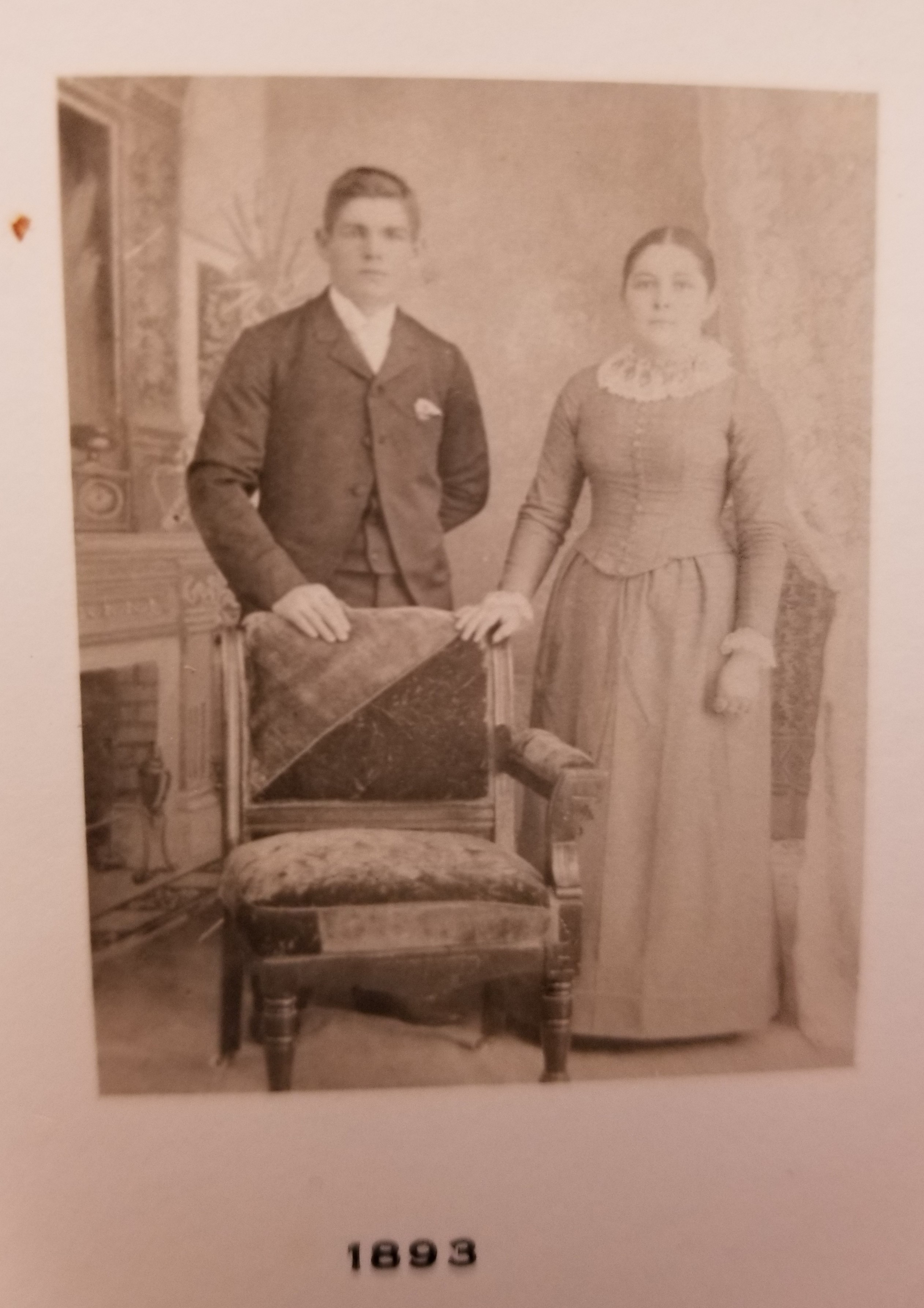
Their wedding picture!! So formal!
My grandmother was very attached to her father those first five years. There were nine siblings in all, some of them already married by the time she was born. In a speech she wrote to share at a family reunion about her history, she noted, “me and my father were great chums.” When she became an orphan, she was moved around among relatives. I think not all of those experiences were happy because she got married at 17. That wasn’t considered so young of course in those days, but their marriage blossomed for 67 years, until Grandma died at the age of 84.
I was just ten when she died. We grandchildren all remember Grandpa Miller taking a bud from one of his rose bushes to put in her hand for the days of visitation by friends and family and for the actual funeral service.
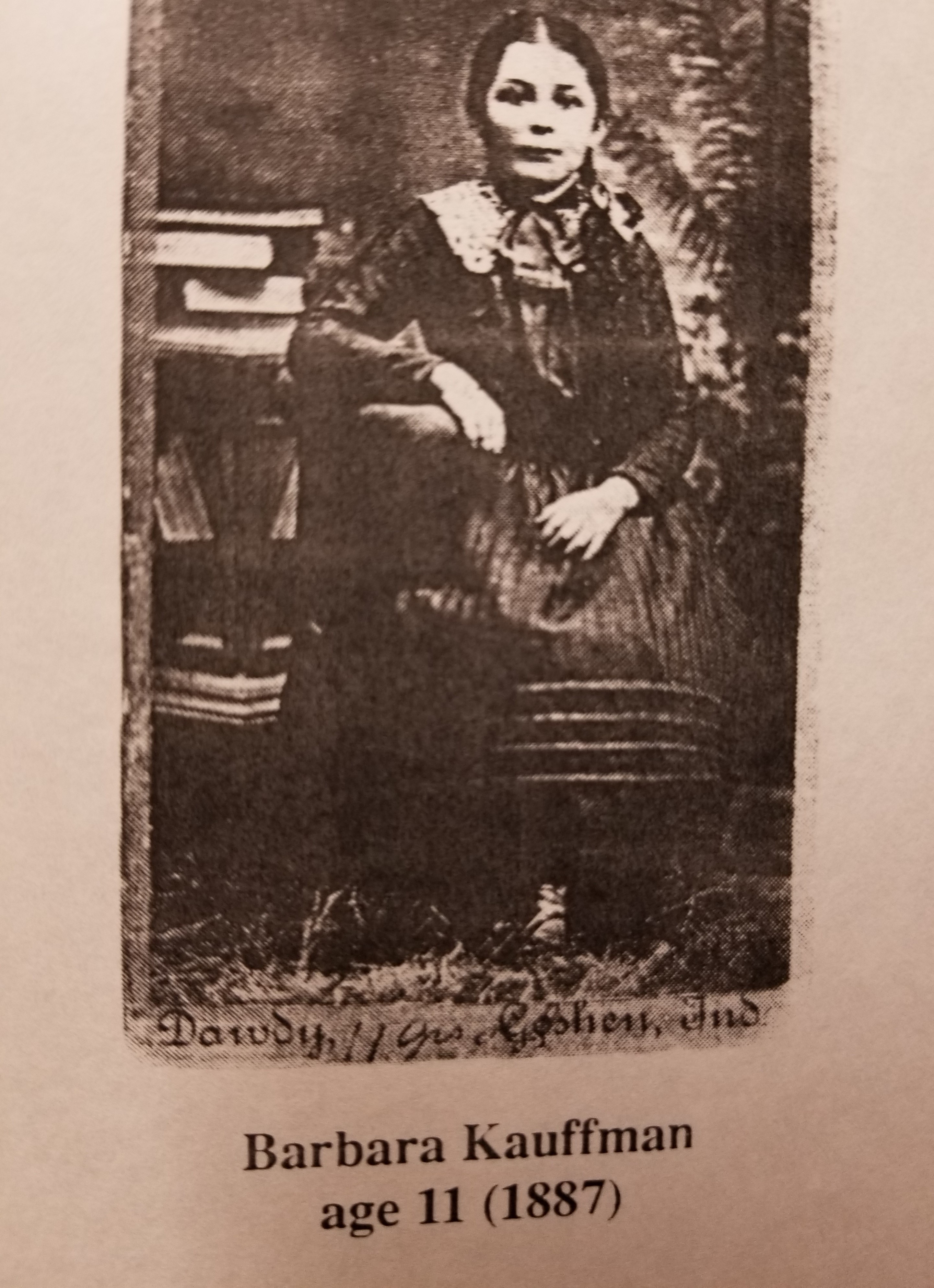
A treasured formal photo of my grandma at age 11.
One reader of this column, “Elsie” gave me more insights into the life and times of Grandma Miller. Elsie said she worked as a hired girl in the home of my Grandma and Grandpa while my dad was still at home: she was 18, my father was 19, and his only brother, Truman was 26. She recalled that the family asked Elsie if she could stand to be teased and replied, “Yes, I have two brothers.” Elsie recalled my grandmother having a huge iron skillet which “made the best fried potatoes” she ever ate. She also recalled my grandma making excellent rolled out lemon cookies. Every Saturday, Elsie and my grandma baked around ten pies to feed the family dessert all week.
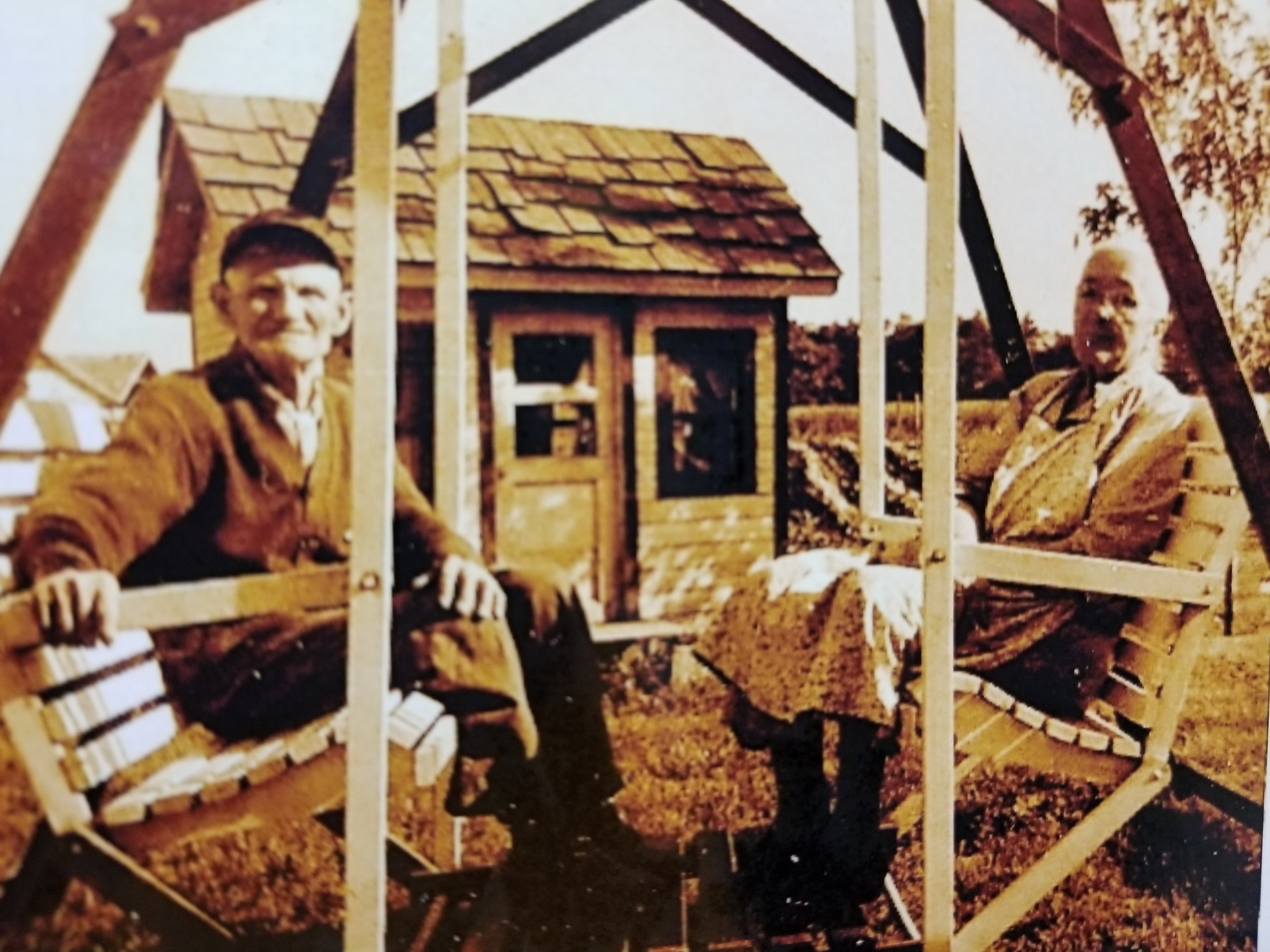
Grandpa Uriah Miller and Barbara Miller the way I remember them, in front of the playhouse Dad build for us. We have a replica of that playhouse at our home today for our grandsons to play in, also built by my Dad and renovated in 2013 by my husband and daughters.
You can bet that those snippets of memories from my grandma’s kitchen are very precious. May they remind you to write or videotape stories so you and your loved ones will remember and know some of the history of your family. Sometimes it appears that younger folks don’t value or remember family history, but many will come to treasure it, especially as they are older.
Plus, don’t forget to show love and appreciation to the mother you have, even if she wasn’t “the best.” If your mother was destructive or abusive or “not present” much in your life, use the bad experiences to be the best mother (or father) you can be and reach out to children who are in difficult, dangerous, or sad situations. Let’s hear it for great moms—and grandmothers!
***
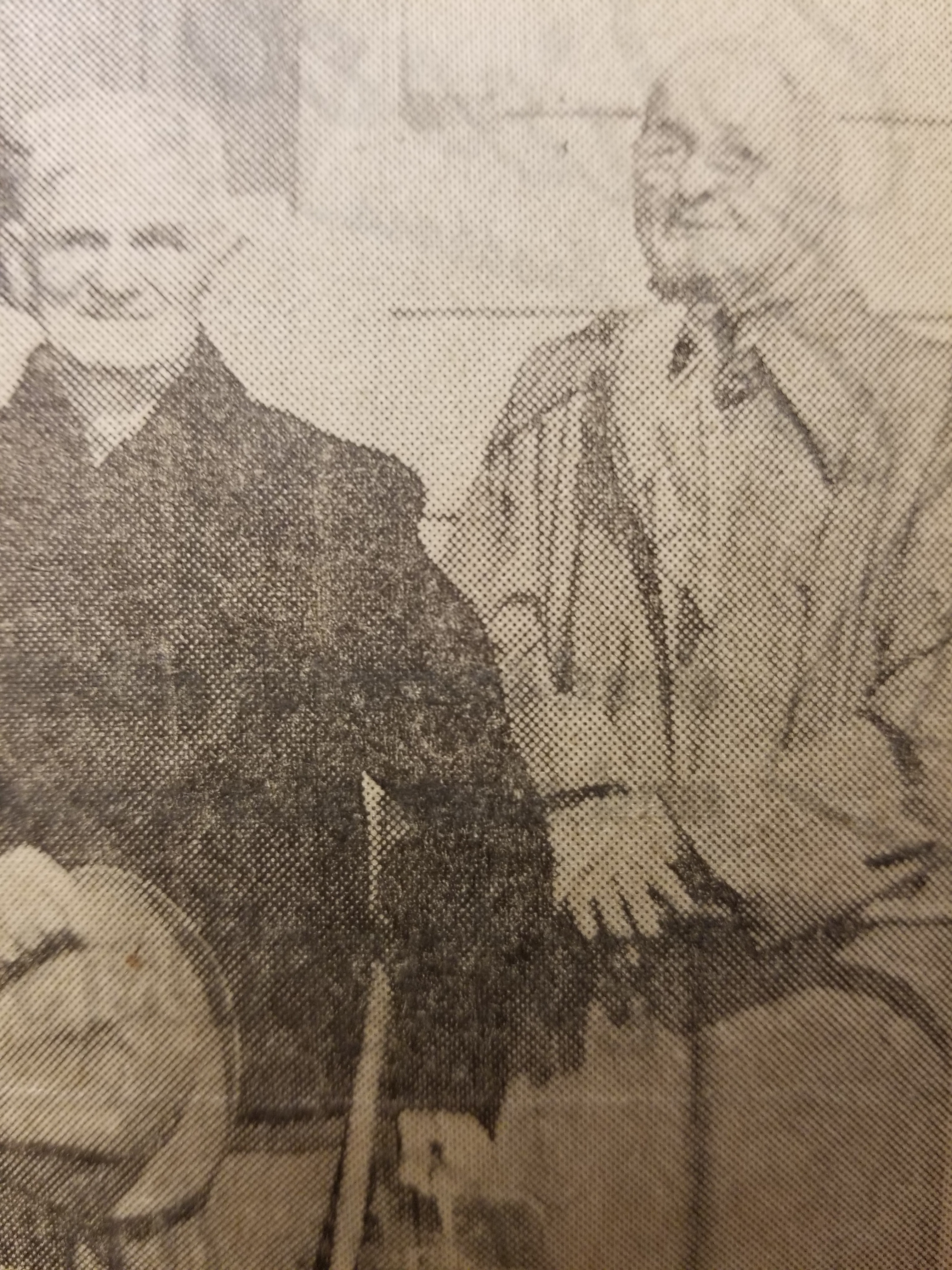
Grandpa and Grandma on their outrageous jet plane trip to California from Indiana. My grandpa traveled by covered wagon and jet, all in one lifetime. Love Grandma’s head shawl here and Grandpa’s hat–and cane!
I’d love to hear your memories or stories of your grandmother.
***
Did your parents or grandparents ever do anything outrageous–read the caption on the photo to the left to learn of an amazing trip they took very late in life.
***
And if any of you with Indiana or LaGrange County, Ind. relatives see any names you know on the school roster, please let me know!! I would love to hear from you.
Comment here or send to anotherwaymedia@yahoo.com or Another Way Media, P.O. Box 363, Singers Glen, VA 22834.
Another Way is a column by Melodie Davis, in syndication since 1987. She is the author of nine books. Another Way columns are posted at FindingHarmonyBlog.com a week after newspaper publication.
Another Way for week of May 3, 2919
Facing Decisions about Aging Loved Ones
Two summers ago at a church convention in Orlando, Fla., I had a soul stirring conversation with a former acquaintance whom I knew multiple ways. I’ll call him Steve. His mother was a tablemate of my mother’s for several weeks in a healthcare facility a few years ago while my mother recovered from some pretty serious surgery. His mother lived at the facility for fulltime care. My sisters and I ate numerous meals with them as we took turns hanging out as Mom got rehab, adjusted to her new regimen, and eventually moved back to her independent apartment.
Steve and his father had gone through some tough decisions regarding his mother’s care; families dealing with aging parents were fresh on my mind from helping conduct a seminar that week with family therapists Gerald and Marlene Kaufman, authors of the book Necessary Conversations Between Families and their Aging Parents (Good Books, 2017).
Several pieces of advice from Steve stick out. At some point my friend realized that he as a son needed to step up and make a decision that his father simply couldn’t make. “Perhaps Dad literally can’t bring himself to make a decision about Mom,” Steve reflected. He was speaking about the great difficulty they had in facing that it was time to move his mother to healthcare. Other tough decisions include feeding your parent, or intubating so they don’t starve, or deciding to have the DNR “Do Not Resuscitate” order on health records.
He recalled phone calls with his mother as being very hard—and then they became impossible. I’m not sure if that was because of hearing issues, or memory losses, or what. But if you’ve ever been in that situation, you know how painful it becomes when even a simple phone conversation with your mother or father or grandparent—deeply intelligent and robust at one time—just becomes a one-way monologue or shouting match. Very sad. At what point do you stop making mechanical or technical or medical interventions? How do you let go?
“Try to make sure ahead of time the family is on the same page in making decisions,” he said. Steve said doctors and nurses who work in the emergency room had shared with him that when kids come in with an older family member, many times they are not of one mind about what kind of care the parent should receive. “It is heartbreaking to do CPR on a frail body,” Steve said doctors told him. If you’ve seen CPR performed in real life or on TV, you know how strenuous that attempt at saving a life by pushing repeatedly on the chest can become. Steve said we need to get to the point where we recognize that it may be best for Mom or Dad to “go home to Jesus.”
 On the other hand, older patients have been revived after a heart episode or other trauma and gone on to thankfully live many additional years and be grateful for them. I worked with one author and medical doctor, Glen Miller who went through major heart episodes and went on to write the book Living Thoughtfully, Dying Well (Herald Press, 2014). In some ways I feel that memory loss, dementia and Alzheimer’s can be the hardest to deal with.
Regardless of the specific difficulties and decisions, Steve gave this excellent piece of advice he had learned from others that I want to leave with you as well: “The ones who visit their parent or loved one are the ones who have fewer regrets after a parent has passed away.”
I’m grateful my own mother is still in relatively good health and that my husband and I are also. But I know as surely as the sun comes up, those days of difficult decisions and changing needs will come for most of us.
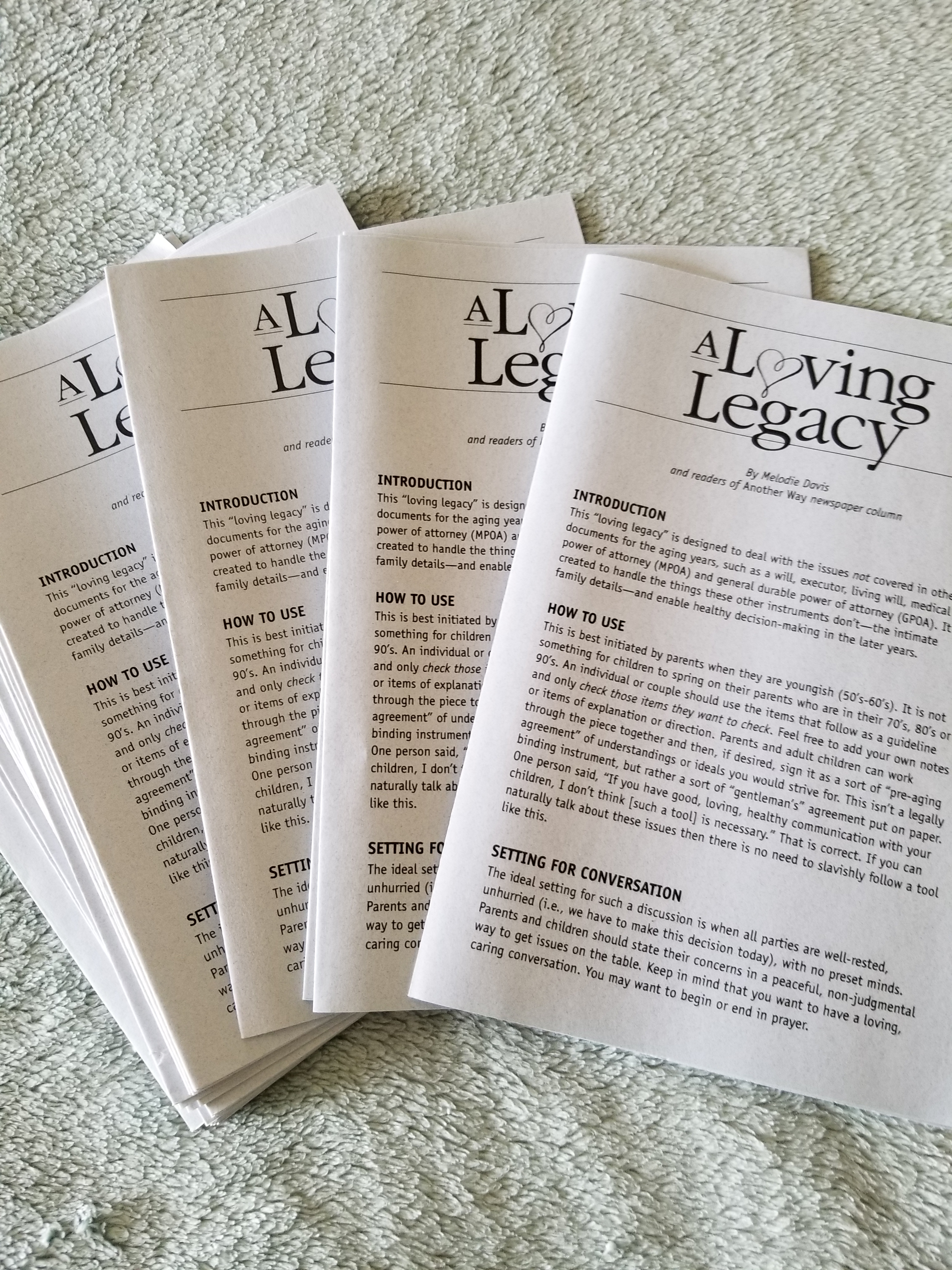
For a free booklet “Wondering What’s Best for an Aging Parent” and my own “A Loving Legacy” providing a guide to the conversations we need to have with our children or parents, write to me at anotherwaymedia@yahoo.com or Another Way Media, P.O. Box 363, Singers Glen, VA 22834. I have plenty of A Loving Legacy if you would like several copies to share.
Another Way is a column by Melodie Davis, in syndication since 1987. She is the author of nine books. Another Way columns are posted at FindingHarmonyBlog.com a week after newspaper publication.
Another Way for week of April 26, 2019
Pie Lady Moments
If you’re wondering, “pie lady?” what on earth is that, I don’t blame you. Greta Isaac is author of a new book, The Pie Lady: Classic Stories from a Mennonite Cook and Her Friends. In it, Greta shares 32 stories of “pie ladies” and their best recipes in a book that is more story than cookbook. I was privileged to serve as the managing editor for this book in my waning months at Herald Press before retiring, and had a lot of back and forth by phone and email with the author as we edited and revised to get all of her details just perfect. She’s an awesome writer and mom. 
The Kansas author’s approach is 100 percent upbeat and beautiful—mingled with an earthy reality among plainer Mennonites who have mostly unpretentious homes, modest farmsteads and a “more with less” approach to life. The women Greta invited to share true stories here are, for the most part not Amish nor Old Order nor thoroughly “modern” Mennonite, but women who dress very modestly by choice or tradition. They quite often find fulfillment and deep happiness in raising their families and working at home. In the introduction, the author writes of the women, “Each life is so amazing, and so full.”
The Pie Lady book starts with Greta’s own growing up days when her grandmother, who lived in Texas, was a literal “Pie Lady.” Greta loved visiting Grandma for a week in summer and helped with pie prep when they loaded up homemade pies in “perfect pie boxes stacked on specially made racks in the trunk of her car, and took them to the local café. There people sprang to open the door and the fridge [saying]: ‘Here’s the Pie Lady!’”
The moment I first read those lines, memories of my mother making yeast-raised cinnamon rolls when we lived in north Florida, and transporting them to the small steak house where I worked as a waitress one summer. The restaurant and customers quickly dubbed her delicacy “Mennonite Sweet Rolls.”
But Greta’s “Pie Lady Moments” can better be described with the word she chooses, “sparkly,” to indicate the many magical moments in our lives and families as pure gold—and having nothing to do with money or heaven forbid, actual jewelry.
Greta relates the story of Julia, a new bride during World War II. When their baby was born, and her husband was serving with Civilian Public Service, she took a job as “house help” for awhile so she could earn money and also care for their small son. In the home where she worked, she loved “learning how to set a beautiful table, loved caring for beautiful things.”
Unfortunately, their first child, Steve, died at the age of three and they mourned him deeply. Five more sons and a daughter came along who, as Julia relates “of course never completely filled his place.” But Julia always had an eye for bright and beautiful things. “All her life, she loved to set the table the way she had learned when she [worked as house help]. She loved making something new and serving it on a red tablecloth. Friends from India taught her to make chicken curry, each topping served in special lovely dishes.”
 Somewhere along the line, I also picked up a love for setting a beautiful table—within the limits of our budget and housewares. I remember loving to set the table for company for Mom: for a while her “china” plates were deep emerald green with bubble bumps around the edges, and stemware that matched plates at their bubbled base. If Mom and Dad went away for a banquet or evening out and we kids were feeling adventurous, my older sister cooked a “restaurant” meal—such as with real French fries (!). I set the table using Mom’s best dishes, and one of us would play waitress and we probably made my younger brother be busboy.
If you pick up this delightful book, I’ll wager that within pages, your own mind will rock back to times of enjoying beauty in everyday life—or the special foods you or your own parents made when they had company over or for a special treat just for your family. At the least it will help you better appreciate the lovely people, special possessions, and moments in your own life.
What stories does this stir up for you? Comments are embraced!
Find more information on Greta’s book at https://heraldpress.com/books/the-pie-lady. I’d love to hear your stories! Send to anotherwaymedia@yahoo.com or Another Way Media, P.O. Box 363, Singers Glen, VA 22834.
Another Way is a column by Melodie Davis, in syndication since 1987. She is the author of nine books. Another Way columns are posted at FindingHarmonyBlog.com a week after newspaper publication.


Doc Teters, you can barely see the green visor but it’s there, along with his vest and bottles of medicine in his old timey practice.
Another Way for week of April 12, 2019
When Doctors Had Time for Patient Care
The first doctor I remember in my childhood was, as we called him, “Old Doc Teters” (pronounced like “meters”). Walking into his quaint office in the small burg of Middlebury, Indiana, was like stepping into a museum from the 1920s. It smelled of antiseptic, like rubbing alcohol. The floor of the waiting room was wooden and the chairs, if I remember correctly, were just plain wooden benches, like old TV programs “Little House on the Prairie” or “Dr. Quinn, Medicine Woman.” Doc Melvin Teters’ father, B. F. Teters, was also a doctor. So his son Melvin maintained the passed-down office décor of his father.

An article posted at the Facebook page, I Grew Up in Middlebury Indiana https://www.facebook.com/groups/157505807660736/
An article I have from the Middlebury Independent notes that local Amish families were fond of having Doc Teters as their doctor, especially since he made house calls. After he died, several of his Amish patients came to rake and clean up his yard since the sister with whom he lived had also just been hospitalized, according to the article. The paper said he was “the last of the old-time doctors,” delivering “generations of babies.” He died November, 1969, shortly after my family moved to Florida.
But I had totally forgotten he may have saved my oldest sister’s life. Nancy was just seven when she developed intense pain in the lower right region of her abdomen. My parents called him asking how long it would last. Mom remembers Doc saying, “Well how long do you want her to live? You need to get her to the hospital right away!” This early hospital experience left her with a strong desire to become an RN and she enjoyed a long career until she fully retired last year. She also remembers sitting beside him for him to pull out a splinter under her fingernail—a very painful place. She almost fainted but was steadied with Doc Teters by her side.
As a child, I never dreaded going to Doc Teters because he knew how to make a doctor visit fun: he wore an old timey green visor, glasses, and a sweater vest. The shelves in his examining room were lined with glass bottles bearing white piles of powder—and huge yellow sulfa pills that would usually make a sore throat go away almost immediately. He would shake down his thermometer swinging it from a string in a big circle: that was just plain amusing. If you were getting a school or athletic physical, he tested your heart by asking you to jog 10 or 20 seconds and then declare you “as healthy as anyone else would be.” Physical all done! He gave free pre-camp physicals when we went to Bible Memory Camp. I also remember a time he tightly tied a string around a wart on my brother’s forehead. It eventually fell off as he said it would.
Many of us have memories of doctors who made house calls, or open their doors on a Sunday morning if necessary. Once when my sister was visiting us here in Virginia, her baby daughter had obvious pain in her ear and we called Dr. Huffman. He quickly dispensed a prescription and she soon felt better.
Medicine has changed much in 60+ years but there are Doc Teters out there who still care deeply for their patients. While house calls are out of fashion, we all appreciate the docs who take time to really talk with you, not at you, who go the second mile in making sure you get set up with a specialist if needed, who make their staff available to answer questions and actually get back to you in person—not call you with a message-leaving mechanism. Insurance practices and hospitals where you are seen by “hospitalists” instead of your family doctor make practicing old-style medicine difficult. But even hospitalists who take the time to really listen, explain, and explain again—help. Plus patients need patience to keep asking until we feel we are truly heard.
And old-style medicine wasn’t always the best, obviously. We were never sure at the end of one of those cheap or free physicals from Doc Teters if jogging in place for 10 seconds was a true test of a flourishing heart!
He thrived on taking care of his patients. I feel privileged to know a few of those today. If you have a doctor like that, make sure he or she knows how much the extra attention and care is valued. We appreciated my husband’s surgeon praying respectively to the Great Healer with us before operating a few years ago.
***
Did you have the privilege of going to an old-timey doctor? Or perhaps he (or she?) made house calls?
I’m all ears right here. I’d love your comments!
***
Do you have a favorite doctor you recall or go to now? What makes this doctor a fav?
***
Of course, there were quacks then as now. Overall, I’m very grateful for the medical care
that is available in most communities today.
***
I am also grateful for whoever posted the article/obituary for Doc Teters some years ago on the Facebook page “I Grew Up in MIddlebury Indiana: https://www.facebook.com/groups/157505807660736/ (without which I would never have been able to verify the details of my Doc Teters memories!)
Send comments or stories to anotherwaymedia@yahoo.com or Another Way Media, P.O. Box 363, Singers Glen, VA 22834.
Another Way is a column by Melodie Davis, in syndication since 1987. She is the author of nine books. Another Way columns are posted at FindingHarmonyBlog.com a week after newspaper publication.

 findingharmonyblog