

Another Way for week of July 26, 2019
Don’t Try This Alone: Why Help May Be Essential
The third in a four-part series on “Learnings from Cousin Camp” by columnist Melodie Davis.
Wednesday was the day of our big outing for the week: a trip to Riven Rock Park in nearby mountains. The rustic park has the chilly and clear Dry Run (stream) running through it, a place we frequently enjoyed as a young family with three daughters. One time before we knew better (of how to access it), we climbed down a steepish bank on one side—each of us with a toddler in our arms and the oldest girl hoofing it safely down on her own. They always enjoyed rock hopping, hunting for minnows and crawdads, and we usually took a picnic lunch.

Reading our young campers the riot act before venturing out to the river.
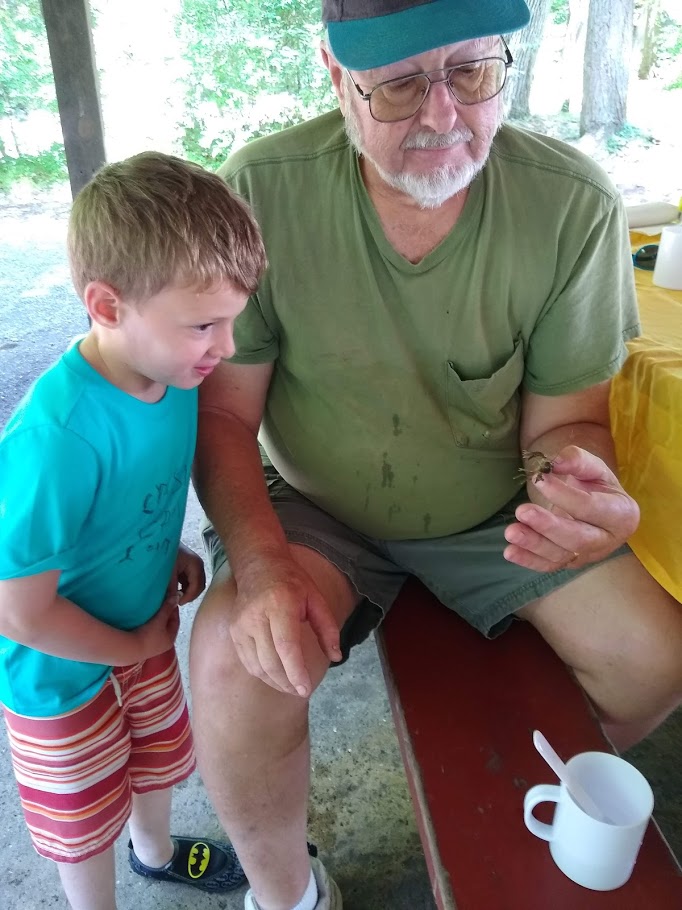
S and Grandpa with the crawdad!

Friend Joe helps our little bit squeamish camper H with his fish.
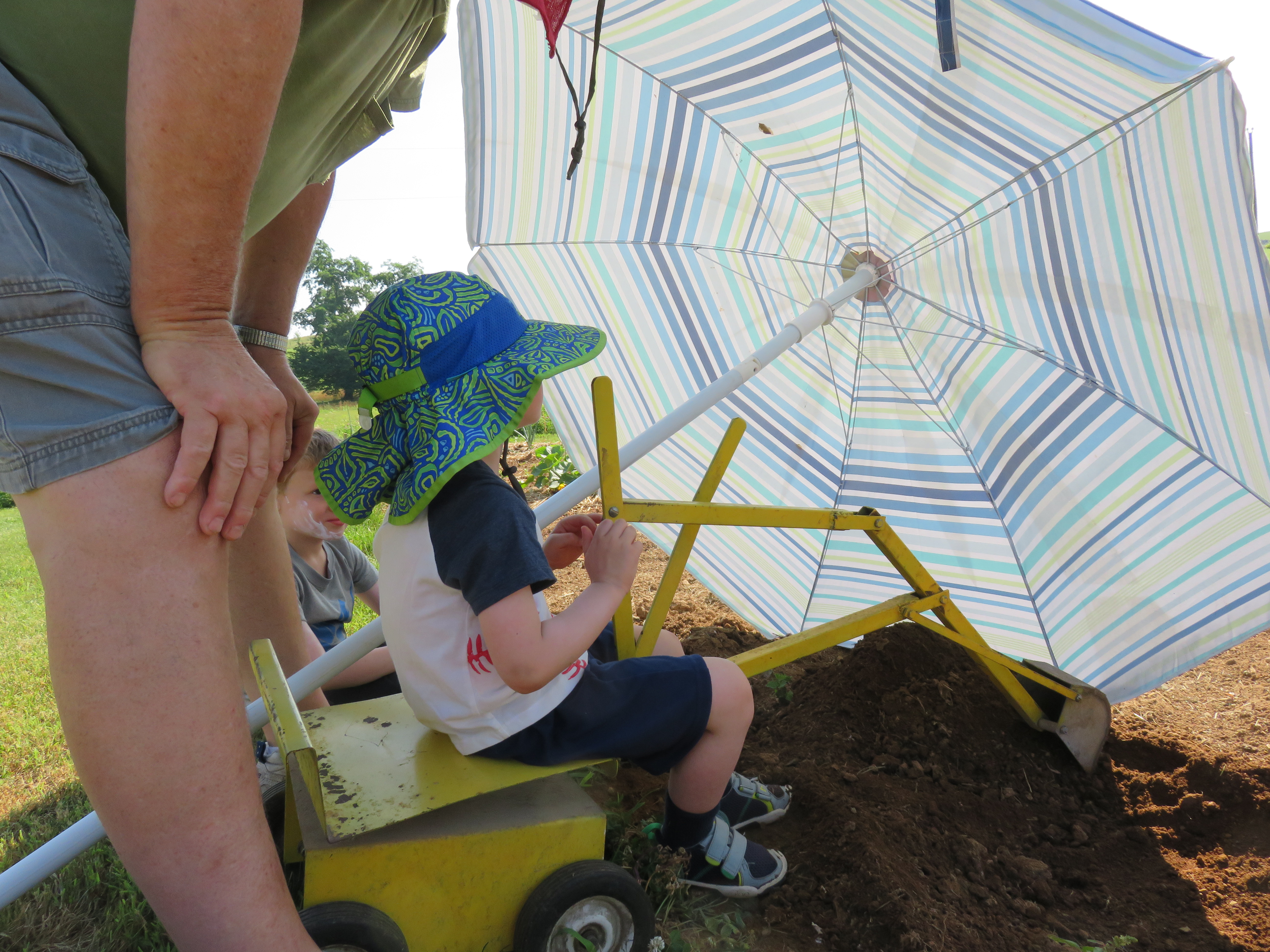
Grandpa and Henry working the little digger Grandpa welded long ago for our daughters.

Grandpa supervises a “sword fight” with leftover “clappers.”

Grandpa helps J. put together his wooden car project while H watches.

J, at bat and S, pitching working on their baseball skills.
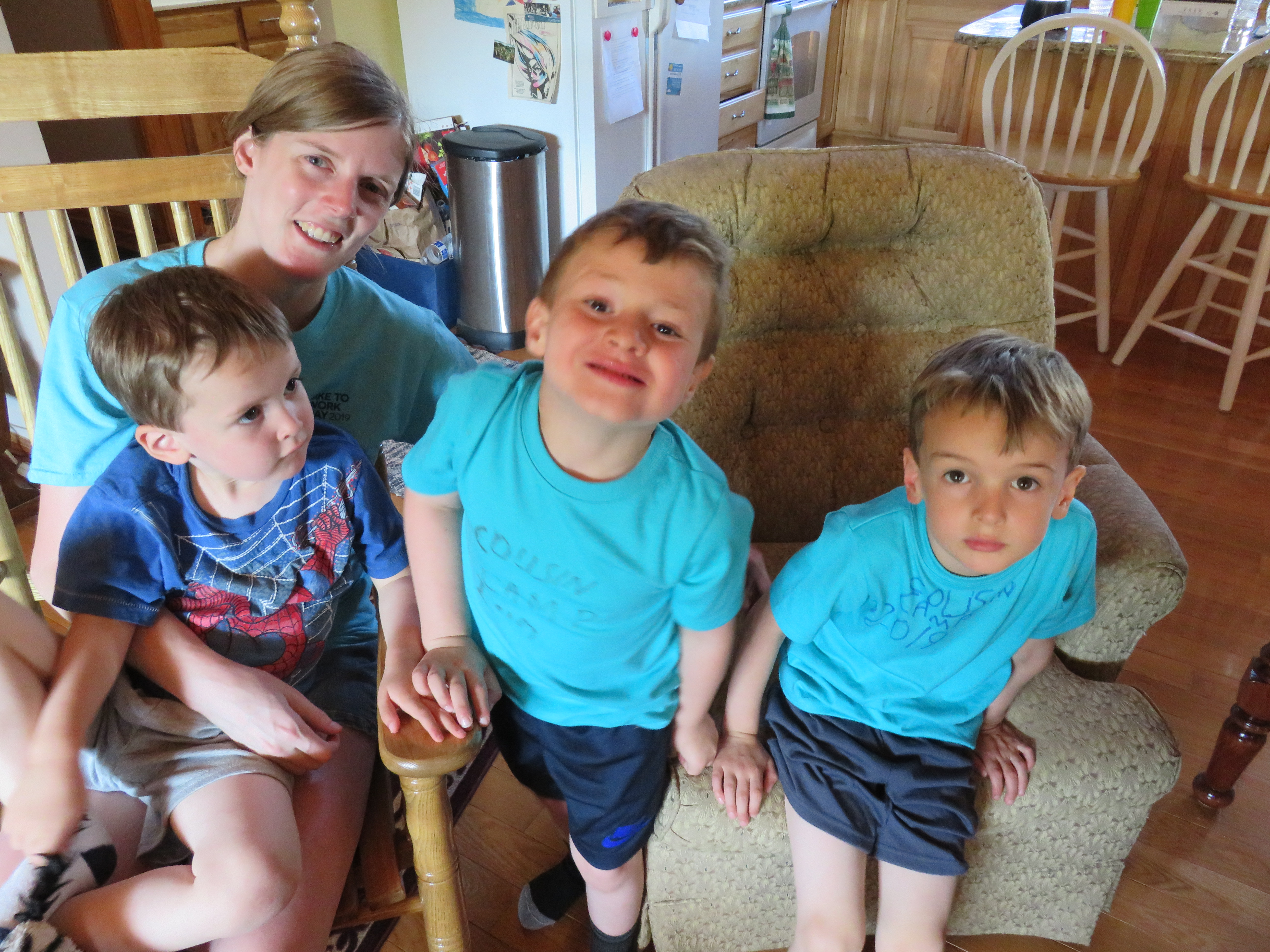
Super helper Aunt Doreen loves her nephews very much.
Now visiting this favorite place with our three oldest grandsons S, J, and H, (ages five, and three-and-a-half), I’m glad we had three adults watching over them. Earlier in this series I mentioned their Aunt Doreen came to help us out. This was one day we needed all hands on deck—or rocks as it were. As I made the boys sit down to go over our safety rules, I emphasized that they needed to listen to Grandma, Grandpa and Aunt Doreen because sometimes children in these settings in the wilderness have wondered off and gotten lost, drowned, or hurt. They seemed properly awed, but not scared off. All of them take swimming lessons, so they know the dangers of water. The water was moving quite fast.
We eventually spotted crawdads and minnows: pretty hard for little ones to find, flitting around their feet, but finally they did! Aunt Doreen ultimately captured a crawdad in a cup, so she and S waded back to show Grandpa (who doesn’t have the agility he used to have). He was keeping watch over our picnic basket, cooler, and open car.
I was very glad Grandpa could be as involved as he was the rest of the week—despite his mobility issues. He and Doreen took the boys fishing at a friend’s pond—leaving me home alone to luxuriate in a quiet house as I made several dishes for the wider family group that came over that evening. Toward the end of the week when I was nearing the end of my rope and creativity, he blew bubbles with them, but the bubbles were hard to get sailing on a very still morning. So we scratched that in favor of a water fight with large plastic water blasters and football stadium noisemakers—the things fans clap at a game to make a lot of noise. We got out the digger Stuart made long ago, and they learned how to operate its shovel in the garden. We ended up cancelling the trip to the local pool, feeling we all needed a low key day at home. Plus Doreen had to get back to her job.
Overall, it took three of us reading books, giving baths, picking up toys, helping with shoes (some were too small, some too new to easily slip on small feet), keeping dishes washed and food cooked. We managed to keep the three of them mostly happy, mostly dry, and mentally challenged. In the future I may try a four-day camp if feasible, unless we again have good “extra” help lined up! After raising three daughters, managing three grandsons for 6-7 days (with no parents present) is a fun but exhausting challenge. No one got sick—either homesick or the other kind, not one got really hurt (thankfully!), and we had only a few bathroom mishaps. There was no major fighting, just a few disagreements on whether to play soccer or baseball, who could sit where at the dining room table, and who got which kid plates. J willingly gave up his chosen evening reading book one night, (a Berenstain Bear volume on scary dreams) when Grandma pointed out that it may be too scary for the three-year-old right before bedtime.
As adult cousins and siblings, we don’t always agree and also get irked at one another, eh? The kids helped each other too: sometimes figuring out the ins and outs of their various car seats faster than Grandpa and Grandma. Next week I’ll share the rewards we found from this very special week.
Remember, we all need each other—and everything goes better with love.
For a copy of all four columns on “Learnings from Cousin Camp,” you can write or email me and I’ll send it to you by mail or email when the series is finished. Write to anotherwaymedia@yahoo.com or Another Way Media, P.O. Box 363, Singers Glen, VA 22834
Another Way is a column by Melodie Davis, in syndication since 1987. She is the author of nine books. Another Way columns are posted at FindingHarmonyBlog.com a week after newspaper publication.

So who’s strongest? Working together gets the job done. (Ha. The bale doesn’t actually budge.)
Another Way for week of July 19, 2019
Why You Need Plan B during Cousin Camp
The second in a four-part series on “Learnings from Cousin Camp” by columnist Melodie Davis.
Last week I began this short series on the pretty ambitious but so-rewarding experience of having our three oldest grandsons stay with us for one week. We came up with a day by day schedule, and like all good schedules, promptly wiggled some things around.
If you read last week’s column, you may recall Tuesday’s plans:
Go to morning $1 parent-approved movie, Paddington Bear 2; shop for sleeping bags at Walmart?; playground if time; write letters home and field trip to post office.
Whoa boy: that was way beyond ambitious, and here are some memorable moments on how we needed to punt.
First, this was the first time these boys had been to a real theater, period. Also, none of them watch much TV, and very few videos, mainly at preschool or at childcare.
A one-and-a-half hour movie—with the previews and “commercials”—took up almost all of the morning. We wound up just running to Chick-fil-A afterwards for a quick lunch, even with longish lines!). Chic-fil-a was our pick because it provides a gluten free option for grandson J.
Paddington 2 turned out to be quite traumatic for the youngest boy, H, who is three and a half and normally doesn’t cry very easily. But as his mother had reported, if he breaks down, he just wails and can’t get his breath, quite dramatically. Yet I do not regret going to this movie (spoiler alert). For me it was a side-splitter—just hilarious i n places and completely kid safe but very sad at one point when it looks like Paddington is going to drown. I kept telling H that Paddington wouldn’t drown. But we spent significant time afterword calming him down. As we left the building, he kept looking back at it, perhaps trying to figure out just what kind of place a theater was. I think he was also uncertain of what was real and unreal.
I was relieved a day or so later when he volunteered that he was scared that Paddington was going to drown when he fell off the train into the water. I was glad he was able to talk about his experience and feelings. The ending of the movie is very happy with a teachable moment, so I’ll leave it at that.

H draws pictures for his “letter” home.
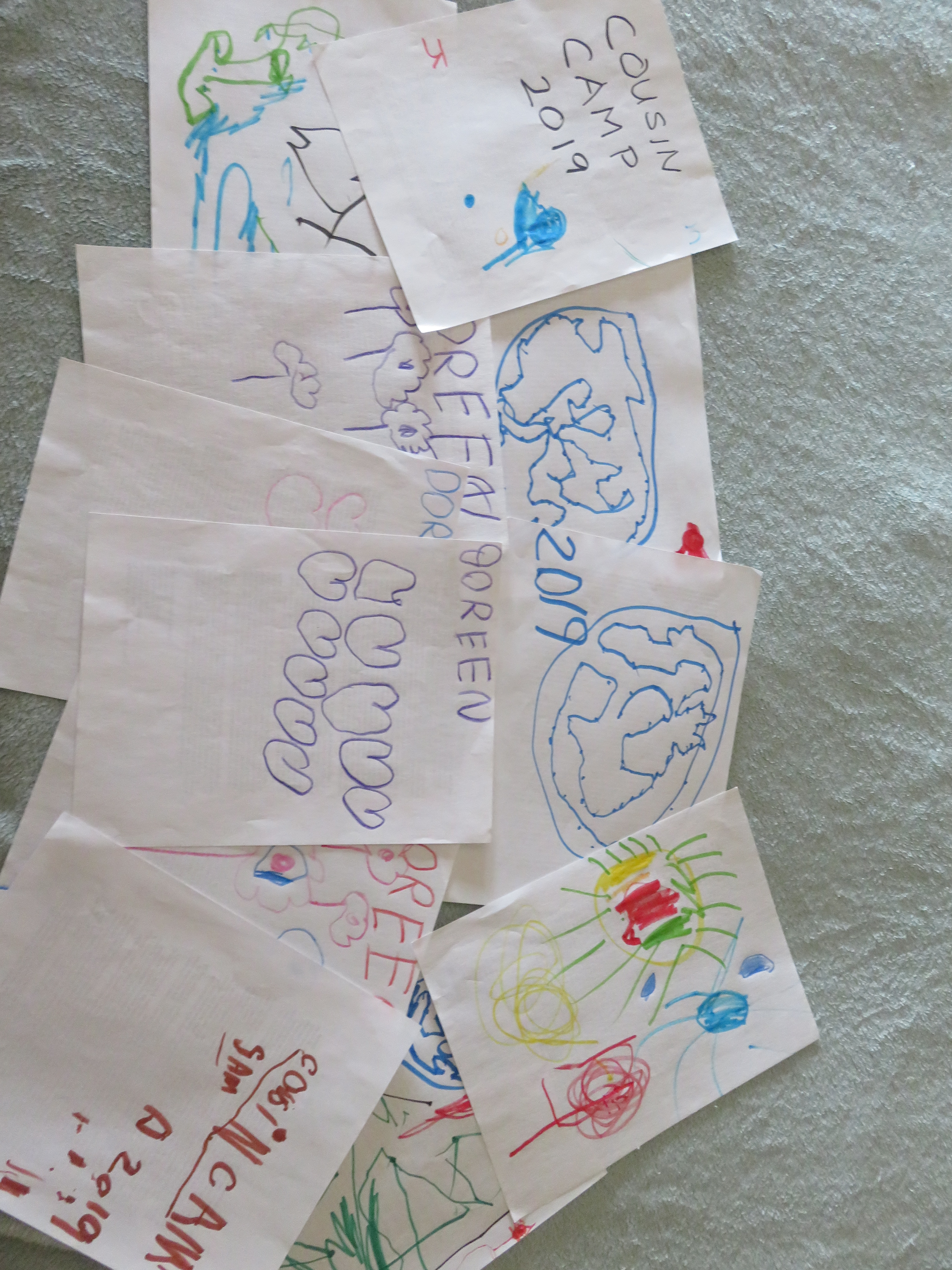
Any doubt these boys love their Aunt Doreen?
We skipped the sto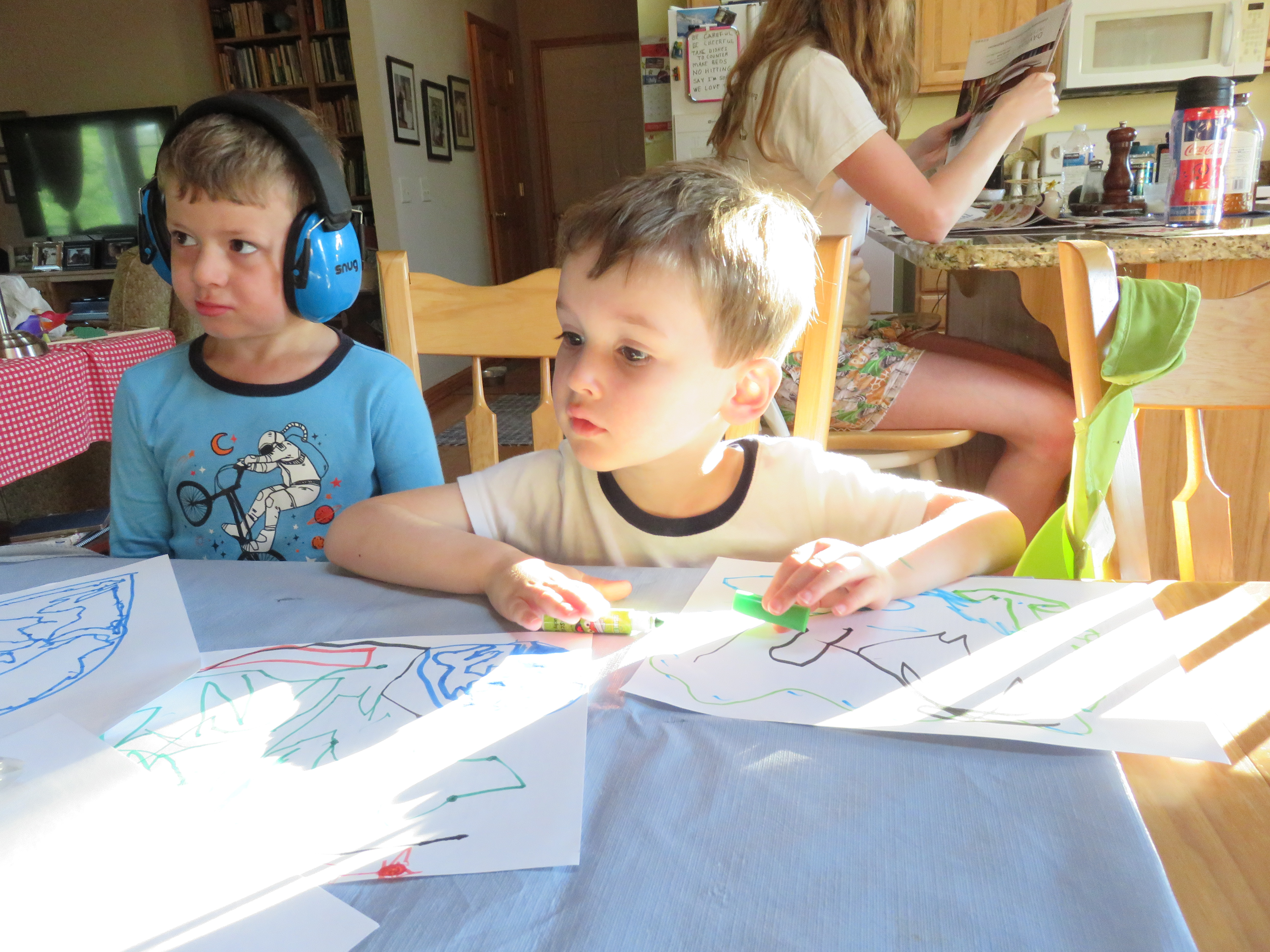 ps at Walmart and our town’s best playground—we really didn’t have time before afternoon rest time. It was also so hot that week I couldn’t imagine them playing in sleeping bags under a real or pretend tent, and it was too warm to think of trying to set up a tent which hadn’t been pulled out of the basement in over 10 years (perhaps moldy?). Later in the day, after naps/rest time, the two older boys did write “letters” to their parents—me spelling words that they wanted to use. And then they drew pictures and added lots and lots of stickers. They still love stickers. But by this time, I knew that trying to write a letter was quite beyond the three-year-old’s interest level, so he just colored on paper.
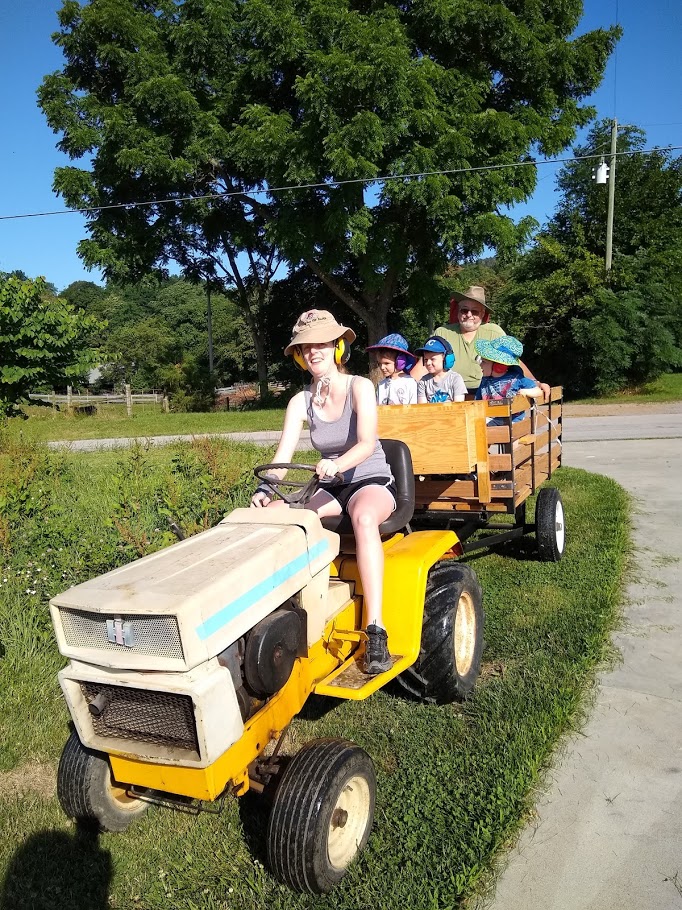
With sun hats and hearing protection for all, Doreen drives the boys on their requested “tractor ride,” while Grandpa rides tailgunner.
The lesson here? Make a master plan, but be flexible. My plan to work on their “Cousin Camp 2019” T-shirts got simplified and reduced to about ten minutes the next day. These boys aren’t into long craft projects! I also wanted to take the kids to our post office to mail their letters: a quaint old timey office where one lone postal worker processes most things by hand. I had reasoned that in their lifetime, they’ll see the demise of most smaller post offices—or perhaps all. It was still a learning experience: where you put things on an envelope (the return address, the stamp, and the main address); and how to lick an envelope—another new experience. Instead of driving to the post office, we just dropped them in my mailbox. S asked “Why is your mailbox on the other side of the road?” Kind of sounds like the beginning of a bad “chicken cross the road” joke. All in all, a “new experiences day” in a week of mostly fun.
My next column is called “Don’t Try This Alone.” Don’t miss it!
***
Having a Plan B is always good advice! When have you defaulted to Plan B or C with your family or activities or travels? We’d love to hear your trials and your triumphs.
***
For a copy of all four columns on “Learnings from Cousin Camp,” you can write or email me at anotherwaymedia@yahoo.com or Another Way Media, P.O. Box 363, Singers Glen, VA 22834 and I’ll send it to you by mail or email when the series is finished.
Another Way for week of July 12, 2019
Planning for Cousin Camp
The first in a four-part series on “Learnings from Cousin Camp” by columnist Melodie Davis.
Do you remember when you were five and got to spend some summer days and nights at your grandparents? What do you remember?
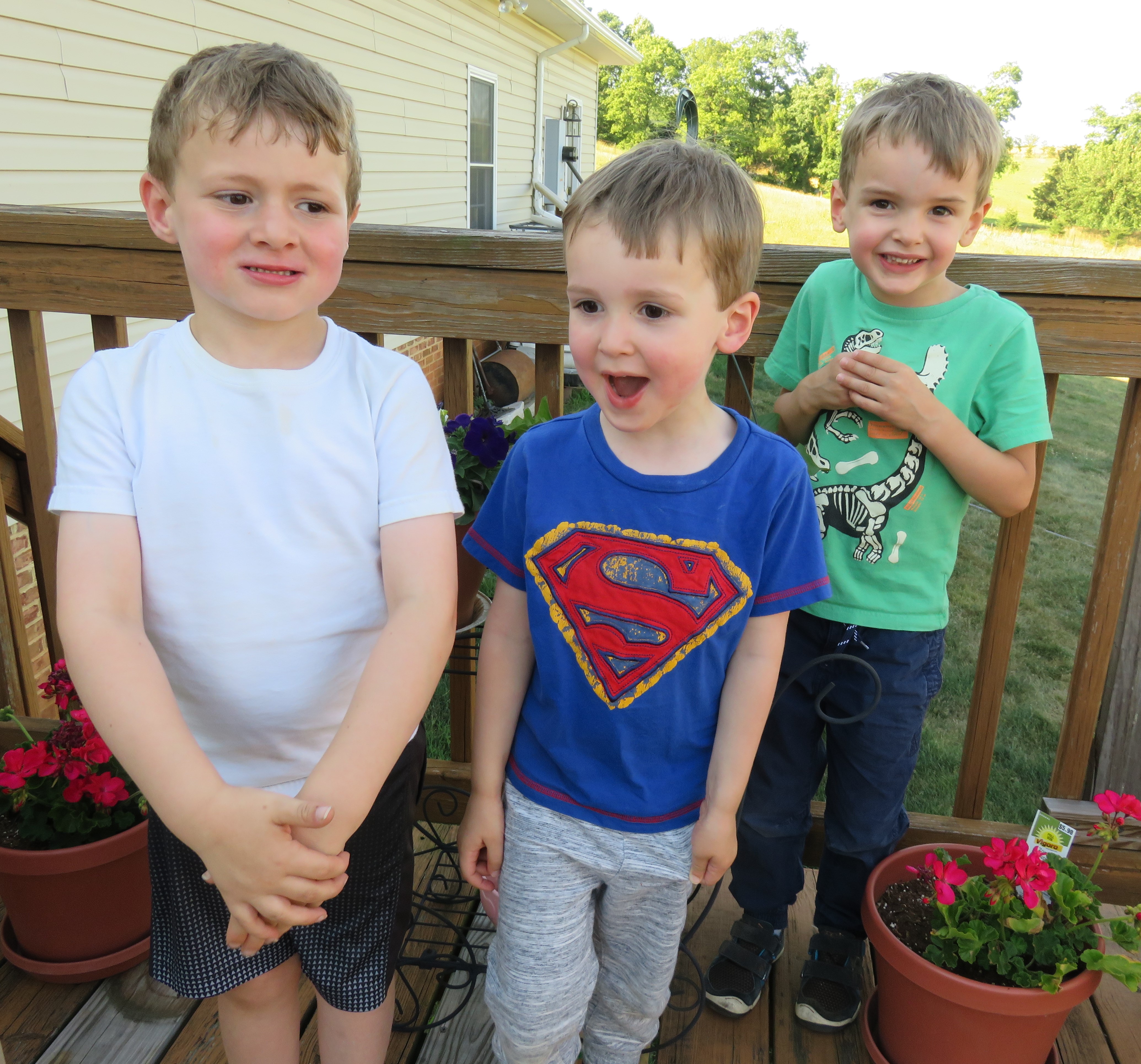
L to R: Our boys for the week: “S.” turning 6 in September, “H,” turning 4 in January, and big brother “J,” turning 6 in November.
Today’s version of this summer tradition in some families is sometimes called “Cousin Camp” or “Grandparent Camp.” I first heard it from friends at church. They had happily hosted their grandchildren together (rather than one or two at a time) so that grandchildren from far flung families get the experience of being together for extended play and conversation with cousins who see each other only infrequently. They mostly conducted it from their own home, but others travel with their young charges or operate from a vacation cabin, tent, or motel/hotel.
When I mentioned Cousin Camp to several friends or acquaintances they responded with “what a great idea.” So it felt like a new concept for some. But children have been “sent” to their grandparents over summer vacation for decades—perhaps even centuries, even though the need for this connection seems much more prevalent in our current culture when many families live hundreds of miles—or even continents apart. I realize how extremely fortunate we are to have grandchildren, to have good relationships with them and their parents, and to be able to afford spending extended time with them now that we are retired.
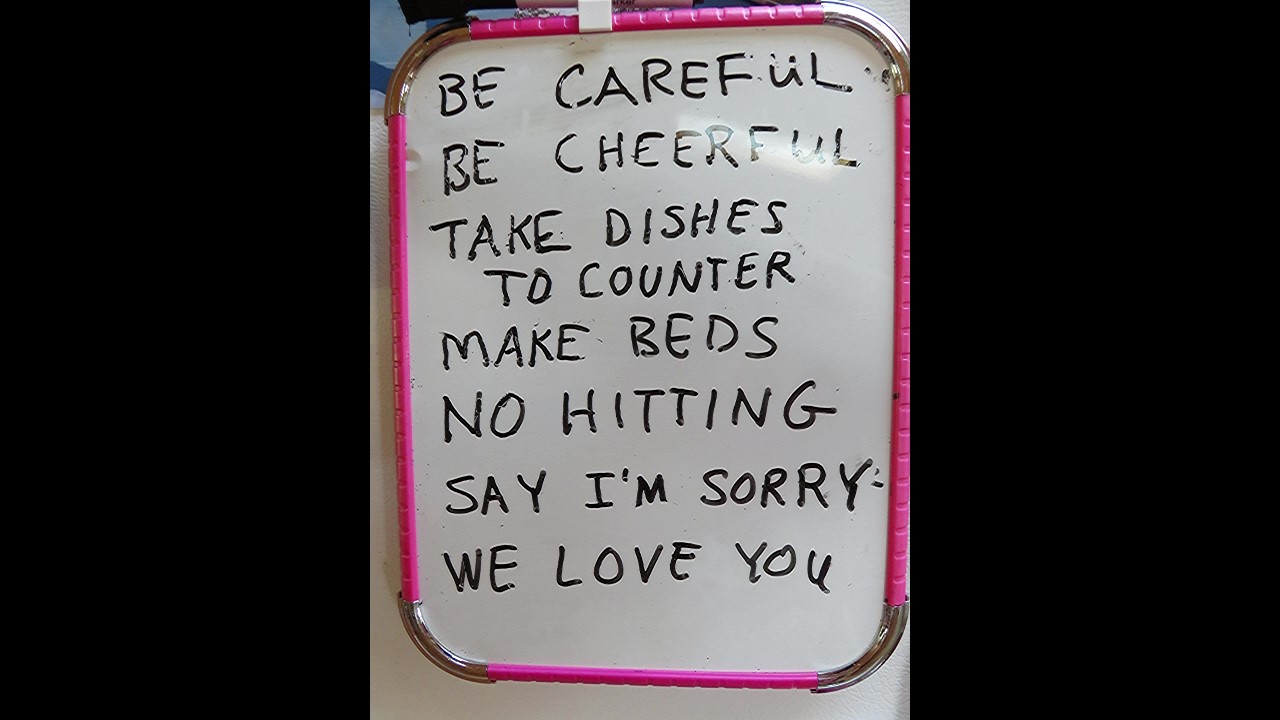
Our ground rules and values for camp.
So what can you do besides the obvious things like take them to a playground, on a hike, or to the nearest children’s museum? NONE of those obvious things happened during our recent special week because we had already done the first and last many many times, and the hike was ruled out as a little ambitious given the age of our youngest “camper.” We hosted two grandsons, S and J, who are five-and-a-half (born two months apart), and one grandson I’ll call H: a tall three-and-a-half-year-old.
Neighbor and blogger Jennifer Murch has held cousin camp numerous times for her own children (not grandchildren) who live at a distance from their first cousins. Her children are now mostly teens who actively help lead the week of activities, games and excursions. Some of their ideas and amenities included a trampoline (old fashioned rectangular kind), neighbors’ above ground swimming pool, taking all the kids to Costco to eat snacks (doesn’t work so well if kids have allergies), the library, and visiting a pet store. Author and former college president Shirley Showalter and her husband also had a week with their grandchildren which she wrote about here.
Here is a modified version of the schedule we initially planned. You could easily adapt this with your own schedule and ideas. (I’ve included a few pictures giving hints at which activities we were able to do or easily illustrate.)
Saturday 11:45 a.m. Pickup grandson S. in Beckley West Va. at Wendy’s (half way meeting point)
6:30 p.m. Friend Joe hosts us for BBQ ribs and then fireworks at our daughters’ old high school
Sunday 10 a.m. church – plus play on church playground after
Daughter Doreen brings grandsons J and H from the city where their family, plus Aunt Doreen live. She helps us with the three boys for four days.
Playtime: Baseball, soccer, and playhouse, plus dinner

Older cousin S sharing his sticker book with younger cousin H. In grandpa’s chair, of course.
Monday Backyard play, maybe put up tent or possibly fishing at Joe’s
4:00 p.m. More cousins (other side of family) come play pee-wee baseball, soccer
6 p.m. Grilled hamburgers, hot dogs, gluten free (GF) smores
Tuesday Go to morning $1 parent-approved movie, Paddington Bear 2; shop for sleeping bags at Walmart?; playground if time; letters home and field trip to post office
Evening: (Stuart and Melodie to Lion Club installation of new officers)
Wednesday Make camp t-shirts; go to Riven Rock park and creek with sandwich picnic (GF bread). Doreen leaves p.m.
Thursday Westover pool with new sprinklers if hot, or fishing if we haven’t been yet
Evening: West Rockingham Lawn Party with “bouncy” house; take GF sandwich for J. Music, real bingo.
Friday Take S. half way home to meet up with Dad. (Other grandma—nearby—keeps J and H)
Saturday Take J and H to meet their Mom at half way point near Walmart.
So, what went well? What had to be scratched or modified? Find out next week in this space!
I’d love to hear your experiences with grands coming to spend time with you. High moments, low moments, insights you gained about yourself or your grands?
What do you recall about your own days at your grandparents?
Comment here!
Or if you prefer, email me at anotherwaymedia@yahoo.com or write to Another Way Media, P.O. Box 363, Singers Glen, VA 22834.
Another Way is a column by Melodie Davis, in syndication since 1987. She is the author of nine books. Another Way columns are posted at FindingHarmonyBlog.com a week after newspaper publication.
Feeling Ripped Off?
I hate feeling ripped off—in this case losing about four hours of time—for both my husband and me. Added up, that makes eight hours, pretty much wasted. I have written about other experiences when we or I were played for the fool—once many years ago when we somehow participated in an offer at the fairgrounds that seemed too good to be true—and was.
This time it was a health screening. A widely advertised company was holding medical screenings in our area. The one for which my husband had signed up was about 30 miles away. We looked forward to the pleasant drive through some scenic areas on our new “both retired” schedule. It was also near a favorite eatery where we would finish off with a nice lunch—him after have an eight-hour fast from the night before. I had made his appointment for 11 a.m. He’d first have time for his morning workout, and we could probably finish the five screenings that were scheduled easily by 12:30. They said to allow 60-90 minutes for all five tests.
Ha ha. We arrived in plenty of time at 10:45 but didn’t walk out until about 2:15.

My mother and my sister (Mom all gussied up for a play she was appearing in).
What took so long? Inadequate staffing, about which the workers who did show up were also feeling really ticked-off. So teed-off in fact that one said if she could punish those who didn’t come for the day’s work, she would. Those who didn’t show up left the others short-handed, and those who came for appointments, waited for hours instead of 15 or 30 minutes to be seen. It appeared that appointments for one set of mostly older men being screened were all at 10 a.m., and another group at 11, and they were still working on the latest guys at 2:10 when we finally escaped. I know, they should call it “Medical Escape Room.” Reading some of the reviews at the Better Business Bureau website before signing up would have warned us.
You’ve probably seen ads for this type of screening, often held in a volunteer fire department facility or at the Salvation Army or other community-oriented place so that it seems like a real community health event. My husband had gone to an earlier one (without me) about three years ago. He didn’t have these problems with long waits and inadequate staffing at that screening center.
What I really didn’t like was all the communication tools they used to get the word out—a barrage of emails, ads online which popped up in my Facebook feed, and paper mail (because of my husband’s earlier experience) that made you think this was a really well-organized professional outfit. Trying to run an event like that without full staffing was no fun or fair for anyone: not for the workers, and certainly not for the victims. Oops, patients. I will doff my hat to all who were there, who tried to treat each other nicely and professionally in less than ideal circumstances. My husband, though seething, hung on to the end.
The day was rescued by a very pleasant, tasty, and affordable lunch at the Hawksbill Diner—not far from Skyline Drive. By the time we arrived it was 2:25 or so, and the noon rush was nearing an end, and we enjoyed chatting to the fine wait staff, cooks and the owner who came out from the kitchen to have their own late lunches.

My daughter listens to one of my mother’s stories. Mom will celebrate her 95th birthday later this month.
We did gain some valuable information from the screening and now that we’ve received a report that says a prior situation had improved, I guess we’re feeling a little less scammed—and my husband will discuss the reports with his own doctor. But there are so many health rip-offs especially targeting older people. Do be aware and try to check out organizations online or with your own doctor before you sign up. Good health is a gift so it is well worth it to try and stay as healthy as we can.
***
Most of us have times when we–or our parents or grandparents–were or felt ripped off. Share your story or comment here!
Or, get in touch by email at anotherwaymedia@yahoo.com or snail mail me at Another Way Media, P.O. Box 363, Singers Glen, VA 22834.
Another Way is a column by Melodie Davis, in syndication since 1987. She is the author of nine books. Another Way columns are posted at FindingHarmonyBlog.com a week after newspaper publication.
Another Way for week of June 28, 2019
Who’s Got Joy?
“I’ve got the joy, joy, joy, joy, down in my heart. Down in my heart, down in my heart…”
No, it wasn’t Marie Kondo crooning this old timey little Sunday school song but rather Granny on Beverly Hillbillies recently. If you’re not sure who Marie Kondo is, she’s the decluttering queen who encourages families or couples to look long and hard at all their possessions and to keep only the things that truly bring them joy. She has appeared on many television talk shows as the author of The Life-Changing Magic of Tidying Up.

Old picture of the old style TV everyone used to have, upon which we watched things like Beverly Hillbillies.
If you’re not sure who Granny on Beverly Hillbillies is, that’s a show from the 60s that still airs on the MeTV channel, watched mostly by older folks. So, the other Saturday morning as I was getting breakfast (here I’m going to sound like the old timey, yes, Southern grandma that I am), it did my heart good to hear this little chorus from my growing up days.
Once in a while, even today, you see a television show with wise morals, values, and a positive portrayal of Christian faith that keeps you singing all day long. I wouldn’t hold up Beverly Hillbillies as a model of Christian behavior, but that morning’s program portrayed some excellent examples of how to treat other people.
Granny had gotten herself in trouble with her wealthy banker neighbors, the Drysdales, by picking up a garden implement she mistakenly thought her son Jethro had carelessly left outside. Granny took it home and the neighbors accused her of stealing it. Well that set off a feud to rival the McCoys and Hatfields, with an ongoing misunderstanding until the end of the show. Finally Granny, after numerous angry words back and forth, and numerous Sunday school songs she sings to herself, is inspired to take the high road and apologize to the Drysdales for her mistake. They reconcile and all is well, at least until the next episode. How many schoolyard fights and misunderstandings between spouses or coworkers would benefit from backing down, valuing the relationship, and offering a genuine apology? That was the message I took to heart that Saturday morning.
Perhaps it would do us all good to more frequently remember how loved and special we each are according to the teachings of the Bible. One seminary professor, Lynn Jost, writing in the Rejoice! devotional magazine, shared an experience from his own seminary days. He recalled an exercise where each student was asked to place humans on a 10-point scale, with earthworm as lowliest with a “1”, and God as highest with a “10.” Where would you rank yourself on that scale as a human? Probably most of us would only give ourselves a 7 or perhaps an 8, as he did in that class exercise. But according to Psalm 8:5, our place in creation as humans is just “a little lower than God and crowned with glory and honor.” So, we are all more like a “9” if you take this verse to heart. Does that give you joy or a wow for your day?
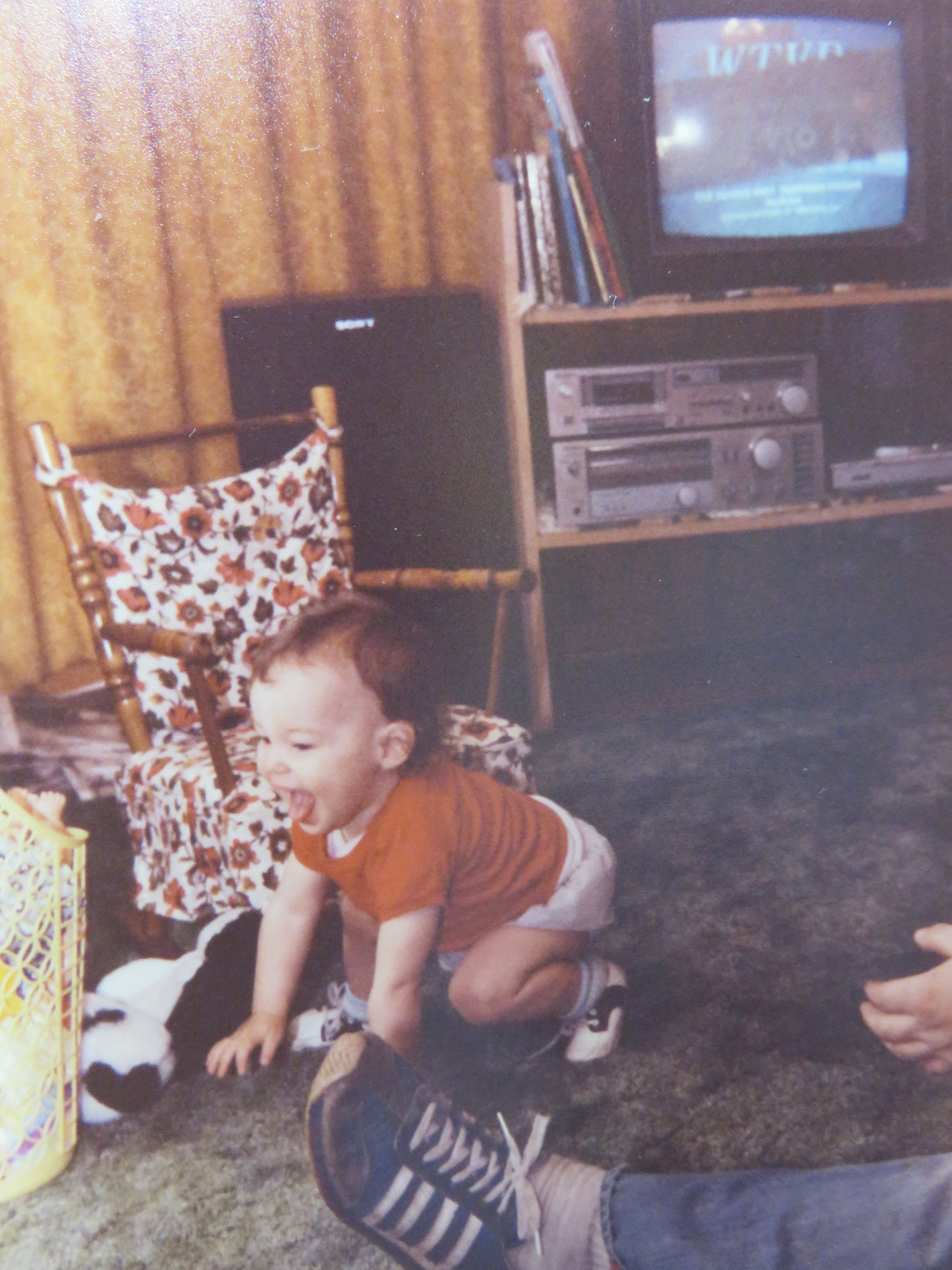
Here you see why I even have an old grainy picture of a grainy TV screen: our oldest daughter Michelle taking some of her first steps. Now that’s JOY, for child and parents alike. Her Daddy is sitting by, ready to catch her if she tumbles.
Jost goes on to suggest keeping this “9” status in front of you even when you are frustrated by the “wasted motions” of a grocery store clerk, or exasperated by a driver on the highway. Such an approach can make a difference in your attitude. Both you and that other person are “9” in God’s eyes. That thought can refill your well of joy.
In another scripture, Zephaniah the prophet is foretelling how the people of Israel in the Old Testament—who went astray many times—will be restored as God’s people. Zephaniah 3:17 reminds them and us: “The Lord your God … will take great delight in you.”
If quarreling and unruly people were told God will find joy in having created them, surely God delights in you, too. And my other takeaway? I haven’t yet done a Marie Kondo cleansing of our house, but I find that just donating objects I’m no longer using or want does my heart good, too!
***
When did a song lift you up at just the right time? What was it?
***
 I just have to mention an exciting new Mennonite hymnal that is coming out in 2020. Learn more over at Voices Together.
Other comments? Post here or Email me at anotherwaymedia@yahoo.com or write to Another Way Media, P.O. Box 363, Singers Glen, VA 22834.
Another Way is a column by Melodie Davis, in syndication since 1987. She is the author of nine books. Another Way columns are posted at FindingHarmonyBlog.com a week after newspaper publication.
Another Way for week of June 21, 2019
Come On In, the Water’s Great Exercise

The VMRC pool offers weekly family hours, with several free passes for family members, which we used in the past before I became a member. Here are several of my children and grandchildren, with me over to the right. (The only pool pictures I have.)
Of all the things I ever imagined happening in retirement, I never thought I would go regularly to a wellness center with a pool.
Some background: over the years we both have enjoyed family vacations with water—especially the beach, rivers, lakes (not many of these) and motels with pools. But my husband was not an avid swimmer: he could paddle around, but that was about it. He enjoyed water activities like boating, floating, canoeing, fishing, and riding ocean waves with a small surfboard—but never was one to swim much. After driving to a destination, he was usually ready to just flop on the bed and sleep. And then the children or I would coax him saying, “Come swim with us.” They loved horseplay with him in the water and building castles in the sand. I loved the water but hated, hated getting ready for it: putting on swimsuits, lotion, and organizing all the paraphernalia always required when a family went swimming.
But ever since my husband retired several years ago and sought assessment from an orthopedic surgeon for the stiffness in his feet and ankles—and difficulty walking, the doctor prescribed physical therapy. We went to the closest therapist at a nearby retirement center. That helped him a lot. Eventually the therapist suggested Stuart could save money (after reaching the limit on my insurance) by joining the pool and continuing some exercises in the water. At first he thought, “You’ve got to be kidding! Me, swimming?” But he respected her judgment and began, cautiously. It wasn’t long before he could see and feel real improvement doing the water exercises they recommended. These last couple years he has experienced far less swelling in his feet and ankles. He also developed enjoyable friendships at the pool.
So, you guessed it: getting me to join him in the pool was high on his priority list for what he hoped to do with me in retirement. By this time, I knew how it had benefited him, but was less sure of what physical benefit it would be to me. Oh, I enjoyed the water and the exercise and the movement and yes, relaxing in the hot tub. But my exercise of choice was walking. I hated the rigamarole of putting on the suit, trying to get out of it when it is wet, drying the hair, changing clothes, all that—still a chore even if I’m not herding three little girls.
After about six weeks, I realized I wasn’t having as much back pain when trying to turn over while sleeping. I had also changed my medicine for osteoporosis—due to going on Medicare. Long story short, I also met new people, made some new friends who have coffee together after their Friday water class, and was enjoying myself much more than I thought I would.
I realize this is a luxury for most of the world. In fact, the pool manager, a native of Guatemala, was reminding us of just what a luxury it is in his country. Only the country’s extremely small upper crust would ever be able to have access to an indoor heated pool and hot tub. Our opportunities here for people of average means are almost unimaginable.

Water can be fun for young and old alike.
One of the things that I like about going to the pool—or at least it is good for me—is seeing women my age and older not being embarrassed by their bodies. We have endured, persisted, survived. Recently I learned one couple at the pool was celebrating their 71st wedding anniversary. At ages 91 and 94, they are remarkable. The husband in particular has amazing tenacity in keeping up with the water movements called out by the instructor. Inspiring indeed!
As with most information of this nature—don’t begin new exercises or try anything without checking with your doctor or physical therapist. Stuart followed careful directions to be on the safe side. But it’s fun to “bicycle” around in the water using a swim noodle, checking in with new friends to pass the time. Soon an hour of exercise has passed! Have a safe summer.
What’s your favorite go-to exercise? What is at the bottom of your list? I’d love to hear your opinions, experiences, stories!
***
For more ideas of how various exercises can be done in the water, check here: https://tinyurl.com/WaterExercises
If you live in our area and are over 50, check out Virginia Mennonite Retirement Community Wellness Center.
(P.S. VMRC is NOT just for Mennonites, in case you wondered.)
Comments here or Email me at anotherwaymedia@yahoo.com.
Another Way is a column by Melodie Davis, in syndication since 1987. She is the author of nine books. Another Way columns are posted at FindingHarmonyBlog.com a week after newspaper publication.

My 60th birthday donut party …. A “couple” years ago.
Another Way for week of June 14, 2019
Being My Own Boss Comes with a Price
I woke up Saturday, June 1, with a marvelously liberating thought on my mind: My whole summer is gloriously free like it was in elementary school and junior high. Remember that fly-through-the-air feeling, and crazy chant: “School’s out! School’s out, teacher left the monkeys out!”?
If you follow my recent columns you already know I worked part or full time most summers from about the time I was a freshman in high school, earning money for clothes, entertainment, and future college attendance. Then when I began a “real” job from age 23 to 67, usually I had only a week or two here and there in the summer off from work (except for three maternity leaves, and no one calls those a vacation).
But now as a new retiree, the years of endless summer stretch before me like a no-end-in-sight horizon. I can sleep in, work in the garden, go to the gym/pool wellness center, polish the granite countertops, wash windows, make a blackberry pie, deep clean the car, take care of a great nephew a few hours, play bingo once a week with a friend in a nursing home, or go babysit the youngest grandson so the older boys can go to a major league baseball game with mommy and daddy.
 Except you know what: it’s not just summer! The open schedule includes fall, winter, and spring! These seasons will eventually take shape day by day and week by week.
Nothing is truly free, however, for everywhere I turn as a new retiree, I’m reminded that the final third of life comes with a cost. Conversations at the pool (with mostly exercisers who are 10, 15, 20 years older than me) center on failing bodies and minds. Get togethers with friends or family frequently have those even older who can barely hear, who need walkers, or maybe don’t recognize who you are. Or those for whom chemo is not working. Sad and depressing.
So how do I get back to that exuberant “fresh out of school for the summer” feeling? Gratitude. Gratefulness that I woke up, that my husband makes my coffee, that we have food and enough money to pay the fee at the wellness center, that I made it to retirement and he did too, and just in time to save his ankles and feet from developing even worse mobility problems after 30 years on his feet in a warehouse. (These issues are the main reason we budget for the wellness center.)
How do you cultivate gratitude? The old hymn and favorite morning song of many offers one clue: “I owe the Lord a morning song; of gratitude and praise; for the kind mercies he has shown, in lengthening out my days.” The other verses of this hymn by Amos F. Herr gives additional ideas for counting your blessings.
A friend on Facebook shared how going for a walk and focusing on the lovely things she saw on a recent morning helped lift her out of a funk related to stress, a family member’s surgery, the state of the world, and too much to do. Which leads us to the role of self-care in helping us feel more thankfulness and appreciation. Self-care is not selfish if your goal is taking care of the life God gave you when he planned your future even—before you were born. Scripture reminds us in Jeremiah 29:11 “’For I know the plans I have for you,’ declares the Lord, ‘plans to prosper you and not to harm you, plans to give you hope and a future.’”
And that’s the thing: retirement would be no fun without plans and a future—of whatever length. None of us know—even as eighteen-year-olds—how many days we’ve been given. Start each day with a prayer or a hymn of praise in your heart and you will cultivate gratitude, graciousness, and God’s love in your heart for those you encounter this day.
What are the gifts that come with aging? Advice or stories?
Comment here or write to me at:
anotherwaymedia@yahoo.com or Another Way Media, P.O. Box 363, Singers Glen, VA 22834.

Jennifer Grant is a lovely writer who connects with these thoughts and feelings
in a humorous yet serious way. Check out her book!
Another Way is a column by Melodie Davis, in syndication since 1987. She is the author of nine books. Another Way columns are posted at FindingHarmonyBlog.com a week after newspaper publication.

Polly Taylor, left, greeting my husband and me on our wedding day, 1976. I’m sure she was giving my husband some great advice. Polly wore her hair long and straight for many years. The girl on the right was also in our house church group, I don’t remember her name. Photo by Galen Lehman.
Another Way for week of June 7, 2019
How Can You Make the World a Better Place?
If I could have as big of impact on others as my friend Polly had, I would feel my life to be worthwhile.
Her full name was as deliciously long as her influence and reach: Pauline “Polly” Elizabeth Hash Taylor. She died last November at 97 years of age. Her memorial service brought friends, relatives and community members from a rich variety of places to reminisce, tell stories, and celebrate her home going to be with God.

Polly circa 2004.
She was a charter member of our congregation. She loved watching birds, naming and growing flowers, and traveling to national parks. By occupation, she was a teacher who first taught second grade, and then took on seventh grade science—spanning over 30 years. Her students sometimes called her “Mother Nature” and “Tree Hugger.”
She took the mission of the “Peace House Church” she belonged to (a small group ministry) so seriously that for many years, every single Sunday during the “prayers of the people,” she would find many ways to beseech God that we really could use peace in the world. To me it was always a ray of hope, even in the darkest of times. In the early 60s she was in Washington D.C. and heard Martin Luther King, Jr.’s “I Have a Dream Speech.” She was also active in the community-wide interdenominational Bible Study Fellowship.
I wrote a tribute to Polly in a book published by Bethany House, Becoming a Better Friend (1988). If anyone epitomized that title, it was Polly. I’ll share part of it here:
“A cross stitched sign hangs right inside the front door of Polly’s house, in a place where you normally don’t look until you’re ready to leave. ‘A well-kept house is the sign of a misspent life.’ I liked Polly’s motto even more after she told me the story behind the sign. She had a relative whose house always looked lovely, and Polly was inclined to apologize profusely for her own house whenever this relative came to visit. One day the relative brought Polly the little cross-stitched motto.
“Before you assume her house is a pigpen, you should know that it is not. The living room is a picture of hominess, beauty, and good taste. Well-used books, and a lifetime of mementoes line one whole wall. Another section is a montage of family photos. Still another features lithographs, art from friends, signed posters. A low table in the middle may sport a huge bouquet of fresh lilacs, or nothing but fresh bread and grape juice for a small group communion service.
“Would people whose house is more orderly take offense at her posted motto? That’s doubtful, because all Polly really seems to be saying ‘If things seem chaotic or dusty here, it is because I have other priorities.’”
I admired how Polly cared for her husband as he became an invalid later in life. She opened her home to almost anyone needing a place to stay, as some of those at the memorial testified. One year, Polly, her husband, and another dear couple from our church took turns hosting every person in our small congregation for a no-strings-attached scrumptious meal with mashed potatoes, gravy and butter beans. We teased them that they could have opened a diner; Polly preferred to keep it a labor of love. Polly was the kind of person to whom I could take a special prayer request, knowing that she’d really pray and care about the outcome.

Polly at the 2008 wedding of our oldest daughter. Isn’t her smile beautiful?
Polly had exactly the opposite of a misspent life. She stayed lovely in person and spirit even after she stopped knowing who you were. I still miss her beautiful smile. There are many other “Polly’s” in our world and I thank God for so many lovely and loving people. What am I doing to make the world a better place?
***
Do you have a motto or sign in your home that people comment on? I’d love to know what turns their heads, or changes perspective.
Or, tell us about someone who has influenced your life or thinking. Comment here or send to me privately at the email below.
***
Plus! I still have several copies of Becoming a Better Friend. Some of it feels dated but I’d be happy to send copies as long as they last. Send $3 for postage to Another Way Media, P.O. Box 363, Singers Glen, VA 22834, or email comments to anotherwaymedia@yahoo.com
Another Way is a column by Melodie Davis, in syndication since 1987. She is the author of nine books. Another Way columns are posted at FindingHarmonyBlog.com a week after newspaper publication.

Not to judge anyone, but what violations do you see here? Perhaps the driver was buying fertilizer or other farm use materials? Taken on a city parking lot in Harrisonburg, Va. (And NOT a farm store.)
Another Way for week of May 31, 2019
Speculating on Farm Use Vehicle Tags
A trooper came to speak to our Lions Club recently. I like hearing state troopers talk, especially if they have a wry sense of humor. I believe it takes a healthy sense of humor to go out on the roads every day and hear some of our lame excuses for doing what we do.
Civic groups are places where troopers often speak because they usually get a free dinner, a rapt audience, and a few laughs. I’ll not use the trooper’s name but he wore his padded armor vest—I guess because he thought Lions were dangerous. But seriously, it’s a job that increasingly is hard to fill in our state and county, he said. Our state has budget for more troopers in our area but they cannot be hired or recruited. I pondered why this would be: the dangers, of course, but also the physical requirements to be in good shape to chase someone, and need it be said, intelligent enough to be smarter than some of the rest of us who do unwise things on the road. And if they are smart enough, they just might want a different, safer, line of work.
His main focus on “red and white farm use tags,” may seem like an unusual topic but here in Virginia, in this mostly rural and agriculturally rich area, he gets asked about tags a lot. Farm use tags are cheaper and don’t have to be renewed annually—plus you don’t have to have the vehicle inspected. So there are financial savings in just buying the tag once and using it forevermore. I’m not sure what the rules or colors of “farm use” tags are in other states or if people there also cheat on the use of them. Locally we often see questionable “farm use tags” on vehicles that don’t look like they are used primarily on the farm. The trooper and his staff also take a lot of gaff from those pulled over for infractions related to using the “farm use” designation, as in “Why pull me over for this: don’t ya’ll have anything better to do?”
Some examples of violations concerning the tags? “You can’t run your red and white farm use tags to town to get a part for your tractor and then stop in at the convenience store for a case of beer.” That’s not considered an “essential food,” he added in case there was any doubt.
But as he said, the main reason these laws exist is to keep roads and people safe, and that is why he does what he does, to keep highways safer for all. In Successful Farming magazine (April 2016) I read about one man who never worried about getting his farm use truck inspected—until a hydraulic line ruptured and his truck rushed rapidly toward a highway. He chose to crash the truck into a tree rather than risk endangering those on the highway.
There are other true stories and tragedies, of course, related to stupidity on the highway. This trooper said he will never forget how after a fatal accident, they discovered the man’s cell phone was still playing the porn he was watching when he veered off the road.
On the “don’t try this” end of things, he told how a high school kid who didn’t have a car to drive was putting “farm use” tags on a truck and driving it with his friends during spring break when his parents were at work, and then changed the tags back to regular tags before they came home. On the “too many times to count” list is people driving vehicles with no insurance, no title, no inspection and being irked to be found out.
We all make careless mistakes in driving. Sometimes they turn out ok, sometimes we are pulled over, and sometimes they turn out tragically. Let this be a reminder to wise up, keep our minds always focused on our driving and not be distracted by the radio, the coffee, finishing our grooming, or the cell phone.
***
Comments or stories? What are the practices and rules in your state, province, or area? What have you observed?
***
Or, perhaps you have farm use tags and use them legally. Have you ever been pulled over, rightly or wrongly?
Comment here to write to me at anotherwaymedia@yahoo.com or Another Way Media, P.O. Box 363, Singers Glen, VA 22834.
Another Way is a column by Melodie Davis, in syndication since 1987. She is the author of nine books. Another Way columns are posted at FindingHarmonyBlog.com a week after newspaper publication.
Another Way for week of May 24, 2019
Before We All Forget
I was privileged to see a local theater group put on the difficult play, “The Diary of Anne Frank.” As most people know, it is the true story of a young Jewish teenager hiding with her family and others during the dark days of World War II. The play is based on her actual writings in a diary her dear father presented for her 13th birthday.
Her father was a banker in Germany before emigrating to Amsterdam to escape Hitler’s campaign to kill all “undesirables” including millions of Jews. In the Netherlands Mr. Frank manufactured products used in jam. The family moved into an upstairs annex of that building, through a door hidden behind an office bookcase. A neighboring family of three also joined them in hiding, plus later another young man, eight people in all. Some Dutch employees and neighbors helped those in hiding by bringing food, supplies, and news for the more than two years they hid. The plot is gripping and disheartening although several scenes offer comic relief.
The space of the annex was not large, and in this stage portrayal, they slept on couches, chairs, the floor, and one very small bed and cot. Living with another family can be challenging in the best of circumstances, and with the tensions of the war, growing persecution, and the threat of being discovered, tempers and emotions get raw. When the mother, Edith Frank, finally loses her temper after one member of their group is caught stealing food at night which they all need and crave, the audience is spellbound as she explodes, speaking truths that need to be said. She finally gets control of her emotions and apologizes for the awful things she has said to their friends. Just one example of how even though the world is frightening and depressing, Anne’s often-quoted statement holds true: “In spite of everything, I still believe that people are really good at heart.”
The father, Otto Frank, was the only one from these families to survive the death camps; he emerged starving and too thin and weak to walk. But eventually he regained strength and lived until August 1980. Shortly before his death, he said in an interview: “I am almost ninety now and my strength is slowly fading. But the mission that Anne passed on, keeps giving me new strength—to fight for reconciliation and for human rights across the world.”

The World War II Memorial in Washington, D.C., with Stuart’s brother Nolan. Their father was wounded in the Pacific theater during WW II.
Today there are people who still don’t believe that the holocaust of Jewish people and others ever occurred. My husband accompanied his brother on a trip to Washington D.C. last fall as part of the Honor Flight organization which takes veterans and one “guardian” to tour various memorials, including the World War II veteran’s memorial there. Stuart talked to one of the greeters at the memorial and learned he had been one of the soldiers who had gone into a concentration camp to help liberate those who were still alive. Stuart asked him what he saw and experienced. The elderly veteran said he was among the first ones who went in and couldn’t believe what they found. “We were walking around, over stuff on the ground, and suddenly we realized we were walking over dead bodies. The holocaust was real and we never imagined that such things could have been happening. No one outside the system knew!”
Anne Frank’s words, written as a girl of just 14 or 15, gives us hope for our own dark places, thoughts and worries: “I simply can’t build up my hopes on a foundation consisting of confusion, misery, and death. … I think that it will all come right, that this cruelty too will end, and that peace and tranquility will return again.”

Older veterans from WW II or Korea service are mostly seated in front row wheelchairs.
This weekend we observe Memorial Day, and this year many people marked Holocaust Remembrance Day from the evening of May 1 to May 2. It is important that we remember and tell the stories of this terrible time, so that people don’t forget. For more on Anne Frank’s family visit https://www.annefrank.org/en/anne-frank/.
For more on Honor Flight check here: https://www.honorflight.org/ or call 937-521-2400.

Stuart’s oldest brother, a Vietnam war veteran (center of photo with name tag) went on a different Honor Flight trip this spring and was greeted by many family members and friends upon his return. Several WWII vets also went on Richard’s trip. (Photo courtesy of Cathy Crider.)
***
You can read more about Stuart’s father’s service here.
Your own stories? I’d love to hear from you. Send to me at anotherwaymedia@yahoo.com or Another Way Media, P.O. Box 363, Singers Glen, VA 22834.
Another Way is a column by Melodie Davis, in syndication since 1987. She is the author of nine books. Another Way columns are posted at FindingHarmonyBlog.com a week after newspaper publication.


