

Another Way for week of May 3, 2919
Facing Decisions about Aging Loved Ones
Two summers ago at a church convention in Orlando, Fla., I had a soul stirring conversation with a former acquaintance whom I knew multiple ways. I’ll call him Steve. His mother was a tablemate of my mother’s for several weeks in a healthcare facility a few years ago while my mother recovered from some pretty serious surgery. His mother lived at the facility for fulltime care. My sisters and I ate numerous meals with them as we took turns hanging out as Mom got rehab, adjusted to her new regimen, and eventually moved back to her independent apartment.
Steve and his father had gone through some tough decisions regarding his mother’s care; families dealing with aging parents were fresh on my mind from helping conduct a seminar that week with family therapists Gerald and Marlene Kaufman, authors of the book Necessary Conversations Between Families and their Aging Parents (Good Books, 2017).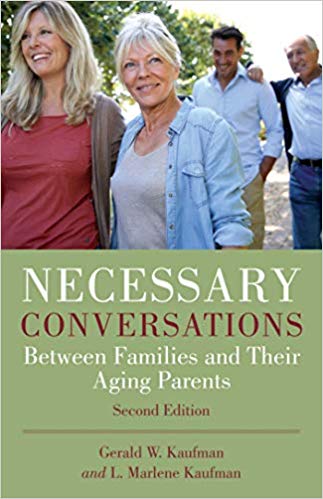
Several pieces of advice from Steve stick out. At some point my friend realized that he as a son needed to step up and make a decision that his father simply couldn’t make. “Perhaps Dad literally can’t bring himself to make a decision about Mom,” Steve reflected. He was speaking about the great difficulty they had in facing that it was time to move his mother to healthcare. Other tough decisions include feeding your parent, or intubating so they don’t starve, or deciding to have the DNR “Do Not Resuscitate” order on health records.
He recalled phone calls with his mother as being very hard—and then they became impossible. I’m not sure if that was because of hearing issues, or memory losses, or what. But if you’ve ever been in that situation, you know how painful it becomes when even a simple phone conversation with your mother or father or grandparent—deeply intelligent and robust at one time—just becomes a one-way monologue or shouting match. Very sad. At what point do you stop making mechanical or technical or medical interventions? How do you let go?
“Try to make sure ahead of time the family is on the same page in making decisions,” he said. Steve said doctors and nurses who work in the emergency room had shared with him that when kids come in with an older family member, many times they are not of one mind about what kind of care the parent should receive. “It is heartbreaking to do CPR on a frail body,” Steve said doctors told him. If you’ve seen CPR performed in real life or on TV, you know how strenuous that attempt at saving a life by pushing repeatedly on the chest can become. Steve said we need to get to the point where we recognize that it may be best for Mom or Dad to “go home to Jesus.”
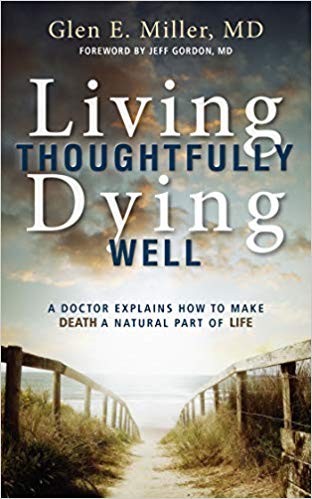 On the other hand, older patients have been revived after a heart episode or other trauma and gone on to thankfully live many additional years and be grateful for them. I worked with one author and medical doctor, Glen Miller who went through major heart episodes and went on to write the book Living Thoughtfully, Dying Well (Herald Press, 2014). In some ways I feel that memory loss, dementia and Alzheimer’s can be the hardest to deal with.
Regardless of the specific difficulties and decisions, Steve gave this excellent piece of advice he had learned from others that I want to leave with you as well: “The ones who visit their parent or loved one are the ones who have fewer regrets after a parent has passed away.”
I’m grateful my own mother is still in relatively good health and that my husband and I are also. But I know as surely as the sun comes up, those days of difficult decisions and changing needs will come for most of us.
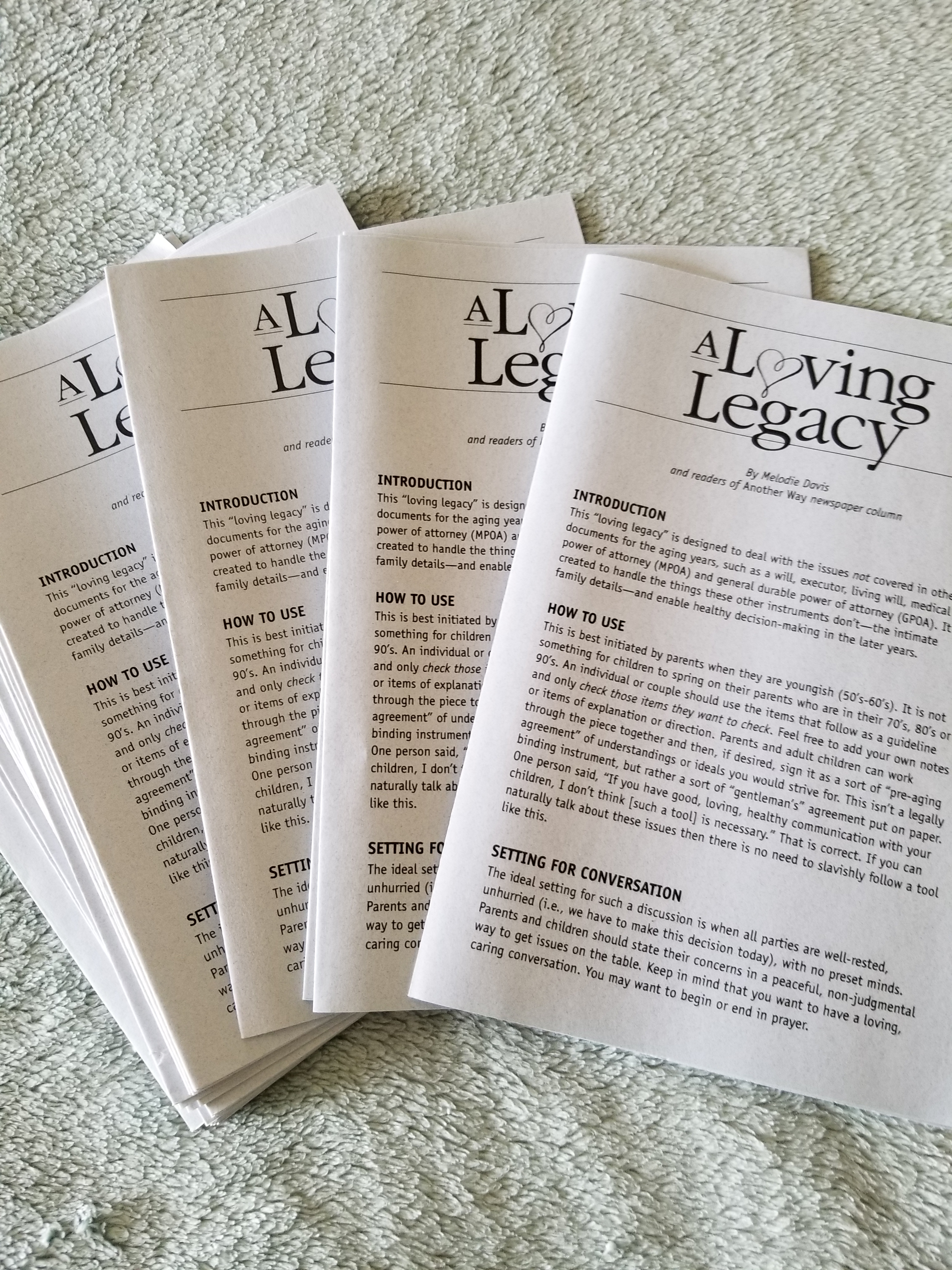
For a free booklet “Wondering What’s Best for an Aging Parent” and my own “A Loving Legacy” providing a guide to the conversations we need to have with our children or parents, write to me at anotherwaymedia@yahoo.com or Another Way Media, P.O. Box 363, Singers Glen, VA 22834. I have plenty of A Loving Legacy if you would like several copies to share.
Another Way is a column by Melodie Davis, in syndication since 1987. She is the author of nine books. Another Way columns are posted at FindingHarmonyBlog.com a week after newspaper publication.
Another Way for week of April 26, 2019
Pie Lady Moments
If you’re wondering, “pie lady?” what on earth is that, I don’t blame you. Greta Isaac is author of a new book, The Pie Lady: Classic Stories from a Mennonite Cook and Her Friends. In it, Greta shares 32 stories of “pie ladies” and their best recipes in a book that is more story than cookbook. I was privileged to serve as the managing editor for this book in my waning months at Herald Press before retiring, and had a lot of back and forth by phone and email with the author as we edited and revised to get all of her details just perfect. She’s an awesome writer and mom. 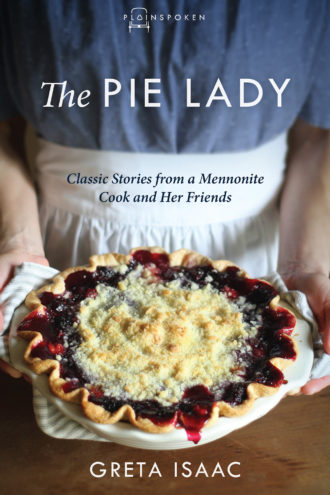
The Kansas author’s approach is 100 percent upbeat and beautiful—mingled with an earthy reality among plainer Mennonites who have mostly unpretentious homes, modest farmsteads and a “more with less” approach to life. The women Greta invited to share true stories here are, for the most part not Amish nor Old Order nor thoroughly “modern” Mennonite, but women who dress very modestly by choice or tradition. They quite often find fulfillment and deep happiness in raising their families and working at home. In the introduction, the author writes of the women, “Each life is so amazing, and so full.”
The Pie Lady book starts with Greta’s own growing up days when her grandmother, who lived in Texas, was a literal “Pie Lady.” Greta loved visiting Grandma for a week in summer and helped with pie prep when they loaded up homemade pies in “perfect pie boxes stacked on specially made racks in the trunk of her car, and took them to the local café. There people sprang to open the door and the fridge [saying]: ‘Here’s the Pie Lady!’”
The moment I first read those lines, memories of my mother making yeast-raised cinnamon rolls when we lived in north Florida, and transporting them to the small steak house where I worked as a waitress one summer. The restaurant and customers quickly dubbed her delicacy “Mennonite Sweet Rolls.”
But Greta’s “Pie Lady Moments” can better be described with the word she chooses, “sparkly,” to indicate the many magical moments in our lives and families as pure gold—and having nothing to do with money or heaven forbid, actual jewelry.
Greta relates the story of Julia, a new bride during World War II. When their baby was born, and her husband was serving with Civilian Public Service, she took a job as “house help” for awhile so she could earn money and also care for their small son. In the home where she worked, she loved “learning how to set a beautiful table, loved caring for beautiful things.”
Unfortunately, their first child, Steve, died at the age of three and they mourned him deeply. Five more sons and a daughter came along who, as Julia relates “of course never completely filled his place.” But Julia always had an eye for bright and beautiful things. “All her life, she loved to set the table the way she had learned when she [worked as house help]. She loved making something new and serving it on a red tablecloth. Friends from India taught her to make chicken curry, each topping served in special lovely dishes.”
 Somewhere along the line, I also picked up a love for setting a beautiful table—within the limits of our budget and housewares. I remember loving to set the table for company for Mom: for a while her “china” plates were deep emerald green with bubble bumps around the edges, and stemware that matched plates at their bubbled base. If Mom and Dad went away for a banquet or evening out and we kids were feeling adventurous, my older sister cooked a “restaurant” meal—such as with real French fries (!). I set the table using Mom’s best dishes, and one of us would play waitress and we probably made my younger brother be busboy.
If you pick up this delightful book, I’ll wager that within pages, your own mind will rock back to times of enjoying beauty in everyday life—or the special foods you or your own parents made when they had company over or for a special treat just for your family. At the least it will help you better appreciate the lovely people, special possessions, and moments in your own life.
What stories does this stir up for you? Comments are embraced!
Find more information on Greta’s book at https://heraldpress.com/books/the-pie-lady. I’d love to hear your stories! Send to anotherwaymedia@yahoo.com or Another Way Media, P.O. Box 363, Singers Glen, VA 22834.
Another Way is a column by Melodie Davis, in syndication since 1987. She is the author of nine books. Another Way columns are posted at FindingHarmonyBlog.com a week after newspaper publication.


Doc Teters, you can barely see the green visor but it’s there, along with his vest and bottles of medicine in his old timey practice.
Another Way for week of April 12, 2019
When Doctors Had Time for Patient Care
The first doctor I remember in my childhood was, as we called him, “Old Doc Teters” (pronounced like “meters”). Walking into his quaint office in the small burg of Middlebury, Indiana, was like stepping into a museum from the 1920s. It smelled of antiseptic, like rubbing alcohol. The floor of the waiting room was wooden and the chairs, if I remember correctly, were just plain wooden benches, like old TV programs “Little House on the Prairie” or “Dr. Quinn, Medicine Woman.” Doc Melvin Teters’ father, B. F. Teters, was also a doctor. So his son Melvin maintained the passed-down office décor of his father.

An article posted at the Facebook page, I Grew Up in Middlebury Indiana https://www.facebook.com/groups/157505807660736/
An article I have from the Middlebury Independent notes that local Amish families were fond of having Doc Teters as their doctor, especially since he made house calls. After he died, several of his Amish patients came to rake and clean up his yard since the sister with whom he lived had also just been hospitalized, according to the article. The paper said he was “the last of the old-time doctors,” delivering “generations of babies.” He died November, 1969, shortly after my family moved to Florida.
But I had totally forgotten he may have saved my oldest sister’s life. Nancy was just seven when she developed intense pain in the lower right region of her abdomen. My parents called him asking how long it would last. Mom remembers Doc saying, “Well how long do you want her to live? You need to get her to the hospital right away!” This early hospital experience left her with a strong desire to become an RN and she enjoyed a long career until she fully retired last year. She also remembers sitting beside him for him to pull out a splinter under her fingernail—a very painful place. She almost fainted but was steadied with Doc Teters by her side.
As a child, I never dreaded going to Doc Teters because he knew how to make a doctor visit fun: he wore an old timey green visor, glasses, and a sweater vest. The shelves in his examining room were lined with glass bottles bearing white piles of powder—and huge yellow sulfa pills that would usually make a sore throat go away almost immediately. He would shake down his thermometer swinging it from a string in a big circle: that was just plain amusing. If you were getting a school or athletic physical, he tested your heart by asking you to jog 10 or 20 seconds and then declare you “as healthy as anyone else would be.” Physical all done! He gave free pre-camp physicals when we went to Bible Memory Camp. I also remember a time he tightly tied a string around a wart on my brother’s forehead. It eventually fell off as he said it would.
Many of us have memories of doctors who made house calls, or open their doors on a Sunday morning if necessary. Once when my sister was visiting us here in Virginia, her baby daughter had obvious pain in her ear and we called Dr. Huffman. He quickly dispensed a prescription and she soon felt better.
Medicine has changed much in 60+ years but there are Doc Teters out there who still care deeply for their patients. While house calls are out of fashion, we all appreciate the docs who take time to really talk with you, not at you, who go the second mile in making sure you get set up with a specialist if needed, who make their staff available to answer questions and actually get back to you in person—not call you with a message-leaving mechanism. Insurance practices and hospitals where you are seen by “hospitalists” instead of your family doctor make practicing old-style medicine difficult. But even hospitalists who take the time to really listen, explain, and explain again—help. Plus patients need patience to keep asking until we feel we are truly heard.
And old-style medicine wasn’t always the best, obviously. We were never sure at the end of one of those cheap or free physicals from Doc Teters if jogging in place for 10 seconds was a true test of a flourishing heart!
He thrived on taking care of his patients. I feel privileged to know a few of those today. If you have a doctor like that, make sure he or she knows how much the extra attention and care is valued. We appreciated my husband’s surgeon praying respectively to the Great Healer with us before operating a few years ago.
***
Did you have the privilege of going to an old-timey doctor? Or perhaps he (or she?) made house calls?
I’m all ears right here. I’d love your comments!
***
Do you have a favorite doctor you recall or go to now? What makes this doctor a fav?
***
Of course, there were quacks then as now. Overall, I’m very grateful for the medical care
that is available in most communities today.
***
I am also grateful for whoever posted the article/obituary for Doc Teters some years ago on the Facebook page “I Grew Up in MIddlebury Indiana: https://www.facebook.com/groups/157505807660736/ (without which I would never have been able to verify the details of my Doc Teters memories!)
Send comments or stories to anotherwaymedia@yahoo.com or Another Way Media, P.O. Box 363, Singers Glen, VA 22834.
Another Way is a column by Melodie Davis, in syndication since 1987. She is the author of nine books. Another Way columns are posted at FindingHarmonyBlog.com a week after newspaper publication.
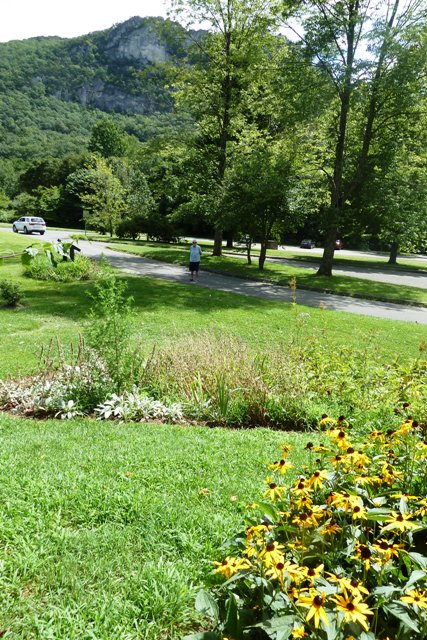
Nearby mountains and rocks–here at Seneca Rocks in nearby West Virginia, are favorite places for day trips. Here my Mom stands in the shade as we enjoy a stop.
Another Way for week of April 5, 2019
Five More Days
The countdown is on in earnest now. As I write this (I write about two weeks ahead of when you read this), I have just five more days until I retire. As I always quickly add for readers of this column—no, I’m not retiring from writing Another Way! But I’m retiring from my main job for MennoMedia which has gone through six to seven name changes, a merger, and more. I’ve worked as an editor, a writer, a columnist, a producer, a radio host and radio scriptwriter, a scriptwriter for TV documentaries (including some on national TV), an ad writer, and much more. Always with a religious and Christian bent.
If I worked until July 7 of this year, the number of years would mount to 44 altogether, for one basic company. But I decided, why wait when grandchildren are growing and waiting to be swung, read to, cuddled, and to play backyard football, soccer, and shooting (lowdown) hoops.
I keep thinking of other big life changes when I was counting down the days: like when it was just a week until we would get married, or a week until I started this job—my first real job out of college. Or, when it was just a week until my first maternity leave began, or my oldest would begin school, and then college. The big events.
This marks a different kind of life passage and with it the inescapable reality that I am getting older. Some writers I know have started using the Spanish word for retirement: jubilado or jubilación. As in the English word, jubilee or “jubilation”. Does that bring a different twist to it? A celebration of joy, euphoria, even triumph!
I have loved my job, loved almost everything I was asked to do, especially on the more creative end. Not so much the reports, news releases, marketing copy—some of those got old but I’ve been fortunate to create a wide variety of media over many years. I loved the travel, meeting people, conferences, conventions, meeting in some pretty fancy hotels. I appreciated and enjoyed almost 100 percent of my coworkers and I used to say I could count on one hand the times I was frustrated to tears. And only one time was my hand slapped, literally, by a young and immature recording engineer—reminding me not to touch any knobs. Okay! But not bad in today’s working environment: blessed to work with Christians who cared about their work, each other, and their ultimate goals.
The hardest part has been times of downsizing, times dear friends were cut from their jobs, times when I wondered if I too should quit in solidarity—for the raw deals I felt they got. Those were tearful times, and there have been far too many but that’s probably part of working for a church agency in years when churches are declining in both numbers and the ability to support large church agencies—a time of diminishing church institutions.
But my inner journey these past few weeks and months has had me thinking: When I was just starting out at Mennonite Broadcasts, Inc., all the shiny accomplished people—amid names and programs I’d heard of, I was a little starstruck to think I’d be working among them. I felt like I was swimming behind, struggling to reach forward and catch up.
Then as I hit my stride after a few years—or my stroke—to continue the water metaphor—I felt like I was holding my own, making waves, holding up my end of the boat, rowing as fast as everyone else. I began to be moved into positions of higher responsibility, was held in high respect, and I loved sailing along.

This was right after we moved to a new office location in Fall 2017. That transition helped me prepare and downsize for eventual retirement here in 2019.
As I’ve neared retirement, I now feel as if I’m slightly behind the boat again—like movements and tides are running on ahead and I’m slipping out of the race. They don’t need my input in meetings. I care somewhat less about what happens with this or that problem. I feel like I’m shrinking away. This is all normal, I’m sure.
I’ve also been feeling very scattered—I’ve had a hard time focusing if anyone distracts me, and writing the wrong name for someone, and in general, missing the mark.
Sound like pre-wedding jitters? Pre-baby panic? Pre-graduation worries about forgetting to do or arrange something very important? All of the above. Stay tuned for my follow up “this is how it feels” column that is sure to arise at some point, good Lord willing!
What do you enjoy most about your job? What do you dislike or hate?
If you are already retired, what wisdom can you share?
Post here or send comments to anotherwaymedia@yahoo.com or Another Way Media, P.O. Box 363, Singers Glen, VA 22834.
Another Way is a column by Melodie Davis, in syndication since 1987. She is the author of nine books. Another Way columns are posted at FindingHarmonyBlog.com a week after newspaper publication.

Photo by By DrTorstenHenning – Own work, CC0, https://commons.wikimedia.org/w/index.php?curid=29277742Toll plaza of the Dulles Greenway, westbound, photographed from LH flight 418 approaching Dulles Airport
Another Way for week of March 29. 2019
When I Blocked Three Lanes of Traffic
Yes I was that car.
You saw me trying to inch my way across three lanes of traffic.
I was the silly grandma from the Shenandoah Valley heading to metropolitan Washington D.C. in Friday morning rush hour, on the Dulles Greenway and Dulles Toll Road. It is used by thousands of commuters every day. I was headed there to help my daughter get ready to go back to work (sorting baby clothes, etc.) after her last maternity leave.
This is a little of how my inner drama went that morning:
Wow this toll road is really great!
No semi’s. Ahhhh. What a way to drive. Not like Interstate 81 down our Valley where you either have to stay in the passing lane and go around all the trucks, or get wedged between two semis and stay there fearing for your life but at least avoiding darting in and out.
This is sweet. I wonder what it costs. Oh well, whatever. I’ll just pay it.
Maybe I should invest in an EZ pass thingy someday, so I can just whiz through those toll plazas.
I wonder what lane I need to be in anyway. There will surely be signs telling me.
At least I avoided the major back up that was inches long on my Google maps screen over on I-66. No siree bob, didn’t want to get in that mess and maybe miss seeing the older grandsons off to preschool and daycare.
Ah there’s the toll plaza. Panic! Which lane should I be in?
Rats! Way over there? In the lane farthest to the right, and here I am three to the left?
This is when my husband would bellow, “Well I can’t make that now! Too late! Forget it!”
This is when I have no choice because I can’t get stuck in the EZ pay lane without a pass. There is no human handling poor novice commuters like me. I flick my right blinker on.
Other drivers are still whizzing up their lanes, way too fast for me to scoot in front of them, suicide-like.
Ah, I manage to inch over one lane. Two more to go, slowly rolling ever closer to the point of no return. People behind me will be getting mad. Cussing. Honking.
Another opening, I dart over. There goes the first horn.
One more lane. Will I make it? Will someone T-bone me? I am now totally perpendicular to the lane of traffic, blocking it fully. I’m a little shocked I don’t hear more horns. The unlucky pickup I’m blocking must come from the country too, he’s waiting!! He’s letting me cross. I lean forward and flash him the biggest wave in the semi-darkness I can manage, as thanks. He did his good deed for the month! Saved by a sweet pickup truck driver letting me budge the line. I wish for the flashing sign my husband wants to invent with which you could alternately say “Thank you” or “So sorry” or “Where’d you get YOUR license?”
I finally wiggle my minivan into the credit card line where there is a glorious grandmotherly human, a woman wearing a hijab.
I say “credit card ok?”. Duh.
She nods, eyes creasing into a smile. I slide my card in. The screen says $7.15. Huh? But it’s worth it to be here, paying my way out of that heart-racing horror. But now I can’t get my credit card out! Where did it go? It is too dark for me to see the place where my card should be spit out.
My helper reaches out of her window, grabs the credit card from the place where I put it in. I collect the receipt, gush “thank you!”, and get out of there as fast as I can. Breathing a prayer for safekeeping, for a human helper, for the man in the pickup truck.
And then I laugh. Did I really just cross three lanes of traffic with mere feet to go before the last metal-looking (but probably bendable) traffic separators blocked my escape? Somehow, yes. Somehow, good Lord, thank you.
(Later I learn that if you pass through most toll plazas without paying, they will either send you a notice, or you can go online and often pay without penalty if you pay on time. Had I known these options, I might have just zoomed through and then paid. Much safer!)
See the toll plaza online here: https://tinyurl.com/DullesGreenwayTollPlaza
What is your hair-raising traffic/travel story? I think I’d love to hear! Perhaps I’ll use your story here. Send to anotherwaymedia@yahoo.com or Another Way Media, P.O. Box 363, Singers Glen, VA 22834.
Another Way is a column by Melodie Davis, in syndication since 1987. She is the author of nine books. Another Way columns are posted at FindingHarmonyBlog.com a week after newspaper publication.
Photo by By DrTorstenHenning – Own work, CC0, https://commons.wikimedia.org/w/index.php?curid=29277742
Toll plaza of the Dulles Greenway, westbound, photographed from LH flight 418 approaching Dulles Airport
 Better-Than-Restaurant Loaded Potato Soup
I have experimented for years with trying to duplicate the kinds of yummy loaded potato soup you find in many restaurants and eateries. Basically my efforts were something I made for myself; my family never “got” my attempts: they were not fans. Actually what I grew up on was a very simple farmer’s potato soup. Mom cut up leftover boiled potatoes, added milk, added maybe chopped celery and salt and pepper and we poured that over buttered bread cubes in the bottom of our bowls. We may have had grilled cheese sandwiches with that. A very simple soup and meal but to me it was tasty, warm and filling. We all liked it.
Years ago, when I tried Mom’s soup on my daughters and husband once or twice, they were going “ehhhhh, what is this?” They politely ate some, if my memory serves, and then filled up on grilled cheese. I knew the soup itself wasn’t a go for this family.
So over the years, I experimented with several recipes for a more loaded potato soup, for a Saturday lunch, just for myself. Eventually I doctored up a one-person serving recipe that I shared over on Amish Wisdom.
Enter my friend Dianne who once owned a restaurant with her husband (now deceased). My husband and another Lion’s Club friend were doing some work at her home and for lunch she served them “Loaded Potato Soup.” My husband came home saying, “You’ve gotta get Dianne’s recipe.” I was shocked to hear he loved it! I went into action and tried it the first chance I got. It was the best loaded potato soup outside of a restaurant I have ever had. Just delightful!
It took me about an hour to assemble it; it needs frequent stirring—to make sure it doesn’t scorch. But well worth the time and I’m sure next time I can shave that time. This makes a huge batch for 15-16, but I’ve also included the pared back quantity I made for me and my husband, with plenty of leftovers.
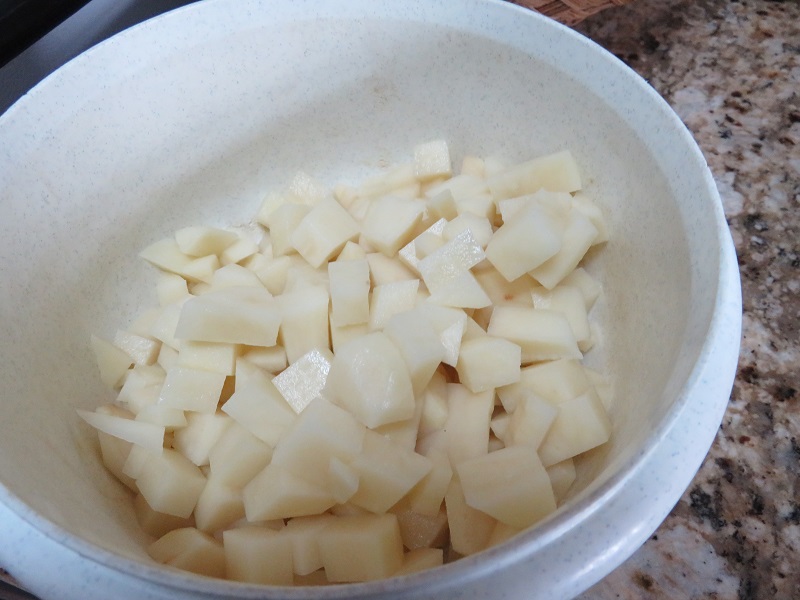
Cubed potatoes, uncooked

For best results, use baking potatoes
1 package (16 oz.) bacon
1 ½ cups chopped onion
6 cups chicken broth
2 lbs. baking potatoes, peeled and cubed
2/3 cup butter
¾ cup flour
4 cups milk
1 teaspoon salt
1 teaspoon fine pepper
1 cup diced, cooked ham (1/2 lb.)
8 oz. sour cream
2 ½ cups sharp shredded cheddar cheese (10 oz.)
¾ cup sliced green onions
- Cook bacon over medium heat until crisp. Drain on paper towels. Reserve 2 tablespoons drippings in skillet. Cook onion in drippings until almost tender.
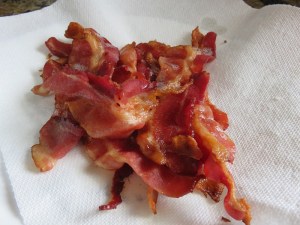
Bacon–crumble up to use in soup.
- In 6-quart Dutch oven, mix onion, broth and potatoes. Heat to boiling, reduce heat. Cook 10 minutes or until potatoes are tender.
- Meanwhile in same skillet where you cooked bacon and onions, melt butter and stir in
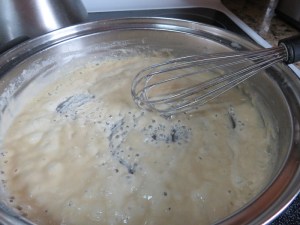
Whisking butter and flour in skillet.
flour. Stir with whisk until smooth. Cook and stir 1 minute. Gradually stir in 2 cups milk (will be very thick). Pour milk mixture into potato mix. Add other 2 cups of milk, salt, and pepper. Cook over medium heat, stirring constantly with whisk, until thick and bubbly.
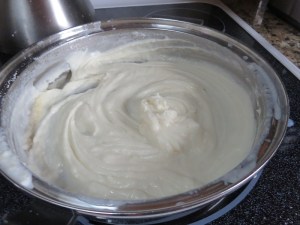
Mixture after you’ve added first 2 cups of milk to butter and flour mixture. Stir till smooth.
- Stir in ham, 1/2 of the bacon (crumbled), sour cream, 2 cups cheddar cheese, and ½ cup green onions. Cook til heated thru. Pour in serving bowl or individual bowls, and garnish with remaining bacon, ½ cup cheese and green onion.

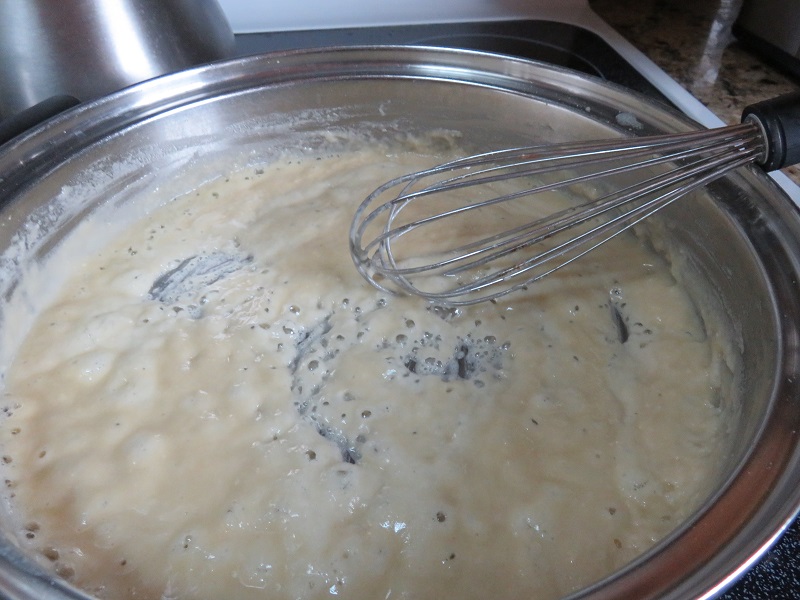
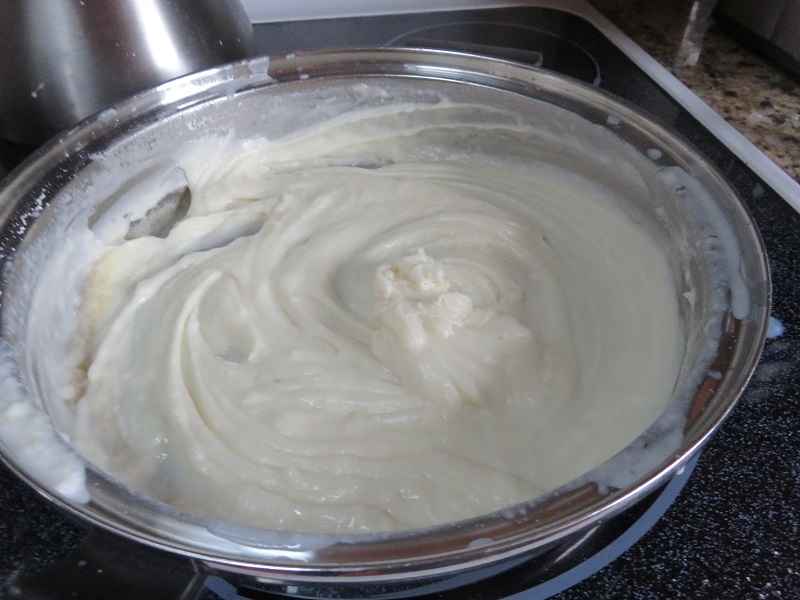
Smaller quantity
For 10-12 servings – I cut the above recipe down by 1/4
¾ package (12 oz.) bacon
1 cup chopped onion
4 cups chicken broth
1 3/4 lb. baking potatoes, peeled and cubed
1/2 cup butter
2/3 cup flour
3 cups milk
3/4 teaspoon salt
3/4 teaspoon fine pepper
3/4 cup diced, cooked ham (1/2 lb.)
6 oz. sour cream
2 cups sharp shredded cheddar cheese (7 oz.)
1/2 cup sliced green onions
(Recipe courtesy of Dianne Plunkett)
My bacon cooking tip: My standard method of cooking bacon is to spread bacon on parchment paper (learned this from a school cook) on a baking pan such as a cookie sheet with at least a half inch edge. Bake in 400 degree oven for 15-20 minutes. You don’t need to turn the bacon, just bake until your desired degree of doneness is reached.
For this soup, I cooked the bacon in the oven, then drained bacon on paper towels. I then poured drippings from my cookie sheet into a skillet as recipe calls for, to cook the onions in bacon drippings. Then go from there using the skillet as describe in Dianne’s recipe.
And P.S. The flour and butter mixing is basically making a roux. (Pronounced “roo.”) Adding milk or cream makes a bechamel sauce. Or gravy, if you prefer! I learned these schmancier terms when Dianne was rescuing a sausage gravy attempt for our Lions Club annual Pancake Days.
***
Although spring has sprung, it’s still chilly where we live. What is your favorite soup, regardless of weather?
***
Lovina Eicher has a loaded potato soup recipe in her most recent cookbook, The Essential Amish Cookbook, a volume I was privileged to edit. You can catch a video made of a model cooking her recipe for loaded potato soup here (along with where to buy the cookbook).
Another Way for week of March 22, 2019

Wildebeest on left. And stickers, always stickers, of course!
Getting Ready to Read
My oldest grandsons, both five, are learning to make their letters. As a writer, I’m excited to see them enter the world of forming words and copying simple sentences.
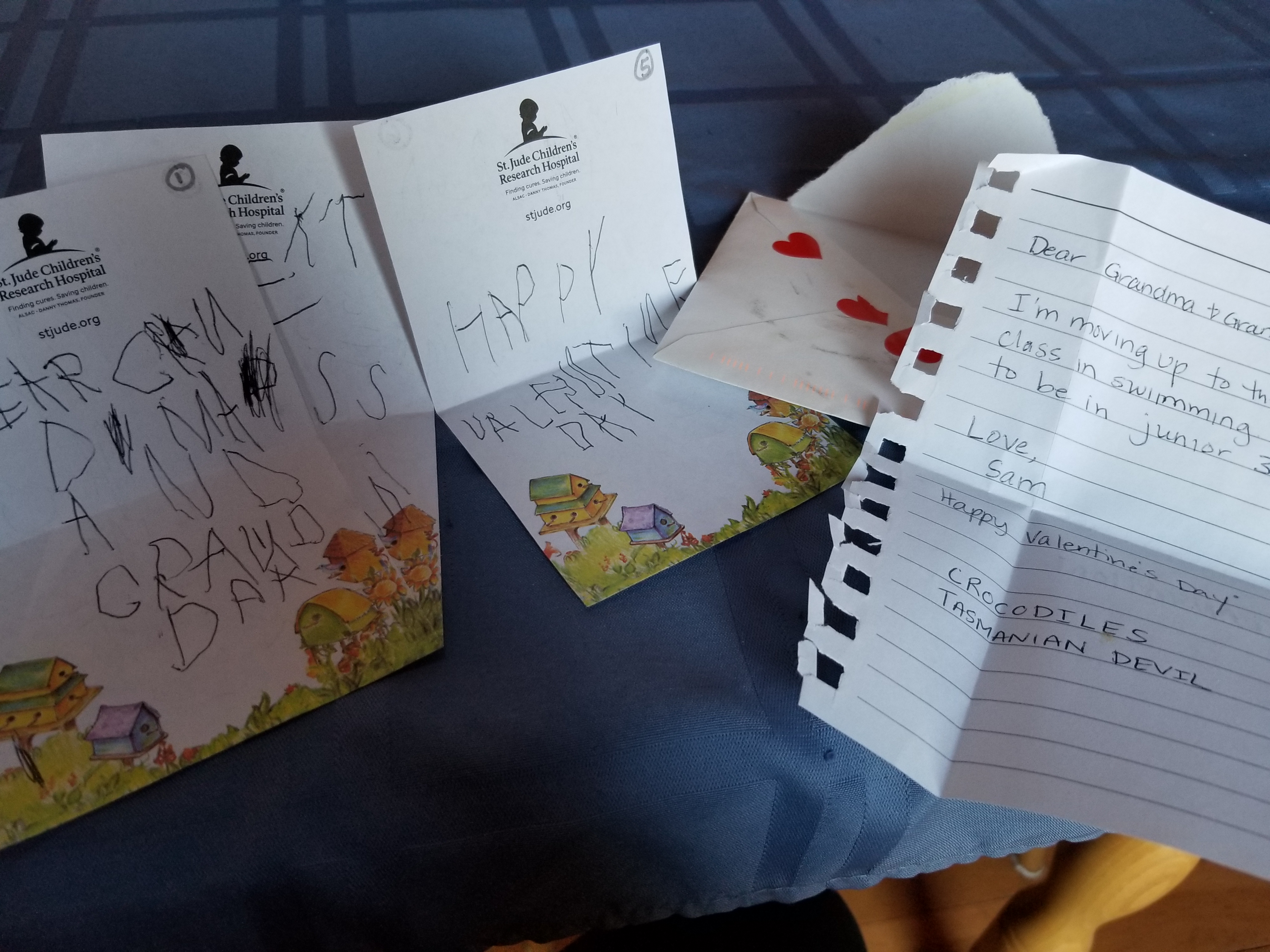
Happy Valentine’s Day card (where I supplied paper, envelope, stamp, and address sticker) and his mama supplied the “translation.” Love it all.
The oldest one sent his grandfather a birthday card this year that was hand lettered with a drawing he made of a wildebeest. I had also sent these boys, with their Valentine’s Day cards, letter writing supplies: paper, envelope, address sticker, and stamp to write back to us. I have no hopes of them ever really using old fashioned letter writing communication to be in touch with us as they grow, but it doesn’t hurt to acquaint them with the practice. Friends with older grandchildren say they enjoy texting back and forth with their grandkids.
Not sure what the meaning of the wildebeest in the birthday card was (neither was his mother) other than that we had visited the zoo with their family last fall and had enjoyed seeing this somewhat unusual African animal. I also enjoyed making, for both sets of grandchildren, photo “memory” books from our experiences with them, with a small storyline. They loved the books. The oldest one has either memorized the text, or learned to actually recognize the words in the book from frequent reading, and can “read” it now to his little brother.
I’m not one to push kids into reading, or academic rigor before they are ready. I remember our oldest daughter coming home from first grade asking us how Mrs. Proctor had been able to teach her to read. She called it “magic.” And in a way, it is. Michelle did not understand all of the work she had put into learning what sounds various letters make in words, how certain combined letters sound, and that some letters make no sound at all in some words. But all of a sudden, she realized she was reading books.
Today she absolutely loves to read. But she didn’t do that automatically either. There was a time when she was not keen on picking up a book just for leisure reading, but then she discovered the Boxcar Children books at school. We went to the public library and she found even more. And she was off, reading forevermore. I’m happy to say all of our daughters are avid readers, as time allows.
From Day One and before, our grandsons have been exposed to words, books, ABC’s, numbers, colors. They have been read to every night and naptime, and many times throughout the day as they want. We know that children who are not blessed with loving, attentive parents—especially those spending first months and years of life in an orphanage miss out on so much (as you might have read about last week in this column). Not only love, but hours and hours of hands on care and deep affection. Blessed are the foster parents and caregivers who share love, attention, food, and clean clothes with little ones when their birth parents are unable to take care of them for various reasons.
But back to ABCs. I was interested to discover that teaching the art and skill of cursive handwriting diminished when “Common Core” curriculum standards were introduced a few years ago (which ignored handwriting, I understand). In recent years some states and locations have incorporated the teaching of cursive again. Never mind that many adults have trouble writing neatly enough to even decipher it, but most official documents still require a handwritten signature, rather than printed. For lovers of history, being able to read cursive may come in handy exploring historic handwritten documents.
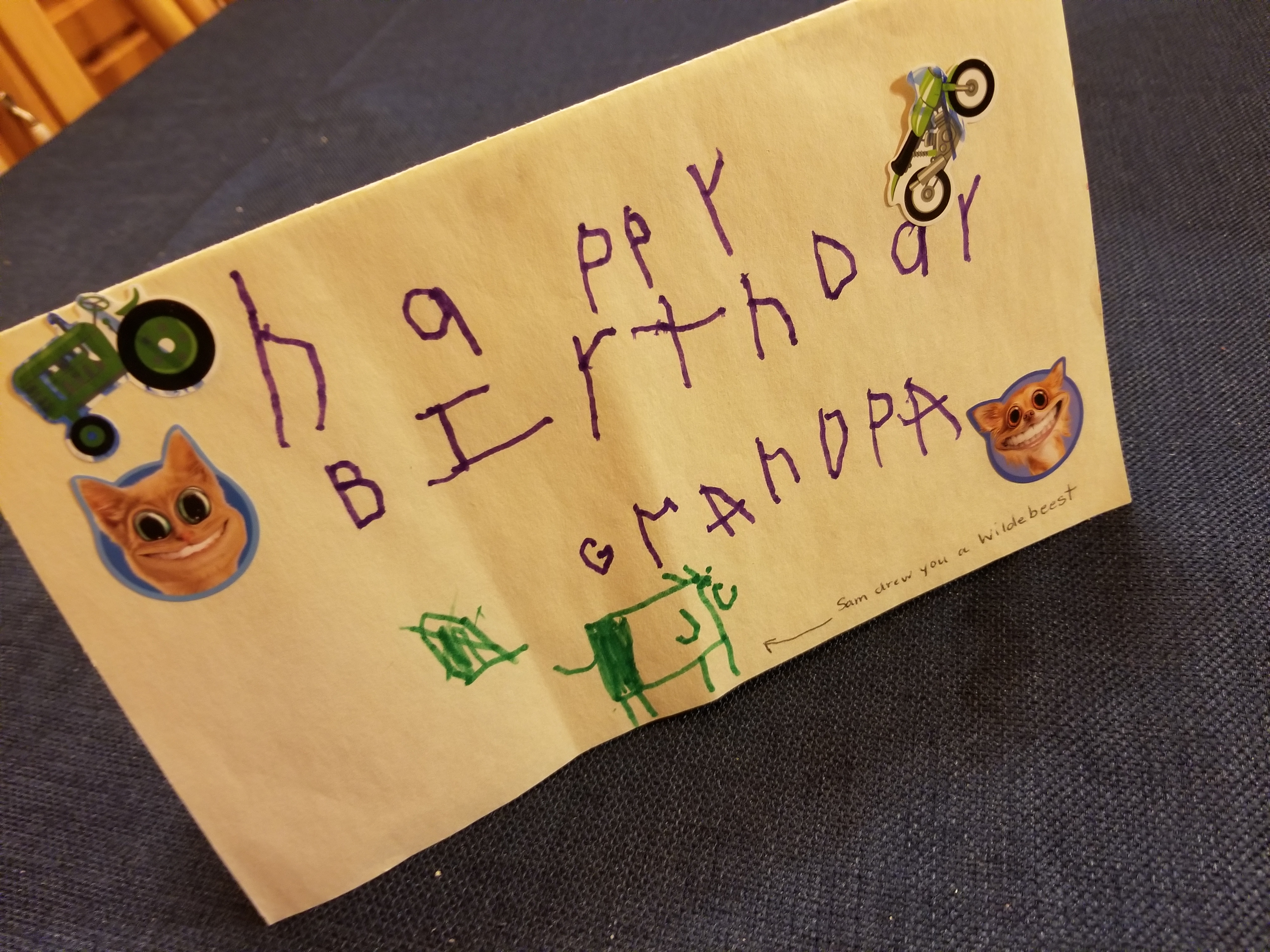
He did such a good job!
So yes, read to children, read for yourself, share the love of books and writing and all the great information out there at the tip of our googling fingers. While worldwide literacy rates are rising, in many cultures little girls especially are not taught to read nor educated beyond the ages of 10-12. That is another tragedy I’ll write about in a future column. What a blessing it is to be able to read, write, and learn about the world.
***
If you have a little one in your house, family, or neighborhood, I have a free St. Patrick’s Day Word Tracer worksheet to download and print, or write for. Here’s the for the PDF: word tracer_st patrick. To receive one by mail, write to anotherwaymedia@yahoo.com or Another Way Media, P.O. Box 363, Singers Glen, VA 22834. You can find more educational resources, at Education.com.
How do you encourage reading and writing readiness in children?
***
How long do you save cards? We recently recycled a bunch from my daughter and our own at a local agency, Pleasant View, Inc. which uses many resources for doing crafts with clients. Many retirement complexes also are happy to get them for craft and art activities.
Another Way is a column by Melodie Davis, in syndication since 1987. She is the author of nine books. Another Way columns are posted at FindingHarmonyBlog.com a week after newspaper publication.
Another Way for week of March 15, 2019
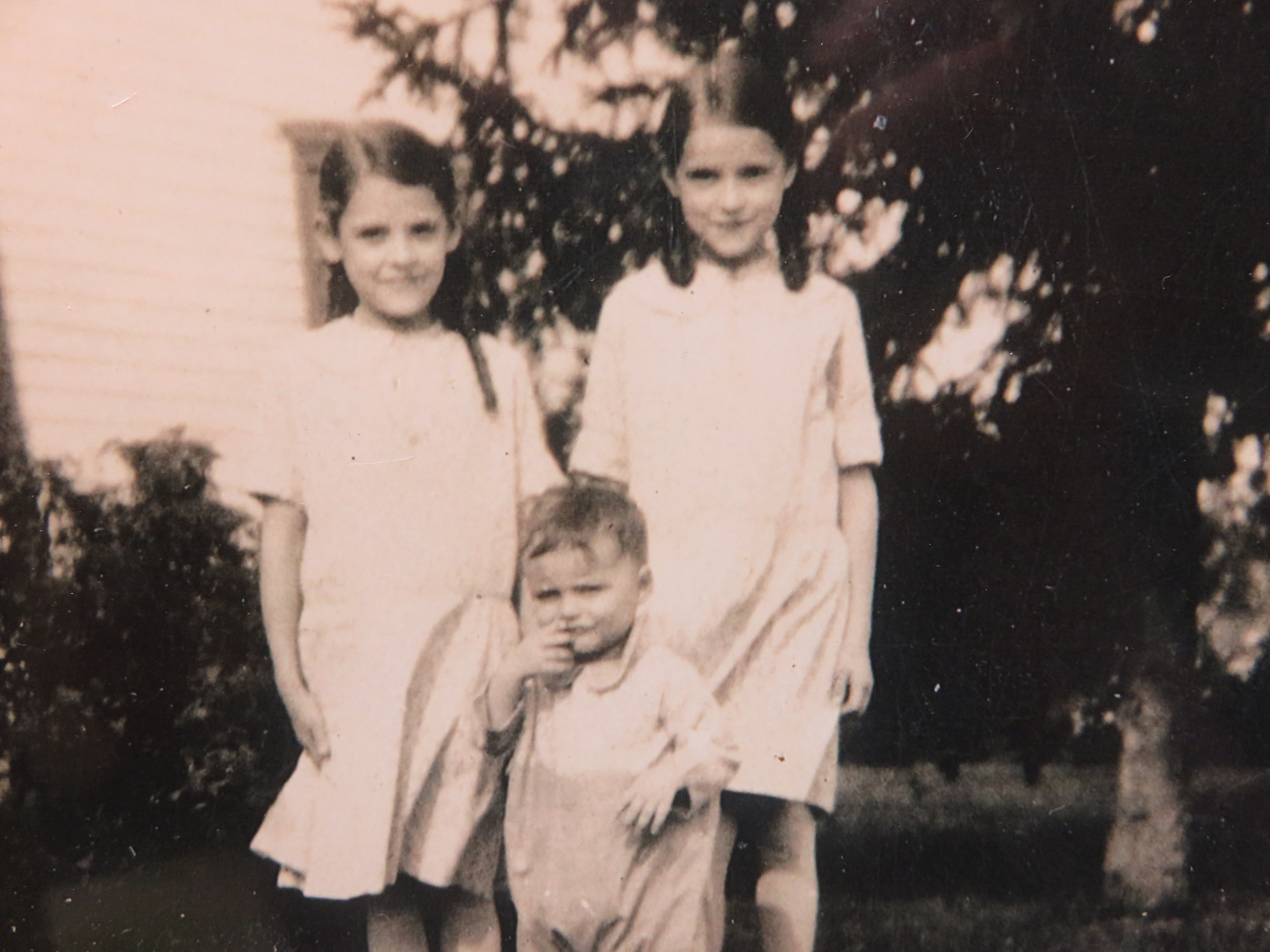
No, this photo is not from Marge’s family, but a picture of my mother and her siblings from approximately the same era. Can we imagine dropping such tykes off at an orphanage?
My Father Left Us at the Orphanage
Guest Column by Marge Thompson
Editor’s note: Marge Thompson, 87, reads Another Way in The Goshen News, Ind., and wanted to share her story to help other struggling teens or families.
All was quiet as we rode down the dirt road not knowing where my Dad was taking my three brothers, my two sisters, and me, Marge. As we grew closer to the orphanage, I knew something wasn’t right. I sat in the back with my brothers and sisters, holding back tears and hoping we’d go right past the orphanage. He began to slow down. I knew all hope was gone. My brothers and sisters had no idea what was happening. I was the oldest, 11, and my sister, the youngest, was just two. As we got out, I felt as if a ton of weight was on my shoulders. At home I took care of my brothers and sisters and did lots of chores, but I didn’t mind.
As I watched him pull away, I felt more than anger or even hatred. I wanted to kill my parents, but I looked at my brothers and sisters and thought, “I’ve got to be strong.” I was so young, asking, “Why me? Oh, God, why me?”
The nuns at the orphanage gave us clothes and showed us where to change and get washed up. The boys were in another part of the orphanage. When we came downstairs, I walked towards the boys and a nun stopped me and said, “No. You stay over here. They will be taken care of.”
I was so angry I just wanted to cry; no—kill. I just stood there in a daze, wondering, what did I do wrong? Is this my fault? My mom had lots of problems. She was basically insane and she might have hurt us. My dad was always gone drinking and a very handsome man.
The next day at the orphanage a girl was bugging my brothers. So I yelled at her to stop but she didn’t. I ran over and started hitting and saying, “How do you like it? How does it feel?” When I looked up, there were two nuns standing over me. I knew I was in BIG trouble. As one leaned down to grab my arm, I started to run. There was nowhere to go. I was trapped like an animal in a cage. I felt sick, and wanted to get away. I wanted to go home to my mom. The nun came closer and closer. I did what any normal kid would do. I started to scream and cry. She grabbed my arm and pulled me to my feet. Then she took me to my room and said “There will be no supper for you. Now think about what you’ve done.” So I thought about how I was going to get out of there—every day.
One winter when I was 13 or 14, I wanted to go ice skating; I got my skates and went out. I wasn’t supposed to, but did anyhow. When I was skating, I felt so free. I could have skated for hours, but it wasn’t long before one of the “penguins” as we called the nuns, came and dragged me into a huge room where the nuns dined and said, “Okay, you don’t want to listen, then we’ll play your way. You start scrubbing the dining room.” They decided I was getting older so they put me in an actual convent at 16.
I worked there for a year but one day got on a bus to South Bend where my mother lived, and stayed with her. I was trying to go to Riley High School and my mom became abusive. When I came home from school, she was gone. Someone had taken her to a mental hospital. The people she rented from told me and said I had to go back to the orphanage. I began to cry. Her landlords went to court to get custody of me. I was a sophomore in high school and worked at Bonnie Doon’s on weekends as a car hop. The woman made me give her ten dollars a week and I had to clean the house and pay for everything myself.
At Bonnie Doon’s I met my future husband at the age of 17. The lady told me I couldn’t go out with him because he was 24 and too old for me. She had a daughter she thought would be better for him. One night I came in at 1:30 and the lady told me I had to move. So I quit school to work full time. My future husband wanted to marry me, but I didn’t want him to marry me out of pity so I said no.
So we waited a year. We got married in 1950 when I was 18, almost 19, and Paul was 26. I’m 87 now and never forgot my background. There’s much more to my story but I’m thankful for my granddaughter who wrote this down for a class project. I’ve always wanted to help other troubled teens, and let them know: you can survive.
***
If you wish to respond to Marge’s story, send letters or email and I will see that she gets them. Send to anotherwaymedia@yahoo.com or Another Way Media, P.O. Box 363, Singers Glen, VA 22834.
Another Way is a column by Melodie Davis, in syndication since 1987. She is the author of nine books. Another Way columns are posted at FindingHarmonyBlog.com a week after newspaper publication.
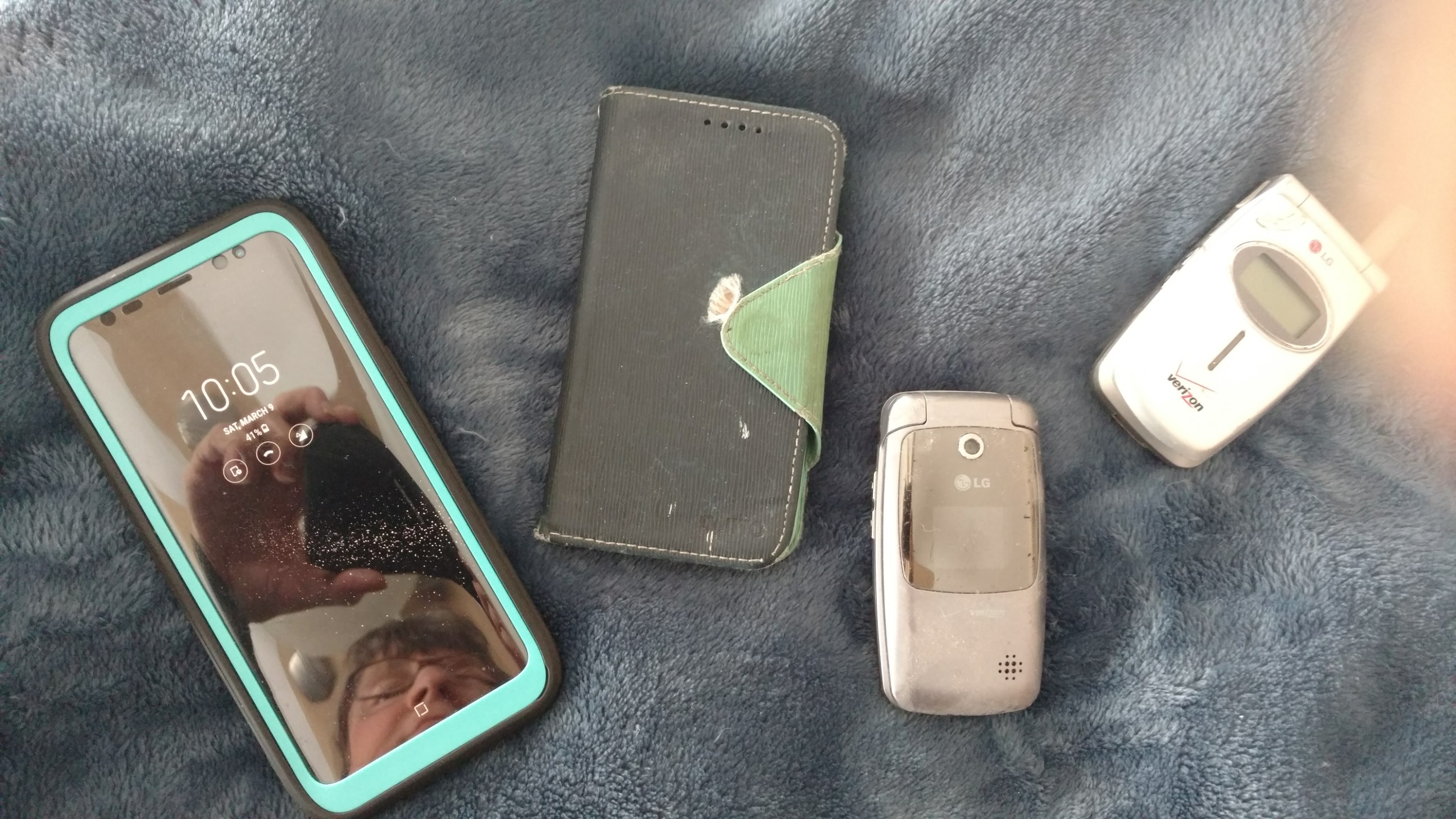
My cell phone history in brief from l to r: Current Samsung Galaxy 8, 2 months old; Motorla X, 2015-2019; LG, 2008-2015; first flip phone, LG, circa 2003-2008. And yes, that’s me snapping the picture reflected in my new phone.
Another Way for week of March 8, 2019
When Keeping Up Gets You Down
My husband bought me a new smart phone this past Christmas. It was beautiful but it took me until the end of January before I could finish activating it. I won’t go into details but I’ve got the shiny new one working now—mostly. There are things I need to change and settings to adjust, but I’m mostly rolling. The old one’s battery—my very first “smart” phone—was slowly becoming unable to maintain a charge.
But this morning I accidentally slipped my old phone in the pocket of my bathrobe as I went about getting ready for the day. The old one still works—not for phone or internet use but I can use the calculator, flashlight, and clock. When I took the phone out of my pocket to check something, I realized I had grabbed the old one. I ran my fingers tenderly over its used and worn case. It was almost like part of my body for these last 4+ years. It went everywhere I did and on occasions when I forgot and left it at home, it was panic and then, “Ok, yes, I can make it through the day … I’ll just email my daughters from my office computer, so they know,” etc.
Indeed, the several times I lost that phone were days of desperation. You may recall me writing about the time my husband was going having surgery and I had to run an errand and left my phone (stupidly) outside a door at my church. A friend found it and someone figured out how to get in touch with me.
The most recent time I lost it was traveling to Indiana. We made a rest stop at a roadside park. I took the phone in with me, as usual. After our break, we resumed driving and maybe 6-7 miles down the road I began to look for my phone. My heart sank. Could I have left it back at the rest stop? I started calling it with my husband’s phone. Nothing. Again. Nope. If it was there and someone was hearing it, they weren’t answering. We had to drive to the next exit to turn around to go back. So it was probably at least a half hour until we got back to the rest stop. My heart was thudding dully. I was so mad at myself. My husband, bless him, was not really angry at me for misplacing it yet again. Just worried and hoping against hope and praying like me.
I walked into the stall I had used. It was gone. Then I heard it ringing! Where?? My one deaf ear makes it very difficult for me to catch directional sound. I called out in the nearly empty restroom: “Anyone know where that phone is?” Someone called out, “Check the bench in the entry.” I hurried there, and laying on the arm of the bench, was my beautiful old blue-green case and phone. I don’t remember when I’ve been so grateful, so overwhelmed with joy. I went running to the car to tell my husband. He had been ringing for it. We couldn’t believe it was still there. Someone had taken it from the stall and put it in a more obvious place—but a place where someone could easily have walked off with a free phone—a phone I never locked.
Whew. I suppose someone could write a book of lost phone rescues. I could also write a complete book using past columns dealing with technology changes. Learning to use a computer. The office getting a fax machine and we stood around marveling. Going online at home with dear old America Old Line and listening to the buzzy sound as the phone line made the connection. When we were first “allowed” to use the Internet as part of our ordinary work day. If you remember some of these things you are probably as old as I am.
A reader wrote recently saying she wished she had a laptop; she’s only 55, has a disability, and can’t afford the technology. She said “Not being able to use technology makes me feel more isolated than my disability.” I’m sure that is true for so many, especially as we get older and “age out” of even hoping to keep up. So for as long as I continue this column, I plan to continue sharing a postal address where you can reach me in addition to email. I try to be mindful of others who simply can’t afford or choose not to use the latest technology.
***
Do you love to have the latest technology, or are you a slower adopter?
Or perhaps you’ve opted not to do the smart phone thing at all, which may be very smart! Tell us here!
I’d love to hear your stories or comments. Send to anotherwaymedia@yahoo.com or Another Way Media, P.O. Box 363, Singers Glen, VA 22834.
Another Way is a column by Melodie Davis, in syndication since 1987. She is the author of nine books. Another Way columns are posted at FindingHarmonyBlog.com a week after newspaper publication.
***
Speaking of technology, here’s a thoughtful and informative book from a Christian viewpoint on what’s coming in technology, published by Herald Press, where I serve as a managing editor, including for this book. Great grist for small group and S.S. class discussions. Find it here.


