

Another Way for week of June 2, 2017
Little Things Can Mean So Much
I noticed a lone tear slip down his cheek. He choked up as soon as we told him our youngest daughter had been able to come with us to visit on Easter afternoon at the nursing home where he’s been living about six months.
I would say he was obviously happy to see her, except he can barely see. But he knew a third shape was with us. He has always had such a tender heart for children, deer (“I could never be a hunter!”), his cats, and earlier, a dog.
Charles, our former neighbor and longtime friend, is one of approximately 1.3 million folks living in a health care facility, (2012 figures according to the Institute on Aging.) The move was not really his choice but I think we all knew the day was coming. He’s quite a survivor, having lived and thrived with a frozen, unbendable right knee (injured long ago) most of his life.
For years he and his beloved wife Letha were among the original farmers who sold home grown produce at the Harrisonburg Farmer’s Market—now the cool, upscale place to be every Saturday morning. Back then it was mostly subsistence part-time farmers who supplemented meager incomes by selling a few vegetables under a parking deck from backs of pickup trucks. Charles and Letha planted hundreds of spring onions and were usually the first vendors to offer them at the market each February.
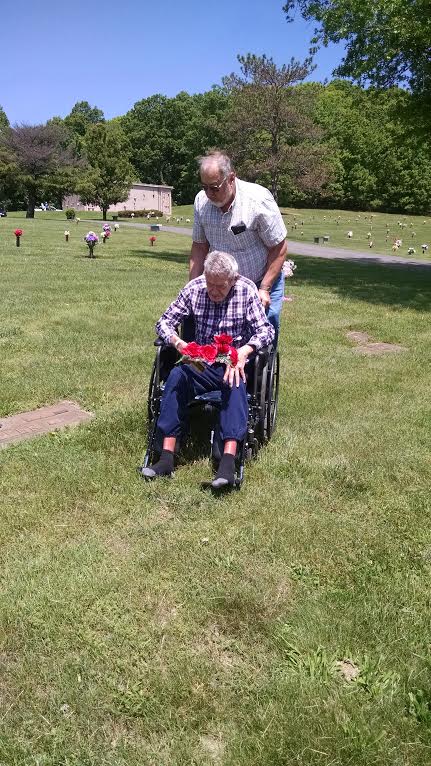
My husband pushing Charles’ wheelchair over the bumpy terrain.
Letha died 13 years ago this month; life has been lonely but livable for Charles ever since. At age 91, he’s had a hard life, and now is legally blind. For a time he managed to live by himself with the help of the local social services folks, and frozen “meals on wheels.” Aides came in several mornings a week to assist him. Then after a bad fall, he could no longer live alone. Only one stepson lives nearby, but lives in a group home and is not independent. The stepson calls and is brought to see Charles every few weeks. A few other neighbors and a long time mail carrier are pretty much Charles’s only other visitors. His biggest wish, now that it’s summer, is that he could sit again under his old outdoor canopied swing enjoying the breezes and sun. We do take him to the courtyard outside his nursing home window whenever possible.
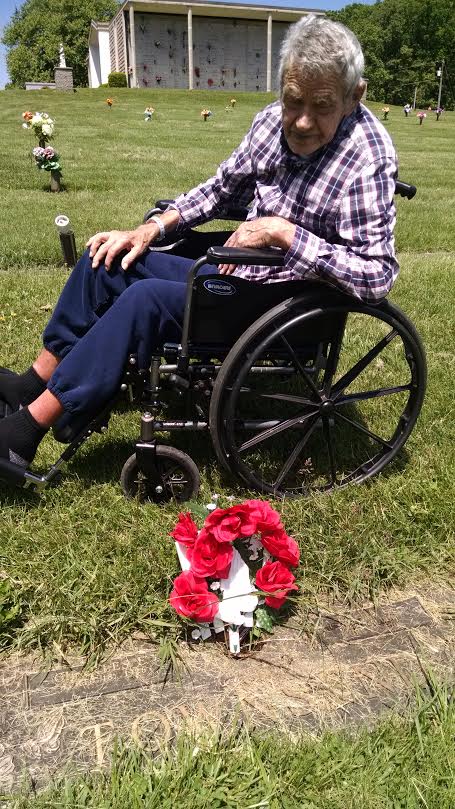 On Mother’s Day, we were able to sign Charles out of his nursing home (we hadn’t known we could do that) to visit his wife’s grave, nearby. He can transfer from a wheelchair to our minivan okay, so my husband pushed Charles’s wheelchair over uneven ground and up a hill at the cemetery. Charles broke down and just sobbed to be there once again. Theirs was a second marriage that lasted nearly fifty years. After her death, he was a loyal visitor to her grave. He kept saying, “You have no idea how much this means.” I think it was good for him to be able to let his sorrow out like that. Afterwards we picked up a fast food lunch to enjoy with him back in his room—so tasty after institutional food.
I write this not to brag on us in any way—I wish we could go visit several times a week. What we do is so meager. But when we do go, I am always struck by how very many lonely and friendless folks there are in long term care facilities throughout the land.
I’m sure many readers of this column visit friends, relatives, and church members. Many more of us could visit more often if we would but carve out time. And even if you are visiting someone who cannot speak, and perhaps it seems like they don’t even know you are there, the staff and caretakers know and take notice.
We all know we may someday be in those wheelchairs, those beds, those halls, eating those lunches. Perhaps recognizing that stark truth is what keeps some of us away. Is there someone who would enjoy a visit from you today or sometime this week? Or perhaps a card or phone call?
***
Any stories or memories this brings to mind?
Another Way is a column by Melodie Davis, in syndication since 1987. Another Way columns are posted at FindingHarmonyBlog.com a week after newspaper publication. Charles gave permission for me to take and use photos.
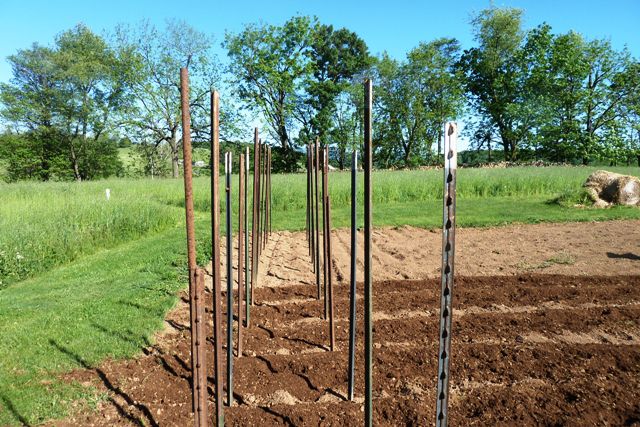
Not perfect, but good enough!
Another Way for week of May 26, 2017
Forty-One Years of Eat, Pray, Love.
The annual setting out of our tomato stakes is often a barometer of our marriage. We bicker about how far apart the stakes should be, whether they are straight, and move the stake back and forth a mere inch or so to get it just right. I feel like a have a reasonably good eye for spacing stakes evenly, although we can both get off track and the stakes gently wind a slow curve. As we age, the job becomes less a test of marriage and more a trial of physical strength getting the stakes in the ground.
If you’re going w-w-w-what is she talking about, a brief primer is in order on planting and raising tomatoes the Hershel Davis way. Hershel was my father-in-law—who modeled and instructed us in the fine art of growing tomatoes. He put out hundreds of tomato plants each summer and staked them all, tying the vines ever further up the stakes as they grew. He loved growing tomatoes and giving many away—especially if you praised them. He also sold some to local independent groceries or regular customers.
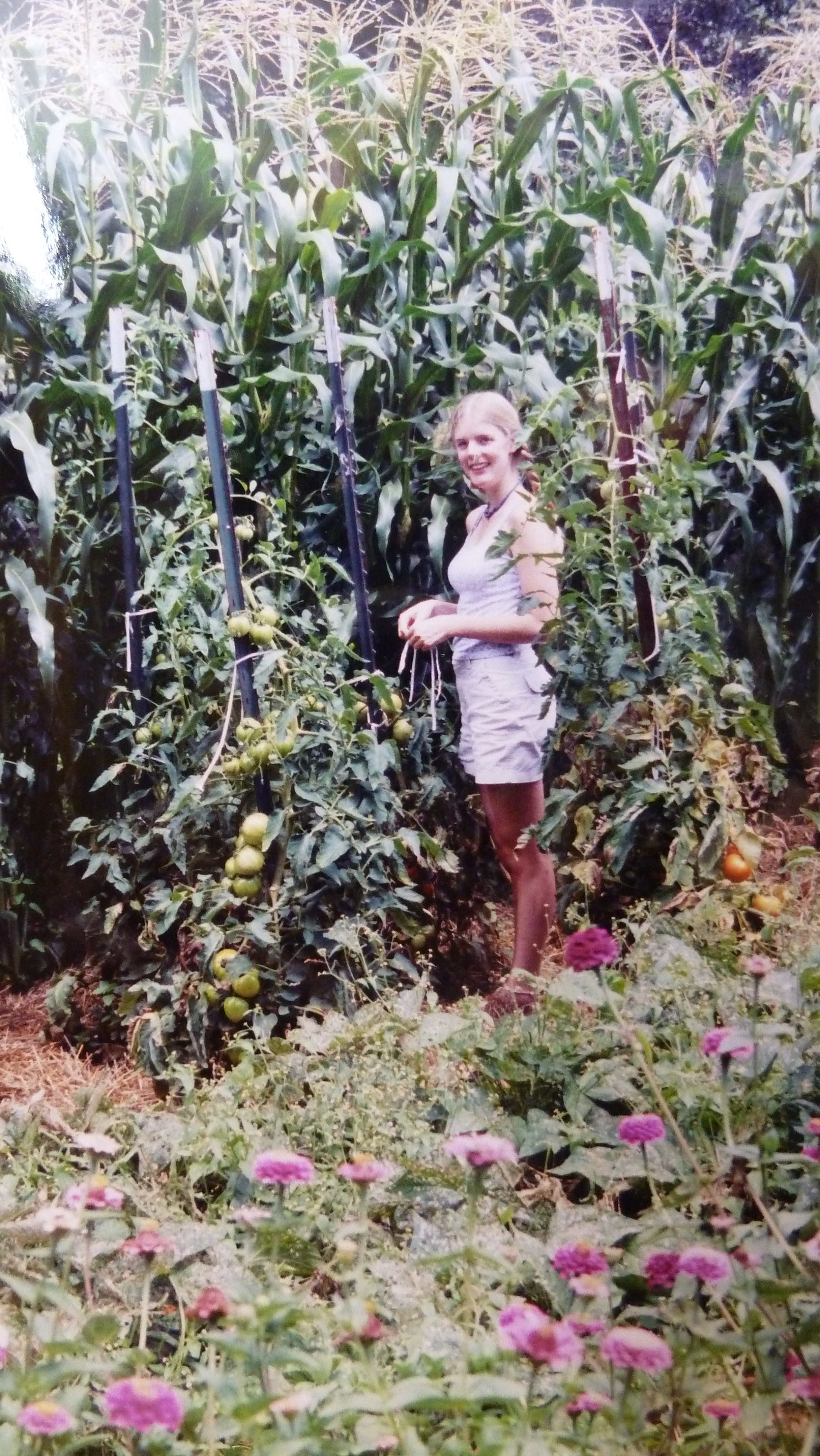
Daughter Doreen standing beside staked up tomatoes at our 30-year-home. And yes, that is even taller corn behind her.
My husband—great tinkerer that he is—went one better for awhile and put extensions on his tomato stakes so the plants could grow even taller. I think he was heading for Jack-and-the-beanstalk’s-giant territory. Stuart has to stand on a step stool in order to get high enough to pound the stakes into the ground using a device he made for the purpose, like a fence post driver. It is a heavy, hollow, steel tube, closed on top with handles on each side that you slide down over the stake to hammer it into the ground. We used to use wooden stakes but some years ago we changed to using metal fencing posts. The hollow steel tube clanging on the metal fence post rings out as we work like we were building a railroad. And feels like that.
So, each year I dread the setting out of the stakes. I dislike it as much for the marital spats it brings out in both of us, as for the hard labor it involves. If you’ve been married 10, 15 or more years I’m guessing there are certain annual rituals and tasks that you get a little heated about every year, too. Choosing or retrieving a Christmas tree, if you buy an actual tree each year. Packing the car for vacation. Figuring out where you’ll go on vacation. How best to shovel snow or wash windows. Or perhaps it’s cleaning the basement or garage that gets you going with irritations and squabbles.
It does get easier with time, because you know your marriage will survive the bickering, and can take it in better stride.
Last year we celebrated 40 years of marriage on May 29. How do we—and millions of other couples manage to keep their wedding vows for 30, 40, 50 or more years?
- You keep the vows because you promised each other you would.
- You find ways to practice daily love expressed through a kiss, a kind word, a special smile, a favor or deed done for your loved one.
- You make getaways—weekend trips or longer if you can—when it is just the two of you. You treat yourselves to the luxury of a nice motel or cabin or camping if that’s your thing, and enjoy the snuggles.
- If you’re not into traveling—just keep date nights when you put away your phones and find things to talk about, like you did when you were dating.
- If you have an argument, you let it cool and then both work at making up later with a genuine “I’m sorry” and repeating any of the love expressions in #2.
- You build memories as a couple or family which keep you hanging on even when the love feels in small supply.
- You get help if necessary when going through a bad patch, depression, grief, or a seemingly irresolvable conflict.
- You let your family support and help you in times of need—and return the favor for all those kin you keep close.
- You pray.
- You eat together.
- You just keep loving.
For my free booklet (sized to fit into wedding or anniversary cards), “Secrets of Long Marriage: Six C’s of Marriage,” write to me at anotherwaymedia@yahoo.com or Another Way Media, Box 363, Singers Glen, Va. 22850. Two or three per request as long as they last. Send one standard U.S. postage stamp for each booklet.
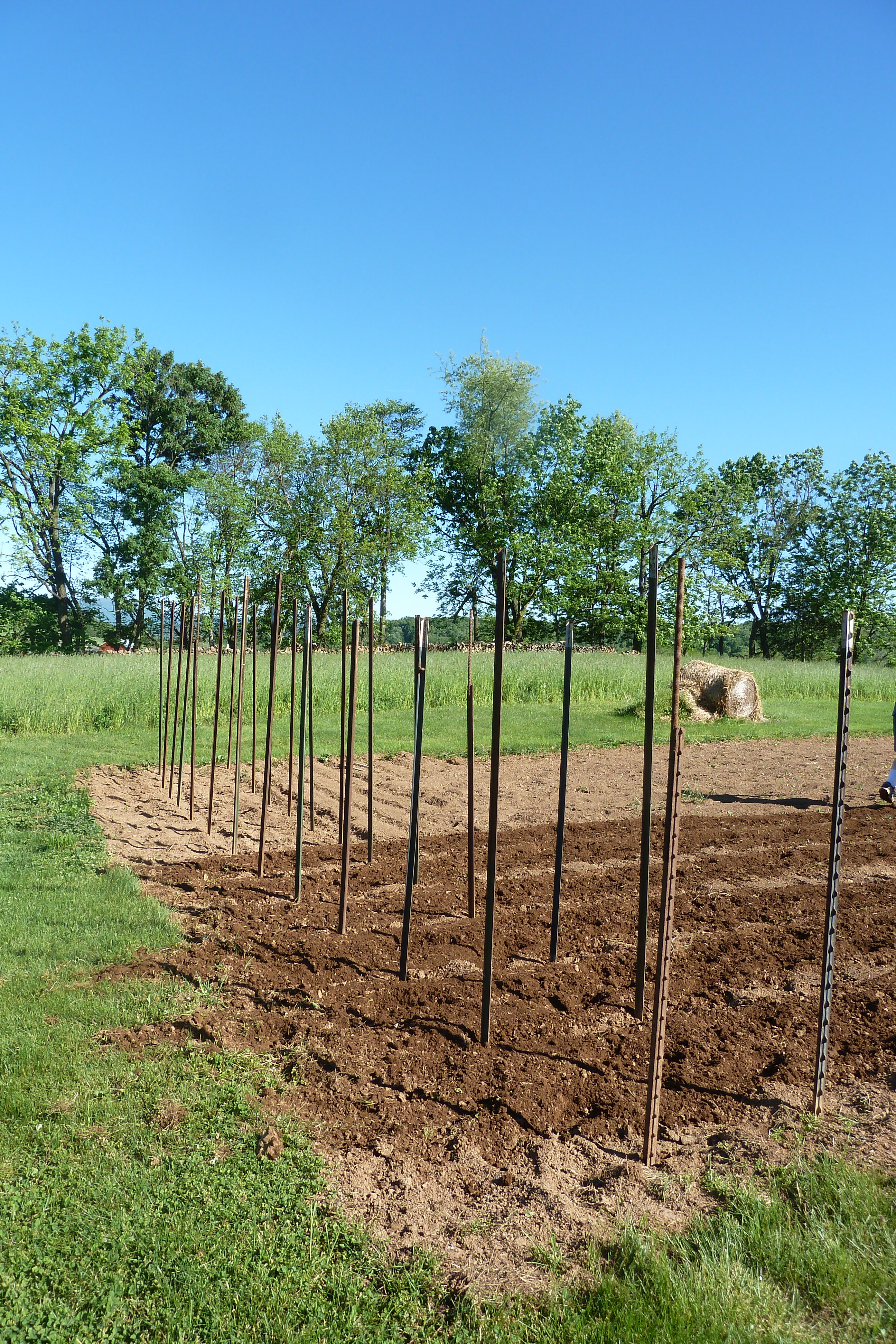
We used to put in stakes after the tomatoes were planted which is even harder. For the last two years we’ve driven in the stakes first. As with marriage, you learn things as you go.
***
What are your top 3 tips for keeping a long marriage going–or perhaps better said, keeping love alive?
I always love to connect with readers.
***
For my free booklet (sized to fit into wedding or anniversary cards), “Secrets of Long Marriage: Six C’s of Marriage,” write to me at anotherwaymedia@yahoo.com or Another Way Media, Box 363, Singers Glen, Va. 22850. Two or three per request as long as they last. Send one standard U.S. postage stamp for each booklet
Another Way is a column by Melodie Davis, in syndication since 1987. Another Way columns are posted at FindingHarmonyBlog.com a week after newspaper publication.

Do you do cilantro, or not?
I had cilantro pop up in my garden very early this year. In fact I had to save some of it from being destroyed by the man who plows our garden, back in late February. We had some very warm spells in February and even though we didn’t end up planting much garden in March, by the end of April we had nice volunteer cilantro—but of course no home grown tomatoes yet, for that delicious pairing.
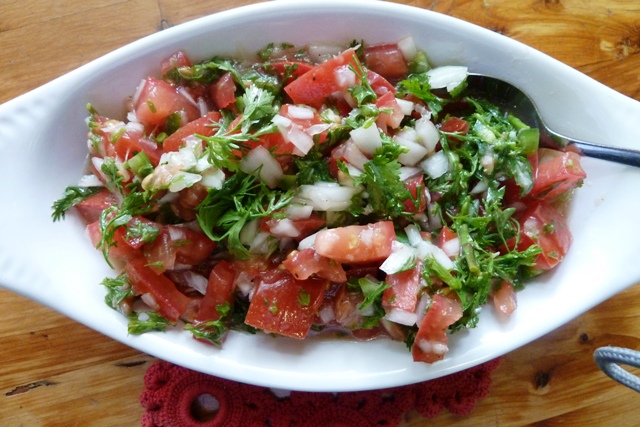
Nevertheless, I splurged on a small supply of Romas and stirred up a batch of pico de gallo for a staff potluck where we were supposed to bring dishes on the theme “Cinco de Mayo” in early May. Mexican, in other words.
I found my friend and former colleague Wayne’s recipe for pico that he once made for a staff potluck. At that time, I had been so blown away by the flavors of his Chicken Fajitas that I begged his recipe, and tried it at home. Some of our children were still at home at the time and I’ll just say they were so not impressed.
Nowadays I think all of my kids enjoy dishes flavored with cilantro, but for that first time with cilantro, at least at my table they were pretty much all thumbs down. I was pretty devastated. Where had I gone wrong?
It was a few more years until I learned the truth that some of us may literally have a gene which allows us to like cilantro, and some of us don’t. A New York Times article gives a decent explanation of the why. So no judgment here if you are not all rave-y about a dish that, according to my husband, reminds him too much of the smell of stink bugs. Or soap, if that’s the way it hits you. Yes there’s that, and I get it, but if the pico is properly marinated and chopped, it is so complex with flavors and in my book, yummy.
First the pico, full name Pico de Gallo, which literally means “beak of the rooster”—with no special meaning attached to that. (No rooster beaks are used in the making of this recipe.)

Pico de Gallo
2 – 3 fresh Roma tomatoes, chopped fairly fine
1/3 cup onion, chopped
1 cup chopped cilantro (don’t use stems)

garlic clove, minced
¼ cup olive oil
2 tablespoons fresh lime juice
salt and pepper to taste
small amount chopped jalapeño pepper, to taste
Mix a day ahead, or let marinate overnight. Use as a salsa dip on anything you like salsa with. Makes about 2 cups.

Chicken Fajitas (not pictured)
2-3 skinless, boneless chicken tenderloins, chopped
juice of 3-4 limes
1 clump cilantro, chopped
½ cup olive oil
2-3 cloves garlic, minced
salt and pepper to taste
Marinate chopped chicken in above mixture. Grill chicken. Serve on tortillas with pico. (Extra tomatoes, cheese, and lettuce optional.)
***
So of course the question of the day is: do you like cilantro, or not.
Let us know! I’d love to hear your story.
Between 5-15 % of the population seems to be adverse to cilantro according to various sources, and according to your country of orgin. Google it. Some feel/claim you can become acclimated if you try.

Wayne and his wife Carmen, who was one of the food editors for my book Whatever Happened to Dinner, have multiple wonderful recipes in it! Check it out if you never have.
Another Way for week of May 19, 2017
Discovering More about Native Life: Christian’s Hope
Although I grew up in the 50s, I didn’t grow up playing cowboys and Indians. This was because:
- We weren’t allowed any games that simulated shooting. My dad hated any play that had to do with guns.
- We didn’t have a TV so we didn’t know the “TV cowboy” genre.
- I had two older sisters and one baby brother so our games involved playing “house,” school, or church with poor Terry as our “baby.”
- I do remember making bows and arrows out of branches and sticks, including attaching arrowhead-shaped stones to the sticks with strings or rubber bands.
My father also often found (well, maybe five or six times) real arrowheads as he was working his northern Indiana farm.

Dad’s collection of arrowheads.
It always kind of thrilled him and we saved those stones. At the time I had no idea that meant our farm was probably a location where Native Americans had lived, nor had I put together why they may have moved on.
In general, my understanding and knowledge through high school and even college about the indigenous people who lived on this continent was limited to the typical stories in history textbooks. We learned about early settler/native attempts at friendship and understanding, broken treaties and conflicts, misunderstandings and wars, and a native culture with such a different way of life it was “foreign.”

Photo courtesy of Ervin Stutzman
A distant cousin, Ervin Stutzman has completed a novel trilogy about a common ancestor, Jacob Hochstetler, regarding what might have happened to Jacob and two of his sons, Joseph and Christian. All three were captured by natives during the French and Indian war in the 1700s in a raid and massacre in the Northkill area of Pennsylvania. Jacob’s wife and two of his other children were brutally killed. The books are titled Jacob’s Choice, Joseph’s Dilemma, and Christian’s Hope, all published by Herald Press.
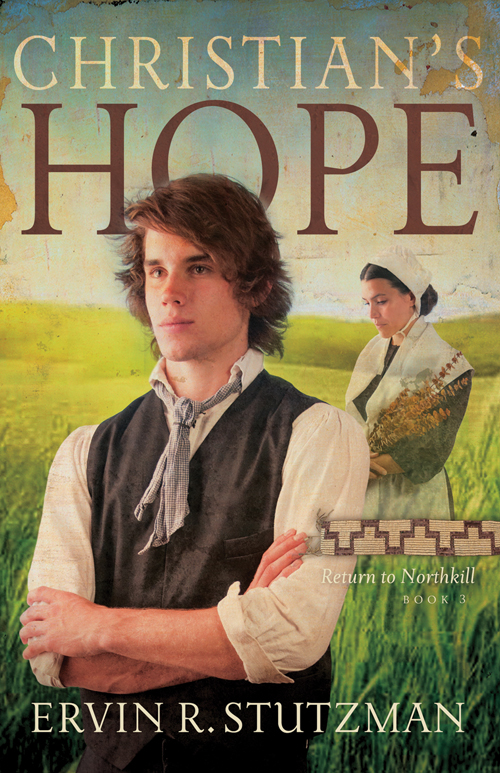 I have now finished reading the third volume, Christian’s Hope, and it especially takes us inside the mind of what it might have been like to live and think like a native in those days. Young Christian lived for about seven years as a native with the Shawnee tribe, adopted by a family he came to love. But after treaties were signed, he is forced to return to his home and while he was interested in seeing his father and family, he is depicted as having an extremely difficult time adjusting to life back in his Amish community. He chooses to retain the dress and hairstyle of the Shawnees. The small wigwam he built for himself is burned down. The hatred and misunderstanding he senses, sees and hears from white settlers is so strong at some points he fears for his life.
Ervin is by now a prolific writer along with being a seasoned church leader, getting ready to retire from his recent years at the helm of Mennonite Church USA as executive director. In this third novel, underlying his well-developed plot, Ervin drives home the point that Native Americans were repeatedly moved westward to accommodate incoming settlers from Europe—in some cases political or religious refugees. The settlers were farmers rather than hunter-gatherers, so they desired land. Possessing their own land was a concept totally foreign to natives who believed all land belonged only to the Creator. Many of us today live on land occupied originally by natives who were pushed to poorer land.
The second and third volumes in Ervin’s trilogy set out to help all of us understand a bit better both the lives and values of Native Americans (in Canada often called First Nations peoples). It is well worth the read to absorb some of the insights Ervin found through extensive research into native religious faith, customs, and history.
Many of us born in North America have indigenous peoples ancestry from many different family trees. While some are inclined to want to forget the terrible deals, fighting, injustice, and sacrifices, the more we understand about the past can help us truly appreciate what others have went through before us.
What the often troubled young man Christian eventually became in this novelist’s imagining, and what researchers know from records regarding what actually happened in his life, weaves a hopeful and rewarding tale.
***
How important is your heritage to you?
***
I’d love to hear of any connections you have to the Jacob Hochstetler family, or native peoples. Write to me at anotherwaymedia@yahoo.com or Another Way Media, Box 363, Singers Glen, Va. 22850. For more on the three novels go to store.mennomedia.org or call 800-245-7894.
***
Another Way is a column by Melodie Davis, in syndication since 1987. She is the author of nine books, most recently Whatever Happened to Dinner. Another Way columns are posted at FindingHarmonyBlog.com a week after newspaper publication.
Another Way for week of May 12, 2017
Habitat Brings Brighter Futures: A Simple, Decent, Place to Live
What does having your own home mean to you, if indeed you are so fortunate? What does it mean for your children?
We went to a fundraising banquet for our local chapter of Habitat for Humanity recently. It was meaningful to be reminded of what having a simple, decent place to live (one of the mottoes of this fine organization) can mean in the life of a child and family. It can mean the difference between a child’s ability to thrive and succeed in school, with friends, and in life–or not.

Jeff Carr was the keynote speaker at this annual fundraising dinner and I think I would have enjoyed Jeff’s speech even if he hadn’t been one of my oldest daughter’s first playmates at the age of one year. Jeff is senior pastor for a large Church of the Brethren congregation, and he called his speech, “Bright Futures and a Peanuts Mailbox.”
Jeff may be a “senior” pastor but he’s only in his mid thirties. I was not too surprised to hear that when his oldest son Gabe was just three going on four, he proposed the idea to collect donations for Habitat for Humanity in his little red Peanuts mailbox.

In the run up to his birthday that year, he let his parents know he wanted presents of course, but he also wanted to collect money and give it to Habitat for his birthday. This likely sprang from his parents’ avid support of our Central Valley Habitat for Humanity Chapter for many years.
The apple doesn’t fall far from the tree. Young Gabe’s grandmother, Gwen is my friend who was recently ordained to ministry in the Presbyterian Church, a latecomer to ordination. She is one of the most caring, giving, creative, and all round beautiful people I know. Her son Jeff and my oldest daughter Michelle were born nine months apart, and I’ll never forget how Gwen reached out to me as a new mother with tips (she put together a whole notebook), moral support, gifts for our newborn, hand-me-downs, and play dates once Michelle was old enough to toddle. Little Jeff (and his family) attended her very first birthday party.

Gabe’s great grandparents, Mac and Ellen (above), were charter members of the church we’ve been a part of for over 45 years. If Gwen and her son Jeff, and his sons Gabe and Nate have generosity and “thinking of others” as part of their natures, I know where they got at least part of their inclination for kindness: great grandma and grandpa. Serving others through whatever means possible has always been part of the DNA of our small but bighearted congregation.
People such as Gabe, Jeff, his grandma, great grandparents, and oodles of others support and volunteer with Habitat because it so transformational: changing the lives of families as it helps lower-income persons find affordable housing and achieve the dream of home ownership. Millard Fuller, founder of Habitat, had the idea that people who were willing to invest their own “sweat equity” into helping build their own home and also homes for others, could end up with an affordable mortgage for a small decent home. Many become homeowners for the first time in their lives.
Habitat also transforms and solidifies communities because home ownership means families who care about their house, yard, and investment, which begets more stable communities, and often surrounds families with caring neighbors. Marsha Smith, who just finished nine years serving as executive director of the Central Valley chapter, summarized it this way: “The simple, decent homes we build with families provide the foundation for safety and security and serve as the center for family interaction, study and growth.”
Personally, there was no better motivation for me to give than seeing young Gabe holding up his little Peanuts mailbox for Habitat for Humanity. And I have no doubt his little brother Nate will be right behind him! (When he gets done scooping up the sweets. 🙂 )

***
Who or what inspires you to give or to volunteer? Comment below or send your stories or comments to anotherwaymedia@yahoo.com or Another Way Media, Box 363, Singers Glen, Va. 22850.
Another Way is a column by Melodie Davis, in syndication since 1987. She is the author of nine books, most recently Whatever Happened to Dinner. Another Way columns are posted at FindingHarmonyBlog.com a week after newspaper publication.
***
Ten years ago I helped to produce the TV documentary, Building on Faith: Making Poverty Housing History, for Habitat, NBC-TV, and other organizations. More info on that here (although the documentary is dated and no longer for sale).

A walk through nature can be like entering an awe-inspiring medieval cathedral.

Or here, it reminds me of a mulched “sawdust trail” beckoning the wayward.

A bench awaits those with tired feet.

The gently swaying honeysuckle offers sweet whiffs like a censor.
God speaks through the whispers of wind and birds gently calling and cooing.
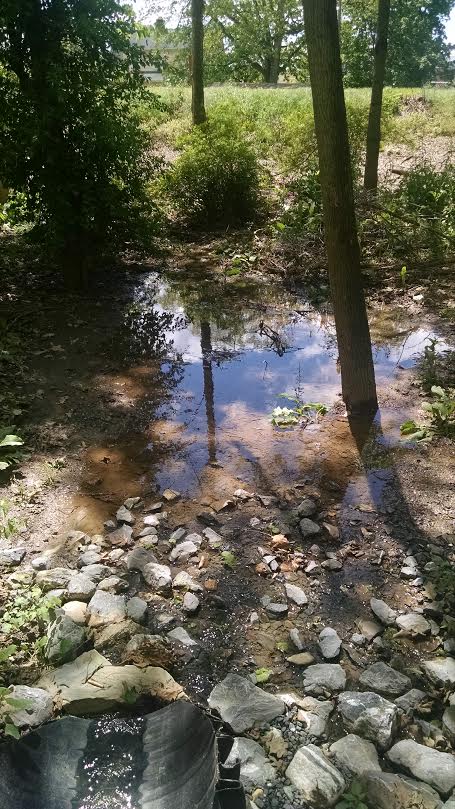
He leadeth me beside still waters.

I commune with the bossy birds, the fat squirrels, the spiders spinning shining webs, and the teeming insects busily at work in this old growth forest.

The dappled sun shining through the leafy canopy is rumored to restore the soul.
I am at peace.
Some say “Even five minutes around trees or in green spaces may improve health. Think of it as a prescription with no negative side effects that’s also free.”
Or perhaps we should call this forest-bathing*.
I call it, “He restores my soul.”

Amen.
***
*I’m told the Japanese coined a term for the benefits of spending time in forests: shinrin-yoku, which means something like taking in the forest atmosphere or “forest bathing.” Find out more about the health benefits here.
***
How and where do you best find relaxation, restoration, communion with God? How often? What helps you find harmony?
Another Way for week of May 5, 2017
Motherhood as Desperate Innovation
Any memories of spit baths, anyone? Either giving them to your own kids, or being on the receiving end of the quick attempt by (usually) a mother to remove some stubborn dirt or remains of breakfast from your face? Or perhaps your kids hate or run from any face scrubbing, including with a nice washcloth?
A mother named Alex shared on Facebook how she dealt with her small boy’s dislike of such episodes: “Because he hates his face being washed I would pretend to be the mommy doggy or kitty and ‘lick’ him clean with a cloth. He thought it was hilarious with the sound effects.” My daughter’s friend, Kelly Gilbert, after reading this illustration from Alex, named this the “desperate innovation” of motherhood. Kelly gave me permission to use her line and this story. (Thanks!)
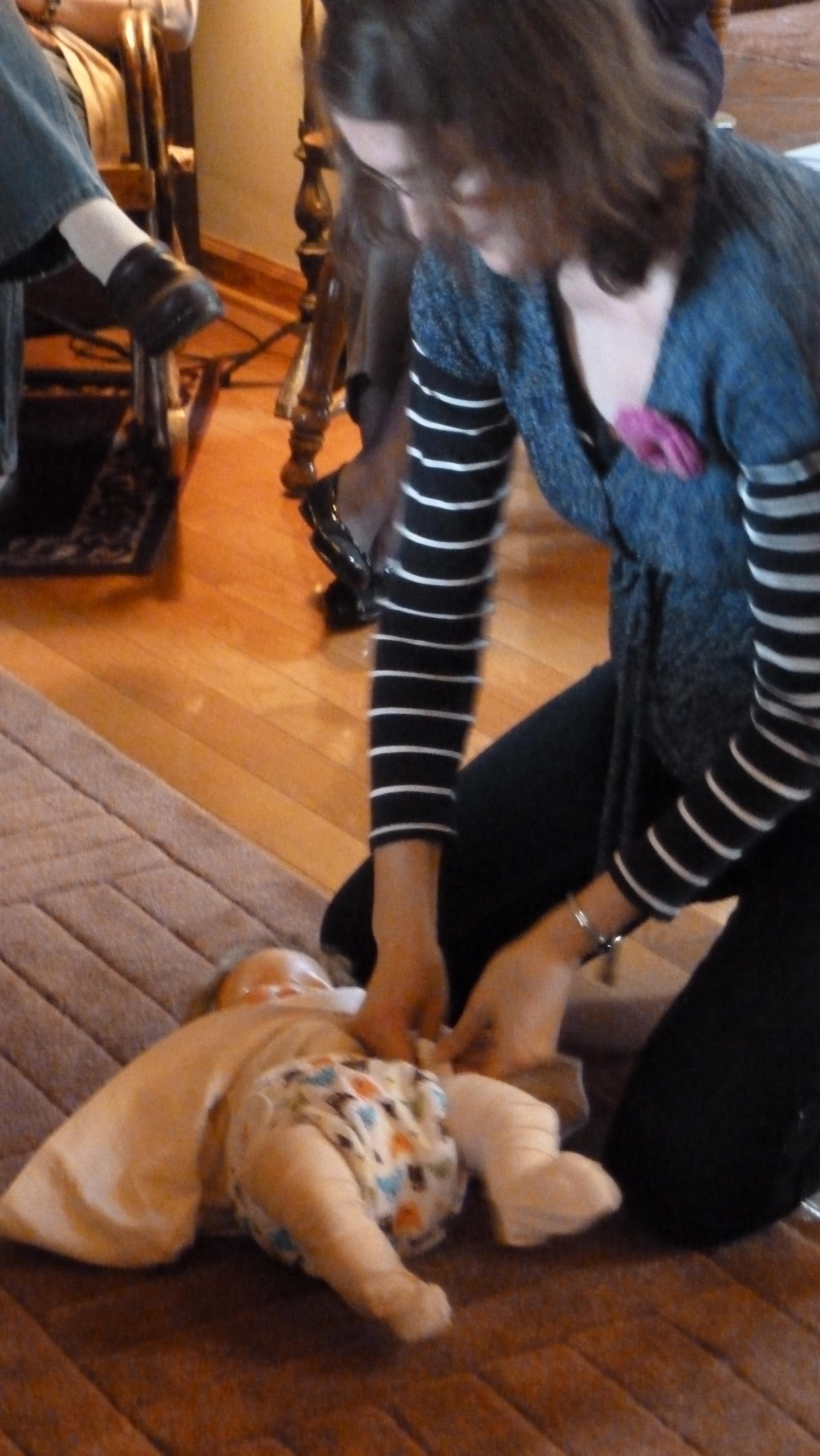
My oldest daughter illustrates diapering a doll while at a baby shower. She has plenty of experience now, of course.
My elementary school friend, Ruby who I love getting to know again on Facebook, added some examples of innovation involving getting a child to finish his food. “Open up the garage door for the truck to come in!” was a ploy which worked with her children many times. Another hurdle was teaching little boys to aim (in potty training) by having them try to hit a Cheerio in the toilet! She adds she never tried that with her boys, but she knows some who have. These qualify for “desperate innovations”!
Our oldest daughter’s son was diagnosed with Celiac disease last fall and his parents are trying to be very faithful in following a gluten free diet. So the day before Easter we were at a park for an egg hunt. The sponsors generously also provide a very simple grilled hot dog lunch immediately after. The hot dogs even turned out to be gluten free, according to the package label one of the men inspected for my daughter when she inquired. So she asked for a hot dog before it was put into a bun.
The problem turned out to be there were no forks or plastic utensils available to cut the hotdog in small, bite-sized slices. My daughter innovated very quickly: found an unused little tool in the infant manicure set she kept in her diaper bag, washed it off at a park fountain, and cut the hot dog into slices. Her son was then able to use the tiny tool to pick up each piece of hot dog and dip it into ketchup. Such a small thing, but sometimes as parents you are just desperate for any innovation that keeps a pleasant outing from dissolving into unhappy tears.
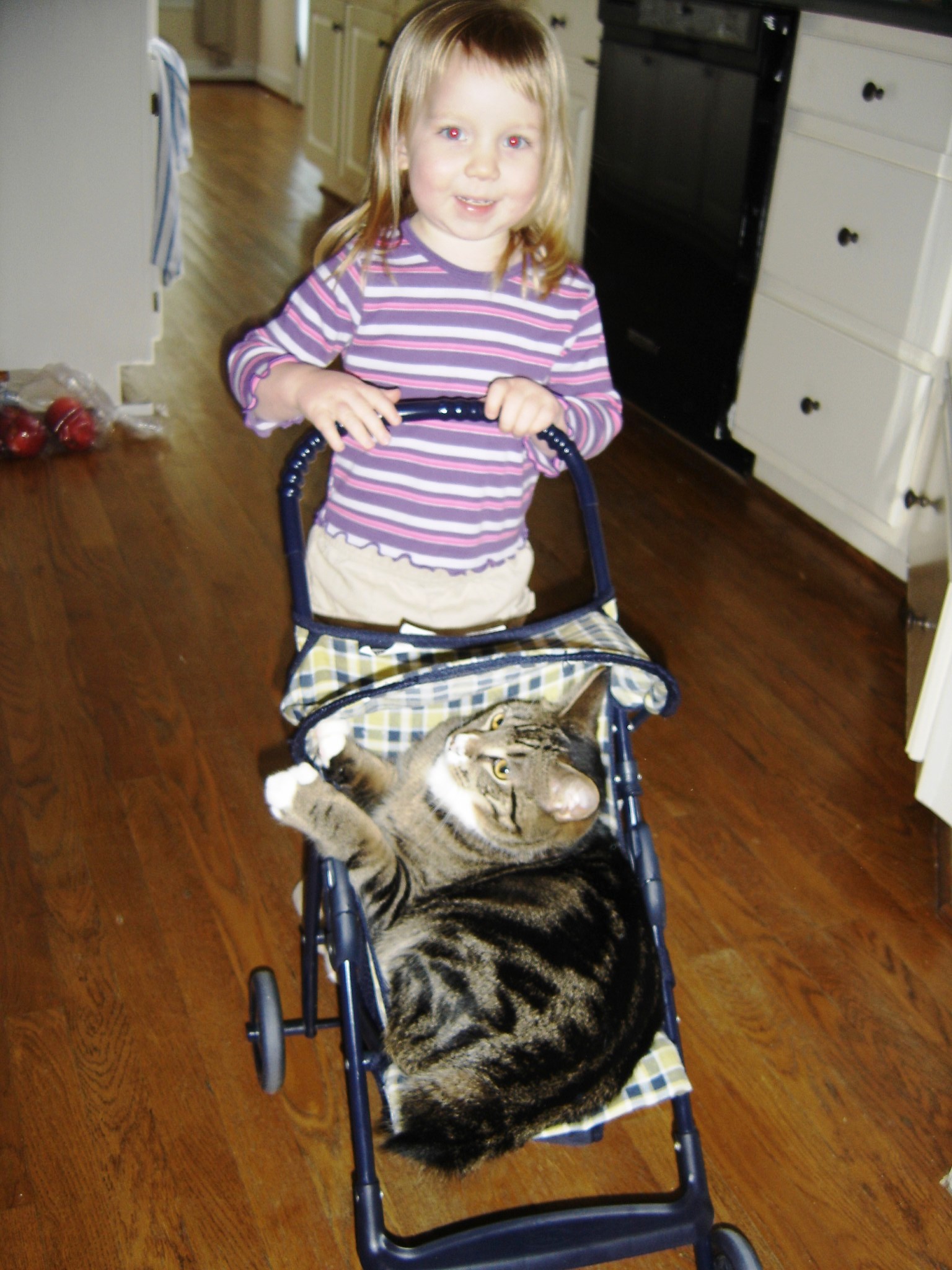
Photo from Donna Coffman, of her granddaughter “innovating” motherhood.
The frantic need for innovation often starts when the second child comes along. It comes with such basic necessities as needing to visit the throne room. I wrote about that in one of my early books, You Know You’re a Mother When… (Zondervan,1984), after we had our second child. The baby was fussy and our oldest daughter was only two and demanding a lot of attention. Rather than let the baby scream in a crib or infant seat, I took both of them into the bathroom with me, holding the baby on my lap while Michelle showed me her latest art drawing. I doubt I’m the only mother who has held her baby on her lap while taking care of bathroom business.
As I looked through that book I found another time when I was urgently innovating while visiting a large church to speak briefly at the Sunday morning worship about the dilemmas of parenting. We had traveled to Florida so the children were off schedule and tired—and there I was in the back row trying heroically to keep the two-year-old quiet using my usual diversionary tacks: books, toys, raisins, even chewing gum. When I went up to speak, leaving my husband alone with the kids, he soon tried a different tactic as he tried to help them behave: he marched them out of the service and told them in no uncertain terms that if they wanted to go back in and see Mommy they would need to be quiet and stop whining. The toddler was quiet and mannerly the rest of the service, and the preschooler nodded off to sleep with her head on one of our laps.
This story reminds us that different parents employ different tactics. Today, both these daughters have their own little ones who (yes), manage to disturb the worship services at their own churches from time to time.
This reminds me of one of the best stories in the Bible about Jesus and the children. The disciples are the ones concerned about the disturbances of children as Jesus talks to the crowds in Luke 18: “People were also bringing babies to Jesus for him to place his hands on them. When the disciples saw this, they rebuked them. But Jesus called the children to him and said, ‘Let the little children come to me and do not hinder them! For the kingdom of God belongs to such as these.’”
***
I’d love to hear more examples from your own life or a friend, of something fun, crazy, or wacko you did in a moment of desperate innovation?? Such as did you ever have to come up with a substitute diaper?
At any rate, let’s hear it for mothers who are able to pull bunny rabbits out of their hats on command!
***
Send stories or comments to anotherwaymedia@yahoo.com or contact me at Another Way Media, Box 363 , Singers Glen, Va. 22850.
Another Way is a column by Melodie Davis, in syndication since 1987. She is the author of nine books, most recently Whatever Happened to Dinner. Another Way columns are posted at FindingHarmonyBlog.com a week after newspaper publication.
Another Way for week of April 29, 2017
What is Middle-aged? What is Old?
I remember going to the 40th reunion of my high school class where I attended my first three years of high school. I took a look around at the gray hair and wrinkles and tried to see in their faces my high school chums. I couldn’t recognize some of those I hadn’t seen in 40 years. Did I look equally different to others? I truly wondered if I looked as old as them. This is a common experience for most of us.
I began writing this newspaper column in 1987 (not this specific column, but the weekly editions), which was a year after we gave birth to our youngest daughter. So I was still a fairly young mom at the time, (or older mom, depending on your viewpoint, to be having babies from age 30 to 35). At any rate, we ended up with three kids age five and under after that final blessed birth event.
This helps to explain why as I approached my 40th birthday with my youngest child just starting kindergarten, I definitely did NOT feel middle-aged. Who said 40 was middle age anyway? If you are unlucky enough to drop over from a heart attack in your 50s, then 40 is downright elderly. If you live to be 100 or 105, which is more and more common, then at 40 you’re just getting started.
But the good Lord provided that we truly don’t know these things—unless we draw the terminal-illness-at-an-early-age-card, which too many, tragically and sadly, do.

Jennifer Grant

So along comes Jennifer Grant, a former columnist for the Chicago Tribune and a funny and prolific writer for magazines and blogs, and with books popping out like rapid babies. Her newest book births May 2 from our office called When Did Everybody Else Get So Old: Indignities, Compromises, and the Unexpected Grace of Midlife (Herald Press). I’ve been blessed to work with Jen on the editing end of her book, passing her baby from copyeditor to designer and through first and second proofreaders, and so on.
Jennifer writes funny—not weird funny, but laugh out loud funny. If you’re anywhere near 40 and up, you’ll love her looks at the transitions of middle age such as the children growing up, feeling inadequate and not as successful as others in your field, going through hormonal swings, and your teenager being embarrassed by something you’re wearing. Been there, done all that.
Here’s one of my favorite stories from Jen:
According to my teenage daughter, I look not only old but also weird in my new glasses. I admit that the woman at the optometrist’s office did mention that not everyone can wear these particular frames, but she assured me that I could. And I quote: “Not everyone call pull off those frames, but you? You’re rocking them!” I walked out of that office with a little spring in my step.
A few days later, unbespectacled at the time, I drive my daughter and one of her friends to Starbucks. They sit together in the back seat of the car, looking down at the screens on their phones.
“My mom has ‘new glasses,’” my daughter announces, apropos of nothing. She speaks the words “new glasses” in gigantic air quotes to underscore her disdain (Grant, p. 85).
She also writes oh so poignantly about an absentee father, her sister who she and a brother often had to rescue after evictions or hospitalizations; the sister ended up dying young of cancer. She writes of an 11-year-itch when she and her husband decide to have marital counseling.
If you’ve ever pondered “Who have I become?” “Is this all there is to life?” “How do I relate to a God I understand less now than I used to?” or ever asked “Now wherever did I put my reading glasses?” you might enjoy Jen’s book.
And if you go looking for the book: look for a book with funky glasses on the cover and title in really big print.
The serendipitous thing about this book is that since we are all aging, Jennifer points to the confidence and grace that this season of life can also bring. She reminds us that midlife is the time to leave regrets behind. It “isn’t the time to make excuses or ruminate. It’s time to move on, with hope” (p. 173). She quotes Solomon in her last paragraph, “What we can do is eat and drink and enjoy the fruits of our labor, knowing them to be gifts from God” (p. 178).
***
Send your comments to anotherwaymedia@yahoo.com or Another Way Media, Box 363, Singers Glen, Va. 22850. Or, find more about the book at store.mennomedia.org.
Another Way is a column by Melodie Davis, in syndication since 1987. She is the author of nine books, most recently Whatever Happened to Dinner. Another Way columns are posted at FindingHarmonyBlog.com a week after newspaper publication.
Another Way for week of April 22, 2017
The Gift of Walking
My daughter shared a wonderful image from her 14-month-old’s life recently as they walked to a nearby playground. It was the first time he’d been to the playground since he had started to walk; he is pretty solid but still falls occasionally.
Her husband and their older son took off quickly for a favorite amusement. Michelle took the toddler out of the stroller and instead of taking him and putting him on the nearest slide or swing, she thought she’d let him choose where he wanted to go first. But instead of making a beeline anywhere, he just stood there, taking it all in.
She imagined him weighing the delicious choices in his very young brain. Where should he go? Did he really have the option to choose? What new freedom did he have? And in a minute, he happily walked toward the swings.
But what struck me about her story was thinking about the process of getting from newborn-infant-helplessness to walking-upright-over-uneven-ground and choosing your own play.

Does cruising count as walking?
We’ve been so fortunate to have four grandsons since 2013. I have been marveling at the wonderful process of learning to walk—even if from afar. When our daughters were learning to walk, I was with them many hours a day (I worked about three days a week while they were small). The learning-to-walk process seemed to take forever. In fact, as a new mom, I remember being somewhat astounded about how unclear a process it was. What was actual walking? Is taking one step while holding on to furniture considered walking? Or just cruising? Is standing and stepping and then falling considered a first step? What counts? What if she takes one step one evening, immediately falls, and then doesn’t try for another week or two? What date do you put in the baby book?
The developmental steps involved start with the baby’s first wobbly attempts at just holding up his own head which weighs proportionally so much more than the rest of his body. Next comes increasing the upper arm and shoulder strength that enables babies to turn over. The current sleeping patterns of infants in North America, where pediatricians encourage parents to always place infants on their backs to sleep (which has greatly reduced death rates from Sudden Infant Death Syndrome), can slow the rate at which they begin holding their heads up off the mattress or floor.
So “tummy time” spent regularly on the floor helps make up that loss. Rolling over and getting into the crouching position and ready to crawl comes over the next few months. Sitting up and then shifting weight onto one hand or another is another step which leads to the walking process. Finally, pulling into a kneeling or standing position with the use of crib rails or furniture—and they’re almost there! But it can still take weeks and months for the actual first step or two to happen.
 Do animals have to labor through any of this? They would appear not to. The difference between human and animal babies is explained at least in part by the relatively undeveloped brain of an infant at birth—where human babies do much less for themselves than the offspring of animals.
We have neighbors with sheep and I always enjoy this time of year when frequently some new baby lambs make an appearance. The lambs love gamboling about in the field down the road from our house. This is like a day or two after they are born. What would we think if a tiny infant would get up and frolic in two days? We’d call the national media! Lambs actually are usually standing within the first hour.
The same with a young baby calf: they are typically on their rather shaky legs within 30 minutes of being born. If they aren’t up and about within two hours veterinarians say humans should intervene. It must be said however that walking on all fours is infinitely easier than standing upright to walk on just two limbs. That’s why we first learn to crawl.
These days, most often grandparents do not see a grandchild’s first steps in person—unless they live nearby or baby sit every day or frequently. We may get a video or do a Facetime video session with them, and oooh and praise their first steps that way. I love the Proverb that goes “Children’s children are a crown to the aged” (Proverbs 17:6).
What fun watching new lambs, calves or babies exploring their world. What a shame that too soon we take for granted the wonderful gift of walking and navigating on our own. We newly appreciate the gift of walking as we get older and watch our friends and relatives lose mobility—temporarily or not. We don’t often remember the second part of Proverbs 17:6, which adds a different slant on aging: “And parents are the pride of their children.” In some cultures, the aged hold places of high respect and honor. In North America, we often could do better in that department—to honor and visit and appreciate the aging among us—whether related or not.
Send any comments to anotherwaymedia@yahoo.com or contact me at Another Way Media, Box 363, Singers Glen, Va. 22850.
Another Way is a column by Melodie Davis, in syndication since 1987. She is the author of nine books, most recently Whatever Happened to Dinner. Another Way columns are posted at FindingHarmonyBlog.com a week after newspaper publication.
Part 3: Katharine Graham and the Pentagon Papers, Watergate, and the Pressmen’s Strike
Note: (Part 3 in a 3-part series on Katharine’s Graham’s memoir, Personal History. Find Part 1 here and 2 here. Page numbers refer to the Vintage Books paperback edition of 1998, not the original hardcover from Knopf.)
President Kennedy’s tragic assassination occurs about halfway through this book. Even though Kay Graham had so recently lost her husband Phil in a violent way, Kay said she felt at a total loss as to how to be of help to Mrs. Kennedy. This was followed, of course, not too long after, by the deaths of Robert Kennedy and Martin Luther King, Jr. Oh how short our memories are—or how young some are—to not truly know and understand the difficult days, months, and years we’ve had as a nation, racially and many other ways, over decades and centuries.
On a personal level Kay grew greatly in her ability to run an organization as huge as what The Washington Post Company became (purchased television and radio stations, etc.), including gathering within herself the chutzpah needed to fire a great friend from his job at the Post. She knew she had to do it for the good of the company (p. 385).
Historically, the Post had a huge role in shaping the second half of the U.S. 20tth century. I had forgotten the actual facts surrounding the publishing of the Pentagon Papers. It’s the kind of thing you remember happening if you’re old enough, but don’t quite remember the whys or wherefores. By the Post defending The New York Times in their decision to go against the government in making the controversial papers public, it catapulted the Post evermore into the category of world class paper—no longer just a city paper. And a long way from the day Kay’s father purchased the ownership of the Post at a bankruptcy auction.
The Pentagon Papers era also laid the groundwork for the Post’s Pulitzer Prize winning work investigating the break-in at the Democratic National Committee’s offices in the Watergate complex related to Nixon’s 1972 presidential election. Graham’s replay of those events as publisher, deciding at every turn whether to keep publishing the findings of Bob Woodward and Carl Bernstein, is also fascinating. She does not tell or rewrite their story which they did ably enough in their book, All the President’s Men. (I was living in Spain in 1973-74 as things fell apart for Nixon, leading to his resignation in August of 1974, so many of the facts of his final year in office were very muddy to me. We rarely believed the Spanish press in that era.)
What I had never followed either were the Post’s internal struggles with the various trade unions which worked on the production side of the paper—the Pressmen’s union and associated labor groups. In some ways this chapter was the least interesting to me personally. But it was incredibly educational about the function and foibles of labor unions of the time—the later ‘70s. Graham, a labor reporter herself in her beginning days, believed fervently in the rights of workers to organize in order to protect themselves and promote livable wages. But when it came to violence and the physical destruction of the presses (the workers set fire to the presses) which first halted the printing of the paper (missing actual publication for only one day), the executives and Kay teamed together for workarounds to keep publishing their paper until the presses were restored (more than a month). They pulled together to do the hard sweaty work through the wee hours of many mornings to get the paper out. That Graham could get messy in the trenches in spite of her pampered and privileged aristocratic upbringing spoke volumes to me about her personal integrity.
Kay died at age 84 after a head injury from a fall walking to a bridge game at Sun Valley, Idaho. Her funeral was held at the National Cathedral in Washington, D.C. A number of times while reading her book, I was struck by her claims that she was not a religious person. References to faith are all but missing in her book except for talking about the history of her parents. But that may also be because for so many, religious beliefs are relegated to the private realm. Her obituary in the New York Times indicated that her parents had a pew at St. John’s Episcopal Church in Washington, “the church of presidents.” Her father, who was Jewish, later gave liberally to many Jewish organizations; her mother was a Lutheran. The named pew was likely, in part, because that’s what rich people did—gave money and had a pew named after them.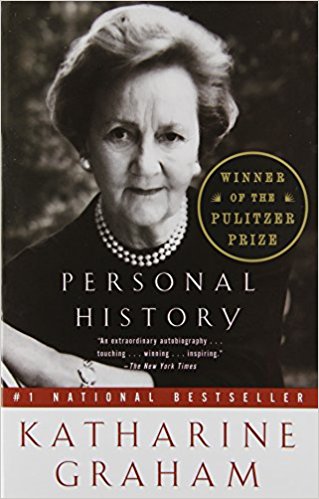
So why read this book? It has a great sweep of 20th century history from the viewpoint of a woman privileged to sit at the helm of a mighty newspaper in what some call the most powerful country in the world. By now my fascination with history should be obvious in the three long biographies I’ve read and shared here. The faith commitments and lives well-lived of Mennonite leaders Harold S. Bender and Orie O. Miller (and even both my father and mother who I’ve often written about), are to me even more noteworthy for what they accomplished without the position and power of a Katharine Graham. So many of our forebears teach such valuable history lessons.
It was also mesmerizing to read this prize winning memoir during what sometimes feels like dramatic times in U.S. history: the election and inauguration of Donald Trump. What it did for me during this time is assure me that our country has been through other extreme leadership crises in our history, and will likely do so again.
May we learn the lessons of history that power and privilege are sometimes abused. In my opinion and in this telling, Katharine Graham lived up to the opportunities which, through no action of her own, befell her. (Perhaps now I need to read a more objective biography.) But she went a step or two further in forging new ground not only for both women and men in her position of power, to behave in morally respectable ways—even if she was not technically a diehard person of faith.
For many of us, prayer and faith are the bedrock that keep us living fruitfully no matter who the leaders are. Our sometimes small acts of faithfulness, prayer, and laboring for better lives are the glue which keep plain (unionized or not) folks going.
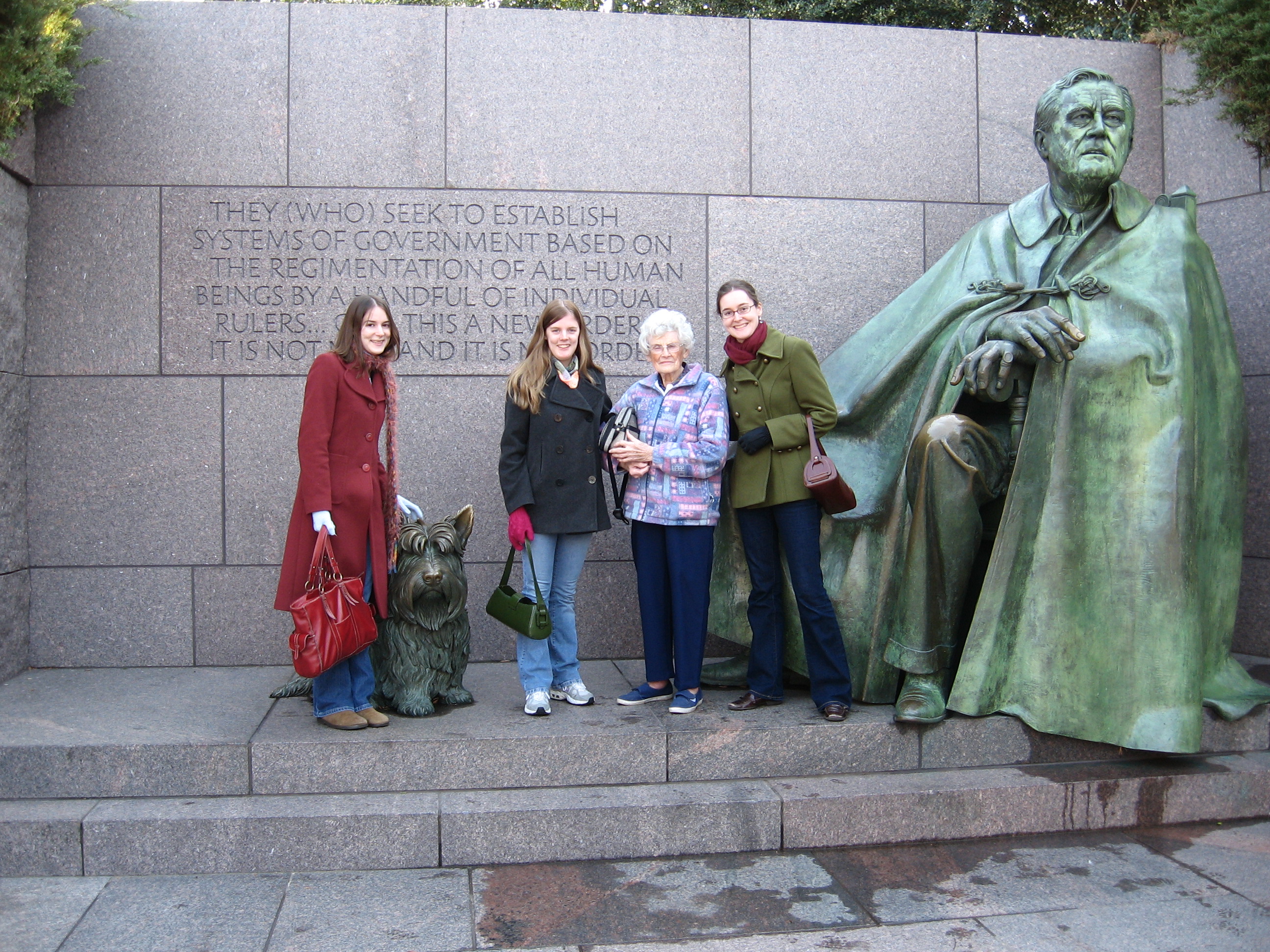
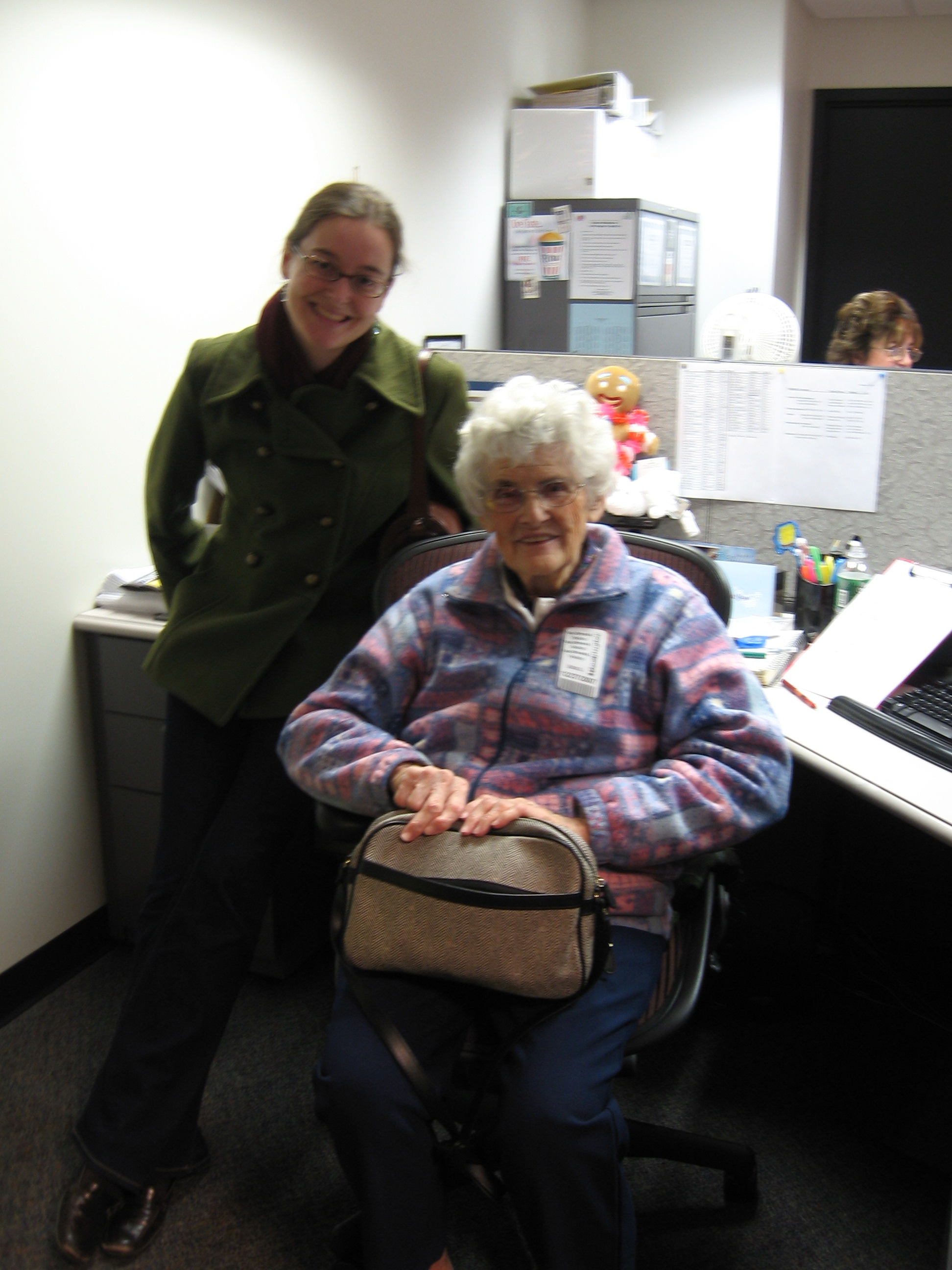
My daughters Tanya, Doreen, and Michelle, with my mother, Bertha at the Franklin D. Roosevelt memorial in Washington D.C., 2007, after touring the Washington Post offices with Michelle (shown below left at her desk).
***
The Roosevelt quote behind my daughters and mothers says: “They (who) seek to establish systems of government based on the regimentation of all human beings by a handful of individual rulers. . . call this a new order. It is not new and it is not order.”
***
I’d love to hear any further reflections you have on Kay Graham’s life, Roosevelt’s quote, or my conclusion that sometimes “small acts of faithfulness, prayer, and laboring for better lives are the glue which can keep us going.”

 findingharmonyblog