

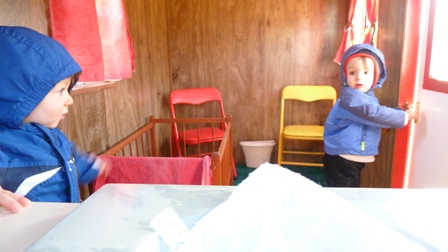
The little backyard playhouse had to be happy.
It was once again enjoying the pitter patter of little feet.
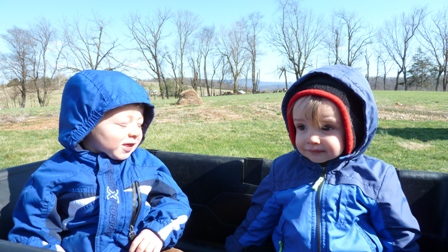
Little guys Sam and James finally are old enough, and walk well enough, to go out and visit the little white and red playhouse that their great grandfather first made, and their grandfather, grandmother and one of the mothers helped restore.

The project had waited for years; it was sorely in need of a new roof, new siding and trim, and once they got into it, a few replacement rafters. Yet it is easy to put off such a project, especially when no grandchildren seemed imminent. But in the fall of 2012, Michelle suggested she take a week of vacation—she had more vacay time to use up than her husband, Brian, and come for a week and launch the grand playhouse restoration.
It would take us almost a year to complete, including moving the project indoors to the garage so work could continue through the winter. You can read the back story here, including the joyful discovery they made once they got into the inside paneling of the playhouse. We were also grateful for Uncle Brett who added some muscle as we carefully moved the finished, refurbished playhouse back outside.
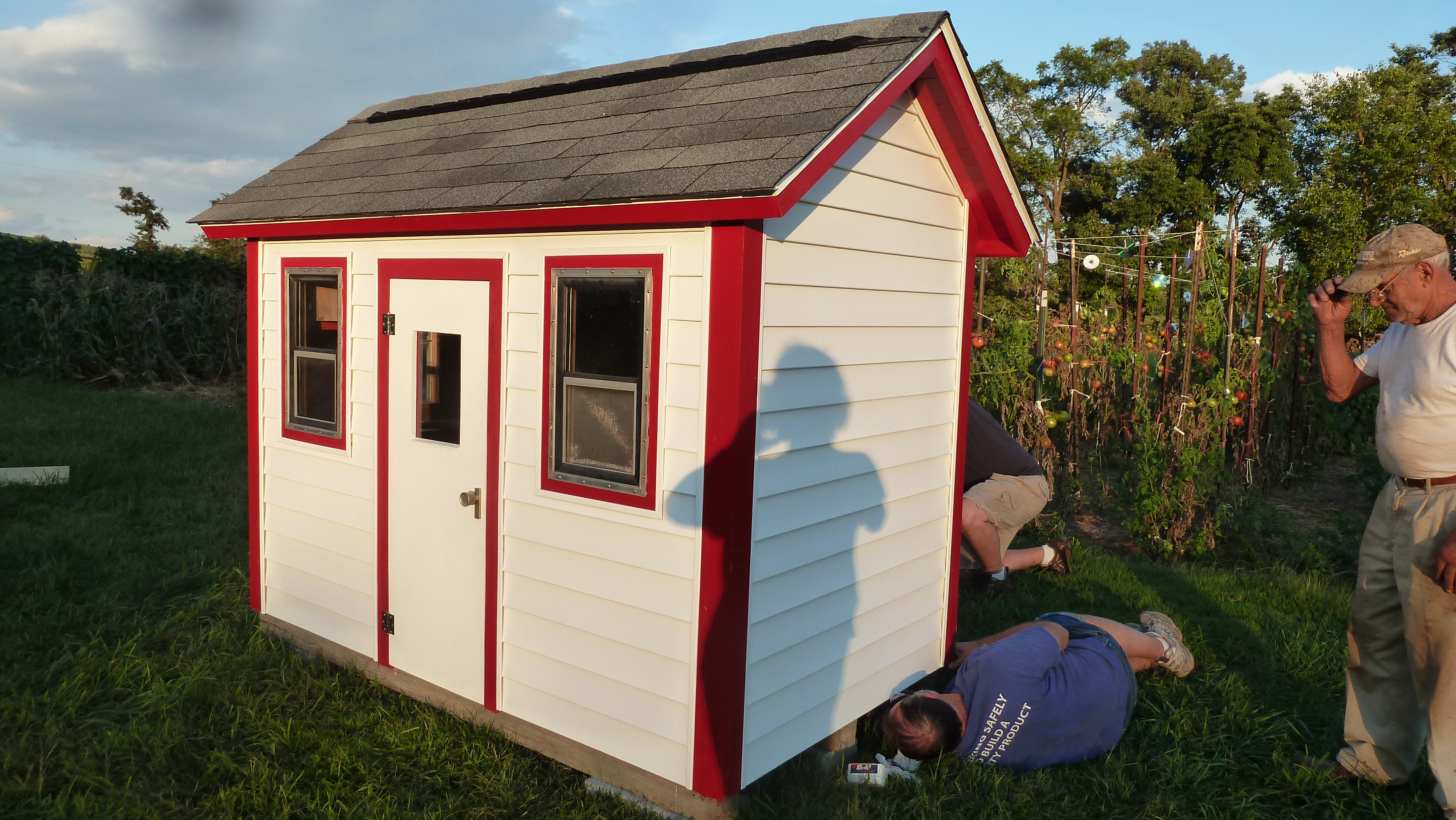 Uncle Brett on the ground helping set up the restore playhouse,
with neighbor Harold (tipping hat) after moving the playhouse with his tractor.
But that’s history. Sam and James won’t understand all that for some time. I had observed how much fun both Sam and James had removing pots and pans from the cupboards in their own home kitchens.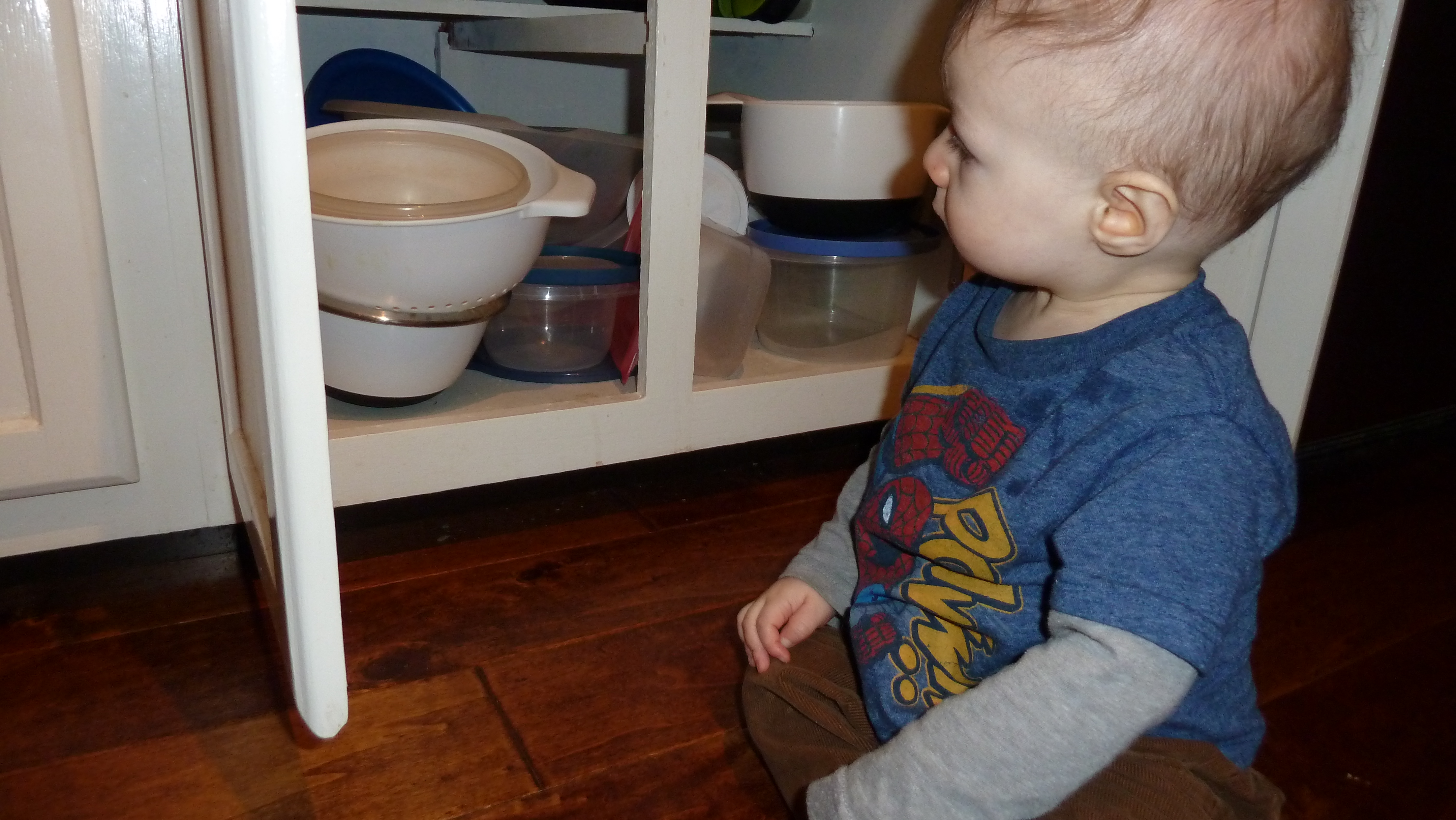
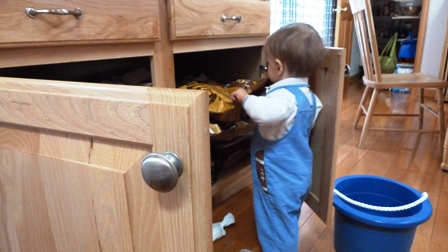
I knew they were ready to enjoy the pint-sized cupboards and the old plastic dishes their mothers and aunt played with.
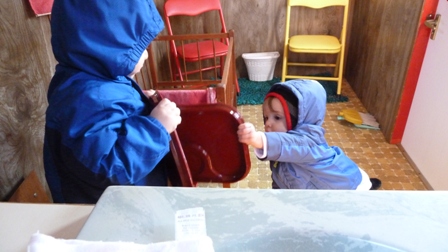
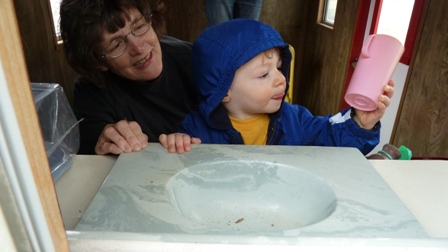
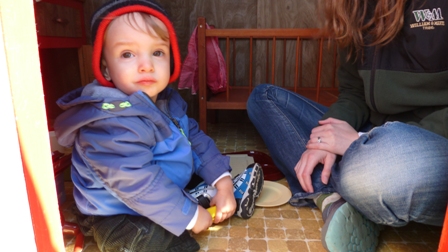
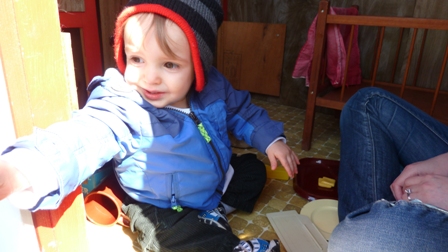
Never mind boys maybe aren’t supposed to play “house.” In time, we fully expect the playhouse to become a hideout, a fort, a sleepover place, an anything-they-want-it-to-be hangout. And if they end up “serving take out” through the drive up window like their mothers and aunt, so be it. That’s how we’ll roll.
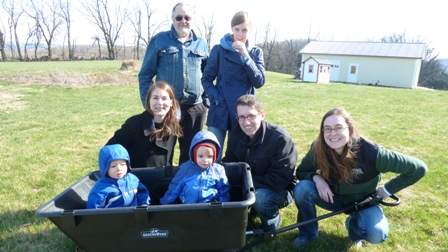 Easter weekend, 2015, with Sam and James in wagon, James’s mother Michelle; 2nd row: Sam’s mother Tanya and Michelle’s husband Brian; back row: Stuart and daughter Doreen. Sam’s dad Jon had to work that weekend. Playhouse in background.
They, and other cousins who we hope may eventually join them, can use it and their imaginations to create their own worlds. Perhaps a space station. An underwater sea lab. A no-girls-allowed club?
How happy their great grandfather would be, to know the little playhouse is ready for a new generation. I know I’m very happy to have it ready for little ones again!
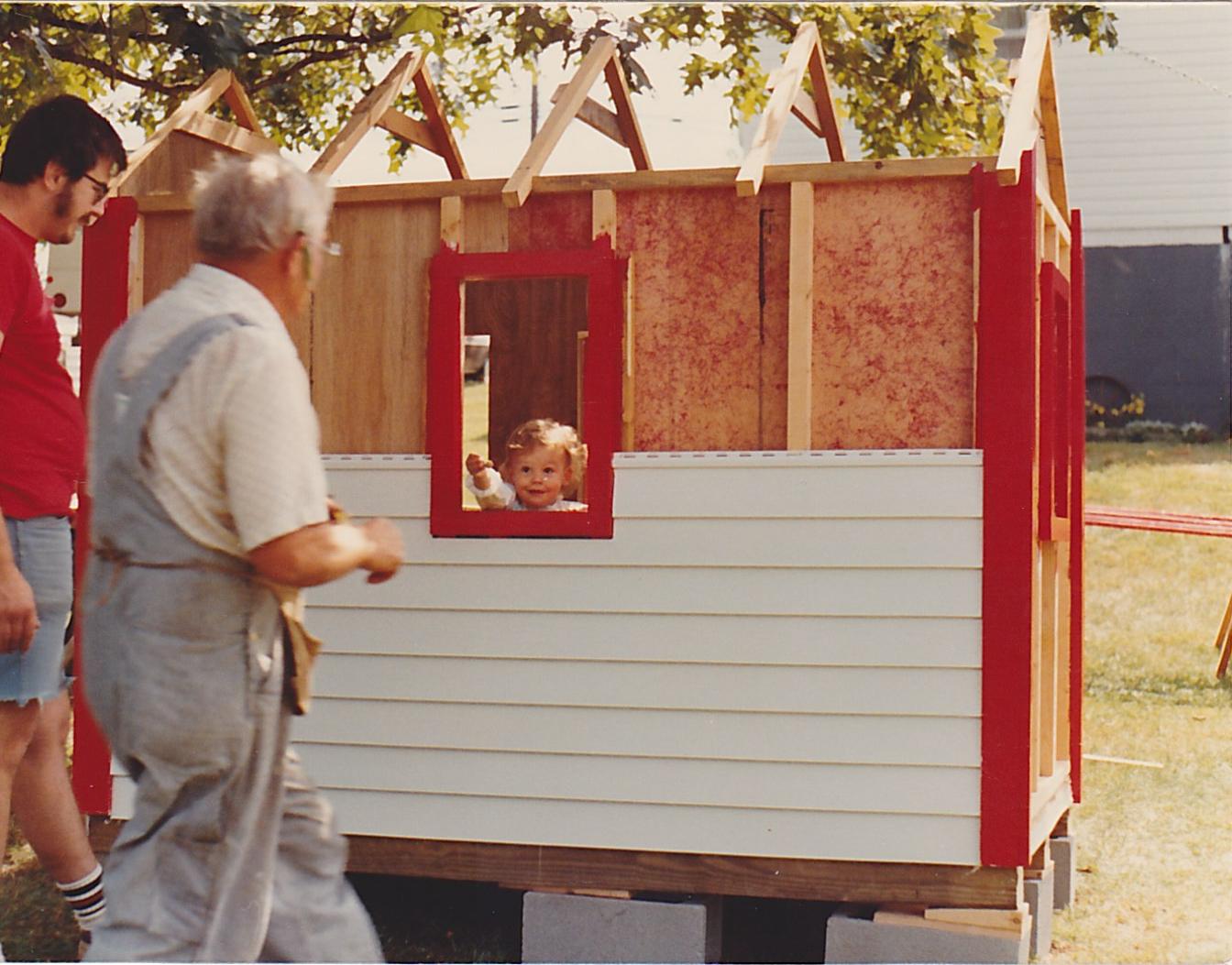
Stuart, Dad, and 18-month-old Michelle building the playhouse in 1982.
Pitter patter. The march of generations goes on.
***
Does play across traditional gender roles get your affirmation? What have you observed in your children or grandchildren?
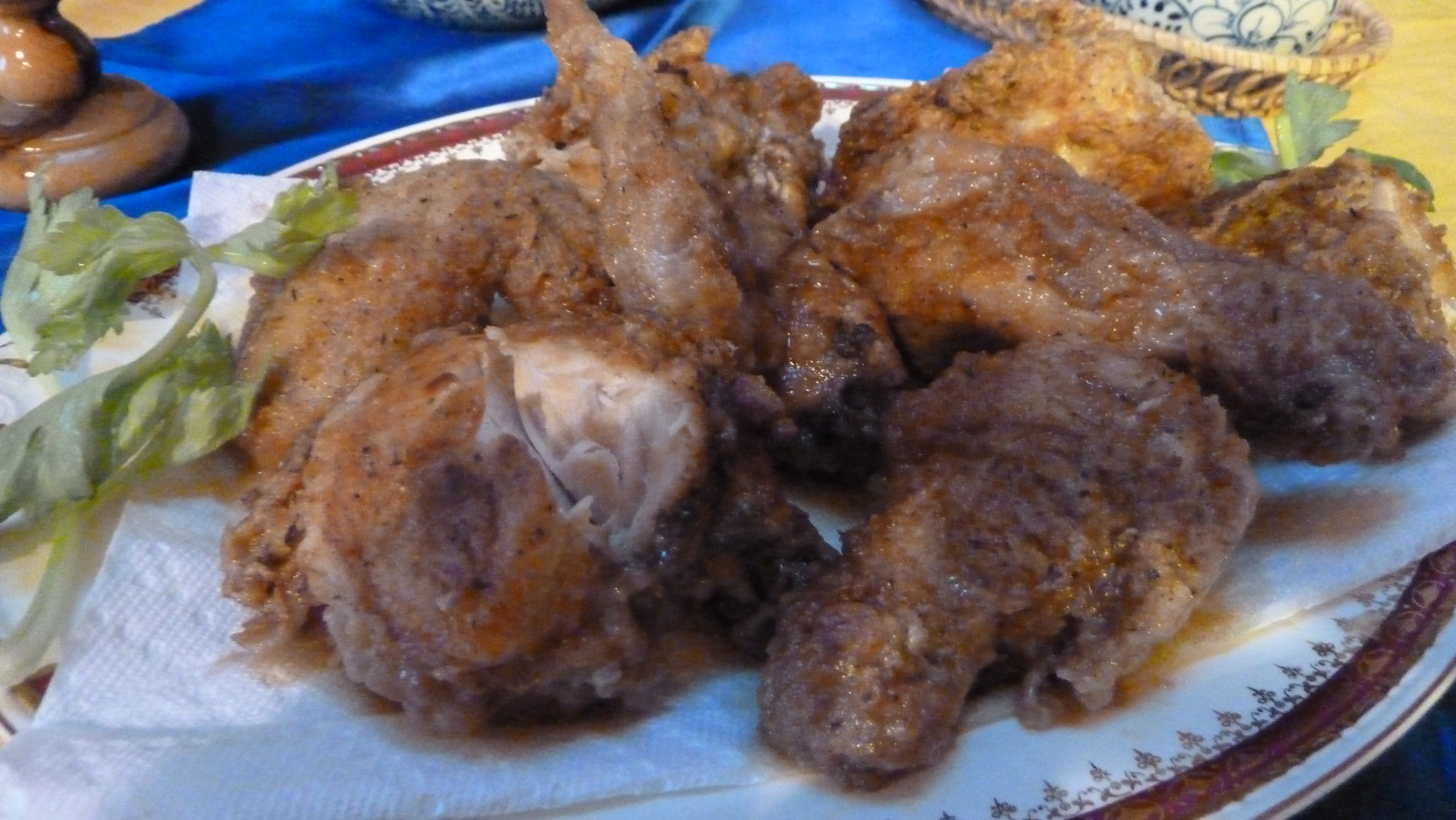
When as a Yankee I married a Virginian, one of my first cooking lessons was learning to fry chicken. My husband’s brothers and my new sister-in-law were all great southern fried chicken fixers. Unfortunately, my husband himself never really learned. With two big brothers who could cook who took over the kitchen, why learn yourself, right?
The brothers did so well in the kitchen because their dear mother, Estella, who I never had the pleasure of even meeting, died in her late 50s of complications from crippling rheumatoid arthritis (and this was before modern treatments for RA). She, by all accounts, was an awesome cook and lovely woman. I wish I could have known her.
At any rate, I knew before I said “I do,” I would have to learn to fry good chicken. It was something they had almost every Sunday for dinner. So I mostly learned by watching my brother-in-law and sister-in-law, and pumping them for hints.
They said to use a coating of flour, poultry seasoning, salt, pepper, and paprika and a little baking powder. Roll the chicken pieces in milk, dip in the coating mixture (or throw the mixture in a bag and shake until coated). They used cast iron skillets; my early attempts at seasoning a cast iron skillet and keeping it that way didn’t work out so well but maybe it’s time I try again.
So currently I cook mine in a stainless steel large skillet with a lid, in about a half inch of melted shortening. For many years while the children were home, I made fried chicken for most Sunday dinners since that was traditional at Stuart’s house. We’d have chicken, mashed potatoes, green beans, and sometimes cole slaw. Until we got home from church and I got all that cooked, it was often at least 1:30 until we ate. Now, I can’t believe I did that so often.
There are many other ways we like chicken; among them: barbecued, breast meat or tenders sautéed lightly in olive oil, baked in a coating of Italian dressing, cheesy chicken which I talked about here. But my husband feels the bones and juices of a cut up chicken add so much flavor to the finished product that if I want to treat him, I put on my best Paula Deen accent, my apron, and fry away.
I ran across this knock off recipe for KFC Chicken and thought it was worth a try. It was! A bit of work, but for a special dinner, it was fun to see how close it came to that traditional fastfood favorite. (But as cheap as rotisserie chicken is these days, usually a raw chicken from the meat aisle costs more than a fully cooked hen, rotisserie style. A way to get people in stores, of course, where we pick up other items.)
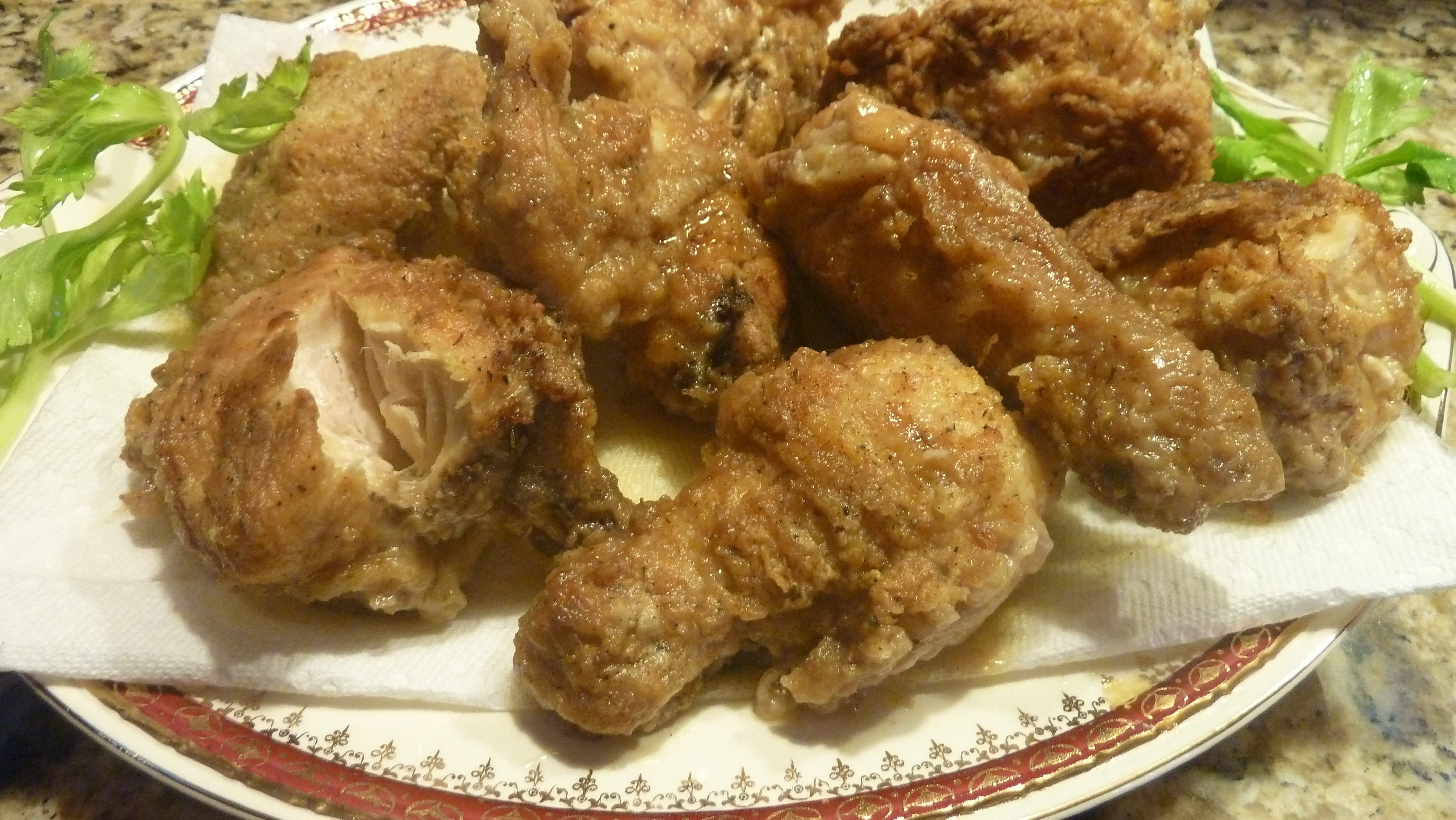
So, you can try the Davis method described above for a shortened recipe for the coating, or this:
KFC Chicken
1 chicken cut up
3 beaten eggs
4 Tablespoons oil – or more
Coating
2 cups flour
4 tsp. paprika
2 ½ tsp. salt
1 tsp. pepper
1 tsp. poultry seasoning
1 tsp. thyme
1 tsp. oregano
1 tsp. tarragon
½ tsp. garlic salt
½ tsp. onion salt
½ tsp. celery salt*
Place flour and spices in a clean plastic or paper bag. Begin heating oil. Coat chicken with beaten eggs, then put pieces in bag with flour mix, one at a time. When oil is hot carefully put chicken pieces in fry pan. Brown slowly on medium heat on one side, uncovered. After about 15 minutes or when pieces or nicely browned, turn pieces over. Cover skillet and keep cooking on gentle/low heat another 30 minutes or more if the chicken was very large. Remove lid for last 5-7 minutes to make crispier chicken. Drain on plate covered with paper towel. Serves 4-6.
*Yes, that’s a lot of salt, all together. You can omit any of the last six spices without noticeable difference in the outcome.
***
Was there any traditional food your spouse loved that you learned to like or make?
What traditions did you have for Sunday dinner?
***
There are numerous places to find knock off KFC recipes online and they vary a great deal! Here are some I found and would like to experiment with; cooking methods vary from deep fat fryer to pressure cookers to cast iron skillet.
http://www.food.com/recipe/kfc-original-recipe-chicken-copycat-393795
http://homecooking.about.com/od/chickenrecipes/r/blchicken46.htm
There’s been another male sharing my bed for the last eight years.
I first fell in love with him when my daughter sent a somewhat desperate email in 2008 with his picture. He had beautiful blue eyes and a mane of soft luxurious hair. He was so so so cute!

OK so I need to stop with the Buzzfeed type gotcha lead-in sentences; yes, Riley was a cat. And now he’s dearly departed. And I miss the old guy like, well, like a sweet buddy who has devotedly followed you around for eight years.
A friend of my daughter’s roommate was seeking a new home for her eight-year-old cat, Riley. She was facing that frequent dilemma: my boyfriend or my cat? The boyfriend apparently won out; she said it tore her heart in two, but she needed to find a loving home for Riley.

My daughter brought him home to us for a weekend visit, to see if he adjusted to us and we to him. He was Himalayan and the most gorgeous cat (in my eyes) we ever owned: beautiful white coat of long fur and azure eyes. After cowering a few hours behind my washing machine in the utility room, he came out and eventually made up to us.
He was sociable, debonair, devoted, and dignified. He amused our visiting female family members by sitting on, playing in, and sniffing their intimate clothing if they happened to leave items laying on a floor or bed somewhere.

His previous owner, or someone, had had his claws removed, which meant he was an indoor cat. Or should have been, but the call of the wild “I wanna go out”* was strong. Guardedly, we allowed him walkabouts since we live in the country. He would step gingerly on the grass as if luxuriating in the thick carpet. We watched him closely, for fear neighbor dogs or dipping hawks would spy the slow and juicy target, since he had no claws to defend himself.
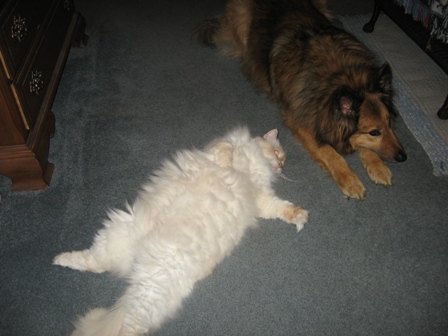
But basically he was a pampered indoor cat who nobly tolerated our dogs, first Fable and more recently, the new kid on the block, Velvet. We owned another stray when Riley moved in with us, by name of Pixie. Pixie developed an open sore which would not heal, likely cancer, and had to be put down a year or two later. Eventually my youngest daughter, living at home a few years post college, pleaded to adopt newborn Paisley, a farm cat whose mother died and needed not only a home, but early syringe feedings. The two cats were a picture; I took lots.


So Riley ruled our animal world with his gentle ways. As he grew older, his soft fur grew more matted. We had to have him shaved at the beginning of most summers. They say a cat’s tongue loses some of its natural roughness which enables them to comb out tangles.

Sharing a water bowl with new dog, Velvet.
In the last two years he also began having thyroid problems causing him to urinate frequently; we consulted a vet, who wanted to put him on medication and a special diet. As a Himalayan, he was subject to hairballs and frequent vomiting anyway, all his life. I’d love to have the money back I spent on paper towels. But we were reluctant to invest heavily in medical care for an aging cat. I did not wish to manage keeping our two cats apart while eating, especially through the day when we were both gone.
About two weeks ago he could no longer jump up onto the bathroom counter to get a drink, which he adored. His barely ate. I sensed his time was ending.

Our family came home for Easter and grandson Sam discovered the joys of Riley, even though Riley was less sure about his new little friend.
The Sunday after Easter, Riley enjoyed what turned out to be one final walkabout.He pushed his way out the patio door onto our gated deck, where I thought he could safely take in the fine spring day. But then he slithered through the rails of the deck and jumped to the ground, even though our dog was right below, playing with neighbor dog, “Blue.” Velvet and Blue just kind of stood back and followed the old guy as he took his lingering walk to the newly tilled garden.

He headed back of our shed, and I think he might have just kept on walking through the pasture, maybe down to our woods to pass away quietly, I don’t know. But we intervened of course, brought him back inside. We worried through Monday night. Tuesday morning I could see his breathing was very shallow. I covered him with a towel. He did not seem to be in great pain. Should we put him down, shorten his suffering? I decided to go home over lunch on Tuesday and resolved to call the vet if he was still struggling. I had a busy day (and week) but thought I could squeeze in a humanitarian visit to the vet. But Riley saved us and himself a final, possibly painful move and trip. He was at peace. We buried him on a knoll overlooking our land, near the dog, Fable.

Can you find all three pets in this picture?
This past Saturday morning doing my routine cleaning, I found a small clump of his hair near a wastebasket in the bathroom. It was a piece I’d trimmed out earlier. Oh. Such soft fur. Such a sweet cat. He will live on in pictures, memories, and stories. 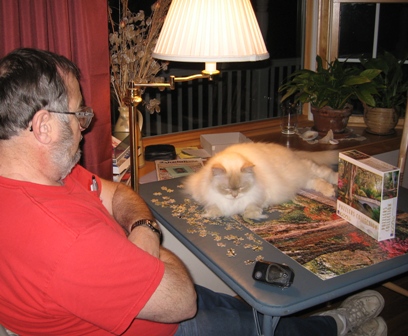 As is always the case when we lose a loved one, I had flashbacks of “oh he should be sitting there in his chair.” No Riley hopping up onto the bar stool beside me as we eat. No begging for that morsel of buttered toast he’d come to love. No climbing up beside me and plopping himself in front of my computer monitor, to my annoyance.
  I’d coax him to the side, tell him to sit over there, and I tapped the desk impatiently to show him where. Some of these things I’ll miss. Some of them I am happy to have over. Pets are a good reminder of the care needs we all have as we age.
The truth is, I was not that much of a cat person. Riley charmed his way into my heart with his big blue eyes. I would have to count him as the first cat I called “mine.” Oh, as a Mom, I may have been chief cat caretaker but seldom really took time to do more than feed, water, clean litter boxes, take them for shots, and perfunctorily pet them now and then.

Riley was one of God’s creatures who needed love and care: we gave him both. He gave back his own devotion and affection. I will always remember his eight year sojourn in our home.
RIP Sir Riley Davis — 2000-2015; shown here with Fable, our dog from 2001 – 2013. I wrote about Fable’s passing here. We buried them near the same spot.
***
Have you ever had a pet who you came to love unexpectedly? How? I’d love to hear.
***
My thanks to Pert Shetler and Kathy Duford at Waterway Animal Hospital for all of their informal pet advice.
***
The Garrison Keillor Cat Song can be found here:
Harrisonburg’s Green Hummingbird Fair Trade Clothing Store
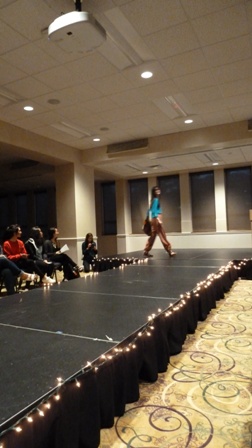
There I was sitting in the first row beside a fashion model’s runway. We’ve all seen the runways on TV or magazines—sparkly lights, photographer flashes going off, models strutting with exaggerated sways down the “catwalk.” What was I doing there?
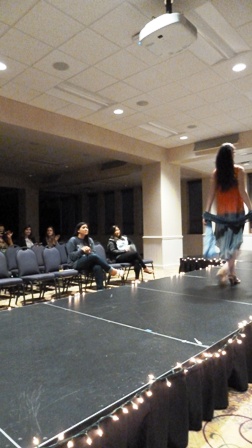
Emily Estep, model, junior at JMU.
It wasn’t a New York or Paris runway of course but a humble Harrisonburg set up in the Madison Ballroom over at James Madison University, organized by JMU communication students. For a “senior project” they were trying out their skills in a practical, real job type environment, putting on a fashion show: promotion, media contacts, programs, music, models, door prizes, speeches or narration, refreshments.
But the real reason I came was in support of a friend from our church, Eleanor Held, whose own store’s fashions at Green Hummingbird were featured in the fashion show.

Eleanor, owner
This isn’t just any clothing store—but a “fair trade” boutique she opened late last summer, stemming from her faith and beliefs in trying to trying to help others.
Eleanor’s Green Hummingbird is set on the south edge of a revitalizing business area of Harrisonburg, a stone’s throw from Harrisonburg’s bustling Farmer’s Market. It’s the first store students come to on a longish walk downtown from campus. Students headed to the ever-popular Klines Dairy Bar see the store, as well as those angling toward the longtime novelty store, Glen’s Fair Price, or hankering for the renowned hotdog dive, Jess’ Lunch.

Ann Held talks with fashion show attendees.
Eleanor is hoping students with disposable income (a sizeable chunk of the JMU crowd) will be the bread and butter for her store—and the rice, beans, and medical care for thousands of families around the world. She envisions the clothing she sells offering children the opportunity to continue their education instead of toiling in dangerous, unhealthy and exploitative conditions. (Think about the “play” kids miss when tied to a carpet loom all day.) The beautifully embroidered or hand sewn purses, scarves, dresses, tops, jackets, sweaters and more (including handmade jewelry) is only part of the “feel good hum” you leave with when you buy something from “The Humm” as Eleanor abbreviates her store’s name.

Two of the fashion show models checking out merchandise after the show.
Fair trade, of course, works to create opportunities for artisans and farmers all over the world but especially those in countries where long time poverty limits access to “long term, well-paying jobs,” according to the Fair Trade Federation’s operating statements. They have a long and admirable list of guidelines and as Eleanor addressed the 40 some students (mostly female) at the Thursday night show, she spoke of having connections through suppliers who work directly with the artisans whose products she carries. One of the things that fair trade fights is sweat shop conditions, and as Eleanor succinctly put the concept, “Think of fair trade as the opposite of sweatshops.”

Models pose at end of show.
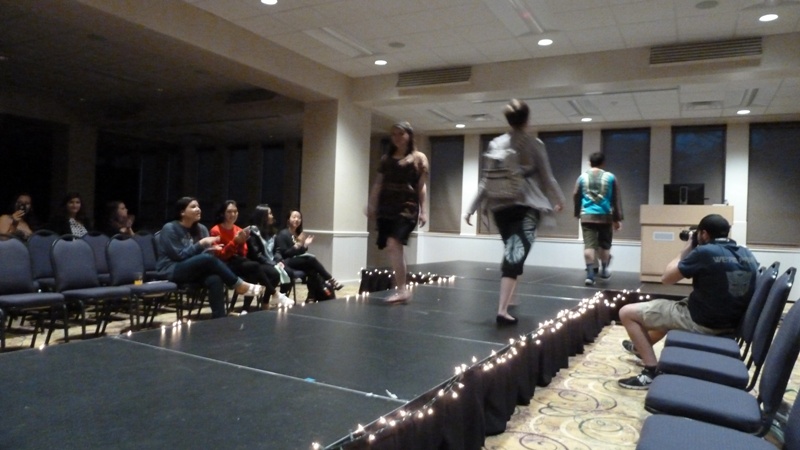
As the models (including one guy) strode the runway (they walked so fast my camera wasn’t set well to capture it!) in eye-pleasing summer fashions including colorful gaucho or “harem” type pants made out of recycled Indian saris, thoughts of sweatshops and ethical fair trade might seem far out of the minds of the college kids mostly thinking about acquiring cute clothes for the next party.
 But I’m guessing the student attendees and those who put on the show couldn’t help but be impressed by Eleanor’s story of how just nine years ago as she herself was graduating from college, running or owning a small store was furthest from her mind. “Not for me,” she put it.

Model Melanie Robinson
Eleanor didn’t go into these details but I know a little of her history as she pondered what she would do with her ideals, interests and passions. She spent a year working as an intern for a church and eventually got a master’s in religion and society among other things. For this audience Eleanor zeroed in on the time she spent at Stony Point Conference Center near New York City, where she was able to help manage a fair trade store gift shop for conferees and the local community. The idea of running a similar shop began to grow in her mind, but focused on clothing, to give customers the chance to see, touch, and try on the actual clothing. Our town has its share of fair trade stores but none focused on clothing.
At an intermission between the show’s “First Walk” and “Second Walk,” Eleanor shared the story of why she named her store “Green Hummingbird,” certainly an offbeat name fitting the somewhat unusual clothing.

The name comes from a folk story from Africa as told by Nobel Peace Prize winner Wangari Maathi. In the middle of the forest, one day the forest caught fire. As all the animals stood by, horrified that their homes were slowly burning to the ground, a little hummingbird started flying to a nearby stream. She scooped drops of water into her beak, and flew back and forth from the stream to the fire, squirting out drops in an effort to put out the flames. The other animals chided her. “What are you doing?” they asked. “What good can you possibly do? You are just a tiny hummingbird. What can one bird do?”
The green hummingbird simply responded, “I am doing the best that I can.”
 We can all do the best we can as the little hummingbird did by supporting and patronizing fair trade stores and products whenever possible, especially in buying gifts: a gift that gives at least three ways: to the artisan and the family, to the local store owner including young and unlikely entrepreneurs like Eleanor, and the loved one with whom we share a gift.
While some fair trade stores tend to be expensive in order to make sure the workers get a fair price, Eleanor keeps her prices—and her cut—on the lower side. She’s not in this to get rich.

Check out her store, visit her website and like her Facebook page for Green Hummingbird. That’s something anyone can do!
***
A current slogan promoting JMU is “Be the Change.” Fit’s Eleanor’s store quite well, I’d say. JMU’s student newspaper, The Breeze, also featured the fashion show, here.
***
 What’s a Fair Trade store near you? What are your favorite things there? The tea and mug set I often feature in my recipe photography is a tea set from our local Artisans’ Hope store, given to me for serving as chair of Anabaptist Communicators for a two-year term. I love the tea set and think often of the hands in Vietnam who formed and painted it! Harrisonburg is also blessed with a Ten Thousand Villages fair trade store just up the street from Eleanor’s Green Hummingbird.
***
Memo to me: If you ever cover a fashion show again, set your simple camera to sports action!
***
For more background on Eleanor and why she got interested in Fair Trade, visit my weekly newspaper column on this topic, Another Way.
At Least 60 Things I’ve Known
So you’re a 60 something person struggling with technology or to bring a friend’s name to the brain or finding yourself calling your dog or cat by a prior dog or cat’s name—for the third time in one day.
So what. So you forget a few things.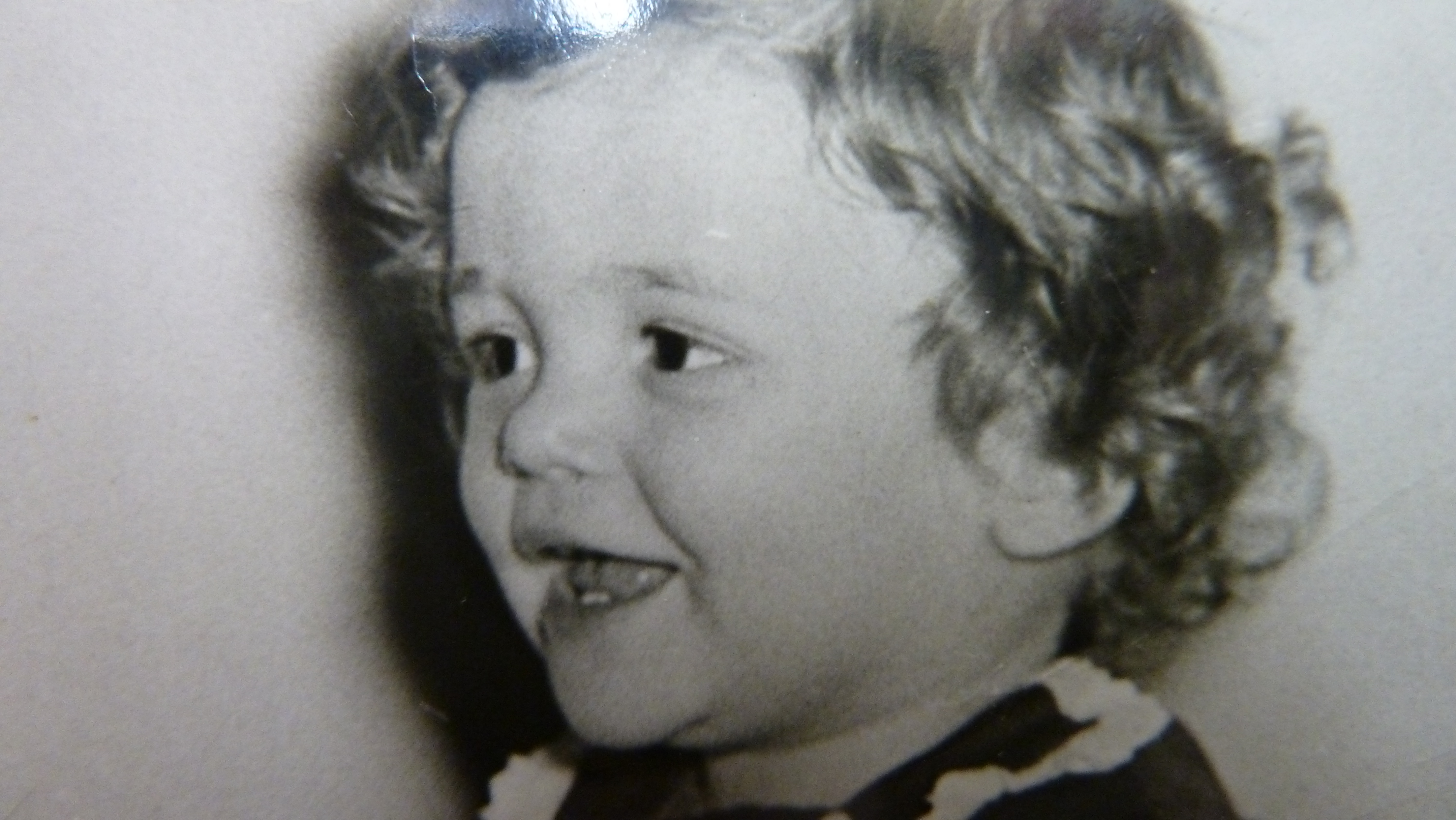
These are the things that I have crammed into my brain from since approximately the age of two.
- Which shoe goes on which foot, and in general, right from left.
- How to get peas on a spoon.
- Your childhood telephone number, which in my case was 838-J. Yes, I go back that far.
- How and when to say please and thank you.
- How to count to 100 and onward.
- How to count backwards from 100.
- My ABC’s and eventually, in Spanish.
- The multiplication tables.
- How to do long division.
- The notes and names of the musical scale.
- My social security number.
- The zip codes for all the places I’ve ever lived, plus for some of my relatives.
- How to conjugate Spanish verbs, including the irregular ones.
- My husband’s social security number.
- My daughters’ social security numbers, which I knew for many years but thankfully don’t have to keep up with any longer.
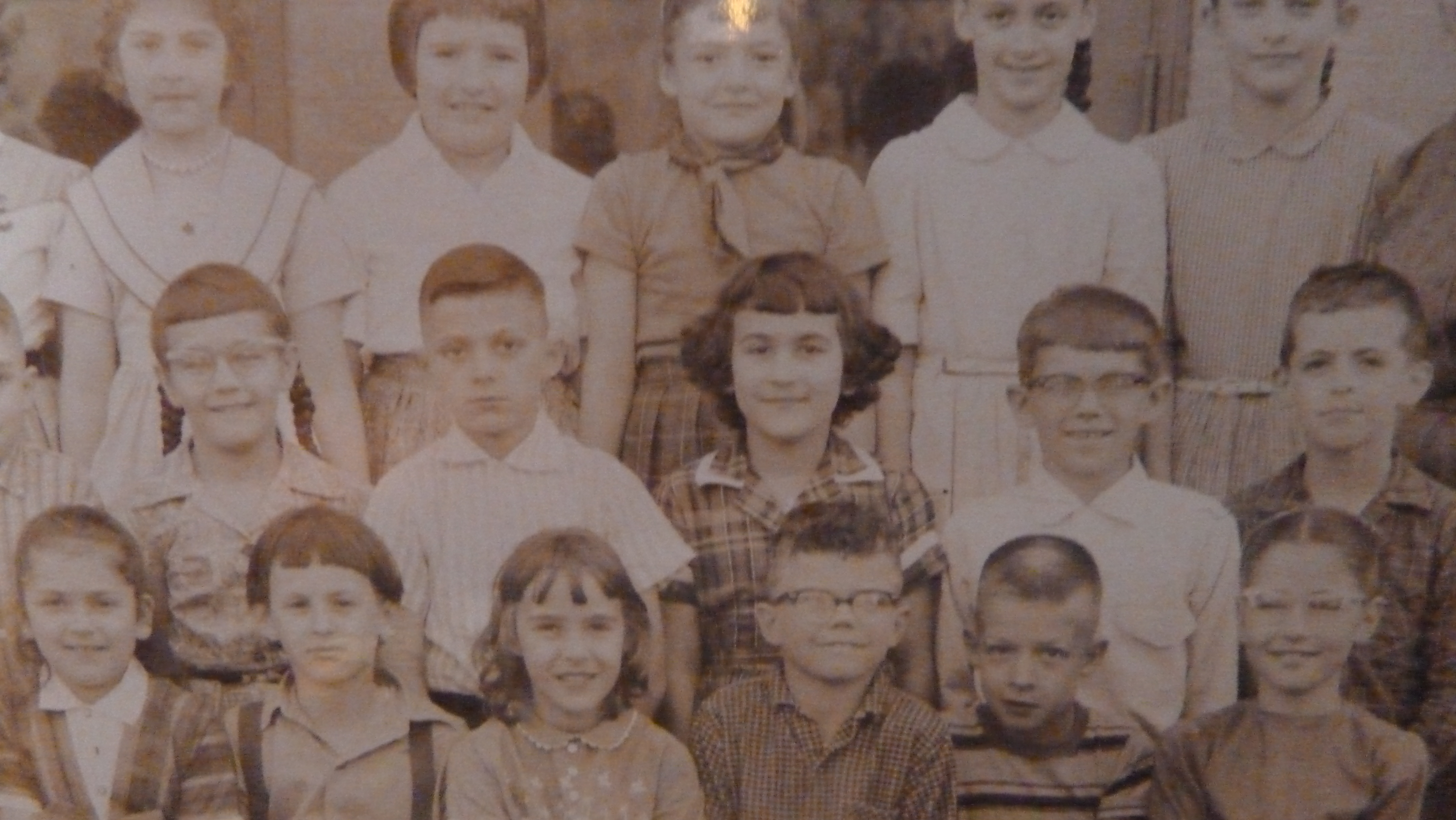
- The names of everyone in my fourth grade class, most of which I can still remember.
- The names of the five Great Lakes in or bordering the U.S.
- The names of everyone in my freshman class in high school, of which I forget a few.
- The names of everyone living on my freshman hall in college, whose names I mostly now forget.
- The cell phone numbers of all my immediate family. The phone numbers of my mother, my husband’s brothers, and my one sister. The others have changed their numbers too often for me to remember.
- Passwords on my work computer.
- How to use Word Perfect, Excel spreadsheets (kind of), Microsoft Word, WordPress, Facebook, Twitter, Pinterest (kind of), Instagram (hardly there yet).
- The names of every pastor I’ve ever had, and most of the people in the churches where I’ve been a member.
- My most recent pastor’s address and phone number.
- The names of my husband’s friends, my children’s friends, their spouses, their in-laws.
- The names of my doctors, (and know the phone numbers for some).
- How many surgeries I’ve had and the approximate dates of hospitalization, plus those of my children.
- How many states I’ve been to.
- The names of the countries I’ve visited.
- The names of all my nieces and nephews, great nieces and nephews, steps and if pushed, the great steps and more.
- The makes of all the vehicles my husband and I have owned.
- Countless novels, poems, characters, and writers from my studies as an English major in college. Ok, I crammed them in my brain once, I didn’t say they are still there.
- The names of all the presidents of the United States. Oh, wait, I never learned them, but my children all have it down, compliments of the old Animaniac song “George Washington was first you see, he once chopped down a cherry tree…” (to the tune of the William Tell Overture). Why couldn’t that song been around when I was young enough to have learned it!
- 300 Bible verses memorized for Bible Memory Camp, a program which was around when I was young enough to learn them.
- Most of the abbreviations on the periodic table of elements. (Of course now there’s a song for that too.)
- Nursery rhymes.
- Songs learned in my childhood from dime store 45 rpm records Mom brought us every week when she bribed us to stay home with Grandpa and Grandma at our house so she could sneak off to town by herself. Now I understand the bribe.
- How to play piano. Somewhat.
- The names of most instruments in a typical orchestra or symphony.
- What I planted in the garden last year (ok, that is only with the help of a gardening journal).
 Names of dozens of flowers, trees and shrubs. Not nearly as much as some people know, but, some.
- How to fold contour sheets so they look neat in a cupboard.
- SAT verbal analogy questions like: crumb is to bread as splinter is to wood.
- The yearly deadline for FAFSA student aid (and if you don’t think that’s important or easy to overlook, you haven’t put three kids through college).
- How to pant properly through a contraction.
- How to do a down-dog, plank, lunge or child’s pose.
- How to write a book.
- How to write a script for a TV documentary.
- How to produce a radio program.
- How to edit a magazine.
- How to write a news article, a feature, a tweet.
- How to make change.
- How to pump up a resume without lying.
- Names of all my aunts and uncles on both sides and at least the first cousins.
- Names of all my spouses’ aunts and uncles on both sides and at least the first cousins.
Photo by the late Polly Fryecousins.
- Birthdays.
- How to sew a dress, skirt, blouse, jacket, slacks.
- How to raise bread—without stopping to read all the directions.
- The words and tunes for many many beloved hymns.
- Finally, I’ve learned that you no longer need to really memorize most of this stuff when you have a smart phone and Google at your fingertips.
I hope my list brought to mind many of the great and silly and important things we cram into our brains over the years. And we can’t purchase and install a bigger memory card.
It is no wonder we can’t remember them all, or I forget my boss’s wife’s name when trying to introduce her to someone!
What have I forgotten to put on this list?
What comes to mind for your list?
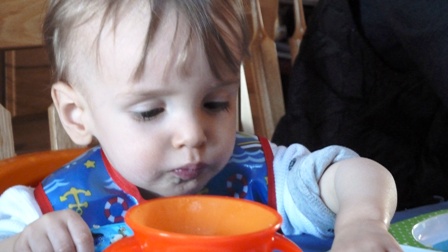
James spouted six teeth very early!
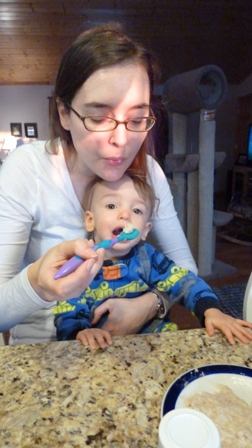
My little boys like to eat. What a treasure it is to sit down for 40-45 minutes and watch them slowly, very slowly, devour a plateful of grown up delicious food. I imagine sometime in the future, they’ll still devour platefuls of food, but not take 45 minutes. And okay, they’re technically my grandsons. (And for the record, Sam and his mom stayed with us this trip, and James and parents stayed with his other Grandma.)
Some of their dinner is shredded, for tiny teeth; the 16-month-old has 6 teeth, the 18 month only has 1, although the 2nd tooth is budding! (Can you see it below?)

Sam’s still working on his teeth–we’re so happy he finally got his first one!
On Easter Sunday, we returned to our home after two big Easter dinners on the weekend, one Saturday evening, the other Sunday noon.
But I knew “grab it and growl night,” our normal Sunday evening tradition (everyone finds/makes what they want), wasn’t going to work for the toddler. His family’s custom, after all, is having their big meal of the day on Sunday evening—not a practice I grew up with, nor did I raise my girls that way. For us it was popcorn, sandwiches (maybe), ice cream or apples. Mom’s night off, mostly, other than making popcorn. The kids, after they got to be a certain age, always seemed to enjoy having a night where they didn’t have to sit down and eat the food that was set before them!
But this night my daughter and I pondered what I had on hand that would be:
- Healthy
- Fast
- Something Sam could eat (no popcorn for him of course)
- Something Sam would like
My daughter recalled, “You said you had more kidney beans, he really likes those.”
“Oh, and I have half a quart of canned tomatoes in the fridge left over from making chili that I’d love to get rid of,” I brainstormed. “That would flavor them and add some Vitamin C.”
So that was the plan and it turned out to be a great little dish for Sam. I seasoned the beans with just a little garlic powder, onion salt, and pepper, because I knew he enjoyed/tolerated those flavors. We served him about a cupful of the dish, not wanting to overdo the beans, because, you know …
But. I. Did. Not. Get. Pictures. (Of the dish, that is.)

Sam.
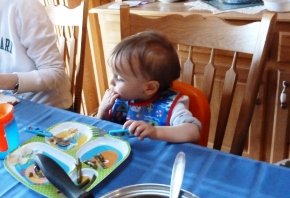
James.
Oh well, everyone knows what kidney beans look like and you’d probably rather see pictures of darling grandsons. If there are fans in your family of either pintos or the larger red beans, this might work for a very quick meatless but decently nutritious main dish with ingredients you probably have in your cupboard. Top it off with some quality bread (could make it into a toasted cheese sandwich), fruit and any veggie you like. Score!
Little Boy Beans
1 15 ounce can red kidney beans
1 15-16 ounce can (or two cups) chopped or stewed tomatoes
A pinch of garlic powder, onion salt, pepper—or to your own taste.
Stir together in medium saucepan. Bring to boil, stirring frequently; lower heat and cook for ten to 15 minutes or as you wish. After 10 minutes the tomatoes had broken down a little and the mixture was sufficiently seasoned.
Even a drive through takes ten minutes sometimes.
Of course, if you have time and don’t have a starving little boy on your hands, you can doctor these beans further with even stronger flavors, any way you like, with real minced garlic, chopped onions, green peppers or hot peppers.
***
In my book, Whatever Happened to Dinner, I talk about the various traditions of families for Sunday evening (or other meals). What is/was your family tradition for Sunday or Saturday night? Anything special? I’d love to hear!
Steve Carpenter’s book, Mennonites and Media: Mentioned in It, Maligned by It, and Makers of It (published through Wipf and Stock, 2014) is based on Steve’s recent thesis towards a Master’s of Arts in Religion from Eastern Mennonite Seminary.
As a writer and editor, when a friend or colleague writes a book, do you review it? How can you be fair, objective, and also supportive?
When that book is about a field you have worked in all of your life, how can you be detached, unbiased and dispassionate?
I’ve known Steve through his work for probably about 15 years. He worked for Virginia Mennonite Conference in development and as conference coordinator, and currently works in a development capacity for MennoMedia. (Also my main employer.) He wrote media reviews for Third Way website for many years under our “Media Matters” column which I edited. Steve is a fine, dedicated writer whose love of and fascination with film helped him produce excellent film reviews for Third Way with a knowledgeable and critical eye. He also did film reviews for the Shaping Families radio program I helped produce for three years. A true film buff who loves nothing more than getting a lively conversation going around the latest flick, his thesis and book marries his dedication to the denomination he discovered as an adult, with his love for films, books and media, topped off with an ample serving of Anabaptist/Mennonite history.
 Steve Carpenter, Director of Development
and Church Relations
Steve comes to Mennonite/Anabaptist history and media with a fresh perspective as a first generation Mennonite who graduated from the U.S. Coast Guard Academy, where he served as an officer in the Coast Guard. How many Mennonites do you know with that kind of background? He is now a dedicated pacifist—the creator of a bumper sticker which saw some popularity proclaiming “Blessed are the peacemakers–Jesus” with a website url for Third Way.
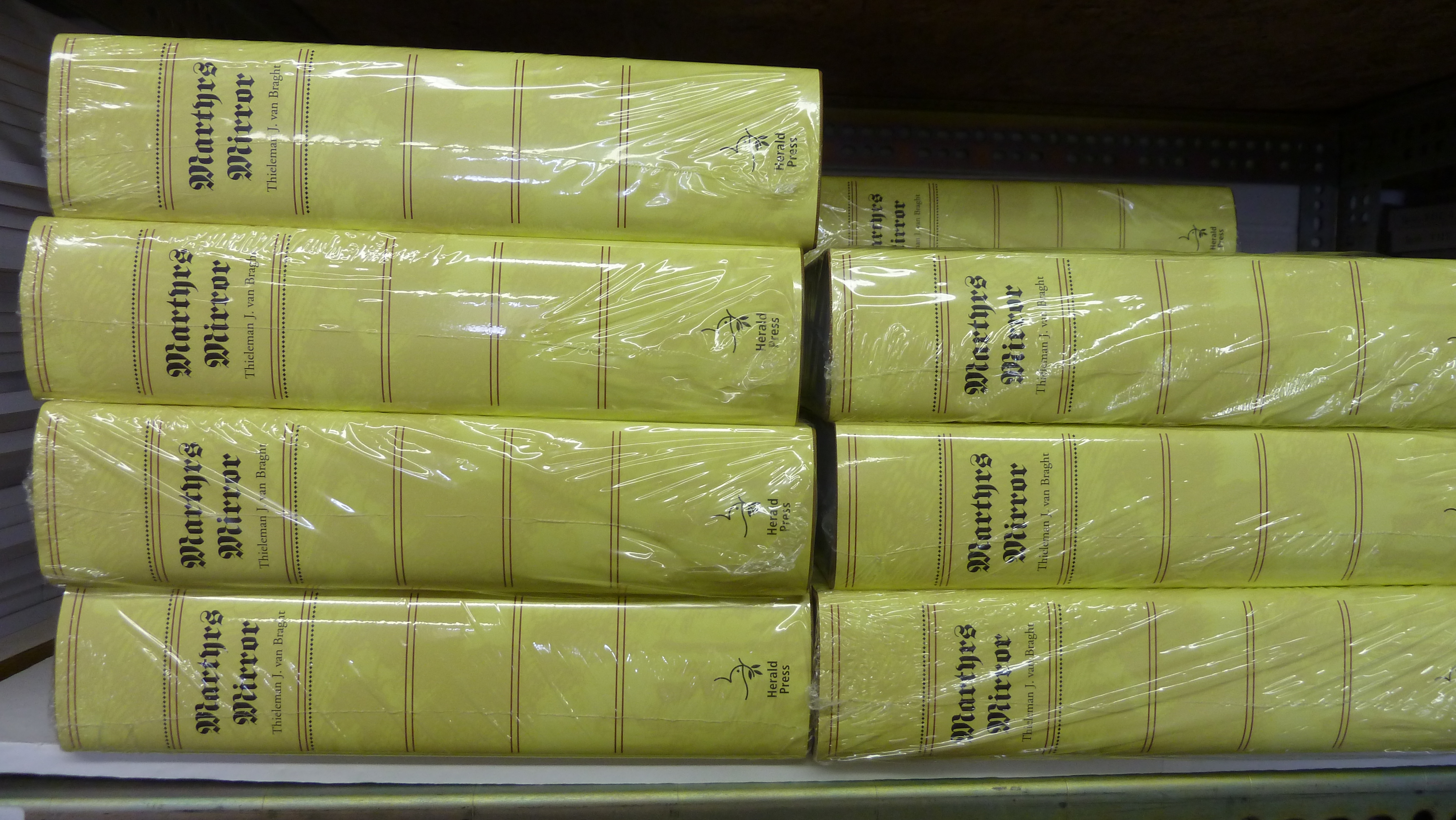
Steve’s book begins with a helpful historical review of the Anabaptist movement, through the lens of the media of the time (such as Martyrs Mirror), and provides a Cliff Notes version of the topic. Throughout his book, Steve carefully sorts out the very casual and often misleading reference to Mennonites (where Mennonites are frequently confused with Amish or Old Order cousins), to references to Anabaptists in more substantial texts or treatments. It must have been fun brainstorming a laundry list of references to Mennonites in pop culture that sometimes come to mind when Mennonites discuss things like “Was Phyllis Diller a Mennonite?” “Are you related to former pro-footballer Jeff Hostetler?” “What do you think of ‘Weird Al’ Yankovic?” “Did you know the creator of The Simpsons was Mennonite?” “What did you think about the Mennonite neighbors in the Amish-themed movie Witness?” “What about Merle Good’s Happy as the Grass Was Green?”
If you’re going huh, huh, huh and huh? you perhaps don’t walk much in the very small subset of people who get excited by this topic. Steve’s index and bibliography are worth the price of the book if you’re in need of a reference tool besides Google for this esoterica. In a nod to the scholarly nature of the work, Steve uses the Ngram, a web-based tool which traces the frequency of how often certain words turn up in print over the centuries, and relates spikes in frequency of words like “Mennonite” and “Anabaptist” to publication of key Mennonite/Anabaptist books.
Since master’s theses specialize in topics no one has quite tackled before, this book deserves study as a basic or supplemental text for communications and media studies in Mennonite-related colleges and universities – or any ministry student who combines a love of theology and Christian pacifist history, with media.
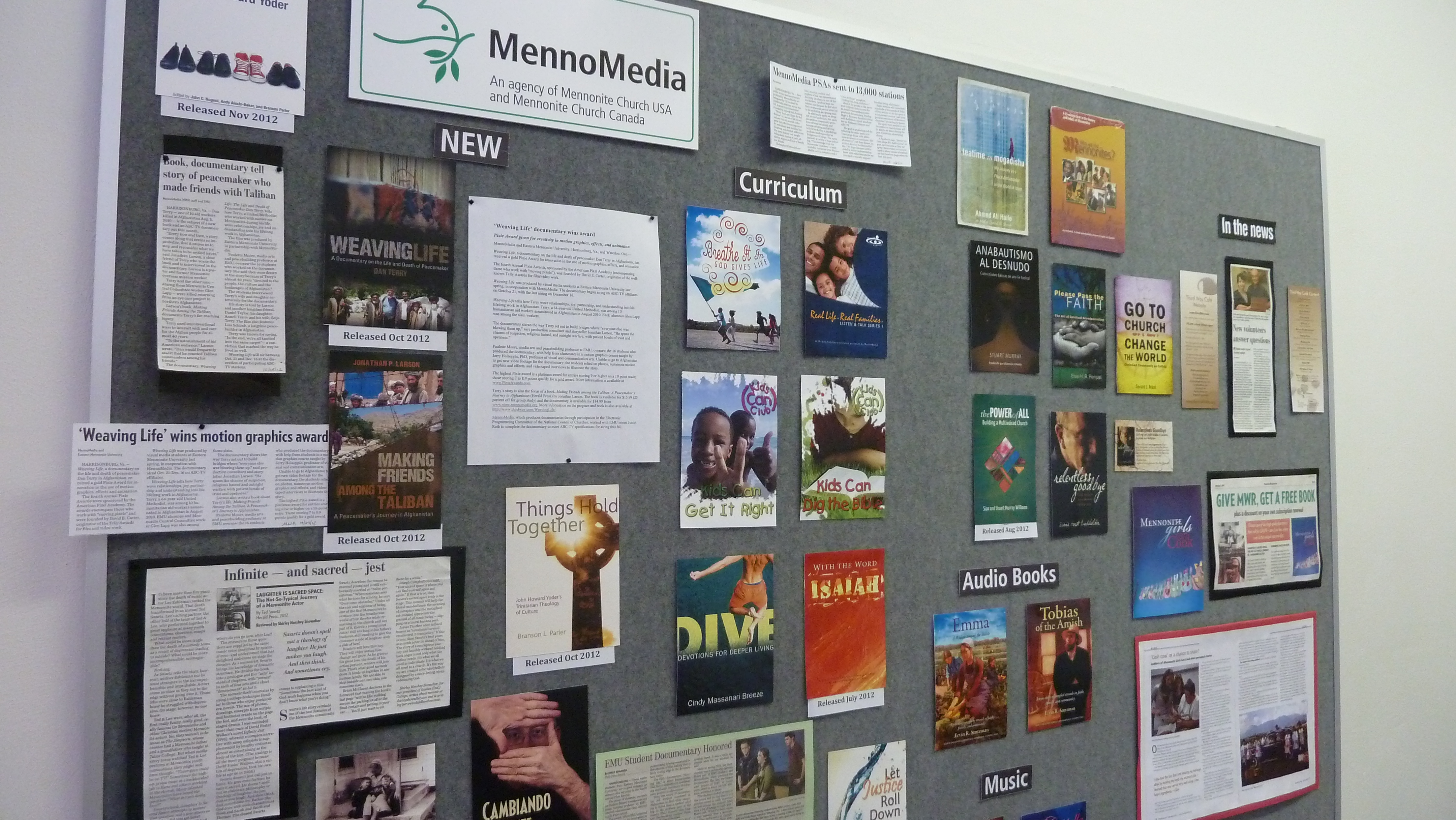
I’ll share several quick examples of media treatment of Mennonites from well known, secular writers/producers which Steve explores:
- Voltaire, author and playwright in the mid 1700s, features an upstanding Anabaptist character in Candide named Jacques. Candide is the main character in Voltaire’s satirical novella.
- An Anabaptist chaplain is a main character in Joseph Heller’s classic Catch-22.
- In current times, radio’s Prairie Home Companion founder and main star Garrison Keillor often tells Mennonite jokes, especially if on similar themes of Minnesota Lutherans.
- Bestselling author Malcolm Gladwell’s recent reconnecting with Mennonites.
Steve is mostly focused here, as you can tell, on media productions produced in the secular realm, but also spends some time noting briefly why he doesn’t examine well known in-church produced media. Therefore he does not scrutinize or catalog much in the way of church-produced media which is the realm of MennoMedia and the agencies that preceded it under various names. So I’ll forgive Steve for not mentioning one of the biggest shapers of in-church media over 40+ years, Ken Weaver, from the mid 50s to the late 90s. Perhaps that’s because Ken was a CEO, and not a producer with his name on a line of books, radio programs, or TV spots.
At times Steve’s examples seem to hopscotch between print, film/TV and aural/oral, with a heavy emphasis on print. Steve includes a brief nod to online media and even evangelical roadside signs.
The book is rich in examples yet I was always aware that the formation of the book was and is scholarly with the purpose of original research and documentation towards a master’s thesis. As such, I commend it heartily to communication and Anabaptist history students, professors, and even pastors or teachers who enjoy preaching and teaching using current or past examples from media. It might provide an interesting small group or Sunday school class study over a series of weeks, playing/watching samples and then discussing Steve’s analysis compared with their own.
In this book Steve illustrates the powerful influence of media on our culture over the past 500+ years. In college when Fiddler on the Roof movie came out in 1971, I wrote a film review for the college paper. In it I pointed to several touchstones comparing the Jewish storyline to that of Mennonites, and wished for more storytellers to bring to cinema such shining and well-told stories of faith. Steve’s book also illustrates that call and need.
If it were not a scholarly tome, I would have surely begun the book with the ending, where he delves into his personal life and reasons for writing the book. Don’t miss that.

***
Mennonites and Media: Mentioned in It, Maligned by It, and Makers of It is available on Amazon and other online retailers, and the publisher.
***
What is your favorite example of secular book, movie or other media which does a great job on artistry as well as faith?
My father died nine years ago March 26. I still remember how I got the call from my sister Pert in the middle of our Sunday morning church service with my phone set on vibrate, and I knew I had to go out to take the call. She ended up leaving me a message before I could answer her call. I saved that message on my phone until I had to give up that phone.
 A painting made by my daughter, Michelle, as a child, in honor of her grandfather and his passion for the hungry.
He was a wonderful dad and he left an indelible mark and witness on our family and his world through the work I’ve written about related to “feeding the hungry people of the world” and his passionate embrace of “there has to be another way to solve the world’s problems other than fighting.” He battled racism and invited many international guests to our home, while at the same time made sure our family enjoyed vacations together every year. He and Mom took the “trip of a lifetime” by traveling around the world in 1967, paid for by his habit of not smoking (according to him). His hogs were actually what helped them visit so many of the organizations and missionaries he had supported all of his life.
 Daddy sharing stories of faith and conviction with two of his grandsons while on family vacation in the Great Smoky Mountains.
Another highlight of his life was meeting former President Jimmy Carter at Maranatha Baptist Church in Plains, Georgia and sitting in Jimmy’s famed Sunday school class. Jimmy posed with mom and dad as he does with many of those who stop by.
 Dad and Mom with Jimmy Carter, circa late 1990s, supported by his cane in his right hand and by Mr. Carter on the other.
My much longer tribute to Dad can be found here on my blog; my Another Way newspaper column written soon after Daddy died is being reposted here because of changes being made to the website which will no longer store archives back to 2006. If you’ve read this before, my apologies, but I wanted a place to store it, the better to remember the details of those last few precious weeks with Dad. I know he rests in peace and will be forever dancing in the presence of the Almighty, forever free of the cane he so longed to toss away.
***
Another Way, 4/20/2006, reposted from Third Way Cafe.
Saying Farewell
 Dad was going to church in heaven that morning. He died about the time many of us were saying prayers for him. And all I could really say as my husband and I made plans to go to Indiana for the funeral was a grateful, heartfelt “Hallelujah!”
The first week of March, I wrote about grief in this column, based on the experiences of a close friend. Then on March 11, we got word that my dad, Vernon Miller in Goshen, Indiana, had subtle changes in his diabetic condition. He was 89 and a kidney specialist said neither dialysis nor surgery would help. He had a blockage, and they gave him two to four weeks to live.
The information set my two sisters, brother, and I mentally spinning. Mom was stunned, too, but since she was his caretaker, she knew how much his health had deteriorated and had been preparing herself for many years. Seven years his junior, she was glad to be able to take care of him. Then one night she couldn’t get him very far into bed, his legs were so heavy with fluid. He fell out near morning and Mom called an ambulance.
We three siblings who live out-of-state made immediate plans to visit Dad and Mom. Then a sudden high temperature and unexplained vomiting (and presumed aspiration of food and pneumonia) caused us all to speed up our plans, driving late into the night to get to Dad’s bedside. My sister, a nurse in the same hospital and same section where Dad was, stayed with him as much as possible.
As often happens, Dad rallied. All of us kids had not been in the same room at the same time with him for about three years. My brother gave him a good shave, he downed hamburgers and fries, and declared on the morning he was checking out that he was feeling great.
However, we knew down deep that the prognosis was not good. We took the advice of the doctor and planned for hospice care in the health care center at Mom and Dad’s retirement complex. The siblings and Mom all agreed on the decision and spent a tender minute or two holding hands in his hospital room feeling the immensity of this step. Dad had signed a living will. He didn’t want to keep having tests, X-rays and shots. The doctor took him off insulin and said he could eat whatever he wanted.
As we checked him into his room in nursing care, Dad said, “I just wish I was on my way to glory.” At various times, we said our goodbyes, our “I love you’s” and “You were a great Dad.” My brother prayed with him and released him to God’s loving care, and told Dad that we would all be okay. I read him a Psalm. My sister sang songs. My other sister got out of him the proper Pennsylvania Dutch response to “Ich glicthe” (which kind of means “I love you a whole bunch.”) The proper response is a loving, “Ich glicthe ah” (which means, I love you right back.”) Our hearts were heavy, full and loaded with questions. How long would he hang on? Did Mom and Dad have enough money to last a year or more in nursing care, if it came to that? Should we go back home? All the questions that so many of my friends and relatives had faced over the years.
On Sunday, March 19, he enjoyed one of his best days in years: we took him to the church where we had all grown up. He enjoyed the drive and the service, staying awake the whole time, alert, commenting, asking questions, telling Mom he wanted hot dogs for lunch. We had planned a large family gathering at noon for all who could come; he prayed a wonderful blessing, ate lunch, stayed awake all day (something he never did anymore) read books, talked, enjoyed the great grandchildren. He tossed a ball to one of them and fed another some ham for supper.
It was wonderful, a gift. But of course we didn’t know if it was the beginning of a recovery, or one of those times the dying often have shortly before they bid us farewell.
It turned out to be the latter, and the following Sunday morning, March 26, when most of us were in church, our cell phones vibrated with the news: Dad was going to church in heaven that morning. He died about the time many of us were saying prayers for him. And all I could really say as my husband and I made plans to go to Indiana for the funeral was a grateful, heartfelt “Hallelujah!”
I feel very fortunate to have had him for a Dad, to have had a warning and to be able to say goodbye, to not feel a lot of guilt or anger or regret. He was not perfect: we all remember bad times with him. I do feel sad, lonely, and sorry that he won’t be able to experience a lot of the things I still hoped he’d experience with us. But most of all I’m glad he raised us in such a way that our goodbyes were really only fond farewells.
***

European Peasant Bread (Or artisan bread)
My friend Janet brought a tasty/crusty loaf of bread to our house church potluck a while back and shared the recipe when I asked. But it took me forever to get around to trying it, because I first had to acquire a stone, which I received for Mother’s Day last year. (I get the impression that most cooks under 40—at least if they are into cooking and baking at all—pretty much consider a stone to be an essential piece of kitchen equipment.) I also had to pick up some rye flour for this recipe (a huge bag from bulk food store that I promptly split with Janet).
I’ve baked standard bread loaves for so long that usually it doesn’t take my reading and re-reading all the instructions, but that is what I had to do here.
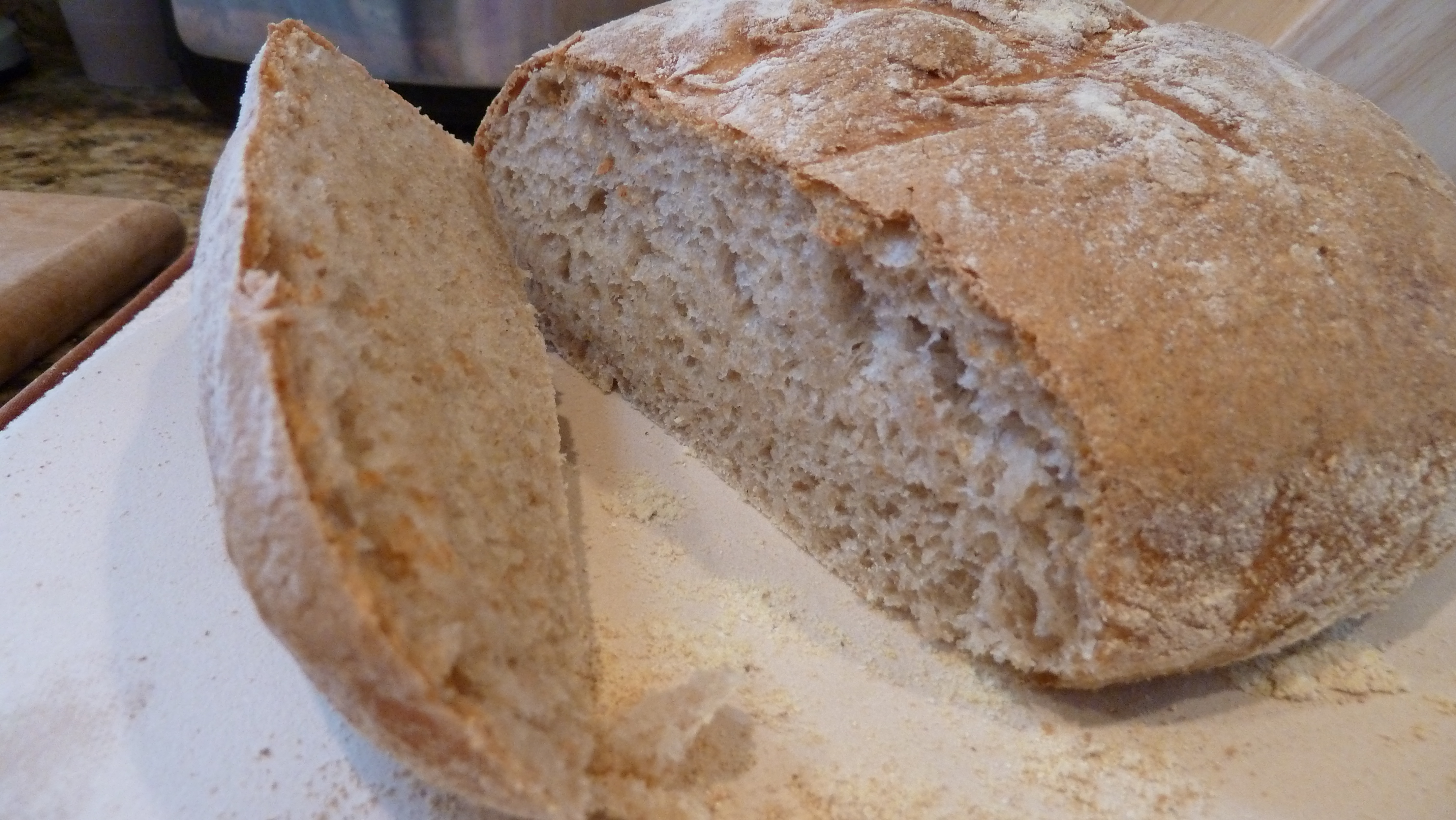
But it was a new learning experience for this cook and I loved the taste, texture and the fact that I could keep two unbaked blobs of dough in the fridge for up to two weeks to bake and have fresh bread for a meal, without doing all the mixing up work. The bread also carried me right across the big pond to so many lunches of bread, picked up in Spanish, French, or Belgian markets topped with sumptuous hunks of cheese.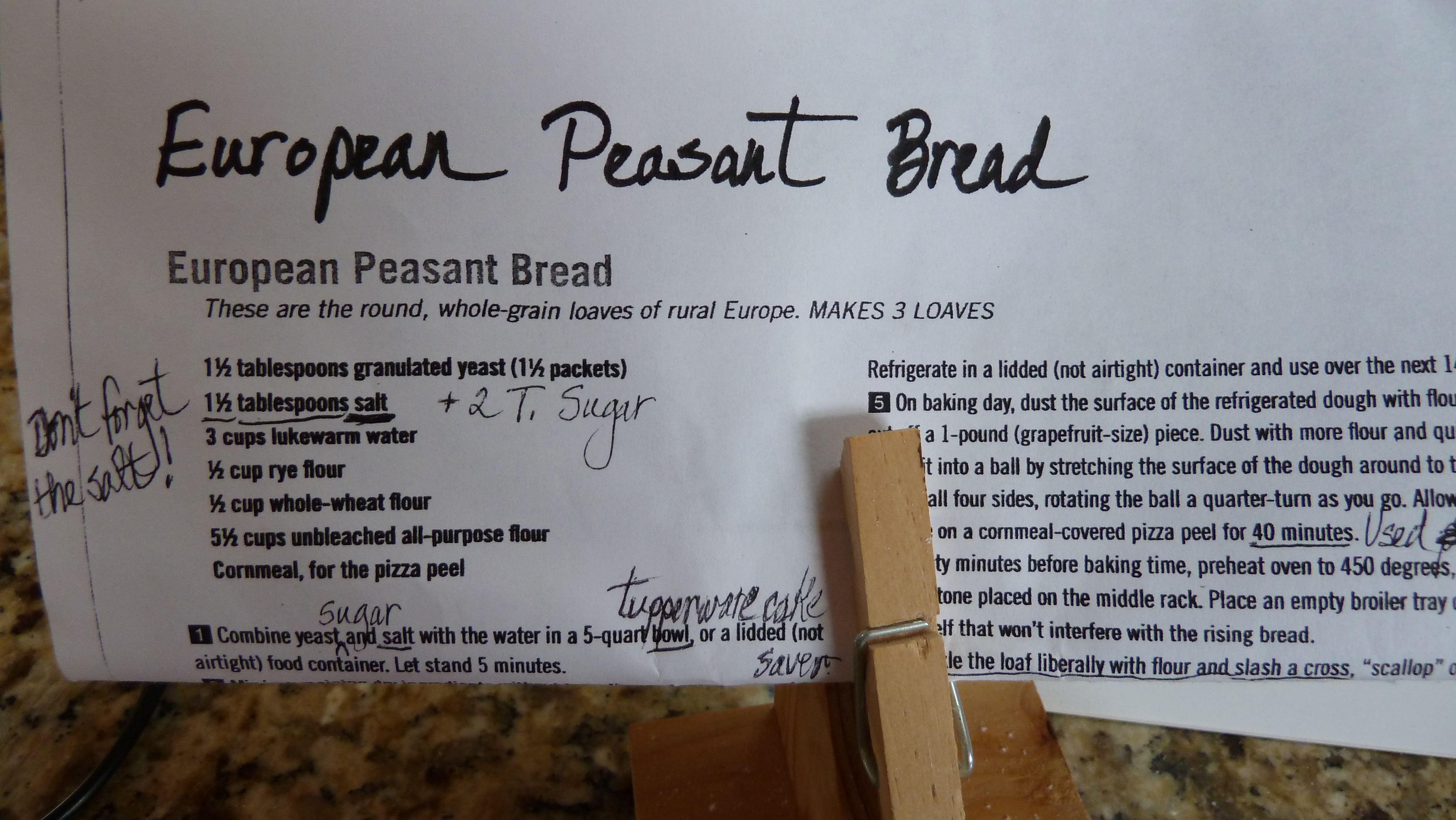
And I LOVE Janet’s notations on her recipe page. She is a real note-kind-of-person.
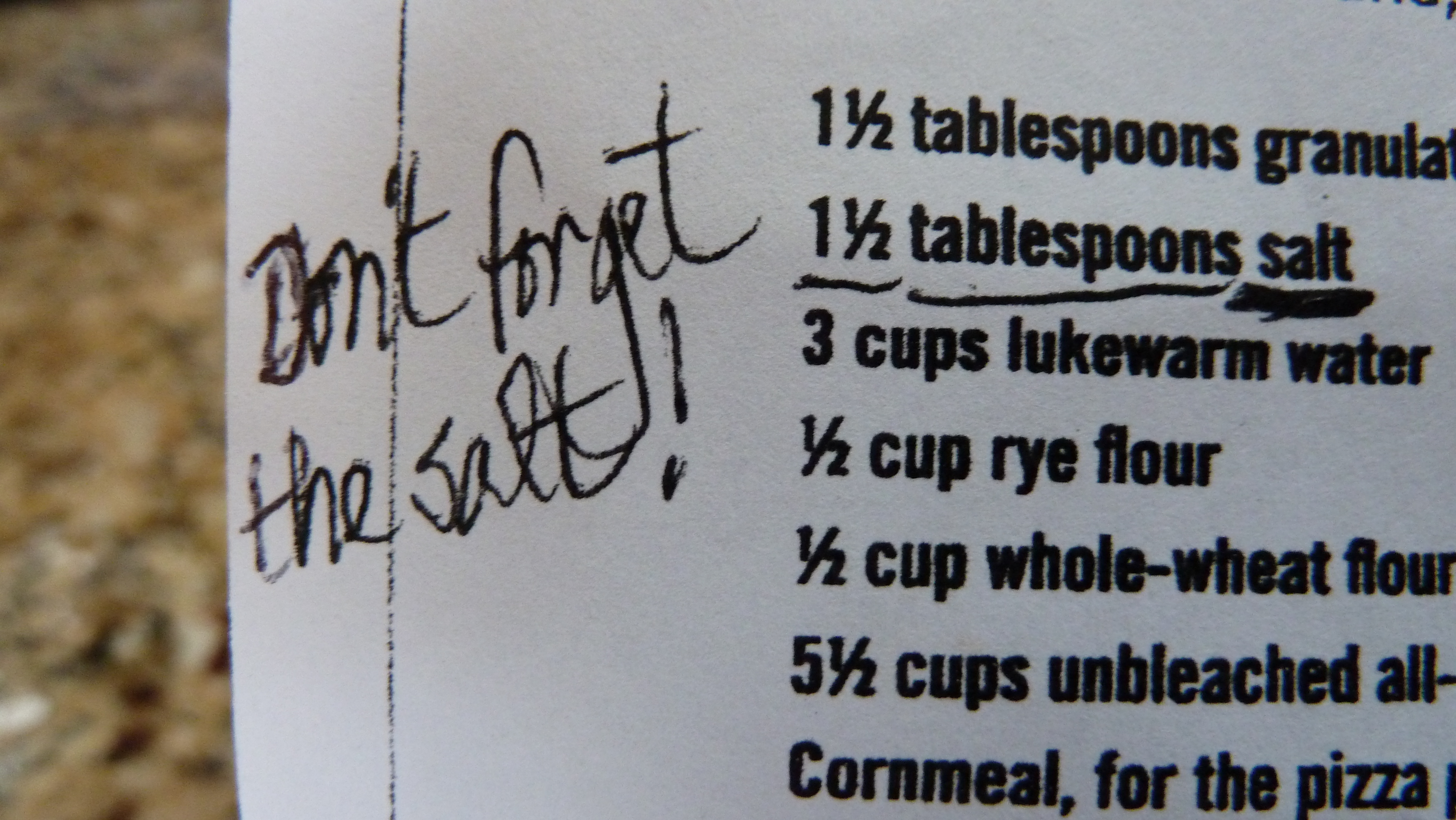
European Peasant Bread, adapted by Janet Slough
1 ½ tablespoons granulated yeast (1 ½ packets)
2 teaspoons sugar
1 ½ tablespoons salt
3 cups lukewarm water
½ cup rye flour
½ cup whole wheat flour
5 ½ cups all purpose flour
Cornmeal, for the pizza peel or cookie sheet
- Combine yeast, sugar and salt with the water in a 5 quart bowl. Let stand 5 minutes.
- Mix in remaining dry ingredients without kneading; use a spoon, large food processor with dough attachment, or a heavy-duty stand mixer with dough hook—that’s what I used. If you’re not using a machine, the recipe says it is helpful to use wet hands to incorporate the last bit of flour.
- When combined, cover mixing bowl with a tea towel. Allow to rest at room temperature until the dough rises and collapses or flattens on top, approximately 2 hours.

- The dough can be used and baked after the initial rise, but the dough is easier to handle cold. Refrigerate at least one hour before baking if doing the same day. Dough can be saved and baked anytime over the next 14 days.
- On baking day, dust the surface of the refrigerated dough with flour and cut off a 1 lb. (grapefruit-size) piece.
 Dust with more flour and quickly shape it into a ball by stretching the surface of the dough around to the bottom on all four sides, rotating the ball a quarter turn as you go, to make a smoother ball. Allow to rest and rise on a cornmeal-covered pizza peel or cookies sheet for 40 minutes.
 - Twenty minutes before baking, preheat oven to 450 degrees, with your baking stone placed on the middle rack. Place an empty broiler tray or any large pan on a lower oven shelf that won’t interfere with the rising bread. (Later you’ll pour hot water into this pan to create the steam that helps make the crusty surface of the bread.)
- Sprinkle the loaf liberally with flour and slash a cross, scallops or tic-tac-toe pattern into the top of the loaf, using a serrated bread knife. Leave the flour in place for baking; (you can tap some of it off before slicing the baked bread).
- Slide the loaf onto the hot stone. Pour 1-2 cups of hot tap water into the broiler tray, and quickly close the oven door. Bake 30-35 minutes, or until the top crust is deeply browned and very firm. Smaller or larger loaves will require adjustments in baking time.
- Cool a while before removing from stone or slicing or eating, but you can still cut off and eat some slices while they are warm!


Store in refrigerator to keep from mold. I wrapped my loaf in a tea towel and put in an unclosed plastic bag. This bread makes great toast and is always good warmed up.

***
I wasn’t sure if I had the cooking chops for using a stone but it turned out! Have you ventured into a new area of cooking or other hobby?
***
See these Pinterest boards for more artisan bread ideas.
***
For more great bread recipes check my book, Whatever Happened to Dinner.

The Excellent Adventures of Sam and James
How nice when the kids and grandkids come to visit—or we go visit them—just for anyhow.
We enjoyed special weekends with both grandsons in the last five weeks, separately. What fun. We spent the only warmish weekend in February soaking up some rays in North Carolina and exploring simple things with Sam, then almost 17 months.

First off to Krispy Kreme for marvelous, fresh, worth-every-calorie hot donuts, with his parents carefully pinching off the sugary stuff and just letting Sam have the inside bready part.

And milk —plenty of milk.
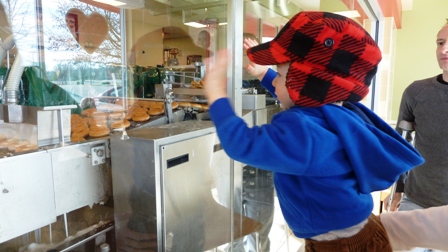
Sam watched donuts coming off the assembly line and you can tell he’s noticing and processing a lot about his young world these days.
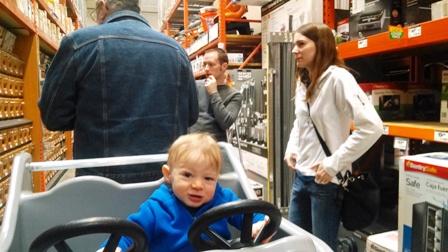
Then it’s on to Home Depot to pick up supplies for a Grandpa project later in the day. What’s not to love about driving a shopping cart made to resemble a hot rod! His mother marvels at how much fun she and her sisters would have had in such a hot rod as they accompanied Dad to what they used to call “every-kid’s-worst-nightmare-store” and they’d have to invent games to entertain themselves. (No electronic hand held games even after they came on the market. So deprived.)

Last on our expedition, Renfro Hardware, an old timey hardware store (circa 1906) that’s like a trip back in time: folks can still gather ‘round a good old wood stove complete with somebody’s lunch or breakfast cooking in a cast iron skillet on top.

It’s too early in Spring for the chicks they often have there, so we visit the grown up hens back of the store for Sam’s first up close look at a chicken.

I like that this store mixes old fashioned wares with locally produced honey, onion and potato starts, and heirloom seeds for trendy chic/hip young gardeners as well.

I think I’m beginning to understand that the beauty of grandchildren is that they take you back to your own early parenting days. No—you have the leisure and perspective to revel in and appreciate that these days are fleeting and so precious (they’re not babies any more—how fast that first year went) that you just savor it all and make memories out of a visit to Home Depot, Krispy Kreme and an old hardware store.
You also jump at the chance to help out their parents by “babysitting.” James and his parents visited the first weekend in March to help grandpa celebrate his birthday (not a big one like his 60th last year, which is one of my most frequently read posts from all last year, there’s a lot of online searching going on apparently for “how to plan a 6oth birthday party”). So I was tickled when his parents announced on Saturday afternoon, “We want to go to Costco. Is it okay if we leave James here?”
Ok? Ok? They trust me? Oh yes boy is it ok. I was to let him play until his nap and then put him down and then keep an “eye” on him with their marvelous video nursery monitor.
So, Grandma and grandson alone in the kitchen? What does grandson get into?
Both James and Sam are into helping mom or dad or whoever is in the kitchen, cook. They love to get out pots and pans, stir things on the floor, and generally get toted around the kitchen on the hip if someone is making something that smells good. This was the phase with my own toddlers that I developed such noticeable pains in my left arm and chest that I actually asked the doctor what could be going on. “Let’s see, how old are your kids?” When I confirmed they were like 12-18 months or so, he was sure it was lifting and carrying them so much.
These two toddlers have just recently really taken off on their walking skills, but on this afternoon, as I’m working on various dishes for my husband’s smallish birthday dinner, James takes up camp near a relatively safe cupboard collection of cereal boxes, chips, canned goods and odds and ends.

He sorts through things, picking up packs of gum from one basket and tossing them onto the next shelf with dispatch as if to say, “Well I certainly don’t want/can’t have them.”
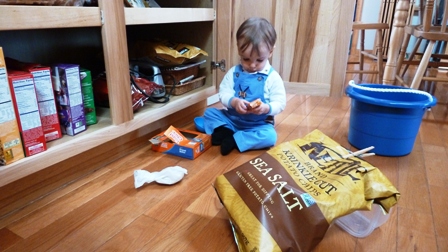
Then he grabs a 10-pack of Nabs crackers I keep there to pack quickly into husband’s lunch. James works until he removes one pack out of the opened 10-pack, and then holds it like a gift.
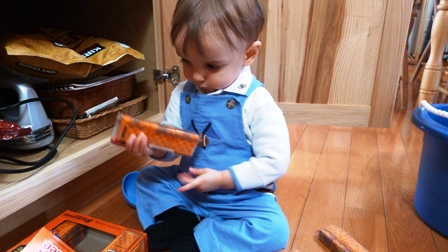
Hmm. Would mommy and daddy mind if he had one peanut butter cracker? It’s a long time til dinner, and he still has his nap coming up, and he ate a good lunch. Peanut butter is a good thing, right, in small doses, on crackers?
I help James open the pack and handed him the little cracker sandwich which he promptly put in his mouth, beaming. He chomped on that awhile and I watched him while also peeling my potatoes and I decided the next one, if he wanted another, I would break in half the better to avoid choking. I was pretty sure it was his first time enjoying that treat but he managed it just fine and soon picked up the pack as if to say he wanted another. I felt just plain naughty helping him sneak another half a cracker, and then another, until he had eaten 2 ½ crackers, and washed it all down with some water. That seemed like a reasonable snack for such a small pint so I put them up into a drawer he couldn’t reach. My husband discovered that partially eaten pack this past Saturday and asked “what’s this?” Of course I had told his mother about the “grandma and James cracker party,” so now I clued in the grandpa.
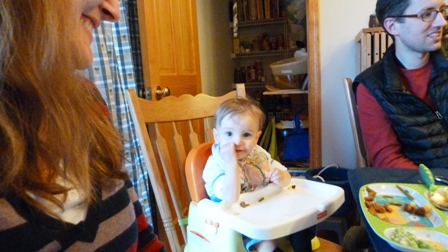
What fun. Like I said on Facebook, it seems most of my photos from the weekend are of James eating, to which his mother exclaimed “Probably because it’s his favorite thing ever.” And I thought, hmm, yes, and it’s only the beginning, we hope, since I hear that adolescent and teenage boys are bottomless pits.
This blog post is some pure grandma journal stuff mostly for family and close friends just so I have a record. Otherwise, over time our minds tend to forget the details, right? And I’m so happy to be on this journey.
***
If this triggers any of your own grandma/grandpa and small person stories, so much the better. I’d love to hear your stories!

 findingharmonyblog