

Writer Wednesday

There are certain kinds of books we write for ourselves, our families, our friends, fans and colleagues—especially when they say, you need to write a book about this!
Seeking Saúl is that kind of book (prounounced sa-ouul). It beautifully chronicles a year of exploration by Rebecca Thatcher Murcia and her two sons, Mario and Gabriel, in tribute to their beloved father and husband after he died of a rare bone cancer. Saúl grew up in Colombia so Rebecca and Saúl and family had traveled there numerous times previously and she was fluent in the language. For her year-long sojourn with her two sons, she gratefully relied on Saúl’s family to get acclimated and outfitted for their year.
Even though I did not know Rebecca and Saúl well, I had worked with them both and I was anxious to read Rebecca’s book. Rebecca is an accomplished and published author many times over, focusing on books for youthful readers especially biographies of people like soccer stars David Beckham and Landon Donovan, and other heroes and histories such as of Americo Parades. Her Twitter page bio simply states: “Author of many books and articles. Translator and Interpreter. Soccer Fanatic.” She has worked for several newspapers including the Brownsville (Texas) Herald as a health reporter, and then a federal agencies reporter, once so angering a drug trafficker with her articles that he apparently mailed her an animal’s tongue as a threat. Later she wrote for the Austin American-Statesman from 1993 to 2000.
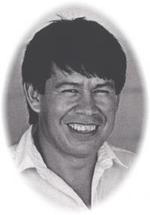
Saúl Murcia
When I knew her husband, Saúl, he was co-director of Mennonite Voluntary Service as we both worked for (then) Mennonite Board of Missions and had agreed to be on the organization’s anti-racism team. We both attended nine days of “Damascus Road” intensive training (four days in one setting, five days in another) to become anti-racism leaders in our organization. As one of the few persons of color participating, his voice was invaluable as we sorted our way through the history of racism in the U.S, personal backgrounds, experiences in church and school, and life in the late 1990s in a Christian organization committed to being as anti-racist as possible and yet failing so many times. There were long discussions and not a few tears during the draining sessions.
Saúl was, outside of the racism team meetings, a trooper: always an eager participant, smiling, engaging, friendly, fun-filled, and down to earth. So it didn’t surprise me too much in reading this book, which includes numerous excerpts of Saúl’s own writing from sermons and letters home, that although he was a dedicated and devout Mennonite leader, he could swear, drink and even dance a sensual salsa if he “was drunk enough” (his words).
From Saúl’s descriptions of Rebecca’s career as an investigative reporter for the Brownsville and Austin papers and as a fellow journalist, I respected and envied her work. So I had high expectations for this book, even though I did not realize that her bent for investigative writing—which is all facts, no feelings or personal views inserted—she had trouble, she said, in injecting the proper amount of emotion in this memoir. I would also say the book succeeds in telling a memorable adventure but doesn’t go the next step in memoir writing of universalizing the experience. Although how do you universalize her unusual year: widow of a Colombian, wanting her two sons to know their father’s homeland and relatives, and being an accomplished writer and awesome soccer coach and player herself? It is meant to be more of a memorial than a memoir.
After Saúl’s death I worked—from a distance—for three years with Rebecca on a radio program called Shaping Families. She was one of six rotating commentators who prepared recorded responses to the guest of the week. Through that I learned she was willing to try almost anything (including self-recording her segments in a closet to reduce noise) to make things work, and that while accommodating and eager to please, she also had firm opinions and stands around which she would not budge. Which is a good thing. So I know she was a formidable force as she jumped through hoops and dodged curves by paper pushers at consulates and government offices as she pursued their family goal for a year long visa.
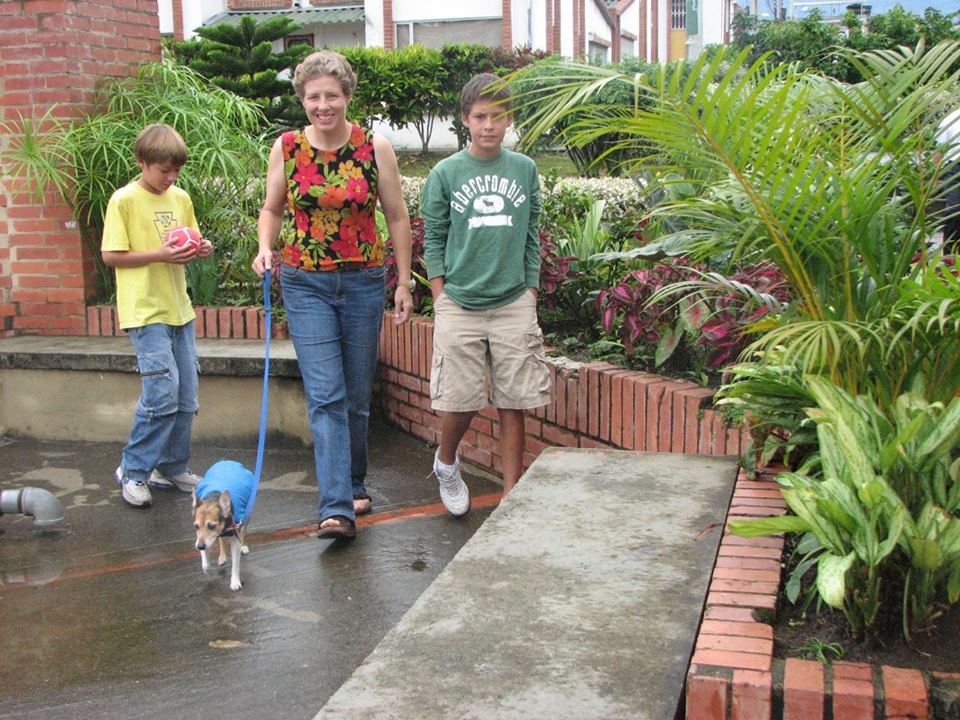 Gabriel, Rebecca and Mario walking their dog Crystal, in Colombia.
In the end, this year in Colombia and this book is a gift she gave her sons so that they will forever appreciate the countries their father had come to love: Colombia and the U.S., with a better grasp of what Saul went through to arrive at the kind of faith convictions and compassion he always demonstrated. Peeking in on that gift, you feel like you too have lived through an amazing experience without exactly filing the paperwork, going without water, trying helplessly to resuscitate your mother-in-law, living with mosquito nets, and worrying through your child’s medical needs. If they could do it, you can probably manage whatever life transforming adventure you feel God calling you to.
Years ago I wrote my first published book about a year of service and adventure in the Appalachian mountains of Kentucky, On Troublesome Creek. Ten years later I wrote another memoir type book, Departure, about a junior year abroad studying in Barcelona, Spain. After they were published, my boss—an excellent boss and may he live forever—kind of scoffed at the books saying “I don’t know why anyone would want to read a book out of someone else’s journal.” The first book was quite successful, went into a second printing thanks to the United Methodist Women’s reading program, and while Departure did not do so well, I’m happy I was able to preserve and publish those years for me and my family, if no one else. But increasingly in today’s very competitive publishing market—unless you are famous or an extraordinary writer—books like this must be self-published, which is a shame, because they don’t get the attention of those published by a regular publisher. They may also be marred by some small errors because they don’t undergo numerous rounds of proofreading.
If you are toying with writing a memoir—of your life or a particular period of your life, head over to the blog by Shirley Hershey Showalter who did a very thorough and wonderful job of studying 100 memoirs before launching her own book, Blush: Mennonite Girl Meets a Glittering World. I also believe it is easier to pick up on universal themes in a memoir covering one’s childhood, for instance, because we all go through early experiences that shape us, have relatives who don’t get along, struggle with adolescence and faith questions, and so on.
Seeking Saúl is entertaining reading for anyone who enjoys memoir type books, has spent a year or more in another culture or is considering it, who knows Saúl or Rebecca or the family, or anyone who has survived widowhood while parenting young children. It is also a story of adventure that nonfiction fans of Rebecca will enjoy—she does not assume the reader knows or understands Mennonites!
Rebecca Thatcher Murcia at a book reading.
***
All photos supplied by permission of Rebecca Thatcher Murcia.
Rebecca Thatcher Murcia has her hand firmly in the commercial publishing market with her series of 14 other books for children and young adults, all published by Mitchell Lane, (some with other authors) whose mission is publishing books to help kids who don’t want to read, to get into reading. Check those out! Rebecca’s books can be found on Goodreads, Amazon, and Barnes & Noble. You can also check out her Facebook page for the book, Seeking Saúl.
***
You can read (and listen to) more of Rebecca’s experiences in Colombia and the U.S. on the website for the former Shaping Families radio program. Here’s one.
We were talking at work about how 2015 shows up in the first “Back to the Future” film of 1985. Remember “Doc” traveling, at the end, from 1985 to 2015? Remember how far ahead that seemed, how unimaginable for all but the futurists among us? Well here we are, on the cusp of 2015. I for one could not truly have believed then that I would have participated in my family’s Christmas gathering 600 miles away via video on a smart phone.
In case you are still pondering what to make or take for a 2014 New Year’s Eve party or New Year’s Day gathering or weekend family get together, Party Mix is always nice to have around and adaptable to whatever you have on hand in terms of specific cereals and ingredients. And if you use healthy cereals, can it substitute for a healthy breakfast??
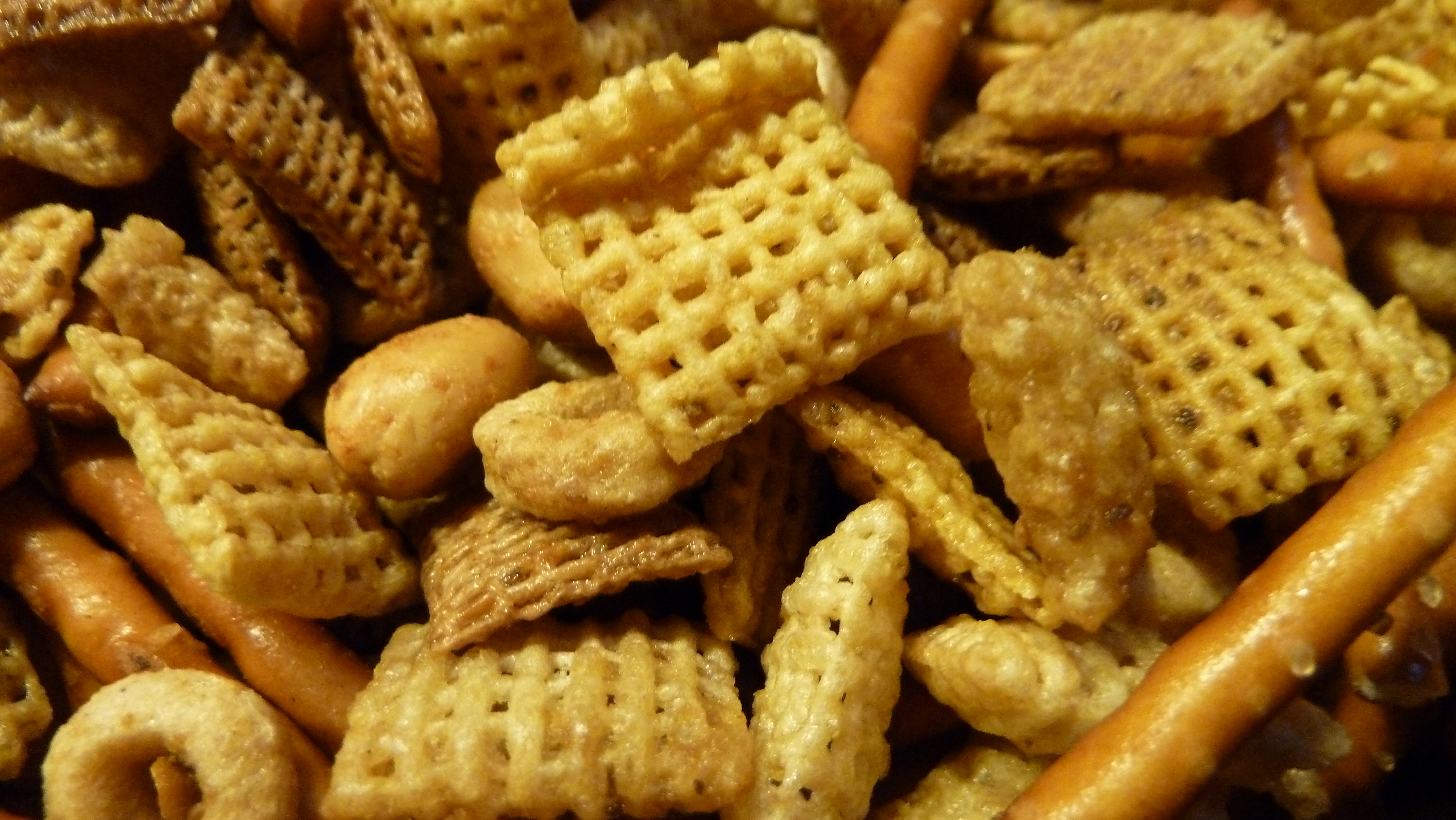
This is a recipe I’ve used over many years and adapted and corrected, see below. This year I had just finished making my batch shortly before Christmas when I was talking to my mother on the phone. She mentioned that a woman from my home congregation, North Goshen, had died unexpectedly, Viola Miller. No relation, but she was a fond church friend, and mother of one of my brother’s best buddies at church. Viola was still a vibrant and active church member, grandmother and all around good woman who will be greatly missed. When I visited my home church earlier this year, Viola was telling me about her numerous grandchildren with eyes sparkling with pride and love. And now I just noticed that another of my favorite recipes came from Viola, Strawberry Pie, posted here.

So I made this batch remembering her and thinking about how our named recipes—those we get from family and friends and cookbooks where we know the authors or cooks—are indeed special, bringing back memories, relationships, mentoring and good feelings along with the good food. That is the best of what this old church cookbook addresses as well: Titled “Fellowship Cooking,” the dedication states that “Fellowship is sharing.”

Speaking of old family recipes, I’m helping to launch a new blog for MennoMedia/Herald Press featuring Mennonite Community Cookbook. We have a new 65th anniversary edition coming out in early 2015, with contests and giveaways of great cookbooks each week. See here for an earlier post about this project. And keep your eyes open for news and posts about all the fun!
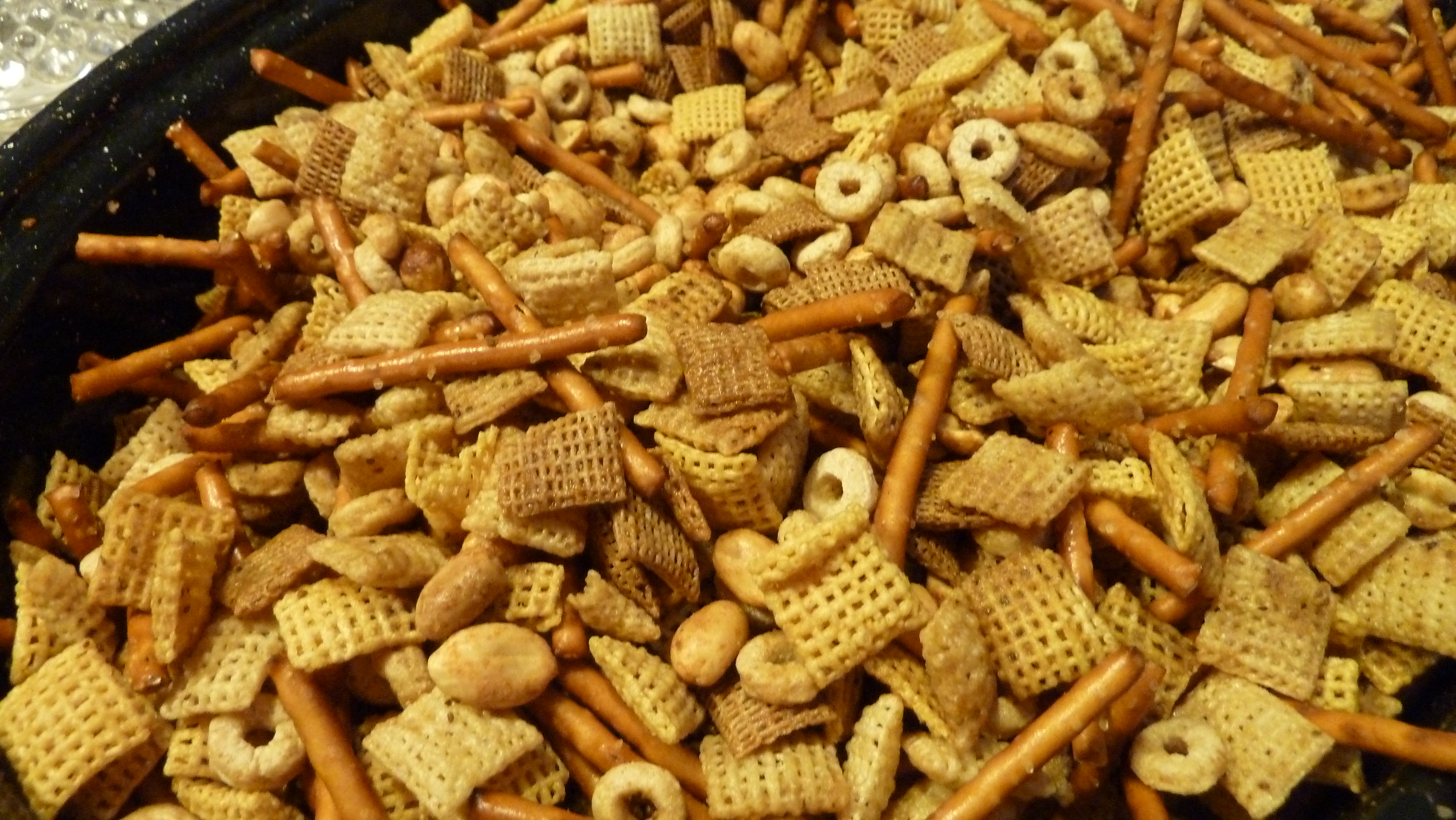
Party Mix
3 sticks (1 ½ cups) butter
¼ cup Worcestershire sauce
2 teaspoons each of garlic salt, celery salt, onion salt (original said 2 Tablespoons each, which I followed one time, but the result was way too salty and too much sodium for us.)
1 lb mixed salted nuts (or just peanuts)
12 oz.* shredded wheat squares (or wheat Chex is what I use)
6 oz. rice Chex
6 oz. corn Chex
7 oz. Cheerios (honey nut flavored or plain, or a mix)
6 oz. thin pretzel sticks
Melt butter in a small sauce pan; add Worcestershire sauce and seasoned salts and warm until all is dissolved. Remove from heat. Combine all dry ingredients in large turkey roaster pan. Pour the butter and seasoning mixture over the dry ingredients. Stir carefully to mix in butter and seasonings. Bake uncovered at low temperature, 225 degrees for two hours, stirring every 15-20 minutes. All amounts of cereals can be more or less to your taste.
*How I guess these ounce amounts is looking at the total ounces on the package, I eyeball how much would be 12 ounces or 6 ounces or whatever.
Adapted from recipe of Viola Miller and Mabel Nisley – Both these mothers had sons named Kenny who were both the age of my brother and therefore all three were great friends!
***
Recipes for Party Mix abound. What is a favorite for you, or what would you add to the above recipe?
***
Great gift idea: A woman from our church, Beverly, makes a huge batch of Party Mix, gives a pint away in a glass pint jar to many of her friends, and asks for the jars back to recycle next year! We are always happy to get a pint and to return the jar back to her!
***
Happy 2015 and thanks for liking, following and commenting on this blog! It has grown a nice step up this year and I appreciate all the blog love, and especially enjoy knowing some new friends.
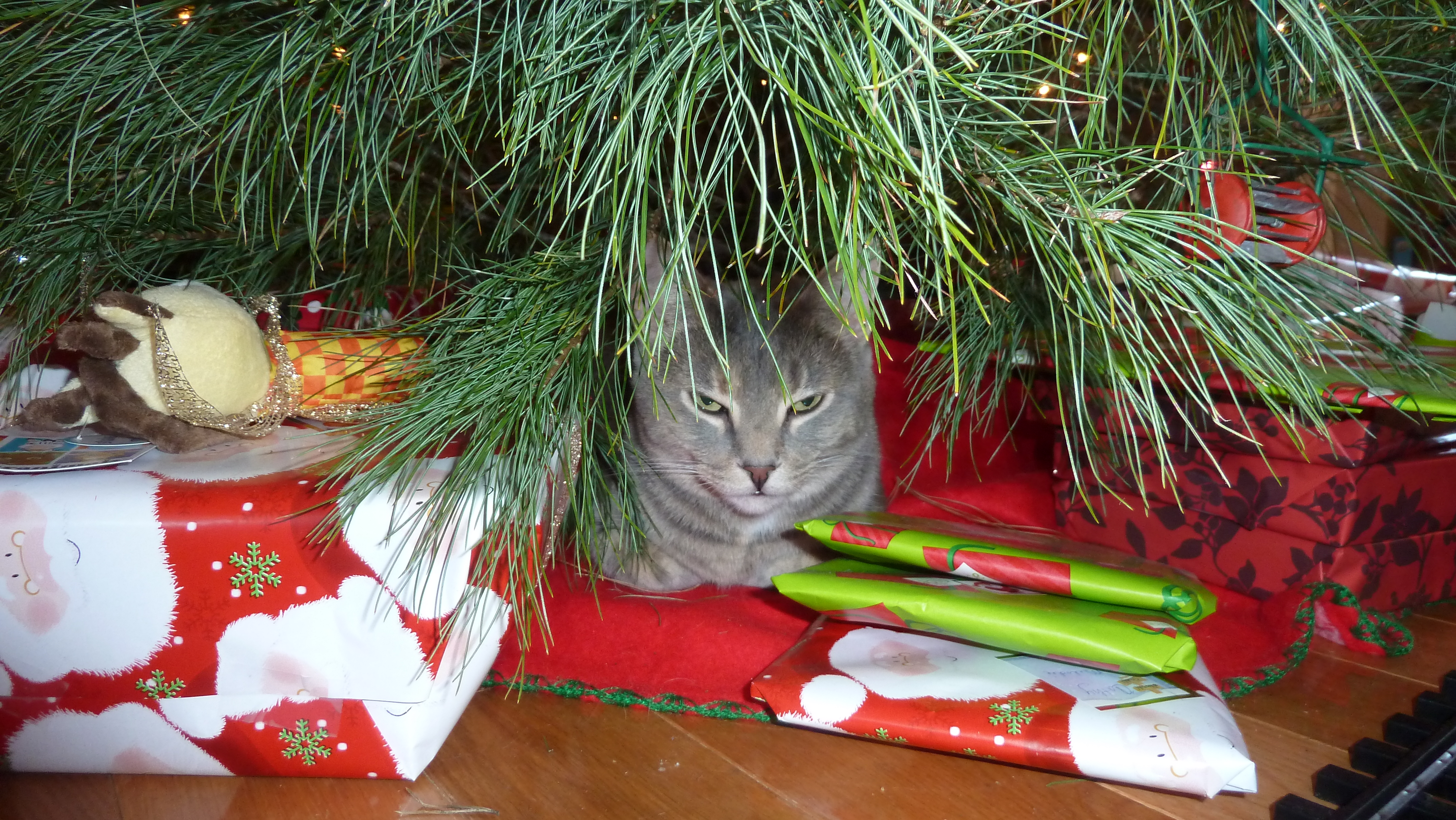 Be not forgetful … (Hebrews 13:2)
[And yes, this verse is totally, entirely, unapologetically, jerked out of context, which I promise never to do again.]
Forgetful Old St. Nick
The aunt who was playing Santa Claus at the family Christmas dinner was nearing the end of the pile of gifts that had been sitting under the tree.
The little face beside me was growing more sober by the minute. The presents were almost gone and he still didn’t have one. My own mind was in a panic: what if I had not grabbed six-year-old Nick’s (his real name and age at the time) Christmas gift in the flurry of leaving for our family Christmas dinner?
One Christmas I wrote about a prior year’s magical Christmas moment when several of my very young great nieces and nephews blew me away by summarizing the Gospel story of Christmas and Easter in several succinct lines. If that was a high when I was left tingly with joy and happiness, this was the exact opposite: I couldn’t have felt lower. My Christmas was gone. Would Nick cry? Pitch a tantrum? (not out of the question). Would he hate me forever? What could I possibly tell him to help him understand?
To make matters really bad, my presents for all the nephews and nieces and the great nephews and nieces were the ONLY presents they were getting that night. So the pressure was on. Each kid was getting one gift and Nick (the irony is only hitting me now) was being slighted by jolly old St. Nick.
“Nick,” I said with the longest, saddest look on my face, and every muscle of it was true, “I am so sorry but I think I left your gift under my tree at home.” I wanted to cry. I wanted to fall through the floor. I wanted to go back and start this evening all over.
Everyone looked around to see if my gift to Nick had been overlooked. I went out to my car to check, double checked boxes still under the tree. I apologized to his family, to the grandma. I felt they probably all thought I had forgotten little Nick all together and hadn’t gotten him anything. But I knew I had bought him a present. It obviously just didn’t make it to the party.
Nick’s face was as long as mine, his eyes wide and doleful. Earlier he had flashed a small wad of cash and a gift card that he had collected at previous exchanges. He was carefully guarding it in his little wallet. I grabbed for the only idea that came to my tormented brain. Did husband have a $10 on him, roughly comparable to the value of the other gifts I was giving the kids? Husband did. He retrieved it, handed it over with a look passing between us that we both understood completely, a gift of almost long years of marriage: (Him: here I am bailing out my crazy wife again. Me: Yes and thank you so much, you sweet thing. I hope this works.)
I handed Nick the $10 and told him again how very sorry I was and that I would bring him his actual gift later. I knew I had it at home. He smiled every so slightly and I knew there would be no tears this night: not his, not mine, just glory alleluia: small crisis had been averted.
My [then] twenty-three-year old daughter summarized it nicely when she said, “No wonder he was smiling. He got a $10 bill out of you.”
And yes, this forgetful old St. Nick really did find the little boy Nick’s present under my tree at home, beneath a pile of presents destined for another gathering.
Moral: Always make a list, check it twice. And it doesn’t hurt to go through December
with a spare $10 or $20 always in your wallet.
***
What was your worst and most famous moment of Christmas forgetfulness? How did it work out?
***
Read this year’s Another Way Christmas column here.

I held a five-month-old Iraqi child in my lap for almost a half hour last night. Any long-distance grandma knows how we ache to hold our own grandchildren, and leap to any opportunity to snuggle another woman’s child or grandchild.

The Clothes Closet our church runs was busier than ever, the last time we’d be open before Christmas. We had over 50, counting infants and children. We’d planned a special evening: candy canes or Peppermint patties for all, our guitarist quietly strumming Christmas carols on his guitar from the back of the room. Hence we were a little short on help—so the on-duty mission leader, Jim, asked if I would take over seeing that the little kids were occupied. The guitarist, John, was the one who usually got out the crayons and old computer paper for the younger kids to scribble on.
I soon noticed that a young Iraqi girl was in charge of her little brother, a five-month-old in a car seat. He wasn’t having any of it, starting to squirm, whimper, looking quite unhappy to be jostled around as she swung the car seat into a somewhat safer position on the floor. It didn’t take me long to ask her if I could hold the baby, he looked fussy. She nodded and I was in heaven. But would he just keep crying, with me, a stranger trying to comfort him?
I centered him on my knee and wiggled it a bit, and he seemed to get happier. Soon he had forgotten his troubles and was watching all the preschoolers getting their paper and crayons. All he seemed to care was that at least he wasn’t in his car seat anymore.
I soon started asking ages and schools of the children; then I got brave enough to ask what county the big sister was from: yes, Iraq. I’d suspected as much. She was nine. Their mother wore a Muslim headdress; our client base is about a third each Middle Eastern, Hispanic, and U.S.
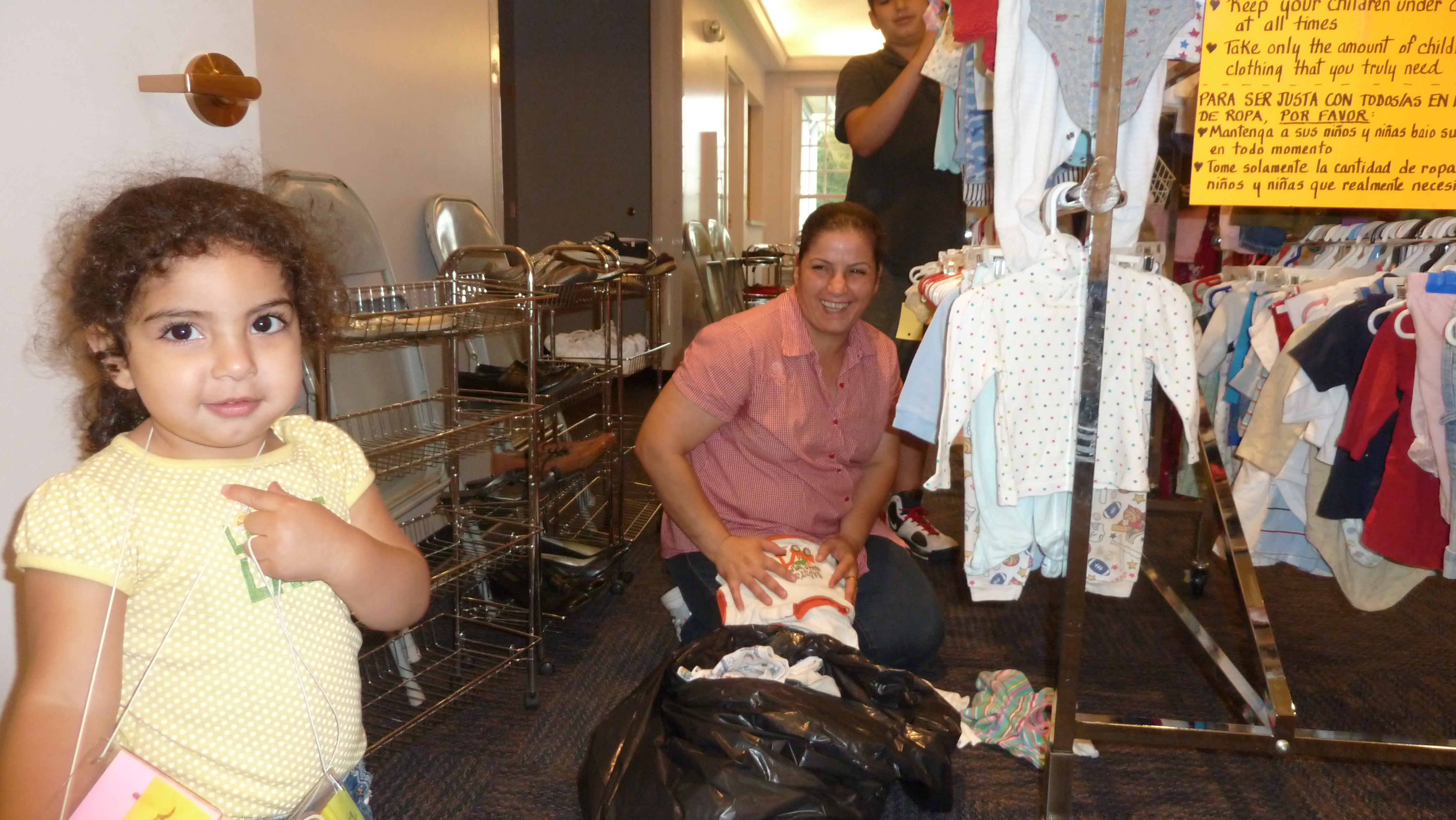 This is not the child or family, but another Iraqi family who helps out at the Closet and earlier gave permission for me to photograph them.
Finally I stood him up so I could look him in the face and he could see me, too, and get used to the idea it was a stranger holding him. He was now smiling. Score! I looked at his straight black hair, his dark eyes, his olive skin, and it didn’t take much to imagine that this would have been much more what the baby Jesus (although technically Jewish) looked like than the “white” babies in all those Christmas pageants in my mostly lily white church experience.
When I looked at his nine-year-old sister, I also thought immediately of baby Moses’s big sister in the Exodus story of the Old Testament. What a great caretaker she was. How smart and quick she was to seize upon the idea of asking Pharaoh’s daughter, who found the baby hiding from Pharaoh’s harsh decree, if she wanted a Hebrew nurse maid for the baby. How brave that big sister was, to offer the scheme, even knowing the house of Pharaoh was of another religion and ethnic group.
This nameless Iraqi child reached across all the political, ethnic and religious barriers of our world to grab my grandmother’s heart, and I wondered if his own grandmother was half a world away, torn too by the huge distance. Where was this child–any child–safe in a world gone mad? This Iraqi baby reached across centuries and millennia to connect me with those Jewish babies of old who both were protected from insecure madmen. Both Moses and Jesus grew up to leaders–saviors for their people.
And here I was in a little Presbyterian church in Virginia in 2014, wondering about it all.
It was a holy night at the Clothes Closet.

***
What is your “o holy night” experience: already this year, or another? I’d love to hear your stories.
***
We join millions around the world praying for the grieving parents and families of those children killed recently in Pakistan, two years ago in Connecticut, and in too many small towns and large cities around the world.
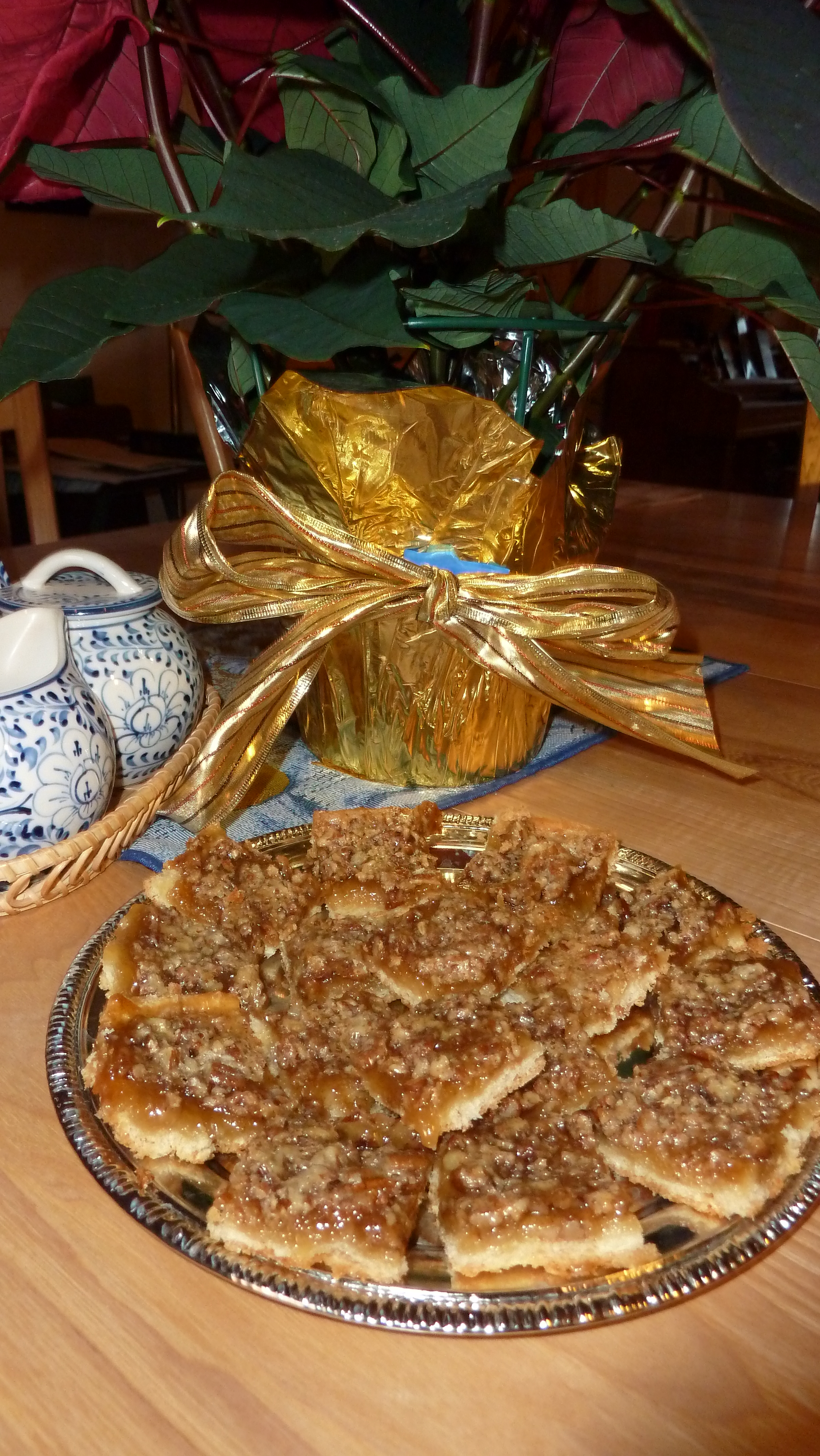

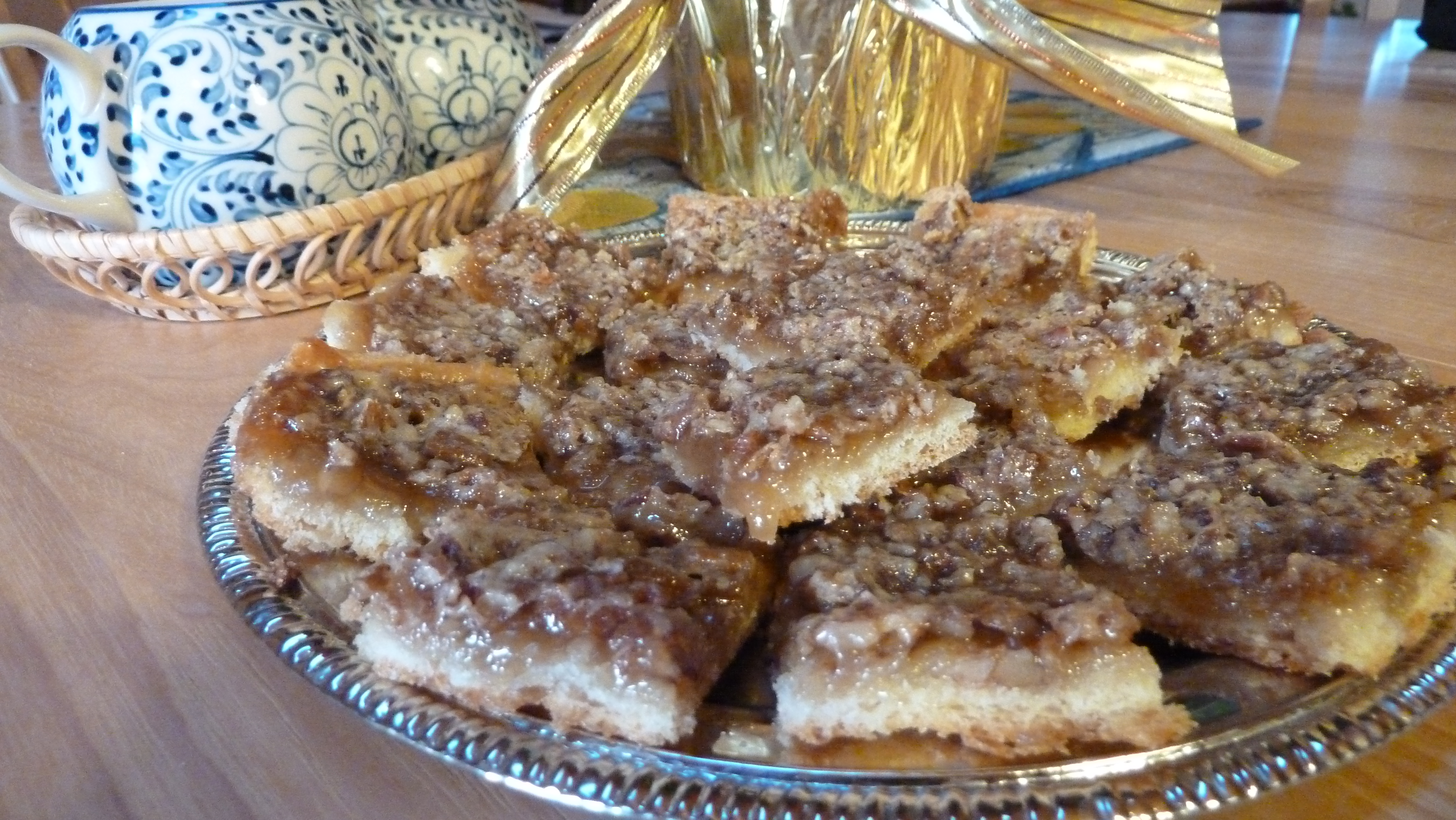
You know how you love pecan pie but a whole piece feels like way too many calories and overdoing the richness. These little pecan pie bars are easy to make, rich, yes, (but only three bites), and deliciously-sweet-tooth-satisfying.
In the busy days of December, keep these ingredients on hand so you can whip up a quick and scrumptious dessert for that dish of cookies you’re supposed to take to work, to an after-caroling party, for youth group, for the club meeting at school your kid forgot to tell you about. Or to dress up and round out a soup and sandwich meal. And since this is December and time is at a premium, on to the recipe. I tried it twice,* first with white corn syrup since the recipe I had did not indicate, and the second time with dark. We liked the dark 25 percent better! (Both were good.)
I saw these first on Facebook and copied it from there. There are plenty of pecan bar type cookies online but I couldn’t find any links for one taking the easy way out by using canned dough.
Pecan Pie Bars
Preheat oven to 350 degrees
1 can crescent rolls
½ cup chopped pecans
½ cup sugar
½ cup dark* corn syrup
2 Tablespoons butter, melted
1 teaspoon vanilla
1 egg, beaten
Unroll dough into ungreased 9 x 11 pan. Pinch dough pieces together, and press ¼ inch of dough for a slight edge around the dough. Bake for 8 minutes at 350 degrees.
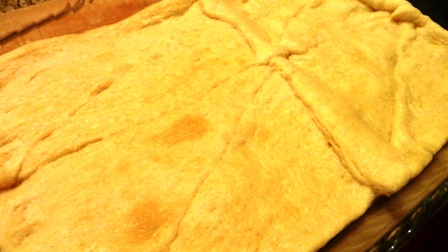 What rolled out crust pinched together and baked looks like. I did better on my 2nd try.
While that bakes, mix top layer of all the remaining ingredients. When crust has baked 8 minutes, remove from oven and pour pecan/sugar etc. mixture over partially baked crust. Bake 18-20 minutes more until golden. Cool completely, about one hour. Cut into bars. If you taste them earlier, the hot sugar/syrup can easily burn your tongue.
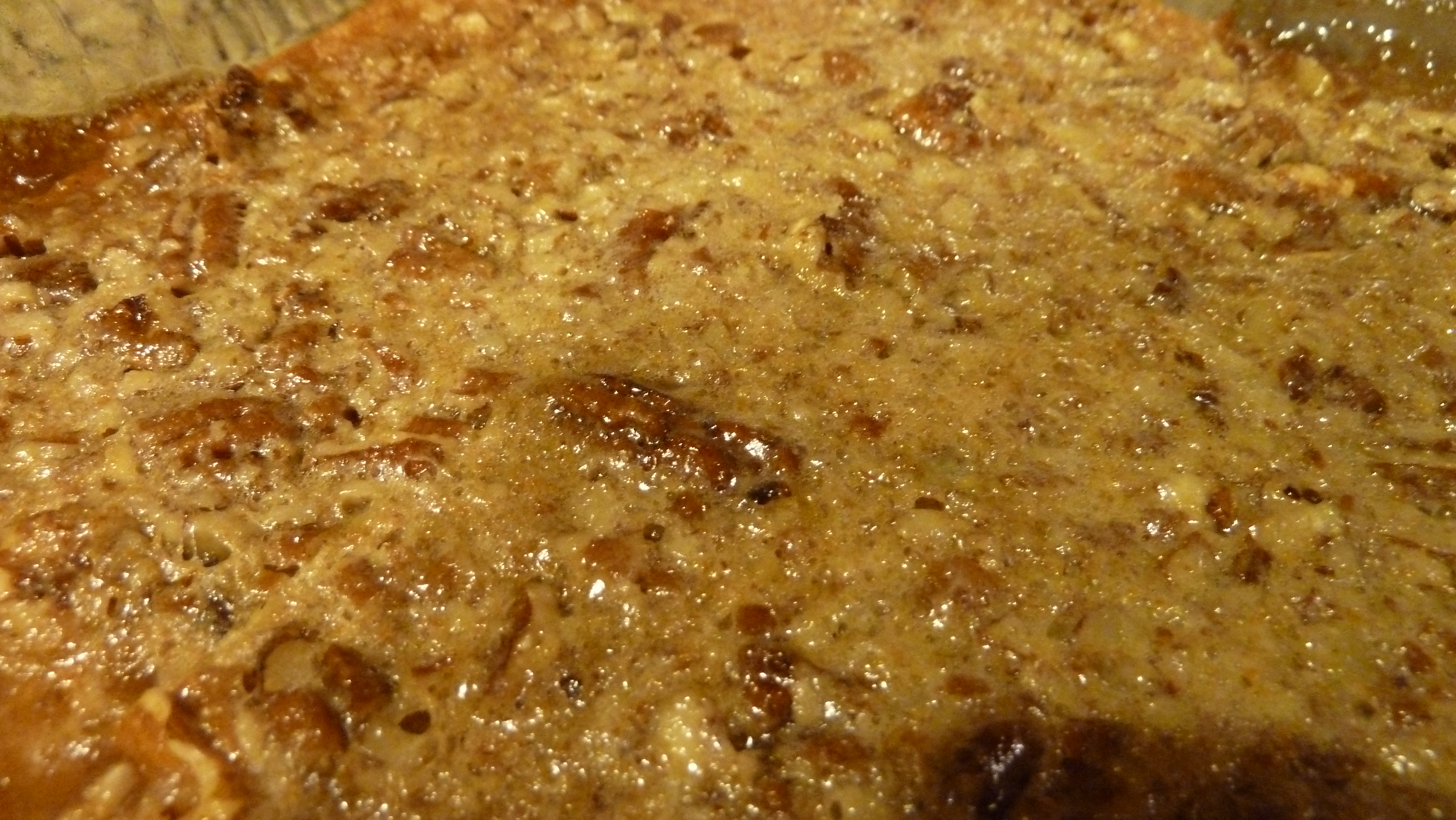 Let them cool one hour.
* I’ve made these twice. The first time I used light corn syrup, since the recipe did not indicate. They didn’t quite have the nice molasses-y flavor I like in my pecan pie. The second time I used dark. Bingo. Real molasses are too strong for me (except in certain recipes asking for them) but the dark corn syrup worked fine.
***
Do you have a quick and easy go-to recipe for something great and good for the Christmas season? I’d love to see links!
***

My book, Whatever Happened to Dinner has over 100 recipes including at least 9 Christmas-type goodies, such as a cheese ball, holiday punch, cranberry orange bread, Christmas morning French toast, peanut butter popcorn balls, Jodi’s best gingerbread recipe ever, magic cookie bars, snowball cookies and more.

Ten Reasons You May Be Too Old to Adopt a Puppy
The Education of Velvet
- You go to visit a batch of puppies right after you’ve been dismissed from the hospital for a procedure they do to folks after age 50, when they tell you absolutely not to sign any contracts or make any big decisions because of the medication they gave you.
- You hope the dog doesn’t knock your feet out from under you.
- You don’t feel like you can take a shower if he/she is awake for fear they’ll get into something.
- You don’t remember much about the last puppy training you went through with grown daughters living at home, who actually did most of the training and night duty.
- You get mixed up and keep calling her Violet instead of Velvet.
- You wish you could just diaper the dog and be done with it.
- You find yourself breathing a huge sigh of relief when she finally goes to bed for the night.
- You give up your morning exercise class because you don’t want to make your dog’s day by herself alone any longer than it already is.
- You give up your effort at doing real fall house cleaning.
- When you visit the farm with the pups, you fall in love and take home the little thing anyway.
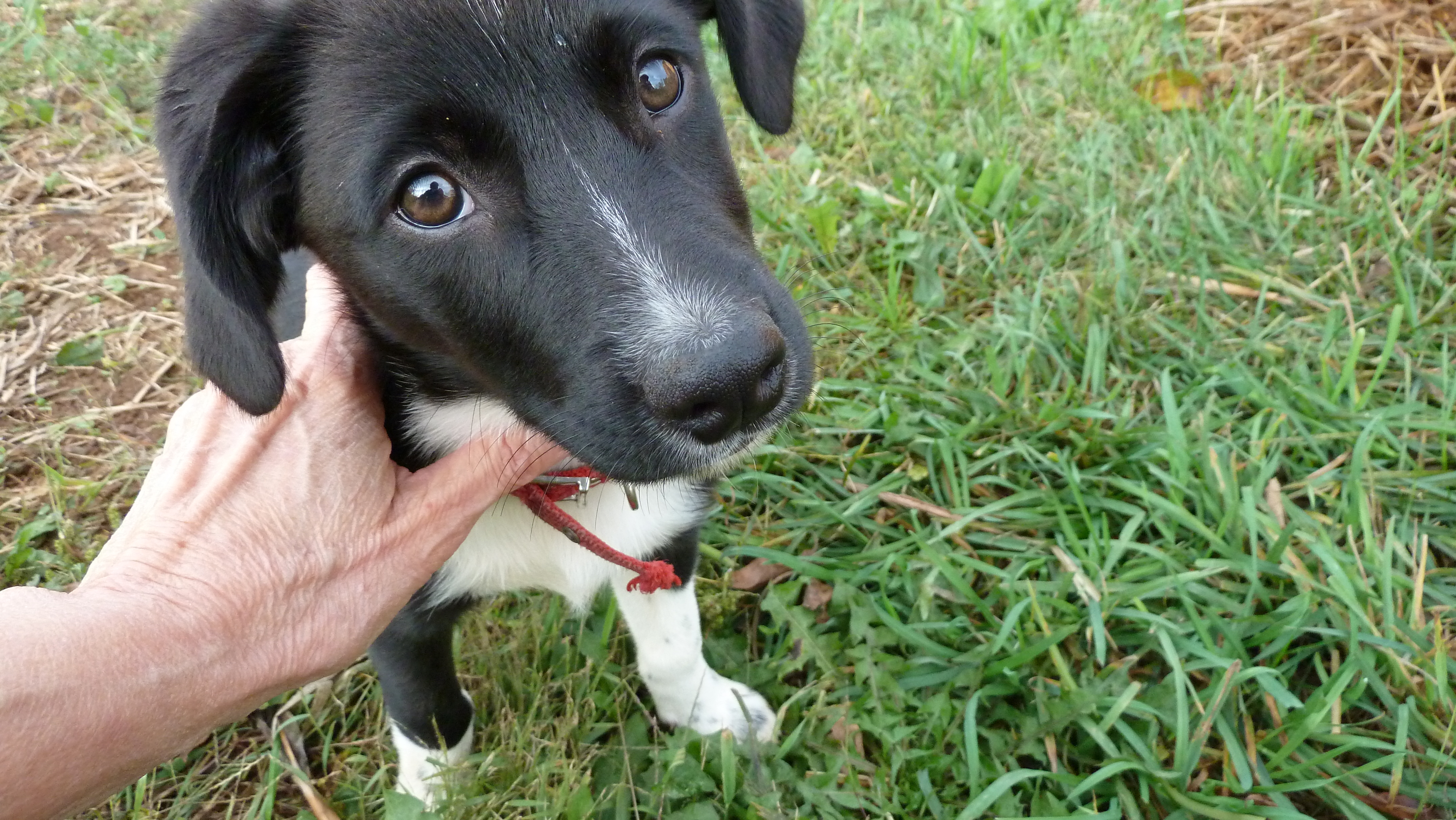
I promised to write and show our new puppy, Velvet, now nearing 4 months old. She doesn’t look like a puppy very much any more, but oh does she act like one.
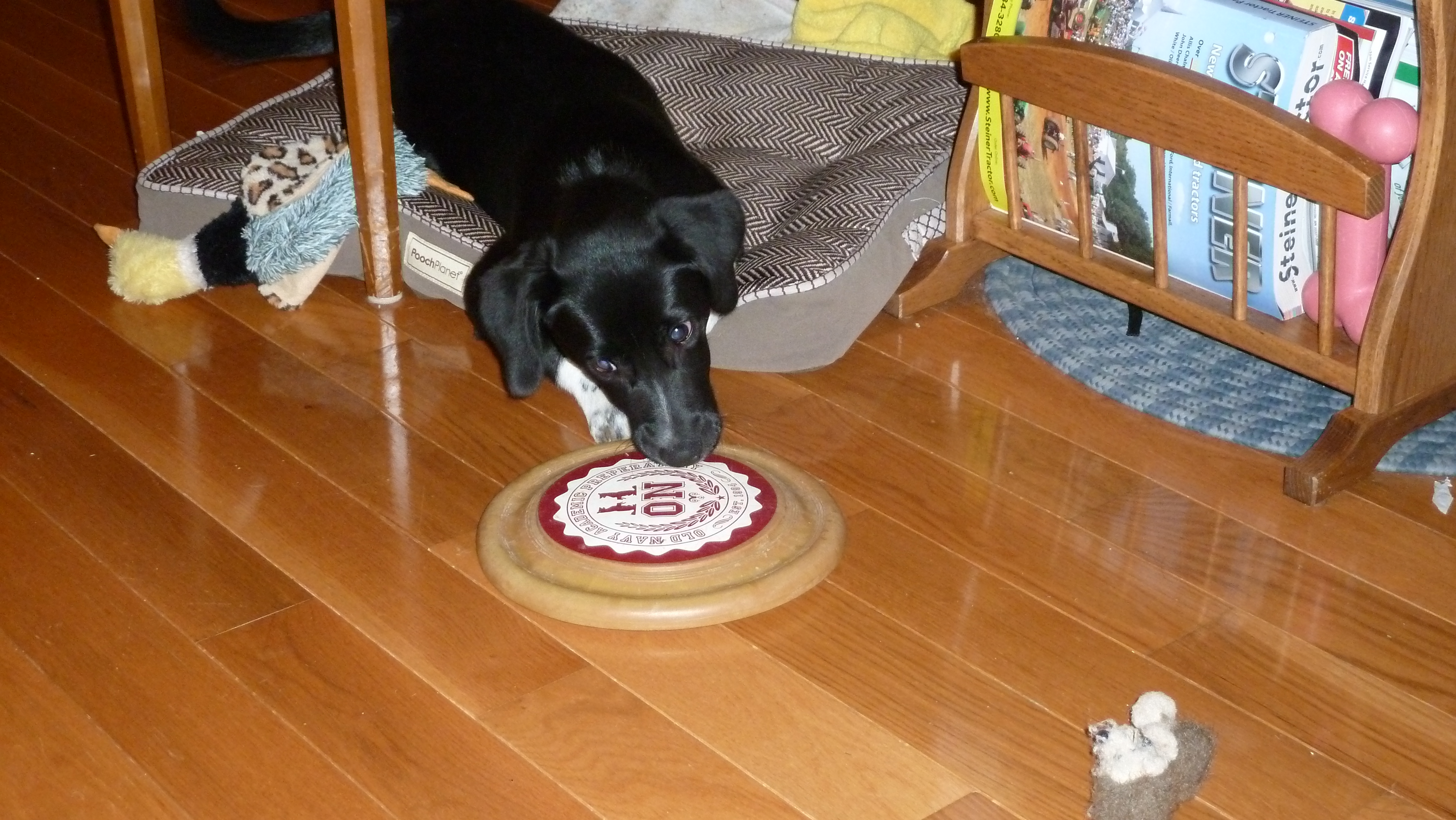
Well, after I was released from that wonderful procedure in the hospital back in October, we consulted the paper about whether anyone had any free puppies available. We had looked for a dog at a local shelter twice, and nothing was working out for an older dog, who all seemed to carry the warning “may be aggressive towards cats.” We have two.
 Our cat Riley’s domain.
We found an ad: Free puppies to good home. Australian Shepherd/beagle mix. “Let’s go check them out,” I told my husband. (Read more about that here.) I also wrote about how taking care of a new puppy reminded me of my daughters’ experiences with their newborns this past year.
 A successful early squat.
Never again will I dismiss anyone’s worry that they are not up to managing a new puppy or kitten. Pets and babies take work, are inconvenient, make lots of messes, require body flexibility and muscle, and not a few dollars.
Perhaps this is a good time to remind not only us “seniors,” but young parents too, pondering whether they should indulge the little ones begging for a pet this Christmas. Maybe you should wait ‘till a saner moment. Like when you’re 60.

 They say puppies/pets help us older people stay active, stretching and bending like here.
Of course I’m being a little on the dramatic side for the purposes of this blog. Velvet appears to be at least as smart as her owners, has taken to her crate training well with the use of a Kong, has survived her first visit to the vet (she weigh 22.9 lbs, in case you’re curious) and we are well on the road to what we hope is along and rewarding relationship.
All dogs are different, but as Velvet sits beside me in my study as I work, I remember how our last dog, Fable, was so tuned to my emotions that anytime I’d read a moving manuscript going through articles for the magazine I edit, Valley Living, and it would make me tear up or even cry, Fable would sense something was wrong and come over and put her face up to mine as if to say “I’m here. It’s alright. Are you ok?”
I want that kind of dog again.
***
What’s your best advice on training a new puppy?
I am happy to share a guest post by a Philadelphia writer, which maybe can offer some ideas of how our images of ourselves and of others begin forming very early, even from the books we read or that are available. — Melodie
—–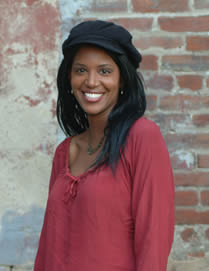 Guest blog post by Allison Whittenberg
A trip to the bookstore can make one believe that children’s books are only for white people and animal lovers. Don’t believe me? Take a trip to your local bookstore and look around.
Exhibits A through Z can be found most obviously in the children’s section. Many covers there feature animals, both imaginary and real. Prehistoric and present day. Mythical or cuddly.
Another image you’ll see is white (cuddly) children. There are some exceptions. Ezra Jack Keats’ popular picture book Whistle for Willie is usually prominently displayed, even though it’s 50 years old.

Venture into the tween section and there are fewer animals but an array of spunky girls and mischievous boys. All attractive, but insufficiently diverse. Move into the teens and the animals have vanished. The cover girls are less sassy, but model slender. The young men appear dreamy. But again, young people of color are missing in action.
I’m not alone in making this observation. Articles have run in the New York Times, Entertainment Weekly, and the Huffington Post. Most of these articles cite a study by the Cooperative Children’s Book Center at the University of Wisconsin. It stated that from the 5,000 children’s books published in 2013 that they examined, just 93 were about black people (even fewer were written by black author). This rate is down from 172 African American books in 2008 — 83 by African Americans. A low tally is also recorded for Latino, Native American, and Asian American books.
What is to be done? Plenty. To start, we could buy more books by minority writers, thus increasing demand. Of course, it’s not enough to just change the bean-counting mentality about books by minorities. There are also social problems to address, including school dropout rates, literacy issues, and the myth that reading is for nerds — or white people.
But let’s say that all those things could be improved. Still, we book-buying people of color will continue to purchase Llama Llama Red Pajama and Harold and the Purple Crayon for our kids, in part because so much of reading is pretending. For 32 pages of a picture book, the reader can imagine herself as a lovable pet or a cherubic, bald white kid. There are no mental gymnastics needed to see the humanity in these characters.
That kneejerk empathy doesn’t transfer to characters of color, though, even for us. In fact, it would seem that the message out there is that writers of color and their characters aren’t needed. Peek into the library of any book-loving young person of color and you will find it replete with the Madeline series, Pippi Longstocking, and, of course, Harry Potter. Don’t stop there. Look at Amazon’s list of “100 Children’s Books to read in a Lifetime. Aside from Esperanza Rising and The Watsons Go to Birmingham, there aren’t many multicultural offerings. Never mind the Pura Belpre and the Coretta Scott King Awards that showcase the brilliance that’s available to readers.
But forget classics for a moment. We need junk-food books too, like the best-selling The Case of the Time-Capsule Bandit by Oscar-winner Octavia Spencer. Usually, writers of color aren’t producing genre books such. Nor do you see much from them in science or fantasy fiction, or even love stories. Books about identity abound for multicultral authors, but too often those works don’t appeal to people outside of a given culture because they fear that they can’t relate — hence the aversion to the cover of a book that features nonwhite characters.
There are plenty of serviceable, lightweight books that only seek to entertain, not deliver some heavy message, featuring white, middle-class heterosexual teenagers. Just once can’t the handsome, rich insensitive boyfriend in a young-adult novel be black. Can’t the unattainable girl in a tween book be indigenous? And why must the one with the smart mouth be a sister?
With so many of our neighborhoods and schools segregated today, books that share a multicultural experience to a broad range of young readers are more needed than ever. Yes, I cringe at the thought. And, no, such a state of affairs would not make the Rev. Dr. Martin Luther King Jr. proud. We should be able to do more for our children to help them relate to all kinds of people in the real world. But if books can help open those doors, then we should make sure they are widely available. Growing up, I treasured the time I spent reading, even though the bulk of that reading didn’t reflect my race or ethnicity.
I wish I could say that just writing about this topic would make a difference, but the reality of years of poor sales for writers of color tells me otherwise.
Still, we must hope. “Books transmit values,” said the beloved children’s author Walter Dean Myers. “They explore our common humanity.”
So, writers, readers, publishers all, let’s keep exploring.
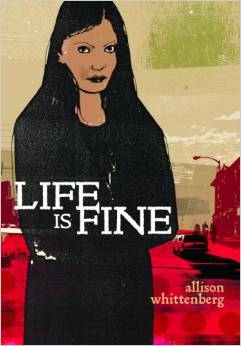
Allison Whittenberg lives in Philadelphia and writes poetry, plays and novels including Life Is Fine, a coming of age novel, Delacorte, 2008.
***
Issues of race, education, and justice all swirl in these days of deep division and discord here in the U.S. My heart grieves, but I don’t feel like I have much to add to the controversies and conversation. This guest post, related to my interests in books, writing, families and education seemed like one way to respond on this Finding Harmony blog.
I’d love to hear your thoughts, stories and responses to Allison’s post.
***
Earlier this year in my Another Way newspaper column, I wrote of some of my upbringing around race, reflecting on the life and witness of another prophetic voice, Vincent Harding, when he spoke last January at my alma mater. He was 82 at the time; he passed away in April.
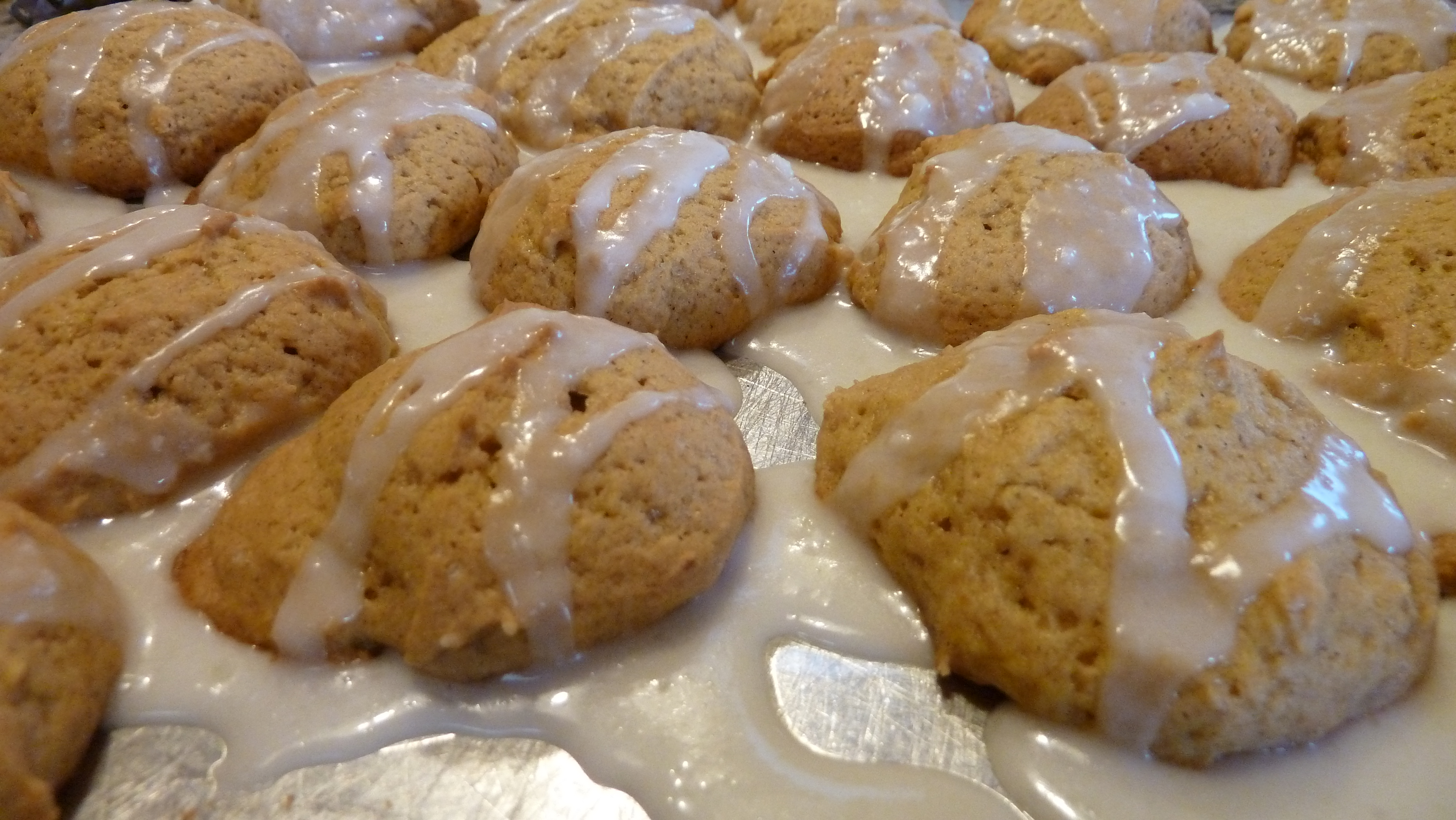
A country store near us offers a few homemade goodies like bread, cookies, and brownies wrapped as singles which go great with morning coffee. I treat myself sometimes while stopping nearby to unload my recyclables.
One day earlier this fall, the store had delectable pumpkin cookies available that were soft like my grandmother’s sugar cookies. The cookie immediately brought back memories of dunking those cookies with grandpa and grandma in their kitchen; they lived in quarters attached to ours. My grandma and grandpa were always old to me, in their high seventies when I was born, so having coffee (filled half with milk) and savoring cookies with them is one of my strong, wonderful memories.
 Grandpa and Grandma Miller in their later years.
I hope my grandsons will soon love coming to grandma and grandpa’s for cookies and other goodies, right? Cookies and grandma go together.
My second grandson was celebrating his first birthday the day before Thanksgiving (an adventure I shared here earlier) and before they arrived, I scoured my cookbooks for a pumpkin cookie recipe, to no avail. I turned to online resources and soon fell over more than I could ever use, and all pretty basic.
The recipe I chose makes cookies that are not terribly rich, have some Vitamin A value with all that pumpkin in them, and only use a cup and a half of sugar (while most cookie recipes call for two). I made some without frosting for the about-to-be-one-year-old. Surely his mother would not object??
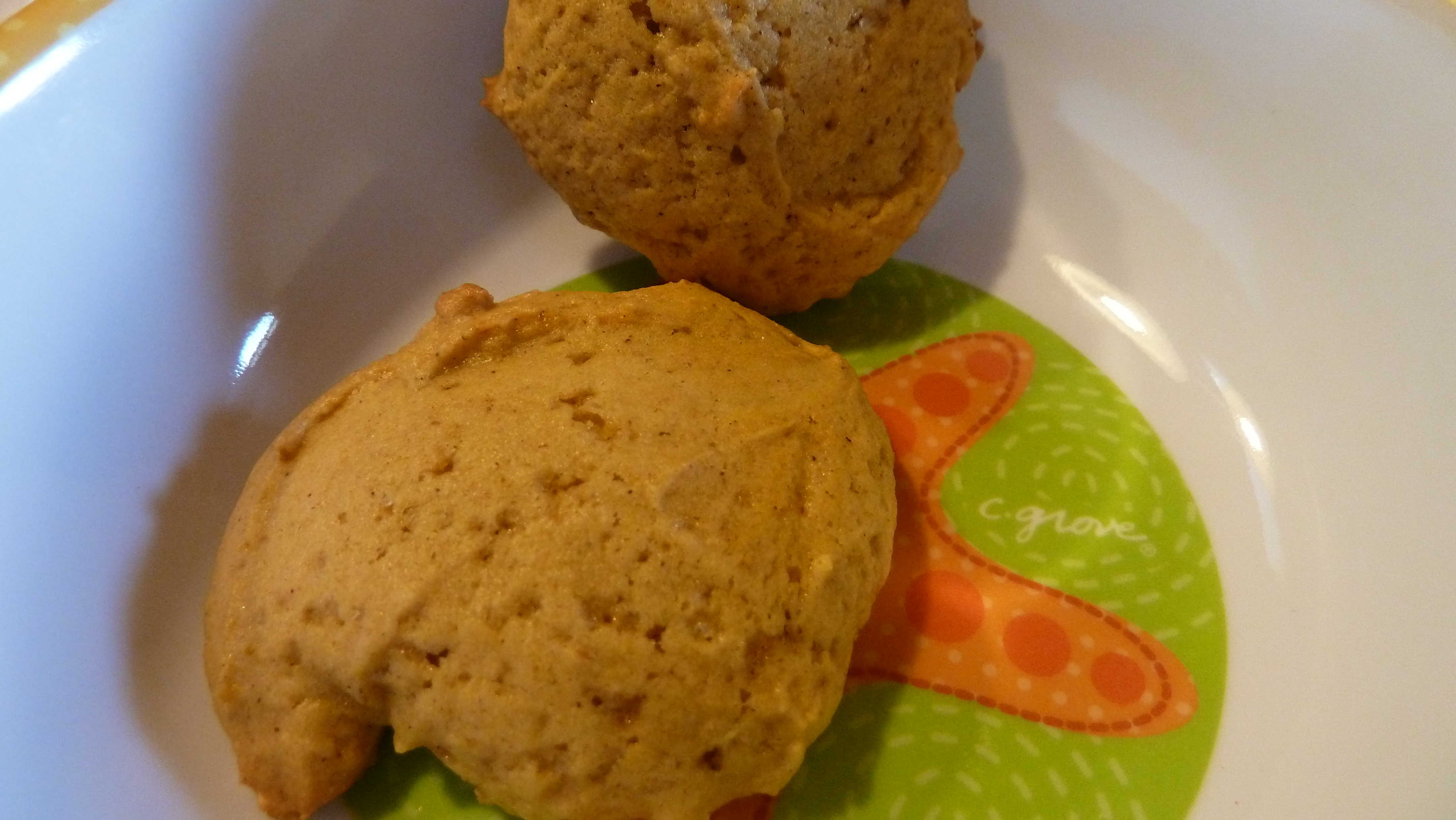
Wrong. Sweets would be withheld until the big birthday—the actual day when James could first sink his teeth into his very own birthday cake, with frosting.
It’s an interesting turning of tables when your children tell you what to do, or rather what you can and cannot do with your grandchildren. Okay, the parents rule.
So I bided my time, obeyed the rules, and on the day after his birthday, when his parents were busily packing up all their stuff to go home, his mother says, “Okay, now you can give him the cookie, Mom.”
We sit at the end of my long dining room table, just the boy and me (doesn’t being one year old qualify you to no longer be called a baby?). I don’t stuff him into his high chair, just hold him on my lap, and break off a piece of the soft cookie and hand it to him. He puts it in his mouth. I wonder what goes through his little-boy head. There is no turning away, no batting my hand back. He chews it slowly. He has been eating all sorts of good-for-you food starting soon after six months: bananas, broccoli, potatoes, even avocado, squash and zucchini, and then graduating to meats in things like chili, spaghetti, sloppy-joes, chicken (he has six teeth). I break off another piece; he uses his newly acquired pincher skill to take the next chunk with his index finger and thumb, and put it in his mouth himself. We sit there, grandma and boy, his parents scurrying with the tasks at hand so they can get on the road. He does not squirm, whine, or try to get down. It is magic. (I confess I was copying the “small boy” style of stories I have come to enjoy from Sharon Clymer Landis over at “Color My Soul” blog. I’ll try not to copy her too much.)

Here is the magic-making recipe. Perhaps you are like I am and sometimes have an extra cup of pumpkin left over after a holiday, from making pumpkin pie or other treat. This is perfect to use up any extra pumpkin you have leftover.
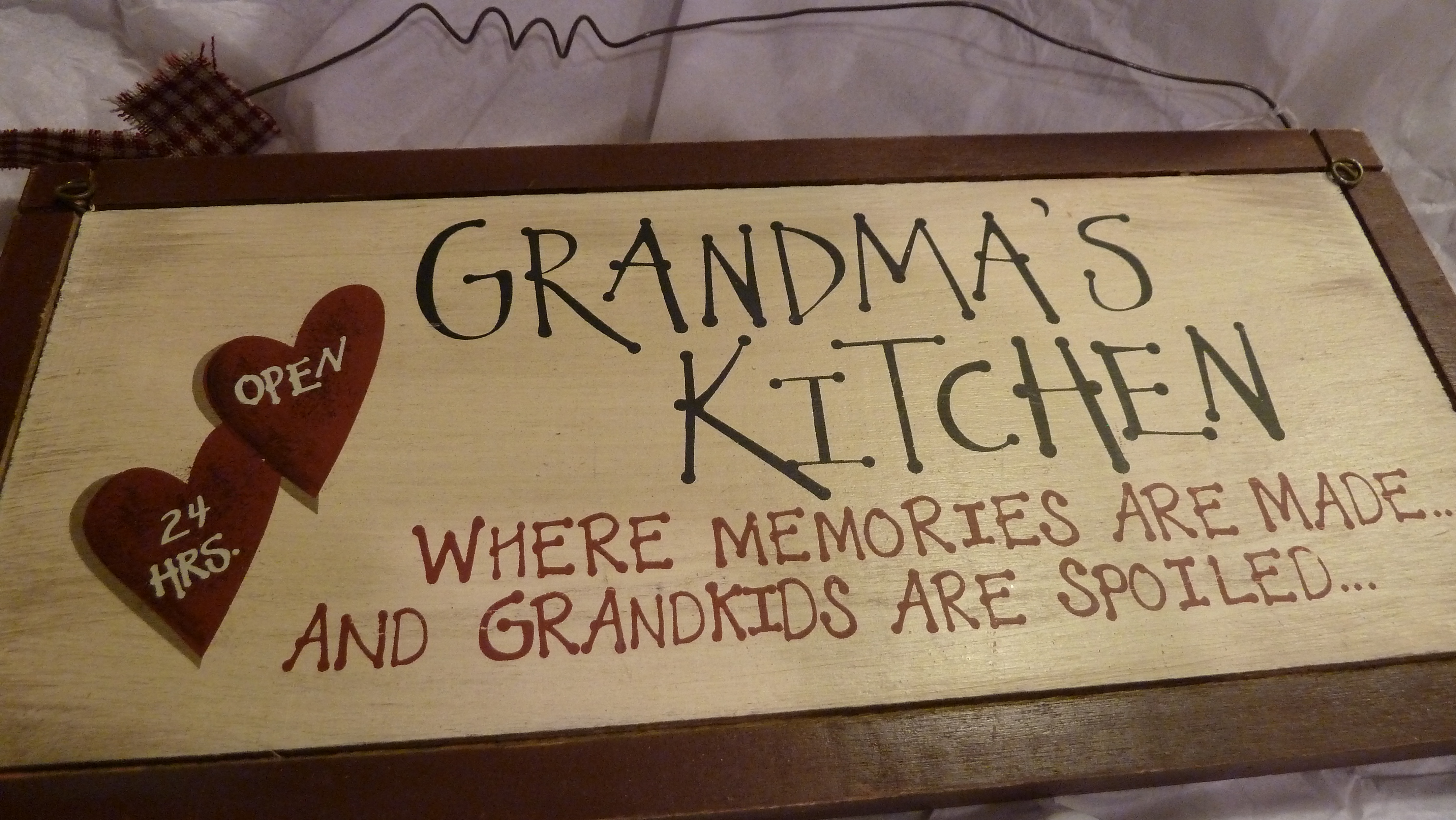
This plaque for my kitchen arrived on my own birthday, a few days later, from a dear sister. How did she know?
Soft Pumpkin Cookies (Adapted from www.VeryBestBaking.com )
2 ½ cups flour
1 teaspoon soda
1 teaspoon baking powder
1 teaspoon cinnamon*
½ teaspoon salt
1 ½ cup sugar
½ cup butter
1 cup pumpkin
1 large egg
1 teaspoon vanilla
*If your family likes nutmeg, you can add it; I left it out for those in my family who don’t like it.
Bake 15-18 minutes at 350 degrees until edges are firm. Remove from pan and cool.
Makes about 3-4 dozen.
Glaze-type frosting**
2 cups powdered sugar
3 Tablespoons milk
1 Tablespoon melted butter
1 teaspoon vanilla
Combine and beat together. Drizzle glaze over cookies.
**These cookies are perfectly good without frosting, too, as James enjoyed. I’m reminded of Doris Janzen Longacre’s (author of More with Less Cookbook) famous poem “Life is Too Short” where she says “Life is too short too ice cakes. Cakes are good without frosting.”
***
What magical moments have you enjoyed with a child recently? Or longer ago?
Have your kids told you to rein back in treating their kids? Or, do you wish you could tell your mom or dad NOT to do something?
I would also be interested in hearing of any great pumpkin cookie recipes you have found or use.
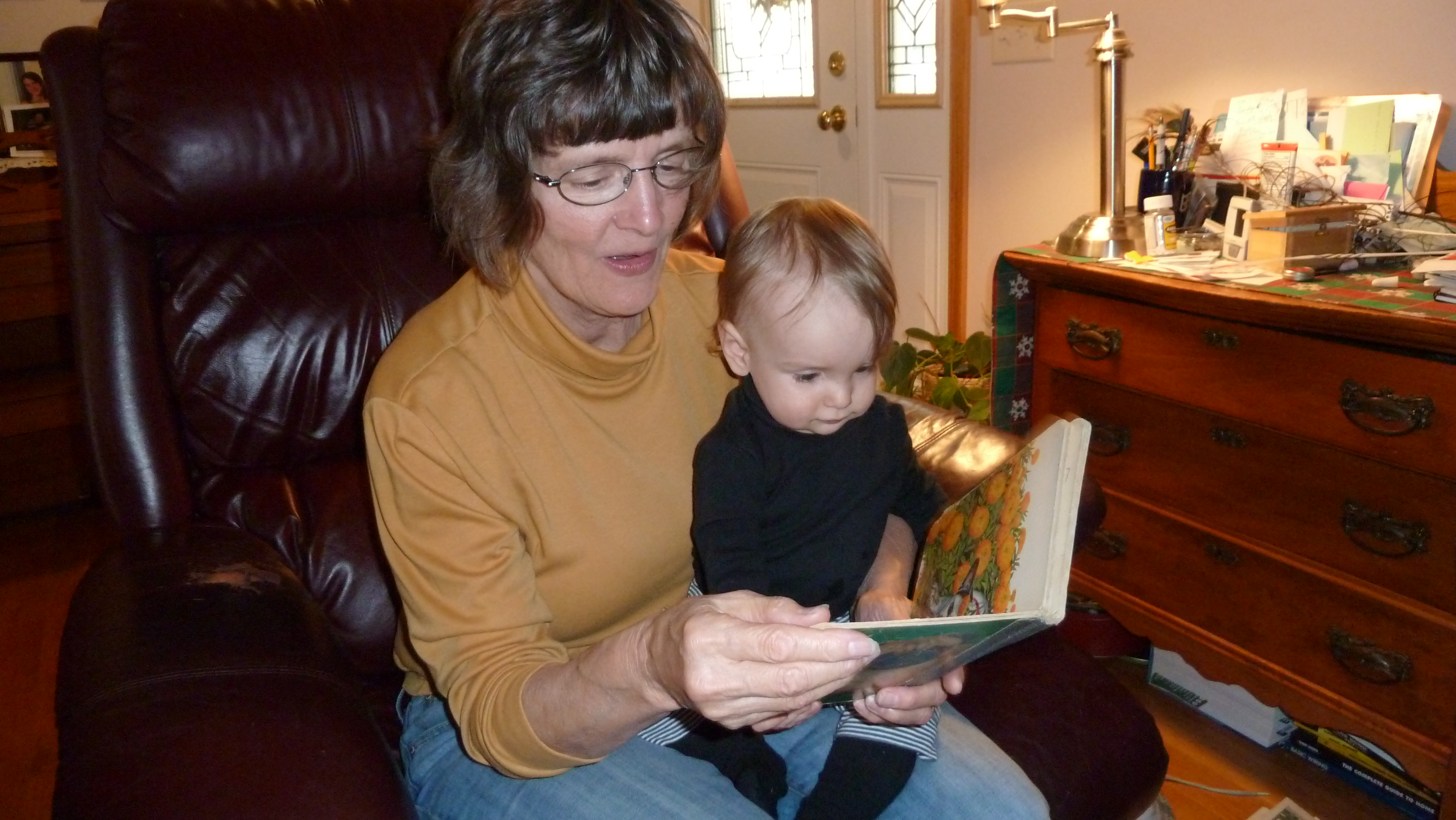 James and Grandma enjoying a favorite old book, Puppies.
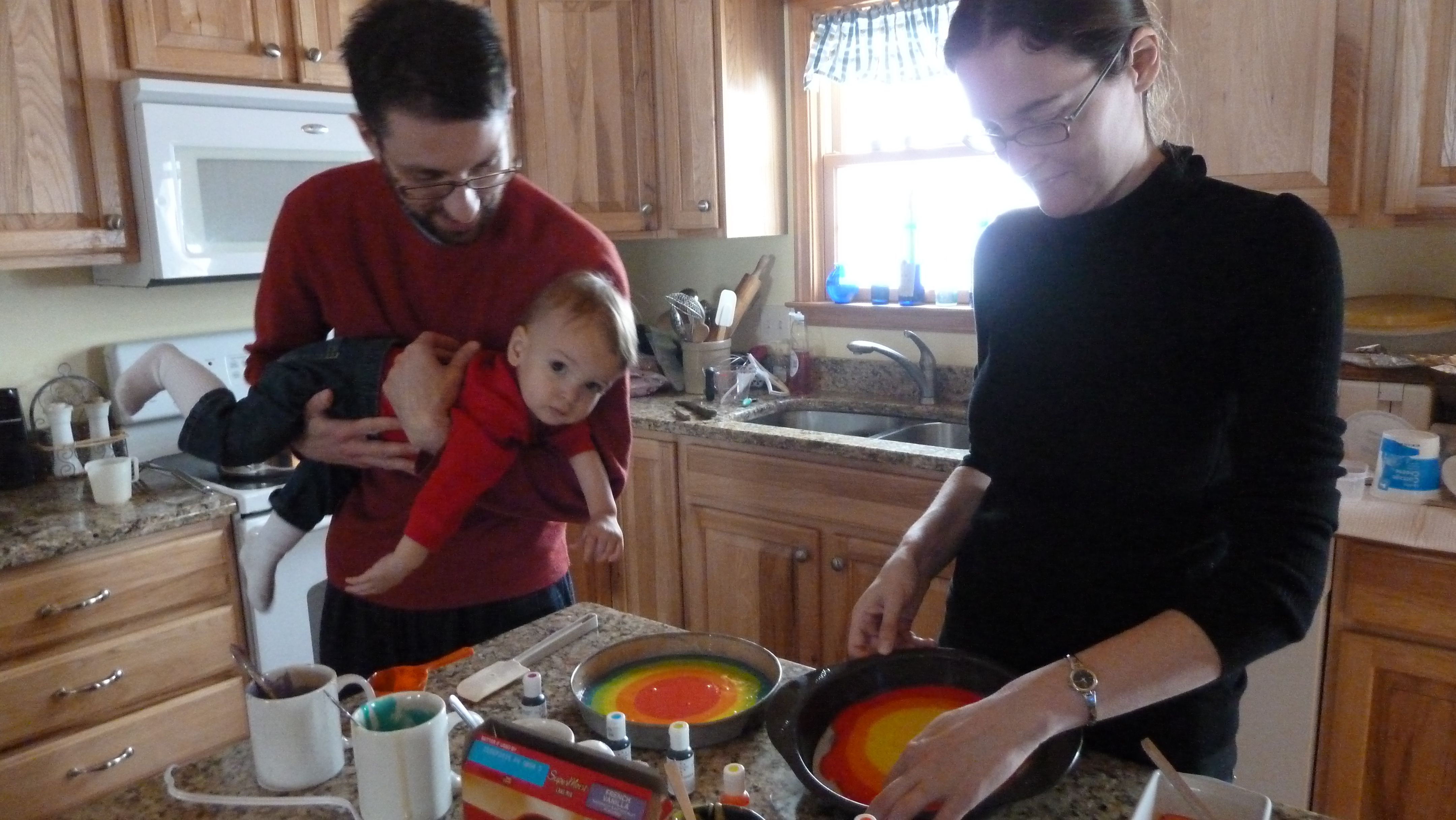 A flying James, held by his father, Brian, inspects the progress on his first birthday cake.
How many one-year-olds today have their first birthday cake baked an old primitive way, over a fire, in a woodstove?
We had planned to celebrate our second grandson James’s first birthday last Wednesday, the day before Thanksgiving.
But the snow started falling early Wednesday and fell steadily throughout the morning. In this part of Virginia, that’s a little unusual for Thanksgiving, in fact most of us around here had a hard time remembering when we’d had a significant snow on or around Thanksgiving.
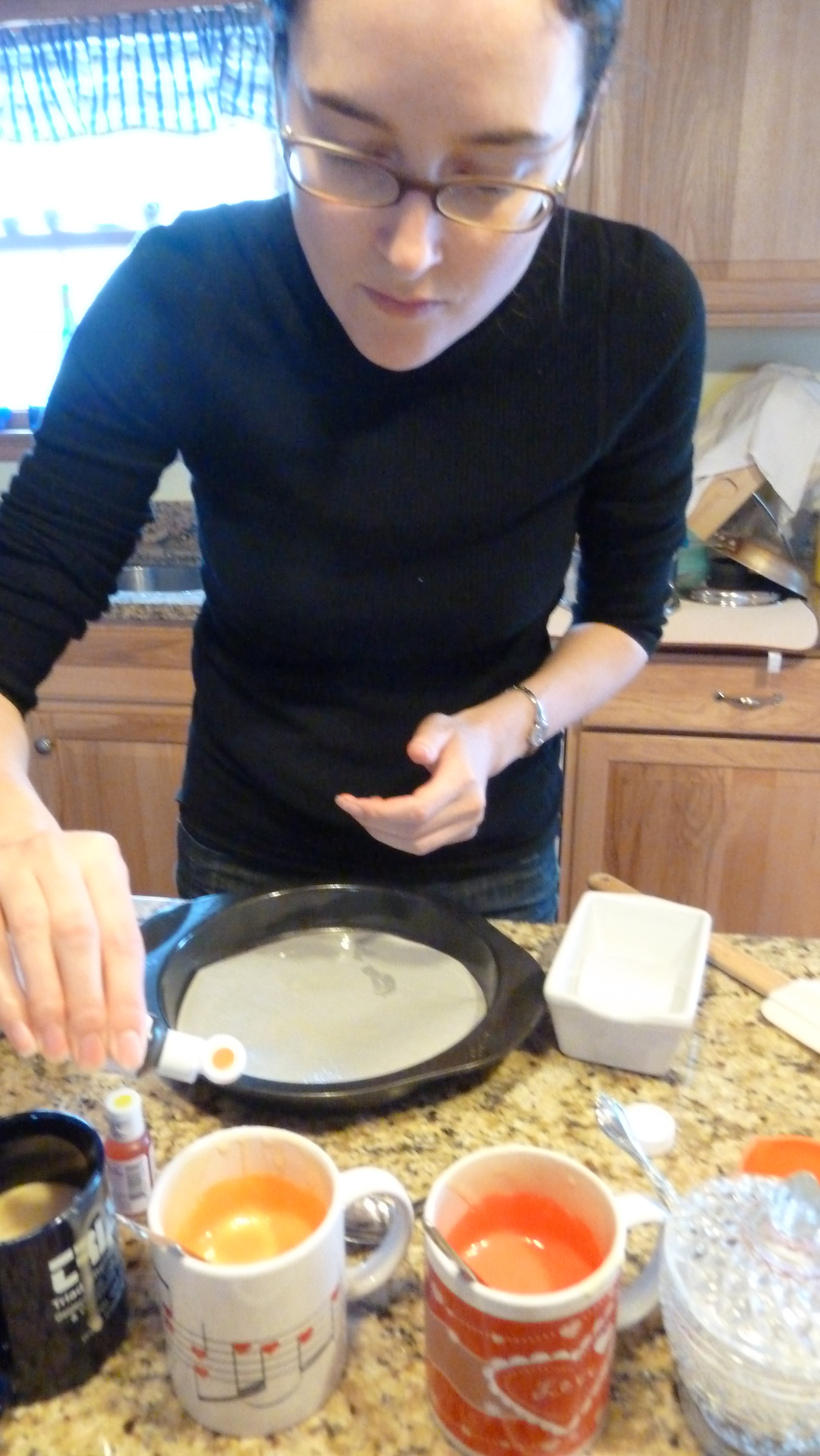
My daughter Michelle was in the middle of making the birthday cake for her son when the lights blinked and then stayed off. The oven, which had been pre-heating, went off too, of course. It took a minute for everything to soak in. The electricity was really off off. Would it come back on? When? How would she bake the cake? Already she had spent a good hour preparing the batter.
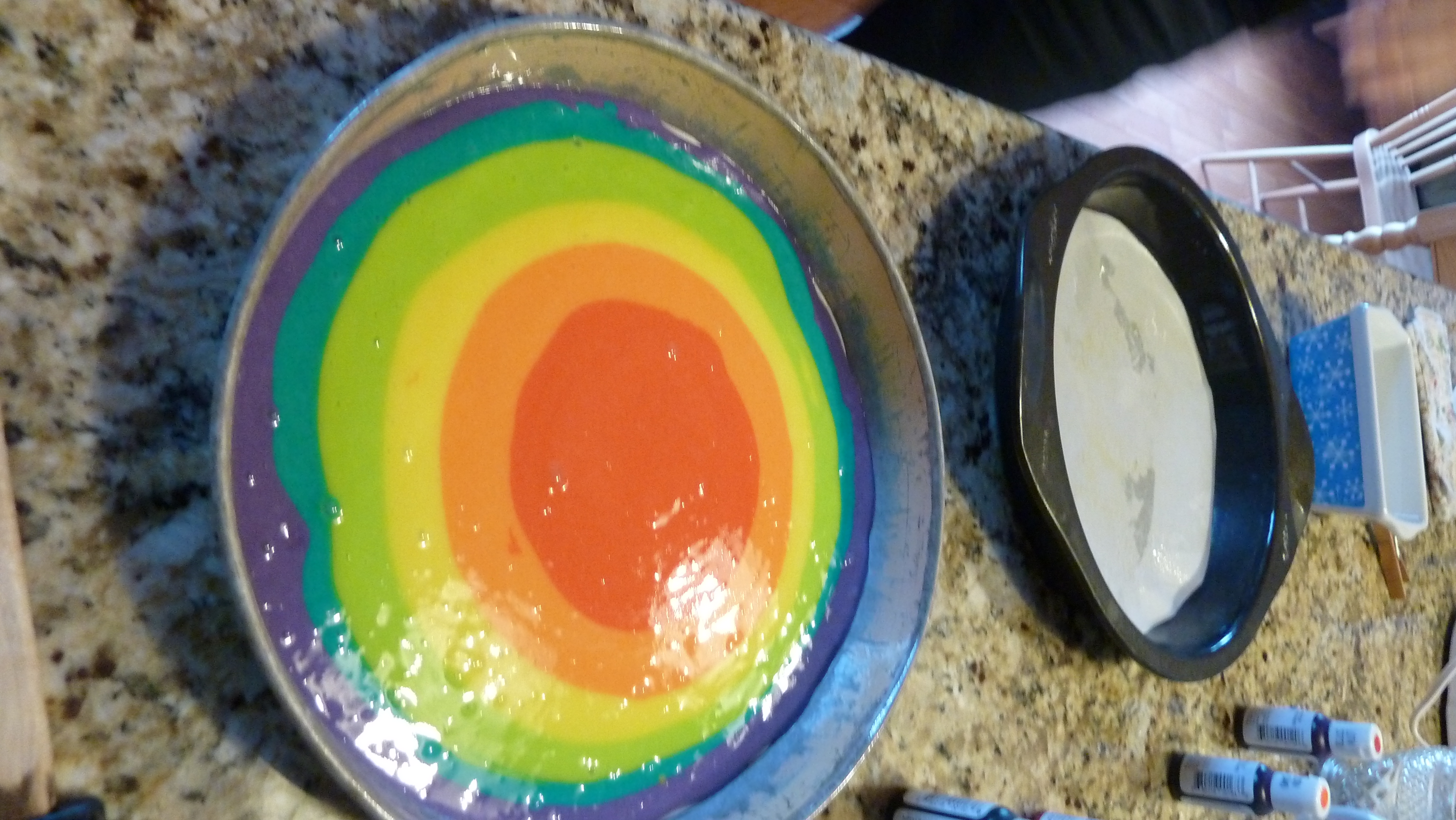
For this wasn’t just any cake. It was a “Tie-Dyed Rainbow Cake,” which Michelle had learned about proofreading the Mennonite Girls Can Cook: Celebrations cookbook for Herald Press two years ago. On pages 60-61 of the cookbook, the deep colors of a beautiful cake topped by white icing caught her imagination, and I think before she even got pregnant, dreamed of one day making that cake for a child of hers.

It takes six different pots of colors—made with the currently popular gel food color that create much brighter colors than the old liquid food coloring many of us grew up using. She had cut the parchment paper liner so carefully too—having learned that the batter would stay in better circles if the edges of the paper laid flat instead of getting crunched up by the sides of the pan.
But now, all that painstakingly colored and spiraled batter would soon be loosing its leavening agents, wouldn’t it? Doesn’t baking soda go flat? The snow was still falling. Would there be a party? How could we bake the cake? The roads were too snowy to consider driving to a neighbor’s house at that time.
Michelle looked to me and her sister, Doreen. “Is there any way we could bake it in the woodstove?”
 Doreen babysitting the cake in the basement woodstove.
Doreen and I looked at each other, and instead of dismissing it, said, “Well, let’s see!” People made cakes in wood cook stoves long before there were electric or gas stoves.
I dug out the grilling rack I use to make hot dogs and hamburgers in the woodstove; we found a piece of wood that was flat on one side on which to anchor the rack. We covered the cake pan with foil to keep ashes off and proceeded—carefully and slowly—to cook one layer. Doreen patiently babysat the cake layers and the separate, smaller loaf cake that would be for James (we could only get one onto the grilling rack at a time).

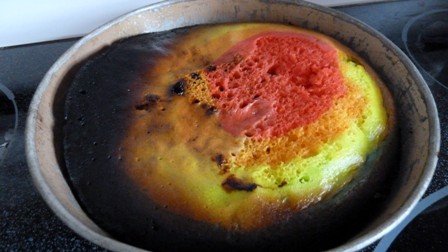 (Top, edible layer; bottom, burned layer, which we discarded)
Eventually (long story made short) we ended up with one edible layer along with a little loaf cake for James. Michelle took it all in stride: in the great scheme of things, matters could be a lot worse, and oh well, we’d just have a great story to tell him instead of pictures of a beautiful cake.
The snow stopped, the snow plows came through and my son-in-law shoveled two paths out the driveway (my husband was at work). Our electricity still hadn’t come back on so we changed the party location to my son-in-law’s mother’s house (James’s other grandmother) about 15 miles away. My husband got home, showered at my office, and we were soon all on our way. I so appreciated Grandma Jeannie hosting the party at the last minute!

And the little boy and his birthday cake? After eating his supper, listening to us sing “Happy Birthday dear James” and his mother blowing out his candle, he picked that cake right up and just bit in like he knew exactly what to do with it, even though it was the first cake he’d ever been given in his life.
 Um, Mom and Dad, did you really mean to give me this whole huge big piece of cake?
 Hmm, I guess so! Well, here goes!
Our pictures and cake didn’t quite turn out like the lovely photos in the cookbook, but did James care? Not one iota.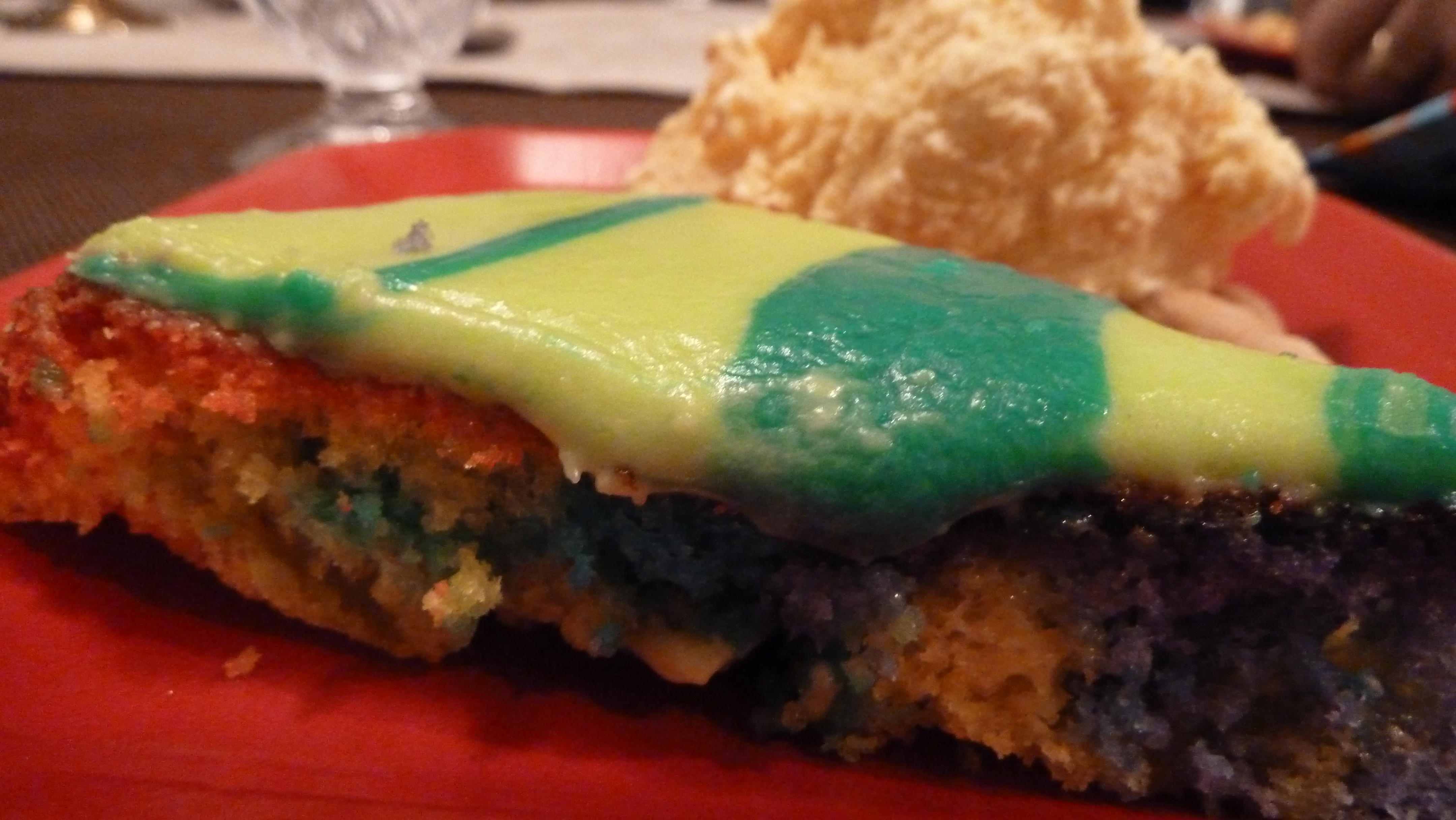
Tie-Dyed Rainbow Cake Recipe (as adapted by Michelle to make a smaller* 2 layer cake). See original post, and gorgeous photos, at author Judy’s blog, here.
Cake
1 white cake mix
3 eggs1/2 cup vegetable oil
1 cup water
gel food coloring
1. Preheat oven to 350 degrees.
2. Prepare 2 9-inch round pans, lining bottoms with parchment paper and spraying with cooking spray.
3. Empty cake mix into large mixing bowl. Add eggs, oil and water.
4. Stir until combined, then beat on medium speed for 1 minutes.
5. Divide batter equally into 6 individual bowls or mugs.
6. Add gel coloring to each bowl: purple, blue, green, yellow, orange and red. In the first pan, pour half the purple batter into the center. Carefully add the blue batter right on top of the purple, followed by green, yellow, orange, and red. Do not stir!
In the second pan, use remaining batter in the reverse order, beginning with red.
Bake for about 25-30 minutes or until toothpick inserted in center comes out clean. Cool. Frost when cool.
(*Judy’s original recipe uses two cake mixes and 4 eggs, for a large, taller cake. To figure out how much water to use, in a 4-cup measuring cup, combine eggs and oil, and then add enough water to make 3 cups of liquid.)
Use your favorite white frosting, or this from Mennonite Girls:
2 packages vanilla instant pudding (4-serving size)
2 cups milk
1 16 ounce tub frozen whipped topping, thawed
Combine pudding mix with milk and beat for 1 minute. Fold in whipped topping until nicely mixed. Cut a thin slice off the top of 1 cake layer to create a level top. Place layer on cake plate. Spread a generous amount of frosting over layer. Top with second layer, and frost top and sides of cake. Decorate with sprinkles, if desired. Refrigerate until ready to serve. (Original by Judy Wiebe)

***
If you have a copy of Mennonite Girls Can Cook Celebrations, do check the recipe and photos for more in the way of a tutorial. If you don’t own the book, it is a drop-dead gorgeous book and 40 % off (new jacket on book) until Christmas, over at the MennoMedia store.
The authors generously donate all royalties on their books to projects that benefit children.
***
There are also a dozen or more illustrated lovely kids’ birthday cake ideas from Judy here on the Mennonite Girls Can Cook blog.
***
And yes, we already celebrated one first birthday this year: my first-born grandson’s birthday party story was posted here!
We enjoyed an early Thanksgiving on November 1. Hey, if our Canadian friends can have Thanksgiving the 2nd Monday in October, why not celebrate Nov. 1. We’ll have another next Thursday of course (with not quite everyone here), but these days, whenever the kids can come home, or the family can get together, make it work. I’ve heard of some families celebrating Christmas in late January.
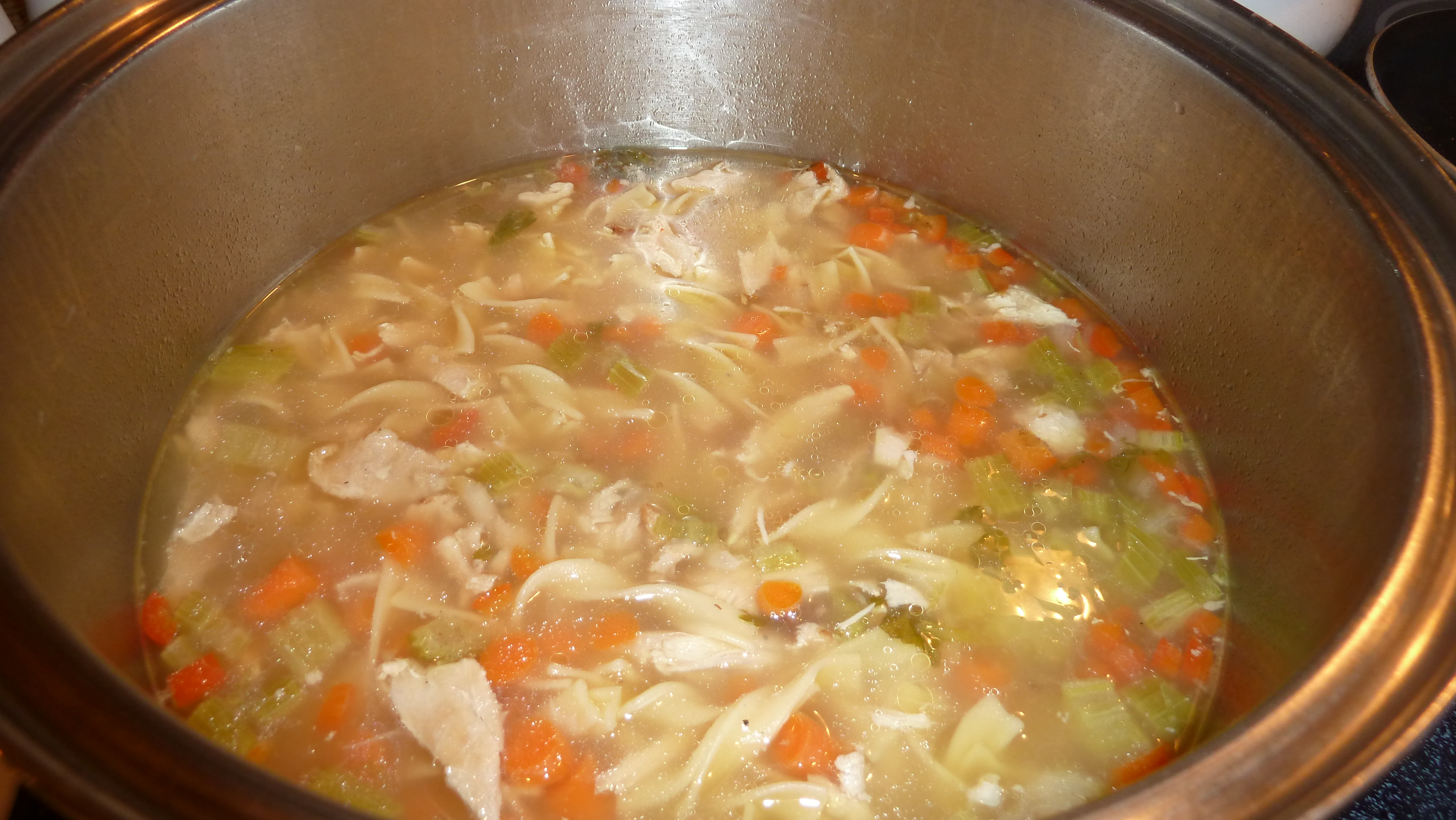
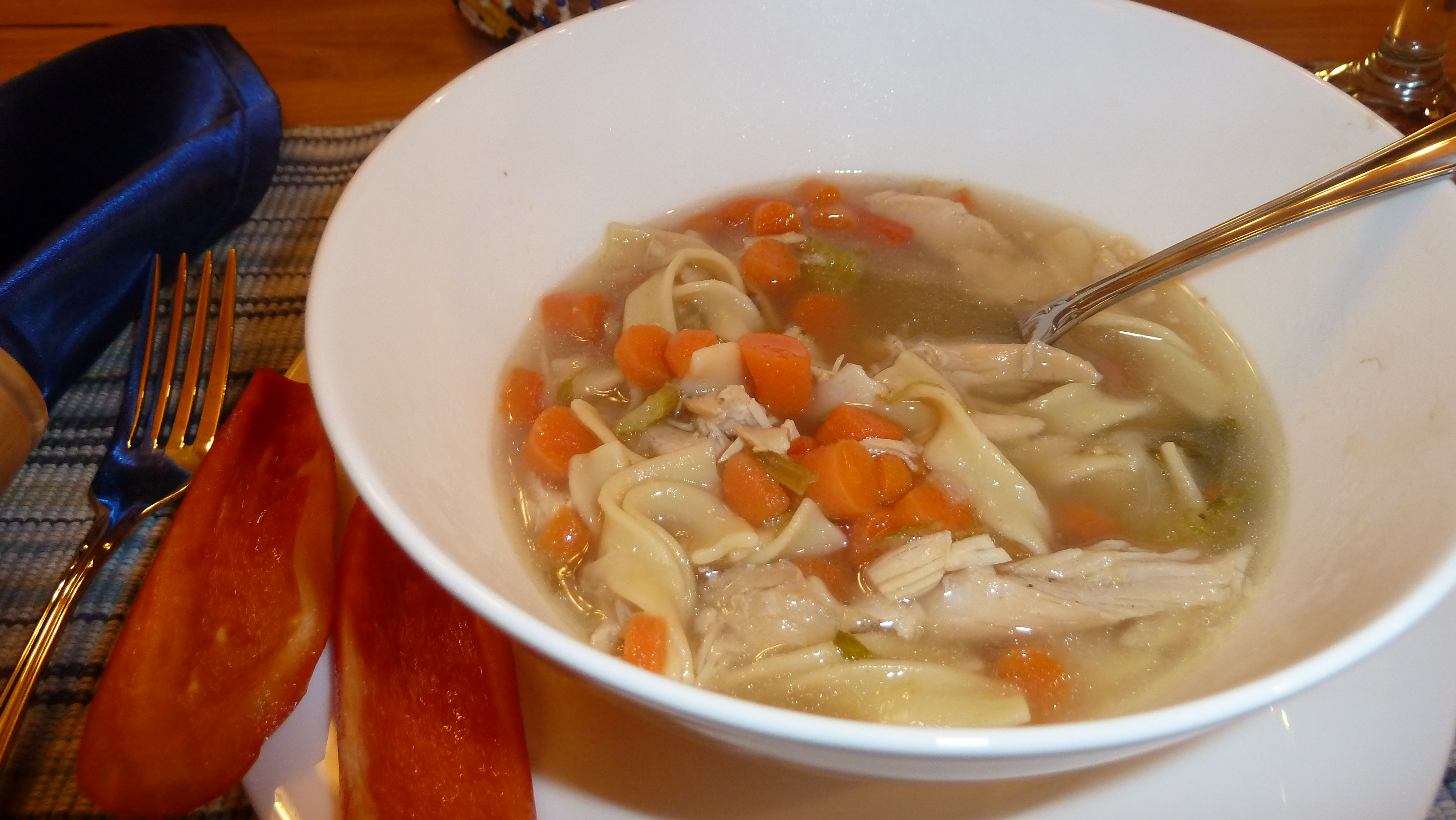
So, I had a leftover turkey breast carcass, meat picked off the bone, and broth. I also had saved pork sausage broth in the freezer and sweet red peppers from the garden. Would all of that make a good soup?
I had everything but the noodles. I waited an extra day to avoid making a trip to town, and cooked up a hearty and satisfying soup with the approximate quantities found in the recipe below. That, of course, is the grace of most soups: you can cheat or add and improvise to your tummy’s content. I especially liked the rich flavor the sausage broth added. We love Mild Gunnoes Sausage, a regional (Virginia and West Virginia) brand that is high quality ground sausage, seasoned well but not too spicy.
While leftover turkey soup recipes abound online especially this time of year (here and here are two to compare), this was something my mother never made when I was growing up because she never cooked a turkey that I can recall. She didn’t really like turkey—the old complaints about it being too dry. That was before cooking a turkey in an oven bag made it SO easy, which also helps to keep the bird juicy. I can’t imagine not cooking turkey for our family—to the extent that if we’re invited away and won’t have a leftover turkey sitting around, I often do cook a breast just to have the leftovers and all the turkey broth goodness.
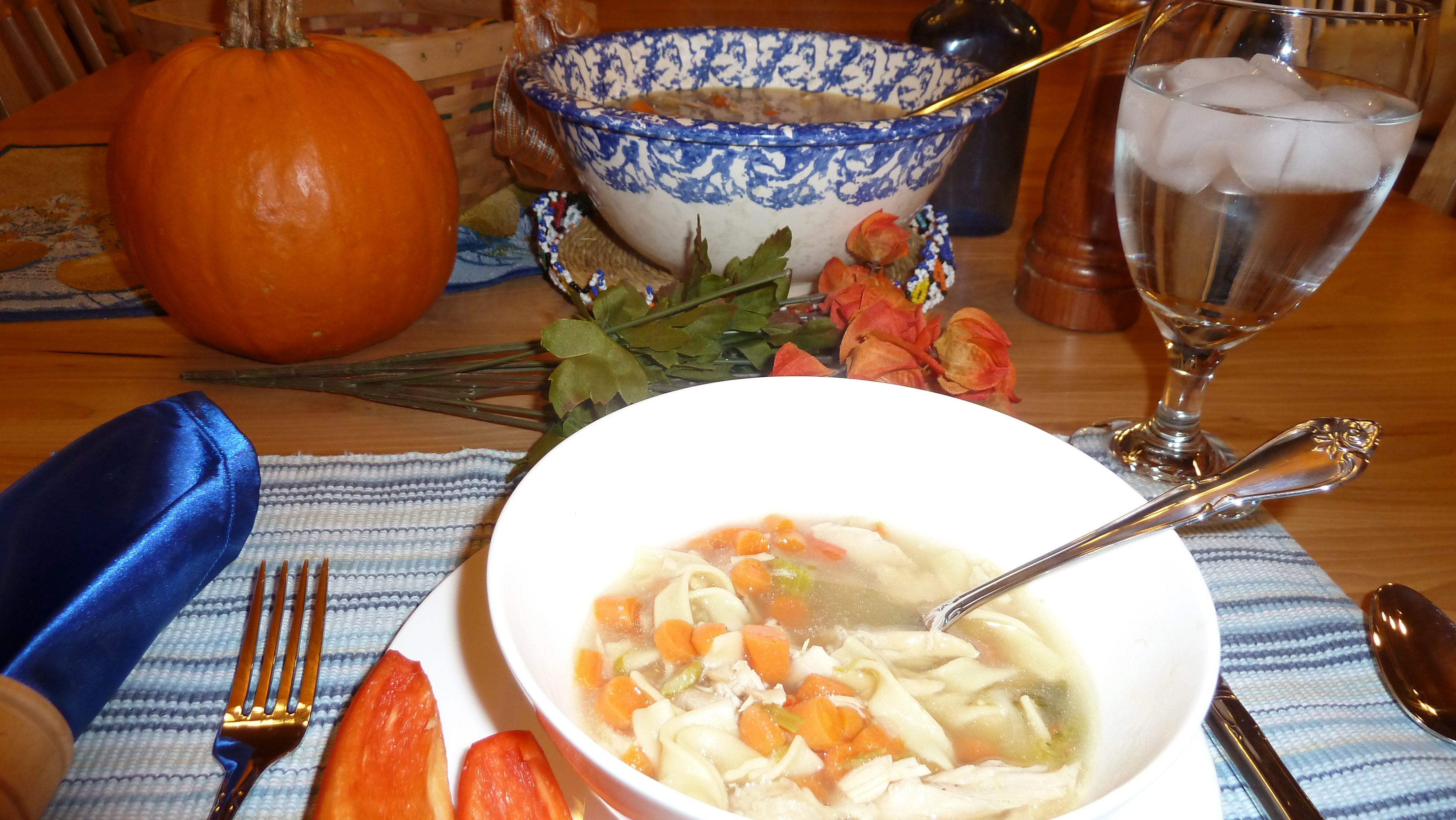 Turkey Noodle Soup
Turkey breast carcass*
2 cups cooked leftover turkey or chicken pieces, shredded or cut up to smallish size
2 cups turkey broth
1 10-oz. can chicken broth
1 cup sausage or pork broth
2 cups medium (or small) dry noodles
2 stalks celery, chopped
1 medium onion, chopped
½ sweet red pepper, chopped
2 carrots, chopped, quartered (approx.)
Salt and pepper to taste (try ½ tsp. each), and other spices as you like (curry, cumin, poultry seasoning, bay leaf)
Boil turkey carcass to create broth by adding enough water to cover carcass in 5 quart (or similar) size pan. Add salt, pepper, and a handful of celery leaves (cut from celery stalks) to mixture as it cooks. Cover and simmer for one hour or so.
Remove carcass from broth. Cool at least ten minutes. Pick off any remaining meat to add to the leftover turkey pieces you have on hand.
Leaving broth in the pan, add chopped turkey, other broths according to how liquidy you like your soup, noodles, celery, onion, red pepper, carrots plus seasonings. Bring to boil. Turn to simmer and cook for about ½ hour.
*Quantities would differ if using a larger size whole turkey carcass. Here’s another cook’s pictorial on how to cook off broth.
Freeze extra quantities in lunch sized containers for quick and hearty lunches in January!
***
What do you like best for Thanksgiving dinner: turkey, ham, oysters, salmon? I’ve heard of families where all these various traditions are enjoyed. For fun, take my poll:
***
For a variety of recipes for favorite family holiday foods, ways to use leftovers, and other recipes, see my book Whatever Happened to Dinner available here.

 findingharmonyblog