

Last week I wrote about my Aunt Susie who traveled the Midwest teaching Summer Bible School most of 44 summers.
This week I want to remember my lovely Awesome Artist Aunt Florence Yoder of Wakarusa, Indiana.
Just yesterday one of my Facebook friends, Richard Kauffman, senior editor at Christian Century, posed this question:
Have you ever thought about the artists among us as gifts to us? (I’m using artists here broadly to include writers, composers, musicians, actors, etc., as well as painters, sculptors, photographers.) Do you ever thank them for what they contribute to our lives?
Aunt Florence Yoder, homemaker, artist and lover of flowers
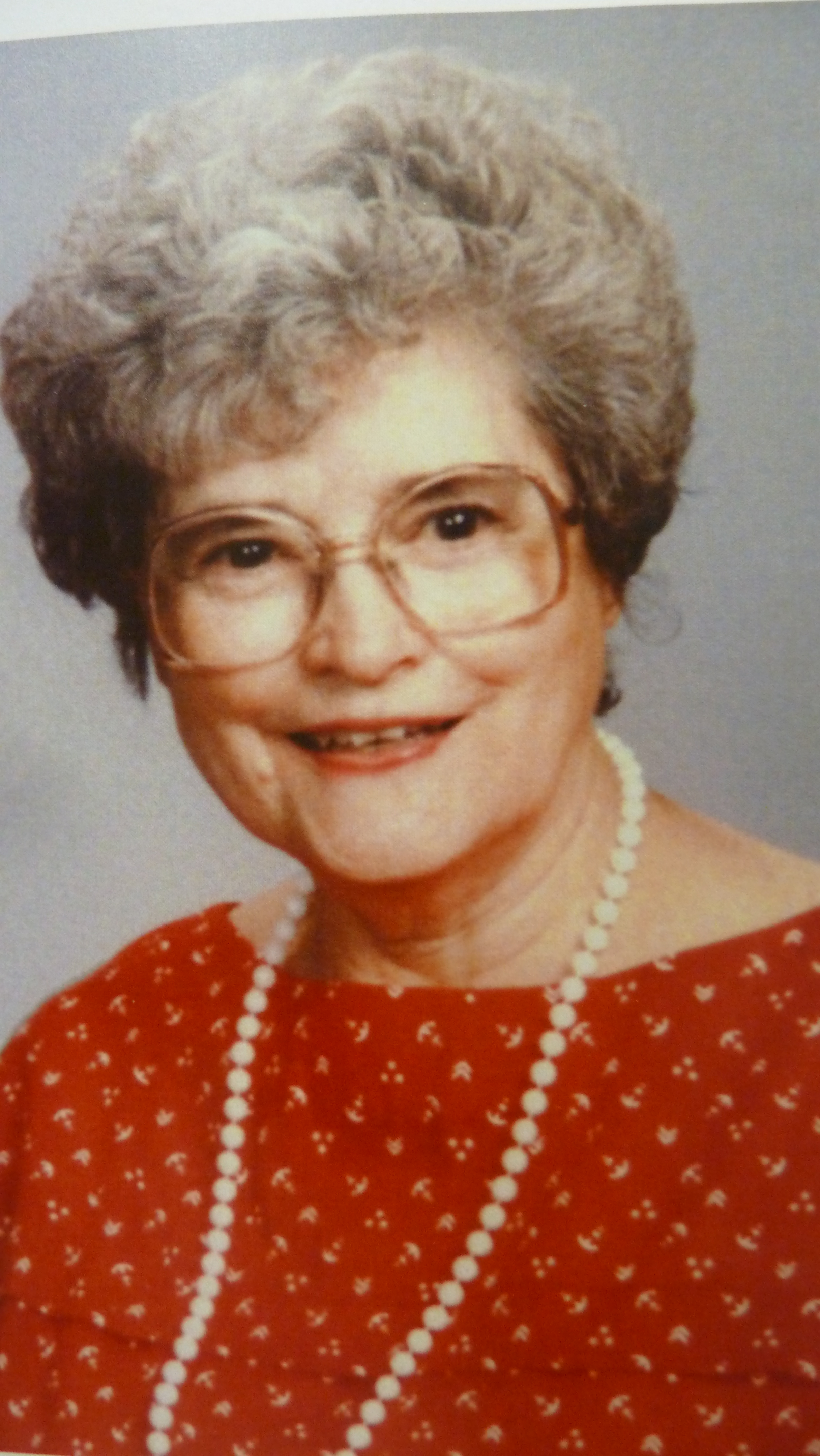
I did not know Aunt Florence well, never traveled with her but stayed overnight with my cousin occasionally and I loved going to their house because 1) they had a TV long before we did and 2) my cousin had really cool Barbie stuff (when I was not allowed, my mother thought I was too old for Barbies). Cousin Judy even got the Barbie Dream House at one point and I was smitten with jealousy.
Florence was my mother’s only sister (they had one brother, Paul Stauffer) and was a true artist at heart. I loved looking at her watercolor paintings on walls and propped at various places throughout her house—many of which won awards at shows throughout the northern Indiana region. I think her example even led me to enter an art exhibit in the children’s division in my hometown of Middlebury (and win a ribbon), where her own painting of the Bonneyville Covered Bridge won a prize in the adult division.
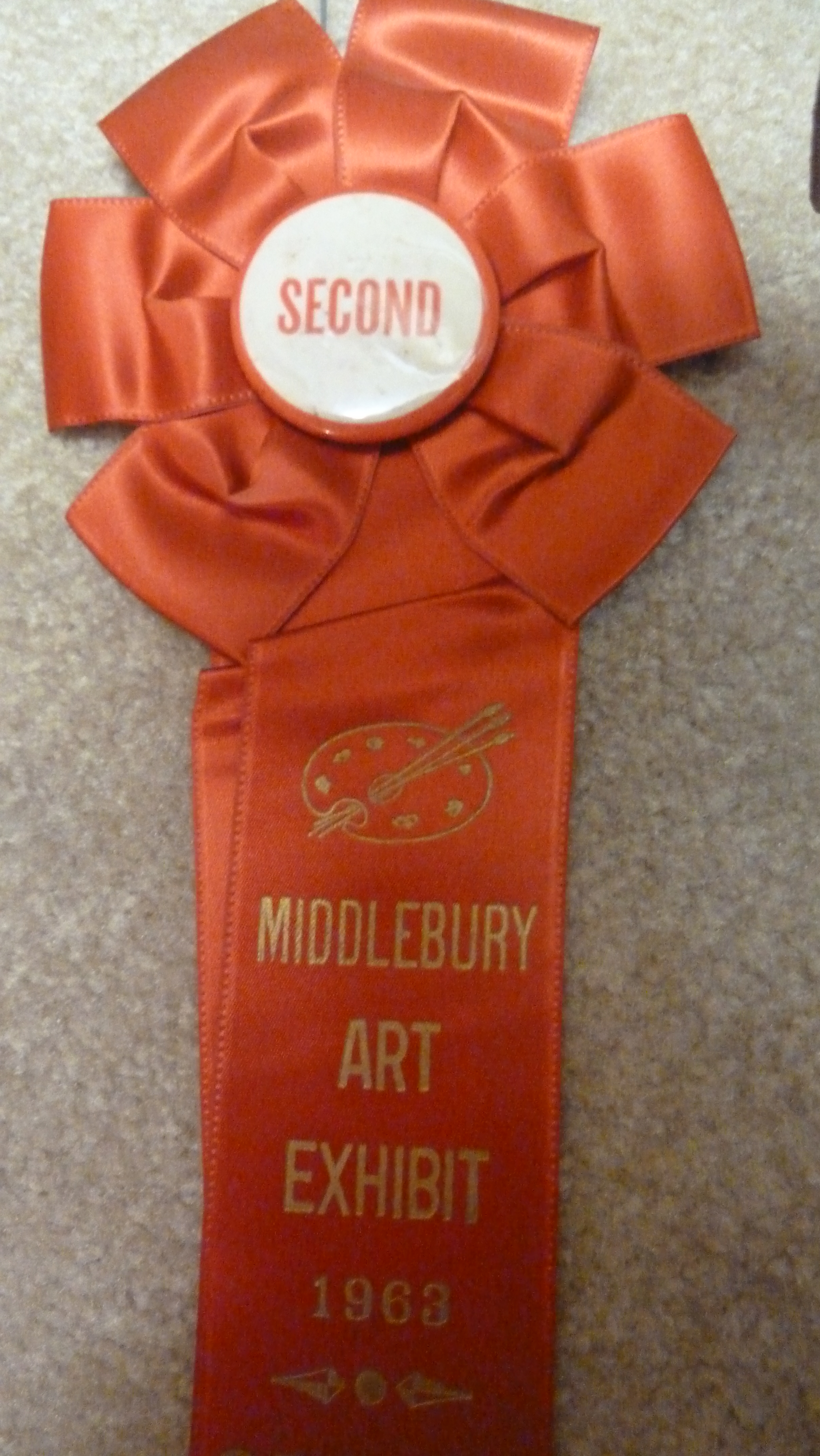
The fact that I still have the ribbon attests to how cool I thought it was to win a ribbon in the same art contest where my aunt ribboned. (I took oil painting lessons the year between college and when I got married but eventually decided I needed to quit “dabbling” in so many hobbies and focus on writing in order to improve in one area.) However, her own daughter, Judy, went on to major in art and has taught art for many years at a school in Ohio.
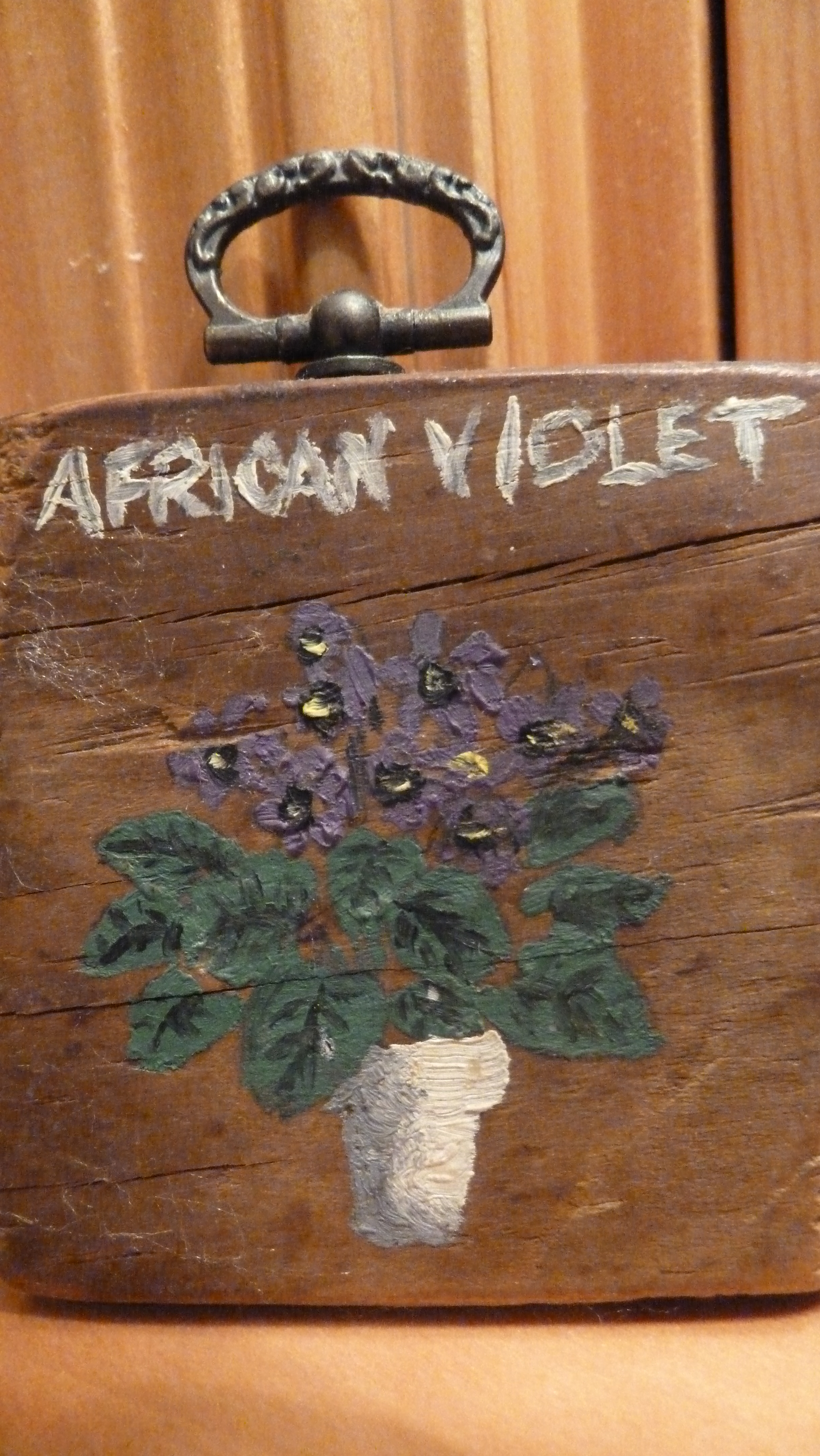 My oil painting on wood, depicting my aunt’s favorite flower.
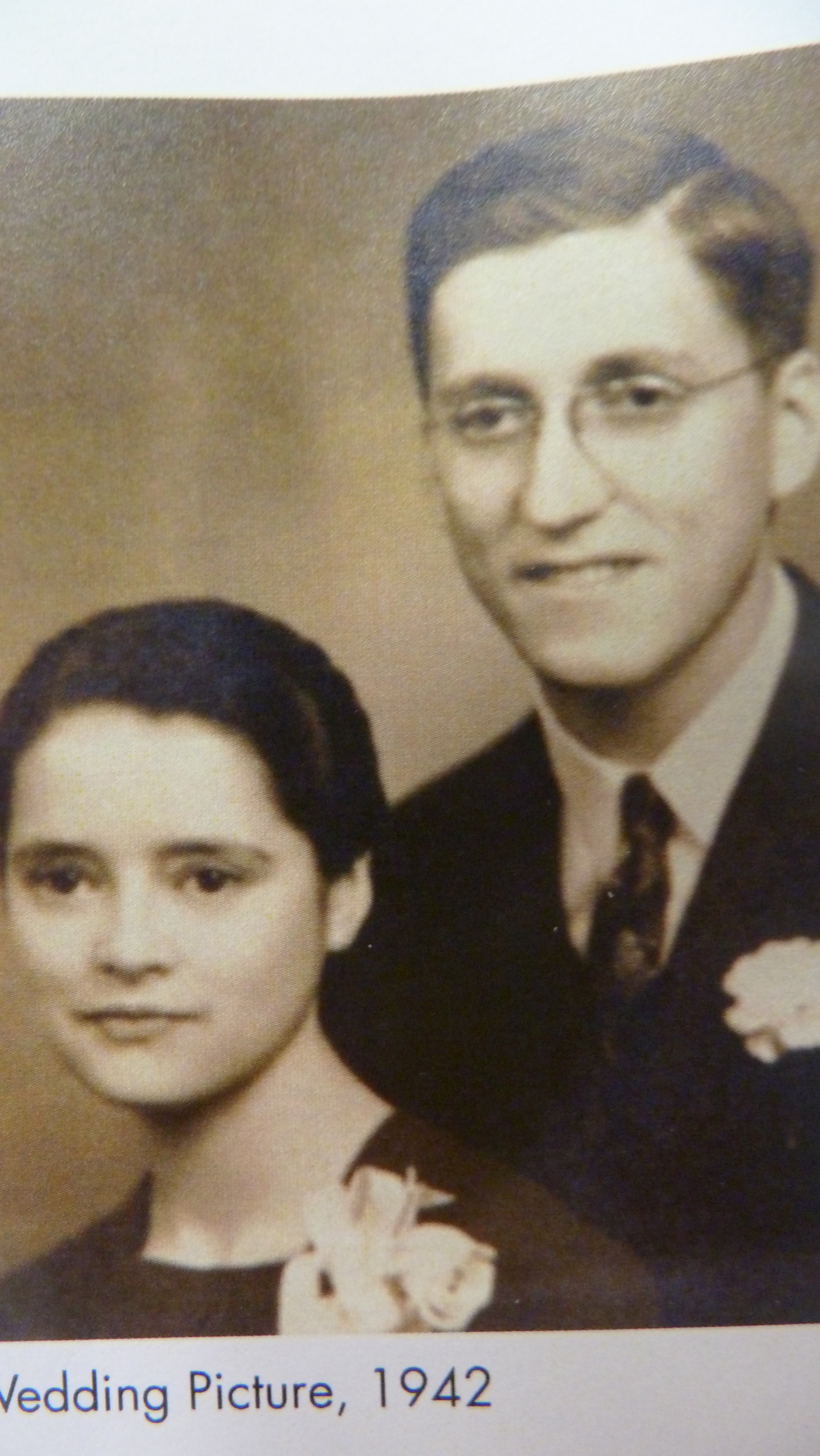
Aunt Florence and Uncle Dave traveled a lot—mostly camping—and Florence used those occasions to widen her scenery from flat Indiana to Rocky Mountains and Yosemite and Quebec and the Smokies—all depicted in her paintings.
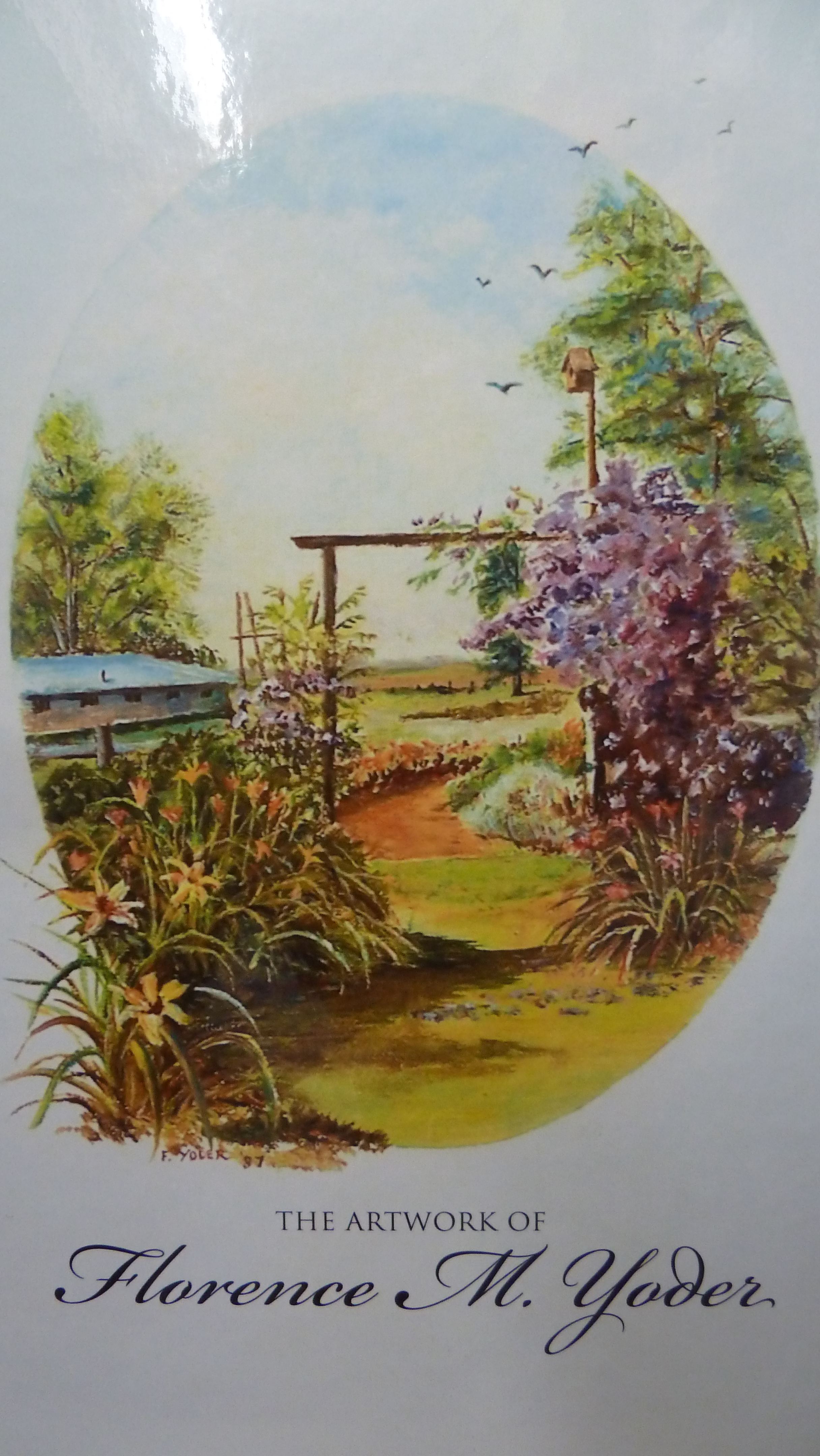 The front of a book commemorating her art features her flower garden.
But more than her art I loved Aunt Florence’s flowers—inside the house and out. She raised African violets with a vengeance—oodles of them, “hundreds” her daughter said. And her flower garden was her pride and joy; she never refused an opportunity to lead us through it and answer any questions I might have. She loved sharing her love of beauty.
Among the “art” pieces in her living room was also the family ironing board, which was always up. My cousin Judy said in a eulogy at her mother’s memorial service that “It has always been there and would just not be home without it. The catch all for all-important papers and the place she taught me to iron my daddy’s handkerchiefs. It is still there today and I doubt if it has felt an iron on it for many a year.”
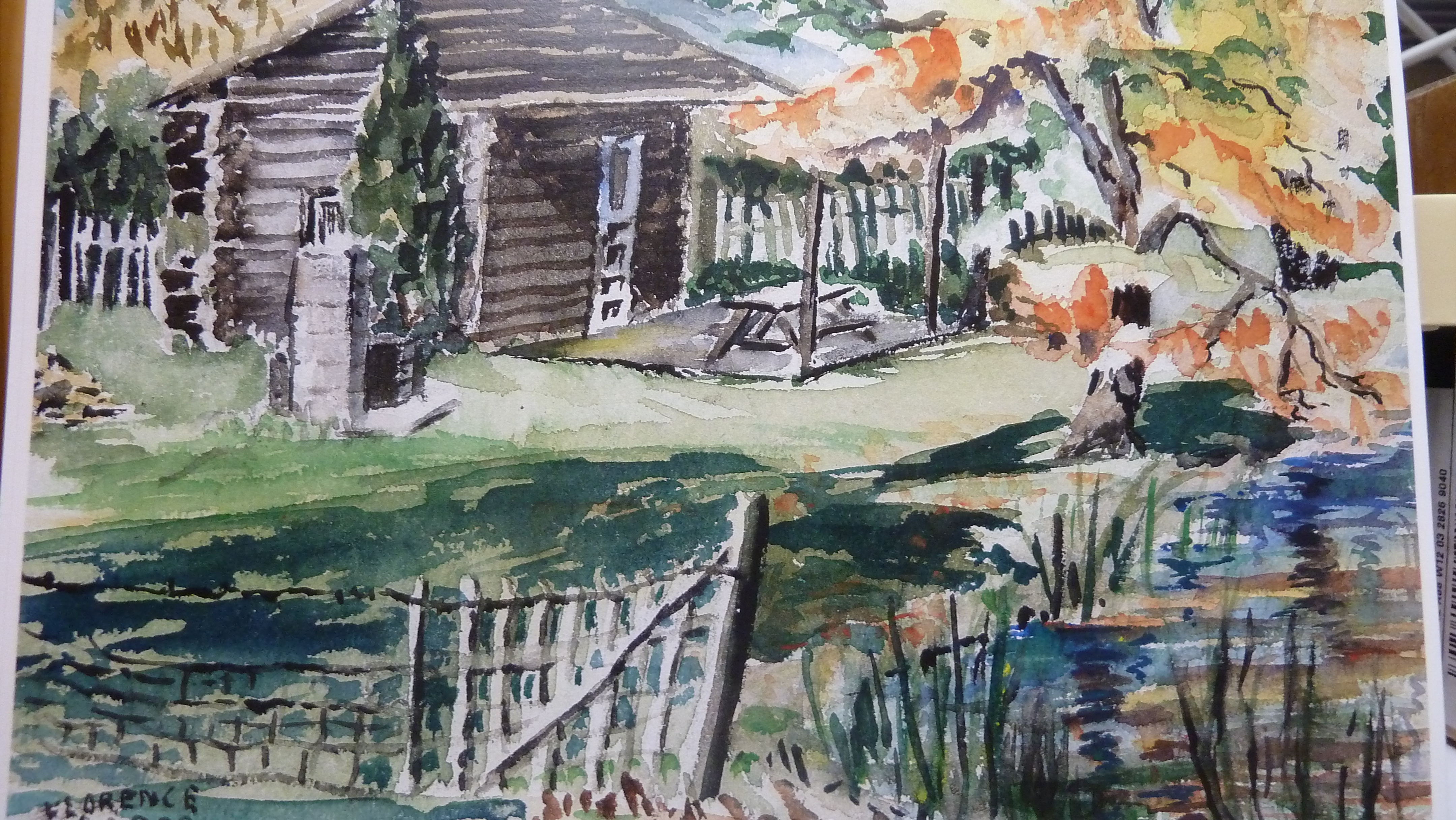
I have two copies of Florence’s paintings which my mother owns; I treasure the copies which two of her daughters gave me permission to share here.
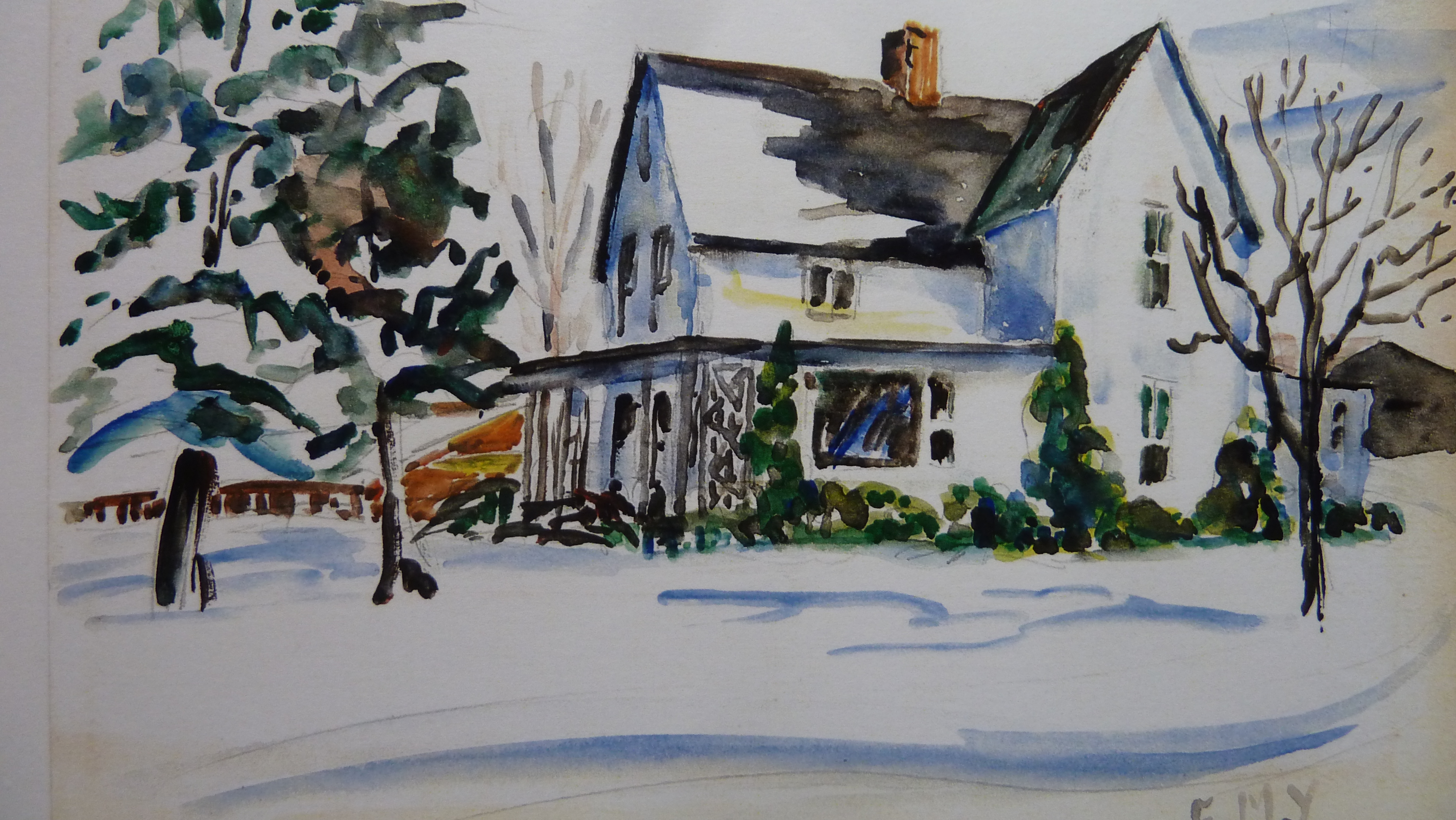
One winter she painted our farmhouse and sent it to us as postcard for Christmas. On the back, along with detailing the flu bugs that had been menacing their family, she noted “I have trouble making houses stand up straight.” I would never have noticed. And then a post script. “Do you want a little white kitten?”
The other painting she made for my parents is of our log cabin built near a pond in a back pasture, a place of retreat and solace on many a busy Saturday.
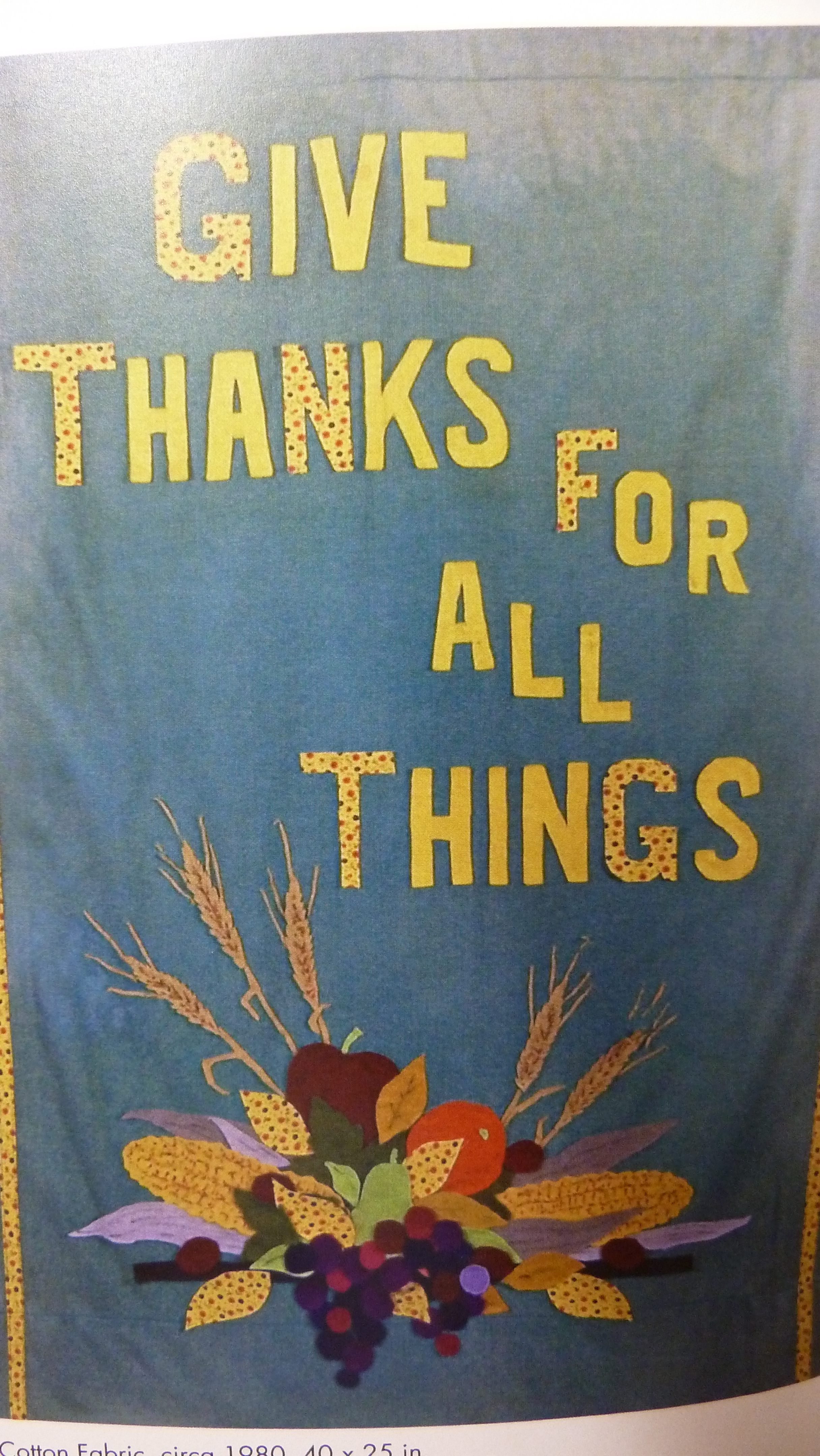
After Florence died in 2007, her husband David took photos of the art they still had in their possession (he was a photographer on the side of his other work) and the children (mainly daughter Marilyn) put together a beautiful book which is very special. It included photos of the art she created for her church, Olive Mennonite, and the decoupage art (here our cabin again, using her own painting) and quilt blocks she made along the way.
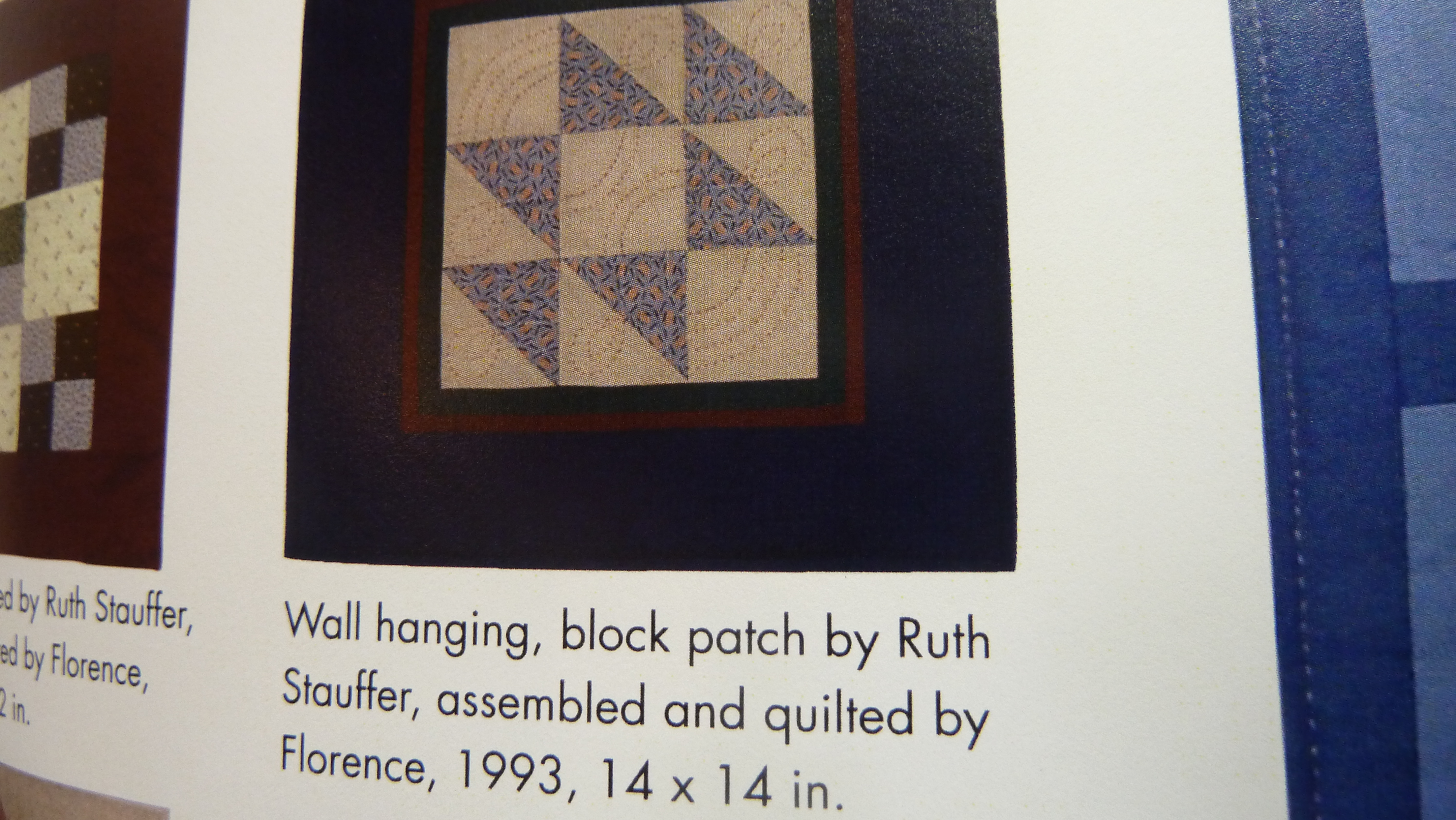
I would love to be able to raise African violets and paint the way Aunt Florence did. My husband once bought her husband’s Dave’s welder, and for many years after (he’s still living) he would ask Stuart if he was “still using that welder.” Absolutely. It is a thing of art and creativity for my husband, as well, where he enjoys brainstorming and muddling through how to create useful objects out of metal.
Yes, Richard Kauffman, we too often fail to pause and think of or thank the artists among us who offer a different way of seeing the world while using their own God-like skills in creativity. God was the ultimate Creator, after all, and we are, yes, created in God’s image. That was Florence, for sure.
***
Is there a permanent (odd) fixture in your home (or the home you were raised in) like Aunt Florence’s ironing board?
What creative gift do you wish you had? How do others inspire you?

Easter isn’t Easter without deviled eggs. Right?
My great niece Britney got married recently and the families hosted a smallish reception a week later. Britney is an enthusiastic and great cook even at her relatively young age (early 20s) and loves deviled eggs. So she made five dozen for her reception. I was kind of blown away by the idea of a bride taking time to make five dozen deviled eggs! That’s a lot of egg peeling, and I always say that’s the hardest part of making deviled eggs. Here are some tricks.
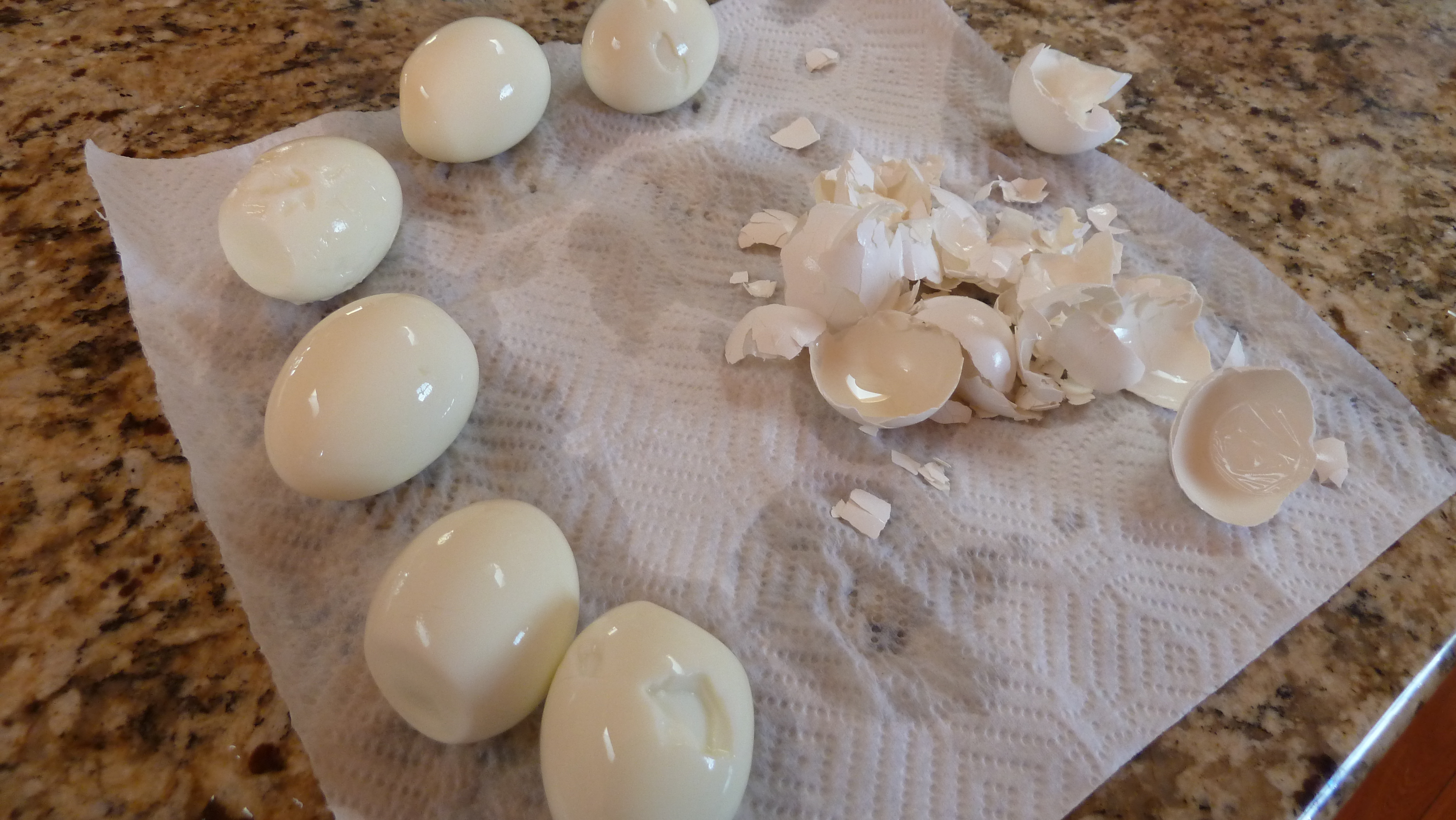
But my goodness there must also be five dozen ways to make deviled eggs! It is hard to find two recipes that taste alike. When I looked up where the term “deviled” comes from, Yahoo gives a bunch of explanations here, generally saying it means food that is chopped up and spiced up, as in hot spices, and the word “deviled” probably originally came from the idea of a devil in a hot hell.
I don’t think of deviled eggs as spicy, but I do like mine tangy, similarly flavored as my potato salad (minus onions). My son-in-law fell in love with my deviled eggs soon after he fell in love with my daughter so I probably should call them “Brian’s.” I thought I made them exactly like my mother made them but she tells me now that she doesn’t use pickle relish in them. So I guess I will “own” this recipe as mine.
Brit says she doesn’t have a recipe “cause I just eyeball things.” I never measured things out either until I made them for this blog post and an early Easter dinner last weekend. Brit’s ingredient list is slightly shorter than mine and includes only salad dressing, mustard, sugar, salt and paprika on top. So take your pick, either way they get gobbled up!
Eggs are of course symbolic of the new life we have after our short years are finished on earth. The resurrection promise, from Romans:
For since we have become one with him in dying as he did, in the same way we shall be one with him by being raised to life as he was. … Since we have died with Christ, we believe that we will also live with him. Romans 6: 5, 8 Bible Gateway.
Melodie Davis Deviled Eggs
8 hardboiled eggs, cooled (because that’s how many my beautiful heirloom dish from my mother holds)
1/3 cup salad dressing
1 teaspoon mustard
1 Tablespoon sweet pickle relish
1 teaspoon sweet pickle juice
¼ cup sugar
1 teaspoon vinegar
Using cooled boiled eggs, slice eggs in half lengthwise. Remove yolks and place in small bowl.
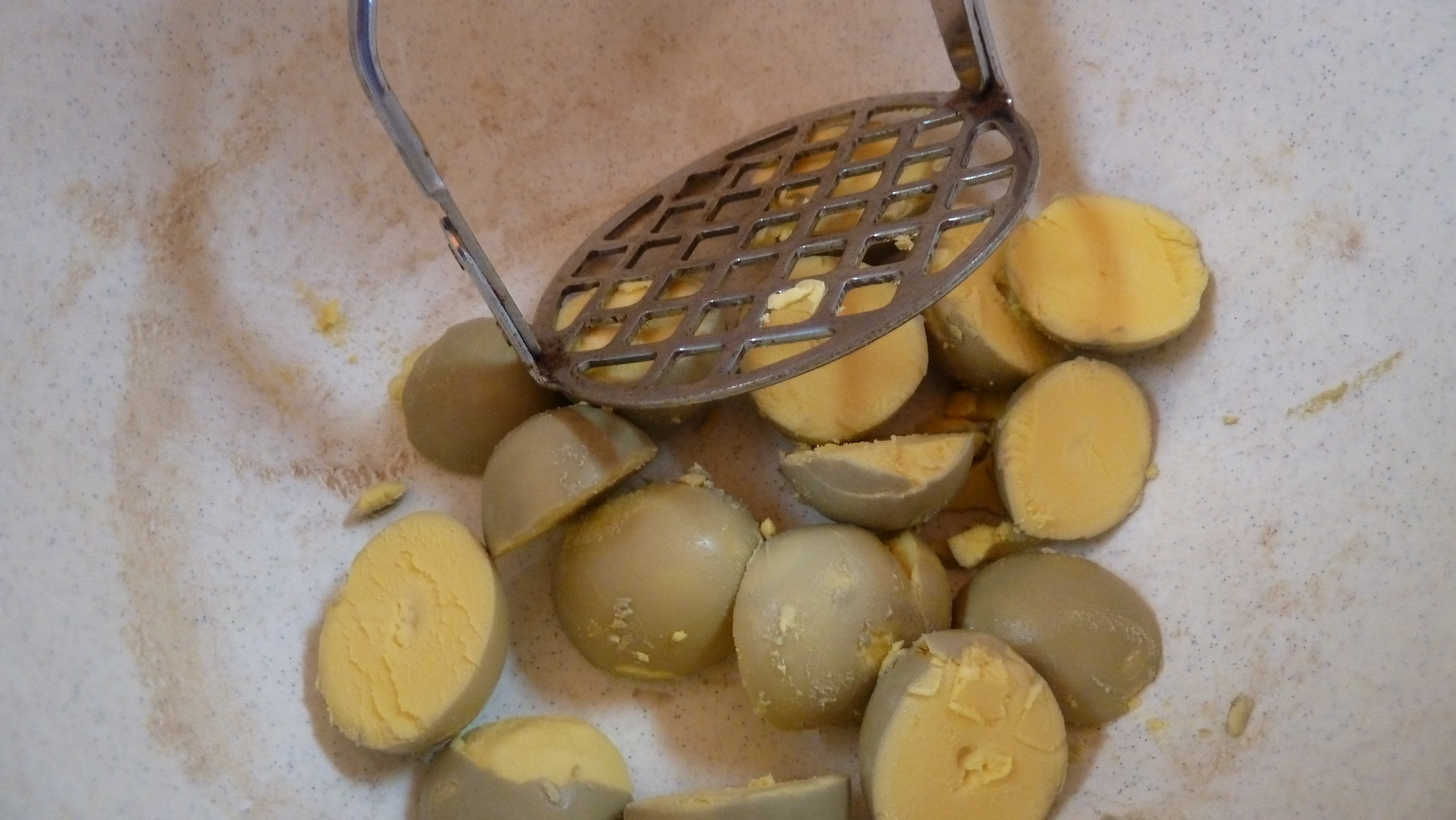
Using a fork or potato masher, pulverize the yolks …

until you have a smooth paste type substance.
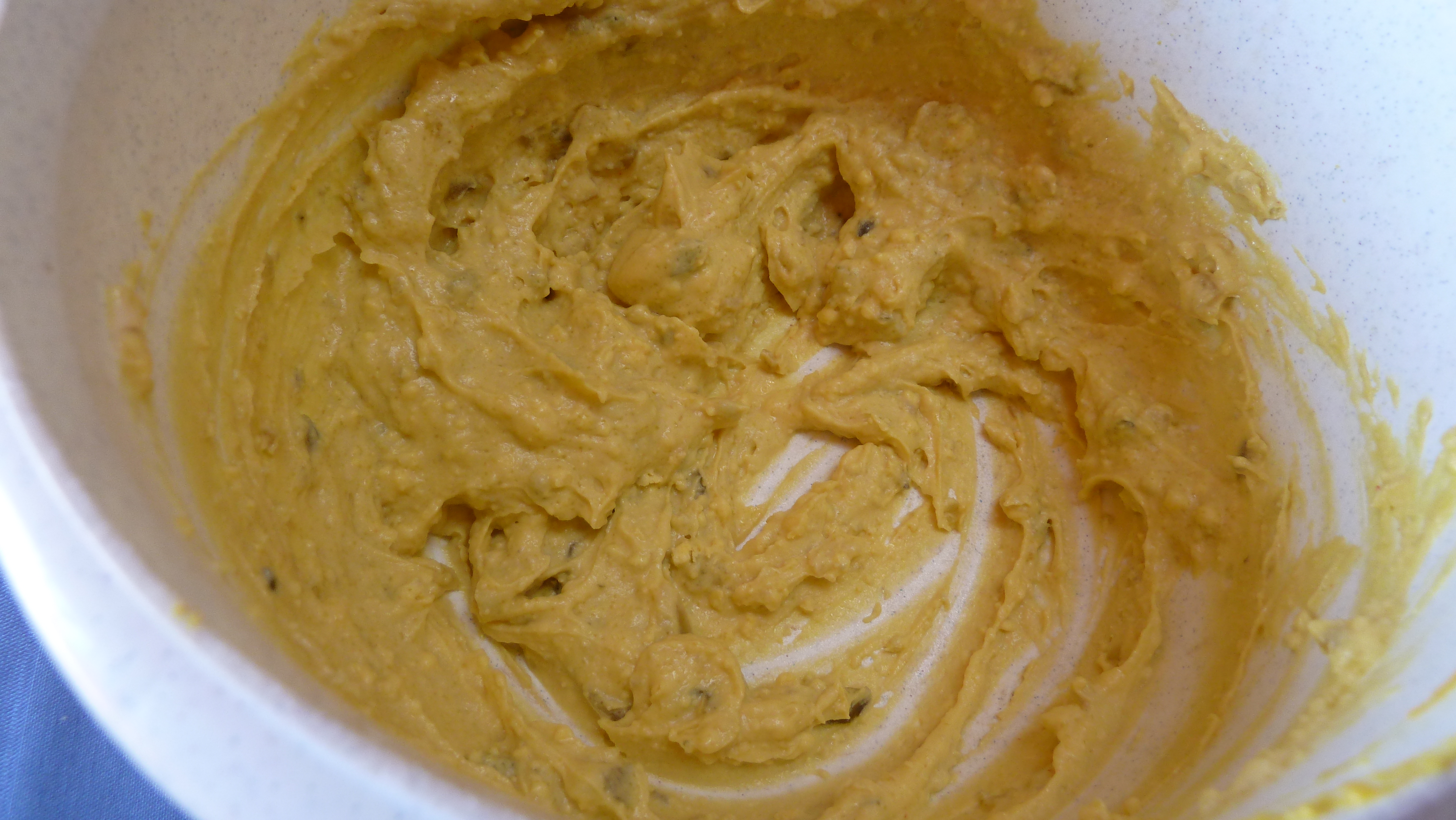
Add the next 6 ingredients.
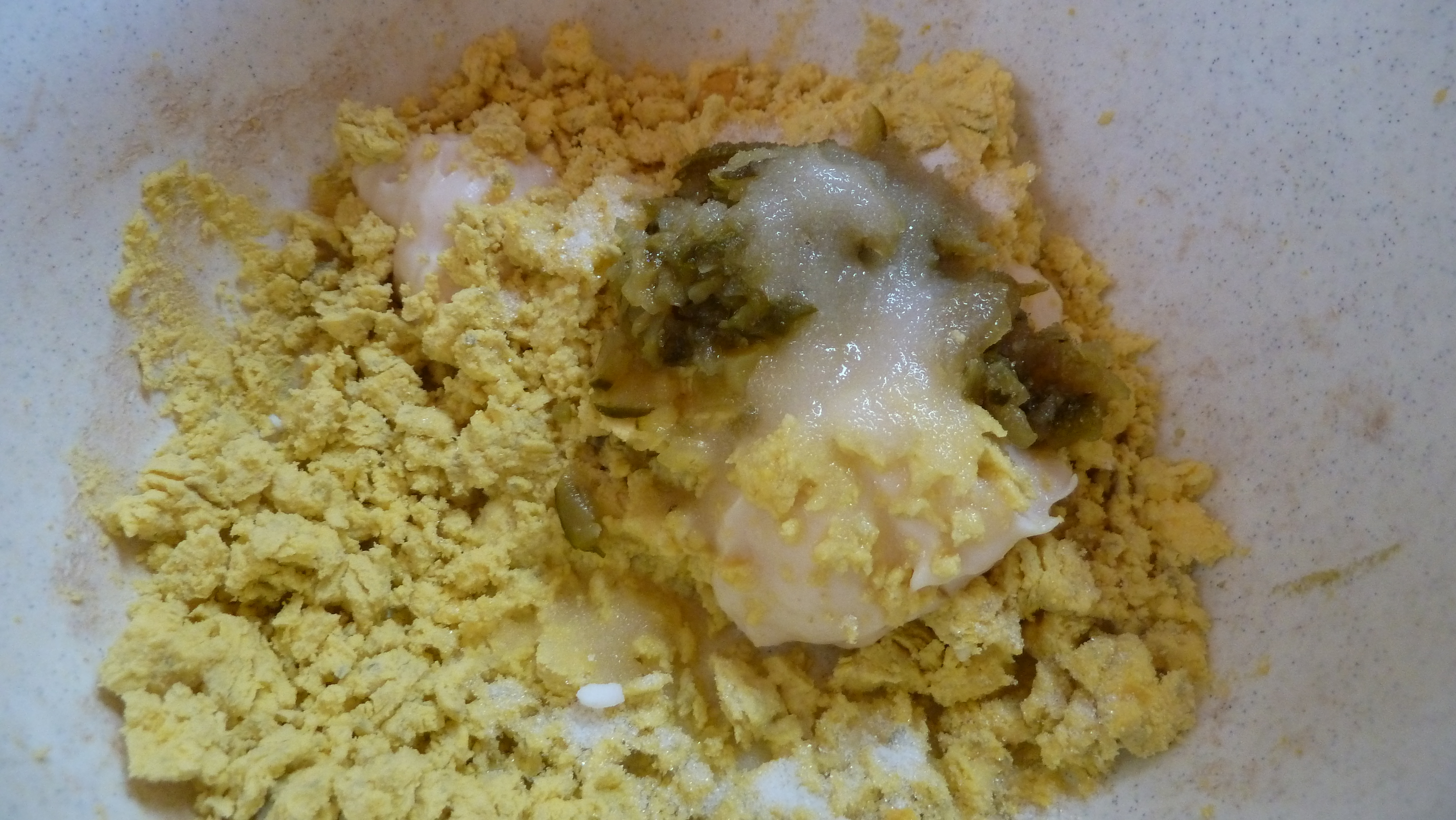
Stir until as smooth as possible.

You could also use a blender or food processor to make smoother, but I don’t bother. Using a teaspoon, fill each egg half with about 1 teaspoon of yolk mixture. Garnish with paprika. Keep cold until served. Makes approximately 16 deviled eggs.

What is your favorite way to make boiled eggs? What is your “have to have” favorite Easter food?
Happy Easter to you!
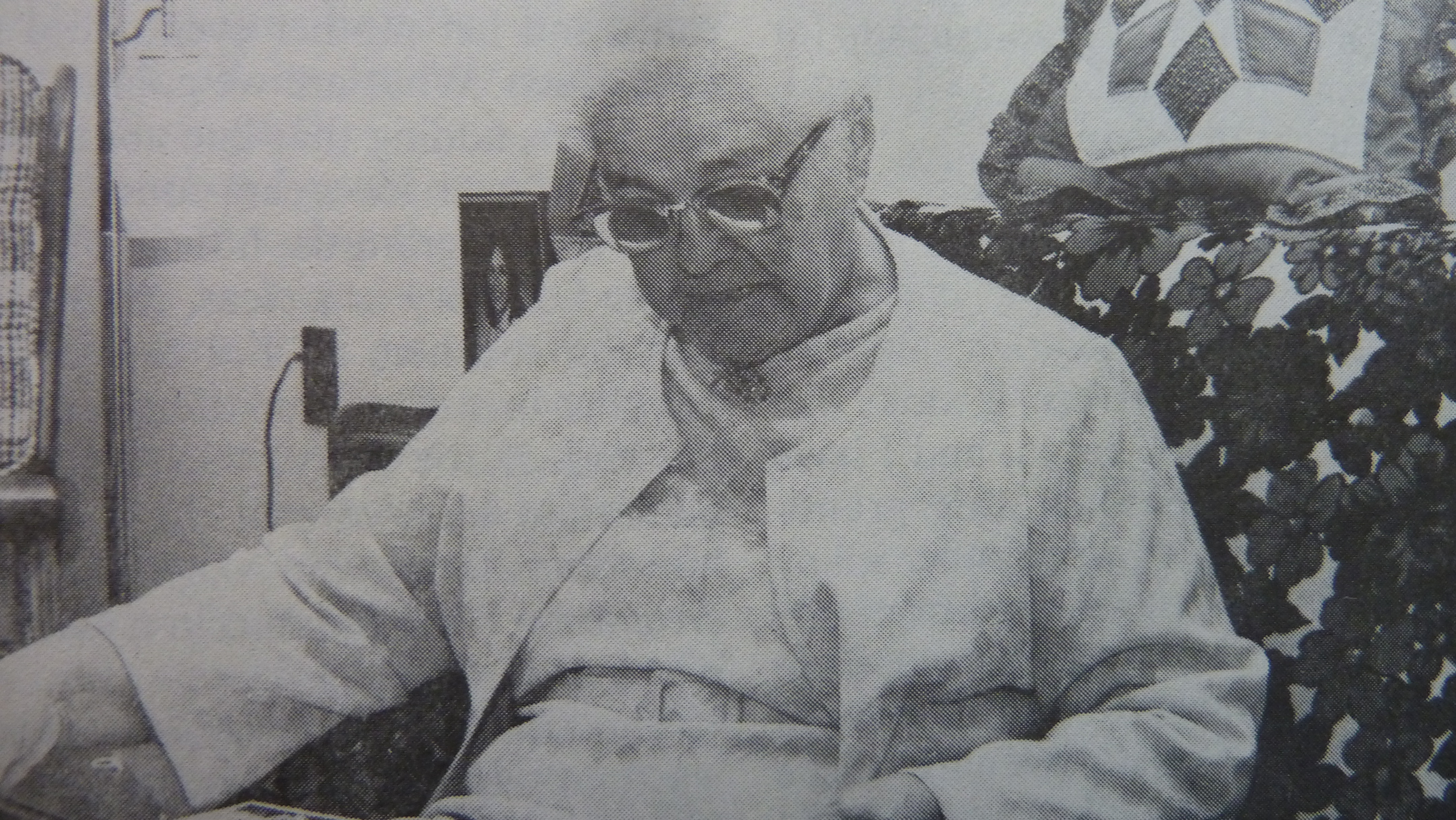
Aunt Susie Roth pouring through her scrapbook collected from 44 years of teaching Summer Bible School.
Every child needs an awesome aunt. Awesome aunts often don’t have any children themselves, and therefore have time and energy to put into holding, playing with, babysitting, taking their nieces and nephews on special excursions, and engaging in a lot of one-on-one mentoring—without ever calling it that. There are awesome uncles too who love to play with their nieces and nephews but as one of my male relatives has said, “The main function of an uncle is to be a rascally scoundrel so as to make the father look great in comparison.”
Today I want to tell you about one of my awesome aunts, Aunt Susie Roth of Emma, Indiana. She did have children of her own and she lived the longest of all my aunts, 100 years, spanning1899 to 1999. Glaucoma took her sight in later years. Toward the end, her walk with Jesus was so close she talked about she was “having cookies with Jesus.” But she was also lucid enough to tell her pastor when he came to visit that he needed to take some time off now and then to get some rest—almost the patient counseling the pastor.
But what made her awesome in my book is her amazing record teaching thousands of youngsters over 44 summers of traveling here and there to help smaller Mennonite churches who were stretched quite thin in having sufficient Summer Bible School teachers.
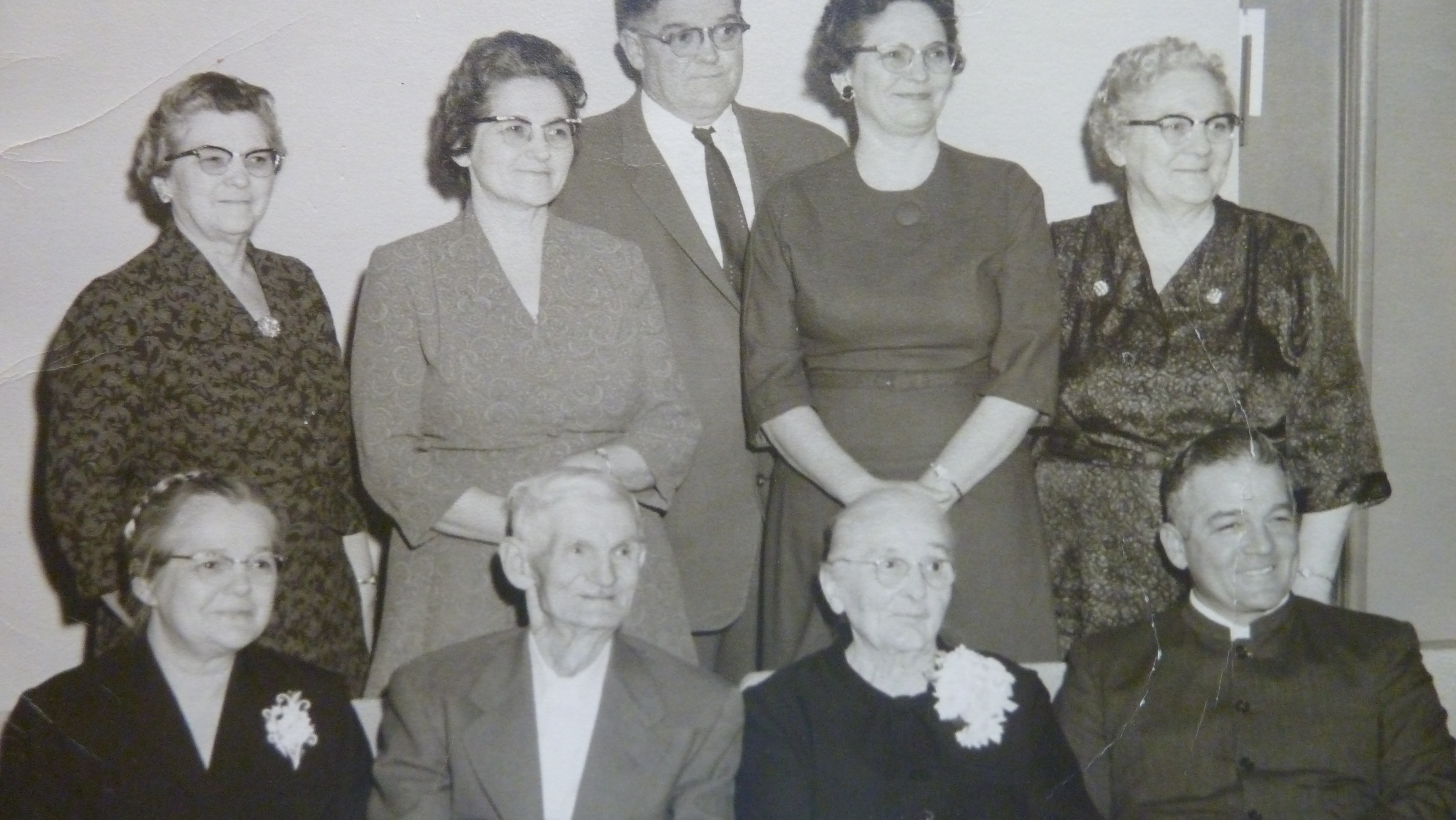 My aunt Susie, bottom left, at Grandpa and Grandma Miller’s (center) 60th wedding anniversary in 1953. My father, bottom right. Back row, l to r: my aunts Adeline, Elnora, Arlene, Irma and back row, Uncle Truman. Note that Aunt Susie was the plainest of my aunts who remained an “old Mennonite” all her life, while my other aunts were in closely related churches but not as plain (note the cut hair hair and earrings on most of my aunts.)
At that time in the Indiana-Michigan Conference of the Mennonite Church, many older established churches from heavily-populated Mennonite areas took on “Big Brother” roles with smaller outpost congregations in areas that had few Mennonites. Whenever a call went out “We need Summer Bible school teachers…” in conference newsletters, Susie heeded the call to this mission field with good hearted zeal and a genuine love for children–and the many lessons they taught her. She would be gone for 6-8 weeks to different locations helping in the local programs: Indianapolis, Chicago, Upper Peninsula of Michigan, southern Indiana and Kentucky. In addition to teaching in her own church, Emma Mennonite Church and others as asked.
I was privileged to travel to teach with her in Chicago and Upper Michigan, and then one year she and her husband, Dan, traveled to Kentucky to teach with me where I was stationed in Voluntary Service. Her work in Chicago was in association with a women’s and family shelter called “Gospel League Home”* and my experience teaching there in a gated facility in a rough area of Chicago where she sometimes confiscated knives from little boys in her classes–gave me a tantalizing introduction to life in the inner city—and also its heart wrenching needs. We rode Chicago’s “L”, went to the Loop, and she assured us that if we stayed long enough, we too would get used to the noise of city traffic, sirens and blaring horns all through the night. I marveled at this small town aunt so wise to the ways of the city.
I once wrote an article about her for Purpose magazine (July, 1981) called “The Peripatetic Teacher” (Peripatetic was the editor’s word, not mine, I had to look it up, which means “traveling”). It was 1980 when I interviewed her for that and she told me with a satisfied glint she had traveled to teach “44 years in a row.”
To some, who’ve been arm-twisted into teaching in Summer Bible School, that sounds like years of torture. I’ll wager that most of these programs were the full two-week, morning-long Summer Bible Schools that took dedicated planning and preparation each afternoon and evening, punching out the little take home Bible memory verses on cute memory triggers like a hammer for the verse from first Thessalonians, “Work with your own hands.”
She recalled one little girl who was supposed to tell the story of the Good Samaritan for the closing Bible school program. In practice the child kept inserting that the Good Samaritan bought the beat up man he was helping an ice cream cone. The little girl was dutifully told to leave that part out because there certainly wasn’t any ice cream in the Bible. Susie recalled the girl’s clear calm voice while reciting the piece and twisting the hem of her little dress. Susie held her own breath as the child neared the ending and announced “So the Good Samaritan took care of the man, left him some money, and bought-him-an-icecream-cone,” she said in her Revised Child Version of the Bible, before dashing off the platform.
But Susie’s educational methods were what helped Susie cope even in keeping classes as large as 23 children (the biggest class) engaged and occupied. A wallpaper hanger and painter by occupation (along with raising two sons and a daughter), she had some teacher training (Goshen College) but more important was that she knew the need of children to wiggle.
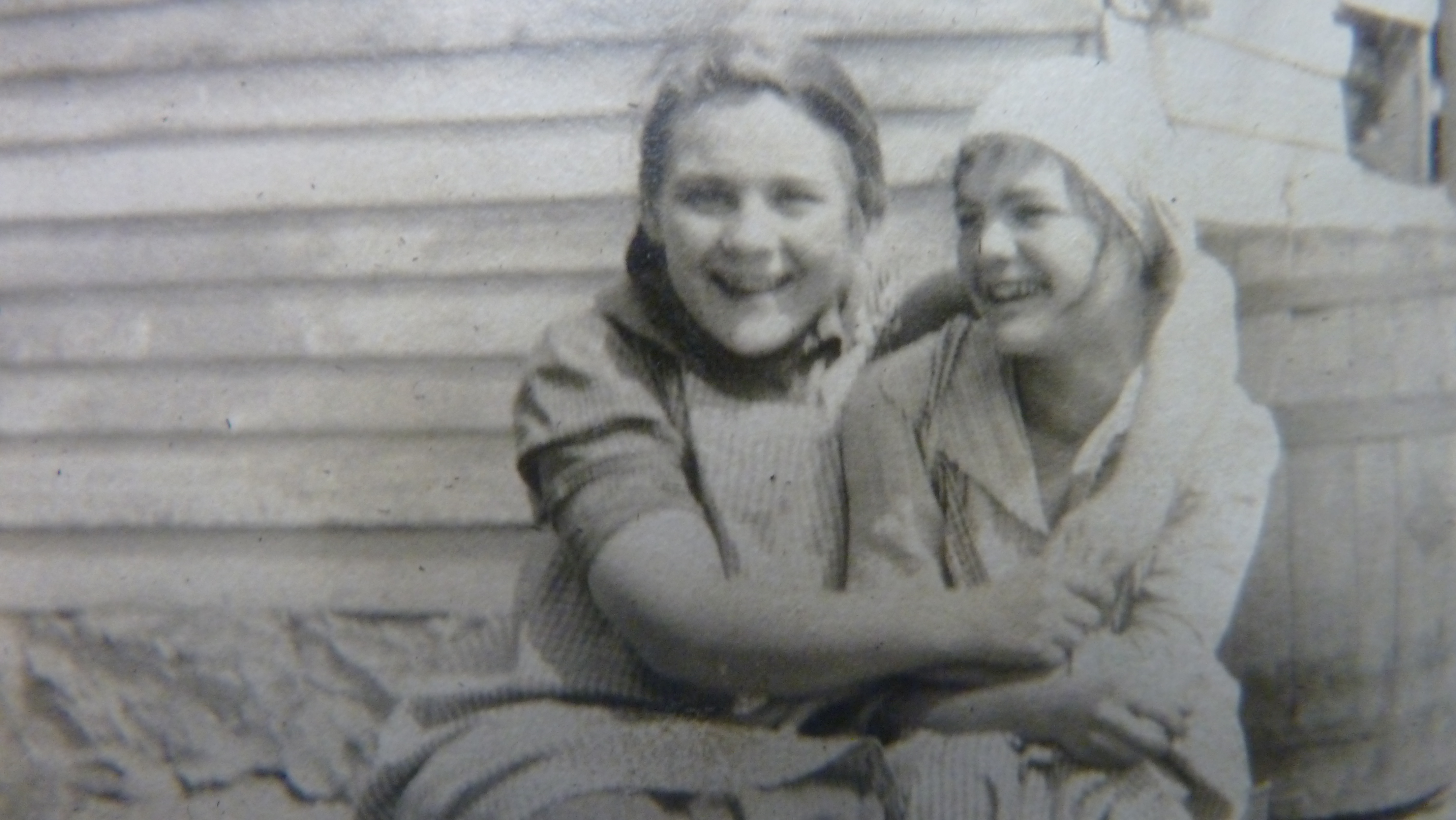
Susie, right, and her sister Irma, left, who were dressing up circa 1916: she knew how to have fun.
How did she cope with 23 in an improvised classroom? “When I saw that they’d had all the listening they could take, I’d silently motion to them that they should get up and follow me. I wouldn’t tell them where we were going and they’d get quiet as church mice, they were so scared. I’d lead them around the church sanctuary four or five times, all without speaking and then we’d file back to the room. The exercise was good for them and it helped to quiet them down.” She expressed this philosophy of teaching as “When the kettle is full, the kettle is full. You can’t tell them anymore.”
In 1980, at the age of almost 80, she was invited back to the Gospel League Home to help teach. “Oh you can’t use me anymore,” Susie hesitated. “Oh yes we can” was the reply and Susie went in an assistant teacher role, making 22 years she served at the Gospel League Home. Over the years she also volunteered as a cook at church camps, meaning she would spend 8-11 weeks away many summers, just coming home weekends between stints to clean up her garden and flower beds. And her husband, Dan, did not seem to mind. That was Susie.
It was a model of service and love that I’ve never duplicated but treasure for the spirit of her service.
I wish I had pictures of:
- Her beautiful backyard flower garden, complete with stream and trellis
- The sweet cherry tree we enjoyed picking from
- The ongoing “rummage” sale she hosted in their garage to help raise money for her beloved Gospel League Home
- The time she busied my young children on a visit to her home where they were growing bored and restless and she put them to work cutting out quilt patches for one of her dozens of quilts pieced together over many years. That was Susie at her finest, sensing the boredom of children, and putting them to useful work (that they thought was great fun). I don’t have a photo of that but I do have one of the three lovely quilts that came to my daughters, her grand nieces.
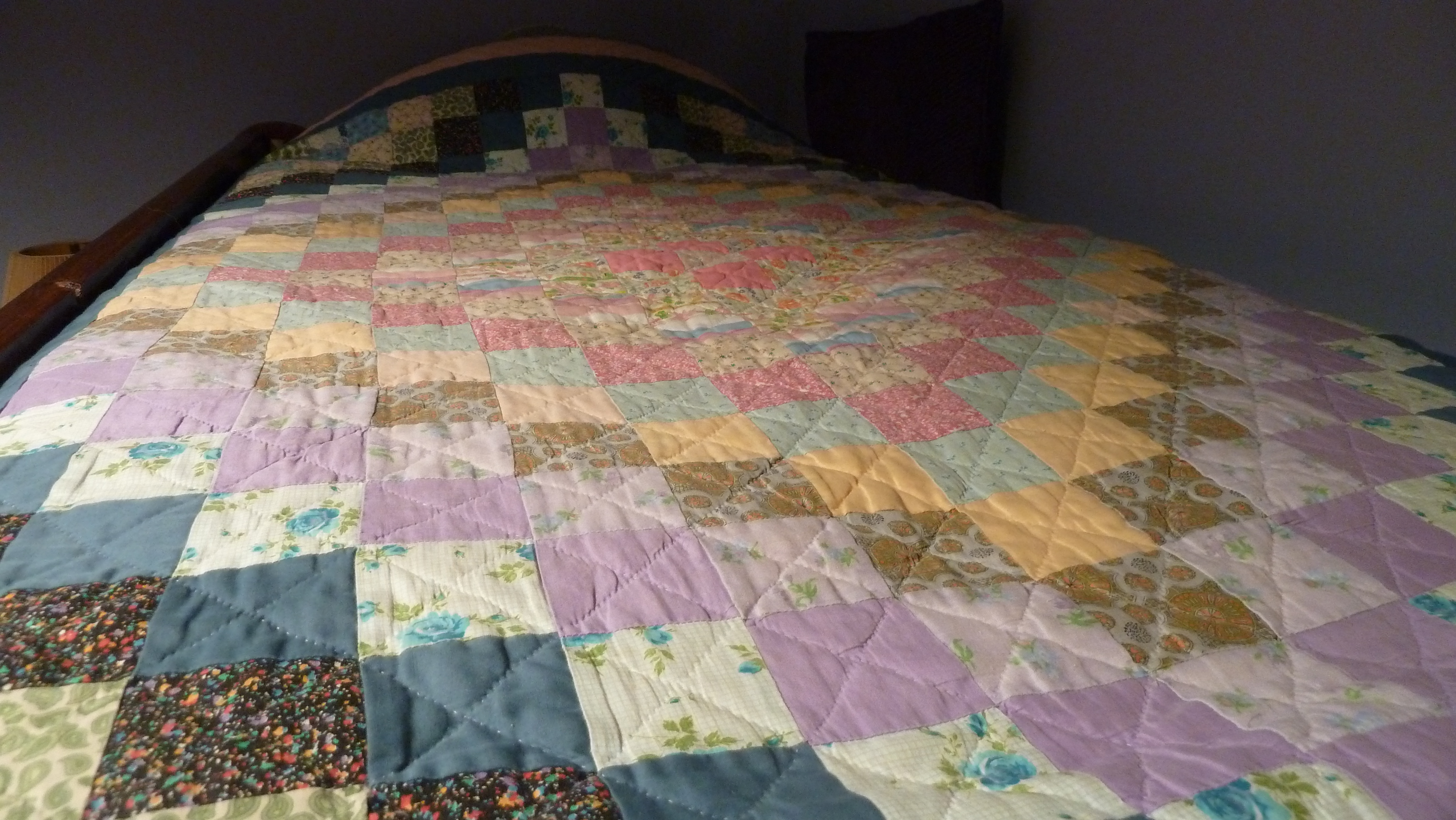
An awesome aunt. I had others but I don’t think anyone else matches her record of Summer Bible School teaching 44 years in a row: not just for one or two weeks, but 6-8 weeks at a time.
Were you privileged to have an awesome aunt or uncle or special relative? I would love to hear their story. I will consider using your stories in an upcoming Another Way Column (If permitted).
***
To “enter” the Emma General Store much as it was in the 50s when I loved to visit Aunt Susie and Dan (right next door to their house in the unincorporated town of Emma), check out the Emma Cafe website here.
***
For a history of Summer Bible School or Vacation Bible School in the Mennonite Church, check here.
***
*Finally, I learned that the Gospel League Home was an arm of the more famous Pacific Garden Mission but eventually the Chicago Tribune reports here (sadly) what happened to the property in 2006.

My mother was famous at certain potlucks for her shredded potato salad and certainly in our family it was something we all loved. At potlucks, we would look for Mom’s because we didn’t like the others.
She never used a recipe for this. A dollop of this and a plop of that.
I learned from watching her and then tweaking it on my own and now finally, here is the definitive Bertha Miller Shredded Potato Salad measured out and refined. You will see two places where it calls for “plus 1 tablespoon.” That is because I measured, then needed to add a bit “to make it taste right” or as most recipes say, “to taste.” So the key is after you have it all mixed up, taste it, add whatever you think is missing, etc. You may like just a bit more sugar, or milk, or salad dressing, or whatever.
The key is the shredded potatoes which help all the flavors blend together around the small potato surface (versus large blocks of big potatoes). Now, I can be a fan of some potato salads using larger chunks of potatoes—for a different slant and taste, like red potato salad with mayo—but Mom’s is a mixture of sweet and sour with crunch and deliciousness. Don’t use warm potatoes: the shredding or grating will turn them to mush.
And don’t miss my special hints at the end, especially if you have a kid (like I did, who shall remain nameless) that doesn’t like potato salad because of the mustard.
Bertha Miller’s Shredded Potato Salad
2 cups cold boiled potatoes (ends up as 3 cups shredded)
2 boiled eggs, cold
2 large stalks celery (1 cup chopped)
½ cup chopped onion
½ cup salad dressing, plus 1 tablespoon (my mother swears by Miracle Whip)
2 tablespoons mustard
1 tablespoon apple cider vinegar
¼ cup milk, plus 1 tablespoon (or plop, as in the sound milk makes coming out of a jug)
¼ cup sugar
½ tsp celery seed
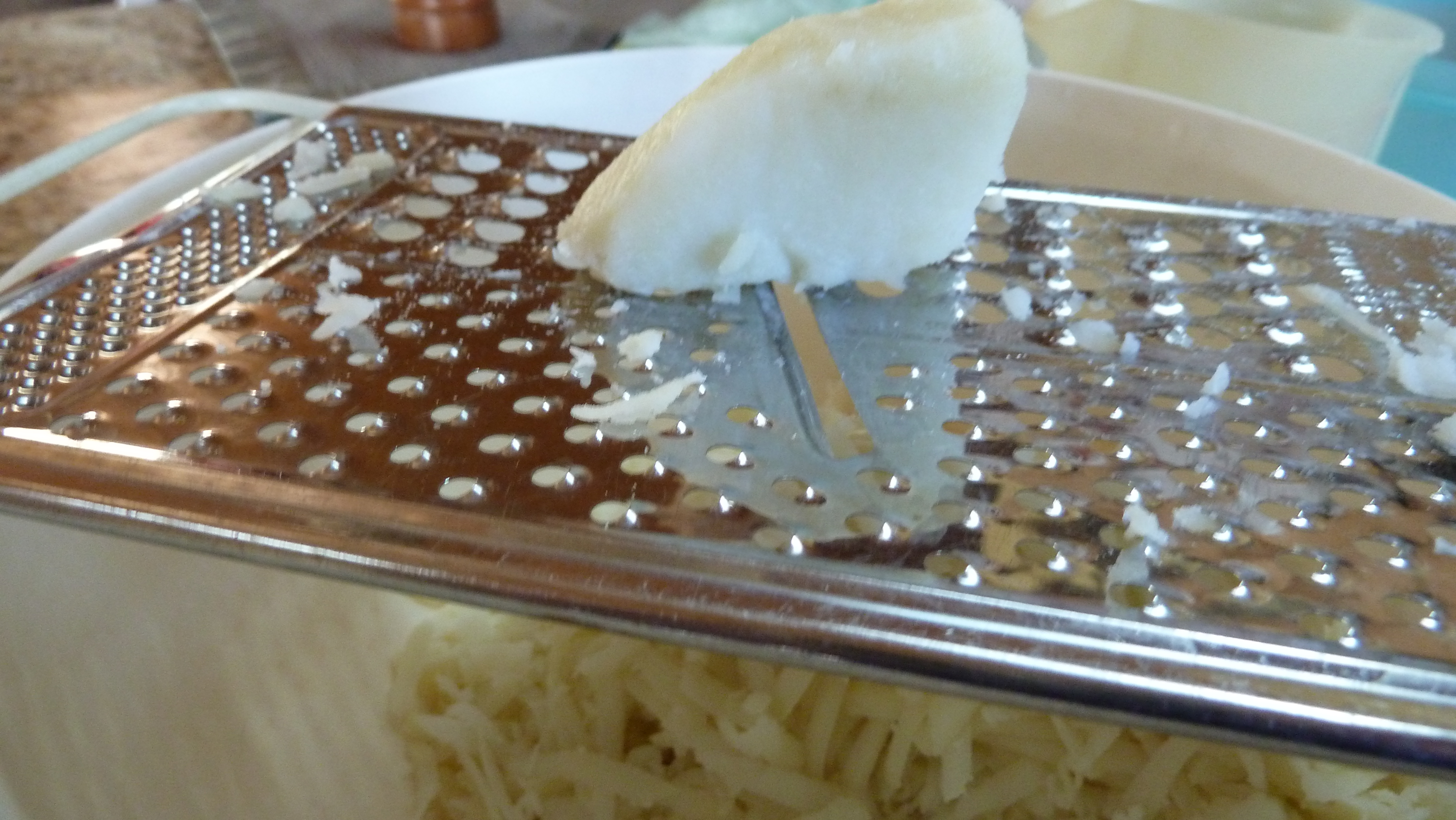
Shred cold potatoes. (I use a grater like this. A food processor may turn the potato to mush, I don’t know. I don’t own one.)
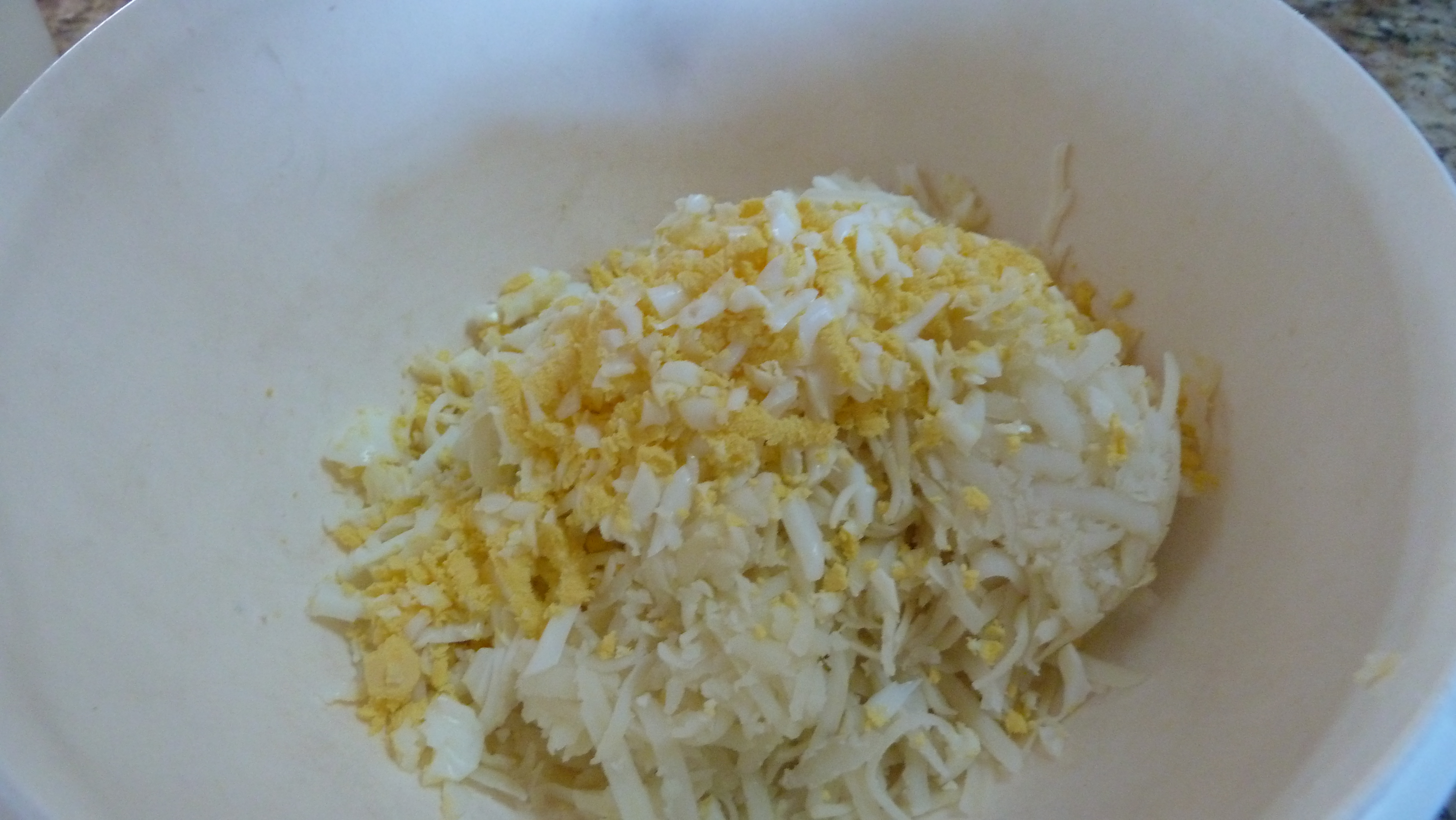
Grate the boiled, cooled egg.
Chop and add the remaining ingredients.

Mix all together.

Refrigerate. Often tastes better if you can refrigerate an hour or more.
Serves about 6 – 8.
Hints:
* I still prefer to make this without using measuring devices because you save washing the messy measuring instruments.
* Anytime you boil potatoes for mashed potatoes, throw some extra in the pot to have for potato salad, or to slice and fry as a quick side for any meal. Or bake an extra or two when baking, to have cold potatoes on hand.
* If you have just a smidgen of left over mashed potatoes, you can add up to 1/2 cup of mashed potatoes to the potato salad recipe without making the end result too mushy. It stretches the potatoes you have on hand and uses up leftovers.
* If you have a child who just doesn’t like potato salad because of the mustard or whatever, you can accommodate their differences by saving 1/2 cup or more of the shredded potatoes and frying them like a small patty of hash browned potatoes.
* You can “doll up” (as my mother would say) almost any deli potato salad by adding a bit of sugar and vinegar to dial up the zing.
***
What was a dish you always sought out at potluck or reunion that your mother (or father) made?
***
Coming next week: my deviled egg recipe, just in time for Easter.
I enjoy having company—that’s what we called it when I was growing up. I’d ask my mom with anticipation, “Are we having company on Sunday?” We didn’t call it entertaining.
In thinking about finding harmony between different types of people (especially in families and marriage), there are probably those who enjoy having people over, and those who don’t. Mother would say she was a reluctant hostess, egged on by my father who loved company (but didn’t have to do much of the work).
At this point in my mother’s life, even having me and my husband there for a few days is a big deal. She shops for the Right Cereal for My Husband (even though he rarely eats cereal anymore) and stocks up on what she thinks I Have To Have for Breakfast (orange juice) because that’s what I always have at my house, and buys what she thinks We Expect to Eat at Her House (homemade sweet rolls from a friend of hers, or bakery sweet rolls, yes!). But at home we only have homemade sweet rolls on Sunday (as in here.) So having us kids for a meal is all she can manage. At 89 years of age, that is normal!
I do think I got my love of having people over from my mother even though she would argue that, but it is because it was something she did frequently—something families in my church in northern Indiana did at least monthly. We would invite someone to our house for Sunday dinner, or go to someone else’s. I loved getting out the good green bubble china and the bubble goblets and the real silverware (which I’ve never had) and setting a pretty table with a centerpiece and maybe candles.
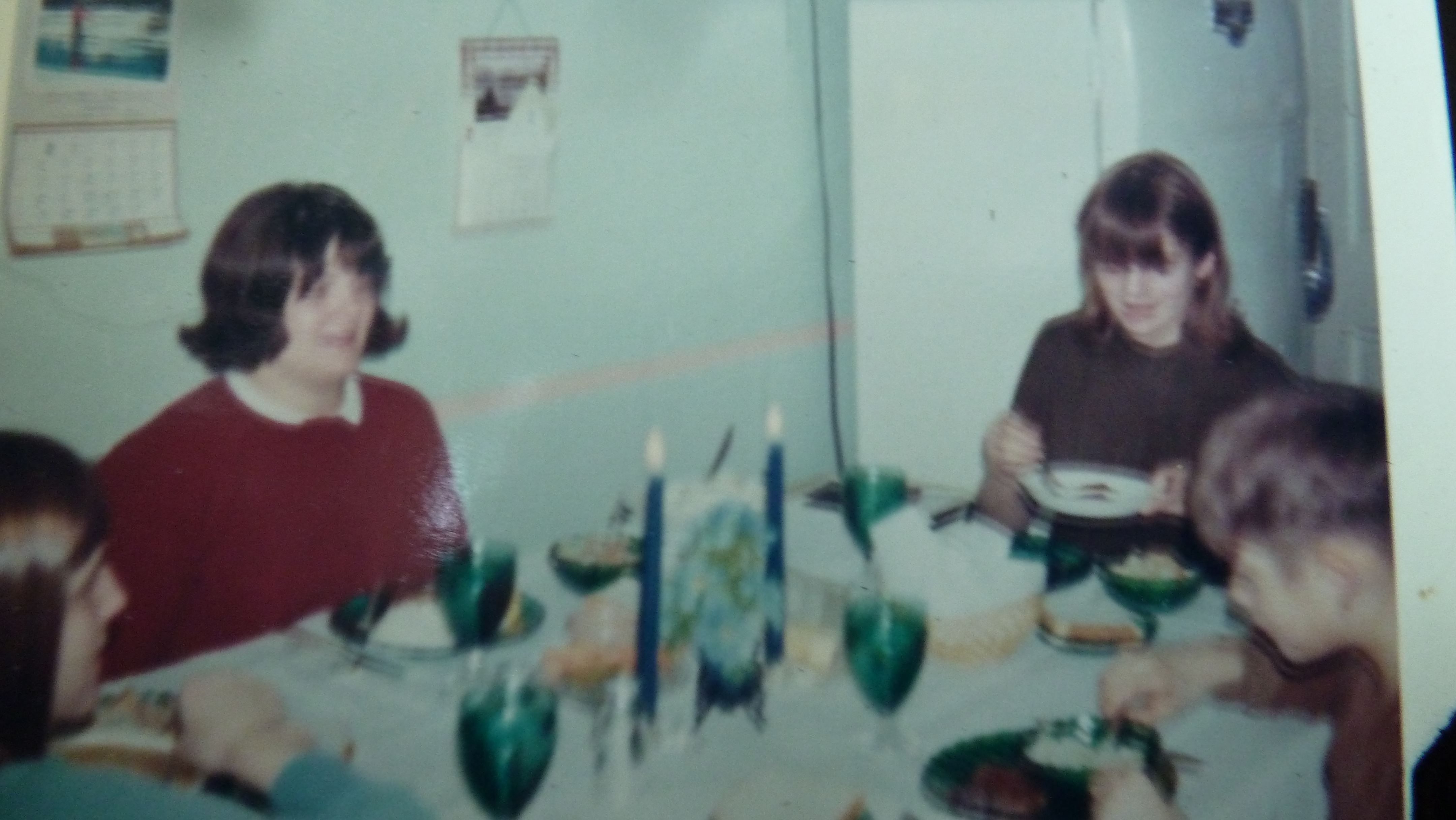 I love this picture of the table in our farmhouse kitchen, recently discovered in my sister Nancy’s slides, which she transferred to print and I photographed. So excuse the poor reproduction, but this is Pert, far left, Nancy, yours truly, and my brother Terry, enjoying our “company meal” with Mom’s green bubbly china and goblets.
We would set it all up on Saturday night. I liked helping mom prepare fancier desserts (date pudding, real whipped cream) and the roast or meatloaf or ham she would bake. We liked setting the table “pretty” so much that sometimes when Mom and Dad would go away to a banquet and we were old enough to cook for ourselves, we would ask permission to use her best stuff and have a “company supper” just us four kids (see above).
So for the first 30 years of our marriage, my husband and I enjoyed having people over even though we didn’t have a dining room or a hutch to store my grocery store china or glassware or a decent table.
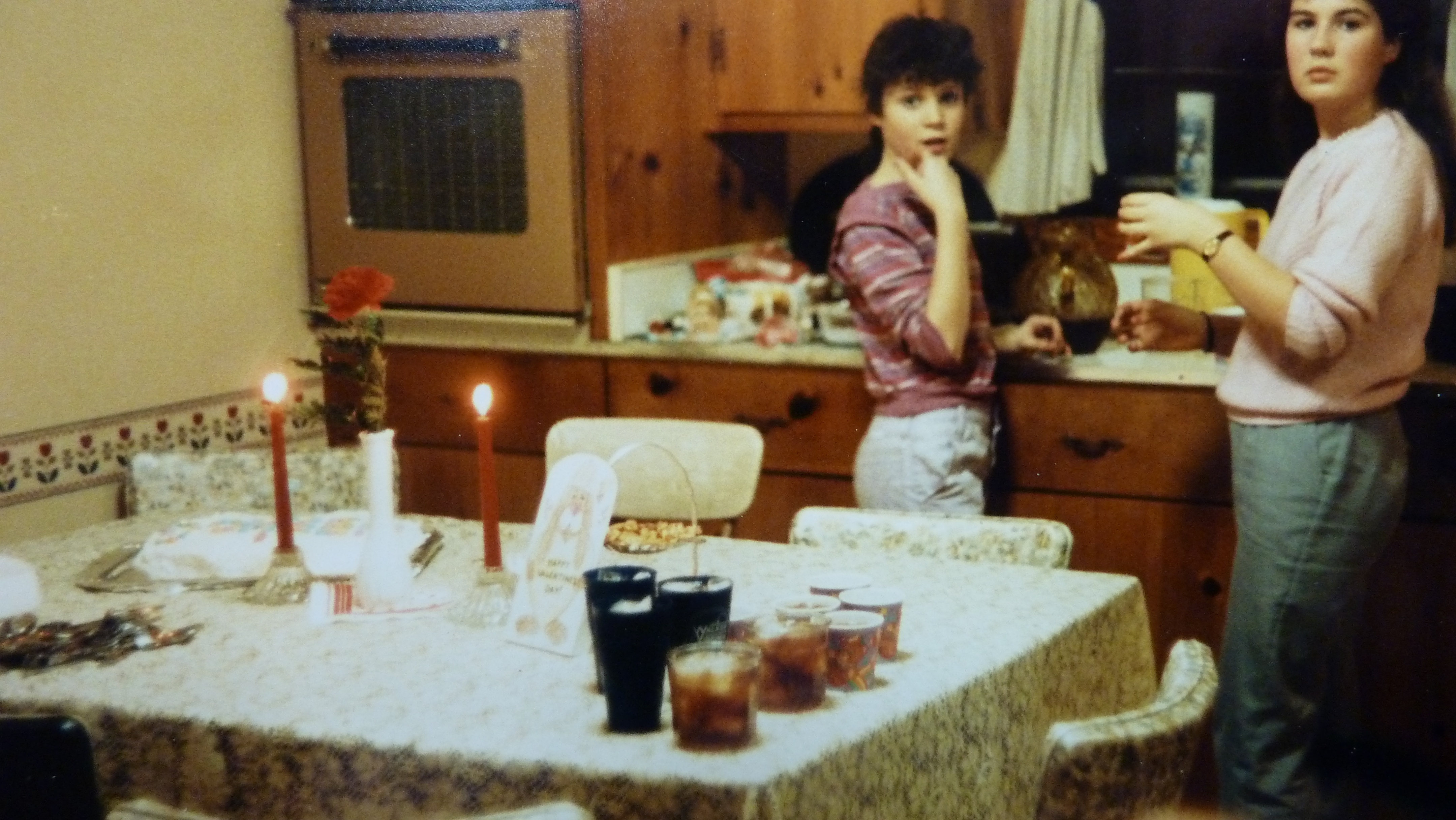 Our metal dinette set, covered up of course with a lace cloth. My nieces, Cindy and JoAnn were great helpers in the kitchen before my own children were old enough.
We used the space we had (or ate outside) and generally made do, first with a metal dinette set that came with our house, and later a cast off table from my parents—a mobile-home-grade-particle-board-table: wowser!—when they finally got their nice long dining room table.
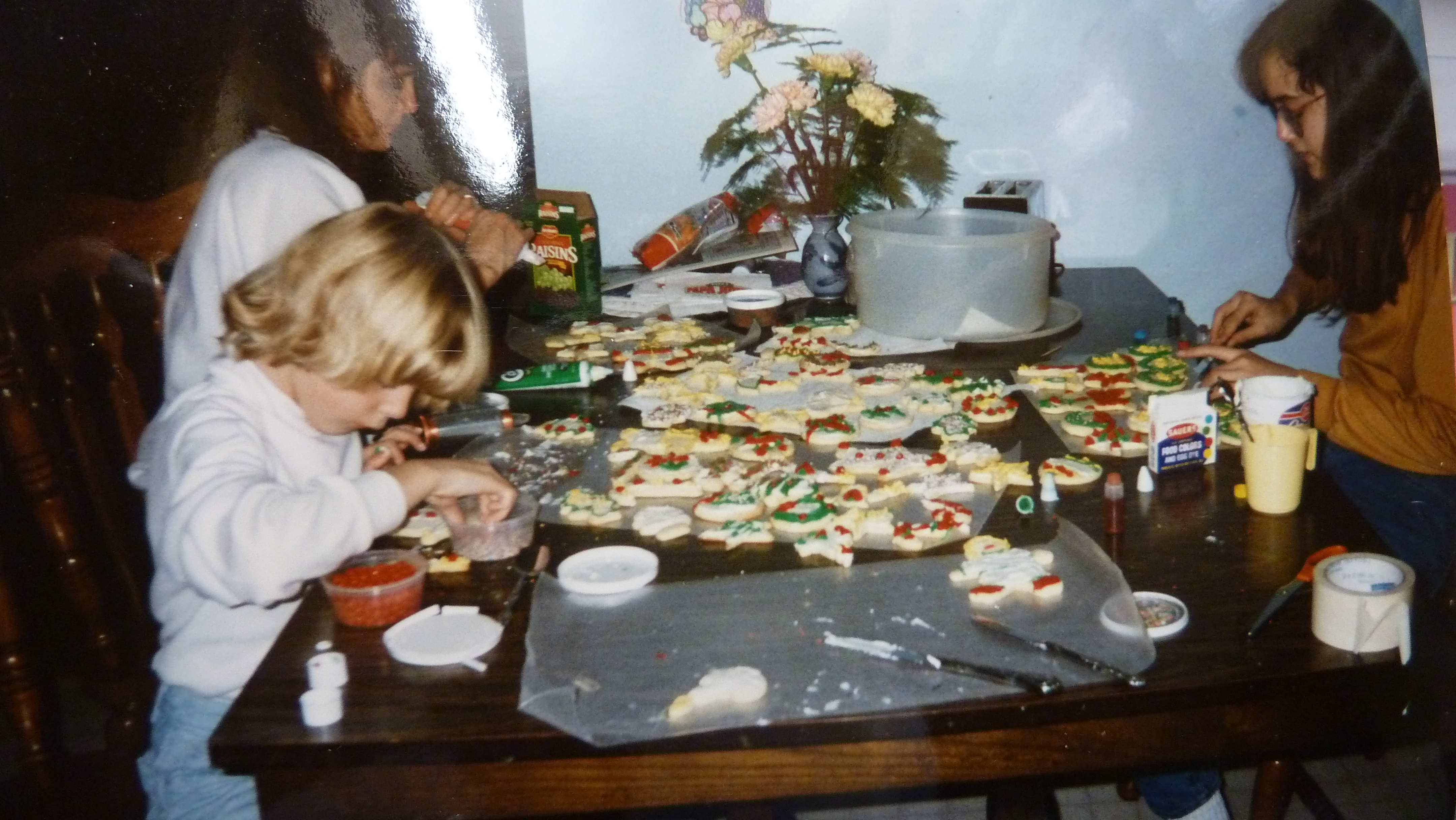 Our fine and forgiving trailer-factory-particle-board-dining-room-table. It stood up to the creation of science fair projects and building model Globe theaters for English class.
The particle board table was where our kids did homework (Doreen will thank me for sparing you the photo of her sleeping in the middle of her homework with rag curlers in her hair), where we decorated Christmas cookies, had countless birthday parties. We hosted mostly family, friends, sometimes people from church. And made do.
One time for Thanksgiving we carried a huge table up from the basement that someone was giving away once, and put it in the living room so we could all get around one table.
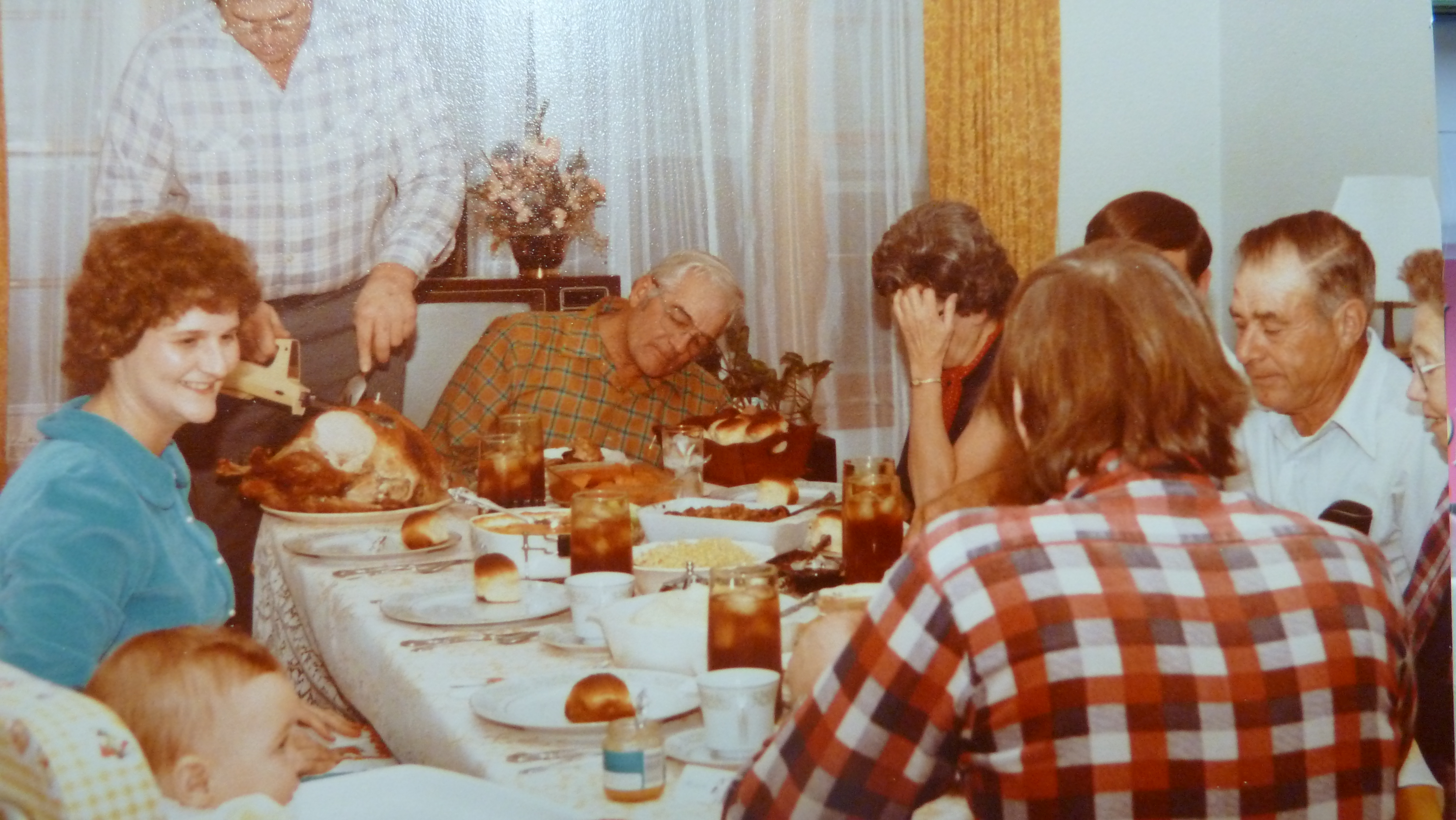 A larger table in our living room with sister-in-law Barbara in blue, brother-in-law Richard carving turkey, my father checking it out, Stuart’s father to the right. Baby Michelle at 7 months in the corner high chair. And Stuart with the plaid shirt and VERY long hair, circa 1982.
Then we moved seven years ago. One of the things I looked forward to most was finally having a dining room, a hutch and a very very long dining room table.
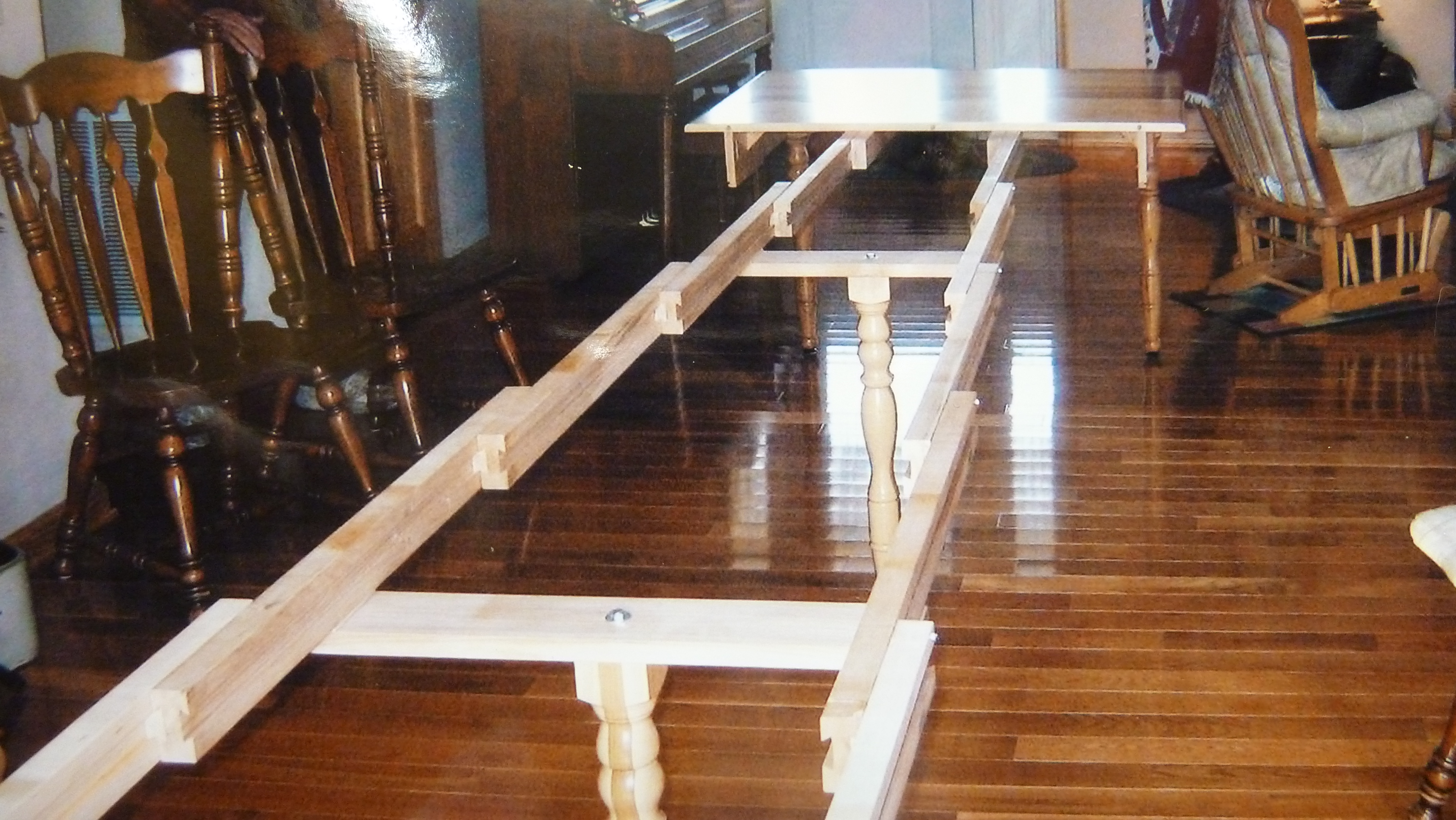
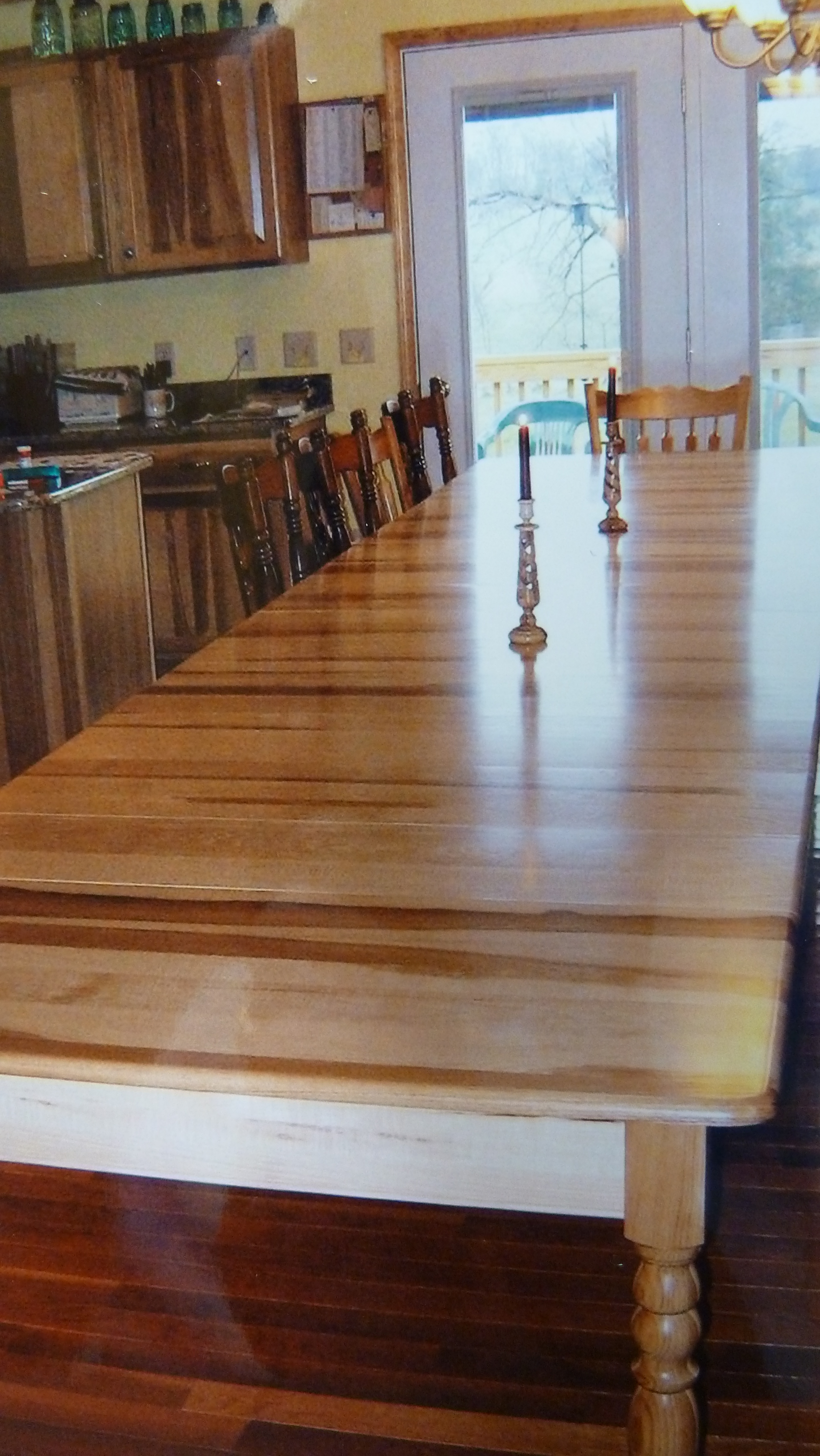
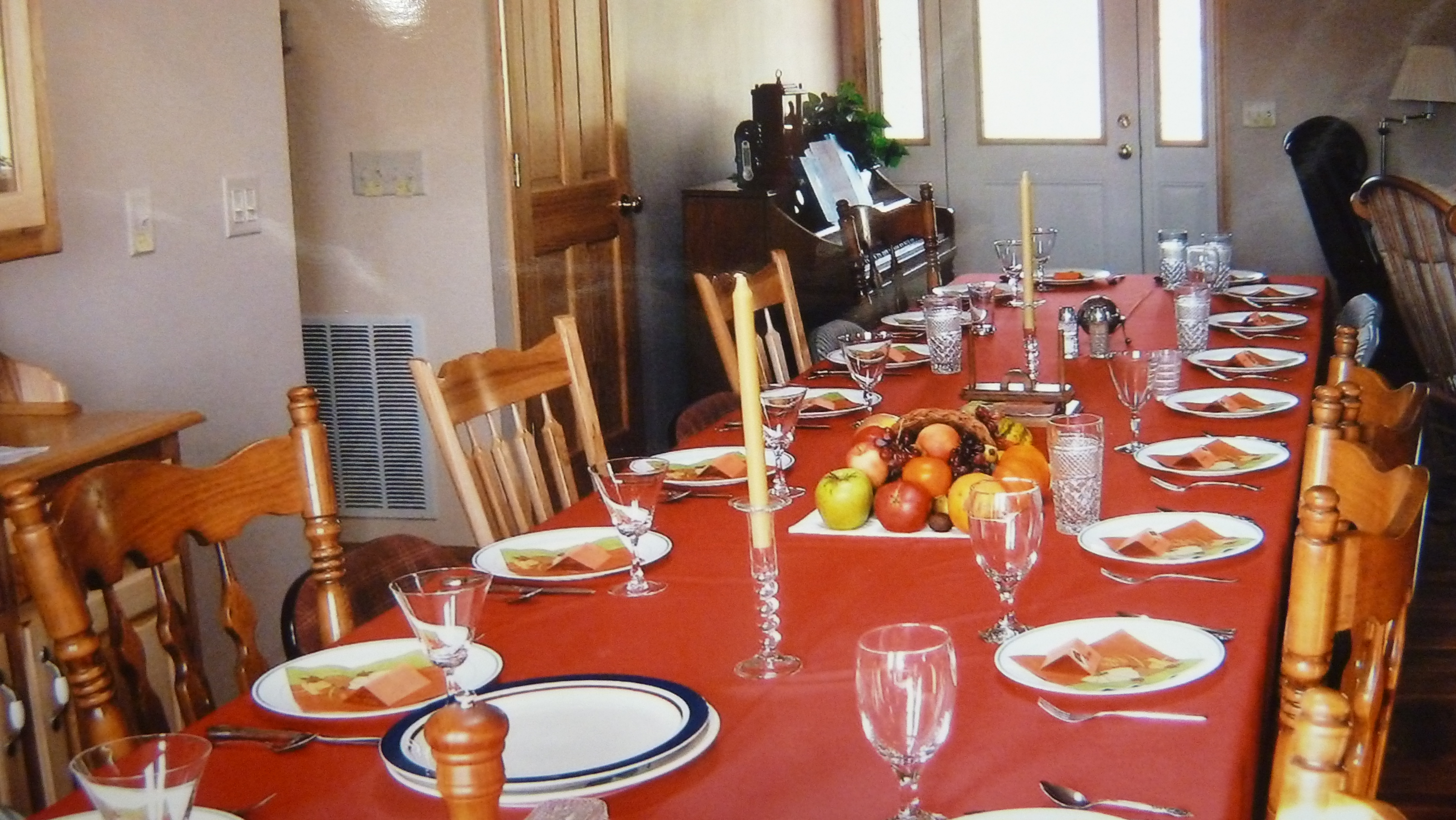
The stuff of legends (not quite King Arthur size or shape). Hickory to match our cabinets. We were able to have an Old Order Mennonite in northern Indiana build it, the same guy who built my parent’s long long table. This one can seat 20, 22 in a pinch. We tend to argue about that, me trying to squeeze in as many as possible, my husband preferring to let folks have some elbow room. I remember the first Thanksgiving we used it and two grand nephews, gazing from the end of the table, looked like they were at the end of an airport runway.
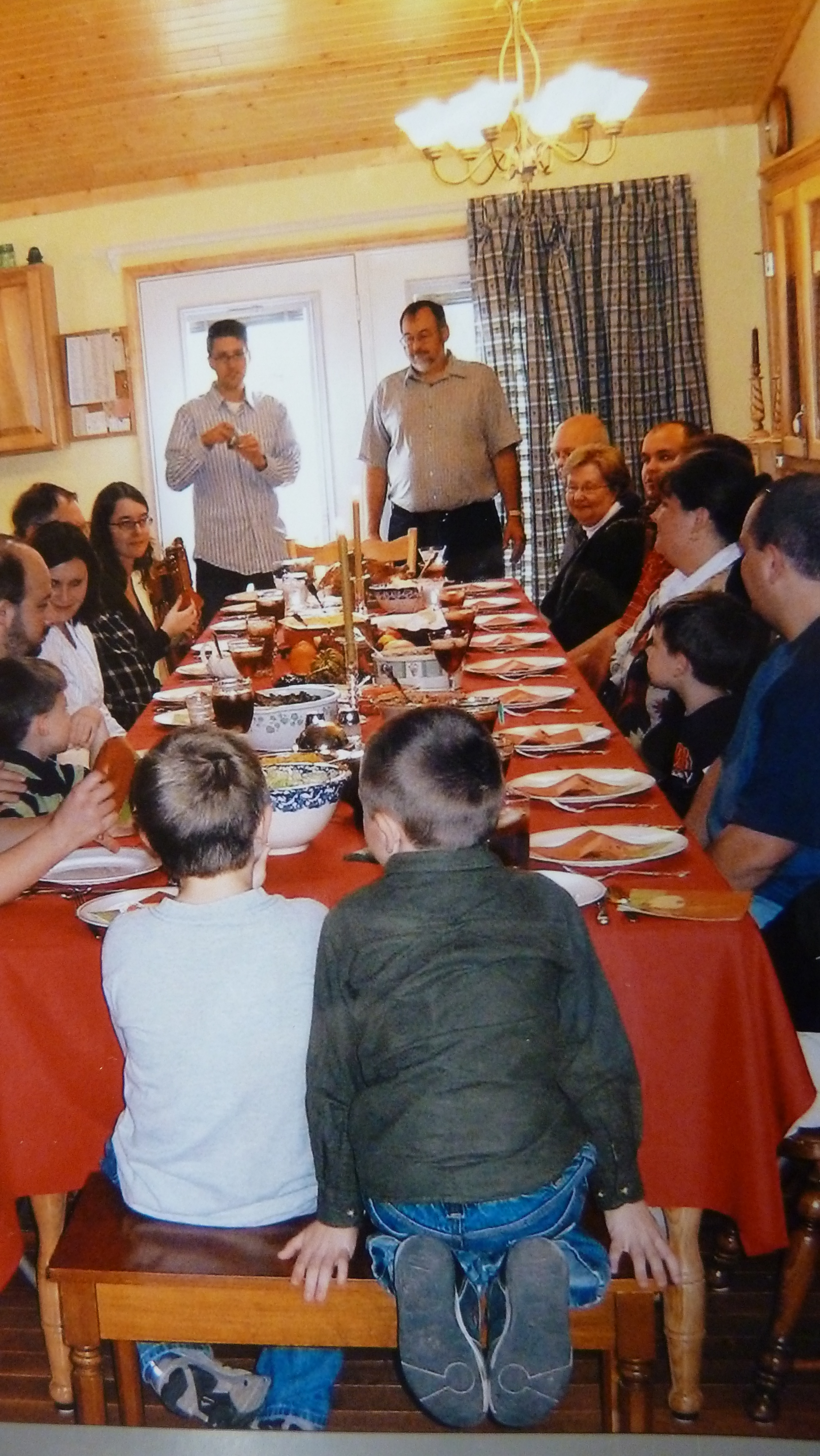
After using this table a few years, I’ll be the first to admit you can’t have a decent conversation with the whole table around such a long board, and you tend to talk in clumps with the folks next to you. So in some ways, I now prefer smaller gatherings. But it is still fun to get a whole bunch of people together around a huge table.
I tend to think that tables, no matter what size or material, are special glue in families–the stuff of building memories. Other cooks with a love for holding families together around tables have written about the difference between entertaining and engaging folks over a shared meal (see Mennonite Girls Can Cook words on hospitality, and Doris Janzen Longacre’s words in More-with-Less Cookbook where she cautions that “serving guests [can] become an ego trip, rather than a relaxed meeting of friends around that most common every day experience of sharing food …” (More-with-Less Cookbook).
And now, pass the bread, please. (Many more family meal photos here, along with do you pass left, or right?)
***
What special memories do you have from around your table, however humble, from your growing up days?
Did your mother and father like to have people over? Do you? I’d love to hear from you!
***
There’s much more about memories and traditions along these lines and how families today can still hang on to the custom of “gather around table” in Whatever Happened to Dinner, available here.

Last week I wrote about growing up in Indiana. Flat Indiana. On our particular farm, our sunrises were partially hidden by the woods immediately to the east but nevertheless could produce some wonderful moments of awe.
One morning when I was a kid, maybe about 10 or 11, I decided to go out in our orchard and watch the sun rise. I could get a better view from the far end of the orchard.
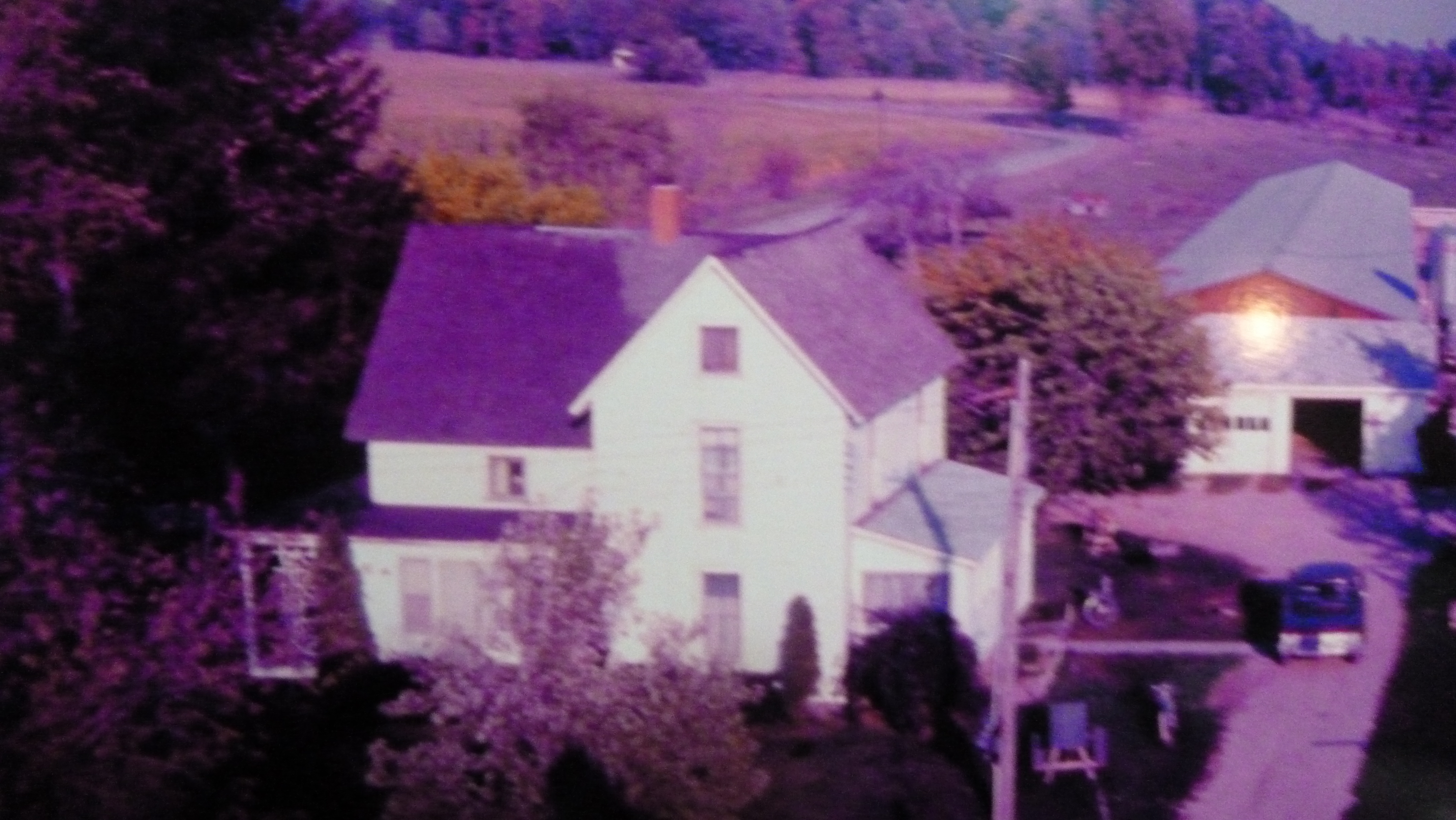
(Our farmhouse in Indiana, with woods to the east. Not a great view.)
I loved the orchard: we had apple, pear, apricot and cherry trees. Maybe some peach. Grandpa and Dad both loved growing fruit and in later years, Mom and Dad had a fine dwarf orchard on their smaller lot from which they ate summer suppers of peaches, bread and milk (or whatever fruit was in season–strawberries, raspberries, etc.) for 4-5 months of the year. They ate locally and in season before that became trendy.
The morning I waited for the sun, I don’t know if I didn’t tell my parents what I was doing, or why I didn’t have appropriate information on what time the sun might rise that day or just what motivated me. It was spring and I headed out—much too early—and thought I’d freeze as I sat on the cold ground waiting.
I waited and waited and while the sky was getting lighter, I finally went back to the house disappointed in my failed mission.
Then for most of my life in Virginia, 30 years, my husband and I and daughters lived in a small ranch house where our kitchen window faced north. I enjoyed my view of the woods and homes behind us, but to really get a peek at the sun, I had to wait for a sunset. Sunsets were visible from my west-facing kitchen window. But no sunrises.
After looking many many years and touring hundreds of homes (yes literally, ask our agent) we finally found a spot of ground that was not too hilly, in the right part of the county, that we could afford. The bonus was it had a spectacular view to the east.

No, we couldn’t quite see the Massanutten mountain peak from our chosen building site, but we can see its range.
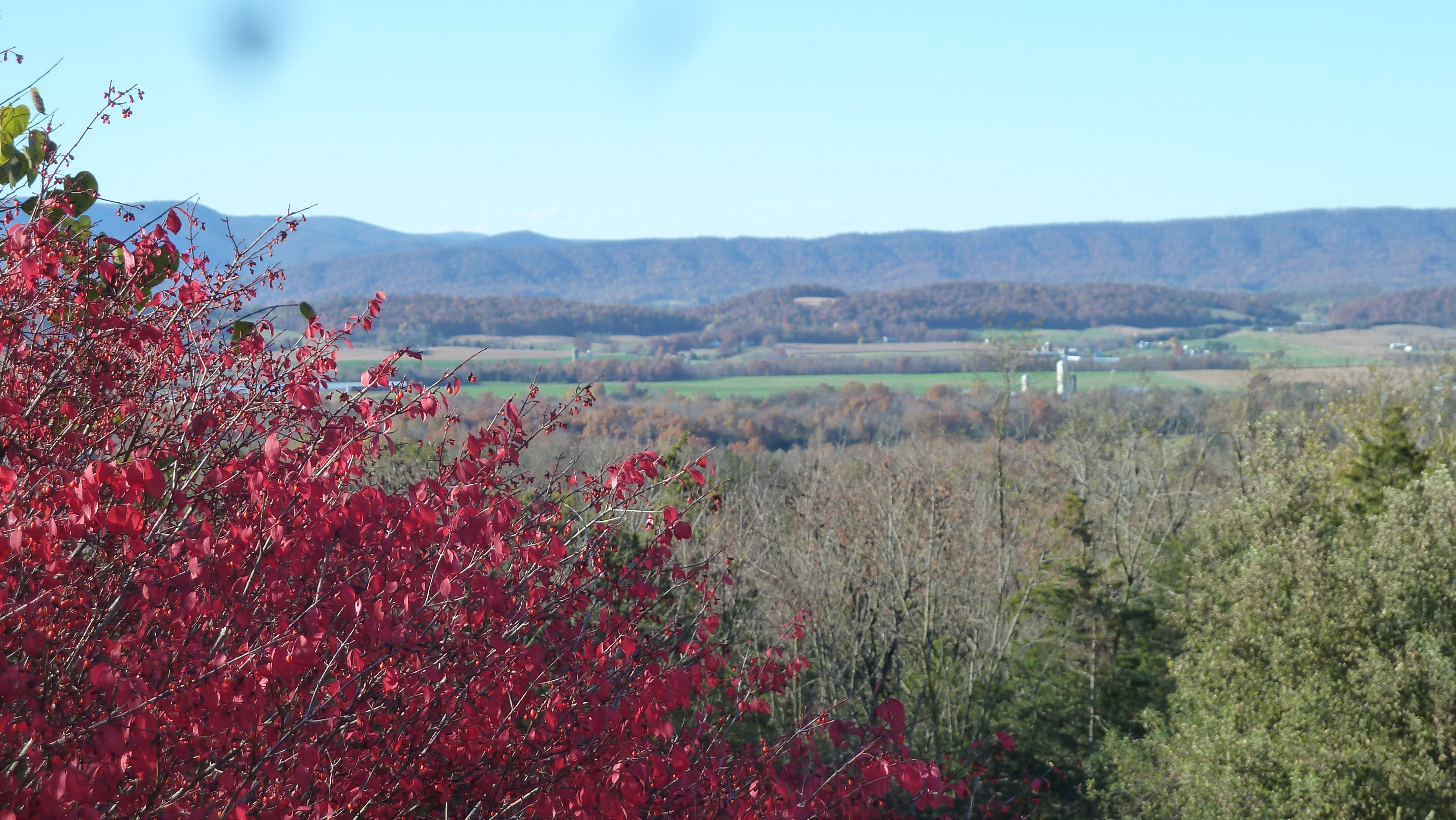
Massanutten range lines the eastern side of the Harrisonburg section of the Shenandoah Valley and punctuates any good photo with its outline. (When I was growing up in flat Indiana, we would pretend that a lining of clouds was a mountain range on the horizon.)
I have to pretend no more. We have a patio door looking out on a deck and I can watch the sun rise from the comfort of my dining room or deck. I try to pause frequently to drink in the beauty, to make up for lost daybreaks. Sometimes I sit on the floor cross-legged in front of the patio door to take it in.

I missed too many sunrises for too many years but I feel very blessed to enjoy them now and pretty much can’t stop photographing them, as lowly as my simple camera is.





A few poetry scriptures for your morning:
From the rising of the sun to the place where it sets,
the name of the Lord is to be praised. Psalm 113:3God[‘s] … splendor was like the sunrise;
rays flashed from his hand,
where his power was hidden. Habakkuk 3: 3-4
When one rules over people in righteousness,
when he rules in the fear of God,
he is like the light of morning at sunrise
on a cloudless morning.” 2 Samuel 23: 3-4
And of course at Easter we recall the most magnificent of all sunrises:When the Sabbath was over, Mary Magdalene, Mary the mother of James, and Salome bought spices so that they might go to anoint Jesus’ body. 2 Very early on the first day of the week, just after sunrise, they were on their way to the tomb 3 and they asked each other, “Who will roll the stone away from the entrance of the tomb?”But when they looked up, they saw that the stone, which was very large, had been rolled away.” March 16:1-4
The powerful majesty of the rising sun, day after day, year after year, century upon century speaks to me. “The name of the Lord is to be praised.”
I am a morning person. Morning has broken! O happy day!

***
Do you love mornings or does your star come out at night? Neither way is better than the other!
Where is your favorite place to watch a sunrise, or sunset? Beach, mountains, prairie, cityscape?

Mexico Beach, Florida

Amigo Centre, Michigan
***
For more about eating locally and in season check out this fine cookbook, Simply in Season.
All photos mine; all are of sunrises, not sunsets.

Marinated Pork Chops
So the other week I signed up for “Take Them a Meal” to two households. I’m not trying to share how generous I am because my hidden motive is it gives me an opportunity to try a new recipe for the blog that I might otherwise not get around to trying. Although that is risky because what if it doesn’t turn out and the people you take the food to think you’re a terrible cook? Or can’t get it down, and they are “down” to begin with?
This time I offered to bring pork chops of some description (along with some other choices) and when the man in the family said bring on the chops, I found this recipe online for 2 which looked promising. But I adapted it to make enough for them (2) and my husband and I (2).
Marinated Pork Chops adapted from “Mitch in the Kitchen”
4 bone-in pork chops (about 6 to 8 oz each but mine did not have bones in)
1/3 cup apple cider vinegar
2 tsp. water
1 teaspoon honey
1 ½ teaspoon kosher salt
several grinds of fresh black pepper
herbs (I used dried thyme, they also suggested rosemary)
2 cloves garlic, sliced

Combine marinade and place pork chops and garlic slices in glass baking pan. Spoon marinade over the top surface. Cover dish tightly and refrigerate. After a few hours, flip the pork chops, soaking for a total of 6 to 8 hours.

Heat a skillet with a thin layer of olive oil on medium heat. When pan is hot, place the pork chops in the pan, prettier side down (for an attractive sear and to place up to serve). Do not disturb the chops while they cook for a few minutes. When they are ready to turn (they should be a nice golden brown and should release easily from the pan, turn them over with tongs or a spatula (not fork or juices will flow out). Cook the other side until the internal temperature reaches 160 degrees and sauce reduces. This took longer than I expected, about 20 minutes. It was like the vinegar had to bubble up and cook out is the only way I know how to describe it. Remove from pan and let rest for a few minutes before eating.
From “Mitch”: *You can also make a pan sauce to spoon on top by adding reserved marinade (but nothing that has touched the raw meat of course), stock, and/or wine to the pan, scraping up browned bits and letting sauce reduce. Spoon sauce over finished pork chops.
*I did not do this, as I ran out of time before needing to deliver the meal.
Having run out of time, I took one bite, left the chops with my husband and drove off to “Take Them a Meal” and an evening meeting.
A few minutes later my husband called on my cell phone and said “Tremendous! They melt in your mouth!” He is usually very supportive and complimentary for anything I try, but this was more effusive than I’m used to!
So, I scored a new dish for our repertoire. Well worth the effort! And obviously I was in such a hurry that I forgot to take a picture of the final product. Next time.
***
What is your go-to meal when you carry food to a friend, family or church member who needs a little help in a time of need?
***
And if you’ve never heard of my book with 100 more great recipes (not all mine) check out Whatever Happened to Dinner: Recipes and Reflections on Family Mealtime (Herald Press, 2010).

Part 3
My posts this week have centered on my faith journey (Part 2) and connections as a Eastern Mennonite College (Part 1) student. The president of EMC at the time (now EMU) was Myron Augsburger, and my personal history with him goes back to my very first days as an infant. He was the first preacher I ever heard the winter I was born in Sarasota, Florida.

My family the winter I was born in Florida: Linda (Pert), front left, Nancy, right, Mom, me and Dad. Our brother Terry would join us four years later who is the only one of us who now lives in Florida. But we all have that sand in our shoes.
My parents had a long love affair with Florida which began on their honeymoon. Mom bargained hard for a honeymoon to the romantic, semi-tropical state that she had only heard about, a perfect place to escape to if your wedding was, like theirs, in the dead of winter in northern Indiana.
They almost didn’t make it because of budget and car breakdowns, but they soldiered on at least in part because “Your daddy promised he would take me to Florida.” They definitely ended up with sand in their shoes and went back to try farming (like many other northern Mennonites) there for about six months in 1951-1952 the winter I was born. They also spent time living in northern Florida for eight years, and wintered in Sarasota for four-five months in their later years, roughly 1992-2002. Altogether roughly 12 years in the Sunshine state.
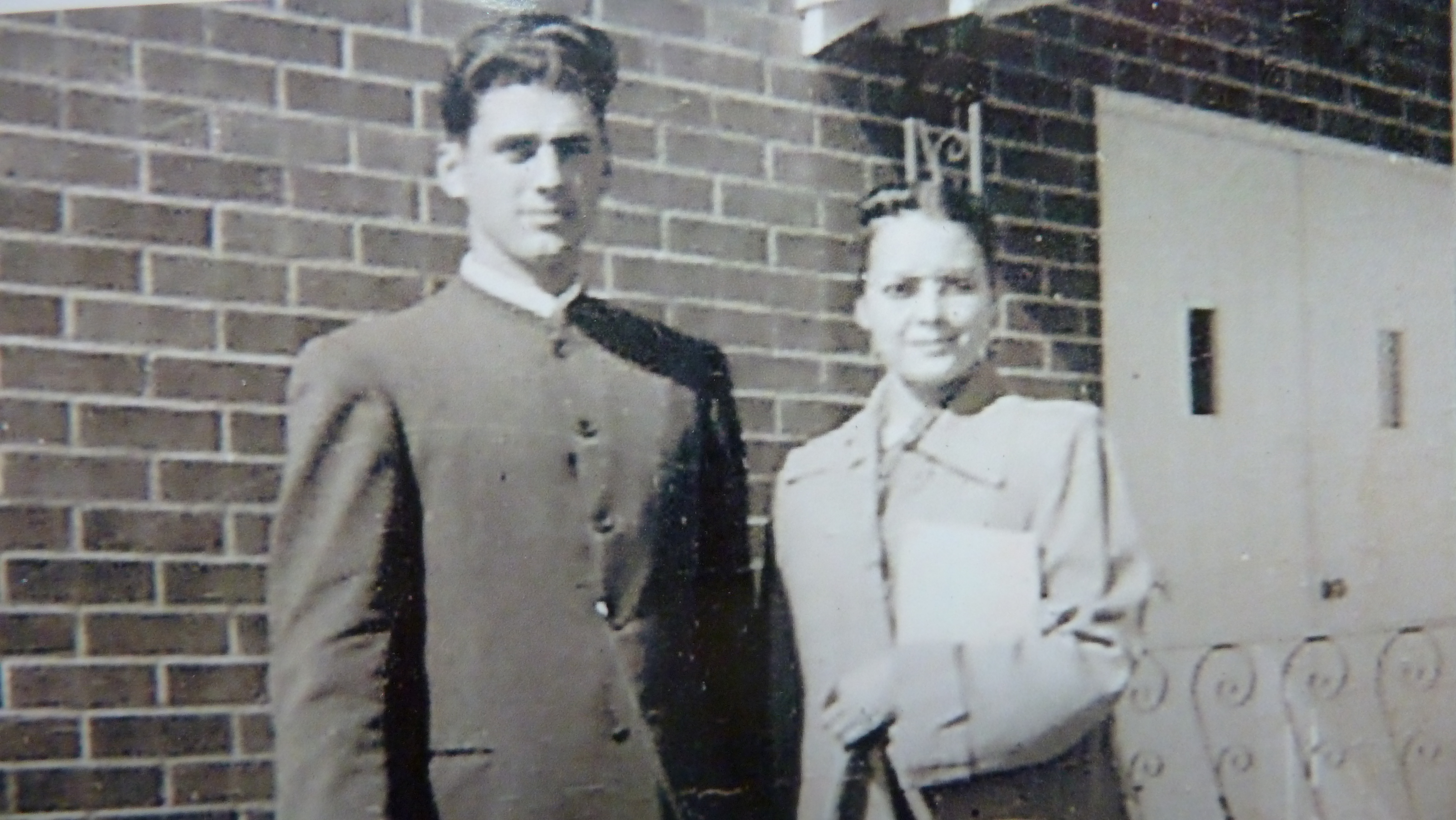 Almost-newlywed Myron and Esther Augsburger in front of Tuttle Avenue Mennonite Church, Sarasota, Fla, winter of 1951-1952. From my parents’ photo collection.
Myron was a budding evangelist who at the age of 23, with his bride Esther, was invited to move to Florida to pastor Tuttle Avenue Mennonite Church—a church plant associated with Virginia Conference. It had only 40 persons in May 1951; by Jan. 1952 (the winter I lived there as an infant), the attendance was around 500 (of course winter was and is high tourist season in Sarasota). In Roots & Branches: A Narrative History of the Amish and Mennonites in Southeast US, 1892-1992, (Cascadia Press, 2010) Martin Lehman describes Myron as “an eloquent speaker. He had a gift for evangelism, and his preaching resonated with Mennonites and non-Mennonites alike.” Martin points out that “some 200 [attenders] were of non-Mennonite background.” The whole history and book is rather complex and doesn’t shy from the conflicts which played out.
Augsburger left Tuttle Avenue in July 1953 to become campus pastor at EMC and to continue his schooling (although he spent another period of time pastoring in Florida). But Mom and Dad so much loved having him for their preacher, that all through my childhood, I often heard my Dad say, “I would sure love it if one of my children would go to Eastern Mennonite where Myron Augsburger is.”
That is NOT why I went to EMU but now I wonder if kids ever lean unconsciously towards paths their parents “wish” for?
Many years later I was asked to write an article for the EMU alumni magazine Crossroads when Myron’s long time assistant Peggy Shenk (indeed she served as assistant for three of EMU’s presidents) retired. Peggy recalled her and her husband’s (Michael) long friendship with Esther and Myron, and how as young women dating Michael and Myron they confided to each other that they hoped “the Lord wouldn’t return [to earth] until they got married.” I also enjoyed the opportunity to work with Myron doing “developmental editing” on one of his many books, The Resurrection Life, (Evangel Press) published in 2005 where I mainly broke up his trademark paragraph-long sentences to more manageable chunks. And yes, I got a little pleasure out of editing my former college president’s work. I also had the fun of interviewing both of them in their home about an assignment in India and got to know more about Esther’s remarkable work in art and its theological connections for her.
Myron was only one of three Augsburger brothers (there were five in all and one sister) who had an impact on my life: Don Augsburger was my pastor and high school principal for a number of years in Goshen, and in fact baptized and instructed me in the faith, and my father worked closely with him as a deacon of North Goshen Mennonite Church. Don’s pastoral gifts of tending a congregation, writing and memorizing poetry, and the ability to listen well and between the lines make him also stand out in my spiritual journey. Their brother David, whose creativity and booming bass voice (both singing and speaking on the long running Mennonite Hour radio program) contributed to the success of Mennonite Broadcasts Inc. for a period from about 1966 to 1975 (he left right before I joined staff in 1975). David was still a guiding force as we contracted with him to write and record various Choice radio series he birthed (one series on Living More with Less re-released as recently as 2011). For one series, I served as ghostwriter and Dave said he got a kick out of reading the material because I “out-Augsburgerized David Augsburger” or something like that–had made it sound so much like his writing.
So this Indiana Mennonite farm girl, whose Midwestern roots went so deep she somehow harbored hopes for many years of someday moving back “home,” ended up with even stronger connections to Mennonites of the southeastern U.S., especially Virginia (through my work for the Mennonite church) and Florida. Along with, yes, what shall we say, longtime formal membership in the Presbyterian Church and awesome local congregation, Trinity, and my husband’s deeply rooted Virginia family? Yes, it’s complicated. It has also led to my lifelong search finding harmony among these various threads.
I remember when I first realized I had a new home in Virginia setting: as my colleagues and acquaintances were aging and moving on, I went to funeral or memorial services and looked around and realized that I likely knew more people sitting in those pews than if you suddenly plunked me back in my home Indiana congregation. These were my people. I knew them much longer than my relatively short 17 years in Indiana. And Presbyterians have also become my people: my pastor Ann Held (the longest preacher I’ve ever had, almost 24 years) can play a pretty good “Presbyterian Game,” always striving to connect people. Her special gift.
 Ann Reed Held, center, flanked by Trinity’s other two pastors, Dan Grandstaff, left, and Don Allen, right, all of whom have been my “Presbyterian pastors.”
Truly, any place can become home when you put down roots. But like the song says, “This world is not my home, I’m just a passin’ through.”
 My mother, Bertha, holding infant me in the trailer park where they lived in Florida.
***
How have you put down roots? How much does your church family play a role?
***
If you love that great Mennonite Hour a cappella music, here’s a link to a bunch of YouTube videos featuring the music (nevermind the visuals, just listen to the music.)
***
And for my tribute to the wonderful new Presbyterian hymnal, Glory to God (designed by a Mennonite, so there), check here.
***
And when I get homesick for Sarasota, Fla. and Amish & Mennonite filled-Pinecraft, I go here.
Part 2. (Find Part 1 here.)
Why I had to apologize and restore harmony with the dean of the seminary goes back to this sawdust trail, spread down between these long rows of chairs on a flat Indiana farm.
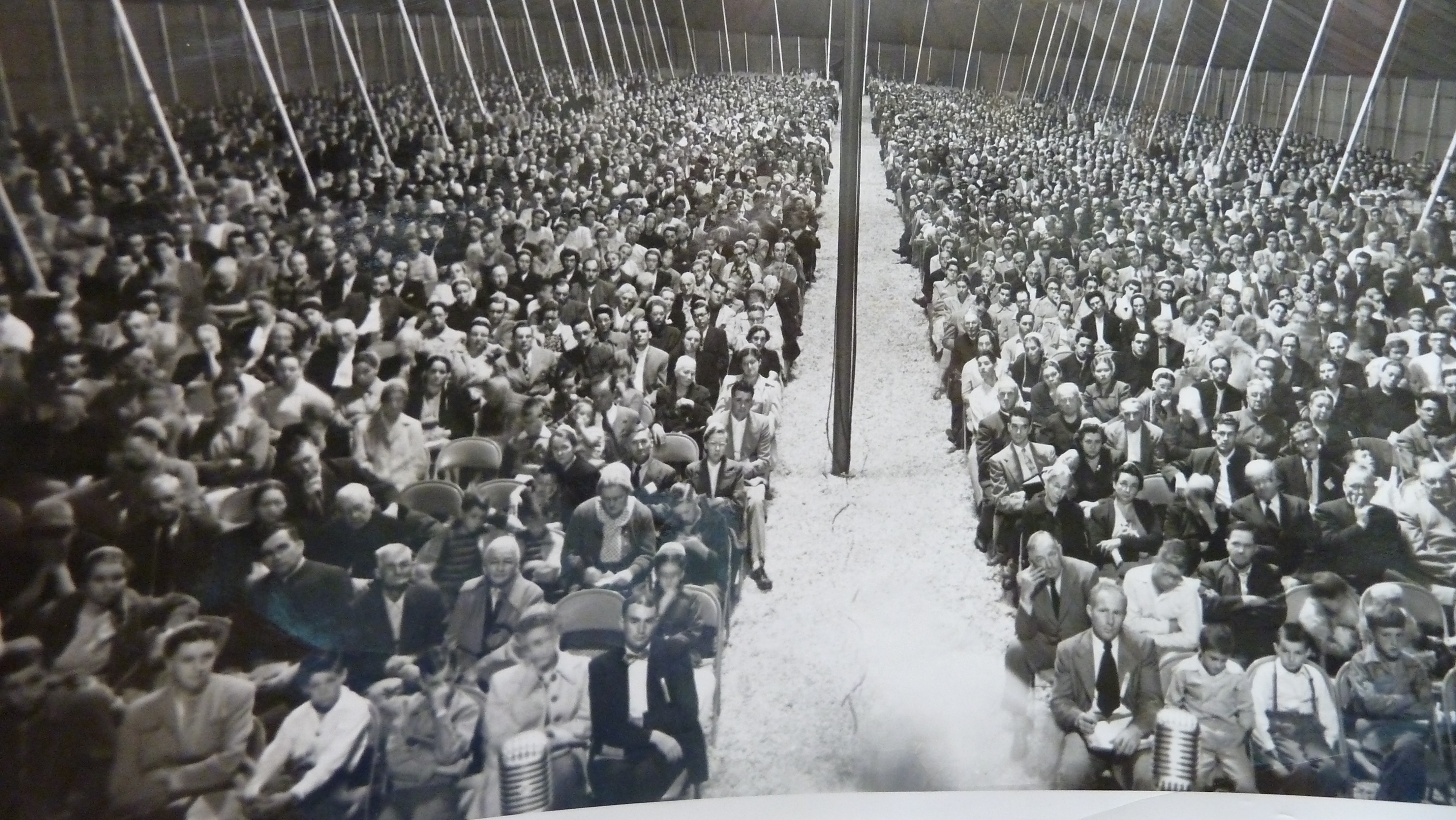 (Photo dated 1952)
A reader of my Another Way newspaper column, Pauline Yoder Kauffman, who knew my family, once sent me this photo, which I treasure. Why? Because it includes my paternal grandparents, Uriah and Barbara Miller, sitting in the second row, pretty much the way I remember them throughout my growing up days as they lived in the “daughty” house attached to our home. I’ve written in this space of how Grandpa was just 6 generations removed from his ancestor, Jacob Hochstetler, featured in the new novel, Jacob’s Choice.

Grandpa Uriah M. Miller and Grandma Barbara Kauffman Miller, second row. He has a coat without a tie, and she has a jacket on.
Persons who attended every night of a Brunk revival received a free Bible. Grandpa and Grandma got a Bible. (I don’t know if it was one copy or two.) They were already in their 80s.
But the tent here is what astounds me as I look at this photo. Look at all those support poles, way back.
Other sources say the tent held roughly 6,000 people. Crowds of 17,000 with overflow tents in some communities are mentioned in other sources. Here the tent looks pretty well filled. That is a lot of people in the small communities where the tent was set up—not dense or urban population areas. People drove from miles around. Sometimes the meetings went as long as 3-4 weeks. That Grandpa and Grandma were there every night kind of blows me away.
So it was the only game in town, and a big game at that. George Brunk II was also a big man, around 6’4″, with a big voice and he knew how to use it. He was sincere in his fervor and calling. In 2014 we may critique the theology, the emotionalism, the hucksterism of the big tent. The 1950s were a different time and my family and I attended likely about a decade later than this photo, probably around 1963. It was a time and era when my peers and I grew up knowing and believing that we would “go forward” at some kind of public meeting thereby demonstrating we were ready or felt God nudging us that it was time to show that we were ready to follow Christ. At age 11 or 12, having grown up in the church, we were still taught that at some point we would need to make that public commitment that said “I’m a Christian.”
The night I went forward I remember watching one of my school mates who was a year younger than me. He went forward first and I thought, if he can do it, so can I. I was emotional of course and my pastor and his wife, I think, joined me in the private area behind the stage to pray with me and support me in that step. I don’t remember exactly how my parents reacted but I’m sure my father said something like “We’re very happy you went forward, Melodie” and that was pretty much the extent of it because we didn’t talk about a lot of deep personal things. I didn’t know what else to say. My sister may have went forward too but that’s her story, not mine to tell. I was baptized several years later.
So in my senior year of college when I wrote the yearbook essay on Eastern Mennonite Seminary mentioned in my last blog post, and George II as dean of the seminary was not happy, I ruminated on that for about two years. I would see George around town or the campus and wondered if he remembered the incident, if he recognized me as the writer of it. I had not intended anything ill or offensive, but I was made in such a way that I wanted to apologize. To me what I wrote was not a sin, but something had come between us. I once wrote a letter of confession and apology to a family whose bathroom scales I broke and had lied about it; in the same way, these bad feelings weighed on my heart.
I finally sent George a letter, apologizing, and asking for forgiveness if I had brought any mar on the reputation of the seminary. In the note I mentioned how as a child I had responded at one of his tent meetings, and how that had been an important marker on my faith journey. Maybe my letter was not necessary, but I felt a lot better after I sent it.
In due time George sent a conciliatory response. All was well. There was no bad blood, no bad feelings. One of my cherished mentors, Ruth Brunk Stoltzfus, the first ordained woman in Virginia Mennonite Conference, was a sister of George, an ordination he definitely opposed. In her memoir, A Way was Opened, she speaks some of her relationship to her brother. They had some family fences to mend, too. I was happy to have taken care of my unfinished business when he died at the age of 90. My compulsion was somehow connected to my grandfather and his grandfather and his grandfather before him (and on back) and how we are taught to not only seek peace with our brothers and sisters as mentioned in my last blog post, but to do good, especially “among those who are of the household of faith.” Galatians 6:10.
For more history of the Brunk Revivals, check here.
To be continued.
***
Did you ever apologize just because you knew you would sleep better if you did so?
Did you walk the sawdust trail or “go forward” at an evangelistic meeting? What do you remember?
When the topic of one’s personal faith journey comes up, mine was irrevocably entwined with two of the well known and powerful Mennonite orators of the day, George R. Brunk II and Myron S. Augsburger. I once got into trouble with the former (now deceased) and am still on friendly speaking terms with the latter. Both held a commanding presence in the Mennonite church of eastern U.S. of the 50s and 60s when I was growing up. I’ll share my intersections with both of these men in a three-part blog.
How I got in trouble with the dean of the seminary
… and I was never even a seminary student, and that was part of the problem. All through my years at Eastern Mennonite College except for the year I lived abroad, I was an active part of the Weather Vane (student newspaper) staff, which served as my practicum in journalism. Everyone needs a place to connect on a college campus and while our college was not big, the writers/photographers/designers who made up the staffs of our newspaper, literary magazine and yearbook was where I hung out.
So I was asked to write a descriptive essay on Eastern Mennonite Seminary for the college yearbook in 1975. The seminary was part of the EMC campus and community, yet its own entity on the edge of campus, even then. The yearbook that year attempted to be an artsy-fartsy attempt to be literary and cool, not just the same old yearbook with pictures and descriptive captions but more of an impressionistic feel for life on campus. That was what the editors described it, at least the way I remember it, and that’s what I wrote about the seminary in a half page essay to accompany a dark, foreboding-looking photo of the seminary building.
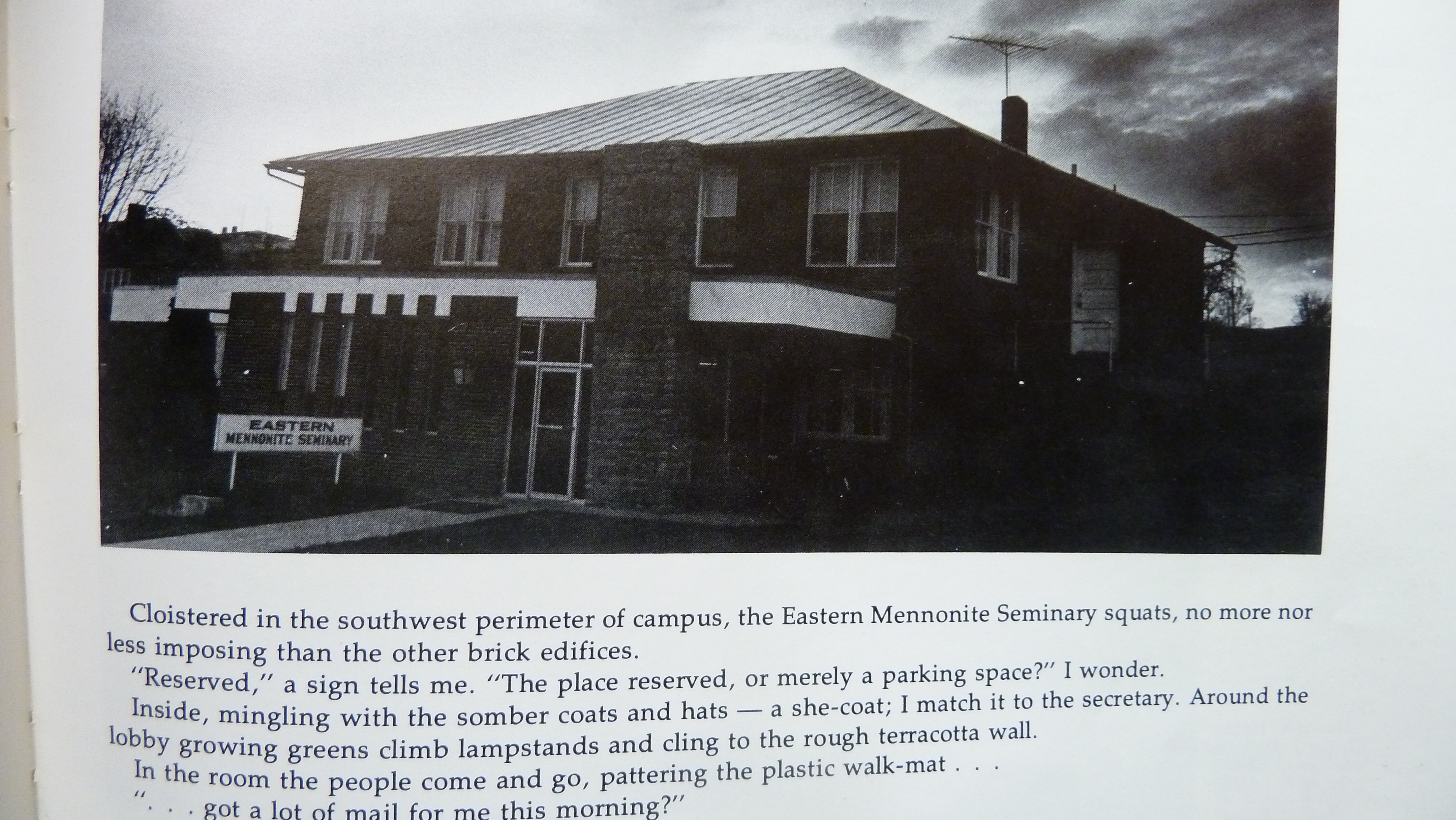
In those days not very many women went to seminary. There were only two that year, which probably represented a real growth spurt. I was starkly aware of my gender as I walked through the seminary building as I attempted to get inspired for my essay.
Here is part of the description I wrote in the 1974-75 Shen: (I think I was trying to write like T.S. Eliot in “Lovesong of J. Alfred Prufrock”) or some of the other poets and literature giants I was studying at the time as an English major. I have to resist the urge to edit myself now.)
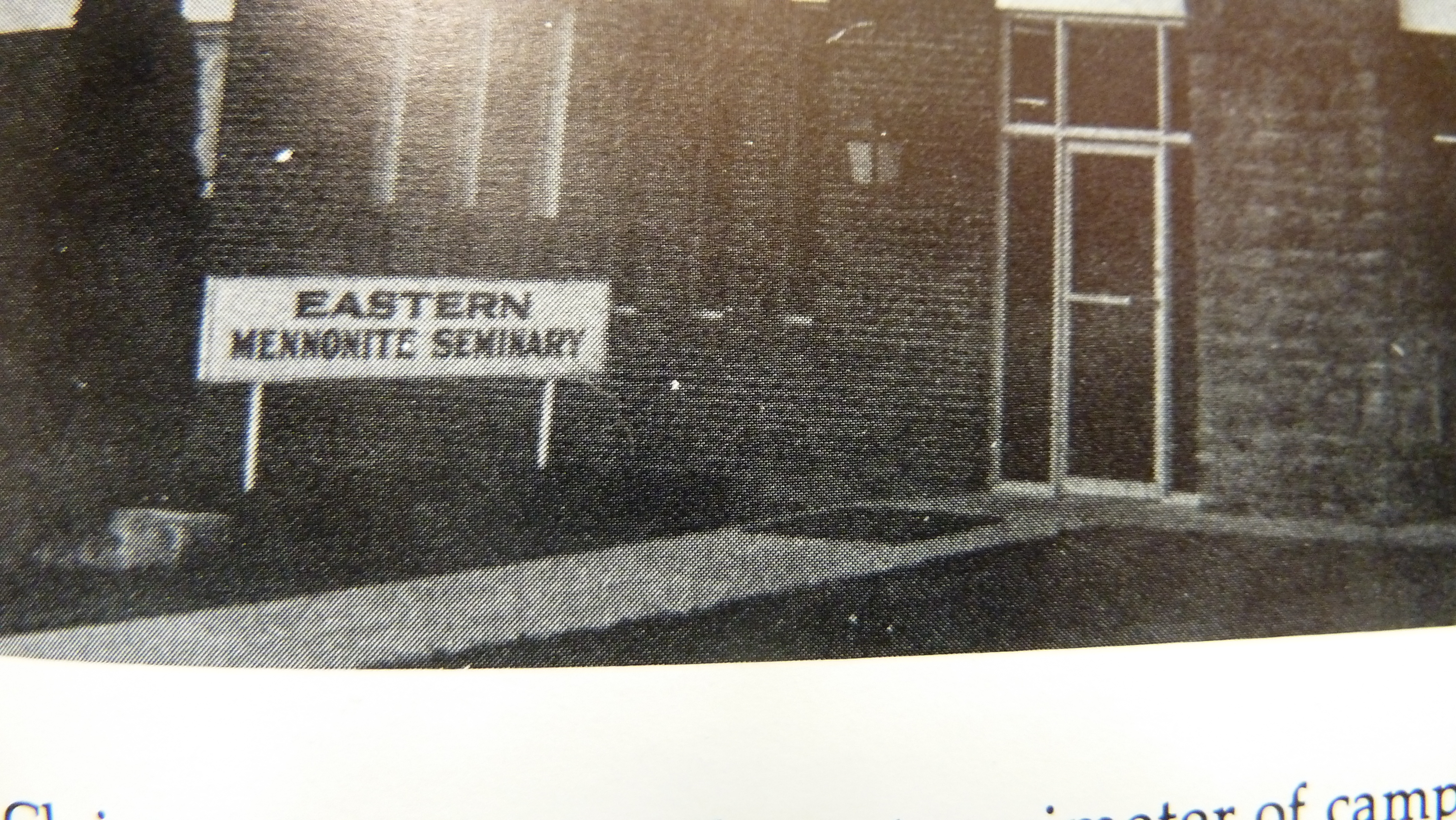
Cloistered on the southwest perimeter of campus, the Eastern Mennonite Seminary squats, nor more or less imposing than the other brick edifices.
“Reserved,” a sign tells me. “The place reserved, or merely a parking space?” I wonder.
Inside, mingling with the somber coats and hats—a she-coat; I match it to the secretary.
In the room the people come and go, pattering the plastic walk-mat …”
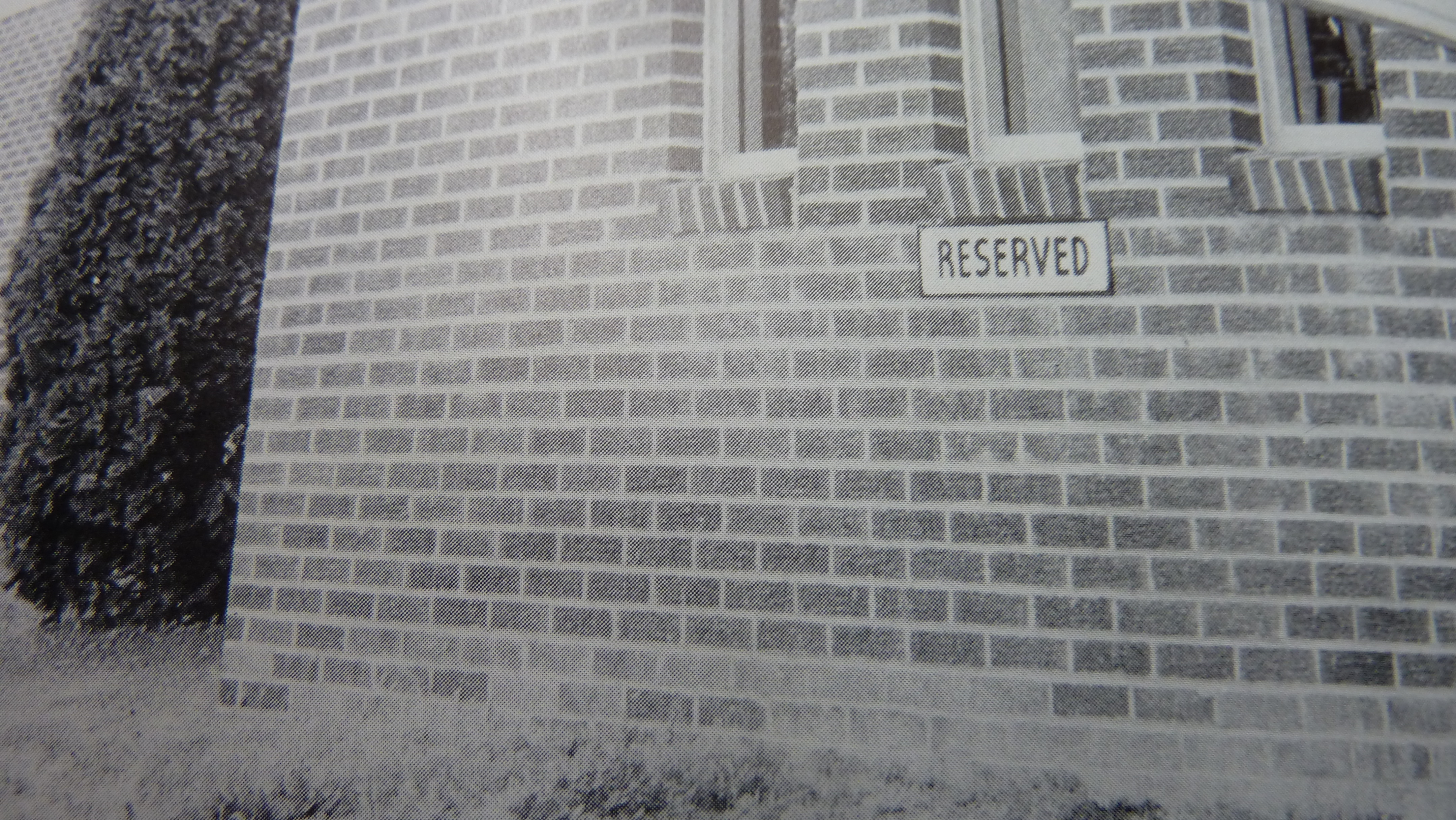
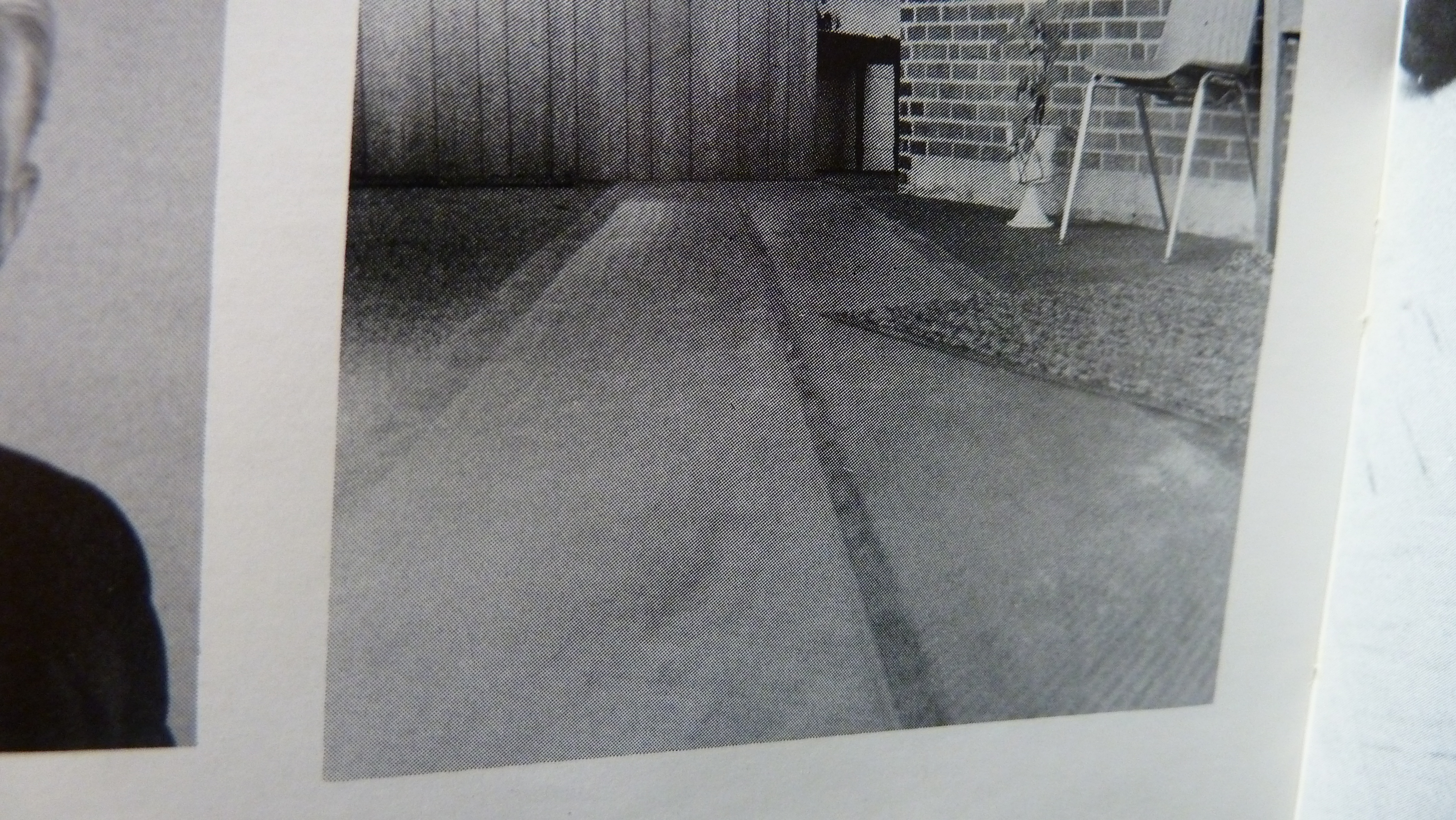
But the part of the essay that got me in trouble was mentioning my awareness of my own legs in this densely male enclave as I tried to depict with words the atmosphere in the seminary. I wasn’t being disrespectful: I knew the scholars were working hard at a level far beyond mine but also had “lives” which made them human like me, which is what I tried to touch on:
Burrowing into Greek, Hebrew, Pastoral Care, Systematic Theology and Early Christian Thought, scholars lose themselves in individual study carrels. Here a photo of a baby, there a stale Styrofoam coffee cup. They man their carrels and barely stir as my female legs prowl into their den.
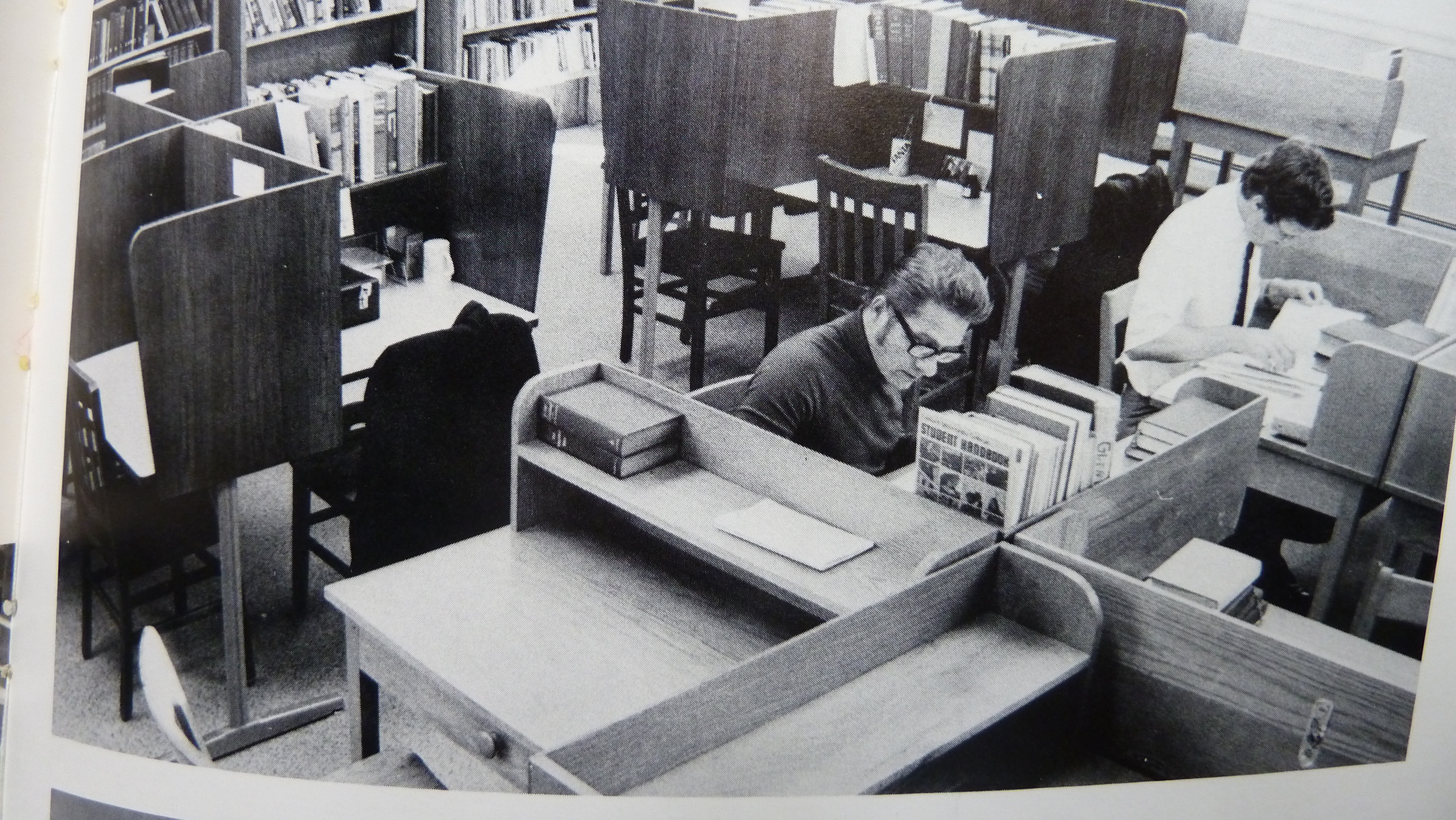
I ended the essay reflecting on the pleasant and inviting chapel atmosphere where there were cushions and hymnbooks in a holy hush. All in all, to me it was a fair description–for a surface look that any stranger walking in might have seen or observed.

But it was NOT taken that way by seminary staff and especially not the Dean. My face grew hot with shame and embarrassment as I read a long angry letter on the Opinion Board (I do not recall who wrote it) in the campus center not long after the Shen was published. How could any underclassman think they were representing what actually goes on in the studies of a 2-3 year graduate program without interviewing or getting information from the administrators or faculty there? How could this short description possibly do justice to the seminary program?
In hindsight and with many years of “maturing,” I certainly can understand the objections. I don’t remember now whether the yearbook editors offered a rebuttal on the opinion board or decided to just “let it go.” I do know that the upshot was that the following year, the seminary published its own yearbook, not just a page or small section in the underclassman year book over which it had no control.
That was then. Fast forward a few years, after I had been working in a sister Mennonite institution, then called Mennonite Broadcasts Inc., a few years. My offense to the seminary dean occasionally pricked my conscience, or at least my desire to do as the scripture tells us in Romans 12:18, “As far as it lies within you to leave peaceably with all.” This was the manifesto my father taught me from little up. I did not like the feeling of having an unsettled issue with George R. Brunk II. I wanted to find harmony. He was, after all, the evangelist who had once inspired me to walk the long saw dust trail, literally, in the days when many of my peers were also doing the same thing.

In the end, I don’t think I did much damage to the overall fine reputation of the seminary: pictured above is the current Eastern Mennonite University president Loren E. Swartzentruber, who was in seminary during those days.
To be continued.
The sawdust trail at a Brunk revival in Indiana, conducted by the “Brunk Brothers” 1952. In my next post I’ll tell you which of my relatives is found in this wonderful photo and why I felt a special need to “make things right” with George R. Brunk II.
Shen Photo credits: I cannot see that our yearbook–(are any yearbooks?) copyrighted nor were the photos in the 1975 volume credited to specific photographers but are listed as follows (many of whom were fine friends of mine at the time): Dave Kraybill, J. Marcos Hostettler, Marian Eberly, Jim Mast, Jim Bishop, Jon Byler, Ken Pellman, Keith Gingerich, Deb Stoltzfus, Tim Landis. If anyone remembers who took the photos which illustrated the seminary essay, I’d love to know!
***
Did you ever get in trouble with authorities at your school? Did you make peace?

 findingharmonyblog