

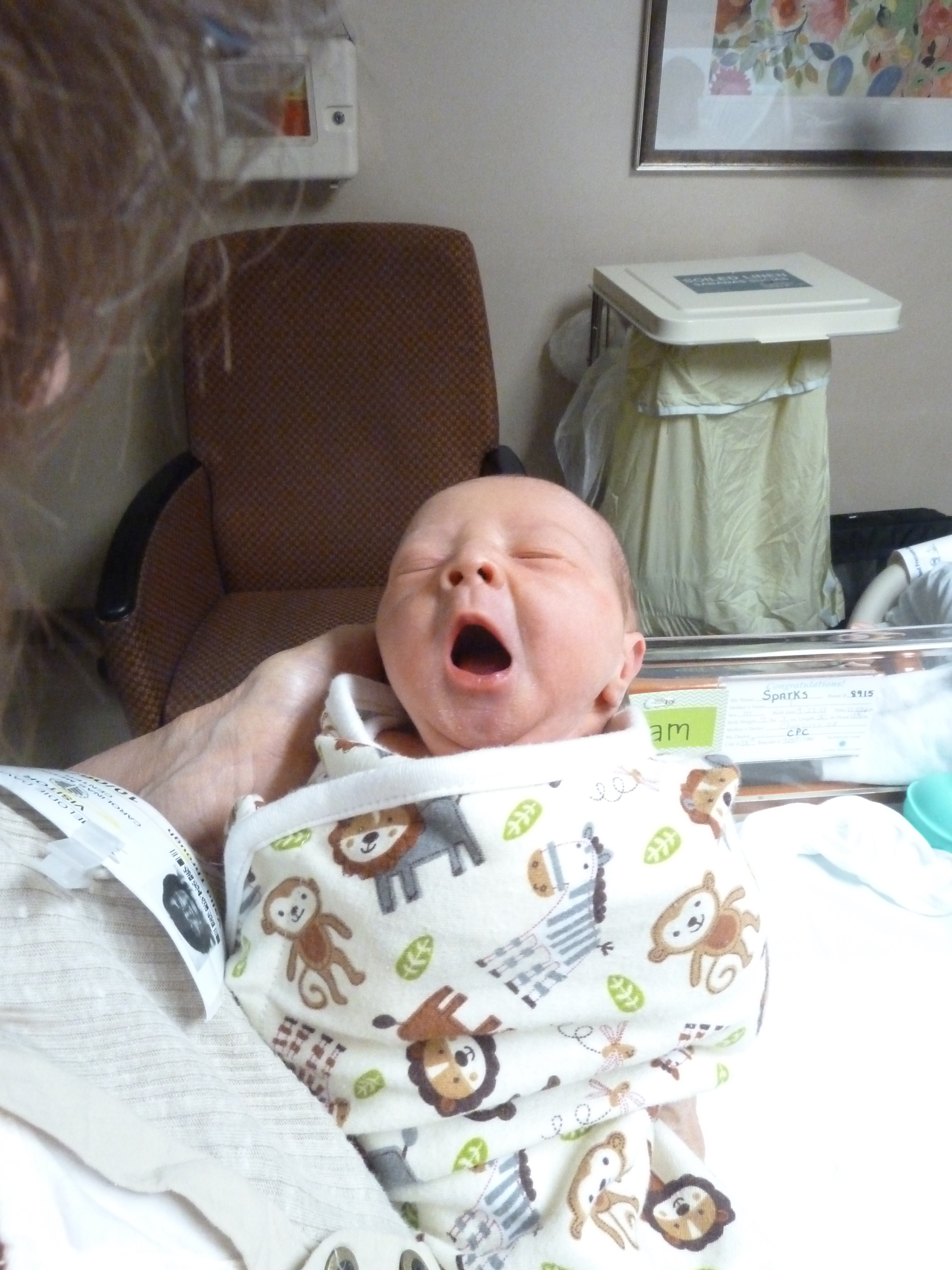
For anyone who has been wondering, or happens to remember my earlier posts about becoming a grandmother, yes, our first grandbaby has arrived!
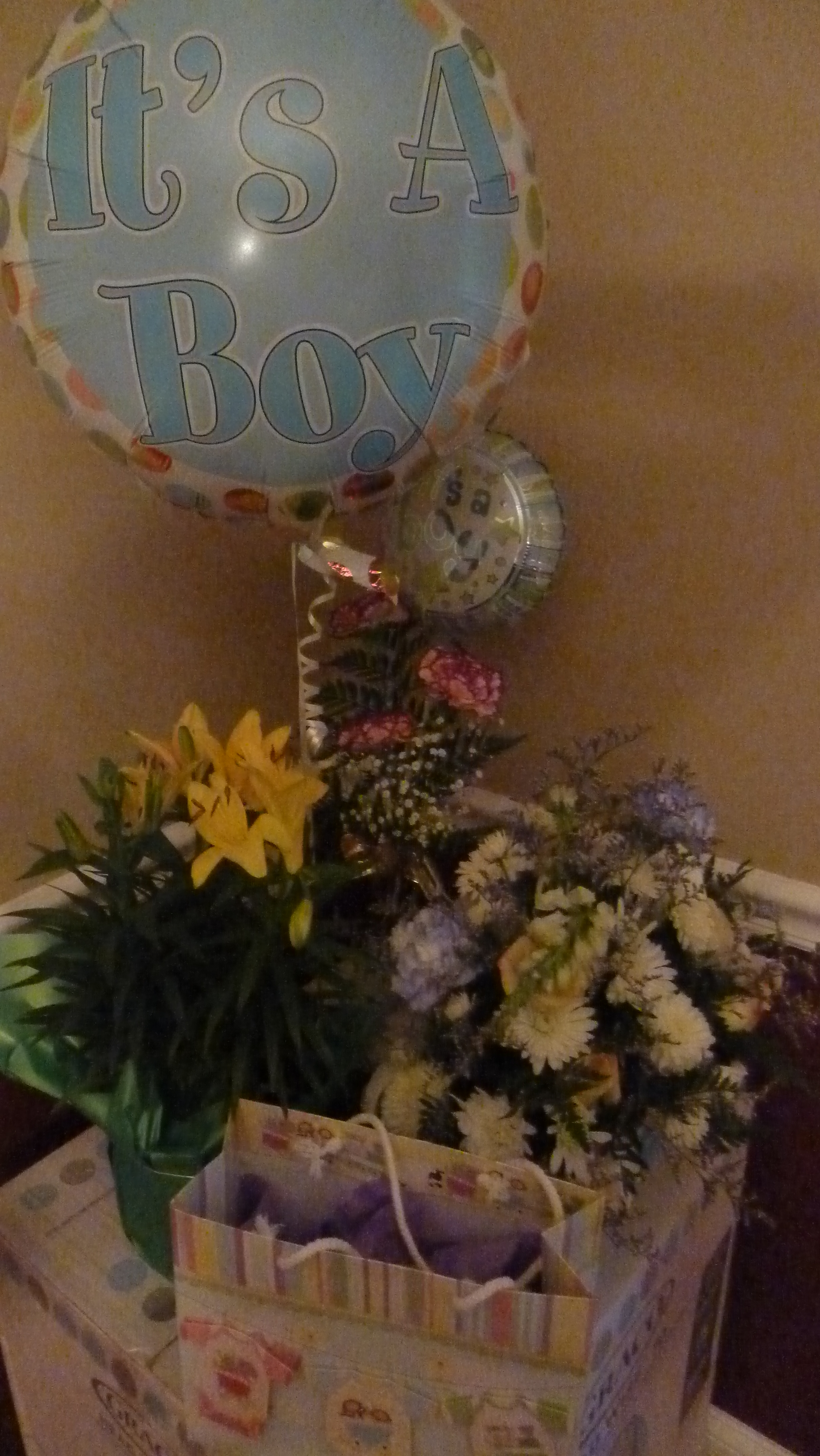
Everyone says how much better it is to be grandparents because you can kiss ‘em and love ‘em and send them home and not be getting up at nights with them.
But I’m not sure how to be happy doing that when my daughter and her husband are in that new baby fog of wondering if they will ever sleep clear through a night again.
I had to leave this baby much too soon – after three days of yes, enjoying snuggling new born cheeks and adorable finger wraps – and even though I get to return to help out a little with those sleepless nights, I wish he lived five minutes away instead of five hours.
Then there are many of my grandparenting colleagues who live 1,000, 3,000 even 5,000 miles away from their grands. And while people used to live closer to their children and grandchildren, I also think of the settler and immigrant families of old who moved across the ocean and in some cases never saw their parents or grandparents again. Of course, I have lived 600-some miles from my parents all my married life and I feel like our children grew to have great love and connections with these grandparents.
So this is how it went down: While I was enjoying swans and hiking through wetlands early on the final day of my speaking commitment (made long before we knew anything about this baby!), my daughter’s labor was being induced. That evening, while I was wandering around the Indiana Michigan Mennonite Relief Sale with my mother and sister, Tanya’s labor kicked into high gear and became so intense she had to go with an epidural. Yes, I was on pins and needles. Yes, I wanted to be there with her, but I would just get there as soon as I could. I hoped and prayed she wouldn’t have to labor all night. I knew I wouldn’t sleep much either.
At 11:30 p.m. the call came as I had just dropped off to sleep. “We have a boy! We’ve named him Sam” said Tanya happily; she sounded a bit smoothed out by the medications.
Immediately I loved the name and the child. I loved that he was finally here, and all appeared to be well, my daughter and her husband were swooning in the early aftermath of bonding time with their new son. I told her she could break the news to her dad, anxiously awaiting news back in Virginia.
I tried to go back to sleep. Funny joke. But I didn’t mind. The labor was over. Thank God.
The next day I couldn’t get there fast enough, through a circuitous route when you end up driving west to fly east and drive south. We arrived at the hospital about 7:15 p.m. Oh happy day.

Sam was and is beautiful, a handful of hungry tummy and increasing lung strength, who did everything babies are supposed to do: squirm, grimace, make wonderful faces, yawn, sleep, nurse (open tiny mouth wide!), wet and dirty his diapers, snuggle, wake his parents too much at night. Suddenly I was thrust back into early nursing woes and pain and feeling like you’ll never get enough sleep again.
His father, after a night or two at home, said “I knew they were supposed to wake up every three hours or so to eat but I didn’t know they stayed awake between times!” My daughter said, with appreciation, “Parenting is hard.” (So much for labor being over.)
Something you can never fully prepare for ahead of time. But amid these struggles I see and hear wonderful bonds of love and commitment strengthening and I trust they too will get through these groggy days and long nights.
 With Grandma Sue.
Welcome to the world Sam. You are loved!

Ike meets Sam.
***
What have been your surprises in grandparenting? Parenting? How do you work at keeping connections from a distance?

Swans gliding on a calm Michigan lake in early fall.
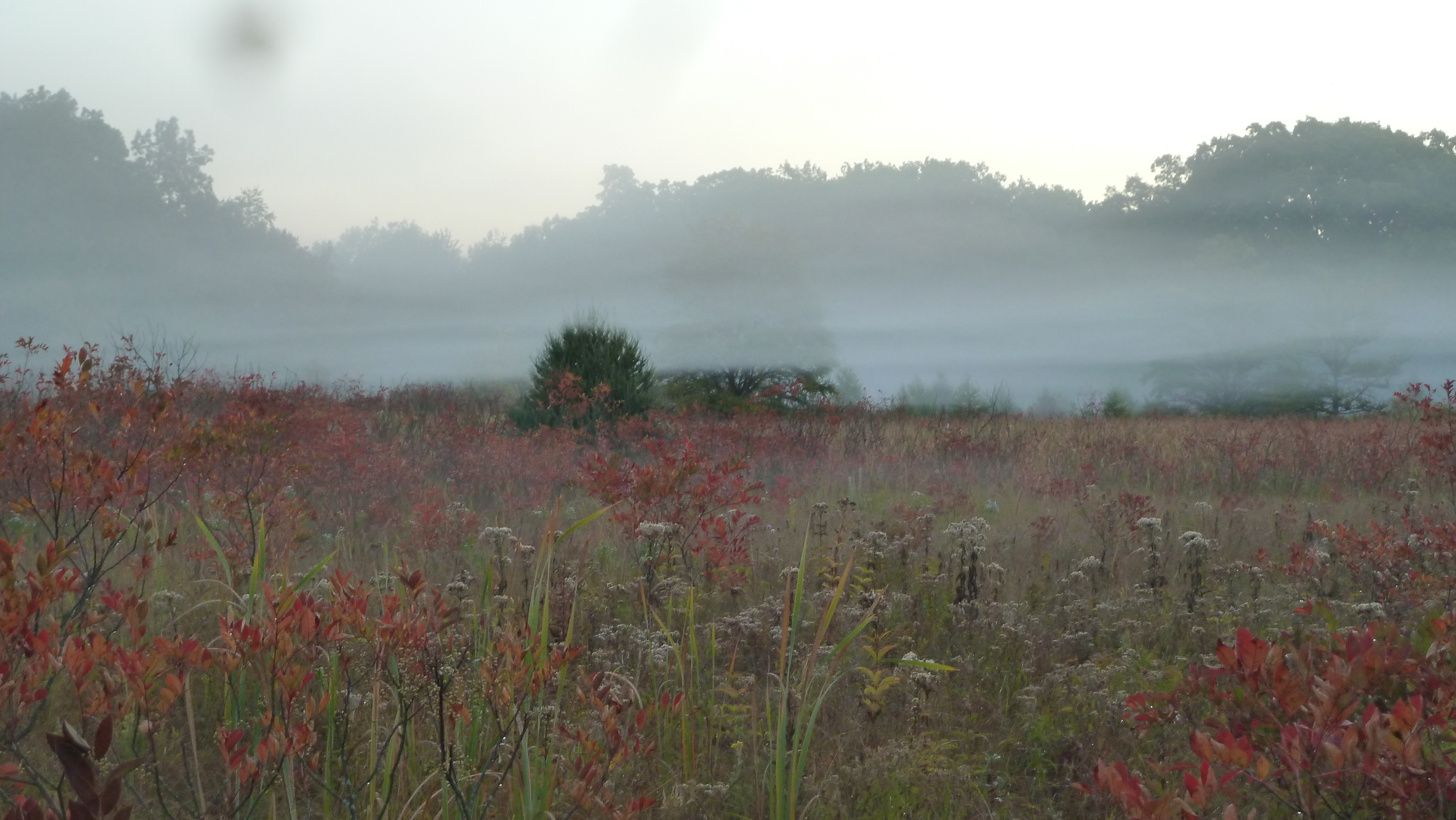
Early morning mist shrouding wetland.

Poison sumac warning us to stay away with its bright fall colors.

Dew lacing a spider web in the dawning new day. In the woods, dark wet ground sports four or five different mosses, said our guide. Hmm. I knew mosses sometimes looked different, but didn’t know they had different names. How rich and varied is the natural world when we take time to truly notice.

Finally, brilliant sun beaming through the woods, warming our slightly chilly walk.

And much more that I can’t name now.
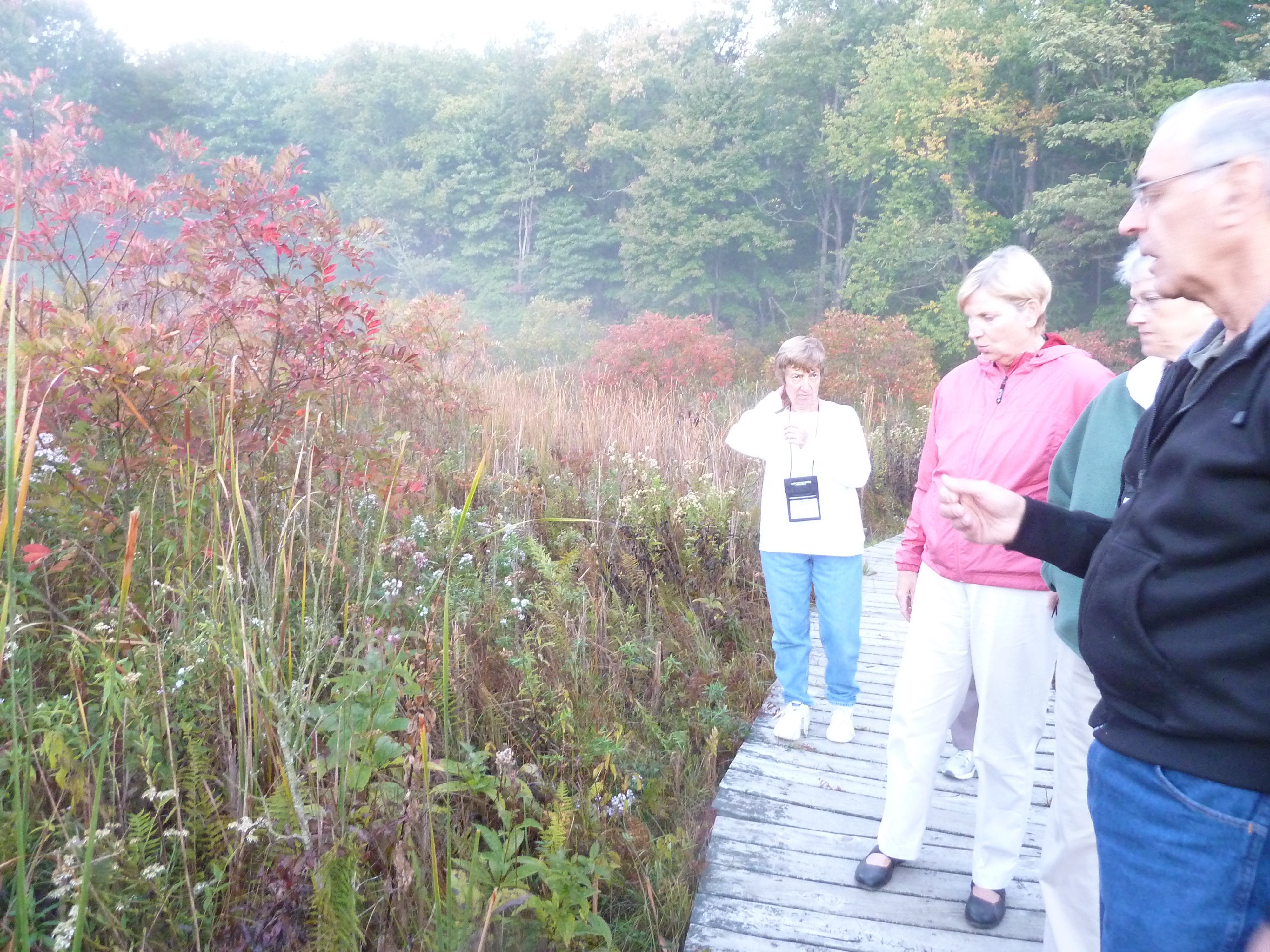
It had been a long time since I’d been on a true nature hike with a naturalist (far right, Jim Gascho).

My stomping grounds at Camp Amigo were not the first childhood camp I ever went to (established in 1957, and I remember well my dad’s excitement to help with early projects making a campground out of woods and lake). Little Eden (how aptly named) a bit further upstate was my first, where my parents coaxed me into leaving my “gi gi” pacifier as a toddler.
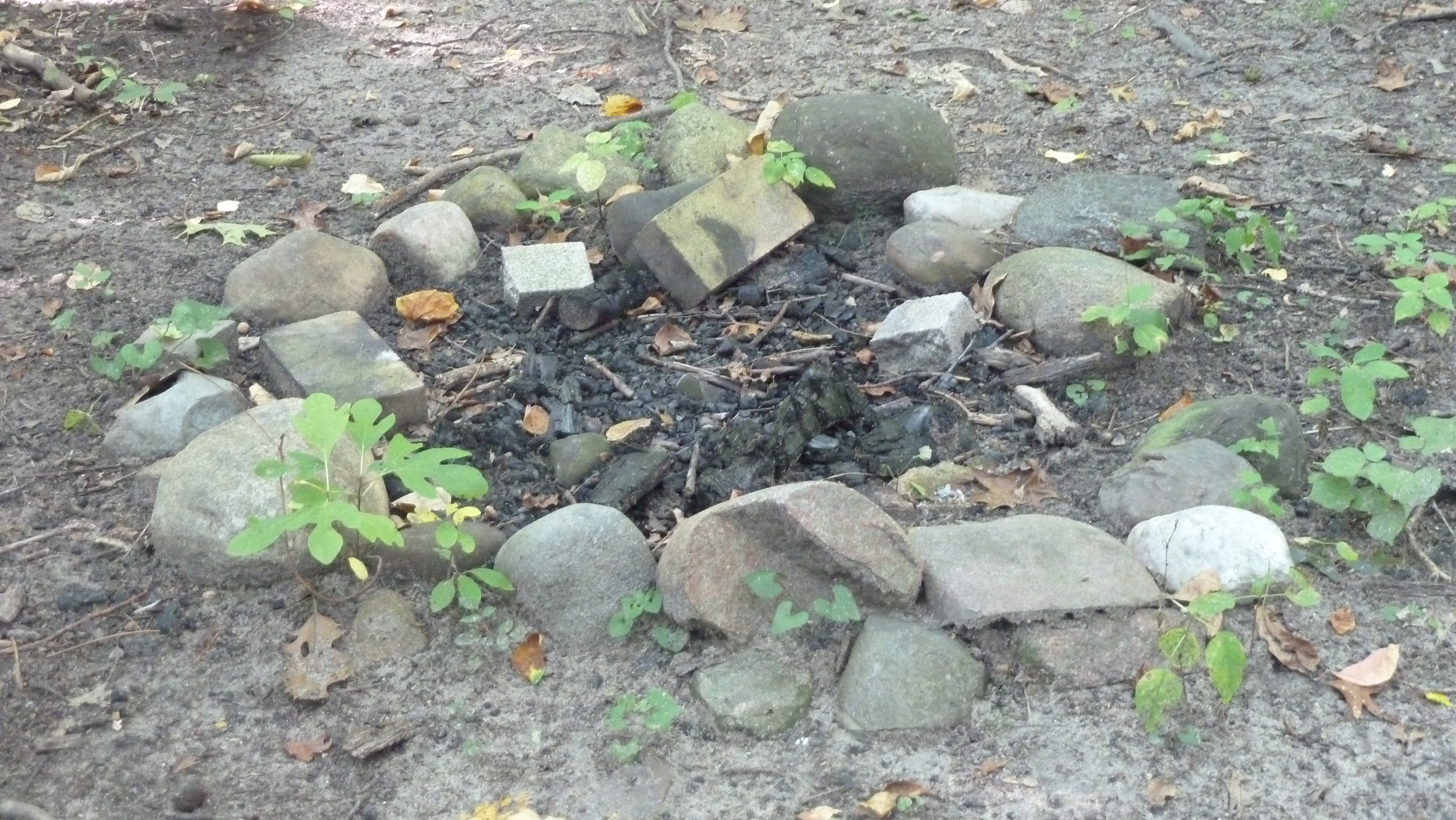
But these grounds at Camp Amigo are close to holy pilgrimage every time I have the opportunity to return to this lower-Michigan-basic-lake-cabins-woods-tennis-and-ball-courts-church campground. How well I remember pondering life direction and my own spiritual wanderings around evening campfires.
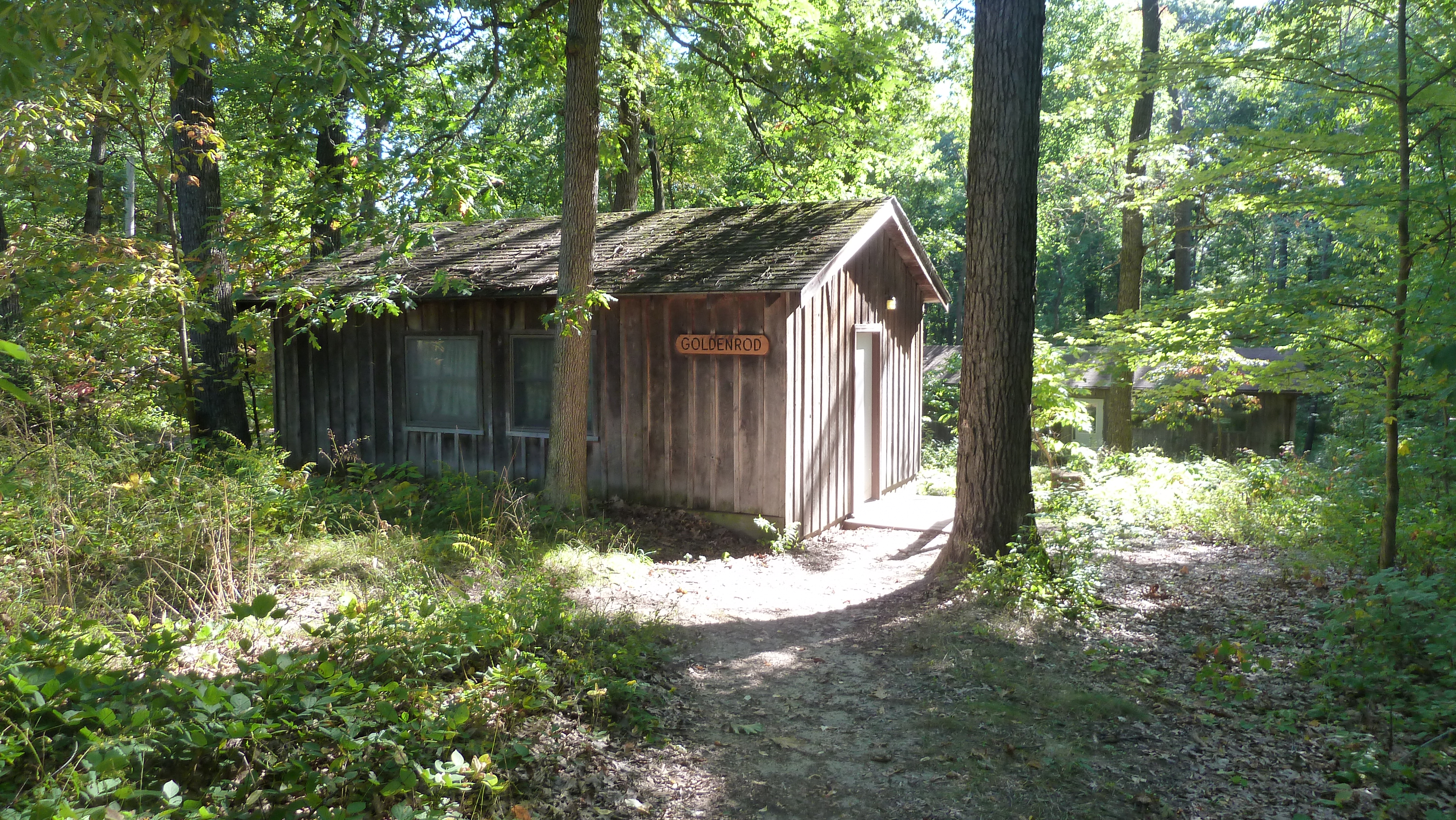
The camp is now called Amigo Centre, headquarters for an exciting outdoor/environmental educational program for public and private school children and hosting a variety of adult programs all year long such as Road Scholars, which I’ll write more about soon, and Quilting Retreats and Scrapbooking and other cool stuff.

Its slogan/logo is “In Harmony with God and Nature.” A perfect slogan for this blog, too, methinks. God for me is inseparable from nature whether it is ocean’s depths or mountain heights or limitless sky or rollicking river.

I do not just find God in nature, God finds me and wraps me once again in thrall of a wondrous world.
Thanks be to God.
***
Where do you find God, or God find you? What places do you remember in your childhood or teenage years as being special? I’d love to hear about them.
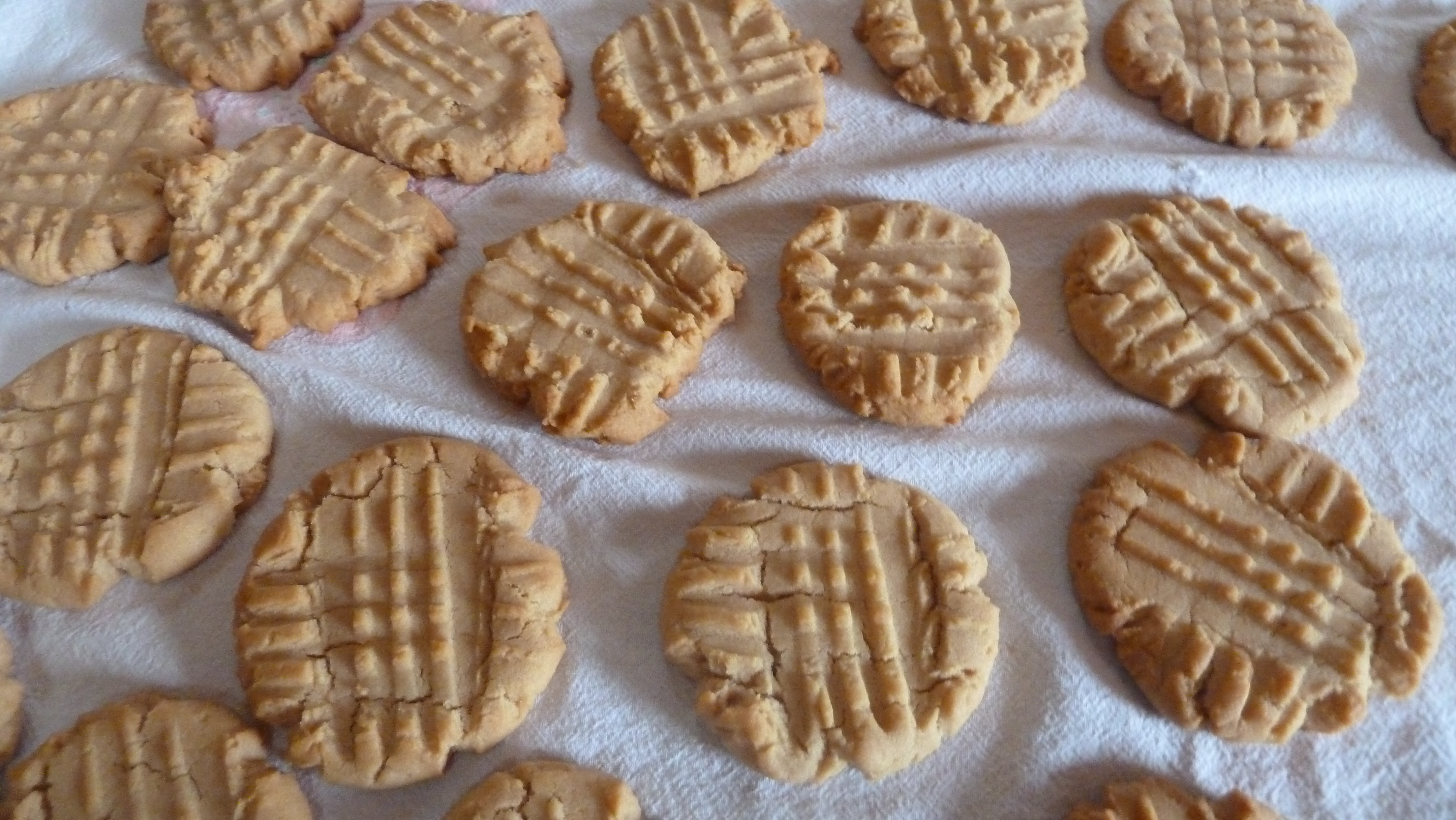
I baked up some peanut butter cookies to carry to my first grandbaby down in North Carolina (still waiting as of this writing/posting). Of course I know technically the grandbaby won’t eat the cookies but the mother will, and she plans to nurse, so there you go. Cooking for my grandbaby.
I went to my trusty recipe box but my tried and true, greased-up-and-stained-up recipe card was gone! Nowhere to be found. Luckily I had this written down on the computer, to send one of my daughters at some point, I’m sure. It is nothing fancy, but your basic peanut butter cookie and I whipped them up in less than 15 minutes using my powerful Kitchen Aid mixer.
Now, the recipe says you are supposed to let them chill a half hour before baking but I rarely do and this time I tried another shortcut and discovered, eureka, you really don’t have to roll them in balls to press them crisscross with a fork. Are you reading this Doreen?
My youngest loves to make and eat peanut butter cookies and she frequently would surprise me with them when I came home in the four years she lived at home after college and mixed up a batch on her day off. But she HATED to roll them in balls so always wanted me to help with that.
So I skipped that step and just plunked dough on the cookie sheet and pressed that hunk down..
Take that, cookie dough. Good anyway you press them.
Who really can tell the difference between the ones rolled into a ball first
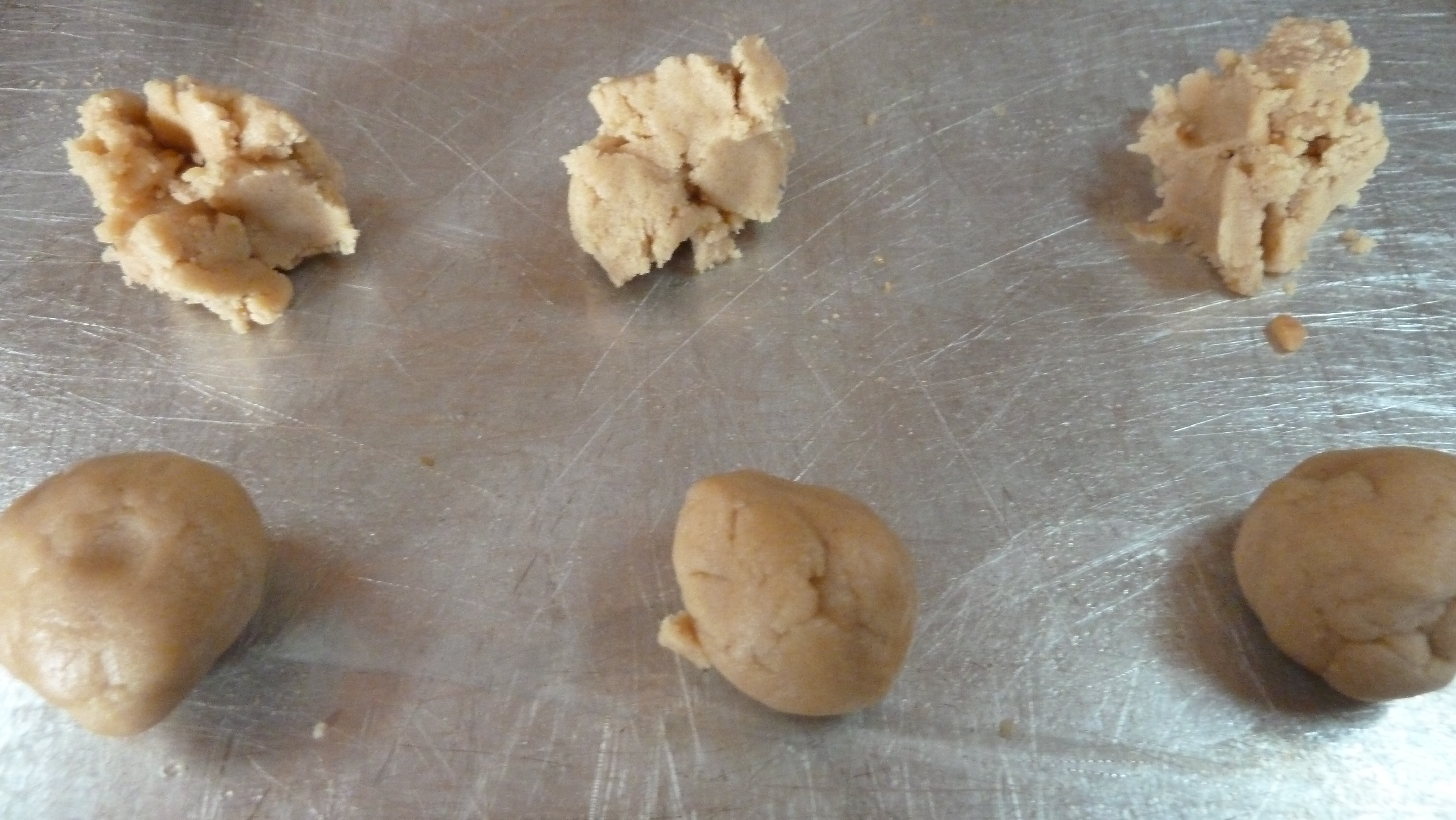
And the ones just kind of spooned or forked onto the cookie sheet?
You can maybe tell here.

But not here.
Or below. And who cares, as long as you’re not a food stylist prettying up things for a blog.

Which I’m not.
So enjoy my homely tips and not bad cookies.
My husband and his brother scarfed this whole plate down before I whisked the last one away.
Peanut Butter Cookies
Cream together:
1 c. shortening
1 c. peanut butter
Add and mix:
1 c. brown sugar
1 c. white sugar
2 eggs
1 t. vanilla
Then add dry things:
3 c. flour
1/2 tea. salt
2 tea. soda
1 tea. baking powder
Chill dough as long as you can. Shape into 1″ balls. Press with fork. 375 degrees for 12-15 minutes.
***
What are your favorite freezer-staple cookies?
And here’s a bonus: the best site for figuring out what went wrong with your baking.
Our wall of pole beans is still bearing
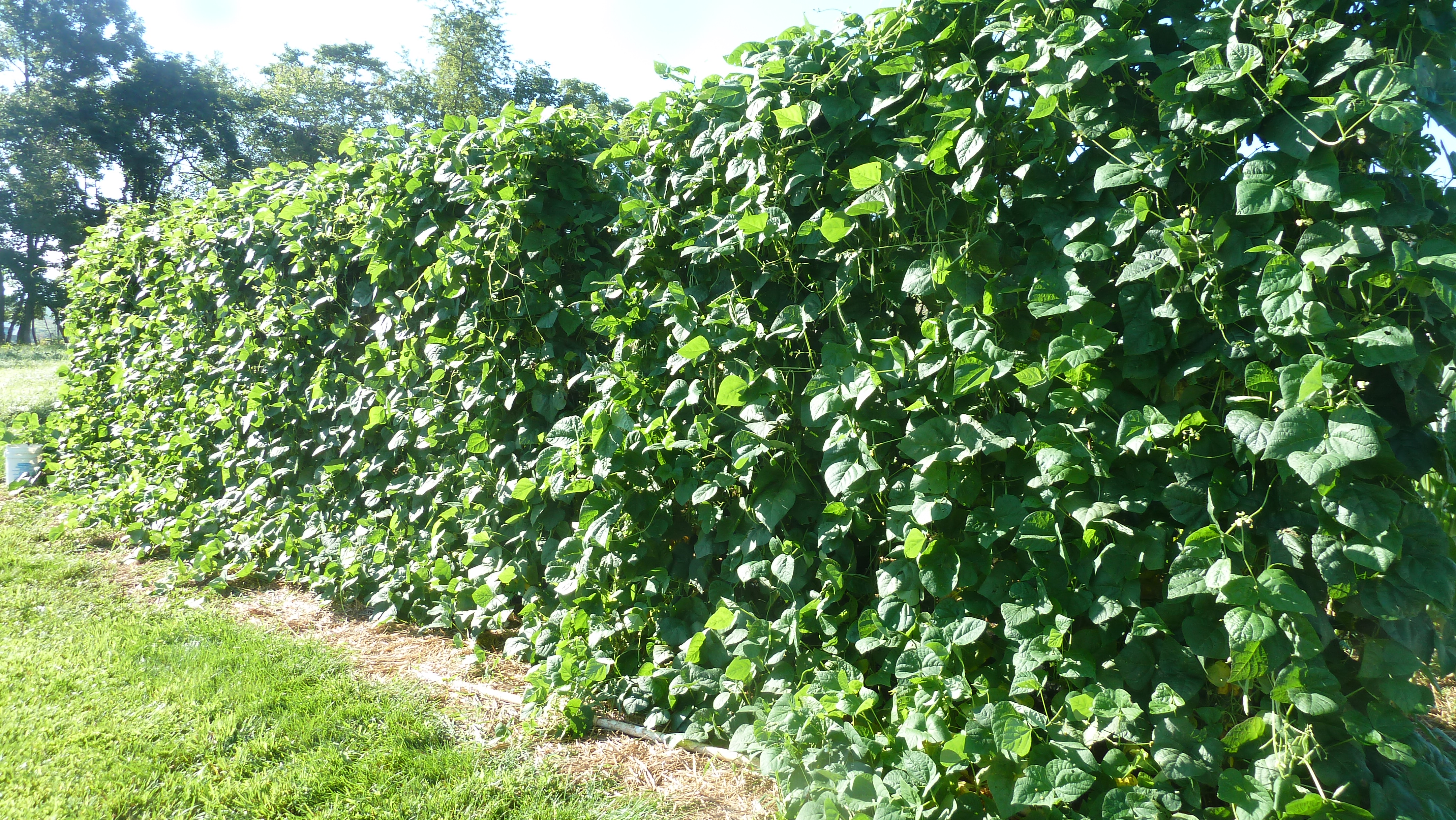
… and I’m not really complaining, especially since the tall wall helps get my husband out there.

And his brother (below).
s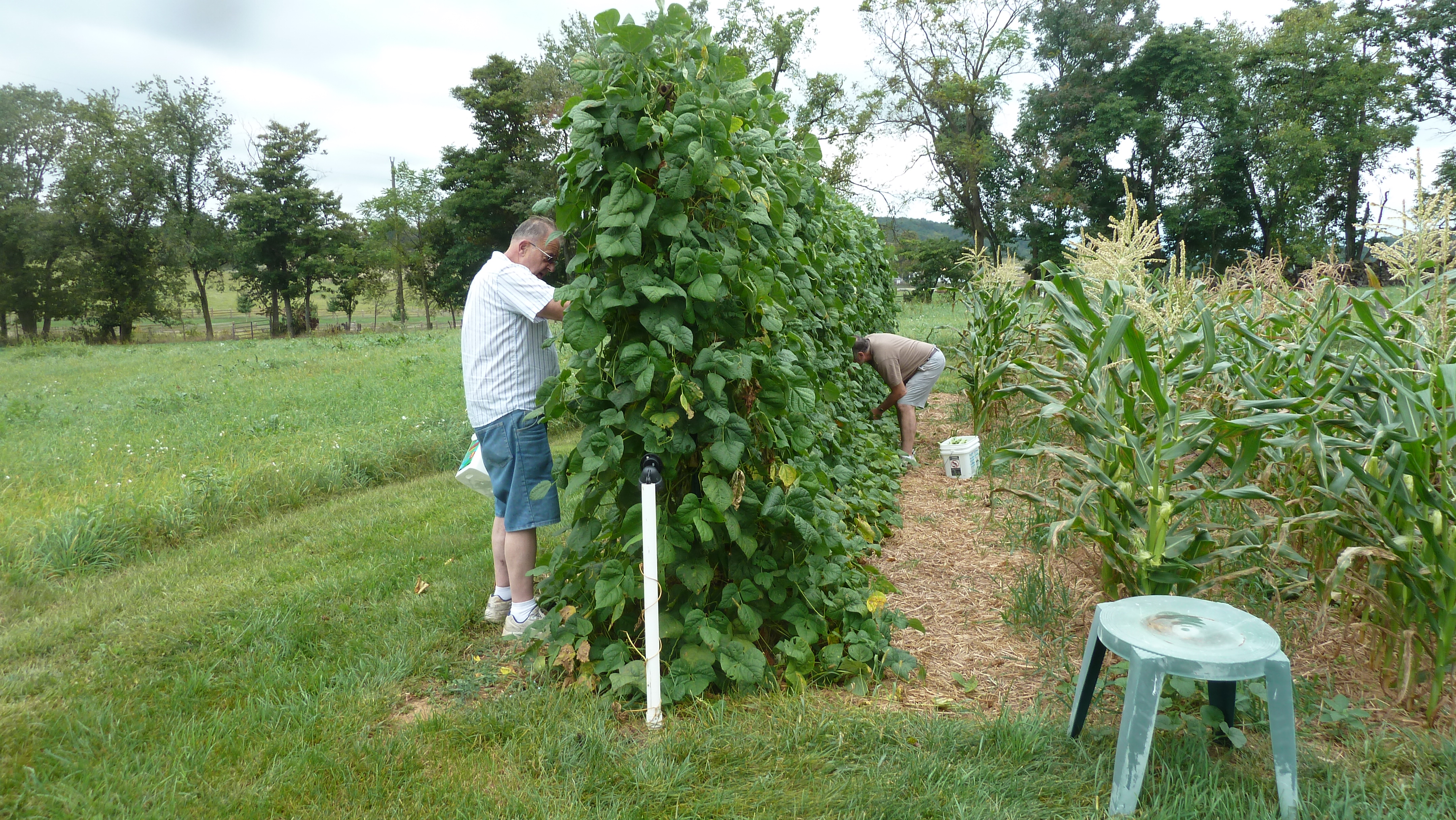
Of course, I pick plenty down lower too.
And here is how you string beans if you are a man.
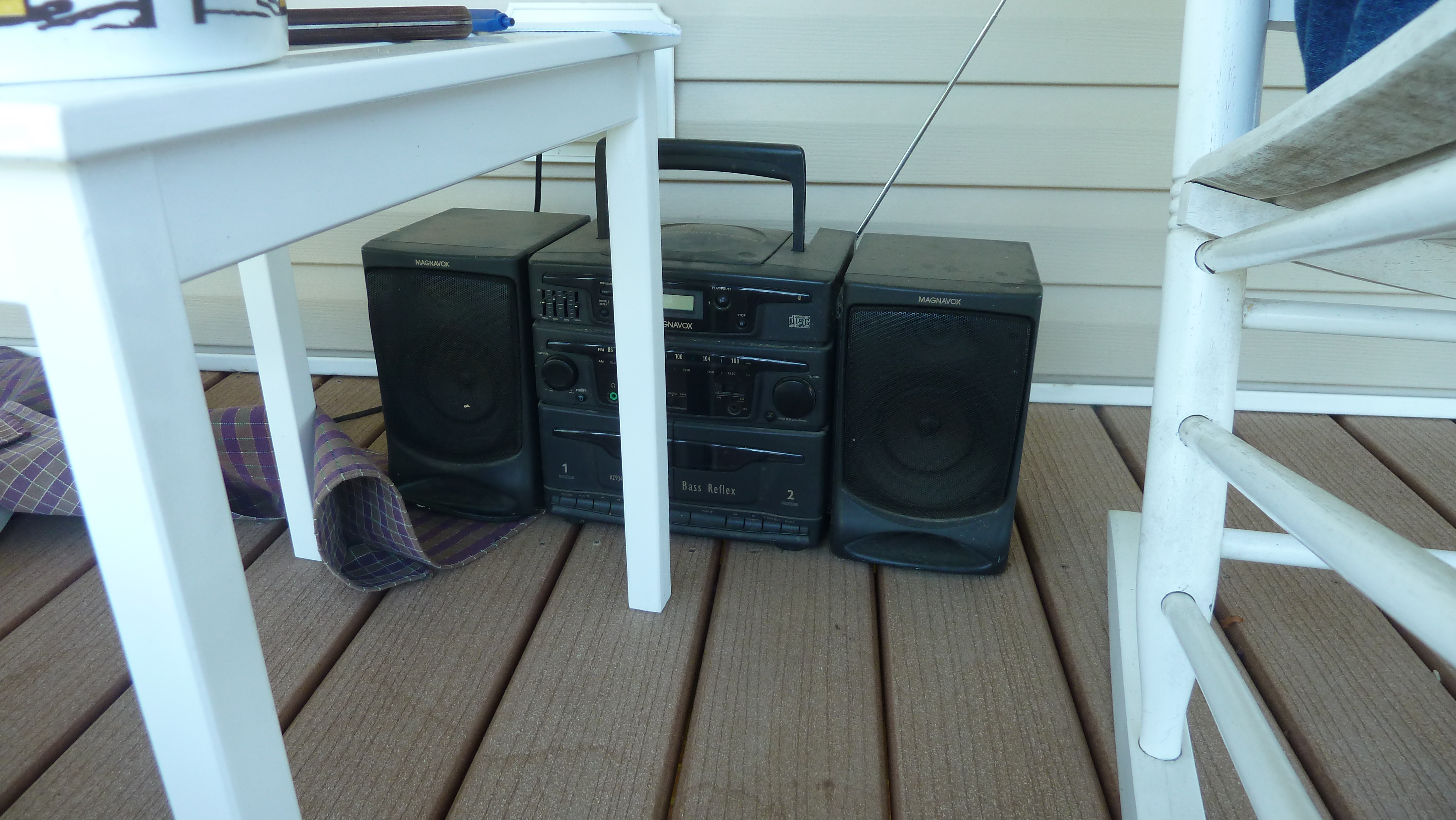

Sit on the front porch with a radio, ready to take notes from a Saturday morning bargain show where people call in what they have for sale.
So far we have harvested more than 5 bushels and given four of those away. We also grow bush beans and canned those earlier in the summer, so I have all I need for the next year.
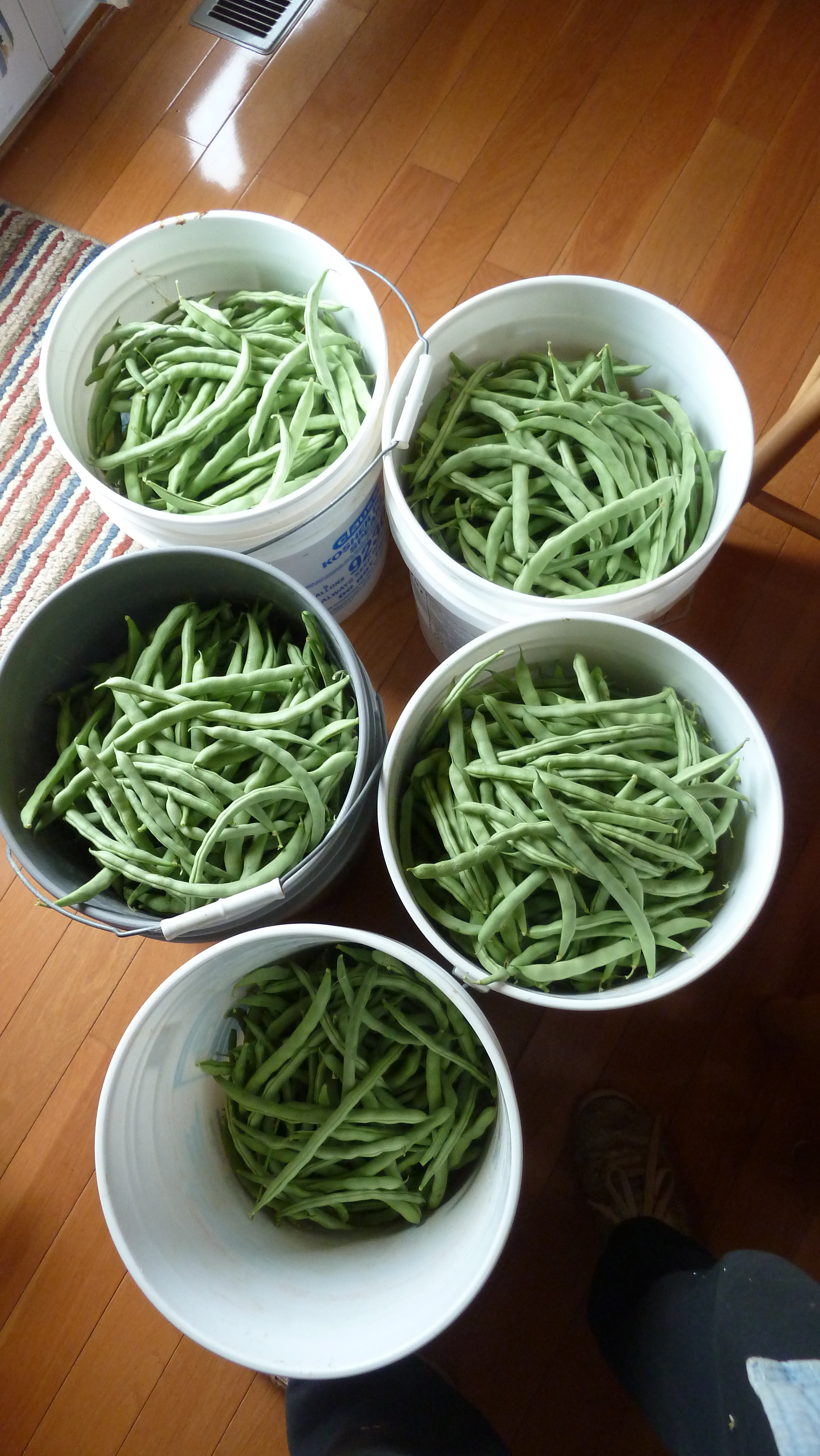
But not everyone knows how to cook pole beans. I sure didn’t. But some kids who have turned up their noses at plain jane basic green beans, seem to like beans at our house, or other beans cooked the slow southern way as I’ve learned to do. One mother of two sons said they loved my beans, but won’t eat them at home when she tried serving the grocery store variety (I’m not sure whether she purchased canned green beans or frozen). The pole beans are not very soft the first time you cook them (unless you use a pressure cooker—which I don’t use), but upon reheating for several days, they take on more and more flavor. I should note that I do use a pressure canner for canning the beans, and once canned, that does of course “cook” and soften them.
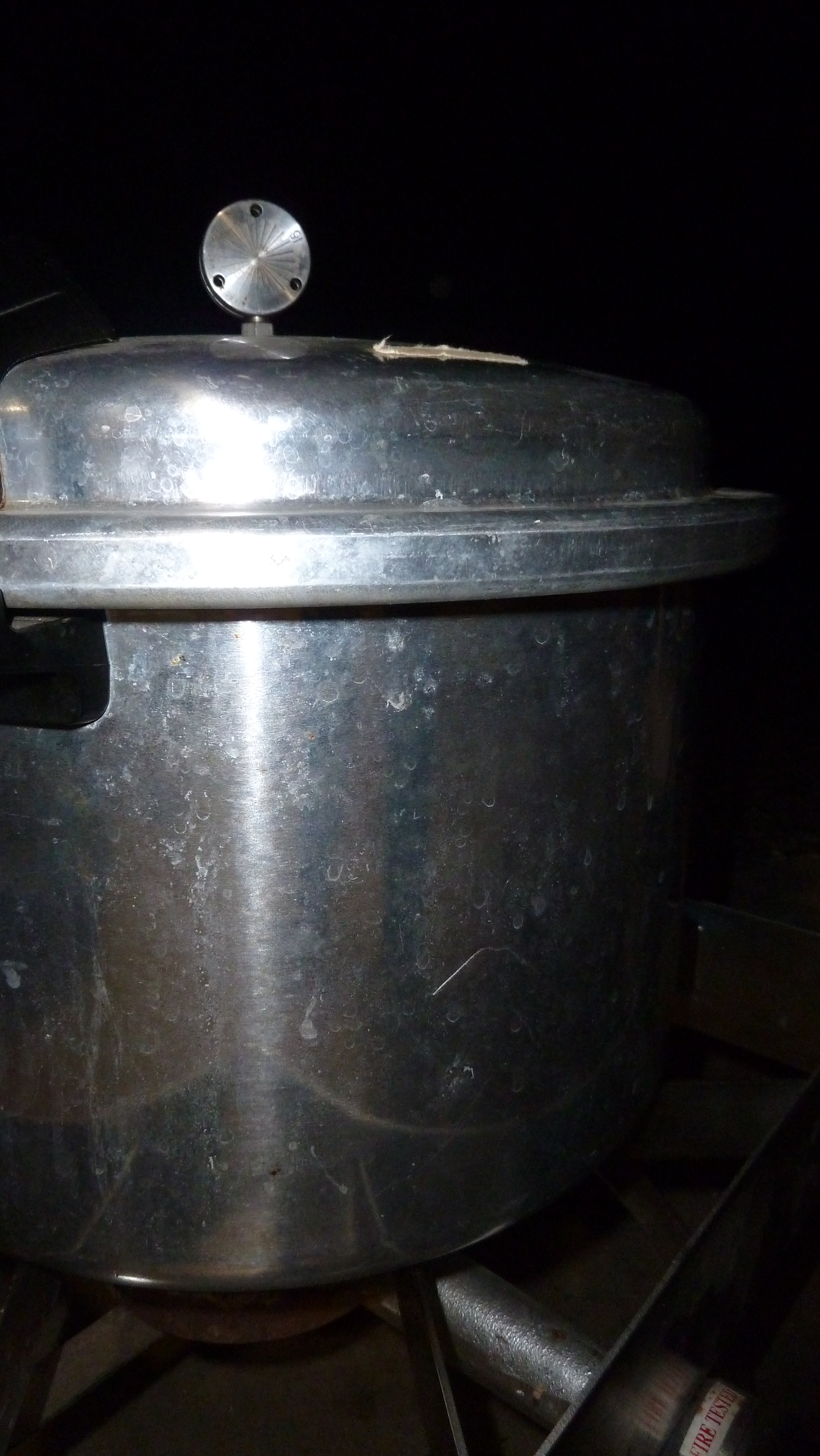
This is a large pressure canner; people generally use much smaller pressure cookers to cook a big mess of beans without canning etc.
No one will tell you the beans are very nutritious this way (and my husband just told me that the Hottingers, his mother’s family) was known for serving green beans with every meal. A staple like bread. No wonder I’ve heard tell of some who “put up” 100 to 150 quart each summer. So if you think of the beans as a side dish, and look to a salad or other veggie for a more nutritious dish at the meal, that works. Many times my Virginia family boils their potatoes right along with the beans, for yet another flavor.
I’ve read that in areas of the world where refrigeration is not available because of spotty electricity, people cook and reheat the same pot of food for several days until it is used up, because reheating (to the boiling point) kills any germs and makes it safe to eat again.
Let me hasten to add that I personally love green beans that have only been lightly cooked or sautéed with a little olive oil, seasoning salt and minced garlic. My mother’s favorite way was to lightly boil fresh garden beans to the point they turn bright green, then brown them in a cast iron skilled in which she’s sautéed a few pieces of bacon. We didn’t even mind the beans a bit burned from the cast iron skillet. Now that was flavorful.
Here’s a little tutorial on pole beans (or others) cooked the slow southern way.
http://www.youtube.com/watch?v=dqNLyNWniTY
And here’s a real chef’s takes on slow cooked southern green beans over at Chef John’s Food Wishes blog.
Like Chef John at this blog says, there was a time when people cooked peas and asparagus and broccoli way too long, too. I do not like any of this trio cooked long and limp and will forgive any school child who grew up having to eat cafeteria-cooked peas or broccoli and think that it has to taste that bad. It doesn’t! It isn’t!
The way I cook most green beans though doesn’t involve onions or chicken broth or any additional ingredients than beans, sautéed or microwaved bacon pieces (I save the ends of fatty bacon for this purpose), or a piece of country ham or ham hock. (If you don’t know what country ham is, never mind, just use the bacon) and salt and pepper to taste.
Here’s my current pot of beans, warmed over now three times I think. I do refrigerate them since I don’t live in Africa or the 1800s.

You’ll take bright lightly cooked green beans? That’s ok. Beans can be fixed great so many different ways. When the wall of beans is done bearing, I’ll be saving some seeds for next year so I don’t know of much cheaper eating.
How do you like your green beans?
Guest post by Michelle Sinclair
Finding Harmony Blog is hosting a series of guest posts in September on how to break out of food ruts and maybe even connect with friends and family in the process. See other posts in the series: Supper Club here, Food Swap here, and From Market to Table here.
Michelle Sinclair is my daughter who writes regular movie reviews for Third Way Cafe, and guest columns for my Another Way newspaper column. She and her husband, Brian, are expecting their first child in November. She works in the advertising (legal notices, exciting!) for The Washington Post but in her free time is a novelist in search of an agent.
Games and Gourmet: EPV* Night
Once a month, my husband and I can be found sitting around a table with two other thirtysomething couples, laughing while playing a board game and sampling food straight out of a gourmet cookbook.
[For shorthand, we call our monthly dinner and board game night “EPV Nights” after the name we adopted when we used to compete as a team at trivia nights. EPV* stands for “E Pluribus Voltron” because we’re dorks children of the 1980s with strong civics backgrounds. Voltron was an eighties-era cartoon: E pluribus unum— “From Many, One” —is a motto of the United States, so perhaps you get the picture.]
We had been doing this off and on over the years, but it seemed like months and months would go by before we found the time to get something planned. I suggested we make a regular date of it—a particular Saturday every month—and set it up so our Gmail Calendar regularly reminds us EPV Night is coming. We rotate between homes, and if someone has a conflict, we find an alternate date or just move on for the month. Most importantly, it reminds us to have the conversation, which leads to nine or ten EPV Nights a year—far more than the three or so we used to muster.
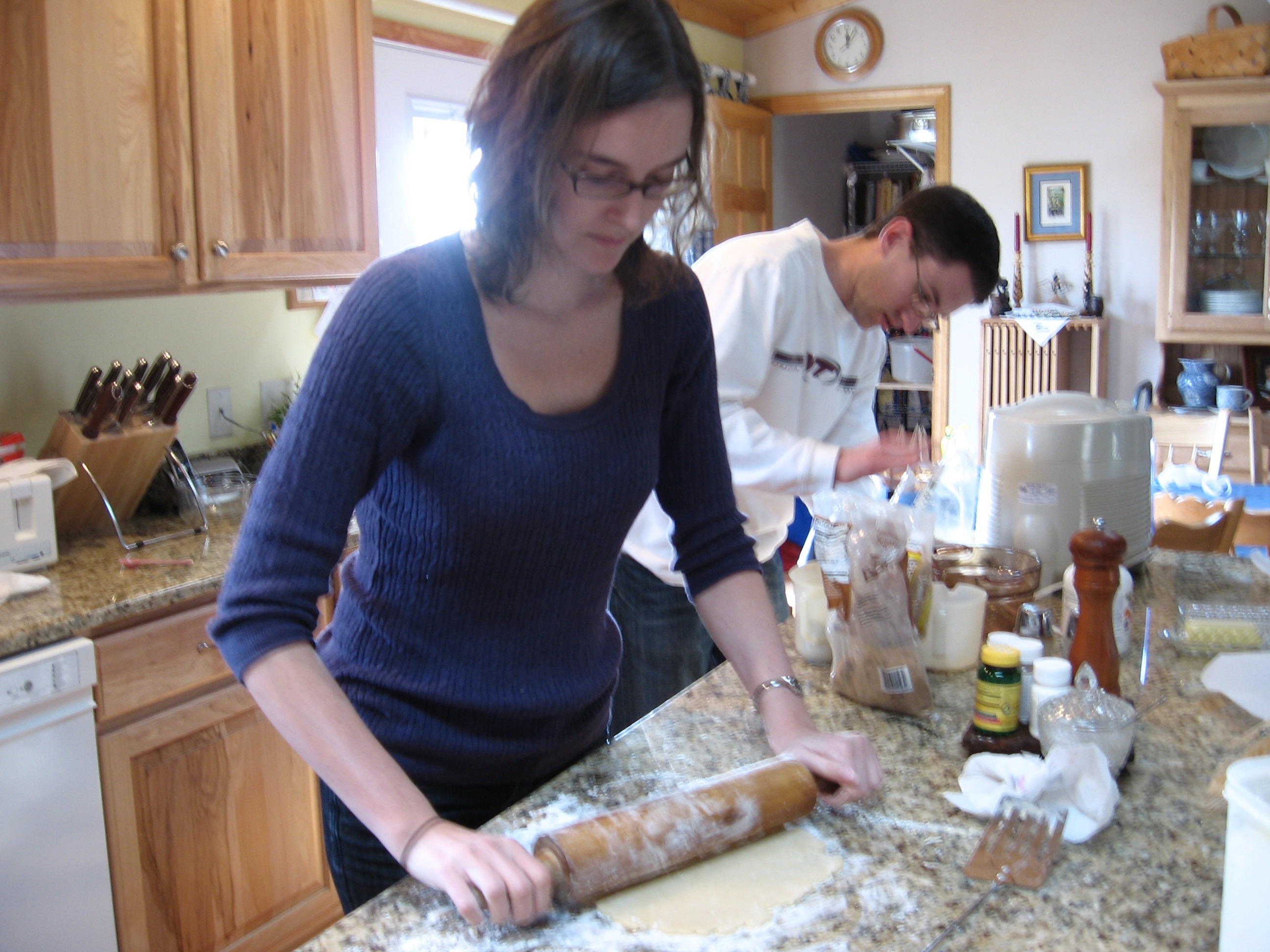
Michelle and her husband Brian, cooking in my kitchen.
Food is always a highlight of the evening. We have all grown as cooks in the years we’ve known each other. What used to be delivery pizza has become stuffed green peppers or sausage orecchiette—“foodie” elements and delicious tastes we don’t often encounter in our own kitchens. The hosting couple serves the main meal, with the guests bringing dessert and drinks, or maybe a side dish. One couple in particular enjoys reading chef books and trying techniques that I sometimes find daunting. What fun to enjoy a “restaurant dinner” at a friend’s house!
The board games are another highlight, although sometimes we get so caught up in good conversation that we never do get around to cracking a game open.
What will happen to our EPV nights once children start to arrive on the scene? Well now that our first child is on the way, (of the group, and personally as a couple) we’ll have to see. I have fond memories of my parents’ own version of EPV, when they had their good friends over for knock-down-drag-out pinochle nights. All the kids played together, and we enjoyed rolling our eyes at the adults whenever their shouts and laughter over the kitchen table interrupted our play. I hope EPV Nights can evolve to become family affairs—so long as we continue to live in the area and don’t get sick of each other!
 As luck would have it, the night this was taken the menu was sloppy jo’s, beans and salads, since it was a work night.
Ultimately, the important part isn’t the games, or the food, or the dorky name. The essential ingredient is regular social interaction in a world and community that is increasingly fractured or moving online. That is particularly true in the Washington, D.C. area, where so many people have moved into the area for jobs and live far from the built-in social fabric of family. To substitute, many people turn to the website Meetup.com to join gatherings centered on a particular interest. Brian and I tried a few of those, but never managed to go back a second time. I suppose we’re just not outgoing enough to try forging new friendships from a houseful of strangers.
That’s why I’m grateful for our EPV friends, and our regular gatherings for as long as they last. We’ve made some great memories, found some new foods, and trounced some good friends. What more can anyone ask?

Michelle and Brian Sinclair, photography by Misty Yoder, at www.mistiyoderphotography.com/
***
How do you get together with friends or family around food? Comment here to be entered into a drawing for a free copy of Whatever Happened to Dinner. You can share links to similar ideas here, or at my Whatever Happened to Dinner Facebook page, to be entered in the drawing. (Posts for the drawing will close Sept. 30, 2013, midnight).
And don’t forget to plan something special for today, Family Day, Monday September 23. For more on my book, here are study questions, an interview with yours truly, two podcasts with the food editors, and a video book trailer. Or think about who might like a copy of the Whatever Happened to Dinner book with about 100 recipes ranging from traditional/old time to foodie! Order here.
Guest post by Jennifer Murch
Finding Harmony Blog is hosting a series of guest posts over two weeks on how to break out of food ruts & punch up mealtime with something a little different. Today we travel to Guatemala, courtesy of my neighbor, Jennifer Murch, a foodie for sure who has blogged at mama’s minutia since about 2008 with an excellent and extensive collection of original and adapted recipes. Jennifer and John have four children so cooking for six in Guatemala gets interesting …
From market to table
Friday morning, my husband and I walked into town. Once in town, we went our separate ways: him to pick up a box at the bus station and me to squeeze my way through the market and juggle money, list, umbrella, and big heavy bags of produce.
Fridays have become my main market day. We stop by the market for necessities on a daily basis, but even so, by the end of the week the refrigerator is pretty bare. All the vegetables and fruit that we eat come into our home in raw form and only as much as we can carry comfortably in our hands or haul in a taxi. In other words—there is no stockpiling bushels of potatoes, canning up jars of spaghetti sauce and peaches, or freezing bags of broccoli and blueberries.
This means there is nothing to pull from when making a meal. You want a green vegetable? Then buy a pound of green beans, snap them, and cook them up. Some fruit to round out a meal? Get a pineapple and chop-chop.
It’s taken me about seven months to get used to this new form of buying and cooking. I think I’m finally catching on.
Wednesday and Thursday are busy days at Bezaleel (school), leaving me with hardly any time to cook, let alone forage for food. So come Friday, the market is a priority.
Here’s what I picked up last week: 9 oranges, 3 pounds of potatoes, 4 pounds of apples, 1 bunch of squash leaves, 1 pineapple, 1 pound of onions, 2 pounds of tomatoes, 2 starfruit, 1 bag of tostados, 2 carrots, 1 cucumber, 1 punch of cilantro, 10 mandarin oranges, 3 limes, 2 tree tomatoes, 3 peppers, 1 pound of green beans, 4 peaches, 1 tayuyo, and 1 ounce of dried chilis.
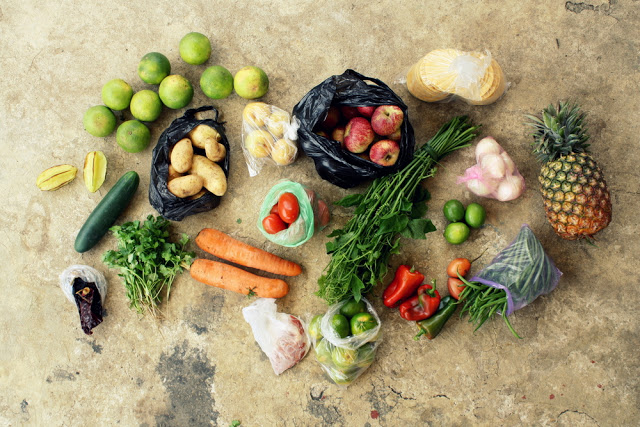
Jennifer’s market finds.
After the kids got home from school, I spent the next several hours getting the food a step closer to being edible. I made a chili sauce, cut up a carrot for the kids’ snack, stewed the squash leaves into a soup (more on that later), cooked a pot of rice, and roasted some onions, peppers, carrots, zucchini, and a giant head of broccoli for the supper’s stir-fry. I also made a zucchini cake.
Saturday morning, the cooking storm continued with bread, a big pot of dried beans with onions, garlic, and dried chilis, pie crust (so an apple pie is just that much closer to being a reality!), and starfruit smoothies. I also put away the granola I had started the morning before. Oh, and there were breakfast pancakes, too.
There is still a lot of work to do to finish readying the market purchases for consumption: cutting up the pineapple (a simple task, but one I hate), that pie, snapping the green beans, and figuring out a plan for the potatoes, peaches, cilantro, limes, tomatoes, cucumbers, and carrots. But at least I’ve made a dent. The new week will begin with a well-stocked refrigerator—full of both cooked food and produce—and an overflowing fruit bowl.

Vegetable stir-fry
I think longingly of my freezers back home. Two big ones filled with containers of soup and pesto, bags of broccoli and peas and corn, jars of meatballs and roasted tomatoes, boxes of strawberries and applesauce! Just thaw, heat, and eat! What a novelty! What a luxury!
However, when I leave here I’ll probably miss the abundance of fresh food and the simplicity of having all my cooking options laid out right before my eyes on the concrete patio floor, no secrets, no surprises.
Neither style is easy. Both take work. In Virginia, my summers are crammed with growing, harvesting, and putting up. In Guatemala, I do it from scratch (minus the growing, thank goodness) on a daily basis.
What’s your method for getting fruits and veggies to the supper table? Do you buy lots of produce on a weekly basis, year round, cooking it up as you go? Or do you prefer to stockpile for quick meals?
From market to table (excerpted, with her permission, from mama’s minutia blog.)
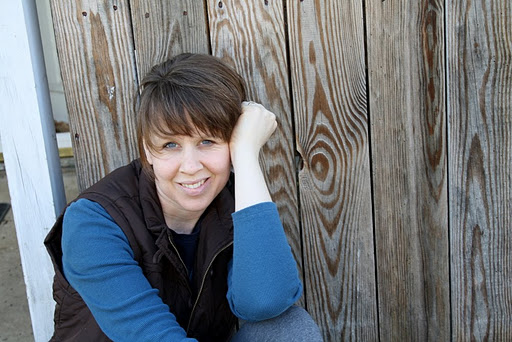
Jennifer Murch. Photo by a daughter, if I remember correctly.
Jennifer Murch and family are currently finishing up a 9-month short term assignment with MCC in Guatemala at Bezalell School, after also serving with MCC in Nicaragua for three years when their oldest child was born 13 some years ago. They serve as vocational arts facilitators with Jennifer’s main work being tutoring and teaching (and learning about) cooking in that setting.
Have you ever cooked in a setting other than North America? What did you learn?
Comment here to be entered into a drawing for a free copy of Whatever Happened to Dinner, which includes lots or recipes from other countries, along with traditional and southern U.S. cooking. You can share links to similar ideas here, or at my Whatever Happened to Dinner Facebook page, to be entered in the drawing. (Posts for the drawing will close Sept. 30, 2013, midnight).
And don’t forget to plan something special for Family Day, Monday September 23. For more on my book, here are study questions, an interview with yours truly, two podcasts with the food editors and me, and a video book trailer. Or think about who might like a copy of the Whatever Happened to Dinner book with about 100 recipes ranging from traditional/old time to foodie! Order here.
Other posts in this series: Food Swaps. Supper Club.

Guest post by Larry Guengerich
Finding Harmony Blog is hosting a series of guest posts September 16-27 in celebration of Family Day on September 23, looking at how to beat the same old same old by finding community around food.
My second contributor is Larry Guengerich, a happy participant (as you’ll see below) in a regular “Supper Club” near Lancaster, Pa. Larry and I go way back: my parents and his family were members of the same Mennonite congregation in northern Indiana; we’ve both been colleagues working in communications for Mennonite agencies for many years; and members of the professional association for weird birds like us, Anabaptist Communicators, having served overlapping terms on the board. Anabaptist Communicators conference is at Bluffton University Oct. 18-19, 2013.
Never Want to Miss
The plan was to mow the lawn. As I got ready to pull the cord, I was hit with the worst pain I have ever experienced. It soon became clear I needed to go to the emergency room. As I lay there, waiting for the drugs to kick in, one of the first things to go through my mind was, “Oh no, it is supper club night!” Finally I was released, pumped full of fluids and drugs, waiting for the kidney stone to pass. It was a struggle, but there was no way I was going to miss Supper Club!
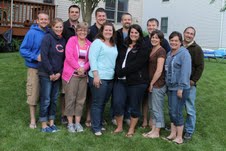
Supper Club: Larry and his wife Kendra, far right. They have two young sons.
We were approached by friends of ours in November of 2003 about being in a supper club. The club is made up of six couples, of which at least one in each couple had attended the same church most of their lives. As time passed, several of the couples had moved on to other churches, but wanted to stay in touch. Supper Club became the way to do it.
We gather once a month with each household serving as host twice a year. When the group began, there were only two couples with children, and when the subject of kids or no kids came up, they were the most insistent that supper club be a time away from the children. Now the 18 children join us once a year, usually on Memorial Day, but the rest of the time, we gather without them.
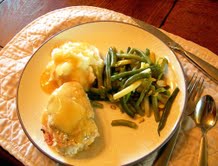
Looks like Pennsylvania Dutch night.
The food varies, depending on who is cooking. It runs the gamut from tried and true Pennsylvania Dutch meals to international flavors to full-on haute cuisine. It is always good and we share recipes to use with others down the road.
As good as the food is, the fellowship is what makes supper club. When I asked the members to share the things that stood out them, food was mentioned, but without exception the comments were about the stories we have shared, the inside jokes carried from one meeting to the next and the expectation with which we approach each event.
One member of the group said, “My life can feel rather serious at times and supper club is a place where I can count on laughing. I love that.” Another commented, “I love that we can be serious or silly, talk all sides of politics and no one gets angry, we don’t just sit around and gossip”
For me supper club has become both a place to explore food as well as explore community. The people in the group, I count as some of my closest friends. No matter what we go through, changes in jobs, church and family, I know there will be at least one night a month were the food and fellowship will be a taste of what I imagine heaven to be.

Larry Guengerich, is director of communications and church relations for Landis Communities, dedicated to retirement living at various levels, including aging in place and new models of age 55+ active adults living in the city of Lancaster, Pa. and elsewhere.
See the first post in this series on food & community here.
Do you have a similar group? Formal or informal? Comment here to be entered into a drawing for a free copy of Whatever Happened to Dinner. You can share links to similar ideas here, or at my Whatever Happened to Dinner Facebook page, to be entered in the drawing. (Posts for the drawing will close Sept. 30, 2013, midnight).
And don’t forget to plan something special for Family Day, Monday September 23. For more on my book, here are study questions, an interview with yours truly, two podcasts with the food editors, and a video book trailer. Or think about who might like a copy of the Whatever Happened to Dinner book with about 100 recipes ranging from traditional/old time to foodie! Order here.
Guest post by Holly Williams Nickel
Finding Harmony Blog is hosting a series of guest posts over the next two weeks on how to break out of food ruts to punch up mealtime with something a little different.
First up is Holly Willliams Nickle of Newton, Kansas, who has hosted a couple of Food Swaps; I heard about her from Hannah Heinzekehr, over at The Femonite blog. I asked Holly to explain how a Food Swap works.
Mission Accomplished
For me, a home is like a museum without the signs saying “Do Not Touch.” Nearly everything that is part of my daily surroundings has emotional or historical significance, or comes with a tale or memory of where, when and who.
My furniture came from my Grandma Mary’s house, my art has been made by friends. My books have been inherited, collected, studied, organized and re-organized from childhood to my present. My home is a virtual timeline of my life and loves, places I’ve been and people I’ve met. Why should my kitchen pantry be any different?

Holly’s collection of memoirs on “authors and food.” All photos from Holly Williams Nickel.
Among my collection of books are many, many memoirs of their author’s relationship to food. Films like “Babette’s Feast” and “Chocolat” have always drawn me in with their images of diverse communities gathered around the table to experience the pleasure of food and company. Last spring, I hosted such a gathering in my own yard – rich food, lots of candles, good wine and better company. These are the kinds of moments that I want my life, and the lives of my children, to be filled with.
To accomplish both of these ends, that same spring I hosted my first “Food Swap.” I first saw images of food swaps nation-wide in a foodie magazine. I loved the idea of having my own little farmer’s market, full of things grown by people I see in my daily life, right in my own backyard. As I own an artisan ice cream business, I knew what my contribution would be and was excited to send my hand-crafted wares home to my friend’s kitchens, while gathering their handiwork in my own. So, I followed the advice offered on the “Food Swap” website, sent out my invitations, put tables with colorful cloths up in my backyard, and we swapped.
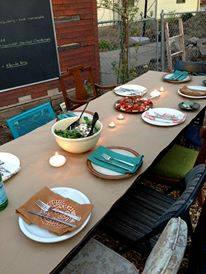
That night, and twice since, my kitchen counter has been overflowing with bartered goods that I would never have made for myself: basil butter, pesto, corn muffins, zucchini cupcakes, home-made bug spray, sugar hand scrubs, peppermint lip balm, pulled pork, fresh pita and ricotta cheese, squash, tomatoes, herbs, peppers, flowers, pickles of every variety, corn salsa, banana cake with caramel icing, biscotti…

When we sit down with our two teenage children and other friends who gather at our table – teenagers seem to multiply themselves – I tell them where the goods came from and about the friends who made them. They get to experience foods that I don’t make, or grow, myself. And they have the knowledge that they are sitting at a table bigger than the one in our kitchen – a table that includes all of the folks who have contributed to our meal and to whose meal we have contributed in return.
Mission Accomplished.
Holly Williams Nickel owns two shops, Salted Creamery, and the Lincoln Perk in central Kansas.
Have you ever planned or participated in a food swap? A variation on it? Comment here to be entered into a drawing for a free copy of Whatever Happened to Dinner. You can share links to similar ideas here, or at my Whatever Happened to Dinner Facebook page, to be entered in the drawing. (Posts for the drawing will close Sept. 30, 2013, midnight).
And don’t forget to plan something special for Family Day, Monday September 23. For more on my book, here are study questions, an interview with yours truly, two podcasts with the food editors and me, and a video book trailer. Or think about who might like a copy of the Whatever Happened to Dinner book with about 100 recipes ranging from traditional/old time to foodie! Order here.
Friday’s Finding Harmony Recipe of the Week
Our office at MennoMedia has started a fun no-fuss themed potluck once a month where no one signs up for anything specific, no one is in charge, and everyone is supposed to just pitch in with set up and clean up.
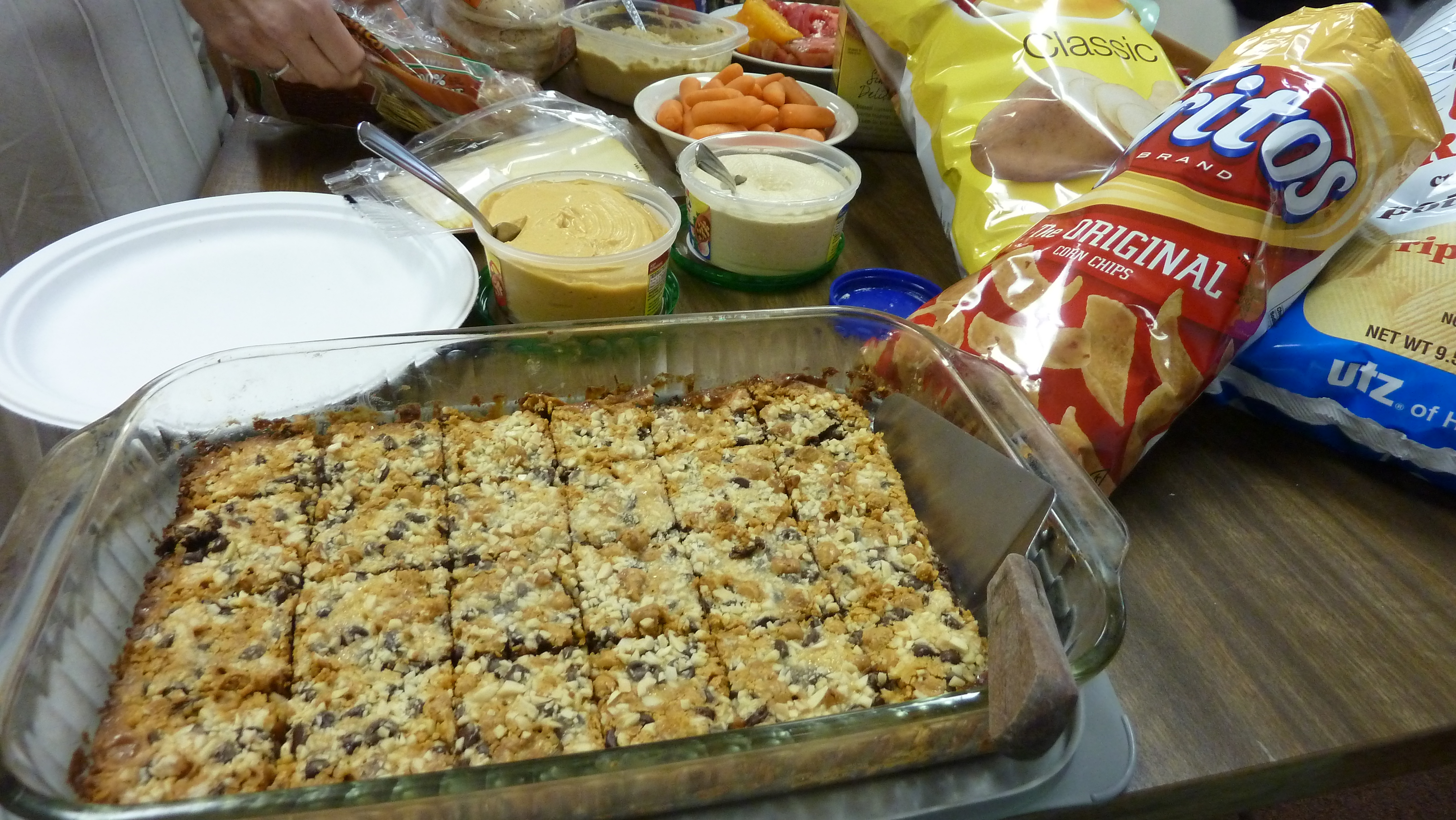
This month’s theme was “sandwiches” –supplies for building a sandwich, or condiments, or whatever you wanted to bring that would go along with sandwiches (i.e. chips, hummus, dessert).
My daughter had gotten a recipe from her mother-in-law, Sue, for homemade stromboli or what I consider Italian sandwiches (Wikipedia calls them turnovers, and a much better wrap up picture is here. Next time I’ll do better.) Sue used to make this for her bridge club, I think, or some other kind of women’s group where fancied up hors d’oeuvres were the order of the day.
I made it after seeing my daughter make it one time when we visited. As a mother, it does my heart good when I see my daughters venturing out and making new dishes.


(Stromboli sliced into 1-2 inch pieces, under the watchful eyes of black lab Ike)
So I made half of this recipe for one long stromboli, since I knew there would be more than enough food at our mini potluck.
Stromboli
2 loaves frozen bread dough (comes in a bag, or make your own dough) Thaw dough on counter just until thawed, or in refrigerator overnight, but not long enough that it begins to rise.
Mix* 1 egg, ¼ c. Parmesan cheese, and 4 Tbs. Italian dressing. Set aside.
Ham, salami, pepperoni
Mozzarella, provolone and Parmesan cheeses
(No set amount-depends on how much meat and cheese you want. If not sure just start with 1 lb of meat and ½ lb of cheese–sliced or shredded cheeses).
Spread out dough with hands to fit about a 11 x 13 pan or cookie sheet

Brush “mix*” down center 1/3 of dough

Then layer with ham, salami, pepperoni, mozzarella and provolone cheeses down center
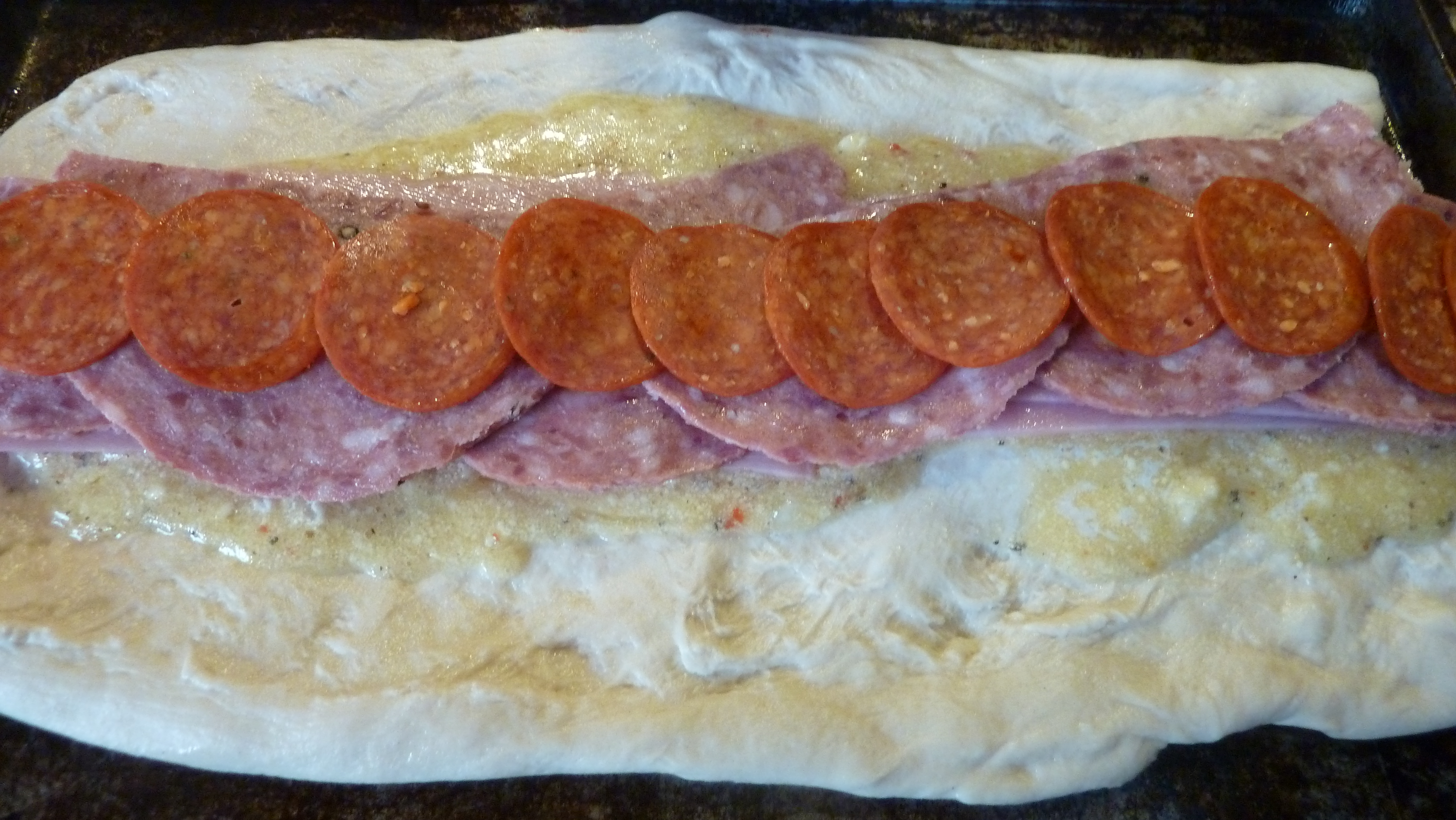
Fold another 1/3 over meat & cheeses
Brush mix* down folded over dough
Repeat with meat and cheeses, if desired (you can make it so it has one layer of meats etc. or two)
Wrap up the whole thing and pinch tightly, or as well as you can!
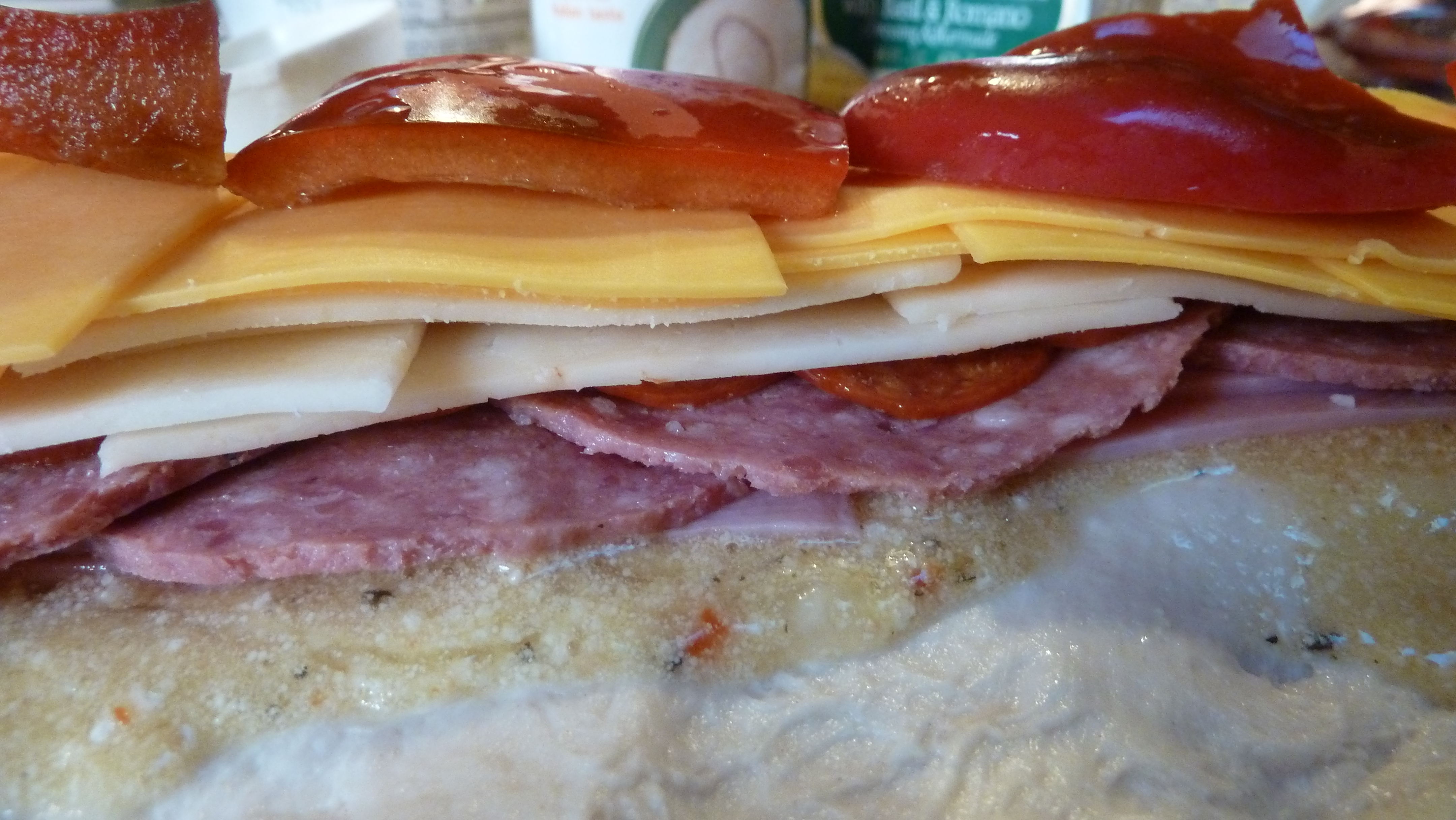

(Melodie note: since I have lots of sweet red bell peppers on hand right now from the garden, I added them for a nice crunch and nutritious veggie)
Bake 30 minutes at 350°
Makes 2 stromboli rolls. Check to make sure bread is done thoroughly. Stick a knife in it to make sure it isn’t still doughy. Slice into 1-2 inch pieces.


At the office potluck, it was the only warm dish so it seemed like a welcome addition to the table, along with Reuben’s rendition (my personal favorite) of West Coast Chicken Salad from the new Mennonite Girls Can Cook Celebrations (green dish, far right). Josh brought in a lemon and caper tuna salad and it was a great twist on the old tried and true tuna. Everyone agreed the prize for most creative went to Barbara who brought “Ice Cream Sandwiches” for dessert.
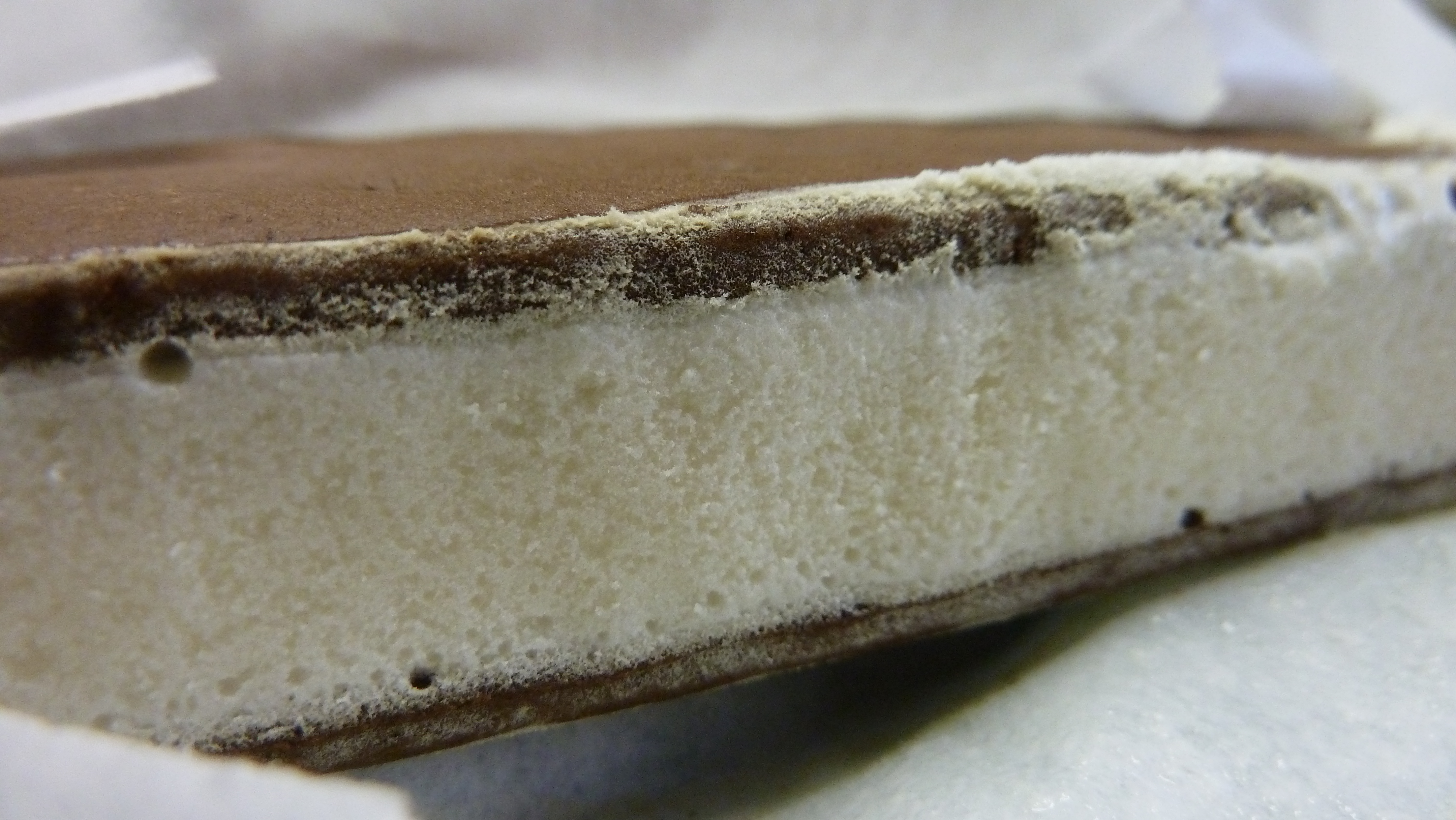
(It took me a second to get it. No one ever accused me of being swift.)
And we loved Cindy’s 7-layer dessert, which I make as “Magic Cookie Bars” and which Phyllis Pellman Good recently featured in her “Cooking with Phyllis” online cooking show, and how to bake them in a slow cooker.
Next week we start a series of guest posts leading up to Family Day Sept. 23 with nifty ideas to add new twists to your family dinner or dinners with friends, or spicing up the humdrum brown bag lunch routine!
Sign up to receive each blog post to your email so you don’t miss any!
Next week–Learn how others inject creativity into their food lives with a:
- Food swap – Holly Williams Nickel, Newton, Kan.
- Supper club – Larry Guengerich, Landis Homes, Pa.
- Marathon food prep from Guatemala markets – Jennifer Kurtz Murch, mama’s minutia blogger
- Games and gourmet group – Michelle Sinclair, media critic over at Third Way Cafe
And if you’d like to do a guest blog post (with a photo) on what you do with food and your family, let me know and I’ll work it in! Blog posts accepted for use will receive a free copy of my book of 100 recipes and ideas, Whatever Happened to Dinner?
Also “like” the Whatever Happened To Dinner Facebook page for periodic posts on topics/recipes/meal ideas of interest.
Writers now face not only what they will write, but what is the best method to convey the message? Is it a blog post? Tweet? A Facebook status update? A magazine article? A column? A book?
(And if you’re counting Twitter and Facebook, then all in the social media world are writers. Who knew?)
On a personal level, is my message best delivered in person, phone call, phone message, text, letter, a football stadium jumbotron?
What a rich age we live in and the short list above is only a click or a keystroke away in the vast sea of contemporary media possibilities.
I thought about this the other week on the 50th anniversary of the Martin Luther King Jr. “I have a dream” speech in 1963. There’s another notable anniversary the U.S. will observe this fall, remembering the 1963 assassination of John F. Kennedy in November. Suddenly these anniversaries were connected in my mind recalling a momentous turn of events in my own Mennonite family growing up: 1963 was the year we got our first television set. Many others in our church already had TVs and or course we begged dad for years, but as a deacon he drug his feet because of the “example” he was supposed to set for others. When Kennedy died, he waited no more, wanting to see all of the events as televised that terrible weekend. We kids didn’t know whether to be happy to sad: glad to be getting a TV, but devastated by the national tragedy.

(My dad, the deacon in Mennonite plain suit.)
This year for the first time I suddenly connected that the King speech and the Kennedy assassination occurred within four months of each other, and realized that likely my father was not only motivated by the murder of JFK to get a TV, but by other news events like the King speech that also captivated the nation. (Dad was an early eager and outspoken advocate of equality and understanding across racial lines.)
Thinking about all this, I wondered whether I should write a blog post on it, but instead boiled the above longish paragraph down to a somewhat cryptic 140 character Tweet:
#martinlutherking just put together that King speech and JFK death both came late ’63.
Dad bght our 1st TV @JFKdeath, but he also loved King
Maybe I should have tried it as a Facebook post? My neighbors recently celebrated their 65th wedding anniversary and the children threw a lovely surprise picnic party for them. For that I chose just a Facebook post, with a few key pictures, because I wanted to share that news with nearby friends who also knew them.

“Congratulations to a great pair, our neighbors, Harold and Willie, who got married 65 years ago yesterday!”
An editor at Christian Century, who was one of my first editors, Richard Kauffman, uses Facebook for messages that sometimes become articles, or in place of an article, or a place to collect feedback that he weaves into an assignment or longer reflection. He recently moved to a condo where he hopes to eventually retire, and not have to move again. I enjoyed his short reflection on Facebook:
“How foolish of me to think we bought a condo. Rather, I now think we’ve been given both a sanctuary and, potentially,
a community–the two conducive to the inward and the outward journey. …”
That is deserving of a longer introspection sometime, it seems.
Speaking of longer media forms, I have often noted that many books start out strong and kind of lose their steam after about 3 or 4 chapters and the writer begins to repeat him or herself. Maybe some readers think that about my books.

My daughter recently wanted feedback on a book, Baby Led Weaning with a book length subtitle: “The Essential Guide to Introducing Solid Foods and Helping Your Baby to Grow up a Happy and Confident Eater.” It’s an interesting book and the writers, Gill Rapley and Tracey Murkett, say they started writing a magazine article and turned it into a book—but yes, it does repeat itself a lot (my only real complaint about it). To prove the point, a new edition of the book is shortened in text but includes recipes.
My husband can’t understand why I sometimes text my daughters when we still don’t have a text plan on our phone so they cost 25 cents a pop. But since our daughters each have busy lives of their own, sometimes a text can seem like a less intrusive way to get a short message to them, such as “on our way” or even just “call me.” Or when you’re waiting for worship to begin on Easter morning.
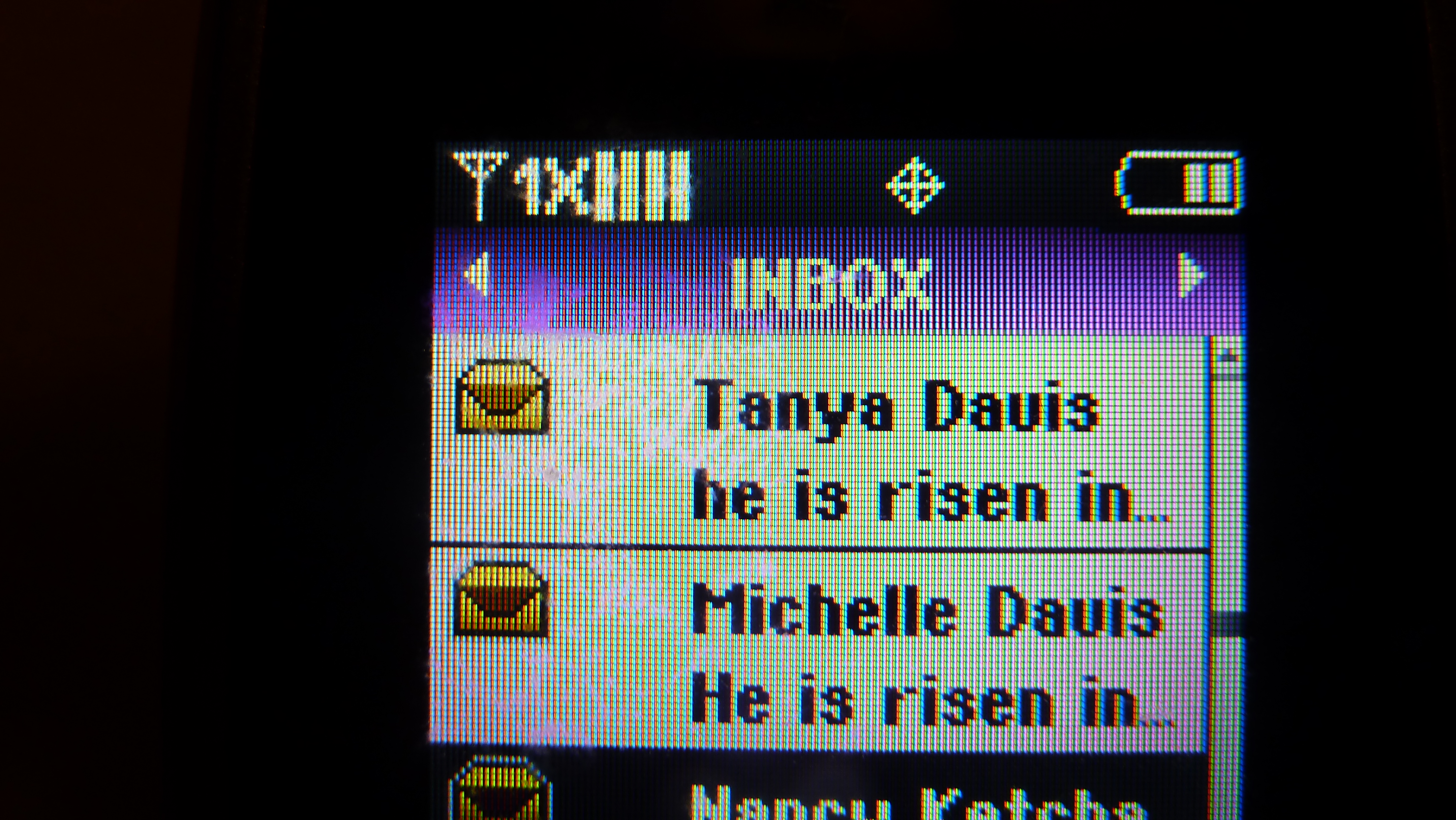
When my work supervisor (who lives in another state) was expecting a new baby any day, she had planned to call me on Friday morning. By Friday afternoon, I had not heard from her, so I strongly suspected she was either in labor or had had the baby. I sent her a quick text about mid afternoon saying “hope u are in labor … prayers n best wishes.”
A short while later I got a short text back saying her new daughter had arrived. That felt kind of special.
Major life events normally shouldn’t be communicated by text (no breaking up with a girlfriend or heaven forbid, a wife or husband, but I know it’s happened). In some circumstances, maybe a wedding proposal by text works. I enjoyed watching several such proposals float by, sent by text, at the opening football game of the season at James Madison University’s stadium jumbotron.
Longer ago, a writer might have pondered whether to write his or her love message as a sonnet, ode, edict or epistle. The Biblical writers, especially in Psalms and Song of Solomon used a variety of poetic forms of the day. I have no doubt that if Jesus could’ve, he would’ve used Facebook, Twitter, blogging. I can see it now, the classic verse we all memorized as kids, “Jesus wept.” Now that’s a tweet.
And now, this is entirely too long for a blog post, and we haven’t even touched on the visual communication arts. If you are still reading, thanks. This is my 100th post since beginning January 1, 2013. The readers are steadily growing, I’m happy to say.
To celebrate, I would love to share my new desktop background photo if you are interested. It’s a lovely scenic view of Zion National Park in Utah that I took this summer. Scenes such as this continue to serve as a communication form with God, don’t you think?
Leave a comment and I’ll be happy to email it to you privately. Or just grab it from here. My 100th post gift. (I know, now everyone thinks they’re stock photographers, too. Ha.)


 findingharmonyblog