

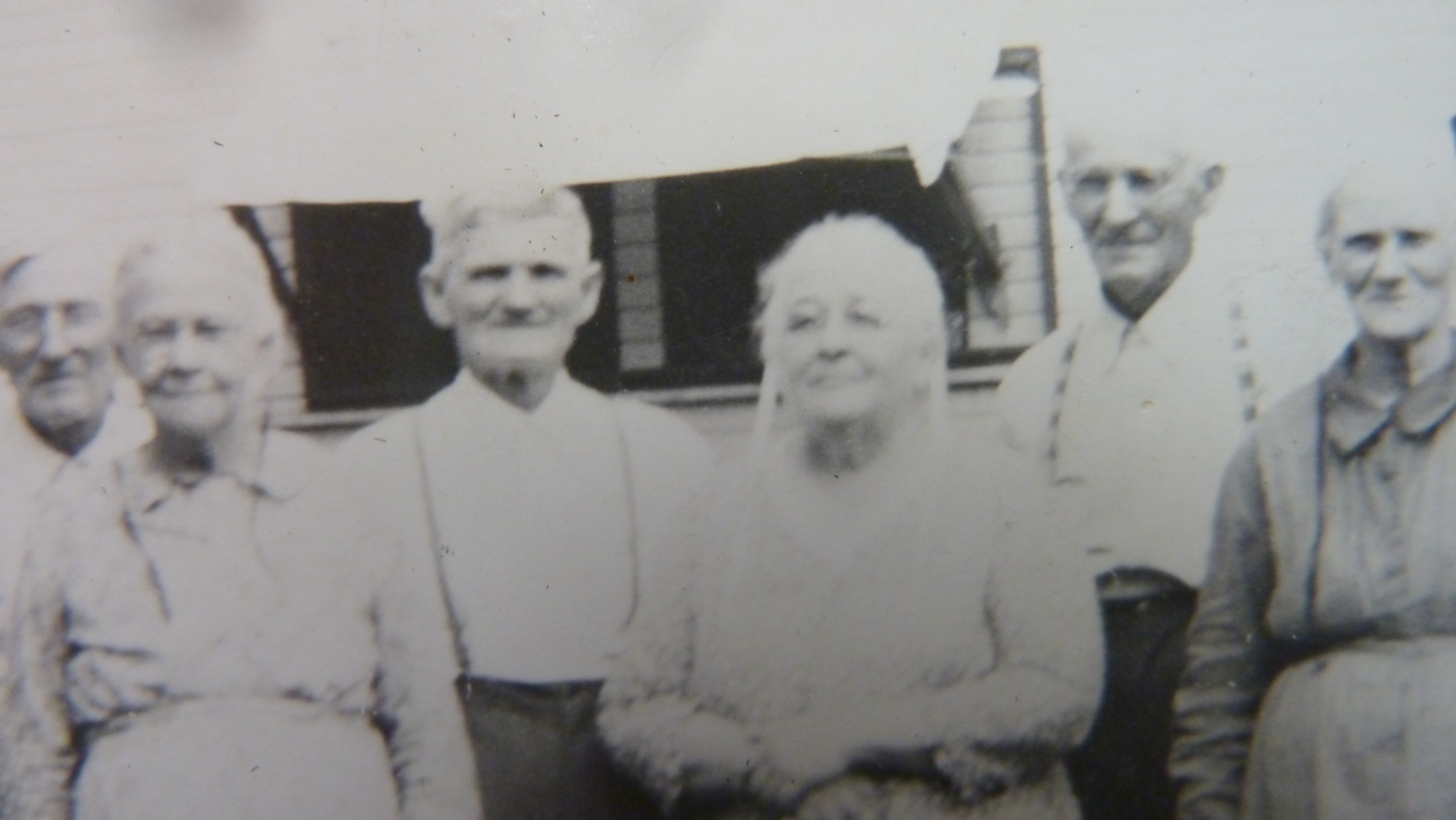
 My paternal grandmother, Barbara Kauffman Miller, center, in the 50s when they lived with my family.
Since I just wrote about Grandpa Uriah Miller, I thought I would feature Grandma Miller’s famous sugar cookies for my recipe of the week. Plus my cousin just asked my mother for the recipe.
But I never make these any more, and have a simpler, not-roll-out cookie that has become my favorite sugar cookie. I hope the Miller family will forgive me. Sometimes you savor the recipes of your youth, but most of us grow up to learn to treasure many new additional recipes. The first recipe is died-in-the-wool Mennonite or Amish in origin. The second comes from a well known Presbyterian Christian educator in our valley, Mary Lou McMillin, and the Shenandoah Presbytery named it’s Resource Center named after her. So together these recipes find harmony in my blog.
Grandma and Grandpa Miller started my love affair with cookies and coffee. Since their two room apartment (kitchen, bedroom/living area and small bathroom) were right off of our kitchen all through my childhood, I enjoyed going over to Grandma’s in the morning while she and Grandpa had their breakfast of cornflakes, coffee and cookies.
Grandma would pour me half a cup of coffee in a big cup with a big saucer underneath, add half a cup of milk to the coffee (so yeah, it was really more like café con leche like I learned to love in Spain) and we would dunk our cookies in that coffee/milk. At times the cup overflowed with the coffee and milk, especially for childish rambunctious dunkers, but that was okay because it only slopped onto the saucer beneath. This is NOT, however, where the term Dunkard Brethren came from, which always confused me in my youth.
So, I have my Grandma and Grandpa to blame for my love of coffee and sugar cookies. Grandma suffered from diabetes (eventually a stroke) so I’m well aware of the hazards of too much sugar.
When I first started serious cooking after I got married, I tried Grandma’s roll out cookies once or twice and they simply seemed like they were pasty with too much flour. Did that ever happen to you with a recipe or food from childhood that you didn’t really like as an adult?
Here’s Grandma’s recipe.
Grandma Miller’s Favorite Sugar Cookies (Rolled)
6 c. flour
1 c. milk
2 t. baking powder
2 c. sugar
1 c. lard (yes, lard)
1 t. soda
2 eggs beaten
1 T. vanilla or lemon flavoring
½ t. salt
Dissolve soda in milk. Cream sugar and lard. Add eggs and flavoring. Sift baking powder and salt with flour and add to sugar mixture alternately with milk at soda.
Add enough flour to make them easy to roll out and not stick to rolling pin. Roll out to ¼ inch thick. Cut shapes with cookie cutters. Bake at 350 degrees for 12 minutes. Makes a bunch. (As written down by my mother, Bertha Miller)
Recipe 2:
But my favorite sugar cookie recipe for many years is “Mary Lou McMillin’s Sugar Cookies.” They are rich, a half-soft/half-crunchy sugar cookie. They use butter and don’t have to be rolled out (just spoon them onto a cookie sheet and flatten with the bottom of a cup) and can be prettily decorated with red and green sugars or other sweets for very quick Christmas cookies. I usually bake up a batch right about now just to have something Christmasy on hand when the parties and get togethers start where you want to take a plate of cookies or your kid forgets to tell you that you need to bring Christmas cookies to the PTA meeting or to youth group at church. Kids love to add the sugars or squash the dough down with a flour-bottomed cup.
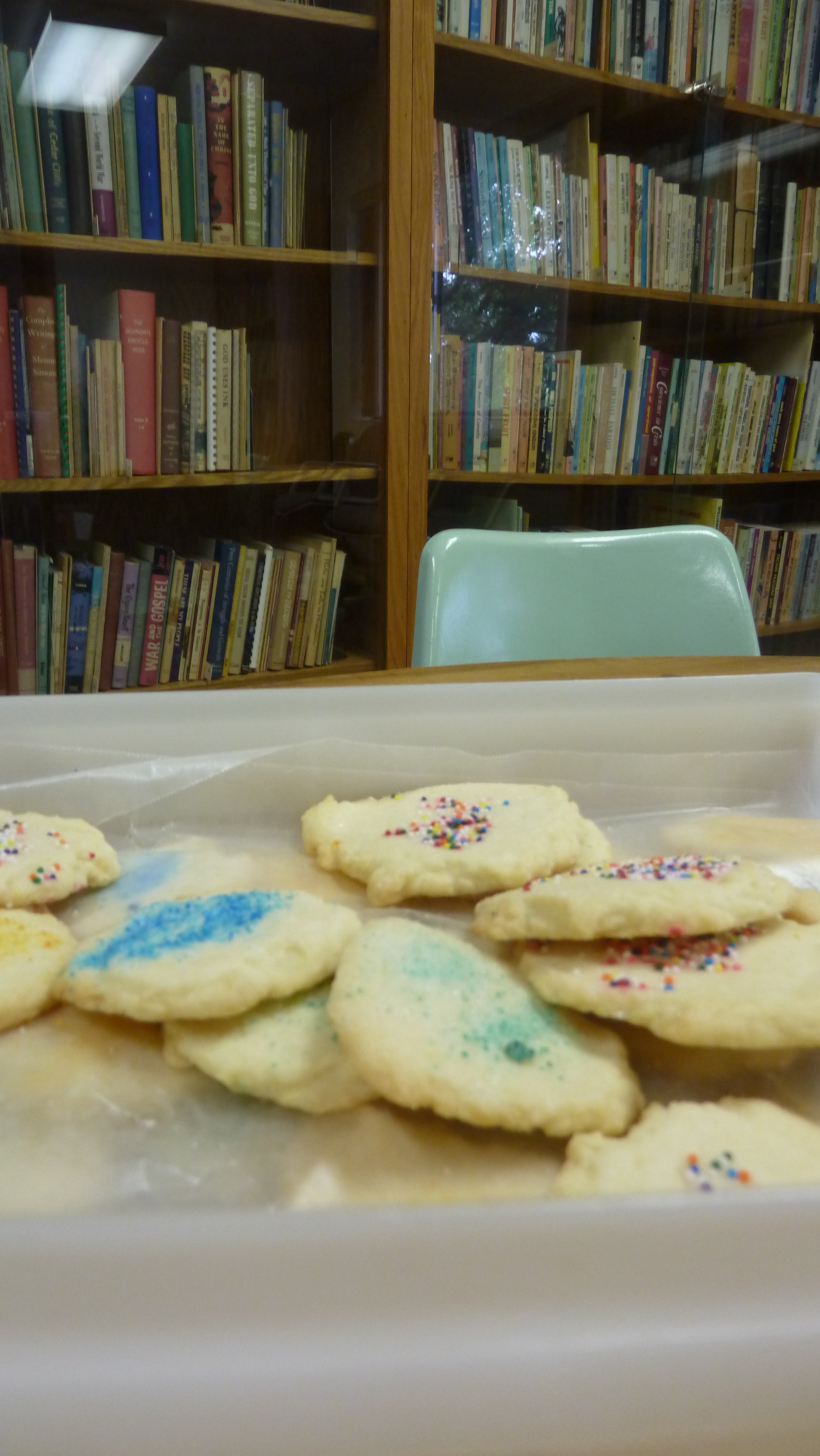
They are great to keep on hand anytime of year (using different colors for different seasons). The ones above I made a while back for break at work, to share my good news of an expected 2nd grandbaby in late November. Which is now! Soon!
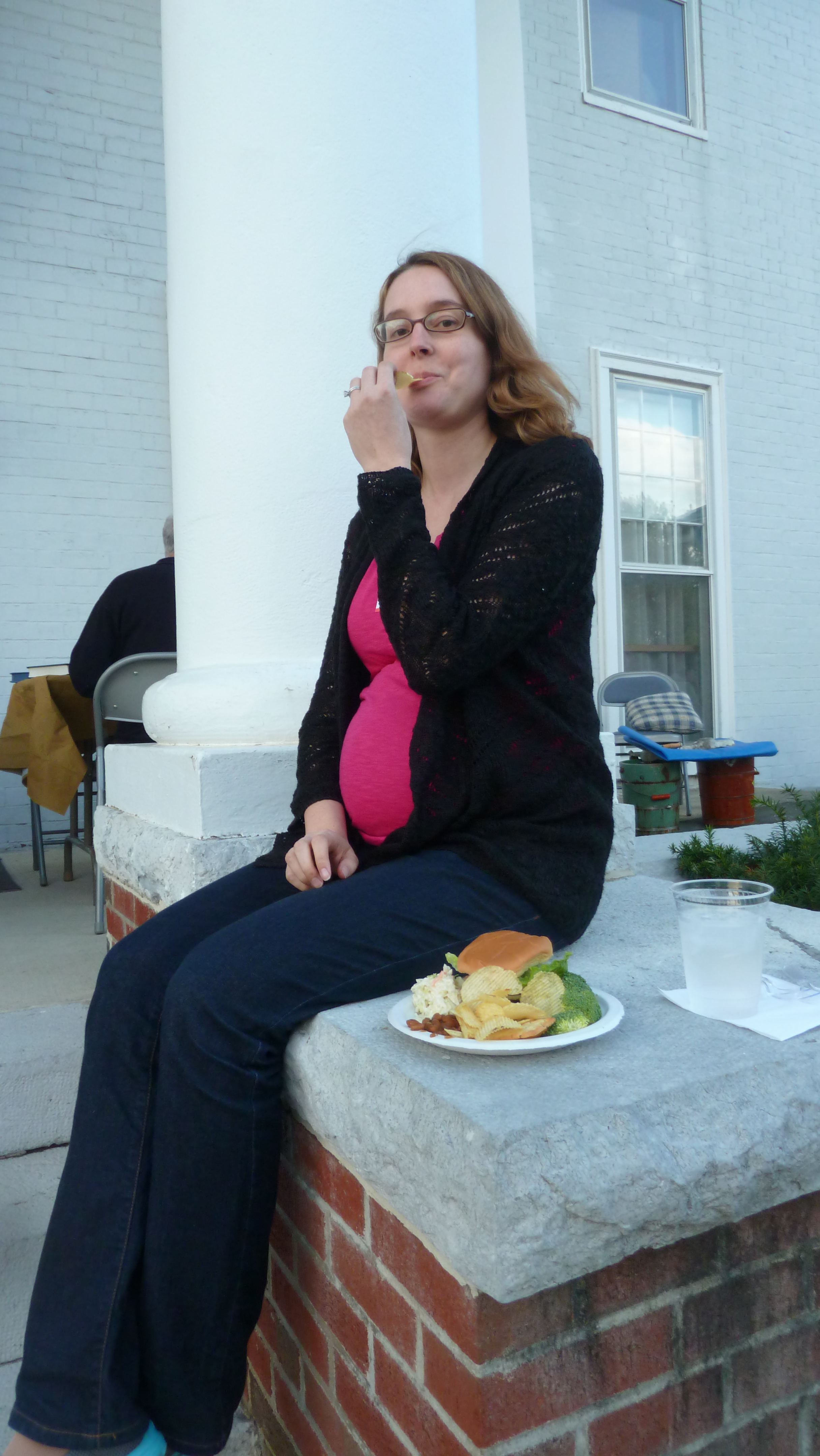 Daughter Michelle in late October, enjoying “eating for two” at our church’s 50th anniversary homecoming. Michelle is still a member of Trinity Presbyterian while an active worship leader at her local church Northern Virginia Mennonite (now that’s Mennonite/Presbyterian harmony).
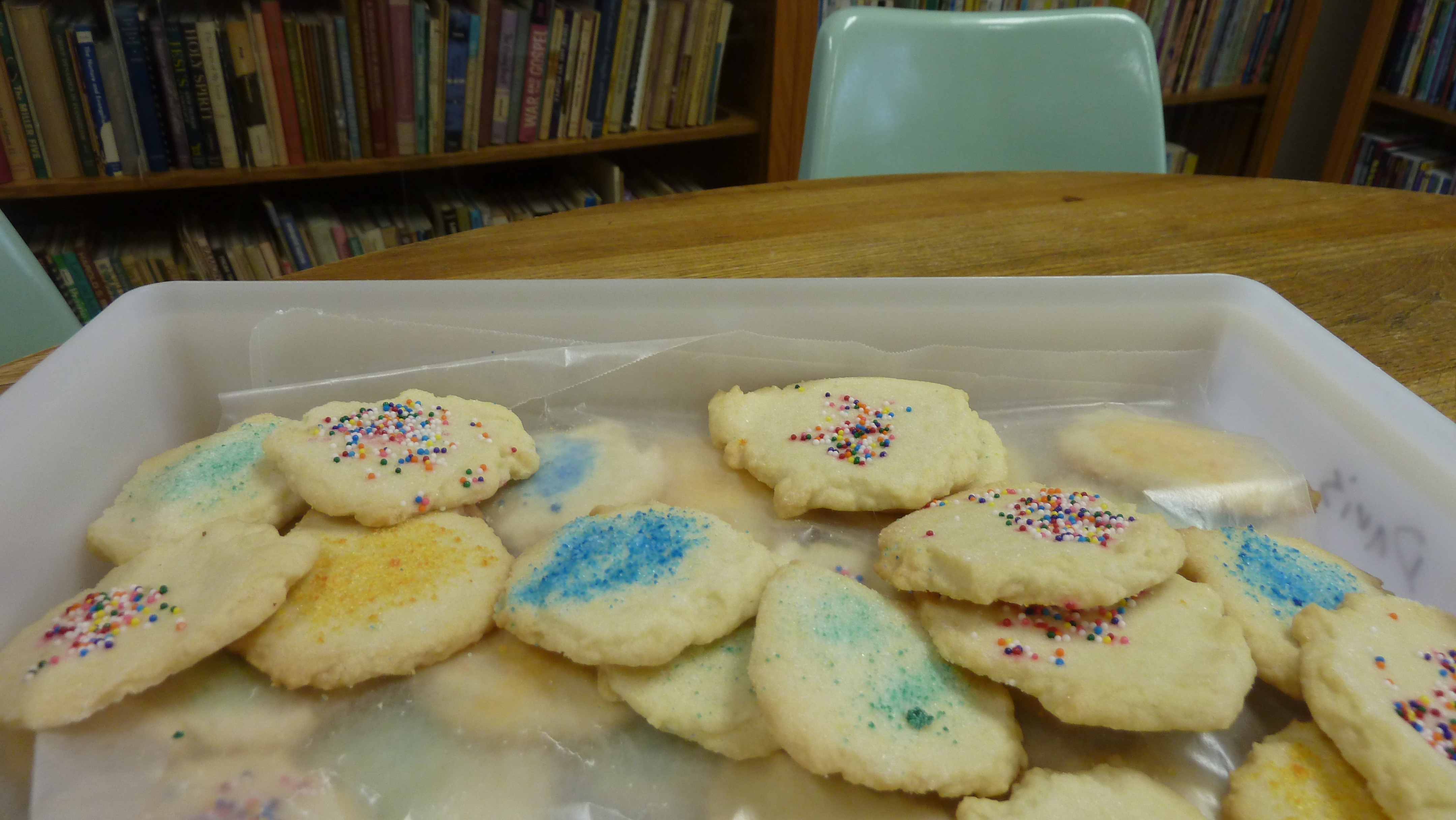
Mary Lou McMillin’s Sugar Cookies
1 c. powdered sugar
1 c. white sugar
1 c. butter (can use margarine)
1 c. vegetable oil
2 eggs
1 t. vanilla
1 t. salt
1 t. soda
1 t. cream of tartar
4 c. and 4 heaping t. flour
Cream sugar and shortenings; add eggs and vanilla; add dry ingredients. Drop by teaspoon onto greased cookie sheet. Flatten with a cup that you’ve greased and dipped in sugar. Sprinkle with white sugar, colored sugars, or purchased decorative sprinkles.
Bake at 350 – 375 degrees for about 10 minutes. Do not overcook. Approx. 9 dozen.
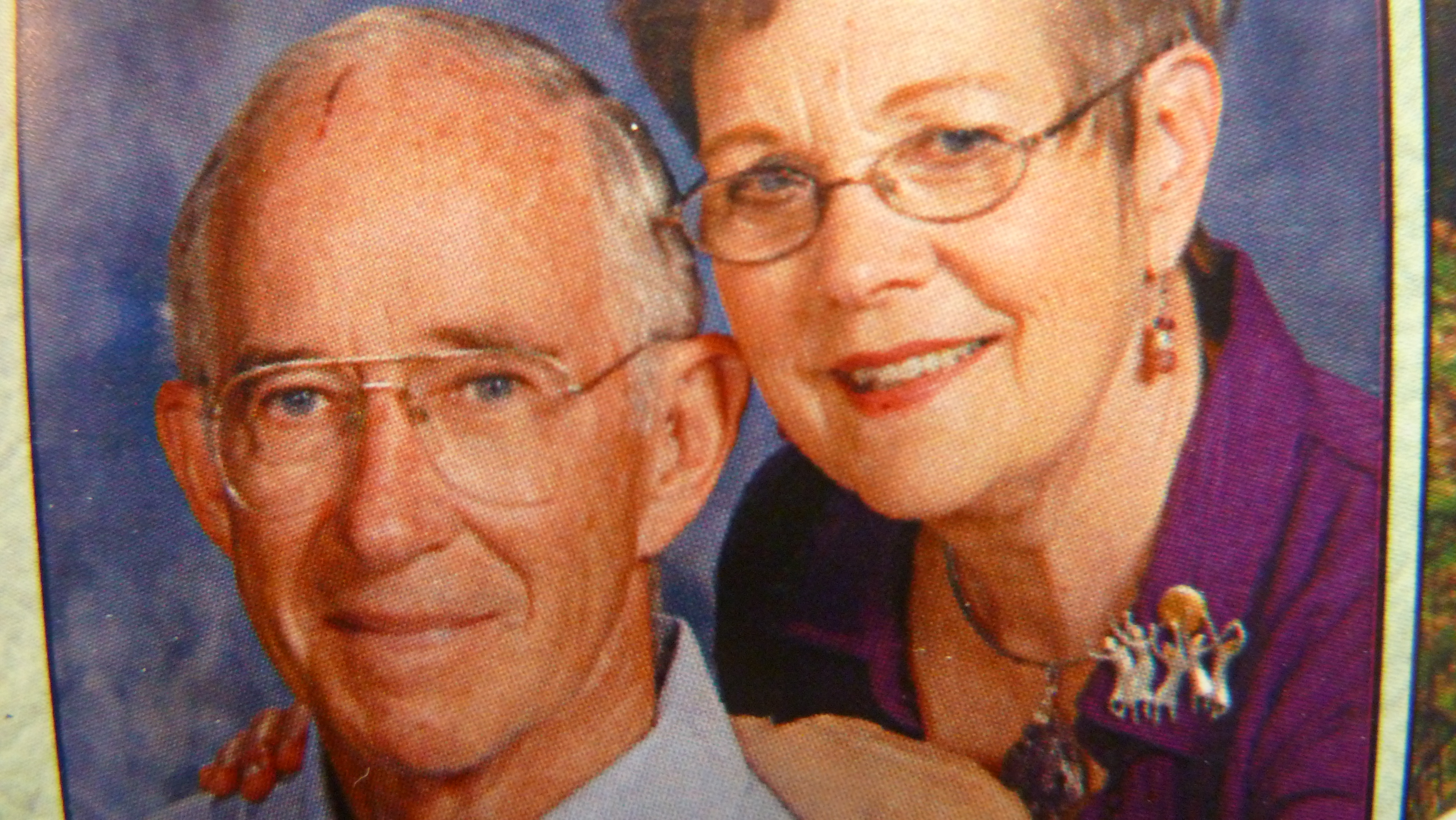
Mary Lou McMillin and her husband, Challace, the first football coach at James Madison University.
***
What is your favorite Christmas cookie? I’d love to see links to your favorites.
Are there recipes and foods you loved as a child but don’t care much for now?
My book with 100 recipes, Whatever Happened to Dinner, includes these favorite cookie recipes: Snowball Cookies, Whole Grain Chocolate Chip Cookies, No Bake Bars, Blondies, Magic Cookie Bars, Gingerbread Cookies. Purchase at the MennoMedia store.
 Uriah and Barbara’s wedding picture, 1893. They were married just eight years later than Laura Ingalls & Almanzo Wilder.
Only eight generations back, my forebears came to America. Like a lot of other folks who grew up Mennonite, my early relatives were Amish. One of the most well-researched and documented genealogies is the Jacob Hochstetler family, with members numbering many hundreds of thousands today.
I’m one.
Much is known about this ancestor Jacob Hochstetler, because his family suffered a tragic massacre during the French and Indian war in the Northkill Amish community in Berks County, Pa. Jacob’s young teenage sons reached for their hunting rifles in an attempt to scare off or kill the attackers, but Jacob was a true pacifist and would not allow them to shoot, even at the risk of their own death.
I’m excited about a fictional trilogy recreating this history being written by Ervin Stutzman, moderator of Mennonite Church USA who during the last number of years has written about his own parents, Tobias of the Amish and Emma: A Widow Among the Amish. The first book in his “Northkill” trilogy is scheduled to be released next February in a volume called Jacob’s Choice.
But here I want to tell you more about my grandfather on my father’s side Uriah Miller, a direct descendant of Jacob Hostetler. Some begats: my grandfather Uriah was the son of Moses, the son of Joseph, the son of Daniel, the son of Anna, the daughter of John, the son of Jacob Hochstetler the guy whose family was attacked. (John, who emigrated with his parents from Europe, was already married and living away from his parents when they were attacked.) That’s a lot of “begats” and eight generations by my calculation, starting with my father (I’m no genealogist or historian, so correct me if I’m not counting correctly). I knew Grandpa Uriah for the first 13 years of my life until he died in 1964, pictured here with his father Moses.
 Bottom row: my great grandfather, Moses, with beard; my grandfather, Uriah, and grandmother, Barbara Kauffman Miller. I don’t know who else is in the photo.
So Grandpa Miller was already 79 by the time I was born. My own father was the youngest of nine children, and 27 before he get married (not old by today’s standards, but old for those times). So that’s a little of why I had such an elderly grandpa.

The Uriah and Barbara Miller family, before their three youngest children (two sons, finally!) were born. Photo courtesy of Dennis Risser.
By the time I really had memories as a young child, Grandpa was already hunched and probably weighed less than 100 pounds. He was always small, especially compared to my robust Grandma (Barbara) Miller, but I like the above pictures because they show him as a much younger man, before he got hunched over and Grandma had a stroke. We were close to them because they lived in a “daughty” house (in-law quarters) attached to ours for about the last twenty years of their lives.
My grandparents, center.
Grandpa’s life story spans from the covered wagon to the jet age—he personally used both modes of transportation, a story carried by our local paper at the time. He and grandma, ages 84 and 81, flew to California to visit a granddaughter and family.
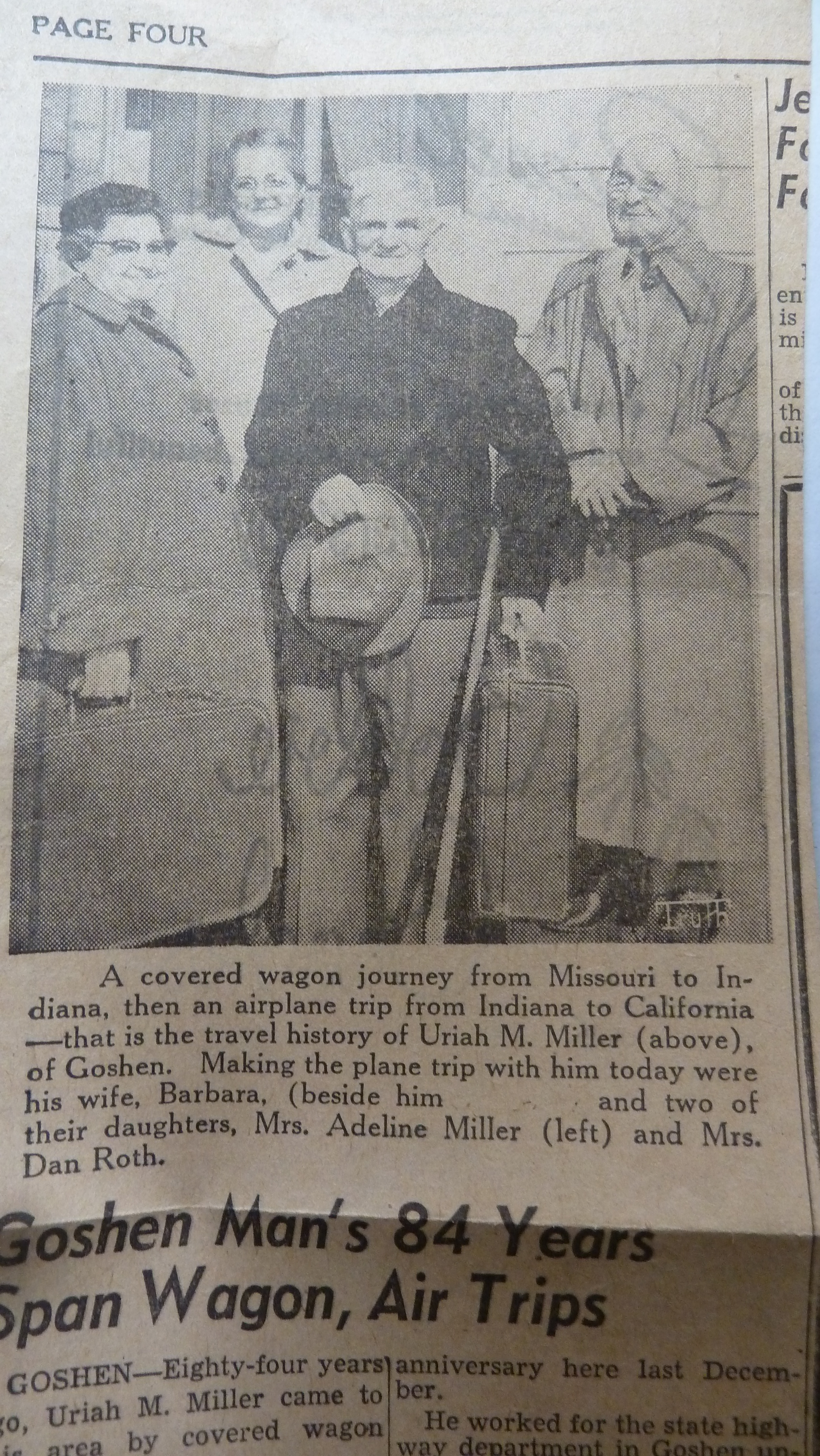
My Aunt Adeline, Aunt Susie, Grandpa and Grandma getting ready to fly to California to visit the Arleta and Marvin Mann family.
Grandpa was born in Wheatland, Missouri during his family’s several year attempt to farm “out west” under very harsh conditions. So the family moved back to Indiana, traveling by covered wagon.
When he grew up, he traded horses, earning him the nickname “Jock,” and spent 34 years as a farmer and thresher in northern Indiana and in lower Michigan , seen here.
 (Small man on top, in the very center of the picture. Double click to enlarge. Photo courtesy of Dennis Risser.)
Later he worked for the state highway commission and after retirement, helped Dad farm. He was a grower of raspberries, roses, and an egg sorter in our family egg business.
He was a lifelong Mennonite who chewed tobacco. As a kid I thought that was kind of edgy and cool. My Aunt Susie said that habit started because he had been told it would keep him from getting TB after his mother and several sisters died of the dreaded disease (11 children in that family).
He always carried pink or white wintergreen mints in the pocket of his suit jacket well into his 90s and kid would line up beside him after church waiting for a piece. My father carried on that tradition in his later years. When I was at Amigo Centre earlier this fall, I learned from program director Mandy Yoder that her father always carried those mints for kids at his church, too.
 Mandy’s bowl of wintergreen mints in honor of her grandfather.
 Grandpa and Grandma the way I remember them best in their later years, on a favorite glider in front of our childhood playhouse.
See more about the playhouse history in our family here.
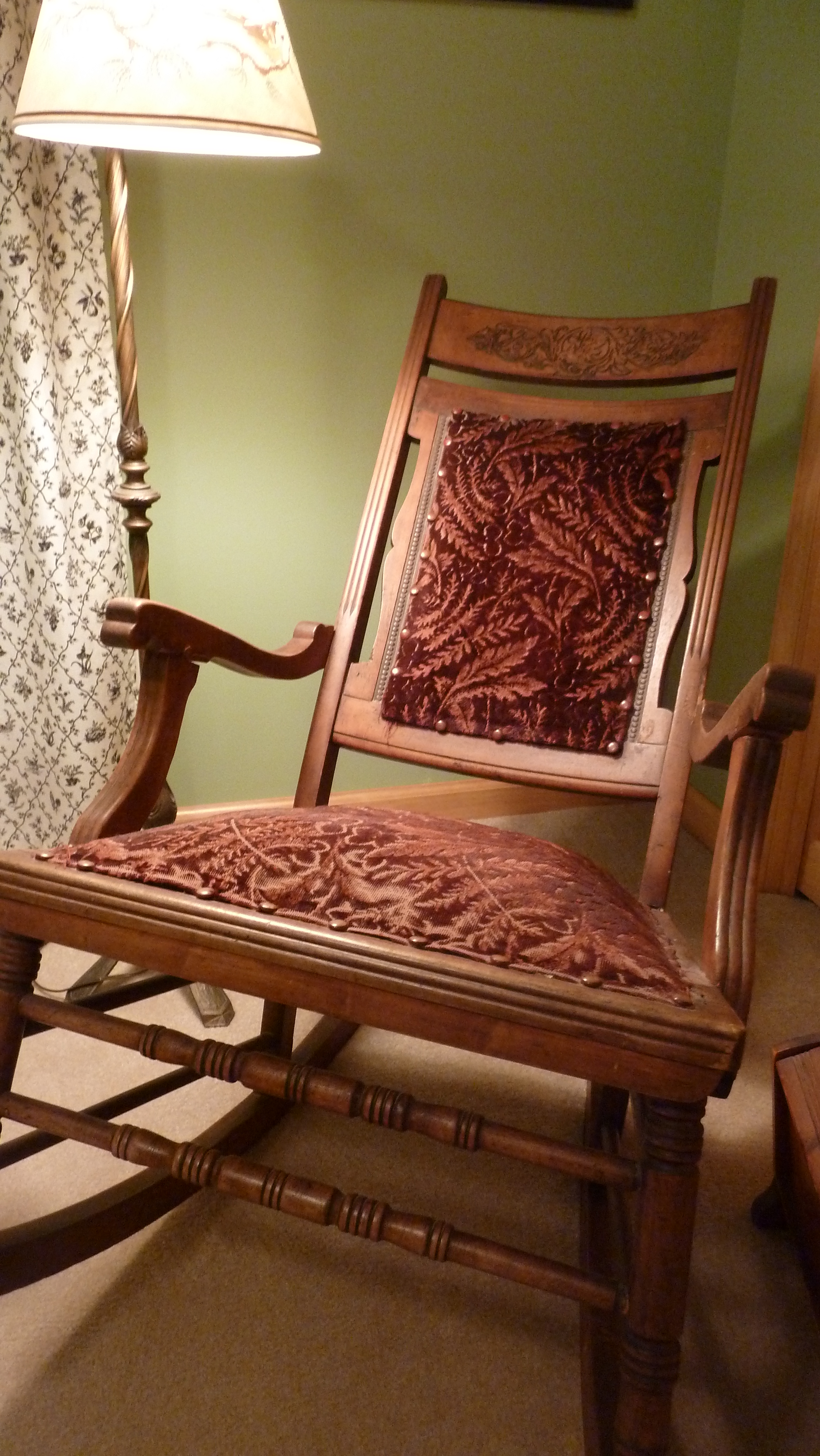
We were all close to Grandma and Grandma Miller—they rocked us, babysat us, and I loved riding to town with Grandpa in his old black Chevy, circa 1950, for his haircut or to pick up more mints (or tobacco). The grandchildren and great grandchildren (my first and second cousins) would come out to the farm to play and visit. I remember Grandpa taking care of me one time when I was sick and had to stay home from school. Momma was busy that day—I don’t remember if she had to go away, but I know he brought me a bucket or tissue or glass of water when I needed to upchuck. That memory always stuck with me—my 90 year old grandfather taking care of a 12 year old girl. I still have his rocking chair.
He and Grandma enjoyed 67 years of married life together. Grandmother died first in 1962 and Grandpa brought a fresh rose every day from the rose bushes they both loved to place in her hands at the funeral home as we received friends and sympathizers. Grandpa himself lived to within days of his 92nd birthday.
But more than these memories, I treasure the faith of my ancestors–those like Jacob Hochstetler, who lived their beliefs. My grandfather didn’t go through anything quite as dramatic as Jacob and his family, but quietly and steadfastly lived their faith through The Depression, through losing two daughters, and literally, thick and thin.

Grandpa holding one of his seven daughters. Grandma on right.
***
Are you part of the Hostetler clan? Let me know or visit the official Hostetler website.
More on Jacob’s Choice
To purchase a copy of Jacob’s Choice at the pre-publication discount price of just $10.50,
(regular price will be $14.99) go here. (Prepub price ends 2/8/2014)
(For more about how threshing works, here’s a fascinating video.)
I will never forget the first time I made stew for Stuart in the first year we were married.
My stew had big chunks of beef, potatoes, cabbage, onion, carrots, and beef broth–and that was about it. Perfectly fine stew in my book, and in my family’s tradition.
He looked at it, ate a few bites, asked “what is this?”—and you know how the newlywed conversation went downhill from there.
I was dumbfounded. What was wrong with my soup? My stew? My delicious wonderful dish?
So what kind of stew did the Davises fix? Well, turns out they call it homemade vegetable soup. Over the next weeks and months, I inquired and watched and tasted and gradually learned to make my own variation of the homemade vegetable soup that folks around here typically make and sell in quart jars at fall and Christmas bazaars and craft shows, or take to neighbors who are ill, or when a loved one passes away.
Love it, and I’ll never turn back to my staid old stew.
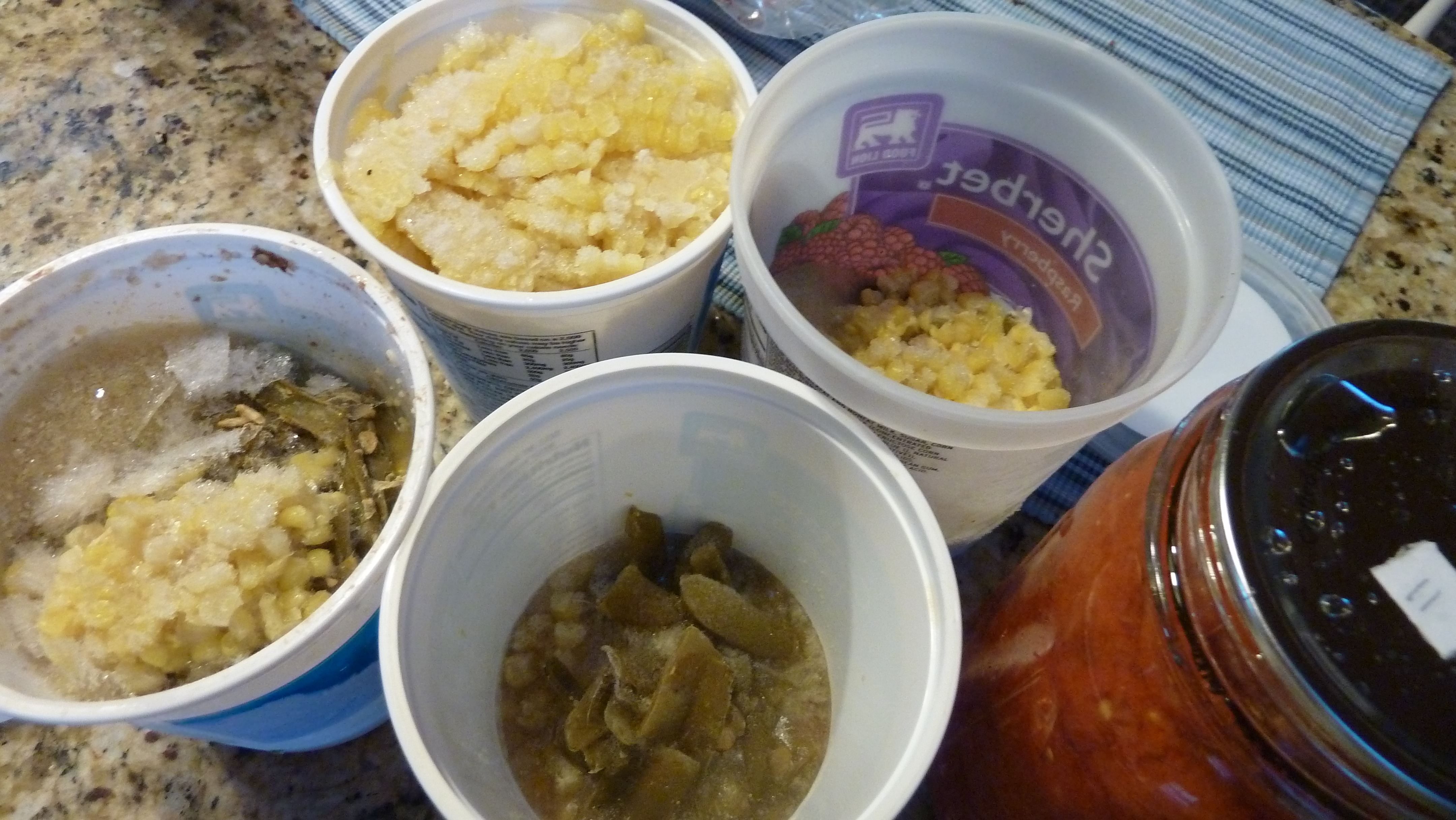
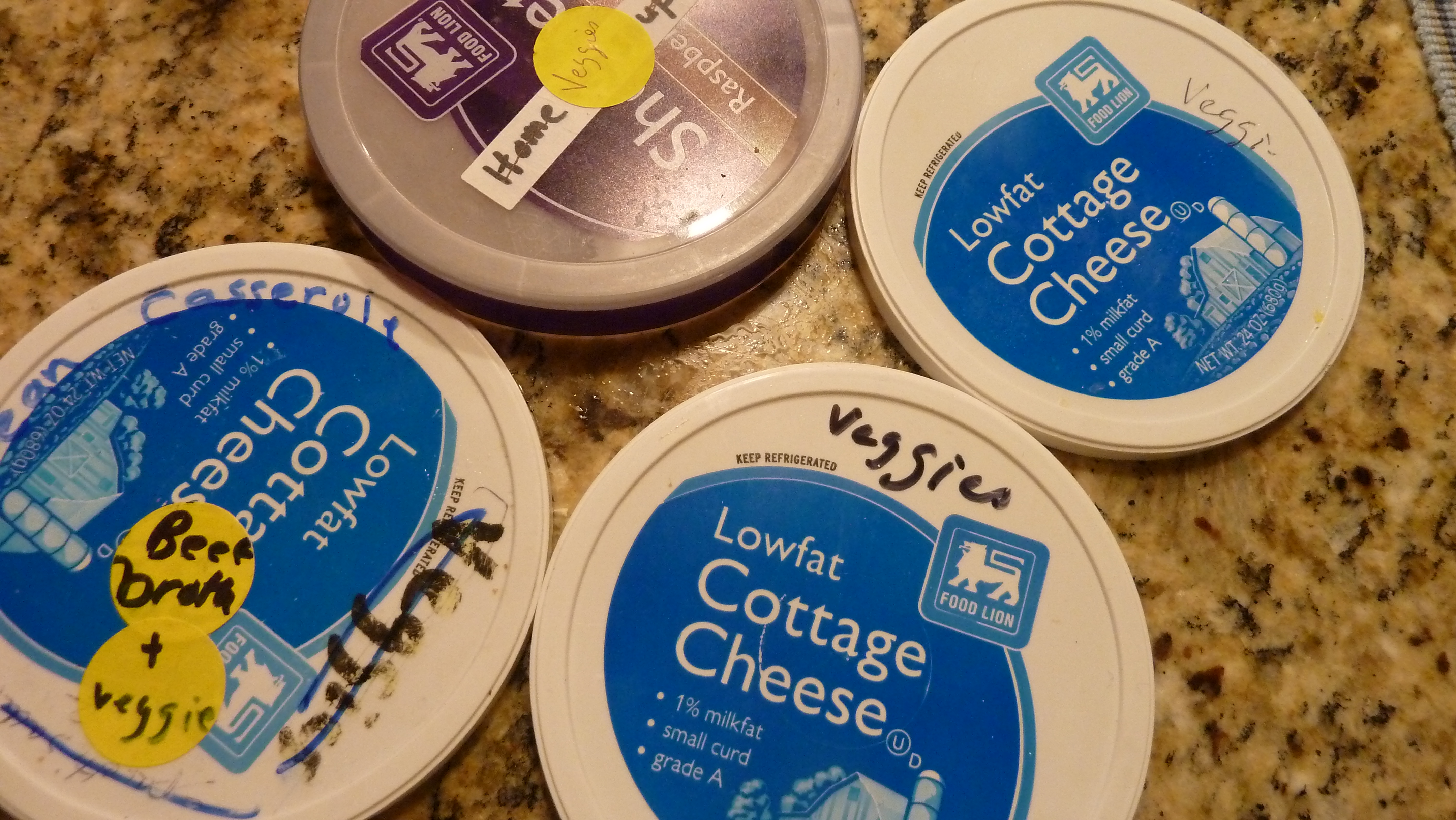
Now the biggest reason I love this soup is it becomes the repository for all those dribbles of green beans, corn or other leftover vegetables from many meals which you hate to throw away (especially if you’ve done the hard work of raising them) but the leftovers are too small of amount to serve for another meal. Or you’re just tired of eating them after three days in a row (happens a lot for empty nesters). I collect these dribbles in cottage cheese or other containers labeled “veggies” in the freezer, and keep them for a pot of soup every now and then. (Assuming you have such a container in your freezer. If not, start one.)
My actual recipe for this soup has evolved over the years, changes a little every time I make it, and now I throw in everything but the refrigerator.

When the leaves change and the thermometer drops, it is time for this soup. My husband likes it with hot bread and peanut butter; I like it with hot bread and cheese. The best homemade bread to serve with it is More with Less Cookbook’s oatmeal bread, which I talk about here.
I don’t know if this type soup is a Virginia thing, a southern thing, or a Shenandoah Valley thing. Anyone? (I talked about those regional or family food traditions here.) Another family favorite, Brunswick stew, is definitely a southern and Virginia thing, and I’ll talk about that (and give recipe for) sometime too.
What do you think? Do ya’ll make this kind of everything-but-the-refrigerator soup up north?
Homemade Vegetable Soup
1 lb stew meat, or approx. 2 cups leftover roast beef1 Table. olive or vegetable oil
3 large potaotes
3 carrots
1 oinion
1/4 head cabbage
2 stalks celery w/ leaves
1 – 2 quart canned tomatoes, to taste
beef or ham bone, optional
1 pint water (or add as needed)
2 tsp. salt
1 tsp. pepper
1-2 quarts canned or frozen vegetables, or leftovers you have frozen: corn, peas, green beans, lima beans
1 cup elbow macaroni
In 5 quart Dutch oven or other large kettle, brown diced stew meat in oil 5-10 minutes. While that’s browning, chop potatoes in small cubes, slice carrots, celery, chop cabbage. Set aside. Add tomatoes and then all raw vegetables to the meat.
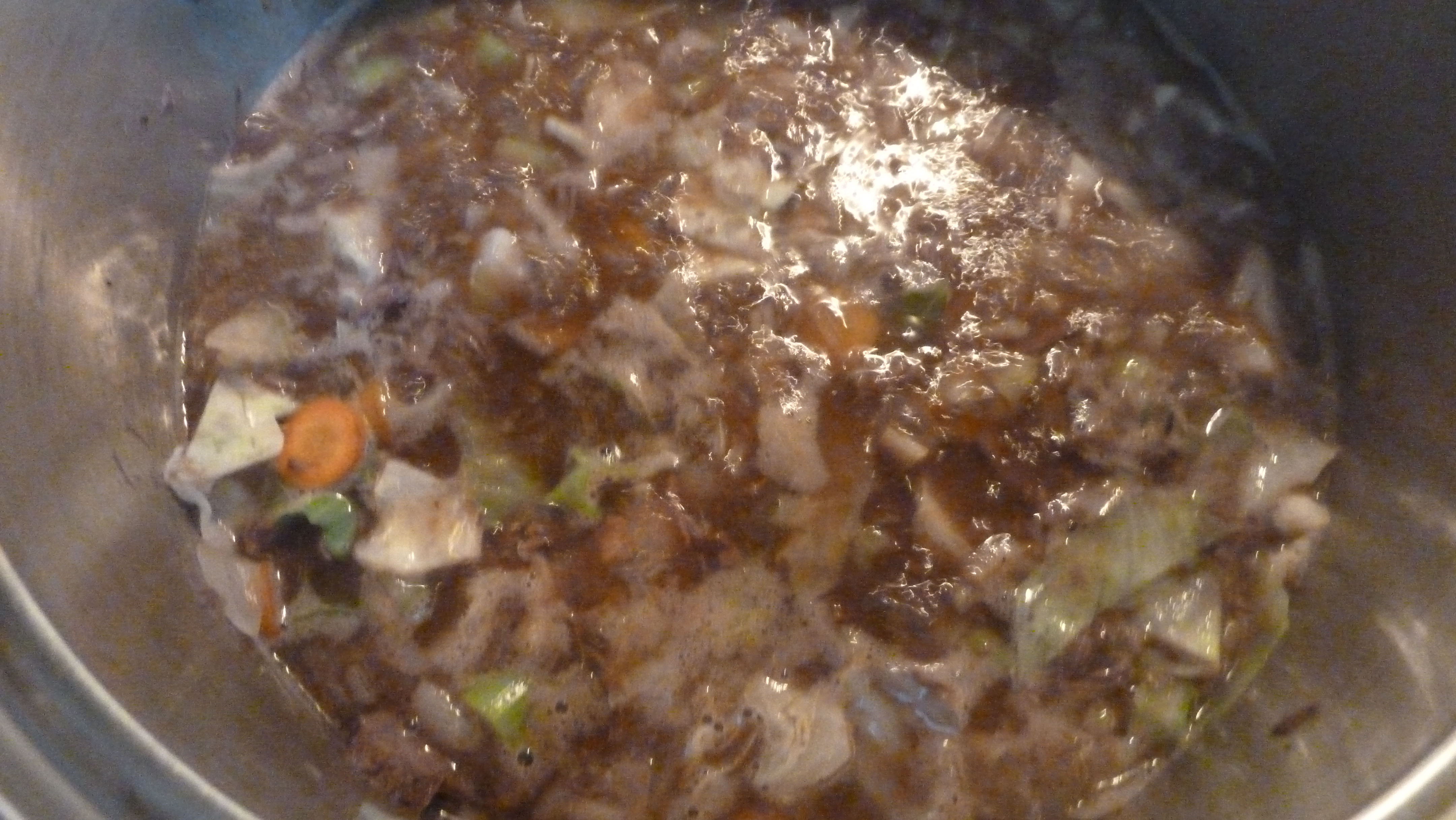
Add water, beef or ham bone if you have any (for flavoring, optional), salt and pepper. Bring to boil and simmer to cook vegetables for 30 minutes. Add leftover vegetables (as listed) or any quick cooking frozen vegetables you have.
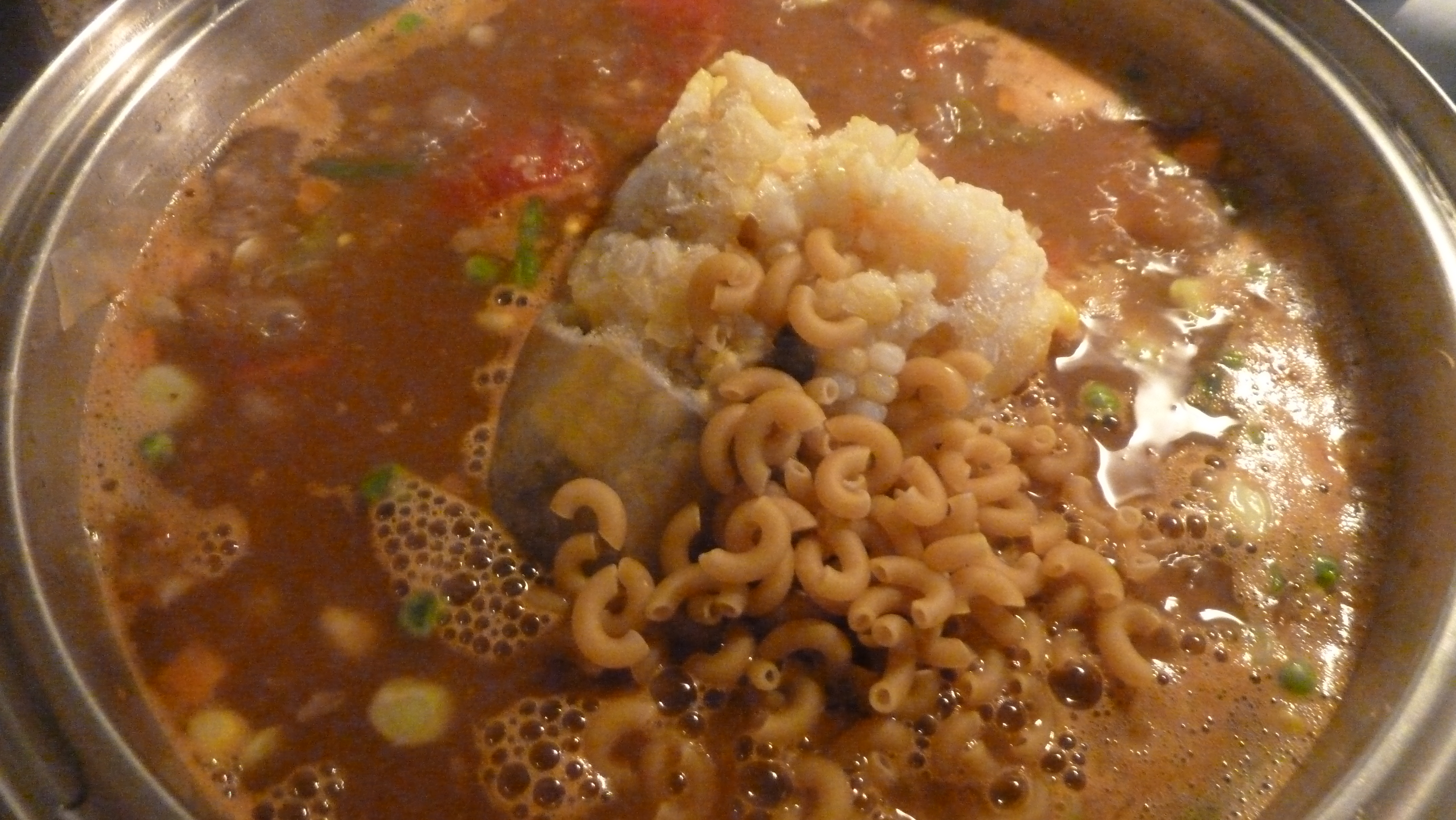
Add macaroni. Stir frequently to keep macaroni from sticking. Cook 30 minutes more. Remove bone, celery leaves. Serve. Makes a large pot of soup, probably enough to serve at least 8.

P.S. The best part about this kettle of soup is you likely have enough for 2 or three meals, depending on the size of your family.
P.P. S. S. This soup didn’t make the cut for inclusion in my Whatever Happened to Dinner: Recipes and Reflections for Mealtime book but almost 100 delicious recipes from (mostly) Shenandoah Valley of Virginia families did. It does include Brunswick Stew. Check it out. Book sold here.
Another P.S. Notice I added a search tool and one of those nifty cloud things for frequent topics.
 I sat at a baby shower for my oldest daughter and husband on Sunday pondering my own days of being large with child, and the recipient of the largess of people who were not my relatives or even long term friends. At both baby showers held for my husband and I, the guests were people who were in my life at that stage: work and church colleagues mostly, since I lived 600+ miles from most of my family and friends from high school or earlier. In our mobile society, this is the norm.
At our daughter’s shower/potluck by her church in northern Virginia (Northern Virginia Mennonite), there was even a couple who had just arrived the night before from Congo.
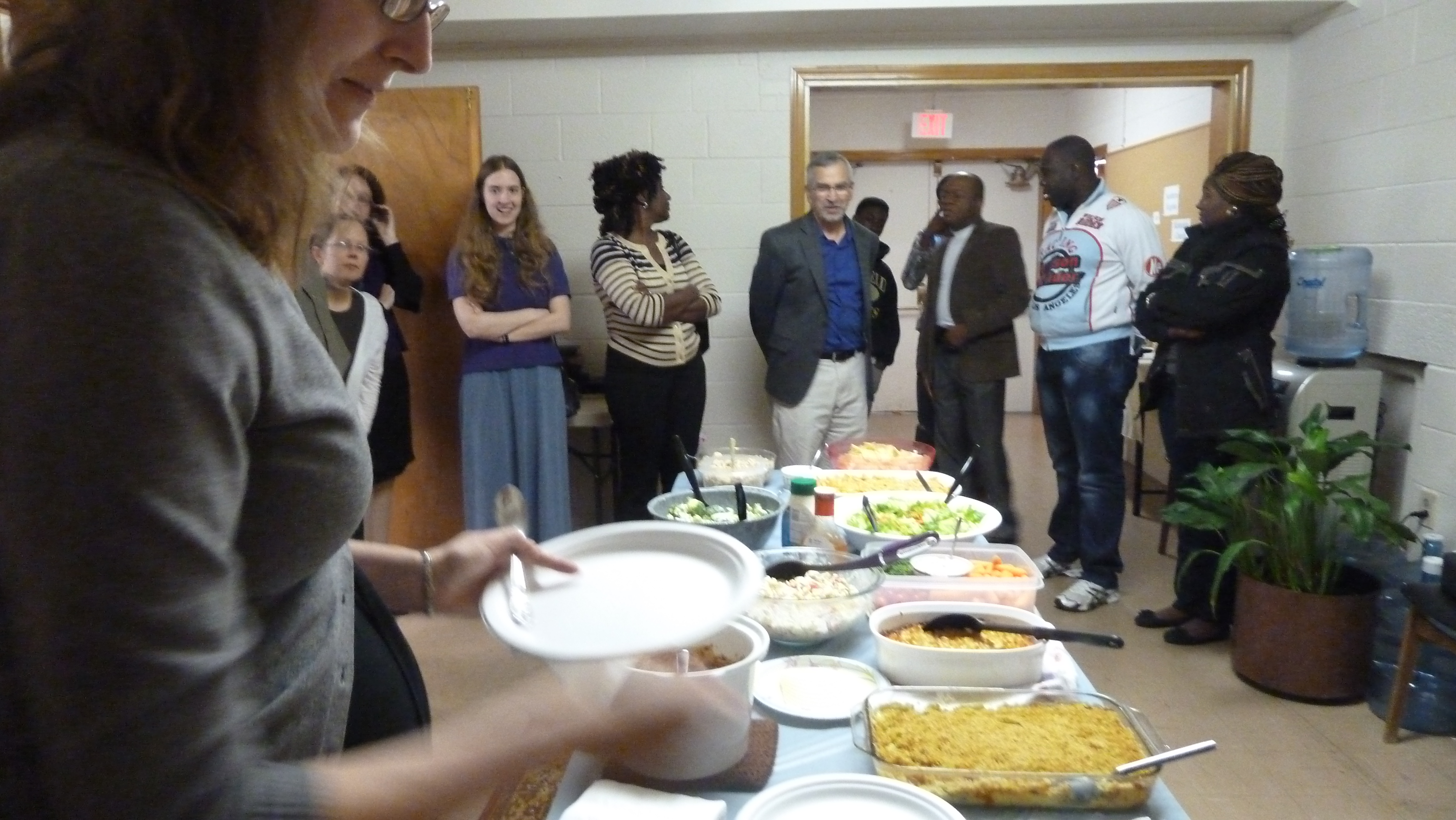
I had to wonder what they thought of the baby shower customs and rituals (thankfully, there were no shower games played–no little diapers with fake poo (mushed brown candy bars) in them passed for everyone to sniff and guess the type of candy bar, as I’ve played at least one shower).
 I thought about how the tables were turning, my daughters becoming mothers. This kind of development is maybe the opposite of the reversal explored in Nancy Friday’s 1970s’ classic book, My Mother, Myself, but just as interesting.
Regarding Nancy Friday’s timeless observations, my sisters and I notice, sometimes with laughter, sometimes with fright, how we are becoming our mother and even our grandmother, especially on mother’s side, who was with us well into adulthood.
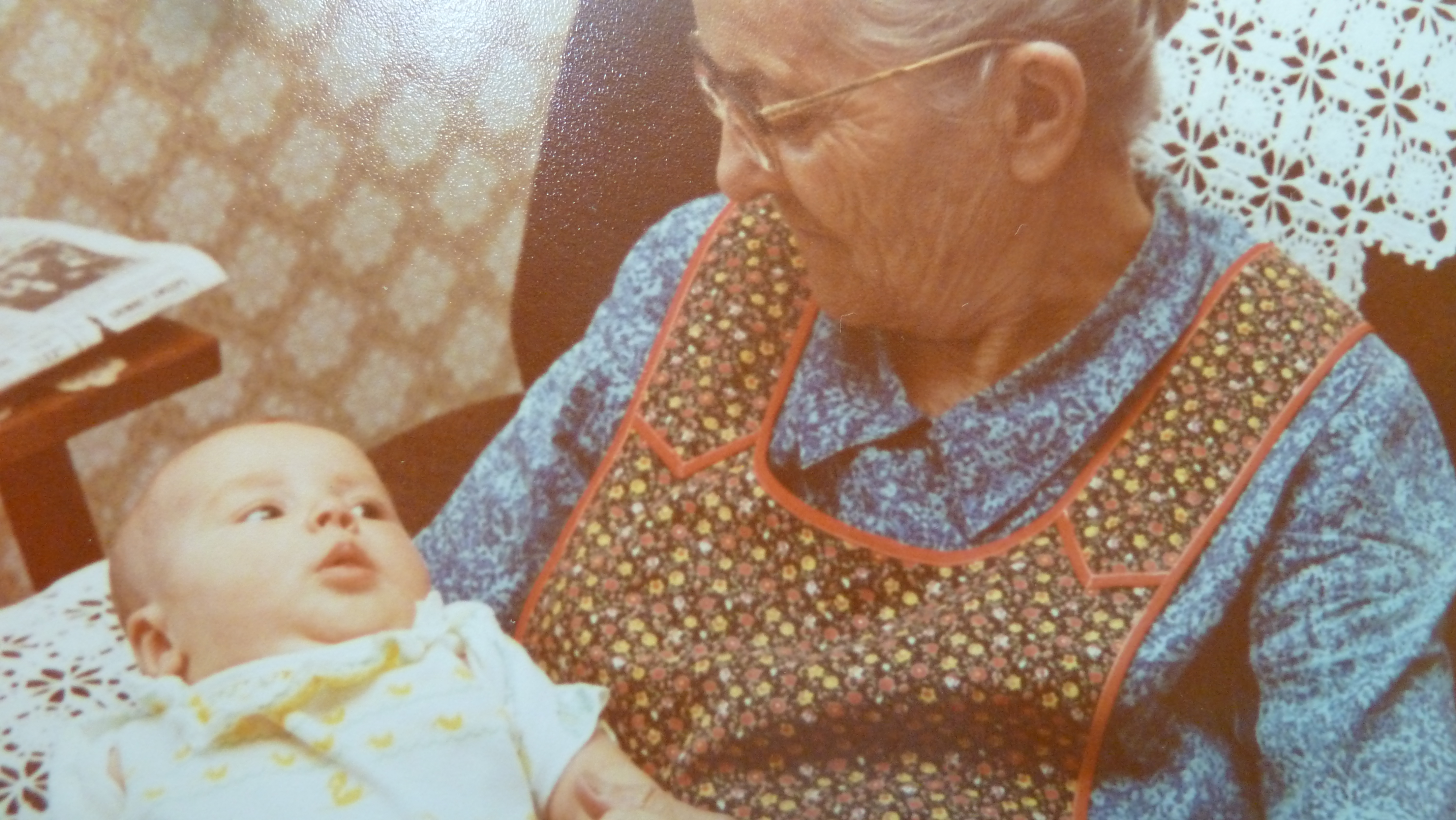 Grandma Stauffer with 2 month old Michelle, now 9 months pregnant with her first.
(My other grandma died when we were adolescents.) I’m even becoming my sisters: little mannerisms, my looks, people say.
 Yours truly, expecting our first born. About 8 months along.
In case the 70s and Friday’s generational “aha” passed you by, see here for a thumbnail description of her book. But my takeaway from that summary is this:
“The greatest gift a good mother can give remains unquestioning love planted deep in the first year of life, so deep and unassailable that the tiny child grown to womanhood is never held back by the fear of losing that love.” —Nancy Friday
I would modify that to say “grown to adulthood” to apply it to boys, too.
Watching my daughters become mothers (one baby is due in 2 weeks, the other is already almost six weeks old) is a gift, (earlier post on Grandma x 2 here) one I wasn’t sure I would be privileged to experience. I am deeply grateful. Those of us who were older mothers or whose pregnancies did not come easily, or ever at all, and found motherhood another way (adoption, foster, or even in vitro) are maybe less likely to take our offspring becoming parents for granted than, for instance, my one aunt who was famous for quipping “all my husband had to do was hang his pajamas on the bed post.” Thank you, Aunt Arlene. (Or was she talking about cousin Arleta??)

All three of my daughters at an earlier double baby shower; in the middle, youngest sister Doreen gets stuck passing out gifts.
I have loved hearing my daughters (mostly by email, Facebook post, or text) discussing varicose veins, having to pee a lot, ultrasound visits, what they’re finding to wear (love the maternity “belly band” which allows you to leave the zipper open on any pants or slacks and still hold them up. Wow, what a great innovation!), comparing weight gains, size of baby, various screenings like for diabetes, products for the nursery, wanting to avoid SUV-type strollers, the emotion of touring the hospital birthing center and realizing and hoping “Oh my, the next time I’m here, I will bring home a real baby! Our baby!”
Their enthusiasm for becoming mothers, even while struggling to sleep with a 15-pound or so basketball attached to their fronts, is gratifying, perhaps a reflection that somehow I and we as parents were able to plant that “unquestioning love deep in the first year of life.”
It is an amazing journey, whether as mother, father, grandmother, grandfather or beyond, and no matter how you follow it. The circle of life.


Top: Dog Ike gets introduced to baby brother Sam, 2013. Bottom: Dog Wendy gets introduced to little sister Michelle, with Aunt Barbara and Uncle Richard, 1981.
Some grandparents talk about payback, meaning that they enjoy grandkids returning the mischief and mayhem they endured as parents. But the payback of watching your kids prepare to become parents and give back the love and care you taught them through long sleepless nights, fussy, tedious days, and sacrificing your own comfort and priorities for theirs, is a far richer benefit.
Like grandmas everywhere, I ponder these harmonies and treasure them in my heart.
***
How have you enjoyed seeing your kids become parents? What stands out? If they’re still kids, what are you hoping to get in payback?
Then and Now Photo Gallery
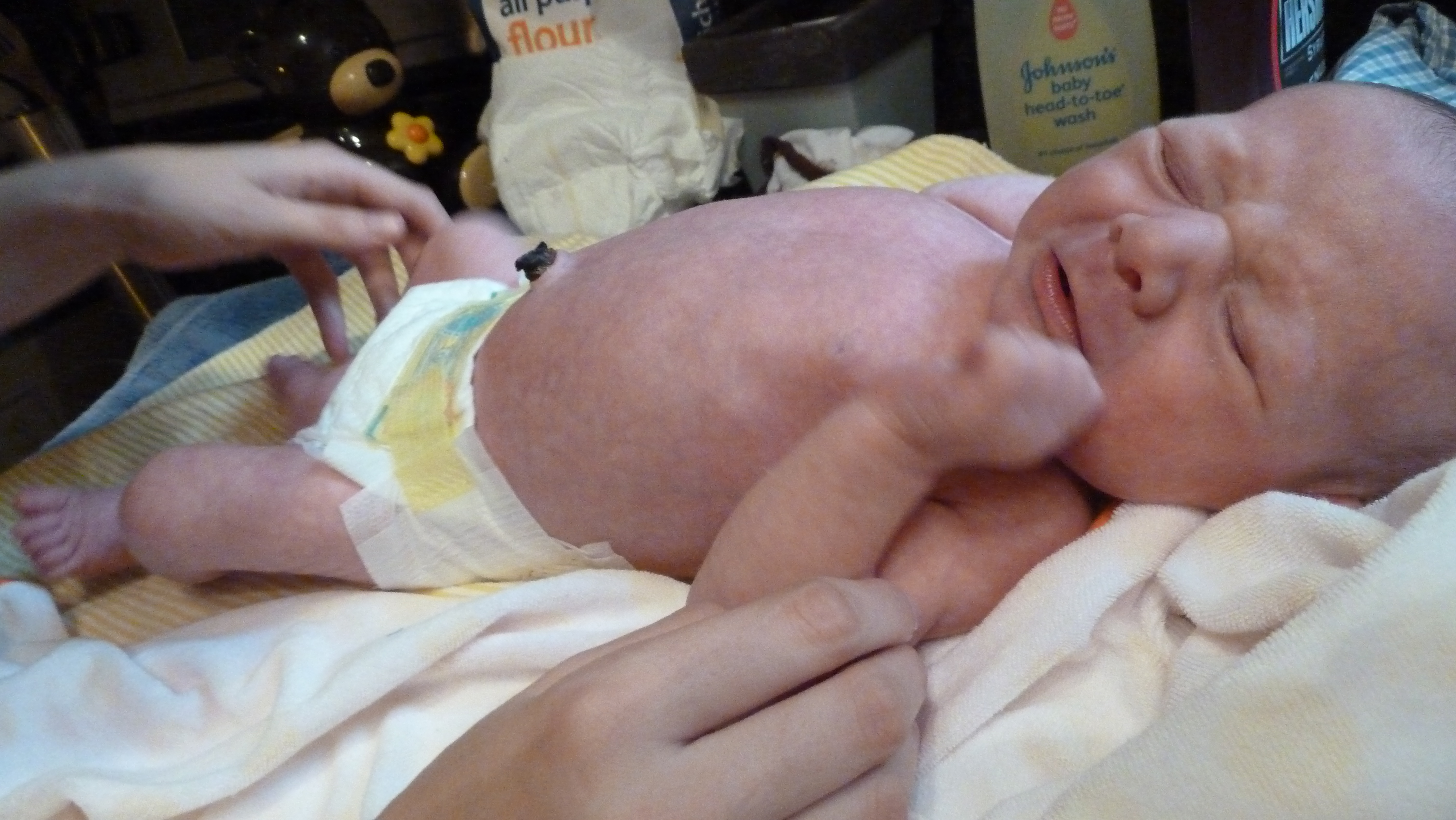

Sam gets his first kitchen sink bath with Grandma Melodie’s assistance. 2013. Michelle gets her first kitchen sink bath with Grandma Miller’s assistance, 1981. (Like all babies everywhere, there are more photos of baby #1’s first everythings than baby #2 or 3. Yeah.)


Baby Sam at three weeks with father Jon, 2013. Baby Tanya at two weeks, (Sam’s mother,) 1983. Do they look alike?
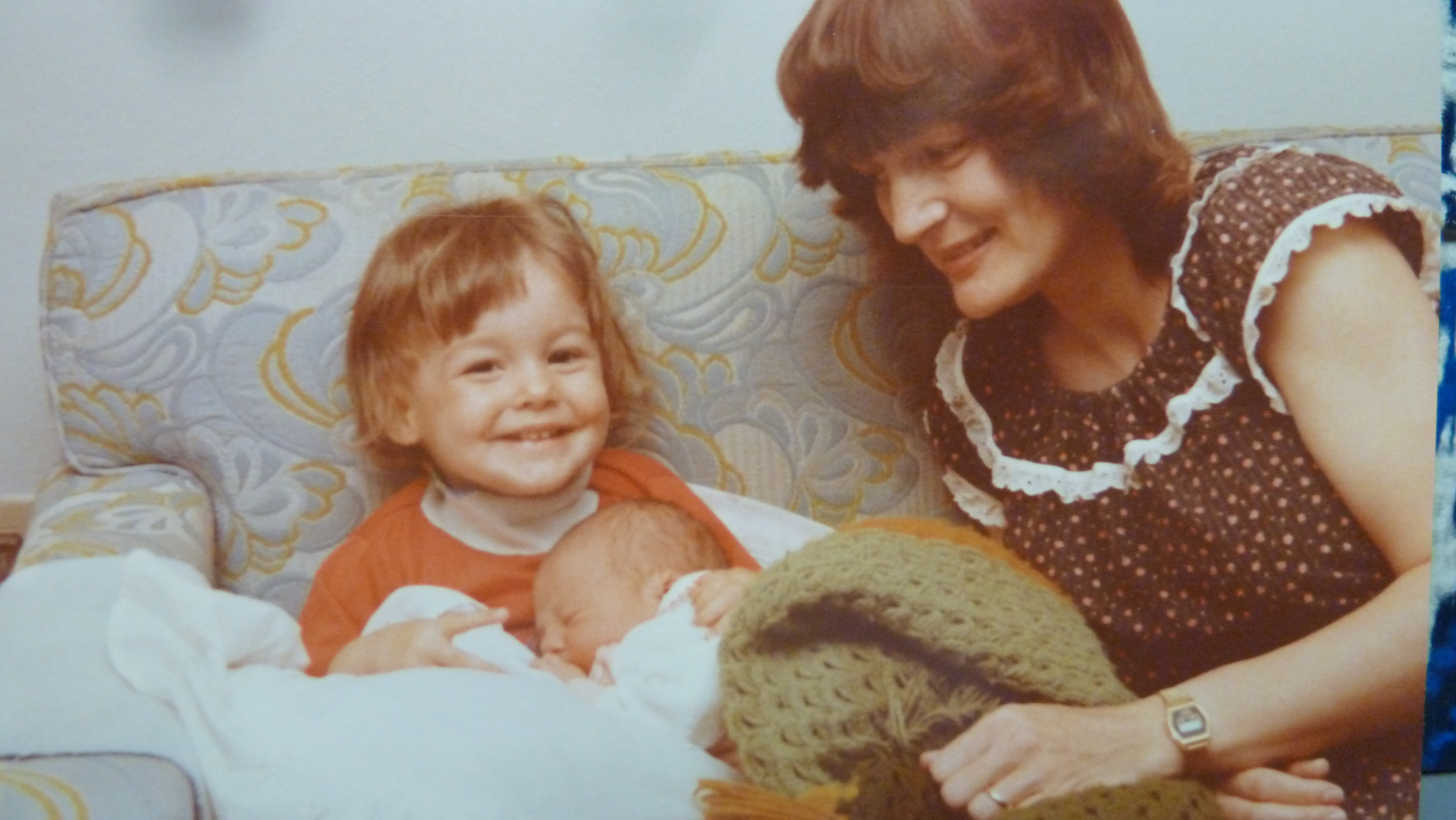

Top: Michelle meets baby sister Tanya, 1983. Bottom: Michelle waves hello to all the people out there in the far over Internet land, courtesy of Grandpa and Grandma Miller, 1981.
.
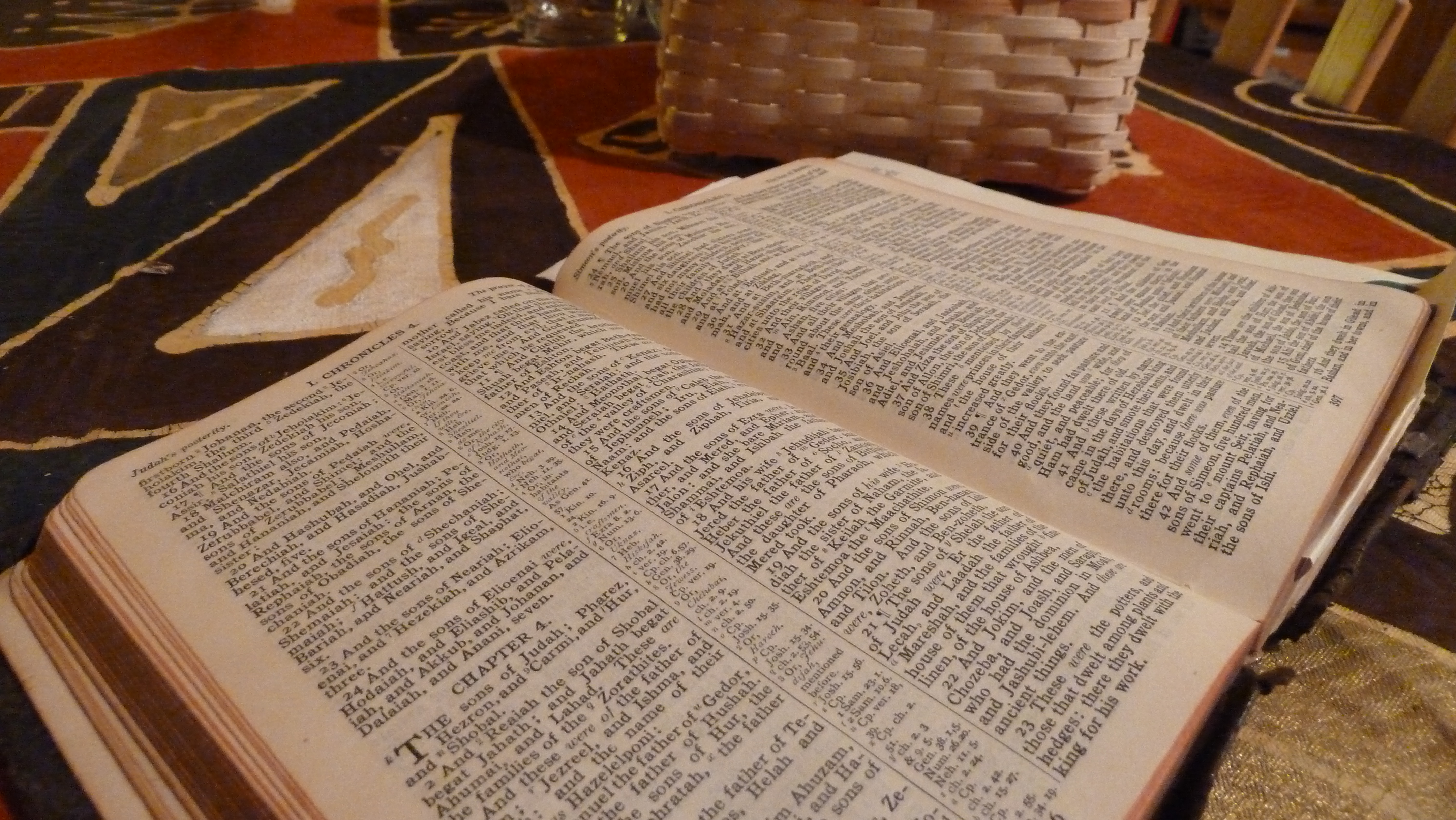 My grandfather Ivan Stauffer’s Bible, who died in a car accident before I was born.
Shown here with creative fabric made in South Africa, and a basket made by my niece Anna.
You never know what you’ll find in the Bible.
I’m plodding through the Old Testament. I started a while ago (recounted in an earlier Another Way newspaper column, here). And lest you think I’m bragging on myself, this was TWO years ago when I started trying to get through it again. I’m like the slow cooker of Bible readers.
I just got through second Kings with my stomach churning, with its tales of child sacrifice and how each king was just like his father and committed all these atrocities. Not much peace and harmony in Kings.
And just when you worry about what happens if people actually crack open a “Gideon” Bible at random in a motel room and read this stuff, a line or phrase or story hits you with some detail and you’re ready to keep plodding through again.
So the other day I started Chronicles, which I understand to be kind of a rehashing of the events recorded in Samuel and Kings but “from a different point of view,” says my Today’s English Version, which I’m now reading from. Chronicles also has a whole lot of genealogy. “Adam was the father of Seth, Seth the father of Enosh …” and on and on and sometimes when the boys are in short supply a female descendant or two is named as well. Yay.
And then there in 1 Chronicles 4: 14 is something I’m sure I never read before or at least never noticed, “Seraiah was the father of Joab, the founder of Handcraft Valley, where all the people were skilled workers.” Another version calls it the “Valley of Artisans.” (See a neat list of all the different ways this is referred to in the Bible, here.)
Handcraft Valley! Valley of Artisans! What great names for a craft store or craft mall, or a magazine, or blog! And no one’s even taken Handcraft Valley yet. (At least according to Google.)
This tells us several things: that not everyone was good at weaving cloth and making pottery and crafting items out of wood or building a house out of stones. It tells us that it was a recognized specialty, an art form. Just like today.
Sometimes when we read about people from earlier times we assume that if everyone had to weave and then make their own clothing, or throw their own pots, that everyone was just good at these things. But the fact that there were “skilled workers” mentioned means to me that some were better than others, just like today.
In other words, they were pretty much just like people today—all of us created in the image of God. Especially God’s creative side. God reveled in creativity. And God made us that way too, no matter how things turn out. Which is pretty cool.
Later in 1 Chronicles the writer notes, “There were potters in the service of the king.” I’m guessing that was an advanced guild.
Then I start 1 Chronicles 5 and we find another interesting Chronicle surprise: “These are the descendants of Reuben, the oldest of Jacob’s sons. Because he had sex with one of his father’s concubines, he lost the rights belonging to the first born son…”
Well, that’s putting it right out there. Always interesting, the Bible. Sounds like a great plot for a novel…
Creativity juices flowing, anyone?
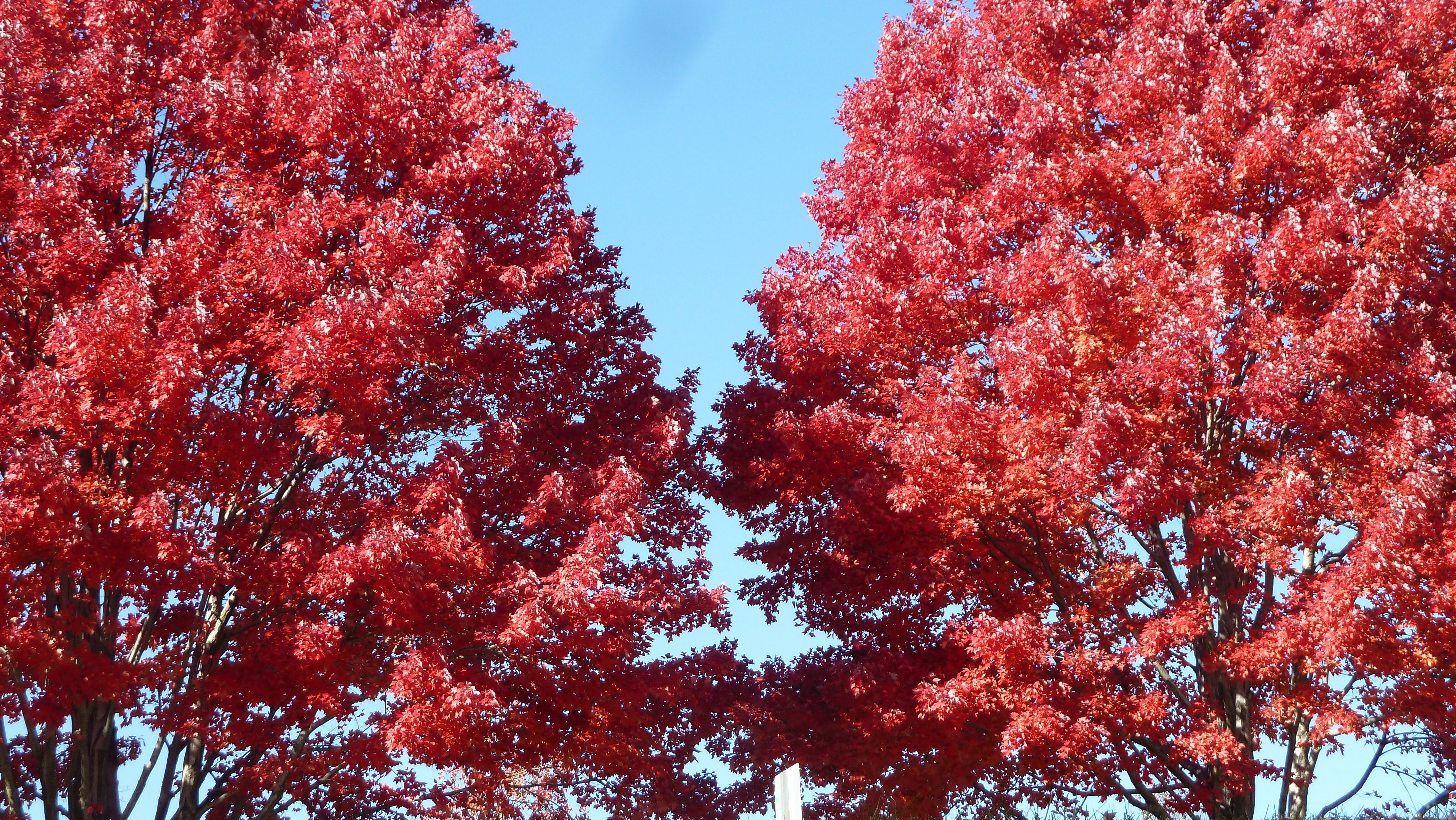
Here are two fall trees I saw yesterday. While God made us to be creative,
Joyce Kilmer put it so memorably, “Poems are made by fools like me, but only God can make a tree.” See Trees.
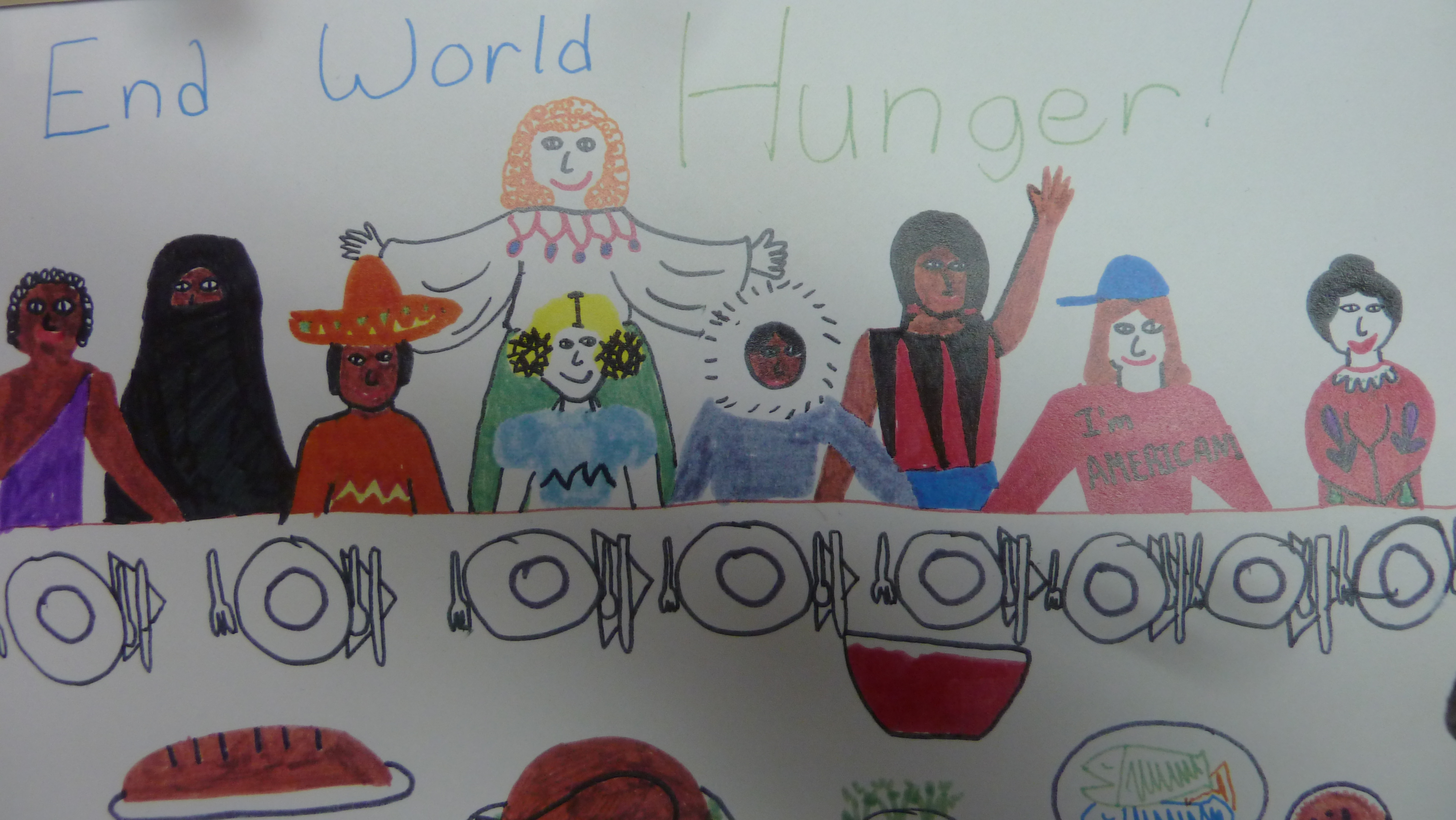 My daughter Michelle’s childhood drawing in honor of her grandfather’s commitment to combating hunger.
A couple weeks ago I wrote about hunger and CROP walks and my own father’s history in the development of Indiana’s statewide CROP program–Dad’s very practical way of working to create more peace and harmony in the world.
Mom, who doesn’t get on the computer unless one of us helps her (and she does love that), responded to a number of my blog posts by old fashioned letter. (I print out most of my blog posts and send them to her,—great technology workaround here.) She had a few “comments” or corrections for me, especially about her role in the first Friendship Acre Farm in Indiana which my father spearheaded. I had said she “helped organize a wonderful potluck dinner that day, like at an old fashioned barn raising.”
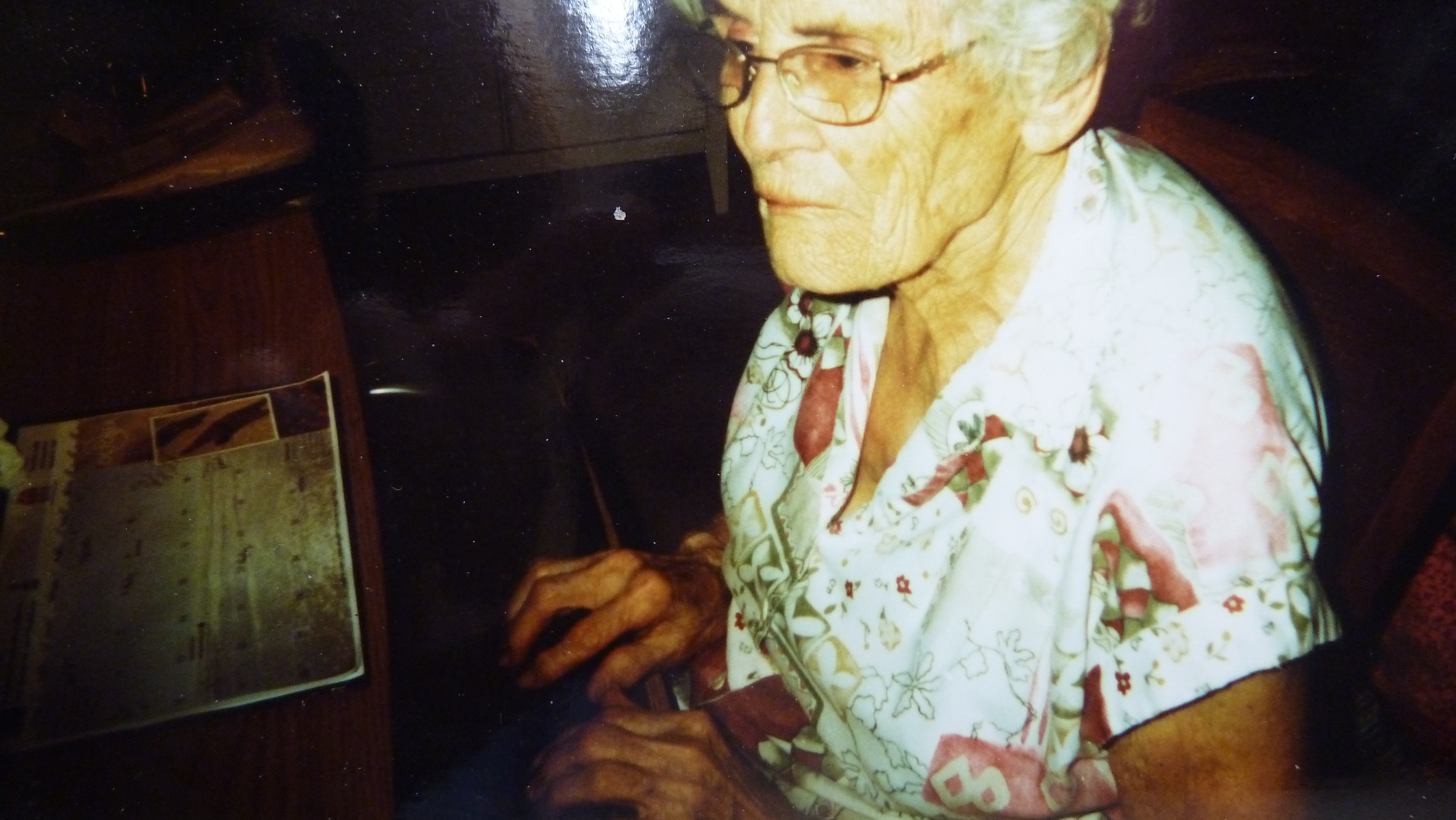
Mom: “I had nothing to do with managing the CROP dinners. I asked Elva Honeyager to do it and she was glad to do it. I figured you knew your mom couldn’t handle that. NO-WAY—I am not a cook like your family is. I cooked for many a dinner for farm hands etc. but that was it. I am sure you remember I told North Goshen women [our church, North Goshen Mennonite] I would work on any committee but Food!”
Ok. I stand corrected. I hope you can hear Mom talking here.
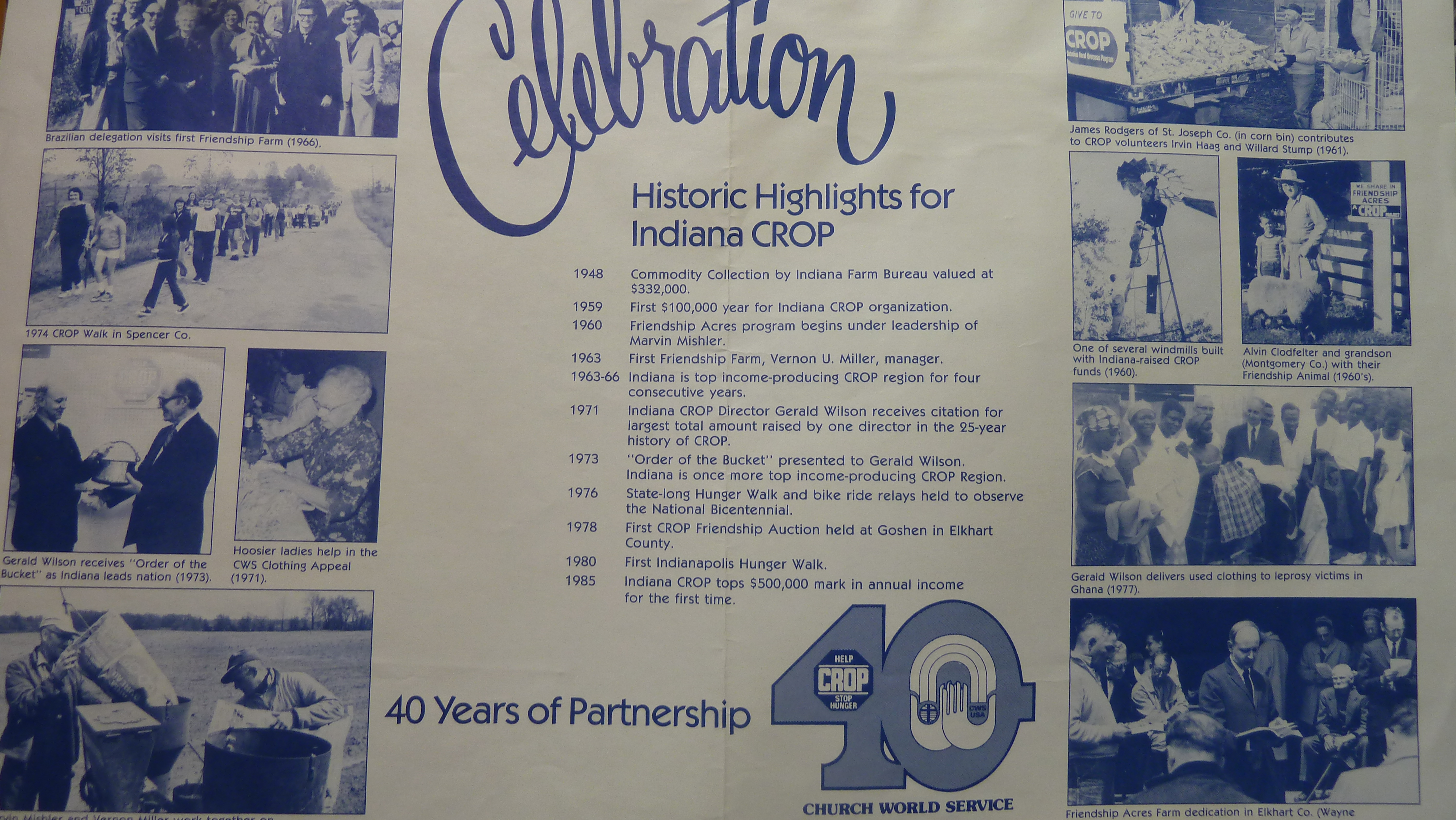 Then today I ran across a place mat Mom saved documenting Indiana’s CROP program history, used apparently at their 40th anniversary banquet in 1988, and also one of my newspaper columns from 1996 in which I interviewed Dad, written about 10 years before he died when his mind was still good.
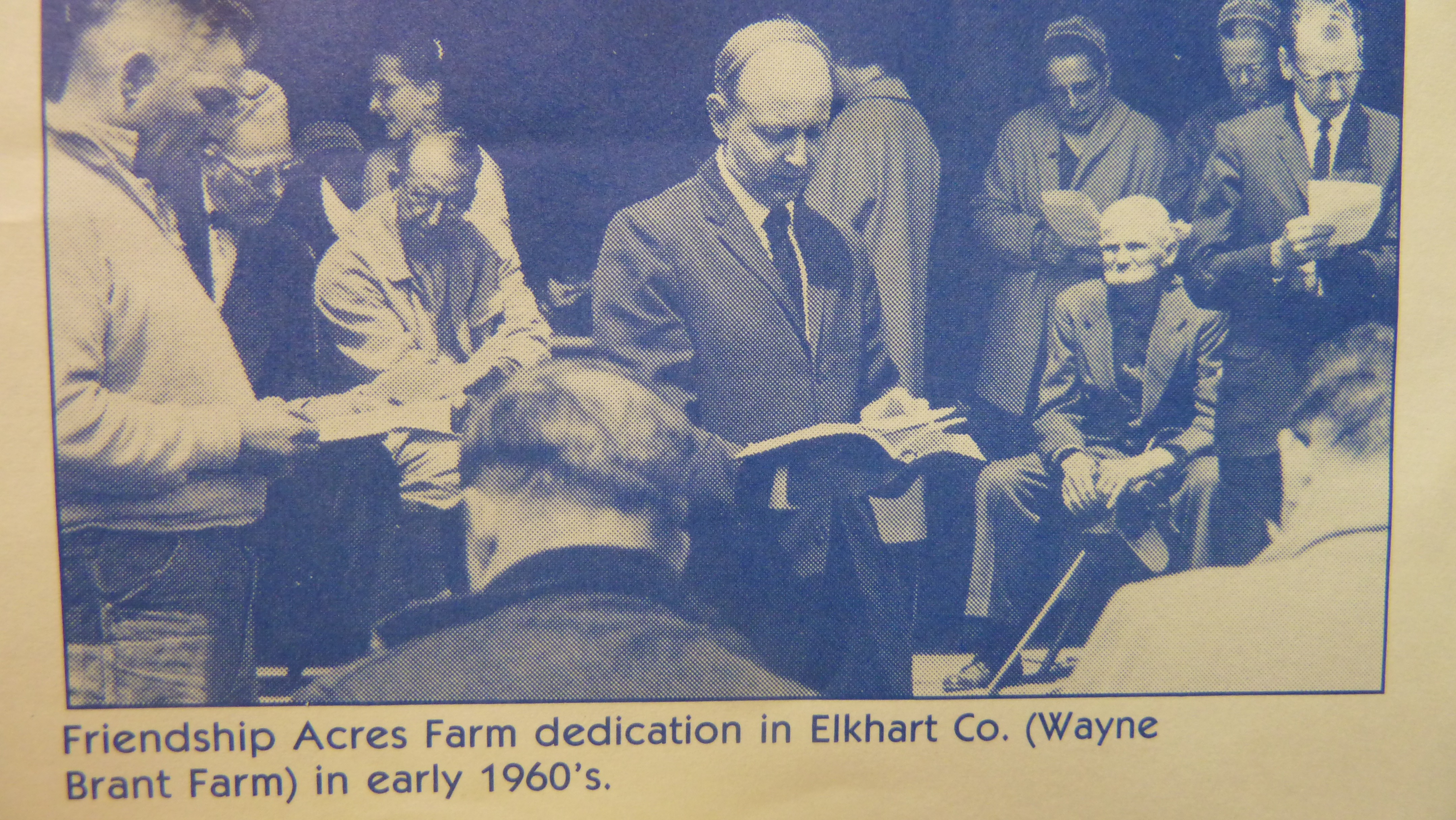
The placemat is special to me because it has a picture of not only my father, Vernon U. Miller, far left, but my grandfather, Uriah M. Miller (seated with his cane and hat), one of the last photos I have of him, taken in 1963. Grandpa died the following spring, almost 92 years old. In the center, leading the program, is the director of the Indiana CROP program at the time, Gerald Wilson.
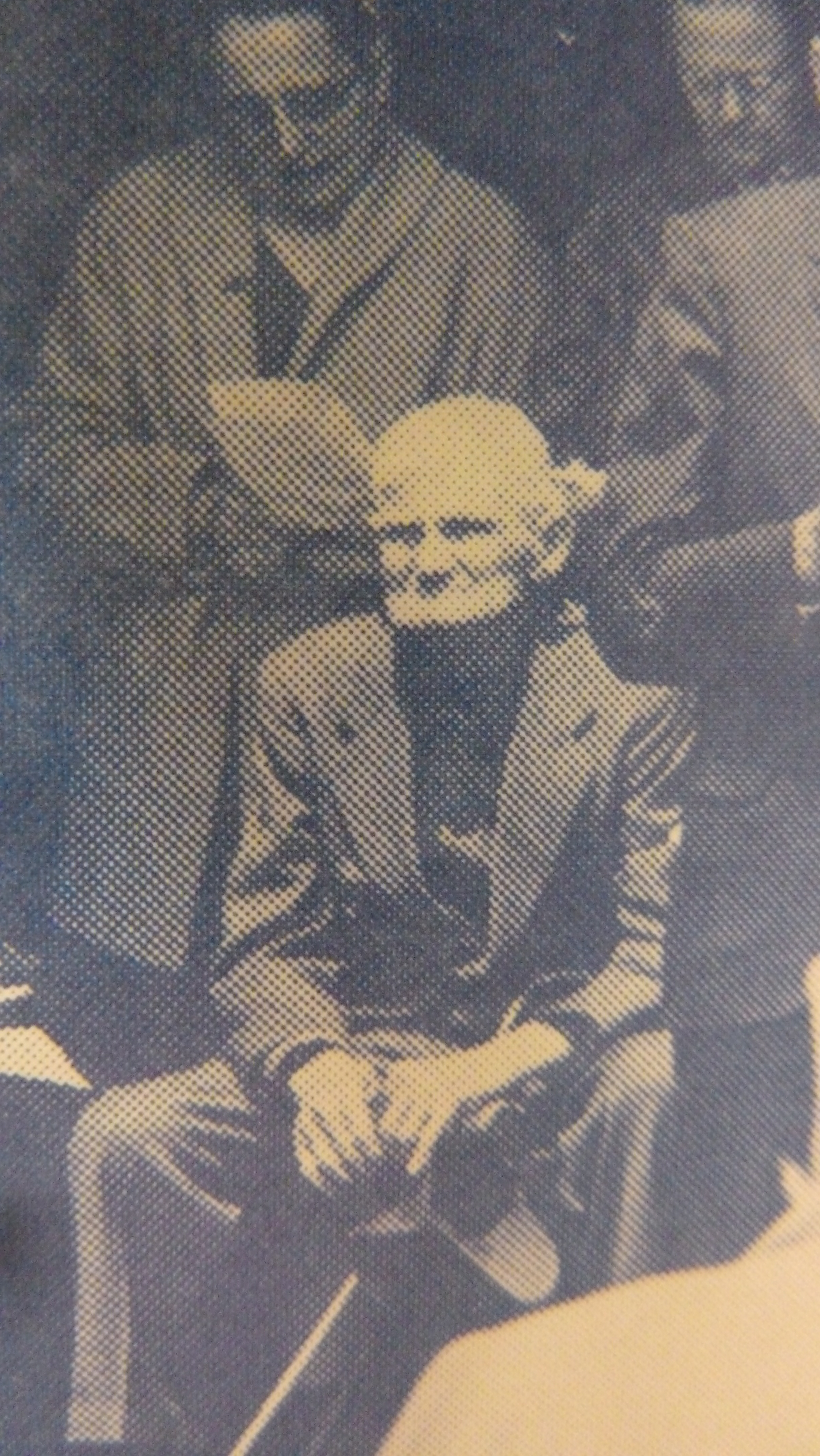
Grandpa Uriah M. Miller, his hat removed for the noon time brief dedication litany and prayer. I also love this photo of two women in the background, my best friend’s mother left, Sarah Mae Miller, and Martha Weldy, far right corner, co-owner of the farm dedicated to CROP.
But here in some of Dad’s own words, is how he went about enlisting sponsors for the farm, which is a good tactic anytime you are tasked with such a thing for a fund raiser, auction, or whatever.
Brief background if you didn’t read my earlier post: Dad’s own participation in CROP had started with him donating the proceeds of one acre to hunger efforts. But he thought, “One acre is such a small amount. Why don’t we try to plant a whole farm for CROP? I know where there’s a farm for rent. We could rent it and I’ll ask my neighbors to come and we’ll plant the whole farm for CROP.”
He set a date for the planting and rented the farm. He called in all his favors asking for donations from seed corn suppliers and fertilizer dealers he had patronized through the years. “We actually got more fertilizer than we needed!” he recalled.
Later in the spring Dad needed nitrogen for the corn [of course today that is considered environmentally questionable, at best, but in the 1960s, it was standard practice]. And nitrogen was very expensive.

So a banker friend coached Dad to contact a small bank in the county who did a lot of farm business to get them to make a small donation, then he should go to the next bigger bank asking for a bigger share, and so on until he got to the largest bank in town. Dad recalled how it went:
Dad: The city banker said, “We have no farm trade at all. But you say those other banks have all given?” Dad affirmed that the other bankers had antied up. The banker replied, “I’d be crazy if I wouldn’t give you the money.” So the biggest bank came through with the biggest check of all.
Dad said the next year, “Three other communities in Elkhart County, Indiana planted similar farms, and the following year, there were 30 Friendship Farms planted in the state and within 5 years, there were 155 farms. That idea kind of ran its course and now CROP walks are the in thing,” he told me in 1996. (I have not been able to verify his numbers but the point is the idea expanded greatly.)
Eventually, a whole delegation from Brazil visited the Friendship Acre Farm, with several of these guests staying in our home.
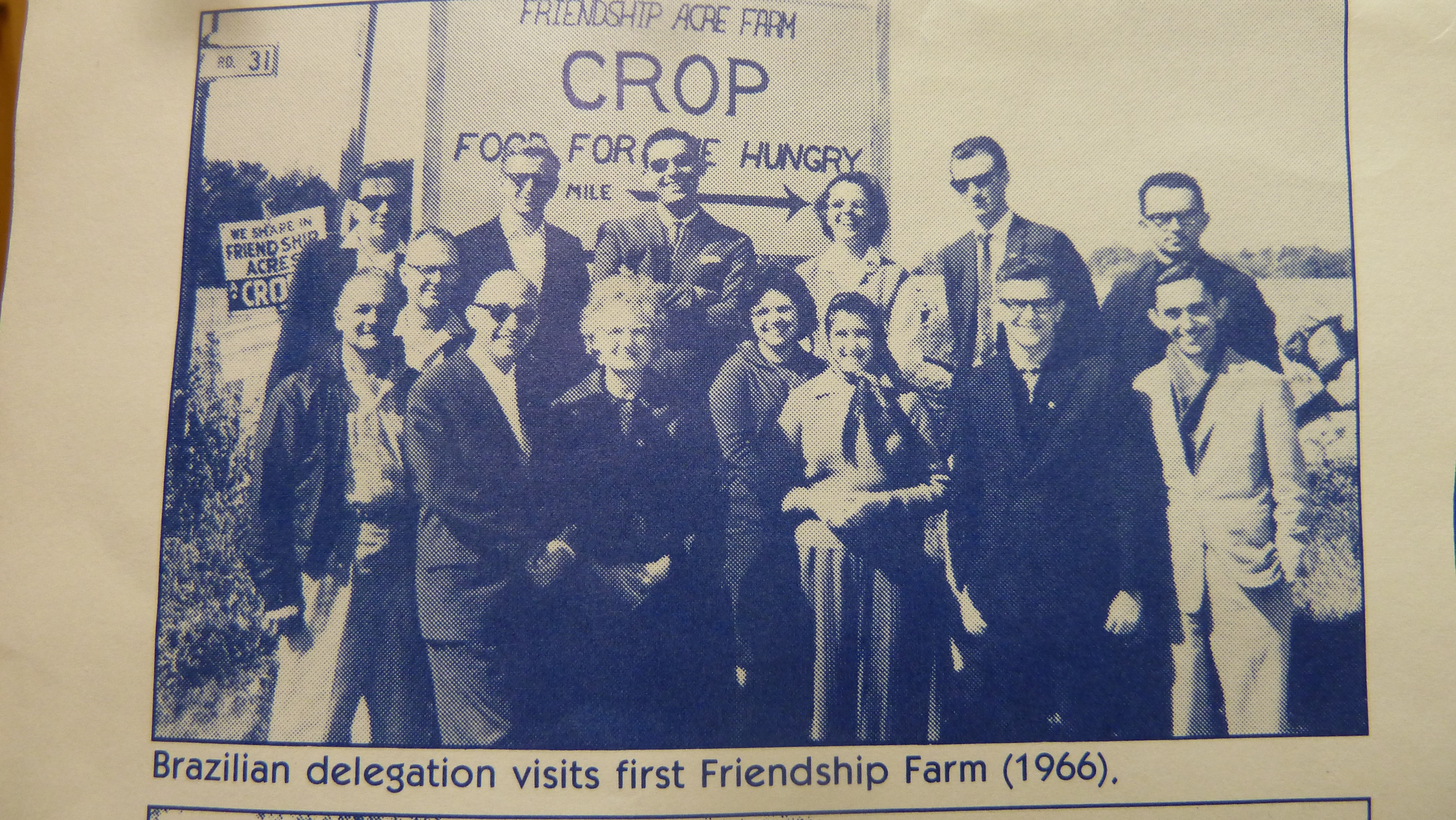
What can one man do for hunger or any other cause? (Start small, ask your neighbors to help, and get the big fish by enlisting smaller fish first.)
Oh and P.S. Mom says the magazine picture of my sister and dad ran on the front of Prairie Farmer, not Indiana Farmer. Consider me corrected.
Thank you Mom, Dad and Elva.
***
Planned five years in advance. A six-week camping trip. $20 dollars a day for a family of six to see almost everything that was on their bucket list “out west.”
Before a blast of winter buries all our memories of summer—yours and mine—I want to share and contrast the trip my growing up family took out west the summer of 1964, with my husband’s and my trip this summer (accompanied by his brother, well-documented ad nauseum here).
I share this now because any time is a great time to begin to plan a “big trip.” Maybe even make an announcement as a Christmas surprise for the family.
My three siblings and I all recall how Daddy first started dreaming of taking us out west. It was about 1959. He said we would take six weeks and he wanted us to visit many of the national parks, especially Glacier National Park, where he worked as a conscientious objector during World War II. We would camp and also stay with friends and family we knew out west, including some of his old “service” buddies. And Dad being dad, we would visit Mennonite mission work and churches. No vacation from church when this family traveled, no sir-ee Bob. We informally called it “Mennoniting your way” before there was ever an organized method of doing this.
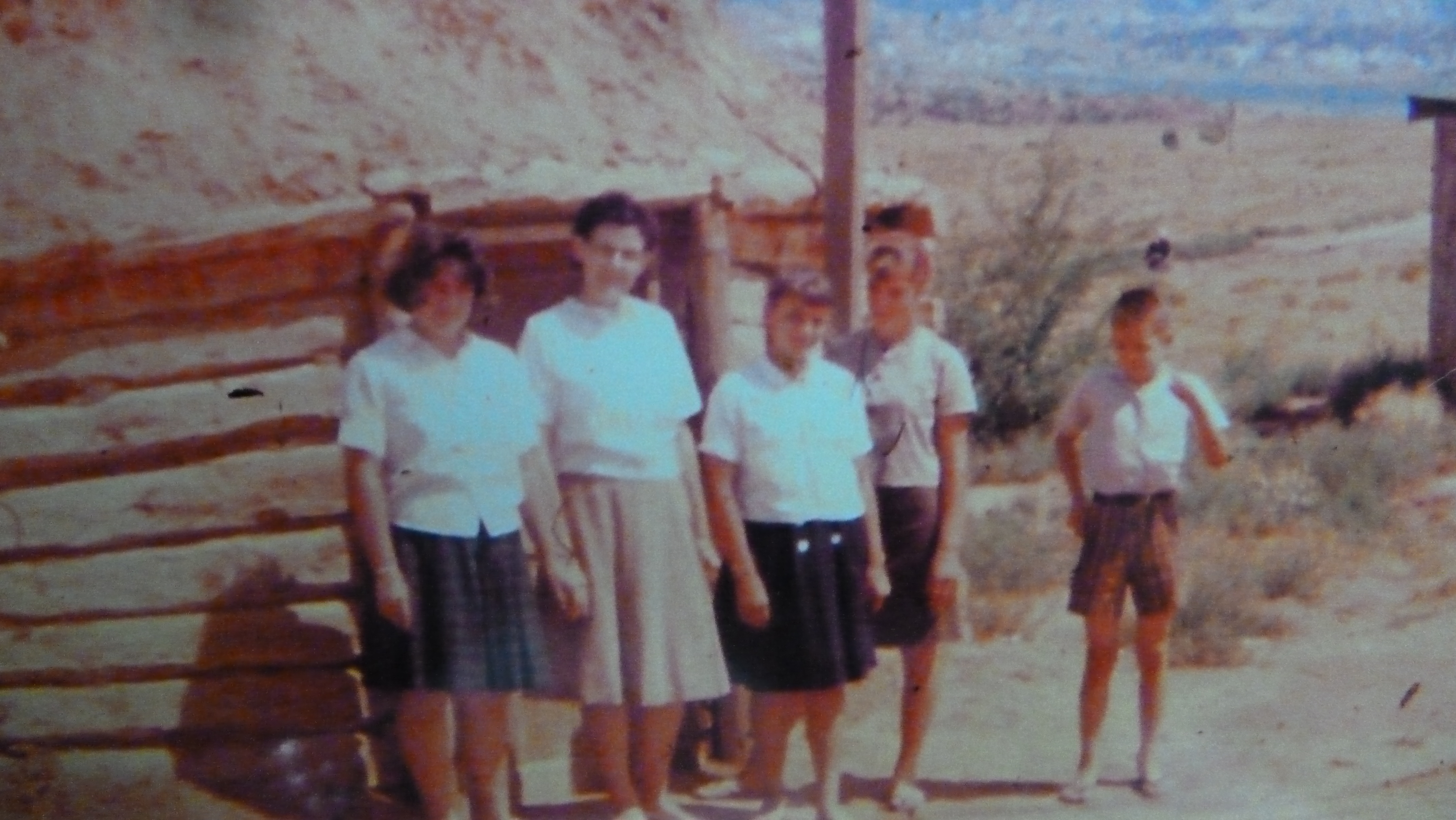 Our family visiting the Navajo reservation, 1964 where there was the Black Mountain Mennonite Church. We wore skirts that day.
But us kids couldn’t fathom five years into the future. It was too long to wait! We would be “too old.” We wouldn’t have any fun. We wanted to go sooner.
But Dad and Mom talked each of us into start saving a part of our allowance or egg gathering money so that we would have our own money to spend on the trip. That helped give us buy in, I recognize now, and also helped us understand how a longer period of time to save would give us more money to spend—and more fun for us.
We were an ordinary farm family of modest means and this trip was big. One of the things I loved about Dad was him getting out the atlas on a blustery Indiana winter night and mapping out routes: “What do you think of taking the southern route first across the country, hit Oklahoma, see our friends the Troyers, head up to Colorado and stay at Rocky Mountain Mennonite Camp a few days, see Pike’s Peak, head down through Mesa Verde National Park.
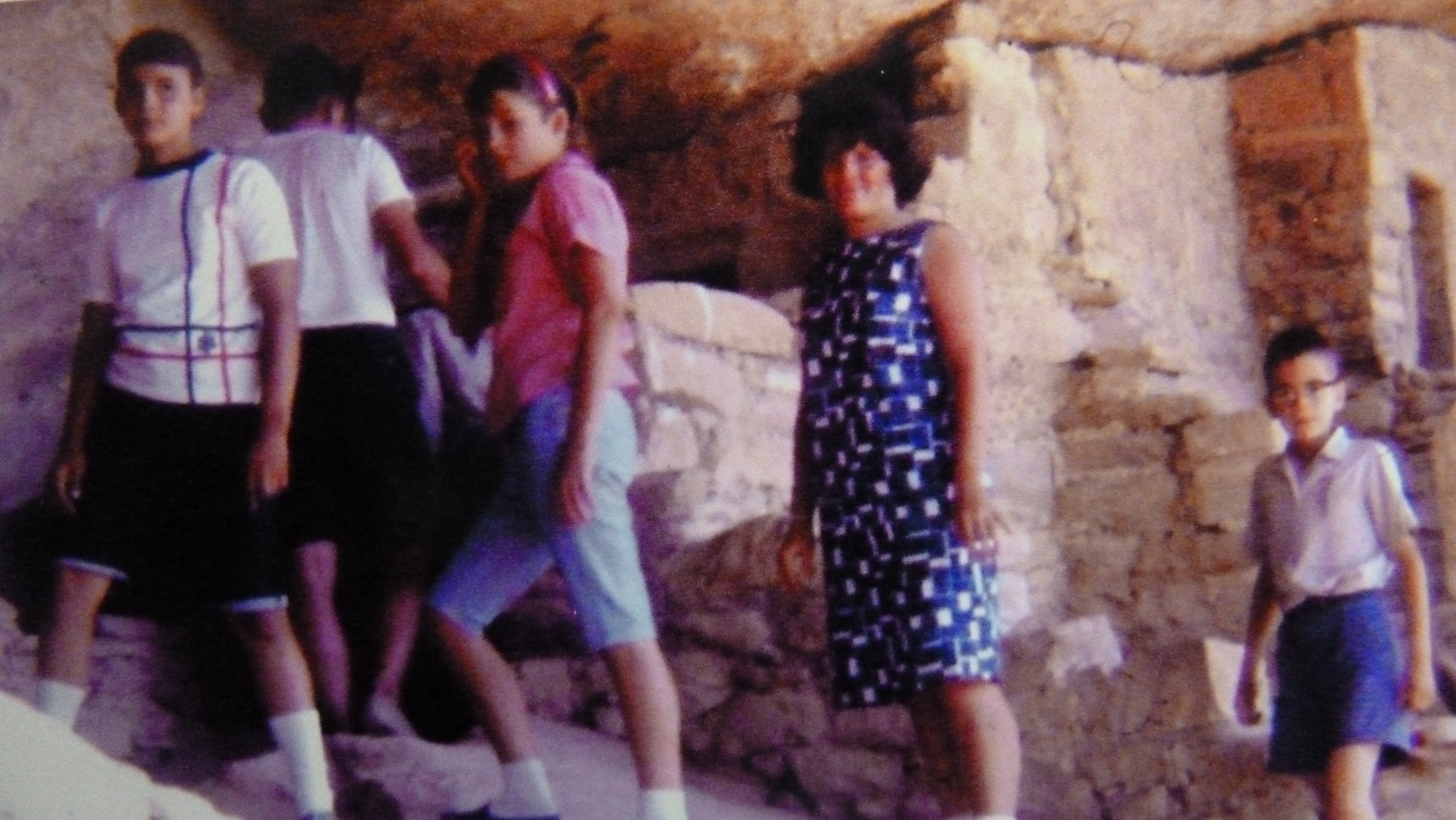 My siblings and I exploring Mesa Verde: left, Pert, me, Nancy, brother Terry. We were thrilled to be allowed to wear “shorts” on this trip.
Dad promised we would see Grand Canyon, then cross the desert at night to Bakersfield, California, go down to Los Angles and visit Knotts Berry Farm that Grandpa and Grandma Miller got such a big kick out of (as 80 year olds, my grandparents flew to California to visit a granddaughter’s family for the trip of their lifetime, especially since Grandpa had traveled in a covered wagon as a 3 month old baby, but that’s another story). And so on.
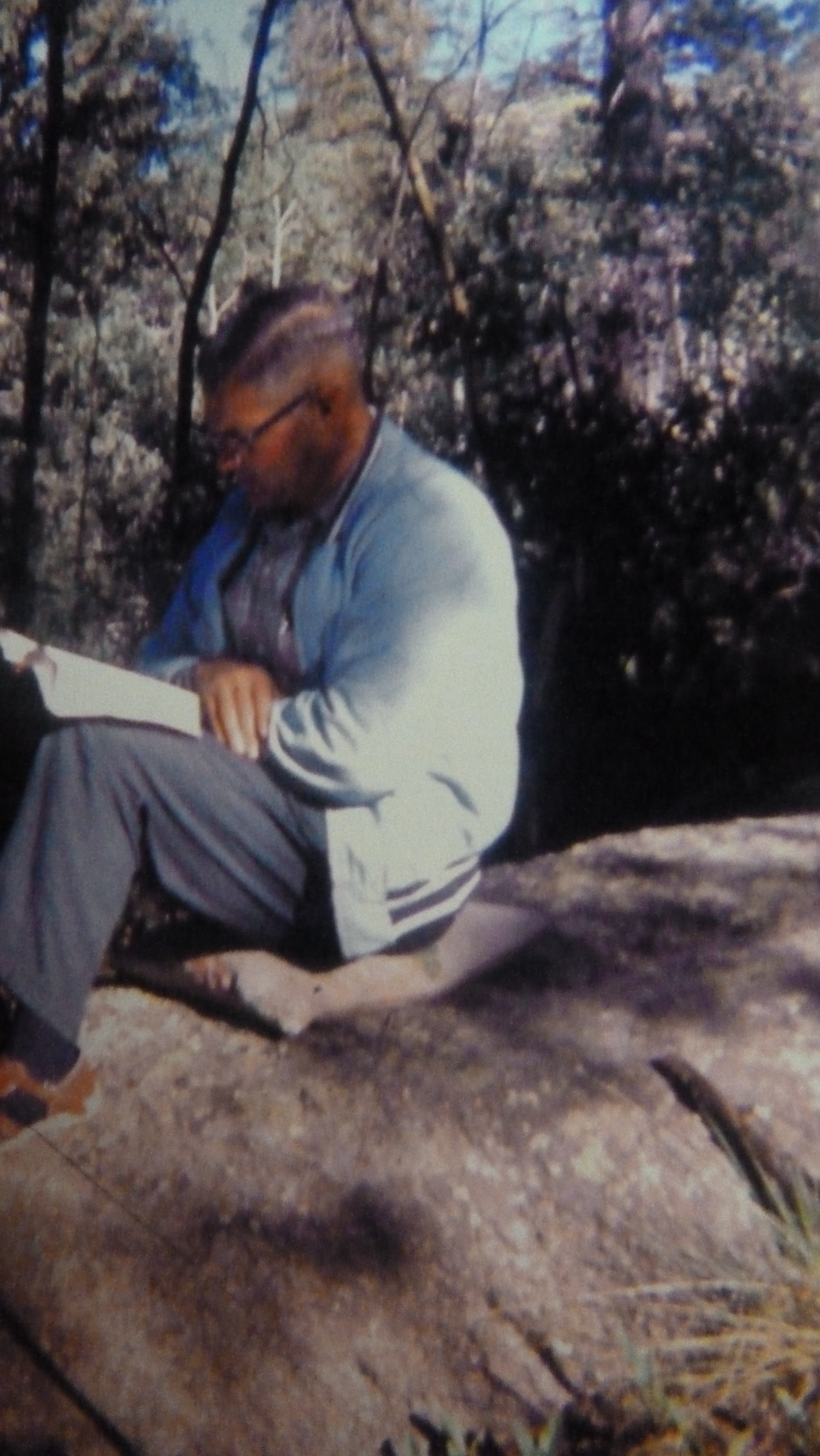
Dad enjoying his morning Bible reading (note pillow) at Rocky Mountain Mennonite Camp.
Can we go to Disneyland? we asked. Can we see movie stars? The first real modern day theme park opened in Anaheim, Calif. in 1955. By the time of our trip, 1964, we had only owned a television one year, but we already knew about Disney and the magic of Hollywood.
Dad allowed that yes, maybe we could go to Disneyland. If we saved our pennies. I think the admission charge was something like $5 each.
Disneyland!!! We could hardly believe our luck. We were farm kids. We would be the talk of our friends. We would be like movie stars ourselves.
Maybe Disneyland was worth waiting five years. At about one year out, I took it upon myself to begin writing to the National Parks on our list and each city that Dad and Mom had mapped out that we’d hit, to get information on campgrounds, fees, and local attractions. I don’t have to remind you there was no Internet to help with all that.
But it was almost as time consuming an exercise for me to do all that via Internet this past spring as I planned and plotted with my husband and brother-in-law for our 2013 expedition: find motels, make reservations, find the best bargain in plane tickets and a car rental that wouldn’t be cost prohibitive as a one way rental (we planned to pick up our car in Phoenix and return it in San Francisco).
In 1964, my sister Nancy was the photographer for our trip and she mostly took slides so what follows are a few photos that she transferred to prints. We also made a big mistake and left her camera in the back window of a hot car one day, not only ruining the camera, but a complete roll of pictures. Eventually she got a new camera on the trip.
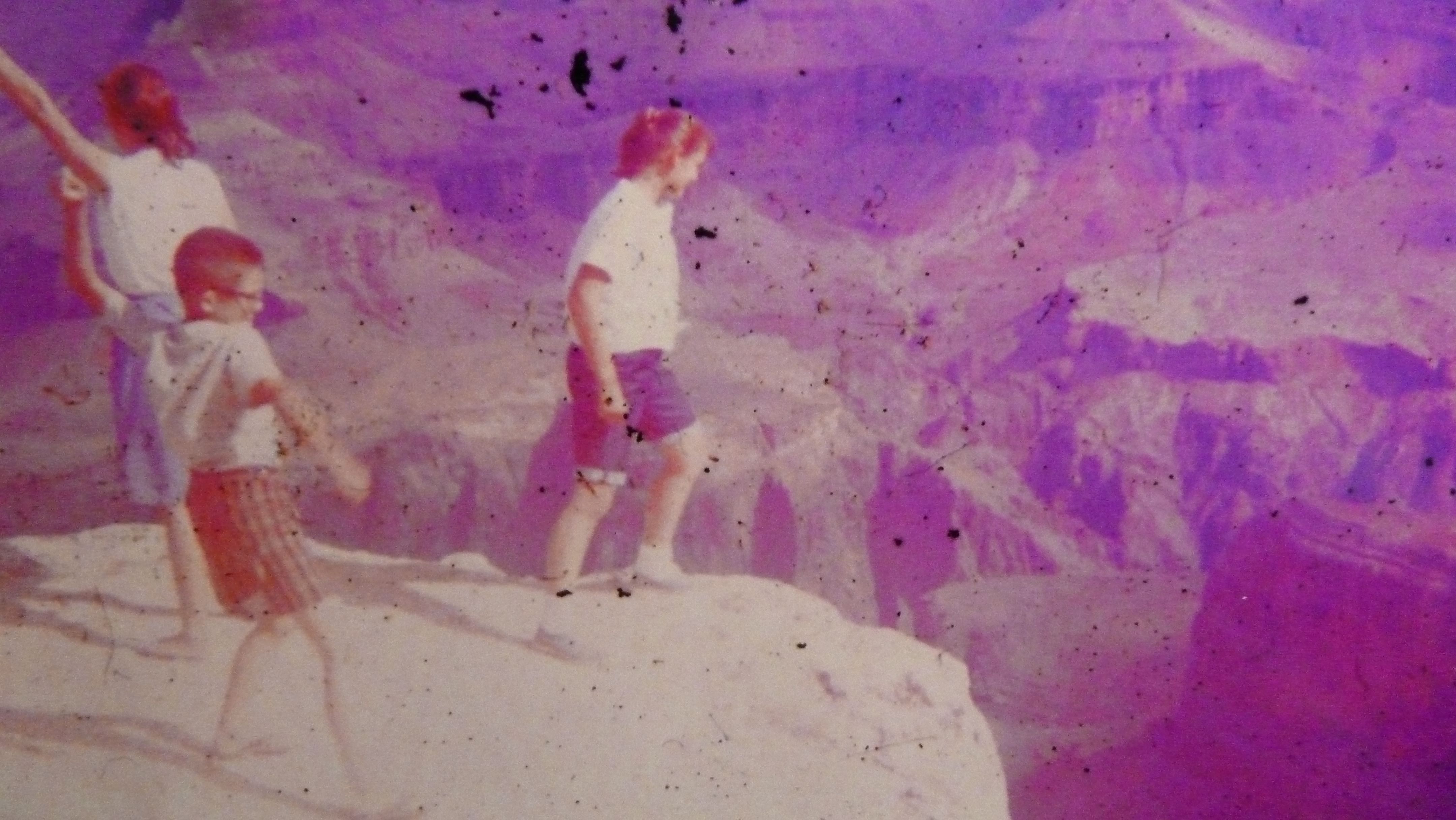
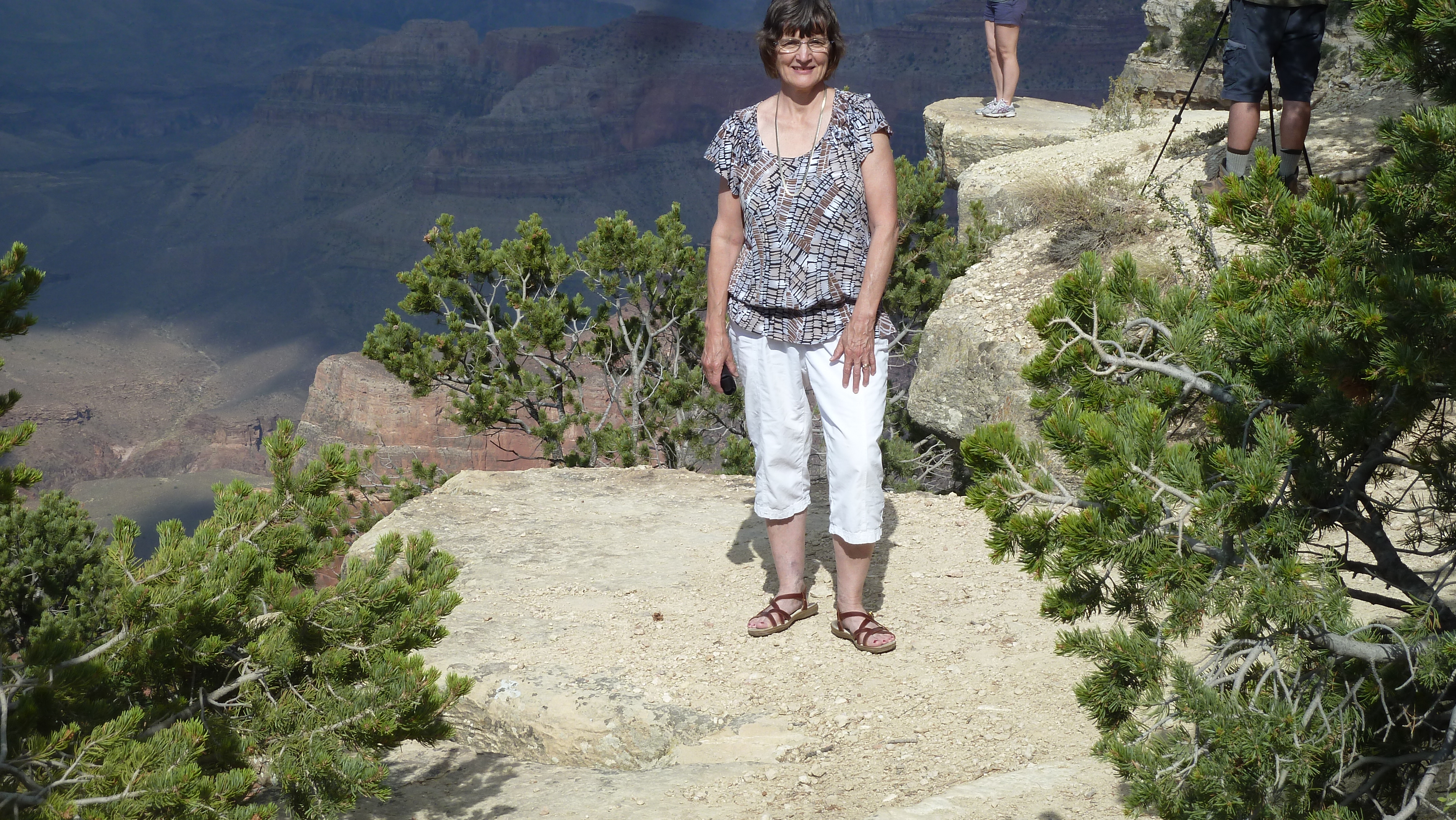
Top: One of the photos ruined in the camera meltdown: throwing rocks into Grand Canyon. I’m on far left. Bottom me at overlook at GrandCanyon, 2013.
And back to the budget? When we got home Dad figured we had indeed averaged spending $20 a day including a $2 a day rental fee for our camper (which barely slept 5, my brother soon decided he would do better in the back seat of the car or our pup tent), gas, food (many times just a can of soup or a package of hotdogs heated up for lunch in the camper at a roadside stop), and attractions. Once a week we got to stay in a motel (only later did I really figure out why Mom and Dad needed a motel once a week, with their own room) and maybe once or twice a week had a fast food or restaurant meal, and plenty of nights camping on the lawn of friends.
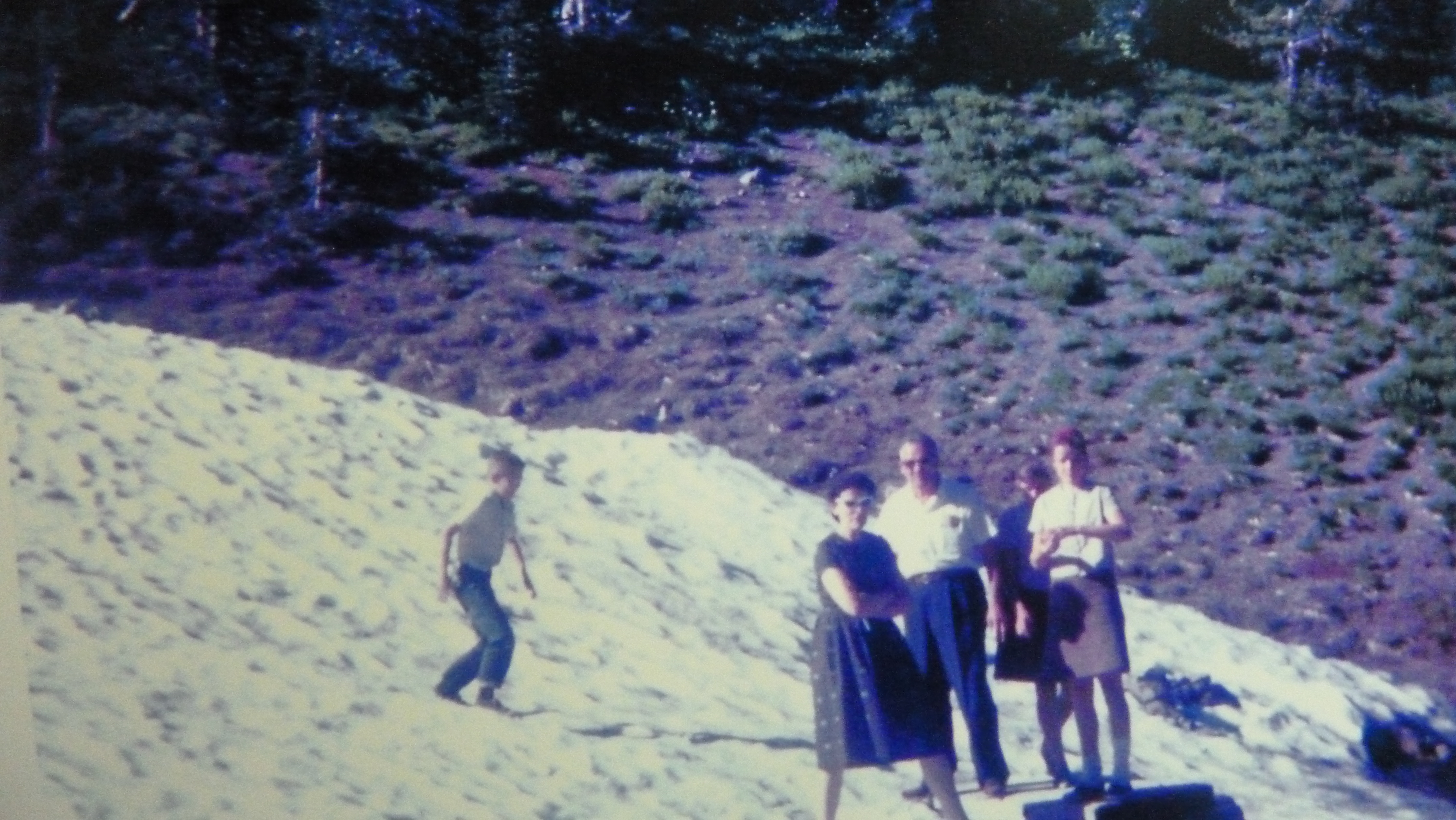 Snow, somewhere in the Rockies.
And no, we were not too old to enjoy the trip! Even at that time, we probably loved the variety of nature sites we visited (Yosemite, Sequoia, Redwood, Mt. Hood, Mt. Rainer, Crater Lake, Yellowstone, and Mt. Rushmore) even more than Disneyland. As kids, we especially liked having our own money, which we had dutifully saved, to spend as we liked—carefully budgeting so we’d have enough for the whole trip (not blowing it the first day or two).
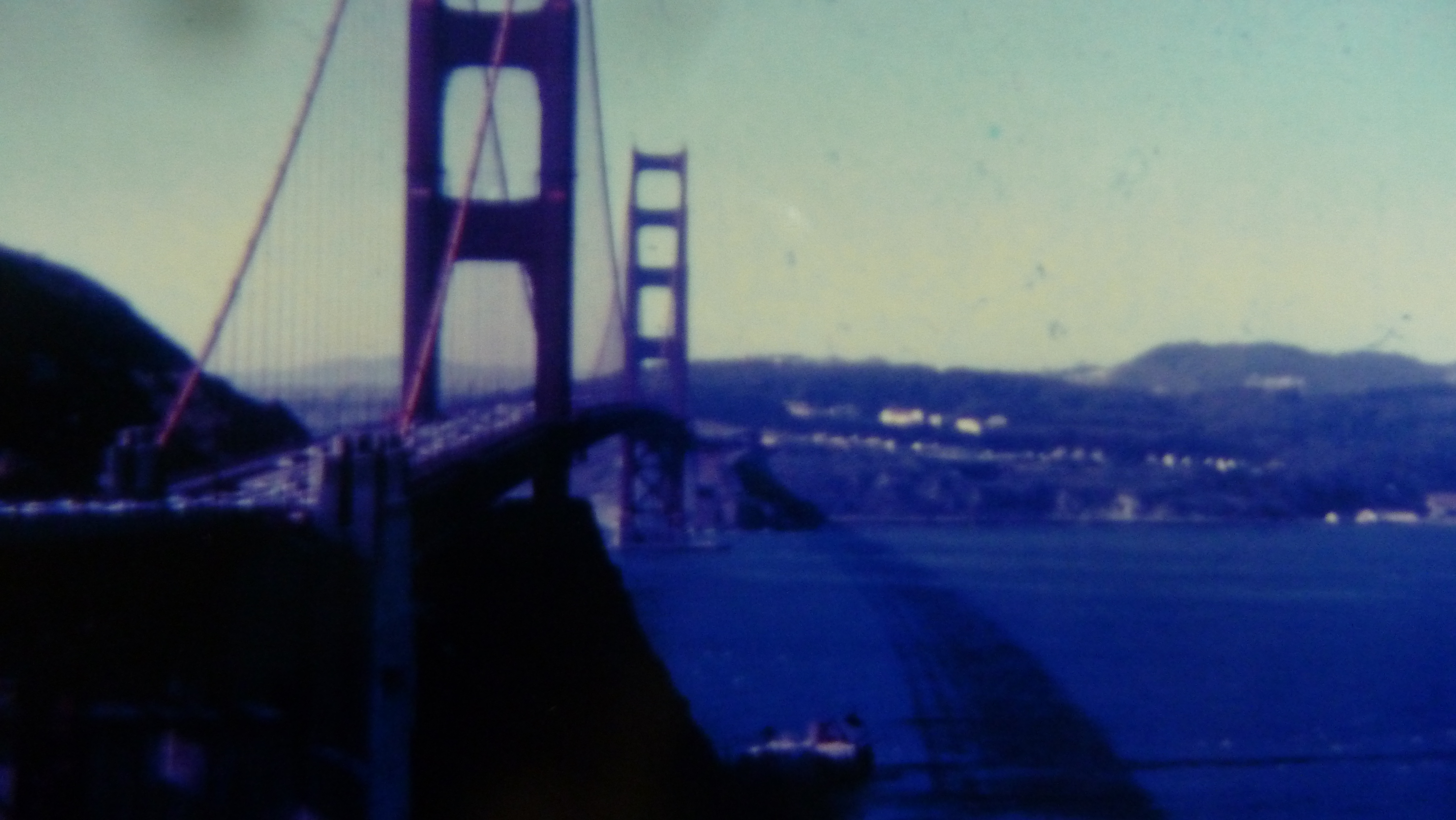

Top: Golden Gate Bridge 1964. Bottom: Golden Gate, 2013.
And no, it was not all harmonious. By the end of the trip, we were all homesick and anxious to “head for home” as Daddy put it, hurrying through the last states so anxious to see our friends, pets and home. Is that why we go on great trips—to make us enjoy home even more?
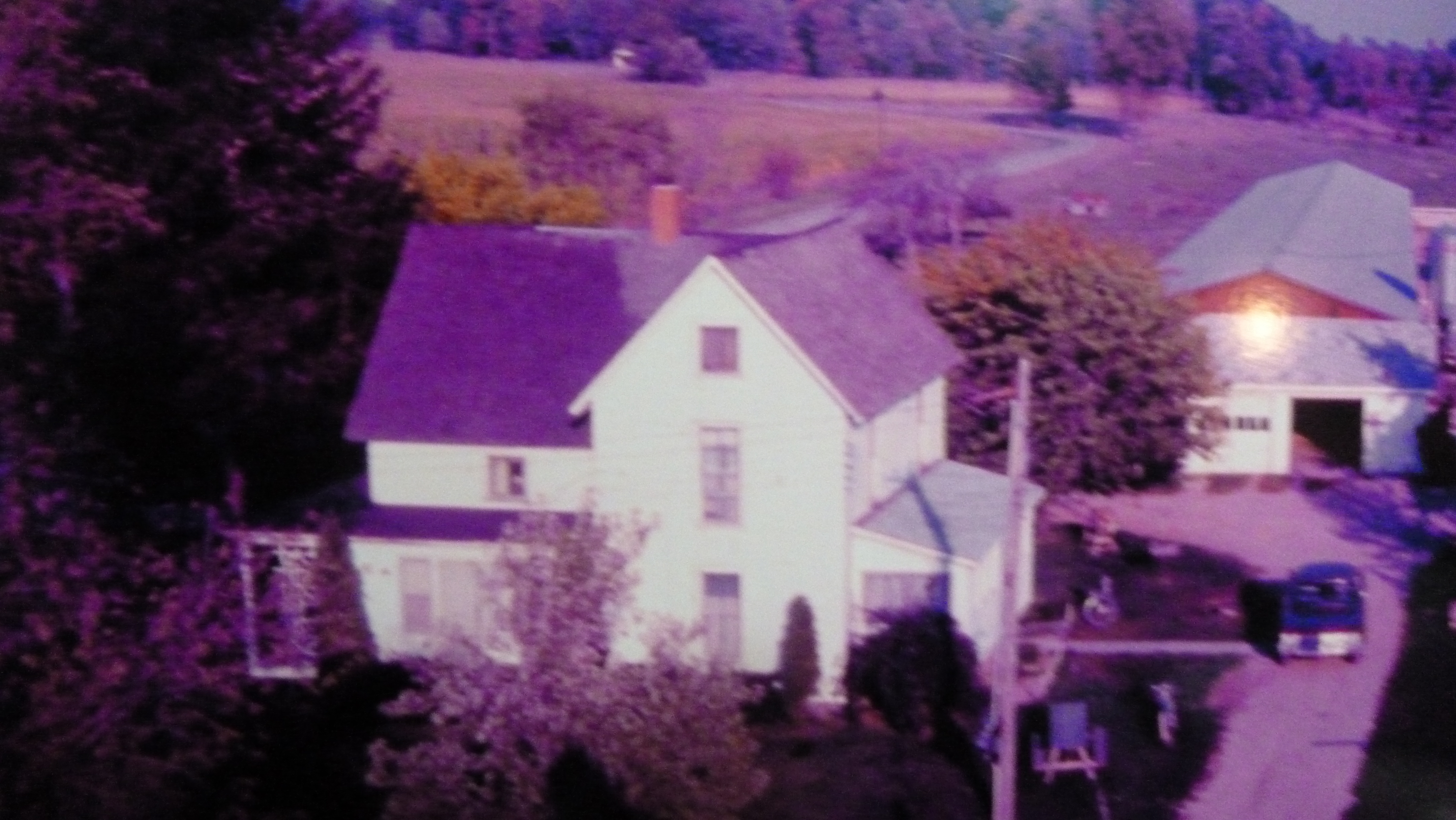
Home sweet home in Indiana, our farm near Middlebury, circa 1967.
For my parents, traveling together as a family was as much a part of our faith walk and training as going to church. I will be forever grateful.
***
Do you enjoy travel? Did you have a big trip as a family? Or do you take the approach of “if you like home so much, why not just stay there and enjoy that on vacation?”
(Thank you, Nancy, for the use of your photos!)

How do you make stuffed green peppers? Are stuffed peppers one of those dishes that people either hate or love? Like liver?
I haven’t decided.
But we had a green pepper bonanza this year down on the Davis farm—after two years of barely squeaking out a crop of three or four peppers. Period. I kid you not. Out of our usual six plants. Something was wrong.
So we doubled our planting—tried 12 plants of two different varieties, (shame on me for not writing the types down), and asked the two greenhouses we bought them from what they would do to get a better yield. BOTH of them, conservative Mennonite women (which is irrelevant but interesting, and they likely wouldn’t lie) recommended using Epsom salt diluted at the rate of one tablespoon per gallon of water, applied to the plants about three times in monthly intervals during the early growing season. Said our garden likely lacked lime. So we tried it.
Best. Yield. Ever. And I wouldn’t lie. My husband has taken a pepper almost every day in his lunch for the last 3-4 months. We love them raw and ate them almost every night for dinner. We’ve given scores away. There are probably 50-75 tiny ones out there right now that will not develop because of frost.
I don’t really can or freeze them (except for a bag or two of chopped pepper to use in a few dishes) but my really dirty secret is this: I’m not a big fan of dishes such as stuffed green peppers. I cannot lie.
But I needed a dish for our church’s homecoming last weekend and I know that many people are big fans so I did some research and found this recipe.

There was a huge line for our homecoming potluck and by the time I went through the line, the 12 peppers were all gone except for a few dribbles in the pan. I didn’t cry.
Here is how I adapted a recipe from AllRecipes.com for a large dish to serve 12:
12 peppers
Salt to taste
2 lb. ground beef
1 cup chopped onion
Salt and pepper to taste
Garlic clove or garlic powder, to your taste
1 quart or 15 oz. can of tomatoes
2 tsp. Worcestershire sauce
1 cup rice
1 cup water
2 cups cheddar cheese
1 can tomato soup
Prepare green peppers by slicing off top, removing insides and seeds. If bottoms are uneven, slice them just enough that green pepper shells will sit up in pan, a neat trick I learned over here.

Bring salted water to boil; cook peppers for 5 minutes. Lightly sprinkle salt inside each pepper; set aside in 13 by 9 inch greased baking dish.
Sauté beef, onion, chopped garlic or powder. Drain fat. Add salt and pepper.
Stir in tomatoes, uncooked rice, water, and Worcestershire sauce.
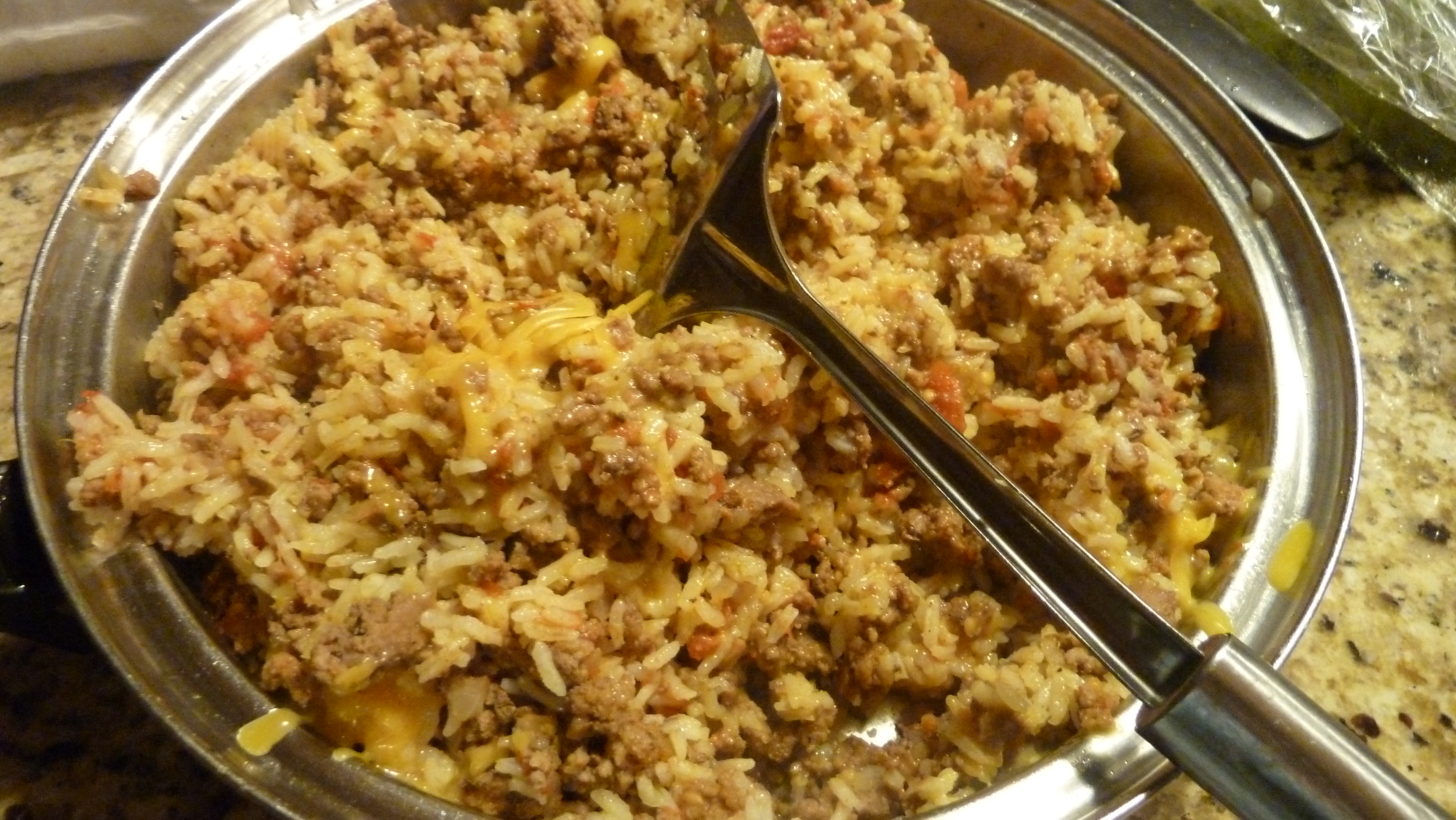
Cover and simmer until rice is tender, about 30 minutes. Remove from hear. Stir in part of cheese, reserving some to sprinkle on top of stuffed peppers.

Preheat oven to 350 degrees.
Stuff each pepper, using ice cream scoop or spoon. Place in baking dish. In separate bowl, combine tomato soup with about ½ can of water and stir until “soup” is gravy consistency. Pour over peppers, making sure some gets down into each pepper. It is okay to have excess spill over to bottom of baking dish. Cover tops with remaining cheese.
Bake 25-35 minutes until cheese is bubbly and browned.
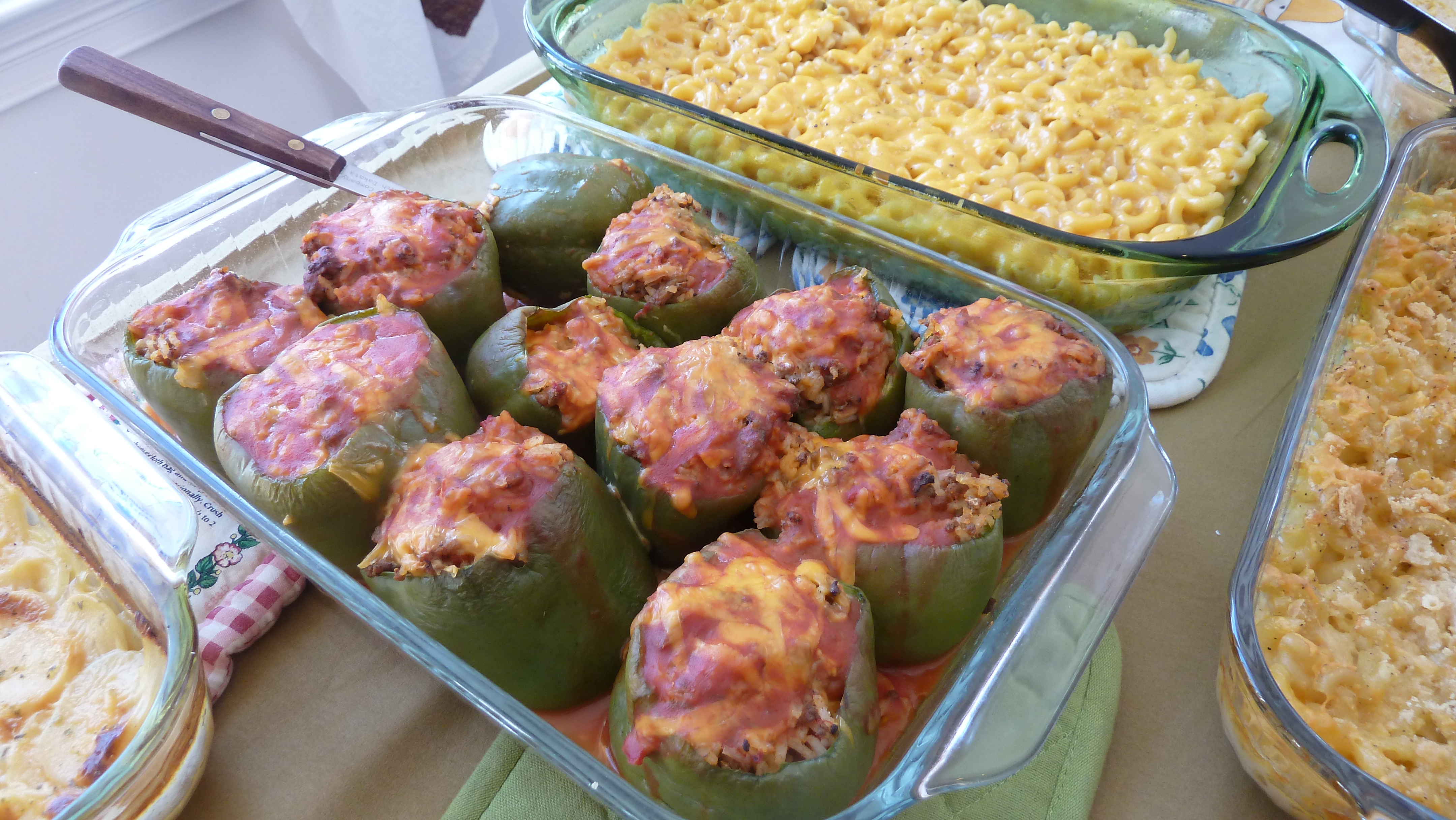
Note: this recipe made too much rice/ground beef/onion/cheese/tomato stuffing; you will have more or less leftover depending on the size of peppers you use. Or reduce the amount of ground beef used. I sent a bonus one quart sized-casserole dish of leftover stuffing home with my daughter. They didn’t cry.
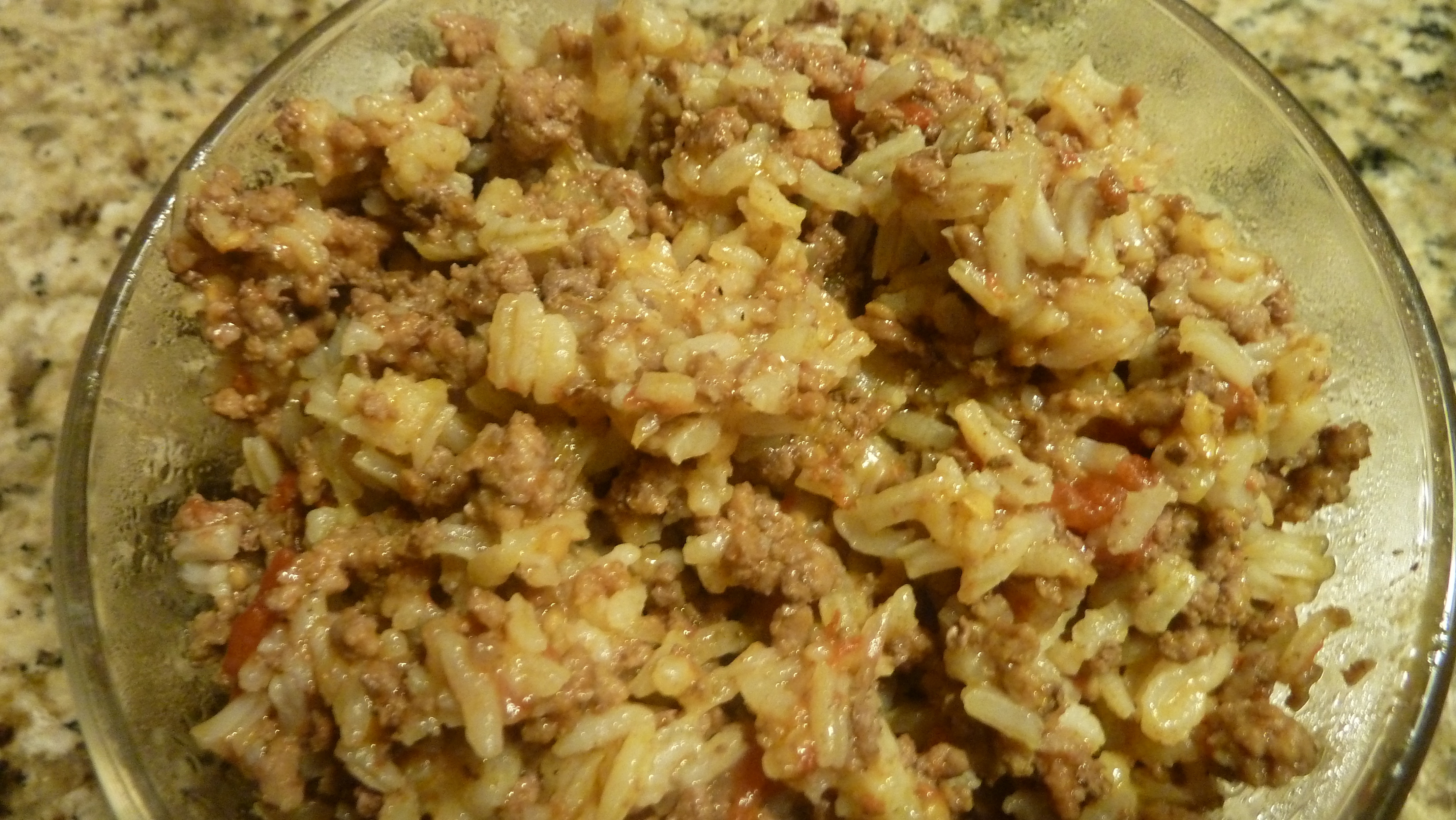
Bonus dish – about 1 quart sized dish of extra stuffing.
P.S. I had planned to eat a stuffed pepper, but didn’t get to. I loved the insides, but am less a fan of the baked pepper shells. Another daughter recommended I try a taco type filling next time. We’ll see!
***
Do you have a favorite stuffed green pepper recipe? I’d love to hear about it. Here’s a challenge: post a recipe (or link) so good I’ll just have to try it. I’ll do a new blog post if you send me one you think I’ll like! I still have peppers to use up.
Give it your best shot. Convince me. Can you teach an old dog (me) a new like?
Or, respond to this:
What is a new dish you have made in the last year?
I also learned new dishes as a result of the cookbook/inspirational I wrote with food editors Jodi Nisly Hertzler and Carmen Wyse a couple years ago, Whatever Happened to Dinner? Check it out here.

When you get to my age, there is something richly introspective about a church’s homecoming commemoration that makes one think about life, death, God and the future.
And deeply emotional. When I saw one woman begin to dab at her eyes before the service had barely begun, I panicked, thinking, oh my, this is going to be a two or three tissue service and did I even have one in my purse?
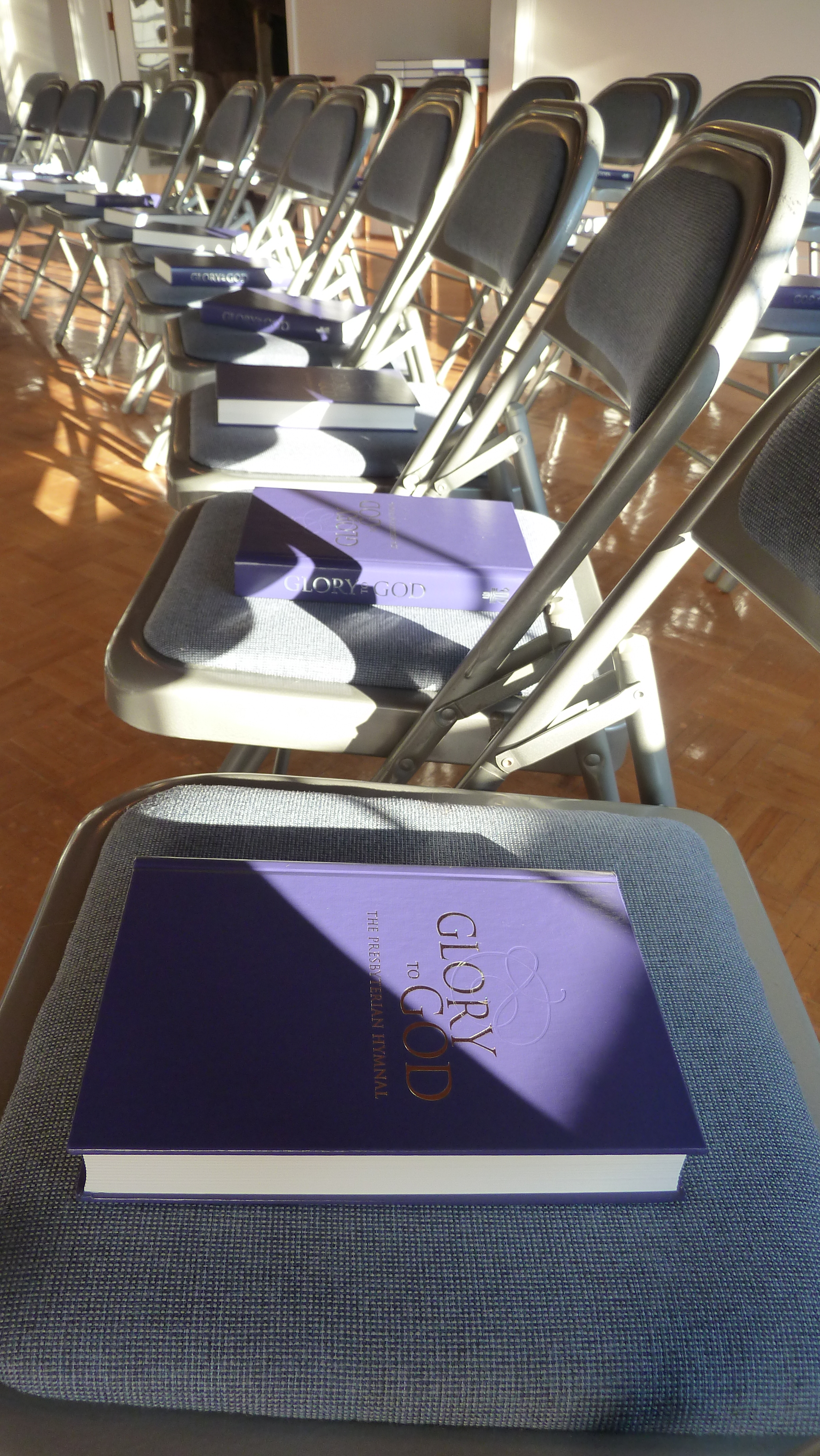 Trinity’s anniversary gift to itself: the brand new Presbyterian hymnal,
Glory to God graced every chair in the sanctuary.
Not to worry. Tissue in hand, I opted not to sing the emotion-filled verses of “Thank you, for giving me the morning” and “Be Not Afraid,” during the opening singalong, picked as representative of music loved during the eras of our three different pastors. Why didn’t I sing outloud? I did not want to fill up my tissue before the service had even begun.
 Trinity’s three pastors: Dan Grandstaff, Ann Held, Don Allen. They served all 50 years, different eras. Note their first names use only four letters of the alphabet.
At one point I spied Becca and George and Ginger on the other side of the congregation and it was like a time warp to have these former members back in “their” chairs. (No pews or benches for our congregation which has always valued the flexibility of a “sanctuary” where the night before, it was turned into a square dance hall.)
 Hoeing down with a pulled together blue grass band and professional caller. (Happy to see my work colleague Beth Nealon and her husband Dave far right adding their chords.)
It is an open-beamed room where yoga devotees love the parquet floor, with full-length windows on each side, and a garden filling the view to the north. Where currently, contra-dancing lines up most Monday nights. Where at-risk kids are trained in bugle blowing and drumming, in hopes they might have something other than the street and drugs to hang on to as they go through adolescence.) But I digress.
It is all of this tradition and more that most of us connected to Trinity Presbyterian Church in Harrisonburg, Va., call this old house “home” for myriad reasons: some children of the church recall it as a stopping off place walking home from the local elementary school; a kitchen where my family frequently downed pizza when Dad mowed the lawn on Friday nights; a place where I, and two of my daughters (and many many others) have dressed for our weddings;
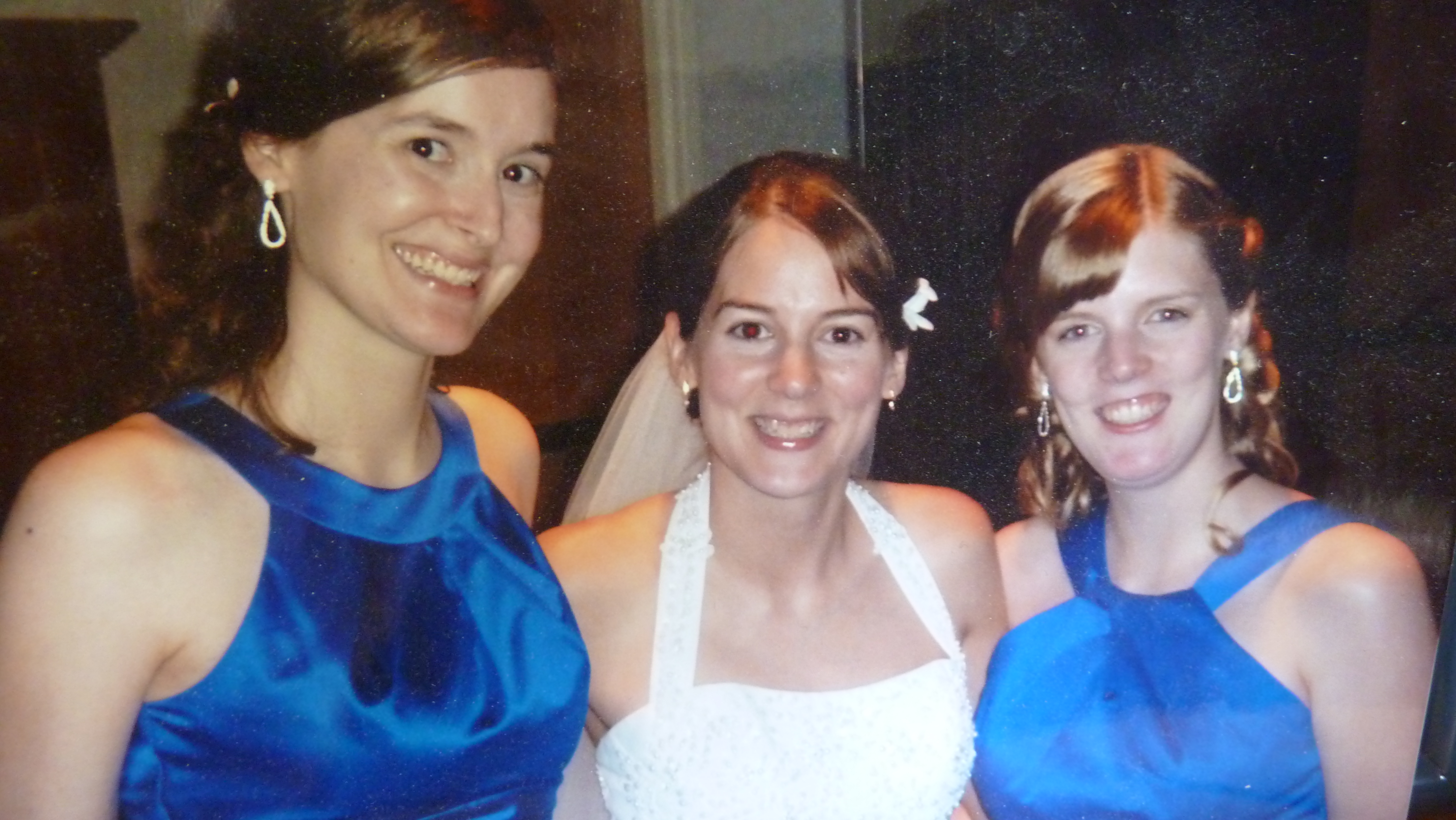
where all three of our daughters were baptized and later confirmed.


Top, our daughter Tanya and pastor Dan. Middle, daughter Michelle and interim pastor Tempe Earl Fussel. Bottom, Doreen as our babe in arms, with sisters Michelle and Tanya, probably Doreen’s first Easter.
And now my oldest daughter’s baby kicks (at eight months along) as we absorb the nearly two hour homecoming service filled with music and folks sharing memories and highlights of 50 years of serving God in this community–and far beyond. To close, there is a spontaneous conga-type train threading through the crowded room to the glorious strains of “Lord of the Dance.”
My husband and I have been part of Trinity since our early dating days the summer of 1975. We chose this church as neutral turf for a born and bred Lutheran (him) and Mennonite (me). One of my college roommates attended Trinity as a student and I knew others from Eastern Mennonite University who did: Evie Krieder (who was also one of my friends way back in high school), Reta Halterman Finger, a professor there. My husband-to-be also knew a family from the church, the Churchmans (yes, really), who were dear to him growing up. Thus we both agreed we would try this church when we were looking for a place to go on Sundays as young adults (it never seemed right not going anywhere). We finally joined in 1980 when our first child was on the way—the same child whose own baby-in-waiting was giving her kicks during the homecoming service.
Not only is this church family (with squabbles, hurt feelings, overflowing toilets at inopportune times, like when “company’s” here for the homecoming), but also the building was literally home for several families since it was built in 1825, and a man who lived in the house as a child (the last family to occupy it) was actually present for the homecoming picnic.

Trinity gathers in an antebellum columned home; this photo from the 60s.
What a rich, full circle. I very much remember the 20th anniversary in 1983 when we had a toddler and a baby. By 1988, when we celebrated the 25th anniversary, our family was complete, at least as far as children was concerned.
So my daughter’s reflections this day during the “Time with the Children” remembering friendships and tree climbing and Halloween parties and advent fairs and children’s choir and playing knuckle ball were told full of emotion, joy and love.


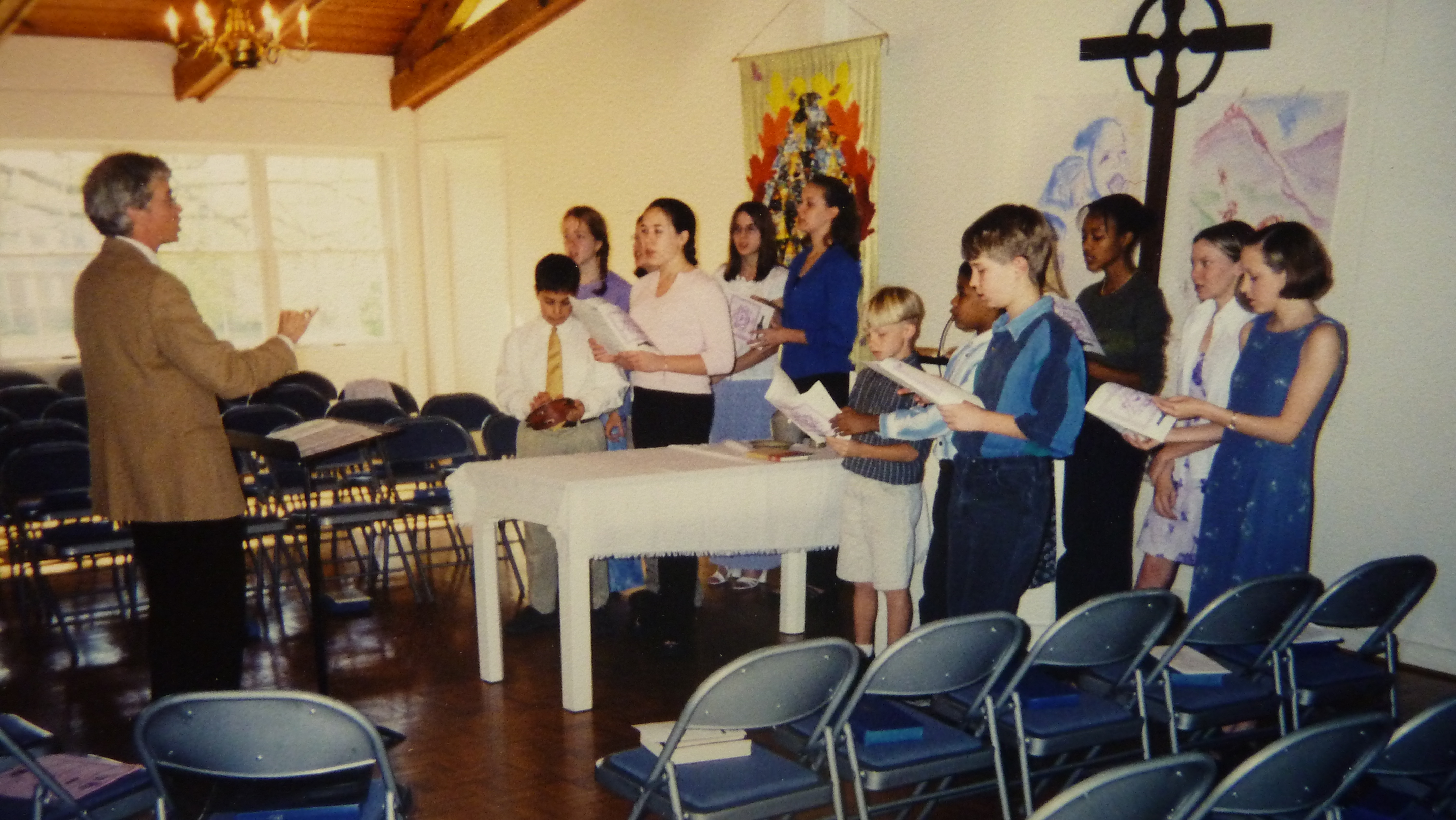
And when a time capsule is buried to be opened in 2038 (oh my goodness, that sounds so far in the future, so “1984” but of course it really isn’t) one can’t help but think, who in this circle will still be here? Which of us will have our ashes already buried near this very spot? In my mind I flit through so many dearly loved friends and members who have already crossed the divide between earth and eternity just in recent years: Laura, John, Jane, Emily, Ken, Sherry, Richard, Ken, John, Julianne, Olivia, Jim, Dorothy, Tom, Alisa, Catherine, Jean, Daisy, Jim, Flossie, Lill, Rai, Don, Connie, and I’ve probably missed many other very special folks.
Why shouldn’t a church service, and especially a homecoming celebration stir these thoughts? We mustn’t shy away from them. No wonder a few tears were shed. For what is faith but one long preparation for a grand homecoming harmony with kindred souls—yes—in the sweet bye and bye, with our sweet Lord and Savior.
*****
Homecoming Photo Gallery
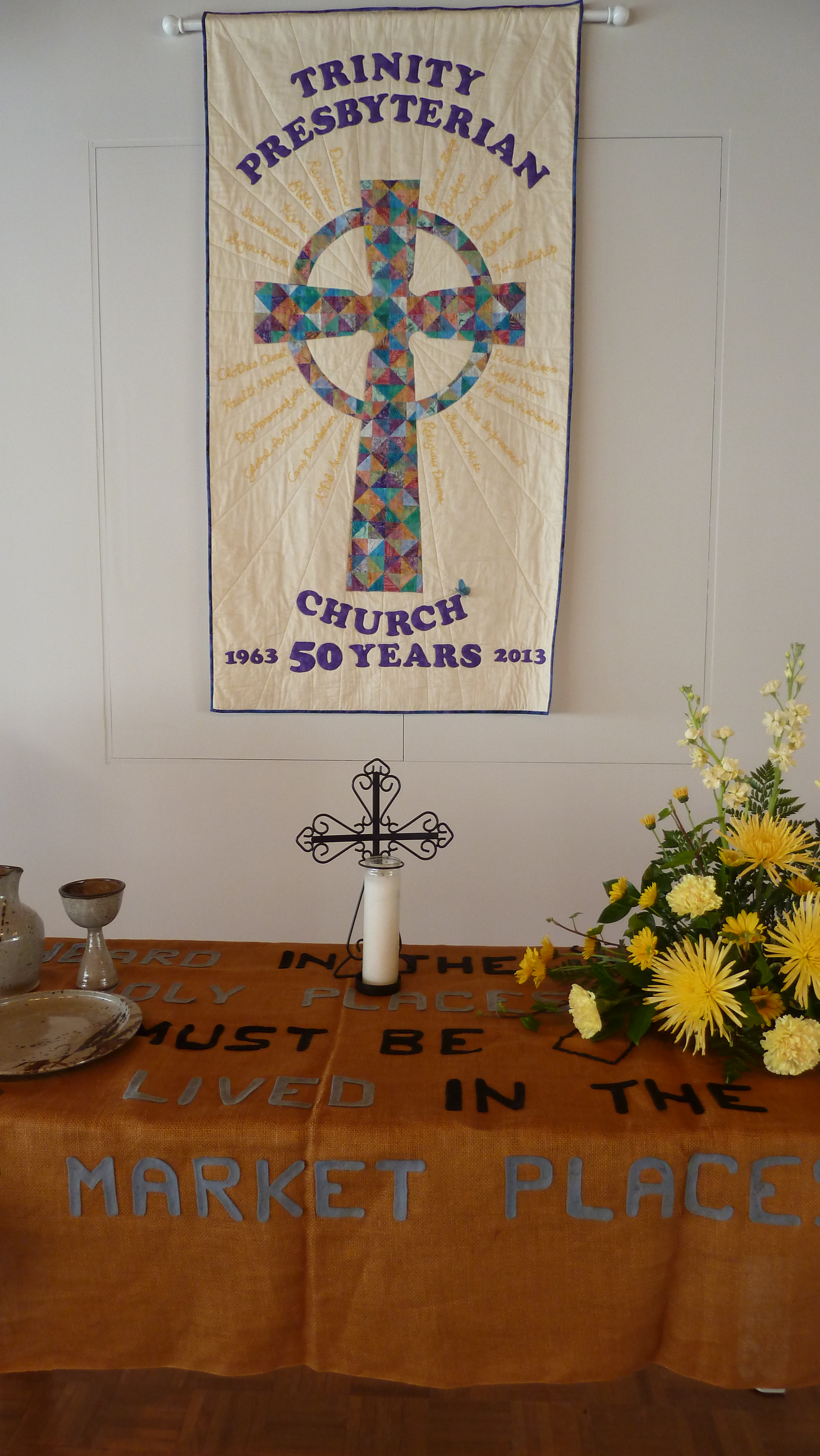
New banner made by lifelong friends Susan, Ginny and Page. Altar cloth is one of Trinity’s first ever banners of burlap, for the Marketplace House Church which ran a coffee house near Court Square in Harrisonburg for many years.
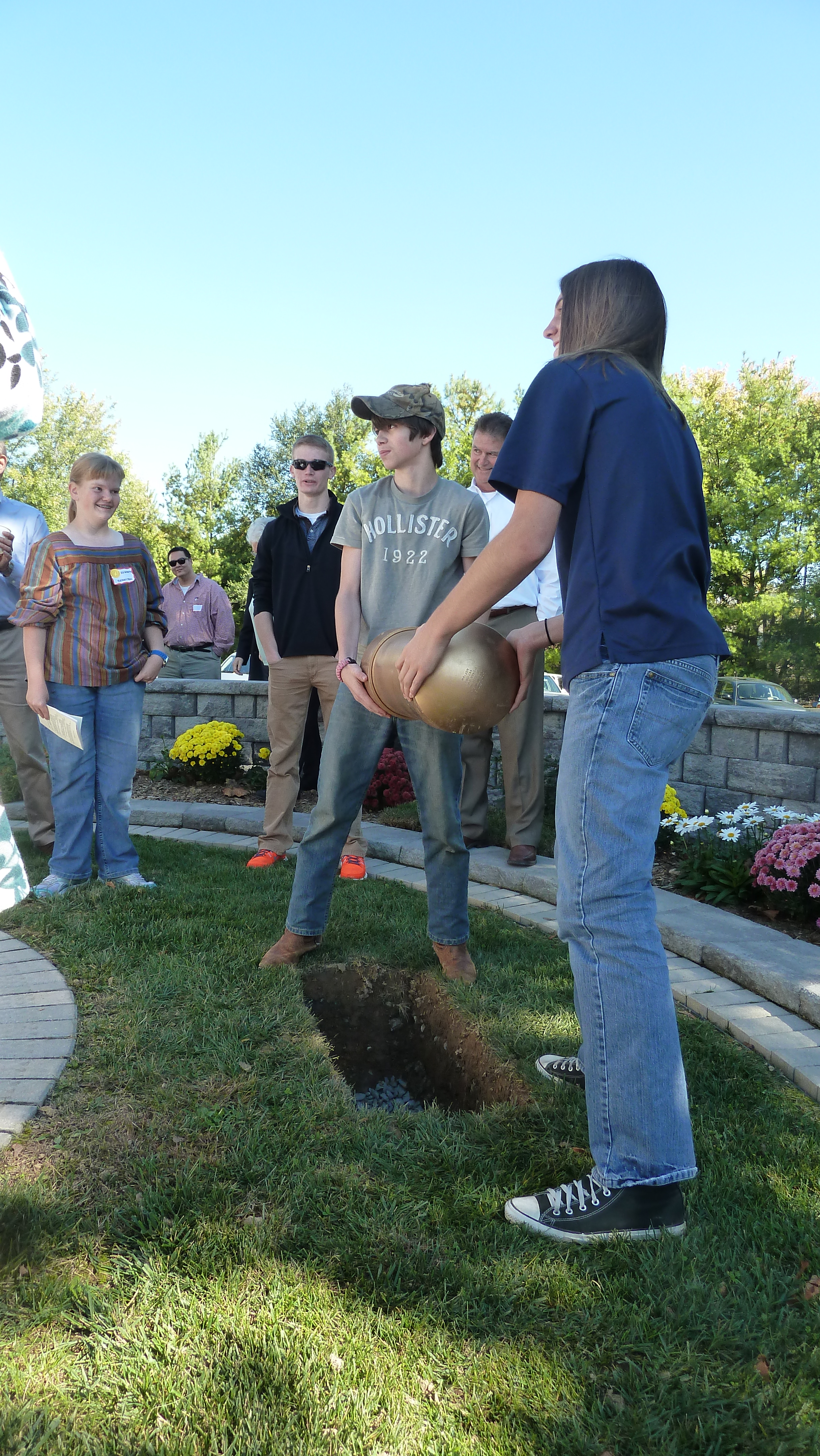
Ben and Luke help “plant” a time capsule.
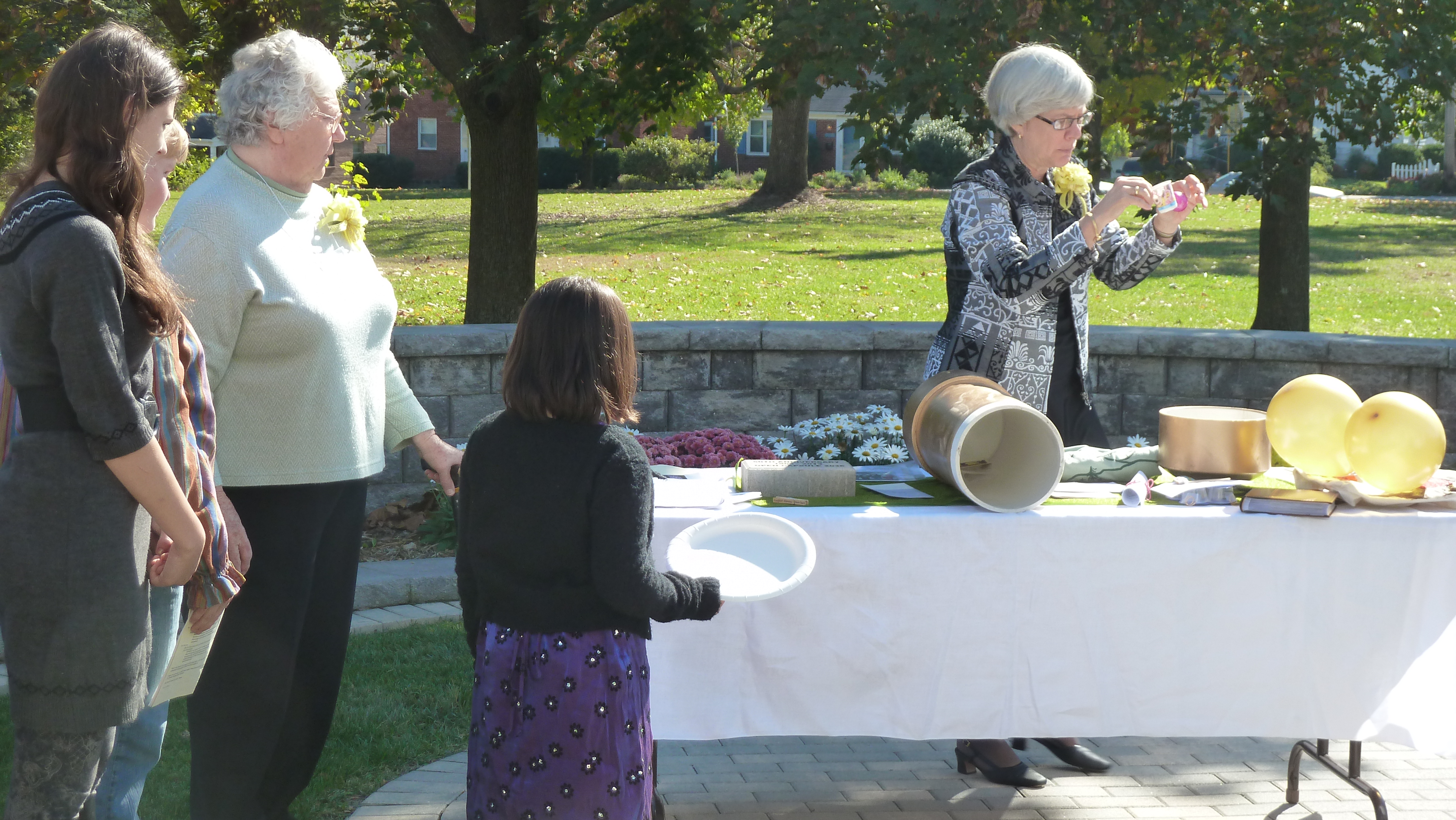
Pastor Ann, far right, and Betty Allen, (in green) tell about some of the items in the time capsule.

Singing grace before the Homecoming picnic meal.

- Former pastor Dan, center, with son Peter, right, and my daughter, Michelle, left. These two plus Thomas (see next pic) spent many hours in the nursery together.

Sister and brother Catherine and Thomas Barber, now both married and shown with their own children, were some of the first friends for my children at church.

The next generation helps crank the ice cream freezers.
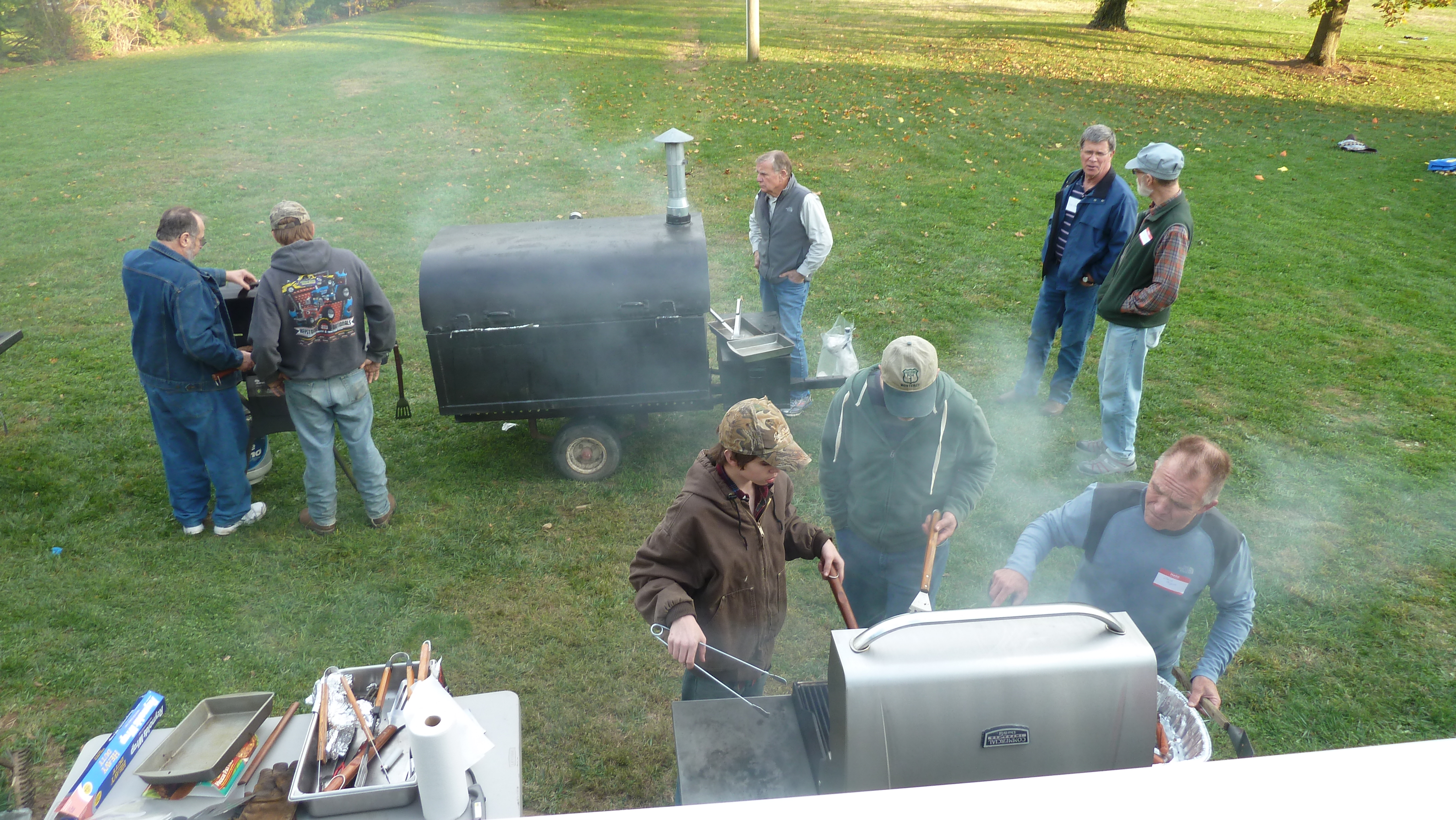
How many Presbyterian men does it take to grill a few hamburgers, veggie burgers and hot dogs these days?
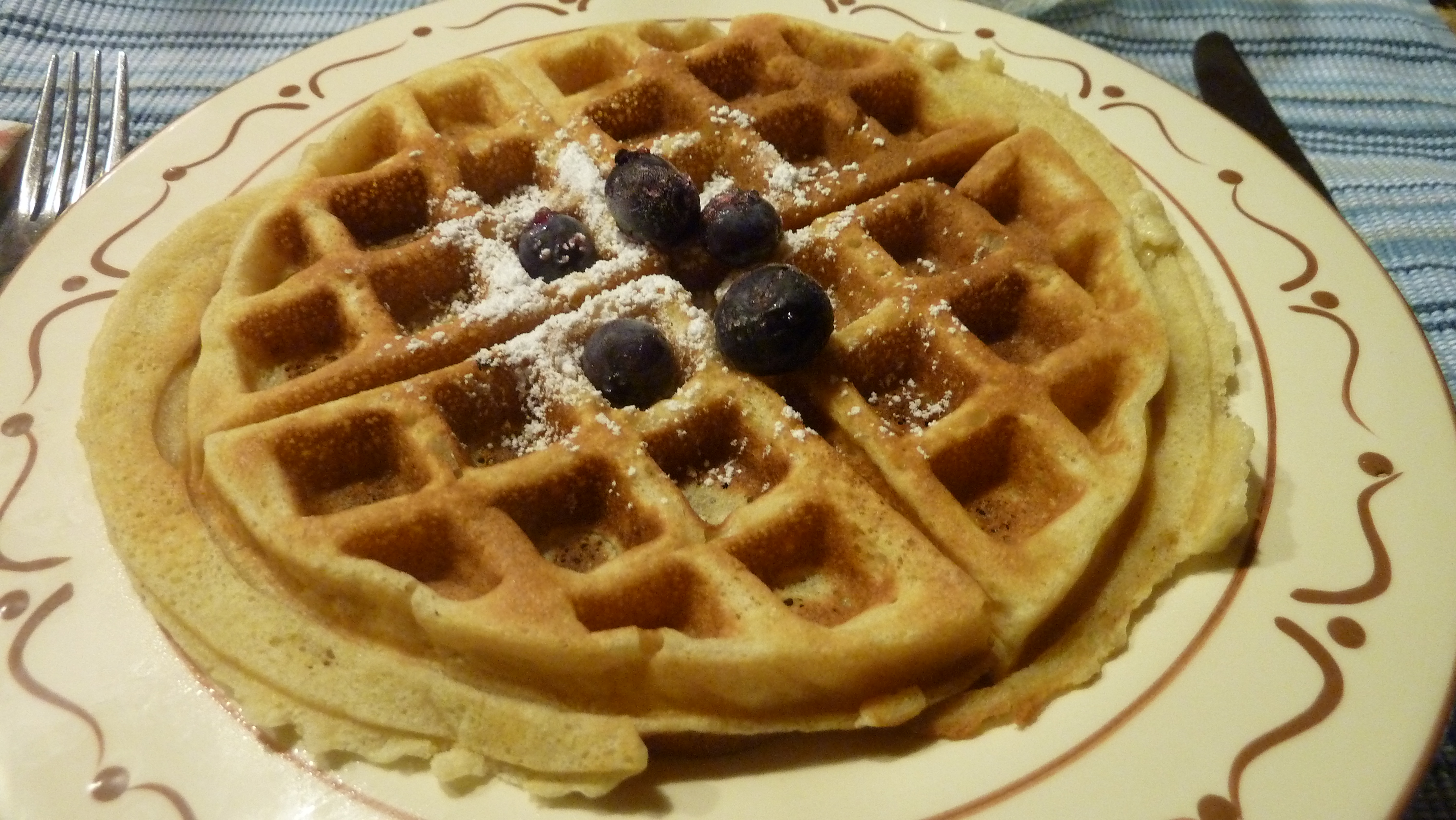
(Top left, my normal waffles from Belgian waffle maker. Lower right, waffles from my daughter’s waffle maker.)
Several years ago for Christmas one of my daughters got me a waffle maker (which is another story I’ll tell sometime).
I had never particularly wanted one in my old kitchen because “where would I put it?” was always my question of the day when looking at some gadgety single-use kitchen item. Like who needs a grilled cheese maker, really.
But after we moved to a new home in 2007, I hinted I might enjoy a waffle maker now that I had more room in our kitchen.
The recipe book that came with the waffle maker had this basic recipe—that looked way complicated at first. Who whips egg whites anymore, when you can just whip out a pancake mix and have (sort of) waffles in your waffle maker?

I do. Now. Especially when the kids and sons-in-law are home for the weekend or a holiday. It is our special treat, and we usually eat until they are gone (the recipe makes probably 9 or 10 rounds of waffles–that’s 4 little sections in one round, and sometimes we share rounds).
This is an awesome recipe and well worth the time to beat the whites and sift the flour. They come out airy and fluffy and thick—when you use a Belgian type “flip” waffle maker, as shown here.
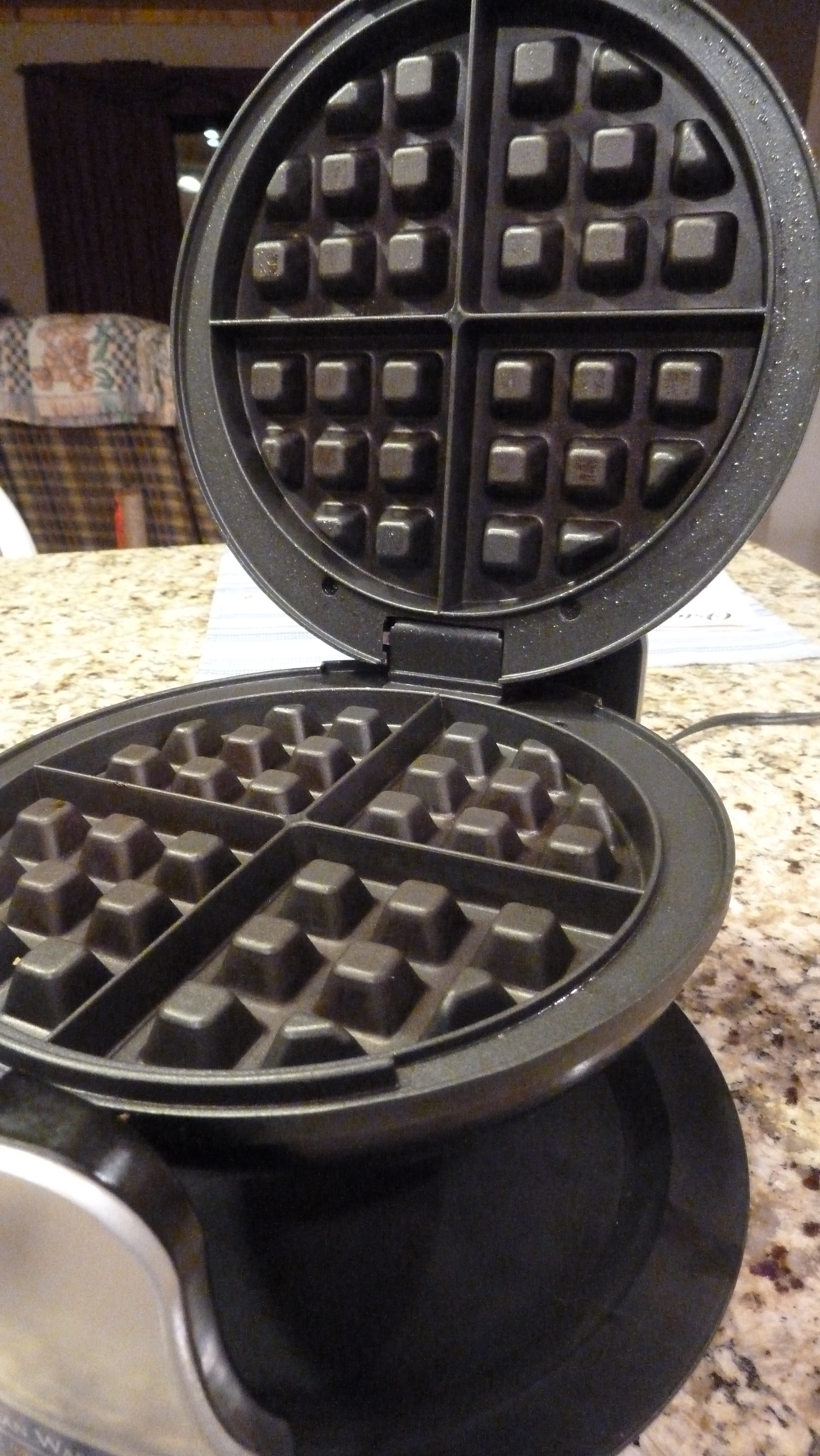
For this batch, I was at my daughter’s house helping with Sam and they just had the thin waffle maker kind, and the waffles were still great, just not as tall or airy.

(Check out this telling why 1/2 cup of cornstarch, and separating the egg whites and yolks, makes the important difference in outcome.)

Waffles – adapted from Oster Waffle Maker recipe book
1 ½ cups flour
½ cup cornstarch
1 Table. baking powder
1 tea. salt
½ cup (1 stick) unsalted butter melted
4 large eggs, separated**
2 Table. sugar
1 3/4 cup milk
1/2 tsp. vanilla
In large bowl, sift or whisk together flour, cornstarch, baking powder, and salt to blend thoroughly; set aside.
In mixer bowl, beat egg whites until soft peaks form.

(Soft peaks, add sugar now.)
Add sugar; continue beating until stiff peaks form; set aside.
(This is stiff.)
Separately, whisk together egg yolks, milk, and vanilla (not pictured).

Take your flour mixture (shown above) …

… and blend flour mixture with egg/milk/vanilla mixture until dry ingredients are moistened (there should still be small lumps; do not over mix).
Stir in melted butter.
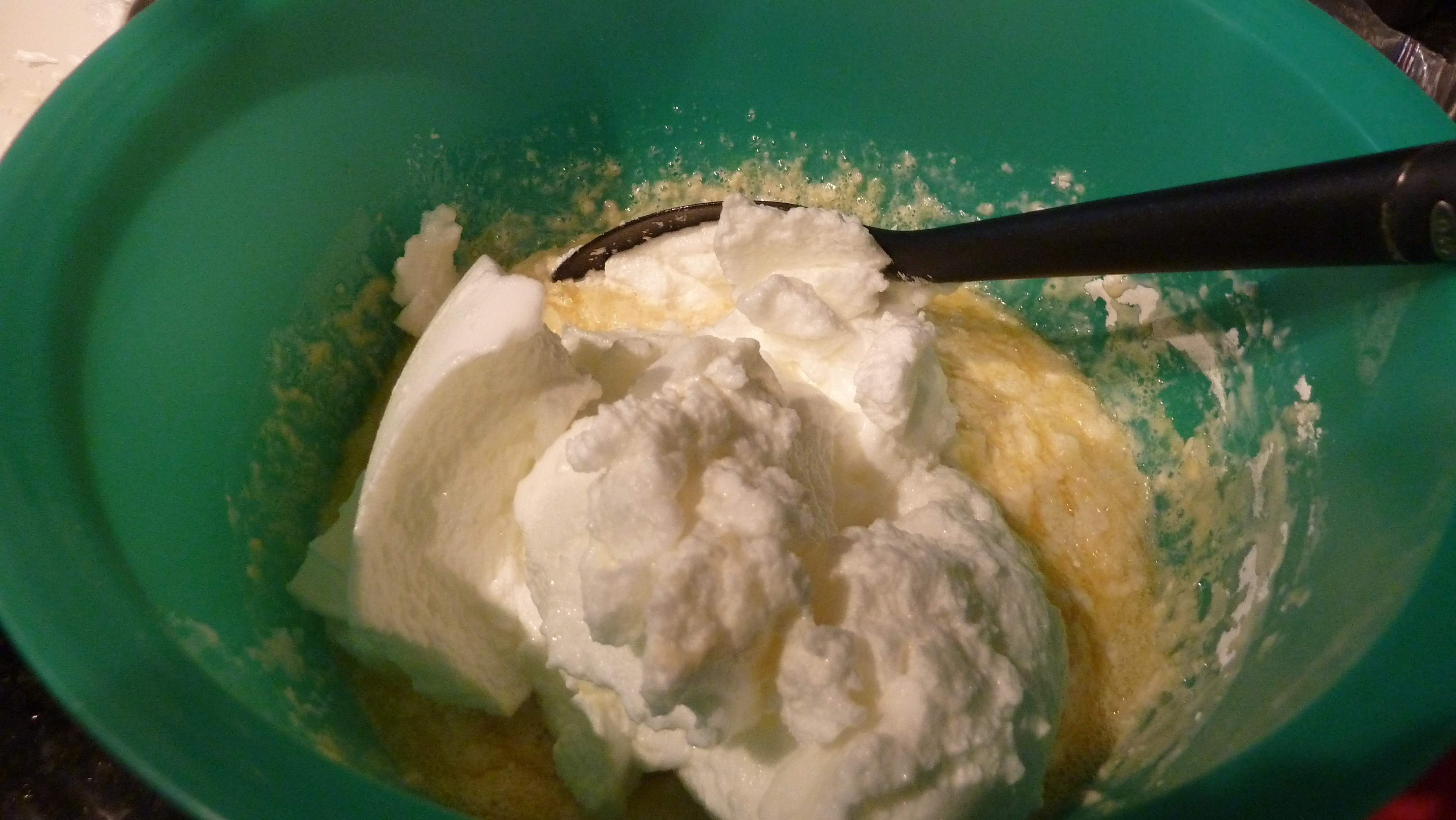
Fold in beaten egg whites until all combined to make your batter.
Pour batter onto hot, greased waffle iron and cook using instructions from the waffle iron. Makes about 5 ½ c. batter.
**This is where I’ve adapted the recipe. I use 4 eggs because my Kitchen Aid mixer bowl is so deep that the beater barely dips into the egg white using only 3.
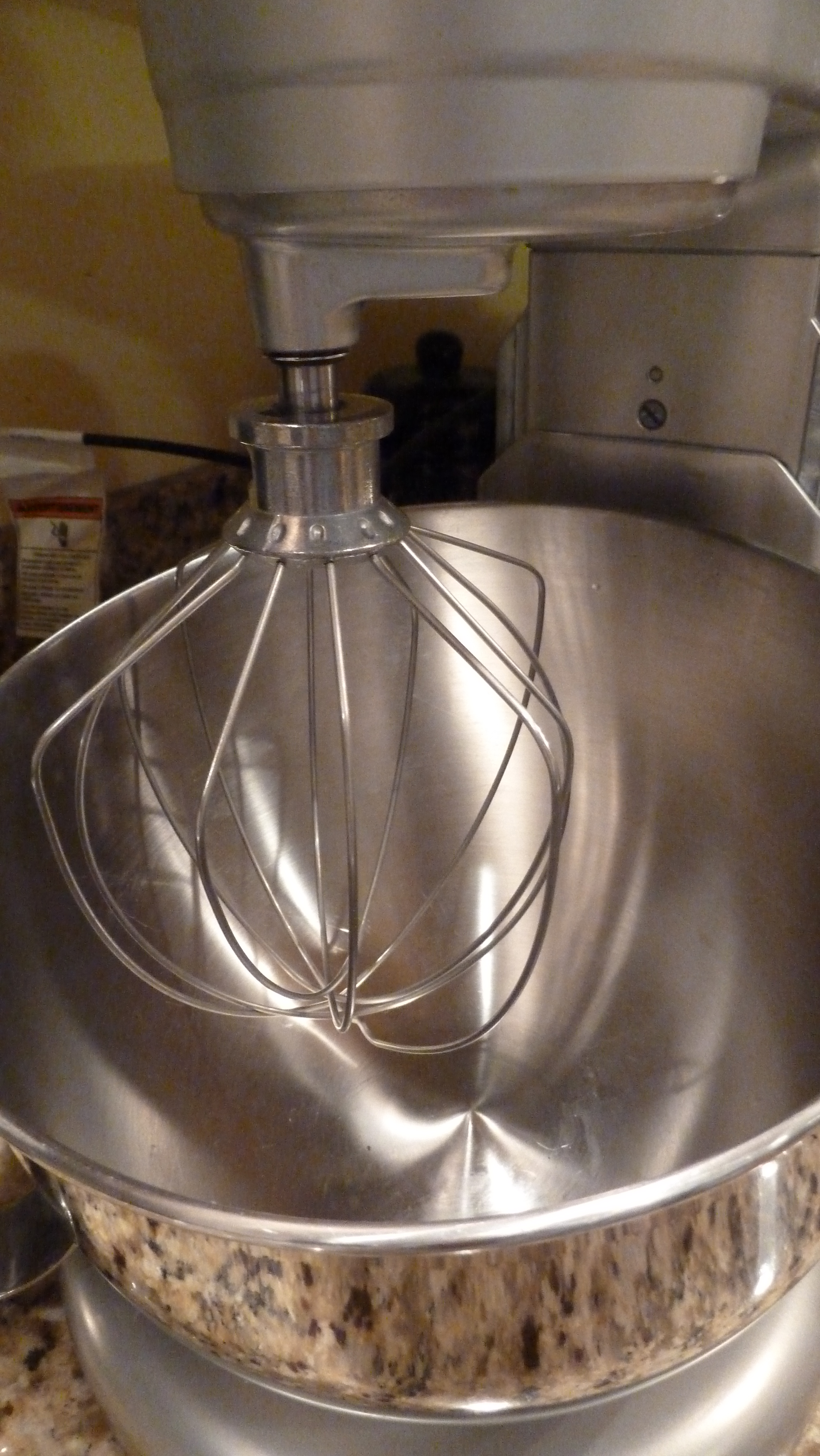
But using 4 eggs, the beater/whisk attachment tip reaches into the egg whites enough (after you raise the bowl) that it begins the connection to the liquid and then gradually brings along more and more of the whites and soon you have a glorious bowl of stiff egg whites. (Adding the sugar at the “almost there” stage as described above.)
P.S. I wasn’t sure if I could beat egg whites with my daughter’s little old hand held mixer (that we bought her when she moved to an apartment in college).
But sure enough, they beat up just fine, perhaps took a little longer. So way to go, little old apartment mixer.
P.S.P.S. These freeze well, if you have leftovers. Just put a layer of wax paper between rounds in a freezer bag. Pop in toaster or microwave on a busy work/school morning.
***
What is your favorite Saturday or Sunday morning breakfast? Who cooks it? Dad? Mom? Kids? IHOP?
Alas, this waffle recipe did not make it into my Whatever Happened to Dinner recipe book but 100 some others did (not nearly all mine, and the recipe editors/testers did a great job), and here’s the scoop.


