


Guest post by Larry Guengerich
Finding Harmony Blog is hosting a series of guest posts September 16-27 in celebration of Family Day on September 23, looking at how to beat the same old same old by finding community around food.
My second contributor is Larry Guengerich, a happy participant (as you’ll see below) in a regular “Supper Club” near Lancaster, Pa. Larry and I go way back: my parents and his family were members of the same Mennonite congregation in northern Indiana; we’ve both been colleagues working in communications for Mennonite agencies for many years; and members of the professional association for weird birds like us, Anabaptist Communicators, having served overlapping terms on the board. Anabaptist Communicators conference is at Bluffton University Oct. 18-19, 2013.
Never Want to Miss
The plan was to mow the lawn. As I got ready to pull the cord, I was hit with the worst pain I have ever experienced. It soon became clear I needed to go to the emergency room. As I lay there, waiting for the drugs to kick in, one of the first things to go through my mind was, “Oh no, it is supper club night!” Finally I was released, pumped full of fluids and drugs, waiting for the kidney stone to pass. It was a struggle, but there was no way I was going to miss Supper Club!
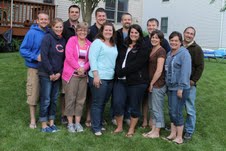
Supper Club: Larry and his wife Kendra, far right. They have two young sons.
We were approached by friends of ours in November of 2003 about being in a supper club. The club is made up of six couples, of which at least one in each couple had attended the same church most of their lives. As time passed, several of the couples had moved on to other churches, but wanted to stay in touch. Supper Club became the way to do it.
We gather once a month with each household serving as host twice a year. When the group began, there were only two couples with children, and when the subject of kids or no kids came up, they were the most insistent that supper club be a time away from the children. Now the 18 children join us once a year, usually on Memorial Day, but the rest of the time, we gather without them.
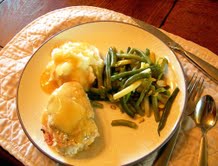
Looks like Pennsylvania Dutch night.
The food varies, depending on who is cooking. It runs the gamut from tried and true Pennsylvania Dutch meals to international flavors to full-on haute cuisine. It is always good and we share recipes to use with others down the road.
As good as the food is, the fellowship is what makes supper club. When I asked the members to share the things that stood out them, food was mentioned, but without exception the comments were about the stories we have shared, the inside jokes carried from one meeting to the next and the expectation with which we approach each event.
One member of the group said, “My life can feel rather serious at times and supper club is a place where I can count on laughing. I love that.” Another commented, “I love that we can be serious or silly, talk all sides of politics and no one gets angry, we don’t just sit around and gossip”
For me supper club has become both a place to explore food as well as explore community. The people in the group, I count as some of my closest friends. No matter what we go through, changes in jobs, church and family, I know there will be at least one night a month were the food and fellowship will be a taste of what I imagine heaven to be.

Larry Guengerich, is director of communications and church relations for Landis Communities, dedicated to retirement living at various levels, including aging in place and new models of age 55+ active adults living in the city of Lancaster, Pa. and elsewhere.
See the first post in this series on food & community here.
Do you have a similar group? Formal or informal? Comment here to be entered into a drawing for a free copy of Whatever Happened to Dinner. You can share links to similar ideas here, or at my Whatever Happened to Dinner Facebook page, to be entered in the drawing. (Posts for the drawing will close Sept. 30, 2013, midnight).
And don’t forget to plan something special for Family Day, Monday September 23. For more on my book, here are study questions, an interview with yours truly, two podcasts with the food editors, and a video book trailer. Or think about who might like a copy of the Whatever Happened to Dinner book with about 100 recipes ranging from traditional/old time to foodie! Order here.
Guest post by Holly Williams Nickel
Finding Harmony Blog is hosting a series of guest posts over the next two weeks on how to break out of food ruts to punch up mealtime with something a little different.
First up is Holly Willliams Nickle of Newton, Kansas, who has hosted a couple of Food Swaps; I heard about her from Hannah Heinzekehr, over at The Femonite blog. I asked Holly to explain how a Food Swap works.
Mission Accomplished
For me, a home is like a museum without the signs saying “Do Not Touch.” Nearly everything that is part of my daily surroundings has emotional or historical significance, or comes with a tale or memory of where, when and who.
My furniture came from my Grandma Mary’s house, my art has been made by friends. My books have been inherited, collected, studied, organized and re-organized from childhood to my present. My home is a virtual timeline of my life and loves, places I’ve been and people I’ve met. Why should my kitchen pantry be any different?

Holly’s collection of memoirs on “authors and food.” All photos from Holly Williams Nickel.
Among my collection of books are many, many memoirs of their author’s relationship to food. Films like “Babette’s Feast” and “Chocolat” have always drawn me in with their images of diverse communities gathered around the table to experience the pleasure of food and company. Last spring, I hosted such a gathering in my own yard – rich food, lots of candles, good wine and better company. These are the kinds of moments that I want my life, and the lives of my children, to be filled with.
To accomplish both of these ends, that same spring I hosted my first “Food Swap.” I first saw images of food swaps nation-wide in a foodie magazine. I loved the idea of having my own little farmer’s market, full of things grown by people I see in my daily life, right in my own backyard. As I own an artisan ice cream business, I knew what my contribution would be and was excited to send my hand-crafted wares home to my friend’s kitchens, while gathering their handiwork in my own. So, I followed the advice offered on the “Food Swap” website, sent out my invitations, put tables with colorful cloths up in my backyard, and we swapped.
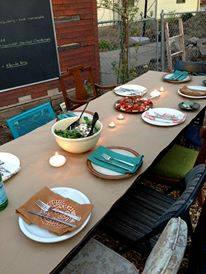
That night, and twice since, my kitchen counter has been overflowing with bartered goods that I would never have made for myself: basil butter, pesto, corn muffins, zucchini cupcakes, home-made bug spray, sugar hand scrubs, peppermint lip balm, pulled pork, fresh pita and ricotta cheese, squash, tomatoes, herbs, peppers, flowers, pickles of every variety, corn salsa, banana cake with caramel icing, biscotti…

When we sit down with our two teenage children and other friends who gather at our table – teenagers seem to multiply themselves – I tell them where the goods came from and about the friends who made them. They get to experience foods that I don’t make, or grow, myself. And they have the knowledge that they are sitting at a table bigger than the one in our kitchen – a table that includes all of the folks who have contributed to our meal and to whose meal we have contributed in return.
Mission Accomplished.
Holly Williams Nickel owns two shops, Salted Creamery, and the Lincoln Perk in central Kansas.
Have you ever planned or participated in a food swap? A variation on it? Comment here to be entered into a drawing for a free copy of Whatever Happened to Dinner. You can share links to similar ideas here, or at my Whatever Happened to Dinner Facebook page, to be entered in the drawing. (Posts for the drawing will close Sept. 30, 2013, midnight).
And don’t forget to plan something special for Family Day, Monday September 23. For more on my book, here are study questions, an interview with yours truly, two podcasts with the food editors and me, and a video book trailer. Or think about who might like a copy of the Whatever Happened to Dinner book with about 100 recipes ranging from traditional/old time to foodie! Order here.
Friday’s Finding Harmony Recipe of the Week
Our office at MennoMedia has started a fun no-fuss themed potluck once a month where no one signs up for anything specific, no one is in charge, and everyone is supposed to just pitch in with set up and clean up.
This month’s theme was “sandwiches” –supplies for building a sandwich, or condiments, or whatever you wanted to bring that would go along with sandwiches (i.e. chips, hummus, dessert).
My daughter had gotten a recipe from her mother-in-law, Sue, for homemade stromboli or what I consider Italian sandwiches (Wikipedia calls them turnovers, and a much better wrap up picture is here. Next time I’ll do better.) Sue used to make this for her bridge club, I think, or some other kind of women’s group where fancied up hors d’oeuvres were the order of the day.
I made it after seeing my daughter make it one time when we visited. As a mother, it does my heart good when I see my daughters venturing out and making new dishes.


(Stromboli sliced into 1-2 inch pieces, under the watchful eyes of black lab Ike)
So I made half of this recipe for one long stromboli, since I knew there would be more than enough food at our mini potluck.
Stromboli
2 loaves frozen bread dough (comes in a bag, or make your own dough) Thaw dough on counter just until thawed, or in refrigerator overnight, but not long enough that it begins to rise.
Mix* 1 egg, ¼ c. Parmesan cheese, and 4 Tbs. Italian dressing. Set aside.
Ham, salami, pepperoni
Mozzarella, provolone and Parmesan cheeses
(No set amount-depends on how much meat and cheese you want. If not sure just start with 1 lb of meat and ½ lb of cheese–sliced or shredded cheeses).
Spread out dough with hands to fit about a 11 x 13 pan or cookie sheet

Brush “mix*” down center 1/3 of dough

Then layer with ham, salami, pepperoni, mozzarella and provolone cheeses down center
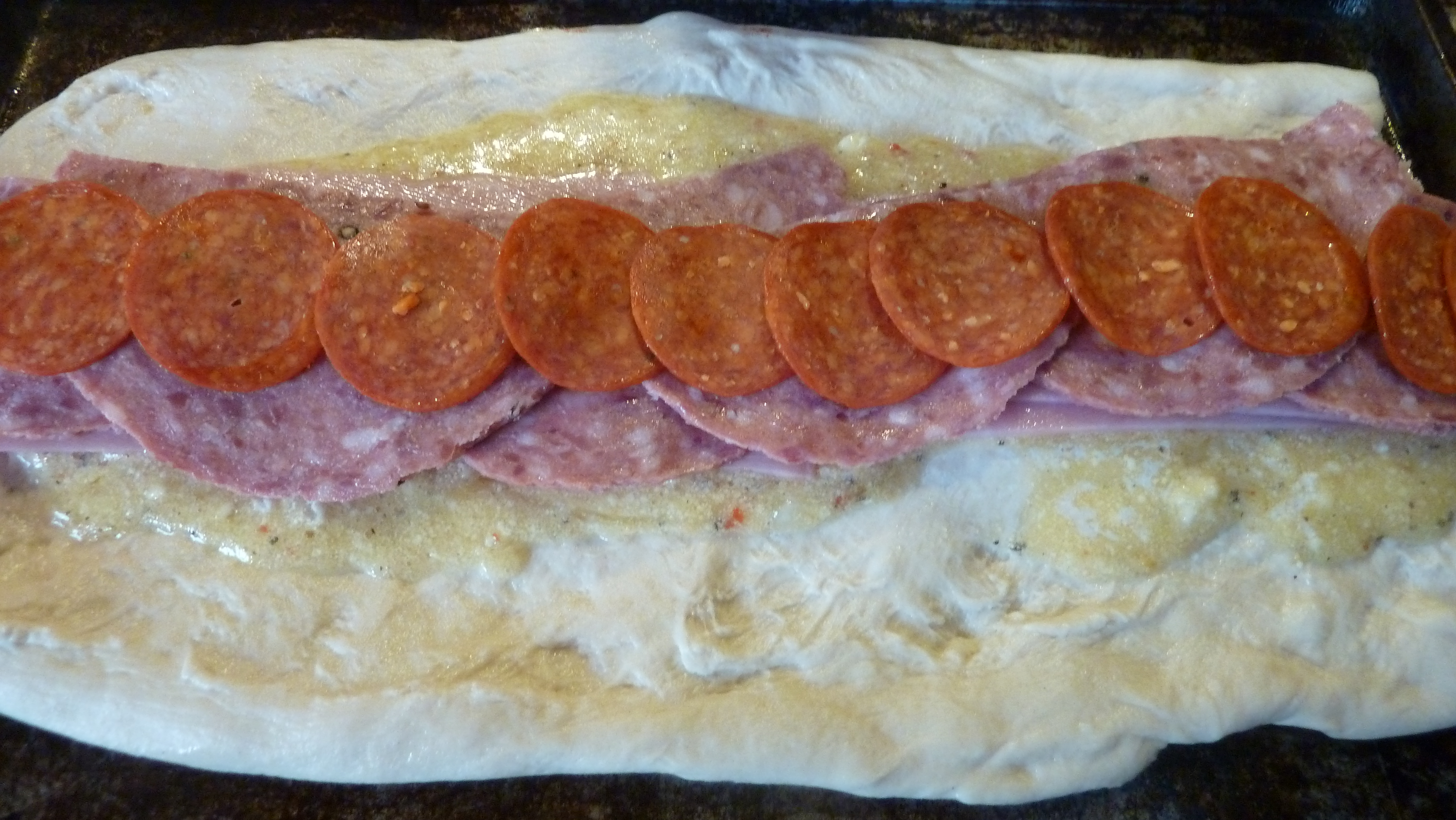
Fold another 1/3 over meat & cheeses
Brush mix* down folded over dough
Repeat with meat and cheeses, if desired (you can make it so it has one layer of meats etc. or two)
Wrap up the whole thing and pinch tightly, or as well as you can!


(Melodie note: since I have lots of sweet red bell peppers on hand right now from the garden, I added them for a nice crunch and nutritious veggie)
Bake 30 minutes at 350°
Makes 2 stromboli rolls. Check to make sure bread is done thoroughly. Stick a knife in it to make sure it isn’t still doughy. Slice into 1-2 inch pieces.


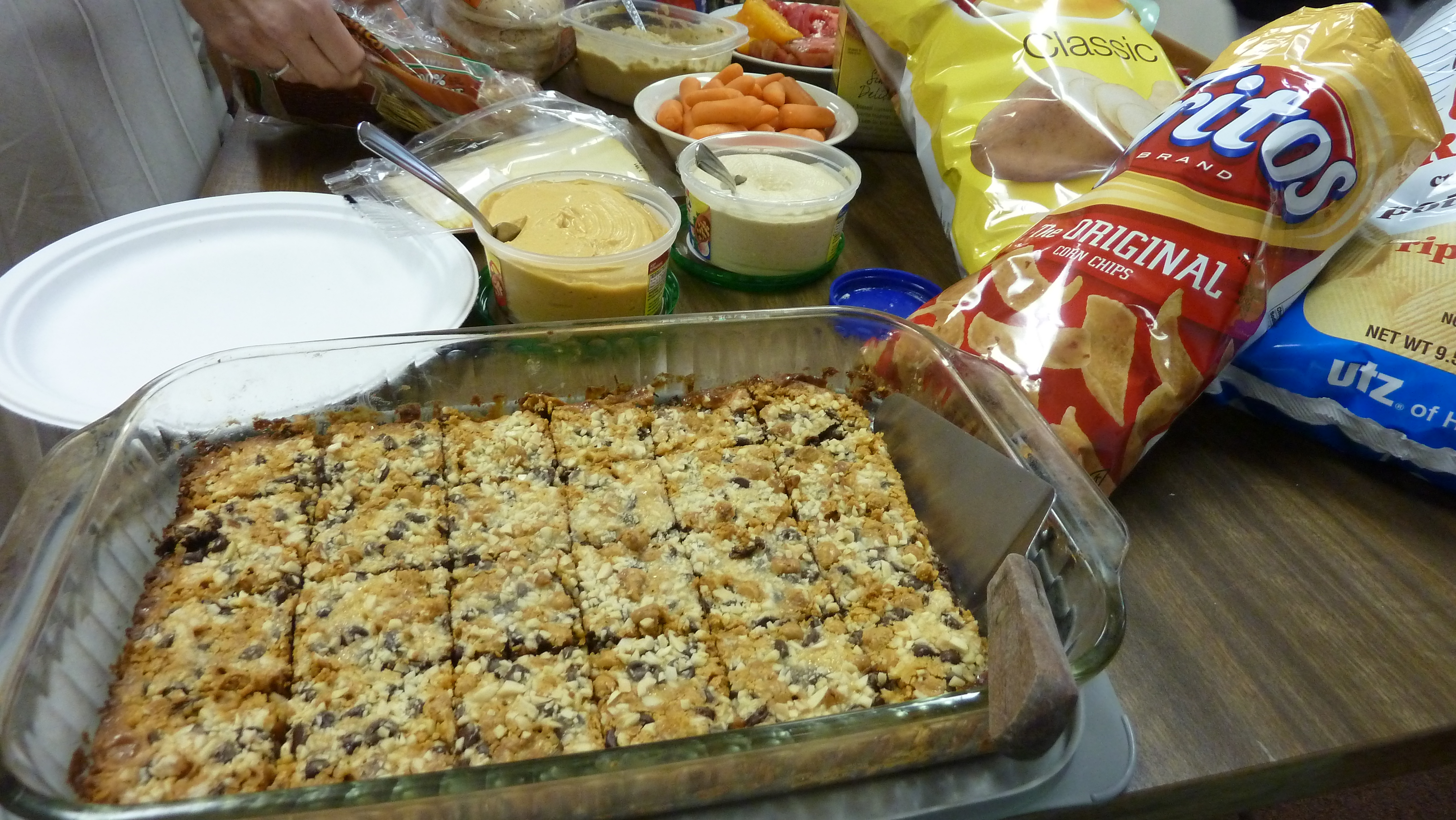
At the office potluck, it was the only warm dish so it seemed like a welcome addition to the table, along with Reuben’s rendition (my personal favorite) of West Coast Chicken Salad from the new Mennonite Girls Can Cook Celebrations (green dish, far right). Josh brought in a lemon and caper tuna salad and it was a great twist on the old tried and true tuna. Everyone agreed the prize for most creative went to Barbara who brought “Ice Cream Sandwiches” for dessert.
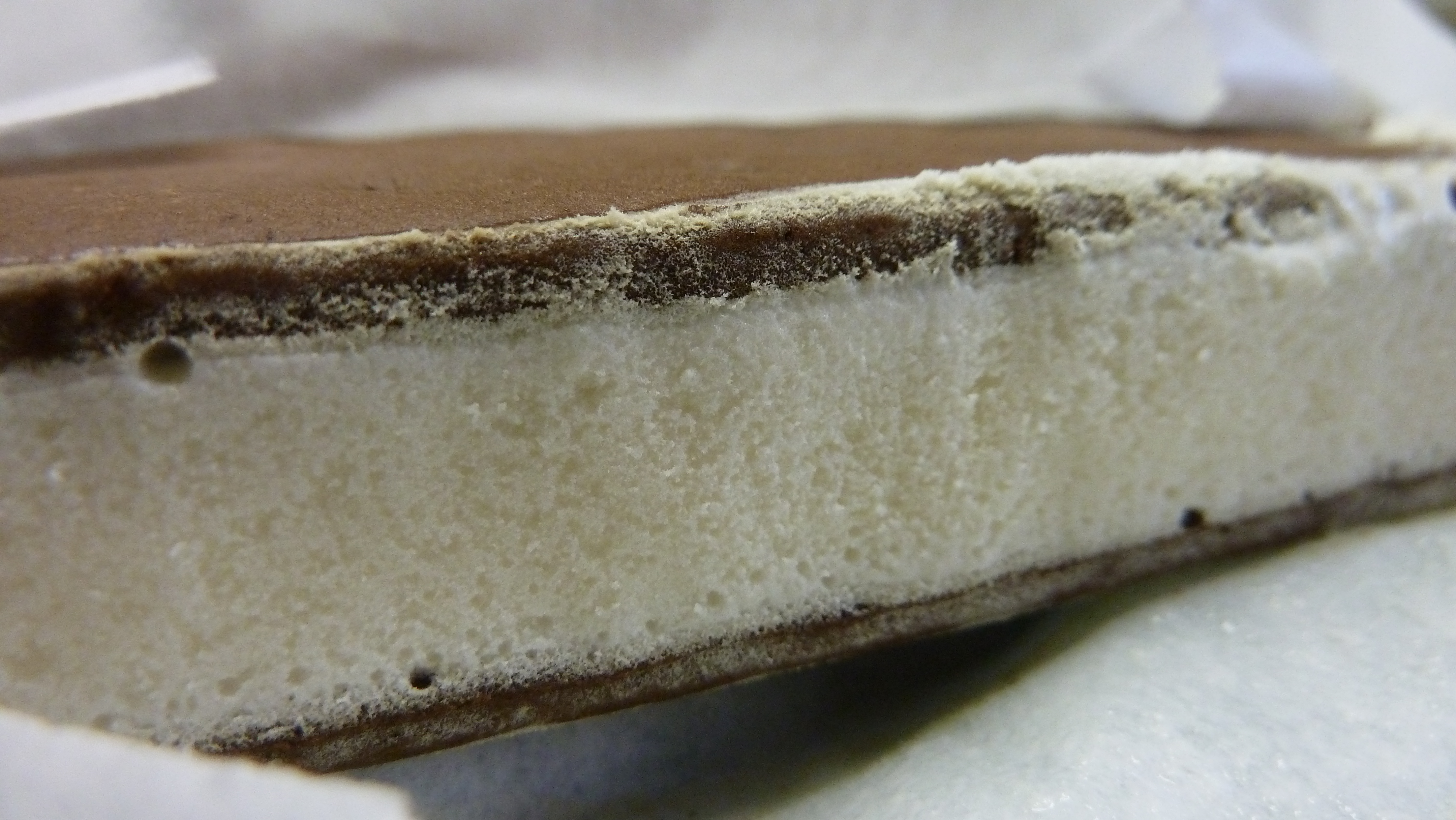
(It took me a second to get it. No one ever accused me of being swift.)
And we loved Cindy’s 7-layer dessert, which I make as “Magic Cookie Bars” and which Phyllis Pellman Good recently featured in her “Cooking with Phyllis” online cooking show, and how to bake them in a slow cooker.
Next week we start a series of guest posts leading up to Family Day Sept. 23 with nifty ideas to add new twists to your family dinner or dinners with friends, or spicing up the humdrum brown bag lunch routine!
Sign up to receive each blog post to your email so you don’t miss any!
Next week–Learn how others inject creativity into their food lives with a:
- Food swap – Holly Williams Nickel, Newton, Kan.
- Supper club – Larry Guengerich, Landis Homes, Pa.
- Marathon food prep from Guatemala markets – Jennifer Kurtz Murch, mama’s minutia blogger
- Games and gourmet group – Michelle Sinclair, media critic over at Third Way Cafe
And if you’d like to do a guest blog post (with a photo) on what you do with food and your family, let me know and I’ll work it in! Blog posts accepted for use will receive a free copy of my book of 100 recipes and ideas, Whatever Happened to Dinner?
Also “like” the Whatever Happened To Dinner Facebook page for periodic posts on topics/recipes/meal ideas of interest.
Writers now face not only what they will write, but what is the best method to convey the message? Is it a blog post? Tweet? A Facebook status update? A magazine article? A column? A book?
(And if you’re counting Twitter and Facebook, then all in the social media world are writers. Who knew?)
On a personal level, is my message best delivered in person, phone call, phone message, text, letter, a football stadium jumbotron?
What a rich age we live in and the short list above is only a click or a keystroke away in the vast sea of contemporary media possibilities.
I thought about this the other week on the 50th anniversary of the Martin Luther King Jr. “I have a dream” speech in 1963. There’s another notable anniversary the U.S. will observe this fall, remembering the 1963 assassination of John F. Kennedy in November. Suddenly these anniversaries were connected in my mind recalling a momentous turn of events in my own Mennonite family growing up: 1963 was the year we got our first television set. Many others in our church already had TVs and or course we begged dad for years, but as a deacon he drug his feet because of the “example” he was supposed to set for others. When Kennedy died, he waited no more, wanting to see all of the events as televised that terrible weekend. We kids didn’t know whether to be happy to sad: glad to be getting a TV, but devastated by the national tragedy.

(My dad, the deacon in Mennonite plain suit.)
This year for the first time I suddenly connected that the King speech and the Kennedy assassination occurred within four months of each other, and realized that likely my father was not only motivated by the murder of JFK to get a TV, but by other news events like the King speech that also captivated the nation. (Dad was an early eager and outspoken advocate of equality and understanding across racial lines.)
Thinking about all this, I wondered whether I should write a blog post on it, but instead boiled the above longish paragraph down to a somewhat cryptic 140 character Tweet:
#martinlutherking just put together that King speech and JFK death both came late ’63.
Dad bght our 1st TV @JFKdeath, but he also loved King
Maybe I should have tried it as a Facebook post? My neighbors recently celebrated their 65th wedding anniversary and the children threw a lovely surprise picnic party for them. For that I chose just a Facebook post, with a few key pictures, because I wanted to share that news with nearby friends who also knew them.

“Congratulations to a great pair, our neighbors, Harold and Willie, who got married 65 years ago yesterday!”
An editor at Christian Century, who was one of my first editors, Richard Kauffman, uses Facebook for messages that sometimes become articles, or in place of an article, or a place to collect feedback that he weaves into an assignment or longer reflection. He recently moved to a condo where he hopes to eventually retire, and not have to move again. I enjoyed his short reflection on Facebook:
“How foolish of me to think we bought a condo. Rather, I now think we’ve been given both a sanctuary and, potentially,
a community–the two conducive to the inward and the outward journey. …”
That is deserving of a longer introspection sometime, it seems.
Speaking of longer media forms, I have often noted that many books start out strong and kind of lose their steam after about 3 or 4 chapters and the writer begins to repeat him or herself. Maybe some readers think that about my books.

My daughter recently wanted feedback on a book, Baby Led Weaning with a book length subtitle: “The Essential Guide to Introducing Solid Foods and Helping Your Baby to Grow up a Happy and Confident Eater.” It’s an interesting book and the writers, Gill Rapley and Tracey Murkett, say they started writing a magazine article and turned it into a book—but yes, it does repeat itself a lot (my only real complaint about it). To prove the point, a new edition of the book is shortened in text but includes recipes.
My husband can’t understand why I sometimes text my daughters when we still don’t have a text plan on our phone so they cost 25 cents a pop. But since our daughters each have busy lives of their own, sometimes a text can seem like a less intrusive way to get a short message to them, such as “on our way” or even just “call me.” Or when you’re waiting for worship to begin on Easter morning.

When my work supervisor (who lives in another state) was expecting a new baby any day, she had planned to call me on Friday morning. By Friday afternoon, I had not heard from her, so I strongly suspected she was either in labor or had had the baby. I sent her a quick text about mid afternoon saying “hope u are in labor … prayers n best wishes.”
A short while later I got a short text back saying her new daughter had arrived. That felt kind of special.
Major life events normally shouldn’t be communicated by text (no breaking up with a girlfriend or heaven forbid, a wife or husband, but I know it’s happened). In some circumstances, maybe a wedding proposal by text works. I enjoyed watching several such proposals float by, sent by text, at the opening football game of the season at James Madison University’s stadium jumbotron.
Longer ago, a writer might have pondered whether to write his or her love message as a sonnet, ode, edict or epistle. The Biblical writers, especially in Psalms and Song of Solomon used a variety of poetic forms of the day. I have no doubt that if Jesus could’ve, he would’ve used Facebook, Twitter, blogging. I can see it now, the classic verse we all memorized as kids, “Jesus wept.” Now that’s a tweet.
And now, this is entirely too long for a blog post, and we haven’t even touched on the visual communication arts. If you are still reading, thanks. This is my 100th post since beginning January 1, 2013. The readers are steadily growing, I’m happy to say.
To celebrate, I would love to share my new desktop background photo if you are interested. It’s a lovely scenic view of Zion National Park in Utah that I took this summer. Scenes such as this continue to serve as a communication form with God, don’t you think?
Leave a comment and I’ll be happy to email it to you privately. Or just grab it from here. My 100th post gift. (I know, now everyone thinks they’re stock photographers, too. Ha.)

Last September our oldest daughter Michelle took a week of vacation time to help us began rehabbing an old playhouse my father built for our family.


Playhouses in our family have a long tradition: my dad built one for us children back before I even remember anything, pictured below: white siding and red trim. To me the playhouse was always just there: on our farm, a special attraction not every family had. Friends and cousins loved it. Cousins came frequently to visit my grandparents who lived with us in a traditional “doughty” house (an addition on the side of the farmhouse).
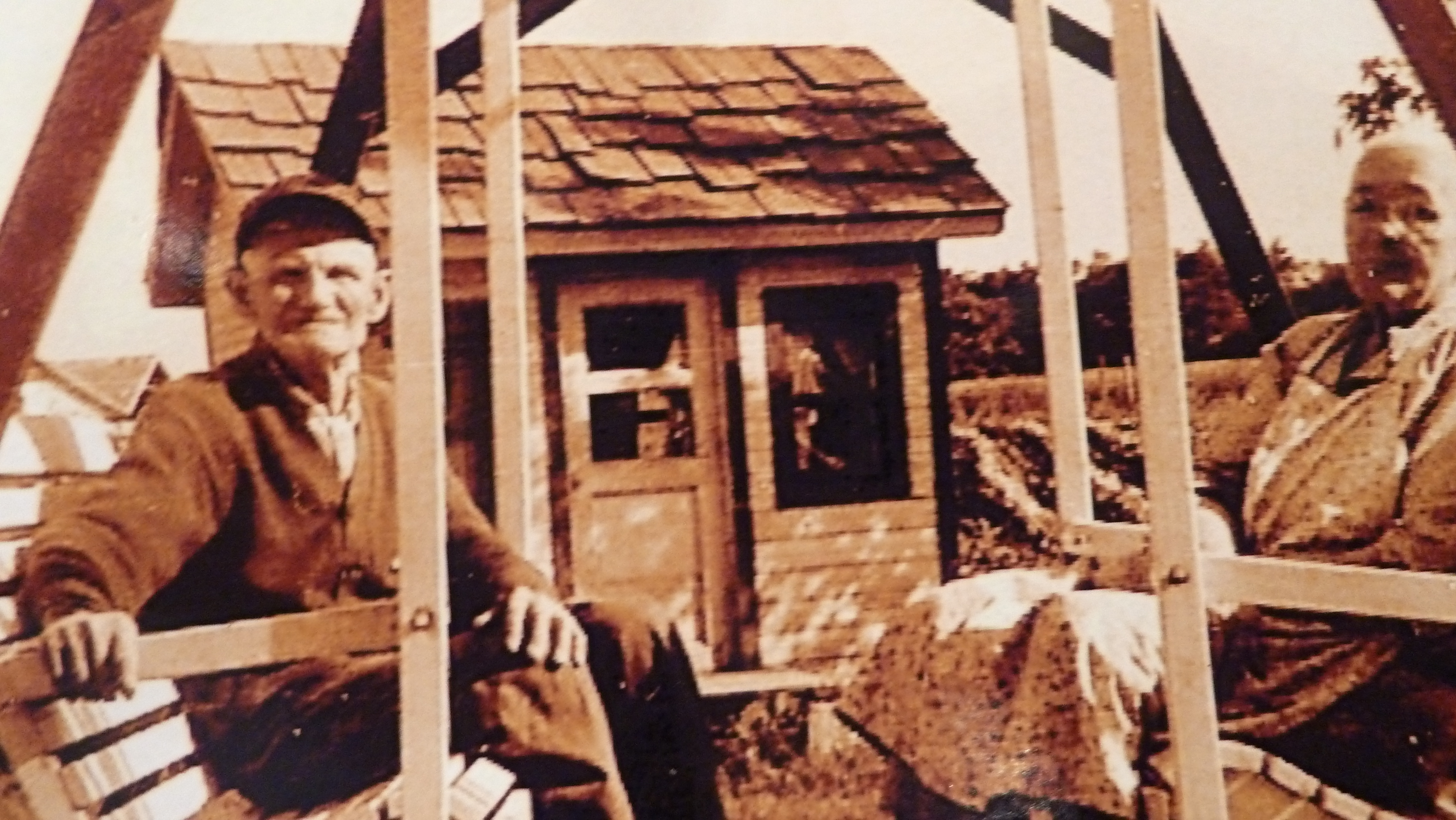
My Grandpa and Grandma Miller (Uriah and Barbara) on a swing in front of our old playhouse.
Then my family moved from northern Indiana to northern Florida in 1969 and had a huge auction selling almost everything we owned. Including our beloved playhouse. It brought lots of excitement, a few tears, and a nice little sum when the auctioneer put it on the block that day.
Not to worry. When Dad and Mom began to have grandchildren, they made sure each family with children got a Grandpa-built playhouse (or tree house in the case of my brother’s family who had two sons).

Some Indiana cousins, Larry, Bob and Jay with their childhood playhouse (plus Michelle).
Then my parents came to Virginia for a week September of 1982 when Michelle was just 18 months old.
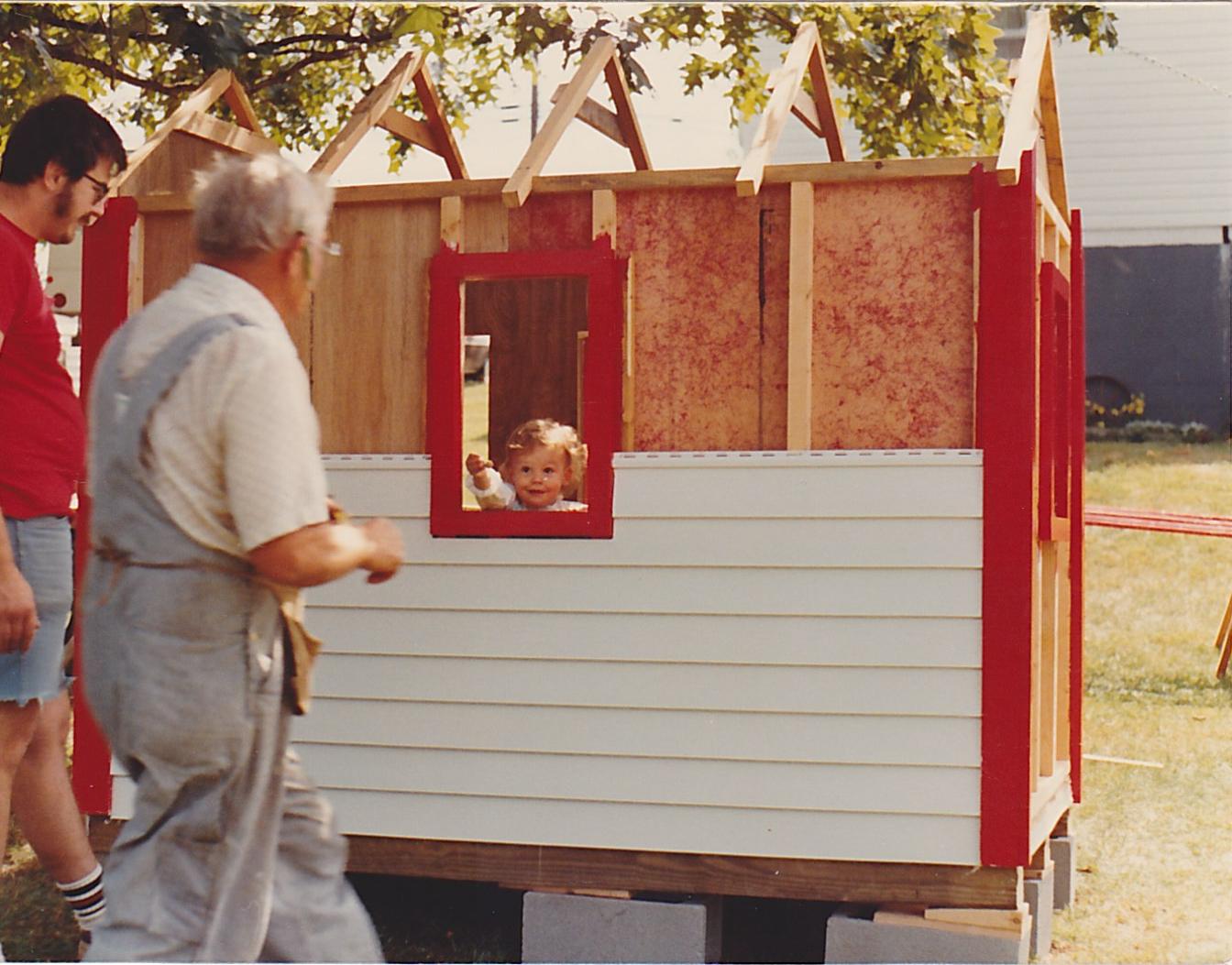
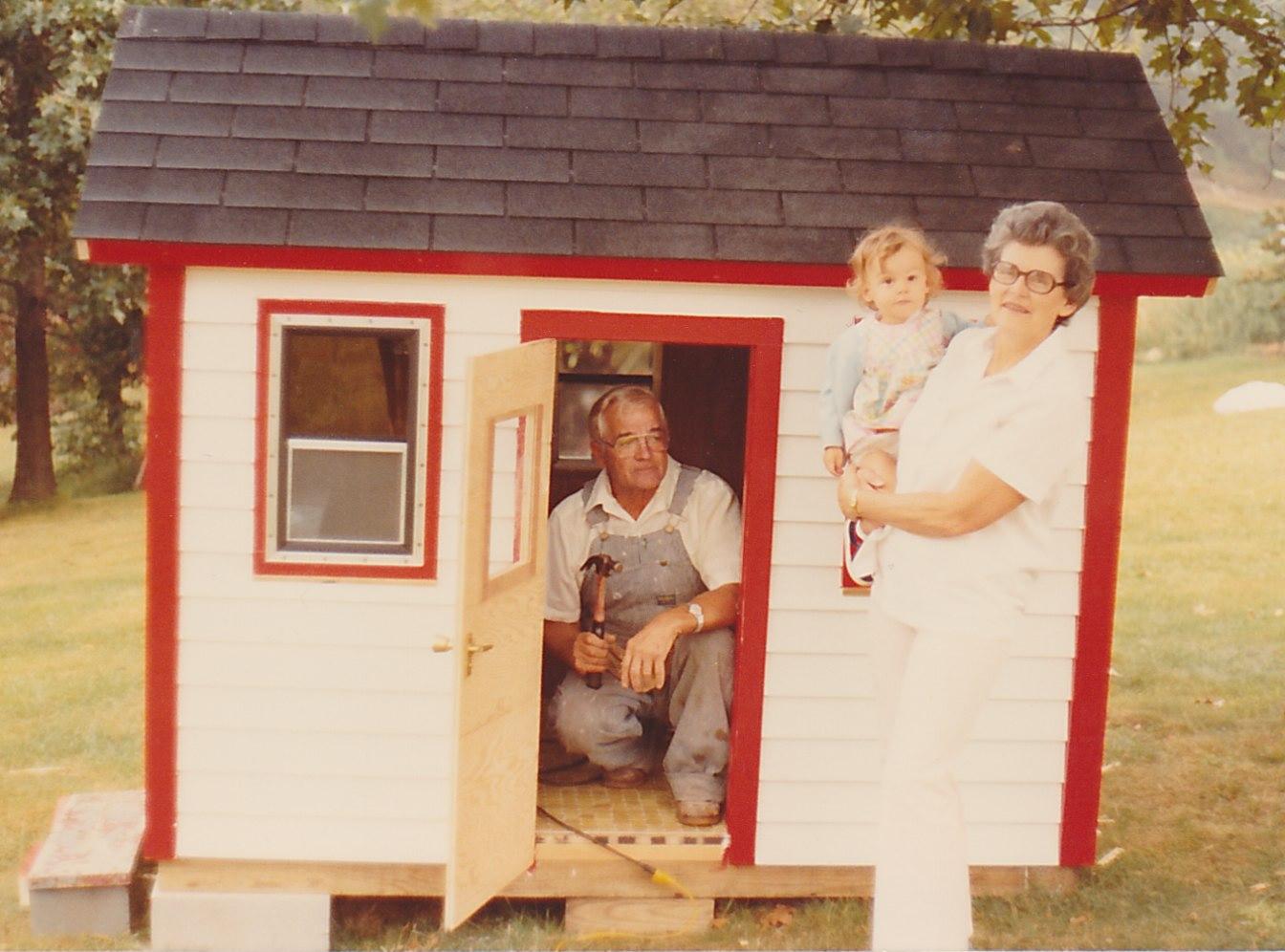
My father, Vernon Miller, building our playhouse with help from Michelle and Stuart. Right, Dad, Michelle and Mom with the finished house.
Fast forward 30 years to 2012. The beautiful (now old) playhouse was in serious need of repair. Michelle wrote about her memories of playing in the playhouse here. And I did an initial Another Way newspaper column about the restoration project as we launched it, here.


Eagerly we began by removing the roof, knowing that we’d have to keep the interior protected. The plan was to almost totally rebuild the trim, siding and roof, while retaining if possible, the interior paneling, cupboards and original flooring. The 4 x 4 pressure treated foundation was also very solid, even after 30 years.

But the idea of covering the whole thing up with tarps and tie downs after every work session soon loomed large. We also had no electricity out near the playhouse for power tools. Hauling all of the tools and equipment in and out of the shed or garage just wasn’t going to cut it. The nearby shed didn’t have electricity. What if we moved the playhouse into our two car garage, and place it atop a large dolly he would construct, my husband schemed. I weighed the options. That sounded like a lot of work. But I did not relish the idea of covering the playhouse up after every work session. He promised I could continue to keep my van in the garage. He felt we could wedge the playhouse into the space between the cars when we weren’t working on it. So we moved the work inside with the help of our neighbor and his trusty tractor with a frontloader.
Work continued through the winter as we had time. It would take almost a full year. All of our daughters got in on the act: painting, prying, giving feedback and encouragement, admiring. Friends helped Stuart figure out how to proceed at key points with the siding, the j channel around the trim, the roof.
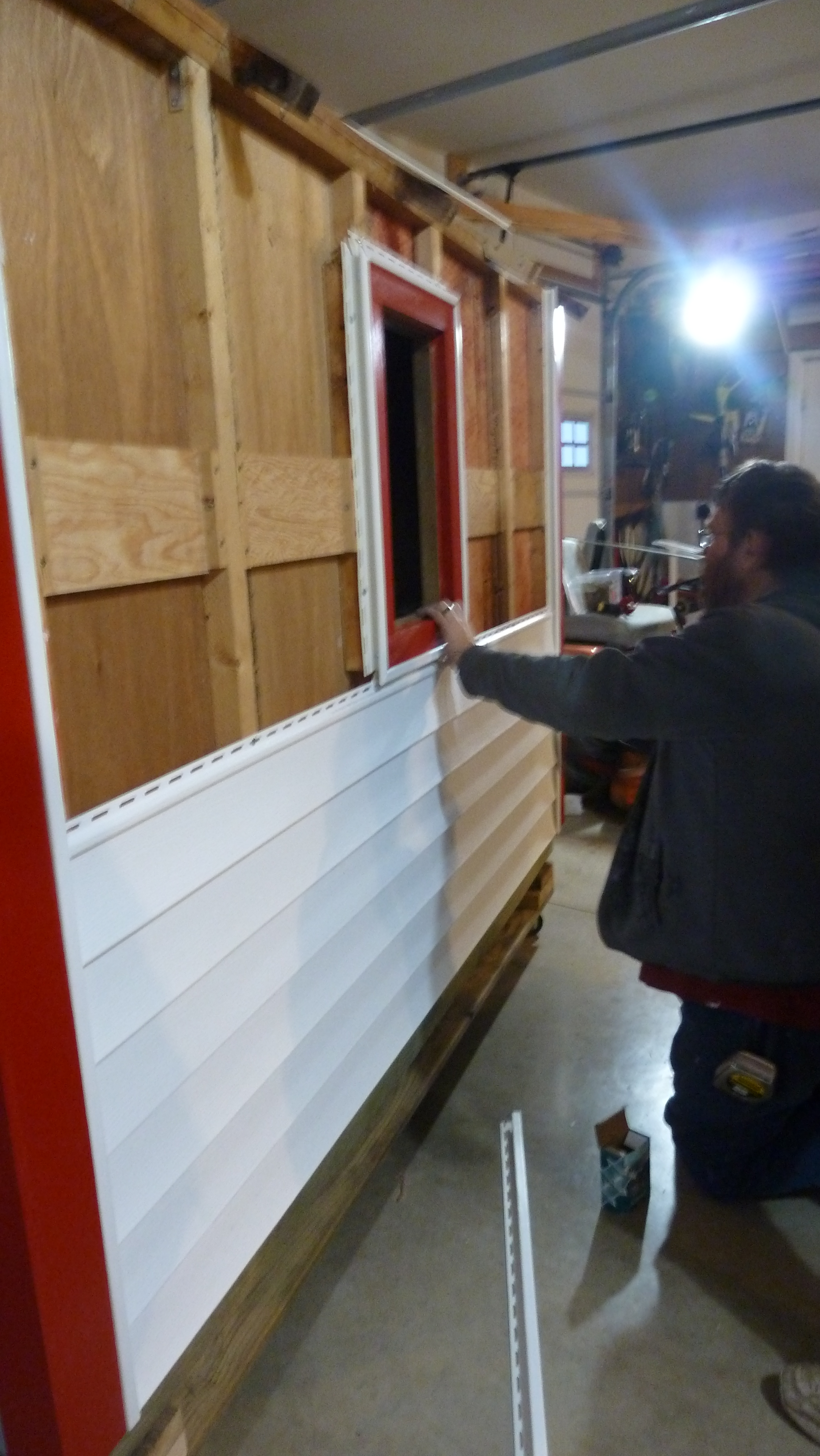
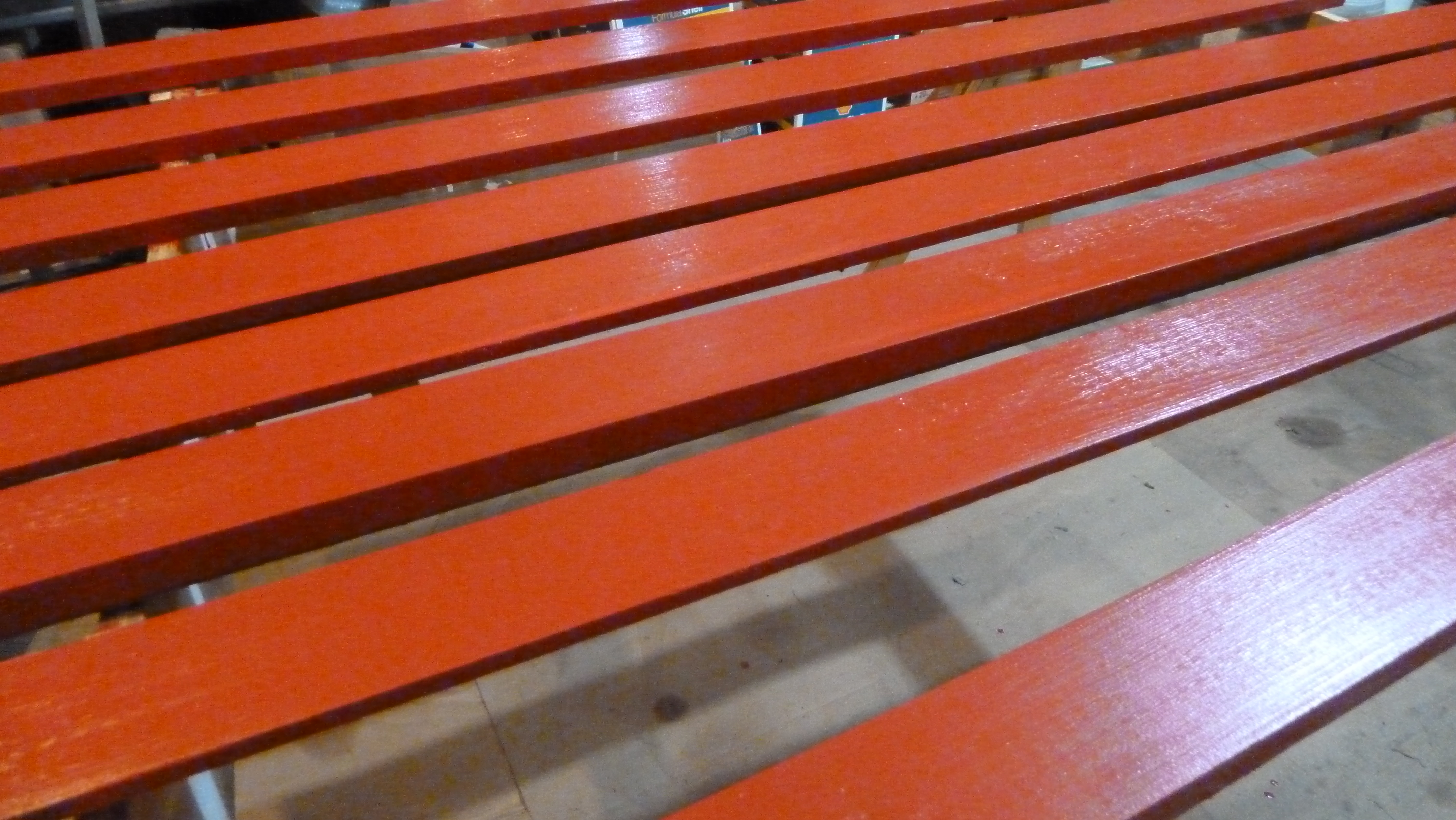
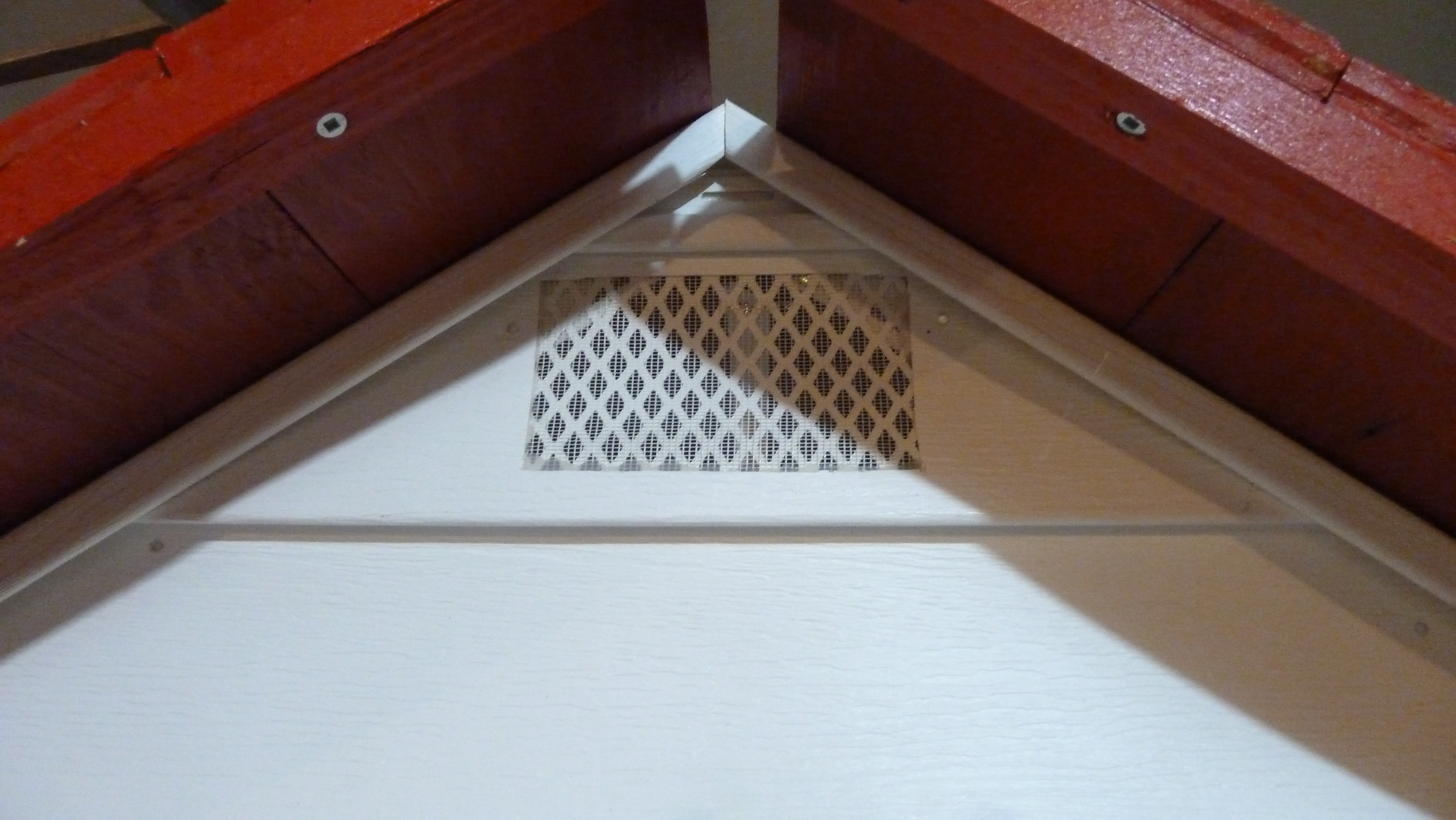
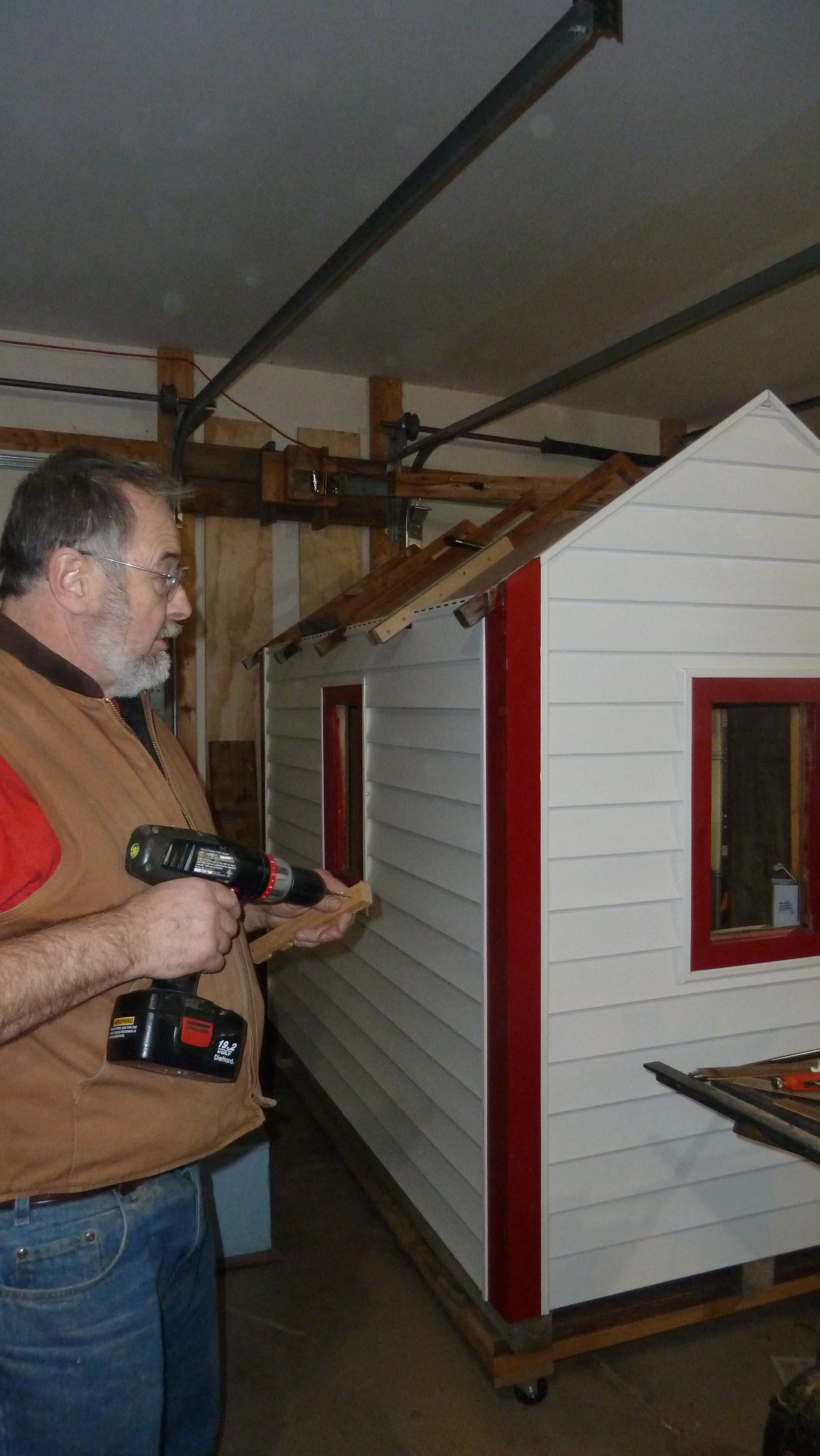
Friend Edgar helps Stuart get the siding started. Mother Melodie (and sometimes daughters, if home) do a lot of trim painting. Stuart adds some improvements, such as roof ventilation, to Grandpa’s original design.
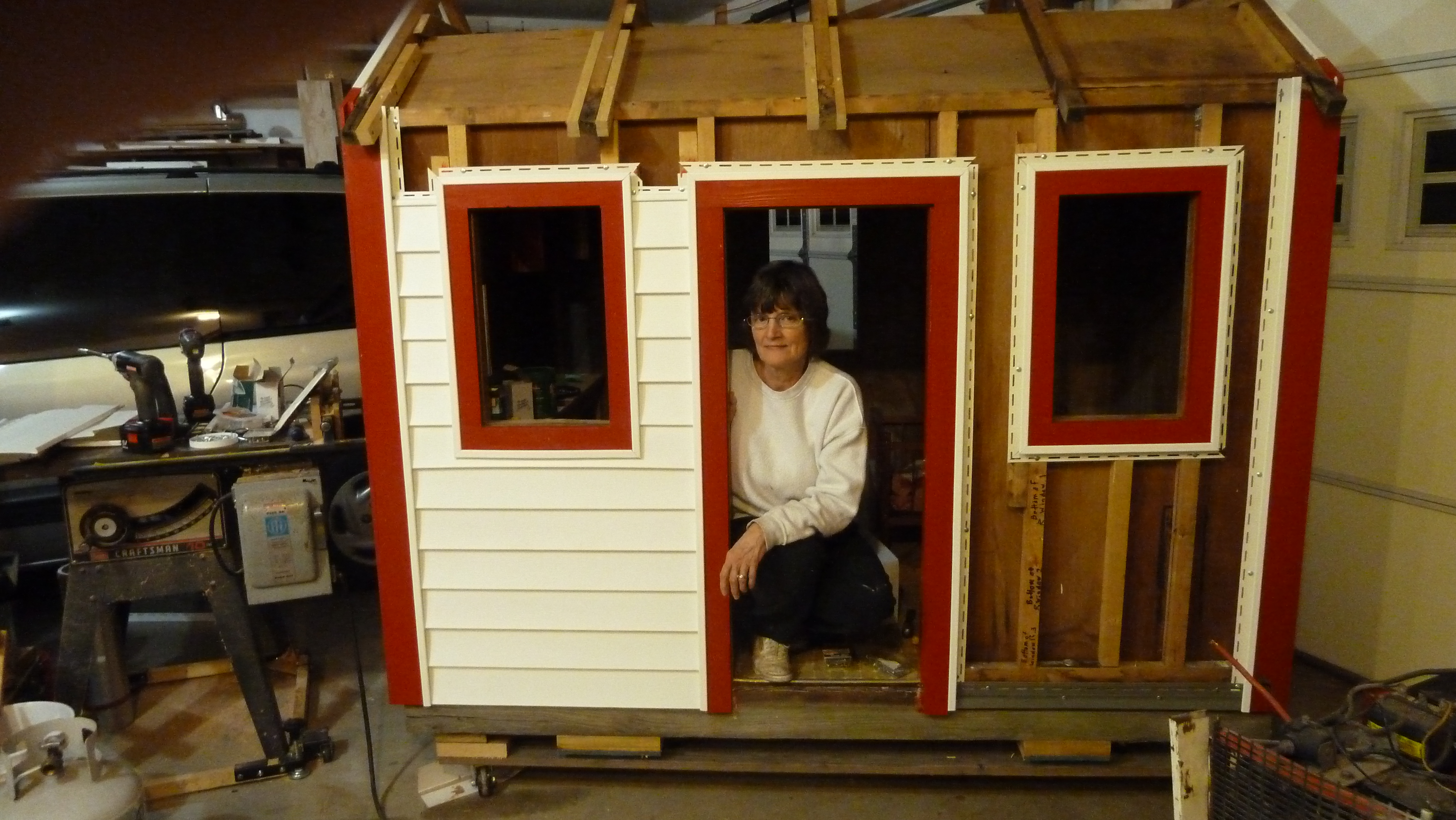
Me posing inside the house, inside the garage during one point in the long rehab process.
Something else wonderful happened while rehabbing the playhouse. Both of our married daughters got pregnant. Grandchildren!!!! If you follow the blog, you know our excitement. A baby bump began to be visible as finishing touches on the playhouse went forward.

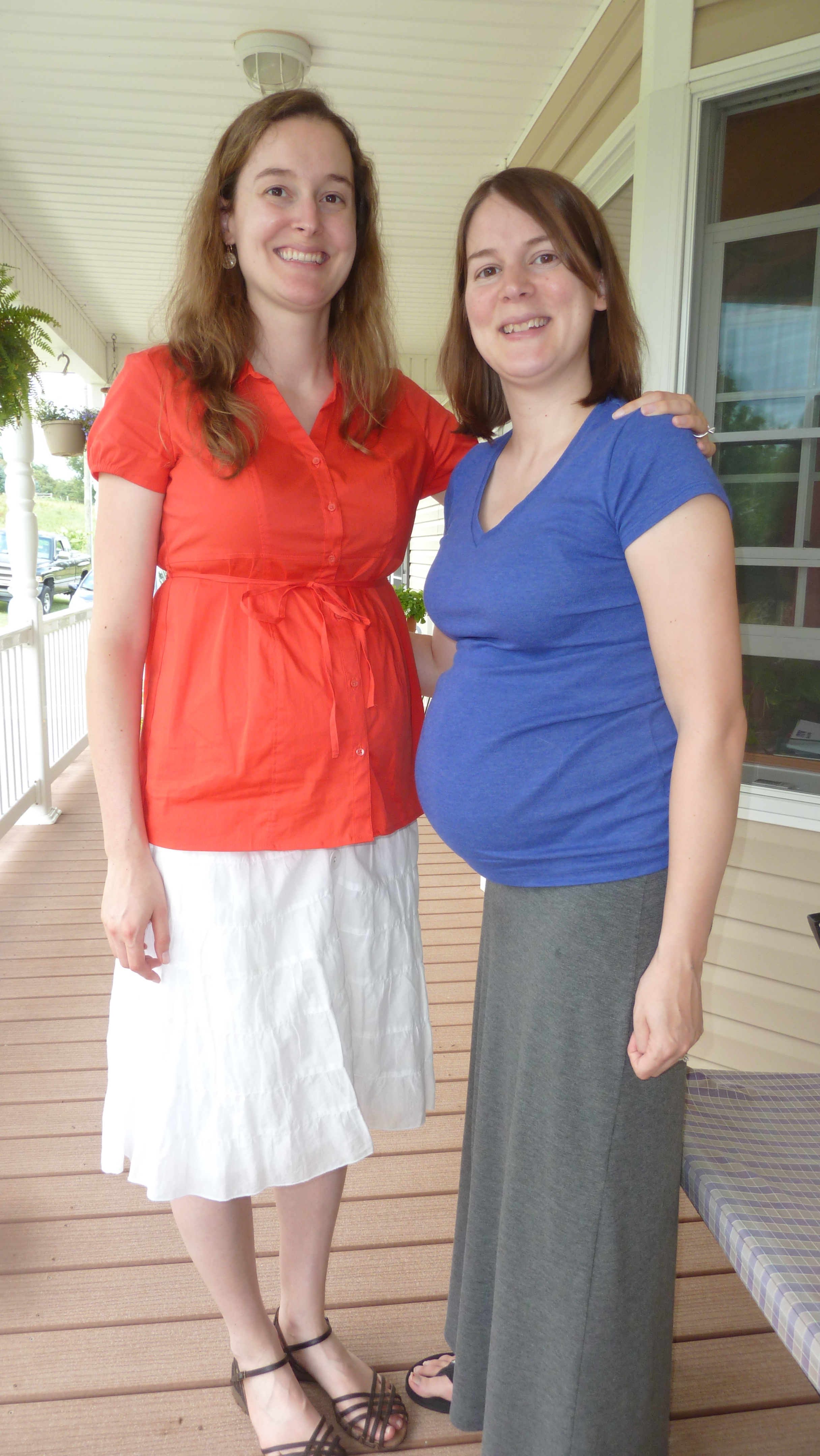
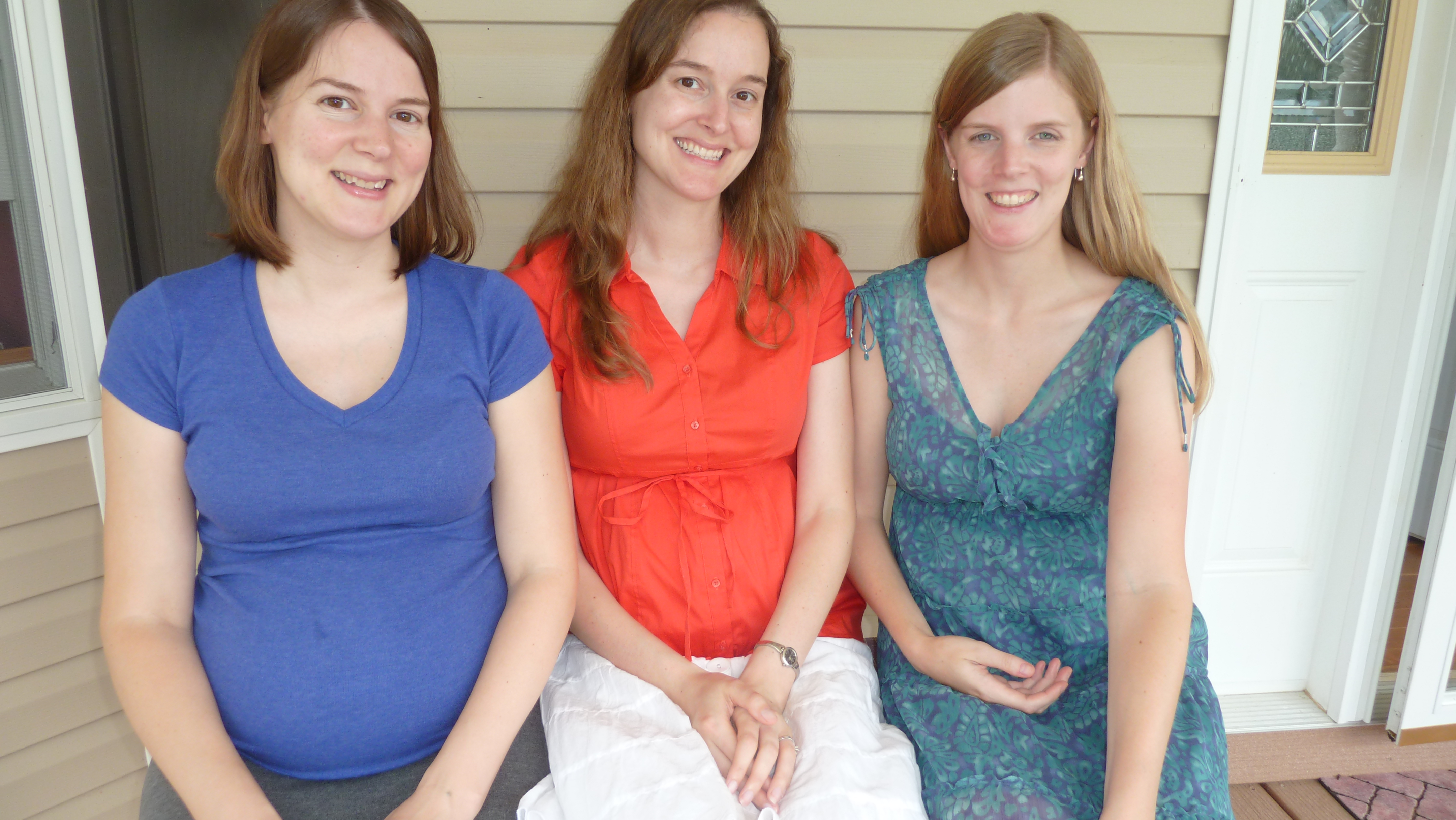
Last week the same wonderful neighbor and his tractor and frontloader came back into action to move the playhouse back out of the garage and to the backyard. Michelle’s brother-in-law, Brett, (middle, below) also gave invaluable help for the move.

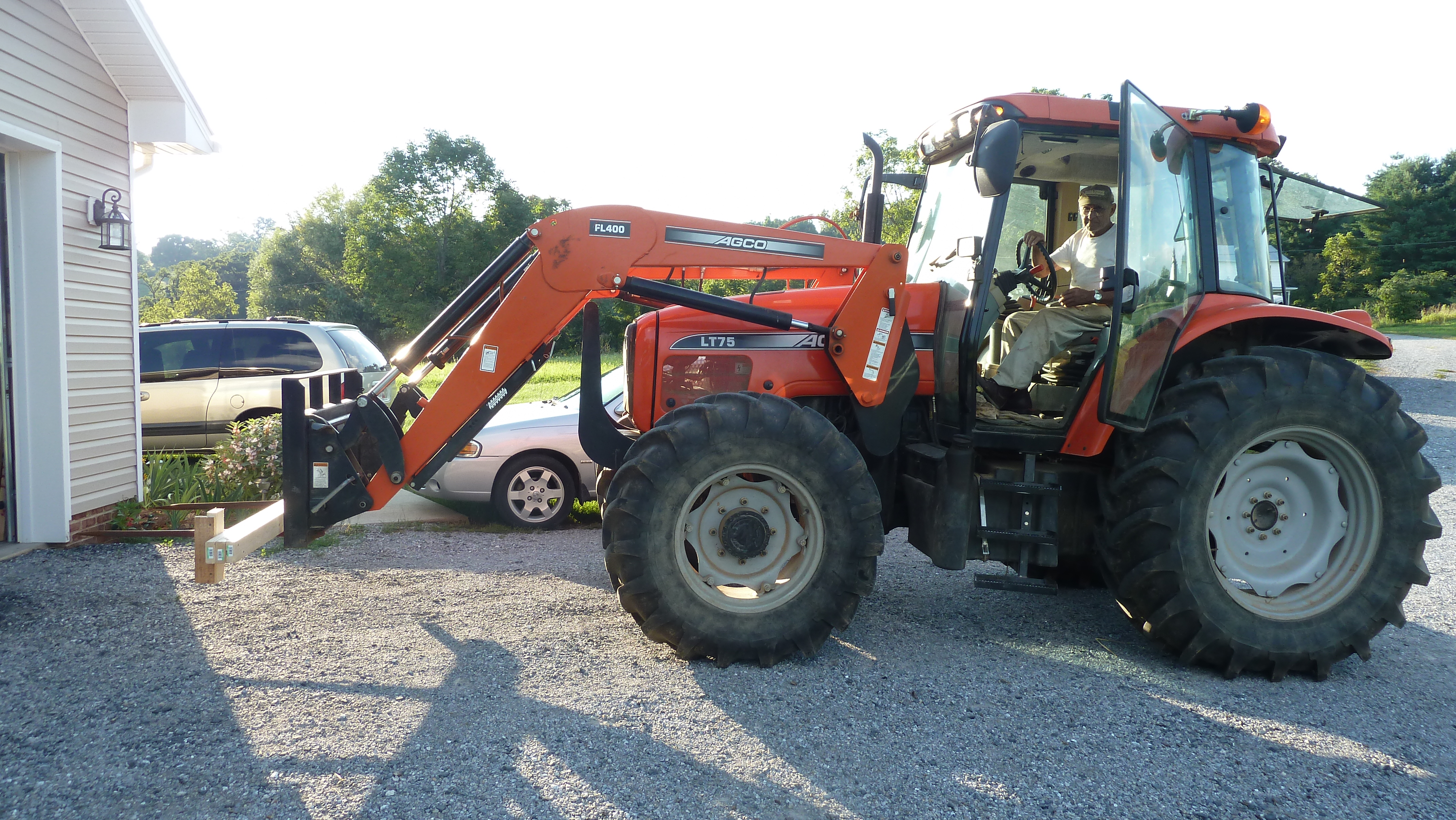

It. Was. A. Great. Day.
We were both elated and extremely nervous about the moving process, after everyone’s hard work. But it went well, no disasters.
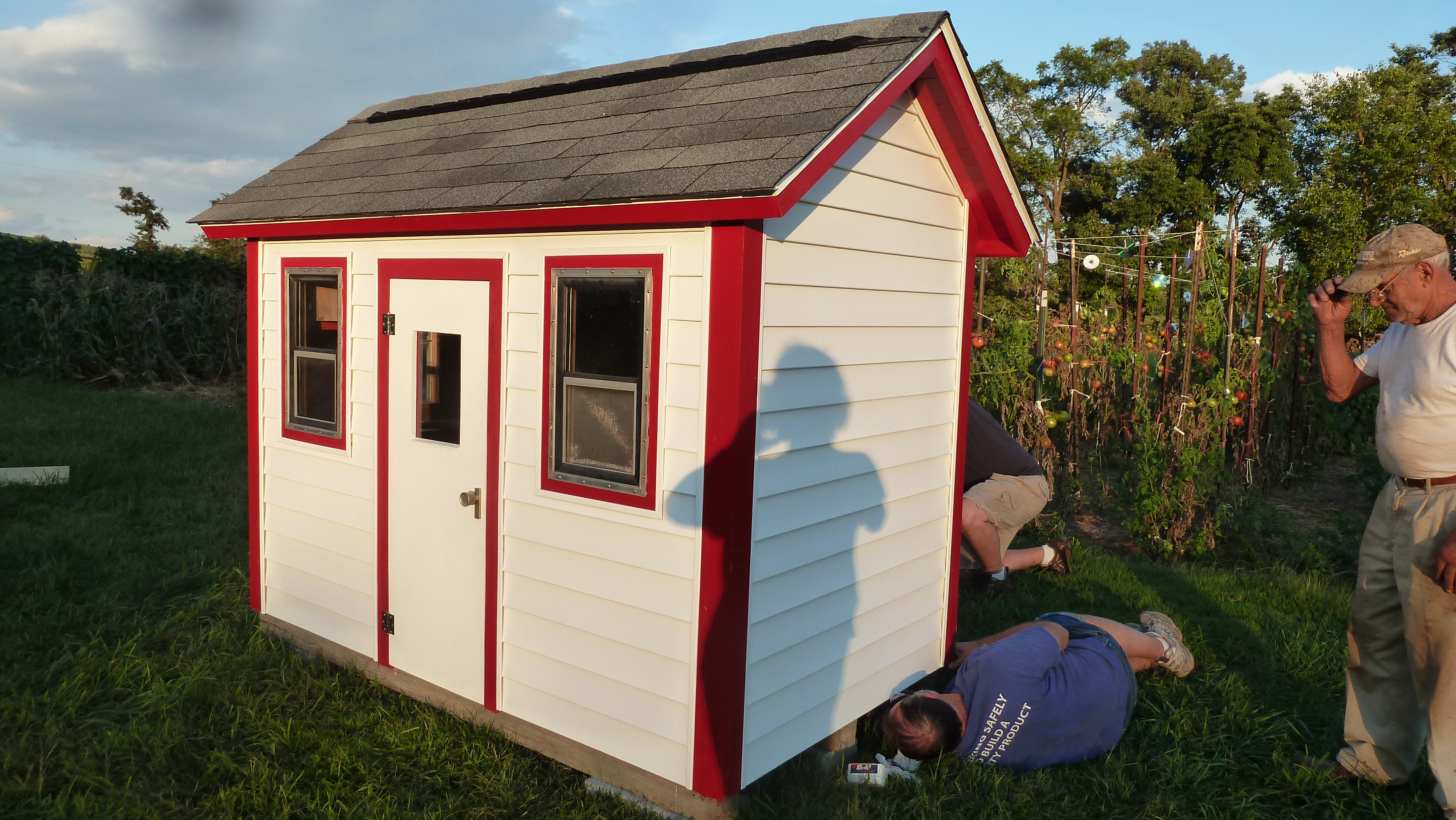
Stuart, Brett and Harold check finishing work.
Our marriage has now survived the rehabilitation of one sadly neglected little playhouse. We are incredibly grateful. With a tip of the hat to Dad and the note he left for us all, that Stuart joyfully discovered one day as he was working on the house. (Again, you can read all about that discovery here.)
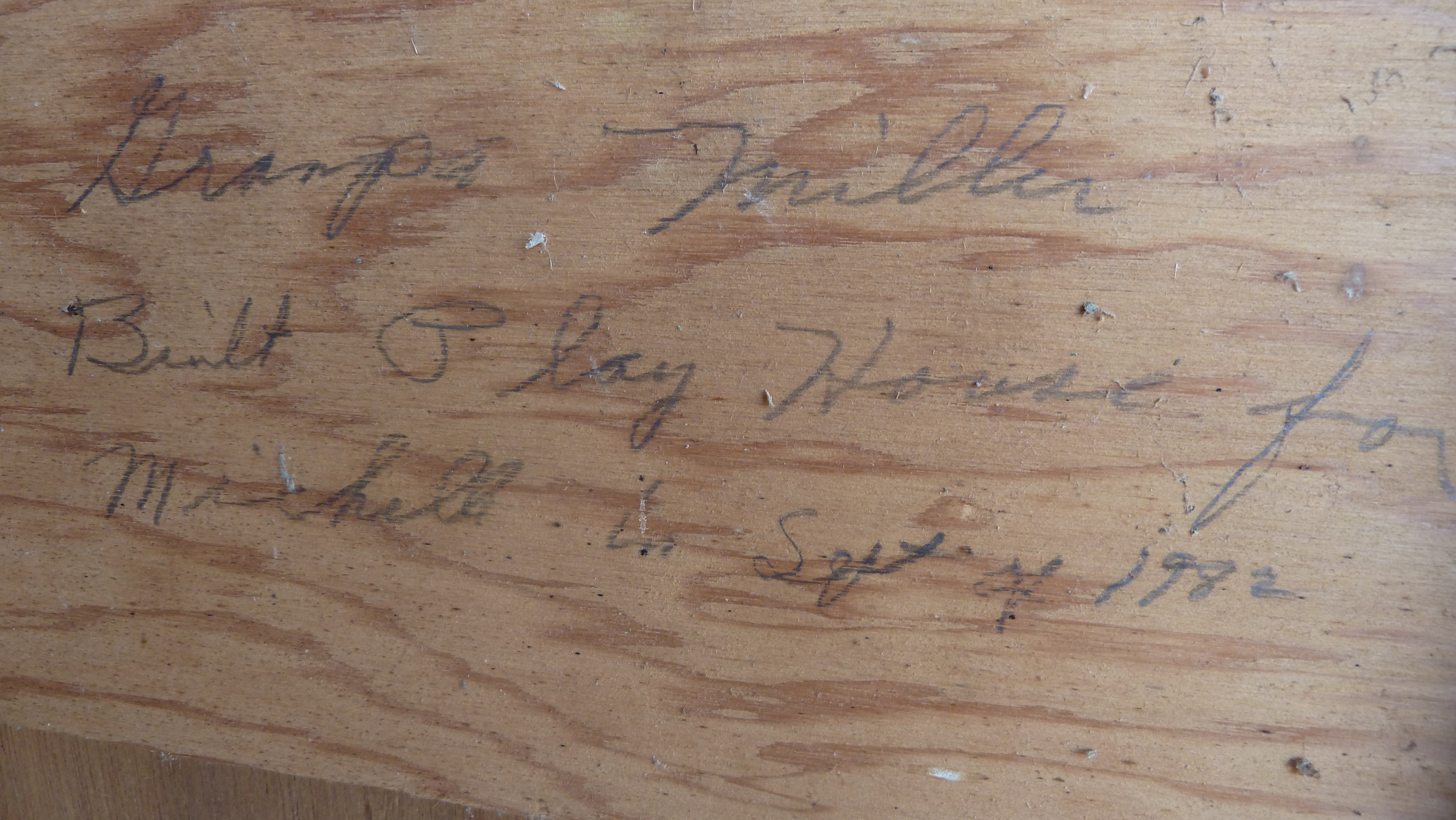
Thanks, two dads.
***
2015 Update. The Third Way archives of Another Way columns are no longer available at Third Way. Here is the column I called “Channeling Dad” which I wrote as we worked on the playhouse, and Michelle’s recollections of playing in the playhouse, “The House that Grandpa Built.”
Another Way for week of November 23, 2012
Channeling Dad
Thirty years ago this fall (September 1982), my dad and mom visited us from Indiana for a week to build a playhouse for our budding family.
Dad was great at building things kids love. In his time, he made an elevated “treehouse” (without the tree for my brother’s sons), toy barns, toy dollhouses, and for my sister’s kids and my kids, a real kid-sized playhouse complete with sliding windows, kitchen cupboards, and a tiny ceramic sink. These creations were not always masterful in workmanship; he tended to sometimes use scraps of things he had on hand, or could pick up cheap at northern Indiana’s RV outlets or the well-known Shipshewana Auction and flea market. Later in life, this hobby became his labor of love—not only for his own grandchildren but any kid whose parents were enchanted by his simple homemade sign: “Homemade dollhouses and barns, ¼ mile.”
This past September, exactly 30 years later, we began the long overdue process of “saving the playhouse” from mold and gradual deterioration. Our oldest daughter, Michelle, took a week’s vacation and came home to get it going. She was the only child we had when Dad and Mom built the playhouse, 17 months old. Michelle had a writing project she was also working on during the day as we began the restoration process, so during evenings we got as far as we could before she had to return to her home.
So the tedious restoration process continues; we were able to move it into our garage to work on it as weather cooled. My husband has been heard to mumble, “I think it would have been less time consuming to build it from scratch.” But most of the basic structure is in remarkably good shape. As we’ve torn apart, hammered and rebuilt, I had to think frequently, “The last person to touch this nail, or handle that board, was probably my dad.” Sentimental, yes. Dad’s been gone now over six years and we’ve all been recalling how in his later years, even getting a simple piece of trim measured just right and hammered onto a piece of wood became a laborious process in calculating, hammering, checking, finding it wasn’t right, tearing it apart, and trying again. That was very sad, and hard to watch.
My dear husband, who has learned most of what he knows about construction by trial and error, has spent many hours studying Dad’s construction of the playhouse and trying to figure out what was in Dad’s mind when he did something one way or another. “I’m just trying to get inside his head,” Stuart said, more than once.
Once Michelle left, Stuart and I continued to remove the vinyl siding. One night he called me out to the garage to see what he had found: a note scrawled by my dad that no one had seen for 30 years. It said: “Grampa Miller Built Playhouse for Michelle in September of 1982.” (Capitalization and spelling his.)
Tears almost came as I thought about him penciling his note in a hidden place: did he know or hope we would one day restore it? Did he ponder the future generations who would find it? Did he know it would settle an old argument, of who the playhouse belonged to among our kids? Not that it was ever an intense argument; they all loved it, but somehow Michelle, being a sentimental chip off her Grandpa’s block, was especially attached, as evidenced by her offer to come home for a week to help restore it to its former days of youthful glory.
We were all delighted by the find and I reminded our other two daughters that no one even knew if we could have more kids. So it wasn’t meant to slight them. No one knew the future. The playhouse was for whoever joined our family.
Our girls, their friends and cousins all spent many happy days and some nights (a few sleepovers with friends) in the little playhouse. More about that next week when my daughter writes a guest column about her memories of the playhouse. We hope the playhouse will serve many more children and happy times to come. Someday.
I have thought more about Dad than I have in years, wondering, as we always do, what our loved ones on the other side of the veil between mortal life and the life hereafter know or are aware of about loved ones on earth. But this we know: Dad, my husband, and others like them, who craft and give their love in these tangible ways, give us gifts that outlast a 30- or even 60-year-old playhouse; they give of themselves.
***
Another Way for week of November 30, 2012
The House That Grandpa Built, By Michelle Sinclair
It sat beneath a towering oak tree, the little white playhouse with jaunty red trim that was the centerpiece of our childhood kingdom. My two younger sisters and I never had video games, horseback riding lessons, or many of the popular toys that kids of the 1980’s dreamed about, but we spent so much time in our backyard we didn’t really miss them. That, and our playhouse was awesome.
On hot summer days, we slid the glass windows open and tied back the curtains to let a breeze circulate through the screens. We swept the linoleum floor with play brooms and “washed” my little metal tea set in imaginary water until someone (probably me) got the bright idea to put sand (from our nearby sandbox) in the ceramic sink. The window above the sink had no screen, which made it the perfect drive-thru window for our fast food operations. If the plastic food was a little sandy (like everything else in the playhouse), well, that was just extra salt.
Over the years, we added a play stove and two doll cribs, which made the interior rather crowded with three growing girls and whatever cat we could trap inside with us. Once, a litter of three kittens disappeared, and after nearly two days of worry, Dad happened to walk by the playhouse and see a little tortoiseshell paw poking from the narrow stove window. We had put the kittens in there while playing, and probably left for dinner, forgetting all about them. At least the kittens were none the worse for the wear. That spunky little owner of the tortoiseshell paw even became the matriarch of our family’s pets, but that day we learned a valuable lesson: kittens don’t belong in stoves.
Games of tag or keep away often ended with one of us darting into the playhouse, slamming the door shut and locking it while the chaser screamed in frustration outside. Then, big sister (moi) figured out you could shimmy the window glass up and reach inside to unlock the door, which lead to lots of screaming from inside the playhouse—and lectures from parents about only screaming when there’s an emergency.
Fall came, and with it, school, and the playhouse fell silent until the weekends, when friends packed it with even more imaginations and laughter. Oak leaves and acorns piled high around the footers. More dishes got washed in sand. Someone made “artwork” to tape to the bare paneled wall on one end, and we dented the top of the stove using it as a chair.
In the winter time, we broke icicles off the eaves, licking them like lollipops. We sledded for hours and then climbed inside the playhouse in an effort to warm up, but our breaths puffed dense and white indoors with no breeze to blow them away. The house might have looked like the real thing, but it had no warmth without children inside.
Friends came over in the spring, eager to play after so many months cooped up inside. We’d stand in the doorframe, hold onto the knob, and swing outside to shout ideas at each other without actually stepping onto the grass. Before long, I had to stoop to stand inside, but that didn’t keep me from playing. I just moved around on my knees.
We had mini-restoration projects over the years—fresh paint for the trim, a good scrub-down inside to get the years of sand out of the sink and countertops. When we were teenagers, my best friend Becky and I made all new curtains and spent the night on the playhouse floor with our sleeping bags stretched into the open cabinets. We strung up a florescent light powered by one of Dad’s trolling motor batteries, and ran our CD player on D-cells, singing along to music while Mom and Dad marveled that the old playhouse could still work its magic.
The playhouse doesn’t sit under an oak tree anymore—it has moved to my parents’ new backyard. The artwork and curtains are faded, the dishes a bit rusty and strewn across the cabinet floors. All that remains of the stove is an oxidized streak on the linoleum floor, but we hope to get most of that cleaned up, too. It’s time for the big renovation project, (see last’s week’s column about renovation: http://www.thirdway.com/aw), time to buff away the scars of thirty years of love and neglect so that a new generation can hang from the doorknob and shriek like little savages.
That’s because a playhouse isn’t just a building; it’s a safety spot in tag, a backdrop for catching fireflies, a jail, a cat pen, a restaurant and bank. It’s a house. It’s a marvelous framework for young imaginations that need only a little nudge to run circles around the most advanced video game on the market. The smartest toys are open-ended, and the best ones are given with love.
Our playhouse is both. Thanks, Grandpa.
Finding Harmony Recipe of the Week

We’ve had glorious weather this week in Virginia:
the night air brings a bit of a nip
the first tinges of red and gold tip the trees
my thoughts turn to warm fall soups.

If you have any butternut squash lying around or available at your farmer’s market, today’s recipe was brand new for me when I first made it two years ago. It was a stretch because I had never messed with a butternut squash, figuring it was as hard to peel as a pumpkin, a chore which I hated. But the Internet came to the rescue when I found a tutorial, giving step-by-step instructions on how to peel the butternut squash, which I’ve kind of duplicated below with my own photos and steps.
But first a story from my oldest daughter at her first job away from home clerking for our local Food Lion when she first encountered butternut squash.
Michelle retells the story in her own words:
An older woman came through the line with a new funny looking vegetable and I knew I had to type a code into the computer for it. So I picked it up and asked her what it was (so I could look up the code). She seemed a bit surprised that I didn’t recognize it, but said “Buttuh-nut Squosh” with the rounded vowels of a good British accent. I couldn’t make out what she said so asked “what?” and she very kindly (and amused I’m sure) repeated it. I’m usually pretty good with English accents, but I had never in my life heard of butternut squash, so the sound wasn’t immediately recognizable. I sort of sounded out the syllables into “American” and flipped through my code book until I could match it to Butternut Squash. And then of course I proceeded to see the word and the vegetable everywhere, as these things go.
The recipe for the soup comes from the kitchen of Rebecca Thatcher Murcia, a writer who supplied recipes for the radio program I used to help produce, Shaping Families. She describes its source like this: “A friend gets a recipe out of a book, makes some changes and sends it to you. You make more changes, and it becomes ‘your’ recipe. So it comes [as many of the best recipes do] from the hands of friends.”
First, here’s my own tutorial of peeling the squash (the blue band just means I donated blood that day, and when I was a few pounds heavier, I have to add):
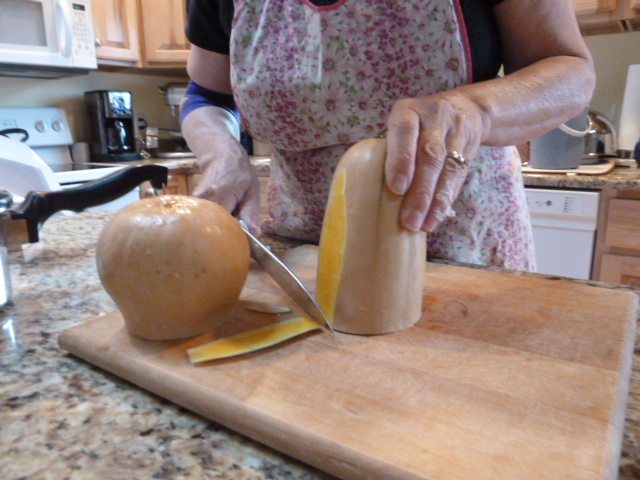
First, cut the stem from the base, then proceed to peel each side by holding the stem upright and with a large knife, slice down to the cutting board.

Keep going.

Cut/peel the sides of the bowl too, and then scoop out the seeds.

Slice the neck of the squash into 1/2 to 3/4 inch rounds, then dice to cubes.

Cha ching! Nice cubes, to cook down into soup.
Butternut Squash Soup
Ingredients:
1 butternut squash, cut in chunks
1 large onion, cut into chunks
several cloves of garlic (to taste)
1/2 (or more) of a sweet pepper
4 cups water or broth
2-3 Tablespoons tomato paste
1 teaspoon allspice
2 teaspoons curry powder
½ teaspoon basil
Sauté squash, onions, garlic and sweet pepper in olive oil about ten minutes or until the onions look pretty well cooked. Add water or broth, tomato paste and spices. Add salt and pepper to taste. Boil until veggies are soft. Puree. Return to low heat. Add milk or cream until soup is the consistency you like. May add more salt if needed. Parsley and cream make attractive and tasty toppings.

See the index of more Shaping Families recipes here.
Also find many many tasty recipes and Mennonite cookbooks here.
Were you ever embarrassed by what you didn’t know about foods, or what your mom or dad failed to teach you, or things you never learned to like? I’d love to hear your stories.
When news started pouring out and newscasters and the blogosphere started spewing about chemical weapons being used in Syria and what would Obama do now, I was struck by the Old Testament stories I was currently reading on my way once again through the Bible. (I go real slow, I’ve been on this read for about two years.)
In Kings II, chapter 5 we read about Naaman, commander of the Syrian army, highly respected and esteemed by the king of Syria, who came down with leprosy.
Hold it, I thought, is this the one and the same Syria as today. Bingo. In approximately the same position on the biblical maps as on Google Maps.
Actually the books of Kings I and II are filled with stories of wars and attacks and counter attacks involving Syria, and of course the Israel of the time.
Elisha the prophet is consulted (a little girl’s idea) about Naaman’s leprosy and he sort of brushes off the malady with a flippancy undue the dreaded disease, and also ignoring Naaman’s station in life. Elisha sent his trusty servant to deliver the message: “Dude, just go wash in the Jordan River and you’ll be fine.”
If you’re reading this I suspect you well know the rest of the story, that Naaman thinks he’s too good for a dip in the dirty Jordan and why couldn’t Elisha have the decency to come out and pray with him for pity’s sake. In the end, Naaman does what Elisha suggests and he’s nicely healed. Elisha goes on to make axheads float (chap. 6, v. 6-7) predict the end of an economic downturn (chap. 7, v. 1) and foretell catastrophic climate change (a long famine, chap 8 v. 1) among many other supercool deeds and predictions that earn him the rep of a Class A prophet. (The poor widow for whom Elisha arranged a running supply of household oil (first oil well?), the rich woman of Shunem who built the little room on top of her house so he’d always have a bed and breakfast.)
Send that man forward to the 21st century. What would Elisha say to the leaders of Syria and Israel and the U.S.?
I have no idea but I do know he would speak truth and that he had access to one superpower that we too possess: the power to pray and to pray often, even when we cannot imagine a solution. I also know that too often we fall into the same weaknesses of going astray by worshiping other gods.
I was reluctant to write on this feeling inadequate but for someone purporting to find harmony in all of life, I was struck by the ancient stories of Elisha and relating to this context.
Wiser political pundits than I (which I don’t claim to be at all) have pointed out the irony of a Nobel Peace Prize winner so seemingly devoid of ideas that a military attack—when the most recent conflicts haven’t even totally ended—is the best idea we can come up with? Some modern Elisha’s like Sheldon C. Good speak out and have written this, urging longterm solutions and holding our leaders accountable. Mennonite Central Committee suggests contacting legislators with lists here. One Mennonerd blogger has suggested at least praying every noon. I’m signing on.
***
For more of my checkered family history regarding peace/pacifism across three generations see here.

(Image Provided by Classroom Clipart)
What is your tried and true method of dealing with poison ivy and its cousins? I have just found a very cheap and almost ubiquitous remedy that eases the itch right now and you can find it anytime you walk in a store, at checkout counters, heck, even on the pulpit at church.
I’ll spare you pictures of my current rash and allow webmd to provide the real facts and pictures of the main three poisons, ivy, oak and sumac, if you are not well acquainted. (And if you really want pictures of bad cases, here is a page, and yes, I’ve looked some of these at various times in my life.)
Over the years I have had my share of poison oak and ivy, usually getting it at least once a year, sometimes twice or more, no matter how careful I am. Right now I have something itchy that is probably poison ivy but it started as a very light case and spread. Checking out the pictures of poison sumac just now, I may have had contact with that as I’m not as tuned to looking for that.
Everyone who gets any of the poison rashes is an expert: what to look for, how to avoid infection if you come in contact, how to treat it, what creams to use and so on.
My first ever case came the summer I was 13 and my family traveled out west. By the time I got home I was breaking out with a mass of horrible hard blisters and an oozing orange gunk. I think it got so bad because I scratched it so much, never having encountered it before and I was the first of my siblings to get it. Another time it spread so much and so deep that it got in my blood stream with hard lumps at my groin. But I think the scariest case was on my face when I didn’t realize I had come in contact. Once poison spreads to your eye region, you better get to a doctor, fast.
I have appreciated when physicians have given me a shot to help control symptoms (I’ve never found a doctor willing to give me shots to prevent me from getting it, although I’ve heard people say they’ve gotten such shots); it seems like the “after-contact” shot given as treatment for a really bad case has provided some protection for a while after—like I have gone a year or two without getting it, but maybe it was just because I didn’t come in contact with the dreaded three.
Every home where I’ve lived as an adult has had poison ivy growing on the property, and while we spray it with Clorox and stronger stuff, my analysis is, you don’t really get rid of it, you can only try to control it.
The best way of course is to avoid contact. The second best solution if you suspect you have come in contact with it is to wash within 2-6 hours with a mechanic’s gritty scrub such as GoJo to remove the oil from your skin in case you’ve come in contact. I have used GoJo anywhere I think I came in contact with it, including on my face.
In my long journey with various poisons, I now end up with it only if don’t know I’ve come in contact with it. In the beginning the methods of itch control and “cure” has included everything from your basic pink calamine lotion (ugly and not very effective) to bathing in baking soda (messy and not very effective) to Ivy Dry liquid or cream (messy and not very effective) to over-the-counter-cortisone type cream, to prescribed creams like Betamethasone, the last two being the most effective for me.
The treatments that I like best, if despite all this I still end up with it, are simple and cheap. I will now share the amazing find, passed on from one of my husband’s work colleagues and he can’t even remember who it was: Just try an antibacterial cleanser on it. It almost immediately eases any itch and seems to dry out the rash very quickly. If you have open sores, it will sting a bit. But it’s cheap. And yes, my pastor keeps it on the pulpit for washing hands quickly before she handles the communion bread.
This may not seem like a “Finding Harmony” post but when you’ve got poison, you ain’t got much harmony so finding ways to control and combat it sounds like harmony to me.
You read about this treatment here first. Let me know if it works for you.
If you want more help in identifying the various leaves when you are hiking or elsewhere, try the T-shirt!
Today begins a new feature at Finding Harmony Blog—a weekly Friday recipe. I have duly noted that blogs offering quality recipes get higher views and shares. We are all so busy that it’s nice to get something useful out of a blog so I hope this becomes a reliable place for regular recipes from a mix of traditions—in keeping with my theme of finding harmony among all things …
The traditions might be …
Mennonite, Presbyterian, Southern, Northern, Lunar (just kidding).
Whether you’re a locavore, omnivore, carnivore or carnival-ore (just guess)
Whatever your thing: my motto is just get ‘er on the table. Keep eating together.

This also kicks off a countdown to (no I won’t put one of those frightening counters on my blog counting the minutes and seconds—they give me a panicky fright) encouraging folks to celebrate and keep family dinner because of all the good things eating together fosters. (That I go on about yadda yadda in my book, Whatever Happened to Dinner.) I’m lining up some other writers and bloggers for a week of special blog posts giving fresh ideas on how others enliven their food preparation, meals and fellowship around food: a food swapper, a supper clubber, a self-confessed group of nerds who come together to eat and play board games and more.
I’m also kicking up my commitment to this blog a notch and while I’ll continue to write on a variety of topics—inspirational (I hope), faith-related, family reminisces, local color stories, book reviews, and soon, Grandma stories (hoping!) and more—every Friday I’ll try to have a new recipe to share and illustrate.
Here’s an easy summer salad that is great for using up the bounty from gardens about now or your veggie refrigerator drawer or your CSA (Community Supported Agriculture) box:
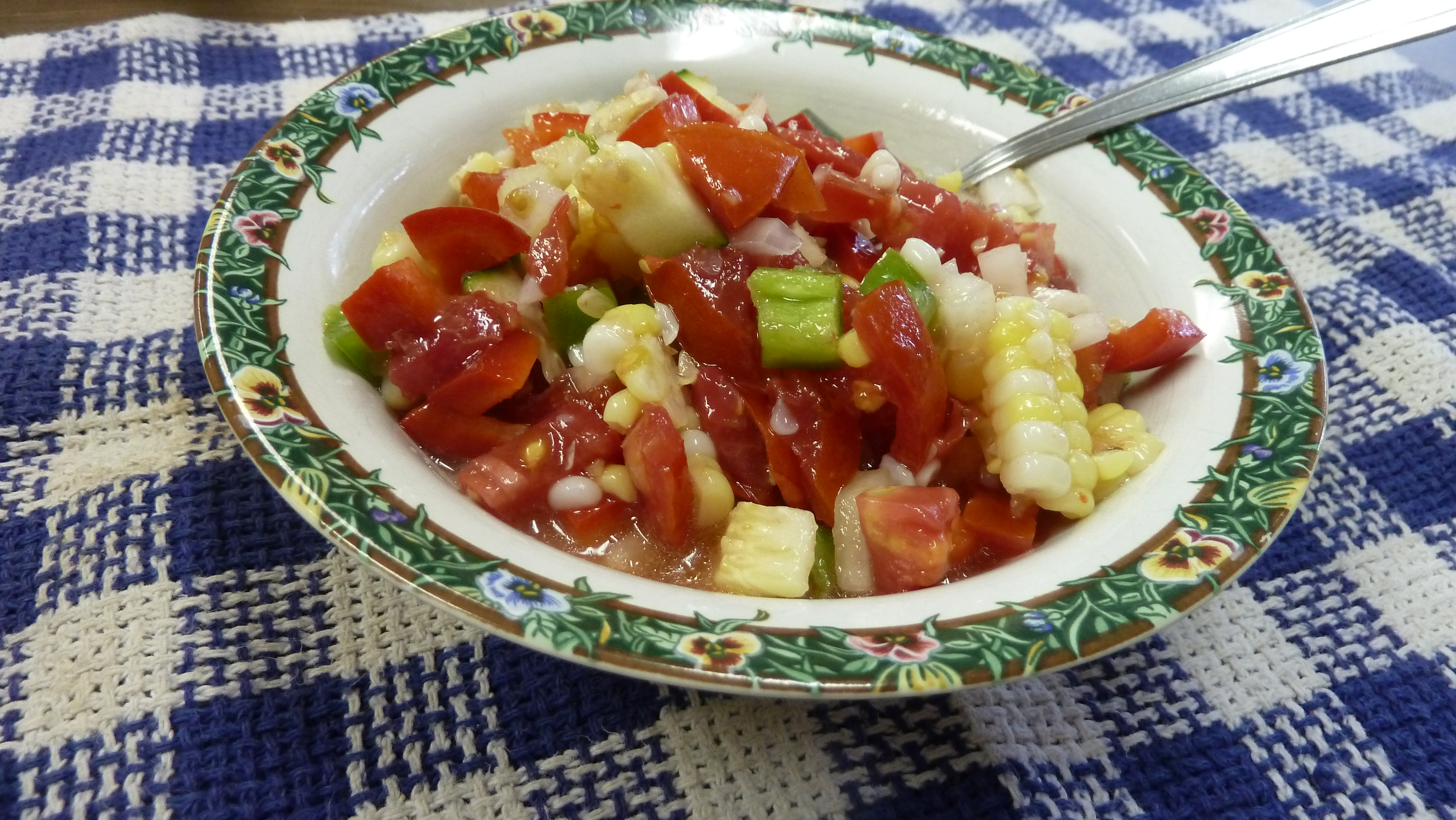
Simple Summer Garden Medley*
Wash and dice equal amounts of : (add or delete according to your supply on hand or tastes)
Zucchini
Yellow squash
Tomato
Cucumber
Green pepper
Red pepper
Add chopped onion to taste. Stir in 1-2 cans rinsed black beans and/or 1 quart corn. (If adding fresh corn, be sure to cook and cool it—great for using up those extra ears of corn you make for a meal but everyone is too stuffed to eat.) Add 1-2 cups Italian dressing and stir. (For just a small batch, try ½ cup quantity of each vegetable and ½ cup dressing.) Chill two hours or longer. Can be made a day ahead. Guaranteed to disappear at your next potluck or family reunion! It can even sit out at a picnic for a couple hours without too much worry of ruination.
 Good way to use up the 1-2 leftover cooked ears from corn on the cob.
* Kid friendly to make and eat. As soon as your kids can safely handle simple knives, set them up with a cutting board and knife and let them chop away, under supervision of course. My kids always loved foods they helped to make. Also makes a great salad for kids starting to eat solid food on the BLW or F (Baby Led Weaning or Feeding) plan. Yes, Grandma-to-be is getting up to speed on current issues in child rearing and will have a book review soon!

(Two demerits on me for not knowing where I got this recipe; it’s in my recipe box without attribution but probably came from an email or staff newsletter that I printed and copied and trimmed off all the source notes. There are many similar out there and I doubt anyone can claim originality but if you gave me this recipe, particularly with the note “Guaranteed to disappear at your next family reunion” which was part of the original let me know and I’ll send you … something.)
Many recipes similar to this in Simply in Season cookbook. This is a newsy page with more info on Simply in Season, soon going for another reprint.
“You’ve got a new cat,” I say upon seeing a beautiful black and white mixed feline—almost like he/she was dressed in a tuxedo.
“Yeah … Beatinst thing I ever did see,” our former neighbor, Charles exclaims. His eyelids thicken and he swallows hard. “When Molly died this’un came over and curled up on the grave I made for Molly, then came in and slept with me on the bed,” he said slowly, pausing when the lump in his throat overcame his speech. We had moved about six miles away seven years ago but still try to check in with Charles as often as we can.
“Molly died?” we both asked, saddened and ashamed that we had totally missed this important passing for Charles. For months we had discussed who would be more bereft if the other died first: If Charles (in his upper 80s) died first, he had made it known to us that he wanted Molly put to sleep and buried in his casket with him. If Molly died first, we knew Charles’ heart would again be broken.
So Molly died at the foot of Charles’ bed on Father’s day. Certainly Charles had been a “father” to Molly and Molly a much-loved child for Charles. “I bought her a casket, made a grave and a stone out there along the drive,” he motioned with his head. The dear man was nearly blind, now on oxygen 24 hours a day. “Gets kind of monotonous” he said of the tank, “but things could be a lot worse.”
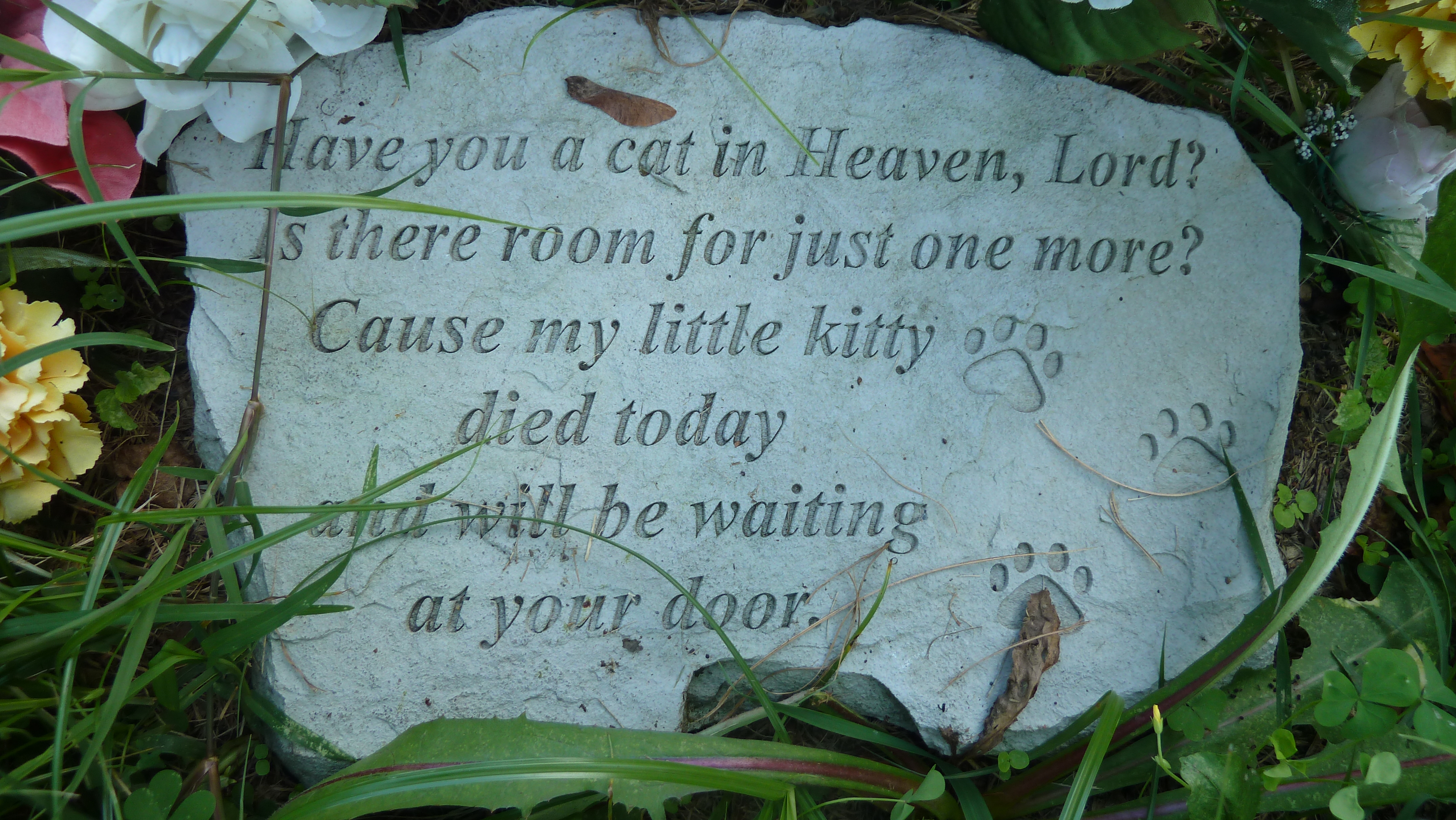
Molly’s gravestone
That Charles can say that is truly a tribute to his steadfast faith. A lifelong Baptist, Charles has had more “lives” than Molly, surviving various heart ailments and near death episodes.
His wife died about ten years earlier, and their companionship had faded away with her increasing Alzheimer’s, but he had cared for her until she succumbed to heart issues. His most steadfast phone caller now is his 60-something step son with mental disabilities, who lived in a group home. A nearby neighbor and family are faithful helpers who stop in a lot.
So Molly had seen him through all this and more. Many a time when we’d go to visit, Molly would be curled up beside him on his bed, arm chair foot rest, or outdoor glider, and Charles would caress Molly’s head endlessly.
But now Molly was gone. I asked what the new cat’s name was. “I just call him ‘Tommy,” he said with a laugh. Tommy had moved in as a temporary resident at the neighbor’s house, but the cat stayed when the man moved on. The new cat came down and made friends with Charles, and tried to make friends with Molly.
“He used to come in and try to play but Molly would bat him,” Charles explained. I could see the scenario in my mind. But with the marvelous sense that animals have, after Molly died the cat must have sensed there was a newly open slot in Charles’ heart.
We were happy that Tommy moved in when the time was right. And marveled that Someone was watching out for Charles’ needs, who we pray for almost every day, especially since my husband’s work schedule currently doesn’t allow us to visit nearly as often as we should or want.
Isaiah says, “Before they call, I will answer; and while they are yet speaking, I will hear” (65:24). The writer of Philippians says “My God shall supply all your need according to his riches in glory by Christ Jesus” (4:19).
That night I thanked God for Tommy, and I know Charles does too. R.I.P. Molly.
***
More on Charles & wife: Earlier I wrote about Charles’ wife Letha and her cookbook collection he passed on to me. And in my Another Way newspaper column I wrote a tribute to Letha here.


