

Another Way for week of August 14, 2020
Pandemic Pings: Are You into Canning?
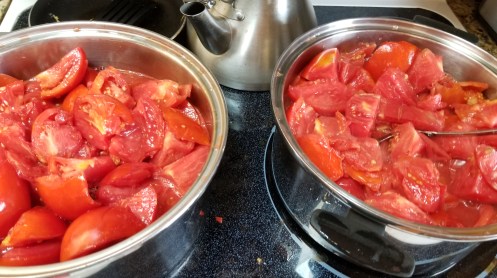
I get our pressure canner out that my brother-in-law gave us for Christmas when we first started a garden. What a great, long lasting gift. It has served us forty-plus years now.
What would August be without canning vegetables to have on hand for the winter? (I don’t can fruits but well remember when mother and grandma did.)
I gather up other items I need for the rather massive and messy project: canning jars, lids, strainer and pestle for squeezing out the tomato juice, scores of large pans or Tupperware, my largest popcorn bowl, salt, a small pot for boiling lids and keeping them hot, digging up the propane fired burner we use outside. Too much to name here.
Making tomato juice is kind of fun (especially for kids) and easier than canning tomatoes themselves. When canning quartered tomatoes, you of course have to get the skins off the ‘maters which involves dipping them in boiling water for 30 seconds or so, then cooling them quickly in ice water (in a spanking clean container), then taking a knife and sliding off the skin or peeling, then cutting them up in quarters to be placed in the sanitized quart jars.
All of this is much easier now that I don’t have to can at the end of a busy and tiring work day. Or doing so with wee ones underfoot.

This year I’ve read that more people have tried their hand at growing their own vegetables, especially in light of the pandemic. I also heard an amusing aside regarding a woman who asked at a store if they had canning jars and the young clerk looked puzzled and said she’d never heard of canning jars.
I hunted widely (by phone and in person) for canning lids on shelves of hardware and grocery stores. Finally, I landed some oddly packed regular sized blue canning lids made by Ball in a store called Jon Henry’s General Store (as old fashioned as it sounds). The canning lids were in little bags, not boxes: I speculate that perhaps some manufacturer was able to produce the lids but didn’t have boxes on hand to meet the demands? Anyone have insights or info on that? Later I did land some traditionally boxed wide-mouth lids at our local hardware store.
Once the jars of juice are lifted from the canner and allowed to cool, the lids give me the satisfaction of a pleasing ping, telling me my efforts panned out: they all sealed, always cause of deep satisfaction.
A niggling unease, though, rises in my psyche: what might we face in years to come in terms of shortages, rising prices, lower incomes. A pandemic of this scope was normally only the territory of doomsday or dystopian novels—and a few epidemiologists (those with expertise on disease epidemics). A worldwide reckoning with a virus was never seriously on my horizon. So what will our children and grandchildren face and experience?
That’s when the legacy of family traditions—like the labor of late summer canning and freezing vegetables and fruits can feel like a source of strength and pressing on. If my parents and grandparents got through the Depression—and even the flu of 1918, World War 1 and 2, Vietnam, Korea and more, it gives us courage to face our fears and doubts. The strength of faith, community, and family remind us that we are not alone. Even if confined to a room in a nursing home. As time goes by in this time of fighting covid infection, some of the early examples of caring for each other (such as the daily music from apartment balconies in cities in support of health workers) fade away with the sheer dailiness of pandemic reality.
My worried wondering can rest in the arms of a God who cares for us all, who reaches eternal arms around us to comfort and sustain us for all time, even when human or medical efforts fail.
I have two free pamphlets I’d love to share with anyone who needs them, “Journeying Through Loneliness” and “Losing Someone Close.” Request for yourself or a friend. Write to anotherwaymedia@yahoo.com or Another Way Media, P.O. Box 363, Singers Glen, VA 22834, or comment on the blog.
Another Way is a column by Melodie Davis, in syndication since 1987. She is the author of nine books. Another Way columns are posted at FindingHarmonyBlog.com a week after newspaper publication.

Yummy and versatile Bread and Butter Pickles
I could have sworn (but that wouldn’t have made my mother happy) that I had shared my husband’s Aunt Edith Mitchell’s awesome recipe for making a particular kind of bread and butter pickles that include onions plus sliced green and red peppers in the mix. It’s the one pickle that I make almost every year, to keep my shelves stocked with a go-to base which I must have in making both potato salad and deviled eggs.
So I searched my blog and it was nowhere to be found.
Here we’ll correct that oversight. And by the way, another pickle canning recipe for Sweet Midget Pickles on my blog is currently the most popular blog post here. It brings scores of new visitors to my blog every day and is keeping my stats up all summer long. In fact, recipes are my bread and butter for this site—the top 7 or 8 view-getters here. Not that you really care. But it (and they) make me happy. (And see my background story for this recipe at the end.)
Aunt Edith’s Bread and Butter Pickles
1 gallon medium size cucumbers
8 small white onions
1 green pepper
1 sweet red pepper
½ cup salt
cracked or crushed ice (about 4-6 cups)
3-4 cups sugar
1 ½ teaspoons turmeric
½ teaspoon ground cloves
2 Tablespoons mustard seed
2 teaspoons celery seed
3 cups apple cider vinegar
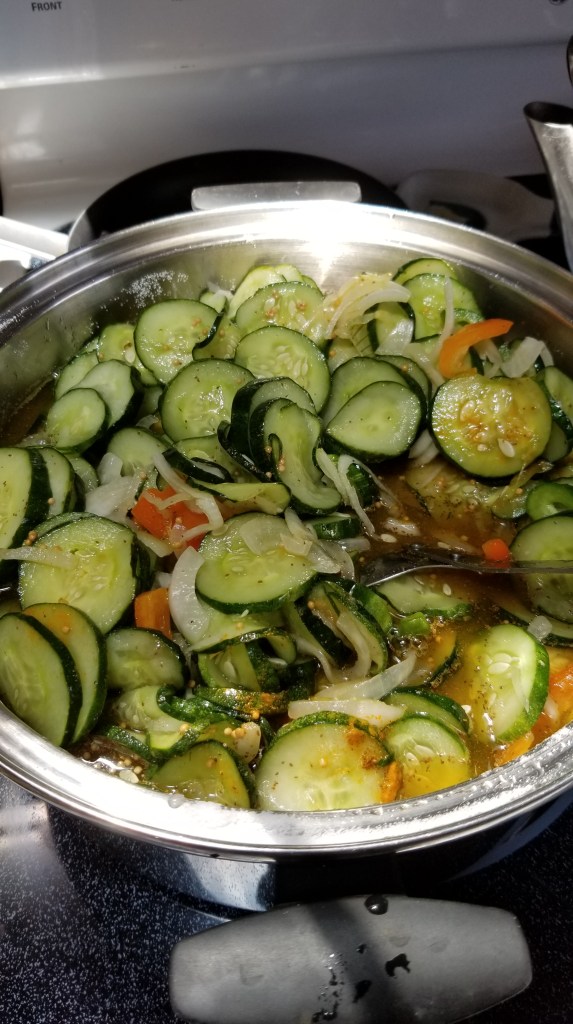
Slice cukes (just leave peeling on), onions, and peppers (in strips). Cover with cracked ice and salt in large stainless steel bowl (could be ceramic or glass, not plastic). To make cracked ice, I put ice cubes in a pillow case or sturdy plastic bag and put on garage floor (or other cement surface) and beat with a hammer to make cracked ice. Let stand for 3 hours. Drain off salt water. Put all other ingredients (the spices) over cukes. Put in 5 quart pot and bring to a boil, turn down heat and cook till the mixture and cukes turn color (brighter green/yellow). Pack in jars (not too full) and put on sealing lids. These will seal themselves, they don’t need to cook again or go in a pressure canner. Do wipe off the the syrupy stuff from the tops of your jars before you put on the lids and rings.
Makes about 10 pints. Enjoy more history below.*
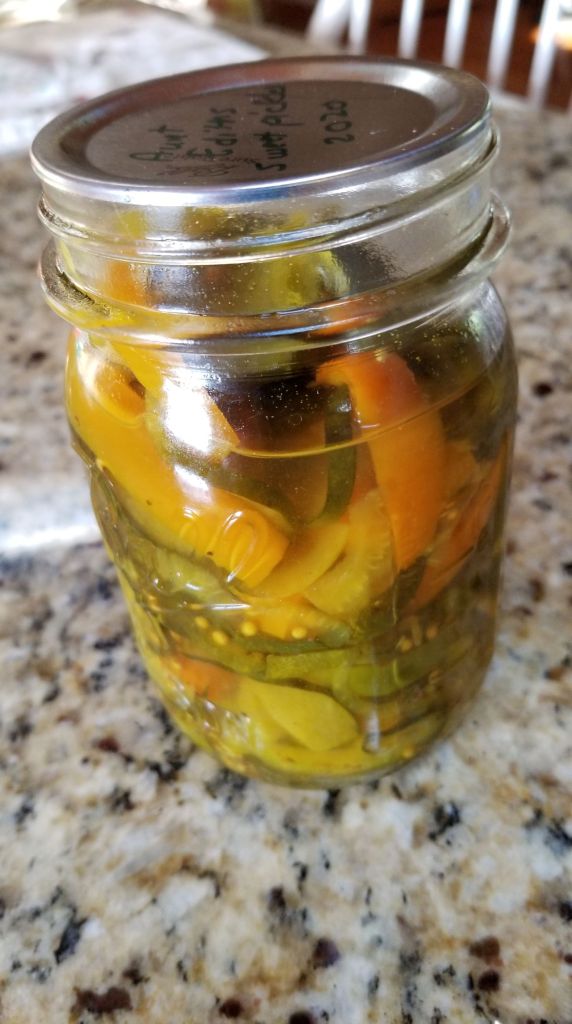
To use these pickles in a potato salad or deviled egg recipe where relish is called for, I take a small amount of pickles (juice, onion, pepper strips and all) and chop them in a chopper and add to whatever I am making.
And there you have a bread and butter pickle recipe for the section of my blog that is its traffic “bread and butter.”
Hint: Last year I made the mistake of peeling the cucumbers. Meh. Just don’t. The peelings add healthy vitamins and after I opened the first jar of these pickles last year, I realized that peeling them weakens their structure and makes them limp in the jar of pickles. But still useable.
*Deep background for this recipe:
Aunt Edith was like a second mother for my husband, because his own mother had severe rheumatoid arthritis, crippling her at far too early of age. She and another aunt, Ressie Robinson, would take turns going to the Davis household to help Estella with cooking, cleaning, and certain major chores—like making pickles, canning tomatoes, beans, and much more. I never had the privilege of knowing my husband’s mother: no mother-in-law, ever. My loss. But my husband tells me that this may have actually been his mother’s recipe. [Cousins: do you know??] Whatever the case, it is my favorite pickle recipe, even more than the aforementioned Midget Sweet Pickles.
***
What’s your favorite kind of pickles? I would love to hear! Or share a recipe.
Or do you like raw only?
Another Way for week of August 7, 2020
Is the Bible Better than a Novel?
I’ve read several books by Walt Wangerin Jr. He is a notable and excellent writer in many genres from children’s literature, to marriage helps, to Bible and theology. Back in early 2001, for a documentary my office did called “Journey Toward Forgiveness,” I helped line him up to share a true story of how one dear woman coped with her anger regarding her husband’s cancer.
So I was anxious to dig into this book titled The Book of God: The Bible as a Novel, published in 1996 that I found at a Gift and Thrift shop.
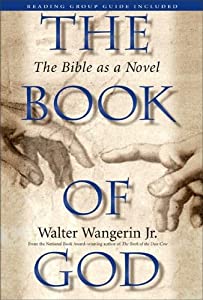
I would recommend it highly to anyone wanting a great overview of the whole Bible: as much drama, great characters, gore of war, romance, torture and ultimately humor and glorious triumph as any novel on a bestseller list. No matter what you believe or don’t believe about God, the Bible and its characters and stories are still a book all should be familiar with, to be well read and informed.
Wangerin took the basic stories of Bible times, dug deep into background and details to help us understand the setting, traditions, and geography, and makes it all come brilliantly alive and personal. I’ve read the Bible through several times but not for a number of years (I know, shame on me). But this reading rejuvenated and restored my faith in God and Jesus—especially during these difficult days of 2020. The book was a page turner in its own right. Currently, Wangerin teaches literature and creative writing at Valparaiso University, Indiana.
Several snippets are worth the price of the book and tackling the very long 850 pages.
–Wangerin’s wonderfully fictionalized version of the birth of baby Jesus: very real, touching, a marvelous snapshot of what it might have been like for Mary and Joseph. I also loved Wangerin’s rendering of their courtship, about which the Bible doesn’t say much.
–In a similar vein, Wangerin gives a very human and down-home description of how the childless and elderly Zechariah and Elizabeth might have conceived the baby whom the angel Gabriel predicted (John the Baptist). I won’t spoil Wangerin’s version by sharing it here (p. 574).
–Some of the lines are poetically powerful as he describes the southern kingdom of Judah (think King David, Solomon, and more). Wangerin writes (personifying the country as a male), “[Judah] had always been poorer than the northern kingdom, his living more austere; but that which impoverished him also preserved him” (italics mine). That can speak to all of us no matter where or how we live (p. 439).
–On the stomach-wrenching side is the story of King Zedekiah who reigned over Judah and was forced to watch his sons’ executions (p. 485). Cruel and horrible yes: I could barely read it.
In this novel as in the regular Bible, the New Testament is where God’s overall plan to send a Messiah to the world soars to inspiring fruition. Jesus and his disciples almost literally step out of the book and become real men and women. Wangerin gives good play to the significant female disciples who were not counted in the “twelve” but nevertheless played key roles in the stories that are described. The conversations between forlorn disciples in the Upper Room after Jesus has died are again worth the price of the book (if you can’t find it in a library).
Wangerin is careful to point out that “This is not the Bible. It is a novel featuring many of the Bible’s most dramatic characters.” I will add that it does not attempt to be a complete paraphrase like Eugene H. Peterson’s The Messenger, another very readable text. Again, The Book of God is quite gruesome in some descriptions, so it may not be appreciated by some.
But the overall spirit of the book was just what I needed during this difficult time of doubt, anxiety, and current worries. It left me surer than ever that the God and Jesus story—I should say bonafide history—is something to stake your life on.
***
Have you read any books by Walt Wangerin Jr.? Which is a favorite?
What is your favorite book of the Bible overall? Why?
Comment here or send to anotherwaymedia@yahoo.com or Another Way Media, P.O. Box 363, Singers Glen, VA 22834.
Another Way is a column by Melodie Davis, in syndication since 1987. She is the author of nine books. Another Way columns are posted at FindingHarmonyBlog.com a week after newspaper publication.
Another Way for week of July 31, 2020
People: Not Disposable
I remember a term from my days growing up on a poultry farm: “culls.” Those were very small or sickly hens that Daddy would put aside and actually butcher for our own use.
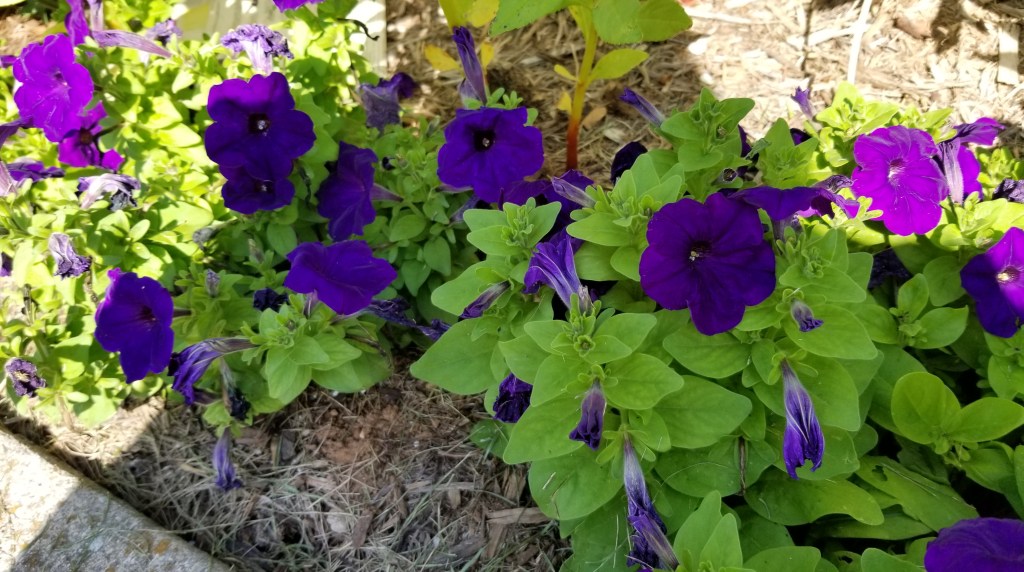
Recently I faced a silly but still difficult decision for me: culling out the volunteer petunias from pots of petunias I had on my deck. Somewhere in early May, I noticed hundreds of volunteers sprouting: simply too many to grow well. I knew I had to get rid of some of them in order for the rest to thrive. And of course, it is very difficult to transplant just a tiny seedling.
Facebook friends gave helpful feedback about what to do with my plentiful petunias. They didn’t agree on whether to just “let them be,” or be proactive and make room for the healthiest plants to mature rather than letting them all get pot bound. But I hated the idea of tossing so many delightful plants.

I tried pulling out the tiniest starts, no bigger than a trimmed fingernail. I also took the larger and hardier looking plants and with a small digger, moved them to a flower bed in front of my house. After transplanting about a dozen, the pots on our deck were still fairly full. I probably threw away a hundred teensy starts. I was not happy.
But pruning and culling can be a healthy thing for a flock of chickens as well as a basket of volunteer petunias. In several places, the Bible reminds us of the need to practice the art of self-pruning.
Gardening often makes me reflect on life and growing things, especially so this summer. I guess culling is hard because for too many in the world, people are dispensable whether they are sick, old, unborn, the wrong color, the wrong abilities, brain injured, even the wrong occupation. Each precious life deserves their place in the sun to grow and be pruned and nurtured into all that God meant them to be.
We have been at another difficult reckoning this summer on the racism that continues to infect and affect so many. I was interested to read about folks at Landis Homes in Lancaster, Pa., (a retirement facility) who wanted to make sure their hearts and minds were represented on the issue of working to become an anti-racist world. Back in June, my friend Larry Guengerich, shared a post relating how a number of senior residents desired to find a way to join a public vigil in support of George Floyd’s family and in recognition of others who’ve died unjustly. But because of pandemic restrictions, they couldn’t. So they put out word that a silent vigil was to take place at the same time at an outdoor space on their own campus. Around 80 residents and staff gathered, (keeping physical distance of course), for nine minutes of silent reflection, witness, and resolve. They also signed a card for the family of George Floyd.
“The purpose was to silently express anguish about what is currently happening in our country, in solidarity with those who were gathering in Lancaster,” the post noted. In addition to the silent time of reflection and prayer, this event also elicited heartfelt comments from other residents at the retirement center. One resident, Don Tyrell, said he participated because he believes in what the Declaration of Independence, the Constitution, and the Bill of Rights say about equality, life, liberty, and freedom. “I’m protesting because I see these values being ignored, reviled and cast aside by too many of my fellow Americans.”
Each and every person is precious in God’s sight. Rather than culling out persons and demeaning them or even hurting and killing them, practice looking at each person you see or meet as a child of God. They may not be Christian or believe like you do, but God created and allowed them to be brought into existence. Let us nourish each other as young plants. Let us do rigorous self-pruning—weeding out the bad thoughts and attitudes in our mind, and the prejudice and racial hatred that is still lurking in and around us. We each have room to grow.
***
What have you had a hard time pruning in your life?
How do you work at considering each person as a child of God?
***
Comments here or write to anotherwaymedia@yahoo.com or Another Way Media, P.O. Box 363, Singers Glen, VA 22834.
Another Way is a column by Melodie Davis, in syndication since 1987. She is the author of nine books. Another Way columns are posted at FindingHarmonyBlog.com a week after newspaper publication.
Another Way for week of July 24, 2020
Thoughts on this Summer of the Pandemic
What are you missing this summer?
I miss the lawn parties. The savory fried chicken, a freshly cooked hamburger and fries, and playing a round or two of Bingo while listening to mostly country or blue grass or even bad karaoke. In our community, a different civic group, rescue squad, or fire department take turns putting on an annual “lawn party” almost every weekend all summer. The events function as huge fundraisers but also entertainment. We usually are regulars and enjoy yakking with friends and neighbors.

I will miss going to local fairs, admiring and comparing the garden and canned goods, browsing through the photo, craft or art entries by kids and teens who’ve done prize-winning work, cruising through the animal barns, ending the evening enjoying a freshly made funnel cake or melting ice cream cone.

We will miss a summer family reunion, the potluck lunch, the catching up and comparing babies while running after toddlers playing in the church gym where the meet up is usually held.

I miss visiting my friend Martha in the nursing home where we used to play Bingo many Friday mornings. Well, she sat there, I played. She is now quarantined along with everyone else: no guests, no visitors, can’t even send flowers. I write cards and pray for her. But I’m glad Jackie and Charles are no longer suffering in that same institution. Oh. So. Glad. Lock down would have killed Charles anyway.

I miss not feeling free to take a plane or train and go visit my mother or sightsee; but at least we can drive to Mom’s, being careful about restrooms and gas pump handles.
I miss going to our favorite restaurant. Sitting in your car in a hot parking lot eating Wendy’s carry out is just not the same as sliding onto a cool restaurant seat, ordering, waiting, being served water or drinks, and not having to clean up your table and kitchen afterwards.
I miss going to church: the weekly ritual of dressing up a bit, driving to church, greeting folks, singing, shaking hands during the passing of the peace, enjoying coffee and snacks together. (Will we ever shake hands again?) I’m glad our church emphasizes still being the church even though at this time we don’t worship in our building.

I miss seeing friends and family; we have seen both on a limited basis, but always with masks.
Many are missing outdoor summer music concerts—just too many people gathered in one place together. What a shame. Will there be football and marching bands this fall?
I miss carefree shopping. I hate feeling alarmed and anxious and judg-y when people aren’t wearing masks in stores. Or, are standing too close behind me in the checkout line, or when I absentmindedly go the wrong way on a one-way aisle. Mask or aisle battles are not something I want to get into.
These may sound like trivial things and they are, at least compared to losing a loved one to the virus or any of numerous diseases. We have missed so many funerals and memorials and our kids have missed weddings and other celebrations with friends.
But we have learned patience and making do. To be more aware that yes, we can survive this time and hold on to hope that the virus will someday be contained, be vaccinated for, a time we will look back marveling at this sad and impossible period. We are learning that we are not immune to terrible pandemics. It is a humbling, horrid experience, and with God’s help, billions will survive and maybe, maybe learn to make this planet a safer and better place. More filled with love and care for other persons.
I’m just finishing reading a book I’m loving (and will write about soon) but it has been a profound reminder of Christ’s dying wish and counsel to his dear disciples and all of us: “Love one another.” How we can put that into practice on a daily basis is the urgent call we all need to respond to in this time of suffering for so many.
***
What special and specific things you are missing—or enjoying! I’d love to hear from you either way.
Comment here or write to me at address below.
***
Write to anotherwaymedia@yahoo.com or Another Way Media, P.O. Box 363, Singers Glen, VA 22834, or comment on the blog.
And don’t forget to enter my summer giveaway:
Two copies to be given away: A beautiful free adult coloring book, “Beloved Mennonite and Amish Quilts.” Deadline to enter: August 7, 2020. I will also put your name on a mailing list to receive information about my work memoir when published.

Another Way is a column by Melodie Davis, in syndication since 1987. She is the author of nine books. Another Way columns are posted at FindingHarmonyBlog.com a week after newspaper publication.
Another Way for week of July 17, 2020

A Stitch from Time: Aunt Susie’s Quilts
Within minutes of our arriving at Aunt Susie’s retirement apartment with our daughters in tow (her great nieces), if she sensed the least bit of kid-boredom looming, she put them to “work.” They would cut out, count, or straighten quilt patches in little piles. They loved it, thought it was a game and didn’t realize they were helping with Aunt Susie’s work. She made at least 130 quilts in her long life.
Aunt Susie was a bustling woman who thrived on quilting. I discovered a letter she wrote about her quilts the other week as I’m doing research for a memoir on my work life. (You’ll have to wait for the book to see what role Aunt Susie played).

The story in her letter opens like this: “It’s Sunday morning and I’m upstairs working on quilts so I’ll answer your letter I received yesterday. I usually get up at 5 or 5:30 a.m. and go upstairs and quilt or cut patches or do piecing until I hear the tea kettle sing. Then I know Dan is up, has the bed made, and breakfast is on the table.”
This snippet gave me new appreciation for my Uncle Dan and two things that surprised me: that she quilted on Sunday morning (in our Mennonite homes, most Sunday work was forbidden), and that Dan made her breakfast and their bed. She adds that this domestic-side development came with retirement when Dan had no other chores or work away from home.

Fixing breakfast for his wife does not fit my picture of somewhat dour Uncle Dan, although he was known to crack a joke or two. I do remember them coming to our house with their home decorating business to paint or wallpaper the dining room, a bedroom, the living room. They also invited us to pick yellow and dark red sweet cherries at their small two-story home in Emma, Indiana. Their huge backyard was a paradise of plants, flowers and trees. The house still stands next to an old general store and café there (and can be seen in the photo at the store’s website, linked).
Susie and Dan operated an ongoing garage sale in a large detached garage, selling things on consignment for others “which takes a lot of our time so I hardly ever get back to quilts until the doors close in the evening and I can relax after supper and piece quilts.” Quilting was not work for Susie: “I quilt for relaxation, money [at times she was paid for her work], relief [to give away to the needy], but most of all because I enjoy it. It is so rewarding to see the finished product and know I put in the best I had of my work and time.”
My purpose in writing this is to encourage everyone to reflect on the relatives and friends who impacted your life in positive ways. Susie’s response to my query about “what pointers would you give to beginning quilters” rings true for all of life, even though it is specific to quilting: “Do your best. Your quilt [or other work] will live a long time and tells many people many things about yourself.”
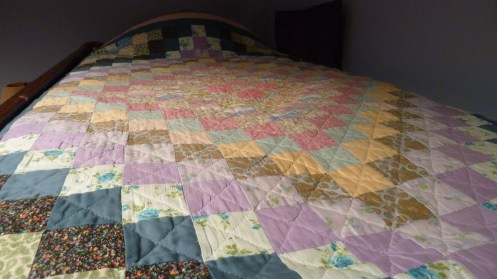
As I stroke the three twin-sized quilts that Susie pieced and gave to me (I hired a quilter to finish them for us), I hope my three girls will hold memories not only of Aunt Susie but our other relatives who were special in their lives. Susie created beauty, shared of herself, was not afraid to travel to Chicago frequently (by train) where she volunteered at Gospel League Home for indigent women (an arm of Pacific Garden Mission). She also loved teaching Summer Bible School for many weeks each summer, traveling to various locations.
Dan stayed home and kept the kettles going. Some of the family pitied Dan for having to be a “bachelor” for many weeks. It was surely lonely at times. But Susie followed what she felt was God’s call to serve others. As she neared death, quite blind and fingers gnarled from the arthritis begat by all her quilting, she would speak of having chats with Jesus—at that point she was sure he was “under the bed.” I’m sure she felt that close to Christ and it gives me joy to know that she’s still having chats with Jesus in her heavenly home.
***
I’d love to hear your memories of a special aunt, uncle, cousin, grandparent! These are such important people in our lives.
Do you enjoy any aspect of quilt making? Do you still see appreciation for quilts or are they a relic of bygone days?
Quilters or coloring book enthusiasts? Don’t miss the drawing below!
Enter my end-of-summer drawing for a beautiful free adult coloring book, “Beloved Mennonite and Amish Quilts.” Deadline to enter: August 7, 2020. Two books will be given away. I will also put your name on a mailing list to receive information about my work memoir when published.
***
To enter, Email me at anotherwaymedia@yahoo.com or send to Another Way Media, P.O. Box 363, Singers Glen, VA 22834, or leave a comment here on the blog.
Another Way is a column by Melodie Davis, in syndication since 1987. She is the author of nine books. Another Way columns are posted at FindingHarmonyBlog.com a week after newspaper publication.
Another Way for week of July 10, 2020
The Milk of Human Kindness
Where does kindness come from? How does it grow in a child or in an adult? What things make it go on a detour? Does kindness come only from inborn nature, or can it be nurtured?
Usually we talk about kindness and say it comes from the heart. But surely kindness starts in the brain, not in the heart, because after all, the heart is an organ pumping blood.
My mind started wandering down this path as I’ve stared at a photo of our young family when our girls were about 7, 5, and 3. Cute little dumplings: most parents feel that way about their offspring. As I looked at the picture, my own heart swelled with happiness to know that each of these daughters is a kind and loving person.

Our world has been struck by both a pandemic of physical illness, as well as an epidemic of discord and ugliness. It has also been blessed by a groundswell of good and gracious deeds, and the giving lifestyles of countless individuals and efforts. I won’t focus on the hostility but rather explore how we can cultivate the expansion of kindness.
It is truly as simple as always keeping the Golden Rule foremost, spoken by Jesus and others: “Do unto others as you would have them do to you.” If we all truly kept this as a rule of life, so much arguing, backbiting, crime, and even wars would be avoided.
Back to how to grow the attitude of kindness in a child’s brain and being. Children deserve to be born into homes headed by two parents, and nurtured, loved, and taught by them both. If there is only one parent, or grandparents stepping in to do the job of teaching and loving children, the children should observe and see kindness acted out every day at home and among friends and relatives. They should be taught why it is important to be nice to the brother who is destroying the towers you carefully built. They should come to understand why words can be just as painful as a pow or slap. And they should be taught to forgive and love each other anyway.
I know that unfortunately, even today, some children are slapped and treated harshly. A child who sees parents slapping or hitting is going to think that such behavior is okay for them to do too. There are many ways to discipline and teach children better behavior: a time out, taking away privileges, taking away toys, withholding treats. There are also ways to reward positive behavior and most of all, to set examples as patient and kind people ourselves. Saying please. Thank you. Can I help you with that?
Reality check: no one said teaching children kindness is easy. In these difficult and depressing times, tempers grow short, boredom breeds, and selfishness can be observed everywhere (ahem, supermarket?). As parents we just want to get something done without umpteen interruptions, before we run out of steam. We want to escape to bed and have some peace and quiet time.
Shakespeare was the original author of the phrase “the milk of human kindness” in his play “Macbeth.” Lady Macbeth accuses her husband of having too soft of heart as they deal with ambition, war, and murder. I think Shakespeare had the right idea: what we receive and give in our homes regarding kind attitudes and behaviors is like the milk that nourishes us from day one. We can’t live (happily) or long without it.
One of my daughters was blessed recently with a gracious comment from a child. Mealtimes are frequently difficult when you’re feeding three little boys. But this six-and-a-half-year-old, after a fun and hot afternoon splashing in a small play pool that they’d fixed up after it had a broken slide for a while, and a favorite supper of gluten free pancakes, said, “Thank you Mom and Dad for such a great day!”
Somewhere along the way, that child had received the milk of human kindness and was now offering it back to them. I’m happy to say I’ve seen the germination and growth of sweetness and love in our other grandchildren as well. May it be so in homes all across the land, around the world, and in yours too.
***
What demonstrations or stories of love and kindness have you observed? We all want and need to hear more!
Comment here or write to anotherwaymedia@yahoo.com or Another Way Media, P.O. Box 363, Singers Glen, VA 22834.
Another Way is a column by Melodie Davis, in syndication since 1987. She is the author of nine books. Another Way columns are posted at FindingHarmonyBlog.com a week after newspaper publication.
Another Way for week of July 3, 2020
Things to Know Before Opting for Knee Replacement
After I first wrote about my husband’s knee replacement (which took place four days before most of the country shut down because of the pandemic), things got dicey with Stuart’s recovery. He started having inflamed IT bands—the part of your upper leg that runs from the outside of the hips to the knee and connects to your shinbone.
IT stands for “iliotibial” and WebMD.com explains the problem like this: “If your IT band gets too tight, it can lead to swelling and pain around your knee.”
If you’ve never heard of it, you’re lucky. Most of the time it keeps the leg hanging together and functioning, but when it gets painful, it can be miserable and the sting can strike any time. It’s a common overuse injury from repetitive movements.
Overall, Stuart’s therapy, although he did his at-home exercises faithfully (often taking three to four hours a day in two sessions, including warm up and icing down afterwards), he felt like he was hitting a wall. It appeared the inflamed band along the side was firing the pain and halting progress.
At his two-month check-up, the doctor said he felt a manipulation was called for, because of how progress seemed to have stalled. In a manipulation, they put you under anesthesia (or opt for a spinal block), and the doctor pushes your leg back to the maximum bend he or she can get. Yes, that would be excruciating pain if you were conscious. The object is to break up scar tissue, which Stuart had plenty of as mentioned in my previous column on this topic. The scar tissue not only made it difficult to get a proper bend in his knee, but together with the IT band, caused a lot of inflammation and pain.
A manipulation doesn’t always work, and sometimes, in very rare situations, a bone breaks. So we were uncertain regarding the risks but Stuart definitely felt stuck, unable to make progress.
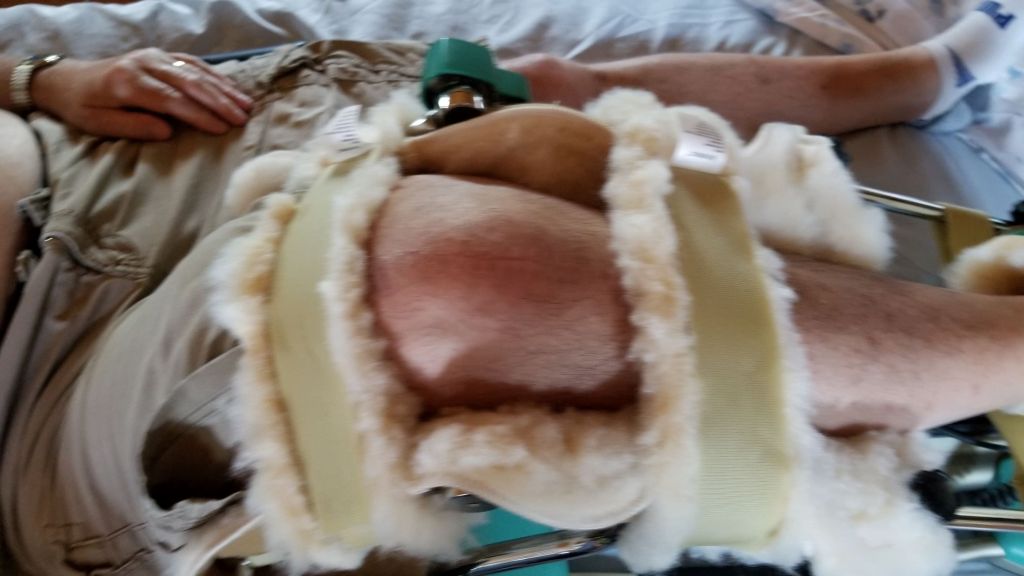
After the manipulation, he would have to use a continuous passive motion (CPM) machine at home for at least a week, to keep his knee moving slowly and gently. These are very common to use on various parts of the body. He would need to be strapped in 16-20 hours a day. How would he even sleep?
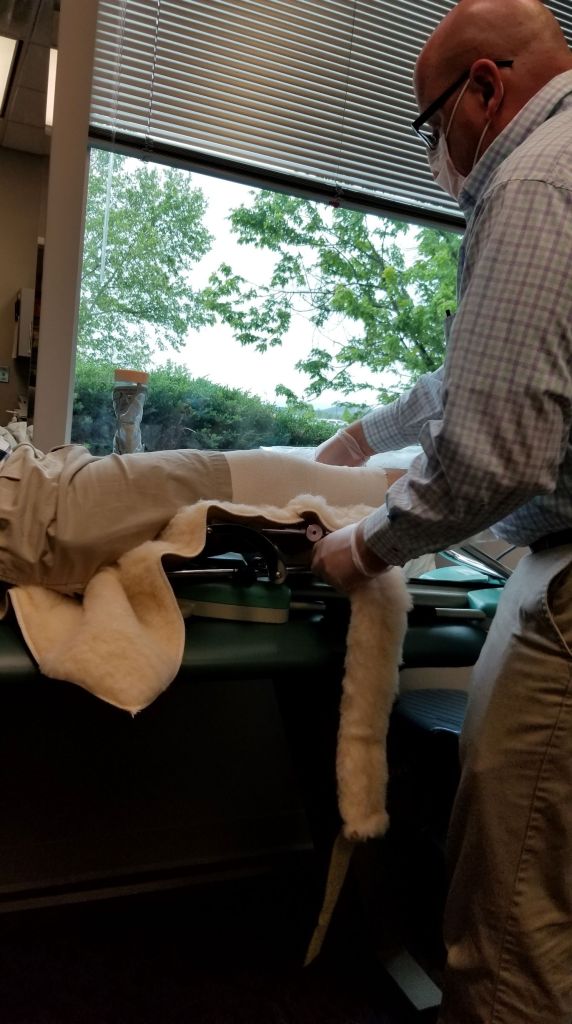
He did manage to sleep some in the contraption, and overall, averaged being literally tied down 15-18 hours each day using it. Both of us were ecstatic when the week was over.
So what was the outcome? Overall, he achieved much more bend in his knee, found walking easier—especially when needing to go down slopes. Generally, his pain level went down. Now the trick is to keep that agility and bend thriving, which is not easy.
At some point Stuart gloomily told his therapist* he would be doing his stretching and prescribed exercises for a year. To which the therapist responded, “No, you will need to continue to do some exercises for your knee the rest of your life.”

Let us hasten to add: everyone’s experience with this type of surgery is somewhat different; our pain thresholds are different, each body make up is different in terms of the afflictions it has faced (high blood pressure, prior injuries, diabetes, heart surgery), and all these health issues can complicate outcomes. Stuart is allowing me to write with this much detail about his experiences in the interest of helping others know what they may be in for when deciding on knee replacement. We were both quite anxious about the manipulation but at this point, 3.5 months after surgery, Stuart is happy he decided to accept the manipulation ordeal.
The recovery has been depressing, exhausting, and difficult, but it’s not chemo, it’s not dialysis, and it’s not Covid with isolation from your mate/family. There have been moments of celebration, such as when the therapist finally got Stuart’s knee to the degree of bend stipulated by the surgeon. He is still working to gain another five degrees or so. We’ll continue leaning on each other and on the good Lord.
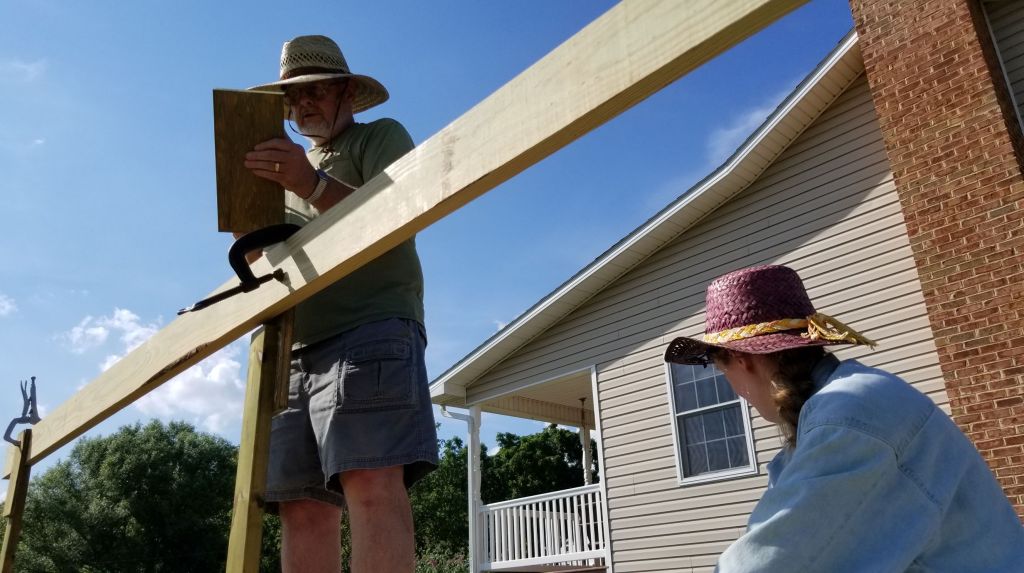
I would welcome stories of your own experiences, good or bad.
What have you learned?
Share here, or write to anotherwaymedia@yahoo.com or Another Way Media, P.O. Box 363, Singers Glen, VA 22834, or comment on the blog.
Another Way is a column by Melodie Davis, in syndication since 1987. She is the author of nine books. Another Way columns are posted at FindingHarmonyBlog.com a week after newspaper publication.
* Stuart received the bulk of his therapy from Center for Hand and Physical Therapy and received great professional care.
Another Way for week of June 26, 2020
Inch by inch, degree by degree, my husband is working to recover from knee replacement surgery he had March 10. He says now he will have to be in deep pain and unable to walk before he would ever decide to have the other knee replaced. His recovery therapy has been very painful and tedious with hours of aching and icing and later also using some heat to help heal the insult to his ligaments tied into the amazing knee cap.
Knee replacement surgery is very common. At the small but locally well-known and respected hospital where he had it done just four days before most of the U.S. closed down all elective surgeries because of the corona virus—they do a thousand or more a year. My mother had one knee done maybe ten years ago. She fared well. At our church, I can barely keep up with who is having which knee done. But, as Stuart would warn, it is no walk in the park.
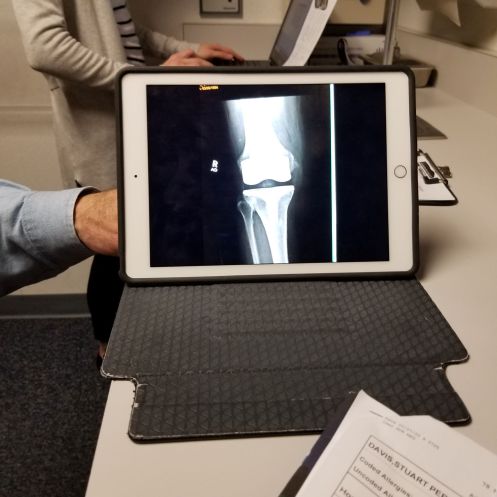
When you think of the trauma inflicted on that critical joint, one nurse painted the picture like this: They take your knee and cut through all the ligaments and tissue above it for several inches and fold all that open to cut loose your knee cap, then lift it out. Then they put in the artificial parts. When she described it like that, I thought, oh my, what have we done? Only the assurance that approximately 600,000 people a year in the U.S. have this done, and successfully recover and now feel less pain than they were living with before, gave me hope.
In Stuart’s defense of his difficulties, you should know that 35 years ago he had a fall at work resulting in a torn ACL (the key “anterior cruciate ligament” that stabilizes your knee) in this same knee and had surgery. That, plus arthritis, probably led to his current issues. His knee has not been fully functional in the way it should have been all these years. Later he also had another fall, and a doctor at the time said maybe he would need to get something fixed at some point, but it never bothered Stuart a lot, so we lived with it.
About six weeks after the knee surgery, we came to the realization that recovery was not going to happen in a sweet six weeks. The post-surgery therapists at the hospital warned that PT (physical therapy) stands for “pain and torture.” The doctor stressed that the important thing to remember is to push through the pain in order to make progress.

But the therapist that Stuart went to emphasized not exercising to the point you have to grimace and grit your teeth. She said rather, to push yourself—yes—but you shouldn’t be experiencing extreme pain.
Many people have complications. Prior surgeries, scar tissue, one’s own conditioning, all contribute to how people recover. After the surgery was done, Dr. Pereles said the knee was in bad shape and he had found an “extra knee cap” floating around in there which he removed—probably tissue that had torn at one point.
We don’t want to scare off anyone else but it is serious surgery, and many who have had other surgeries, or had both a hip and knee replacement, say the knee was far more painful.
Stuart has showed grit and determination along with extreme frustration and pain. I was encouraged immensely as I watched (before limitations were placed on extra people being in the studio) a much younger man receiving therapy. He was well-muscled in his arms and legs and looked to be in very good shape, yet as a therapist pushed on his one knee (I’m thinking he may have had a sports injury), he began to shake and squirm and sweat like a woman in childbirth. I have helped at the bedside for laboring daughters for three of my grandsons. His sweating and grimacing and eeks and groans sounded as difficult as THAT labor. Yet he did not give up and got through.
Next week I’ll share part two about what came next on Stuart’s road to knee surgery recovery.
***
If you’ve had knee surgery, we’d love to hear all about it and how recovery went. Was it better or worse than you expected? Advice for others?
Of if you have permission to share someone else’s story, we’re all ears.
Stories here!
Want to share your story or a comment? Reach me at anotherwaymedia@yahoo.com or Another Way Media, P.O. Box 363, Singers Glen, VA 22834.
Another Way is a column by Melodie Davis, in syndication since 1987. She is the author of nine books. Another Way columns are posted at FindingHarmonyBlog.com a week after newspaper publication.
Another Way for week of June 19, 2020
Revisiting the Flu of 1918
I had an aunt who died from the Spanish Flu of 1918 at the age of 21. But that fact never became real for me until the Corona-virus pandemic of 2020 when I started reading how just like today’s battle with a major virus, citizens at the time wore masks, schools were closed, churches shuttered, businesses tamped down, and outdoor cemetery funerals were held, all in an effort to halt or slow down the spread.
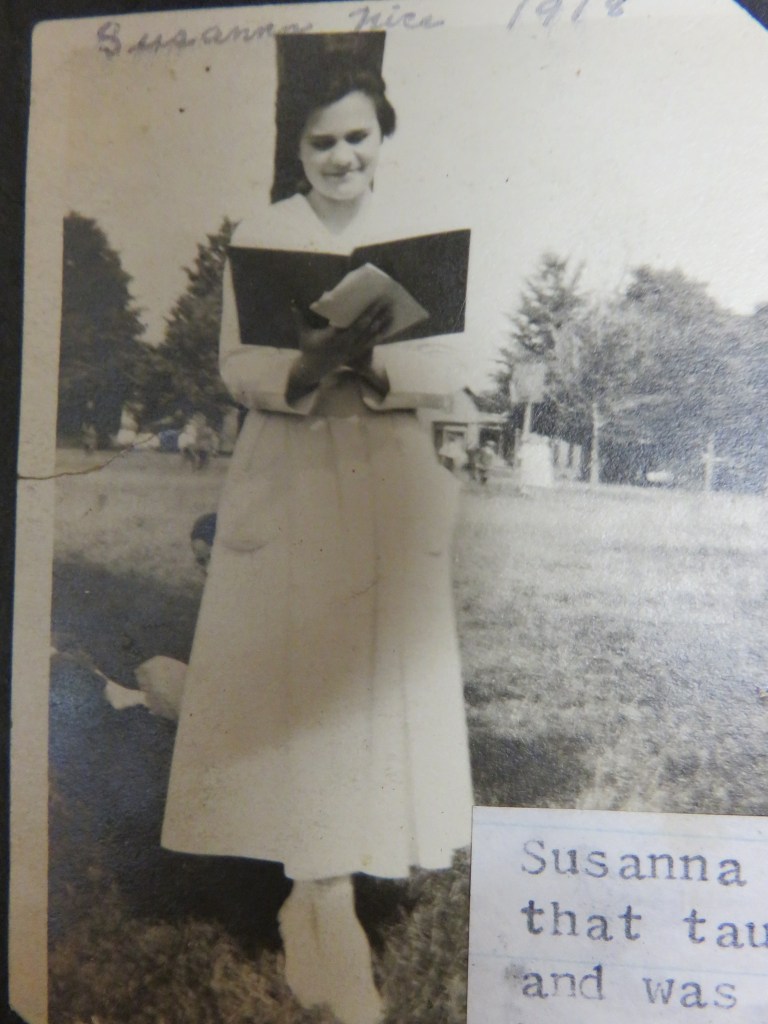
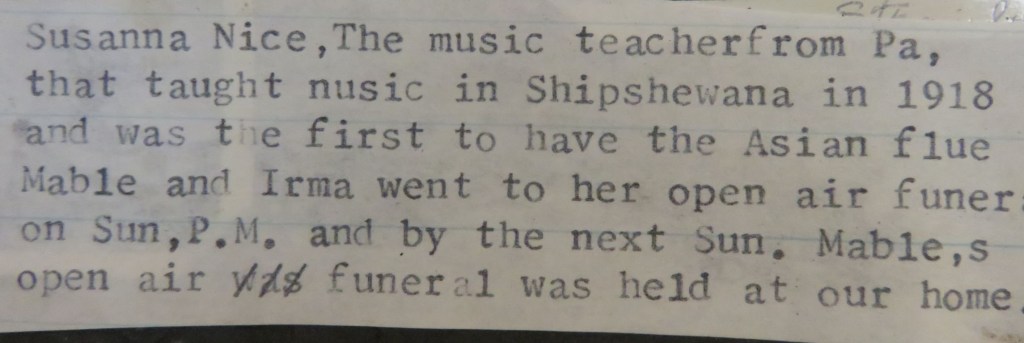
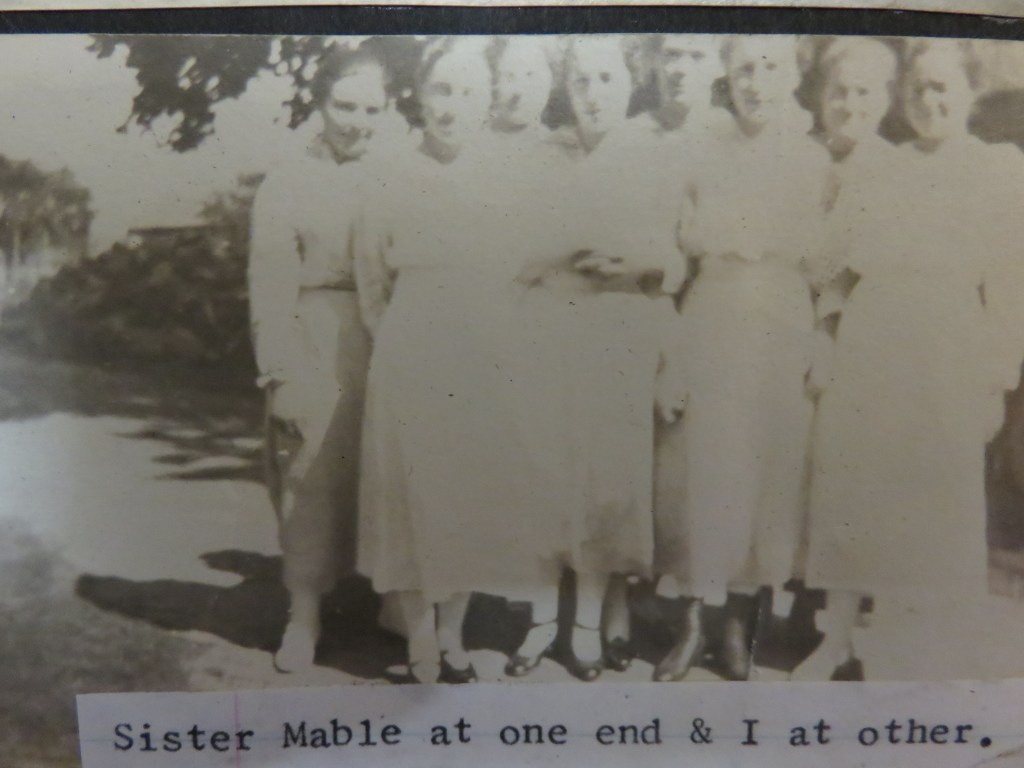
In fact, apparently attending an open-air funeral for a teacher who died with the flu is how my aunt Mabel apparently caught it from others present. Mabel died of pneumonia a week after she attended her friend’s funeral.
Of course I never knew Mabel nor another aunt, Mary, who died as a one-year-old child (not of the flu). But Mabel always had a visual presence with us through a framed, old-fashioned poem titled “The Absent One” which included a beautiful photo of Aunt Mabel as a young woman inserted with the poem. There was also a lock of her hair and a piece of fabric and button from one of her blouses. That framed poem and memorabilia still hangs in the guest bedroom at my mother’s apartment.
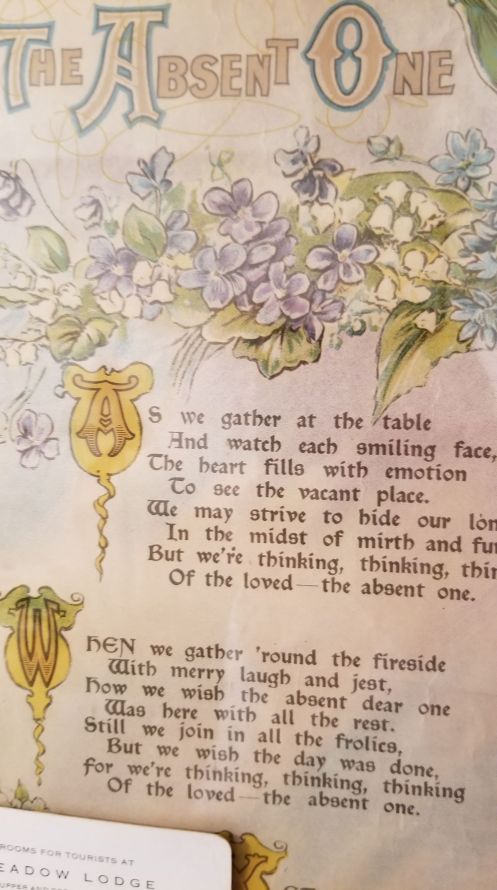

As a girl, with Grandma and Grandpa living in quarters attached to our farm home, I often looked at that poem, photo, and lock of hair when spending time with them. The hair in particular made her feel real. I’m sure we asked about Mabel, but I don’t recall anything Grandma or Grandpa might have told me. Our focus was on the marvelous large family that survived: Susie, Irma, Adeline, Elnora, Arlene and Truman, plus my Dad, the baby. He was only one-and-a-half when Mabel died. I can imagine Grandma’s deep grief not only in losing her first child at age one, but then losing beautiful Mabel in her prime. The heartache must have been heavy.
That pandemic seems to have spread towards the close of World War I; recently our local paper mentioned that two Virginia army camps had high numbers of Spanish Flu cases. By October 8, 1918, our paper noted that half of the students and faculty at the State Normal School (a women’s teacher training school which is now James Madison University) had the flu. Thus the college was closed along with city schools. The article stated that people speculated that students heading to school in September by train may have come in contact with infected troops. I found it interesting that over 600 miles away in northern Indiana, my aunt died October 11 during this same rampant time of spread.
College students in Virginia then returned to school again on November 6, only to be hit by a second wave of cases by Thanksgiving, which extended into February 1919. The article also states that the economic pressure to reopen businesses was very much in play, just like today. They had to do social distancing, masks and had much the same kickback. But the cities that stuck with the safety measures during the Spanish Flu, especially in the second wave had better outcomes with fewer illnesses and deaths. It’s an interesting article and should serve as a grim reminder of the things we keep hearing, to “watch out for a second wave” in the event that cases and deaths go on an uptick again (Daily News Record, May 22, 2020, by Jessica Wetzler).
I’ve visited my aunt’s grave at the Miller Cemetery near LaGrange, Indiana where my grandpa and grandma are also buried. They lived very long lives and I feel especially blessed to have spent the first 10 years of my life with both of them next door. I am indebted to my second cousin Melissa Mann, whose grandmother was my Aunt Adeline, for details from Mabel’s obituary she retrieved online (see below). The obituary says her last words were of hope, love, and everlasting joy “beyond the river.” My cousin Dennis Risser notes his mother Arlene was four when Mabel died, and remembers hearing that Mabel had probably taken care of her a lot when Grandma was busy with my toddler dad. Dennis also remembers his mother Arlene had an amaryllis plant that had been Mabel’s. How precious.
What will our children and grandchildren remember of this pandemic? What stories will they tell? I will wear a mask in memory of Mabel and will continue to do so as long as necessary, both to protect myself and others.
****
A bonus you’re getting on my blog, is a little deeper history than I found before I wrote and sent this to newspapers.
In addition to the photo above I had long seen in Grandpa and Grandma’s home, I just discovered a photo of the friend who died a week before Aunt Mabel, below.
***
Here’s a link to the obituary that my cousin Melissa Mann found in Mennobits from Gospel Herald.
Miller, Mabel Edith, daughter of Bro. Uriah M. and Sister Barbara K. Miller, was born in La Grange Co., Ind., Dec. 11, 1897; died at her home Oct. 11, 1918; aged 21 y. 10 m. Death was caused by pneumonia following influenza. She leaves father, mother, 5 sisters, (Susie, Irma, Adeline, Elnora, and Arlene), 2 brothers (Truman and Uriah Vernon), an aged grandfather, uncles, aunts, cousins, and a host of relatives and friends. Her oldest sister, Mary, preceded her to their home in Glory 23 years ago. Sister Mabel left us a bright evidence that our loss is her eternal gain. Her last words were of hope, love and everlasting joy, telling her friends to prepare and meet her in that beautiful home which is waiting to welcome her in. Her only comfort was to have us pray with her and have the Word of God read to her. She accepted Christ as her Savior and united with the Mennonite Church while yet in youth and was a faithful member until death. Open air services were held at the home Oct. 13, by Brethren O. S. Hostetler, D. D. Miller, and A. S. Cripe. Text, John 16:16. The remains were laid to rest in the Miller Cemetery.
The Savior has taken our Mabel away;
But we know it is not forever.
“Come follow, come follow,” we hear her say,
“It is beautiful beyond the river.” (Written by a sister.)
***
How is your family doing? How is your area — city, county, state, country — doing with restrictions still in place? Or not. I’d love to share ups and downs, hopes or fears.
Write to anotherwaymedia@yahoo.com or Another Way Media, P.O. Box 363, Singers Glen, VA 22834, or comment on the blog.
Another Way is a column by Melodie Davis, in syndication since 1987. She is the author of nine books. Another Way columns are posted at FindingHarmonyBlog.com a week after newspaper publication.

 findingharmonyblog