

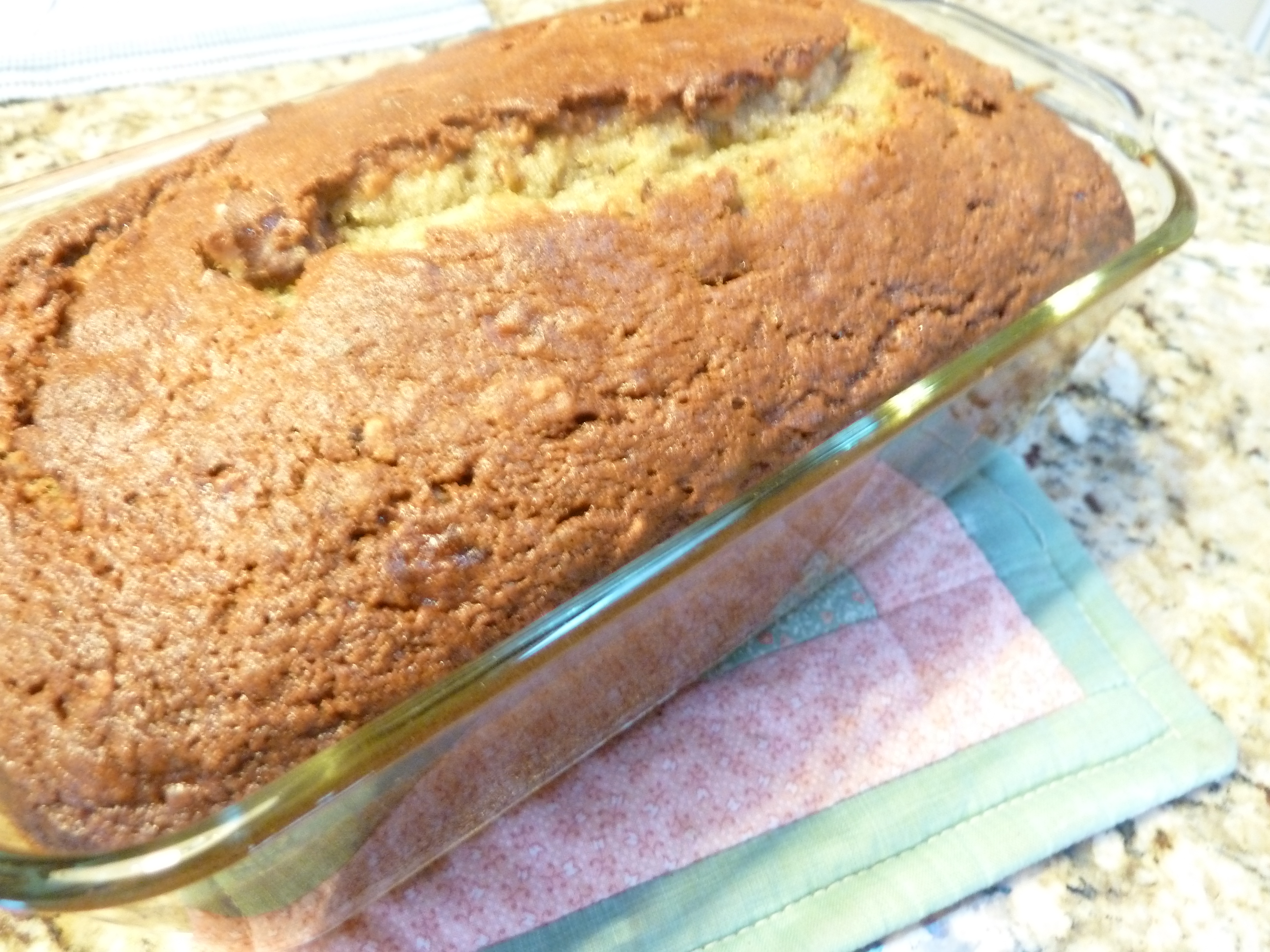
I feel truly doubly guilty whenever my bananas get too old to eat—or at least too old to enjoy eating. Barbara Kingsolver made me especially feel that way nine years ago in her prize-winning book, Animal, Vegetable, Miracle: A Year of Food Life for buying bananas, knowing they had to be shipped from tropical zones and never would fit into the 100-mile diet (foods you grow or buy from within one hundred miles of you). But since she and her family gave themselves a free pass for coffee (also not available locally!) on their shopping list, I figure I could allow myself both coffee AND bananas.
I do like to keep bananas on hand not only because I love them, but because they make a great tummy buffer if you have to get up in the middle of the night and take aspirin or ibuprofen on an empty stomach. At one point I decided to try just eating half a banana in the middle of the night—and skip the medicine if my headache was just kind of iffy and weak. Eureka—I could get rid of a headache just by consuming the banana. (My father would say it was all in my head. Yeah.) So sometimes I end up with rotten bananas because I’m always saving them for the next potential middle of the night headachey feeling.
Back to banana bread. I wanted just a basic recipe, right? So I found it interesting that some of my favorite all purpose cookbooks where I expected to find it, didn’t have a recipe.
Now in one, I could quickly figure out why. First I checked Simply in Season, knowing it had an index listing things by the predominate fruit or vegetable in the recipe, since it features seasonably available foods.
Well duh, of course in North America, bananas—although they are available to us year round, are, as we’ve already discussed, hardly seasonable local fruits, so I’m sure the cookbook editors nixed any entries there.
But I was really surprised not to find it in Mennonite Country Style Recipes: The Prize Collection of a Shenandoah Valley Cook by almost-neighbor Esther Shank. Bananas are a basic food group recipe, right? Something you might have even learned to make long ago in Home Ec. Class? Nope.
Never fear, I found it in Mennonite Recipes from the Shenandoah Valley collected by New York Times bestselling cookbook author Phyllis Pellman Good and her daughter Kate, submitted by Jennice Babkirk, right here in Harrisonburg. (Anyone know her?) And of course recipes abound on the web.
This recipe turned out great the very first time I made it. I have made banana bread previously but did not keep track of what recipe I used.
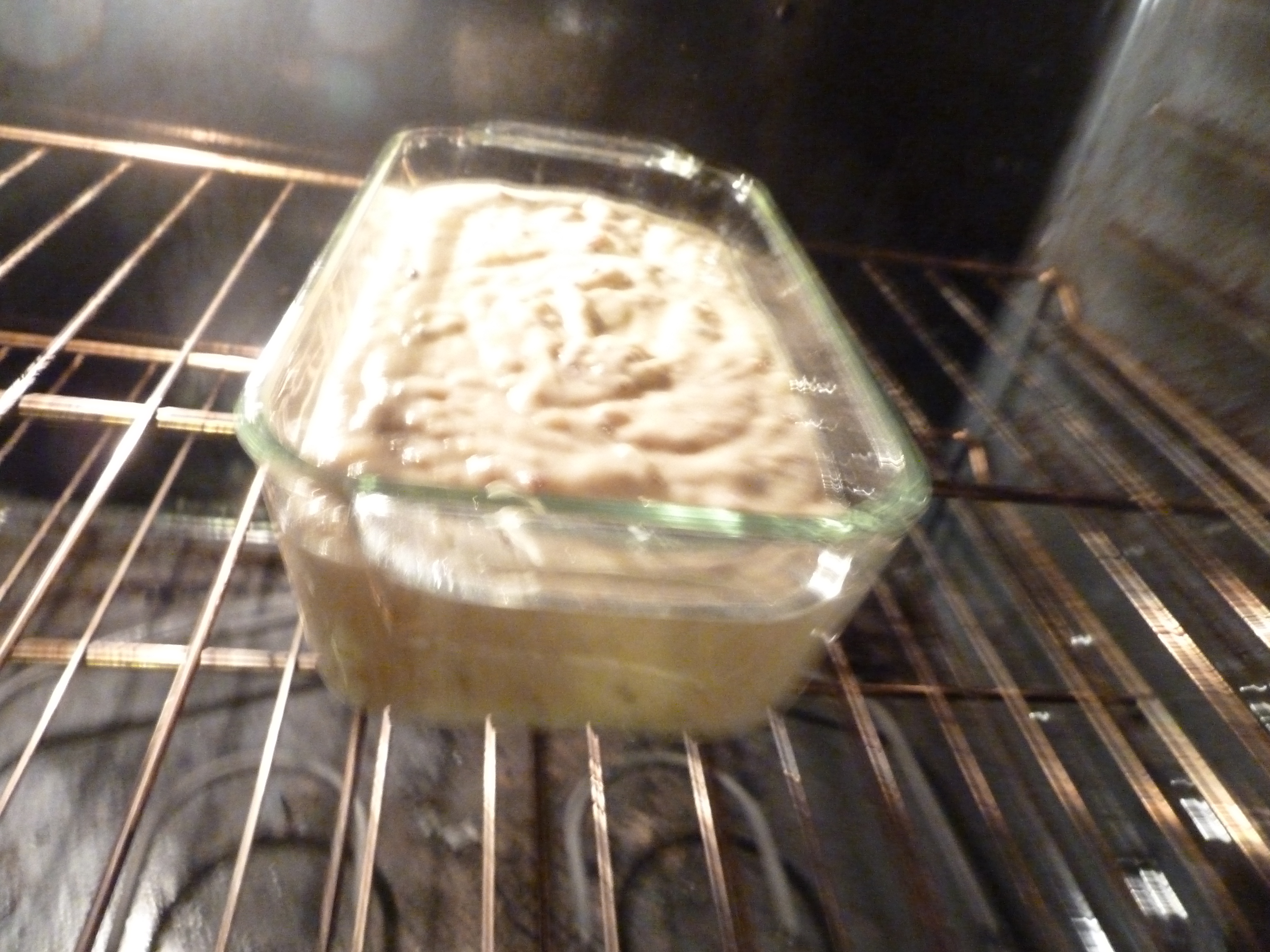
Banana Bread
1 cup sugar
1/3 cup margarine or butter, softened
2 eggs
1 ½ cup mashed bananas (3-4 medium sized bananas)
1/3 cup water
1 2/3 cups flour
1 tsp. baking soda
½ tsp. salt
¼ tsp. baking powder
½ cup chopped nuts
Directions:
- Cream together sugar and margarine.
- Stir in eggs until well blended.
- Add bananas and water. Beat 30 seconds.
- Stir in flour, baking soda, salt, and baking powder, mixing just until moistened.
- Fold in nuts.
- Pour into loaf pan which has been greased only on the bottom.
- Bake at 350 degrees for 55-60 minutes, until wooden pick inserted in center comes out clean.
- Cool 5 minutes in pan. Loosen sides of loaf from pan, then remove from pan. Cool completely before slicing.
Makes 1 loaf.


My notes:
Rotting or not? My bananas looked pretty far gone and ugly, but inside they were still fairly firm, and definitely not rotting.
So while I use old bananas, those that have gotten to the stage where they are black and mushy—I’m not sure I would use those. Anyone else tried using literally rotten bananas? (You can always freeze black-turning bananas you haven’t gotten around to using.)
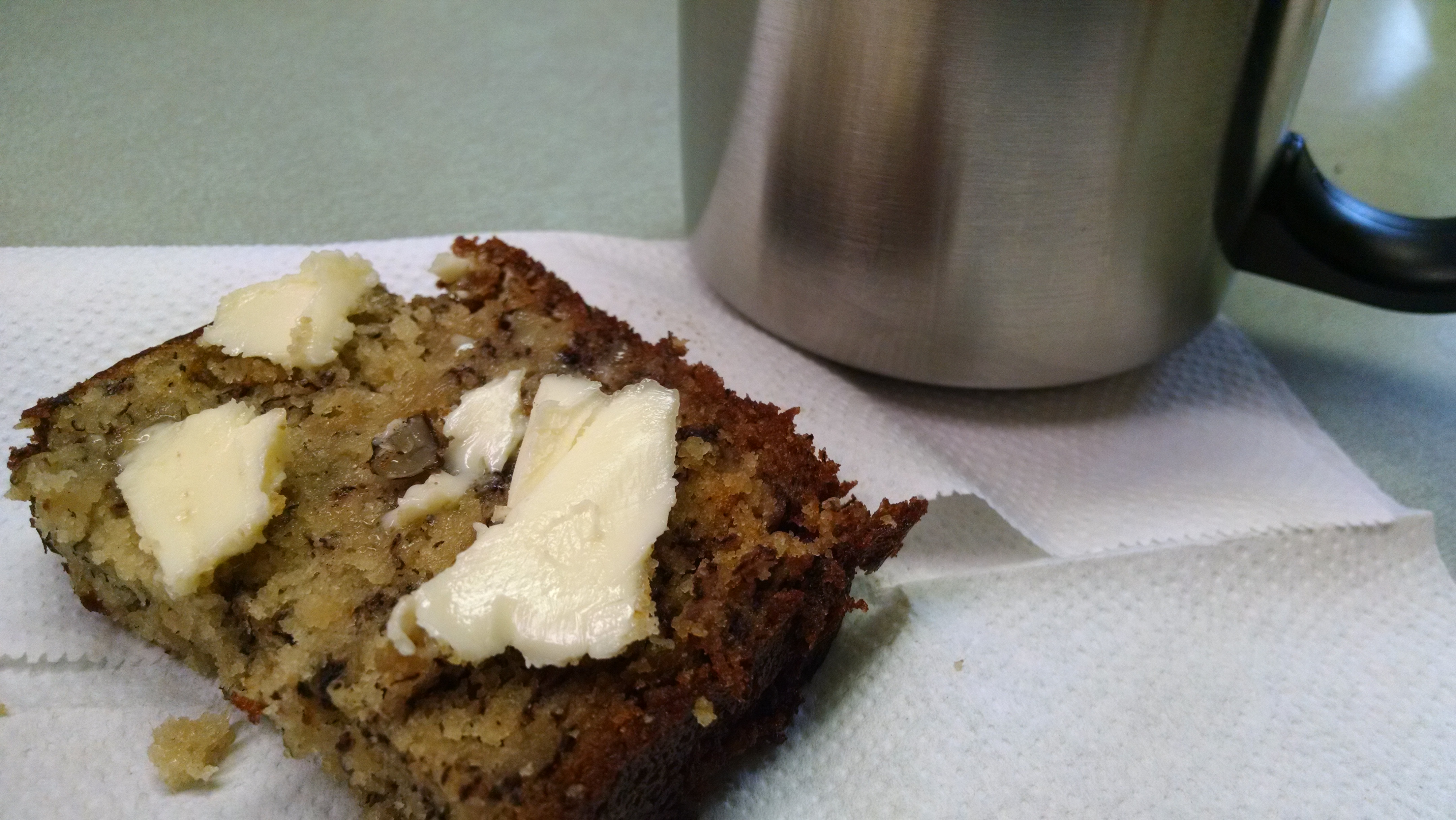
Remove from pan? I also did not take my bread out of the pan in five minutes. In fact, I took the bread to work in the baking pan, kept it that way with foil over the top, and it was still warm three hours later for our coffee break at work. I made slices right in the pan and they came out just fine.
Free, not-really-medical advice. And my medical tip to substitute banana for an aspirin in the middle of the night?? Completely free advice. You are very welcome. Or, even better, a slice of this bread with a hot drink or cold milk. Yum.
***
Where do you first look for recipes? Your own recipe box, online, a favorite cookbook? Which one?
***
Or, do you have an unconventional headache remedy?
I’d love to hear!
Another Way for week of September 23, 2017
The Value of Education
School’s been back in session for most children for over a month now, and families and teachers are settling into the fall routine. Most of us had some excellent, favorite teachers as we went through school (thinking here particularly of elementary through

Typical valley classroom; photo by Melodie Davis
high school). My hat is off to all of those great teachers, and they are far the majority. Then there are those who because of lack of training or career suitability, or perhaps a personal crisis, fail their students and themselves. They usually also lack the ability to control a classroom—and thus have no way to really teach anything, other than how not to be a teacher.
My second grade teacher was that kind of teacher. I hadn’t thought about her in years. But a description of a teacher in a book I am reading suddenly brought Mrs. S. vividly and sadly to my mind: “She begged for attention, but no one gave it to her. ‘Listen to me!’ she screamed. … her screams proved useless as she still was unable to gain the attention of a single child”

School was at the time not compulsory, just as many children around the world today are living in countries or communities where either families can’t afford it, no school is available, or girls—especially—are not permitted to go. However, Mark’s mother worked very hard to not only get the proper paperwork for him completed, but to talk her son into the value of an education when other boys his age were already running wild, living on the streets (ages 7-8) all day. Her eloquent speech as written down many years later by her son went something like this:
“Though our lot isn’t any better today, an education will get you a decent job. If you can read and write you’ll be better off than those of us who can’t. Take my situation: I can’t find a job because I don’t have papers, and I can’t get papers because white people mainly want to register people who can read and write. But I want things to be different for you, child. I want you to go to school, because I believe that an education is the key you need to open up a new world and a new life for yourself. It is the only key that can do that, and only those who seek it earnestly and perseveringly will get anywhere in the white man’s world. Education will open doors where none seem to exist. It will make people talk to you, listen to you and help you; people who otherwise wouldn’t bother. It will make you soar, like a bird lifting up into the endless blue sky, and leave poverty, hunger and suffering behind. It’ll teach you to learn to embrace what’s good and shun what’s bad and evil. … That’s why I want you to go to school, child, so that education can do all that, and more, for you” (from Kaffir Boy: The True Story of a Black Youth’s Coming of Age in Apartheid South Africa, by Mark Mathabane, Free Press, p. 138).
Here in North America, we take these things for granted, don’t we? A free education is available to all and in many cases, even the public schools have excellent programs, teachers and facilities. Shamefully, too often in our inner cities children experience the kind of second rate and failing classrooms young Mark experienced. But following his mother’s counsel, he graduated college and today has written numerous books after studying journalism and moving to the U.S. His book is reawakening in me an appreciation for the education I was given—both in classrooms and at home, through travel, my work, and learning to know different kinds of people. I also have new joy that our church was able to help start an academy for young children in the very township in South Africa where young Mark began his education.
If your children hate school or struggle or are in a questionable classroom situation, their education and future is worth your involvement. Not helicopter parents completing their homework, heaven forbid, but reminding kids that doors will certainly shut for those who drop out early or don’t understand how important true learning is. A thirst for knowledge begins at home. Education happens in and out of the classroom.
***
I’d love to hear your stories of great or bad teachers and how you or your family coped. Send to Another Way Media, Box 363, Singers Glen, Va. 22850 or anotherwaymedia@yahoo.com.
Another Way is a column by Melodie Davis, in syndication since 1987. Another Way columns are posted at FindingHarmonyBlog.com a week after newspaper publication.
Every Boy Needs to Learn to Can Beans
Last weekend we had some moments of pure gold with a niece getting married at some lovely Shenandoah Valley caverns near here,

The lodge at Melrose Caverns, an old restored lovely wedding venue.
picking pole beans and canning them with two of my grandsons here,
 and my youngest daughter being ordained and installed as an elder at her Presbyterian church over in Maryland.

(We forgot to get pictures.)
Busy, yes. At some points I wasn’t sure where I was, but happy to have my feet planted wherever the action was.
Earlier in the summer I shared our struggles battling bean beatles, and how a new variety we tried had helped to stem the onslaught of the little pests. We also usually plant pole beans (my husband’s favorite) later in the summer—he planted those this year on July 5. They are a lot of work to string up the lines and the poles but my husband loves his pole beans, so in they went.
At any rate, decent rains helped bring on a bumper crop and they were ready for a second picking last Saturday. I went out as soon as there was enough daylight to find the beans, I began picking—and praising my husband for doing a great job of keeping a path clear through the middle of the two rows where we could walk.

Grape arbor of beans.
We picked beans hanging down like grapes in an arbor. They are dandy beans and if you pick them before they start to get old: not tough or stringy, but robust and flavorful.

Daughter Doreen and Henry get started snapping beans.
Henry was awake by the time I came in with some beans for my husband and the rest of the family to begin breaking. At 18 months, Henry is all into whatever his older brother or grown ups are doing (no baby toys for him anymore, no sirree).

My daughters helped him learn how to snap them—sometimes he was successful and other times just kind of bent them over and looked at us with his big brown eyes like “what am I doing wrong that I can’t break them so easily as you?” His older brother was still dozing and taking his sweet time getting up.

James, left, Henry, and daughter Michelle supervising.
Later, though, when we were ready to put the beans in cans, James was all into it. I used some of my regular size jars, since I knew we’d have small hands that could get those beans into those openings.

I showed James how I smacked the beans down further into the jar by slapping the jar on my palm which he thought was pretty cool. “This is fun!” he declared and I just hope he agrees with that assessment with he’s 14 instead of almost 4.
I had to dig out the photos of his mommy helping can beans when she was just a little older than him, going on 5.

Canning beans with Michelle, left, and Tanya when Doreen was just starting to grow inside a much younger me. 🙂
Don’t you think every kid needs to learn to know where their food comes from, and how to preserve it? My sister-in-law was happy to introduce her grandson, Mason, to the art earlier this summer as well.

Mason and his mammaw Barbara. (Photo courtesy of Cathy Davis Crider)
I will be happy to be done with canning beans soon, but what a treat to have all those little hands helping. These grandmas are treasuring these times and memories.

We hope these boys will love “their” beans next winter.
***
Do you remember any jobs that seemed like fun when you did them at Grandma or Grandpa’s house?
***
Esther H. Shank’s Mennonite Country-Style Recipes and Kitchen Secrets: The Prize Collection of a Shenandoah Valley Cook including basic tips and instructions on canning and preserving foods are found in this very popular cookbook! Check it out.

Skin is perhaps the least appreciated bodily organ, but so important. In fact, we seldom think of skin as an actual organ, like the heart, or liver. But remove that outer layer of our bodies—and we fall apart.
As we get older, our skin becomes more and more fragile. I learned that lesson this summer. I was coming up our basement steps carrying something, I forget what, with my husband. I slipped, and my right middle finger, skin side, caught on the edge of a wooden step. The mishap almost took a whole patch of skin the size of half a nickel off the last section. Almost: the skin hung on, but only in a couple of places.
No splinters and not much pain, but a giant nuisance to keep from bleeding and then from infection.
Luckily a trip to the beach and it’s healing salt waters was coming up three weeks after the accident—just at the right time to finish healing my digit. Now you can barely see a scar and my finger print looks roughly the same. Amazing.
Speaking of beach, I remember the years when we soaked up all the sun we could—using baby oil as a medium with which to fry our skin.
How very stupid. Generations of us are now paying the price. Skin cancer—in the form of basal cell, or the more deadly melanoma, are popping up among baby boomers and even younger. But we did not know better; if much was said about skin cancer when I was a teen, I did not hear it, or it passed through my cranium in obeisance to the god of beautifully tanned skin.
My dermatologist—who I began going to because of a small basal skin cancer on my chest—has a brilliant poster that shows a piece of leather and then says something along these lines: “This is leather. How is leather made? By tanning skin. Get the picture?’
In her examining room another huge medical-teaching poster explained the steps in the healing of a wound.
- a blood clot forms to help stop the bleeding, and usually dries to make a protective scab;
- below the surface, inflammation and nearby blood vessels enlarge to deliver oxygen and nutrient-rich blood and “leukocytes” to clean the wound of dead tissue and bacteria;
- rapid proliferation (or regeneration) and migration of new epithelial cells [lining that helps separate the inner parts of our body from the skin and outside environment] helps to replace the damaged area with new tissue and close the wound.
Of course, if a wound is deep enough, stitches or another substance—even crazy glue—helps hold skin together, generally resulting in less scarring.
When my finger got hurt, I toyed with the idea of going to the ER or a doctor but didn’t like the idea of stitches on the end of my finger. Indeed the healing happened pretty much on its own.
How cool is that. Just amazing, when you stop to think about it, as with most of the functions of our bodies.
Wikipedia says “In humans, skin is the largest organ of the integumentary system. The skin has up to seven layers of ectodermal tissue and guards the underlying muscles, bones, ligaments and internal organs.” Wikipedia further defines integumentary as “the organ system that protects the body from various kinds of damage, such as loss of water or abrasion from outside. [It] includes the skin and its appendages including hair, scales, feathers, hooves, and nails [when considering the whole mammal world].
How fearfully and wonderfully God made us all!

Photo from author Winona Miller
Guest column by Winona Miller
Or, send to Another Way Media, Box 363, Singers Glen, Va. 22850 or anotherwaymedia@yahoo.com.
Another Way is a column by Melodie Davis, in syndication since 1987. Another Way columns are posted at FindingHarmonyBlog.com a week after newspaper publication.
Another Way for week of August 25, 2017
The Company We Keep
My husband left me in early August to go on a work trip to West Virginia to help rebuild a home after the floods of June 2016. You may recall the one that forced the closing of the Greenbrier Resort in those parts. Now that my husband is retired, he was happy to be invited to join some volunteers with Brethren Disaster Ministries.
While packing, we realized he had never gone away without me, except for two trips to attend funeral services for two of his aunts in North Carolina and Mississippi, where he traveled with his brothers. My oldest daughter also joined them for the North Carolina trip. I have traveled on my own many times—either for business or to visit family when he wasn’t able to take off work. Once he traveled by train to Indiana for my grandmother’s funeral, when the girls and I left two days before he was able to get away.

He did NOT fly to West Virginia, but this is an example of adventures we have enjoyed TOGETHER.
So we both kind of looked forward to the experience of him trying his wings with a volunteer trip, and me looking after the garden, the pets, the summer harvesting and canning, and still working full time. I will have to say I have new appreciation for all the times he held down the fort at home with me off to parts unknown for days, weekends, and at times full weeks–and even one three-week jaunt. For many of these, he was also daddy in charge of children at home, although sometimes I took one or more with me. He did try to keep up with the garden but, no, he’s never done canning on his own.
I have a new appreciation for widows, divorced folks and singles who live by themselves all the time. The house seemed awfully empty; it is easy to feel lonely and overwhelmed.
If you follow my column at all, you know, however, that I am more of a loner and introvert, while my husband has never met a stranger. You may even recall me sharing the story of me warning him—a day into our honeymoon—that I like to be alone at times. He never thought that was a very good way to begin a honeymoon. And I was just aiming for honesty in our relationship. (My timing was not great.)
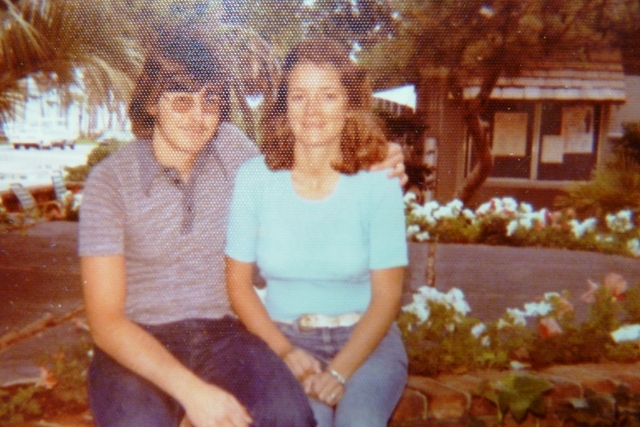
On our honeymoon, Myrtle Beach SC, enjoying each other’s company a great deal!
When I called my mother the first day he was gone, she said, “Oh! You’ll enjoy not having to cook supper.” And that I did. The first night I had a glorified egg sandwich (kind of an omelet with salsa in it, that Stuart would not have loved.) The next night I picked up a frozen package of fettuccini and broccoli (not his fav dish) to microwave, along with some fresh sweet corn from the garden. My schedule was freer. I had fewer interruptions. I didn’t, ahem, need to do quite so much straightening up.
But even the very first morning, when I was just hopping out of the shower and the dog barked for no good reason, I quickly locked the bedroom door, just in case. I was a little jumpy anytime the dog barked, but my dog is a little jumpy like that, sometimes barking for no good reason.
Yet by the end of the first day, I was definitely missing him more than I thought I would. After years of living with and loving someone, you miss the camaraderie, the friendship, the playful flirting, the having someone else in the house. The missing him felt good.
Of course I appreciated some things. I adored the quiet: no TV, just the sounds of country birds and insects. But I didn’t miss him on a trip to town to do errands. I could do just what I wanted and NOT have to go to Harbor Freight or Lowe’s. Instead, I went dress shopping for my niece’s September wedding.
The old adage goes, “Let there be spaces in your togetherness.” You appreciate each other more after time apart; perhaps you take each other less for granted. I think that is what I was trying to tell him long ago on our honeymoon. But now I better understand the bond of long term togetherness—and the sometimes forlorn feeling when a spouse goes away. And how good it is to have more appreciation for the company we keep, for what you have together.
***
And thank you, sweetheart, for allowing me to share our lives here and elsewhere.
***
If you are married, what do you miss when you are apart?
***
If you’ve already lost your mate, what would you add to these reflections?
For my free booklet, “Secrets of Long Marriage,” write to me at anotherwaymedia@yahoo.com or Another Way Media, Box 363, Singers Glen, Va. 22850. Send one standard U.S. postage stamp for each booklet requested.
Another Way is a column by Melodie Davis, in syndication since 1987. Another Way columns are posted at FindingHarmonyBlog.com a week after newspaper publication.
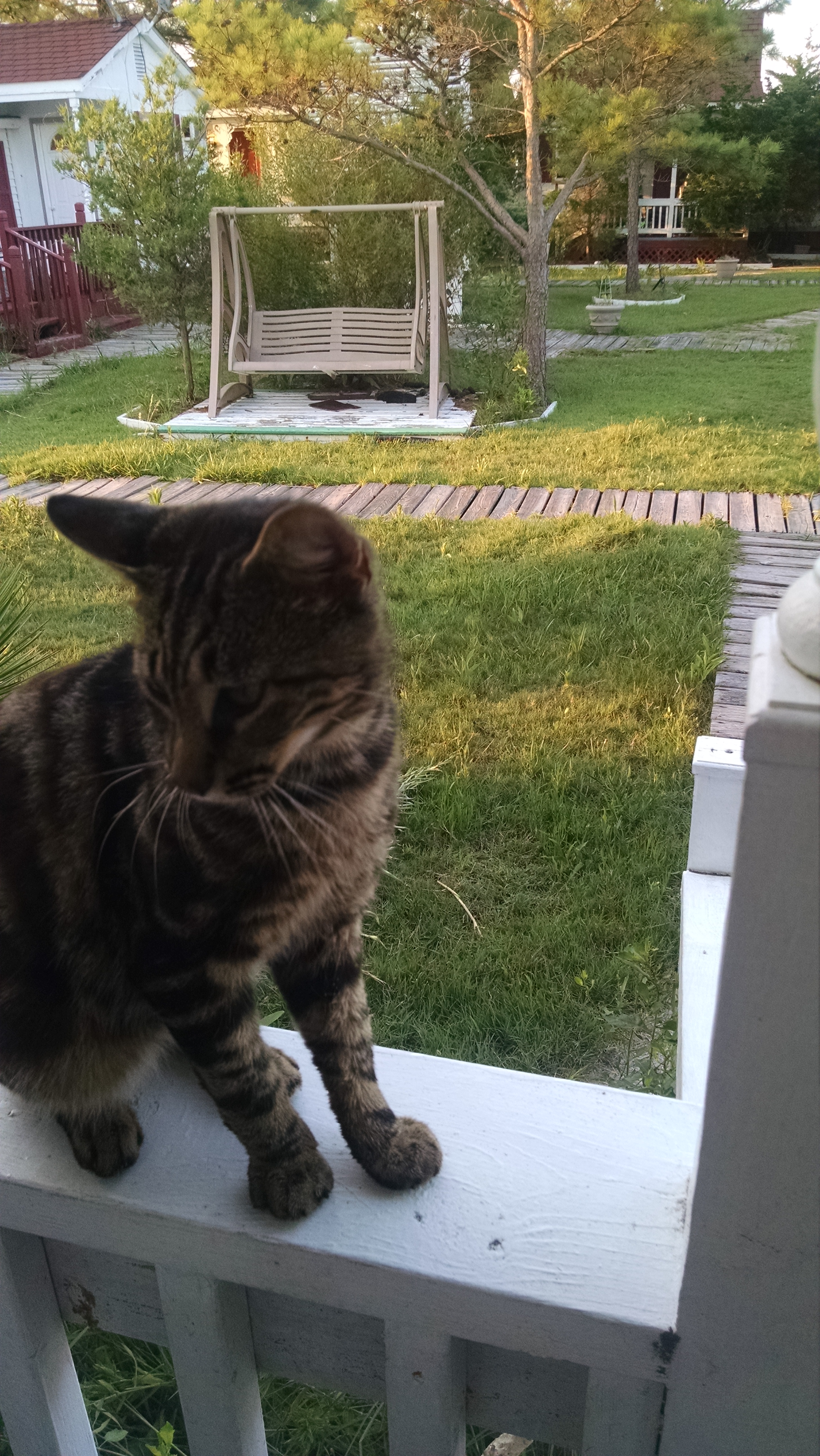
Slices of life on Tangier Island
I step outside our small island bed and breakfast room to sit down and journal a bit in longhand, the old fashioned way. Various cats soon lounge nearby. They are not feral in the sense of being wild looking and fearful of humans; they are quite tame and just looking for food and company. Yet no one “owns” them, or takes them to the vet. Perhaps they are so thin from worms, my husband speculates. I soon spy a whole brood of tiger-stripped cats. Elsewhere on the island we spotted black, white, Siamese, Maine Coon—not quite as prolific with cats as the Roman Forum in Italy or Cape Charles just across the Chesapeake Bay in Virginia.
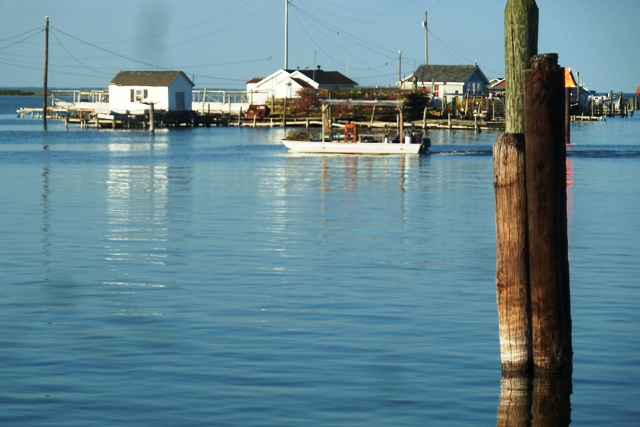
Crabbing boat.
I was happy to finally make it to the island that first captured my attention when I’d heard of the unique British accent that those born and raised on the island still maintain. My interest was piqued even more in the late 1990s when the mayor of Tangier Island —with majority support of the islanders—turned down a proposal to make a movie there, “Message in a Bottle.” Filmmaker/actors Kevin Costner and Paul Newman wanted to film the Nicholas Sparks novel on the tiny, one-by-three-mile island.
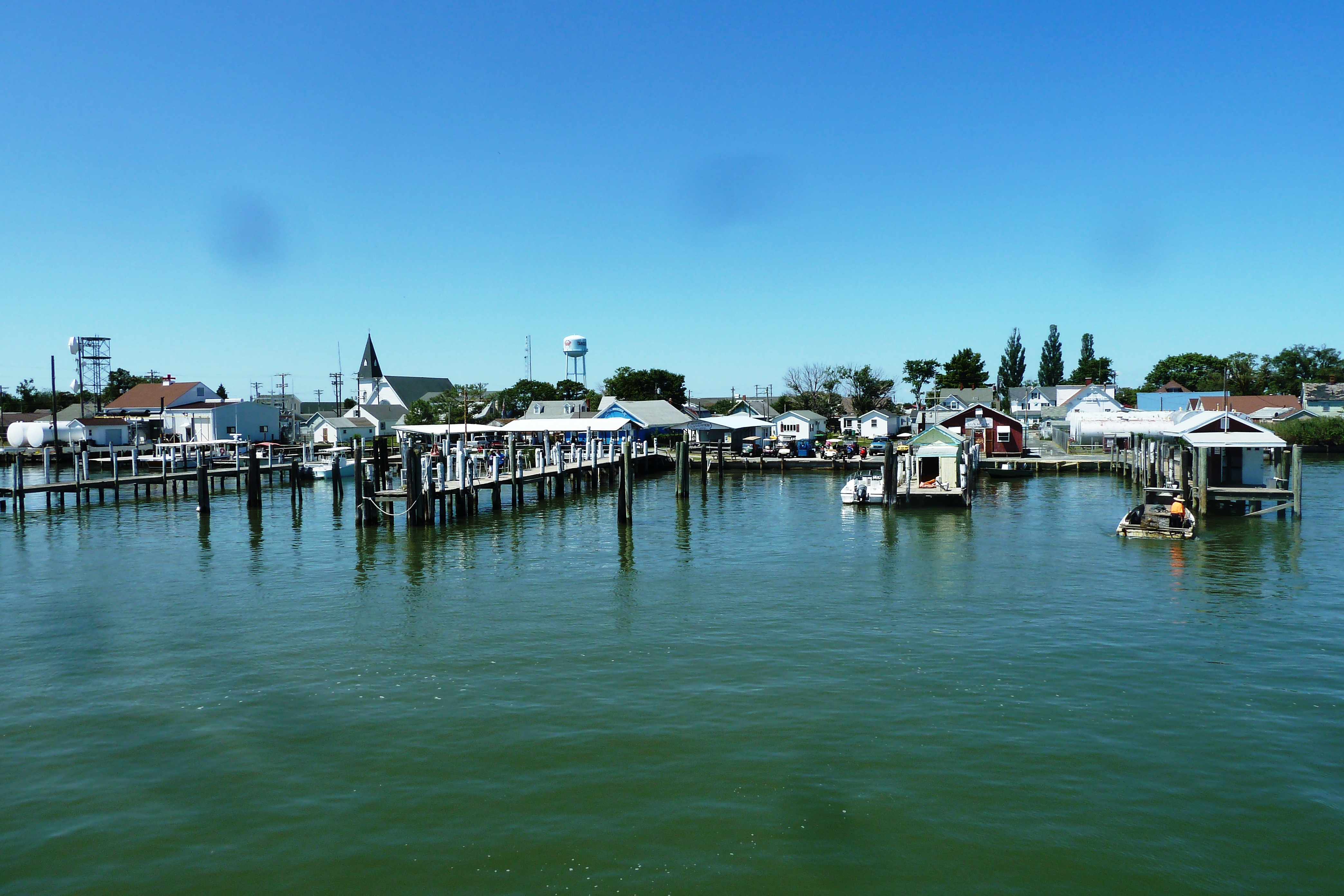
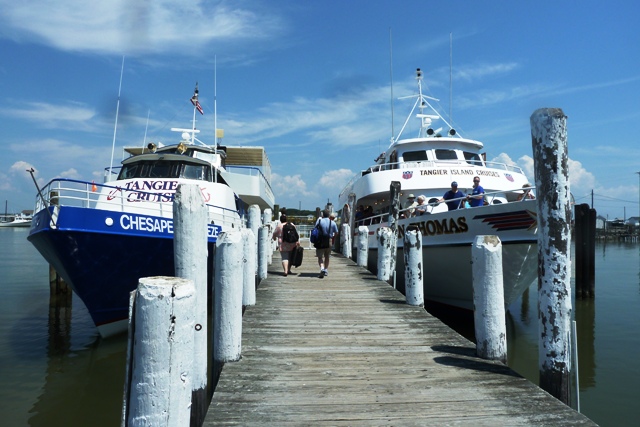
Arriving by boat to the Tangier docks.
Most residents were opposed to the proposed sexual scenes and alcohol use in the book. I wrote about the issue in my Another Way column at the time, and received dozens of affirmative letters or emails: people who saluted the people of Tangier for not wanting it filmed there for fear it would change something about their deeply Methodist values and way of life.
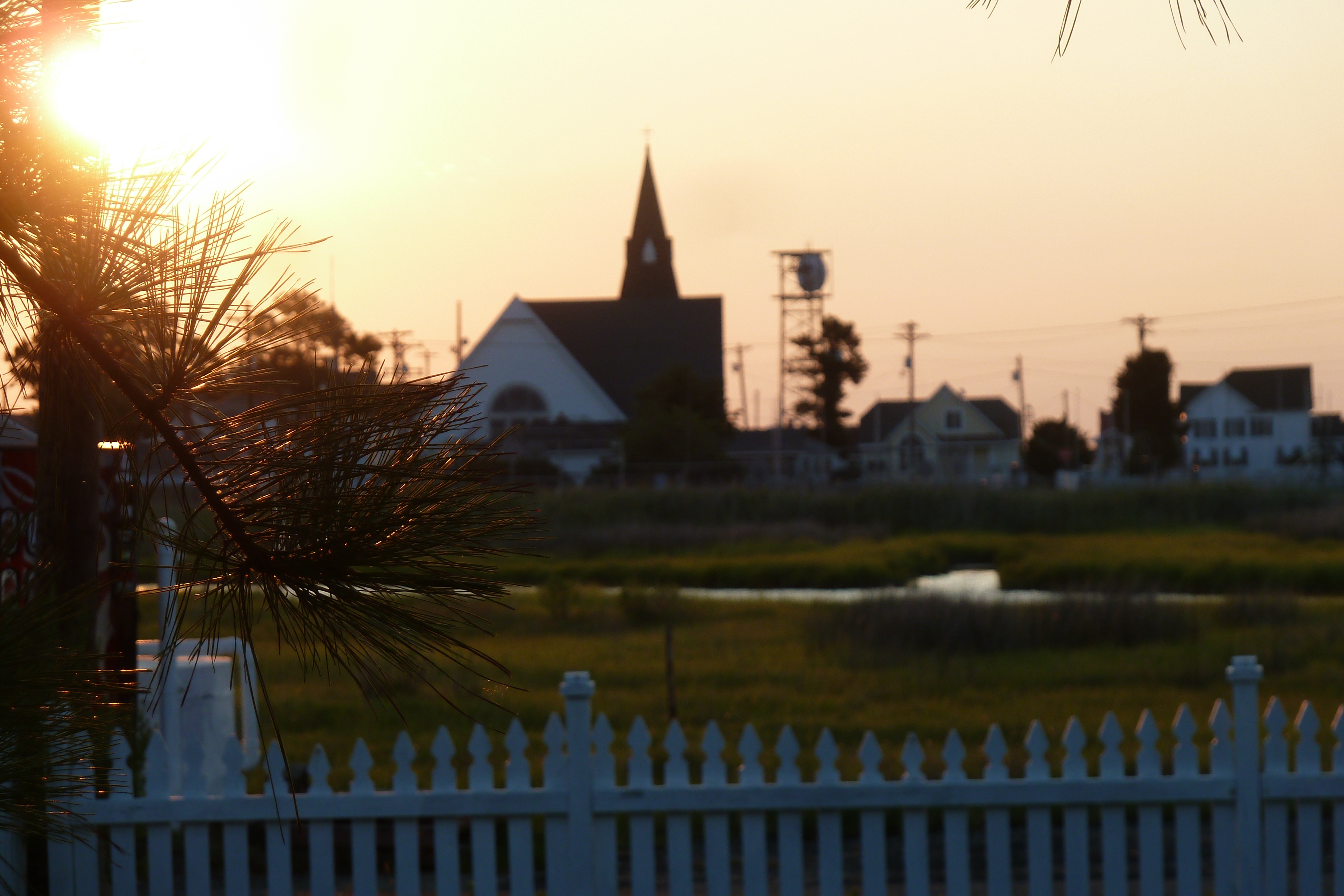
The Methodist church near the center of the town, and the town’s life.
The idea of visiting a Virginia island for an overnight stay always kind of intrigued me. Last year we had scheduled a trip to Tangier in late September to belatedly celebrate our 40th wedding anniversary, but the trip was cancelled when storms threatened that region. We rescheduled for July 31, 2017, and had a beautiful day to embark.
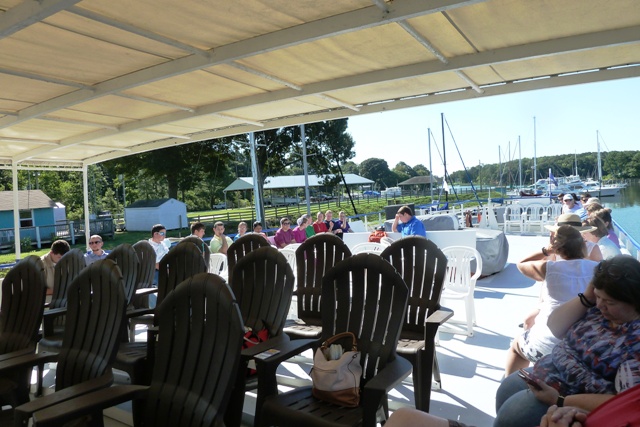
The boat was not full on a Monday morning, but a delightful group of conservative Mennonite young people were on board (see colorful dresses). And note: they also were taking photos.
I jokingly crooned, Gilligan-Island-like to my husband, “a three hour tour.” Daytime tourists to Tangier only get about a 3 hour stop on the island, so we planned to stay overnight. (The boat ride takes about 90 minutes each way.)

The slight rise on the horizon is Tangier on the Chesapeake Bay.
Island life on Tangier in 2017 seems a fascinating mix of peaceful serenity, calm and quiet—along with the stressful logistics of always being a $20 boat ride away ($40 round trip, but only $30 if you don’t stay overnight) from the mainland (or have your own boat). Our bed and breakfast host spoke of needing to plan way ahead for her needs and purchases, and making endless lists for her husband—of what to buy and where before he commuted home every two weekends (he has to work on the mainland of Virginia).
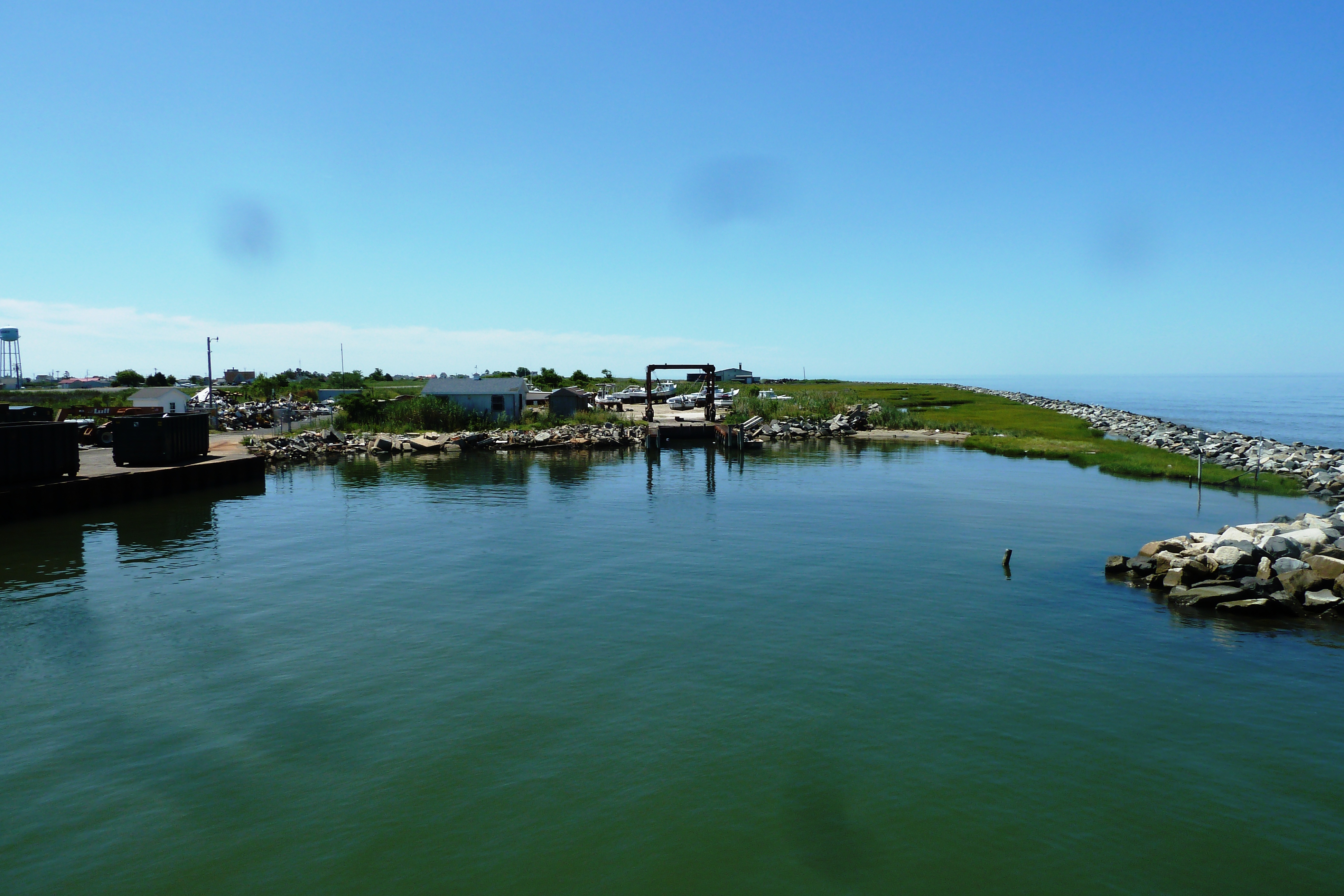
To the right you see part of the shore that was reinforced. More needs to be done.
Environmental concerns. The bigger issue just under the surface for residents of this shrinking space is when and where will repairs be made to the eastern shoreline. The western coastline was “shored up” in the 1980s to keep the encroaching sea at bay as it looses some 9-12 feet every year to the bay/ocean through climate change and erosion.
Before we visited, we had read most of a long but fascinating article from this 2016 New York Times paper on the major environmental issues it is facing. It was depressing when I read it, and with that backdrop, a visit to the island is more than just a nice ferry trip. But the few native islanders we were able to hear from (our inn hosts were originally from New Jersey) were fairly upbeat that something would be done to at least protect the shoreline to save the crabbing industry. One key paragraph in the NY Times piece says:
Tangier was not necessarily a lost cause: Schulte [a marine biologist with the Army Corp of Engineers] outlined a rough engineering plan, costing around $30 million, that involved breakwaters, pumped-in sand and new vegetation that could preserve the island. [There are, though,] immense economic and political obstacles involved in saving an obscure place from oblivion precisely when big East Coast cities were seeking hundreds of millions of federal dollars for storm-surge protection.
An interesting side note is that the island voted heavily (87 percent) for Trump in the recent election and Tangier apparently is on Trump’s radar for “saving.” Campaign signs were still visible around town, along with several “Trump for 2020” signs.
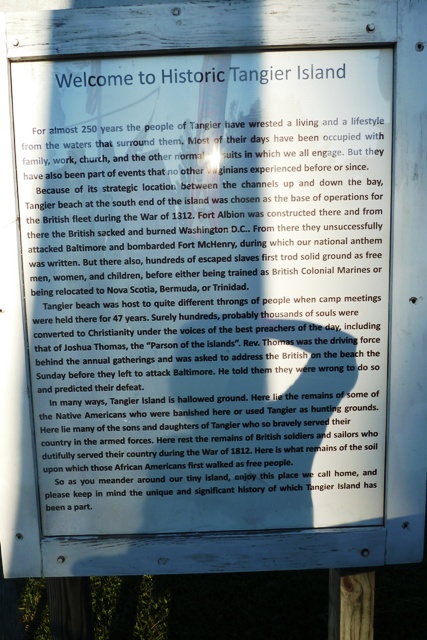
A bit of island history. But the historical aspect of the island was of special interest to both my husband and me. We spent a good hour or two in the well-kept museum. Tangier was one of several islands in the Chesapeake explored by Caption John Smith in the 1600s.
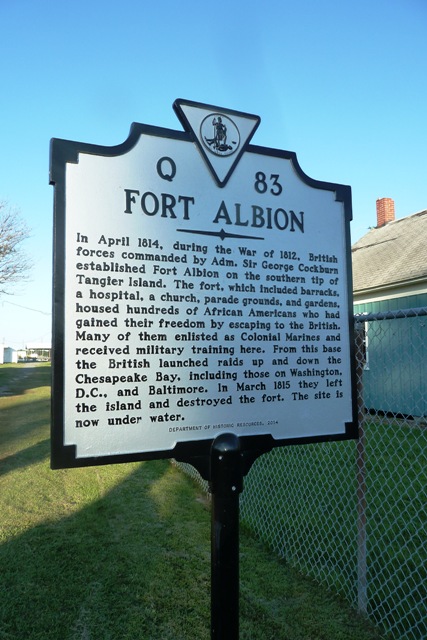
In the War of 1812, the British established Fort Albion at the beach end of the island and from there sailed up the Chesapeake Bay to sack and burn Washington D.C. Later they also unsuccessfully attacked Fort Henry up near Baltimore (which is of course where the national anthem “Star Spangled Banner” got its birth). Fort Albion was also where hundreds of escaped slaves first experienced freedom before being inducted and trained in the British Army, or relocated to Bermuda and Trinidad. Methodist camp meetings were also held on the island and its religious roots still run deep. We observed many crosses, religious signs on boats or piers, and souvenir mementos pointing to a solid Christian faith.

Island life. We were lucky to have been there during temperatures of mid to high 80s, rather than the higher 90s to 95 of a very hot and humid July, according to the inn keeper. The grounds there must be a continual upkeep challenge: boardwalk paths cover a marshy yard which needed mowing. The warped and raised boards posed a real stumbling hazard for those of us over 50—where an awkward fall can quickly twist a knee or back into years of pain or treatment.
After a 3-4 inch rain the Saturday before our trip, there had been flooding. The tour boat had not even made its regular Sunday run. Into this damp setting, we arrived Monday morning. So things were not quite shipshape, no pun intended. We observed that it would be hard to grow crops on the sea level island at this point in its history; we love our sweet corn in summer picked fresh from the garden—30 minutes from garden to table. That is probably impossible on Tangier. We did see a few tomato plants and back yard raised bed gardens.
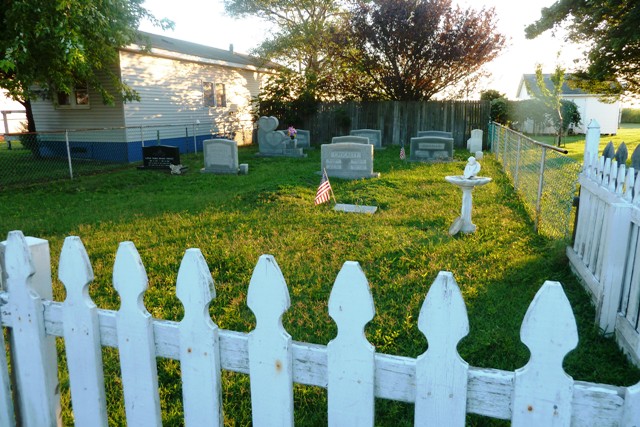
People on the island mostly bury their loved ones in small family cemeteries in their backyards, even though there are no traditional funeral homes on the island. A doctor comes to the island once a week and a physician’s assistant handles things in between at a modern clinic where simple procedures can be performed. People can be helicoptered to the mainland in an emergency.
School and children on the island. Somewhat in the center of the inhabited part of the island is a school—K-12 all in one building. The school has only about 75 students, but is a normal school (as we could see in old yearbooks in the museum) with graduations, proms, and festivities.
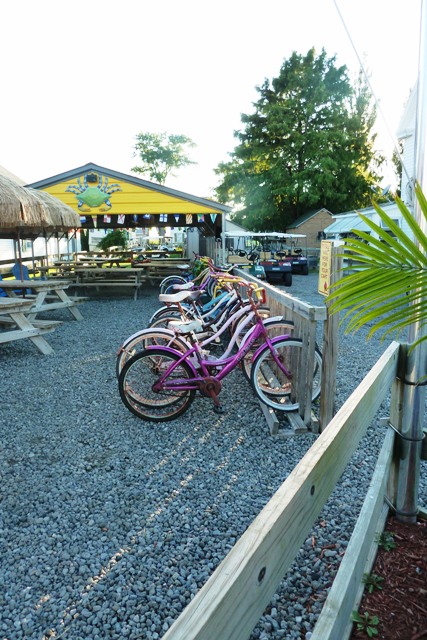
We saw these island kids playing late into the evening: riding bikes in the streets, making up games where children on foot chased kids on bikes, and hanging out at the ice cream shop with picnic tables and a large screen TV under a canopy. These children were approximately ages 7 and up, with no adults hovering—like kids in mainstream America used to play in the 50s. The island residents know who the island children are and would quickly recognize a stranger or tourist messing with them.
That is not to say all is idyllic on the island in terms of drugs and alcohol use, our inn keeper admitted. It is a “dry” island with no alcohol officially sold in any of its stores or restaurants. Several full fledged restaurants keep interesting schedules to accommodate the influx of daytime boat visitors: most serve lunch (the boats arrive around lunch time) but then close for the afternoon (except for two ice cream shops).
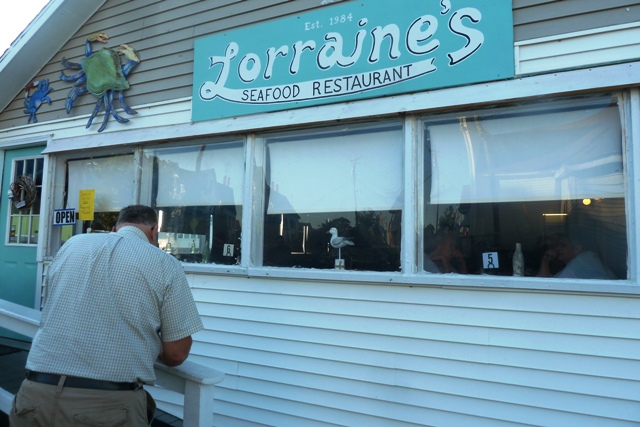
We ate at Lorraine’s with excellent food and to-die-for island cornbread; not being seafood people, we left the island without sampling the crab cakes everyone said were a “must eat.” When we cycled past Lorraine’s restaurant in the afternoon I saw a woman taking the garbage out the backend and guessing, I hollered with a smile, “Are you Lorraine?” Bingo. “Yes,” she smiled back. That smile won her two more dinner guests—since it was the only restaurant open on a Monday evening, other than one other bed and breakfast, which in addition to breakfast, also served dinner to its guests. The next day we had a decent lunch at a 50s themed shop, Spanky’s Ice Cream and also bought cones at Four Brothers, where you can also rent bikes or golf carts.
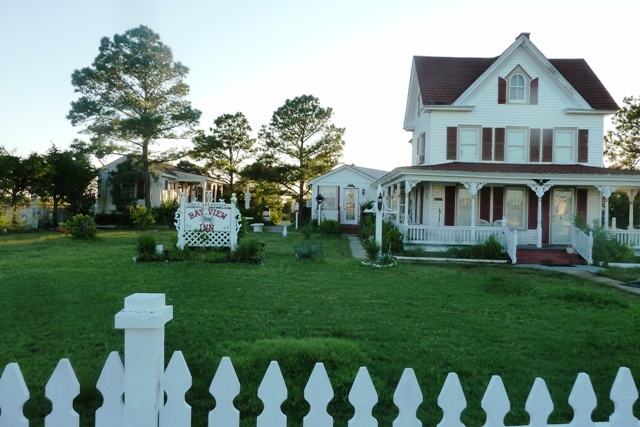
Lodging. We enjoyed our stay at the Bay View Inn which served a hearty and delicious made-to-order hot breakfast of bacon (or sausage); eggs however you like them or omelets with a long list of possible additions; toast, orange juice and coffee. The omelets and bacon were superb, and the service, very personal just like you want in a B&B. We got to hear the owner’s back story and appreciated the hard work it takes to run such an establishment on a small island where everything needs to be shipped in and picked up at the docks by golf cart.

The owner’s son driving us and our luggage in a golf cart from the docks to the inn.
Reflections. In a documentary we saw at the island museum, I was deeply touched by a young woman who ran a gift shop who said other women like her work hard even if they don’t earn a real living. “Island life is hard,” she said simply, but resisted moving to the mainland. We shopped in the few gift stores just to buy several items, and give people sorely needed business.
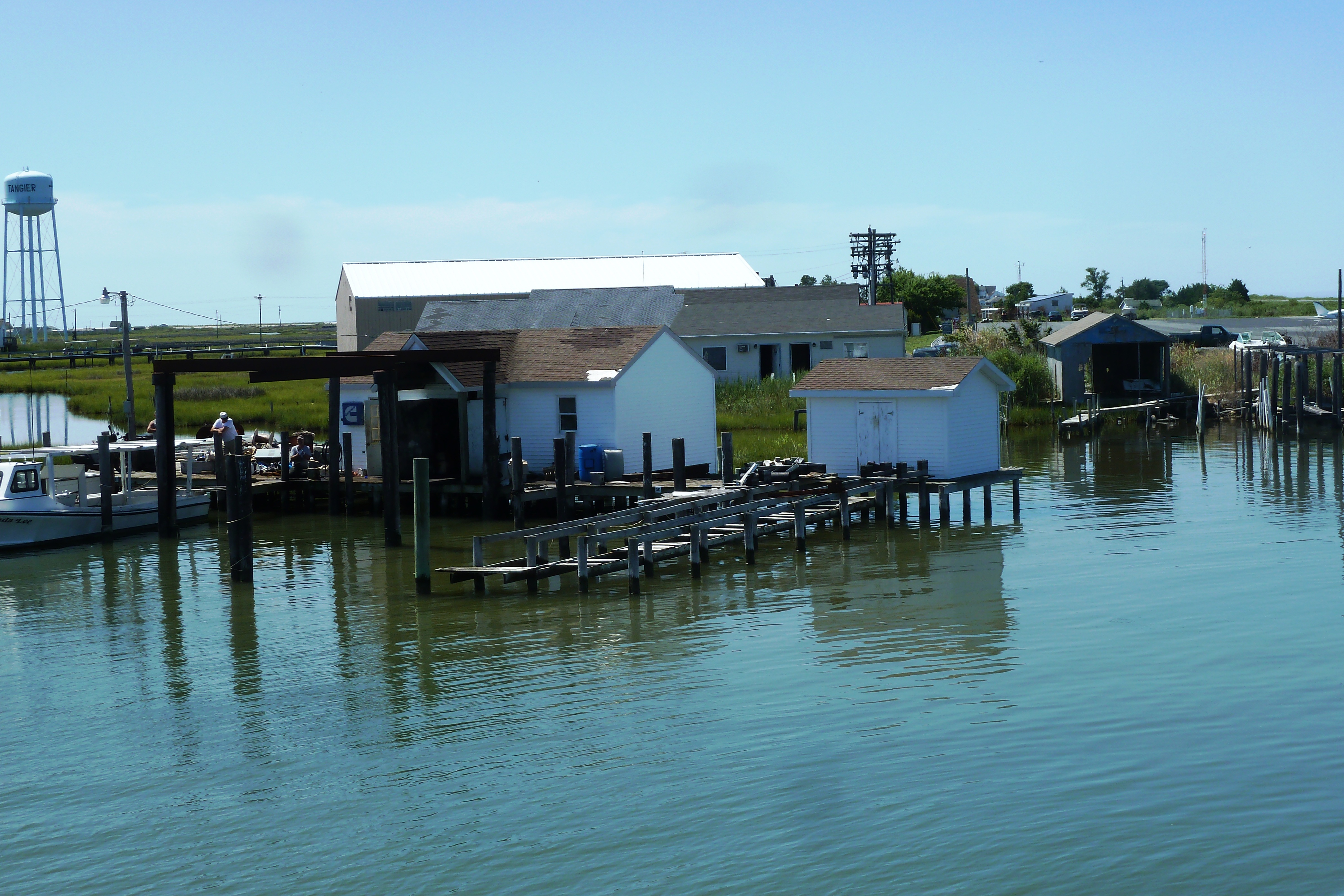
My husband had to find the hardware store, sparsely stocked, (which doubles as the place to buy gas for boats and other engines); men gathered inside chatting on a bench; the clerk there keeps running tabs for the locals on an antique desk with individual “account drawers” for such purposes. I wanted to take a photo of that desk but feared feeling intrusive and touristy.
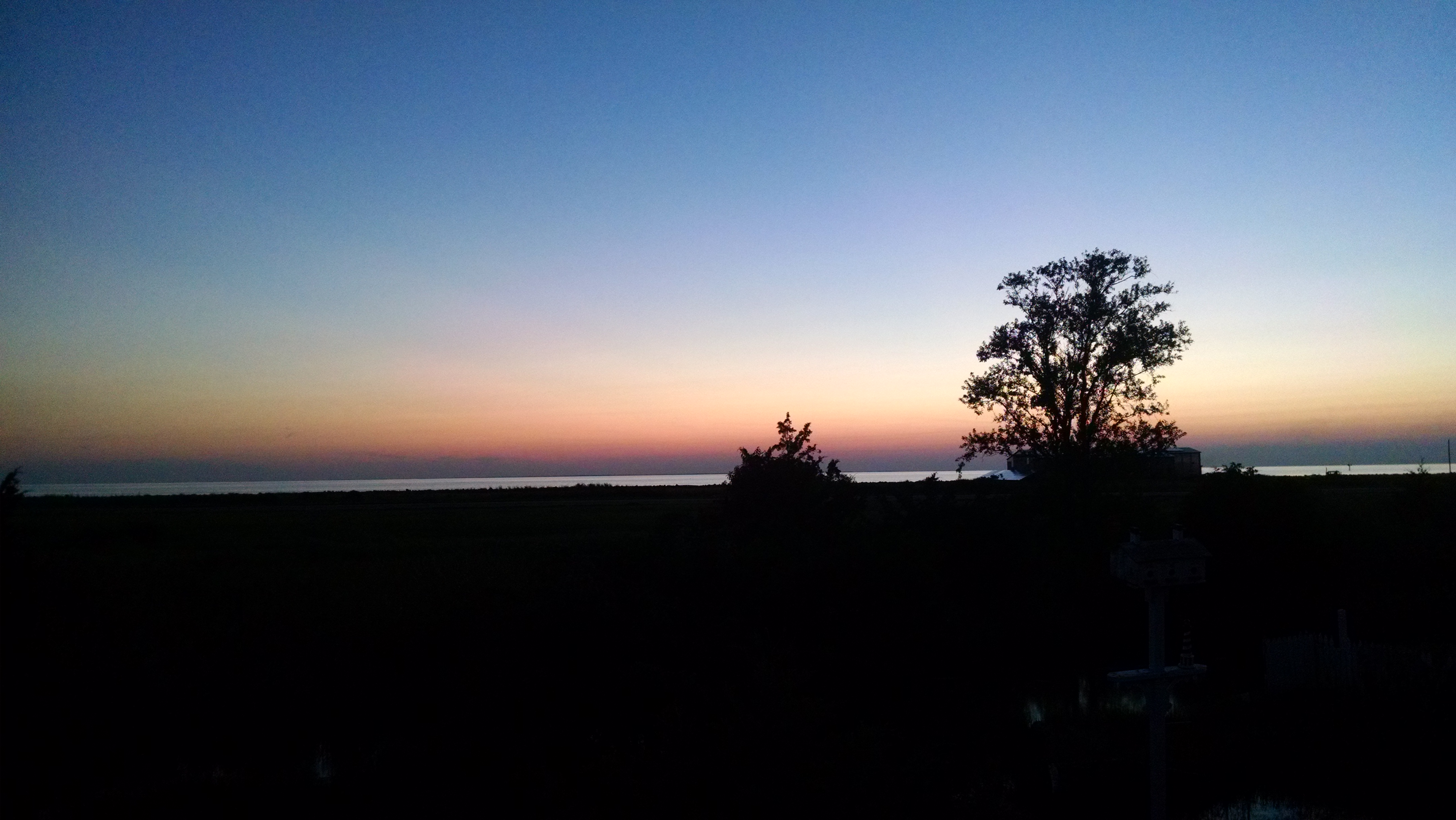
I cannot hope to capture the essence of Tangier Island in a visit of little more than 24 hours. We listened to retired watermen chatting near the docks, even though I could barely understand or pick up most of it; one louder fellow sounded a lot like Crocodile Dundee; mostly they strung out their vowels. Here are a few samples I was able to catch.
- Out there was “owt dere”
- Just like was “jes l-i-ake”
- Go out was “gout”
- Fuel was “few-ell”
- Hear me? was “he-ear me?”
But I breathed enough island air to have new appreciation for the history, the tremendous odds it faces from the erosion of its shores, the hard work it takes for most of those who live there, the call of home for those who have never known another way of life.
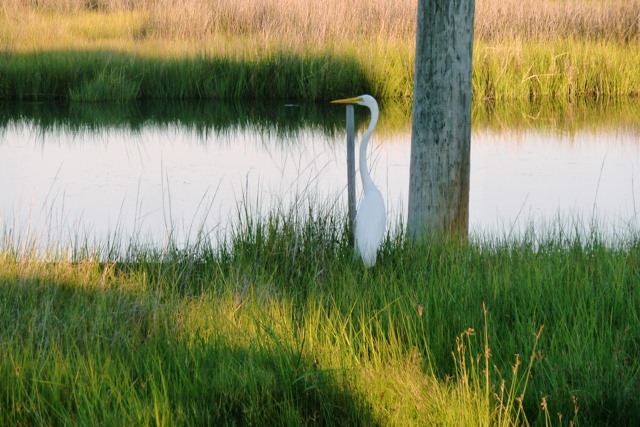
If it intrigues you too, plan a visit. Just don’t wait too long. Don’t just go for a day trip; the island takes on a different feel when the daytimers leave, and just a few overnighters stroll the soggy turf and trails, pondering the history, the future, and how life was for islanders 400 years ago.
***
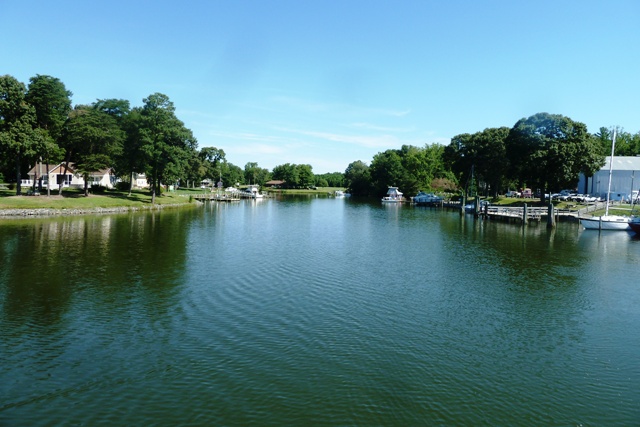
Arriving back on the mainland in Reedville, Va.
We used Tangier Island Cruises leaving from Reedville, Va., (Buzzard’s Point Marina to be exact), but you can also get to the island from Maryland’s Eastern Shore in Crisfield from Steve Thomas’s boat.
Find more information on Bay View Inn here.
Reservations and info on the boat from Reedville here.
***
Have you enjoyed a visit to an out-of-the-way place in your own state or province, that could use more visitors? Tell us where, and why!

My apologies to readers for my schedule these past few weeks, a bit haphazard in posting Another Way columns because of vacations and busy summer gardening projects. I usually post them a week after publication in newspapers. We’ll get back on schedule!
Another Way for week of July 28, 2017: Loved, Spoiled, and Boundaries
I was standing in line at the dollar store where I buy most of my greeting cards. In front of me was a man wearing a big pouch attached to a belt.
Another customer came in the store and immediately reached into this man’s pouch and petted something. My curiosity rising, I peeked around to find the man in line had a small dog in his pouch. The cute pooch looked like she was enjoying the attention.
The other customer headed on into the store so as the man with the dog finished checking out, I said something I’d heard before: “She’s not at all spoiled, is she?” I exclaimed.
The man responded firmly, “Loved, not spoiled.”
I was a bit startled at his response and responded softly, “Good answer!” I was glad he hadn’t simply agreed with me. It’s what I will try to remember to say in the future when a stranger tells me my grandchildren are surely spoiled rotten.
Some children wear T-shirts proclaiming their spoiled status. Usually it is a joke, but I always wonder if children begin to absorb some of the comments they hear, and begin to think of themselves as spoiled as they begin understanding language and its meaning. So I do hate hearing such lines especially said by a proud parent or grandparent: you sometimes act the part after hearing it so often.
On a recent night at our church clothes closet, one child, maybe five years old, was behaving like a dreadful brat. He ran up and down the aisles, pulling clothing off the hangars and whipping each piece to the floor. When asked, he would not pick them up, or stop. His mother was not calling him out, so those of us supervising tried to rein him in. He would have none of it. As we discussed the situation later, one elementary school teacher said the child needed boundaries. I couldn’t have agreed more. Sad are the children whose parents and caretakers set no boundaries or behavior standards.
That said, I too was guilty of trying to ignore the behavior of my young children at times. I am chagrined to recall the time when two of my daughters decided to turn a bar separating check out lines at K-Mart into a “monkey bar.” I was just trying to get through the check out line without the children begging for snacks or other goodies, and was trying to ignore their misbehavior. In this case, the clerk asked them not to swing on the bar. My face turned red I’m sure as I realized that even good mothers (which I tried to be) are sometimes too tired to cope, or just wanting to get out of the store after a long hard day. We sometimes fail to stick to limits on a child’s behavior.
Here are a few boundaries that are good for children and parents:
- When a parent counts to ten, or counts down from five for a child to stop a behavior, there WILL be consequences, such as an age-appropriate time out.
- Have regular times for naps and bedtime: so many behavior problems arise when children do not get proper rest. Parents can be flexible according to different activities, but have a game plan in mind.
- Follow through on promised punishments: nothing bends boundaries any faster than sensing a parent’s “no” is only a “maybe.”
- As children grow, expect them not to interrupt adult conversations unless it is an emergency; they can learn to wait if you’re on the phone or talking to someone.
Debbie Pincus, an author and licensed mental health counselor says at the Empowering Parents website, “Let’s face it, kids push the boundaries every day, all the time. They are wired to test us and see how far they can go; it’s in their nature.” She gives these additional markers for knowing when your children have become head of your household:
- Doing for your child what he can (or should) do for himself.
- Constantly asking questions; interrogating your child over everything.
- Letting your child invade your boundaries as a couple—making your kids the center focus at all times.
- Over-sharing with your child about your life; treating them like a friend rather than your child.
- Giving up your parental authority and allowing your child to take control of the household.
- Living through your child vicariously; feeling as if their achievements are yours, and their failures are yours as well.
- Your child is upset, and you fall apart.
Now, I may have crossed some personal boundary line when I gave my offhand comment about the man’s little dog, just for conversation. But I’m grateful for the gracious reminder he gave me, regarding the difference between “spoiled” and “loved.” We want children who know and feel respected and loved—and that starts by supplying love AND boundaries.

Our three daughters circa 1989, setting their own boundaries in a backyard tent they put up themselves.
For my free book on parenting, Working, Mothering, and other “Minor” Dilemmas (published 1984), send $3 for postage to Another Way Media, Box 363, Singers Glen, Va. 22850. Or send comments to anotherwaymedia@yahoo.com.
Another Way is a column by Melodie Davis, in syndication since 1987. Another Way columns are posted at FindingHarmonyBlog.com a week after newspaper publication.

How to Beat or Maybe Just Manage Mexican Bean Beetles
I have been dealing with Mexican Bean Beetles since before I knew what they were called, with varying degrees of failure. Never completely successful, at least not yet. I’ve been battling them at least 15 years, but, it is important to note, not all 40 years of my adult gardening and bean raising life.
We moved ten years ago this month and while we certainly had bean beetles in our earlier garden, I know there were many years when we had zero or very few of these destructive and prolific pests. Early on, if I had had them to the degree we’ve had them the last few years, I think I would have given up raising green beans (like I’ve given up trying to raise broccoli, due to the worms they get). Why some people can garden for years without any bean bettles or few, is beyond me. According to my research online, these bean beetles are more and more ubiquitous.
But this year, I have had the first success in keeping them more at bay, and I hope it is worth reporting here and sharing for all you fellow bean beetle sufferers. Stay tuned.

The adults looks like this.

The maturing larvae look like this.

The baby eggs look like this.
I hate all of them, especially when there are a bunch of the larvae on one bean leaf that make me absolutely “grively.” As below:

If you don’t know what grively means, it is a family word which means seeing something, usually in a pattern and something yucky that makes me turn away, shut my eyes, grit my teeth and shudder. They are so so gross! (I could barely stand to post the above photos… but I’m doing it for ya’ll.)
While my husband and I are not organic gardeners, we only use pesticides when absolutely necessary. In the early days 20-25 years ago, I did use some bean powder; maybe that’s what controlled them at that stage. But in recent years, our control method is simply picking off bugs and letting them drown (happily!) in a mixture of bleach and water (2/3 bleach, 1/3 water).
I have tried homemade mixes which included dish soap, rubbing alcohol, and mouthwash. Don’t try this at home. I REPEAT, DO NOT USE THIS HOMEMADE mixture. It killed my bean plants, totally dried them out.
Generally, when the plants get riddled from the bean beetles chomping away at them to the point they are no longer producing, I pull up all the plants, stuff them in garbage bags, and stomp (repeatedly) the soil where they stood, in order to kill the remaining larvae. I understand that the adult beetles overwinter in dirt and wood. Mother Earth News describes their life cycle here, and Weekendgardener shows the various stages here.
SOoooo given all of this, and having already handpicked likely 10,000-20,000 (counting dozens of eggs on leaves which I just smoosh in one fell crush) in my life so far, I was happy to read about Wade bush beans, which were said to be somewhat resistant to Mexican Bean Beetles. I bought 4 ounces of seeds and they are expensive, but the things I noticed were:
- The leaves are very sturdy and thicker—more leathery. (Less tender and tasty perhaps to the beetles?) than the leaves of my Jades or Tenderettes that I had previously grown as bush beans.
- The eggs that were laid seemed to dry up on the leaves and not mature into larvae as much—many of the eggs look dead or inactive.
- The adult bean beetles seem a little more sluggish and dull—not so lively and quick to escape my fingers.
These things could all have been my imagination, but whatever. I have had far fewer beetles so far, and the bean plants and leaves remain viable and producing beans, for about 3 weeks now. I have also not seen any pupa stage beetles. Yet.
The Wade beans at Adaptive seeds (based in Oregon, who said they originally secured them from Germany) were a little more pricey than at my local seed store, but worth it. So far, my family members who’ve eaten them have liked them just fine.
We’ll see what happens when my husband’s fav McCaslan pole beans start growing more and bearing (read the story behind these southern favorite beans). We always plant them later as a bean that can grow and thrive late into the fall. Let’s hope!
***
If you garden, do you plant bush beans? What kind(s)?
Do you get these nasty bean beetles? What are your methods of pest control?
Do you have a family word like grively? Does anyone know if it comes from Pennsylvania Dutch, (which my family knows a little)?
***
If you garden and preserve foods, here’s my favorite canning/preserving guide: Saving the Seasons: How to can, freeze, or dry almost anything. Purchase here.

 (Sorry for my delay in publishing this online but our summer has been a bit busy.)
Another Way for week of July 14, 2017
What Travel Does
Fifty years ago this month my parents took the trip of two lifetimes. I say two lifetimes because I doubt I will ever have the opportunity to duplicate it. But that’s ok. That they even attempted it, is just as incredible to me today as it was in 1967.
They went around the world visiting Germany, Amsterdam, France, Switzerland, Israel, Jordan, Egypt, India, Thailand, Vietnam, Korea, Japan, and Hawaii in a trip of about four weeks.
However, fifty years ago in June 1967, less than three weeks before they were set to leave, the “six day” war erupted in Israel. For several anxious days, they (and the tour organizers for their “Holy Land” tour) pondered: can we still visit? What will happen? Many many more face those kinds of ongoing questions on almost any trip abroad or even as we fly or travel in the U.S. Where is safe?
They did what so many others do: go anyway. Nowhere is truly safe, not even in 1967.
They didn’t feel too guilty, either, for leaving us at home doing the chores on the farm (with the help of a wonderful family who moved in with us for the duration). Just three years earlier, in 1964, Mom and Dad took our whole family on a western U.S. camping trip that we planned and saved for over five years—and remembered for decades. Truly our lifetime trip as a family.
Mom and Dad did not first plan on going clear around the world. The original idea was to attend Mennonite World Conference in Amsterdam, a long term dream. When they went to make arrangements through the travel agency, Mom and Dad asked the agent how much extra would it cost to visit France and Switzerland, where they wanted to visit historical sites related to the beginnings of Mennonite faith. Looking at the map, then they asked how much extra it would be to add on a leg to the Middle East to visit the Holy Lands and then India, in order to visit food distribution sites for the CROP program Dad had long worked with. The travel agent pointed out that once they were that far, it made as much sense to continue on to the Far East. So they decided to visit locations where heifers and other donated animals were making life easier for families in Thailand through what was then called the Heifer Project (now Heifer International). And so it went. I remember those details because Dad told the story so often!
It made sense for them to do this trip even though they were ordinary farmers with an average income which went up and down with the price of pigs and corn (two of our main products on the farm). Dad always said they paid for this trip by not smoking all their lives. Think about it. At today’s price of roughly $25 a carton (on the super cheap side), if you smoked a carton a week that’s $2600 a year for both husband and wife. You could save up for a pretty nice trip in ten years—$26,000, which isn’t that far to plan ahead.
A big savings for them was staying with missionaries in some locations, and also with friends who had visited our home over the years from various countries. They ate frugally—they both came back having lost weight, if my memory serves me. When you are visiting countries partially to see just how far the crops and money you donated to “feed the hungry people of the world” went (one of their main goals), you don’t exactly feel like gorging at a buffet.
Dad came back a “missionary” himself: as he began sharing their slides and many stories, they were invited to numerous churches, CROP programs and farmer banquets to talk about the needs they saw and deliver the message that yes, there truly were starving people they were helping through both distribution of precious sacks of rice and grain (where he witnessed very thin men scraping the leftover grain up off distribution platforms, so as not to let any go to waste). Dad often told that story with emotion in his throat and tears in his eyes. He learned and shared that supplies and food sent through government agencies often sat in warehouses or docks and spoiled because of red tape, while goods shipped through Christian and other non-governmental sources reached the people with less obstruction.
My memories these fifty years later, and how thoroughly Dad preached Christ’s gospel truth of “caring for the least of these” (Matthew 25:40) to anyone who would listen, is one testament to the lasting impact their life changing trip had.
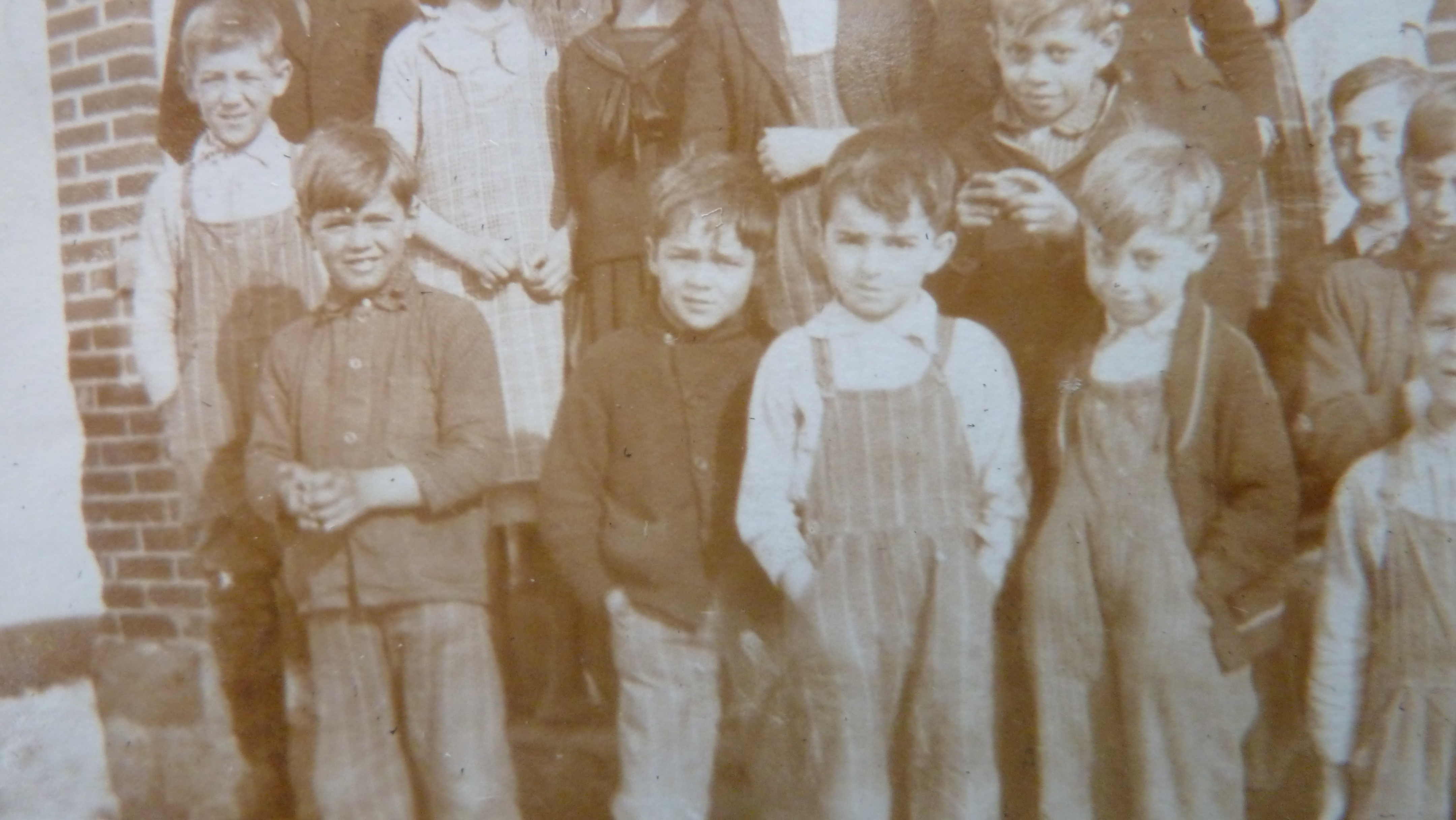
My father as a young school boy, circa 1922, second from left in front row, who couldn’t have imagined flying in an airplane, let alone going around the world.
What has travel done for you? Even if it is only to an area nearby? What have you learned through opening your eyes to needs—perhaps in your own backyard? I’d love to hear from you at anotherwaymedia@yahoo.com or Another Way Media, Box 363, Singers Glen, Va. 22850.
***
My own brief experience at Mennonite World Conference 2015 in Harrisburg, Pa. was described in several blog posts here.
***
Another Way is a column by Melodie Davis, in syndication since 1987. Another Way columns are posted at FindingHarmonyBlog.com a week after newspaper publication.

 findingharmonyblog