

Another Way for week of October 20, 2017
Parking Lot Encounters of the Friendly Kind
I was heading out of Food Lion with my usual cart of Friday groceries and noticed two men talking at the backend of a pick up truck. Out of the corner of my eye it seemed that one was paying attention to me; I wondered briefly if I knew him.
Two weeks earlier in the same parking lot, a guy on a motorcycle, with a green helmet and jacket smiled and said hello as I was getting into my car after buying groceries. I almost ignored him because, well, at my age, I’m not used to guys on motorcycles saying hi. (He turned out to be a man I had worked with for several years on various projects whom I hadn’t seen in years.) So I guess my radar was up to not snub anyone in my neighborhood grocery store parking lot where I do often know people.
After depositing the groceries in my minivan, I trucked my empty shopping cart to the nearest cart caddy and then saw the one man heading my way.
“I just wanted to tell you, I love your hair!” he said with genuine pleasantness.
This is not an everyday occurrence for a 65-year-old gal.
My hair? My hair! Really? No one hardly ever compliments my hair anymore, unless it is on days that I have just come from my hairdresser. And then I generally find a way to deflect the compliment, out of habit.
In high school, looking back, I did have pretty hair: long, washed and rolled every single night. Yes, I slept on curlers of the large, hard, plastic painful type through most of high school. Ugh. But my hair earned raves. Big price to pay for shiny, bouncy, smooth locks after I combed it all out in the morning.
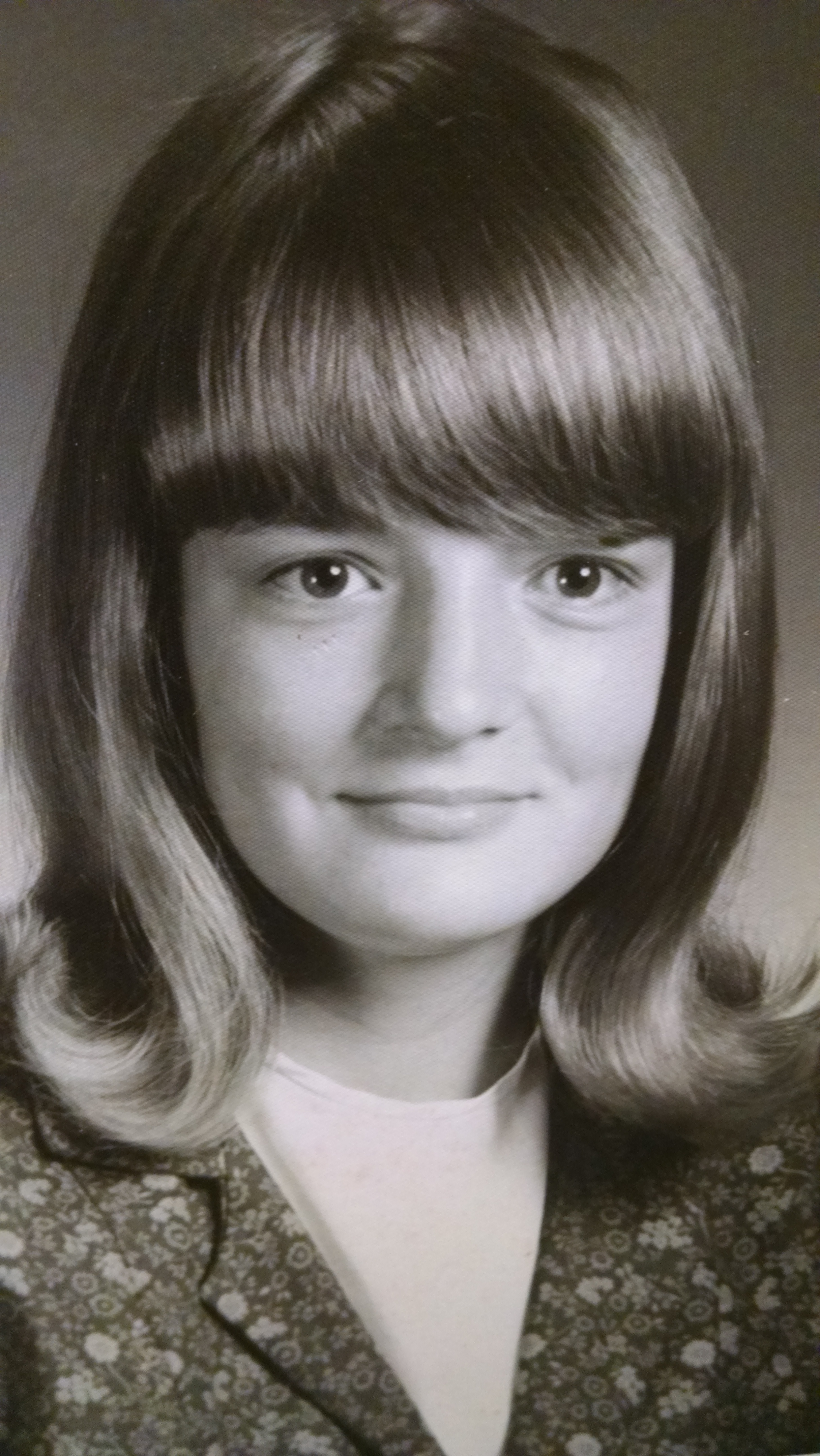
Hair from my “big roller” days, 1967.
So after the parking lot hair compliment, I was so shocked that I allowed my face to break into the biggest smile I could muster and just said “Wow, thank you! That’s very nice.”
He stammered to say that he didn’t mean to be anyone scary or looking for a pick up but just likes to find something to compliment any chance he can. “You never know what a compliment can mean to someone.”
Mr. Random Complimenter did make my day and I’ll confess I went home and looked in the mirror to see how my hair was looking. It was the normal salt and pepper graying hair of many a woman over the age of 65, but I had to laugh because my husband often says he doesn’t say anything about my hair ever because he’s not sure how it is supposed to look. I had recently told my haircutter not to keep trimming the layers and that I would try to grow it to one length again, just for something different.
I tell this story not to compliment myself, but to sing the praises of a man willing to take such a risk in this day and age.
My point here? Who can you surprise with a genuine compliment? Try it!
My final unusual parking lot encounter, at least for a woman of my advanced years, was a week later. (I think we’re on a roll here.) I was scrubbing our small, trusty Nissan at a do-it-yourself carwash before a weekend trip. A younger man (40s, 50s?) pulled up to the vacuum cleaner in front of my bay, and prepared to clean out the inside of his car. But first he called to me over the noise of the water sprayer: “Need some help, sweetie?”
Now, I don’t believe he was trying to pick me up either, heaven forbid, but rather thinking perhaps a woman as old as I in my office clothes shouldn’t be washing a car all by herself? I’ll never know. I politely refused, saying I was fine. Maybe he was just trying to get my bay quicker.
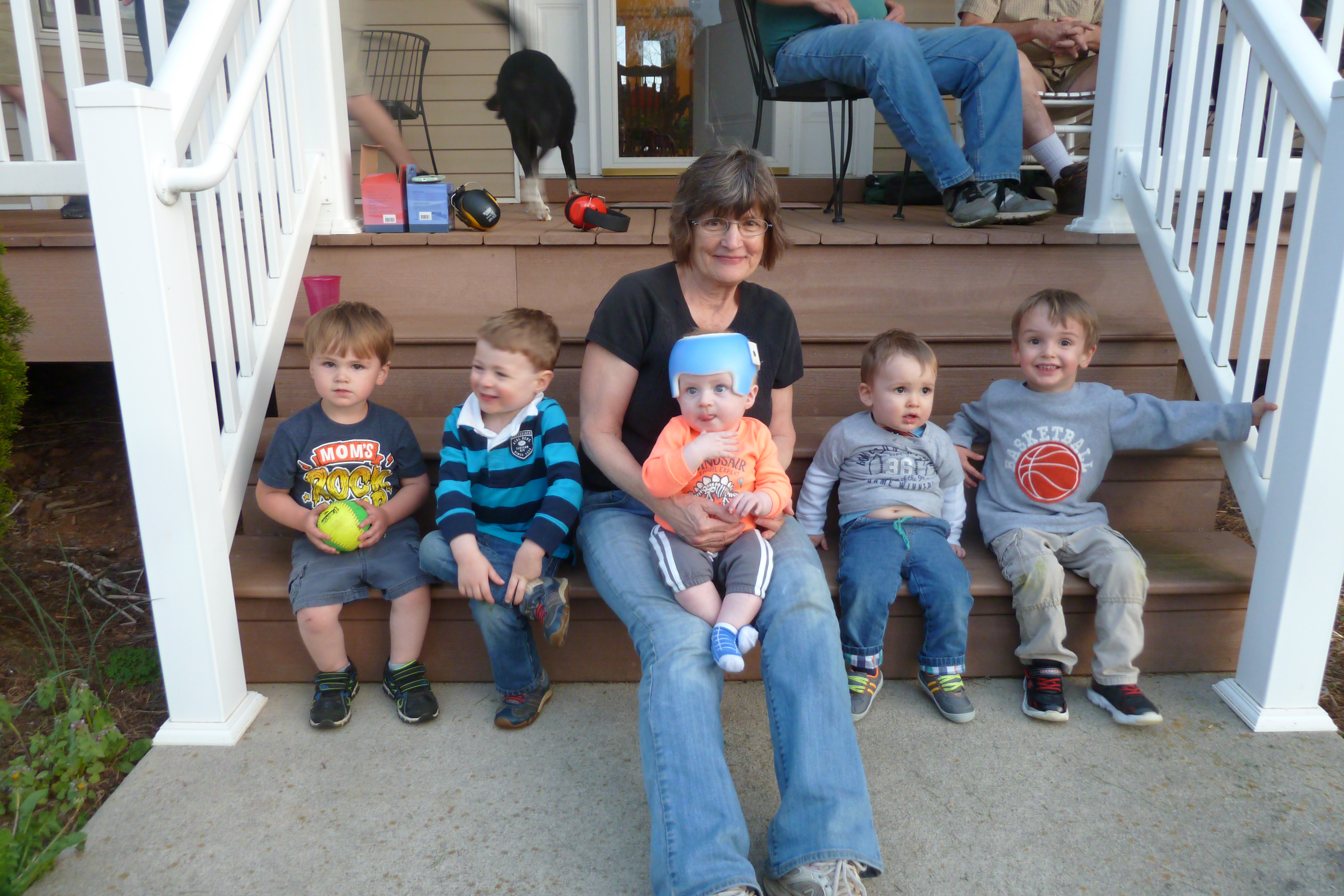
Grammy hairdo now, and my four grandsons, plus their cousin, far left.
Moral of this story? Don’t try calling a woman sweetie unless you think she is old enough to be your grandma, ok?
***
Do you have stories of random compliments or similar to send my way? I’d love to hear them and perhaps do a follow up post or column.
***
Any hair-raising stories, of what you’ve put your hair through as a teen, young adult, or older?
Post in comments or send comments or stories to anotherwaymedia@yahoo.com or Another Way Media, Box 363, Singers Glen, Va. 22850 or post at my Facebook page called Another Way Newspaper Column.
Another Way is a column by © Melodie Davis, in syndication since 1987. Another Way columns are posted at FindingHarmonyBlog.com a week after newspaper publication.

Another Way for week of October 14, 2017
Smoking at School?
It was the Motley Crew who sang this popular song by The Brownsville Station in the year 1973: “Smokin’ in the boys room … Everybody knows that smokin’ ain’t allowed in school.”
My husband, who graduated high school in 1972, had his 45th year class reunion recently. One of the planned activities for the weekend was a trip through the hallowed halls at his old high school, now a middle school. The principal, a young woman (well, ok, she said her class was having its 25th reunion, but she looked so young!) made sure we got to go into all of the classrooms that still looked very much like they did back in 1972. I toured with my husband just to get a taste of what his high school was like back then, and to hear the stories and memories the walls evoked.
But my head wasn’t the only one that turned around when these classmates started reminiscing about an outside smoking area in a courtyard between some wings of the school.

Former smoking area at my husband’s old high school.
This was not a smoking area for teachers, but for students! Can you imagine it today? Even the Motley Crew said way back then, “everybody knows” that it “ain’t” allowed.
As my husband reminded his former classmates, it was only permissible if you had a signed note from your parents on file at the school; if you didn’t have a note, you better not stop and talk with anyone in the area or else you could be tapped for your permission papers. I’m guessing that there was also a cut off age—perhaps 16, although my husband didn’t remember any.
I don’t know how widespread this rule was. I went to a Christian school my first three years where that would have been totally forbidden, but I do recall there was a smoking area at the public high school where I graduated high school. I would love to hear from readers about the rules on smoking you remember at your schools.
When I told my work colleagues about this discovery and memory, they were amazed. Our society has changed so much it is incredibly difficult to imagine schools allowing kids to light up on the grounds. But remember back in the day—people could smoke on airplanes in a special section. In restaurants, sometimes you could have your “smoke” without a special section. And my hospital roommate, when I had our first daughter, was a smoker. There was only a curtain dividing us in our room. (Thankfully, I was moved.)
Unfortunately, I can’t say I was a nonsmoker all my life. I’m not proud of it, but for about two to three months of my junior year of college in Barcelona, Spain, where 75-80 percent of people—including my friends—smoked. Cheap brands were about ten cents a pack then. I went through several packs before I realized how easily it could become a habit. I told myself I had better stop before it become entrenched and hard to quit.
I do have sympathy for anyone who has tried and wants to quit but has difficulty. Of course there are all kinds of products available to help reduce the urge to smoke.
I did a little research online to see if other people remembered the days of “smoking at school.” One wrote in a discussion forum:
“Upon registration a parent had to sign if you were allowed to smoke. Then you’d have a box checked on your ID and could go out to a shed. My dad signed mine. He said he wanted it to be my choice, and he didn’t want to prevent me from hanging out with friends who smoked. This just seems crazy now!”
When we reflect on how policies about smoking have changed so dramatically in the last 30 years, we wonder what changes could come about that we can’t imagine now.
Nicotine is a powerfully addicting drug. If you smoke and want to quit, the Great American Smoke Out is coming up on November 16, a great time to quit! Some quit that day, or set goals for quitting. That would make this the best holiday season ever.
We only get one precious life. Now is a good time to make sure your life is not cut short by the habit of smoking.
***
What policies do you remember from your high school days on smoking? I’d love to hear practices in your community.
***
Another Way Media, Box 363, Singers Glen, Va. 22850 or anotherwaymedia@yahoo.com.
Another Way is a column by Melodie Davis, in syndication since 1987. Another Way columns are posted at FindingHarmonyBlog.com a week after newspaper publication.
Another Way for week of October 6, 2017
How Are We Taught to Love?
One of my newer favorite writers, Marianne Jantzi, posed this question in one of her “Connections” columns (a small Canadian women’s magazine): “What if we had never been taught to keep our homes and families near our hearts?”
Are we taught that, and how? Where does family love and devotion start? Perhaps more importantly, how do we nourish that in ourselves, our children? Is it natural, or learned?
***
Chad Churchman with his parents, Charles and Pat.
It was one of those “let’s-toss-normal-structure-aside-Sundays,” with chairs placed around tables and in small circles instead of traditional rows (we don’t have pews). The liturgy was pretty normal but when we got to the sermon, mostly we were led through discussion suggestions, with each person sharing from their own journey. We were to close our circles by praying for each other, anointing each other with a bit of oil, and then telling each other “God loves you and I love you.”
On that Sunday morning, one of the persons in my small circle was Chad, who I will always think of as a “young” man, about 11 years younger than me. Chad had suffered a severe head injury in a skiing accident when he was truly young and daring, a freshman in college. After the accident he lay in a coma in critical care for weeks, but eventually regained the ability to walk, talk and function. He was, however, very much changed in personality, but he became a much loved member of our church community as he lived in a separate small cabin at his parents’ home. He eventually was able to hold a job as a landscaper at a local university, loved hiking and the outdoors, and took great joy in doing stonemasonry on the side. Then he had to quit his job about four years ago. Increasingly, he had difficulties talking, swallowing and sometimes walking.
The next Sunday morning after our “small circle” experiment in worship, we received the terrible and shocking news that Chad had died Saturday evening in a choking incident. His aging parents were not strong enough to do a Heimlich maneuver, although they tried valiantly to help him.
My mind went immediately back to the small group circle with Chad and the special anointing. The blessing we gave each other was so simple, yet profound: “God loves you, and I love you.” I will treasure that special service and memory of Chad as he now walks and lives freely in that other heavenly realm with our great and loving God.
Our pastor, Stephanie Sorge Wing, said she gives each of her small sons this blessing—God loves you, and I love you—each night as they go to bed. That is one way to help teach our families the love of God. It is also through the daily tasks requiring great patience, endurance and dedication that our families see love demonstrated (and which Chad’s parents—through many difficulties—possessed in spades).
This is how we teach children and each other what love is. Chad himself became a carrier of that love as his main greeting at church became a solidly gripped handshake or a sweet bear hug. He also reached out to help others however he could.
***
Another excellent Canadian writer (British Columbia), Gareth Brandt, writes in a devotional magazine Rejoice! about God’s great love. Brandt notes that, “God is often depicted as quite emotionally volatile in various Old Testament stories, but divine anger is always temporary, whereas God’s love is always steady and lasting, even eternal. … This love is … the basic message of the gospel we pass on to the next generation.”
Brandt closes with this beautiful reminder:
“When our daughter was lying in a coma: God is love. When we moved from rich familiar soil to windblown prairie: God is love. In the thick and thin of our marriage: God is love. Amid disunity and division: God is love. On special occasions and in ordinary life: God is love. Whatever you have experienced: God is love. Come what may: God is love.”
***
How do you see God’s love made visible around you?
What prayer or reminder did you or do you say to your children or grandchildren when you put them to bed, or other special traditions?
What do you remember your parents or grandparents saying to you?
I’d love to see your comments below!
***
Another Way is a column by Melodie Davis, in syndication since 1987. Another Way columns are posted at FindingHarmonyBlog.com a week after newspaper publication.

You mentioned in your column that you were raised around the Amish as a child. I was also raised in a neighborhood like that. It was my family and another family that was not Amish on our little country road. My summers were spent at the neighbors. I was in high school before I knew you could buy chicken from the grocery store. I thought everybody had a grandma who butchered chickens.
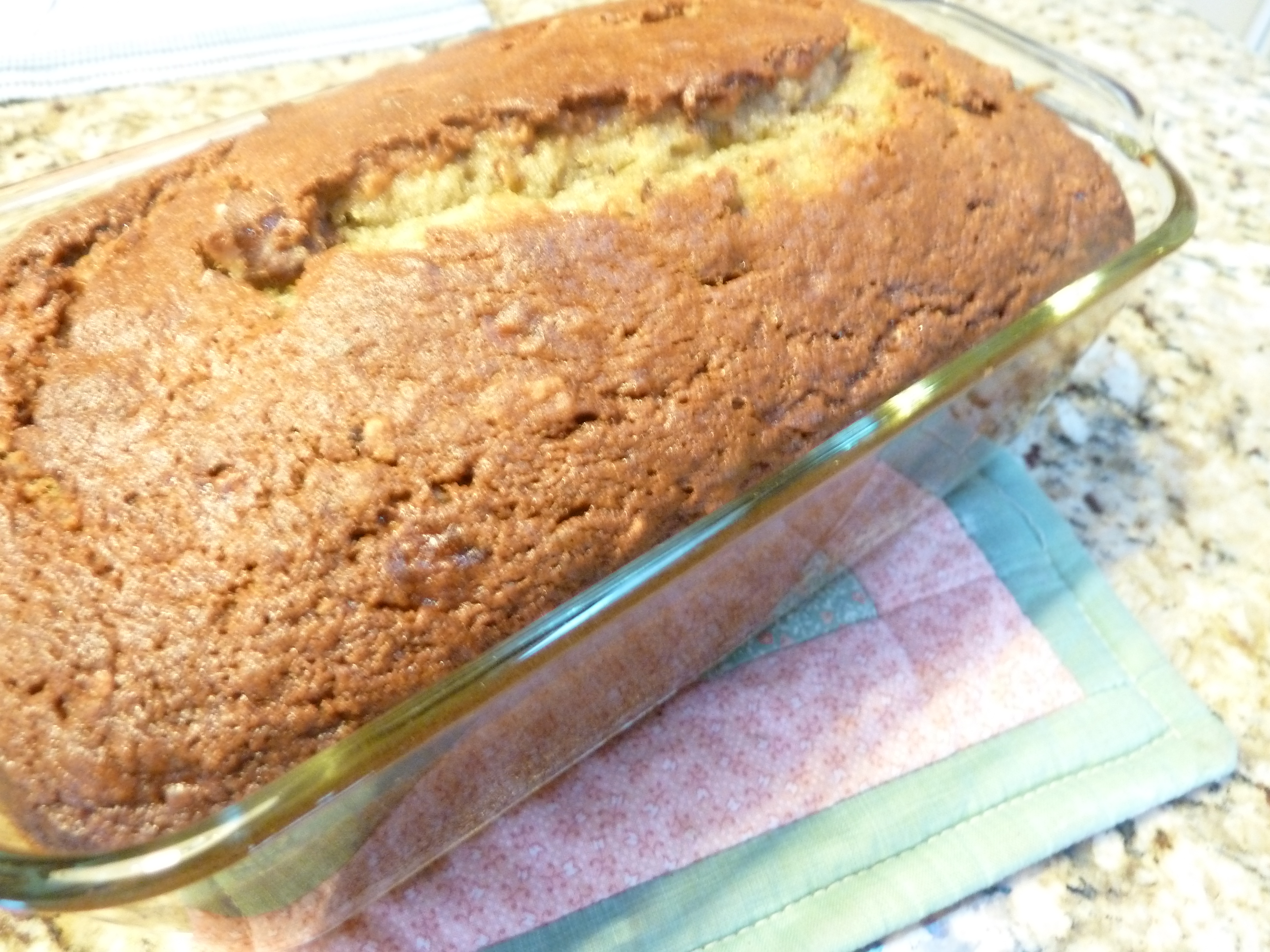
I feel truly doubly guilty whenever my bananas get too old to eat—or at least too old to enjoy eating. Barbara Kingsolver made me especially feel that way nine years ago in her prize-winning book, Animal, Vegetable, Miracle: A Year of Food Life for buying bananas, knowing they had to be shipped from tropical zones and never would fit into the 100-mile diet (foods you grow or buy from within one hundred miles of you). But since she and her family gave themselves a free pass for coffee (also not available locally!) on their shopping list, I figure I could allow myself both coffee AND bananas.
I do like to keep bananas on hand not only because I love them, but because they make a great tummy buffer if you have to get up in the middle of the night and take aspirin or ibuprofen on an empty stomach. At one point I decided to try just eating half a banana in the middle of the night—and skip the medicine if my headache was just kind of iffy and weak. Eureka—I could get rid of a headache just by consuming the banana. (My father would say it was all in my head. Yeah.) So sometimes I end up with rotten bananas because I’m always saving them for the next potential middle of the night headachey feeling.
Back to banana bread. I wanted just a basic recipe, right? So I found it interesting that some of my favorite all purpose cookbooks where I expected to find it, didn’t have a recipe.
Now in one, I could quickly figure out why. First I checked Simply in Season, knowing it had an index listing things by the predominate fruit or vegetable in the recipe, since it features seasonably available foods.
Well duh, of course in North America, bananas—although they are available to us year round, are, as we’ve already discussed, hardly seasonable local fruits, so I’m sure the cookbook editors nixed any entries there.
But I was really surprised not to find it in Mennonite Country Style Recipes: The Prize Collection of a Shenandoah Valley Cook by almost-neighbor Esther Shank. Bananas are a basic food group recipe, right? Something you might have even learned to make long ago in Home Ec. Class? Nope.
Never fear, I found it in Mennonite Recipes from the Shenandoah Valley collected by New York Times bestselling cookbook author Phyllis Pellman Good and her daughter Kate, submitted by Jennice Babkirk, right here in Harrisonburg. (Anyone know her?) And of course recipes abound on the web.
This recipe turned out great the very first time I made it. I have made banana bread previously but did not keep track of what recipe I used.
Banana Bread
1 cup sugar
1/3 cup margarine or butter, softened
2 eggs
1 ½ cup mashed bananas (3-4 medium sized bananas)
1/3 cup water
1 2/3 cups flour
1 tsp. baking soda
½ tsp. salt
¼ tsp. baking powder
½ cup chopped nuts
Directions:
- Cream together sugar and margarine.
- Stir in eggs until well blended.
- Add bananas and water. Beat 30 seconds.
- Stir in flour, baking soda, salt, and baking powder, mixing just until moistened.
- Fold in nuts.
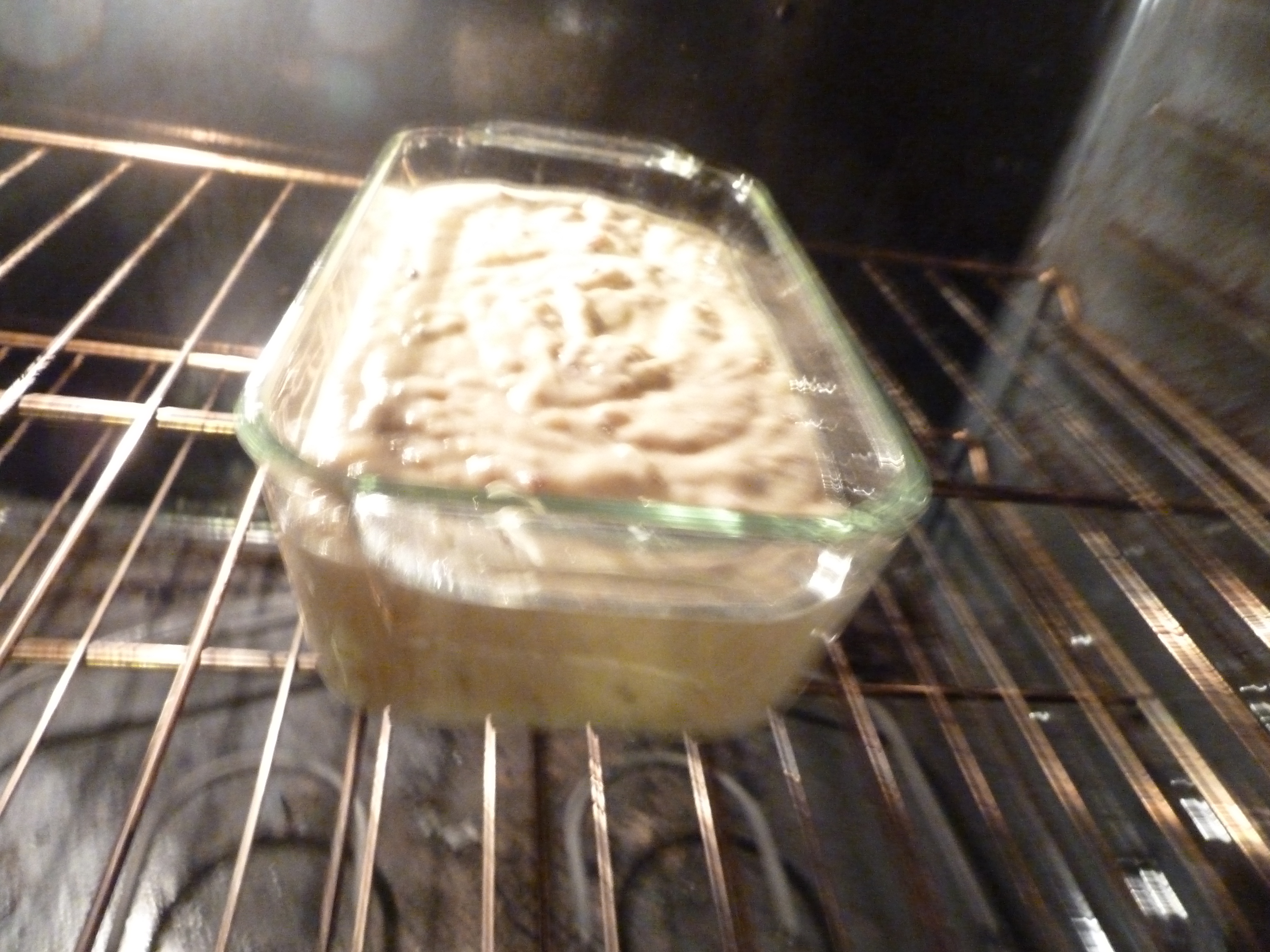
- Pour into loaf pan which has been greased only on the bottom.
- Bake at 350 degrees for 55-60 minutes, until wooden pick inserted in center comes out clean.
- Cool 5 minutes in pan. Loosen sides of loaf from pan, then remove from pan. Cool completely before slicing.
Makes 1 loaf.

My notes:
Rotting or not? My bananas looked pretty far gone and ugly, but inside they were still fairly firm, and definitely not rotting.
So while I use old bananas, those that have gotten to the stage where they are black and mushy—I’m not sure I would use those. Anyone else tried using literally rotten bananas? (You can always freeze black-turning bananas you haven’t gotten around to using.)
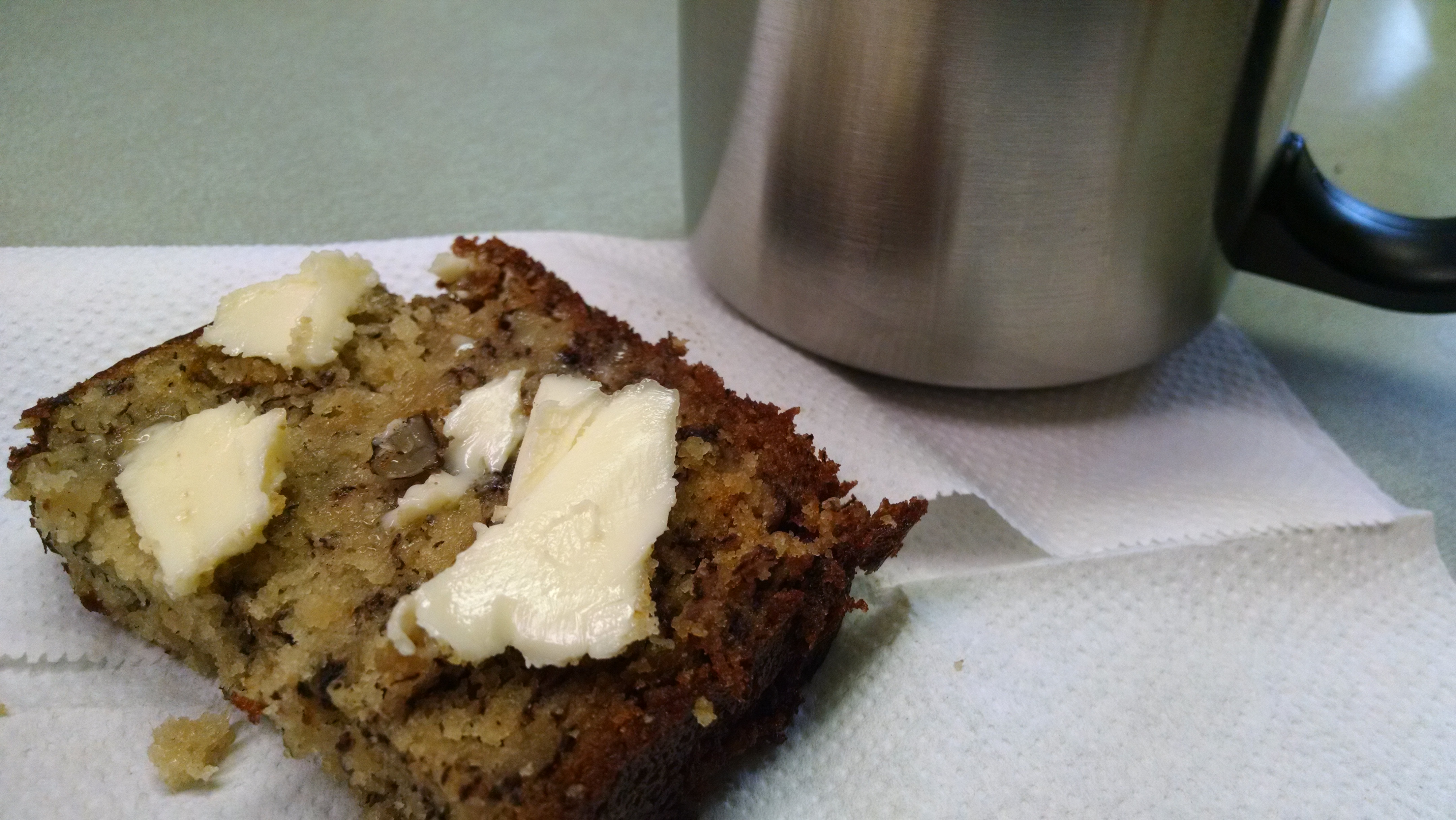
Remove from pan? I also did not take my bread out of the pan in five minutes. In fact, I took the bread to work in the baking pan, kept it that way with foil over the top, and it was still warm three hours later for our coffee break at work. I made slices right in the pan and they came out just fine.
Free, not-really-medical advice. And my medical tip to substitute banana for an aspirin in the middle of the night?? Completely free advice. You are very welcome. Or, even better, a slice of this bread with a hot drink or cold milk. Yum.
***
Where do you first look for recipes? Your own recipe box, online, a favorite cookbook? Which one?
***
Or, do you have an unconventional headache remedy?
I’d love to hear!
Another Way for week of September 23, 2017
The Value of Education
School’s been back in session for most children for over a month now, and families and teachers are settling into the fall routine. Most of us had some excellent, favorite teachers as we went through school (thinking here particularly of elementary through

Typical valley classroom; photo by Melodie Davis
high school). My hat is off to all of those great teachers, and they are far the majority. Then there are those who because of lack of training or career suitability, or perhaps a personal crisis, fail their students and themselves. They usually also lack the ability to control a classroom—and thus have no way to really teach anything, other than how not to be a teacher.
My second grade teacher was that kind of teacher. I hadn’t thought about her in years. But a description of a teacher in a book I am reading suddenly brought Mrs. S. vividly and sadly to my mind: “She begged for attention, but no one gave it to her. ‘Listen to me!’ she screamed. … her screams proved useless as she still was unable to gain the attention of a single child”

School was at the time not compulsory, just as many children around the world today are living in countries or communities where either families can’t afford it, no school is available, or girls—especially—are not permitted to go. However, Mark’s mother worked very hard to not only get the proper paperwork for him completed, but to talk her son into the value of an education when other boys his age were already running wild, living on the streets (ages 7-8) all day. Her eloquent speech as written down many years later by her son went something like this:
“Though our lot isn’t any better today, an education will get you a decent job. If you can read and write you’ll be better off than those of us who can’t. Take my situation: I can’t find a job because I don’t have papers, and I can’t get papers because white people mainly want to register people who can read and write. But I want things to be different for you, child. I want you to go to school, because I believe that an education is the key you need to open up a new world and a new life for yourself. It is the only key that can do that, and only those who seek it earnestly and perseveringly will get anywhere in the white man’s world. Education will open doors where none seem to exist. It will make people talk to you, listen to you and help you; people who otherwise wouldn’t bother. It will make you soar, like a bird lifting up into the endless blue sky, and leave poverty, hunger and suffering behind. It’ll teach you to learn to embrace what’s good and shun what’s bad and evil. … That’s why I want you to go to school, child, so that education can do all that, and more, for you” (from Kaffir Boy: The True Story of a Black Youth’s Coming of Age in Apartheid South Africa, by Mark Mathabane, Free Press, p. 138).
Here in North America, we take these things for granted, don’t we? A free education is available to all and in many cases, even the public schools have excellent programs, teachers and facilities. Shamefully, too often in our inner cities children experience the kind of second rate and failing classrooms young Mark experienced. But following his mother’s counsel, he graduated college and today has written numerous books after studying journalism and moving to the U.S. His book is reawakening in me an appreciation for the education I was given—both in classrooms and at home, through travel, my work, and learning to know different kinds of people. I also have new joy that our church was able to help start an academy for young children in the very township in South Africa where young Mark began his education.
If your children hate school or struggle or are in a questionable classroom situation, their education and future is worth your involvement. Not helicopter parents completing their homework, heaven forbid, but reminding kids that doors will certainly shut for those who drop out early or don’t understand how important true learning is. A thirst for knowledge begins at home. Education happens in and out of the classroom.
***
I’d love to hear your stories of great or bad teachers and how you or your family coped. Send to Another Way Media, Box 363, Singers Glen, Va. 22850 or anotherwaymedia@yahoo.com.
Another Way is a column by Melodie Davis, in syndication since 1987. Another Way columns are posted at FindingHarmonyBlog.com a week after newspaper publication.
Every Boy Needs to Learn to Can Beans
Last weekend we had some moments of pure gold with a niece getting married at some lovely Shenandoah Valley caverns near here,

The lodge at Melrose Caverns, an old restored lovely wedding venue.
picking pole beans and canning them with two of my grandsons here,
 and my youngest daughter being ordained and installed as an elder at her Presbyterian church over in Maryland.

(We forgot to get pictures.)
Busy, yes. At some points I wasn’t sure where I was, but happy to have my feet planted wherever the action was.
Earlier in the summer I shared our struggles battling bean beatles, and how a new variety we tried had helped to stem the onslaught of the little pests. We also usually plant pole beans (my husband’s favorite) later in the summer—he planted those this year on July 5. They are a lot of work to string up the lines and the poles but my husband loves his pole beans, so in they went.
At any rate, decent rains helped bring on a bumper crop and they were ready for a second picking last Saturday. I went out as soon as there was enough daylight to find the beans, I began picking—and praising my husband for doing a great job of keeping a path clear through the middle of the two rows where we could walk.

Grape arbor of beans.
We picked beans hanging down like grapes in an arbor. They are dandy beans and if you pick them before they start to get old: not tough or stringy, but robust and flavorful.

Daughter Doreen and Henry get started snapping beans.
Henry was awake by the time I came in with some beans for my husband and the rest of the family to begin breaking. At 18 months, Henry is all into whatever his older brother or grown ups are doing (no baby toys for him anymore, no sirree).

My daughters helped him learn how to snap them—sometimes he was successful and other times just kind of bent them over and looked at us with his big brown eyes like “what am I doing wrong that I can’t break them so easily as you?” His older brother was still dozing and taking his sweet time getting up.

James, left, Henry, and daughter Michelle supervising.
Later, though, when we were ready to put the beans in cans, James was all into it. I used some of my regular size jars, since I knew we’d have small hands that could get those beans into those openings.

I showed James how I smacked the beans down further into the jar by slapping the jar on my palm which he thought was pretty cool. “This is fun!” he declared and I just hope he agrees with that assessment with he’s 14 instead of almost 4.
I had to dig out the photos of his mommy helping can beans when she was just a little older than him, going on 5.

Canning beans with Michelle, left, and Tanya when Doreen was just starting to grow inside a much younger me. 🙂
Don’t you think every kid needs to learn to know where their food comes from, and how to preserve it? My sister-in-law was happy to introduce her grandson, Mason, to the art earlier this summer as well.

Mason and his mammaw Barbara. (Photo courtesy of Cathy Davis Crider)
I will be happy to be done with canning beans soon, but what a treat to have all those little hands helping. These grandmas are treasuring these times and memories.
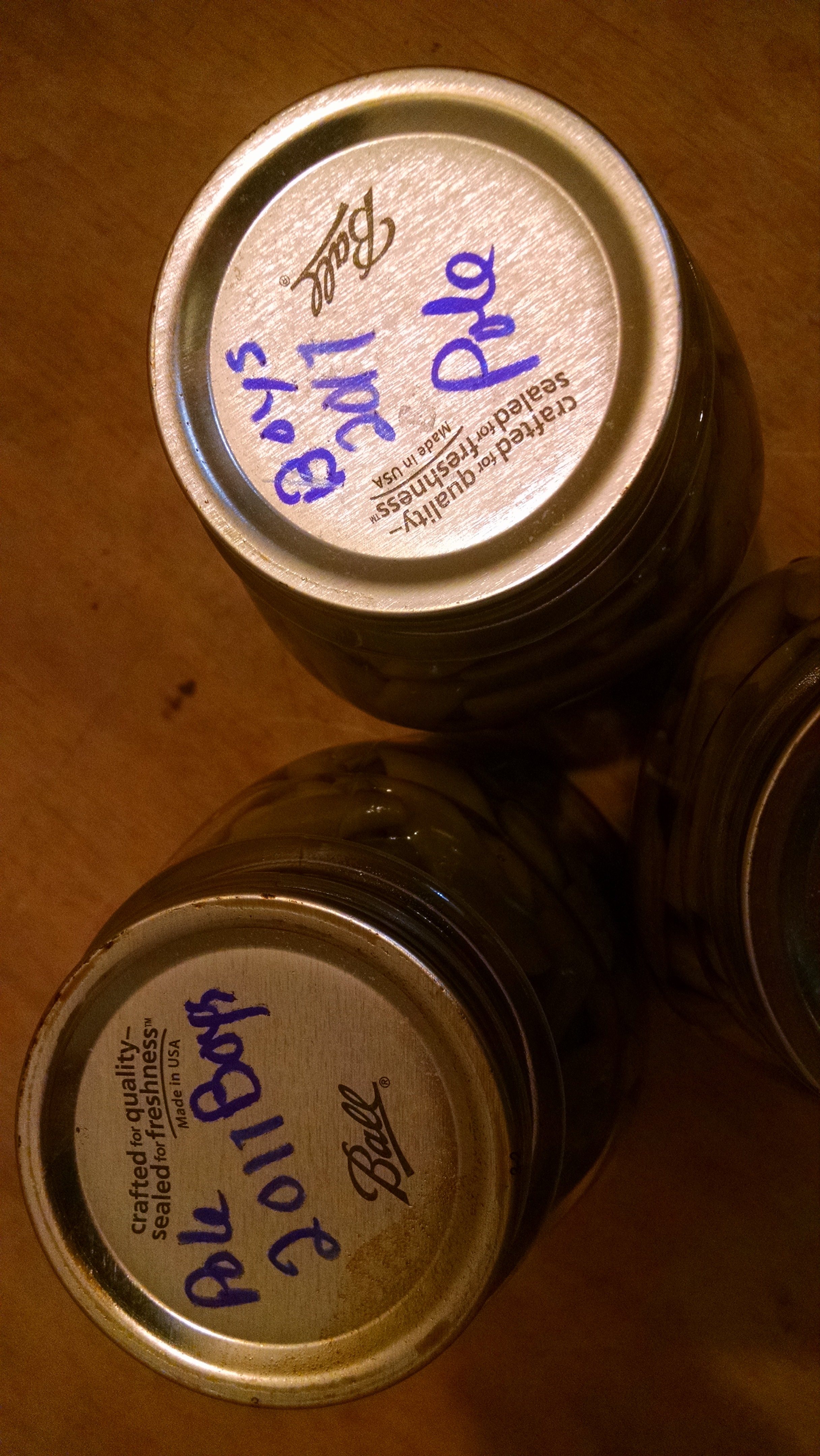
We hope these boys will love “their” beans next winter.
***
Do you remember any jobs that seemed like fun when you did them at Grandma or Grandpa’s house?
***
Esther H. Shank’s Mennonite Country-Style Recipes and Kitchen Secrets: The Prize Collection of a Shenandoah Valley Cook including basic tips and instructions on canning and preserving foods are found in this very popular cookbook! Check it out.

Skin is perhaps the least appreciated bodily organ, but so important. In fact, we seldom think of skin as an actual organ, like the heart, or liver. But remove that outer layer of our bodies—and we fall apart.
As we get older, our skin becomes more and more fragile. I learned that lesson this summer. I was coming up our basement steps carrying something, I forget what, with my husband. I slipped, and my right middle finger, skin side, caught on the edge of a wooden step. The mishap almost took a whole patch of skin the size of half a nickel off the last section. Almost: the skin hung on, but only in a couple of places.
No splinters and not much pain, but a giant nuisance to keep from bleeding and then from infection.
Luckily a trip to the beach and it’s healing salt waters was coming up three weeks after the accident—just at the right time to finish healing my digit. Now you can barely see a scar and my finger print looks roughly the same. Amazing.
Speaking of beach, I remember the years when we soaked up all the sun we could—using baby oil as a medium with which to fry our skin.
How very stupid. Generations of us are now paying the price. Skin cancer—in the form of basal cell, or the more deadly melanoma, are popping up among baby boomers and even younger. But we did not know better; if much was said about skin cancer when I was a teen, I did not hear it, or it passed through my cranium in obeisance to the god of beautifully tanned skin.
My dermatologist—who I began going to because of a small basal skin cancer on my chest—has a brilliant poster that shows a piece of leather and then says something along these lines: “This is leather. How is leather made? By tanning skin. Get the picture?’
In her examining room another huge medical-teaching poster explained the steps in the healing of a wound.
- a blood clot forms to help stop the bleeding, and usually dries to make a protective scab;
- below the surface, inflammation and nearby blood vessels enlarge to deliver oxygen and nutrient-rich blood and “leukocytes” to clean the wound of dead tissue and bacteria;
- rapid proliferation (or regeneration) and migration of new epithelial cells [lining that helps separate the inner parts of our body from the skin and outside environment] helps to replace the damaged area with new tissue and close the wound.
Of course, if a wound is deep enough, stitches or another substance—even crazy glue—helps hold skin together, generally resulting in less scarring.
When my finger got hurt, I toyed with the idea of going to the ER or a doctor but didn’t like the idea of stitches on the end of my finger. Indeed the healing happened pretty much on its own.
How cool is that. Just amazing, when you stop to think about it, as with most of the functions of our bodies.
Wikipedia says “In humans, skin is the largest organ of the integumentary system. The skin has up to seven layers of ectodermal tissue and guards the underlying muscles, bones, ligaments and internal organs.” Wikipedia further defines integumentary as “the organ system that protects the body from various kinds of damage, such as loss of water or abrasion from outside. [It] includes the skin and its appendages including hair, scales, feathers, hooves, and nails [when considering the whole mammal world].
How fearfully and wonderfully God made us all!

Photo from author Winona Miller
Guest column by Winona Miller
Or, send to Another Way Media, Box 363, Singers Glen, Va. 22850 or anotherwaymedia@yahoo.com.
Another Way is a column by Melodie Davis, in syndication since 1987. Another Way columns are posted at FindingHarmonyBlog.com a week after newspaper publication.
Another Way for week of August 25, 2017
The Company We Keep
My husband left me in early August to go on a work trip to West Virginia to help rebuild a home after the floods of June 2016. You may recall the one that forced the closing of the Greenbrier Resort in those parts. Now that my husband is retired, he was happy to be invited to join some volunteers with Brethren Disaster Ministries.
While packing, we realized he had never gone away without me, except for two trips to attend funeral services for two of his aunts in North Carolina and Mississippi, where he traveled with his brothers. My oldest daughter also joined them for the North Carolina trip. I have traveled on my own many times—either for business or to visit family when he wasn’t able to take off work. Once he traveled by train to Indiana for my grandmother’s funeral, when the girls and I left two days before he was able to get away.

He did NOT fly to West Virginia, but this is an example of adventures we have enjoyed TOGETHER.
So we both kind of looked forward to the experience of him trying his wings with a volunteer trip, and me looking after the garden, the pets, the summer harvesting and canning, and still working full time. I will have to say I have new appreciation for all the times he held down the fort at home with me off to parts unknown for days, weekends, and at times full weeks–and even one three-week jaunt. For many of these, he was also daddy in charge of children at home, although sometimes I took one or more with me. He did try to keep up with the garden but, no, he’s never done canning on his own.
I have a new appreciation for widows, divorced folks and singles who live by themselves all the time. The house seemed awfully empty; it is easy to feel lonely and overwhelmed.
If you follow my column at all, you know, however, that I am more of a loner and introvert, while my husband has never met a stranger. You may even recall me sharing the story of me warning him—a day into our honeymoon—that I like to be alone at times. He never thought that was a very good way to begin a honeymoon. And I was just aiming for honesty in our relationship. (My timing was not great.)
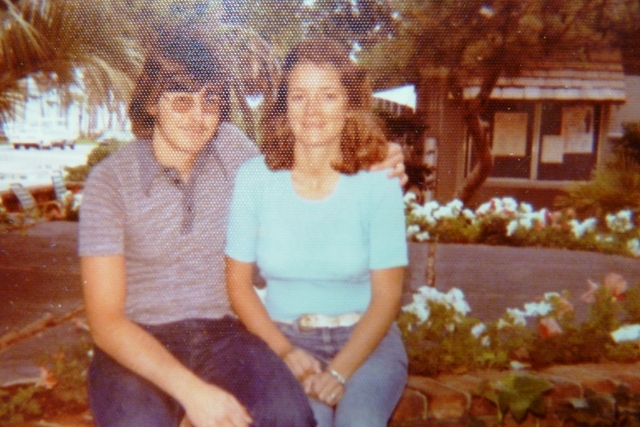
On our honeymoon, Myrtle Beach SC, enjoying each other’s company a great deal!
When I called my mother the first day he was gone, she said, “Oh! You’ll enjoy not having to cook supper.” And that I did. The first night I had a glorified egg sandwich (kind of an omelet with salsa in it, that Stuart would not have loved.) The next night I picked up a frozen package of fettuccini and broccoli (not his fav dish) to microwave, along with some fresh sweet corn from the garden. My schedule was freer. I had fewer interruptions. I didn’t, ahem, need to do quite so much straightening up.
But even the very first morning, when I was just hopping out of the shower and the dog barked for no good reason, I quickly locked the bedroom door, just in case. I was a little jumpy anytime the dog barked, but my dog is a little jumpy like that, sometimes barking for no good reason.
Yet by the end of the first day, I was definitely missing him more than I thought I would. After years of living with and loving someone, you miss the camaraderie, the friendship, the playful flirting, the having someone else in the house. The missing him felt good.
Of course I appreciated some things. I adored the quiet: no TV, just the sounds of country birds and insects. But I didn’t miss him on a trip to town to do errands. I could do just what I wanted and NOT have to go to Harbor Freight or Lowe’s. Instead, I went dress shopping for my niece’s September wedding.
The old adage goes, “Let there be spaces in your togetherness.” You appreciate each other more after time apart; perhaps you take each other less for granted. I think that is what I was trying to tell him long ago on our honeymoon. But now I better understand the bond of long term togetherness—and the sometimes forlorn feeling when a spouse goes away. And how good it is to have more appreciation for the company we keep, for what you have together.
***
And thank you, sweetheart, for allowing me to share our lives here and elsewhere.
***
If you are married, what do you miss when you are apart?
***
If you’ve already lost your mate, what would you add to these reflections?
For my free booklet, “Secrets of Long Marriage,” write to me at anotherwaymedia@yahoo.com or Another Way Media, Box 363, Singers Glen, Va. 22850. Send one standard U.S. postage stamp for each booklet requested.
Another Way is a column by Melodie Davis, in syndication since 1987. Another Way columns are posted at FindingHarmonyBlog.com a week after newspaper publication.


