


West Virginia color from an Amtrak train window.
These have been busy, glorious, late September and October days, with no time to blog amid celebrating our oldest grandchild’s second birthday, visiting my 91-year-old mother (tied to a business trip), participation in the intense work of finding a new pastor for our church, and much more.

Sam’s second birthday.
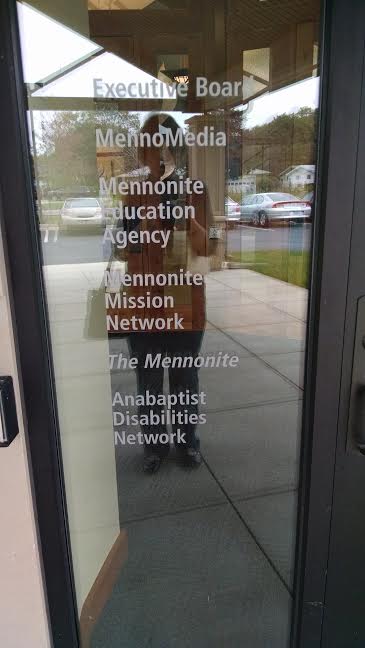
MCUSA offices, Elkhart, Ind.
I had considered declaring a blog sabbatical or vacation or something, but I’m back. I like having this blog/journal because I like to remember things and too often, things that are not written down do get forgotten, reshaped, or remembered differently by diverse people.
Our pastor emeritus, Don Allen, preached in late summer and a note I took during his sermon reminds me of his chosen theme of remembering: “If things are forgotten, it’s like they didn’t happen. What we remember corporately determines what and who we are.” (And if I had not made this note to myself, I would never have remembered his sermon from three months ago, sorry to say.)
Do you believe when things are forgotten, it’s like they didn’t happen?
Increasingly, I find myself the oldest—or among the oldest in a group. In a meeting, I hang out with younger people who don’t know names of well-known—to me—people of the church, community, or organization. And then I think, oh, they were just babies when that icon was a leader in the church. Or consider that most teenagers today have no personal memory of events like September 11, 2001, whereas for many of us, it was a pivotal moment in our personal and national/international history.
Inside, I am still 24 (my age when I got married). Outside, my face and arms have wrinkles, and you don’t even want to know about my thighs. I can’t bear to share a close up selfie of my face. I look at my mother’s frail frame which was once strong and robust. I encourage her to not let her weight fall below a certain number, figuring I’ll probably be as frail and light as her someday too, if I last that long.

Dear friend Martha, left, in earlier days, with Mom.
Is it lucky to live to be in your 90s? Mom says, “I’m afraid I’ll live to be one hundred.” Somehow that no longer seems like the grand milestone everyone aims for, when friends, family and even younger loved ones have already passed to the great beyond. I hope she sticks around until 100 and more if she is healthy. But not being able to hear—and having maxed out the capabilities of hearing aids—is no fun either.
Her statement makes me think of Ecclesiastes 12:1, “Remember your Creator in the days of your youth, before the days of trouble come and the years approach when you will say, ‘I find no pleasure in them.’”
But Mom still takes obvious pleasure in:

Mom at Yoder’s Department Store
- An afternoon jaunt to Amish-Mennonite tourist mecca Shipshewana, Ind. to browse at Yoder’s Department store for shoes, the fabric and hobby department, and kitchen wares, even if she didn’t find what she was looking for. (Not too big of surprise—that.)

- Reading for those who can no longer read for themselves in her retirement complex.
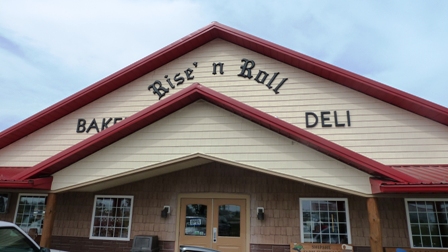
- Popping in to a favorite bakery/deli near my hometown of Middlebury, Rise’ n Roll, for another round of those famous cinnamon and carmel donut holes, which I first fell in love with and wrote about here.

Great nephew Eli, who just celebrated his first birthday.

Nephew Christopher, great niece Lucy, and more.
- Pizza night with several members of my extended family. Yes, Mother got her Mountain Dew and Pizza Hut pizza. And I got to meet new great nephew Eli, about a year younger than my grandsons.
For me personally, the highlight of these recent autumn days and weeks was hearing both grandsons finally saying the beautiful words every grandparent longs to hear: Grandpa! Grandma! Grammy!
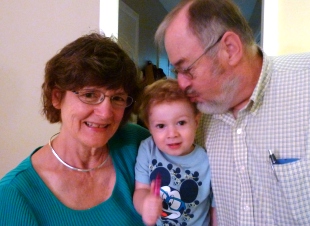
Bye bye to Sam
I will remember these days and savor all the sweetness—far sweeter than the momentary high of those marvelous but addictive doughnut holes.

Yoder’s Department Store, Shipshewana, Ind.: Where people really do still sit in chairs outside of stores and read, rock, and remember.
Do you believe when things are forgotten, it’s like they didn’t happen?
***
Is it lucky to live to be in your 90s?
***
You can also sign up for my weekly Another Way newspaper column, appearing each Friday on ThirdWay.com/aw, or let me know if there is a newspaper near you which may be interested in using the column. Thanks!
Teaching My Own Children to Cook
Four Terrible Family Secrets and One Marvelous Outcome
In honor of CASA* Family Dinner Day, September 28.
The Family Dinner Project helps promote an annual day in the U.S. to draw attention to statistics on how eating together as a family accomplishes much more than just filling tummies. Faithful followers of this blog are well aware of the book I wrote tying into the research conducted by *Columbia University’s Center for Addiction and Substance Abuse, titled Whatever Happened to Dinner? Recipes and Reflections on Family Mealtime, but may sometimes wonder did she/does she practice what she preaches? Did she pass on a passion for cooking to her kids? Here I bare a few family secrets on the topic.
I was cleaning a shelf recently when an old and odd notebook fell out.

My folder of cooking instructions for my daughters, from a recycled office binder.

Oh my. It was my lengthy, detailed notebook of instructions for our daughters’ first forays into cooking once they got old enough to try to put meals on the table whenever I went away on business.
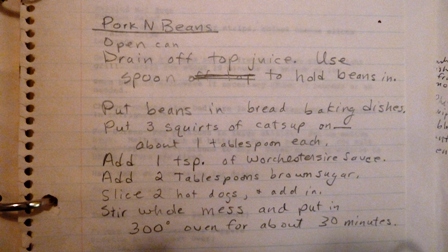
Terrible Family Secret #1. My kids’ greatest cooking lessons came when I was out of the house. Gone. Away on business. Yes, I was a working mother (half time when they were preschoolers) and that included business travel, which I not-so-secretly enjoyed.

Terrible Family Secret #2. My husband, bless him, was not much of a cook except for grilling which he enjoys when he has the time. Before we married, he lived in a small mobile home on his own. I knew he survived mainly on peanut butter and jelly sandwiches, fast food, and by warming up pork and beans and maybe hot dogs in an electric popcorn popper. When I traveled, especially with all three of them pitching in and figuring things out, they began the art of Putting a Whole Meal on the Table. (You can see why I was in awe of my young church friend, Lizzy, just 12, about whom I recently wrote a three-part series [here] on how she cooks real food and complicated menus for their family almost every night.)

Terrible Family Secret #3. I’m not a very patient or good role model in the kitchen. Our tradition of eating together at home as a family was so strong that I would not have dreamed of leaving them without carefully planned meals before flying the coop. Instinctively I knew, though, that it was incredibly valuable for them to step up and try their own wings.
I’m not sure why I didn’t do a better job of truly teaching them—hands on—when I was at home. Perhaps because I was more inclined to Do Things Myself because it was faster, neater, cleaner, and safer. My daughters would probably tell you I got antsy watching them knowing I could get something done faster.
I also didn’t have a great role model in that regard.
Terrible Family Secret #4. My mother—bless her—will tell you quickly that she never liked cooking all that much and did not dote on mixing up wonderful dishes alongside of us. Oh we were called upon to pitch in and she enjoyed and appreciated our help, but as a farmer’s wife, cooking was quite basic. It was just a part of the chores she did: peeling (almost) daily potatoes. Popping a meatloaf or roast or ham in the oven. Frying hamburgers or boiling hot dogs on the stove. Once she found out I grooved on messing with fancier desserts, I remember she often put me in charge of making things like real whipped cream at the last minute for her rich and special date pudding or other specialties for company.
So, our daughters were kind of on their own, too in the cooking department, after they learned basics of measuring, kitchen safety, and working together to make things like cookies, cakes and vegetable stew.
Marvelous Outcomes Anyway. Guess what. My daughters have all turned out to be quite fine cooks in their own right, and in their own styles. And I guess I turned out to be an okay cook. When our oldest daughter got married, she took a wonderful cooking class which introduced her to making things like scallops and bananas flambé—enough culinary know-how that she soon took off flying, much to her husband’s glee, (who in exchange does most of their cleaning at their house. Nice set up!).
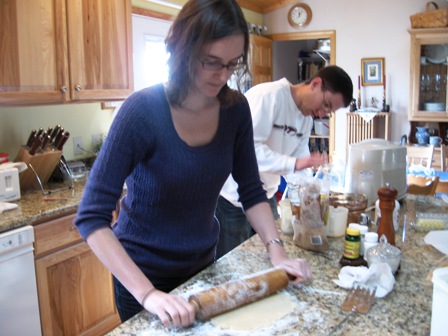
Michelle making pie in our kitchen with her husband helping.
My second daughter has learned from her mother-in-law some of her husband’s favorite dishes, picked up things on her own that she’s enjoyed in restaurants and found online—and her husband pitches in as well when both of them are home.

Tanya working on favorite Stromboli, the eager Lab “Ike” at her side.
I would say my third daughter learned the most at my side in the kitchen as she lived at home for four years after college, while employed in town at a bank. She hung out with me in the kitchen because she wanted to 1) be helpful; 2) learn how I did things. But now she has way surpassed me in coming up with her own lentil concoctions as well as following recipes for more adventuresome cooking like crepes, beef Bourguignonne, French onion soup, pot pie, and more.

Doreen stirring filling for chicken pot pie, shown below.

Call me a happy and blessed mom, in spite of myself and in spite of my mother. Eating together almost every evening was important to us as a family, although I don’t know I thought about it that much back then: it was just what we did. Like brushing teeth and reading stories before bed.
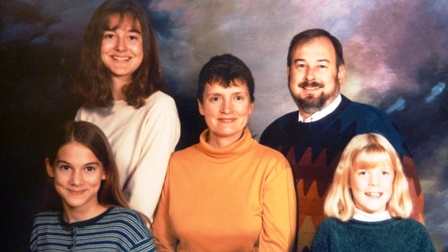
Our daughters at about the ages when I could rely on them to put dinner on the table when I went away. L to R: Tanya, Michelle, yours truly, Stuart, Doreen.
***
How did you teach your children to cook? Or not?
***

If you’re new here, learn more about my book, Whatever Happened to Dinner? Recipes and Reflections on Family Mealtime
***
Make plans for your Family Dinner Day, September 28 (February dates in Canada), originally launched from CASA, which encourages eating together as a family as one way to fight the societal influences that sometimes lead to addictions in youth.
There’s much more on this topic at The Family Dinner Project, a website with ongoing resources, ideas and stories to promote the strengths of eating together.
From their website:
The Family Dinner Project is a growing movement of food, fun and conversation about things that matter. We are a nonprofit organization currently operating from the offices of Project Zero at Harvard University. Over the past 15 years, research has shown what parents have known for a long time: Sharing a fun family meal is good for the spirit, brain and health of all family members. Recent studies link regular family meals with the kinds of behaviors that parents want for their children: higher grade-point averages, resilience and self-esteem. Additionally, family meals are linked to lower rates of substance abuse, teen pregnancy, eating disorders and depression. We also believe in the power of family dinners to nourish ethical thinking.
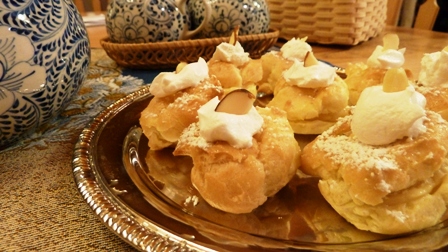
How to Make Midget Cream Puffs (Petits Choux)
I had not made cream puffs in years. I remember doing some years ago for a reception/tea. My trusty 70’s era bridal-shower-gift Betty Crocker Cookbook rose to the occasion.
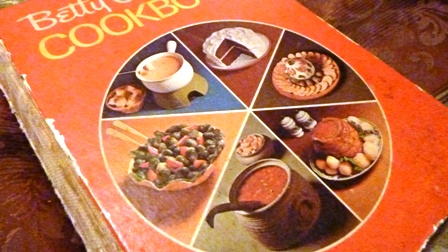
I remember being astounded at how easy it was to actually make cream puffs or even éclairs, and they both look so impressive and well, like Julia Child or Martha Stewart French, don’t you think?

We had a meeting looking to the future of Valley Living where I serve as editor the other night. I promised to bring snacks and decided to make cream puffs. (See that’s the thing about having a semi-cooking blog and a semi-recipe book, you volunteer to do all sorts of cooking you wouldn’t otherwise do, just so you have something to write about and photograph.)

L to R: Former Valley Living Board Chair Laban Peachey, current Board Treasurer Bill Troyer, and local writer for Valley Living, Lauree Purcell.
One of the men at the meeting was Laban Peachey, former president of Hesston College, who helped launch its remarkable and visionary aviation program, and former board chair for Valley Living in its earlier days. Laban is famous for having a story for every occasion (and of course that’s what Living is all about, sharing great and uplifting stories). Laban did not disappoint.
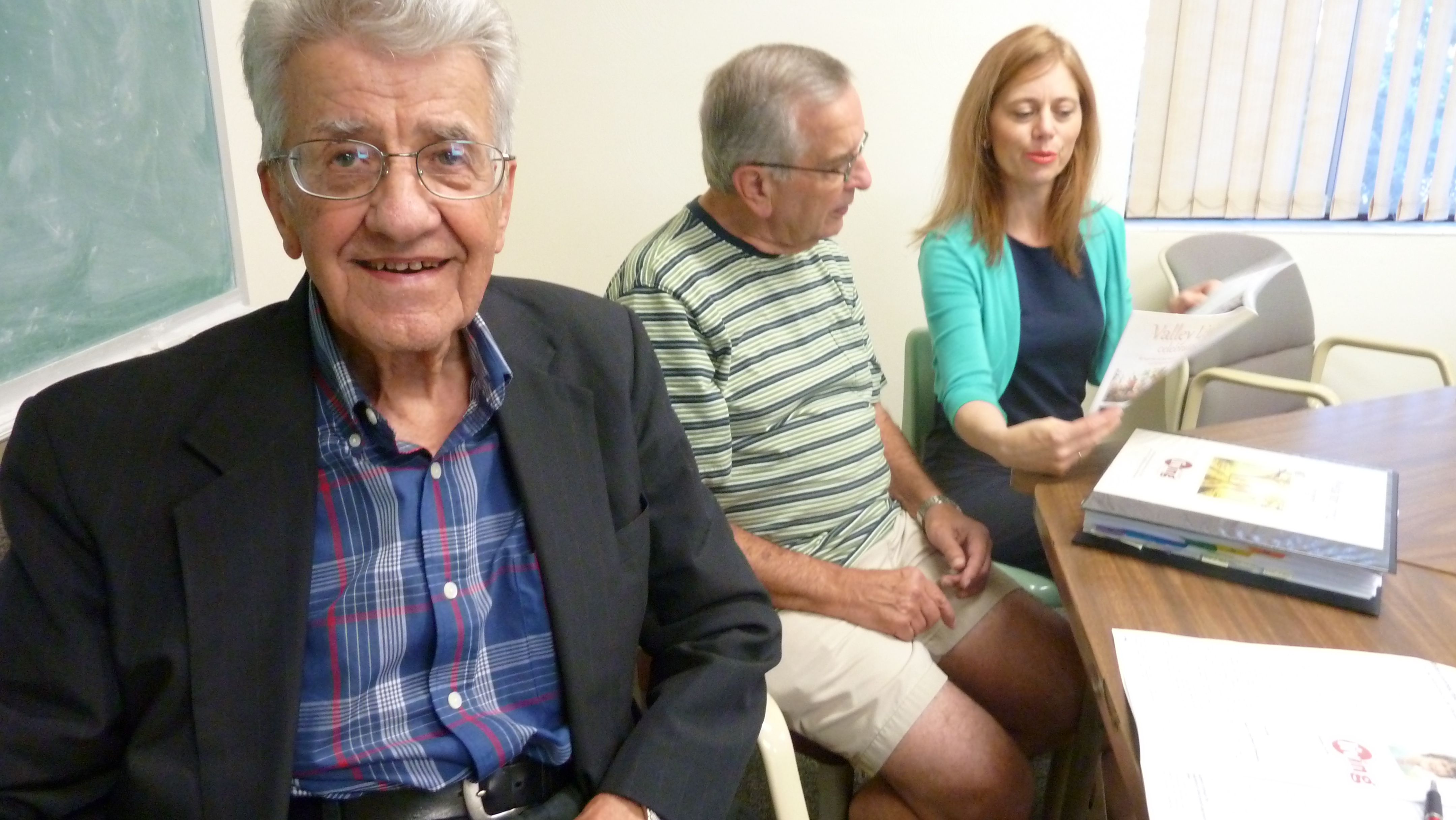
Going on 89 (he said at this age he now likes to talk up his next birthday, to make him seem even older and more impressive), as he chomped into his Petits Choux, he said “I can’t eat a cream puff without remembering when I was eight years old and someone brought cream puffs to school for a party. They were so delicious and I had never eaten one before. Now I take a bite and I’m right back there, eight years old.” I asked him if I could share his little story and of course he said sure. (Why else do you tell stories?)
Food and stories. They go together.
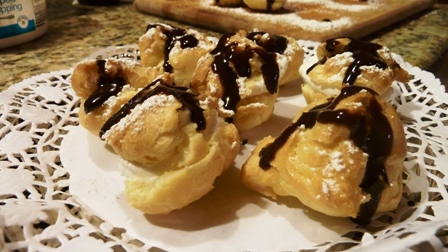
Have a cream puff.
1 cup water
½ cup butter or margarine
1 cup all purpose flour (may want to sift flour to avoid lumps)
4 eggs
Fillings
Vanilla cream pudding (instant or other homemade) or sweetened whipped cream or prepared whipped topping.
Topping options
Powdered sugar
Slivered almonds
Chocolate sauce
Whipped topping
Heat oven to 400 degrees. Bring water and butter to rolling boil. Stir in flour. Stir vigorously (so it does not burn) over low heat about 1 minute or until mixture joins together/pulls away from sides/almost forms a ball.

Remove from heat. Let it sit just a minute to cool (so it won’t cook your eggs when you add them). Meanwhile break eggs, then beat them in with flour/butter/water dough, all at one time. (Betty Crocker says no need to add them one at a time as in some recipes.) Beat until it becomes smooth. (I used a mixer to beat, but you can just use a spoon.) Drop dough by slightly rounded teaspoonfuls onto ungreased baking sheet.

Bake 25-30 minutes or until puffed and golden.

About 4-5 dozen puffs (or 2-3 dozen, depending on how big you make the teaspoonfuls).

Cool (away from draft). Cut off tops, or cut in half, depending on the size. Pull out any larger filaments of soft puff.
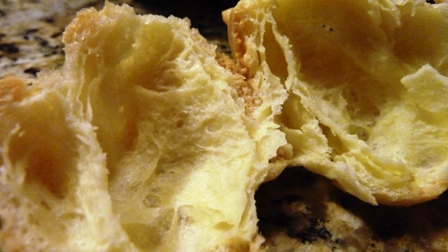
Fill puffs with vanilla, other pudding, or whipped cream. Replace tops.

Dust with powdered sugar. Top with drizzle of chocolate syrup like you’d use on ice cream, a nut, or red raspberry. Refrigerate until served. Can be frozen. (Adapted from Betty Crocker Cookbook, 1974 edition.)
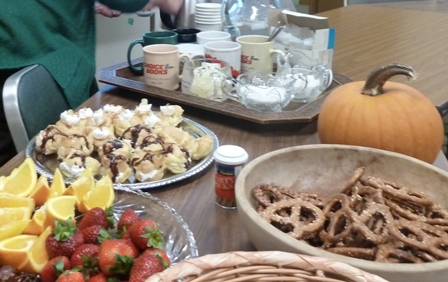
Is there a food that takes you back to your childhood?
I’d love to hear your story or food memory!
***
That’s what family dinner time is all about–an opportunity to bond and laugh around shared stories.
Dinner prompt: What is a favorite food from your childhood? What is one of the earliest foods you remember eating?
***
We’re celebrating Family Dinner Night all month on this blog. If you don’t have the book Whatever Happened to Dinner: Recipes and Reflections for Family Mealtime now is the time! Check it out.


Impromptu chamber group: daughter Tanya on flute, Michelle on French horn, friend Allison Fletcher on bassoon.
I planned to write a simple old marching band nostalgia post, for all the years and memories of my girls’ time spent in high school and college playing trumpet, flute and percussion instruments. Band threaded their teenage and early twenties with music, laughter, friends, camaraderie, the heights of happiness, and a place to belong.
Let me count the memories:
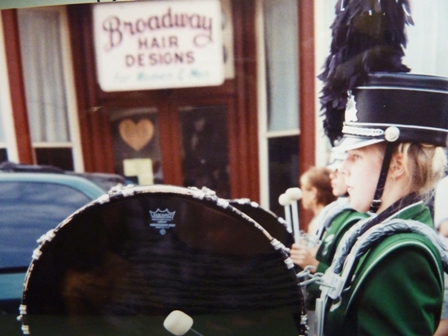
Doreen marching in Broadway (Va. that is.)
There were the parades.
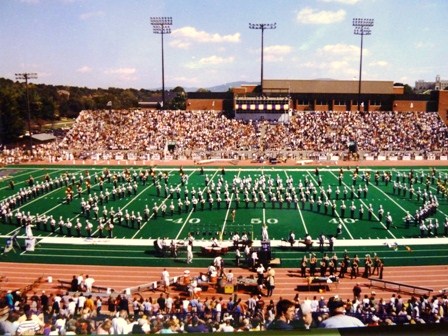
JMU Stadium before expansion.
The games.
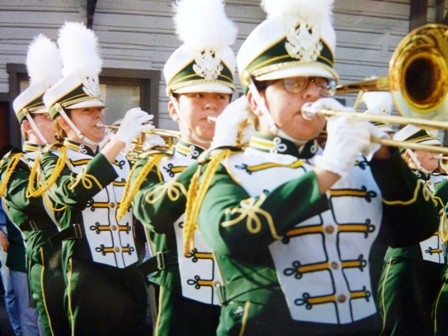
Michelle, 2nd from left.
The competitions.
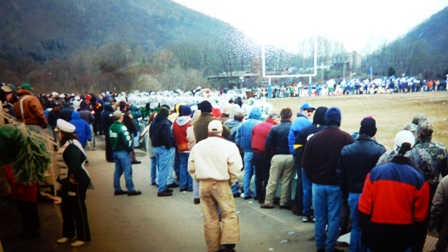
Playing Gate City in southwest Virginia on a cold and miserable December Saturday.
The state playoffs.
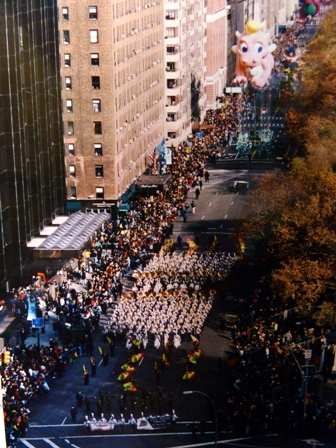
The Macy’s Day Parade in 2001, just two months after September 11.
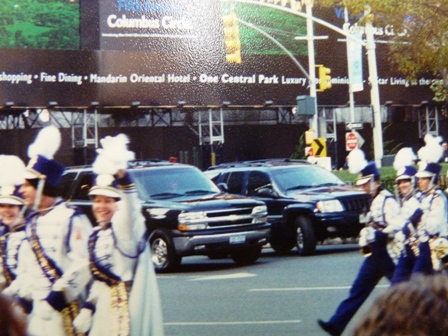
The crowd helped us yell “Tanya” (blue uniforms, marching, 2nd from right) until she heard us and looked our way!
And finally, gloriously, winning an actual college football national championship (Division I-AA schools).
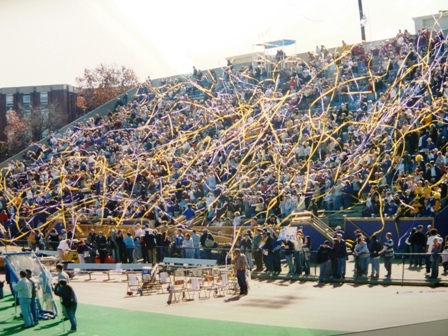
As band parents, our girls gave us the gift of music, laughter, friends, camaraderie, the heights of happiness, and a place to belong, especially on Fall Friday nights and sunny Saturday afternoons. We were there for most of it, including the national championship game, and our first Macy’s Thanksgiving Parade.
Band was something neither my husband nor I had experienced at any level. I had wanted basketball players. Growing up Hoosier in a basketball playing household, what else would you expect or want? I don’t think my husband was ever actually interested in band but it was also somewhat out of the realm of possibility for his family because of finances and with a mother who, because of illness, was not able to get out and do like band mothers have to do (and who died when he was just 19).
But when our oldest daughter got to 6th grade, band helped her survive the tumultuous torment of middle school meanies. By high school she’d found her niche with the band crowd, crossing over also into choir. All three of them spent marvelous years helping in various aspects of accompanying or performing in exquisitely perfected school musicals at a high school aptly named Broadway High.
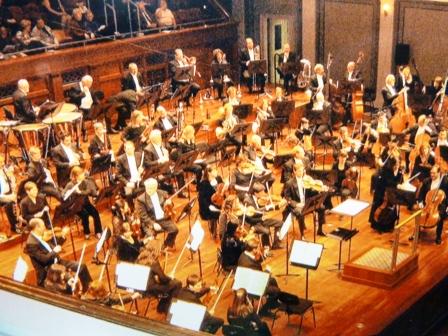
Nashville Symphony where daughter worked.
Middle sister ended up making orchestra administration her career; the two others didn’t find their careers in music, but made lifelong friends. All precious gifts to each of them. We owe the band world, and the teachers who were willing to lead them (and survive all the dang fund raisers), much!
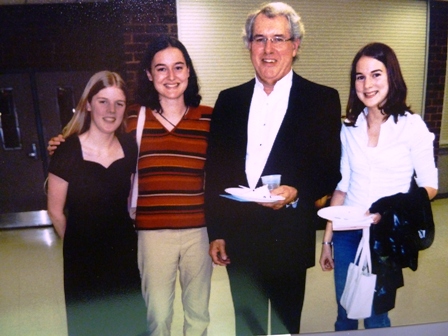
Our daughters with Mr. David Snively, longtime band teacher at Broadway High School at his retirement celebration.
But this nostalgic marching band tribute changed for me last Saturday. We had free tickets for the season football opener for James Madison University where our middle daughter majored in music, and spent four splendid years in its awesome (and as the game announcers always reminded you), “the award-winning Marching Royal Du-u-u-u-u-kes!”
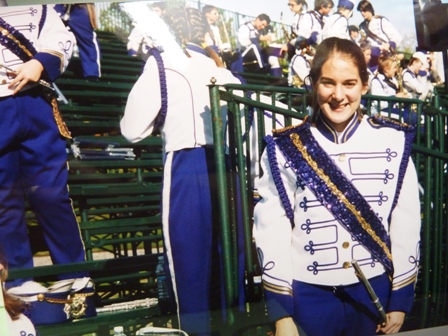
Tanya with JMU Band.
Hearing the band’s music swell up through the stands and experiencing the crowd pandemonium is always emotional for me anyway—remembering when Tanya was out on the field, with her father and I sweeping the field with binoculars to catch a glimpse of her among the 400 or so other marching band members.
And then the announcer called for a minute of silence—amazing how quiet a large stadium can actually get—for JMU alum Alison Parker, gunned down with her cameraman colleague Adam Ward in the midst of just doing her job as a TV reporter 10 days earlier (two hours down the road near Roanoke, Va.): two deaths that would go down as the first on-air murder (so terrifying and heart-achingly sad) and no parents, no friends, no family members or colleagues want that notoriety—the awful notoriety apparently sought by the gunman. A short video commemorating Alison’s life on campus (graduated in 2012) and promising future was shown on the huge electronic billboard. Alison’s parents were in attendance at the game but mercifully not spotlighted.
And my tears flowed some more—until a woman, a stranger sitting next to me, put her hand on my arm and asked me if I was okay. I assured her I was, mumbling something about the band music always made me emotional anyway.
But no, none of us are really okay with this kind of violence tearing through our hearts and lives. Or safe anywhere, I thought, not even that much comforted or assured by the armed police and security guys standing around the field. If marching band sometimes gave us moments of exuberant happiness, this was the opposite: utter grief, dismay, sadness.
I thought back to more moments of silence—too many times—at other football stadiums filled with people. When a daughter’s best friend’s mother died after surgery for a kidney transplant and the band dedicated its music and half time show to that band mom, Liz. When thousands of us in football stadiums across the U.S. dedicated their games and half time shows to those who died on September 11, 2001 in New York City, Washington, D.C. and the random field near Shanksville, Pa. where Flight 93 ended. When my youngest daughter’s high school classmate, a former state wrestling champion, Bucky Anderson, was killed in action in Afghanistan 2010 and a ceremony with moments of silence were held in his honor at a Broadway football game.
Music—whether it is the stuff of marching bands, symphony orchestras, powerful soloists, or a church anthem on Sunday morning—has the power to move us in the inner places of our hearts and psyches to feel things that need to be felt.
I felt fresh pain for the parents and loved ones of Alison, and all families who’ve had to grieve the too soon deaths of their offspring: something every parent fears and knows can happen yet hopes against hope that the senseless, random, and especially media-inspired killings, at least, can somehow be curbed, deaths lowered, even, eliminated! Dare we think it, dream it, pray for it? I hope so, or we are miserable human beings not to dream of, envision, and work for a better world. We may not agree on how to work at eliminating senseless violence in all its forms—whether war, accidental, domestic, or murder, but we must continue to believe in and march toward a more sane and safer world for all.
A Prayer*
God of all comfort, we confess our bewilderment, our sadness, anger, and fear.
Hear our prayers.
Surround those who mourn the loss of loved ones.
Embrace them with your loving arms.
Comfort those whose loved ones are missing.
Protect those who risk their lives protecting others. Strengthen them with your loving arms. Remind us that your love is stronger than hate. Keep us from becoming the evil we deplore.
Give us wisdom and restraint.
With trembling faith we pray, O God, for a sure sense of your presence in our grieving.
Embrace us with your loving arms.
In you alone do we trust. Amen.
[Adapted from Carmen Schrock-Hurst, Harrisonburg, Va. *Originally written in response to Sept. 11, 2001. From Words for Worship 2, Diane Zaerr Brenneman, Herald Press, 2009.]
Younger sister Tanya comforting older sister Michelle at a final home game.
Cooking with Lizzy, Part 3: Grandmother’s waffles and the story of what happened to Lizzy’s perfect carrot birthday cake
Missed earlier parts? Part 1. Part 2.

At the point Lizzy has the chicken mostly safely in the oven, she launches the other main dish for the family’s evening meal: waffles. Waffles for supper I get. We often enjoyed pancakes with sausage or bacon for an evening “breakfast” meal. But with chicken? Not so much. (Later I learn this is a specialty dish in some areas of the southern U.S. Who knew? Not me.)
And why not—it’s a starch like when I make potatoes or pasta or beans. And remember, she’s including a healthy and nutritious salad for the veggie (described in Part 1).
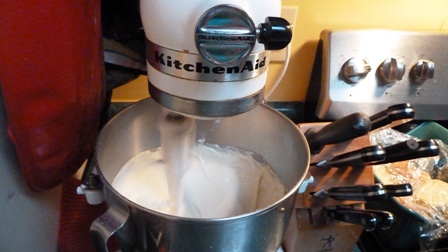
Back to the waffles. Even her mother is a little surprised to hear Lizzy reciting her grandmother’s (Virginia’s mother) recipe from memory:
Lizzy’s Grandmother’s Waffles
2 cups buttermilk
4 Tablespoons olive oil (“Olive oil?” her mother challenges her. “Yes, that’s what Rachael Ray uses on Food Network.” Okay. Olive oil it is. I find one of Rachael’s using butter, too.)
2 eggs
2 Tablespoons sugar (but she doesn’t measure, just counts as it pours from a dispenser thingy).
Mix on low speed and then add dry ingredients.
2 cups flour
2 teaspoons baking powder
¼ baking soda
½ teaspoon salt (Lizzy uses Kosher)
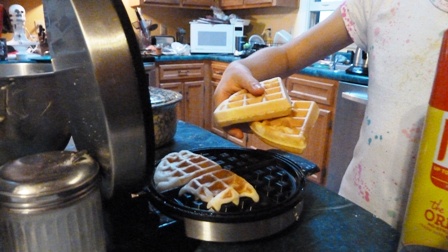
Mix altogether and bake in lightly sprayed waffle iron.

First sample waffle I get to taste.
Lizzy fondly remembers the Mickey Mouse shaped waffle maker her grandmother has; Grandmother uses the same recipe for both waffles and pancakes.
In my family, mashed potatoes were the go-to starch with a meal like fried chicken. I ask if Lizzy knows how to mash potatoes. Yes, sure.
Again, I’m not sure any of my daughters routinely mash potatoes. (Sorry daughters, you’re my gauge here.) In their defense and mine, each has turned out to be pretty adventuresome in their cooking if I do say so myself, each with their own specialties. Yay. The two married ones also have husbands who cook. Another big yay.
At last, the men of Lizzy’s family call home. The dog’s ears perk up. Dad and brother are finally on their way home after a long football practice and maybe a team meeting. Lizzy recognizes the ringtone.
“I’ve got dinner ready” she says into the phone.
Someone on the other end must have asked the usual, “What are we having?”
“Fried chicken and waffles.”
I don’t learn what the response is, but 30 seconds later, the phone rings again, and Lizzy goes on a search in the pantry and fridge to learn the state of their maple syrup supply.
“Nope. I’m not seeing any …” Lizzy says carefully. Inwardly I lament this likely means a stop at a grocery, with the excellent chicken and once-fresh waffles waiting even longer to be consumed. Brother and father decide to swing by the international grocery, the most convenient grocery on their commute home. “Yes, just go to the American aisle,” Lizzy instructs them as to where to look for syrup.
I ask what she’s having tomorrow night.
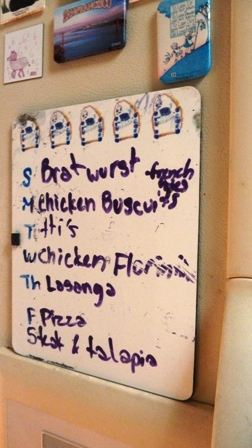
Menu planning from an earlier week.
She shrugs, not sure. “I’ll decide during the day.” Once school resumes, they’ll begin again their weekly menu planning.
Does she cook for her friends? “I did for a birthday party. I made Indian [food]. I love cooking from different cultures.”
What about decorated birthday cakes? She talked about making a classic chocolate Black Forest Cake with cherries on top, with the layers soaked in liquor. Whew. I’ve made that twice, minus the liquor. A tricky but impressive cake to put together.
Then she lights up again remembering a story that is funny now, not so much when it happened.
The Perfect Carrot Cake Story
Lizzy had worked very hard to make a delicious, perfect carrot cake for her ninth birthday. It turned out well and she placed it on a special birthday plate she made at a “make it take it” store in town. She even put shaved nutmeg on top. (Real nutmeg is not even on my own baking bucket list, but just for the record, here’s my carrot cake topped with slivered almonds.) She set it on their dining room table, and then she and her mother left to go buy some matching flowers for the party.
They came home and found that the family dog, “Streak,” had sampled the cake. He decided it was so good that like Goldilocks and the Three Bears, ate the whole thing, apparently pulling the plate off the table which smashed to the floor!
I felt Lizzy’s pain. “I would have cried,” I said.
“Ohhhhhh yes,” she sighs, nodding at the memory.
“And then I’d have gotten mad,” I added. Yes, she got mad too. Lizzy proceeded to show me other things Streak had ruined—the padding in a couple of recliners, according to her memory. Such is life with a dog.
But life with a Lizzy in the house? Even dinner delayed by a half hour is taken in stride.
Her brother and father arrive home, syrup in hand. Supper or dinner, is served stove style, which works best when needing to keep things warm.
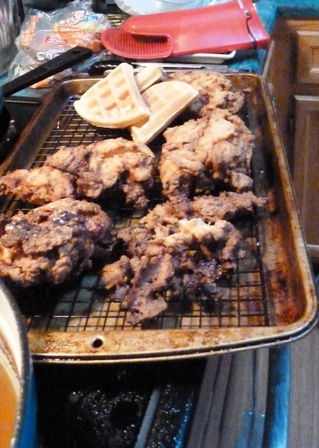
Earlier Virginia told me that Lizzy has helped cooked for the high school football coaches and hungry football teams.
So what’s next? Restaurant cook? Celebrity chef?
“I want to go to culinary school and then start a food truck.”
Oh really, I say, wondering why not a chef in a restaurant?
“I’ve watched those shows on Food Network and the restaurant kitchens are always so hectic, with everyone screaming at each other. I wouldn’t like that much stress.” A minute later she adds, “Dad would like to join me running a food truck. One time he left football practice EARLY to bring something home so I could make schnitzel,” she says.
She doesn’t have to tell me that was a big deal. A coach leaving early to pick up something for a dish his daughter is making (okay, so it was one of Dad’s favorite dishes)? That’s family love and commitment in my book.
Whatever is in Lizzy’s future, the present is what matters now. I would have done almost anything to have such a cook making our meals every evening. What a gift.
Other young girls I know play awesome soccer. Some perform graceful ballet (Lizzy took ballet when she was younger). Some play flute, piano, and sing in choirs at the White House. I’m reminded of one of the first things Lizzy told me: “Others do gymnastics. This is what I do.”

Lizzy
***
What part of Lizzy’s experiences cooking impresses you most? What message do you have for Lizzy or her family?
***
Do you think food trucks will continue their popularity in 8-10 years by the time Lizzy finishes culinary school?
Or what’s your fav food truck food?
***
This series posted with a salute to Family Dinner Day, the last Monday in September (February dates in Canada), originally launched from CASA, which encourages eating together as a family as one way to fight the societal influences that sometimes lead to addictions in youth. This is the theme of my most recent book, Whatever Happened to Dinner: Recipes and Reflections for Family Mealtime.
If you missed Part 1, go here.
When Lizzy was 7, which is where we left off last time, her mother participated with others in a Sunday school class I taught at our church related to the 2010 publication of my book, Whatever Happened to Dinner.

Lizzy’s mother, far left, in after-class discussion on Whatever Happened to Dinner?
In the class one of the things we talked about was how picky eaters can spoil the enjoyment of a family meal. Virginia mentioned she had found that her kids were enjoying a new step she’d taken to plan menus with the help of the children, and that they ate much better when they could have a say in what was being served. I thought that was a wonderful idea.
Lizzy (whose favorite foods are way beyond this now) remembers her choice of meal to put on the menu each week was homemade mac and cheese. Her father made it, using a typical white sauce and a mix of whatever cheeses they chose or had on hand including Swiss, cheddar and more, with Panko bread crumbs on top. Her father grew up in a military household and lived most of his early life in Germany, so Lizzy also has learned to make several German dishes he loves such as spaetzel (egg noodles), and schnitzel (any of various boneless meats sliced thin, coated in egg and flour, and fried). He also loves gnocchi (soft dough dumplings) after living in Italy and graduating from Naples American High School there.
Twelve-year-old Lizzy cook things I’ve only barely heard of, seen on menus, and can’t spell (I’ve embedded links for all those I had to look up). When asked, she ticks off a list of some foods she enjoys making:
Chicken piccata
Chicken parmesan
Grilled chicken with a marinade of lemon oil and spices (yes, on a gas grill, that she manages)
Lasagna
Tom Khi Gai
Bolognese (meat sauce)
She enjoys following and adding recipes to her mother’s 33 boards on Pinterest.
Back to the class I taught five years ago using the study guide from Whatever Happened at Dinner which encourages inter-generational activities around cooking: we held a church potluck with kids and adults making some of the food together in the church kitchen to share our learnings. That Sunday, Virginia volunteered to make homemade ice cream. I recall seven-year-old Lizzy being very eager to help with every step. I snatched this wonderful brief video:
Now of course Lizzy knows very well what a dasher is and does and personally owns a beautiful 5-quart Dutch oven (see photo), cast iron skillet, pasta maker, food processor and more, because she asks for these things for birthday and Christmas.
Lizzy shows me her large expanding plastic file folder stuffed with print outs or clipped recipes from newspapers and magazines.

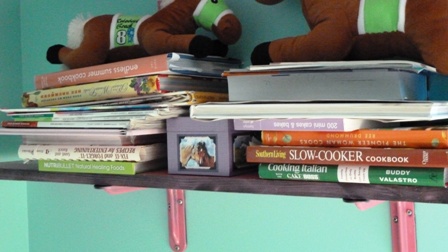
She points out, “Grandma has a whole crate of recipes like this.” Lizzy leads me to her own personal collection of cookbooks she keeps on a shelf in her neatly straightened bedroom.
How does she get her homework done, cook, and manage it all during her cross country and musical seasons? “Others do gymnastics,” Lizzy says by way of example. “This is what I do.” When her friends ask her how she has time for cooking dinner, she says she tells them, “While you’re off doing that, I do this.”
If she has a really busy night, she plans around it, her mother adds, like any adult would. If the family needs to be somewhere early, such as for a football game, she makes chili or a beef stew in the morning or the evening before to take to the game.

Tonight she is making fried chicken. I arrive about 5:30 p.m.; dinner is usually planned for around 7. She gets five or six huge boneless Costco chicken breast pieces from the freezer and puts them in a microwavable pan to begin thawing. She fetches the neatest series of interlocking Pampered Chef dredging trays where she will dip the chicken in seasoned flour and thick, cultured buttermilk.
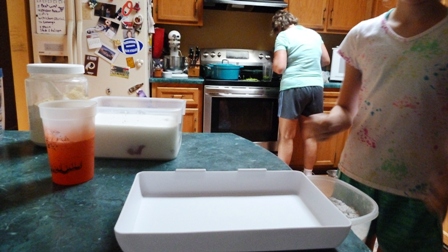
While we chat about the other dishes she likes to make and the cookware she owns, she eventually nukes the chicken without checking any notes or recipes.
Since I have the video of her at 7, I thought you might enjoy this one of her at this age nuking the chicken.
(Note Lizzy’s hand washing technique after handling the raw chicken, with water + soap. A+)
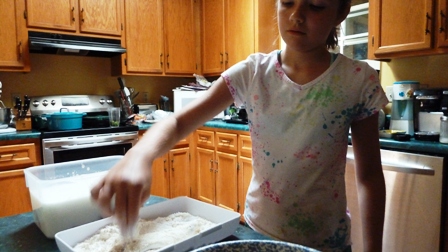
Once thawed to her liking, she plops a single piece of chicken in the dredging tray, and soaks it a few minutes, “to stay more tender” she explains, which she says she learned on the Food Network.

Not surprisingly, The Food Network is her main television watching, competing for TV time with brother Sam who spends most of his time on ESPN. “We couldn’t be more opposite” Lizzy observes, but it is just a statement, not a put down. Lizzy tolerates football games for her dad and brother. And while Sam loves the fried chicken, Lizzy will bake her own piece, just because she likes it better that way.
She removes the soaked chicken breast, rolls it again in a generous amount of flour spiked with pepper and salt, then dips it again in the buttermilk.
“Oh, you do it again?” I ask, a little surprised. “Yes, it’s double dredging. It gives it a really nice texture” she supplies. I really must start watching Food Network, I decide.
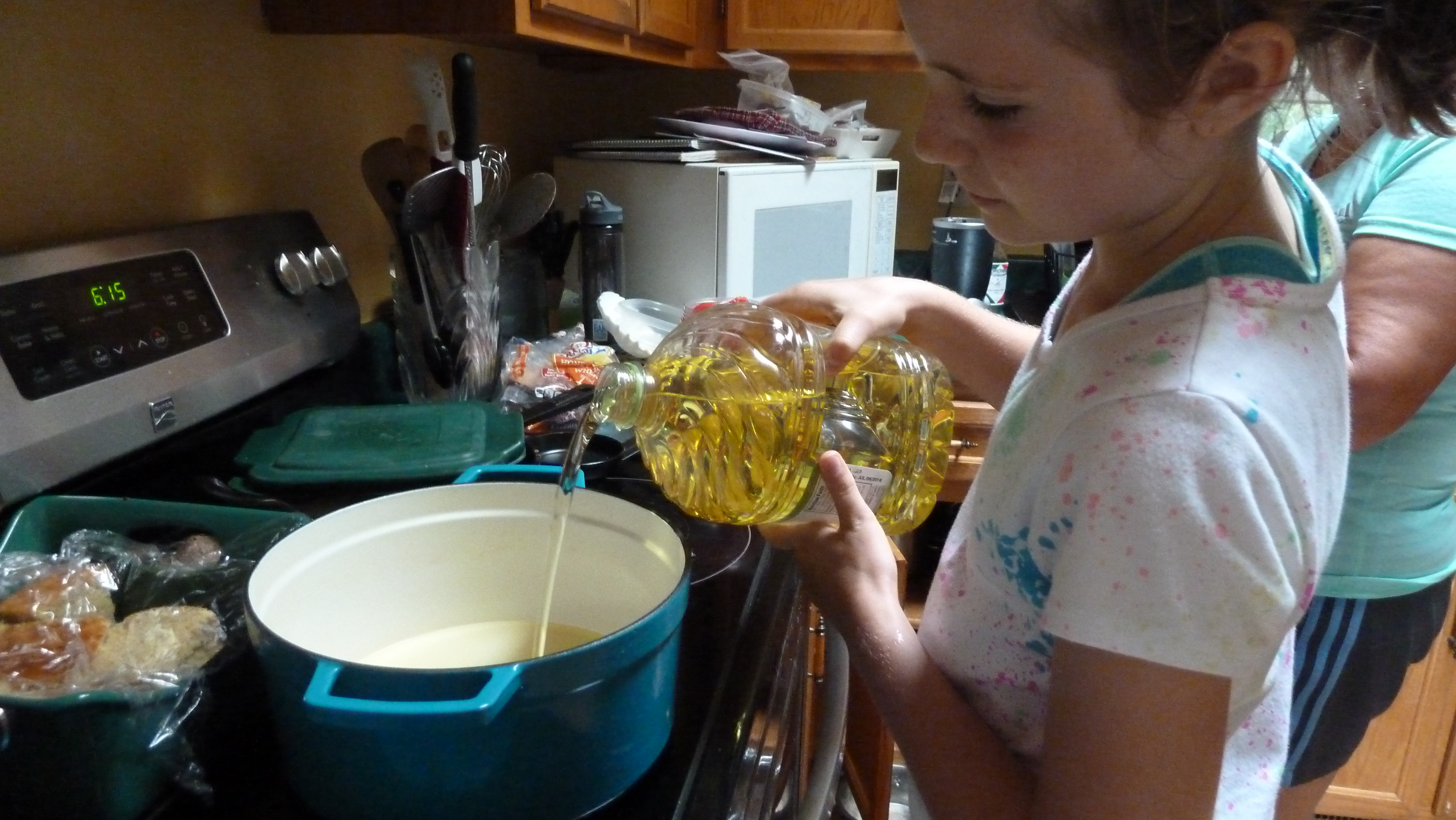
She chugs half a jug of vegetable oil into her Dutch oven-turned fryer. Wow. My daughters never even attempted frying chicken until they were well into their 20s. They too prefer baking or light sauteing of meats, but I think I was scared to let them try the big fry.

Not to be overly cautious about this, but I would carefully supervise any child beginning to fry foods, especially in oh-so-hot deep fat, and would make sure they knew where the kitchen fire extinguisher was and how to use it—and how to never put water on a grease fire but instead use baking soda—also kept handy in the kitchen. Just saying. (One of my daughters learned the hard way what happens when there is no baking soda handy; but in her defense, the rented house where she and other housemates were living also apparently had some faulty wiring around their gas stove. My daughter ended up having to call 911 and watching with dismay as firefighters smashed through a window and wall in the kitchen to put the fire out.) Things happen.

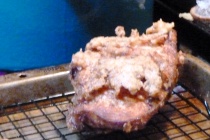
The chicken fries up beautifully with lots of golden-crusty-floured-buttermilk coating sticking to the edges. Lizzy leans back a little when the grease pops. One piece sticks to the bottom of the pan, which Lizzy carefully nudges off the bottom with a spatula, keeping her distance and using mitts as appropriate.
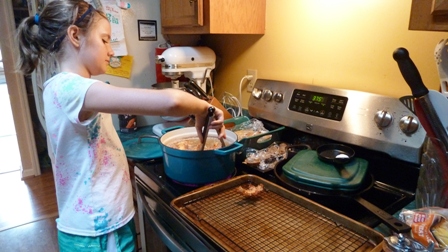
She tries to keep counters cleared and dishes stacked in the sink as she works. Her “pay” for doing most of the cooking is mostly getting out of doing dishes.
But the planning ahead, cooking and making sure they have a complete meal, is mostly Lizzy’s arena. “It’s a gift she gives our family,” her mother says before heading off to her evening meeting.
So what does Lizzy want to be when she grows up? We’ll learn next time.
***
Do you watch Food Network? Why or why not? What are your favorite shows?
***
I like Virginia’s thought of cooking for family as a “gift” we give. Perhaps that could be a dinner table discussion prompt: “What gift do you bring to our family?”
***
I’m offering a package where any group gets three free copies of Whatever Happened to Dinner with any speaking engagement invitation, to use as door prizes, or whatever. Check the offer here.

Lizzy
A three-part series
How many 12-year-old kids do you know who cook dinner for their family almost every night?
I had heard her mother, Virginia, say repeatedly “Oh Lizzy made that” at church potlucks. “She does most of the cooking.”
Most recently, Lizzy brought a scrumptious peach cobbler made from scratch to the church picnic in a cast iron skillet. That impressed me. Her own cast iron skillet. Given to her by her grandmother’s neighbor who apparently has great collections of things. He had a brand new one just sitting around. Lizzy seasoned the cast iron skillet and uses it regularly. She also owns several other kitchen appliances, pans, and food prep equipment. She asks for these things for birthday and Christmas gifts.

Lizzy’s Food Processor
(About cast iron: I once tried to season a cast iron skillet as a new bride but somehow it rusted anyway. Eventually I got rid of it and, this quasi-cooking blogger is ashamed to say, I have not tried to own one since.)
“Other kids like to go hang out or shop at the mall,” says her mom. “Lizzy loves to go to specialty kitchen and gourmet grocery stores.”
Lizzy is your ordinary (well not really, but we’ll get to that in a minute) 12-year-old bouncy kid with gorgeous hazel eyes and a face that lights up whenever she’s excited, especially talking about or demonstrating cooking. She runs cross country at her middle school and participates in spring musicals, but otherwise after school on most weekdays, you’ll find her stirring, dredging, frying, baking, pulsing in the kitchen of her family’s suburban split level.
This she loves, and so does her family, especially her parents. She tries to appease the food likes of her 15-year-old brother, Sam, who plays football in the fall and lives for it the rest of the year.
“My dad and brother are mostly meat and bread guys,” Lizzy notes, not unkindly. “When it is just my mother and I, we’re kind of more adventuresome, and we try other things.”
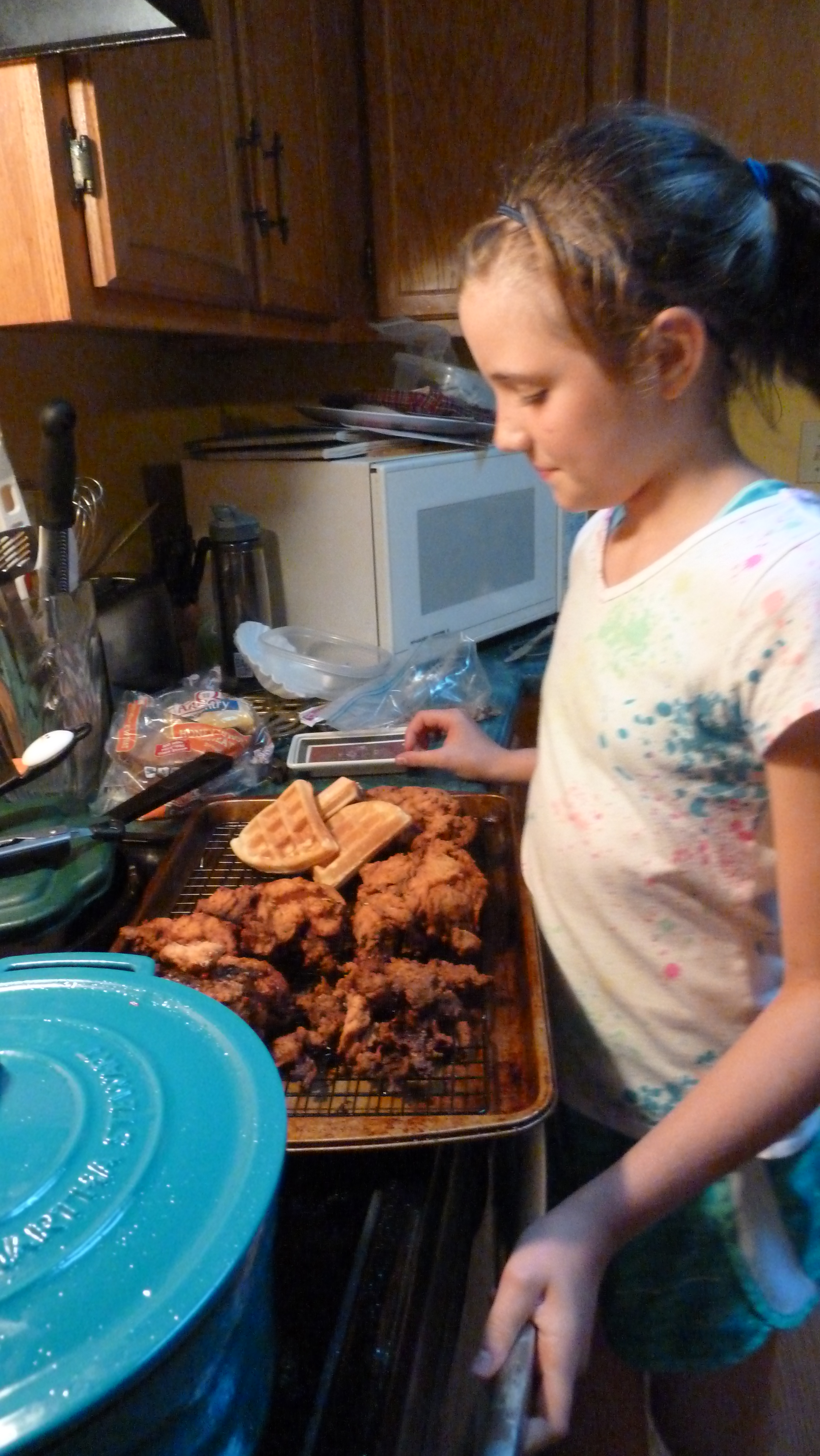 This night she is indeed cooking up a meat and bread kind of supper—deep fat fried chicken, with homemade-from-scratch waffles supplying the “bread” portion of the meal. “Sam is a big fried chicken aficionado. Big fan! And if he says something is good, it’s really good. If it is ‘eh’—that equals ‘pretty good.’”
Most everything Lizzy makes is from scratch: even the dressing for the salad. She throws a salad and dressing together, like a chef on the Food Network, as the final touch for her meal.

Homemade Dressing
She calls out the dressing ingredients as she adds them to a shaker: olive oil, apple cider vinegar, a little brown sugar, a grinder turn from a pepper mill, and a literal pinch of salt from her salt bowl. She tosses some spinach leaves in a bowl, adds some blue cheese crumbles and dried cranberries—two of her favorite foods. Presto: salad to round out the evening supper.

She is 12 years old. Not 42 or even 22. Children today only make cookies and occasional muffins, boxed cakes or scrambled eggs maybe. Right? Not fried chicken, homemade waffles, and salads plus dressing with such a flourish. Or maybe I’m behind the times. At least that was the case when I grew up, and with my own girls. I always felt I did pretty good “letting” them try their hand in the kitchen. But not take over.

This girl almost owns the kitchen. Her mother, a middle school science teacher (background, above), circulates in and out of the kitchen putting things away from her day preparing for the first day of school. Virginia starts putting tomatoes and other fresh ingredients for salsa into a blender. “Mom does make good salsa,” Lizzy chats. “I’ll have to give her that. She makes good soups too but I’ve mostly taken over on the soups.”
Virginia will have to attend the local school board meeting tonight; she’s head of the Harrisonburg Education Association. She’ll leave before Lizzy’s brother and dad get home from football practice, which means they won’t actually get to eat all together, which is often how it is for many families with school-age children. Lizzy keeps things warm in the oven. Her dad teaches AP courses in European history and psychology, and is a defensive football coach at the local high school.
Back in the day—say the 1930s and 40s, children were more frequently called on to take over the cooking at an early age, perhaps even on a wood cookstove. I delved into that last fall in several posts reviewing books of Appalachian sociologist Peggy Shifflett. In her book Mom’s Family Pie, Shifflett talks about 8-10 year old girls often taking on cooking responsibilities and definitely by the time they were teens.
But who does this in 2015? I did find at least one other 12-year-old cook who reminds me somewhat of Lizzy in her kitchen.

Lizzy says she started learning to cook when she was 7 or so, especially making typical cookies and muffins; she loved learning at the side of her grandmother who lives about 50 miles away, who taught her the waffle recipe she’ll be making tonight. Another recipe Lizzy loves came from Alton Brown on Food Network, and won a blue ribbon (first place) for Lizzy last year in the county fair. This year she won 15 ribbons in various craft and cooking categories.
I was delighted to try a new recipe for biscuits, because mine were always crumbly and flat in taste and size. These turned out great: they held together very well and were mouth-watering delicious!

Alton Brown’s Prize Winning Biscuits (via Lizzy)
2 cups flour
4 Tablespoons butter
1 teaspoon salt
4 teaspoons baking powder
¼ teaspoon baking soda
1 cup buttermilk
Put all of that in a food processor to mix it (or cut in the butter with a pastry blender and mix that way). Knead together gently a few turns on floured board.
Roll out dough ¼ inch thick. (Alton Brown says 1 inch thick. I’ll try that next time!) Cut out with floured biscuit cutter. Place biscuits close together with sides touching in a lightly greased pan. Bake at 350 degrees for 10-15 minutes (Alton’s recipe says 400 degrees). Serve while warm.

Next time we’ll watch, step-by-step, how to make fried chicken the Lizzy way.
***
When did you or your children start cooking? What favorites did they or you like to make?
***
This series posted with a salute to Family Dinner Day, the last Monday in September (February dates in Canada), originally launched from CASA, which encourages eating together as a family as one way to fight the societal influences that sometimes lead to addictions in youth. This is the theme of my most recent book, Whatever Happened to Dinner: Recipes and Reflections for Family Mealtime.
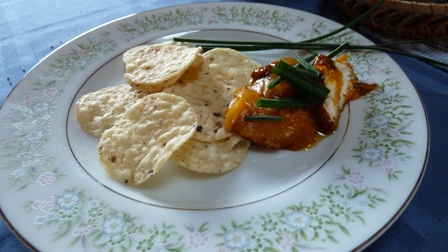
If last week’s recipe took half a day to make, this one took no more than half a shake. For real.
Furthermore, I was floored when my husband came home from work one day recently saying “I have a new recipe you’ve got to try.” Husband? Bearing a new recipe?
A coworker had brought in a hot dip and it is good. Healthy? Not so much. But hey, for a quick dip if friends or family are coming over, small group, a potluck or break at work, a hungry soccer team, a tail gate party, this works beautifully. I whipped it up because I knew we were headed to town on some errands and then out to eat. I knew it would be awhile until we would possibly wait for a table, order and get our food. So this can work as a homemade appetizer, sparing the expense at a restaurant. (I halved the recipe below and put it in the bottom of a bread pan, and froze the canned chili I didn’t use for later projects.)
Chili and cream cheese dip
1 can Hormel chili, without meat
1 8 oz. bar cream cheese
2 cups shredded cheese

Spread softened cream cheese in bottom of 9 inch pie pan (use knife or spatula).
Spread chili on top of cream cheese.
Cover with shredded sharp or cheddar cheese (or any mix of cheese you like).
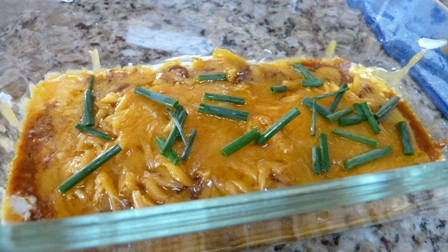
Microwave on high for 45-60 seconds, watching to see when cheese melts and mixture seems hot in center.
Options: chopped chives
The recipe I was given did not call for chives but they make a nice addition. You might also add halved cherry tomatoes, black olives, green olives, chopped hot peppers, chopped basil—if you use these things you know what to try.
You could also easily substitute your own thickened chili, or use refried beans.

Cautions: There are no preservatives in Hormel chili, but the sodium content is pretty high. Surprise surprise.
***
Do you order appetizers in restaurants? While I don’t have a lot of use for them (usually get too full anyway with calorie-laden food) sometimes they make a meal in themselves.
***
Does your spouse bring home recipes or suggestions to try? Do you welcome them? Why or why not?
***
There’s a chapter with appetizers and party foods in my book, Whatever Happened to Dinner: Recipes and Reflections for Family Mealtime.
My husband’s Aunt Mary R., now she was a cook. I say was because even though she’s still living, she is not able to cook for herself anymore. But the great passion of her life—in addition to the husband she lost in the Korean War and never found—was cooking for family. I got the impression sitting down to her groaning table that she was the happiest when feeding a huge meal to others—frequently using her best dishes.
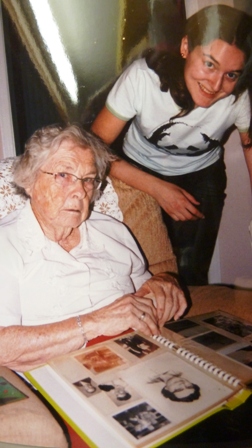
Aunt Mary with oldest daughter, Michelle.
I thought of her this past weekend as I made a coconut cake for a family reunion and recalled the time she drove from Montgomery, Alabama to visit us here in Virginia, all by herself and probably in her high seventies. She came with the goal of making several of her brother’s (my husband’s father, Hershal) special favorites including a barbecue sauce for pork, and a coconut cake. I wish I could say co-co-nut cake the way she does in her deep Alabama drawl.
She stayed with us that fall and attended the kids’ homecoming parade and we made more than one stop at grocery stores hunting for the exact brand name of ingredients so she could make everything “just like mamma made.”

So for her coconut cake, she had to use a real coconut—never mind the work. I had never opened one before her visit, and until last Saturday, had never opened one since. But after I wrote (here) about making Mary Emma Showalter’s coconut cake (of Mennonite Community Cookbook fame), another Mary V. (hang on to your hats, this story is filled with Marys. Mary V., my husband’s cousin on his mother’s side), pounced on that post and proclaimed I had to make it for the family’s summer picnic. I squirmed, not anxious to repeat the three layer huge cake and Mary Emma’s arduous mixing process. I reminded Mary V. that it might go better for the Christmas get together but she hinted that ever since the older aunts stopped baking—and have all now passed on—the reunion had been missing its coconut cake. I told my husband what I was planning and he flinched only slightly: he wasn’t going to get one of my reunion mainstays, Arnold Felcher cake.
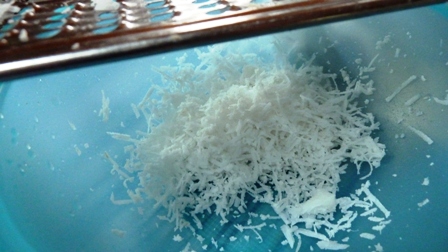
Finally I resolved to make the cake, but to look for another recipe and use freshly grated coconut. Might as well get the real “foodie” thing going: drill the hole; drain the milk; break open the coconut (not easy either); separate the coconut meat from the shell (ugh); scrape the brown liner off the white meat; and THEN grate the pieces into fine fluffy coconut.
(Video help here.)
All of that took un-expert-me hours all by my lonely self (husband working), when I could have just opened a bag. But I was determined.
So it wasn’t until I had gotten to the last step of slowly making my pile of fluffy grated coconut that I decided to sit down for the job. I flashed back 20 or so years to Aunt Mary’s visit and recalled how she had sat in my kitchen at the table grating that coconut while I went about my other chores. Suddenly she was with me in the kitchen—not in Aunt Mary’s charismatic religious way of visions and prophecies—but her love and spirit of pouring out her life for her family.

Each coconut has a face. Did you know? The facial features are the best places to make a hole.
I reflected on how this was probably going to be the last time I would use a real coconut, grating and all, and how for anyone to do this on a regular basis—it would be a labor of love.
The other truth that also hit me was that her making that cake was a true toil of love for her only living brother, for the memories of their mother, for family. Their family relationships were complicated to be sure—(aren’t most?)—but down beneath the connections ran deep.
The things we do for love and family. Now coconut—fresh or otherwise—seems to be something you either enjoy or you don’t. As some of us enjoyed the reunion cake, my sister-in-law Barbara said what it made her think of was grating coconut at Christmas as a family; her father would always drill the hole and dig it out of the shell and they’d all help grate and enjoy the fluffy stuff.

All that to say, here’s a recipe that was easy and turned out perfectly. The nutty flavor of fresh coconut was a treat—and my husband and I enjoyed the cake even more a day later when we could eat it with a dollop of ice cream. But on this we agreed: we both like Arnold Felcher’s Cake a tad better!

And if one of my grandkids develops a taste for real homemade fresh coconut cake, they might get me to do it again. Especially if they help.
Coconut Cake
Adapted from recipe by Esther B. Rodes, (correct spelling) McGaheysville, Va. in Mennonite Recipes from the Shenandoah Valley, Good Books.
1 ½ cups sugar
2 cups flour
3 ½ teaspoons baking powder
1 teaspoon salt
½ cup shortening
1 cup milk (or substitute in enough “milk” from the coconut to make one cup)
1 teaspoon vanilla
1 teaspoon coconut flavoring (or milk from the coconut)
6 egg whites
12-ounce container whipped topping
1 ½ cups freshly grated or frozen coconut
- Mix together sugar, flour, baking powder, and salt.
- Add shortening, milk, vanilla and flavoring. Beat for 3 minutes with mixer.
- Add egg whites and beat on high speed for another 3 minutes.
- Pour into 2 greased and floured 8 or 9-inch round pans. Bake at 360 degrees for 30-40 minutes.
- Remove from oven. Let rest for 5 minutes. Remove from pans and place on cooking racks. Before cake is completely cooled, place cake layers in airtight containers to retain moisture. (MD note: I always freeze my layer cakes before frosting them, makes the layers so much easier to handle and I think it improves moisture content too.)
- When completely cooled, spread whipped topping over bottom layer. Sprinkle with coconut. Place top layer on cake and spread with whipped topping. Add remaining coconut. Refrigerate. The cake is best if refrigerated for at least 6 hours to firm topping.
Serves 12-16.
***
What stories from your own family does this bring to mind?
What dish or dishes do you make “for love” of family?
Do you have a favorite coconut cake recipe you recommend?
***
Find Mennonite Recipes from the Shenandoah Valley here.

Another wonderful and now-classic Mennonite Shenandoah Valley cookbook is the 600+ page Mennonite Country-Style Recipes and Kitchen Secrets : The Prize Collection of a Shenandoah Valley Cook by Esther Shank, who also wrote an endorsement for my cookbook, Whatever Happened to Dinner.

Over the last 30 years, Mennonites and Lutherans have been working on a reconciliation process stirring from struggle with “the condemnation of Anabaptists” in Lutheran printed confessions of the 16th century. The persecution and death of many of the early Anabaptists through burning, drowning and other methods of the day is documented and well known. The Lutheran World Federation and Mennonite World Conference bodies specifically have worked on moving beyond the past.
As a born and bred former Mennonite married to a born and bred former Lutheran, you can understand why attending a workshop listed as “From Condemnation to Healing of Memories: Lutheran-Mennonite Reconciliation,” drew me. It was led by two German pastors, one a Mennonite, Rainer W. Burkhart (below left), and the other a Lutheran, Michael Martin.

Seeing and hearing Martin and Burkhart was like having the early discussions—even arguments —that my future husband and I engaged in during our early dating days brought to life, and to positive fruition. Stuart and I lived Mennonite/Lutheran differences in theology and practice, and these two men helped to bring about a reconciled relationship of the worldwide denominational groups that resulted not in a marriage—I don’t think anyone wants or needs that—but harmony, forgiveness, and, if you will, healing. What better topic for my Finding Harmony blog, and indeed, writ through our family backgrounds (which I shared here of my father’s faith background, my father-in-law’s faith and upbringing, and most recently writing about charming little Lutheran-Mennonite-Presbyterian handbooks posted here).
The story of Lutheran-Mennonite reconciliation began in 1980 with the 450th anniversary of the writing of the Augsburg Confession in which Anabaptists (and many others) were condemned—sealing the fate of the Anabaptist movement’s early leaders and peasant believers. Following that 450th anniversary event, Lutheran leaders invited Mennonite leaders to help launch a dialogue process to understand and bring about healing for past differences. By 1988, formal negotiations were in place to proceed.

Rainer and Martin* both began their theological studies at a Lutheran seminary in Germany. Rainer recalls, upon first meeting Martin, with a nod to the historical background of the two groups, he said something like “I’m a Mennonite, but don’t be afraid. It’s not a contagious disease.”
A friendship between the two men developed and eventually Martin even served a Mennonite congregation for a number of years in Munich who were in need of a pastor, so the two were well suited to help with and even embody the reconciliation process.
Today both men serve congregations in their respective faith groups, and the two outlined their long friendship from seminary days when they stayed up half the night (“we were younger then”) hammering out the sharp and often fatal differences of the 1500s that resulted in Lutheran outright condemnation of Anabaptists, and a persecution complex for Anabaptists. “Anabaptist,” for the unacquainted, means re-baptized as an adult, which was punishable by death because it was a sin against the state church of the day where everyone had to belong to the church. (In a lighter aside, Rainer spent a moment consulting with the translator working to translate the workshop into German and noted to the audience that “Anabaptist” was a very difficult word to translate into German.)

Rainer and Martin’s long seminary discussions, (including suddenly realizing at 3 a.m. they were starving and cooking up a mess of spaghetti together) were the questions that were vital in the reconciliation consultations such as:
–What role does an older doctrinal writing (The Augsburg Confession) play in the church today?
–Should a denominational confession go so far as to condemn others?
–What do we believe about infant baptism and God? What role do humans take on (deciding when to actively believe and practice Christian faith (as in the theology supporting adult or believer’s baptism) and what is the role of God–how God acts on our behalf before we can even acknowledge God (as in theology supporting infant baptism)?
–Do we believe that God’s action takes priority over human action?
–What about Christian discipleship?
–What is the role of God’s grace?
–Why does one group encourage followers of Jesus to be conscientious objectors and the other support military service for its members?
–Is there a just war?
I won’t go further into the long process of consultations but the two men noted also practical outcomes like results for accepting the baptismal process of the other denomination:
–Mennonites would refrain from requiring re-baptism for Lutherans joining their ranks.
–Pastors could respect individual conscience on matters of military service and baptism.
–Both would be welcome at each other’s communion or Eucharistic services.
And regarding age old persecution and condemnation—(which was likely originally worded so strongly to prove or demonstrate the orthodoxy of Lutherans at a time when they were stepping away from the Catholic church), it was decided that even though today’s Lutheran and Mennonites had nothing to do with those old writings or actions, Lutherans as a body would ask for forgiveness as a healing step.
But Lutherans were not the only ones needing to make confession. At times Mennonite were guilty of (eek, can it be?) arrogance, name calling, and enjoying the victim role of “past martyr.” (Not active martyr, but throwing that past up in the heat of argument.) Anabaptists had for so long lived with their past history of “sons and daughters of those martyred for their faith”—would they find a new identity going forward?

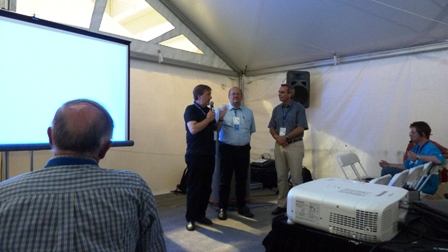
Larry Miller (above left), former head of Mennonite World Conference for many years, noted that the gift of the Lutheran Church to Mennonites in this process was an opportunity for Mennonites to be freed from the past (should never be buried or forgotten) and freed to be brothers and sisters in the Lord, today.
This was all an unexpected and welcome gift for me. Praise be to God.
In Stuttgart, Germany, July 2010, at the meeting of the Lutheran World Federation, a healing service was included where persons were given the opportunity of accepting an anointing with healing oil shared by other participants.
Viewing that short video was a moving moment for me, too.
The equally long and painful conversations between me and my boyfriend—then fiance—and eventually husband played in the back of my mind. Here were two men, who were a living embodiment of not only the 1500s but the 21st century—who charted a path mirroring Stuart and I coming together across faith lines. This was a personal path which wasn’t always easy either, resulting in my father basically boycotting the Presbyterian baptismal services of our first two daughters, and mom “coming anyway” to the baptism of our youngest.

Our daughter, Tanya, with son Sam and husband Jon upon Sam’s baptism.
So it goes. Stuart and my dealings with “personal merger” resulted in joining a middle ground as Presbyterians. Scratch us and we might bleed Lutheran or Mennonite, but underneath we bleed Christian. We can be thankful that truly bleeding for the devotion of our ancestral fathers and mothers, in faithfulness to Christ’s own martyrdom, is rare. But not rare enough (thinking of Charleston SC) in these times.
***
What personal or church stories does this bring to mind for you?
***
That’s all of my posts from Mennonite World Conference, I think! Link to first one; link to 2nd one.
***
*Bios for Burkhart and Martin in English are hard to track down online, so here is a little more about them in English, from the Mennonite World Conference program book:
[Rainer W. Burkhart is a Mennonite pastor in Germany, member of MWC executive committee and Faith and Life Commission, co-secretary of Lutheran-Mennonite dialogue in Germany 1989-1993, and co-chair of International Lutheran-Mennonite Study Commission 2005-2008. Michael Martin is a Lutheran pastor in Germany, member of the church governing board of the Evangelical Lutheran Church of Bavaria, and head of the department for ecumenical affairs and church life. He ministered in a Mennonite congregation in Munich from 1992-1996, and is chair of the task force of the Lutheran World Federation to follow up on the reconciliation process.]

 findingharmonyblog