

Since most of the east coast of the U.S. (from Virginia on up) is happily (?) enjoying a snow day today, I’m taking a break from my Lenten devotional series and have been trying to catch up a bit on reviewing manuscripts for the magazine I edit, Living for the Whole Family.

Our spring 2013 issue.
I’m also a writer who has also submitted many many articles and book proposals to a variety of publishers and publications, and that’s what makes my job as editor so hard.
I know the sting of rejection. The desire to lash out, “stupid editor, she/he doesn’t know anything. People would love this topic! They would buy thousands of books! They would beat a path …” Or not. (Hence why you have so many publishing their own blogs today. Me included.)

(What you hope you never get)
So I HATE to send rejections (and that’s why it takes me so long to respond sometimes). But I have had many writers tell me, “yours is the nicest rejection I have ever received.” Some writers are grateful for any comment, any direction, any feedback that will help them (us) in our quest to connect and be published!
Thus I weigh the options for the feedback I give to writers:
- Shall I be brutally honest or spare feelings?
- How do I tell an elderly writer that the writing feels like it was written in the 1960s or 1970s? How do I feel about maybe becoming an elderly writer myself someday (not now, heavens!) and feeling rejected because of “ageism”?
- How do I balance the need for articles with a different twist or slant, with the “way out there” pieces that no one will identify with because no one else has had or will have this experience?
- The profound experiences of everyday life – birth, marriage, death – are just that, profound experiences that all of us experience (except for marriage) and therefore, most editors receive way way too many articles on the topic (especially grieving and loss or death).
- Would writers rather hear “we are overstocked” which is usually true, even though I make exceptions for pieces that totally rock and sing? Or would they (you) rather hear “this humor just isn’t funny” or “you are talking down to your readers.”
Hating to send rejections is almost overcome by the joy of opening an email or letter to find an article that jumps from the computer screen or page and makes me laugh, cry or think deeply.
The amazing thing to me is that writers go through all this trouble and travail to be paid a mere $35 to $50 most of the time and be JUMPING UP AND DOWN FOR JOY when they get the check and a copy of the publication with their name in print.
Writers are not really vain, we just live for the byline.
But at least I rarely get pieces anymore (which used to be fairly common at some publications) from writers saying “God inspired me to write this piece” and inferring you better use it or your publication is not so inspired. L Editors have probably complained about that old standby for so long they have pretty much killed the line, even if writers still feel it.
My old standby advice for getting published anywhere is to spend a lot of time reading the publication or website or blog where you’d like to be published, so that you absorb not only what it is about, but the language (formal, informal, loose, trendy) the publication uses, how they approach readers, the editorials (what the editor writes about gives you clues as to their likes and dislikes). And for pity sake, do read (memorize!) whatever guidelines the editor or magazine shares. Ours are here.
If you are a writer, what kind of feedback do you prefer from an editor? Feel free to respond to any of the above bullet items if you comment. You will be a help. Thanks!
Verse for reflection: Give thanks to the Lord, for he is good; his love endures forever. Let the redeemed of the Lord say this—those he redeemed from the hand of the foe, those he gathered from the lands, from east and west, from north and south. (Psalm 107: 1-3, NIV)
The inside of New York City Police Department’s impound lot, where they send vehicles towed off the streets of Manhattan, is a place you don’t to be. Everyone is mad or at least unhappy—even the workers. Who would want to work there?
This one appeared as shady as one in a TV show or movie. What “evidence” from someone’s crime is hidden there? Which of these cars have been stolen? Abandoned with a dead body inside?

Jim Bowman taping residents and family members discussing care in an urban New York City retirement community, Village Care of New York. Photo by Wayne Gehman.
We were in New York City taping interviews for a documentary, Embracing Aging: Families Living With Change; at 4 p.m., we needed to move the car but I was running just a few minutes late at the end of an interview. I volunteered to go move the car while the guys tore down the equipment. I reached the street at 4:07 p.m. and it had already vanished. No sign left behind. Not even a number to call on the parking sign. What do you do?
I go back to the building and asked the concierge. She said to call 311, a non-emergency phone tree that I could quickly tell was going to take me hours to wade through. The concierge also knew the address of the impound lot off the top of her head and said it was not far away. I thought I might as well grab a taxi. With only one impound lot in the whole of Manhattan, this was my first stroke of luck all day.
The taxi dumped me out near a pier along the Hudson River and pointed me to the tin/metal warehouse that functioned as the impound lot. I could easily imagine a shoot-out or clandestine interrogation/intimidation of a “witness” happening there. I followed a bunch of signs and finally found a room with a sullen clerk silently directing me with a jerk of her head to a window marked “Information. Start here.”
Seated behind bulletproof plastic, a clerk in heavily accented English tried to tell me three times what I needed to do. Finally I told her I’m hard of hearing (which I am) and she said it again. I had to surrender my driver’s license and leave it with her while I walked to another building, marked NYPD. I felt almost like I was being arrested. There I had to wait for a van to drive me to our company van on the impound lot where I retrieved the car’s registration card, to take back to the clerk.
Meanwhile, one of the other detainees is pounding his fist into the wall of the office and yelling “It’s a scam” because the clerk had denied him the right to use his credit card to pay the hefty $185 towing fee, because his name didn’t exactly match the name on the registration card. “And I suppose there’s no ATM near here?” he shot back. “What am I supposed to do?” A mother who had her car towed had just gotten her adult daughter out of the hospital and was in tears from frustration and stress.

When the clerk finally stamped “Redeemed” on the top of what had quickly grown to be a pile of paperwork about my case, I was struck by the theological nature of not only the stamped word, but the whole experience. I was no longer a crook, who had stolen seven minutes of street time from the parking meter. I was free to drive out of the impound lot; it was not only me that was saved, but the Mennonite Media vehicle: we hadn’t abandoned her; we “bought” her salvation. She was “made good” (which is what redeemed really means) and we were free to head home.
Action: Thank God for the gift of redemption. Perhaps you can respond with a gesture of thankfulness and give someone else a “free” pass today—someone who has wronged, slighted, or looked over you, and share the good feeling of being left off the hook.
***
Here’s a video clip of the documentary we were producing that day. The actual ticket reads that the car was picked up at 4:01 p.m, one minute after time was up. Be warned.
Portions first used for my Another Way newspaper column for MennoMedia.
Verse for reflection: I have not stopped giving thanks for you, remembering you in my prayers. I keep asking that the God of our Lord Jesus Christ, the glorious Father, may give you the Spirit of wisdom and revelation, so that you may know him better. Ephesians 1:16-17.
My five-year-old was heartbroken. We couldn’t find the library book she had brought home from school and she wouldn’t be allowed to bring another one home until she had returned that one. Sensible rule.
We hunted in all the logical places, then the illogical ones. My usual line about “I’m sure it will turn up,” just didn’t comfort her. On library day at school, she was always left out.

After three weeks of not getting anywhere, I called the school librarian and explained the situation. “I’ll be glad to pay for the book,” I offered, “so Tanya can start bringing books home again.”
The librarian with the sensible rule also turned out to have a sensible head. “Well, books turn up so frequently soon after parents have paid for a book, and I have to go through all the book work,” she said, with the wisdom of ages. “I’ll tell you what; since you called, I’ll go ahead and let Tanya bring books home again. I know you’ll be responsible. If you still haven’t found it by the end of the year, then I’ll let you pay.”
I could have kissed her. Tanya’s eyes as she got off the bus that day were my reward. “Mrs. Fisher let me have a book today!” she sang out.
When I saw Mrs. Fisher several weeks later at school, I told her we still hadn’t found it. “You know,” she said without a hint of condescension, “books so often turn up caught behind a bureau or desk right at the top of the baseboard. They don’t slide down so you can see them from the floor, and it’s hard to see behind the furniture.”
I was sure I had looked in all those places but I went home and checked behind older sister’s platform bed. Sure enough, as though Mrs. Fisher had snooped through our house, there it was. That day Tanya’s eyes really did shine when I showed her the lost book.

Mrs. Fisher, to us, had the smarts of a King Solomon, the experience of long years dealing with children, parents, and books, and when to offer grace.
Action: Do I seek God’s wisdom and revelation, as Paul reminds us in Ephesians? What gems are waiting for our discovery? One of the things that fascinates me about reading scripture is that no matter how often I’ve read a passage, it can speak fresh to me each time. Even though God’s word doesn’t change, we change, and look at things differently, and God’s spirit can speak to us with a new word for each day and situation, if we are persistent. We can also rejoice that God always extends grace, even when we’ve messed up.
***
Our children were fortunate to attend a wonderful local elementary school with fantastic teachers and staff, including Mrs. Fisher. This story first appeared in my book, Why Didn’t I Just Raise Radishes? Herald Press, 1994).
Saturday was baking day in many households (along with cleaning day) when I was growing up. The mood to bake something still often strikes me on Saturday.
I actually made this cake earlier this week to celebrate a couple of birthdays at work, and as usual, the cake, especially the frosting, won rave reviews. (Of course, you can take cookies given to you at a Christmas cookie exchange that no one at your house cared much for and shuffle them off at work and they still get eaten, right?)
This recipe is one of my favorite from what I now like to refer to as a cookbook, Whatever Happened to Dinner? Recipes and Reflections on Keeping Family Mealtime (Herald Press, 2010). There are almost 100 recipes in that book and I’m still grateful to the women who helped organize and test the recipes for that project. If you are in the mood for something sweet—this is like eating dark chocolate with candy on top. If you’ve given up all sweets for Lent, bookmark this for later!
It contains simple ingredients–I’m guessing you already have all these ingredients in your pantry, and the cake doesn’t even take eggs!

Sheri’s Chocolate Cake
This recipe came from a friend originally and quickly became the family favorite whenever we wanted chocolate cake. Quick and easy to make. Putting it in a large sheet pan instead of a regular-size cake pan makes it a great dessert for a church potluck. – Sheri Hartzler
Sift together:
3 cups / 750 ml flour
2 cups / 500 ml sugar
1/3 cup / 75 ml cocoa
2 teaspoons baking soda
½ teaspoon salt
Add to dry ingredients (don’t overmix):
2 cups / 500 ml water
2/3 cup / 150 ml melted shortening or butter
2 tablespoons vinegar
1 teaspoon vanilla
Bake at 350° F/ 180° C in two 9-inch round pans or one 12-inch by 17-inch sheet cake pan for 25–30 minutes.
Easy Penuche Icing
My aunt brought a chocolate cake with this icing to a family reunion. My husband Wayne was thrilled, made a huge fuss over it, and asked for the recipe. We received it in the mail a short time later. The whole family now knows that if there is chocolate cake, Wayne is going to ask for penuche icing. It really is good—and it is just fun to say penuche! – Carmen Wyse
½ cup / 125 ml butter
1 cup / 250 ml brown sugar
¼ cup / 50 ml milk
1¾ cup / 425 ml powdered sugar
Melt butter, add brown sugar, and boil 2 minutes, stirring constantly. Add milk and bring back to a boil. Remove from heat and cool to lukewarm. Add powdered sugar a little at a time, beating until it is nice and creamy. Spread on cake. Add chopped pecans or slivered almonds for a final touch if you want.
Making the frosting

Melting butter in sauce pan on stove, add brown sugar.

Boiling 2 minutes, stirring constantly.

After the mixture has cooled to lukewarm, then you add your powdered sugar.


The cake is rich, moist and good all by itself, or with chocolate frosting or a white frosting–for which there are also recipes in the book. This time I added slivered almonds which makes the whole thing like a candy bar. I know, sinful, especially during Lent. But tomorrow is feast day!
Verse for reflection: But when you fast, put oil on your head and wash your face, so that it will not be obvious to men that you are fasting, but only to your Father, who is unseen; and your Father, who sees what is done in secret, will reward you. Matthew 6:17-18 (NIV)
Facing a long weekend of getting ready for a certain medical procedure wherein your insides are fastidiously clean (if you get my drift and you’re of a certain age), is no fun.
But doing so during Lent: what’s not to love? You do the every-ten-year thing, win points with God, and lose weight all in one l-o-n-g weekend.
Right. That’s not what Jesus told his disciples to do nor does it qualify for true sacrificing in anybody’s religion whether you call it Ramadan or Lent. In a church school class for Lent, we’re studying the classic Soul Feast: An Invitation to the Christian Spiritual Life (Marjorie Thompson) regarding spiritual disciplines, and last Sunday looked at the topic of fasting.
I was reminded of the one time I engaged in spiritual fasting for five days. I was in Mennonite Voluntary Service (VS) and was earnestly trying to figure out what I should do next. I lived with five other people in our “unit” house. To escape notice of my fellow VSers, I fasted only over lunch. I could easily arrange to be absent or otherwise engaged over lunch and no one would notice, so I ate breakfast and dinner with the others, but skipped lunch and all snacks in between.

(Goofing off in the kitchen of our unit apartment, about to snitch a bedtime snack. Circa 1970.)
That probably doesn’t sound like true suffering (it wasn’t) but I got hungry enough that my stomach would remind me frequently through the day that I was fasting. And I used those hunger pangs to pray specifically for direction from God as to what I should do when I got out of VS. Perhaps it wasn’t much of a fast, but it was genuine.
The most likely direction was college, but I truly wasn’t sure where I should go, what I should study, or how I would pay for it. This was 1971, before admission deadlines were as stringent as they are today. While I fasted and prayed that week in early spring, I received two strong nudges: a letter from a friend of mine who had enrolled at Eastern Mennonite College (now University) and encouraged me to go there; then a couple days later the financial aid officer from the school called and said I would probably qualify for some pretty strong financial aid. My friend had put him up to it. It looked like pretty clear guidance to me, and I really never looked back. So I went to EMU, had four wonderful years (including one year studying abroad), found good direction for my life’s work, and ended up meeting the man with whom I would share my journey (but that’s a story for another time).
The neatest thing was feeling a very strong connection with God as I prayed, searched, meditated, and tried not to yield to the constant temptation of one of my favorite things: food.
Action. Whatever you’re giving up, or taking on for Lent, keep at it. Sunday—feast day if that’s the way you practice Lent—is coming when you can take a “break” from your discipline for one day. As we recall the sacrifice of Jesus, this is nothing. We don’t “earn” our salvation anyway; it is a pure gift of God. Amen.


Pic 1: Judi Brenneman, unit hostess, demonstrates a craft with the girls club we ran. Pic 2: Watching my nursery school students which I taught three days a week at Talcum Mennonite Church. Pic 3: Here’s proof I played college basketball my first two years: #33. Miriam Mummaw, our coach is beside me.
***
My first book, On Troublesome Creek (Herald Press, 1981) is about the year I spent in Voluntary Service near Hazard, Kentucky.
Verse for reflection: Oh, how I love your law! I meditate on it all day long. Psalm 119:97
Growing up, I always did my best thinking in the chicken coop (not to mention my worst sibling fight there).
It was a mighty fancy chicken coop in those days (before the trend to lucky free range chickens), and it was pretty mindless work to push your cart down a cement row between cages and gather up the eggs and place them in cardboard egg flats.
The chickens functioned as my therapists: cocking their heads this way and that as I talked earnestly to them about my problems. They looked like they were truly listening. I sometimes ranted, sometimes cried in frustration or joy, and sometimes warbled a song at the top of my lungs. It was a great place to unload.

But it is only in retrospect that I can talk so lovingly about my chicken house therapy. How we hated to gather eggs back then. How Mother must have dreaded the hour to shoo us out to the chicken house twice a day. We were paid a small amount which helped motivate us.
But besides teaching us the value of work and a dollar earned, I now realize how manual, repetitive work contributed to my having time and space to think things out. It was after one of these chicken house “therapy” sessions that I went in our house and found an index card and jotted down what I thought I wanted to be in life—truly not knowing or even imagining how this would ever be possible for me: to be a Christian writer. I was 15.

This is the real card I inscribed that day, saved in a top secret file I call “Weird to keep but interesting.”
Jesus was a carpenter by occupation and I’m thinking that Jesus must have ruminated on his calling and his life as he sanded wood or sawed in his carpenter shop. Did he know what lay ahead for him? I wonder if he ever sneaked back to the shop once he began teaching and preaching, in order to have contemplative time to himself.
Most of us can’t meditate on God’s word all day long as the Psalmist did, but if you do manual work, that can be an advantage. Many of us like working in the garden for that reason—or freezing or canning its produce. Shelling peas or snapping beans is some of the best “mindless” work there is—if you are so fortunate!

Action: Where do you do your best thinking? If you don’t do manual kind of work, take whatever opportunities you have in the day—commuting, walking, running, washing dishes, showering—to focus on a verse of scripture or big questions: your life and where it is headed; your relationships; on God’s provisions for you and how you can respond more faithfully to God’s call; on Jesus’ example and extreme sacrifice as we go through this season of Lent. May we seek clarity, cleansing, self-understanding, and joy.
Chicken photo from FreeFoto.com
Verse for reflection: He called a little child and had him stand among them. And he said: “I tell you the truth, unless you change and become like little children, you will never enter the kingdom of heaven. Therefore, whoever humbles himself like this child is the greatest in the kingdom of heaven.” Matthew 18: 2-4
Children have much to teach us—including on this Lenten journey. Here, in no particular order, are things, both profound and profane, my kids have tried to teach me—or teach their siblings:
~ When I was pregnant with our third child, the oldest saw me reading a book. “Mommy, is that book about pregnancy?”
“No,” I replied. “Why?”
“Well,” she said, like a stern nurse, “you should be reading books about being pregnant.” (Not that I hadn’t had a baby before or anything.)
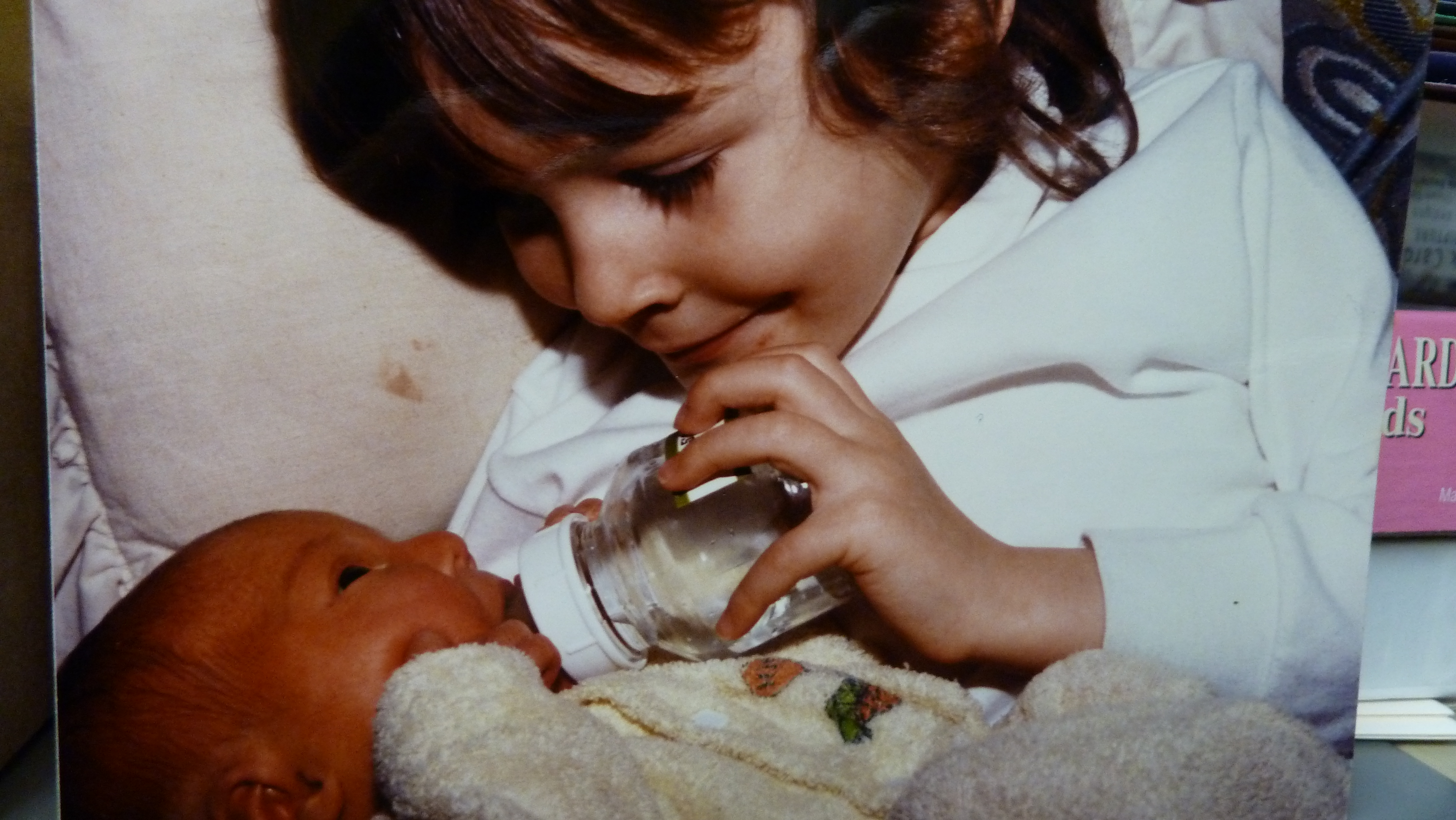
Michelle feeding baby Doreen
~ It was at the beginning of this same pregnancy that I shared the news with a family of three kids, all of whom had been adopted as foster children. When I excitedly shared the news that we were going to have a new baby, they smiled politely and one asked, “Do you mean foster or adopted?”
~ Big sister to younger sister when she first headed to school: “Don’t forget—a rule at our school is, “Don’t walk out of the bathroom with your pants still down!’”

Tanya looking up to big sister Michelle at school
~ My post last week about digging a well after struggling with a cistern for many years reminded my oldest daughter of how amused my husband and I were upon hearing her leading her two-year-old sister in a game of “check the water in the cistern.” She had leaned over the heavy cement lid, pretending to lift it up like Mommy did, loudly grunting “uh” in the process. Until that instant, I had never realized I always made such a graphic sound when checking the water in the cistern! We howled with laughter.
And I don’t remember now which one of my kids said these:
~ “Mommy, what comes after the New Testament?” Great question.
~ “If you say God doesn’t need to sleep [Psalm 121], why did Genesis say God rested?”
~ “Why don’t they list the mothers?” (after hearing a genealogy from the Bible).
~ “Did God write the Bible?”
And sometimes it is not so much something they say that prompts chuckles or a lump in the throat, but an action: a tissue brought for a crying sibling; a Cheerio shared with the family dog.
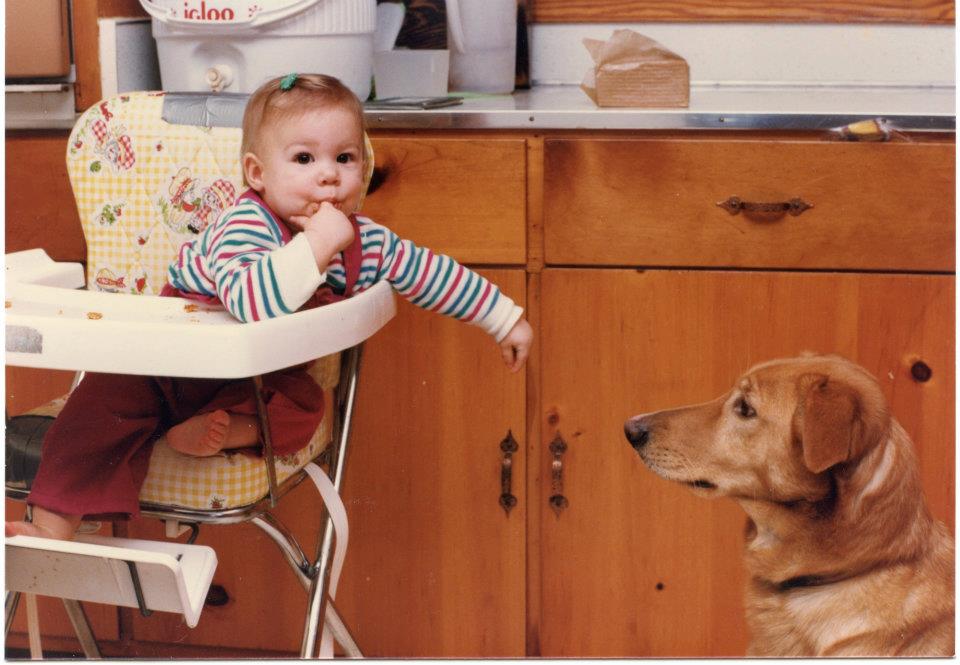
Tanya holding out a Cheerio to dog Wendy
If we think of children coming to us fresh from the hand of God, I don’t think it is too far-fetched to let their words—profound or embarrassing—speak to us. Children will humble us, like Jesus said, enabling us to enter the kingdom of heaven.
Action: If you have children or grandchildren around, allow them to lead you closer to God. If you don’t have any around, enjoy looking at some photo albums (like I’ve been) today. Call, email or text the special children in your life, whether your own or a friend’s.
Verse for reflection: In those days John the Baptist came, preaching in the Desert of Judea and saying, “Repent, for the kingdom of heaven is near.” Matthew 3: 1-2
At our office we used to have a cactus plant that bloomed about three or four times a year. Normally I’m not a big fan of cacti, but there was something about this particular plant’s blooming that always caught my imagination. I don’t know the name, but it was more similar to this video than my photo below of a simple thistle blooming (which is awesome for a weed!).

The feathery bloom on the plant in our office lunchroom was as delicate as any orchid (in fact some people call it an orchid cactus), and lasted only one day. It would burst open one morning and by evening was limp: exhausted and spent from its one brief day of shining.
One morning I came to work to find it was the cactus’ day to bloom. But the flowers were squashed up against the window with no room to spread out. So I turned the planter around and watched the flowers unfold more fully. I imagined them thanking me for not having to spend their one day of glory bent up and miserable.
It made me think of a man I knew, who in a sense spent his life turned in the wrong direction because of forces beyond his control when he was a child. I always felt he was damaged by a warped childhood, with no one to turn him around enough to say, “Look at life from this side now. You don’t have to wallow in the circumstances of your birth. You’re free to become better than you’ve ever been before, given room to stretch and bloom.”
That can be the experience we have on our Lenten journey. We don’t have to spend another day mashed up and unable to blossom. Sometimes it takes the help or assistance of another person to turn us around. Sometimes our own squirming and searching gets us into a position where we can bloom the way God intended. John the Baptist preached about repentance, turning around.
Action: In what way could I use a fresh angle—turn around to look at my life another way?
Verse for reflection: But I have stilled and quieted my soul; like a weaned child with its mother, like a weaned child is my soul within me. Psalm 131:2
One time when the two youngest were six and three, I had to stay home with the children who had flu and strep throat. They were sick, but not too sick to want to play “office” with Mommy.
Suddenly I found myself with two pint-sized bosses. One was far tougher, and the other way more lenient than any real life-bosses I’ve encountered.
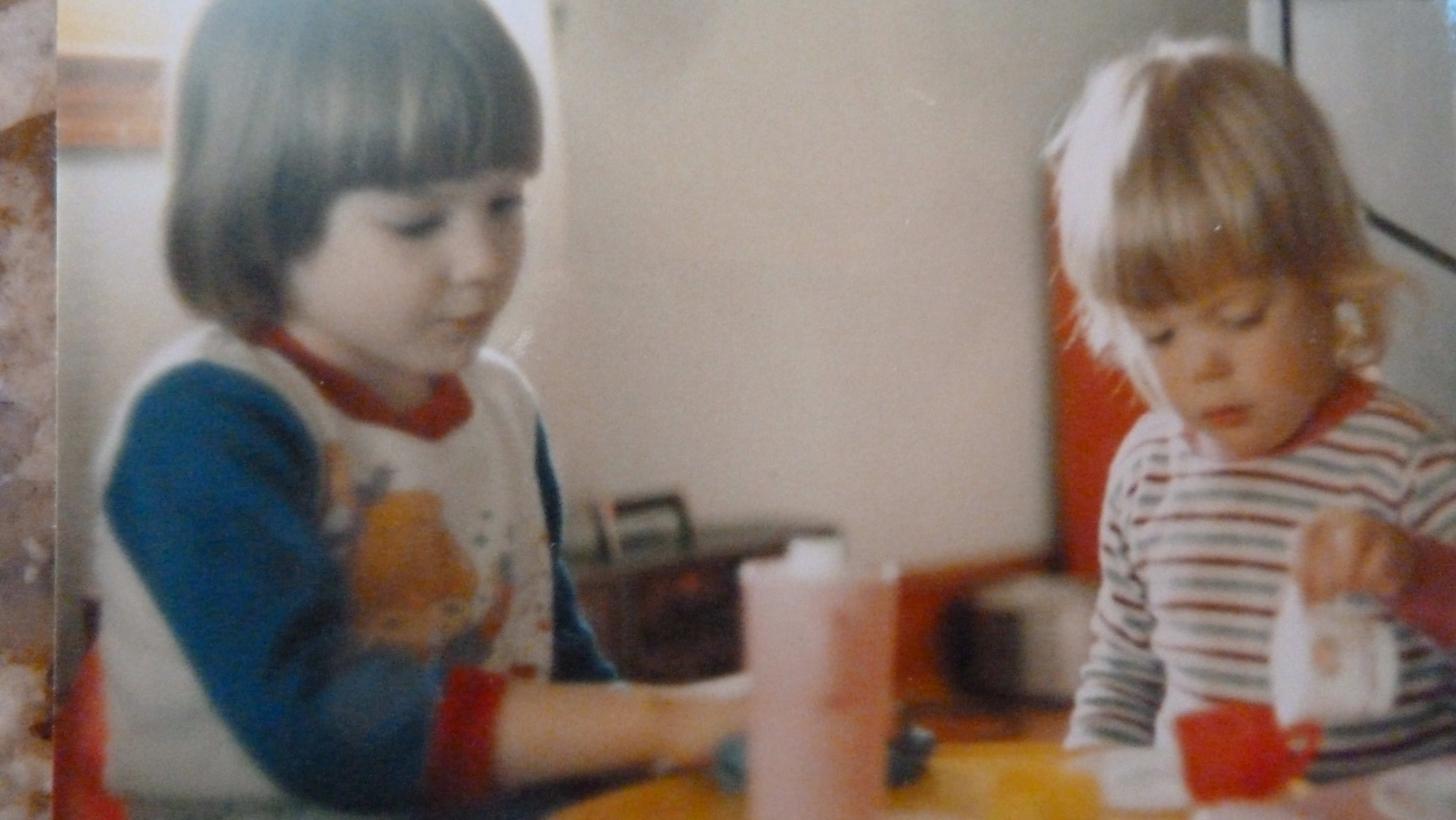
Six-year-old: “Now, I want you to finish an article for the paper today.” (She hands me a blank page and I decide to write down our conversation so she’ll think I’m “writing.”)
Me: “Today?”
“Yes, today. Start writing.”
Shortly three-year-old arrives with a play lunch of plastic food. “Ta da! Lunch!”

“Oh, lunch already?”
“Yes, I put ketchup and mustard on it.”
“Oh, (chuckle) yes! I heard you going ‘plop plop.’”
Six-year-old: “This is your lunch break.”
I take two pretend bites. Six-year-old: “Okay, start writing again.”
“Hey! That was a short break.”
(Relenting.) “Well, you’ll have another break later.”
Three-year-old returns with a plastic Big Mac box, hiding a smile. “Here’s your break. You won’t like it.” (Giggle.)
I open the box. Instead of a hamburger, she has tucked inside a treat like you get with a fast food kid’s meal. “Oh, you gave me a Happy Meal!”

She grins her delight.

Six-year-old. “Now hand your paper to me when you’re finished. I’ve drawn a picture to go with it.” …
And once again I was grateful to step inside my children’s world, even if it took a sick day to do it. It’s always a revelation to hear kids playing back to us what they’ve caught from our work world.
I chose a mommy track when I cut back my full time job to half time, a decision I never regretted. My boss may have raised an occasional eyebrow when I had to stay home with sick kids, but it was a choice I tried to make whenever possible. It meant cutting back on travel for the company, not doing much overtime or evening meetings. I didn’t pursue grad school because it would have meant uprooting the family. I was clearly on the parent track.
Stepping off the career track is a good thing, especially during this season of Lent. There are many images of God in the Bible as a parent, or loving mother hen, as our pastor read in the Lectionary passage yesterday. God IS a parent, and parenting–or loving the children in our lives–can be one more picture to help us understand a little more fully God’s wide and all embracing love for us.
Action: Today’s verse speaks of a still and quiet soul. There are many tasks facing us on Mondays, but this season reminds us to take time to be quiet and still. Even just for ten minutes.
Verse for reflection: “You know what I am going to say even before I say it.” Psalm 139:4
I’ve enjoyed helping interview people for the documentaries Mennonite Media (now MennoMedia) produced. This true story happened to another producer, who was interviewing an elderly woman whose husband had been murdered several months earlier in an apparently random shooting. The conversation was all recorded in the transcript.
“Do you remember your feelings during that period?” the producer asked, innocently pursuing the most relevant part of the story.
“Wait a minute,” Mrs. Todd (not her real name) protested. “I wanted to tell you about our marriage before we got to this part. You got the book backward! You’re asking me about his death, and you never thought to ask me about our lives together.”
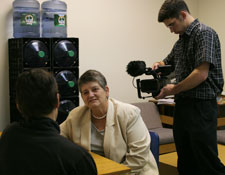
Ouch. To his credit, at that point the interviewer backed up and listened to a grieving woman remember her life with a wonderful husband. I’ve tried to follow this principle when interviewing people for articles, radio programs and films.
How often do we tell people, by our attention or lack of it, “Just get on with the story; spare me the details.”
Yes, there is an art to summarizing a story instead of getting lost in irrelevant details, but how important it is to listen—really listen—to a spouse, a child, or a friend when they need to unload—with details. I’ve very guilty of this, especially at home.
I took a still-life oil painting class for a year. My teacher was always telling us, “Squint, squint, squint! You have to squint to really see the exact shades of red on an apple, the precise gleam on an oil lamp. You won’t be a good painter if you don’t squint!”
We also need to “squint” when we’re listening to someone. Figuratively in thus case: focusing totally on the other person and blocking out all the busy issues crowding my mind. The person can tell if we are listening with “squinting” ears.
This Lenten journey, perhaps we can think of God listening to us with “squinting” ears, and revel in God’s availability to us. It is important to listen to God, too, but today bask in the presence of a listening God. Our God is totally unbound by the human constraints of time, energy, boredom, the next task.
Action: Made in the image of God, we humans have similar capacities to be good listeners when others need to share their hearts. When someone—child, spouse, friend—shares with you today, give them your full attention.
***
Photo by Wayne Gehman for Mennonite Media, from the production of Shadow Voices: Finding Hope in Mental Illness. Pictured are Lyn Legere and Denver Steiner, listening to a young man in a peer-to-peer listening session. Lyn’s story is told in Shadow Voices and her struggles with cigarette addiction finally made it into a radio spot you can find here.
Most of these Lenten meditations, appearing Monday through Friday are adapted and excerpted from my book, Why Didn’t I Just Raise Radishes: Finding God in the Everyday, Herald Press, 1994.

 findingharmonyblog