

Verse for reflection: In those days John the Baptist came, preaching in the Desert of Judea and saying, “Repent, for the kingdom of heaven is near.” Matthew 3: 1-2
At our office we used to have a cactus plant that bloomed about three or four times a year. Normally I’m not a big fan of cacti, but there was something about this particular plant’s blooming that always caught my imagination. I don’t know the name, but it was more similar to this video than my photo below of a simple thistle blooming (which is awesome for a weed!).

The feathery bloom on the plant in our office lunchroom was as delicate as any orchid (in fact some people call it an orchid cactus), and lasted only one day. It would burst open one morning and by evening was limp: exhausted and spent from its one brief day of shining.
One morning I came to work to find it was the cactus’ day to bloom. But the flowers were squashed up against the window with no room to spread out. So I turned the planter around and watched the flowers unfold more fully. I imagined them thanking me for not having to spend their one day of glory bent up and miserable.
It made me think of a man I knew, who in a sense spent his life turned in the wrong direction because of forces beyond his control when he was a child. I always felt he was damaged by a warped childhood, with no one to turn him around enough to say, “Look at life from this side now. You don’t have to wallow in the circumstances of your birth. You’re free to become better than you’ve ever been before, given room to stretch and bloom.”
That can be the experience we have on our Lenten journey. We don’t have to spend another day mashed up and unable to blossom. Sometimes it takes the help or assistance of another person to turn us around. Sometimes our own squirming and searching gets us into a position where we can bloom the way God intended. John the Baptist preached about repentance, turning around.
Action: In what way could I use a fresh angle—turn around to look at my life another way?
Verse for reflection: But I have stilled and quieted my soul; like a weaned child with its mother, like a weaned child is my soul within me. Psalm 131:2
One time when the two youngest were six and three, I had to stay home with the children who had flu and strep throat. They were sick, but not too sick to want to play “office” with Mommy.
Suddenly I found myself with two pint-sized bosses. One was far tougher, and the other way more lenient than any real life-bosses I’ve encountered.
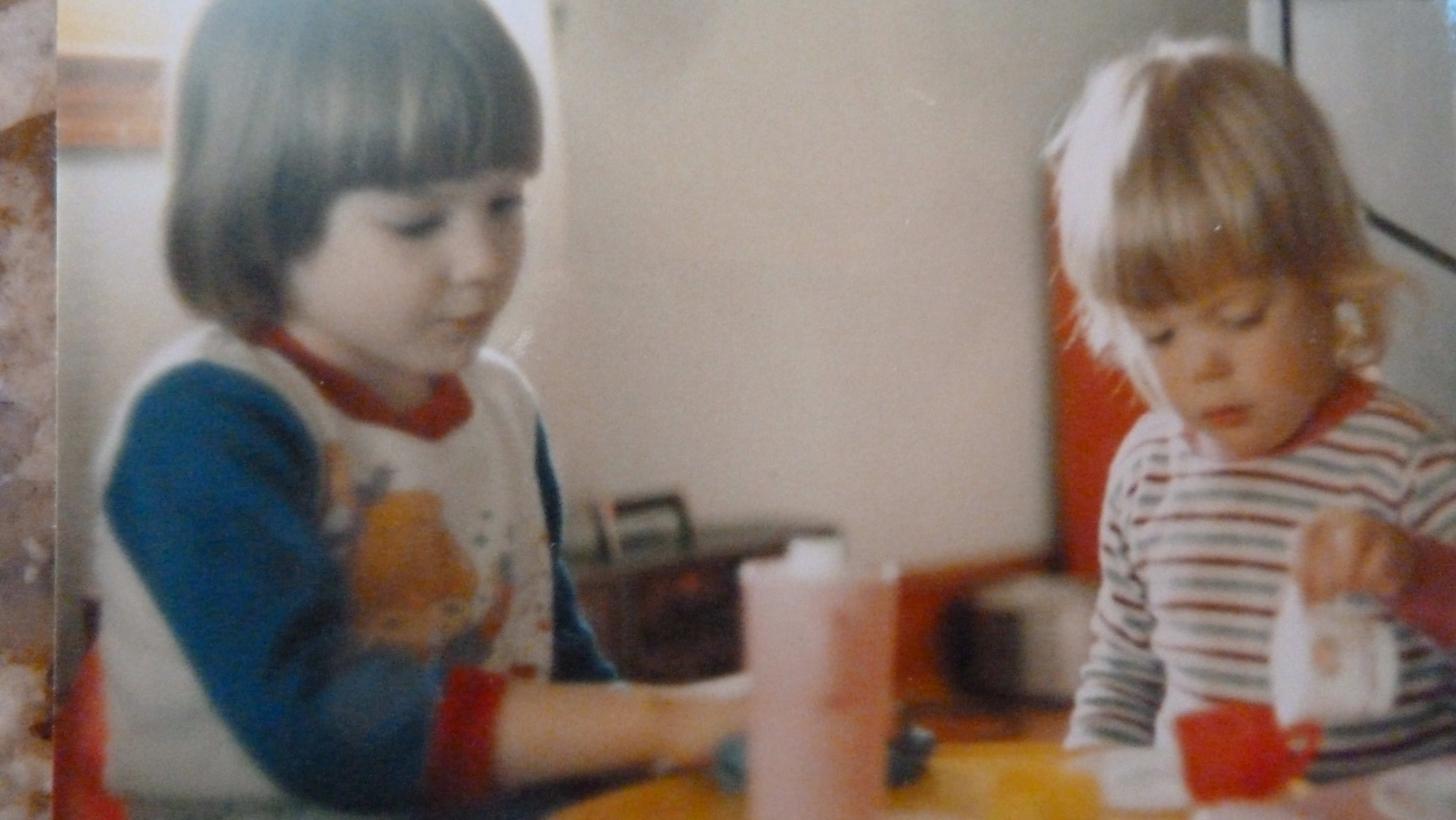
Six-year-old: “Now, I want you to finish an article for the paper today.” (She hands me a blank page and I decide to write down our conversation so she’ll think I’m “writing.”)
Me: “Today?”
“Yes, today. Start writing.”
Shortly three-year-old arrives with a play lunch of plastic food. “Ta da! Lunch!”

“Oh, lunch already?”
“Yes, I put ketchup and mustard on it.”
“Oh, (chuckle) yes! I heard you going ‘plop plop.’”
Six-year-old: “This is your lunch break.”
I take two pretend bites. Six-year-old: “Okay, start writing again.”
“Hey! That was a short break.”
(Relenting.) “Well, you’ll have another break later.”
Three-year-old returns with a plastic Big Mac box, hiding a smile. “Here’s your break. You won’t like it.” (Giggle.)
I open the box. Instead of a hamburger, she has tucked inside a treat like you get with a fast food kid’s meal. “Oh, you gave me a Happy Meal!”

She grins her delight.

Six-year-old. “Now hand your paper to me when you’re finished. I’ve drawn a picture to go with it.” …
And once again I was grateful to step inside my children’s world, even if it took a sick day to do it. It’s always a revelation to hear kids playing back to us what they’ve caught from our work world.
I chose a mommy track when I cut back my full time job to half time, a decision I never regretted. My boss may have raised an occasional eyebrow when I had to stay home with sick kids, but it was a choice I tried to make whenever possible. It meant cutting back on travel for the company, not doing much overtime or evening meetings. I didn’t pursue grad school because it would have meant uprooting the family. I was clearly on the parent track.
Stepping off the career track is a good thing, especially during this season of Lent. There are many images of God in the Bible as a parent, or loving mother hen, as our pastor read in the Lectionary passage yesterday. God IS a parent, and parenting–or loving the children in our lives–can be one more picture to help us understand a little more fully God’s wide and all embracing love for us.
Action: Today’s verse speaks of a still and quiet soul. There are many tasks facing us on Mondays, but this season reminds us to take time to be quiet and still. Even just for ten minutes.
Verse for reflection: “You know what I am going to say even before I say it.” Psalm 139:4
I’ve enjoyed helping interview people for the documentaries Mennonite Media (now MennoMedia) produced. This true story happened to another producer, who was interviewing an elderly woman whose husband had been murdered several months earlier in an apparently random shooting. The conversation was all recorded in the transcript.
“Do you remember your feelings during that period?” the producer asked, innocently pursuing the most relevant part of the story.
“Wait a minute,” Mrs. Todd (not her real name) protested. “I wanted to tell you about our marriage before we got to this part. You got the book backward! You’re asking me about his death, and you never thought to ask me about our lives together.”
Ouch. To his credit, at that point the interviewer backed up and listened to a grieving woman remember her life with a wonderful husband. I’ve tried to follow this principle when interviewing people for articles, radio programs and films.
How often do we tell people, by our attention or lack of it, “Just get on with the story; spare me the details.”
Yes, there is an art to summarizing a story instead of getting lost in irrelevant details, but how important it is to listen—really listen—to a spouse, a child, or a friend when they need to unload—with details. I’ve very guilty of this, especially at home.
I took a still-life oil painting class for a year. My teacher was always telling us, “Squint, squint, squint! You have to squint to really see the exact shades of red on an apple, the precise gleam on an oil lamp. You won’t be a good painter if you don’t squint!”
We also need to “squint” when we’re listening to someone. Figuratively in thus case: focusing totally on the other person and blocking out all the busy issues crowding my mind. The person can tell if we are listening with “squinting” ears.
This Lenten journey, perhaps we can think of God listening to us with “squinting” ears, and revel in God’s availability to us. It is important to listen to God, too, but today bask in the presence of a listening God. Our God is totally unbound by the human constraints of time, energy, boredom, the next task.
Action: Made in the image of God, we humans have similar capacities to be good listeners when others need to share their hearts. When someone—child, spouse, friend—shares with you today, give them your full attention.
***
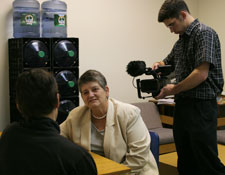
Photo by Wayne Gehman for Mennonite Media, from the production of Shadow Voices: Finding Hope in Mental Illness. Pictured are Lyn Legere and Denver Steiner, listening to a young man in a peer-to-peer listening session. Lyn’s story is told in Shadow Voices and her struggles with cigarette addiction finally made it into a radio spot you can find here.
Most of these Lenten meditations, appearing Monday through Friday are adapted and excerpted from my book, Why Didn’t I Just Raise Radishes: Finding God in the Everyday, Herald Press, 1994.
Verse for reflection: For by the grace given me I say to every one of you: Do not think of yourself more highly than you ought, but rather think of yourself with sober judgment, in accordance with the measure of faith God has given you. Romans 12:3
Caffeine used to be one of my major vices. I would get up, grope for my slippers, and soon pump fresh caffeine into my veins. Was I any different from the heroin addict, except that what I did was legal?
When one of our children was about fifteen months old and struggling to give up her bottle, I chuckled as I watched a grown man nurse a beer bottle with two hands one day at an archery competition. He looked so much like my toddler, attached to his security. Then in a flash I saw myself walking around the office or at home, coffee cup clutched between two hands.

I’ve now given up the caffeine part (makes mammograms hurt less and I don’t get caffeine withdrawal headaches anymore) but still, getting that first cup of decaf coffee in the morning is a great motivator for getting out of bed.
I recently heard Dr. Brian Kelley, a psychology professor who has done much research on substance abuse say that cigarette addiction is so powerful because so much of the habit is associated with certain activities. You get up in the morning, you have to have your smoke. You drive to work, you go on break, you have lunch—all tied to the Vise (yes I mean that spelling) grip of the cigarette.
Whatever you’ve given up for Lent, Day 9 can be a tough time. The newness has worn off; your commitment is wearing thin. There are still 31 days to go. You are just so hungry for ____ (fill in the blank). You’ll just sneak on Facebook to catch this or that meditation. You’ll just watch that mindless 30 minute TV show. You deserve it. You aren’t on a quest to survive 40 days in the wilderness, after all; who but you will care if you cheat on your crazy “sacrifice” this year.
Jesus had those temptations and more. Who but Jesus and God would know the outcome of the mind games Jesus played with the tempter.
We have much worse temptations and vices. Pride. Vanity. Thinking disparaging thoughts about our loved ones and friends—let alone our enemies. Hanging strong through Lent can give us the mental stamina to put aside the vices that really matter.
What can I learn from my own weaknesses which will help me be more understanding of others? How can I live a lifestyle that is healthy and pleasing to God?
Action: Every time you are “tempted” today to indulge in what you’ve give up, or to not practice the discipline you began at the start of Lent, say what Jesus ended up telling his tempter: “Away from me. I will worship the Lord my God.”
Verse for reflection: For I will pour water on the thirsty land, and streams on the dry ground; I will pour out my Spirit on your offspring, and my blessing on your descendants. Isaiah 44:4
The first home my husband and I owned had a cistern as its only water supply—very common in these parts of Virginia. But after living with it for six-seven years and enduring more waterless weekends than I’d like to remember (when we’d forgotten to order water from the water hauler and were too thrifty to pay the extra fee for weekend delivery), and with two children and hoping for a third, we were finally ready to dig our own well.
My husband was hoping to hit water by 250 feet but pessimistically predicted 500 feet at the most.
By the time we hit 600 feet, co-workers’ jokes about oil and China were getting stale. We begged the driller to try another hole, but he wanted to keep on where he was. As the droning rig tore ever further into our front yard, the incessant noise became a corkscrew impaling not only our budget but our nerves.

I read about Jacob’s well-digging ventures in the Old Testament and suddenly felt a new respect for his patience with the well robbers (Gen 26:17-22).
But I didn’t feel right praying that we’d find water. That seemed like praying for a boy or a girl after the baby’s already been conceived. Enough faith may move mountains, but I didn’t want to worry the Almighty about personal stream moving. Yet I did pray for patience to survive frayed nerves, and peace not to worry about our stretched budget.
We drilled all the way to 925 feet. And finally we had water, almost twice as far as our most pessimistic prediction. To my family members who live in Indiana where 30- to 90 foot wells are the norm, 925 feet deep went beyond ridiculous to ludicrous. How would we ever pay for it?
My husband talked to the contractor who agreed to charge us for only 580 feet—the depth where we had urged him to try another hole. God hadn’t moved a stream but maybe had softened a contractor’s heart in compassion for a young, struggling family.
We celebrated like we were in some far-off country drinking from a newly dug village well. All over the world, so many walk many miles every day to obtain water. I vowed I would never take water for granted again.
But of course I do. But for this day of Lent, every time you turn on a tap or take a drink of water today, think of persons walking miles for their water. Think of the woman at the well in Samaria who met Jesus and found not only water, but a new source of life.

Action: Thank God for your access to water—and to eternal life flowing from God, the giver of water—and life.
***
See more on one Water project in Benin, and a book with gorgeous photography related to that project check here.
Verse for Reflection: Everyone who drink this water will be thirsty again, but whoever drinks the water I give … will never thirst. Indeed, the water I give … will become a spring of water welling up to eternal life. John 4:13-14
One person who decided to try the “ten minutes of doing nothing” discipline for Lent (which I mentioned on Ash Wednesday) said, “You know what ten minutes of doing nothing reminds me of? The time outs we used to do when we were kids.”

Oh yes. Time out as a “discipline”—a form of punishment. I had not thought of that when I suggested it, taken from my pastor’s meditation that day.
And that is what is wrong with our approach to many of the classic disciplines. Fasting. Praying. Giving up smoking. Somehow Lent sometimes feel like punishment—because we’ve been bad. We’re bad because we don’t live a sacrificial life all year long.
Somehow I don’t think spiritual disciplines are supposed to be like that.
When Jesus went to the wilderness for 40 days, he did not go as punishment. He went seeking … something more from God. Seeking to gather strength for the journey ahead—the launch of his ministry. The mission of three years of giving himself, and then, ultimately, giving up his very life, in the end. I don’t think he really knew what lay ahead. So his 40 days in the wilderness was a journey to get closer to God, discover the path God had for him.
And that is how the ten minutes of “doing nothing” or time out, or meditation, (or giving up coffee or French fries should be approached).
As a purposeful ten minutes of being quiet and still (or, if you giving up something, the urges and temptation for whatever you’ve given up can be a reminder of the need to stay in connection to God).
My pastor also talked about renewing strength like an eagle. Maybe we can approach the ten minutes of doing nothing like a recharging of the battery. Like with your cell phone.

Does that help? Power up! A spring of water welling up to eternal life.
Action: In your meditation time today, think of it as the most exciting gift you can give yourself all day. It is a banquet. A hike to the top of a mountain. A chance to listen to the waves roll in at the shore. It is a wondrous place you can come to at any time.
Verse for reflection: But Mary treasured up all these things and pondered them in her heart. Luke 2:19
Usually we read this verse in conjunction with the Christmas story. I’ve always been so glad for this postscript and window into Mary’s heart. But it is a great verse for Lent, and living more mindfully or purposefully.
When our youngest was just a toddler, my parents came to visit and together we went to Chincoteague barrier island off the coast of Virginia for a few days. We made the trip in a trusty circa 1979 Plymouth station wagon, packing my father’s wheel chair, a walker, a car seat and assorted paraphernalia for a beach vacation for four adults and three children. Some of our gear was stored in one of those Turtle-type toppers on the wagon.

Our daughters dutifully washing the wagon before the trip with Grandpa and Grandma.
On the way home, we needed to drop my parents off at the airport on a Sunday morning. We had a short devotional/worship time in the car as we drove. My parents weren’t pious Joes, but anytime we traveled on Sunday as a family when I was growing up, we usually tracked down a church to visit. Or if not that, at least we had “devotions” at the motel or campsite. So they tried to teach and live that one’s faith never took a vacation.
After our little worship service, we spied a roadside fruit stand in eastern Maryland—really just a flatbed hay wagon piled up with watermelons. A crude sign announced “3 melons for $1.” They were huge melons and the bargain was too good to pass up, so we stopped. We stewed awhile over which ones to pick, and also how to fit them in our overloaded station wagon, and ended up taking one or two out and replacing them with smaller melons that fit our space. We paid our dollar and continued on, now a little worried about making it to the airport on time.
Soon a police car pulled us over! My husband went into panic mode and was sure he had failed to stop for a light or had maybe been speeding. But no, the cop, sheepishly, said he had been informed that someone thought we had stolen some watermelons. He said he’d gotten a call from the roadside stand saying we had put more than three melons in our car.
At that point my husband fell over himself in relief explaining how we had put some in, and then out, and officer, you can search this car all over but we only have three watermelons in it. He showed him one at the feet of one child, and then offered to open the Turtle topper to show him the other two. As the officer peered at our walker, grandparents and children (with my mother muttering in the background about how we weren’t crooks, we’d just had a worship service, for crying out loud) suddenly the officer waved his hand and said something like “That’s alright. I think you’re telling the truth” and waved us on, also probably deciding he had better things to do than chase down anyone accused of stealing something worth 33 cents.
This is now one of our favorite vacation stories and if you trade cop or vacation stories with my family for very long, you will probably hear it, with more or less embellishment, depending on who’s telling it. My mother treasures the worship service we had on the road. My kids remember being squished in the station wagon, but basking in the attention of doting grandparents. My husband recalls the gratitude that washed over him when he discovered he was “only” being stopped as a suspect in a highway robbery. I ponder all these things, remembering my parents’ strong value of always taking time to remember the Lord’s day, no matter where you are.
Which gets us back to Lent and the reminder from Mary as she contemplated all the events of Jesus’ birth. If we are to “keep a holy Lent” as the pastor reminds us, surely the mundane details or even wild surprises, are worthy of mulling, worthy of finding the God moments in every day. It’s a reminder to us to do likewise with the everyday experiences of our lives.
Action: Take time at the end of the day to ponder where you saw God. Were there any surprises? Or perhaps your day did not go so well. Focus on the love and devotion your heavenly parent extends to you. Share a comment if you wish.
***
This Lenten series runs Monday through Friday. I invite you to join me on this journey through Lent (if you sign up to follow this blog it will be easier). As a thank you, I can send you a FREE booklet I wrote several years ago, 14 Days to a Better You, which is a look at the classic 7 Vices and 7 Virtues. It’s more fun than it sounds. No obligation—just my way of connecting with blog followers a little better. Leave a comment and I’ll be able to see your email and follow up.
Verse for reflection: “I tell you the truth, this poor widow has put more into the treasury than all the others. They all gave out of their wealth; but she, out of her poverty, put in everything—all she had to live on.” Mark 12:43-44.
Twenty-seven years ago this week, our youngest daughter was born. Four days before that, we were in the emergency room because our two-year-old had a seizure. And ten days later, the new baby was back in the hospital with jaundice. (You can see them both below, including signs of jaundice.)

Of course our problems were minor compared to many people. Yet all of this on top of new-mother-exhaustion plus caring for my two preschoolers, left me with few coping resources, frequently near the edge of tears. The hospital bills also meant extra expenses.
A dear older woman from church volunteered to babysit so I could take the middle child back to the doctor for tests related to her seizure (turned out to be fever-related). But when I picked the other two children up, Connie stuffed an envelope into our diaper bag saying, “Someone left this for you.”
When I was in the car with all three kids strapped in, I couldn’t wait to see what was in the envelope. It was a crisp $100 bill. You can imagine the tears, flowing so freely I could barely drive. Who and why?
Most of us have been recipients of someone’s generosity at one time or another. The widow mentioned in the Mark passage speaks to us this Lent: if the widow put in everything she had to live on, what is God saying to me? How could I stretch to sacrifice for someone else? I may never be able to repay the gift of whoever slipped us that $100 bill, but I can repay it to others. I haven’t come close to putting in everything like the widow, but remembering how we’ve been blessed helps me be more generous with others.
This brings to mind that God sacrificed the divine son for the forgiveness of our sins. Since we are created in God’s image and likeness, we should get that was a heart- wrenchingly difficult gift to us. Thanks be to God.
Action: Recall, with gratitude, God’s generous gift, and when someone blessed you with generosity.
Verse for reflection: “Martha, Martha, the Lord answered, “you are worried and upset about many things, but only one thing is needed. Mary has chosen what is better, and it will not be taken away from her.” Luke 10:42:42
I love these women. They have issues—family issues. Jesus loved these women. (No, not like that.) I love that the gospel writers include several stories about these real women.
Our family had issues. When our oldest daughter started going to school, we struggled constantly with morning routine. She got ready in slow motion; I operated on fast-forward. Finally in exasperation I observed, “What’s wrong here is that all the hurry is in me. Don’t you realize what will happen if you’re late for the bus?”
So it was interesting to find that daughter number two, after only a few weeks of kindergarten, started watching the clock in the morning with all the worry of a fast-track executive. “Come on,” she’d tell her sister ten minutes before the bus was due. “The big hand is straight up and the bus is coming!” With that she’d hurry out the door.

Today, remarkably, her gifts in this area are put to good use in her real job.
We can’t escape a certain amount of fast-lane living. But we can make choices to tame the hurry in us. This daughter unwinds walking her dog after work. She jogs. She takes time for really long walks on Sunday afternoons. She digs in a small raised bed garden.
During Lent, we might want to get up ten minutes early to find time for solitude, talking with God to help control the hurry of the day. Time spent with God won’t be taken away from us. Ever. As my pastor reminded us yesterday at our Ash Wednesday service, “Give up busyness for Lent.”
Challenge: My pastor’s challenge was this: take ten minutes and do nothing. Can you do it?

***
I invite you to join me on this journey through Lent (if you sign up to follow this blog it will be easier).
As a thank you, I can send you a FREE booklet I wrote several years ago, 14 Days to a Better You, which is a look at the classic 7 Vices and 7 Virtues. No obligation—just my way of connecting with blog followers a little better. Leave a comment and I’ll be able to see your email and follow up.
Day 1: Ash Wednesday
Verse for reflection: The Lord delights in you and will claim you as his own.
Isaiah 62:4
My oldest daughter and I both remember the time she accompanied me to a fancy hotel at the age of eight for a grown-up Virginia Press Women banquet. I had thrown in a pair of dress shoes that I thought she could still wear.
As we hurried to get dressed at the hotel, she exclaimed, “Mama, those shoes don’t fit me any more,” like she was the one talking to a child. After mild panic and trying, Cinderella-step-sister-like, to squeeze her feet into her dress shoes, I eased up and said, “Oh just go ahead and wear your tennis shoes.”
I had to swallow a bit of my pride as I hastily explained to one woman who glanced at my daughter’s shoes, “Kids have a way of growing so fast. I thought she could still wear her dress shoes!”
But the rest of the evening was wonderful—and I savored watching my daughter add her own special glow and bright conversation to the candlelit table, sneakers safely out of sight under the table.

More than any parent, God delights in us, as today’s verse says. That may seem like a weird way to begin the solemnity of Lent, with the accompanying self-denial and sacrifice we sometimes associate with the season. But if you participate(d) in Ash Wednesday services today with imposition of ashes—with the somber reminder that we are mortal and to dust we shall return—let it also be a sign of the love and joy God marks us with: God knew us in the womb and claims us forever and ever. Amen.
Action: As you go through the day, (or think back on it) imagine God delighting in you. How? Why? What specifically does God savor about you? Enjoy.
***
I invite you to join me on this journey through Lent (if you sign up to follow this blog it will be easier).
As a thank you, I can send you a FREE booklet I wrote several years ago, 14 Days to a Better You, which is a look at the classic 7 Vices and 7 Virtues. It’s more fun than it sounds and small enough to slip into an envelope. No obligation—just my way of connecting with blog followers a little better. Leave a comment and I’ll be able to see your email and follow up.
Adapted from Why Didn’t I Just Raise Radishes: Finding God in the Everyday, by Melodie Davis, Herald Press, 1994, p. 15-17.


